 Ali Cheshmehzangi
 Zhaohui Su
 Tong Zou
- 1Network for Education and Research on Peace and Sustainability (NERPS), Hiroshima University, Hiroshima, Japan
- 2Department of Architecture and Built Environment, University of Nottingham, Ningbo, China
- 3Center on Smart and Connected Health Technologies, Mays Cancer Center, School of Nursing, University of Texas Health San Antonio, San Antonio, TX, United States
- 4School of Public Health, Southeast University, Nanjing, China
A prominent move amid the COVID-19 pandemic is related to the wide use of ICT applications for various reasons. Such services are context-specific and sector-specific, but we see transformative directions leading to digital data collection, monitory, and management platforms. For now, these have been beneficial to evaluate trends and issues related to the pandemic. Some aggregated data could also help decision-making processes, which are helpful to contain such disruptive events. However, the main concern is the use of the individual's data and information, which means we may shift to micro-management and eventual controlling tools that could harm data protection processes. Undoubtedly, the use of ICTs during the COVID-19 pandemic has been primarily positive at multiple scales, but we have to evaluate the pros and cons before accepting all data collection processes. Such ICT-mediated platforms and/or applications must remain beneficial to all and avoid breaching the individual's data protection. This short communication paper first introduces ICT applications during the COVID-19 before providing an overview and further analysis of the situation of the ICT applications. Afterward, it discusses issues of data privacy, data collection, and data use, which are the backbone of ICT applications. The discussions highlight that future research in this area could look into associated issues related to digital privacy, data-driven approaches, and data protection regulations.
Introduction
The ongoing COVID-19 pandemic has boosted the use of ICT applications in favor of the free flow of information and data usage. The former is debatable, while the latter has become a common approach in many places. Despite their threats to people's privacy, ICT-mediated platforms have become the backbone of trace and tracking mechanisms for infected cases and those who have been in contact with them. This approach has encouraged extended data collection at multiple scales and purposes. Some of these data are publicly available, and some are used by the governments, specific authorities or sectors, commercial groups, etc. In many ways, such ICT applications breach our privacy, and we have come to accept them at a much faster pace (Cheshmehzangi, 2021a). Although “free flow of information” is one of the positive peace pillars, it could also threaten the use and misuse of individual data. Nonetheless, free flow of information from the positive pillar perspective mainly refers to the freedom of information and allowing people to have access to information. But, this could also be interpreted differently regarding the free flow of people's data and information, leading to associated factors mainly correlated with data collection, data management, and data usage. If so, individuals' data need to be protected. There is an urgent need to avoid mishandling individuals' data in the name of the pandemic's control and safety measures. Hence, we see some countries have recently tightened their data sharing platforms, ensuring that large-scale data is protected against any future misuse. The misunderstandings in the literature should be highlighted to avoid mixing the free flow of information with the individuals' data and access to such data.
Undoubtedly, the use of ICTs during the COVID-19 pandemic has been primarily positive at multiple scales, particularly at the smaller scale (Milenković et al., 2021). For instance, the COVID-ICT relationships are appraised due to their effective and optimized methods for daily operations (Yang et al., 2020). ICT-based events have helped promote innovative operations (Arshad, 2020) and speed the process of data collection and monitoring. Yet, most current debates are narrowed down to only a few sectors, mainly related to online education, healthcare services, etc. Also, it is evident that ICT-mediated platforms have been largely beneficial to promote the free flow of information (Saariluoma, 2006). With multiple ways of adoption, application, and utilization of the ICT platforms, we see growing interest in the use of such approaches in information collection, analysis, and management (Inyang, 2016). This fact, however, has its flaws that need to be addressed holistically. We hope this is done so that the free flow of information is not mistaken with individuals' data gathering and use.
In this overview paper, we aim to explore the role of ICTs and their applications during the COVID-19 pandemic. In particular, we look into the individuals' data and information, highlighting the pros and cons of big data use, information fluidity, and beyond just motivating factors and implications already addressed in the literature (Lee et al., 2021). While three key areas of innovation, entrepreneurship, and sustainability are highlighted as potential future directions (Ngugi and Goosen, 2021), we note that individuals' data collection issues could lead to consequences that may not be necessarily fully beneficial to all. However, this trend of information use has existed for a long but has been boosted due to mobility control and measures implemented at multiple scales during this ongoing pandemic. By focusing on mobility data alone, the article reflects on the ongoing trends that remain as the new normals (Cheshmehzangi, 2020), which should be looked at with more careful attention.
An overview of ICT applications during the COVID-19 pandemic
So far, most research related to ICT applications during the COVID-19 pandemic is focused on its benefits for community education (Usmani et al., 2021), online education (Naresh, 2020; Rahiem, 2020), remote working (Davies, 2021; Rachmawati et al., 2021a), and digital healthcare (Lee and Lee, 2021; Siriwardhana et al., 2021) or telemedicine (Chowdhury et al., 2021). Only a few studies highlighted associated research that considers the impact of ICT use for healthcare data collection and blockchain methods (Biswas et al., 2021) or using technologies to help healthcare services (Kilintzis et al., 2022). In light of such studies, we note faster ICT acceptance for particular sectors and contexts (Li, 2022), which is not universal. But, issues such as the digital divide (Cheshmehzangi et al., 2022), technology availability and accessibility (Cheshmehzangi, 2021b), data protection regulations (Becker et al., 2020), and privacy (Ventrella, 2020) have highlighted the negative impacts of ICT applications and big data use amid the COVID-19 crises (Figure 1). Hence, responsible use of digital data appears to play a significant part in how individuals' information is protected and appropriately manifested (Taylor, 2020).
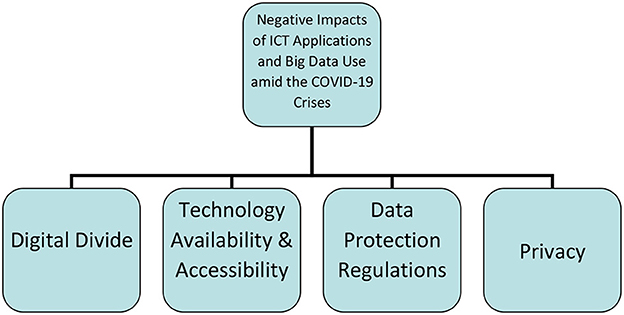
Figure 1. Four primary negative impacts of ICT applications and big data use amid the COVID-19 crises, based on the recent literature and ongoing research related to ICT-COVID nexus studies.
In a way, the ongoing pandemic has become a significant data collection hub, which entails using digital technologies, data collection and processing, data management, and control (Malgieri, 2020). The latter is of concern as we see a growing demand for mobility monitory and control, leading to large-scale data collection and use. Many researchers and policymakers are now using mobility big data to conduct data-driven research and evaluations, helping current and future decision-making (Hu et al., 2021). Such approaches often use aggregated data, which minimizes individual privacy through large-scale or big data use. This is just reasonable in regards to broader evaluations. However, as such data collection is used for mobility checks and monitory, then individuals are often uncomfortable and feel under constant surveillance. To date, little has been discussed about this topic due to its contextual sensitivity. But, as this trend becomes more widespread, data protection and privacy challenges become more vivid (Zwitter and Gstrein, 2020). While we favor such data use for containment and better management processes, we believe much of such data usage through ICT platforms has led to micro-management and control scenarios. The barriers between management and control have become so fuzzy that one cannot distinguish between the two. Thus, while data availability and accessibility have benefited research and scholarly work, they have opened a Pandora's Box, meaning that future use of individuals' data and information could be more open and easier for various uses. If accepted, this approach would require a holistic data protection regulation to ensure ICT tools and practices are used for the sole purpose of “management” and not control.
Furthermore, the situation of the ICT applications during the COVID-19 pandemic is different from other previous pandemics. The growing ICT tools, devices, and applications are much more than what we have experienced in other earlier epidemic events of the last two decades, such as Ebola, MERS, H1N1, and SARS. Some studies already explore the role of ICT solutions for compelling management scenarios (Strielkowski et al., 2021), some of which are used for the implementation of smart cities (Rachmawati et al., 2021b), containment of the pandemic spread (Zaman et al., 2020), sector-based interventions (Azhari and Fajri, 2022), HR management (Rahman et al., 2020), etc. Evidence shows the role of digital transformation and ICT being central to transitions for e-governance (Alalwan et al., 2021; Ghosh, 2021) and other sorts of e-transitions (Cheshmehzangi, 2022). Much of what has occurred and is currently occurring is related to digitization and digitalization processes (Cheshmehzangi, 2021a), which are largely embedded in the emergence of new technology use, new applications, and ICT-based interventions. Examples such as the use of QR codes, online payment, online health checks, telemedicine or telehealth, online learning, etc., are only a few of what have been boosted by the COVID-19 pandemic. A study by Arshad (Arshad, 2020) appraises the ICT professionals as it is believed the situation of the pandemic management is very much dependent on ICT use as common practice for our daily lives and activities. The telehealth demand trend is one example that shows ICT has been used for information sharing and information exchange (Wong et al., 2021). While there are significant challenges and shortfalls for such practices, both opportunities and limitations remain for ICT innovation and applications (Yang et al., 2020) (Figure 2). Some researchers already suggest changes that may put particular sectors on a different pathway, such as the education sector (Al Ansi and Al-Ansi, 2020) or the academic environment (Raja, 2022), healthcare (Lee, 2021), food industry (Mustafa and Abbas, 2021), etc.
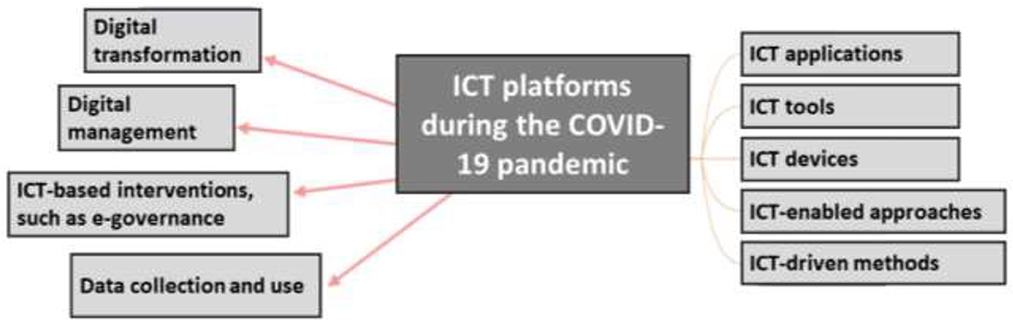
Figure 2. Summarizing ICT platforms as mediators between ICT applications, tools, devices, approaches, and methods for digital transformation, digital management, ICT-based interventions such as e-governance, and data collection and use.
In recent months, some of the ongoing studies have optimistically started focusing on the post-COVID-19 era, inclining toward the role of digital applications in enhancing the resilience and smartness of our systems (Siriwardhana et al., 2021; Tortorella et al., 2022; Ziemba and Eisenbardt, 2022). The so-called “digital push” (Gallistl and Seifert, 2021) results from the faster transformation that replaced some of, the earlier digital transitions (Cheshmehzangi, 2021a), which means the situation of the ICT applications has become much stronger than the time before the COVID-19 pandemic. Directions like contactless services and systems, integrated artificial intelligence, and facial recognition (Kim and Kim, 2021; Su et al., 2022) are a few examples that are now becoming common norms, which are boosted due to the COVID-19 pandemic. On the other hand, data usage remains a major concern for people and companies, which is partly neglected in some specific contexts. Under the broader understanding of the ICT applications situation during the pandemic, we see new opportunities to change perceptions, usage, access, and utilization. Hence, the availability of ICT applications, devices, and tools has become a norm that penetrates various daily operations. In this regard, data collection and usage have become the backbone of data-based analytical approaches, enabling new opportunities for ICT-mediated or ICT-enabled approaches (Cheshmehzangi, 2022) that were not commonly practiced before. In particular, applications of artificial intelligence (AI) (Enughwure, 2020), machine learning (Kushwaha et al., 2020), and the Internet of Things (IoT) (Singh et al., 2020; Yousif and Hewage, 2021) are boosted because of the COVID-19 pandemic, and such applications are data-based or data-driven. While we appraise such applications, technologies, and approaches, we have to be cautious about data collection and use boundaries to ensure the current situation does not lead to the eventual misuse of the individuals' data and information.
Discussion and conclusions
To date, we can confirm ICT platforms and applications have been beneficial during the COVID-19 pandemic. The trend has become transformative, boosting digitization and digitalization across many sectors (Cheshmehzangi, 2021a). But, we have to consider the eventual impacts of long-term data collection on the individuals' data protection. Such an approach could be sold in the name of enhanced safety and security, putting pressure on people due to regular data collection and use. There are already growing barriers related to utilization, availability, and accessibility factors (Cheshmehzangi et al., 2022), which may become even more concerning if the current practices remain as the new normal practices. This is likely to happen as countries adopt mobility data for safety and protection purposes, meaning that future mobility will be monitored even more. From the extended use of mobile phone data to other means of public data collection, we are already in the process of using ICTs and digital media for data collection, monitory, and management. As such mechanisms turn into enhanced data hubs, we are concerned that individual data and information may mean entirely different things in a few years. Thus, future research in this area could look into associated issues related to digital privacy, data-driven approaches, and data protection regulations. Moreover, we cannot just have a universal approach in all sectors, and we need to ensure context-specific and sector-specific factors are considered carefully. Lastly, we hope ICT applications could enhance the resilience of communities rather than control them in the name of safety and security. We hope smart-resilient strategies could be genuine and fully use ICT applications amid and beyond the COVID-19 pandemic.
Despite its limitations, this study provides a comprehensive overview of ICT applications during the COVID-19 pandemic. This study summarizes five key arguments that could be used for future studies in the same or similar research areas. First, ICT applications could differ based on sector-based demand and practice as well as context-specific factors. For instance, in contexts where the ICT infrastructure is already established or progressive, we have witnessed a wider use of ICT applications in various sectors. In countries like China, ICT applications have boomed for management and control practices. Second, digitization has become trendy in areas where digital practices were previously developing slowly. For instance, the booming telehealth practices are now more common, allowing space and time for adaptable uses, medical checks, patient appointments, prescriptions, etc. Third, data protection has become weaker than before, meaning there are more opportunities for potential cyber-attacks, private-data misuse, hacking, etc. In this regard, private data is not only aggregated in various statistical reports but is passed around between different organizations and departments. For instance, mobility data has been used to provide statistical reports for management purposes. Meanwhile, it is also used to control and monitor an individual's mobility and activities, breaching privacy with little data protection. Fourth, the future of ICT applications will be data-based or data-driven, and this transformation seems inevitable. The use of big data has already been popular for years, and this pandemic has just created the opportunity that big data could be even more helpful for standardization processes, management enhancement, implementation of control measures, and the further development of e-platforms such as e-governance. Nonetheless, the so-far impacts on the individual's data protection show there is a lack of attention—and perhaps intentional—on data privacy measures, paving the path for future policies and practices to consider inventing and/or adapting new data protection laws and regulations. And fifth, we will witness the birth of many new firms that focus entirely on big data analysis and act as third-party companies or enterprises for different sectors. As big data analysis remains progressive, there will be new branches emerging beyond the mere smart practices and toward the development of future planning, management scenarios, and fulfilling the needs of companies, reflecting on the sustainability of their resources, infrastructures, finance and economy, staffing, etc. The provided five key arguments help future studies be more aware of ongoing accepted ICT applications and practices. The findings suggest future studies to be context-specific, considering the available ICT infrastructures, governance structure, cultural factors, and sector-based aspects. Researchers should suggest ways against the growing micro-management practices that rupture our data privacy and protection. Lastly, the free flow of information should not be misused as there is an urgent need to safeguard private data. With the current digital push, digital privacy must be taken into full consideration; otherwise, policies and practices may be revised and reinvented against the current data protection movements.
Data availability statement
The original contributions presented in the study are included in the article/supplementary material, further inquiries can be directed to the corresponding author.
Author contributions
All authors listed have made a substantial, direct, and intellectual contribution to the work and approved it for publication.
Acknowledgments
AC acknowledges the National Natural Science Foundation of China (NSFC) for the provision of funding for project number 71950410760. He also acknowledges the Ministry of Education, Culture, Sports, Science and Technology (MEXT), Japan Government, and the Network for Education and Research on Peace and Sustainability (NERPS), Hiroshima, Japan.
Conflict of interest
The authors declare that the research was conducted in the absence of any commercial or financial relationships that could be construed as a potential conflict of interest.
Publisher's note
All claims expressed in this article are solely those of the authors and do not necessarily represent those of their affiliated organizations, or those of the publisher, the editors and the reviewers. Any product that may be evaluated in this article, or claim that may be made by its manufacturer, is not guaranteed or endorsed by the publisher.
References
Al Ansi, A. M., and Al-Ansi, A. (2020). Future of education post Covid-19 pandemic: reviewing changes in learning environments and latest trends. Solid State Technol. 63, 201584–201600. Available online at: https://www.researchgate.net/profile/Abdullah-Al-Ansi/publication/349692733_Future_of_Education_Post_Covid-19_Pandemic_Reviewing_Changes_in_Learning_Environments_and_Latest_Trends/links/603cd73192851c077f0bbf5c/Future-of-Education-Post-Covid-19-Pandemic-Reviewing-Changes-in-Learning-Environments-and-Latest-Trends.pdf
Alalwan, A. A., Baabdullah, A. M., Dwivedi, Y. K., Rana, N. P., and Lal, B. (2021). Et-moone and marketing relationship governance: the effect of digital transformation and ICT during the COVID-19 pandemic. Indus. Market. Manag. 98, 241–254. doi: 10.1016/j.indmarman.2021.09.001
Arshad, M. (2020). COVID-19: It's time to be thankful to our ICT professionals. Inform. Technol. Electrical Eng. 9, 23–31. Available online at: http://www.iteejournal.org/v9no2apr20_pdf4.pdf
Azhari, B., and Fajri, I. (2022). Distance learning during the COVID-19 pandemic: school closure in Indonesia. Int. J. Math. Educ. Sci. Technol. 53, 1934–1954. doi: 10.1080/0020739X.2021.1875072
Becker, R., Thorogood, A., Ordish, J., and Beauvais, M. J. (2020). COVID-19 research: navigating the European general data protection regulation. J. Med. Internet Res. 22, e19799. doi: 10.2196/19799
Biswas, S., Sharif, K., Li, F., Bairagi, A. K., Latif, Z., Mohanty, S. P., et al. (2021). GlobeChain: an interoperable blockchain for global sharing of healthcare data—a cOVID-19 perspective. IEEE Consum. Electron. Magaz. 10, 64–69. doi: 10.1109/MCE.2021.3074688
Cheshmehzangi, A. (2020). The City in Need: Urban Resilience and City Management in Disruptive Disease Outbreak Events. Singapore: Springer. doi: 10.1007/978-981-15-5487-2
Cheshmehzangi, A. (2021a). From transitions to transformation: a brief review of the potential impacts of COVID-19 on Boosting digitization, digitalization, and systems thinking in the built environment. J. Build. Constructi. Plann. Res. 9, 26–39. doi: 10.4236/jbcpr.2021.91003
Cheshmehzangi, A. (2021b). “Technology availability and accessibility: dealing with the issues of digital divide,” in Urban Health, Sustainability, and Peace in the Day the World Stopped (Singapore: Springer), 153–160. doi: 10.1007/978-981-16-4888-5_18
Cheshmehzangi, A. (2022). ICT, Cities, and Reaching Positive Peace. Springer: Singapore. doi: 10.1007/978-981-19-3167-3
Cheshmehzangi, A., Zou, T., and Su, Z. (2022). The digital divide impacts on mental health during the COVID-19 pandemic. Brain Behav. Immun. 101, 211–213. doi: 10.1016/j.bbi.2022.01.009
Chowdhury, S. R., Sunna, T. C., and Ahmed, S. (2021). Telemedicine is an important aspect of healthcare services amid COVID-19 outbreak: its barriers in Bangladesh and strategies to overcome. Int. J. Health Plann. Manag. 36, 4–12. doi: 10.1002/hpm.3064
Davies, A. (2021). COVID-19 and ICT-supported remote working: opportunities for rural economies. World 2, 139–152. doi: 10.3390/world2010010
Enughwure, A. A. (2020). Applications of artificial intelligence in combating Covid-19: a systematic review. Open Access Library J. 7, 1–12. doi: 10.4236/oalib.1106628
Gallistl, V., and Seifert, A. (2021). COVID-19 as a “Digital push?” Research experiences from long-term care and recommendations for the post-pandemic era. Front. Public Health 9, 660064. doi: 10.3389/fpubh.2021.660064
Ghosh, I. (2021). Introspecting predictability of market fear in Indian context during COVID-19 pandemic: an integrated approach of applied predictive modelling and explainable AI. Int. J. Inform. Manag. Data Insights 1, 100039. doi: 10.1016/j.jjimei.2021.100039
Hu, T., Wang, S., She, B., Zhang, M., Huang, X., Cui, Y., et al. (2021). Human mobility data in the COVID-19 pandemic: characteristics, applications, and challenges. Int. J. Digit. Earth 14, 1126–1147. doi: 10.1080/17538947.2021.1952324
Inyang, O. (2016). ICT revolution in librarianship in Africa: the state of the art university of calabar library. J. Appl. Inform. Sci. Technol. 9. Available online at: https://ssrn.com/abstract=3644012
Kilintzis, V., Beredimas, N., Kaimakamis, E., Stefanopoulos, L., Chatzis, E., Jahaj, E., et al. (2022). CoCross: an ICT platform enabling monitoring recording and fusion of clinical information chest sounds and imaging of COVID-19 ICU patients. Healthcare 10, 276. doi: 10.3390/healthcare10020276
Kim, J. J., and Kim, I. (2021). A change of perceived innovativeness for contactless food delivery services using drones after the outbreak of COVID-19. Int. J. Hosp. Manag. 93, 102758. doi: 10.1016/j.ijhm.2020.102758
Kushwaha, S., Bahl, S., Bagha, A. K., Parmar, K. S., Javaid, M., Haleem, A., et al. (2020). Significant applications of machine learning for COVID-19 pandemic. J. Indus. Integr. Manag. 5, 453–479. doi: 10.1142/S2424862220500268
Lee, S. M. (2021). Opportunities and challenges for contactless healthcare services in the post-COVID-19 Era. Technol. Forecast. Soc. Change 167, 120712. doi: 10.1016/j.techfore.2021.120712
Lee, S. M., and Lee, D. (2021). Opportunities and challenges for contactless healthcare services in the post-COVID-19 era. Technol. Forecast. Soc. Change. 167, 120712.
Lee, Y. C., Malcein, L. A., and Kim, S. C. (2021). Information and communications technology (ICT) usage during COVID-19: motivating factors and implications. Int. J. Environ. Res. Public Health 18, 3571. doi: 10.3390/ijerph18073571
Li, B. (2022). Ready for for online? Exploring EFL teachers' ICT acceptance and ICT literacy during COVID-19 in mainland China. J. Educ. Comput. Res. 60, 196–219. doi: 10.1177/07356331211028934
Malgieri, G. (2020). Data protection and research: a vital challenge in the era of COVID-19 pandemic. Comput. Law Security Rev. 37, 105431. doi: 10.1016/j.clsr.2020.105431
Milenković, M., Kekić, D., Glavaš, D., Markovic, D., and Plemić, V. (2021). “The use of ICT during the Covid-19 pandemic in the city of Belgrade, political science,” in Sinteza 2021 - International Scientific Conference on Information Technology and Data Related Research (Belgrade: Singidunum University, Serbia), 187–192. doi: 10.15308/Sinteza-2021-187-192
Mustafa, M., and Abbas, A. (2021). Comparative analysis of green ict practices among palestinian and malaysian in sme food enterprises during COVID-19 pandemic. PalArch's J. Archaeol. Egypt Egyptol. 17, 14589–14599. Available online at: https://archives.palarch.nl/index.php/jae/article/view/5692
Naresh, R. (2020). Education after COVID-19 crisis based on ICT tools. Purakala 31, 464–468. Available online at: https://d1wqtxts1xzle7.cloudfront.net/65649375/Education_after_COVID_19_Crisis_Based_on_ICT_Tools-libre.pdf?1612918558=&response-content-disposition=inline%3B+filename%3DEducation_after_COVID_19_Crisis_Based_on.pdf&Expires=1676267695&Signature=L3tbnOmAazdgEi8M4OHW~5W4HSTAFbsVdClOWGsoO-X6U7wrC6S7fxxwQKLWmP4FnJzuJ-wDdfd1joW189pGgM7gInhUaOS1HAX6DL3f47dGYuFEzT73gl4kcdz-xYUKAh7iAMZeA-04zogmLi27rNmNTgBWGWQqNq2WTT1VH3k6wjYG-avZDKKl2r2QnvNVBBK4fo27zfwWuoKyV2hFAWeoUKcokhe7lXNADAJi-HLKMGKbBmAWlMQen89bFs3F6Emh-ncMAS12TKi4EQzYFXdtL93v9jlKDae1Rjz5-7akNZ7Xb85ELm-slpm~GBhwOPJPlTBlk1oAboyLxye2Vg__&Key-Pair-Id=APKAJLOHF5GGSLRBV4ZA
Ngugi, J. K., and Goosen, L. (2021). “Innovation, entrepreneurship, and sustainability for ICT students towards the post-COVID-19 era,” in Handbook of Research on Entrepreneurship, Innovation, Sustainability, and ICTs in the Post-COVID-19 Era (Hershey, PA: IGI Global), 110–131. doi: 10.4018/978-1-7998-6776-0.ch006
Rachmawati, R., Choirunnisa, U., Pambagyo, Z. A., Syarafina, Y. A., and Ghiffari, R. A. (2021a). Work from home and the use of ICT during the COVID-19 pandemic in Indonesia and its impact on cities in the future. Sustainability 13, 6760. doi: 10.3390/su13126760
Rachmawati, R., Sari, A. D., Sukawan, H. A. R., and Widhyastana, I. M. A. (2021b). The use of ict-based applications to support the implementation of smart cities during the covid-19 pandemic in Indonesia. Infrastructures 6, 119. doi: 10.3390/infrastructures6090119
Rahiem, M. D. (2020). Technological barriers and challenges in the use of ICT during the COVID-19 emergency remote learning. Univ. J. Educ. Res. 8, 6124–6133. doi: 10.13189/ujer.2020.082248
Rahman, M. H., Mutsuddi, P., Roy, S. K., and Al-Amin, M. (2020). Performance efficiency evaluation of information and communication technology (ICT) application in human resource management during COVID-19 pandemic: a study on banking industry of Bangladesh. South Asian J. Soc. Stud. Econ. 8, 46–56. doi: 10.9734/sajsse/2020/v8i430218
Raja, M. (2022). “Using virtual reality and augmented reality with ICT tools for enhancing quality in the changing academic environment in COVID-19 pandemic: an empirical study,” in Technologies, Artificial Intelligence and the Future of Learning Post-COVID-19 (Cham: Springer), 467–482. doi: 10.1007/978-3-030-93921-2_26
Saariluoma, P. (2006). From the editor-in-chief: the importance of the free flow of information and knowledge. Hum. Technol. Interdiscipl. J. Hum. ICT Enviro. 2, 1–3. doi: 10.17011/ht/urn.2006155
Singh, R. P., Javaid, M., and Haleem, A. (2020). Internet of things (IoT) applications to fight against COVID-19 pandemic. Diab. Metab. Syndrome Clin. Res. Rev. 14, 521–524. doi: 10.1016/j.dsx.2020.04.041
Siriwardhana, Y., Gür, G., Ylianttila, M., and Liyanage, M. (2021). The role of 5G for digital healthcare against COVID-19 pandemic: opportunities and challenges. ICT Express 7, 244–252. doi: 10.1016/j.icte.2020.10.002
Strielkowski, W., Firsova, I., Lukashenko, I., and Raudeliuniene, J. (2021). Effective management of energy consumption during the COVID-19 pandemic: the role of ICT solutions. Energies 14, 893. doi: 10.3390/en14040893
Su, Z., Cheshmehzangi, A., McDonnell, D., Bentley, B. L., da Veiga, P, and Xiang, Y.-T. (2022). Facial recognition law in China. J. Med. Ethics. 48, 1058–1059. doi: 10.1136/medethics-2022-108130
Taylor, R. C. (2020). Advertising and COVID-19. Int. J. Advert. 39, 587–589. doi: 10.1080/02650487.2020.1774131
Tortorella, G. L., Fogliatto, F. S., Saurin, T. A., and Tonetto, L. M. (2022). Contributions of Healthcare 4.0 digital applications to the resilience of healthcare organizations during the COVID-19 outbreak. Technovation 111, 102379. doi: 10.1016/j.technovation.2021.102379
Usmani, R. S., Saeed, A., and Tayyab, M. (2021). “Role of ICT for community in education during COVID-19,” in ICT Solutions for Improving Smart Communities in Asia (IGI Global), 125–150. doi: 10.4018/978-1-7998-7114-9.ch006
Ventrella, E. (2020). Privacy in emergency circumstances: data protection and the COVID-19 pandemic. ERA Forum21, 379–393. doi: 10.1007/s12027-020-00629-3
Wong, M. Y. Z., Gunasekeran, D. V., Nusinovici, S., Sabanayagam, C., Yeo, K. K., Cheng, C. Y., et al. (2021). Telehealth demand trends during the COVID-19 pandemic in the top 50 most affected countries: infodemiological evaluation. JMIR Public Health Surveill. 7, e24445. doi: 10.2196/24445
Yang, S., Fichman, P., Zhu, X., Sanfilippo, M., Li, S., Fleischmann, K. R., et al. (2020). The use of ICT during COVID-19. Proc. Assoc. Inform. Sci. Technol. 57, e297. doi: 10.1002/pra2.297
Yousif, M., and Hewage, C. (2021). IoT technologies during and beyond COVID-19: a comprehensive review. Fut. Internet 13, 105. doi: 10.3390/fi13050105
Zaman, A., Islam, M. N., and Zaki, T. (2020). ICT intervention in the containment of the pandemic spread of COVID-19: an exploratory study. arXiv [Preprint]. arXiv: 2004.09888. 1–16. doi: 10.48550/arXiv.2004.09888
Ziemba, E. W., and Eisenbardt, M. (2022). The effect of the Covid-19 pandemic on ICT usage by academics. J. Comput. Inform. Syst. 62, 1154–1168. doi: 10.1080/08874417.2021.1992806
Keywords: ICT application, COVID-19, data use, individual's data and information, data protection, data collection
Citation: Cheshmehzangi A, Su Z and Zou T (2023) ICT applications and the COVID-19 pandemic: Impacts on the individual's digital data, digital privacy, and data protection. Front. Hum. Dyn. 5:971504. doi: 10.3389/fhumd.2023.971504
Received: 17 June 2022; Accepted: 07 February 2023;
Published: 23 February 2023.
Edited by:
Peter David Tolmie, University of Siegen, GermanyReviewed by:
Arminda Guerra, University of Lisbon, PortugalCopyright © 2023 Cheshmehzangi, Su and Zou. This is an open-access article distributed under the terms of the Creative Commons Attribution License (CC BY). The use, distribution or reproduction in other forums is permitted, provided the original author(s) and the copyright owner(s) are credited and that the original publication in this journal is cited, in accordance with accepted academic practice. No use, distribution or reproduction is permitted which does not comply with these terms.
*Correspondence: Ali Cheshmehzangi,  YWxpLmNoZXNobWVoemFuZ2lAbm90dGluZ2hhbS5lZHUuY24=