 Thomás N. S. Banha1,2
 Osmar J. Luiz3
 Nils E. Asp4
 Hudson T. Pinheiro2
 Rafael A. Magris5
 Ralf T. S. Cordeiro6
 Michel M. Mahiques7
 Miguel Mies7
 Vinicius J. Giglio8
 Claudia Y. Omachi7
 Eduardo Siegle7
 Luciane C. Nogueira4
 Cristiane C. Thompson9
 Fabiano L. Thompson9
 Vinicius Nora10
 Paulo A. Horta11
 Carlos E. Rezende12
 Paulo Y. G. Sumida7
 Carlos E. L. Ferreira13
 Sergio R. Floeter14
 Ronaldo B. Francini-Filho2*
- 1Programa de Pós-Graduação em Ecologia, Instituto de Biociências, Universidade de São Paulo, São Paulo, Brazil
- 2Laboratório de Ecologia e Conservação Marinha, Centro de Biologia Marinha, Universidade de São Paulo, São Sebastião, Brazil
- 3Research Institute for the Environment and Livelihoods, Charles Darwin University, Darwin, NT, Australia
- 4Instituto de Estudos Costeiros, Universidade Federal do Pará, Bragança, Brazil
- 5Instituto Chico Mendes de Conservação da Biodiversidade, Ministério do Meio Ambiente, Brasília, Brazil
- 6Departamento de Biologia, Área de Zoologia, Universidade Federal Rural de Pernambuco, Recife, Brazil
- 7Instituto Oceanográfico, Universidade de São Paulo, São Paulo, Brazil
- 8Universidade Federal do Oeste do Pará, Oriximiná, Brazil
- 9Instituto de Biologia, Universidade Federal do Rio de Janeiro, Rio de Janeiro, Brazil
- 10WWF-Brazil, Brasília, Brazil
- 11Departamento de Botânica, Centro de Ciências Biológicas, Universidade Federal de Santa Catarina, Florianópolis, Brazil
- 12Laboratório de Ciências Ambientais, Universidade Estadual do Norte Fluminense Darcy Ribeiro, Campos dos Goytacazes, Brazil
- 13Departamento de Biologia Marinha, Universidade Federal Fluminense, Rio de Janeiro, Brazil
- 14Departamento de Ecologia e Zoologia, Universidade Federal de Santa Catarina, Florianópolis, Brazil
Introduction
We seek to shed light on the recent controversy regarding the existence, vitality and extent of the Great Amazon Reef System (GARS; see Francini-Filho et al., 2018). This elucidation is critical considering the plans for large-scale oil and gas exploration in the region and the ongoing legal disputes between oil companies and the Brazilian Environmental Agency (IBAMA) over the approval of environmental licensing. In 2018, IBAMA denied the operating license for oil exploration to the company TOTAL due to a fragile Environmental Impact Assessment (EIA) (IBAMA, 2018). More recently (September 2022), following the evaluation of the EIA presented by the Brazilian company PETROBRAS, the Brazilian Federal Prosecutions Office recommended IBAMA and PETROBRAS to not proceed with the pre-operational assessment needed for obtaining the operating license (Brasil, 2022). Currently, 130 oil blocks overlap with the GARS (Figure 1). Central to this debate is the presence of sensitive marine habitats and the modeling of oil dispersal and the delimitation of the area under the influence of oil exploration.
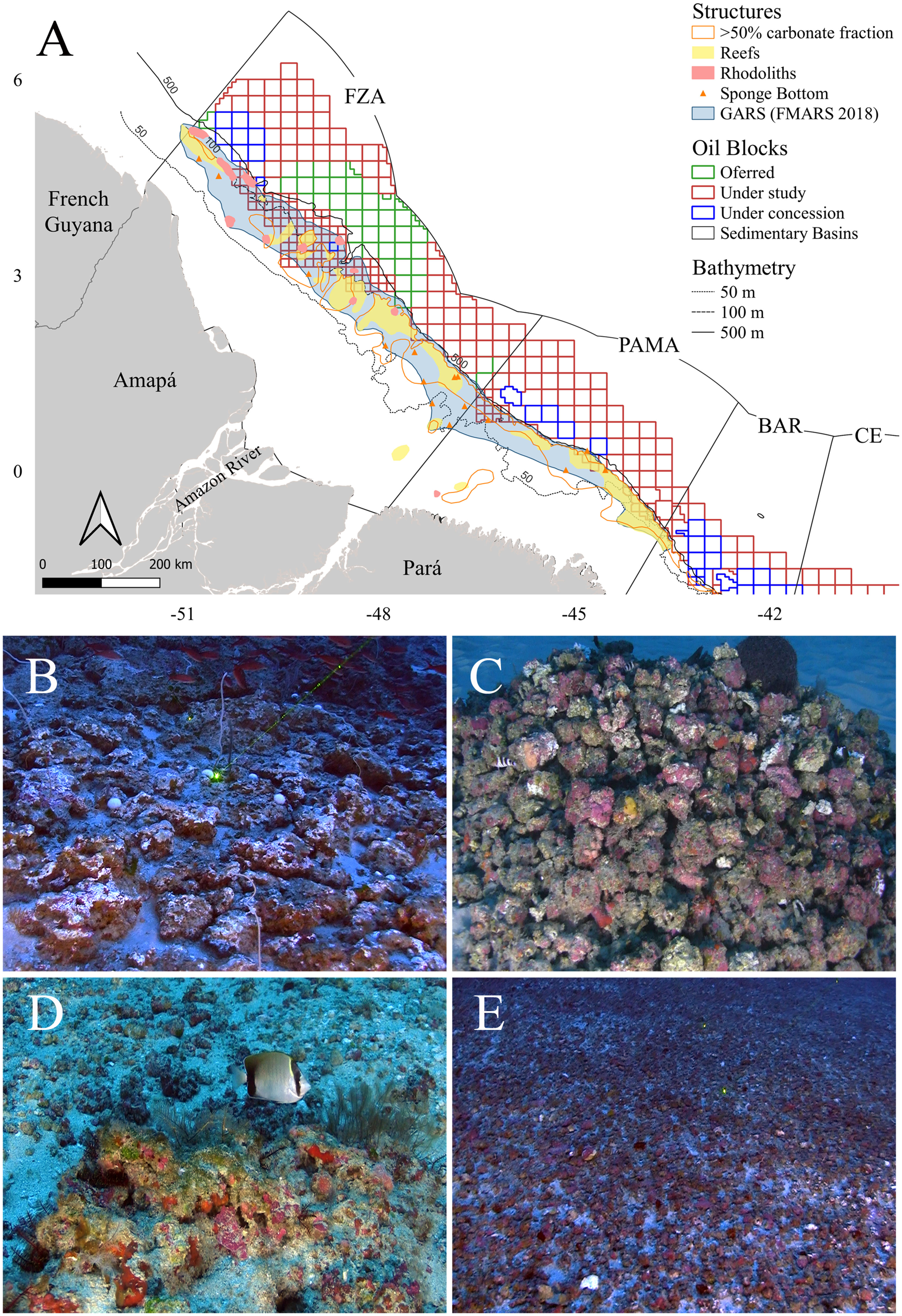
Figure 1 (A) The Great Amazon Reef System (GARS), as delimited by Moura et al. (2016) and Francini-Filho et al. (2018), and its overlap with oil blocks. (B) A complex live calcareous algae reef inhabited by fish (Paranthias furcifer) and black-corals (~130 m depth). (C) A mound built with living rhodoliths by the tilefish Malacanthus plumieri (~130 m depth). (D) The reef butterflyfish Chaetodon sedentarius over a calcareous algae patch reef (~110 m depth). (E) A high-vitality rhodolith bed (~140 m depth). Sedimentary basins: FZA, Foz do Amazonas; PAMA, Pará/Maranhão; BAR, Barreirinhas; CE, Ceará.
History of the GARS
In April 2016, the paper by Moura et al. (2016) sparked widespread coverage in news outlets across the globe about the existence of an extensive reef system (~ 9,500 km2) on the Amazon shelf. Although the media reported that Moura et al. (2016) discovered the GARS, the key novelties of that study were based on detailed analyses of the species composition, ecosystem functioning and sheer extent of the reef system, not on their existence per se, as historical evidence already pointed to that. Kempf (1970) reported on an extensive calcareous algae reef along the north and northeastern Brazilian coast, with records of six scleractinian species for the area of the GARS. Milliman et al. (1975) and Milliman (1977) suggested that “algal limestone” and “ridges” exist in the outer shelf, which are now known to be encompassed by the GARS (Moura et al., 2016). Collette & Rützler (1977) recorded several reef fish and sponge species and hypothesized that reefs on the Amazon shelf could work as stepping stones connecting the Brazilian and Caribbean Biogeographic Provinces. After the seminal works mentioned above, and before the publication of Moura et al. (2016), several other pieces of evidence amounted to the existence of the GARS. Moura et al. (1999) recorded a relatively high richness of scleractinians in the southern portion of the GARS and one reef fish species previously known only for the Caribbean (Chromis scotti), reinforcing Collette & Rützler’s hypothesis. Comprehensive biogeographical data further corroborated their hypothesis by showing that reef occurrence in the Amazon shelf could explain connectivity patterns for reef fish in the Atlantic (Rocha, 2003; Floeter et al., 2008). Ayres Neto et al. (2009) compiled geological and geophysical data and concluded that reefs up to 20 m in height exist near the Amazon shelf’s edge. Moreover, based on primary, museum and literature data, Cordeiro et al. (2015) recorded 38 coral species (including 27 octocorals, nine scleractinians, one hydrocoral, and one black-coral). They concluded that mesophotic coral ecosystems occur offshore of the Amazon River.
Soon after Moura et al. (2016), Francini-Filho et al. (2018) provided the first-ever submarine and drop cam footage for the GARS. They uncovered the presence of reefs covered by living benthic organisms between 70-220 m depth and the existence of distinct habitats, such as rhodolith beds (i.e. bottoms extensively covered by free-living calcareous algae nodules), live carbonate platforms and sponge bottoms. Because some of the surveyed reefs were outside the range of reef occurrence proposed by Moura et al. (2016), and based on the typical isobath in which the reefs were found, Francini-Filho et al. (2018) suggested that reef habitats could extend for up to 56,000 km2 of the Amazon shelf. Afterward, Marceniuk et al. (2019) recorded extensive reef fisheries and listed 93 reef associated fish species in the GARS. Finally, reefs covered with living organisms were recently recorded to the north (Guyana) (Giresse et al., 2022) and south (Ceará) (Carneiro et al., 2022) of the GARS.
The controversy
After the initial excitement over the GARS, an abstract published at the 49th Brazilian Congress of Geology entitled “Myths and truths on the corals of the Amazon River mouth” raised doubts about the very existence of the reefs (Figueiredo Júnior, 2018). The author argues that: 1) the GARS is a drowned reef covered mainly by sponges, dead crustose calcareous algae (CCA) and few dead corals and 2) the muddy low-light environment under the Amazon River plume is not favorable for carbonate deposition (i.e. reef growth). Both arguments proved to be invalid. Kempf (1970) already reported that living sponges are common on an “upper living layer” of Melobesia calcareous algae in the GARS. All samples analyzed by Cordeiro et al. (2015) presented living tissues, conflicting with the idea of “a few dead corals”. Moura et al. (2016) showed that rhodoliths with high vitality (i.e., >50% of live cover) dominated the central and southern portions of the GARS. Remote sensing analyses by Omachi et al. (2019) confirmed that enough light reaches the bottom of the GARS to allow photosynthesis and growth of reef-building organisms, i.e. calcareous algae and photosymbiotic corals. Mahiques et al. (2019), using radiocarbon data, showed that reef organisms are alive and growing in the entire extension of the GARS. Finally, Francini-Filho et al. (2018) and Mahiques et al. (2019) provided images of the GARS showing high coverage of live reef-building organisms throughout the GARS (Figure 1).
The vitality of the GARS was also recently questioned by Vale et al. (2022). They referred to the term “reefs” in quotation marks throughout the text and concluded that “a thin layer of encrusting organisms, coralline algae, sponges, bryozoans and serpulids presently colonizes most of these surfaces”. This conclusion contrasts with Moura et al. (2016) statement that “in a significant portion of the Amazon reef range, in all sectors, there is a living assemblage of reef-associated organisms typical of West Atlantic mesophotic and deep reefs”. Using the thickness of living organisms as a criterium to define reef vitality is inappropriate, as the living layer of a healthy reef can range in thickness from just a few millimeters, as is the case with the surface of coral colonies, to more than a meter, such as across the tissue of the giant barrel sponges Xestospongia muta found throughout the GARS (Francini-Filho et al., 2018). It is worth noting that Vale et al. (2022), considered only “high-relief structures” as reefs and did not consider the extensive high-vitality rhodolith beds on the Amazon shelf (Moura et al., 2016, Vale et al., 2018). Rhodolith beds are widely recognized as significant components of Mesophotic Coral Ecosystems (MCE) (Amado-Filho et al., 2012; Sissini et al., 2022). The definition of MCE was reached at the first International MCE workshop: “Mesophotic coral ecosystems (MCEs) are characterized by the presence of light-dependent corals and associated communities that are typically found at depths ranging from 30 to 40 m and extending to over 150 m in tropical and subtropical regions. The dominant communities providing structural habitat in the mesophotic zone can be comprised of coral, sponge, and algal species” (Hinderstein et al., 2010). In this context, the mosaic of benthic megahabitats of the GARS perfectly fits to the MCE definition, with features typical to those found in other MCEs across the globe (Loya et al., 2019).
More recently, Santos Filho et al. (2022), using seismic and bathymetric data provided by oil companies, presented a new size estimate for the GARS: 13,478km2. Although this is actually larger than the reef size given by Moura et al. (2016) (~ 9,500 km2), the authors concluded that “The Amazon Mesophotic Reefs, actually a much smaller area than previously predicted by Moura et al. (2016) and Francini-Filho et al. (2018), would correspond to a small portion of a Great Brazilian Mesophotic Bioconstruction Province”. It is unclear if Santos Filho et al. (2022) included rhodolith beds in their reef size estimates, further contributing to the confusion about the GARS extension. They mislead the readers to believe that the GARS is not an MCE by stating that “mesophotic reefs seem to happen in isolated spots over the outer FZA [Foz do Amazonas sedimentary basin]” and that “The misconception that these environments constitute an MCE can give a different analysis by the general public from its real state and can disqualify its true environmental importance (biological diversity, abundance and ecological relevance)”. Finally, they claimed that using the term “great” to name the Amazon reefs is inappropriate because the GARS is only a little over half of the size of the Great Barrier Reef (GBR; ~25,600 km2). Although the decision to use a superlative adjective to name the GARS is subjective, we reiterate here that the adjective “great” is suitable in light of the scale of the reef and the regional context. It is extraordinary to find an MCE larger than half of the area of the GBR unusually close to and connected with the world’s largest rainforest, river, and continuous mangrove belt. Ironically, Santos Filho et al. (2022) coined the name “Great Brazilian Mesophotic Bioconstruction Province” to purposely downplay the GARS’s grandeur.
Moving forward
Less than 5% of the GARS has been studied in detail (Francini-Filho et al., 2018) and further research is evidently necessary. Basic data, such as detailed information on bathymetry and current patterns and the relative abundance of fish and benthic organisms, are still lacking. Among top research priorities to subsidize effective conservation and sustainable uses of the GARS, we highlight the importance of: 1) developing accurate maps and predictive models for marine habitats and anthropogenic threats, 2) descriptions of spatio-temporal patterns in biodiversity and oceanographic parameters, 3) assessments of fish stocks (catch, effort and basic biological parameters), 4) socio-economic reliance on coastal and marine resources and 5) conservation planning initiatives for the implementation of area-based management tools such as the establishment of marine protected areas. This data-poor context explains why the Federal Prosecutions Office deemed inadequate the oil dispersal models presented in the last request for oil exploration in the Amazon shelf. Finally, despite a recent compilation of spatial data for the Amazon shelf (Araujo et al., 2021), there is still no formal conservation prioritization exercise specifically tailored for the region, except for broad models recently developed for the entire Brazilian coast that indicate priority areas in the Amazon shelf (Brasil, 2018; Magris et al., 2021). Alarmingly, the GARS region still lacks any type of marine protected area. Therefore, detailed planning initiatives that consider the region’s complex dynamics, the threats from different human uses, and the spatial distribution of key habitats and species are urgently required.
Conclusion
Our daily lives are impacted by disbelief in science, particularly in the post-truth era in which we live (Compton et al., 2021). For example, during the COVID-19 pandemic, countries with higher trustworthiness in science also presented higher confidence in vaccination (Sturgis et al., 2021). The current turmoil about oil exploration in the Amazon shelf is taking a disproportionate political dimension in Brazil. Weekly press news flood the media with claims that the GARS does not exist and that previous scientific studies are fake. Scientific denialism also threatens other biomes in Brazil, such as the Amazon Forest and Pantanal wetlands (Diele-Viegas et al., 2021). In this scenario, replicable and trustable science is essential to effectively guide political actions towards the conservation and rational use of marine resources in the region. Thus, we call for a scientific consensus about the extension and vitality of the GARS based on replicable open-access data obtained through independent research. This requirement is essential considering that Environmental Impact Assessments in Brazil are often of poor quality, based on scattered data, financed by the same companies requesting environmental licenses and mostly flawed (Ruaro et al., 2021, Dias et al., 2022). A common ground among the different groups studying the GARS, as well as clear and sound evidence-based communications with the general public, are critical to foster confidence to all stakeholders interested in the conservation and sustainable uses of the GARS and adjacent coastal/marine habitats.
Author contributions
TB and RF-F designed and wrote the first version of the manuscript. All authors contributed to the article and approved the submitted version.
Acknowledgments
The authors thank George Mendes and Carolyne Schiavo for providing data for the map production.
Funding
This study was financed in part by the Coordenação de Aperfeiçoamento de Pessoal de Nıvel Superior ́ – Brasil (CAPES) – Finance Code 001, through a scholarship granted to TB, Conselho Nacional de Desenvolvimento Cientıfí co e Tecnológico (fellowship #309651/2021-2 to RF-F), Fundação de Amparo à Pesquisa do Estado de São Paulo (grants 2019/24215-2 and 2021/07039-6 to HP), and Fundação de Amparo a Ciência e Tecnologia do Estado de Pernambuco (APQ-1610-2.05/22 to RC).
Conflict of interest
The authors declare that the research was conducted in the absence of any commercial or financial relationships that could be construed as a potential conflict of interest.
Publisher’s note
All claims expressed in this article are solely those of the authors and do not necessarily represent those of their affiliated organizations, or those of the publisher, the editors and the reviewers. Any product that may be evaluated in this article, or claim that may be made by its manufacturer, is not guaranteed or endorsed by the publisher.
References
Amado-Filho G. M., Moura R. L., Bastos A. C., Salgado L. T., Sumida P. Y., Guth A. Z., et al. (2012). Rhodolith beds are major CaCO3 bio-factories in the tropical south West Atlantic. PloS One 7, e35171. doi: 10.1371/journal.pone.0035171
Araujo L. S., Magdalena U. R., Louzada T. S., Salomon P. S., Moraes F. C., Ferreira B. P., et al. (2021). Growing industrialization and poor conservation planning challenge natural resources’ management in the Amazon shelf off Brazil. Mar. Pol. 128, 104465. doi: 10.1016/j.marpol.2021.104465
Ayres Neto A., Falcão L. C., Amaral P. J. T. (2009). Caracterização de ecofácies na margem continental norte brasileira: estado do conhecimento. Rev. Bras. Geof. 27, 97–106. doi: 10.1590/S0102-261X2009000500008
Brasil (2018). “PORTARIA n° 463, DE 18 DE DEZEMBRO DE 2018. Brasília: Ministério do Meio Ambiente. Available at: https://www.gov.br/mma/pt-br/assuntos/ecossistemas-1/conservacao-1/areasprioritarias/2a-atualizacao-das-areas-prioritarias-para-conservacao-dabiodiversidade-2018.
Brasil Ministério Público Federal. Procuradoria da Repú blica (2022) RECOMENDAÇÃO CONJUNTA n° 17/2022. Available at: https://www.mpf.mp.br/pa/sala-de-imprensa/documentos/2022/recomendacao-conjunta-mpf-ap-pa-ibama-petrobras-suspensao-perfuracao-foz-amazonas.pdf.
Carneiro P. B. M., Ximenes Neto A. R., Jucá-Queiroz B., Teixeira C. E. P., Feitosa C. V., Barroso C. X., et al. (2022). Interconnected marine habitats form a single continental-scale reef system in south America. Sci. Rep. 12, 17359. doi: 10.1038/s41598-022-21341-x
Collette B., Rützler K. (1977). Reef fish over sponge bottoms off the mouth of the Amazon river. Proc. Int. Coral Reef Symp, 305–310.
Compton J., van der Linden S., Cook J., Basol M. (2021). Inoculation theory in the post-truth era: Extant findings and new frontiers for contested science, misinformation, and conspiracy theories. Soc Personal. Psychol. Compass 15, e12602. doi: 10.1111/spc3.12602
Cordeiro R. T., Neves B. M., Rosa-Filho J. S., Pérez C. D. (2015). Mesophotic coral ecosystems occur offshore and north of the Amazon river. Bull. Mar. Sci. 91, 491–510. doi: 10.5343/bms.2015.1025
Dias A. M. S., Cook C., Massara R. L., Paglia A. P. (2022). Are environmental impact assessments effectively addressing the biodiversity issues in Brazil? Environ. Impact Assess. Rev. 95, 106801. doi: 10.1016/j.eiar.2022.106801
Diele-Viegas L. M., Hipólito J., Ferrante L. (2021). Scientific denialism threatens Brazil. Science 374, 948–949. doi: 10.1126/science.abm9933
Figueiredo Júnior A. G. (2018) MITOS e VERDADES SOBRE OS “CORAIS DA FOZ DO AMAZONAS.” in anais do 49° congresso brasileiro de geologia (Rio de Janeiro, RJ, Brazil: Sociedade brasileira de geologia), 2056. Available at: https://www.49cbg.com.br/anais.php.
Floeter S. R., Rocha L. A., Robertson D. R., Joyeux J. C., Smith-Vaniz W. F., Wirtz P., et al. (2008). Atlantic Reef fish biogeography and evolution. J. Biogeogr. 35, 22–47. doi: 10.1111/j.1365-2699.2007.01790.x
Francini-Filho R. B., Asp N. E., Siegle E., Hocevar J., Lowyck K., D’Avila N., et al. (2018). Perspectives on the great Amazon reef: Extension, biodiversity, and threats. Front. Mar. Sci. 5. doi: 10.3389/fmars.2018.00142
Giresse P., Loncke L., Heuret A., Longueville F., Casanova A., Sadaoui M. (2022). Beachrocks of the last low sea level, substrate of the barrier reef system along the outer Guiana shelf. Preprint, Research Square. doi: 10.21203/rs.3.rs-2028202/v1
Hinderstein L. M., Marr J. C. A., Martinez F. A., Dowgiallo M. J., Puglise K. A., Pyle R. L., et al. (2010). Theme section on “Mesophotic coral ecosystems: Characterization, ecology, and management”. Coral Reefs 29, 247–251. doi: 10.1007/s00338-010-0614-5
IBAMA (2018). “Licença ambiental para a atividade de perfuração marítima nos blocos FZA-M-57, 86, 88, 125 e 127 na bacia da foz do Amazonas,” in Despacho n° 3912994/2018-GABIN. Brasília: Ministério do Meio Ambiente. Available at: http://www.ibama.gov.br/phocadownload/notas/2018/SEI_IBAMA%20-%203912994%20-%20Despacho.pdf.
Kempf M. (1970). Notes on the benthic bionomy of the n-NE Brazilian shelf. Mar. Biol. 5, 213–224. doi: 10.1007/BF00346909
Magris R. A., Costa M. D. P., Ferreira C. E. L., Vilar C. C., Joyeux J.-C., Creed J. C., et al. (2021). A blueprint for securing brazil’s marine biodiversity and supporting the achievement of global conservation goals. Divers. Distrib. 27, 198–215. doi: 10.1111/ddi.13183
Mahiques M. M., Siegle E., Francini-Filho R. B., Thompson F. L., Rezende C. E., Gomes J. D., et al. (2019). Insights on the evolution of the living great Amazon reef system, equatorial West Atlantic. Sci. Rep. 9, 13699. doi: 10.1038/s41598-019-50245-6
Marceniuk A. P., Rotundo M. M., Caires R. A., Cordeiro A. P. B., Wosiacki W. B., Oliveira C., et al. (2019). The bony fishes (Teleostei) caught by industrial trawlers off the Brazilian north coast, with insights into its conservation. Neotrop. ichthyol. 17, e180038. doi: 10.1590/1982-0224-20180038
Milliman J. D. (1977). “Role of calcareous algae in Atlantic continental margin sedimentation,” in Fossil algae. Ed. Flügel E. (Berlin, Heidelberg: Springer Berlin Heidelberg), 232–247. doi: 10.1007/978-3-642-66516-5_26
Milliman J. D., Summerhayes C. P., Barretto H. T. (1975). Quaternary sedimentation on the Amazon continental margin: A model. Geol. Soc America. Bull. 86, 610. doi: 10.1130/0016-7606(1975)86<610:QSOTAC>2.0.CO;2
Moura R. L., Amado-Filho G. M., Moraes F. C., Brasileiro P. S., Salomon P. S., Mahiques M. M., et al. (2016). An extensive reef system at the Amazon river mouth. Sci. Adv. 2, 1–12. doi: 10.1126/sciadv.1501252
Moura R. L., Martins Rodrigues M. C., Francini-Filho R. B., Sazima I. (1999). Unexpected richness of reef corals near the southern Amazon river mouth. Coral Reefs 18, 170–170. doi: 10.1007/s003380050175
Omachi C. Y., Asp N. E., Siegle E., Couceiro M. A. A., Francini-Filho R. B., Thompson F. L. (2019). Light availability for reef-building organisms in a plume-influenced shelf.Cont. Shelf Res. 181, 25–33. doi: 10.1016/j.csr.2019.05.005
Rocha L. A. (2003). Patterns of distribution and processes of speciation in Brazilian reef fishes. J. Biogeogr. 30, 1161–1171. doi: 10.1046/j.1365-2699.2003.00900.x
Ruaro R., Ferrante L., Fearnside P. M. (2021). Brazil's doomed environmental licensing. Science 372 (6546), 1049–1050. doi: 10.1126/science.abj4924
Santos Filho J. R., Anjos J. V. M., Silva C. G., BarrosFilho A. K. D., Dias G. T. M., Figueiredo A. G., et al. (2022). Resizing the extension of the mesophotic “reefs” in the Brazilian equatorial margin using bioclastic facies and seabed morphology. Preprint, Research Square. doi: 10.21203/rs.3.rs-1927169/v1
Sissini M. N., Koerich G., de Barros-Barreto M. B., Coutinho L. M., Gomes F. P., Oliveira W., et al. (2022). Diversity, distribution, and environmental drivers of coralline red algae: the major reef builders in the southwestern Atlantic. Coral Reefs 41, 711–725. doi: 10.1007/s00338-021-02171-1
Sturgis P., Brunton-Smith I., Jackson J. (2021). Trust in science, social consensus and vaccine confidence. Nat. Hum. Behav. 5, 1528–1534. doi: 10.1038/s41562-021-01115-7
Vale N. F., Amado-Filho G. M., Braga J. C., Brasileiro P. S., Karez C. S., Moraes F., et al. (2018). Structure and composition of rhodoliths from the Amazon River mouth. Braz. J. South Am. Earth Sci. 84, 149–159. doi: 10.1016/j.jsames.2018.03.01
Keywords: rhodolith beds, marine conservation, oil exploration, South Atlantic, marginal reefs, mesophotic ecosystems
Citation: Banha TNS, Luiz OJ, Asp NE, Pinheiro HT, Magris RA, Cordeiro RTS, Mahiques MM, Mies M, Giglio VJ, Omachi CY, Siegle E, Nogueira LC, Thompson CC, Thompson FL, Nora V, Horta PA, Rezende CE, Sumida PYG, Ferreira CEL, Floeter SR and Francini-Filho RB (2022) The Great Amazon Reef System: A fact. Front. Mar. Sci. 9:1088956. doi: 10.3389/fmars.2022.1088956
Received: 03 November 2022; Accepted: 24 November 2022;
Published: 08 December 2022.
Edited by:
Salvatore Siciliano, Escola Nacional de Saúde Pública Sergio Arouca, Fundação Oswaldo Cruz (Fiocruz), Rio de Janeiro, BrazilReviewed by:
Jorge Luiz Silva Nunes, Universidade Federal do Maranhão, BrazilCopyright © 2022 Banha, Luiz, Asp, Pinheiro, Magris, Cordeiro, Mahiques, Mies, Giglio, Omachi, Siegle, Nogueira, Thompson, Thompson, Nora, Horta, Rezende, Sumida, Ferreira, Floeter and Francini-Filho. This is an open-access article distributed under the terms of the Creative Commons Attribution License (CC BY). The use, distribution or reproduction in other forums is permitted, provided the original author(s) and the copyright owner(s) are credited and that the original publication in this journal is cited, in accordance with accepted academic practice. No use, distribution or reproduction is permitted which does not comply with these terms.
*Correspondence: Ronaldo B. Francini-Filho, ZnJhbmNpbmlmaWxob0B1c3AuYnI=