 Melanie Hebe Hughes
 Melisa Fernández Severini
 Paola G. Scodelaro Bilbao
- 1Departamento de Biología, Bioquímica y Farmacia, Universidad Nacional del Sur (UNS), Bahía Blanca, Argentina
- 2Instituto Argentino de Oceanografía (IADO) (UNS-CONICET), Universidad Nacional del Sur-Consejo Nacional de Investigaciones Científicas y Técnicas, Bahía Blanca, Argentina
- 3Centro de Recursos Naturales Renovables de la Zona Semiárida (CERZOS) (UNS-CONICET), Universidad Nacional del Sur-Consejo Nacional de Investigaciones Científicas y Técnicas, Bahía Blanca, Argentina
Editorial on the Research Topic
World’s oceans: opportunities and challenges looking under the sea
The oceans are home to a vast biodiversity below their surface, offering innumerable opportunities that remain mostly untapped. In recent years, marine organisms have drawn increasing interest as a renewable and sustainable source of pharmacological, food and cosmetic bioactive compounds (Ebrahimi et al., 2023). In addition, the great biodiversity of organisms, from invertebrates to algae, and the interactions among them, are being studied in search of sources of renewable energy (Borowitzka and Moheimani, 2013), sewage treatment mechanisms (Sutherland and Ralph, 2019), aquaculture techniques (Ma and Qin, 2023), among other aspects. However, the sustainable use of these resources also draws enormous challenges that must be overcome. The numerous pollutants found in marine ecosystems (such as microplastics and nanoparticles, heavy metals and nutrients), high population densities in many coastal areas and poor public policies addressing these issues, all pose a threat to the unique, resource-rich coastal and marine biodiversity (Gobas and Morrison, 2000; Cloern, 2001; Andrady, 2011; Holmes et al., 2012).
This Research Topic focuses on the emerging opportunities and challenges related to the utilization of marine resources, with a view to coordinating efforts towards a sustainable development. The articles published in this Topic, reveal the interconnected roles of marine organisms, including diatoms, macroalgae and polychaetes, and their potential for nutrient recycling and sustainable aquaculture practices, underscoring the complex dynamics of marine ecosystems in the face of anthropogenic pressures and climate change (Figure 1).
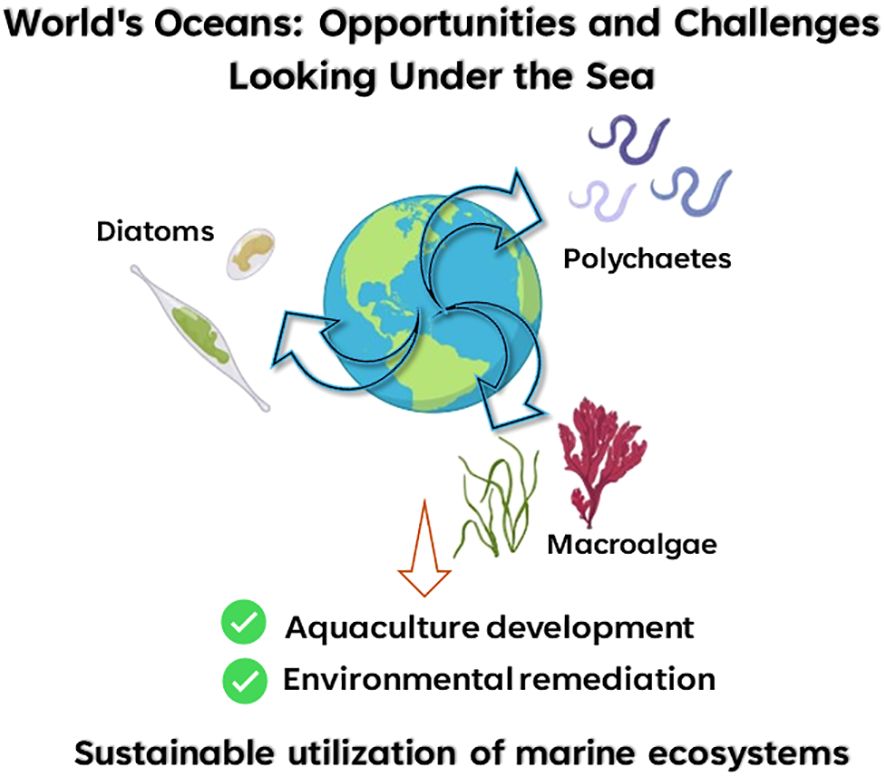
Figure 1 Interconnected roles of the marine organisms addressed in the Research Topic and their potential applications in bioremediation and aquaculture practices.
The intricate dynamics of marine ecosystems necessitate a multifaceted understanding of their constituent organisms, particularly those serving as primary producers. Among these, diatoms are the main components of marine phytoplankton. These unicellular algae are one of the main primary producers in the marine ecosystem, they play an essential role in the silicon biogeochemical cycle and serve as food to many invertebrate and fish species. Yang et al. studied epiphytic diatoms from China for potential wastewater nutrient removal as well as for aquaculture purposes. They isolated a total of five species of Navicula and Nitzschia that were growing as seaweed epiphytes near a sewage discharge, and evaluated their growth and fatty acid composition using optimized combinations of macronutrients, trace metals and vitamins in f/2 culture medium. All species showed improved biomass productivities in the optimized f/2 culture medium compared to conventional f/2 culture medium. In addition, the fatty acid profiles were improved or did not change in terms of relative amounts of poly-unsaturated fatty acids (PUFAs), which are essential for invertebrate’s feed in aquaculture.
Complementing the pivotal role of diatoms, macroalgae, colloquially termed seaweeds, emerge as yet another vanguard of marine primary productivity. Within this paradigm, kelp forests, offer numerous ecosystem services such as carbon removal and providing habitat and shelter to numerous organisms. Marambio et al. studied the ecophysiology and reproduction of Macrocystis pyrifera kelp forests from the Magellan subantarctic ecoregion, in order to better understand the capacity of this species to adapt to anthropogenic effects and climate change and providing valuable information for understanding the resilience of these ecosystems. They observed that kelp forests from this region have great acclimatization capacity to the environmental gradients represented by the different seasons and the four localities studied. As kelp forest are also important economic resources, these results should be considered for the sustainable use of this resource as well as for aquaculture development strategies.
Aquaculture plays a major role as food source, especially considering the global population growth and the food supply challenges that come with it. Addressing the symbiotic nexus between aquaculture and nutrient recycling, Anglade et al. studied the growth of the polychaete Hediste diversicolor in aquaculture sludge and its potential incorporation as salmon feed in aquaculture farms. They concluded that H. diversicolor cultivated in smolt and post-smolt sludge reached high growth rates, similar protein content and aminoacid composition, and different lipid and fatty acid contents and compositions depending on the diet. According to these results, H. diversicolor is a promising candidate for recycling nutrients from different salmon aquaculture sludges. Thus, assessing the nutritional value of H. diversicolor as a feed ingredient for salmon, this study supports the advancement of sustainable aquaculture methods aimed at reducing environmental impact and maximizing resource utilization.
The studies presented here show some of the opportunities lying beneath the oceans in terms of utilization and exploitation of marine resources, aiming to coordinate efforts towards a sustainable development, and contribute to the knowledge in this rapidly developing field. These findings not only offer solutions for environmental remediation but also hold promise for enhancing sustainable aquaculture practices. Overall, these studies underscore the multifaceted benefits and challenges associated with harnessing marine resources for various purposes, ranging from environmental remediation to aquaculture development. By addressing these complexities through interdisciplinary research and collaborative efforts, it is possible to advance towards a more sustainable and responsible utilization of marine ecosystems and their valuable resources.
Author contributions
MH: Conceptualization, Investigation, Writing – original draft, Writing – review & editing. MF: Conceptualization, Investigation, Writing – original draft, Writing – review & editing. PS: Conceptualization, Investigation, Supervision, Writing – original draft, Writing – review & editing.
Conflict of interest
The authors declare that the research was conducted in the absence of any commercial or financial relationships that could be construed as a potential conflict of interest.
Publisher’s note
All claims expressed in this article are solely those of the authors and do not necessarily represent those of their affiliated organizations, or those of the publisher, the editors and the reviewers. Any product that may be evaluated in this article, or claim that may be made by its manufacturer, is not guaranteed or endorsed by the publisher.
References
Andrady A. L. (2011). Microplastics in the marine environment. Mar. Poll. Bull. 62, 1596–1605. doi: 10.1016/j.marpolbul.2011.05.030
Borowitzka M. A., Moheimani N. R. (2013). Sustainable biofuels from algae. Mitig. Adapt. Strateg. Glob. Change. 18, 13–25. doi: 10.1007/s11027-010-9271-9
Cloern J. E. (2001). Our evolving conceptual model of the coastal eutrophication problem. Mar. Ecol. Prog. Ser. 210, 223–253. doi: 10.3354/meps210223
Ebrahimi B., Baroutian S., Li J., Zhang B., Ying T., Lu J. (2023). Combination of marine bioactive compounds and extracts for the prevention and treatment of chronic diseases. Front. Nutr. 9. doi: 10.3389/fnut.2022.1047026
Gobas F. A. P. C., Morrison H. A. (2000). Bioconcentration of persistent organic pollutants in aquatic systems: an overview. Environ. Toxicol. Chem. 19, 1901–1914.
Holmes L. A., Turner A., Thompson R. C. (2012). Adsorption of trace metals to plastic resin pellets in the marine environment. Environ. Pollut. 160, 42–48. doi: 10.1016/j.envpol.2011.08.052
Ma Z., Qin J. (2023). New techniques in marine aquaculture. J. Mar. Sci. Eng. 11, 2239. doi: 10.3390/jmse11122239
Keywords: aquaculture, bioremediation, marine biodiversity, marine resources, sustainability
Citation: Hughes MH, Fernández Severini M and Scodelaro Bilbao PG (2024) Editorial: World’s oceans: opportunities and challenges looking under the sea. Front. Mar. Sci. 11:1416160. doi: 10.3389/fmars.2024.1416160
Received: 11 April 2024; Accepted: 19 April 2024;
Published: 26 April 2024.
Edited and Reviewed by:
Yngvar Olsen, NTNU, NorwayCopyright © 2024 Hughes, Fernández Severini and Scodelaro Bilbao. This is an open-access article distributed under the terms of the Creative Commons Attribution License (CC BY). The use, distribution or reproduction in other forums is permitted, provided the original author(s) and the copyright owner(s) are credited and that the original publication in this journal is cited, in accordance with accepted academic practice. No use, distribution or reproduction is permitted which does not comply with these terms.
*Correspondence: Paola G. Scodelaro Bilbao, cHNjb2RlbGFAY3JpYmEuZWR1LmFy
†These authors have contributed equally to this work