1 Introduction
Health services management differs from the traditional definition of a profession, as it lacks a standardized body of knowledge and a single entry credential (1). Instead, it is an applied field that integrates competencies from medicine, economics, public administration, engineering, and social sciences (2). Due to the need for diverse skill sets, no universal educational pathway exists for health service managers (3). Comparative studies demonstrate significant variation in managers' educational backgrounds, ranging from postgraduate qualifications to clinical experience without formal management training (4–6). Despite this diversity, the strategic importance of this workforce is increasing. Factors such as rising costs, demographic shifts, and heightened accountability expectations (7, 8) demand leaders capable of coordinating resources, interpreting data, and guiding improvement initiatives. The lack of a standardized pathway complicates the definition of professional training, underscoring the need to examine current educational preparation.
In Brazil, where a universal public health system operates alongside a substantial private sector and governance is decentralized, managerial preparation significantly influences access to care, operational efficiency, and the sustainability of services (9). While the education of physicians and other healthcare professionals has received increasing attention due to its impact on the system's future (10–12), the preparation of healthcare managers also merits close examination, as they are essential in primary care, hospitals, diagnostic networks, and regulatory agencies (13, 14). Job titles such as coordinator, supervisor, director, and manager encompass a range of functions that vary by setting and region (15). Professional competencies are developed through formal education, training, and ongoing professional development, with requirements differing by sector and management level (16). Delivering health services with consistent quality depends on the training and qualifications of those in leadership roles (17). In this context, a narrow professional definition is insufficient, as no universally mandated educational pathway exists.
Analyzing training and education offers a concrete approach to defining and understanding health service management as a profession. Systematic evaluation of courses can identify areas for improvement, inform decision-making, and clarify which topics are most relevant for graduates' societal roles (18). In the Brazilian higher education system, post-bachelor's programs are divided into two legal categories (19): lato sensu programs, which include specialization courses and MBAs classified as continuing education (20, 21), and stricto sensu programs, which are research-oriented master's and doctoral degrees. Lato sensu programs, offered by accredited institutions, require a minimum of 360 hours, emphasize practical skill development, and primarily serve professionals seeking additional credentials. In contrast, stricto sensu programs confer academic titles and develop research expertise.
Specialization programs play a critical role in professional upskilling and lifelong learning, but they face challenges as knowledge requirements shift in response to market and societal changes (18). Variability in duration, workload, delivery mode, and competency focus creates uncertainty regarding the knowledge and skills that graduates bring to the health system. Lato sensu courses are especially significant, with approximately 173,000 active offerings enrolling around 1.4 million students in 2023 (22). A flexible regulatory environment enables institutions to rapidly introduce or update programs, adapting curricula to emerging areas such as hospital quality improvement, digital health operations, and value-based care (21). These certificates, typically delivered in modular weekend, evening, or distance-learning formats, are accessible to professionals who continue working full-time. Consequently, analyzing these programs provides a practical means to map the educational pipelines that supply Brazil's managerial workforce.
Despite its significance, comprehensive evidence on national management curricula is limited, as most studies address only specific regions or small samples (15, 23). This lack of system-wide perspective hinders efforts to understand and improve training pathways. The Brazilian government maintains an official registry of specialization and certification programs, which, if analyzed, can clarify the educational content that defines the field on a national scale. Previous studies have not fully utilized this registry to provide a structured curriculum overview. This study addresses this gap by compiling a dataset of instructional topics from registered lato sensu specialization and certification courses in health services management. Rather than ranking programs or evaluating outcomes, it offers a descriptive, system-level reference to inform accreditation, workforce planning, employer expectations, and future educational assessments. By consolidating dispersed national data, this study establishes a foundation for targeted improvements and informed discussion among educators, employers, and regulators regarding the enhancement of management education.
2 Methods
2.1 Data acquisition
Initial data were extracted from the National Registry of Higher Education Courses and Institutions (24) (e-MEC, Cadastro Nacional de Cursos e Instituições de Educação Superior). This official electronic information system underpins the federal regulation, accreditation, and supervision of Brazilian higher-education institutions and their academic programs. The e-MEC platform began operations in January 2007. Subsequent normative acts, most recently a Ministerial Ordinance in 2017 (25), reaffirmed e-MEC as the exclusive environment for registering, updating, and disseminating course-level information within the federal higher education system. Since accreditation or major curricular changes require a new e-MEC submission, the registry provides a near-census view of all recognized courses since the mid-2000s.
Due to limitations in the e-MEC platform's search engine, we first exported a large dataset to apply external filters. The e-MEC public interface was queried on 1 July 2025. In the search form, we selected the course type lato sensu (Curso de Especialização) and entered the Portuguese keyword for health (saúde). No temporal filters were applied, ensuring that the query returned the full historical series available in the system. This process produced a spreadsheet file containing 16,179 unique course records.
2.2 Data descriptors
Each record contained seven groups of variables. Institutional identifiers included the code assigned to the higher education institution, its full legal name, acronym, and administrative category (such as federal public, state public, municipal public, or private). Program identifiers comprised the unique course-specialization code, course name, and the disciplinary area to which the program is linked according to the Ministry of Education classification. Delivery characteristics specified whether the course was offered via distance learning or in person and listed the approved workload in hours. Geographic attributes included the two-letter abbreviation of the state identifier (UF) in which the course was authorized to operate; this did not apply to distance learning courses. Enrollment capacity and uptake measures recorded the number of authorized student positions and the cumulative number of graduates reported to date. Governance information included the name of the course coordinator and the course's current status (active or inactive). The reported start date of the course was used to establish chronology.
2.3 Pre-processing and eligibility
The raw spreadsheet file was imported into Pyspread 2.4 for data cleaning. All character fields were normalized to UTF-8, and obvious misspellings in the headers were corrected programmatically. To focus on programs oriented toward organizational leadership rather than clinical practice, a keyword filter was applied to the course denomination variable. Only rows with titles containing the Portuguese equivalents of management or administration in any position (case-insensitive) were retained. This filtering reduced the dataset to 3,898 course registrations, which then underwent manual validation. During this process, duplicate entries were identified, and courses whose titles matched the keyword filter but targeted domains outside of health services management (such as health sciences, mental health administration, and QSHE in the oil industry) were excluded. To address misspelled date entries, correct dates were inferred by cross-referencing course codes with their corresponding registration histories from previous and subsequent records. In state identification (UF) fields containing placeholder codes, these codes were first removed. If this was the sole UF value for a record, the entry was excluded from the dataset. Ultimately, this curation process eliminated 645 records, resulting in a final dataset of 3,253.
3 Descriptive analysis
We conducted an introductory and descriptive analysis of the main structural and curricular attributes that can be observed in the cleaned dataset of 3,253 lato sensu specialization and certification courses related to health services management, active in the Brazilian registry as of 1 July 2025. The resulting dataset is publicly available at doi.org/10.5281/zenodo.16876909. This section emphasizes descriptive reporting, presenting observable patterns in the data without interpreting underlying causes or evaluating program quality.
3.1 General characteristics
Figure 1 presents the most significant institutional and geographic variables. Distance learning is the predominant course delivery modality, enabling courses to reach students across broad geographic areas, often extending beyond the state of the coordinating campus. This expanded catchment area increases enrollment potential in sparsely populated regions while maintaining fixed operational costs.
Figure 1

Summary of characteristics of the dataset with the specialization and certification courses offerings related to health services management in Brazil.
Despite the presence of courses in all five macro regions, the market remains highly concentrated. A small group of private providers based in the Southeast accounts for the majority of enrollments, with their online courses contributing to totals in multiple states. These institutions effectively export managerial education from established academic centers to states lacking comparable local offerings.
The composition of providers reinforces this pattern. Public universities and nonprofit institutions account for approximately one-third of the programs. Private institutions, many affiliated with larger corporate groups, supply the remaining two-thirds and offer the widest variety of thematic tracks and class sizes.
While e-MEC has functioned as the official registry since 2007, the number of annual course approvals increased notably in 2020 and 2021. This growth coincided with regulatory initiatives promoting remote postgraduate education during the pandemic. More than half of the courses in the current database were launched in 2020 or later, confirming the digital expansion of Brazil's tertiary education sector during this period.
These findings do not suggest that Brazilian healthcare managers are required to hold these certificates, nor do they preclude professionals from obtaining alternative credentials. However, mapping these programs clarifies the competencies emphasized by institutions, the geographic distribution of training capacity, and the curricular areas currently prioritized by the market. These insights establish a foundation for future research examining educational pathways to better understand the knowledge base of Brazil's health service workforce.
3.2 Curriculum emphases
Although the dataset categorizes courses, it does not initially focus specifically on management. To address this, a qualitative classification using inductive coding was performed (26). Course titles were recursively evaluated to develop a codebook comprising 20 categories. To illustrate the codebook and its occurrences, a Voronoi treemap was created (27) using the amCharts 5 framework and Kelly's qualitative color palette (28). Figure 2 summarizes the managerial focus of curricula, with the treemap displaying each thematic cluster as a cell sized according to its frequency in the national catalog.
Figure 2
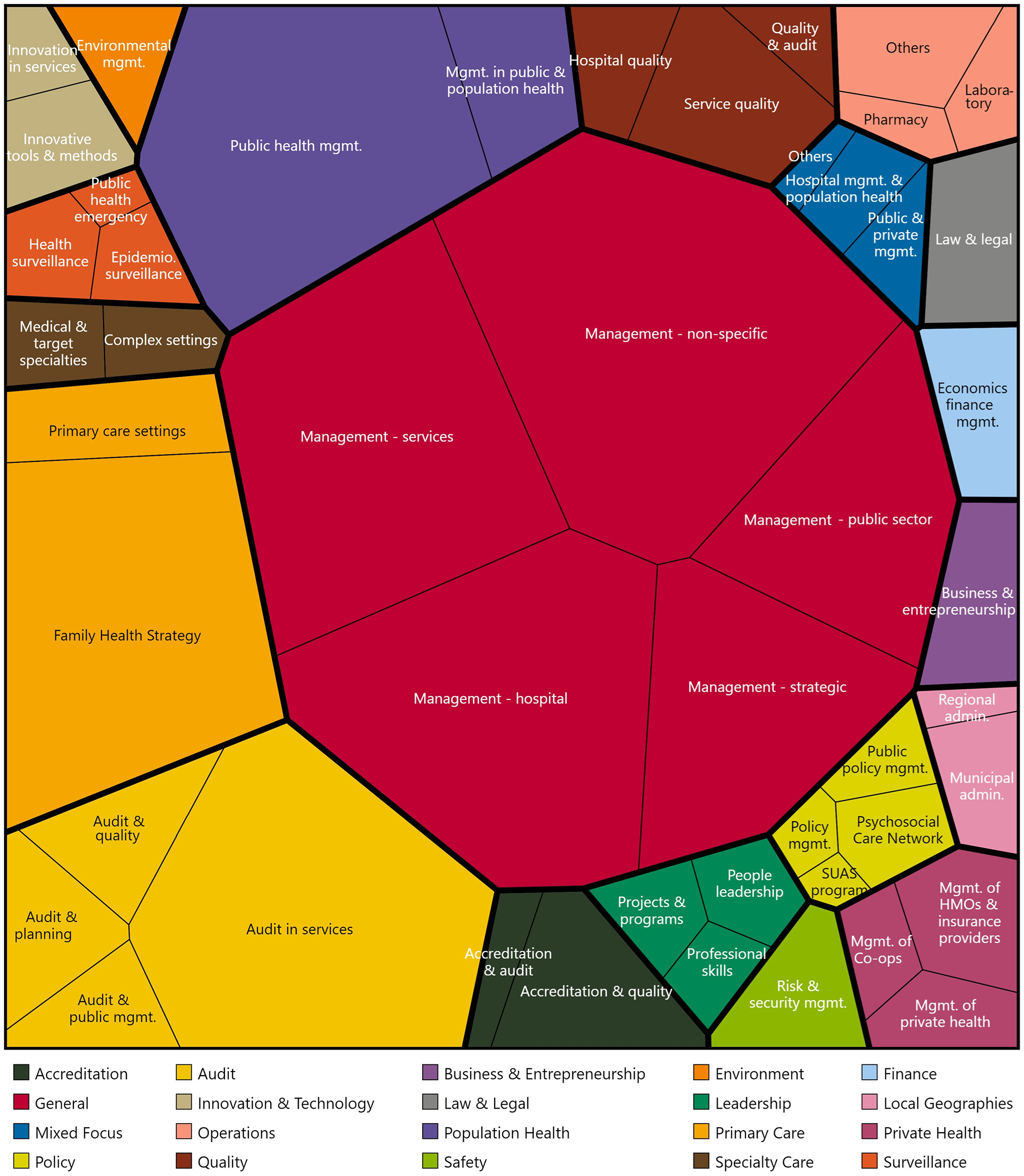
A Voronoi treemap summarizing the curriculum emphases by occurrence of specialization and certification courses offerings related to health services management in Brazil.
The central area of the treemap features broad polygons representing general courses, reflecting sustained demand for general preparation. Surrounding these are sizable cells dedicated to hospital, strategic, and public-sector management, indicating that managerial education continues to emphasize comprehensive leadership skills. Programs have evolved from general health management to more specialized areas, such as quality assurance, emergency management, and health technology. This progression is illustrated by distinct brown and yellow clusters for audit, service quality, and accreditation, as well as teal cells highlighting people-focused leadership competencies. The treemap also displays medium-sized regions for population health, primary care strategies, and policy governance, suggesting a balanced but not predominant public health emphasis.
Smaller, vividly colored cells represent emerging or niche areas of interest. Finance, law, entrepreneurship, and private health administration are depicted as narrow strips along the perimeter, while even finer segments correspond to environmental management, innovative tools, surveillance, and local geographies. This detailed segmentation indicates limited capacity in these areas despite increasing relevance. The uneven distribution reflects differences in market dynamics, institutional missions, and regional capacities. The diagram highlights areas of market saturation, diversification, and potential investment needs to address competency gaps.
3.3 Implications and strategic directions
Because the file documents course offerings rather than graduate characteristics, the data cannot be interpreted as an inventory of practicing managers. Instead, the dataset serves as a proxy for the most visible and accessible training pathways for health service professionals nationwide. A pronounced spatial imbalance is evident: institutions located in the Southeast continue to dominate supply, reflecting the concentration of undergraduate medical schools previously reported in the literature (29). Furthermore, between 2020 and 2024, there was a marked increase in new course offerings and a diversification into technology-oriented and highly specialized subjects. This trend suggests that providers are responding to increasingly segmented and digitally mediated demand.
Approximately eight years ago, Cunha and Hortale (30) reported similar characteristics, with some distinctions. Their study identified the predominance of private sector providers, geographic concentration of institutions, and the centrality of hospital and general management in course portfolios. These features persist, indicating continuity in the field. However, since 2017, distance learning has expanded significantly, the total number of offerings has increased rapidly, and public and philanthropic participation has grown. The curriculum has also diversified, incorporating quality assurance, emergency management, health technology, and other specialized tracks. These developments warrant further analysis using the current dataset.
This dataset offers several practical applications. Regulators may use it to assess the alignment of curricular offerings with strategic priorities, such as primary care management or value-based purchasing. Accreditation bodies can employ the descriptive statistics as a baseline for targeted quality assurance audits. From a research perspective, the institutional and geographic parameters enable potential linkages with labor market or health outcome databases, facilitating analyses of correlations between training density, managerial vacancies, service performance, or regional quality indicators. By assigning each course to one or more of the 20 thematic categories, the codebook enables targeted filtering and aggregation of offerings. For instance, researchers can isolate only courses focused on primary care strategies or health technology to maximize the utility of the dataset for other investigations. Combined with the dataset, the descriptors provided here establish a reference point for future evaluations of Brazil's health management education landscape.
Statements
Data availability statement
The datasets presented in this study can be found in online repositories. The names of the repository/repositories and accession number(s) can be found below: https://doi.org/10.5281/zenodo.16876909.
Author contributions
EB: Conceptualization, Data curation, Formal analysis, Methodology, Writing – original draft. DB: Data curation, Formal analysis, Validation, Writing – original draft. CM: Conceptualization, Methodology, Writing – review & editing. AA: Conceptualization, Methodology, Writing – review & editing. AD: Conceptualization, Funding acquisition, Methodology, Writing – review & editing.
Funding
The author(s) declared that financial support was received for this work and/or its publication. This study was financed in part by the Coordenação de Aperfeiçoamento de Pessoal de Nível Superior - Brasil (CAPES) - Finance Code 001, the State of Rio Grande do Sul Research Support Foundation (Fapergs), code 24/2551-0001391-1; and the Brazilian National Council for Scientific and Technological Development (CNPq).
Conflict of interest
The author(s) declared that this work was conducted in the absence of any commercial or financial relationships that could be construed as a potential conflict of interest.
Generative AI statement
The author(s) declared that generative AI was not used in the creation of this manuscript.
Any alternative text (alt text) provided alongside figures in this article has been generated by Frontiers with the support of artificial intelligence and reasonable efforts have been made to ensure accuracy, including review by the authors wherever possible. If you identify any issues, please contact us.
Publisher’s note
All claims expressed in this article are solely those of the authors and do not necessarily represent those of their affiliated organizations, or those of the publisher, the editors and the reviewers. Any product that may be evaluated in this article, or claim that may be made by its manufacturer, is not guaranteed or endorsed by the publisher.
References
1.
Evashwick CJ Aaronson WE . Editorial: Global education of health management. Front Public Health. (2019) 7:103. doi: 10.3389/fpubh.2019.00103
2.
Liang Z Howard PF Leggat S Bartram T . Development and validation of health service management competencies. J Health Organ Manag. (2018) 32:157–75. doi: 10.1108/JHOM-06-2017-0120
3.
Harrison R Meyer L Chauhan A Agaliotis M . What qualities are required for globally-relevant health service managers? An exploratory analysis of health systems internationally. Global Health. (2019) 15:11. doi: 10.1186/s12992-019-0452-3
4.
Liang Z Blackstock FC Howard P Liu C Leggat G Ma H et al . Managers in the publicly funded health services in China - characteristics and responsibilities. BMC Health Serv Res. (2020) 20:721. doi: 10.1186/s12913-020-05577-9
5.
Liang Z Blackstock F Howard P Leggat G Hughes A Maddern J et al . A health management competency framework for Australia. Austral Health Rev. (2020) 44:958. doi: 10.1071/AH19006
6.
MacKinnon NJ Chow C Kennedy PL Persaud DD Metge CJ Sketris I . Management competencies for canadian health executives: views from the field. Healthc Manag Forum. (2004) 17:15–20. doi: 10.1016/S0840-4704(10)60624-2
7.
Hensher M McCartney G Ochodo E . Health economics in a world of uneconomic growth. Appl Health Econ Health Policy. (2024) 22:427–33. doi: 10.1007/s40258-024-00883-3
8.
Bellei EA De Marchi ACB . Championing health systems management with digital innovation and applications in the age of artificial intelligence: protocol for a research program. F1000Research. (2024) 13:741. doi: 10.12688/f1000research.152543.1
9.
Ravioli AF Soárez PCD Scheffer MC . Health services management modalities in the Brazilian Unified National Health System: a narrative review of research production in Public Health (2005–2016). Cadernos de Sade Pblica. (2018) 34:e00114217. doi: 10.1590/0102-311x00114217
10.
Valentim J Oliveira EdSG Valentim RAdM Dias-Trindade S Dias AdP Cunha-Oliveira A et al . Data Report: “Health care of persons deprived of liberty” course from Brazil's unified health system virtual learning environment. Front Med. (2021) 8:742071. doi: 10.3389/fmed.2021.742071
11.
Valentim RAM de Oliveira CAP Oliveira ESG Ribeiro EL da Costa SM Morais IRD et al . Virtual learning environment of the Brazilian health system (AVASUS): efficiency of results, impacts, and contributions. Front Med. (2022) 9:896208. doi: 10.3389/fmed.2022.896208
12.
Andrade BB Villalva-Serra K Menezes RC Quintanilha LF Avena KdM . For-profit growth and academic decline: a retrospective nationwide assessment of Brazilian medical schools. Front Med. (2025) 12:1617885. doi: 10.3389/fmed.2025.1617885
13.
Barbosa AP Malik AM . Challenges in the organization of health public-private partnerships in Brazil. Analysis of projects designed between January 2010 and March 2014. Rev de Admin Pública. (2015) 49:1143–1165. doi: 10.1590/0034-7612136177
14.
Bellei EA Moretto CF Freitas CMDS De Marchi ACB . A survey on digital solutions for health services management: features and use cases from Brazilian national literature. Healthcare. (2025) 13:2348. doi: 10.3390/healthcare13182348
15.
Bulhões B Bellas H Arcuri R de Carvalho PVR Jatobá A . Shifting the management model of Brazilian health services: perceptions of major stakeholders on the participation of the private sector in public hospital administration. Dial Health. (2022) 1:100011. doi: 10.1016/j.dialog.2022.100011
16.
Martins JM Isouard G Freshman B . Human dimension of health service management. Austral Health Rev. (2019) 43:103. doi: 10.1071/AH17063
17.
Grossi MGR Silqueira SMdF Gomes LCC Silva LDC Saleme AMB . The contribution of postgraduation–lato sensu–at distance for training health field professionals: a case study at a Brazilian Federal University. Int Educ Stud. (2017) 10:29. doi: 10.5539/ies.v10n10p29
18.
Fonseca M Fonseca DMd . A gestão acadêmica da pós-graduação lato sensu: o papel do coordenador para a qualidade dos cursos. Educação e Pesquisa. (2016) 42:151–64. doi: 10.1590/S1517-9702201603136263
19.
Senado Federal . LDB: Lei de Diretrizes e Bases da Educação Nacional. 4th ed. Brasília, DF: Senado Federal, Coordenação de Edições Técnicas (2020).
20.
Fernandes TR Alves ACT . Pós-graduação lato sensu em ensino de ciěncias no Brasil: um levantamento de cursos e vagas por meio do portal e-MEC. Rev Prtica Docente. (2018) 3:180–95. doi: 10.23926/RPD.2526-2149.2018.v3.n1.p180-195.id125
21.
Sousa Filho FGd . Para Quê Especialização? Sobre o Papel da Pós-Graduação Lato Sensu na Formação dos Especialistas. In: Anais do XVI Colóquio Internacional Educação e Contemporaneidade (EDUCON). Educon (2022). doi: 10.29380/2022.16.10.05
22.
Sanches M . O cenrio da pós-graduação no Brasil. In: Revista Ensino Superior. (2024).
23.
Santos GCd Bonacim CAG Miranda CdS . Clinical Managers in the context of Brazilian hospitals: profile description and experience report. Rev Contabil Organ. (2024) 18:e225919. doi: 10.11606/issn.1982-6486.rco.2024.225919
24.
Brazilian Ministry of Education . e-MEC: Cadastro Nacional de Cursos e Instituições de Educação Superior. (2025). Available online at: https://emec.mec.gov.br/emec (Accessed August 30, 2025).
25.
Ministério da Educação . Portaria N 21, de 21 de dezembro de 2017: Dispõe sobre o sistema e-MEC. Brasil, Diário Oficial da União. (2017). p. 245. Available online at: https://portal.mec.gov.br/index.php?option=com_docman&view=download&alias=80181-anexo-2-portaria-normativa-n-21-pdf&category_slug=janeiro-2018-pdf&Itemid=30192 (Accessed August 30, 2025).
26.
Kim H Sefcik JS Bradway C . Characteristics of qualitative descriptive studies: a systematic review. Res Nurs Health. (2016) 40:23–42. doi: 10.1002/nur.21768
27.
Balzer M Deussen O Lewerentz C . Voronoi treemaps for the visualization of software metrics. In: Proceedings of the 2005 ACM symposium on Software visualization. SOFTVIS05. ACM (2005). p. 165–172. doi: 10.1145/1056018.1056041
28.
Coombes KR Brock G Abrams ZB Abruzzo LV . Polychrome: creating and assessing qualitative palettes with many colors. J Stat Softw. (2019) 90:1–30. doi: 10.18637/jss.v090.c01
29.
Guimarães RA de França e Silva ALG de Souza MR Guimarães AM de Souza Lauro ME Naghettini AV et al . Trend and spatial clustering of medical education in Brazil: an ecological study of time series from 2010 to 2021. BMC Health Serv Res. (2023) 23:882. doi: 10.1186/s12913-023-09795-9
30.
Cunha MLS Hortale VA . Characteristics of health management courses in Brazil. Saúde em Debate. (2017) 41:425–40. doi: 10.1590/0103-1104201711307
Summary
Keywords
Brazilian national health system, case managers, curriculum and instruction, health care facilities workforce and services, health services, health services administration, interprofessional education, public health professional education
Citation
Bellei EA, Bellei DC, Moretto CF, Alves ALSA and De Marchi ACB (2026) Educational background of professionals managing health services in Brazil: insights from the national registry of specialization and certification course offerings. Front. Med. 12:1695937. doi: 10.3389/fmed.2025.1695937
Received
30 August 2025
Revised
28 November 2025
Accepted
05 December 2025
Published
08 January 2026
Volume
12 - 2025
Edited by
Mohammad Chand Jamali, Liwa University, United Arab Emirates
Reviewed by
Mohammed Abushohada, Al Khawarizmi International College, United Arab Emirates
Updates
Copyright
© 2026 Bellei, Bellei, Moretto, Alves and De Marchi.
This is an open-access article distributed under the terms of the Creative Commons Attribution License (CC BY). The use, distribution or reproduction in other forums is permitted, provided the original author(s) and the copyright owner(s) are credited and that the original publication in this journal is cited, in accordance with accepted academic practice. No use, distribution or reproduction is permitted which does not comply with these terms.
*Correspondence: Ericles Andrei Bellei, 168729@upf.br
Disclaimer
All claims expressed in this article are solely those of the authors and do not necessarily represent those of their affiliated organizations, or those of the publisher, the editors and the reviewers. Any product that may be evaluated in this article or claim that may be made by its manufacturer is not guaranteed or endorsed by the publisher.