 Carole Tafforin
Introduction
Regarding space exploration by human travelers, our viewpoint is to consider the core concept of adaptation, in which strengths overtake weaknesses. The interpretation of findings, whether it be in physiology, in psychology, in anthropology, in ergonomics, or in robotics should properly converge in a positive direction that gives men and women their place at the heart of the spatial and temporal system. This has many facets. One facet is a self-organized system where heterogeneity of the components and autonomy of the whole are characteristic features that contribute to its proper functioning and to the success of exploration missions. Would it be the operating rule for crewmembers of future missions to the Moon and Mars? Isolated and confined crews in synergy with extended periods of time are actually facets to highlight as impacting factors. Ethological research is used to draw up these scientific hypotheses by applying its methods in various space simulation settings, analogous environments and experimental campaigns. Focusing on the recent data over the last 3 years, we found modern contributions in different research areas from multidisciplinary approaches.
A comprehensive account of how crews self-organized their schedules with regard to work routine and social activities during three Mars analog missions of 4-month duration, 8-month duration and 12-month duration outline group-living habits that evolved similarly with high autonomy (Heinicke et al., 2019). The authors describe common features that developed in a similar direction when each crew was faced with isolation and confinement in the same setting with increasing mission time. They emphasize socio-psychological, group coordination and team performance challenges of long-duration space travels along with technical and operational challenges. In new science frameworks on the behavioral biology of teams, other investigators described key components of these extreme environmental systems that can interact with neurobiological systems as individual-level inputs influencing dynamics over the crew life cycle (Landon et al., 2019). Their emphasis is on food and nutrition, exercise and physical activity, sleep-wake-work rhythms and habitat design. What we know about social group dynamics for long-distance space missions is found in analog research (Bell et al., 2019), in which space crews are expected to cope with psychologically, cognitively, physically and operationally demanding conditions that they have never encountered. The researchers revealed specific outcomes regarding conflict, cohesion, efficiency, mood or communication with the Mission Control Crew (MCC). For instance, the nature of conflict was examined under a new concept mapping based on a more nuanced typology, i.e., noted discords, work disagreements, interpersonal tensions and interpersonal breakdowns (Marcinkowski et al., 2021). Their research conducted in NASA’s Human Exploration Analog (HERA) program shows variations by crews on patterns of conflict type and timing of conflict. Such a stress-induced environment can have negative impacts but also positive outcomes in taping into new personal and social resources such as tend-and-befriend behavior (Šolcová et al., 2022). Experiments carried out within the frame of the Scientific International Research in Unique Terrestrial Station (SIRIUS) program at the RAS’s Institute of Biomedical Problems (IBMP) confirm the detachment phenomenon in crew-MCC communication and show subtle differences between men and women (Supolkina et al., 2021). A 40-min delay is the setting of a Martian journey. Increasing or decreasing levels in data reports or style of communication, as in the International Space Station (Yusupova et al., 2021), can be interpreted as negative outputs but used for positive inputs in the crew support onboard. New countermeasures, such as virtual reality technologies, voice assistant technologies and social robots are key insights to compensate for sensory deprivation and interrelationship limitations (Gushin et al., 2021).
Potential interventions for cognitive and mental health challenges are other possibilities for research (Oluwafemi et al., 2021). The current question is whether Earth-like settings should be recreated in the space habitat or whether crews should develop adaptive responses to unusual living conditions. For instance, in daily life activities, proper nutrition and shared meals help to maintain the physical state, well-being and group climate of space travelers. In a Controlled Ecological Life Support System (CELSS) deployed at the Space Institute of Southern China (SISC), greenhouses are solutions for fresh food production (Yuan et al., 2019). Meal replacement does not appear suitable, and food acceptability is needed to deal with unvaried flavors, unique textures, and menu fatigue demands (Sirmons et al., 2020). Again, new technologies may help meet these needs with the innovative concept of a tri-dimensional food printer used to make food prepared to crewmembers’ preferences (Oluwafemi et al., 2021). Another concept is on color design inside a particular area of the space habitat where the highest quality of emotional habitability was achieved by using yellow light surroundings, which is close to the natural solar conditions (Jiang et al., 2020).
Around five decades of research on psychosocial issues in the space field has prepared us for successful interplanetary travel by successfully addressing many challenges (Palinkas and Suedfeld, 2021). Among the risks for a journey to the red planet Mars, prolonged exposure to radiation is a consideration to take for the crewmembers’ medical health (Patel et al., 2020). Advanced research and advanced technology need continued improvement in several areas of space medicine and health, space habitats and construction, space food and life support, and various environments where crews experience similar issues. Nearly two decades of biomedical research supported by ESA at the Antarctic Concordia station contributed to this knowledge (Van Ombergen et al., 2020). Moreover, the two buildings design in this construction could inspire the design of a Moon village. Prolonged residence in Antarctica offers opportunities for studies on the time factor to determine the third quarter phenomenon (Khandelwal et al., 2019; Kanas et al., 2021).
Above all, there is a unique aspect of manned space exploration by the concept of the overview effect, i.e., seeing the Earth and the Universe from a vantage point. It has positive benefits for space explorers and strengthens their performing creative traits, balancing some of the inherent issues mentioned above (White, 2021). Humanistic changes were among the positive effects of being in space (Kanas, 2020) and in a weightless world.
This salutogenic experience reflecting the optimal relationship between the individual and the environment defines the scientific foundation of the ethological approach. It is at the interface of life sciences, social sciences and science of humanity. The resulting behavioral data can be integrated for implementing multi-system adaptation from multidisciplinary approaches. That is the value of the method used.
The three-phase method
Three decades of research in human and space ethology allowed the deployment of the methodological tools and the validation in a large set of environments (Table 1).
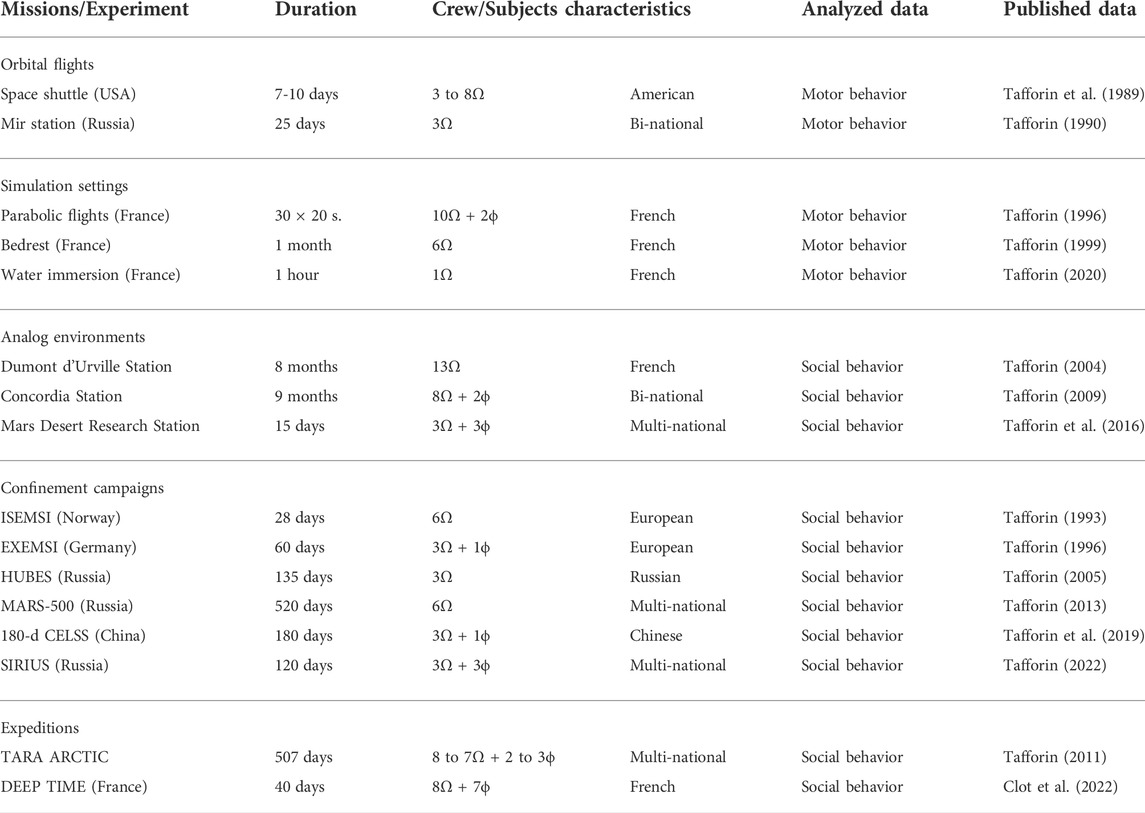
TABLE 1. Data report from ethological method application in real and experimental situations as travel of humans in space and time.
From a general viewpoint, the ethological approach is a noninvasive method that objectively analyzes the spontaneous motor behavior (movements, postures, orientations, and positions) or social behavior (actions, interactions, expressions, and communications) of the individual in any situation of daily life activity, routine work or experimental tests. There are three main phases as methodological tools. Phase 1 is the choice of observation protocol with adequate video recordings or encoding tables. Phase 2 is the collection of observational data by description with the Observer XT® software-based solution. Phase 3 is the procedure of data quantification by descriptive nonparametric statistical tests (Tafforin and Gerebtzoff, 2010; Tafforin, 2017). Exhaustive data analyses are based on broad filtering per subject, per day, per situation, etc. Such studies do not only take into account the result of the behavior, i.e., performances, but also the patterns leading to it, i.e., behavioral strategies.
The three-R adaptation
We analyzed a panel of findings on humans in space and time that emphasized multi-system adaptation to various environments, be it in weightlessness, in confinement or in insolation (Tafforin, 2020a). The behavioral strategies developed over short-term to extended periods of time are built on the new Referential, i.e., when the crewmember uses novel possibilities for body orientations in a tri-dimensional space and for object manipulations in a weightless space. They are built on Rhythms, i.e., when social organization follows nominal changes per period and cycle. They are built on Rituals, i.e., when social interactions and positions increase per special event and cultural habit. During autonomous missions to the Moon or Mars, self-organized crews develop their adaptability to strike a new balance of their usual activities and tasks for mitigating psychosocial issues and to create new living and working habits for wellbeing in unusual conditions. In the literature, ancestral ways of life are portrayed in the same sense. Native tribes in remote places of the word can be organized on such items as well. We suggest a new view on the evolution of astral lifestyles. The three-R adaptation is taken as the assumption.
The three-D system
We investigated the crew’s social behavior in an unprecedented situation beyond time named Deep Time (DT). In the frame of deep space projects, DT expedition offered an opportunity for setting up a new type of analog mission scenario in a natural cave with specificities inherent to such an environment, i.e., large living, recreational and exploring areas, with no time information and without access to sunlight (Clot, 2021). A cohort of multi-board scientists was involved in complementary studies. Cognitive, physiological, sensory and emotional data are currently being analyzed. From the ethological perspective, we may describe the integrative multi-system adaptation in three aspects, using adequate French vocabulary. First Diversité (diversity) is the quality of the crewmembers coming from different horizons by their background, experience, generation and gender. Second, Divertissement (entertainment) is the possibility for the crew to have a wide range of leisure activities to avoid monotony by strolling, tinkering, discovering and contemplating the beauty of the site. Third, Dépendance (dependence) is the security conditions and the sociality mode to share survival and operational tasks in a hostile environment. There are no findings yet but lessons learnt from the recent pandemic situation that constrained people in the world to periods of lockdown. We suggest a new view on the application of living suitably in the astral Universe. The three-D system is taken as the assumption.
Discussion
Further knowledge of human behavior through adaptive strategies in space and time would help to integrate observational, descriptive and quantitative data from ethological sciences to technological sciences in a multidisciplinary framework. Novel perspectives would be to add artificial intelligence to human intelligence for performing additional functions by processes of imitation, cooperation and automation that consider the diversity of the crewmembers, variations in their behavior and autonomy far from Earth (Tafforin, 2020b). The direction of research needed in the next three decades for preparing the first step on Mars, is actually to unite efforts around a crossed-view of humans on the home planet and humans on other planets, and should actively promote sustainable ways of life. The objectives are interplanetary supports both humanistic and logistic.
Manned travel to the red planet is the future of space exploration. We can imagine crews inventing their own Martian culture and ways of contact that do not conform to the roles and rules they experienced in the terrestrial environment. Once on Mars, a micro-society could be created based on social organization, group size, developmental cycle, ecological settings, type of subsistence, and gender balance (Szocik et al., 2020). In the near future, a woman should travel to the Moon and walk on it for the first time.
Author contributions
The author confirms being the sole contributor of this work and has approved it for publication.
Funding
The research works in space ethology are supported by the French Space Agency (CNES) upon annual DAR (Demande d'Aide à la Recherche) contracts.
Acknowledgments
The author thanks the scientific teams and the subjects who participated in all of the mentioned experiments.
Conflict of interest
The author declares that the research was conducted in the absence of any commercial or financial relationships that could be construed as a potential conflict of interest.
Publisher’s note
All claims expressed in this article are solely those of the authors and do not necessarily represent those of their affiliated organizations, or those of the publisher, the editors and the reviewers. Any product that may be evaluated in this article, or claim that may be made by its manufacturer, is not guaranteed or endorsed by the publisher.
References
Bell, S. T., Brown, S. G., and Mitchell, T. (2019). What we know about team dynamics for long-distance space missions: a systematic review of analog research. Front. Psychol. 10, 811. doi:10.3389/fpsyg.2019.00811
Gushin, V., Ryumin, O., Karpova, O., Rozanov, I., Shved, D., and Yusupova, A. (2021). Prospects for psychological support in interplanetary expeditions. Front. Physiol. 12, 750414. doi:10.3389/fphys.2021.750414
Heinicke, C., Poulet, L., Dunn, J., and Meier, A. (2019). Crew self-organization and group-living habits during three autonomous, long-duration Mars analog missions. Acta Astronaut. 182, 160–178. doi:10.1016/j.actaastro.2021.01.049
Jiang, A., Yao, X., Schlacht, I. A., Musso, G., Tang, T., and Westland, S. (2020). “Habitability study on space station colour design,” in Advances in Human aspects of transportation. Editor N. Stanton (Switzerland: Springer Nature), 507–514. doi:10.1007/978-3-030-50943-9_64
Kanas, N. (2020). Spirituality, humanism, and the Overview Effect during manned space missions. Acta Astronaut. 166, 525–528. doi:10.1016/j.actaastro.2018.08.004
Kanas, N., Yusupova, A., and Gushin, V. (2021). Whither the third quarter phenomenon? Aerosp. Med. Hum. Perform. 92 (8), 689–691. doi:10.3357/amhp.5857.2021
Khandelwal, S. K., Bhatia, A., and Mishra, A. K. (2019). Psychological adaptation of Indian expeditioners during prolonged residence in Antarctica. Indian J. Psychiatry 59, 313–319. doi:10.4103/psychiatry.IndianJPsychiatry_296_16
Landon, L. B., Douglas, G. L., Downs, M. E., Greene, M. R., Whitmire, A. M., Zwart, S. R., et al. (2019). The behavioral biology of teams: multidisciplinary contributions to social dynamics in isolated, confined and extreme environments. Front. Psychol. 10, 2571. doi:10.3389/fpsyg.2019.02571
Marcinkowski, M. A., Bell, S., and Roma, P. (2021). The nature of conflict for teams in isolated, confined and extreme environments. Acta Astronaut. 181, 81–91. doi:10.1016/j.actaastro.2021.01.004
Oluwafemi, F. A., Abdelbaki, R., Lai, J. C. Y., Mora-Almanza, J. G., and Afolayan, E. M. (2021). A review of astronaut mental health in manned missions: potential interventions for cognitive and mental health challenges. Life Sci. Space Res. (Amst). 28, 26–31. doi:10.1016/j.lssr.2020.12.002
Palinkas, L. A., and Suedfeld, P. (2021). Psychosocial issues in isolated and confined extreme environments. Neurosci. Biobehav. Rev. 126, 413–429. doi:10.1016/j.neubiorev.2021.03.032
Patel, Z. S., Brunstetter, T., Tarver, W. J., Whitmire, A. M., Zwart, S. R., Smith, S. M., et al. (2020). Red risks for a journey to the red planet: the highest priority human health risks for a mission to Mars. npj Microgravity 6, 33. doi:10.1038/s41526-020-00124-6
Sirmons, T. A., Roma, P. G., Whitmire, A. M., Smith, S. M., Zwart, S. R., Young, M., et al. (2020). Meal replacement in isolated and confined mission environments: consumption, acceptability, and implications for physical and behavioral health. Physiol. Behav. 219, 112829. doi:10.1016/j.physbeh.2020.112829
Šolcovà, I., Vinokhodova, A., Gushin, V., and Kuznetsova, P. (2022). Tend-and-befriend behaviour during spaceflight simulation. Acta Astronaut. 191, 79–87. doi:10.1016/j.actaastro.2021.11.001
Supolkina, N., Yusupova, A., Shved, D., Gushin, V., Savinkina, A., Lebedeva, S., et al. (2021). External communication of autonomous crews under simulation of interplanetary missions. Front. Physiol. 12, 751170. doi:10.3389/fphys.2021.751170
Szocik, K., Abood, S., Impey, C., Shelhamer, M., Haqq-Misra, J., Persson, E., et al. (2020). Visions of a martian future. Futures 117, 102514. doi:10.1016/j.futures.2020.102514
Tafforin, C., and Gerebtzoff, D. (2010). A software-based solution for research in space ethology. Aviat. Space Environ. Med. 81, 951–956. doi:10.3357/ASEM.2780.2010
Tafforin, C. (2017). “Ethological tools application on crews over 6-month periods of confinement for space exploration,” in Global Space Exploration Conference (GLEX 2017), Beijing, China, June 6-8.
Tafforin, C. (2020a). Human's 3R-adaptation for space colonization. J. Humanit Soc. Sci. Stud. 2, 72–82. Available at: https://al-kindipublisher.com/index.php/jhsss/article/view/275.
Tafforin, C. (2020b). in Human missions analysis for intelligent missions improvement in Mars exploration: a step forward. Editors G. Pezzela, and A. Viviani (London: IntechOpen), 113–123. doi:10.5772/intechopen.90795
Van Ombergen, A., Rossiter, A., and Ngo-Anh, T. J. (2020). White Mars' - nearly two decades of biomedical research at the Antarctic Concordia station. Exp. Physiol. 1-12, 6–17. doi:10.1113/EP088352
White, W. F. (2021). The Overview Effect and creative performance in extreme human environments. Front. Psychol. 12, 584573. doi:10.3389/fpsyg.2021.584573
Yuan, M., Custaud, M. A., Xu, Z., Wang, J., Yuan, M., Tafforin, C., et al. (2019). Multi-system adaptation to confinement during the 180-day controlled ecological life support system (CELSS) experiment. Front. Physiol. 10, 575. doi:10.3389/fphys.2019.00575
Keywords: adaptation, humanity, isolated and confined environments, long duration, interplanetary missions, simulation settings
Citation: Tafforin C (2022) Human travels in space and time from ethological perspectives. Front. Space Technol. 3:984851. doi: 10.3389/frspt.2022.984851
Received: 02 July 2022; Accepted: 08 August 2022;
Published: 30 August 2022.
Edited by:
Yosuke Yamashiki, Kyoto University, JapanReviewed by:
Naoko Yamazaki, Space Port Japan Association, JapanCopyright © 2022 Tafforin. This is an open-access article distributed under the terms of the Creative Commons Attribution License (CC BY). The use, distribution or reproduction in other forums is permitted, provided the original author(s) and the copyright owner(s) are credited and that the original publication in this journal is cited, in accordance with accepted academic practice. No use, distribution or reproduction is permitted which does not comply with these terms.
*Correspondence: Carole Tafforin, ZXRob3NwYWNlQG9yYW5nZS5mcg==