 Tuyet-Anh T. Le
 Kelly Vodden
 Jianghua Wu
 Ghada Atiwesh4
- 1School of Science and the Environment, Grenfell Campus, Memorial University of Newfoundland, Corner Brook, NL, Canada
- 2Environmental Policy Institute, Grenfell Campus, Memorial University of Newfoundland, Corner Brook, NL, Canada
- 3Forestry Economics Research Centre, Vietnamese Academy of Forest Sciences, Hanoi, Vietnam
- 4The National Commission for Scientific Research, Tripoli, Libya
Introduction
Studying trade-offs and synergies of ecosystems services (ES) has recently been one of the most emphasized topics within the ES literature, aimed at finding environmentally sustainable solutions in response to the dramatic changes in ES across the globe (Tomscha and Gergel, 2016; Xiangzheng et al., 2016; Zheng et al., 2019). Understanding how to achieve sustainability is a major overarching challenge facing global society in the twenty-first century (Cavender-Bares et al., 2015b). ES provide a great diversity of benefits to humans, such as survival, livelihoods, health, wealth etc. (Costanza et al., 2014). Yet, while seeking these benefits, society puts undue pressure on ecosystems and natural resources, resulting in substantial losses of ES (Perez-verdin et al., 2016) and causing pressure on all aspects of the sustainability, from the economic dimension, e.g., livelihoods, hunger, poverty (Groot et al., 2012), to social issues, e.g., inequality, social well-being, peace, justice, institutions (Henderson and Loreau, 2023), and environmental degradation, e.g., soil losses, water quality deterioration, biodiversity decline (António et al., 2018). Human development that benefits from ES often involves ES trade-offs and doing so in a manner that secures the natural capital needed in delivering services for future generations, is pivotal for sustainable resource management (Cavender-Bares et al., 2015a,b).
ES topics have been studied in diverse ways, mostly focusing on specific perspectives, e.g., ES trade-offs and synergies reviewed under a landscape lens (Castro et al., 2014; Tomscha and Gergel, 2016; Grass et al., 2020), market-based approaches (Royal, 2021), nature-based solutions (Salvatori and Pallante, 2021; Ma et al., 2022), particular aspects of approaches (Zheng et al., 2019), or methods (Baiqiu et al., 2019). Some mention ES trade-offs in a specific biome, e.g., for peatland (Saarikoski et al., 2019), boreal forests (Chen et al., 2016), tropical forests (Naime et al., 2020), dryland ecosystems (Yu et al., 2021a), or biodiversity hotspots/regions (Chisholm, 2010; Maes et al., 2012; Maass et al., 2016; Girardello et al., 2019). Others analyze ES trade-offs/synergies with a focus on various beneficiaries (King et al., 2015), e.g., urban stakeholders (Washbourne et al., 2020), rural, or indigenous communities (Delgado-Serrano, 2017; Wang et al., 2019; Schaafsma et al., 2021; Savari et al., 2022a,c), or through a gender lens (Savari et al., 2022b). There are also some broader reviews of ES trade-offs/synergies by scale (Cavender-Bares et al., 2015a), types of trade-offs (Rodríguez et al., 2006), for human well-being (Howe et al., 2014; Daw et al., 2015; Liu et al., 2022), or drawing from empirical research observations (Aryal et al., 2022). Some recent studies, such as Cord et al. (2017) describe the relationships between ES conflicts (“trade-offs”) and synergistic (“synergies”), while Zheng et al. (2019) introduce a framework to analyze the ES types, drivers, and integrated approaches to minimize ES trade-offs. However, optimal perspectives have not been mentioned in these frameworks. Further, “there is not one classification scheme that will be adequate for the many contexts in which ES research may be utilized” (Fisher et al., 2009, p. 643). Thus, in various contexts for ES assessment, each context requires different perspectives, or need to be evaluated by integrating different lenses for each dimension to achieve comprehensiveness and/or inclusiveness. In general, although these numerous dimensions have been explored, determining which core determinants govern ES trade-offs/synergies, as well as the relationships between them and how to minimize ES trade-offs and maximize positive synergies of ES to achieve win-win outcomes remains a considerable challenge for sustainability. Accordingly, our objectives are to propose an appropriate framework that is based on the relevant previous studies to contribute to answering these outstanding questions. In doing so we aim to enhance understanding of key factors and relationships at play in minimizing ES trade-offs and maximizing positive ES synergies.
Literature related to ES and sustainability was selected and reviewed from the Web of Science and Scopus databases, with a focus on ES trade-offs and synergies (or win-win outcomes). This led to a proposed framework for understanding the multiple dimensions of ES trade-offs and synergies (Figure 1) in seeking sustainability outcomes. To achieve ES win-win outcomes (F) toward sustainability (G), we propose that four main domains need to be considered in minimizing ES trade-offs and maximizing positive ES synergies (E), including ES types or values (A), demand types (B), drivers (C), and coordinating approaches (D). This opinion article, thus, provides a comprehensive view of the relationships between these domains by synthesizing their current situations according to their relevant achievements/strengths (), weaknesses/challenges () and corresponding recommendations ().
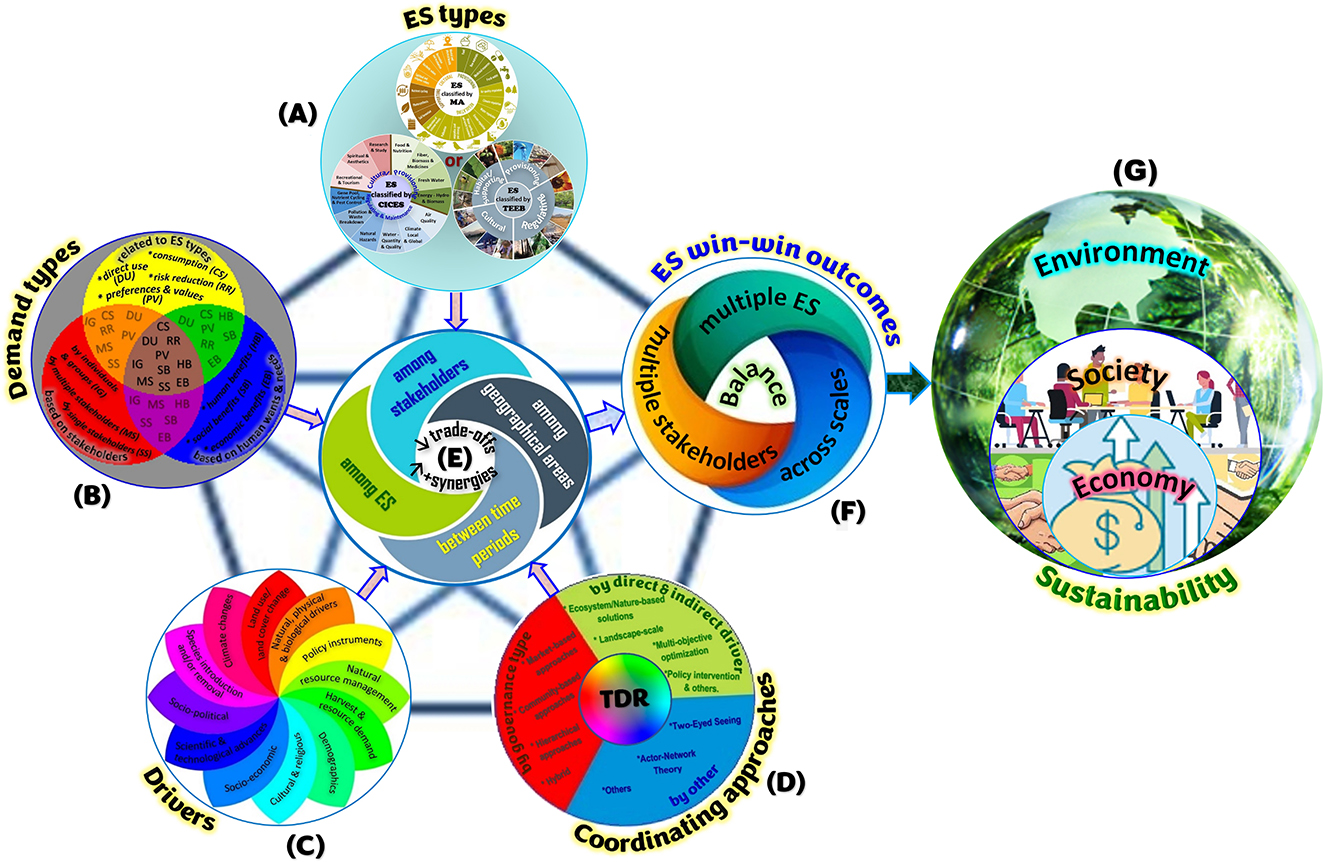
Figure 1. The analytical framework for minimizing ES trade-offs and maximizing positive ES synergies (E) from the relationships with the ES types (A), demand types (B), drivers (C) and approaches (D) for the win-win outcomes (F), and sustainability (G). (A) Adapted from MA (2005), Haines-Young and Potschin (2010), TEEB (2010); (B) classified by ES involvement, by human want and need, and by stakeholder (adapted from Wolff et al., 2015; Chen et al., 2019, and Zheng et al., 2019, respectively); (C) adapted from Wolff et al. (2015), Dade et al. (2019); (D) classified by governance type, by direct and indirect driver (adapted from Sattler et al., 2018; Zheng et al., 2019, respectively) and by other [e.g., Two-Eyed-Seeing (Buxton et al., 2021), Actor-Network theory (Ernstson, 2013), transdisciplinary research (TDR) (Quintas-Soriano et al., 2018; Auerswald et al., 2019; Aryal et al., 2022), etc.]; (E) adapted from TEEB (2010), Cohen-shacham et al. (2019); (F) adapted from Zheng et al. (2019); (G) adapted from Wu (2013).
The key relationships to minimize ES trade-offs and maximize positive ES synergies toward sustainability
From ES types (A) to ES trade-offs and ES synergies (E)
ES play essential roles for human well-being (Harrison et al., 2014; Maass et al., 2016). Ecosystems provide us with diverse ES through four service groups: provisioning (e.g., food and raw materials), regulating (e.g., water quality regulation and pollination), cultural (e.g., recreation and ecotourism) and supporting (e.g., nutrient cycling and photosynthesis) (MA, 2005; Haines-Young and Potschin, 2010; TEEB, 2010) (). Notably, trade-offs are everywhere in a world with resource constraints and value preferences (Yu et al., 2021a). Trade-offs are also a typical characteristic of the complex dynamics in interdependent social-ecological systems (Galafassi et al., 2017). Trade-offs among ES, for example, arise when the provision of one ES is reduced due to increased use of another ES (Rodríguez et al., 2006; Dade et al., 2019; Schaafsma and Bartkowski, 2021) or when one party earns one ES benefit at the expense of another (Schaafsma and Bartkowski, 2021) (). In contrast, synergies occur when two ES increase or decrease simultaneously (Dade et al., 2019) ( or ).
There are different understandings about ES trade-offs and synergies, and trade-offs are not necessarily a negative thing (Yu et al., 2021a). A trade-off mindset inspires us to find the existing imperfections and reinforce management approaches that make the most rational option under restricted conditions (Station et al., 2019; Yu et al., 2021a). One of the most common classifications of ES trade-offs is proposed by the Economics of Ecosystems and Biodiversity assessment (TEEB, 2010) with four types: spatial trade-offs, temporal trade-offs, trade-offs between beneficiaries, and trade-offs among ES (Zheng et al., 2019) (E). Spatial trade-offs often represent spatial relationships among various ES caused by spatial differences in ES supply and demand capacities (Rodríguez et al., 2006; Yu et al., 2021b). Temporal trade-offs indicate the relationship between current and future conditions (Mutzel et al., 2013), or refer to whether the effects take place relatively slowly or rapidly (Rodríguez et al., 2006). Types of relationship between ES and the multiple dimensions of ES trade-offs and synergies are generally based on interactions between objectives, i.e., spatially heterogeneous and temporal variability of ES (Baiqiu et al., 2019), or management choices made by humans (Rodríguez et al., 2006). And these lead to three types of interactions, negative (Muniz and Cruz, 2015; Baiqiu et al., 2019; Dade et al., 2019), positive (Muniz and Cruz, 2015; Baiqiu et al., 2019; Dade et al., 2019), and neutrality (Baiqiu et al., 2019).
The concept of ES is utilized for many approaches in sustainability science to characterize the interdependence of human well-being and the environment (King et al., 2015). Depending on different research contexts, assessment of ES, including ES trade-offs and synergies, is typically derived from one of several different perspectives of ES classifications, including the report of the Millennium Ecosystem Assessment (MA, 2005), the Economics of Ecosystems and Biodiversity (TEEB, 2010), the Common International Classification for ES (CICES) (Haines-Young and Potschin, 2010) (see Cavender-Bares et al., 2015a,b; Zheng et al., 2019; Liu et al., 2022) or various ES classifications (see for examples, Howe et al., 2014; Lee and Lautenbach, 2016; Xiangzheng et al., 2016; Cord et al., 2017; McDonough et al., 2017; Baiqiu et al., 2019). Reliance on different ES classifications is often used for the study types of reviewed and/or systematic reviews because the databases for analysis are often selected from different sources of previous studies. Given the variety of alternatives and study contexts we agree with Fisher et al. (2009, p. 643) that “any attempt at classifying ES should be based on both the characteristics of the ecosystems of interest and a decision context for which the concept of ES is being mobilized.”
Natural regeneration of ecosystems is considered as crucial in recovering essential ES for humanity (Naime et al., 2020). Yet natural regeneration can not avoid trade-offs and synergies across ES and across stakeholders (Naime et al., 2020) (A → E: /). In a recent review of trade-offs in ES with 473 empirical studies conducted in over 80 countries, Aryal et al. (2022) have pointed out that ES trade-offs occur among and within all four categories of ES, with the highest frequency of trade-offs being related to relationship provisioning—regulating services (62%), followed by provisioning—supporting (45%), provisioning—cultural ES (25%), and regulating and supporting ES (15%) (A → E). More than two-thirds of these studies were implemented in developed countries of the temperate region and sub-tropical climatic zones and about 90% of these studies received research funding (Aryal et al., 2022). This implies that ES trade-offs research in globally significant ecosystem hotspots in the tropics, mostly in developing countries, are difficult to assess given lack of primary data or limited investment by donors from advanced countries or funding organizations (Aryal et al., 2022) (). This is also a significant research gap for environmental and sustainability research more generally (Tang et al., 2018; Nita, 2019) because the research system in developed countries is stronger (Nita, 2019), and therefore developing countries have a less significant effect on environmental and sustainability publications (Tang et al., 2018). Therefore, adequate technical and financial support for the developing regions in the hyper-diverse tropical region and climate sensitive zones is needed (Aryal et al., 2022) ().
From ES demand types (B) and ES drivers (C) to others
ES supply and ES demand are linked together by ES flows through delivering goods and services to benefiting areas (Wolff et al., 2015; Yu et al., 2021a) (). Based on different ES categories, there are four distinct demand types identified: risk reduction, preferences and values, direct use, or consumption of goods and services (Wolff et al., 2015) (A → B). Based on human wants and needs from ES, there are social, economic and human benefits (Chen et al., 2019). Based on beneficiaries, multiple ES are provided for single stakeholders, diverse stakeholders, and both individuals and groups (Zheng et al., 2019) (B). Meeting these various demands requires negotiating trade-offs among different options and values that are posited by multiple stakeholders and organizations (Ellis et al., 2019) (B → E). Meanwhile, “positive (synergistic) and negative (trade-off) relationships among ES are influenced by drivers of change, such as policy interventions and environmental variability, and the mechanisms that link these drivers to ES outcomes” (Dade et al., 2019), p. 1116 (C → E: /; C → F: /). Indeed, ES relationships can be affected by drivers in multiple ways (Dade et al., 2019). There are four main interactions influenced by a driver: (1) the supply of one ES directly influenced, with no effect on other ES; (2) a single ES with either a unidirectional (one way) or bidirectional (two way) interaction with another ES; (3) two ES with no interaction with each other directly affected; (4) two ES with either a unidirectional or bidirectional interaction between them directly affected (Dade et al., 2019) (C → A). Drivers of ES trade-offs and synergies can be classified into two groups, drivers of ecosystem changes (i.e., climate changes, land use/land cover change, natural, physical, biological drivers) and drivers of socio-economic changes (i.e., policy instruments, socio-political, socio-economic, cultural and religious, demographics, etc.) (Wolff et al., 2015; Dade et al., 2019). Failure to consider these drivers and their mechanisms can lead to ill-informed management decisions and decreased ability of ES delivery (Dade et al., 2019) (). Conversely, at least, the identification of these drivers and their mechanisms is crucial in discovering whether trade-offs or synergies between ES are likely to occur (Dade et al., 2019) (). For example, due to increasing temperatures in boreal forests from global climate change, the rate of soil nutrient cycling is decreased. Likewise, the mechanisms of this rate influences two final ES, below ground carbon storage and maintenance of soil fertility. In other words, climbing temperatures is a driver to promote a negative synergy between these two services (Allison and Kathleen, 2008) ().
From coordinating participatory approaches (D) to ES trade-offs/synergies (E) and others
To navigate ES trade- offs, it is important to enhance approaches for processes of decision-making (Schaafsma and Bartkowski, 2021) (). Rooted in direct and indirect drivers, approaches including ecosystem, landscape-scale, multi-objective optimization, and policy interventions among others can be used to diminish ES trade-offs (Zheng et al., 2019) (D). Interestingly, nature-based solutions—one type derived from the ecosystem approach, are increasingly applied as one of the most effective choices to “recognize and address the trade-offs between the production of a few immediate economic benefits for development, and future options for the production of the full range of ES” (Cohen-shacham et al., 2019, p. 24) to support conservation and sustainable development objectives (Cohen-shacham et al., 2019; Seddon et al., 2020; Babí et al., 2021; Pan et al., 2021; Ma et al., 2022) (). Minimizing ES trade-offs and/or maximizing positive ES synergies can also be achieved by using other approaches, e.g., market-based approaches (Crookes et al., 2013; Ecology et al., 2021), community-based approaches (Mistry et al., 2017), two-eyed-seeing seeing (Buxton et al., 2021), actor-network theory (Ernstson, 2013), transdisciplinary research (TDR) approach (Quintas-Soriano et al., 2018; Auerswald et al., 2019; Aryal et al., 2022) (). Strikingly, among all these approaches, the role of stakeholders' participation is the most commonly emphasized characteristic as it is paramount in addressing environmental problems for sustainability (Grifoni et al., 2014). In fact, the involvement of all human actors, i.e., governments, communities, non-government organizations, companies (both for production and services) is needed to accelerate the transition toward a sustainable society (Grifoni et al., 2014). Public involvement implies the active participation of people from planning processes to decision-making and activities toward environmental sustainability (Grifoni et al., 2014). “Participation” is linked to “bottom-up processes” and “comprehensive governance” that enable collective awareness of environmental issues and obligate relevant institutions to incorporate greater transparency into their rules and policies (Grifoni et al., 2014) (). This participation is needed from the information/feedback level, to consultation, collaboration, negotiation, and empowerment, increasingly facilitated by online interaction (Stauffacher et al., 2010; Grifoni et al., 2014). Nevertheless, there are still conceptual and empirical gaps in participatory approaches that if addressed can contribute to the development of an improved understanding about trade-off dynamics and the capacities to handle them (Galafassi et al., 2017) ().
Another important point in the emerging literature is the very close relationship between participatory approaches and TDR in solving environmental problems (Maheshwari et al., 2014; Grove and Pickett, 2019; White et al., 2021; Kim et al., 2022; Le, 2022). TDR is widely understood as a process to address one or more specific complex problem(s) through interdisciplinary research (cooperating from different disciplines) and participatory approaches, with mutual learning from inside and outside academia (Lang et al., 2012). TDR applications for ES aim to contribute to the world's most pressing environmental challenges (Munns et al., 2015; Steger et al., 2021). Accordingly, TDR may reveal ES supply, ES demands and ES drivers (Edrisi and Abhilash, 2021; White et al., 2021) (). This approach also allows for identification of ES trade-offs and synergies for supporting the vitality of natural resources, thereby helping minimize the trade-offs in the degraded ecosystems and maximize various co-benefits (Quintas-Soriano et al., 2018; Auerswald et al., 2019; Edrisi and Abhilash, 2021) ().
In the context of the Decade 2021-2030 on Ecosystem Restoration for preventing, halting, and reversing ecosystem degradation globally (Edrisi and Abhilash, 2021; Fischer et al., 2021), TDR might provide the way to explore new dimensions, identify, understand, and analyze the hidden issues of ES by applying appropriate different disciplines (whereas they might be overlooked by a single discipline), and provide novel solutions to complex problems in the real world co-developed by diverse stakeholders (Blythe et al., 2017; Edrisi and Abhilash, 2021) (). Furthermore, the integration of TDR with other rational approaches will allow for comprehensive discovery of “win-win” outcomes to sustainability challenges (Bergendahl et al., 2018; Zheng et al., 2019). For example, to understand community-based fisheries management in the Pacific, a natural science approach helps discover biological drivers of community-based management, while a social science approach is applied to detect the socio-cultural dimensions of community-management, and using a social–ecological approach aims to investigate the relationships between reef closures, fishers' behavior, and marine biomass (Blythe et al., 2017) ().
To contribute to mitigating ES trade-offs, promoting the conservation of ecosystems and enhancing livelihoods, in recent decades, a number of environmental initiatives such as payments for ecosystem services (PES) and Reducing Emissions from Deforestation and Forest Degradation (REDD+) have been applied from local to global scale (Friess et al., 2015; Bladon et al., 2016; Nava-lópez et al., 2018; Yang et al., 2018; Perevochtchikova et al., 2021). Although market-based approaches and/or PES outcomes and for sustainability remain controversial (Redford and Adams, 2009; Gómez-Baggethun et al., 2010; Van Hecken et al., 2015; Yang et al., 2018; Kaiser et al., 2021), it is undeniable that the growth of PES programs have focused on the dual goals of improving ES and contributing to poverty alleviation, especially for the rural poor in developing countries (Gauvin et al., 2010). This example points out that policy intervention and market instruction are also necessary approaches (Zheng et al., 2019). With the wicked problems that these practical policies (e.g., PES, REDD+, etc.) need to address, a TD approach is necessary (Farley and Costanza, 2010; Costanza et al., 2017; Conner, 2022) ().
Conclusions
Overall, ES trade-offs have been seen as one of the most important current sustainability issues (Seppelt et al., 2011; Börner et al., 2017; Schaafsma et al., 2021; Aryal et al., 2022), because understanding ES trade-offs and synergies is essential to manage multi-functional ecosystems better and to minimize costly trade-offs (Baiqiu et al., 2019). In seeking to help address this issue, this study firstly stresses the need for more comprehensive thinking in understanding the core ES determinants and their relationships affecting ES trade-offs and synergies. To maximize co-benefits and minimize conflicts between various ES trade-offs (E), in addition to considering prerequisite factors, i.e., ES types/values (A), ES demands (B), and ES drivers (C), this study strongly calls for TDR approaches (D) to understanding and resolving ES issues (Costanza et al., 2014; Quintas-Soriano et al., 2018; Kim et al., 2022; Le, 2022), including ES trade-offs for improving sustainability (Cundill et al., 2005; Quintas-Soriano et al., 2018; Auerswald et al., 2019; Aryal et al., 2022). The increasingly influential ES-centered paradigm of sustainability requires a continuing search for so-called “win–win–win” goals, as economic activities are part of the social domain, and both economy and society are constrained and supported by the environment (Wu, 2013) (). In the context of the critical state of ecosystems worldwide, applying related policies instruments, such as PES and REDD+ is emphasized as a promising solution to respond to the degradation of ecosystems (Kaiser et al., 2021). Yet, their effective implementation requires a TD approach (Farley and Costanza, 2010; Costanza et al., 2017; Conner, 2022). Through proposing an analytical framework for minimizing ES trade-offs and maximizing positive ES synergies our discussion may assist policymakers in seeking better strategies for ES sustainability. Lastly, we note that the framework to minimize ES trade-offs and maximize synergies introduced in this study mainly aims to focus on a logic of linking the major factors concerned, understanding these relationships and dynamics. An understanding of specific contexts is also required in seeking appropriate perspectives related to each factor dimension as well as policy solutions for these specific ES contexts.
Author contributions
T-AL created the idea for the paper and conducted the literature review, wrote the initial manuscript, and revised for the final version based on feedback from the co-authors and reviewers. KV, JW, and GA revised and contributed to the development and completion of this article. All authors contributed to the article and approved the submitted version.
Acknowledgments
This paper was developed from the lead author's comprehensive examination (in Winter, 2022) in the PhD Transdisciplinary Sustainability program for the first group of students (2021–2024) of Grenfell campus, Memorial University of Newfoundland (MUN), Canada. She would like to thank all supports funded by a joint PhD scholarship between the Vietnamese Government and the School of Graduate Studies (MUN) (2018–2020) and the great funding jointed by her co-supervisors and the MUN (2021–2022). We also would like to thank the Open Access funding enabled and organized by Environmental Policy Institute (EPI), Grenfell Campus (MUN). The authors also would like to express my great appreciation to Dr. Gabriela Sabau and Dr. Joseph Bowden at Grenfell (MUN) for their helpful comments. We also would like to send our sincere thanks to three reviewers for their valuable comments and suggestions on the manuscript.
Conflict of interest
The authors declare that the research was conducted in the absence of any commercial or financial relationships that could be construed as a potential conflict of interest.
Publisher's note
All claims expressed in this article are solely those of the authors and do not necessarily represent those of their affiliated organizations, or those of the publisher, the editors and the reviewers. Any product that may be evaluated in this article, or claim that may be made by its manufacturer, is not guaranteed or endorsed by the publisher.
References
Allison, S. D., and Kathleen, K. T. (2008). Warming and drying suppress microbial activity and carbon cycling in boreal forest soils. Glob. Chang. Biol. 14, 2898–2909. doi: 10.1111/j.1365-2486.2008.01716.x
António, F., Pacheco, L., Filipe, L., Fernandes, S., Farias, R., Junior, V., et al. (2018). Land degradation: Multiple environmental consequences and routes to neutrality. Curr. Opin. Environ. Sci. Heal. 5, 79–86. doi: 10.1016/j.coesh.2018.07.002
Aryal, K., Maraseni, T., and Apan, A. (2022). How much do we know about trade-offs in ecosystem services? A systematic review of empirical research observations. Sci. Total Environ. 806, 151229. doi: 10.1016/j.scitotenv.2021.151229
Auerswald, K., Moyle, P., Seibert, S. P., and Geist, J. (2019). HESS Opinions: Socio-economic and ecological trade-offs of flood management-benefits of a transdisciplinary approach. Hydrol. Earth Syst. Sci. 23, 1035–1044. doi: 10.5194/hess-23-1035-2019
Babí, J., Elliot, T., Rugani, B., Philippe, B., Navarrete, T., Sonnemann, G., et al. (2021). Nexus between nature-based solutions, ecosystem services and urban challenges. Land Use Policy 100, 22. doi: 10.1016/j.landusepol.2020.104898
Baiqiu, W. U., Junbang, W., Shuhua, Q. I., Shaoqiang, W., and Yingnian, L. I. (2019). Review of methods to quantify trade-offs among ecosystem services and future model developments. J. Resour. Ecol. 10, 225–233. doi: 10.5814/j.issn.1674-764x.2019.02.013
Bergendahl, J. A., Sarkis, J., and Timko, M. T. (2018). Transdisciplinarity and the food energy and water nexus: Ecological modernization and supply chain sustainability perspectives. Resour. Conserv. Recycl. 133, 309–319. doi: 10.1016/j.resconrec.2018.01.001
Bladon, A. J., Short, K. M., Mohammed, E. Y., and Milner-Gulland, E. J. (2016). Payments for ecosystem services in developing world fisheries. Fish Fish. 17, 839–859. doi: 10.1111/faf.12095
Blythe, J., Nash, K., Yates, J., and Cumming, G. (2017). Feedbacks as a bridging concept for advancing transdisciplinary sustainability research. Curr. Opin. Environ. Sustain. 26–27 114–119. doi: 10.1016/j.cosust.2017.05.004
Börner, J., Baylis, K., Corbera, E., Ezzine-de-Blas, D., Honey-Rosés, J., Persson, U. M., et al. (2017). The effectiveness of payments for environmental services. World Dev. 96, 359–374. doi: 10.1016/j.worlddev.2017.03.020
Buxton, R. T., Bennett, J. R., Reid, A. J., Shulman, C., Cooke, S. J., Francis, C. M., et al. (2021). Key information needs to move from knowledge to action for biodiversity conservation in Canada. Biol. Conserv. 256, 1–9. doi: 10.1016/j.biocon.2021.108983
Castro, A. J., Verburg, P. H., Martín-lópez, B., Garcia-llorente, M., Cabello, J., Vaughn, C. C., et al. (2014). Ecosystem service trade-offs from supply to social demand: A landscape-scale spatial analysis. Landsc. Urban Plan. 132, 102–110. doi: 10.1016/j.landurbplan.2014.08.009
Cavender-Bares, J., Balvanera, P., King, E., and Polasky, S. (2015a). Ecosystem service trade-offs across global contexts and scales. Ecol. Soc. 20, 5. pp. doi: 10.5751/ES-07137-200122
Cavender-Bares, J., Polasky, S., King, E., and Balvanera, P. (2015b). A sustainability framework for assessing trade-offs in ecosystem services. Ecol. Soc. 20, 12. pp. doi: 10.5751/ES-06917-200117
Chen, J., Jiang, B., Bai, Y., Xu, X., and Alatalo, J. M. (2019). Quantifying ecosystem services supply and demand shortfalls and mismatches for management optimisation. Sci. Total Environ. 650, 1426–1439. doi: 10.1016/j.scitotenv.2018.09.126
Chen, S., Shahi, C., and Chen, H. Y. H. (2016). Economic and ecological trade-off analysis of forest ecosystems: options for boreal forests. Environ. Rev. 24, 348–361. doi: 10.1139/er-2015-0090
Chisholm, R. A. (2010). Trade-offs between ecosystem services: Water and carbon in a biodiversity hotspot. Ecol. Econ. 69, 1973–1987. doi: 10.1016/j.ecolecon.2010.05.013
Cohen-shacham, E., Andrade, A., Dalton, J., Dudley, N., Jones, M., Kumar, C., et al. (2019). Core principles for successfully implementing and upscaling Nature-based Solutions. Environ. Sci. Policy 98, 20–29. doi: 10.1016/j.envsci.2019.04.014
Conner, D. S. (2022). Transdisciplinary research for wicked problems: a transaction costs approach. Agric. Human Values 39, 1169–1172. doi: 10.1007/s10460-022-10368-5
Cord, A. F., Bartkowski, B., Beckmann, M., Dittrich, A., Hermans-neumann, K., Kaim, A., et al. (2017). Towards systematic analyses of ecosystem service trade-offs and synergies: Main concepts , methods and the road ahead. Ecosyst. Serv. 28, 264–272. doi: 10.1016/j.ecoser.2017.07.012
Costanza, R., de Groot, R., Braat, L., Kubiszewski, I., Fioramonti, L., Sutton, P., et al. (2017). Twenty years of ecosystem services: How far have we come and how far do we still need to go? Ecosyst. Serv. 28, 1–16. doi: 10.1016/j.ecoser.2017.09.008
Costanza, R., De Groot, R., Sutton, P., Ploeg, S., Van Der Anderson, S. J., Kubiszewski, I., et al. (2014). Changes in the global value of ecosystem services. Glob. Environ. Chang. 26, 152–158. doi: 10.1016/j.gloenvcha.2014.04.002
Crookes, D. J., Blignaut, J. N., De Wit, M. P., Esler, K. J., Le Maitre, D. C., Milton, S. J., et al. (2013). System dynamic modelling to assess economic viability and risk trade-offs for ecological restoration in South Africa. J. Environ. Manage. 120, 138–147. doi: 10.1016/j.jenvman.2013.02.001
Cundill, G. N. R., Fabricius, C., and Marti, N. (2005). Foghorns to the future: Using knowledge and transdisciplinarity to navigate complex systems. Ecol. Soc. 10. doi: 10.5751/ES-01444-100208
Dade, M. C., Mitchell, M. G. E., Mcalpine, C. A., Rhodes, J. R. (2019). Assessing ecosystem service trade-offs and synergies: The need for a more mechanistic approach. Ambio 48, 1116–1128. doi: 10.1007/s13280-018-1127-7
Daw, T. M., Coulthard, S., Cheung, W. W. L., Brown, K., Abunge, C., Galafassi, D., et al. (2015). Evaluating taboo trade-offs in ecosystems services and human well-being. Proc. Natl. Acad. Sci. 112, 6949–6954. doi: 10.1073/pnas.1414900112
Delgado-Serrano, M. M. (2017). Trade-offs between conservation and development in community-based management initiatives. Int. J. Commons 11, 969–991. doi: 10.18352/ijc.792
Ecology, N., Booth, H., Arlidge, W. N. S., Fisheries, I., Squires, D., Fisheries, S., et al. (2021). Bycatch levies could reconcile trade-offs between blue growth and biodiversity conservation. Nat. Ecol. E5, 715–725. doi: 10.1038/s41559-021-01444-w
Edrisi, S. A., and Abhilash, P. C. (2021). Need of transdisciplinary research for accelerating land restoration during the UN Decade on Ecosystem Restoration. Restor. Ecol.29:e13531 doi: 10.1111/rec.13531
Ellis, E. C., Pascual, U., and Mertz, O. (2019). Ecosystem services and nature's contribution to people: negotiating diverse values and trade-offs in land systems. Curr. Opin. Environ. Sustain. 38, 86–94. doi: 10.1016/j.cosust.2019.05.001
Ernstson, H. (2013). The social production of ecosystem services: A framework for studying environmental justice and ecological complexity in urbanized landscapes. Landsc. Urban Plan. 109, 7–17. doi: 10.1016/j.landurbplan.2012.10.005
Farley, J., and Costanza, R. (2010). Payments for ecosystem services: from local to global. Ecol. Econ. 69, 2060–2068. doi: 10.1016/j.ecolecon.2010.06.010
Fischer, J., Riechers, M., Loos, J., Martin-Lopez, B., and Temperton, V. M. (2021). Making the UN decade on ecosystem restoration a social-ecological endeavour. Trends Ecol. E36, 20–28. doi: 10.1016/j.tree.2020.08.018
Fisher, B., Turner, R. K., and Morling, P. (2009). Defining and classifying ecosystem services for decision making. Ecol. Econ. 68, 643–653. doi: 10.1016/j.ecolecon.2008.09.014
Friess, D. A., Phelps, J., Garmendia, E., and Gómez-Baggethun, E. (2015). Payments for Ecosystem Services (PES) in the face of external biophysical stressors. Glob. Environ. Chang. 30, 31–42. doi: 10.1016/j.gloenvcha.2014.10.013
Galafassi, D., Daw, T. M., Munyi, L., Brown, K., and Barnaud, C. (2017). Learning about social-ecological trade-offs. Ecol. Soc. 22, 1–13. doi: 10.5751/ES-08920-220102
Gauvin, C., Uchida, E., Rozelle, S., Xu, J., and Zhan, J. (2010). Cost-effectiveness of payments for ecosystem services with dual goals of environment and poverty alleviation. Environ. Manage. 45, 488–501. doi: 10.1007/s00267-009-9321-9
Girardello, M., Santangeli, A., Mori, E., Chapman, A., Fattorini, S., Naidoo, R., et al. (2019). Global synergies and trade-offs between multiple dimensions of biodiversity and ecosystem services. Sci. Rep. 9, 1–8. doi: 10.1038/s41598-019-41342-7
Gómez-Baggethun, E., de Groot, R., Lomas, P. L., and Montes, C. (2010). The History of Ecosystem Services in Economic Theory and Practice: From Early Notions to Markets and Payment Schemes. Ecol. Econ. 69, 1209–1218. doi: 10.1016/j.ecolecon.2009.11.007
Grass, I. (2020). Trade-offs between multifunctionality and profit in tropical smallholder landscapes. Nat. Commun. 11, 1–13. doi: 10.1038/s41467-020-15013-5
Grifoni, P., Guzzo, T., and Ferri, F. (2014). Environmental Sustainability and Participatory Approaches: the Case of Italy. J. Sustain. Dev. 7, 1–12. doi: 10.5539/jsd.v7n3p1
Groot, R., De Brander, L., Ploeg, S., Van Der Costanza, R., Bernard, F., Braat, L., et al. (2012). Global estimates of the value of ecosystems and their services in monetary units. Ecosyst. Serv. 1, 50–61. doi: 10.1016/j.ecoser.2012.07.005
Grove, J. M., and Pickett, S. T. (2019). From transdisciplinary projects to platforms: expanding capacity and impact of land systems knowledge and decision making. Curr. Opin. Environ. Sustain. 38, 7–13. doi: 10.1016/j.cosust.2019.04.001
Haines-Young, R., andPotschin, M. (2010). Proposal for a common international classification of ecosystem goods and services (CICES) for integrated environmental and economic accounting. Eur. Environ. Agency. 30.
Harrison, P. A., Berry, P. M., Simpson, G., Haslett, J. R., Blicharska, M., Bucur, M., et al. (2014). Linkages between biodiversity attributes and ecosystem services: A systematic review. Ecosyst. Serv. 9, 191–203. doi: 10.1016/j.ecoser.2014.05.006
Henderson, K., and Loreau, M. (2023). A model ofSustainable Development Goals: Challenges and opportunities in promoting human well-being and environmental sustainability. Ecol. Modell. 475, 110164. doi: 10.1016/j.ecolmodel.2022.110164
Howe, C., Suich, H., Vira, B., and Mace, G. M. (2014). Creating win-wins from trade-offs? Ecosystem services for human well-being: A meta-analysis of ecosystem service trade-offs and synergies in the real world. Glob. Environ. Chang. 28, 263–275. doi: 10.1016/j.gloenvcha.2014.07.005
Kaiser, J., Haase, D., and Krueger, T. (2021). Payments for ecosystem services: a review of definitions, the role of spatial scales, and critique. Ecol. Soc. 26. doi: 10.5751/ES-12307-260212
Kim, M. K., Douglas, M. M., Pannell, D., Setter, S. A., Hill, R., Laborde, S., et al. (2022). When to Use Transdisciplinary Approaches for Environmental Research. Front. Environ. Sci. 10, 1–10. doi: 10.3389/fenvs.2022.840569
King, E., Cavender-Bares, J., Balvanera, P., Mwampamba, T. H., and Polasky, S. (2015). Trade-offs in ecosystem services and varying stakeholder preferences: Evaluating conflicts, obstacles, and opportunities. Ecol. Soc. 20. doi: 10.5751/ES-07822-200325
Lang, D. J., Wiek, A., Bergmann, M., Stauffacher, M., Martens, P., Moll, P., et al. (2012). Transdisciplinary research in sustainability science: practice, principles, and challenges. Sustain. Sci. 7, 25–43. doi: 10.1007/s11625-011-0149-x
Le, T. A. T. (2022). Transdisciplinary research in valuing forest ecosystem services for sustainability: the importance and challenges. Front. Ecol. E10, 6pp. doi: 10.3389/fevo.2022.859748
Lee, H., and Lautenbach, S. (2016). A quantitative review of relationships between ecosystem services. Ecol. Indic. 66, 340–351. doi: 10.1016/j.ecolind.2016.02.004
Liu, M., Dong, X., Wang, X., Zhao, B., Wei, H., Fan, W., et al. (2022). The Trade-Offs/Synergies and Their Spatial-Temporal Characteristics between Ecosystem Services and Human Well-Being Linked to Land-Use Change in the Capital Region of China. Land 11, 1–22. doi: 10.3390/land11050749
MA (2005). Millennium Ecosystem Assessment-Ecosystems and Human Well-being: Synthesis. Washington, DC, USA: MA (2005).
Ma, S., Wang, H., Zhang, X., Wang, L., and Jiang, J. (2022). A nature-based solution in forest management to improve ecosystem services and mitigate their trade-offs. J. Clean. Prod. 351, 11. pp. doi: 10.1016/j.jclepro.2022.131557
Maass, M., Balvanera, P., Bourgeron, P., Equihua, M., Baudry, J., Dick, J., et al. (2016). Changes in biodiversity and trade-offs among ecosystem services, stakeholders, and components of well-being: the contribution of the International Long-Term Ecological Research network (ILTER) to Programme on Ecosystem Change and Society (PECS). Ecol. Soc. 21. doi: 10.5751/ES-08587-210331
Maes, J., Paracchini, M. L., Zulian, G., Dunbar, M. B., Alkemade, R. (2012). Synergies and trade-offs between ecosystem service supply, biodiversity, and habitat conservation status in Europe. Biol. Conserv. 155, 1–12. doi: 10.1016/j.biocon.2012.06.016
Maheshwari, B., Varua, M., Ward, J., Packham, R., Chinnasamy, P., Dashora, Y., et al. (2014). The role of transdisciplinary approach and community participation in village scale groundwater management insights from Gujarat and Rajasthan, India. Water 6, 3386–3408. w6113386. doi: 10.3390/w6113386
McDonough, K., Hutchinson, S., Moore, T., Hutchinson, J. M. S. (2017). Analysis of publication trends in ecosystem services research. Ecosyst. Serv. 25, 82–88. doi: 10.1016/j.ecoser.2017.03.022
Mistry, J., Matzdorf, B., and Leclerc, G. (2017). Community-based management of environmental challenges in Latin America and the Caribbean. Ecol. Soc. 22, 9. pp. doi: 10.5751/ES-08924-220104
Muniz, R., and Cruz, M. J. (2015). Making nature valuable, not profitable: Are payments for ecosystem services suitable for degrowth? Sustain. 7, 10895–10921. su70810895. doi: 10.3390/su70810895
Munns, W. R., Rea, A. W., Mazzotta, M. J., Wainger, L. A., and Saterson, K. (2015). Toward a standard lexicon for ecosystem services. Integr. Environ. Assess. Manag. 11, 666–673. doi: 10.1002/ieam.1631
Mutzel, A., Blom, M. P. K., Spagopoulou, F., Wright, J., Dingemanse, N. J., Kempenaers, B., et al. (2013). Temporal trade-offs between nestling provisioning and defence against nest predators in blue tits. Anim. Behav. 85, 1459–1469. doi: 10.1016/j.anbehav.2013.03.043
Naime, J., Mora, F., Sánchez-Martínez, M., Arreola, F., and Balvanera, P. (2020). Economic valuation of ecosystem services from secondary tropical forests: trade-offs and implications for policy making. For. Ecol. Manage. 473, 118294. doi: 10.1016/j.foreco.2020.118294
Nava-lópez, M., Selfa, T. L., Cordoba, D., Pischke, E. C., Torrez, D., Avila-Foucat, S., et al. (2018). Decentralizing payments for hydrological services programs in Veracruz, Mexico: Challenges and implications for long-term sustainability. Soc. Nat. Resour. 31, 1389–1399. doi: 10.1080/08941920.2018.1463420
Nita, A. (2019). Empowering impact assessments knowledge and international research collaboration—A bibliometric analysis of Environmental Impact Assessment Review journal. Environ. Impact Assess. Rev. 78, 1–10. doi: 10.1016/j.eiar.2019.106283
Pan, H., Page, J., Cong, C., Barthel, S., and Kalantari, Z. (2021). How ecosystems services drive urban growth : Integrating nature-based solutions. Anthropocene 35, 14. doi: 10.1016/j.ancene.2021.100297
Perevochtchikova, M., Castro-Díaz, R., Langle-Flores, A., and Ugalde, J. J. V. (2021). A systematic review of scientific publications on the effects of payments for ecosystem services in Latin America, 2000–2020. Ecosyst. Serv. 49, 101048. doi: 10.1016/j.ecoser.2021.101270
Perez-verdin, G., Sanjurjo-rivera, E., Galicia, L., Hernandez-diaz, J. C., Hernandez-trejo, V., Marquez-linares, M. A. (2016). Economic valuation of ecosystem services in Mexico: Current status and. Ecosyst. Serv. 21, 6–19. doi: 10.1016/j.ecoser.2016.07.003
Quintas-Soriano, C., García-Llorente, M., and Castro, A. J. (2018). What has ecosystem service science achieved in Spanish drylands? Evidences of need for transdisciplinary science. J. Arid Environ. 159, 4–10. doi: 10.1016/j.jaridenv.2018.01.004
Redford, K. H., and Adams, W. M. (2009). Payment for ecosystem services and the challenge of saving nature. Conserv. Biol. 23, 785–787. doi: 10.1111/j.1523-1739.2009.01271.x
Rodríguez, J. P., Beard, T. D., Bennett, E. M., Cumming, G. S., Cork, S. J., Agard, J., et al. (2006). Trade-offs across Space, Time, and Ecosystem Services. Ecol. Soc. 11, 14. doi: 10.5751/ES-01667-110128
Royal, T. (2021). Private land conservation policy in Australia: Minimising social-ecological trade-offs raised by market-based policy instruments. Land Use Policy. 109, 1–9. doi: 10.1016/j.landusepol.2021.105473
Saarikoski, H., Mustajoki, J., Hjerppe, T., Aapala, K. (2019). Participatory multi-criteria decision analysis in valuing peatland ecosystem services—Trade-offs related to peat extraction vs. pristine peatlands in Southern Finland. Ecol. Econ. 162, 17–28. doi: 10.1016/j.ecolecon.2019.04.010
Salvatori, E., and Pallante, G. (2021). Forests as Nature-Based Solutions: Ecosystem Services, Multiple Benefits and Trade-Offs. Forests 12, f12060800. doi: 10.3390/f12060800
Sattler, C., Loft, L., Mann, C., and Meyer, C. (2018). Methods in ecosystem services governance analysis: An introduction. Ecosyst. Serv. 34, 155–168. doi: 10.1016/j.ecoser.2018.11.007
Savari, M., Mombeni, A. S., and Izadi, H. (2022a). Socio-psychological determinants of Iranian rural households' adoption of water consumption curtailment behaviors. Sci. Rep. 12, 13077. doi: 10.1038/s41598-022-17560-x
Savari, M., Naghibeiranvand, F., and Asadi, Z. (2022b). Modeling environmentally responsible behaviors among rural women in the forested regions in Iran. Glob. Ecol. Conserv. 35, e02102. doi: 10.1016/j.gecco.2022.e02102
Savari, M., Yazdanpanah, M., Rouzaneh, D. (2022c). Factors affecting the implementation of soil conservation practices among Iranian farmers. Sci. Rep. 12, 1–13. doi: 10.1038/s41598-022-12541-6
Schaafsma, M., and Bartkowski, B. (2021). “Synergies and trade-offs between ecosystem services,” in Life on Land (Springer) 1022–1032. doi: 10.1007/978-3-319-95981-8_117
Schaafsma, M., Eigenbrod, F., Gasparatos, A., Gross-camp, N., Hutton, C., Nunan, F., et al. (2021). Trade-off decisions in ecosystem management for poverty alleviation. Ecol. Econ. 187, 1–13. doi: 10.1016/j.ecolecon.2021.107103
Seddon, N., Chausson, A., Berry, P., Girardin, C. A. J., Smith, A., Turner, B., et al. (2020). Understanding the value and limits of nature-based solutions to climate change and other global challenges. Philos. Trans. R. Soc. B Biol. Sci. 375. doi: 10.1098/rstb.2019.0120
Seppelt, R., Dormann, C. F., Eppink, F. V., Lautenbach, S., Schmidt, S. (2011). A quantitative review of ecosystem service studies: Approaches, shortcomings and the road ahead. J. Appl. Ecol. 48, 630–636. doi: 10.1111/j.1365-2664.2010.01952.x
Station, A. B., Jenkins, D. G., Bohlen, P. J., Fauth, J. E., Engel, A., Shukla, S., et al. (2019). Trade-offs and synergies in a payment-for-ecosystem services program on ranchlands in the Everglades headwaters. Ecosphere 10, 22. pp. doi: 10.1002/ecs2.2728
Stauffacher, M., Krütli, P., Flüeler, T., and Scholz, R. W. (2010). A functional-dynamic approach to collaboration among diverse actors in applied energy settings. J. Risk Res. 13, 861–875. doi: 10.1080/13669871003703252
Steger, C., Hirsch, S., Cosgrove, C., Inman, S., Nost, E., Shinbrot, X., et al. (2021). Linking model design and application for transdisciplinary approaches in social-ecological systems. Glob. Environ. Chang. 66. doi: 10.1016/j.gloenvcha.2020.102201
Tang, M., Liao, H., Wan, Z., Herrera-Viedma, E., Rosen, M. A. (2018). Ten years of Sustainability (2009 to 2018): A bibliometric overview. Sustain. 10, 1–21. su10051655. doi: 10.3390/su10051655
TEEB (2010). The economics of ecosystems and biodiversity: ecological and economics foundations. In: Kumar. Earthscan, London and Washington: TEEB.
Tomscha, S. A., and Gergel, S. E. (2016). Ecosystem service trade-offs and synergies misunderstood without landscape. Ecol. Soc. 21, 10. doi: 10.5751/ES-08345-210143
Van Hecken, G., Bastiaensen, J., and Windey, C. (2015). The frontiers of the debate on Payments for Ecosystem Services A proposal for innovative future research. Antwerpen, Belgium.
Wang, Y., Bilsborrow, R. E., Zhang, Q., Li, J., and Song, C. (2019). Effects of payment for ecosystem services and agricultural subsidy programs on rural household land use decisions in China: Synergy or trade-off? Land Use Policy 81, 785–801. doi: 10.1016/j.landusepol.2018.10.057
Washbourne, C., Goddard, M. A., Le, G., Manning, D. A. C., and Manning, P. (2020). Trade-offs and synergies in the ecosystem service demand of urban brownfield stakeholders. Ecosyst. Serv. 42, 8. doi: 10.1016/j.ecoser.2020.101074
White, A., Faulkner, J. W., Conner, D., Barbieri, L., Adair, E. C., Niles, M. T., et al. (2021). Measuring the supply of ecosystem services from alternative soil and nutrient management practices: A transdisciplinary, field-scale approach. Sustain. 13, su131810303. doi: 10.3390/su131810303
Wolff, S., Schulp, C. J. E., and Verburg, P. H. (2015). Mapping ecosystem services demand: A review of current research and future perspectives. Ecol. Indic. 55, 159–171. doi: 10.1016/j.ecolind.2015.03.016
Wu, J. (2013). Landscape sustainability science: ecosystem services and human well-being in changing landscapes. Landsc. Ecol. 28, 999–1023. doi: 10.1007/s10980-013-9894-9
Xiangzheng, D., Zhihui, L. I., and Gibson, J. (2016). A review on trade-off analysis of ecosystem services for sustainable land-use management. J. Geogr. Sci. 26, 953–968. doi: 10.1007/s11442-016-1309-9
Yang, H., Yang, W., Zhang, J., Connor, T., and Liu, J. (2018). Revealing pathways from payments for ecosystem services to socioeconomic outcomes. Sci. Adv. 4, 1–8. doi: 10.1126/sciadv.aao6652
Yu, D., Fu, B., and Lu, N. (2021a). Navigating trade-offs in the social-ecological systems. Curr. Opin. Environ. Sustain. 48, 77–84. doi: 10.1016/j.cosust.2020.10.014
Yu, H., Xie, W., Sun, L., and Wang, Y. (2021b). Identifying the regional disparities of ecosystem services from a supply-demand perspective. Resour. Conserv. Recycl. 169, 105557. doi: 10.1016/j.resconrec.2021.105557
Keywords: trade-offs, synergies, ecosystem services, win-win outcomes, transdisciplinary research, sustainability
Citation: Le T-AT, Vodden K, Wu J and Atiwesh G (2023) Trade-offs and synergies in ecosystem services for sustainability. Front. Sustain. Resour. Manag. 2:1129396. doi: 10.3389/fsrma.2023.1129396
Received: 23 December 2022; Accepted: 06 February 2023;
Published: 27 February 2023.
Edited by:
Naser Valizadeh, Shiraz University, IranReviewed by:
Moslem Savari, Khuzestan University of Agricultural Sciences and Natural Resources, IranDavood Amin Fanak, University of Zanjan, Iran
Hassan Azarm, Shiraz University, Iran
Copyright © 2023 Le, Vodden, Wu and Atiwesh. This is an open-access article distributed under the terms of the Creative Commons Attribution License (CC BY). The use, distribution or reproduction in other forums is permitted, provided the original author(s) and the copyright owner(s) are credited and that the original publication in this journal is cited, in accordance with accepted academic practice. No use, distribution or reproduction is permitted which does not comply with these terms.
*Correspondence: Jianghua Wu,  and1QGdyZW5mZWxsLm11bi5jYQ==; Kelly Vodden, a3ZvZGRlbkBncmVuZmVsbC5tdW4uY2E=; Tuyet-Anh T. Le, dGF0bGVAbXVuLmNh