PJ
p.k. johnny wong
School of Microelectronics, Northwestern Polytechnical University
Xi’an, China
5,666
Total downloads
31k
Total views and downloads
Global efforts are currently underway to develop revolutionary new technologies that can potentially integrate, improve, and even replace charge-based electronics whose physical limitation is coming in sight. With many disruptive phenomena discovered in the past few decades, which include, but are not limited to, giant magnetoresistance (2007 Physics Nobel Prize), spin-transfer torque, magnons, skyrmions, spin-charge interconversion, voltage-controlled magnetic anisotropy, terahertz emission, and so forth, spintronics has now become an extremely vivid research area, well-positioned to support this global electronics evolution. Central to these phenomena is an active usage of electron spin in tandem with charge, which endows spintronic devices with a combined asset of high integration density, non-volatility, ultra-low power dissipation and fast processing speed. Depending on specific material choices and device architectures, these features and derived technology could be complimentary with or even beyond the mainstream semiconductor electronics.
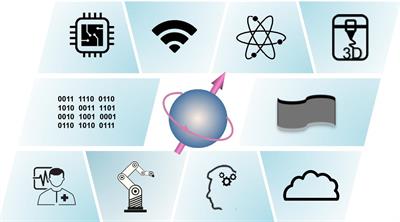
The rollout of 5G networks as well as emerging applications, such as artificial intelligence (AI) and internet-of-things (IoT) are collectively shaping the information and memory segment of the technology landscape for the next decade from now. These intelligent applications are expected to accelerate the development of new materials, device architectures and even computing paradigms, as well as their synergy, as they can allow for the handling of considerably higher data workloads, and can improve transmission efficiency, processing time, storage and energy consumption, which is an advantage over current existing devices. Even though a great variety of functional electronic materials, such as traditional semiconductors, magnetic materials (e.g. highly spin-polarized magnets, synthetic antiferromagnets), organic molecular materials, 2D materials, topological materials, ultrafast materials, etc, have been explored and exploited in the past for spintronics, such effort has remained quite segmented. In this respect, hybrid materials that integrate radically different materials are envisioned to be crucial for realizing highly exotic and/or customized spin properties. When it comes to faster and more energy-efficient data processors, spin-based in-memory computing could be a promising route, which intrinsically combines ultralow energy consumption and non-volatile storage. Another potential intelligent technology towards AI and IoT applications is spin logic and sensing devices, where recent progress has demonstrated various mechanisms to encode data, using nano-sized magnets, magnons, or spin-textures (domain walls, skyrmions, etc). As such, the main aim of this Research Topic is to gather global research effort at both fundamental and applied levels and look at how spin-based technology could contribute to and impact the fast-developing landscape of intelligent electronics.
We encourage submissions of Original Research, Reviews and Perspectives on the state-of-the-art experimental and theoretical research towards hybrid materials, integrative devices and computing architectures for intelligent spintronics. Potential subjects to be considered include, but are not limited to:
• Hybrid materials integrating radically different materials in any form (magnetic materials, semiconductors, organic molecular materials, 2D materials, topological materials, ultrafast materials, etc) to achieve highly exotic and/or customized spin properties.
• Integrative devices relying on the spin degree of freedom for memories and information encoding in novel entities, such as nanomagnets (spin-torque oscillators), magnons (spin-waves), spin-textures (domain walls, skyrmions), and so forth.
• Computing architectures, in particular, spin-based in-memory computing, with functionality-driven design and selection of both hybrid materials and integrative devices, as well as scalable algorithm, modelling and circuitry towards on-chip applications.
Keywords: Spintronics, hybrid materials, integrative devices, intelligent electronics, in-memory computing
Important note: All contributions to this Research Topic must be within the scope of the section and journal to which they are submitted, as defined in their mission statements. Frontiers reserves the right to guide an out-of-scope manuscript to a more suitable section or journal at any stage of peer review.
School of Microelectronics, Northwestern Polytechnical University
Xi’an, China
Northwestern Polytechnical University
Xi'an, China
National University of Singapore
Singapore, Singapore
Université de Lorraine
Nancy, France
Imperial College London
London, United Kingdom
