
Blockchain technology is complicated, frequently misunderstood, and heavily criticized by some, but 10 warmly embraced by others. Independent of one's particular standpoint, one thing is for sure: 11 distributed ledgers are here to stay, and their implications on economies and industries will be 12 substantial. In this research topic, numerous researchers from all over the world with varying 13 backgrounds explore the economic and business implications of blockchain technology. They use a in the late 1980s and early 1990s that information technology was going to dramatically restructure 50 industrial organizations; however, this has not happened so far. They conclude that it can actually be 51 blockchain technology that offers an infrastructure for electronic integration that will subsequently 52 lead to the realization of the electronic markets hypothesis. 53 Burnie et al. (2020) use social media discussions to discover the causes of shifts in the prices of 54 cryptocurrencies. They find an effect of regulatory bans on Bitcoin, repeated effects of rival 55 innovations on Ether, and the influence of technical traders on both cryptocurrencies. Furthermore, 56 they develop a framework that can be applied to better understand cryptocurrencies' price series 57given that sufficient social media information exists. 58 Dimitri (2021) provides insights into the economics of proof-of-stake. He finds that the aggregate 59 demand and supply of currency may not typically coincide, which implies that users could hold 60 suboptimal quantities of the currency. Additionally, he discusses how symmetric stationary states of 61 the system could be implausible, which implies that a fair distribution of money in the long run 62 seems unlikely unless appropriate measures are introduced. 63The popularity of this Research Topic in Frontiers in Blockchain reflects the growing interest in the 64 area from academics and practitioners. So what will be next? We are sure that blockchain 65 technologies will continue to evolve, and further scholarly research is needed that explores its 66 applications, potentials, and limitations using academic rigor. In light of the increasing diversity of 67 the underlying technologies, we see numerous potentials and recommend that future research on that 68 matter dives deeper into investigating specific use cases that the increasing tokenization of (digital 69 and physical) assets will enable (Sunyaev et al., 2021;Treiblmaier, 2021). In this regard, research is 70 needed that investigates appropriate token designs (Hülsemann & Tumasjan, 2019). The ongoing 71 digital transformation offers an unprecedented potential to create economies and societies that 72 operate effectively, efficiently, and sustainably. In this regard, rigorous academic research can
Editorial12 April 2022
Editorial: Economic and Business Implications of Blockchain TechnologyPOLICY AND PRACTICE REVIEWS
27 May 2020
7,743 views
8 citations
7,101 views
7 citations
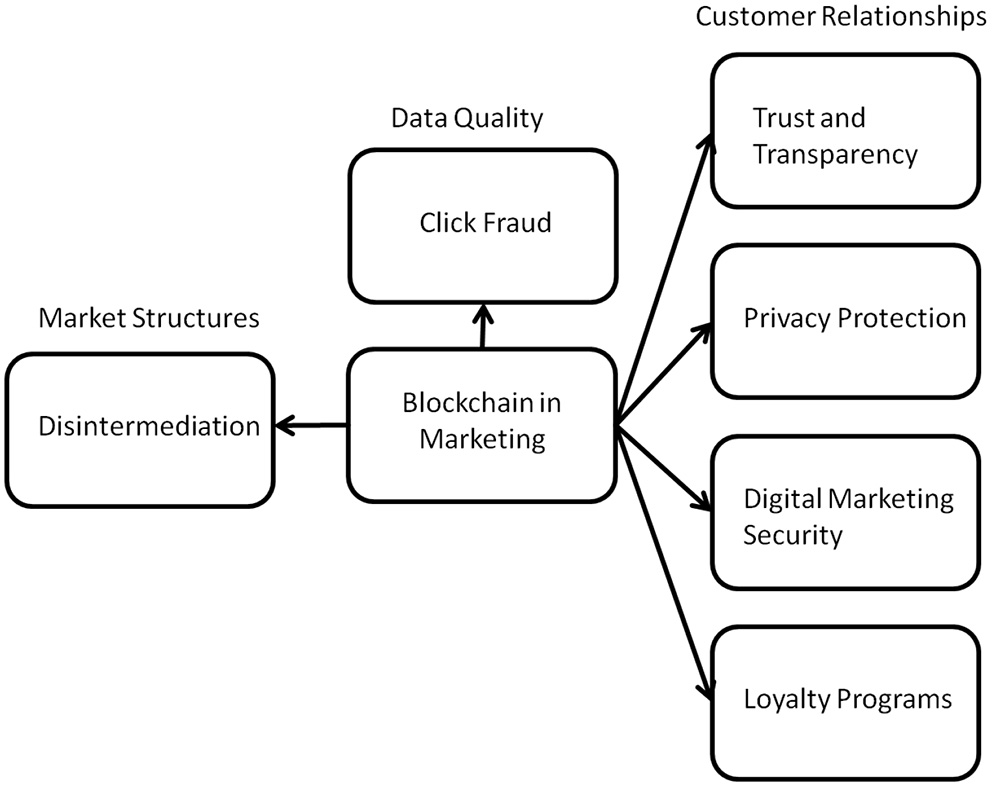
The proliferation of sophisticated e-commerce platforms coupled with mobile applications has ignited growth in business-to-consumer (B2C) commerce, reshaped organizational structures and revamped value creation processes. Simultaneously‚ new technologies have altered the dynamics of brand marketing‚ enabling a broader reach and more personalized targeting aimed at increasing brand trust and enhancing customer loyalty. Today‚ the Internet allows marketers to penetrate existing markets, create new online marketplaces and to generate new demand. This dynamic market engagement uses new technologies to target consumers more effectively. In this conceptual paper, we discuss how blockchain technology can potentially impact a firm’s marketing activities. More specifically, we illustrate how blockchain technology can empower the consumer-centric paradigm and foster disintermediation‚ combat click fraud, reinforce trust and transparency, enable privacy protection, empower security and enable creative loyalty programs. We present six propositions that will guide future blockchain-related research in the area of marketing.