In the original article, there was a mistake in Table 1 as published. The SPTA1 mutation of Allele 2 in Patient 1, is stated as “c.4294T>A (p.L1432*).” The correct mutation should read “c.4295del (p.L1432*).” The corrected Table 1 appears below.
Table 1
| Phenotype | Patient | Allele 1 | Allele 2 | Age at time of report and comments | Ektacytometry | α-spectrin in RBC ghosts (% of control) |
|---|---|---|---|---|---|---|
| GROUP I (patients 1–4) Severe, recessive HS (transfusion-dependent, responding to splenectomy) | 1 | c.4339-99C > T | c.4295del (p.L1432*) | 11 year-old, chronic transfusion requirement with partial response to partial splenectomy, resolved after total splenectomy | 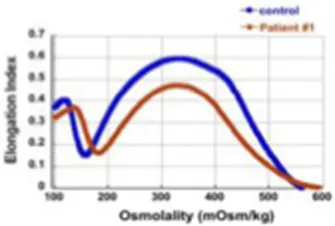 | 54% |
| 2 | c.4339-99C > T | c.5102A > T (p.L1701*) | 7 year-old, chronic transfusion requirement, improved with partial splenectomy | 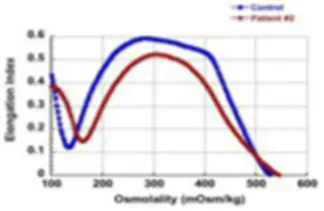 | 64% | |
| 3 | c.4339-99C > T | c.3267A > T (p.Y1089*) | 11 year-old, not splenectomized due to family preference, continues to require frequent transfusions | Not evaluable in a transfused sample | ||
| 4 | Mutation not identified | Gross deletion of SPTA1 | 3.5 year-old, RT-PCR demonstrated significantly decreased α-spectrin expression; hemoglobin has normalized after recent splenectomy | Not evaluable in a transfused sample | ||
| GROUP II (patients 5–8) Severe to moderately severe, recessive HS | 5 | c.4339-99C > T | c.1120C > T (p.R374*) | 4 year-old, chronic transfusion requirement for first three years with improved pattern since. | Sample not provided after age 3, when transfusion-independent | |
| 6 | c.4339-99C > T | c.1351-1G > T | 7 year-old, occasional transfusion requirement, resolved after splenectomy at 5 years of age | 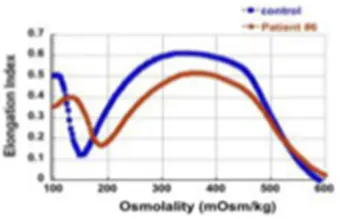 | 59% | |
| 7 | c.4339-99C>T | c.2671C > T (p.R891*) | 4 year-old, has not been transfused so far, Hgb 7.1-8.9 g/dL, ARC 420-572 x 103/μl. | 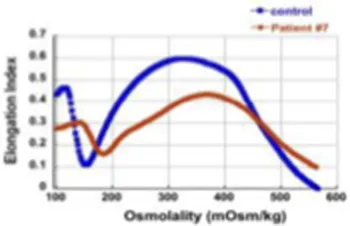 | 61% | |
| 8 | c.4339-99C > T | c.3257delT | 8 year-old, transfused once as neonate, Hgb 10.6–11.8 g/dL, ARC 354–535 x 103/μl; now Hgb 15–16 g/dL with normal ARC after splenectomy at 6 years of age (splenectomy performed because of chronic abdominal pain due to co-morbidities) | 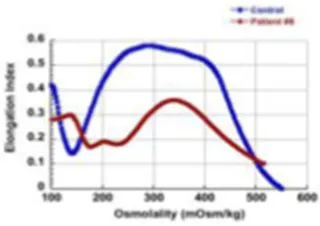 | Not performed. | |
| GROUP III (patients 9-11) Life-threatening anemia in utero leading to fatal hydrops fetalis if untreated (transfusion-dependent, not responding to splenectomy) | 9 | c.4206delG (fs) | c.4180delT (fs) in haplotype with c.6631C > T (p.R2211C) | Died at birth. Post-mortem diagnosis from parental studies and DNA extracted from liver tissue saved in paraffin block | N/A | |
| 10 | c.6788+11C > T | c.6788+11C > T | 11 year-old, born prematurely at EGA of 33 weeks with hydrops fetalis, remained transfusion-dependent even after splenectomy; now doing well after matched sibling transplant | Not evaluable in a transfused sample (required chronic transfusions up until bone marrow transplant) | 26% (performed in CD71+ cells) | |
| 11 | c.6154del (p.Ala2052fs) | c.6154del (p.Ala2052fs) | 2 year-old, severe in-utero anemia requiring five in-utero transfusions. Born with severe neonatal hyperbilirubinemia requiring exchange transfusion. Remains transfusion-dependent | Not evaluable in a transfused sample | ||
Genetic mutations and associated phenotype in HS due to SPTA1 mutations.
Of note, all the SPTA1 variants reported here except c.4339-99C > T (αLEPRA) and c.2671C > T; p.R891
(Bogardus et al., 2014) have not been previously described.
The authors apologize for this error and state that this does not change the scientific conclusions of the article in any way. The original article has been updated.
References
1
BogardusH.SchulzV. P.MaksimovaY.MillerB. A.LiP.ForgetB. G.et al. (2014). Severe nondominant hereditary spherocytosis due to uniparental isodisomy at the SPTA1 locus. Haematologica99, e168–e170. 10.3324/haematol.2014.110312
Summary
Keywords
SPTA1, α-spectrin, αLEPRA, hereditary spherocytosis, next generation sequencing, hemolytic anemia, hydrops fetalis
Citation
Chonat S, Risinger M, Sakthivel H, Niss O, Rothman JA, Hsieh L, Chou ST, Kwiatkowski JL, Khandros E, Gorman MF, Wells DT, Maghathe T, Dagaonkar N, Seu KG, Zhang K, Zhang W and Kalfa TA (2019) Corrigendum: The Spectrum of SPTA1-Associated Hereditary Spherocytosis. Front. Physiol. 10:1331. doi: 10.3389/fphys.2019.01331
Received
03 September 2019
Accepted
04 October 2019
Published
18 October 2019
Volume
10 - 2019
Edited by
Paola Bianchi, IRCCS Ca 'Granda Foundation Maggiore Policlinico Hospital, Italy
Reviewed by
Elisa Fermo, IRCCS Ca 'Granda Foundation Maggiore Policlinico Hospital, Italy
Updates
Copyright
© 2019 Chonat, Risinger, Sakthivel, Niss, Rothman, Hsieh, Chou, Kwiatkowski, Khandros, Gorman, Wells, Maghathe, Dagaonkar, Seu, Zhang, Zhang and Kalfa.
This is an open-access article distributed under the terms of the Creative Commons Attribution License (CC BY). The use, distribution or reproduction in other forums is permitted, provided the original author(s) and the copyright owner(s) are credited and that the original publication in this journal is cited, in accordance with accepted academic practice. No use, distribution or reproduction is permitted which does not comply with these terms.
*Correspondence: Theodosia A. Kalfa theodosia.kalfa@cchmc.org
This article was submitted to Red Blood Cell Physiology, a section of the journal Frontiers in Physiology
Disclaimer
All claims expressed in this article are solely those of the authors and do not necessarily represent those of their affiliated organizations, or those of the publisher, the editors and the reviewers. Any product that may be evaluated in this article or claim that may be made by its manufacturer is not guaranteed or endorsed by the publisher.