Abstract
We present a study investigating the question whether and how people’s intention to change their environmental behavior depends on the degrees of immersion and freedom of navigation when they experience a deteriorating virtual coral reef. We built the virtual reef on top of a biologically sound model of the ecology of coral reefs, which allowed us to simulate the realistic decay of reefs under adverse environmental factors. During their experience, participants witnessed those changes while they also explored the virtual environment. In a two-factorial experiment (N = 224), we investigated the effects of different degrees of immersion and different levels of navigation freedom on emotions, the feeling of presence, and participants’ intention to change their environmental behavior. The results of our analyses show that immersion and navigation have a significant effect on the participants’ emotions of sadness and the feeling of helplessness. In addition, we found a significant effect, mediated by the participants’ emotions, on the intention to change their behavior. The most striking result is, perhaps, that the highest level of immersion combined with the highest level of navigation did not lead to the highest intentions to change behavior. Overall, our results show that it is possible to raise awareness of environmental threats using virtual reality; it also seems possible to change people’s behavior regarding these threats. However, it seems that the VR experience must be carefully designed to achieve these effects: a simple combination of all affordances offered by VR technology might potentially decrease the desired effects.
1 Introduction
Virtual reality (VR) can serve as a medium to convey messages and narratives in a deeply engaging way. Unlike other technologies, VR can offer much higher immersion1. There is evidence that exposure to a VR simulation providing sufficient interaction, rendering, and simulation fidelity can lead to a high feeling of presence (Lombard and Ditton, 1997; Slater, 1999; McMahan et al., 2012), which was recently defined by Skarbez et al. (2018) as “perceived realness of a virtual experience.”
While it seems obvious that users experiencing a virtual environment (VE) will be affected emotionally if the experience is designed accordingly, the space of VR/VE configuration parameters contributing to eliciting specific emotional responses or behavior changes is still not fully explored (Riva et al., 2007; Herrera et al., 2018). In addition, although there is evidence about the potential of virtual experiences to influence attitudes and even behavior (Ahn et al., 2015; Ahn et al., 2016; Fonseca and Kraus, 2016; Zaalberg and Midden, 2010), it is not yet entirely clear if or how immersion, presence, and interactivity are instrumental in eliciting a change of attitude and, ultimately, can change the behavior of users (Herrera et al., 2018). In this paper, we investigate factors that potentially influence participants’ emotions and behavioral intentions.
Environmental responsibility, in which a change in people’s behavior is rather urgent, has been identified by the United Nations as one of the 17 Sustainable Development Goals (Nations, 2015). While the totality of the damage caused by the global footprint of humankind is hard to grasp, there is mounting scientific evidence that many habitats will be eradicated within the next decades. But despite heightened public awareness of this evidence, there seems to be a wide knowledge-to-action gap (Kollmuss and Agyeman, 2002). One reason could be large psychological distances, both temporally as well as socially, between each individual and the problem (Weber, 2006). Maloney and Ward, (1973) defined the problem as a “crisis of maladaptive behavior,” and stated that in order to slow down the trajectory of environmental destruction, influencing individuals is key. The mere sharing of knowledge about the environmental problems, however, does not seem to produce enough of a positive change in environmentally conscious behaviors in enough individuals (Kollmuss and Agyeman, 2002). It has been suggested that interactive simulations of climate-based destruction could be helpful in communicating environmental issues effectively (Weber, 2006). Previous research also suggests that direct experience of environmental destruction in reality leads to a stronger correlation between attitude and behavior (Rajecki, 1982) and leads to a higher perception of the risks of environmental problems (Akerlof et al., 2013).
According to the Rubicon model (Achtziger and Gollwitzer, 2008), actual behavior is shaped by a large number of factors influencing people on the long way from early conceptions up until performing associated actions. With the present experiment, we aimed to assess one of the first phases in this process towards action, namely, the point of deliberately taking a decision, thereby excluding later stages, which might, in the positive case, lead to the performance of the intended action, but which also might become target of other influencing factors, eventually preventing the desired action. Focusing on behavioral intentions enabled us to assess very early processes of decision making, while other confounding factors could be excluded.
We chose to simulate the deterioration of a coral reef ecosystem, in order to investigate the effects of VR experiences on participants’ emotions and intentions to change their environmental behavior (see Figure 1). First of all, coral reefs are highly endangered ecosystems (2/3 of the world’s coral reefs are under grave threat) (Hoegh-Guldberg et al., 2007). Second, the temporal and social distance between most people and those ecosystems is very large: people’s actions will have a measureable impact only in several decades’ time, and damaged or dead coral reefs will not have a direct impact on most societies. Allowing people to experience the decay of these habitats for themselves can therefore act as a method to communicate the hitherto rampant change of climate on a more understandable scale, both temporally and spatially. In addition, we believe we avoided indirect influences, since coral reefs are not a part of people’s everyday life in the country where we conducted our experiment.
FIGURE 1
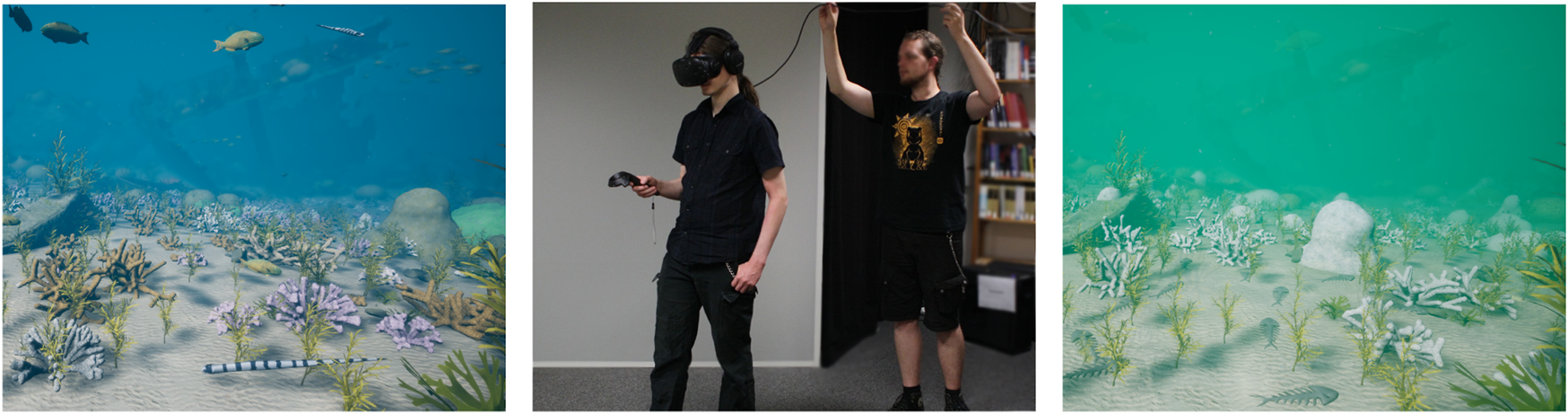
We let participants explore a virtual coral reef, in order to investigate effects of immersion and navigation capabilities on behavioral intentions. Left: healthy reef; middle: one of the experimental conditions; right: damaged reef.
For our experiment, we developed a VE of a complete coral reef ecosystem including different kinds of corals, animals, and algae, based on a scientifically sound, multi-agent simulation (Kubicek et al., 2012; Kubicek and Reuter, 2016). In this VE, users can witness the evolution and decline of this ecosystem over the (accelerated) time span of hundreds of years.
We hypothesized that by leveraging the affordances of virtual reality, such as immersion, presence, and active and intuitive interaction, people are more likely to experience and feel the disastrous effects of environmental deterioration on an instinctive and emotional level which will induce them to modify their intentions regarding environmentally conscious behavior.
There are, to our knowledge, only very few research studies that investigate the effects of immersion and interaction agency,2 such as the ability to navigate freely and naturally, on behavioral intentions. One of those few are Herrera et al. (2018); Ahn et al. (2015) (more details in Section 2). Others have looked at the influence of display and interaction fidelity on presence (McMahan et al., 2012), or the link between presence and emotions, e.g., (Baños et al., 2004; Bouchard et al., 2008)), or the link between presence and behavior change (Zaalberg and Midden, 2010). But these studies do not elucidate a potential link between interaction agency and immersion on behavior change.
In this paper, we will provide novel insights into these questions based on an extensive two-factorial user study. Our major contributions are the following:
• We found that our experimental conditions had a significant effect on participants’ emotions. More specifically, participants in highly immersive conditions indicated reduced sadness. Also, participants in conditions with high navigation capabilities indicated reduced helplessness.
• Significant mediation effects show that the experimental conditions influenced environmentally conscious behavioral intentions, mediated by the emotions “sadness” and “helplessness.”
• Contrary to our assumption, a virtual experience with a high level of immersion and navigation capabilities did not lead to the highest environmentally conscious intentions. Instead, a virtual experience offering only a high level of immersion or only high navigation capabilities led to a higher degree of environmentally conscious intentions.
These findings, in particular the last one, suggest that it is not obvious that higher immersion and freedom of navigation in VR are always more effective when designing virtual experiences aiming to influence people’s behavioral intentions.
Research into the factors of VE design that can eventually change users’ intentions and behavior could provide knowledge and opportunities to help make society more aware of environmental challenges that need to be overcome. Similarly, we hope that other pro-social causes could be pursued using similar approaches. Like most research, such knowledge could pose the threat of being used with malevolent intention. We believe, however, that the open knowledge of these factors will help society to identify and avoid adversarial virtual experiences.
2 Previous work
The effect of technological variables of a VR/VE configuration on presence was investigated by, for instance, McMahan et al. (2012). They compared configurations of display and interaction fidelity; variables included the FoV and monoscopic vs. stereoscopic rendering in a CAVE setup, but also different interaction and locomotion techniques, like mouse and keyboard vs. free walking and the “human joystick” technique for free locomotion. For both interaction fidelity and display fidelity, higher levels consistently and significantly increased presence. While they study the effects of locomotion fidelity, we rather study the effect of locomotion agency and, in addition, different levels of immersion.
In the area of virtual reality exposure therapy, there is a large body of literature, see (Rothbaum and Hodges, 1999; Parsons and Rizzo, 2008; Bouchard et al., 2017), to reference but a few. In more detail, Schuemie et al. (2000) investigated the relationship between presence and fear in acrophobic patients undergoing a VR exposure therapy session. As initially suggested by Regenbrecht et al. (1998), they could verify a positive correlation between levels of presence and fear. Gorini et al. (2010) took a similar approach, verifying these results in the context of VEs for people with eating disorders. However, the generalizability of these results to voluntary changes of behavior seems limited, considering their focus on extreme emotional and psychopyhsiological reactions in phobic patients.
Baños et al. (2004) also explored the relationship between presence and emotion. Their results show that emotions may play a role as “both determinants and consequences of presence,” suggesting a circular relationship; i.e., if the experience cannot induce a sense of presence, its potential in modifying emotional states is low, while a high feeling of presence heightens the emotional impact of the experience. Similar results were presented by Bouchard et al. (2008). Furthermore, they suggest that if the goal of a virtual experience is to modify an emotional state, immersion and associated technical variables might be less important than the emotional charge of the content being presented.
Riva et al. (2007) examined how to elicit an emotional response by different content within a VE. All participants were treated with the same VR setup and had to walk through multiple virtual parks designed to induce different emotional responses. The study confirmed the circular relationship proposed by Baños et al. (2004), and additionally, suggests that higher feelings of presence correlates with higher degrees of the respective emotion the VE was designed to produce. Baños et al. (2008) looked at the effect of different degrees of stereoscopy on levels of presence by presenting emotional virtual environments to participants on a big projection screen and providing navigation possibilities. They found that modifying the variable of stereoscopy did not lead to changes in presence, which contrasts previous results (Hendrix and Barfield, 1996; Freeman et al., 1999; McMahan et al., 2012). In our work, we took these findings into account by, on the one hand, implementing features in our VE that would make it sufficiently emotional to facilitate feelings of presence. On the other hand, we avoided to evoke emotions externally, e.g. by playing a dramatic soundtrack that would change from blissful to sad music, or by adding a dramatic voice-over narration, since we are mainly interested in the influence of technological variables on behavioral intentions.
Freeman et al. (2005) investigated the interrelatedness of presence and emotions in the context of a virtual anxiety therapy session using a VE with calming properties. Their data did not show a significant link between presence and emotions, indicating that presence and emotions might be correlated only for arousing stimuli. Utilizing these insights, we designed a VE that includes arousing features in order to ensure that emotions can be modulated by levels of presence.
Zaalberg and Midden, (2010) investigated how a simulated catastrophic flooding influenced participants towards exhibiting self-protective behavioral intentions after the experience. They suggest that a heightened sense of presence during the experience of a catastrophic event increases “the perception of the effectiveness of adaptive actions,” e.g., a higher willingness to purchase flood insurance in the future. In our work, we go one step further by investigating in which way participants show behavioral intentions that are pro-social and have psychologically distant effects (seeSection 5 for more details).
In an extensive study on framing and interactivity in VE’s, Ahn et al. (2015) considered the effects of message framing (gain or loss) in a virtual, embodied experience on behavior intentions and actual behavior. In the same experiments, they also considered the effect of different levels of interactivity, where the interaction consisted of cutting down a tree, or watering a sapling. In both cases, the experiment provided visuo-tactile synchronicity to the participants (by using a force-feedback device), but they did not have any choice or other agency regarding their interaction. Results show that higher levels of interactivity led to greater self-reported environmental behavior, Also, it was found that any form of VR experience reduced the actual paper consumption of participants directly afterwards by 25%. In our study, we also investigate the effect of interaction, but instead of investigating different types of navigation, we concentrate on the agency of navigation.
Regarding framing, there are mixed results as to whether gain or loss framing is more effective in the promotion of environmentally sustainable behaviors (Cheng et al., 2011). Overall, there is some evidence that loss framing is more persuasive, especially when the message is self-other referencing (Davis, 1995; Cheng et al., 2011). Therefore, contrary to Ahn et al. (2015), we opted to design our virtual coral reef to convey a loss-framed message in our experiments.
With a similar scenario (tree cutting), Ahn et al. (2014) compared the effect of different media (print, video, VR) on the environmental behavior. The study showed that VR as a medium to convey a message is more effective than print or video, that changes in environmental behavior can transfer into the physical world (20% less paper consumption directly after experience), and that the effect of VR exposure is stronger than that of print or video media. Building on these results, we stay within a virtual 3D environment as a medium and study the effects of several factors of this medium.
There is also a large body of studies on the effects of different types of more traditional media on behavior change. Fonseca and Kraus, (2016) used 360° videos, which is a medium relatively close to VR. They showed participants highly emotional 360° videos about the environmental impact of meat consumption either on an HMD or on a tablet. The control group watched a neutral 360° video on an HMD. High-immersion conditions resulted in environmentally more positive attitudes. Additionally, the more emotional footage in the immersive setup elicited heightened feelings of presence, which confirms previous findings (above). In contrast to their study, we do not use a narrator-driven, storytelling approach, where participants are passive and possess no agency; we provide an interactive VE rather than a video, enabling participants to navigate intuitively in it.
There are a number of studies concerned with the effects of perspective-taking on users’ empathy and pro-social behavior. For instance, Bailenson et al. (2006), Boker et al. (2009), Roberts et al. (2009), Banakou et al. (2016) modified or manipulated participants’ self-avatars and investigated how users’ behavior changed and adapted within the virtual experience while they were engaged in social interactions with other users in the same VEs. Recently, van Loon et al. (2018) studied the effect of a first-peson experience of a “day-in-the-life” of another person on their empathy. Indeed, they found an increase in empathy towards that person in real life, which they impersonated in VR. Other studies looked at the effects of perspective-taking on racial bias (Peck et al., 2013; Peck et al., 2021), heightening environmentally conscious attitudes (Ahn et al., 2016), and pro-social behavior (Rosenberg et al., 2013). Most of these studies consider the type of self-avatar as a factor, which is not investigated in our study. There are also many more studies using VR as a tool for studying perspective-taking or empathy, such as (Mado et al., 2021; Raij et al., 2009; Estrada Villalba et al., 2021); but since these studies do not investigate the effects of technology factors on behavior, but rather the effectiveness of VR as such, we do not discuss those studies here.
Recently, in an extensive study, Herrera et al. (2018) compared the effect of perspective-taking on empathy under different levels of immersion (narrative-based, desktop, VR). There was no difference in the self-reported measures, but more participants in the VR condition signed a petition to support the homeless. They argue that more research is needed to “assess the role that interactivity plays […] toward a specific social target, and pro-social behaviors.”
There has also been considerable research on the effect of emotions on pro-environmental behavior, such as (Carrus et al., 2008; Gifford, 2014; Rees et al., 2015; Ibanez et al., 2017), to name but a few. Results seem to be mixed as to whether positive or negative emotions lead to pro-environmental behavior more effectively (Brosch, 2021); Specifically, Schwartz and Loewenstein, (2017) showed that sadness is relevant for pro-environmental behavior. (For a discussion on the relevance of positive emotions, seeSchneider et al. (2021)). Karnaze and Levine, (2018) showed that sadness can be a component of major importance for reconstructing goals and beliefs, hence sadness is not in and by itself passive. With respect to pro-environmental behavior, the potential effects of a person’s effort need to be taken into account. If people believe that they are not able to have an impact on their environment, and that the situation is beyond their influence, then their “locus of control” (Rotter, 1966) is external (see also Heimlich and Ardion, (2008)). In this line of argumentation, Landry et al. (2018) were able to show that helplessness moderates the influence of concern on pro-environmental behavior, and they concluded that helplessness can inhibit pro-environmental behavior. Similarly, Salomon et al. (2017) also found that the level of perceived personal influence on the environment is important for individual intentions and actions. In summary, these works show that helplessness is very relevant, in order to explain individual pro-environmental intentions and behavior.
3 Virtual coral reef simulator
Our virtual environment visually simulates a coral reef based on SICCOM (Kubicek et al., 2012; Kubicek and Reuter, 2016), a biologically realistic model of a coral reef. This multi-agent model represents individual organisms of a reef’s main components (different corals and algae) with their life-cycles, interactions and reactions to the environment (e.g. temperature). This allows to simulate the outcome of spatial competition in reefs for various scenarios with different environmental settings (for a visual representation of its output seeFigure 2). SICCOM is parameterized for coral reefs in Zanzibar. The model has been used by marine scientists to investigate the impact of long-term temperature changes and mechanical disturbance on coral reefs (Kubicek and Reuter, 2016).
FIGURE 2
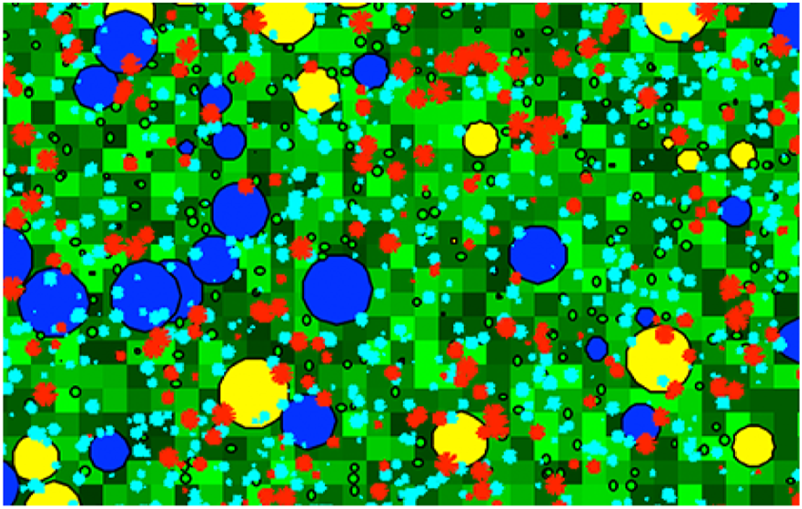
This 2D visualization shows the output generated by our biologically sound simulation model (SICCOM), which then gets converted into 3D models of corals in the virtual environment at runtime (Figure 3).
At runtime, we procedurally generate meshes for individual corals once born, based on the data generated by SICCOM. During their lifetime, we update the meshes to reflect the current stage of their life cycle. We also populate the VE with animals one would find in a typical coral reef, including sea snakes, turtles, and different schools of fish, in order to make the reef feel more lively. Some types of fish can only be found in specific spots that users can discover.
During runtime, SICCOM is running in the background, computing the evolution of the coral reef. Depending on various environmental parameters, it creates bleaching events for individual corals. In those cases, we modify the appearance of the affected corals to appear bleached. SICCOM also signals the death of corals, in which case we remove the corals from the VE.
To further resemble the development of a real coral reef, we fade the water color from blue to green the more the reef gets unhealthy. In addition, visibility is reduced so as to mimic algae particles, which signifies a high amount of nutrients often resulting from pollution. When the reef health decreases below a threshold, the fish will slowly die and only their skeletons will remain on the sea floor. Other species will also vanish from the environment, leaving the impression of a dead reef (seeFigure 3).
FIGURE 3
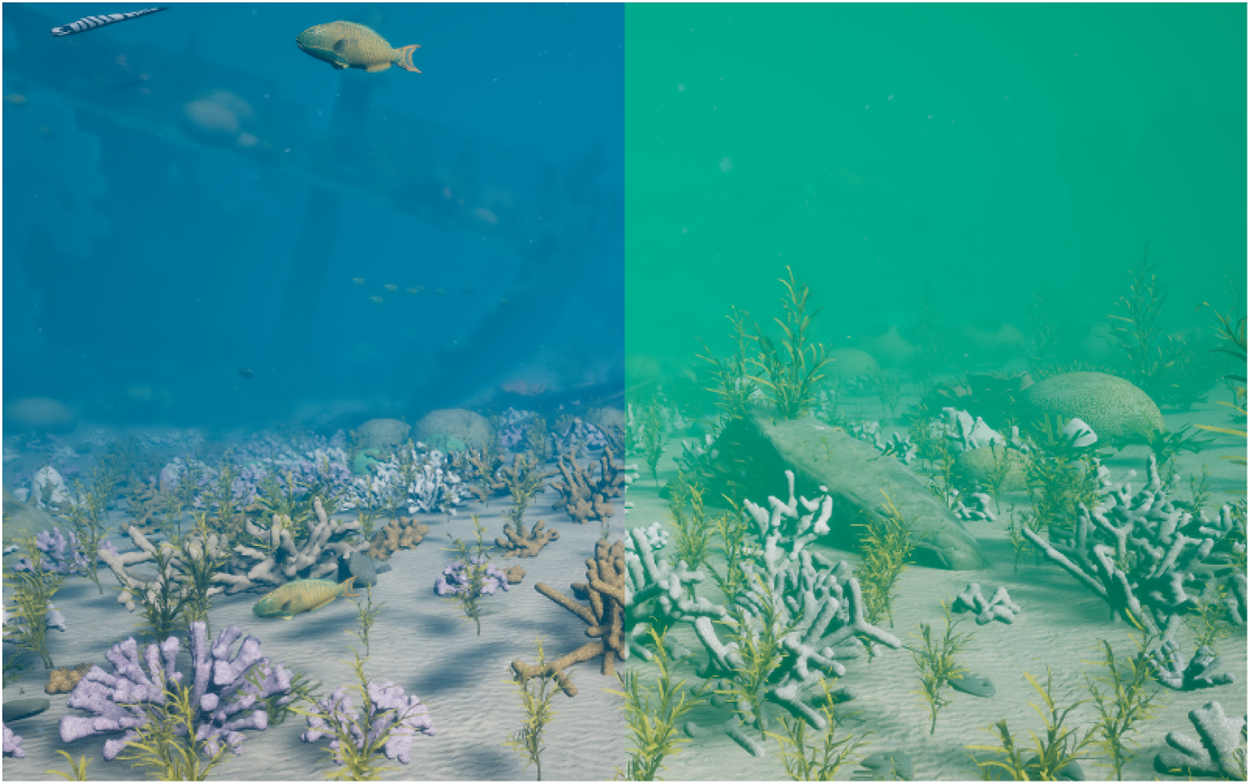
Comparison of a healthy reef (left) with an unhealthy reef (right). Notice the greenish color of the water, the absence of animals, and the bleached corals.
Since we wanted to show the development of the coral reef over several centuries, but also wanted the animals to behave realistically (and not move in super-fast time-lapse), we decided to use two different timescales: moving entities like fish and other animals exist and move on a real-time scale, while corals live on the accelerated time scale (seeSection 5.4.2 for the time scale we used in our experiment).
4 Research questions and hypotheses
The present study investigates the impact of two specific factors of VR experiences on emotions and behavior intentions: Navigation and Immersion. Here, the latter represents degrees of visual immersion (which is one important component of overall immersion, see the definition in Section 1), while the former describes different capabilities to move about: users are either restricted to a fixed position (like in a 360° video), or they can navigate freely. We decided to choose the navigation factor as the, arguably, most important kind of interaction with and in a virtual environment. Also it is extremely easy to learn for participants (who experience the VE for the first time), and it can be supported by almost all VR devices. With respect to the concrete emotions, we chose sadness and helplessness because they are expected to be of major importance when people are confronted with environmental degradation (see, e.g., (Kollmuss and Agyeman, 2002)). Also, negative emotions have been shown to be significant predictors of pro-environmental behavior (Carrus et al., 2008; Rees et al., 2015; Salomon et al., 2017; Schwartz and Loewenstein, 2017; Landry et al., 2018).
In more detail, we investigated the following research questions and hypotheses.
RQ1: Does navigation agency and immersion, or the lack thereof, influence emotions, specifically helplessness and sadness, resp?
According to our definition of agency (seeSection 1), we expected a lack of navigation capabilities, or restriction of navigation possibilities, to lead to higher levels of feeling helpless, since the user has less options to interact with their surroundings (Kollmuss and Agyeman, 2002); conversely, if participants can freely move around, this should decrease the sense of helplessness. Likewise, we expected a higher sense of presence in a virtual environment to lead to higher levels of emotions (Freeman et al., 2005), in our case the feeling of sadness, since this is what we expect a deteriorating coral reef to elicit. We did not expect different levels of immersion and the sense of presence to influence the level of helplessness. Likewise, we do not expect a link between different levels of navigation agency and levels of sadness.
H1a: We hypothesize that feelings of helplessness can be reduced by providing participants with the possibility to interact with the VE, even very simple kinds should have an effect. In our study, we chose to enable participants to move freely around, since this is very easy to learn for participants. Thus, it was expected that higher locomotion agency would reduce feelings of helplessness.
H1b: With respect to sadness, we hypothesized that it can be stimulated in a virtual environment, in our case by demonstrating the deterioration of the coral reef with a high level of presence and immersion.
Concerning the effect of immersion, we formulated H1b in a bi-directional way: on the one hand, we expected that the dying coral reef would elicit sadness; on the other hand, we expected that a highly immersive setup can also elicit positive emotions. Accordingly, with respect to immersion, we formulated this part of the hypothesis in a bi-directional way: we expected that immersion would influence the level of sadness.
Furthermore, we analyzed whether the effects of VR (if any) depend on participants’ prior familiarity with the technology. With increasing familiarity with the technology, we assumed that the effects on emotions would decrease; thus, we expected an influence of prior VR experiences on the level of sadness in the groups with full immersion.
RQ2: Does the level of immersion and navigation capabilities influence intentions to behave in an environmentally conscious way in the future?
H2: We hypothesized that higher freedom to navigate/move around in the virtual environment and higher levels of immersion using an HMD, while witnessing the deterioration of the virtual coral reef, induces higher intentions to behave environmentally consciously.
RQ3: Are effects on future behavioral intentions mediated by emotions?
With respect to the relationship between specific features (immersion and navigation capabilities) and behavioral intentions, we assumed that emotions are of major importance. Specifically, we assumed that immersion and navigation capabilities influence emotions, which in turn influence behavioral intentions.
H3: We assumed that experiencing varying degrees of immersion influences future intentions through the intervening variable “sadness”, and that navigation capabilities influence future intentions through the intervening variable “helplessness”.
5 Experiment methodology
5.1 Sample and general design
We realized a 2 × 2 factorial experimental design, with the factors “Navigation” (Full Navigation versus Restricted Navigation) and “Immersion” (High Immersion versus Low Immersion). 228 people participated in the study,3 however, due to technical problems leading to missing data, 4 of them could not be included in the data analyses. Thus, we based our results on N = 224 people, mostly university students (age: M = 25.24 years, sd = 6.56; 80 female, 142 male, 2 preferred not to say). We assigned the participants to the experimental groups randomly (High Immersion and Full Navigation: N = 56, female = 23, male = 33; High Immersion and Restricted Navigation: N = 57, female = 22, male = 35; Low Immersion and Full Navigation: N = 56, female = 17, male = 39; Low Immersion and Restricted Navigation: N = 55, female = 18, male = 37). Of all participants, 63% reported to have some prior VR experience.
5.2 Apparatus
In the following, we will describe the hardware and the experimental setups used in the four different conditions (seeFigures 4, 5). We built the VR experience using the Unreal Engine 4 running under Windows 10. In all conditions, we supplied users with the same headphones, in order to block outside noise and to provide them with audio feedback from the VE, which was not spatialized.
FIGURE 4
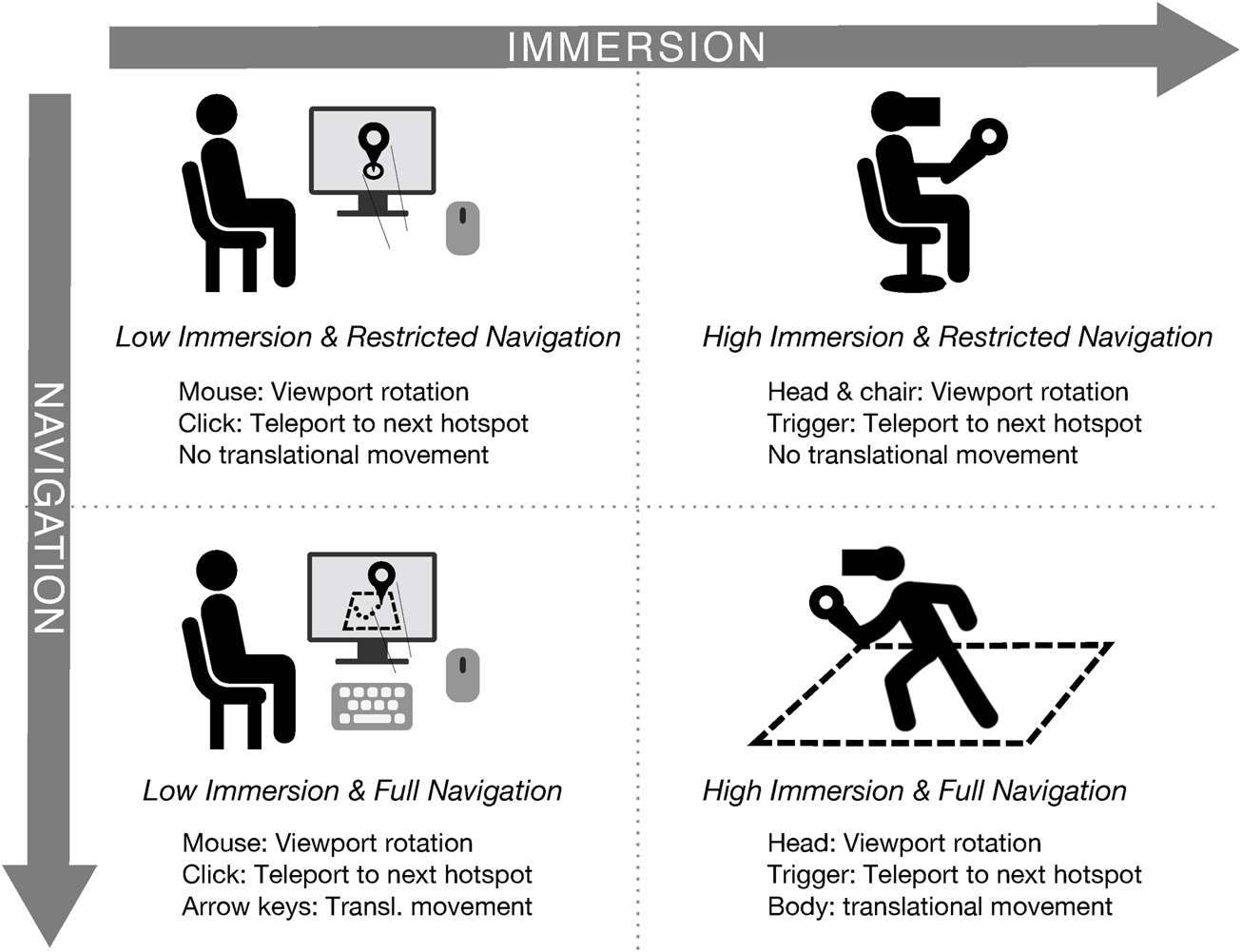
The four different experimental conditions we used in our two-factorial study.
FIGURE 5
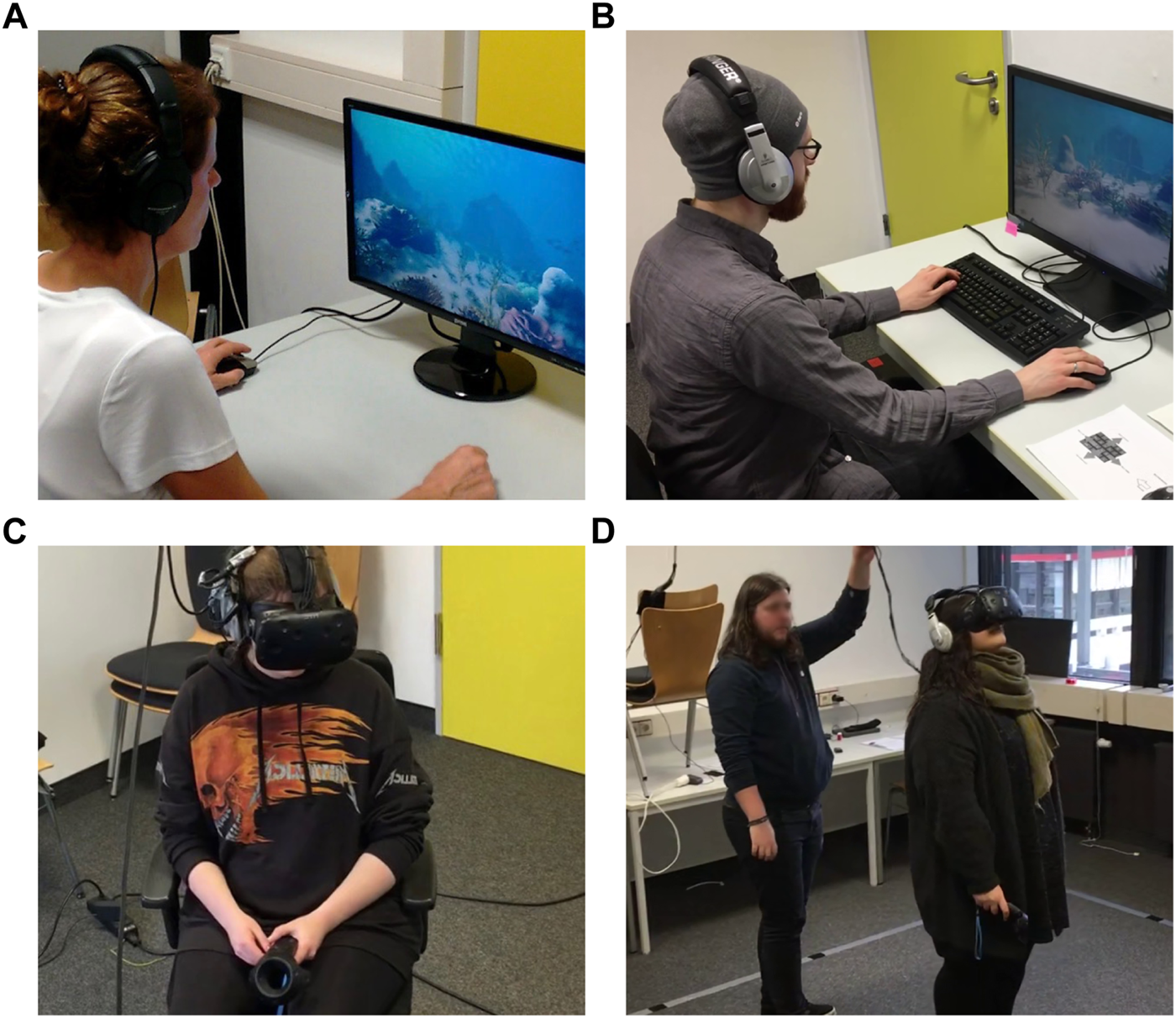
The four setups corresponding to the four conditions as depicted in Figure 4. Notice the missing keyboard in (A) and the swiveling chair in (C), both of which are in the Restricted Navigation condition. Images (C) and (D) both show the setups for the High Immersion condition; (B) and (D) show the Full Navigation condition.
In the High Immersion conditions, we provided the participants a state-of-the-art consumer VR headset, the HTC Vive, and a Vive controller for interaction.
In the High Immersion and Full Navigation condition, the participants were able to walk freely within a 3 × 3 meter space around the five pre-defined locations mentioned in Section 5.4.2, thus allowing them to navigate naturally in the VE. In order to make this kind of navigation plausible to the participants, we included a picture of modern-day helmet diving in the one-page information sheet (seeSection 5.4.1). In contrast, in the High Immersion and Restricted Navigation condition, participants sat on a swiveling chair (seeFigures 4, 5) and could simply look around at the five locations. The VR system ran on a PC that delivered a constant frame rate of 90 fps.
In the Low Immersion conditions, participants saw the virtual reef on a 24 inch 60 Hz 2D monitor, sitting approximately 50 cm away from it. Participants used a mouse for rotating the viewpoint. In the Low Immersion and Full Navigation condition, a computer keyboard allowed participants to navigate around in the VE.
5.3 Measurements
We divided our questionnaire into sections, addressing different aspects of our hypotheses, and carefully designed the order of the questions so as not to create any bias in the participants. In the same vein, we deemed it necessary to avoid any questions concerning emotions in the pre-questionnaire, because addressing any specific emotions explicitly before the experimental experience might have influenced the participants. We assume that the sample size is sufficient to cancel out emotional differences prior to the experiment.
Pre-questionnaire. We presented the participants with nine questions before the VR experience in order to establish a baseline with respect to the individual’s environmentally conscious behavior, for example: “If possible, do you use bike or public transportation instead of driving a car?”
Post-questionnaire. Directly after the experience, we asked participants to indicate whether they felt nauseous (in order to assess potential cybersickness), and asked about their current emotional state. Due to the negative message of the dying coral reef, we assessed influences on negative emotions, in particular their current level of sadness and helplessness. We formulated the questions in a straightforward way (i.e., “In this moment, do you feel sad?,” “In this moment, do you feel helpless?”). We asked these questions in the present tense, so as to capture their current feelings in the real world, not a potential memory of a past emotion.
In the following part of the questionnaire, we asked participants to indicate their future behavioral intentions, which is one of the early phases in the Rubicon model (Achtziger and Gollwitzer, 2008) describing the process of decision taking. Table 1 shows the list of those questions. In the pre-questionnaire, we asked similar questions, except concerning the past behavior. In addition, the participants answered the igroup presence questionnaire (IPQ) to measure presence (Schubert, 2003), and were then asked to indicate whether they noticed dying fish, bleaching corals, changes of the color of the water, and changes with respect to the visibility. In addition, we asked about prior VR experience (“Have you ever experienced 3D virtual reality technology before? If yes, how many times?”), and collected demographic information, such as their age and gender.
TABLE 1
| In the future, if possible, do you want to choose using a bike or public transportation instead of driving a car? |
| In the future, do you want to purchase organic food? |
| In the future, do you want to buy fair trade products? |
| In the future, do you want to buy local products? |
| In the future, do you want to use eco-friendly cleaning products? |
| In the future, do you want to save energy? |
The questions from the post-questionnaire regarding participants’ intent to change behavior.
Coding. Most of the items in the pre- and post-questionnaires were provided with a 7-point Likert scale with verbally labeled endpoints. The questions regarding emotions, opinions, and intentions were labeled with yes and no as anchors for the extreme points, so as to make it as uniform and as easy for participants to go through them. The questions of the IPQ were labeled with the original labels. Maximal emotions and maximal environmentally friendly behavior was coded with 7. The only exceptions were the four items concerning awareness of the dying fish, bleaching corals, color and visibility of the water, which were binary questions; the question “Have you ever experienced 3D virtual reality technology before? If yes, how many times?” had to be answered with a number.
Usage of the reef health plot. During runtime, we continuously logged the times when participants activated and dismissed the plot of the reef’s health, which can be measured and plotted in terms of the reef’s biodiversity (seeFigure 6).
FIGURE 6
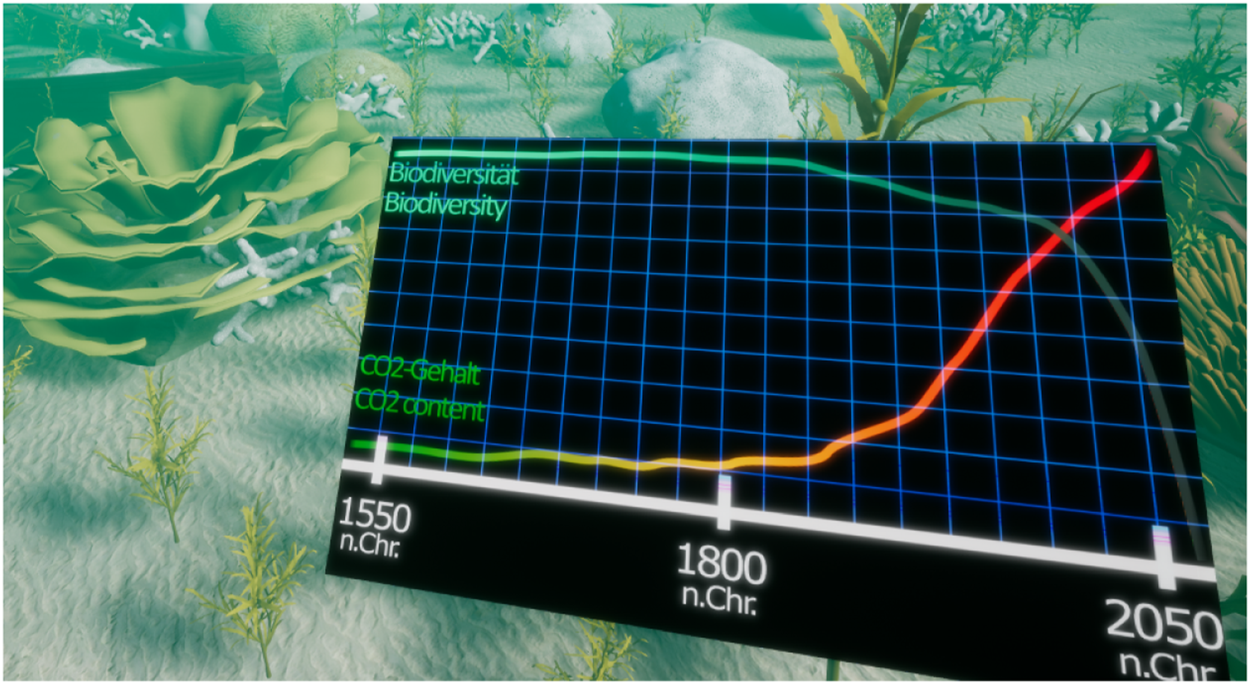
In addition to obvious environmental changes in the decaying coral reef, we included a chart visualizing the reef’s health on a virtual screen, which participants could bring up very easily by flicking their left wrist.
5.4 Procedure
5.4.1 Pre-experience
Participants arrived at the reception, where we supplied them with consent forms and the pre-questionnaire (seeSection 5.3). After completion, we instructed them to read a one-page information sheet about coral reefs and their decay to ensure a baseline of knowledge before starting the VR experience. The homogeneous and relatively high level of education of our participants allowed us to keep this information sheet very brief; in particular, it did not explain the relationship between the production of carbon dioxide, everyday transportation, and the health of the reefs. Also, we did not explain the intent of the experiment to participants.
We then randomly assigned participants to one of the experimental conditions and led them into the corresponding room. Participants did not know the other conditions and could not see them. For all conditions, after an initial greeting, the experimenter explained the controls.
In the High Immersion conditions, all participants were instructed how to use the VR setup. In particular, the usage of the controllers was explained in a neutral VE4, since they only work when the HMD is put on. Also, we made sure that the HMD was adjusted to fit the individual participant. In the High Immersion and Restricted Navigation condition, we also explained how to rotate the viewpoint in the VE by swiveling the chair the participants sat on. The instruction phase lasted as long as the participants needed to familiarize themselves with the devices and the controls.
In the condition High Immersion and Full Navigation, conductors utilized this phase to make participants comfortable with natural walking while immersed. They asked the participants to walk in the same neutral VE to learn about the virtual fence.5 Subsequently, they let the participants move around freely. This phase lasted until the participants signaled that they felt comfortable. As a result, all participants made use of locomotion.
5.4.2 Experience of the reef
Regardless of the different conditions, all participants experienced the same VE. At the beginning, they saw a lively, healthy coral reef. Over headphones, they heard a realistic underwater soundscape consisting of ambient sounds, i.e., bubbles, waves and animal sounds (e.g., the crackling noise of pistol shrimps). We controlled parameters of SICCOM to simulate the reef’s development between 1550 AD and 2050 AD within the 7-min experience, marking a timeframe in which the results of the industrial revolution first took effect on a large scale. Therefore, the participants witnessed a healthy virtual coral reef first, and during their experience they could notice several ways in which the virtual reef changes and deteriorates (see also Figure 3). At about 1800 AD, the CO2 level starts to rise dramatically, signifying the beginning of the industrial revolution and culminates around the 2000s, marking a big extinction event: corals bleach, fish die, and human intervention is hinted at through an industrial soundscape increasing in volume. After 7 min, the screen fades to black, concluding the VR experience.
To create more temporal awareness, we introduced a virtual hand-held chart to visualize the current CO2 concentration and biodiversity as line plots over time (seeFigure 7). Since severe extinction happens at points of high CO2 levels, this creates a context for understanding what participants see happening in the VE. Participants can bring up the chart at any time very easily: In the Low Immersion conditions, it can be toggled with the right mouse button. In the High Immersion conditions, it appears when participants bring the controller in front of their face.
FIGURE 7
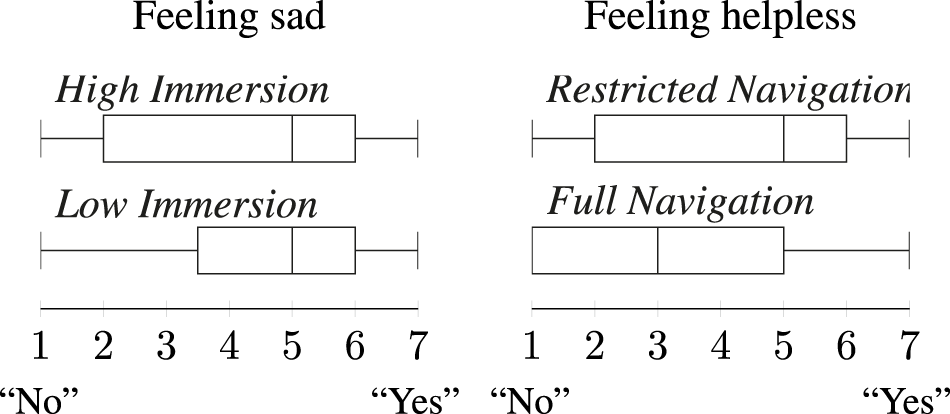
Distribution of participants’ answers to “feeling sad” and “feeling helpless” on a 7-point Likert scale in the different conditions. Participants were specifically asked to answer spontaneously. (The boxes show the medians as well as the 25% and 75% quartiles).
Participants could also instantly teleport between five pre-defined locations, apart from each other by about 30–50 m, that show different aspects of the coral reef and the surrounding fauna. This action is mapped to the left mouse button for the Low Immersion conditions, and the trigger of the HTC Vive controller in the High Immersion conditions. Teleportation is organized in a round-robin fashion, keeping the design between conditions as uniform as possible. In the Full Navigation conditions, at each location, participants can freely move within a range of 3 × 3 meters. When the boundary of this space is approached, a virtual semi-transparent fence signals the maximum extent of movement.
6 Results and discussion
In order to address the research questions, we performed various statistical analyses, which we will present and discuss in the following. Various statistical analyses were performed, so that multiple comparisons problems cannot be ruled out with certainty. However, while an adjustment of the alpha error would lead to a reduced number of false-positive results, several really existing effects would be excluded; the null hypothesis would not be rejected even though the alternative hypothesis might be correct. In striking a balance between alpha and beta error, we decided against a Bonferroni correction.
6.1 Results
Nine items of the pre-questionnaire concerned environmentally conscious behavior. These items intercorrelated substantially, and Cronbach’sα = 0.740 was obtained, indicating an acceptable degree of internal consistency of the scale. Thus, we integrated the items into one score by averaging the original scores (seeTable 2). A two-factorial analysis of variance (with the factors Immersion and Navigation) showed a significant interaction effect (seeTable 3). However, no significant main effects were obtained, thus, we did not include this score in the following analyses.
TABLE 2
| Low Immersion | High Immersion | |||||||||
|---|---|---|---|---|---|---|---|---|---|---|
| Restr. Nav | Full Nav | Restr. Nav | Full Nav | Scale | ||||||
| Measures | m | sd | m | sd | m | sd | m | sd | Score of 7 means | |
| Env. conscious behav | 4.54 | 0.83 | 4.81 | 0.90 | 4.86 | 0.89 | 4.61 | 0.87 | very env. conscious | |
| Feel nauseous | 1.73 | 1.45 | 1.80 | 1.69 | 1.48 | 1.16 | 1.61 | 0.92 | max. symptom | |
| Feel sad | 4.68 | 1.65 | 4.56 | 2.05 | 4.12 | 1.96 | 3.88 | 2.21 | yes, very much | |
| Feel helpless | 4.34 | 2.07 | 3.49 | 2.07 | 4.00 | 2.14 | 3.37 | 2.14 | yes, very much | |
| IPQ spatial presence | 3.91 | 1.23 | 4.46 | 1.14 | 5.16 | 0.81 | 5.42 | 0.92 | maximal | |
| IPQ involvement | 3.57 | 1.07 | 4.02 | 1.29 | 4.86 | 1.45 | 5.04 | 1.25 | fully agree | |
| IPQ experienced realism | 3.12 | 0.86 | 3.64 | 0.95 | 3.76 | 1.04 | 3.84 | 1.05 | completely real | |
| IPQ general item | 3.68 | 1.39 | 4.35 | 1.40 | 4.95 | 1.31 | 5.46 | 1.24 | very much being there | |
| Future intentions | 5.22 | 0.10 | 5.59 | 1.04 | 5.48 | 1.07 | 5.23 | 1.06 | yes, very much | |
| Measures | yes | no | yes | no | yes | no | yes | no | ||
| Notice dying fish | 82% | 18% | 84% | 16% | 83% | 17% | 84% | 16% | ||
| Notice bleaching | 77% | 23% | 70% | 30% | 88% | 12% | 81% | 19% | ||
| Notice color change | 89% | 11% | 77% | 23% | 84% | 16% | 74% | 26% | ||
| Notice visibility change | 82% | 18% | 79% | 21% | 79% | 21% | 81% | 19% | ||
Means and standard deviations of the questionnaire items, together with the scales, or percentages in the case of the yes/no questions.
The first line is derived from the pre-questionnaire, while all other lines are derived from the post-questionnaire.
TABLE 3
| Main Effect Immersion | Main Effect Navigation | Interaction Effect | ||
|---|---|---|---|---|
| Measures | df | |||
| Env’ly conscious behav | 1 220 | 0.28 0.60 | <.01 0.95 | 4.90 0.03 0.02 |
| Feel nauseous | 1 220 | 1.50 0.22 | 0.31 0.58 | 0.03 0.86 |
| Feel sad | 1 220 | 5.49 0.02 0.02 | 0.47 0.49 | 0.06 0.80 |
| Feel helpless | 1 220 | 0.67 0.41 | 6.93 0.01 0.03 | 0.15 0.70 |
| IPQ spatial prescence | 1 218 | 63.3 < .01 0.23 | 8.58 < .01 0.04 | 1.12 0.29 |
| IPQ involvement | 1 219 | 45.7 < .01 0.17 | 3.31 0.07 0.02 | 0.64 0.42 |
| IPQ experienced realism | 1 219 | 10.2 < .01 0.05 | 5.09 0.03 0.02 | 2.86 0.09 0.01 |
| IPQ general item | 1 220 | 44.2 < .01 0.17 | 10.8 < .01 0.05 | 0.19 0.66 |
| Notice dying fish | 1 220 | 0.06 0.81 | 0.03 0.86 | 0.02 0.90 |
| Notice bleaching | 1 220 | 4.98 0.03 0.02 | 2.27 0.13 | 0.01 0.93 |
| Notice color change | 1 220 | 0.36 0.55 | 5.78 0.02 0.03 | 0.01 0.93 |
| Notice vis. change | 1 220 | 0.01 0.95 | 0.11 0.74 | 0.16 0.69 |
| Future intentions | 1 220 | 0.13 0.72 | 0.17 0.68 | 4.94 0.03 0.02 |
Two-factorial analyses of variance.
Directly after the exposure to the coral reef, the participants were asked whether they felt nauseous. The results indicated that mostly no cybersickness occurred (a score in the range 1–2 means (almost) no symptom occurred). A two-factorial analysis of variance did not reveal significant differences between the experimental groups.
With respect to “feeling sad,” the participants in the High Immersion conditions indicated lower scores, i.e., feeling less sad, compared to the participants in the Low Immersion conditions. Accordingly, a two-factorial analysis of variance yielded a significant main effect; neither the main effect Navigation nor the interaction effect reached the level of significance.
With respect to “feeling helpless,” the participants in the conditions Full Navigation indicated lower scores than the participants in the conditions Restricted Navigation, thus expressing a lower level of helplessness (seeFigure 7). Accordingly, a two-factorial analysis of variance yielded a significant main effect for the factor Navigation. Neither the main effect Immersion nor the interaction effect reached the level of significance.
Thus, the factors Navigation and Immersion significantly influenced participants’ emotions. Specifically, the participants in the High Immersion conditions indicated reduced sadness, and participants in the Full Navigation conditions indicated reduced helplessness.
Comparing the two High Immersion conditions concerning the question “Have you ever experienced 3D virtual reality technology before? If yes, how many times?,” no significant differences emerged, F < 1. Dividing the participants in three subgroups according to the number of prior experiences led to a group without prior experiences (49%), a group with one or two prior experiences (32%), and a group with three or more prior experiences (20%). A comparison between these three groups with respect to their level of sadness indicated the highest level of sadness in the middle group (M = 3.61, sd = 2.14), compared to the group without prior experience (M = 4.11, sd = 2.00) or the group with three or more prior experiences (M = 4.36, sd = 2.19). However, this effect was not significant, F(2, 110) = 1.039, p = 0.357.
In order to measure presence, the participants answered the IPQ questionnaire (Schubert, 2003), containing 14 items arranged in three subscales measuring “Spatial Presence” (the sense of being physically present in the VE), “Involvement” (measuring the attention devoted to the VE and the involvement experienced), and “Experienced Realism” (measuring the subjective experience of realism in the VE). With respect to these three subscales, the reliabiltiy scores were Cronbach’sα = 0.771, 0.832, and 0.684, respectively. Two-factorial analyses of variance indicated significant results for all three subscales: With respect to “spatial presence,” we could obtain significant main effects for Immersion and Navigation, indicating that the High Immersion version of the coral reef induced significantly higher spatial presence than the Low Immersion version, and the Full Navigation conditions induced significantly higher spatial presence than Restricted Navigation conditions. The interaction effect was not significant.
With respect to the subscale “Involvement,” a significant main effect Immersion was obtained, indicating significantly more involvement in the High Immersion conditions than the Low Immersion conditions. The difference between the conditions with full versus restricted navigation were less pronounced, and just barely missed the level of significance. The interaction effect was not significant.
Concerning the subscale “Experienced realism,” the High Immersion conditions reached significantly better results than the Low Immersion conditions. The main effect Navigation was also significant, indicating higher values for the Full Navigation groups than participants from the Restricted Navigation groups. The interaction effect just barely missed the level of significance.
With respect to the general item In the computer generated world I had a sense of “being there,” we found significant main effects for Immersion and Navigation. The interaction effect was not significant. Again, the participants in the High Immersion conditions showed higher values than those in the Low Immersion conditions, and the participants in the Full Navigation conditions showed higher results than the Restricted Navigation conditions.
The participants were asked to indicate whether they noticed dying fish, bleaching corals, changes of the color of the water, and changes with respect to the visibility. Overall, the large majority of participants noticed these changes: dying fish, bleaching, color change, and visibility change were noticed by 84, 79, 82, and 80% of all participants, resp. The proportion of participants who noticed the dying fish did not differ by condition, χ2(1, N = 225) = 0.11, p = 0.99. Similarly, there were no differences wrt. bleaching, χ2(1, N = 225) = 6.8, p = 0.08, no difference wrt. color change, χ2(1, N = 225) = 6, p = 0.11, and no difference wrt. visibility change, χ2(1, N = 225) = 0.23, p = 0.97.
With respect to future intentions, the post-questionnaire contained eight items. These items intercorrelated substantially, and Cronbach’sα = 0.819 was obtained, indicating a good degree of internal consistency of the scale. Thus, the items were integrated in one score by adding up the original scores and dividing the result by 8. With respect to this score, the most environmentally conscious results were obtained in the groups “Low Immersion and Full Navigation” and “High Immersion and Restricted Navigation,” followed by “High Immersion and Full Navigation” and “Low Immersion and Restricted Navigation.” Accordingly, a two-factorial analysis of variance yielded a significant interaction effect. Neither the main effect Immersion nor the main effect Navigation reached the level of significance.
According to the hypotheses, we tested whether experiencing VR influences future intentions through the intervening variable “feeling sad” and whether navigation capabilities influence future intentions through the intervening variable “feeling helpless.” So, in order to analyze whether Immersion and Navigation affected future behavioral intentions mediated by the variables “feeling sad” and “feeling helpless,” we performed mediation analyses (for an overview, also with respect to the debatable requirement of a significant total effect of X on Y, seePreacher and Hayes, (2008)). The aim was to explain the mechanism underlying the relationship between experiencing Immersion and Navigation on the one hand and future behavioral intentions on the other hand. In these mediation analyses, the causal effect of Immersion (and Navigation, resp.) is portioned into an indirect effect on future intentions through “feeling sad” (or “feeling helpless,” resp.) and a direct effect on future intentions. The indirect effects of Immersion (or Navigation, resp.) were bootstrapped using the SPSS macro of Hayes, (2018), based on 5,000 bootstrap samples (as recommended by (Preacher and Hayes, 2008)).
With respect to Immersion and the mediator “feeling sad,” the total and direct effects of Immersion on future intentions were B = 0.049, p = 0.724, and B = −0.051, p = 0.702, respectively. The difference between these effects is the indirect effect through the mediator “feeling sad,” with a point estimate of ab = 0.101 and a 95% confidence interval of 0.015–0.215 (thus, different from zero). Thus, this mediation analysis confirmed that “feeling sad” served as a mediator between Immersion and behavioral intentions.
With respect to Navigation and the mediator “feeling helpless,” the total and direct effects of Navigation on future intentions were B = −0.054, p = 0.700, and B = −0.123, p = 0.376, respectively. The difference between these effects is the indirect effect through the mediator “feeling helpless,” with a point estimate of ab = 0.070 and a 95% confidence interval of 0.009–0.162 (thus, not including zero). Thus, this mediation analysis confirmed that “feeling helpless” served as a mediator between experiencing navigation capabilities and behavioral intentions.
Overall, the correlations between “feeling sad” and “feeling helpless” with environmental consciousness were positive and significant, r = 0.307, p < 0.001, and r = 0.182, p = 0.006, respectively.
Within each of the 2 × 2 groups, the correlation between “sadness” and “helplessness,” measured using Spearman’s rank correlation coefficient, ranged from ρ = 0.35 in the group of Low Immersion and Restricted Navigation, to ρ = 0.48 in the group of Low Immersion and Full Navigation, to ρ = 0.61 in the group of High Immersion and Restricted Navigation, up to ρ = 0.65 in the group of High Immersion and Full Navigation.
Finally, the log files we saved during the VR experience show that all participants activated the CO2 plots at least several times. On average, the chart was active for 95 s, with a wide spread from 7 to 380 s. We did not find a significant difference between different conditions. Also, it is difficult to derive meaningful information from these data since many participants did not care to dismiss the chart after looking at it.
6.2 Discussion
The results indicate that mostly no cybersickness occurred. Therefore, we can exclude this potential confounder. With respect to presence, the virtual experience led to the expected results: when participants were more immersed, the level of presence increased. Also, we were able to replicate the subscales as defined by the IPQ questionnaire (Schubert, 2003). This indicates that our different levels of immersion and navigation have been working correctly.
With respect to emotions prior to the experiment, we assumed that the sample size was sufficient to cancel out differences between the experimental groups. We believe this would not have been possible to ensure otherwise without influencing, and possibly biasing the participants.
The perception of the visual effects that we chose to visualize in the dying coral reef—the bleaching of the corals, changes of the color of the water, changes of the water turbidity, and the dying fish—reveal interesting differences between the factors Immersion and Navigation. The High Immersion groups perceived the bleaching of the corals significantly more than the Low Immersion groups. This could indicate that they concentrated much more on details, or that they had a much richer experience. The perception of the changing water color was influenced significantly by the factor Navigation. This could indicate that the attention of the Full Navigation groups was focused more on other things.6 All groups recognized the water turbidity almost the same which indicates that the reason for the aforementioned difference seems not to be based on different display parameters of the HMDs and the 2D screens. Moreover, all groups observed the dying of the fish similarly. Overall, the high mean values for the perception of all four visual effects show their suitability for the visualization of the changing coral reef.
In RQ1, we hypothesized that both factors Immersion and Navigation would affect the participants’ emotions. In H1a specifically, we expected that participants in the Restricted Navigation conditions would indicate stronger feelings of helplessness; the present results support this hypothesis.
Concerning the effect of Immersion, we formulated H1b in a bi-directional way: on the one hand, we expected that VR increases negative emotions elicited by the dying coral reef. On the other hand, we expected that a highly immersive setup also elicits positive emotions. Our results indicate that the latter effect is stronger than the former one, at least in our scenario, which extends the results of Baños et al. (2004), who posited a circular relationship. Surprisingly, this effect is not affected by prior VR experience of the users. This seems to indicate that the positive emotions generated by being in a highly immersive setup are not (yet) weakened by habituation of VR. By contrast, Bailenson and Yee, (2006) found that some behaviors, at least self-reported cybersickness and some social interactions, changed over time in a longitudinal study. On the other hand, our results seem to extend one of the findings of Khojasteh and Won, (2021) and Bailenson and Yee, (2006), which is that the sense of presence does not seem to change over time significantly.
With respect to RQ2, our results indicate that none of the individual factors alone had a significant effect on behavioral intentions. Instead, we found that different combinations of the factors differently affected behavioral intentions. Specifically, the most environmentally conscious behavioral intentions emerged when only one feature was implemented, either high immersion or high navigation capability. So, on the one hand, H2 has to be rejected. On the other hand, less environmentally conscious intentions emerged when none of these features were realized, or when both of them were present. This differentiates the findings by Herrera et al. (2018) to some extent, who found that perspective-taking in a full VR condition can increase pro-social behavior. However, they have done their experiments only with the Low Immersion and Full Navigation and the High Immersion and Full Navigation conditions, not the other two combinations. Our findings also extend those of Ahn et al. (2016) who state the “importance of direct experiences in promoting interconnectedness with nature and involvement with environmental issues”. Also, our results extend those of Fonseca and Kraus, (2016), who investigated the effect of immersion using 360-videos, and those of Ahn et al. (2015), who found that “higher levels of interactivity led to greater behavioral intentions.” Our results suggest that the sweet spot in the multi-dimensional design space of virtual experiences might not be at the far end along each dimension when positive behavior change is the goal of the virtual experience.
We conjecture that this rather surprising finding could be explained by rather playful, and thus potentially distracting features of a full-fledged VR setup: participants could have put their focus on specific details of the VE, such as individual corals or the behavior of the different schoals of fish, thus missing the overall picture of the dying coral reef. Only in the condition High Immersion and Full Navigation, it was intuitive and easy to walk up to specific locations in the VE where participants could try to touch or interact with specific parts of the environment; incidentally, we actually observed this exploratory and playful behavior in some of the participants, accompanied with expressions of enjoyment. This observation could provide another explanation: With all its affordances combined, beyond a certain threshold, a fully immersive VR setup and interactive VE might generate a positive emotional undercurrent just from the illusion of being present and having the freedom and agency to act in a virtual space, while being aware at all times that it is indeed an illusion. This could possibly undermine the efficacy of the content, which in our case was to affect emotional state in a specific direction. By contrast, the Low Immersion and Restricted Navigation condition probably did not engage participants enough in order to have a large effect on behavioral intentions. This latter condition is relatively close to film documentaries which were found to have no lasting effect on behavior change (see, for instance, Dunn et al. (2020)). Thus, our study confirms and expands those studies to virtual environments, which postulate that “understanding alone cannot drive action” (Kollmuss and Agyeman, 2002).
Refining these results, we found support for hypothesis H3: Significant mediation effects show that immersion influences future intentions through the intervening variable “feeling sad.” Also, navigation capabilities influence future intentions through the intervening variable “feeling helpless.” More specifically, higher levels of helplessness, and higher levels of sadness were associated with more environmental responsibility (seeFigure 8). In both cases, the correlations were strongly positive.
FIGURE 8

In our study, we observed significant mediation effects: Immersion (A) and navigation (B) influenced behavioral intentions through the intervening variables sadness (A) and helplessness (B), resp.
In total, our findings seem to fit well into the Theory of Planned Behaviour (Ajzen, 1991; Ajzen, 2011), which posits that “affect and emotions […] can serve as background factors that influence behavioural, normative and/or control beliefs.”
6.3 Limitations
Before the experimental variation, we asked the participants to indicate their level of environmentally conscious behavior. With respect to this score, no significant main effects were obtained. However, a significant interaction effect emerged, thus, the possibility that pre-existing differences in pro-environmental behaviour between the groups were carried through and/or amplified cannot be excluded with certainty. In our analyses, we decided against computing differences of scores between the items concerning present behavior and those concerning future behavior, because people’s actual present behavior is influenced by a large number of factors, many of which are not under their control (e.g., their financial situation, or access to organic food). By contrast, intention to change behavior is not directly constrained by these factors, thus, present behavior and future intentions cannot be considered in the same category.
Our experiments cannot explain the differences regarding the awareness of specific changes in the VE’s between the groups. Our experiment was designed to investigate behavior change (or, rather, the intention to change behavior). Our hypotheses we ventured in this paper still require further experiments to investigate relations and connections in detail, specifically in light of the fact that the effects found in the present study were rather small.
Another limitation of our study is that it does not assess long-term effects of paticipants’ exposure to the VR experience on their actual change of behavior. Such as study would be, of course, not trivial, since it can be very challenging to link any kind of behavior change back to an earlier virtual experience that could be weeks or even months ago. One of the very few studies on long-term effects are the ones by Herrera et al. (2018) (2 months in this case), Ahn et al. (2015) (1 week), or Banakou et al. (2016) (1 week).
7 Conclusions and future work
Research on the relationship between VR as a technological medium, emotions, and behavioral intentions is still relatively scarce. It is highly interdisciplinary research at the intersection of computer science, psychology, and media theory. Contrary to many other media types, VR can be a highly interactive medium, so that results from film and other non-interactive media cannot be applied directly.
In this paper, we have presented an extensive user study to investigate the influence of VR on people’s emotions and possible resulting behavioral changes. The results of our analyses show that navigation agency as well as the degree of immersion influence people’s intention to change their environmental behavior significantly. This influence is mediated by the emotion of sadness and the feeling of helplessness, which, in the case of our study, was evoked by our virtual environment that shows a dying coral reef.
Interestingly, we did not observe the largest positive change of behavioral intentions in the group with the highest amount of presence, i.e., the one with highest immersion and free and natural navigation capabilities. This is an essential result for future designs of VR experiences, because it suggests that just increasing immersion and interaction agency in and by itself may lead to unintended consequences that impact the emotional quality of the experience. This is especially true if VR is intended for awareness raising, behavioral change, or decision making.
Following our discussion (in Section 6.2), we believe there are many avenues of further research. Perhaps the most interesting line of research could be investigations into the processes that cause the observed drop in behavioral change intentions when the features of VR (immersion, realism, agency) are fully utilized, compared to setups where those features are only partially realized. In addition, it could be very interesting to determine if there is a significant difference regarding change intentions between the more positive emotions such as feelings of collective efficacy, togetherness, or compassion, and the more negative emotions such as sadness or anger.
Different VR devices, especially different types of HMDs with different FoV and different resolutions, could be used to adjust different levels of immersion. In particular, it would be very interesting to determine a set of best practices that would allow for fully immersive and engaging VR experiences, and yet achieve the intended raising of awareness or even cause behavior change. Considering our example, framing the experience in a positive way could leverage the positive emotions generated by the fully immersive setup in order to influence participants pro-environmentally.
Other possibilities for further research could be to investigate effects of different kinds of audio tracks or a narration accompanying the deterioration of the coral reef and its importance relative to other factors of the virtual experience.
Furthermore, other mediating emotions arising during virtual experiences could be investigated, and completely other ways of making participants intend to change their behavior through VR, for instance using rational argumentation instead of emotional influence.
In addition, whether or not VR experiences can have a sustained, lasting effect on the behavior of participants is an open question, which would require long-term studies to investigate this. To our knowledge, such studies exist only for the effect of message framing and extreme differences in presentation technique (Ahn et al., 2014; Ahn et al., 2015; Banakou et al., 2016; Herrera et al., 2018).
The influence of background variables like, for example, the educational level could be interesting topics for further research on the way how such VR experiences should be designed or framed.
Finally, instead of trying to convey effects of the climate crisis on geographically distant ecologic systems, one could try to portray those effects on the users’ direct surroundings, albeit in a distant future. This would then pose a different, interesting research question in what might be the best VR conditions in order to elicit behavior change on today’s users when the effects of their behavior can be seen only in a distant future. Only very few research has been investigating such potential uses of VR, see for instance Şenel and Slater, (2020).
Statements
Data availability statement
The data sets collected during this study are available at https://osf.io/vqtey.
Ethics statement
Ethical review and approval was not required for the study on human participants in accordance with the local legislation and institutional requirements. The patients/participants provided their written informed consent to participate in this study. Written informed consent was obtained from the individual(s) for the publication of any potentially identifiable images or data included in this article.
Author contributions
RW has supervised the design of the study and the implementation of the software. JC, RA, and KM have implemented the software and helped with data analysis. CG has helped with data analysis and the design of the study. HR has developed the biological model. GZ has supervised the project, helped with the design of the study, and supervised the implementation.
Funding
The Leibniz Center for Tropical Marine Research generously provided funding for conducting the user study (SAW-2014-ZMT-1 317).
Conflict of interest
The authors declare that the research was conducted in the absence of any commercial or financial relationships that could be construed as a potential conflict of interest.
Publisher’s note
All claims expressed in this article are solely those of the authors and do not necessarily represent those of their affiliated organizations, or those of the publisher, the editors and the reviewers. Any product that may be evaluated in this article, or claim that may be made by its manufacturer, is not guaranteed or endorsed by the publisher.
Footnotes
1.^In this work, we follow the widely-used definition, by which immersion is measured by the number and degree of senses being stimulated with artificial information, thereby blocking real-world stimuli (Slater and Wilbur, 1997; Slater, 1999; Slater, 2003; Bowman and McMahan, 2007).
2.^Depending on the context, agency can have several slightly different, yet related meanings. Here, we will define interaction agency as the sense of being able to directly control one’s own interaction with the virtual environment; more specifically, in our case, different levels of navigation agency means different levels of capability to control one’s viewpoint in the virtual environment. This is similar to Hoyet et al. (2016), who define the sense of agency as “the impression to be able to control the actions of the virtual hand.” According to Blanke and Metzinger, (2009), agency includes “the subjective experience of action, control, intention, motor selection and the conscious experience of will.”
3.^Assuming medium effect sizes (Cohen’s f = 0.25) and the conventional significance level of α = 0.05 and power of 1 − β = 0.95, a power analysis using G*Power (Faul et al., 2009) revealed that a total sample size of N = 210 is required.
4.^We used the default SteamVR environment which consists of a grey infinite plane without audio; thus, it is devoid of any emotional stimuli.
5.^In SteamVR’s terminology, this is called Chaperone technology, which indicates the boundaries of the play area, in order to prevent users from running into obstacles in the real world. Usually, those boundaries are rendered by a semi-transparent grid pattern when users approach those boundaries.
6.^ Nichols, (2017) argues that “distraction is a permanent state which varies in intensity” in the cinematic experience. Distraction has also been studied in narrative immersion in film (Bjørner et al., 2016).
References
1
Achtziger A. Gollwitzer P. M. (2008). Motivation and volition in the course of action. 2 edn.Cambridge: Cambridge University Press, 272–295.
2
Ahn S. J. G. Bailenson J. N. Park D. (2014). Short- and long-term effects of embodied experiences in immersive virtual environments on environmental locus of control and behavior. Comput. Hum. Behav.39, 235–245. 10.1016/j.chb.2014.07.025
3
Ahn S. J. G. Bostick J. Ogle E. Nowak K. L. McGillicuddy K. T. Bailenson J. N. et al (2016). Experiencing nature: Embodying animals in immersive virtual environments increases inclusion of nature in self and involvement with nature. J. Comput-Mediat Comm.21, 399–419. 10.1111/jcc4.12173
4
Ahn S. J. G. Fox J. Dale K. R. Avant J. A. (2015). Framing virtual experiences. Commun. Res.42, 839–863. 10.1177/0093650214534973
5
Ajzen I. (1991). The theory of planned behavior. Organ. Behav. Hum. Decis. Process.50, 179–211. 10.1016/0749-5978(91)90020-t
6
Ajzen I. (2011). The theory of planned behaviour: Reactions and reflections. Psychol. Health26, 1113–1127. 10.1080/08870446.2011.613995
7
Akerlof K. Maibach E. W. Fitzgerald D. Cedeno A. Y. Neuman A. (2013). Do people "personally experience" global warming, and if so how, and does it matter?Glob. Environ. Change23, 81–91. 10.1016/j.gloenvcha.2012.07.006
8
Bailenson J. N. Yee N. (2006). A longitudinal study of task performance, head movements, subjective report, simulator sickness, and transformed social interaction in collaborative virtual environments. Presence. (Camb).15, 699–716. 10.1162/pres.15.6.699
9
Bailenson J. N. Yee N. Merget D. Schroeder R. (2006). The effect of behavioral realism and form realism of real-time avatar faces on verbal disclosure, nonverbal disclosure, emotion recognition, and copresence in dyadic interaction. Presence Teleoperators Virtual Environ.15, 359–372. 10.1162/pres.15.4.359
10
Banakou D. Hanumanthu P. D. Slater M. (2016). Virtual embodiment of white people in a black virtual body leads to a sustained reduction in their implicit racial bias. Front. Hum. Neurosci.10, 601. 10.3389/fnhum.2016.00601
11
Baños R. Botella C. Alcañiz M. Liaño V. Guerrero B. Rey B. et al (2004). Immersion and emotion: Their impact on the sense of presence. CyberPsychology Behav.7, 734–741. 10.1089/cpb.2004.7.734
12
Baños R. M. Botella C. Rubió I. Quero S. García-Palacios A. Alcañiz M. et al (2008). Presence and emotions in virtual environments: The influence of stereoscopy. CyberPsychology Behav.11, 1–8. 10.1089/cpb.2007.9936
13
Bjørner T. Magnusson A. Nielsen R. (2016). How to describe and measure obstacles of narrative immersion in a film? The wheel of immersion as a framework. Nord. Rev.37, 101–117. 10.1515/nor-2016-0004
14
Blanke O. Metzinger T. (2009). Full-body illusions and minimal phenomenal selfhood. Trends Cognitive Sci.13, 7–13. 10.1016/j.tics.2008.10.003
15
Boker S. M. Cohn J. F. Theobald B.-J. Matthews I. Brick T. R. Spies J. R. et al (2009). Effects of damping head movement and facial expression in dyadic conversation using real-time facial expression tracking and synthesized avatars. Phil. Trans. R. Soc. B364, 3485–3495. 10.1098/rstb.2009.0152
16
Bouchard S. Dumoulin S. Robillard G. Guitard T. Klinger E. Forget H. et al (2017). Virtual reality compared with in vivo exposure in the treatment of social anxiety disorder: A three-arm randomised controlled trial. Br. J. Psychiatry210, 276–283. 10.1192/bjp.bp.116.184234
17
Bouchard S. St-Jacques J. Robillard G. Renaud P. (2008). Anxiety increases the feeling of presence in virtual reality. Presence Teleoperators Virtual Environ.17, 376–391. 10.1162/pres.17.4.376
18
Bowman D. A. McMahan R. P. (2007). Virtual reality: How much immersion is enough?Computer40, 36–43. 10.1109/MC.2007.257
19
Brosch T. (2021). Affect and emotions as drivers of climate change perception and action: A review. Curr. Opin. Behav. Sci.42, 15–21. 10.1016/j.cobeha.2021.02.001
20
Carrus G. Passafaro P. Bonnes M. (2008). Emotions, habits and rational choices in ecological behaviours: The case of recycling and use of public transportation. J. Environ. Psychol.28, 51–62. 10.1016/j.jenvp.2007.09.003
21
Cheng T. Kathryn Woon D. Lynes J. (2011). The use of message framing in the promotion of environmentally sustainable behaviors. Soc. Mark. Q.17, 48–62. 10.1080/15245004.2011.570859
22
Davis J. J. (1995). The effects of message framing on response to environmental communications. Journalism Mass Commun. Q.72, 285–299. 10.1177/107769909507200203
23
Dunn M. E. Mill M. Veríssimo D. (2020). Evaluating the impact of the documentary series blue planet ii on viewers’ plastic consumption behaviors. Conservation Sci. Pract.2, 1–20. 10.1111/csp2.280
24
Estrada Villalba É. San Martín Azócar A. L. Jacques-García F. A. (2021). State of the art on immersive virtual reality and its use in developing meaningful empathy. Comput. Electr. Eng.93, 107272. 10.1016/j.compeleceng.2021.107272
25
Faul F. Erdfelder E. Buchner A. Lang A.-G. (2009). Statistical power analyses using g*power 3.1: Tests for correlation and regression analyses. Behav. Res. Methods41, 1149–1160. 10.3758/BRM.41.4.1149
26
Fonseca D. Kraus M. (2016). “A comparison of head-mounted and hand-held displays for 360 degree videos with focus on attitude and behavior change,” in ProcAcademicMindtrek (NY, USA: ACM), 287–296. 10.1145/2994310.2994334
27
Freeman J. Avons S. E. Pearson D. E. IJsselsteijn W. A. (1999). Effects of sensory information and prior experience on direct subjective ratings of presence. Presence. (Camb).8, 1–13. 10.1162/105474699566017
28
Freeman J. Lessiter J. Pugh K. Keogh E. (2005). “When presence and emotion are related, and when they are not,” in Proc. PRESENCE (London, United Kingdom: University College London), 213–219.
29
Gifford R. (2014). Environmental psychology matters. Annu. Rev. Psychol.65, 541–579. 10.1146/annurev-psych-010213-115048
30
Gorini A. Griez E. Petrova A. Riva G. (2010). Assessment of the emotional responses produced by exposure to real food, virtual food and photographs of food in patients affected by eating disorders. Ann. Gen. Psychiatry9, 30. 10.1186/1744-859X-9-30
31
Hayes A. F (2018). “Introduction to mediation, moderation, and conditional process analysis, second edition: A regression-based approach,” in Methodol. Soc. Sci. (New York, NY: Guilford Publications).
32
Heimlich J. E. Ardion N. M. (2008). Understanding behavior to understand behavior change: A literature review. Environ. Educ. Res.13, 215–237. 10.1080/13504620802148881
33
Hendrix C. Barfield W. (1996). Presence within virtual environments as a function of visual display parameters. Presence. (Camb).5, 274–289. 10.1162/pres.1996.5.3.274
34
Herrera F. Bailenson J. Weisz E. Ogle E. Zaki J. (2018). Building long-term empathy: A large-scale comparison of traditional and virtual reality perspective-taking. Plos One13, e020449437–37. 10.1371/journal.pone.0204494
35
Hoegh-Guldberg O. Mumby P. J. Hooten A. J. Steneck R. S. Greenfield P. Gomez E. et al (2007). Coral reefs under rapid climate change and ocean acidification. Science318, 1737–1742. 10.1126/science.1152509
36
Hoyet L. Argelaguet F. Nicole C. Lécuyer A. (2016). wow! i have six fingers!”: Would you accept structural changes of your hand in vr?Front. Robot. AI3, 27. 10.3389/frobt.2016.00027
37
Ibanez L. Moureau N. Roussel S. (2017). How do incidental emotions impact pro-environmental behavior? Evidence from the dictator game. J. Behav. Exp. Econ.66, 150–155. 10.1016/j.socec.2016.04.003
38
Karnaze M. M. Levine L. J. (2018). Sadness, the architect of cognitive change. Heidelberg: Springer International Publishing.
39
Khojasteh N. Won A. S. (2021). Working together on diverse tasks: A longitudinal study on individual workload, presence and emotional recognition in collaborative virtual environments. Front. Virtual Real.2, 53. 10.3389/frvir.2021.643331
40
Kollmuss A. Agyeman J. (2002). Mind the gap: Why do people act environmentally and what are the barriers to pro-environmental behavior?Environ. Educ. Res.8, 239–260. 10.1080/13504620220145401
41
Kubicek A. Muhando C. Reuter H. (2012). Simulations of long-term community dynamics in coral reefs - How perturbations shape trajectories. PLoS Comput. Biol.8, e1002791. 10.1371/journal.pcbi.1002791
42
Kubicek A. Reuter H. (2016). Mechanics of multiple feedbacks in benthic coral reef communities. Ecol. Model.329, 29–40. 10.1016/j.ecolmodel.2016.02.018
43
Landry N. Gifford R. Milfont T. L. Weeks A. Arnocky S. (2018). Learned helplessness moderates the relationship between environmental concern and behavior. J. Environ. Psychol.55, 18–22. 10.1016/j.jenvp.2017.12.003
44
Lombard M. Ditton T. (1997). At the heart of it all: The concept of presence. J. Comput. Mediat. Commun.3, 0. 10.1111/j.1083-6101.1997.tb00072.x
45
Mado M. Herrera F. Nowak K. Bailenson J. (2021). Effect of virtual reality perspective-taking on related and unrelated contexts. Cyberpsychology, Behav. Soc. Netw24 (12), 839–845. 10.1089/cyber.2020.0802
46
Maloney P. Ward P. (1973). Ecology: Let’s hear from the people: An objective scale for the measurement of ecological attitudes and knowledge. Am. Psychol.28, 583–586. 10.1037/h0034936
47
McMahan R. P. Bowman D. A. Zielinski D. J. Brady R. B. (2012). Evaluating display fidelity and interaction fidelity in a virtual reality game. IEEE Trans. Vis. Comput. Graph.18, 626–633. 10.1109/tvcg.2012.43
48
United Nations (2015). “Transforming our world: The 2030 agenda for sustainable development,” in Proc. PERSUASIVE (New York, NY. Available at: https://www.un.org/sustainabledevelopment.
49
Nichols E. (2017). Distracted spectatorship, the cinematic experience and franchise filmsLancaster, Uk: Lancaster University, Institute for the Contemporary Arts. PhD dissertation.
50
Parsons T. D. Rizzo A. A. (2008). Affective outcomes of virtual reality exposure therapy for anxiety and specific phobias: A meta-analysis. J. Behav. Ther. Exp. psychiatry39, 250–261. 10.1016/j.jbtep.2007.07.007
51
Peck T. C. Good J. J. Seitz K. (2021). Evidence of racial bias using immersive virtual reality: Analysis of head and hand motions during shooting decisions. IEEE Trans. Vis. Comput. Graph.27, 2502–2512. 10.1109/TVCG.2021.3067767
52
Peck T. C. Seinfeld S. Aglioti S. M. Slater M. (2013). Putting yourself in the skin of a black avatar reduces implicit racial bias. Conscious. cognition22, 779–787. 10.1016/j.concog.2013.04.016
53
Preacher K. J. Hayes A. F. (2008). Asymptotic and resampling strategies for assessing and comparing indirect effects in multiple mediator models. Behav. Res. Methods40, 879–891. 10.3758/BRM.40.3.879
54
Raij A. Kotranza A. Lind D. S. Lok B. (20092009). Virtual experiences for social perspective-taking. IEEE Virtual Real. Conf., 99–102. 10.1109/VR.2009.4811005
55
Rajecki D. (1982). Attitudes, themes and advances. Sunderland, MA: Sinauer Associates.
56
Rees J. H. Klug S. Bamberg S. (2015). Guilty conscience: Motivating pro-environmental behavior by inducing negative moral emotions. Clim. Change130, 439–452. 10.1007/s10584-014-1278-x
57
Regenbrecht H. T. Schubert T. W. Friedmann F. (1998). Measuring the sense of presence and its relations to fear of heights in virtual environments. Int. J. Human–Computer Interact.10, 233–249. 10.1207/s15327590ijhc1003_2
58
Riva G. Mantovani F. Samantha Capideville C. Preziosa A. Morganti F. Villani D. et al (2007). Affective interactions using virtual reality: The link between presence and emotions. CyberPsychology Behav.10, 45–56. 10.1089/cpb.2006.9993
59
Roberts D. Wolff R. Rae J. Steed A. Aspin R. McIntyre M. et al (2009).Communicating eye-gaze across a distance: Comparing an eye-gaze enabled immersive collaborative virtual environment, aligned video conferencing, and being together. IEEE Virtual Reality Conference. IEEE, 135–142. 10.1109/vr.2009.4811013
60
Rosenberg R. S. Baughman S. L. Bailenson J. N. (2013). Virtual superheroes: Using superpowers in virtual reality to encourage prosocial behavior. Plos One8, e55003. 10.1371/journal.pone.0055003
61
Rothbaum B. O. Hodges L. F. (1999). The use of virtual reality exposure in the treatment of anxiety disorders. Behav. Modif.23, 507–525. 10.1177/0145445599234001
62
Rotter J. B. (1966). Generalized expectancies for internal versus external control of reinforcement. Psychol. Monogr. General Appl.80, 1–28. 10.1037/h0092976
63
Salomon E. Preston J. L. Tannenbaum M. B. (2017). Climate change helplessness and the (de)moralization of individ ual energy behavior. J. Exp. Psychol. Appl.23, 15–28. 10.1037/xap0000105
64
Schneider C. R. Zaval L. Markowitz E. M. (2021). Positive emotions and climate change. Curr. Opin. Behav. Sci.42, 114–120. 10.1016/j.cobeha.2021.04.009
65
Schubert T. (2003). The sense of presence in virtual environments: A three-component scale measuring spatial presence, involvement, and realness. Z. für Medien.15, 69–71. 10.1026/1617-6383.15.2.69
66
Schuemie M. J. Bruynzeel M. Drost L. Brinckman M. Haan G. D. Emmelkamp P. et al (2000). “Treatment of acrophobia in virtual reality: A pilot study,” in Proc. Euromedia (Antwerp, Belgium: Euromedia), 271.
67
Schwartz D. Loewenstein G. (2017). The chill of the moment: Emotions and proenvironmental behavior. J. Public Policy and Mark.36, 255–268. 10.1509/jppm.16.132
68
Şenel G. Slater M. (2020). “Conversation with your future self about nicotine dependence,” in Virtual reality and augmented reality. Editors BourdotP.InterranteV.KopperR.OlivierA.-H.SaitoH.ZachmannG. (Springer International Publishing), 216–223.
69
Skarbez R. Brooks F. P. Jr. Whitton M. C. (2018). A survey of presence and related concepts. ACM Comput. Surv.50, 139. 10.1145/3134301
70
Slater M. (2003). A note on presence terminology. Presence Connect3, 1–5.
71
Slater M. (1999). Measuring presence: A response to the witmer and singer presence questionnaire. Presence. (Camb).8, 560–565. 10.1162/105474699566477
72
Slater M. Wilbur S. (1997). A framework for immersive virtual environments (FIVE): Speculations on the role of presence in virtual environments. Presence. (Camb).6, 603–616. 10.1162/pres.1997.6.6.603
73
van Loon A. Bailenson J. Zaki J. Bostick J. Willer R. (2018). Virtual reality perspective-taking increases cognitive empathy for specific others. Plos One13, e0202442. 10.1371/journal.pone.0202442
74
Weber E. U. (2006). Experience-based and description-based perceptions of long-term risk: Why global warming does not scare us (yet). Clim. Change77, 103–120. 10.1007/s10584-006-9060-3
75
Zaalberg R. Midden C. (2010). “Enhancing human responses to climate change risks through simulated flooding experiences,” in Proc. PERSUASIVE. Editors PlougT.HasleP.Oinas-KukkonenH. (Copenhagen, Denmark: Springer Berlin Heidelberg), 205–210. 10.1007/978-3-642-13226-1_21
Summary
Keywords
behavior change, virtual reality, presence, environmental consciousness, coral reef ecosystem, simulation
Citation
Weller R, Cepok J, Arzaroli R, Marnholz K, Große CS, Reuter H and Zachmann G (2022) Effects of immersion and navigation agency in virtual environments on emotions and behavioral intentions. Front. Virtual Real. 3:893052. doi: 10.3389/frvir.2022.893052
Received
09 March 2022
Accepted
27 June 2022
Published
05 September 2022
Volume
3 - 2022
Edited by
Francesco Ferrise, Politecnico di Milano, Italy
Reviewed by
Thomas Schubert, University of Oslo, Norway
Joan Llobera, University of Barcelona, Spain
Updates
Copyright
© 2022 Weller, Cepok, Arzaroli, Marnholz, Große, Reuter and Zachmann.
This is an open-access article distributed under the terms of the Creative Commons Attribution License (CC BY). The use, distribution or reproduction in other forums is permitted, provided the original author(s) and the copyright owner(s) are credited and that the original publication in this journal is cited, in accordance with accepted academic practice. No use, distribution or reproduction is permitted which does not comply with these terms.
*Correspondence: Gabriel Zachmann, zach@informatik.uni-bremen.de
This article was submitted to Virtual Reality and Human Behaviour, a section of the journal Frontiers in Virtual Reality
Disclaimer
All claims expressed in this article are solely those of the authors and do not necessarily represent those of their affiliated organizations, or those of the publisher, the editors and the reviewers. Any product that may be evaluated in this article or claim that may be made by its manufacturer is not guaranteed or endorsed by the publisher.