Abstract
Background:
ASEAN countries such as Singapore, Thailand, Philippines and Malaysia have adopted and deployed 5G technology. Despite the technological advances, Brunei Darussalam have yet to launch 5G network for public usage. However, there has been no study done in investigating consumers’ behavioral intentions towards the adoption of new network services in Brunei Darussalam.
Aims:
The aim of this study is to explore the consumers’ behavioral intentions towards 5G networks for digital activities in Brunei Darussalam using Technology Acceptance Model.
Methodology:
This study employs a quantitative method conducted using closed-ended survey questionnaires distributed through online platforms. Data from 116 smart phone users were then obtained and analyzed employing PLS-SEM to determine the factors influencing the behavioral intentions of customers to use 5G networks.
Results:
The outcome of the study determines that factors such as subjective norms, speed, ubiquity, and attitude have significant relationship in influencing the consumers’ intentions to use 5G network. Attitude towards 5G networks were also found to have moderation effects on these factors. In contrast, privacy risks have no significant relationship in this study.
Conclusion:
The outcome of this study will contribute further understanding about the consumers attitude and behavioral intentions to use and adapt the new mobile network, which can help the telecommunication industry in effectively planning, disseminating, and regulating new mobile network for higher acceptance of consumers in the transitioning and deployment stages.
Recommendations:
Deeper exploration of consumers’ intentions through qualitative methods should also be conducted to gain further understanding of the underlying motivations. Thus, it is recommended that future studies should consider incorporating qualitative methods to obtain a more comprehensive understanding of consumers’ behavior.
1 Introduction
1.1 Background of the study
The first generation of mobile network (1G) was introduced and deployed in 1980 with analogue cellular technology and with only 2 kbps data speed (Goyal et al., 2019). This marked the beginning of mobile network technology all around the world, removing the need for copper cabling and phone cords, allowing network calls to be made on the move for voice call. Brunei Darussalam deployed the first generation of mobile network (1G) in 1989. Introduced by Jabatan Telekom Brunei (JTB), this had drastically changed the way people communicate as opposed to the tradition fixed line telephone (UNN, 2022).
In 1990, the second generation of mobile networks (2G), was then introduced and launched under GSM standard. The telecommunication industry had made a significant shift, transforming from analog technology to digital, enabling data calls, texts messages (SMS), as well as multimedia messages (MMS). 2G was brought to Brunei Darussalam in 1995 by Datastream Technology Sdn Bhd (DST), improving the evolution of mobile technology in Brunei Darussalam (UNN, 2022).
Third generation of mobile networks, or 3G, was first introduced in 2000 with speed up to 2 Mbps (Javed and Siddiqui, 2017). One of the most significant revolutions this technology brought was the introduction of video calls and mobile internet with its faster data rates and its capability for various internet driven services. 3G was introduced in Brunei by B-Mobile in 2005, enabling the consumers to access data from anywhere around the world using modern smartphones and their applications.
Globally, fourth generation mobile networks, 4G Long Term Evolution (LTE) was introduced in 2009 with speeds up to 1 Gbps, bringing with it a host of advancements like wearable devices and technology and online everything (Gopal and Kuppusamy, 2015). 4G network was the main key that enabled the use of smart phones among consumers all over the world as the mobile devices need to support 4G to leverage the network. In 2021, ITU reported that 88% of world’s population have 4G network coverage with 96% coverage in Asia Pasific. Datastream Technology Sdn Bhd (DST) introduced 4G network in Brunei in 2014, making it to be the leading mobile network service available to-date. This technology had made a significant cultural impact towards Bruneians’ ways of communication as well as lifestyles. The applications range from online banking, marketplace, IoT and Cloud computing. Although these mobile solutions are not being heavily used as compared to other countries, it has been successful in encouraging and inspiring many Bruneians to adopt more connectivity in their daily lives, as demonstrated by the example of Dart, an online marketplace for ride booking, sharing and delivery.
Today, the telecommunication sectors around the world are witnessing yet another significant proliferation in mobile network development as the fifth generation mobile network (5G) was launched in 2019. 5G aims to have 1000 times faster aggregate data rate up to 10 Gbps with lower latency of 1 millisecond, lower cost per link bases, lower energy and essentially, supporting various types of devices (Andrews et al., 2014). According to International Mobile Telecommunication vision (IMT-2020 vision), the future IMT systems shall enable the enhanced mobile broadband (eMBB) to improve the existing 4G LTE performance and user experience, as well as allowing the emerging use cases with a various of applications such as massive machine-type communication (mMTC) to cater for the demand in digital industry and ultra-reliable and low latency communications (URLLC) to develop a digital society services such as smart city and smart agriculture.
South Korea has achieved success in becoming one of the top nations among the economic powers that have moved to pave the way for 5G (Blackman and Forge, 2019). By the end of 2020, South Korea had almost 12 million 5G subscribers, equivalent to approximately 20% of the country’s total mobile subscriptions (Yonhap News Agency, 2021). This is due to the technology-savviness of the Korean population who are generally curious about experimenting with new technologies and services, thus facilitated rapid adoption of 5G (Massaro and Kim, 2022). Countries around the world are keen to understand how South Korea managed to be at the forefront of 5G.
Several ASEAN countries including Singapore, Thailand, Philippines, and Malaysia have also started their deployment with excellent business cases. Brunei, on the other hand, initially targeted to rollout 5G services in mid-2022 (Rasidah, 2021) and foreseen the potential to improve productivity, to enhance virtual experiences and to achieve digitalization (Digital Economy Council, 2020). 5G will open the door to life-changing innovations with immersive experience of Internet of Things (IoTs), artificial intelligence (AI), augmented reality (AR) and virtual reality (VR) which will create possibilities to full implementation of IR4.0, centralized digital governance, smart cities, autonomous vehicle as well as improved and efficient public services such as water and electric supply, healthcare, and education. Adopting 5G networks can be the catalyst to digital transformation in Brunei Darussalam through its massive capabilities. Its potential benefits are critical in aiding the nation towards realizing Brunei Digital Economy 2025 and Wawasan 2035.
Therefore, 5G Taskforce was established in 2021 led by AITI to strategize the development of 5G in Brunei Darussalam, addressing the key areas including the introduction of regulatory enablers to cater for 5G environment, the collaboration with stakeholders to identify potential use of 5G use cases and to foster business opportunities in realizing Industrial Revolution 4.0 (IR 4.0) as well as enabling the availability of radio-frequency resources to meet the demand on the telecommunication industry (AITI, 2019). In April 2021, Brunei has commenced a 5G Pilot Project to demonstrate 5G network environment, promote the viability of high-speed 5G mobile communications and raise public awareness for the adoption of 5G technology (AITI, 2022). In September 2022, AITI, together with the operator network, UNN has also announced its first trial on 5G network for mobile subscribers over a period of 8 weeks to allow UNN, and the service providers such as DST, PCSB and Imagine to receive and evaluate feedback from the trial participants in facilitating end-to-end network and process optimization in order to achieve a satisfactory and successful launch in the near future (AITI, 2022). This also initiative aimed to demonstrate the network environment, promote the feasibility of high-speed 5G mobile communications and raise awareness to the public for the adoption of 5G technology in Brunei Darussalam. Although 5G networks have been in Brunei for more than 2 years and its infrastructure is ready, it is yet to be launched for public consumers (Kon, 2022).
1.2 Problem statement
As 5G is still new and evolving, customers’ acceptance in adopting 5G networks in Brunei Darussalam remain uncertain. Despite the promising technological potential of 5G, issues relating to cybersecurity and privacy risks may possibly be one of the largest concerns that could create hesitancy in terms of adopting the technology. While 5G was built to ensure the reliability of connections with the improved bandwidth and speed performance, a tidal surge of new devices, gadgets and connections will make maintaining security much more challenging. For example, Cheng et al. (2021) studied attitude towards 5G networks in influencing the consumers’ intention to review and to purchase the 5G communication service has included factors such as privacy risks, speed, ubiquity, and subjective norms. Speed had a positive effect towards attitude towards 5G, highlighting that other factors that might contribute to consumer’s attitude in adopting 5G networks. Furthermore, while 5G is expanding rapidly across the countries, the research on the aforementioned factors is yet to be discussed amongst the researchers in Brunei. With the establishment of UNN to unify all the network infrastructures and base stations in Brunei Darussalam, it may facilitate the ubiquitous networks, connectivity, and technology. This enables the consumers to access the 5G mobile network from any location in Brunei, regardless of which mobile service providers they subscribe from.
Meanwhile, subjective norms of adopting 5G service among the society in Brunei Darussalam remains questionable as there is no study are currently available relating to this construct. The benefits of 5G network may currently be seen as more advantageous towards the ICT and industrial sectors as compared to the individual consumers. The need for individual consumers to adopt 5G services may be insignificant at the moment, as the existing 4G LTE are still sufficient to satisfy their needs. In addition, the introduction of 5G networks may also increase the service charges for data transfers as well as the cost associated with the devices or gadgets required to adopt the new technology.
To our knowledge, there has been no study done in investigating consumers’ behavioral intentions in accepting the new network services in Brunei Darussalam. With such limited academic attention devoted to this topic, there is no data available to understand and acknowledge the influencing factors that may lead to hesitancy or acceptability among the consumers. Thus, this study is aimed to fill this gap by identifying, analyzing, and discussing the societal factors within the academic framework as well as to be the foundation study for future research in the field of societal acceptance of digital technology and network telecommunication. This study is also intended to be part of contribution to the telecommunication industry and digital sectors as well as the 5G Taskforce in deploying 5G network infrastructures and commercializing 5G use cases.
1.3 Significance of the study
While the adoption of 5G and its potential benefits are advantageous towards aiding a nation to progress into a smart nation, there is fewer known information of consumers’ behavioral intentions towards the adoption of 5G networks particularly in Brunei Darussalam. With the lack of studies investigating the factors influencing the behavioral intentions of consumers’ adoption in Brunei, this causes difficulties in developing solutions about these issues. Therefore, this study will make contribution to research on the adoption of 5G networks and to provide the foundation for further studies in investigating the technological acceptance of 5G networks as well as the technologies that comes with it in Brunei Darussalam. By investigating the influencing factors such as privacy risks, speed, ubiquity and subjective norms, and its association towards consumers’ acceptance of 5G, the industry leaders and 5G actors could aid in identifying and prioritizing relevant factors in order to deliver optimal implementation strategies. Understanding these factors could facilitate the telecommunication industry in effectively planning, regulating, and commercializing new mobile networks for higher acceptance of consumers particularly in the transitioning and deployment stages.
2 Literature review
2.1 Review of literature
2.1.1 Behavioral intention
Behavioral intention can be defined as individual’s readiness to engage in a behavior and the main predictor in engaging with the behavior (Ajzen, 1991). In the context of technology acceptance model, it is the intensity of individual’s readiness to engage in a behavior which aims to capture ‘acceptance-like’ processes (Tojib and Tsarenko, 2010). Previous studies have found positive effects of social influence in intention and usage for smart devices (Becker et al., 2015). The major predictor of acceptance in the field of TAM is intention, or behavioral intention (BI); the stronger the BI, the more likely a person is to adopt the technology (Praoga and Abraham, 2020). As the individual’s attitudes are associated to their perceptions, marketers and managers need to understand the intentions of the users and the reason they are drawn to adopt new technologies (Gursoy et al., 2006).
2.1.2 Attitude towards technology
The concept of attitude is important in the study of information systems, technology, and marketing. It is also a key construct in the research of acceptance information systems, particularly when TAM model is used and adapted. Nunkoo and Rambhunjun (2013) indicated that in the original TAM model by Davis (1989) and the Decomposed Theory of Planned Behavior by Taylor and Todd (1995), attitude exerts a positive effect on behavioral intention. According to Alsamydai et al. (2004), as attitude has been found to have influence and predict many behaviors, it is considered as a psychological construct. Attitude is characterized as a positive or negative evaluation of people, ideas, activities, events, or anything in the environment.
2.1.3 Privacy risk
Privacy risk in technology describes how the usage of technology individual’s rights to privacy creates harm to the individual (Miyazaki and Fernandez, 2001). Privacy in the context of the internet refers to the absence of outside interference and the protection of private information of the consumers. In general, the right of a consumer to privacy in the web or online is covered by by law (Khan et al., 2019). This includes the rights of freedom from unauthorized and illegal access to sensitive personal data, copied, searched, used, or publicized. Additionally, it is the protection of the individuals from being read, copied, searched, used, or disclosed.
To identify the potential risks in business operations related to assortment of accessibility to their private information and to comply with applicable regulatory, policy and legal requirement for privacy protection in serviced-based organizations, assessments relating to breach of privacy are conducted (Gorrepati et al., 2021). Consumers’ intention to use can be developed and increased by enhancing their perception of privacy and security (Shankar et al., 2010). According to a study on the use of online banking, factors such as safety and privacy were highly correlated and were found to be precursors in their model of the study (Lallmahamood, 2007). Online-based companies such as Amazon. eBay and Grab provide easy and accessible transactions, with conditions that they are required to store and protect consumers’ confidential information including credit card details, phone numbers as well as address information. Comparably, applications of social media such as such as Instagram and Facebook offer features in assisting consumers protecting them against threats to their personal data, such as unauthorized access to photos and videos on their devices.
Americans have considered that their online privacy is at risk (Miyazaki and Fernandez, 2001). On 23 February 2012, the U.S. government planned the Consumer Privacy Bill of Rights, which outlines seven guiding principles of protection for internet user. In these principles, it comprises the users’ control over personal information that can be used and taken online, rights on privacy-related information and the business requirements to utilize user information in a responsible manner. US internet organizations like Microsoft and Google have also stated that they will utilize non-tracking technologies on browsers to let internet users choose whether they agree to accept this tracking practices (Baldini et al., 2017).
A study also indicated that consumers mostly consider factors such as bandwidth limits, costs, speed as well as privacy in choosing their mobile service (Pagani, 2004). Privacy, trust, integrity, identity verification, and availability are the main safety problems of mobile networks (Seddigh et al., 2010).
2.2 Theory of acceptance model (TAM)
The Technology Acceptance Model (TAM), originally developed by Davis in 1986 and grounded in the Theory of Reasoned Action, offers a robust framework for explaining and predicting individuals’ behavioral intentions to adopt new technologies. The model emphasizes how external factors shape internal beliefs such as perceived usefulness and perceived ease of use—two key predictors of user attitude, behavioral intention, and ultimately, actual system usage (Davis, 1989) (Figure 1). These constructs serve as the basis for analyzing user acceptance of emerging technologies, particularly when direct experience is limited, as is currently the case with 5G in Brunei Darussalam.
FIGURE 1

The TAM model proposed by Davis (1986).
TAM has been widely applied across multiple domains including telecommunications, mobile banking, healthcare, virtual reality, and e-learning systems (Wilson, 2004; Al-Gahtani, 2016; Araújo and Casais, 2019). For example, Demoulin and Coussement (2020) highlighted that in adopting text-mining tools, perceived usefulness and ease of use were decisive factors for user engagement. In contrast, Singh et al. (2020) found that in virtual reality applications, perceived usefulness was a stronger predictor of intention than ease of use.
However, while TAM provides a solid theoretical lens, the current study acknowledges certain methodological limitations, particularly regarding sample size and representativeness. With 116 valid responses collected via simple random sampling through online platforms, the sample is sufficient for exploratory PLS-SEM analysis based on established statistical guidelines (Hair et al., 2014). Yet, we recognize that this approach may introduce selection bias, especially within the conservative sociocultural context of Brunei, where digital engagement and openness to innovation may vary across demographic groups. Online self-selection may underrepresent individuals who are less digitally literate, reside in rural areas, or belong to older generations—populations that may hold distinct views on 5G technology. To address these concerns, the study includes detailed demographic profiling to provide context, but future research should employ stratified or quota sampling techniques to enhance representativeness and inclusivity. Additionally, combining TAM with other models (e.g., UTAUT or DOI) could offer a more nuanced understanding of technology acceptance across diverse segments of Brunei’s population.
2.3 Gap in literature review
While existing studies deployed TAM to investigate behavioral intention to adopt new technologies such as online banking (Lallmahamood, 2007; Shih and Fang, 2011), mobile applications (Hajiheydari and Ashkani, 2018) and information system (Wu and Wang, 2005), less is known of consumers’ behavioral intentions towards accepting 5G networks, particularly in the context of Brunei Darussalam. The identified gap in literature also lies in the limited exploration of the impact of privacy risks, subjective norms, speed, and ubiquity on behavioral intentions and the role of attitude as a mediator between these relationships. By addressing this gap, this study can provide a more comprehensive understanding of consumers’ dynamics as the users of 5G networks, that impact their decision in adopting the new mobile network. In addition, this can in turn aid 5G actors to develop effective strategies to implement 5G networks and their technologies in Brunei Darussalam.
2.4 Research framework
The current study adapts the Technology Acceptance model developed by Davis (1986) in studying factors that may predict consumers attitude towards acceptance of 5G network in Brunei Darussalam. In comparison with TAM model, based on literature review, the perceived ease of use and perceived usefulness were modified into factors that are more relevant with 5G services acceptance namely privacy risks, speed, ubiquity, and subjective norms in influencing consumer’s behavioral intention, mediated by their attitude towards 5G, as shown in Figure 2.
FIGURE 2

Proposed research framework.
3 Research methodology
3.1 Data collection
In this study, a quantitative approach was deployed, in which the primary research methodology for this study used a survey with closed-ended type of questionnaires. The questionnaire was distributed through Google Form. The link and QR code to the questionnaire were then disseminated online through selected social media platforms such as Instagram and Facebook, as well as through email and messaging applications such as Whatsapp. This enabled flexibility for the respondents to take time to think and answer the questions at their own convenience and at their own pace, while also reducing the cost of printing and minimizing the usage of paper. The data gathered would then be analyzed quantitatively.
3.2 Research design
3.2.1 Sampling techniques
The aim of this study is to investigate factors influencing the behavioral intentions of the consumers in adopting 5G networks in Brunei Darussalam. As 5G networks are yet to be deployed in the country, 4G LTE networks currently serve as the main network. With the current capability of 4G LTE networks, consumers utilize these services for various purposes, including internet browsing, social media, video streaming, and online gaming. According to AITI’s 2020–2021 Annual Report (2021), currently, 4G LTE networks have covered 95% of populated areas in Brunei Darussalam with 96% of the population has access to 4G services.
The type of sampling method adopted in this study was simple random sampling. The data collection was conducted on a sample of 122 randomly selected respondents, consisting of smartphone users who were 18 years and above and were citizens of Brunei Darussalam. The expected number of respondents was based on 10% of the total 4G LTE network subscribers in Brunei Darussalam, who met the characteristics mentioned above. The sampling method aimed to ensure that the respondents represent the population of interest and allow for generalization of the findings to the broader population.
The quantitative method of collection involved the use of a closed-ended survey questionnaire. The questionnaire was distributed through various channels, including email, messaging apps such as WhatsApp, and social media platforms such as Facebook and Instagram. The survey questions were designed to gather information on the factors influencing consumers’ acceptance of 5G networks in Brunei Darussalam. The closed-ended nature of the questionnaire enabled the efficient collection and analysis of data, while the broad distribution ensured that a diverse and representative sample of respondents were reached.
3.2.2 Section two: general survey of basic understanding of 5G networks
This section aims to focus on getting some insights into the respondents’ basic understanding of 5G networks as a mobile network consumer. The questions used in this section were sourced from non-academic surveys conducted by Ansys and LocalCircles websites. The Ansys conducted a survey on 5G in March 2020, with a sample size of 16,037 adults aged 18 and over from the U.K., U.S., DACH (Austria, Germany, and Switzerland), France, Sweden, Japan, China, and India.
On the other hand, LocalCircles is a renowned community social media platform in India that facilitates the escalation of issues for policy and enforcement interventions and enables the government to develop policies that are citizen and small business oriented. Localcircles conducted its survey via its platform and received over 29,000 responses from mobile service consumers in 318 districts of India. All participants in the LocalCircles survey were validated citizens who had registered with the platform.
Although the surveys were not conducted in an academic setting, they are still valuable sources of information for understanding consumers’ basic knowledge and perspectives towards 5G networks. Additionally, the use of non-academic surveys can provide a more comprehensive view of the subject matter and help to bridge the gap between academic research and practical industry applications. By incorporating these surveys into the analysis, this part of the surveys aims to provide a well-rounded and practical understanding of the factors that influence consumers’ behavioral intentions towards the acceptance of 5G networks. The general survey of respondents’ basic understanding of 5G is shown in Table 1 below:
TABLE 1
| Question | Option | |
|---|---|---|
| 1 | Do you know what 5G is? | Yes |
| No | ||
| 2 | When do you expect to have access to 5G? | Already have access |
| Expect access within a year | ||
| Expect to access 1 year or later | ||
| Other | ||
| 3 | Do you think the excitement over 5G is overrated, justified, or underrated? | Overrated |
| Justified | ||
| Underrated | ||
| Other | ||
| 4 | Do you have concerns around 5G? (You may choose more than one) | I have no concern around 5G |
| I have to buy devices that are compatible to 5G | ||
| I am concerned the data service will be too expensive | ||
| I am concerned it will drain phone battery | ||
| I am concerned I will not be able to access it for a long time | ||
| I have health concerns about the technology | ||
| I am concerned it will not be secure | ||
| Other | ||
| 5 | Do you think 5G will be positive for the economy? | Yes |
| No | ||
| Neither | ||
| Not sure | ||
| 6 | How much are you willing to pay for 5G services monthly? | 0%–10% more than the current 3G/4G tariff |
| 10%–25% more than the current 3G/4G tariff | ||
| 25%–50% more than the current 3G/4G tariff | ||
| 50%–75% more than the current 3G/4G tariff | ||
| 75%–100% more than the current 3G/4G tariff | ||
| Willing to pay over 100% more than the current 3G/4G tariff | ||
| Not willing to pay anything more than the current 3G/4G tariff | ||
| Cannot say | ||
| Other | ||
| 7 | Most current devices (phones/tablets) are not likely to work with 5G services and hence will require consumers to purchase a device that supports 5G. When are you likely to do the same? | I already have a device that supports 5G |
| In first half of 2023 | ||
| In second half of 2023 | ||
| In 2024 | ||
| No plan to upgrade my device in the foreseeable future | ||
| Cannot say | ||
| Other | ||
| 8 | Based on your understanding, what should 5G offer for you to be able to spend the money on 5G device and a more expensive service plan? Select more than one if applicable | Improve voice network |
| Improve availability of data network | ||
| Improve internet speed | ||
| Reduce unsolicited calls and text messages | ||
| Cannot say | ||
| Other | ||
| 9 | Which of the following industries do you think could benefit most from 5G? Select more than one if applicable | Manufacturing |
| Energy and utilities | ||
| Agriculture | ||
| Retail | ||
| Financial | ||
| Media and entertainment | ||
| Healthcare | ||
| Transportation | ||
| Hospitality/Tourism | ||
| Other | ||
| 10 | Where have you heard 5G talked about? | Websites/news sites/blogs |
| Social Media | ||
| Print advertisements | ||
| Print newspapers or magazines | ||
| Family, friends, coworkers | ||
| School/University/Educational Institution | ||
| I have not heard 5G talked about yet |
Survey of respondents’ basic understanding of 5G.
3.3 Data analysis method
Measurement model assessment was performed to ensure the reliability and validity of the data, where it involved the evaluation of factor reliability, consistency reliability and convergent validity of the measurement items.
Prior to hypothesis testing, structural model assessment was conducted to assess the overall goodness of fit of the model, examine the relationships between latent construct, which includes bootstrapping and two-tail testing and assess the effect of mediator on each relationship.
3.4 Ethics and code of conduct
Researchers at Universiti Teknologi Brunei must adhere to a set of protocols before distributing their questionnaire to ensure compliance with ethical standards. These protocols require the completion of the Graduate Ethics Application form, which contains a summary of the study, proposals, the duration of data collection, and details of the data collection method. The completed form must be reviewed by their supervisors and approved by the Graduate Studies and Research Committee (GSRC) to ensure that the study adheres to accepted ethical standards.
Necessary permission has been obtained for this study to ensure compliance with ethical standards before conducting data collection. After completing all the necessary procedures, the application form was approved. The procedures ensure that the confidentiality of the respondents is protected, and their responses remain anonymous. The retention of data is limited to a maximum of 6 months from the date of the activity.
4 Analysis and findings
4.1 Sample characteristics
A closed-ended survey questionnaire using Google Form was distributed through various channels, including email, messaging apps such as WhatsApp, as well as social media platforms aimed at respondents who use smart phones. The data collection began on 22 February 2023 and in about 3 months’ time, the survey was closed on 1 June 2023. The survey questions were designed to gather information on the factors influencing consumers’ acceptance of 5G networks in Brunei Darussalam. Privacy, speed, ubiquity, subjective norms, attitude toward 5G and behavioral intention to adopt 5G networks were evaluated after the respondents had read the introduction of the study and a brief information of 5G networks. Out of the 122 responses received, a detailed evaluation resulted in 116 questionnaires being deemed valid. Among these, 5% (n = 6) of the responses were found to be incomplete and contained invalid answers (Table 2).
TABLE 2
| Demographic | Frequency | Percent | |
|---|---|---|---|
| Highest Level of Education | Secondary School | 6 | 5% |
| Diploma | 24 | 21% | |
| Bachelor’s Degree | 61 | 52% | |
| Masters’ Degree | 22 | 22% | |
| PhD | 3 | 3% | |
| Educational Background | IT educated | 41 | 35% |
| Non-IT educated | 75 | 75% | |
| Job Nature | Student | 37 | 32% |
| Unemployed | 4 | 3% | |
| Business owner | 5 | 4% | |
| Freelancer | 1 | 1% | |
| Education and Academia | 7 | 6% | |
| IT | 12 | 10% | |
| Telecommunication | 10 | 9% | |
| Energy and Utilities | 15 | 13% | |
| Finance | 5 | 4% | |
| Healthcare | 2 | 2% | |
| Media and Entertainment | 1 | 1% | |
| Non-profit | 1 | 1% | |
| Governance | 5 | 4% | |
| Other | 11 | 10% | |
Demographic of respondents by highest level of education, educational background and job nature.
4.1.1 Education and job nature
As shown in Figure 3, the majority of respondents (52%, n = 61) held a bachelor’s degree, followed by diploma holders (21%, n = 24) and master’s degree holders (22%). A smaller percentage held a PhD (3%, n = 3), while 5% (n = 6) had only completed secondary school. In total, 95% (n = 110) of respondents had attained tertiary education or higher, reflecting a well-educated sample.
FIGURE 3

Distribution of respondents by education level.
In terms of academic background, 35% (n = 41) had studied in IT-related fields (e.g., Computer Science, Software Engineering, Telecommunications, Cybersecurity), while 65% (n = 75) came from non-IT disciplines, such as business, finance, engineering, and law. This classification allows for a basic discipline-based segmentation of consumer readiness toward 5G adoption.
Occupationally, students made up the largest group (32%, n = 37), followed by professionals from energy and utilities (13%), IT (10%), telecommunications (9%), and education sectors (6%). Smaller groups included respondents from business, finance, administration, healthcare, agriculture, logistics, and other service-related industries. This occupational spread offers preliminary insight into sectoral differences in 5G interest or familiarity.
However, we acknowledge that while these demographic indicators provide valuable context, they were not explicitly used for consumer segmentation analysis in this study. In line with the reviewer’s recommendation, we recognize the importance of conducting targeted segmentation analysis based on socio-economic indicators such as income level, geographic distribution (urban/rural), or generational cohorts to inform more precise policy and marketing strategies. We therefore recommend that future research adopts more detailed demographic profiling, including income brackets, age groups, and digital literacy levels, to support a more robust understanding of consumer segmentation in Brunei’s context.
4.1.2 Usage of mobile network
The demographic of respondents by their mobile network subscription, daily usage of mobile network and purposes of using mobile network were represented in Table 3.
TABLE 3
| Demographic | Frequency | Percent | |
|---|---|---|---|
| Mobile Network Subscription | DST | 96 | 83% |
| PCSB | 16 | 14% | |
| Imagine | 4 | 3% | |
| Daily usage of using mobile network for personal use | <20% a day | 32 | 28% |
| 20%–30% a day | 30 | 26% | |
| 30%–50% a day | 27 | 23% | |
| >50% a day | 27 | 23% | |
| Purpose of using mobile network (Allowed to select more than 1) | Social media (Facebook, Instagram, Twitter, Tiktok, etc.) | 108 | 93% |
| Communication (Whatsapp, WeChat, emails etc.) | 116 | 100% | |
| News sites, blogs, journals | 56 | 48% | |
| Leisure and entertainment (Netflix, gaming, streaming etc.) | 73 | 63% | |
| Smart home appliances | 26 | 22% | |
| Bill payment and online banking | 101 | 87% | |
Demographic of respondents by mobile network subscription, daily usage of mobile network and purpose of using mobile network.
It is shown that the majority of the respondents, amounting to 83% (n = 96), subscribed to DST as their mobile network. PCSB, on the other hand, had 14% (n = 16) of the respondents subscribed to their services. The smallest group consisted of only 3% (n = 4) who subscribed to Imagine.
Based on the data presented, it was observed that 28% (n = 32) of the respondents utilized less than 20% of their daily time on the network. In contrast, 26% (n = 30) of the respondents spent between 20% and 30% of their daily time on mobile networks. The remaining respondents fell into two categories: those who used 30%–50% of their mobile network daily, and those who exceeded 50% of their daily usage on mobile networks. Each of these categories consisted of 23% (n = 27).
The data also revealed that when it comes to utilizing mobile networks on a daily basis, respondents had multiple purposes for their usage as they were allowed to select multiple responses from the options provided. All the respondents used mobile networks for communication through messaging apps such as WhatsApp, WeChat, and email. Social media usage, including platforms like Facebook, Instagram, and TikTok, ranked second, with 93% (n = 108) of the respondents selecting this option. 87% (n = 101) of them indicated that they utilized mobile networks for bill payments and online banking. Among them, 48% (n = 56) mentioned browsing news sites, blogs, and journals as a purpose, while 22% (n = 26) mentioned that they used mobile networks to control smart home appliances. These findings highlight the varied reasons for utilizing mobile networks among the respondents.
4.2 PLS-SEM analysis
For this study, the statistical analysis was conducted by employing the partial least squares (PLS) method within the framework of structural equation model analysis (SEM). The Smart PLS four software was utilized to validate the hypothetical model. In contrast to other methods such as LISREL and AMOS, PLS-SEM is advantageous as it can yield reliable predictions with smaller sample sizes (Ringle et al., 2012). Therefore, it is well-suited for exploratory studies and aligns with the requirements of this study.
The process of data analysis for PLS-SEM involves several stages of analysis procedure, starting from data collection to hypothesis testing. Figure 4 below sets out the analysis procedure for this study.
FIGURE 4

Analysis procedure.
Once the survey was concluded, the data underwent a thorough cleaning and preparation process. This involved checking the data for any missing values, outliers, or inconsistencies that could render the sample unreliable or invalid. Any instances of such issues were identified and subsequently removed from the dataset. In this case, a total of six samples were excluded due to such issues.
The next stage is the measurement model assessment. This stage involved evaluating the factor reliability, consistency reliability and convergent validity. The assessment includes analyzing the relationships between the observed variables and their underlying constructs through testing such as factor analysis, Cronbach’s Alpha coefficient, composite reliability (CR), average variance extracted (AVE), Fornell-Larker criterion test and square root of AVE test (Hair et al., 2018). This stage aimed to ensure the internal reliability and validity of the measurement items used to assess consumers’ behavioral intention in accepting 5G networks.
The fourth stage in the analysis procedure is the structural model assessment. This stage focuses on evaluating the overall goodness of fit of the model and examining the relationships between latent constructs (Hair et al., 2017a). Bootstrapping and two-tail testing were performed in this stage, which included statistical assessment of the multicollinearity (VIF), coefficient of determination R2, Predictive Relevance Q2, and overall Model Fit.
The last stage of analysis procedure is hypothesis testing. This stage focuses on testing six hypotheses derived from the model used in this study. Hypothesis testing involved the evaluation of the statistical significance of individual paths or relationships between constructs in the model. This includes examining the p-values associated with the path coefficients (β) to determine if the observed relationships are statistically significant or if they can be attributed to chance (Hair et al., 2017a).
4.3 Measurement model assessment
4.3.1 Factor reliability
The measurement model assessment aimed to assess the measurement items of the variables used in the analysis. When conducting PLS-SEM analysis, the Hulland criterion suggests that the factor loading for each measurement item should ideally exceed 0.7 or at least be above 0.5 (Hulland, 1999). In factor analysis, factor loading is a statistical measure used to evaluate the relationship between the latent factors and the observed variables, representing the strength and direction of the association between the observed variables and the latent factors (Hair et al., 2011).
Based on the data presented on Table 4, the measurements items demonstrate values above the desired threshold of 0.7, indicating a favorable outcome. The only exception is PR1, which shows a slightly lower factor loading value of 0.675.
TABLE 4
| Factor reliability | |||
|---|---|---|---|
| Construct | Measurement item | Factor loading | |
| 1 | Privacy Risk (PR) | PR1 | 0.675 |
| PR2 | 0.811 | ||
| PR3 | 0.881 | ||
| PR4 | 0.895 | ||
| 2 | Subjective Norm (SN) | SN1 | 0.734 |
| SN2 | 0.915 | ||
| SN3 | 0.917 | ||
| 3 | Speed (SP) | SP1 | 0.929 |
| SP2 | 0.944 | ||
| SP3 | 0.933 | ||
| 4 | Ubiquity (UB) | UB1 | 0.789 |
| UB2 | 0.807 | ||
| UB3 | 0.843 | ||
| UB4 | 0.869 | ||
| 5 | Attitude Towards 5G (ATT) | ATT1 | 0.882 |
| ATT2 | 0.930 | ||
| ATT3 | 0.927 | ||
| ATT4 | 0.911 | ||
| ATT5 | 0.882 | ||
| 6 | Behavioral Intention to Use (BI) | BI1 | 0.865 |
| BI2 | 0.926 | ||
| BI3 | 0.948 | ||
| BI4 | 0.925 | ||
Indicator reliability - factor loading.
Although a loading value above 0.5 is generally acceptable, it still did not meet the criteria for being deemed satisfactory. To strengthen the reliability of this data, a new assessment of factor loading was conducted, excluding PR1 from the PR construct. Represented on Table 5 below are the updated values of factor loading of the measurement items. The values range from 0.735 to 0.948, indicating that all the factor loadings for the measurement items can be deemed satisfactory.
TABLE 5
| Factor reliability | |||
|---|---|---|---|
| Construct | Measurement item | Updated factor loading | |
| 1 | Privacy Risk (PR) | PR2 | 0.802 |
| PR3 | 0.905 | ||
| PR4 | 0.896 | ||
| 2 | Subjective Norm (SN) | SN1 | 0.735 |
| SN2 | 0.915 | ||
| SN3 | 0.917 | ||
| 3 | Speed (SP) | SP1 | 0.928 |
| SP2 | 0.944 | ||
| SP3 | 0.934 | ||
| 4 | Ubiquity (UB) | UB1 | 0.789 |
| UB2 | 0.806 | ||
| UB3 | 0.843 | ||
| UB4 | 0.870 | ||
| 5 | Attitude Towards 5G (ATT) | ATT1 | 0.875 |
| ATT2 | 0.920 | ||
| ATT3 | 0.918 | ||
| ATT4 | 0.913 | ||
| ATT5 | 0.902 | ||
| 6 | Behavioral Intention to Use (BI) | BI1 | 0.865 |
| BI2 | 0.926 | ||
| BI3 | 0.948 | ||
| BI4 | 0.925 | ||
Factor reliability - updated factor loading.
4.3.2 Consistency reliability
Cronbach’s alpha and the composite reliability (CR) tests were employed to evaluate the consistency and reliability of each construct. The Cronbach’s Alpha coefficient is a measure to ensure the internal consistency and reliability of each variable. Various factors, such as group variability, score reliability, number of items, sample size, and instrument difficulty, can influence the calculated Cronbach’s alpha value (Taber, 2018). In structural equation modelling, the internal consistency reliability of a structural equation modeling is assessed through composite reliability (CR). It represents the extent to which the items within a construct reliably measure the same underlying concept, and a value of at least 0.6 is typically recommended for satisfactory reliability (Hair et al., 2017a). It is recommended that both values should be at least 0.6 and preferably above 0.7 (Bagozzi and Yi, 1988).
As can be seen in Table 6, it illustrates the results from Cronbach’s α and composite reliability (CR) for all constructs. The Cronbach’s α values range from 0.826 to 0.945, indicating the internal consistency of the constructs. The construct with the highest coefficient is ATT, which has a value of 0.945, followed by BI with a coefficient of 0.936, and SP with a coefficient of 0.929. UB has a coefficient of 0.847, while PR has a coefficient of 0.837, and SN has the lowest coefficient of 0.826.
TABLE 6
| Consistency Reliability | ||||
|---|---|---|---|---|
| Construct | Cronbach’s α | CR (rho_a) | CR (rho_c) | |
| 1 | Privacy Risks (PR) | 0.837 | 0.849 | 0.902 |
| 2 | Subjective Norms (SN) | 0.826 | 0.897 | 0.894 |
| 3 | Speed (SP) | 0.929 | 0.933 | 0.955 |
| 4 | Ubiquity (UB) | 0.847 | 0.854 | 0.897 |
| 5 | Attitude Towarsds 5G (ATT) | 0.945 | 0.946 | 0.958 |
| 6 | Behavioral Intention to Use (BI) | 0.936 | 0.938 | 0.955 |
Consistency reliability–Cronbach’s alpha and composite reliability.
In SmartPLS 4, the output for CR comprises of two measures, namely omega-a (rho a) and omega-c (rho c) (Khozaei, 2023). (rho_a) The CR (rho_a) and CR (rho_c) values range from 0.849 to 0.946 and 0.894 to 0.958, respectively. All constructs have Cronbach’s Alpha coefficients and CR values above 0.5. Therefore, the consistency reliability of the data can be considered as satisfactory.
4.3.3 Convergent validity
Convergent validity refers to the degree of correlation between one measure to other measures with which it is compared. To assess convergent validity of the constructs, the average variance extracted (AVE) was conducted. The minimum value for AVE should be greater than 0.5 (Fornell and Larcker, 1981) (Hair, Ringle, and Sarstedt, PLS-SEM: Indeed a Hair et al., 2011). AVE value less than 0.5 indicates that the variability in the constructs may contain more measurement inaccuracies (Fornell and Larcker, 1981).
The results of AVE for all constructs are presented in Table 7, indicating their convergent validity. The AVE values range from 0.685 to 0.875, indicating the extent to which the constructs measure the underlying latent variables. Among the constructs, SP has the highest AVE value of 0.875, followed by BI with an AVE value of 0.840, and ATT with 0.821. PR has an AVE value of 0.755, while SN has an AVE value of 0.739, and UB has the lowest AVE value of 0.685. It can be observed that all AVE values for the constructs exceed the threshold of 0.5, showing that they possess ideal convergent reliability.
TABLE 7
| Convergent Validity | ||
|---|---|---|
| Construct | Average variance extracted (AVE) | |
| 1 | Privacy Risks (PR) | 0.755 |
| 2 | Subjective Norms (SN) | 0.739 |
| 3 | Speed (SP) | 0.875 |
| 4 | Ubiquity (UB) | 0.685 |
| 5 | Attitude Towards 5G (ATT) | 0.821 |
| 6 | Behavioral Intention to Use (BI) | 0.840 |
Convergent validity - average variance extracted (AVE).
4.3.4 Discriminant validity
Discriminant validity is a measure used to assess whether different constructs in a structural equation model are distinct from each other. It examines whether the indicators of one construct are more strongly correlated with each other than with indicators from other constructs (Fornell and Larcker, 1981). Discriminant validity is evaluated using the Fornell-Larker criterion test, where the square root of the AVE value should be higher than the correlation between latent variables (Hair et al., 2011). Table 8 below shows that the square root of each construct’s AVE was greater than its highest correlation with other constructs. Thus, this indicates that the construct has discriminant validity. In other words, the construct is distinct from other constructs in the model, as its indicators are more strongly correlated with each other than with indicators from other constructs.
TABLE 8
| Constructs | ATT | BI | PR | SN | SP | UB |
|---|---|---|---|---|---|---|
| ATT | 0.906 | |||||
| BI | 0.698 | 0.917 | ||||
| PR | −0.302 | −0.345 | 0.869 | |||
| SN | 0.535 | 0.479 | −0.184 | 0.860 | ||
| SP | 0.594 | 0.492 | −0.083 | 0.386 | 0.935 | |
| UB | 0.578 | 0.721 | −0.258 | 0.425 | 0.472 | 0.828 |
Discriminant Validity - Fornell and Larcker criterion.
The bold values represent the square root of the Average Variance Extracted (√AVE), which are used as benchmarks to assess discriminant validity based on the Fornell–Larcker criterion.
However, in recent research by Henseler et al. highlighted certain limitations of Fornell and Larcker in relation to assessing discriminant validity within the context of PLS-SEM. These limitations primarily arise when the factor loadings on a construct exhibit only minor differences, which makes it challenging for the Fornell and Larcker criterion to detect potential issues with discriminant validity, even when they are present (Henseler et al., 2015). As an alternative, Henseler et al. proposed the use of the heterotrait-monotrait (HTMT) ratio of correlations (Voorhees et al., 2016) which is considered more reliable to identify discriminant validity problems (Ghasemy et al., 2020). According to guidelines, the HTMT value should be below 0.85 for constructs that are conceptually different, and below 0.9 for constructs that are conceptually similar (Henseler et al., 2015).
Table 9 below shows the HTMT ratio of the constructs are all below 0.85. This indicates that all the conceptually distinct constructs in the data are deemed satisfactory discriminant validity, suggesting that the measurement items representing these constructs are sufficiently distinct from each other and are not highly correlated, measuring different underlying concepts.
TABLE 9
| Constructs | ATT | BI | PR | SN | SP | UB |
|---|---|---|---|---|---|---|
| ATT | ||||||
| BI | 0.741 | |||||
| PR | 0.339 | 0.387 | ||||
| SN | 0.584 | 0.520 | 0.211 | |||
| SP | 0.632 | 0.526 | 0.094 | 0.414 | ||
| UB | 0.642 | 0.806 | 0.307 | 0.498 | 0.528 |
Discriminant validity - HTMT ratio.
4.3.5 Summary of measurement model assessment
In this study, measurement model assessment was conducted through four categories of assessment, namely factor reliability, consistency reliability, convergent validity, and divergent validity. For factor reliability, factor loading of the measurement items was conducted. The outcome indicated that the factor loading of each measurement item was greater than 0.7, ranges between 0.735 and 0.948. Generally, each construct has ideal factor loading and the indicator reliability meets the requirements. For consistency reliability, the Cronbach’s alpha coefficient and CR assessment were conducted. The outcome represented that all the constructs were greater than 0.7, ranges between 0.826 to 0.945 and 0.849 to 0.946 for Cronbach’s alpha and CR, respectively. For convergent reliability, AVE assessment was conducted. The outcome of AVE assessment indicated that the AVE values of each construct were higher than 0.5, ranging from 0.685 to 0.875. Lastly, for discriminant validity, Fornell and Larcker criterion and HTMT ratio were conducted. The outcome from Fornell and Lacker criterion represented the square root of each construct’s AVE was greater than its highest correlation with other constructs. While the outcome from HTMT ratio indicated that the HTMT value of the of all constructs are below 0.85.
Overall, the measurement model assessment indicated that the measurement reliability and validity are deemed satisfactory. This determines that the measurements used in the study are reasonably accurate and provide a reliable representation of the intended constructs (Table 10).
TABLE 10
| Construct | Measurement item | Factor reliability | Consistency reliability | Convergent validity | |||
|---|---|---|---|---|---|---|---|
| Factor loading | Cronbach alpha coefficient | Composite reliability (rho_a) | Composite reliability (rho_c) | Average variance extracted (AVE) | |||
| Ideal threshold | >0.7 | >0.7 | >0.7 | >0.7 | >0.5 | ||
| 1 | Privacy Risk (PR) | PR2 | 0.802 | 0.837 | 0.849 | 0.902 | 0.755 |
| PR3 | 0.905 | ||||||
| PR4 | 0.896 | ||||||
| 2 | Subjective Norm (SN) | SN1 | 0.735 | 0.826 | 0.897 | 0.894 | 0.739 |
| SN2 | 0.915 | ||||||
| SN3 | 0.917 | ||||||
| 3 | Speed (SP) | SP1 | 0.928 | 0.929 | 0.933 | 0.955 | 0.875 |
| SP2 | 0.944 | ||||||
| SP3 | 0.934 | ||||||
| 4 | Ubiquity (UB) | UB1 | 0.789 | 0.847 | 0.854 | 0.897 | 0.685 |
| UB2 | 0.806 | ||||||
| UB3 | 0.843 | ||||||
| UB4 | 0.870 | ||||||
| 5 | Attitude Towards 5G (ATT) | ATT1 | 0.875 | 0.945 | 0.946 | 0.958 | 0.821 |
| ATT2 | 0.920 | ||||||
| ATT3 | 0.918 | ||||||
| ATT4 | 0.913 | ||||||
| ATT5 | 0.902 | ||||||
| 6 | Behavioral Intention to Use (BI) | BI1 | 0.865 | 0.936 | 0.938 | 0.955 | 0.840 |
| BI2 | 0.926 | ||||||
| BI3 | 0.948 | ||||||
| BI4 | 0.925 | ||||||
Summary - reliability and validity of measurement.
5 Discussion
5.1 Introduction
In this chapter, a comprehensive discussion on the findings of the analysis will be elaborated. Through leveraging the outcomes obtained from quantitative analysis, this study aims to achieve its objectives. The chapter will start by discussing the hypotheses that were formulated based on prior studies, with the aim of determining the level of support for these hypotheses. Additionally, Managerial and societal implications arising from the findings will be explored and recommendations will also be presented.
5.2 Theoretical framework
The initial framework for this study was based on Davis TAM developed in 1986. Over the years, TAM has been extensively examined in various technological domains such as telecommunication, mobile banking, e-shopping, healthcare, virtual reality, and e-learning systems (Wilson, 2004; Al-Gahtani, 2016; Araújo and Casais, 2019).
In this study, TAM model was adjusted to better fit the acceptance of 5G services. In comparison to TAM model, the perceived ease of use and perceived usefulness were modified to include new factors such as privacy risks, speed, ubiquity, and subjective norms, that are specifically relevant to 5G networks. Through the structural analysis, it was determined that these influencing factors have significant on the consumers’ behavioral intentions to use 5G networks, either direct or indirect or both.
5.3 Practical and strategic implications
The findings of this study offer important implications for key stakeholders—including government agencies, policymakers, network operators, and service providers—towards fostering a successful 5G rollout in Brunei Darussalam. Significant predictors of consumers’ behavioral intention to adopt 5G include subjective norms, speed, ubiquity, and attitude, while privacy risks, although not significantly related to attitude, still influence overall intention.
5.3.1 Infrastructure and pricing strategies
Given the influence of speed and ubiquity, 5G actors should prioritize developing robust and accessible infrastructure to ensure nationwide high-speed coverage. Despite current satisfaction with existing services, consumers indicate a willingness to accept a slight increase in service charges (0%–10%) if accompanied by enhanced performance. This suggests opportunities for tiered pricing models and differentiated service packages that balance affordability with innovation, allowing service providers to maintain competitiveness while supporting broader adoption.
5.3.2 Consumer education and engagement
The significance of subjective norms and attitude highlights the importance of social influence and perception in shaping behavioral intentions. Raising awareness about the capabilities and benefits of 5G—especially among less tech-savvy populations—should be a priority. Targeted outreach campaigns, partnerships with local influencers, and community education programs can help build trust and foster a positive outlook toward 5G. This is particularly crucial in a culturally conservative society like Brunei, where peer influence and social conformity often shape technology adoption.
5.3.3 Privacy and regulatory readiness
Although privacy risks were not found to significantly impact consumer attitudes, their influence on intention warrants serious attention. Government and industry actors must proactively implement strong privacy safeguards, including encryption, anonymization, and clear data governance frameworks. Transparent communication about these protections can help maintain public trust, especially as 5G enables more data-intensive applications. Furthermore, public awareness campaigns on data protection and surveillance should be embedded within national digital literacy programs to ensure informed use and long-term user confidence.
5.3.4 Societal and economic impact
From a broader societal perspective, 5G adoption has the potential to accelerate digital transformation across sectors such as education, healthcare, governance, and public services. Increased connectivity can lead to enhanced service delivery, innovation, and productivity. Moreover, successful 5G deployment can support national objectives outlined in Brunei’s Digital Economy Masterplan 2025 and Wawasan Brunei 2035 by attracting foreign investment, enabling entrepreneurship, and creating employment opportunities in the tech and telecommunications sectors.
5.4 Practical application
5.4.1 Proposed 5G network implementation framework
The aim of this study is to explore consumers’ behavioral intentions to use 5G networks in Brunei Darussalam. The significant findings in the relationship of speed, subjective norms, ubiquity and attitude with behavioral intentions can be practically applied in the context of strategizing the implementation of 5G networks and their technological capabilities.
In telecommunication industry, the government agencies, policymakers and regulatory body serve as the industry leaders and are essential to the internal processes involved in deploying and implementing 5G networks in Brunei Darussalam. Their role in formulating policies, issuing regulations, and overseeing compliance is crucial in facilitating the deployment of 5G networks in the country. In achieving the vision of Brunei’s Digital Economy Masterplan 2024 to transform Brunei into smart nation, and the goal of Wawasan 2035 to achieve dynamic and sustainable economy, the implementation of 5G networks certainly has full support and commitment from the government agencies and regulators in executing the internal processes.
Currently, 4G LTE networks have covered 95% of populated areas in Brunei Darussalam with 96% of the population has access to 4G services. With a widespread of mobile network services throughout the country, and a high level of connectivity among the population, this can be the foundation for the continued development and adoption of new mobile networks. Additionally, as a nation with a relatively small population and culturally conservative, it fosters a community-centric approach when it comes to decision making, whereby others’ views are valued and influential. This social and cultural environment plays an important role in driving the success of 5G adoption by society as consumers.
With the current conducive environment in terms of the strong support for internal processes, the existing technological infrastructure and coverage, and conservative, community-centric culture, they can create a conducive environment for the successful adoption of 5G networks in Brunei Darussalam. These environments, combined with the active participations of 5G actors, particularly government agencies, regulator, network operator, service providers as well as other relevant stakeholders such as academia, non-government organizations and startups, are the key elements in leading the implementation and acceptance of this advanced technology. Figure 5 illustrates the proposed 5G implementation framework, proposing proactive measures and key actions related to the significant influencing factors, such as speed, subjective norms, and ubiquity, 5G actors can take part and create an environment that fosters effective implementation and adoption of 5G technology.
FIGURE 5
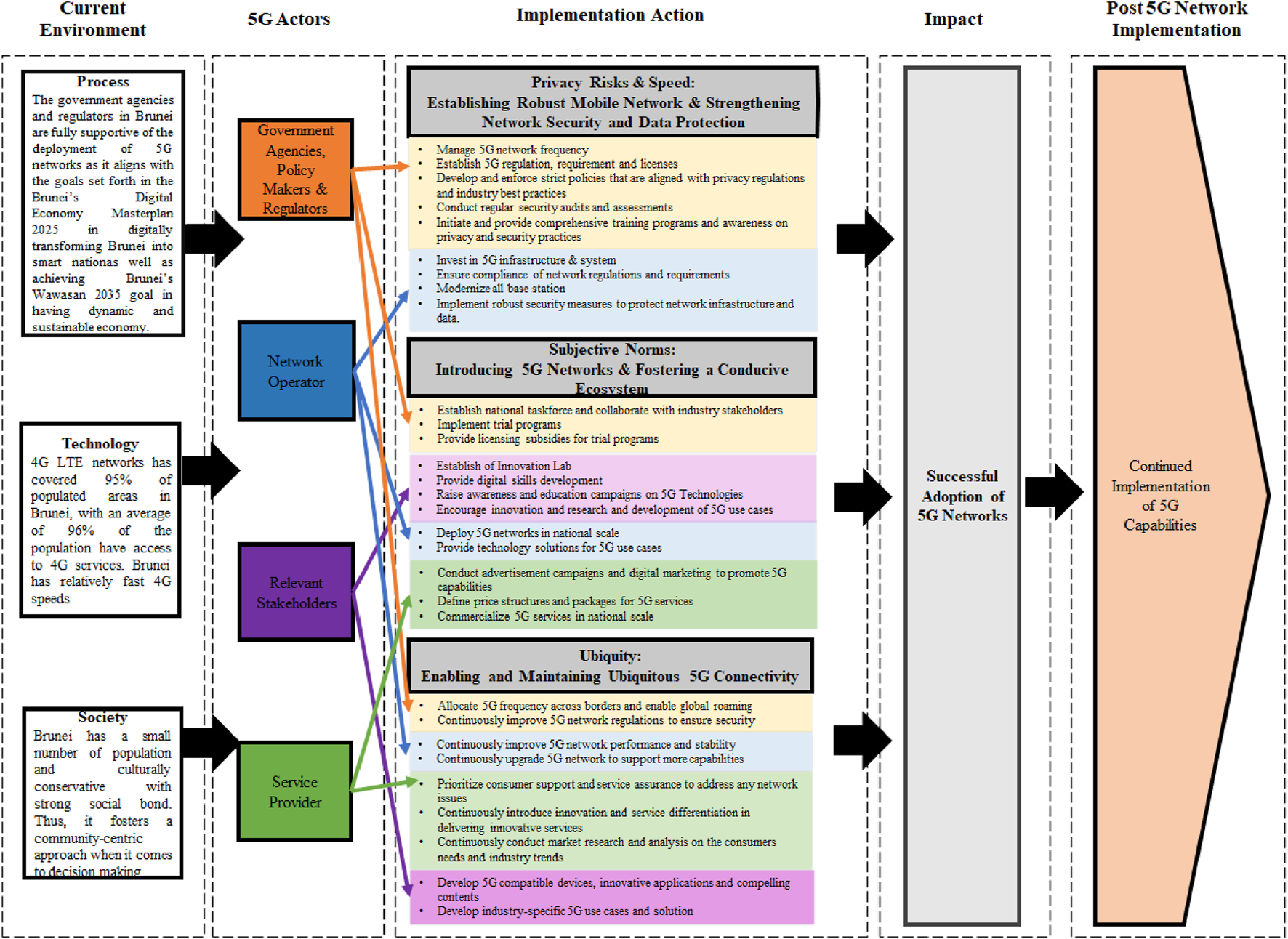
Proposed 5G network implementation framework.
In addressing the factors of privacy risks and speed, one key action 5G actors should take is to establish robust a mobile network with strengthened network privacy and data protection. The main 5G actor responsible for this action is the government agencies and regulatory body, and network operator. These entities should focus on effectively managing and allocating the 5G network frequency and formulating 5G regulation, requirement, and licenses, based on the international standard to ensure compatibility and interoperability with networks worldwide. To ensure the network privacy and data are protected, the regulatory body should develop and enforce policies and regulations that are aligned with privacy regulations and industry best practices. Regular security audits should also be conducted periodically to ensure network infrastructure and data handling processes meet established security standards. Providing awareness and initiating comprehensive training programs on the importance of data protection, privacy regulations, and handling sensitive information should also be done in ensuring the public to be aware and knowledgeable towards the privacy threats.
To accommodate the high-speed connectivity offered by 5G, the network operator should also invest in infrastructure upgrades. This includes deploying additional 5G base stations and towers and ensuring the compliance of network regulations and requirements to improve coverage, capacity, and connectivity. Moreover, implementing security measures into the infrastructure and network system may contribute to further protect against attacks and unauthorized access, and maintain privacy and data protection.
Meanwhile, the key action for subjective norms that 5G actors can take is introducing 5G networks and fostering a conducive ecosystem. In achieving this, the government agencies and regulatory body should establish national taskforce and collaborate with industry stakeholders, implement trial programs as well as provide licensing subsidies for trial programs to initiate a collaborative ecosystem. Relevant stakeholders such as academia, technology companies and start-up accelerators should establish an innovation lab that dedicated to fostering innovation, research, and development in various fields, promoting, and educating the public about the benefit and potential application of 5G. While the network operator plays the role in deploying 5G networks, they should also provide technology and IT solutions for 5G use cases. As the service providers commercialize the 5G services in national scale, they should conduct advertisement campaigns and digital marketing to educate the public about the benefits and features of 5G and generate interest and excitement among potential users, as well as defining their pricing strategy in offering attractive price structures and packages to cater the consumers’ needs to ensure that 5G services are accessible and appealing to a wide range of consumers.
Finally, when addressing the ubiquity of 5G, one key action the 5G actors should focus on is to enable and maintain ubiquitous 5G connectivity. The government agency and regulatory body should allocate 5G frequency across borders and facilitate global roaming to enable seamless and uninterrupted connectivity. By continuously improving 5G regulations, it ensures robust cybersecurity measures and protection, thus maintaining a secure and safe 5G ecosystem, while fostering and encouraging widespread adoption. Network provider plays a significant role in ensuring the performance and stability of 5G networks, as well as continuously upgrading them to support more capabilities.
As the consumers’ demand and needs may evolve over time, network operators should be at the forefront of technological innovations in terms of the development of infrastructure and system to ensure that they can fully leverage the benefits of 5G. In order to meet consumers expectations on the stable connectivity of 5G services, prioritization from the service providers should be centered in providing consumer support, promptly addressing network issues, introducing innovative services, and differentiating themselves from competitors while also continuously conducting regular market research and analysis to understand consumer needs, preferences, and industry trends. With their offerings in the market demand and ensuring positive experience, these may attract and retain the consumers into continuously using 5G networks. Relevant stakeholders such as startups, innovation labs and academia should lead the development of 5G devices, innovative applications as well as the development of industry-specific 5G use cases and solutions. Improvements, innovations, and integrations of technologies may aid in ensuring robust and reliable 5G network, and accessibility to wide range of devices that can take advantage of 5G connectivity to drive digital transformation and optimize operations.
With the successful adoption of 5G networks, it can pave the way for continued implementation and expansion of 5G capabilities. Various sectors and industries may benefit from the potential capabilities of 5G, which can lead to overall digital transformation of Brunei, and ultimately, achieving the Brunei’s Digital Economy Masterplan (Figure 5).
The aim of this study is to explore consumers’ behavioral intentions to use 5G networks in Brunei Darussalam. The significant relationships found between speed, subjective norms, ubiquity, and attitude toward behavioral intention can be translated into actionable strategies for national 5G deployment. However, to ensure the viability of implementation, this revised framework integrates feasibility considerations related to Brunei’s demographic scale, technological readiness, and policy environment.
Brunei Darussalam benefits from an already extensive 4G LTE infrastructure, covering 95% of populated areas, and 96% of the population has access to 4G services. This provides a solid technical foundation for gradual 5G expansion. Moreover, Brunei’s small population size (∼440,000) allows for manageable scaling of infrastructure investments, potentially reducing the financial and logistical burden compared to larger countries.
To enhance practicality, the proposed implementation strategies are categorized into short-term (2025–2027) and long-term (2028–2035) phases:
Short-term Priorities (2025–2027):
Establish trial zones in urban areas and high-demand sectors (e.g., education, logistics, and healthcare).
Upgrade core infrastructure through deployment of essential 5G base stations.
Launch nationwide public awareness campaigns addressing privacy, health, and pricing concerns.
Provide subsidies or incentives for 5G-compatible devices to early adopters.
Long-term Priorities (2028–2035):
Expand 5G coverage to semi-urban and rural areas in stages.
Integrate 5G into smart governance, IoT-driven public services, and industry automation.
Strengthen national cybersecurity frameworks and data governance systems.
Foster partnerships between government, academia, and private sector for use case development and workforce upskilling.
To further assess feasibility, this framework aligns with existing national objectives such as the Brunei Digital Economy Masterplan 2025 and Wawasan Brunei 2035. These strategic alignments ensure that 5G development is embedded within broader national digital transformation goals, supported by policy momentum and institutional backing.
In conclusion, by accounting for resource constraints, social readiness, and realistic timelines, this revised implementation framework aims to be both technically sound and operationally viable, offering a pathway that balances ambition with feasibility in advancing Brunei’s 5G landscape.
5.4.2 Proposed strategy for implementation of 5G capabilities
In achieving the goal of Brunei’s Wawasan 2035, the full implementation of 5G capabilities can be crucial in driving the digital transformation and economic growth of the nation. Based on the key project mentioned in Brunei’s Digital Economy Masterplan (2020) and the capabilities of 5G networks, a strategy for the full implementation of 5G capabilities were formulated. These capabilities can serve as a guide for developing specific projects and initiatives. Figure 6 illustrates the proposed strategy for full implementation of 5G capabilities by technological demand towards the year 2035.
FIGURE 6
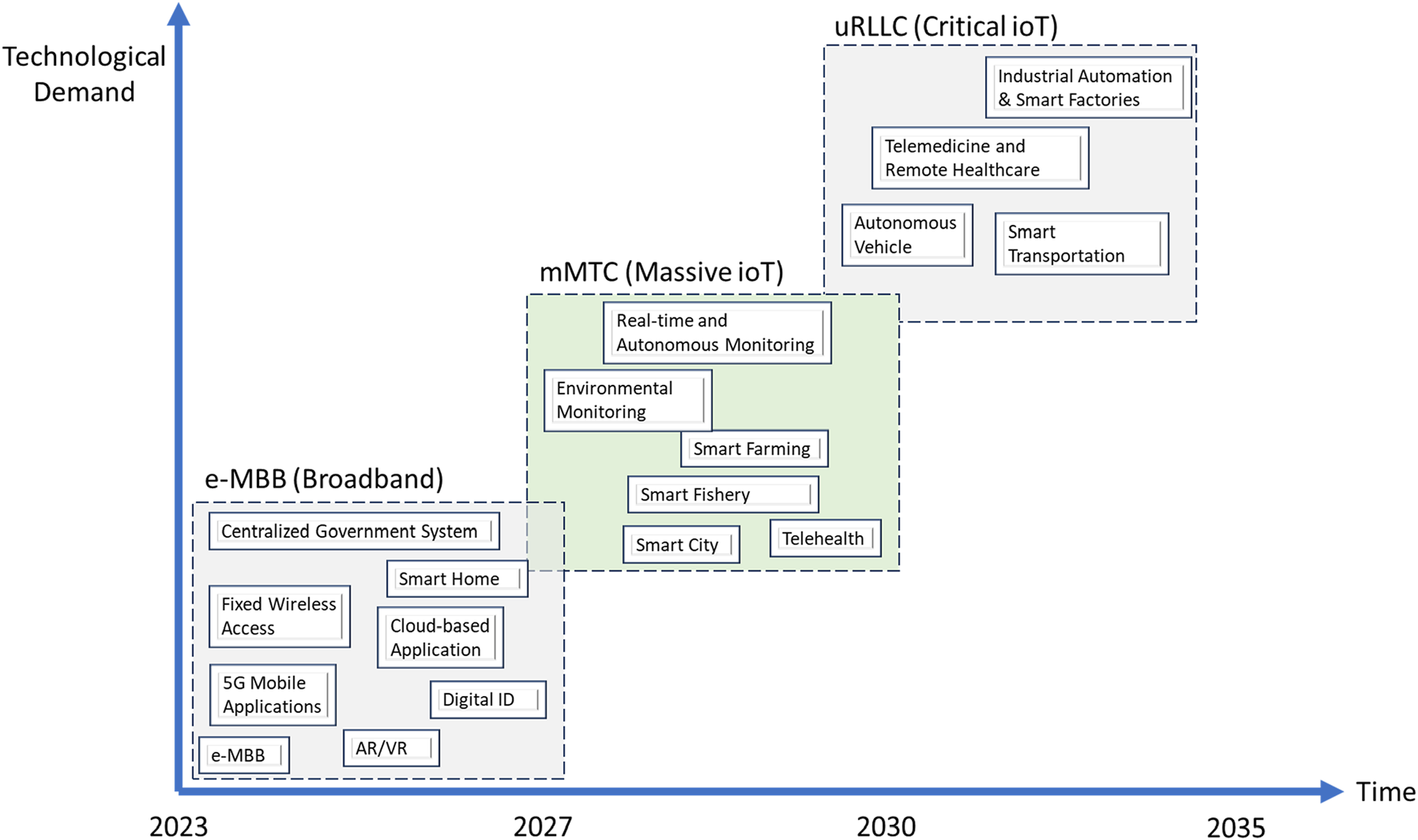
Proposed strategy for implementation of 5G capabilities.
As the eMBB offers significantly faster data speeds and increased capacity, it may open up a range of possibilities for various applications and services such as fixed wireless access, 5G mobile applications, immersive AR/VR experiences, digital ID, efficient utilization of cloud-based applications and services, smart home integration, and centralized government system. These projects and initiatives can be developed and implemented by the year 2027.
With the capabilities offered by mMTC, it enables the connection of a massive number of Internet of Things (IoT) devices. Thus, it may create opportunities for various industries to benefit from real-time and autonomous monitoring, environmental monitoring, smart farming, smart fishery, smart city as well as telehealth. The implementation of these projects by the year 2030 is indeed possible with the advancements in 5G technology and the ongoing efforts to develop and advance these capabilities.
The uRLLC is the most crucial capability of 5G that enables applications requiring ultra-low latency and high reliability. It holds great potential to transform industries and enable innovative applications in autonomous vehicles, telemedicine, industrial automation, and smart transportation. However, these projects may require significant technological advancements, critical infrastructure development, and regulatory frameworks to be in place, thus, they are targeted to be developed and implemented by the year 2035.
It is important to note that the timeline for full implementation of 5G capabilities may be affected by various factors such as infrastructure development, regulatory frameworks, investment priorities, market demand, and technological advancements. In addition, consumers’ acceptance, perceptions, and intentions to adopt these technologies may also be the challenges in implementing these projects.
Therefore, the current study serves as a foundation for future research and practical applications of the new technologies enabled by 5G capabilities to guide for decision-making, investment priorities, and the formulation of strategies to harness the benefits of 5G capabilities. As 5G networks continue to evolve and expand, there will be a need for further exploration and understanding of the potential benefits, challenges, and implications of these technologies in various sectors and industries. While this study provides a valuable cross-sectional snapshot of consumers’ behavioral intentions toward 5G adoption in Brunei Darussalam, it is important to note that consumer attitudes and intentions are dynamic and may shift over time, particularly before and after the actual rollout of 5G services. As the deployment of 5G in Brunei remains in its preparatory phase, current perceptions may be shaped more by expectations than by actual experience. Future longitudinal research is strongly recommended to observe temporal changes in behavioral intentions and actual usage patterns. Such studies can track the evolution of public trust, satisfaction, perceived benefits, and concerns as 5G infrastructure becomes available and widely adopted. Monitoring these trends over time—particularly at multiple points such as pre-launch, early adoption, and post-adoption—can offer richer insights into technology acceptance lifecycle, user retention, and behavioral sustainability. This longitudinal approach would also be critical in identifying adoption barriers or enablers that only emerge after users begin interacting with the technology directly.
6 Conclusion
6.1 Review of findings
The study conducted in this research has fulfilled the aim and overall findings to assess consumers’ behavioral intentions towards the adoption of 5G networks in Brunei Darussalam. In achieving the aim of this study, research objectives and research questions were formed and developed, making them the basis of the findings.
In chapter 1, it was stated that the first research objective was to investigate the impact of influencing factors such as privacy risks, speed, ubiquity, and subjective norms on consumers’ behavioral intentions to use 5G networks. In answering the first research question “How do factors such as privacy risks, speed, ubiquity, and subjective norms influence consumers’ intention to use 5G networks?”, four hypotheses were tested in order to determine the relationship between the four variables. Through structural analysis, it was proven that all the factors positively influence consumers’ behavioral intention to use 5G networks. However, only speed [SP→ATT→BI: (p = 0.046, t = 1.998, β = 0.125)] and subjective norm [SN→ATT→BI: (p = 0.038, t = 2.080, β = 0.089)] have significant effect on behavioral intention through attitude.
In contrast, privacy risks [PR→ BI: (p = 0.030, t = 2.169, β = −0.109)] only have a direct significant effect on behavioral intention. Ubiquity [UB→ BI: (p = 0.001, t = 5.088, β = 0.443) and UB→ATT→ BI: (p = 0.050, t = 1.963, β = 0.090)] has a significant effect on behavioral intentions both directly and indirectly through attitude.
The second research objective focused on the role of attitude as a mediator in influencing consumers’ behavioral intentions to use 5G networks. Thus, another research question was developed, “How does the role of attitude as a mediator influence these factors on consumers’ intention to use 5G networks?”. This part of research objectives was to focus on the effect of attitude as a mediating variable in examining the indirect relationship between the influencing factors and behavioral intentions. Systematic mediation analysis procedure was employed in answering this research question. Based on the procedure, it was found that attitude has full mediation effect on the relationship between subjective norms and behavioral intention, and the relationship speed and behavioral intention. In contrast, attitude has no mediation effect on the relationship between privacy and behavioral intentions. On the other hand, ubiquity has complimentary partial mediation effect on behavioral intentions.
The last objective of this study was to determine the impact of consumers’ attitude in influencing their intention to use 5G mobile networks. Research question “How does consumers’ attitude influence their intention to use 5G networks?” was developed. In answering this research question, a hypothesis was tested to determine the relationship between attitude and behavioral intentions. Through the statistical analysis, it was found that attitude has a significant relationship with behavioral intention.
6.2 Limitations and future research
Despite the methodological rigor and practical contributions of this study, several limitations must be acknowledged.
First, the sample size of 116 valid respondents, while adequate for exploratory PLS-SEM analysis, may not fully capture the diversity of the broader population in Brunei Darussalam. The use of a simple random sampling technique distributed primarily via online platforms introduces potential selection bias, which may underrepresent specific demographic segments such as rural communities, older populations, or individuals with limited digital access. Consequently, the generalizability of the findings to the entire population should be approached with caution.
Second, the socio-economic distribution of the sample—such as income levels, employment types, or urban–rural divides—was not evenly captured. This could limit the ability to identify differentiated behavioral patterns across various consumer subgroups, which are especially relevant in a conservative and diverse society like Brunei.
Future research is therefore recommended to utilize larger and more stratified samples to improve representativeness and enhance the external validity of the results. Employing mixed-method approaches (e.g., integrating qualitative interviews or focus groups) would also deepen understanding of nuanced issues such as digital trust, cost sensitivity, and cultural perceptions towards 5G technology adoption.
In addition to quantitative approaches, future research is strongly encouraged to incorporate qualitative methods such as in-depth interviews, focus group discussions, or narrative inquiry. These techniques would allow researchers to explore the underlying motivations, emotional perceptions, and context-specific concerns that influence consumer intentions toward 5G adoption—factors that are often not fully captured through structured surveys. For instance, issues related to trust, misinformation, perceived health risks, or socio-cultural influences may emerge more vividly in open-ended discussions. A mixed-method design would not only strengthen the explanatory power of the findings but also offer a more holistic perspective on consumer behavior, particularly in a conservative and tightly regulated society like Brunei Darussalam. Qualitative insights could also inform the refinement of quantitative instruments, ensuring higher contextual validity in future studies. Therefore, integrating qualitative approaches is essential for advancing both theory development and practical strategy formulation in 5G adoption research.
Statements
Data availability statement
The original contributions presented in the study are included in the article/supplementary material, further inquiries can be directed to the corresponding author.
Author contributions
HS: Project administration, Resources, Funding acquisition, Visualization, Formal Analysis, Validation, Data curation, Writing – original draft, Supervision, Writing – review and editing, Methodology, Software, Investigation, Conceptualization. IH: Data curation, Methodology, Investigation, Writing – original draft. AS: Writing – review and editing.
Funding
The author(s) declare that financial support was received for the research and/or publication of this article. UTB Grant No. 18.
Conflict of interest
The authors declare that the research was conducted in the absence of any commercial or financial relationships that could be construed as a potential conflict of interest.
Generative AI statement
The author(s) declare that no Generative AI was used in the creation of this manuscript.
Any alternative text (alt text) provided alongside figures in this article has been generated by Frontiers with the support of artificial intelligence and reasonable efforts have been made to ensure accuracy, including review by the authors wherever possible. If you identify any issues, please contact us.
Publisher’s note
All claims expressed in this article are solely those of the authors and do not necessarily represent those of their affiliated organizations, or those of the publisher, the editors and the reviewers. Any product that may be evaluated in this article, or claim that may be made by its manufacturer, is not guaranteed or endorsed by the publisher.
Abbreviations
5G, The Fifth Generation of Wireless Cellular Technology; ASEAN, The Association of Southeast Asian Nations; AITI, Authority for Info-communications Technology Industry; DST, Datastream Digital; eMBB, Enhanced Mobile Broadband; mMTC, Massive Machine-Type Communications; PCSB, Progresif Cellular Sdn Bhd; TAM, Technology Acceptance Model; UNN, Unified National Networks UNN; URLLC, Ultra-reliable and Low-latency Communications.
References
1
AITI (2019). 5G plan of action. Brunei Darussalam Auth. Infocommunications Technol. Industry Brunei Darussalam (AITI).
2
AITI (2022). 5th generation (5G) Mobile network trial initiated. Available online at: https://www.aiti.gov.bn/news/2022/5th-generation-5g-mobile-network-trial-initiated/ (Accessed February 21, 2025).
3
Ajzen I. (1991). The theory of planned behavior. Organ. Behav. Hum. Decis. Process.50, 179–211. 10.1016/0749-5978(91)90020-t
4
Al-Gahtani S. S. (2016). Empirical investigation of e-learning acceptance and assimilation: a structural equation model. Appl. Comput. Inf.12 (1), 27–50. 10.1016/j.aci.2014.09.001
5
Alsamydai M. J. Jasim M. Yassin S. G. Alnaimi H. M. Dajani D. M. Ihab (2014). Measuring consumers attitudes towards banking services offered by Iraqi public and private. Int. Rev. Manag. Bus. Res.
6
Andrews J. G. Buzzi S. Choi W. Hanly S. V. Lozano A. Soong A. C. et al (2014). What will 5G be?IEEE J. Sel. Areas Commun.32 (6), 1065–1082. 10.1109/JSAC.2014.2328098
7
Araújo T. Casais B. (2019). “Customer acceptance of shopping-assistant chatbots,” in Marketing and smart technologies: proceedings of ICMarkTech 2019 (Singapore: Springer), 278–287.
8
Bagozzi R. R. Yi Y. (1988). On the evaluation of structural equation models. J. Acad. Mark. Sci.16, 74–94. 10.1007/bf02723327
9
Baldini G. Giuliani R. Pons E. C. (2017). An analysis of the privacy threat in vehicular Ad hoc networks due to radio frequency fingerprinting. Mob. Inf. Syst.2017, 1–13. 10.1155/2017/3041749
10
Becker J.-M. Ringle C. M. Sarstedt M. Völckner F. (2015). How collinearity affects mixture regression results. Mark. Lett.26, 643–659. 10.1007/s11002-014-9299-9
11
Blackman C. Forge S. (2019) “N-DEPTH ANALYSIS: 5G deployment: state of play in Europe, USA and Asia,” in Directorate-general for internal policies, policy department for economic, scientific and quality of life policies. Luxembourg, France: European Parliament. Available online at: https://www.europarl.europa.eu/RegData/etudes/IDAN/2019/631060/IPOL_IDA(2019)631060_EN.pdf (Accessed February 21, 2025).
12
Cheng L.-K. Huang H.-L. Yang S.-Y. (2021). Attitude toward 5G: the moderating effect of regulatory focus. Technol. Soc.67, 101795. 10.1016/j.techsoc.2021.101795
13
Davis F. D. (1989). Perceived usefulness, perceived ease of use, and user acceptance of information technology. MIS Q.13 (3), 319–340. 10.2307/249008
14
Davis F. D. Bagozzi R. P. Warshaw P. R. (1989). User acceptance of computer technology: a comparison of two theoretical models. Manag. Sci.35, 982–1003. 10.1287/mnsc.35.8.982
15
Digital Economy Council. (2020). Brunei digital economy masterplan 2025.
16
Fornell C. Larcker D. F. (1981). Evaluating structural equation models with unobservable variables and measurement error. J. Mark. Res.18, 39–50. 10.1177/002224378101800104
17
Ghasemy M. Teeroovengadum V. Becker J.-M. Ringle C. M. (2020). This fast car can move faster: a review of PLS-SEM application in higher education research. High. Educ.80, 1121–1152. 10.1007/s10734-020-00534-1
18
Gopal B. Kuppusamy P. (2015). A comparative study on 4G and 5G technology for wireless applications. IOSR J. Electron. Commun. Eng. (IOSR-JECE)10 (6), 67–72.
19
Gorrepati U. Zavarsky P. Ruhl R. (2021). “Privacy protection in LTE and 5G networks,” in 2021 2nd International Conference on Secure Cyber Computing and Communications (ICSCCC), 382–387. 10.1109/icsccc51823.2021.9478109
20
Goyal P. Sahoo A. Vimal V. (2019). A roadmap towards connected living: 5G Mobile technology. Int. J. Innovative Technol. Explor. Eng. (IJITEE)9 (1), 1670–1685. 10.35940/ijitee.A4742.119119
21
Gursoy D. Spangenberg E. R. Rutherford D. G. (2006). The hedonic and utilitarian dimensions of attendees' attitudes toward festivals. J. Hosp. and Tour. Res.30 (3), 279–294. 10.1177/1096348006287162
22
Hair J. F. Ringle C. M. Sarstedt M. (2011). PLS-SEM: indeed a silver bullet. J. Mark. Theory Pract.19, 139–152. 10.2753/mtp1069-6679190202
23
Hair J. F. Black W. C. Babin B. J. Anderson R. E. (2014). Multivariate data analysis. 7th Edition. Upper Saddle River: Pearson Education.
24
Hair J. F. Hult G. T. Ringle C. M. Sarstedt M. (2017a). A primer on partial least squares structural equation modeling (PLS-SEM). Thousand Oaks: Sage.
25
Hair J. F. Risher J. J. Sarstedt M. Ringle C. M. (2018). When to use and how to report the results of PLS-SEM. Eur. Bus. Rev.31, 2–24. 10.1108/ebr-11-2018-0203
26
Hajiheydari N. Ashkani M. (2018). Mobile application user behavior in the developing countries: a survey in Iran. Inf. Syst.77, 22–33. 10.1016/j.is.2018.05.004
27
Henseler J. Ringle C. M. Sarstedt M. (2015). A new criterion for assessing discriminant validity in variance-based structural equation modeling. J. Acad. Mark. Sci.43, 115–135. 10.1007/s11747-014-0403-8
28
Hulland J. (1999). Use of partial least squares (PLS) in strategic management research: a review of four recent studies. Strategic Manag. J.20, 195–204. 10.1002/(sici)1097-0266(199902)20:2<195::aid-smj13>3.0.co;2-7
29
Javed M. Siddiqui A. T. (2017). Transformation of Mobile communication network from 1G to 4G and 5G. Int. J. Adv. Res. Comput. Sci.8 (3), 193–197.
30
Khan R. Kumar P. Jayakody D. N. Liyanage M. (2019). A survey on security and privacy of 5G technologies: potential solutions, recent advancements and future directions. J. LATEX IEEE Commun. Surv. TUTORIALS.
31
Khozaei F. (2023). Re: what is the difference between composite reliability (rho_a) and composite reliability (rho_c). Available online at: https://www.researchgate.net/post/What_is_the_difference_between_Composite_reliability_rho_a_and_Composite_reliability_rho_c/63b975411212846b6f095b3e/citation/download (Accessed February 21, 2025).
32
Kon J. (2022). 5G services on the horizon. Retrieved Borneo Bull.Available online at: https://borneobulletin.com.bn/5g-services-on-the-horizon-2/ (Accessed February 21, 2025).
33
Lallmahamood M. (2007). N examination of individual’s perceived security and privacy of the internet in Malaysia and the influence of this on their intention to use E-Commerce: using an extension of the technology acceptance model. J. Internet Bank. Commer.
34
Massaro M. Kim S. (2022). Why is South Korea at the forefront of 5G? Insights from technology systems theory. Telecommun. Policy46, 102290. 10.1016/j.telpol.2021.102290
35
Miyazaki A. D. Fernandez A. (2001). Consumer perceptions of privacy and security risks for online shopping. J. Consumer Aff.35 (1), 27–44. 10.1111/j.1745-6606.2001.tb00101.x
36
Nunkoo R. T. D. J. Rambhunjun T. (2013). “Applying the extended technology acceptance model to understand online purchase - behavior of traveler,” in Proceeding of 21st International Business Research Conference.
37
Pagani M. (2004). Determinants of adoption of third generation Mobile multimedia services. J. Interact. Mark.18, 46–59. 10.1002/dir.20011
38
Rasidah (2021). Brunei targets 5G rollout by Mid-2022. Available online at: https://thescoop.co/2021/01/29/brunei-targets-5g-rollout-by-mid-2022/ (Accessed February 21, 2025).
39
Ringle C. M. Sarstedt M. Straub D. W. (2012). Editor's comments: a critical look at the use of PLS-SEM in MIS quarterly. MIS Q.36. 10.2307/41410402
40
Praoga T. Abraham J. (2020). “Technopsychology of IoT optimization in the business world,” in Securing the internet of things: concepts, methodologies, tools, and applications (IGI Global), 21–45.
41
Seddigh N. Nandy B. Makkar R. (2010) “Security advances and challenges in 4G wireless networks,” in 2010 eighth annual international conference on privacy, security and trust.
42
Shankar V. Venkatesh A. Hofacker C. Naik P. (2010). Mobile marketing in the retailing environment: current insights and future research avenues. J. Interact. Mark.24, 111–120. 10.1016/j.intmar.2010.02.006
43
Shih Y.-Y. Fang K. (2011). Effects of network quality attributes on customer adoption intentions of internet banking. Total Qual. Manag. and Bus. Excell.17, 61–77. 10.1080/14783360500249661
44
Singh N. Sinha N. Liébana-Cabanillas F. J. (2020). Determining factors in the adoption and recommendation of mobile wallet services in India: analysis of the effect of innovativeness, stress to use and social influence. J. Inf. Manag.50, 191–205. 10.1016/j.ijinfomgt.2019.05.022
45
Tojib D. Tsarenko Y. (2012). Post-adoption modeling of advanced Mobile service use. J. Bus. Res.65, 922–928. 10.1016/j.jbusres.2011.05.006
46
Taber K. S. (2018). The use of Cronbach’s alpha when developing and reporting research instruments in science education. Res. Science Education48 (6), 1273–1296. 10.1007/s11165-016-9602-2
47
Taylor S. Todd P. (1995). Decomposition and crossover effects in the theory of planned behavior: a study of consumer adoption intentions. Int. J. Mark. Res.12 (2), 137–155. 10.1016/0167-8116(94)00019-k
48
UNN (2022). Borneo bulletin. Available online at: https://borneobulletin.com.bn/evolution-of-telecommunications/ (Accessed February 21, 2025).
49
Voorhees C. M. Brady M. K. Calantone R. Ramirez E. (2016). Discriminant validity testing in marketing: an analysis, causes for concern, and proposed remedies. J. Acad. Mark. Sci.44, 119–134. 10.1007/s11747-015-0455-4
50
Wilson B. G. (2004). Designing e-learning environments for flexible activity and instruction. Educ. Technol. Res. Dev.52 (4), 77–84. 10.1007/bf02504720
51
Wu J.-H. Wang S.-C. (2005). What drives Mobile commerce?an empirical evaluation of the revised technology acceptance model. Inf. and Manag.42, 719–729. 10.1016/j.im.2004.07.001
52
Yonhap News Agency (2021). Available online at: https://en.yna.co.kr/view/AEN20210129007200320 (Accessed February 21, 2025).
Summary
Keywords
5G, mobile network, telecommunication, TAM, behavioral intentions
Citation
Susanto H, Hj Ahamad IN and Shafa Susanto AK (2025) Investigating consumers’ behavioral intentions in the adoption of 5G mobile networks: a holistic approach to technology acceptance and business process integration. Front. Commun. Netw. 6:1594378. doi: 10.3389/frcmn.2025.1594378
Received
16 March 2025
Revised
02 July 2025
Accepted
19 August 2025
Published
09 December 2025
Volume
6 - 2025
Edited by
Essaid Sabir, Université TÉLUQ, Canada
Reviewed by
Saadane Rachid, École Hassania des Travaux Publics, Morocco
Eisinger Balassa Boglárka, Széchenyi István University, Hungary
Updates
Copyright
© 2025 Susanto, Hj Ahamad and Shafa Susanto.
This is an open-access article distributed under the terms of the Creative Commons Attribution License (CC BY). The use, distribution or reproduction in other forums is permitted, provided the original author(s) and the copyright owner(s) are credited and that the original publication in this journal is cited, in accordance with accepted academic practice. No use, distribution or reproduction is permitted which does not comply with these terms.
*Correspondence: Heru Susanto, susanto.prof@gmail.com
Disclaimer
All claims expressed in this article are solely those of the authors and do not necessarily represent those of their affiliated organizations, or those of the publisher, the editors and the reviewers. Any product that may be evaluated in this article or claim that may be made by its manufacturer is not guaranteed or endorsed by the publisher.