 Alexandre R. Vieira
- Department of Oral Biology, School of Dental Medicine, University of Pittsburgh, Pittsburgh, PA, United States
Dentistry for Children Today
Children are different than adults. They are actively growing and developing. They are not miniature adults. Clinical presentations and trajectory of disease can be very different. One example is COVID-19, in which most affected children show mild illness but as the pandemic took its toll, clusters of children and adolescents showed a multisystem inflammatory condition with some features similar to those of Kawasaki disease and toxic shock syndrome. COVID-19 manifestations in children appear to be different from the ones in adults. This is true for many conditions. When it comes to oral health outcomes, the same is also true. Oral, dental, and craniofacial conditions in children have their own distinct features, different many times to when the same conditions affect adults. Research findings for these conditions in adults many times will not apply to children. Children need to be the focus of research on interventions and definition of best practices that will determine their care. Frontiers in Dental Medicine Pediatric Dentistry section aims to address this need by serving as the main forum for cutting edge work on dentistry for children and adolescents.
There are gaps of knowledge in early childhood caries, the first biological changes of periodontal disease and infection, first signs of temporomandibular joint disc degeneration, or the mechanisms leading to disturbances in enamel development.
Pediatric dentistry has evolved continuously. There is great interest in early detection of dental caries with diagnostic and imaging tools. In the care of children, painless injection systems and techniques are more recent developments that impact behavior management. Finally, identification of groups that are at higher risk for oral disease is another area that needs to be explored.
Adolescents in particular are a group that is historically understudied, and they have their own issues that need to be researched. Erosive tooth wear, anxiety-related issues, and abuse of substances are issues that affect adolescents uniquely.
What to Study?
To answer this question, ideally, we know what the profile of children in different geographic areas is. As an example, here is the current profile of children from Pittsburgh, USA. Pittsburgh is the largest city of the poorest area in the country, the Appalachian region. Although, it has dramatically improved in the last 60 years, this area has registered some of the worse health outcomes of the country. On one sense, it is an interesting area to develop studies, on the other, many aspects of the region might not be generalizable. Consulting data from the University of Pittsburgh School of Dental Medicine Dental Registry and DNA Repository project (DRDR), we identified 577 children ages 2 through 18. The DRDR currently has more than 6,700 participants and in this project, which was started in 2006, individuals provide written consent to allow or their medical and dental records to be used for future investigations and give a biological sample (saliva) that allows for the planning of molecular studies. From the 577 children, 281 are female. Table 1 lists the frequency of a number of conditions and exposures in the cohort.
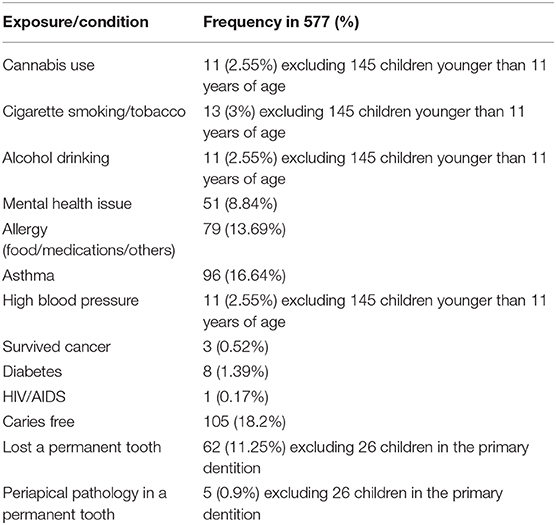
Table 1. Exposures and Health Issues of a Cohort of 577 Children from the University of Pittsburgh School of Dental Medicine Dental Registry and DNA Repository Project.
The list in Table 1 is far from complete but gives an idea of the amplitude of issues that affect children and deserve to be studied to determine their impact on oral health and outcomes of dental treatment. It is also of interest to understand the long-term impact of oral conditions with an onset during childhood.
When looking at caries experience, we can notice that 12.4% of children have 45.27% of the disease (Figure 1).
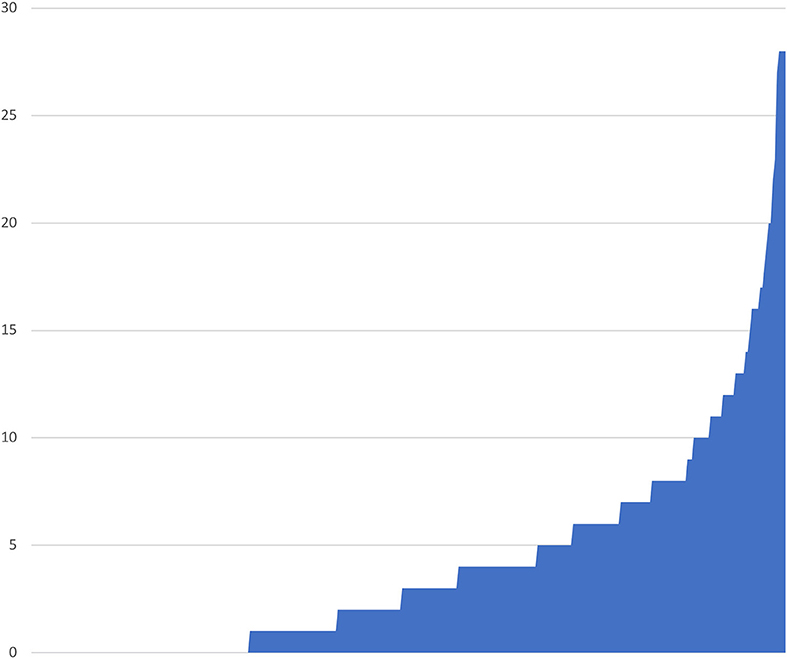
Figure 1. Distribution of caries experience of the children from Pittsburgh participating in the University of Pittsburgh School of Dental Medicine Dental Registry and DNA Repository project. On the X-axis each child is displayed side-by-side. The Y-axis is individual caries experience based on the DMFT (Decayed, Missing due to caries, Filled Teeth) score.
The identification of subsets of individuals at high risk is likely one of the most important tasks of future research, in pediatric dentistry in particular. The focus on risk management and health promotion and prevention, rather than rehabilitation of the damage caused by disease has been preconized for a few decades and has become more relevant than ever. Taking advantage of molecular data to characterize individuals and their risks will accelerate discovery.
Final Remarks
Finally, the pediatric dentist who cared for children from the neighborhood no longer exists in many places. They now care for children and families from all walks of life. Children from different lands, with different cultures, speaking different languages. Parents with prompt access to information, and misinformation. Interventions that require less patient compliance and are ever more effective are desirable. Biomarkers of risk for disease that affect life way into adulthood are desirable. Understanding the impact of childhood experiences on mental health, and how the environment has shaped the children's parents and grandparents modulating the expression of the child's genes are areas for future investigation.
Author Contributions
AV: concept, data collection, data analysis, and writing the manuscript.
Conflict of Interest
The author declares that the research was conducted in the absence of any commercial or financial relationships that could be construed as a potential conflict of interest.
Keywords: pediatrics, dental medicine, pediatric dentistry, cariology, adolescent
Citation: Vieira AR (2020) The Future Research Agenda of Pediatric Dentistry. Front. Dent. Med. 1:4. doi: 10.3389/fdmed.2020.00004
Received: 25 June 2020; Accepted: 02 July 2020;
Published: 17 July 2020.
Edited and reviewed by: David John Manton, University Medical Center Groningen, Netherlands
Copyright © 2020 Vieira. This is an open-access article distributed under the terms of the Creative Commons Attribution License (CC BY). The use, distribution or reproduction in other forums is permitted, provided the original author(s) and the copyright owner(s) are credited and that the original publication in this journal is cited, in accordance with accepted academic practice. No use, distribution or reproduction is permitted which does not comply with these terms.
*Correspondence: Alexandre R. Vieira, YXJ2MTFAcGl0dC5lZHU=