 Katy Jordan
- Institute of Educational Technology, The Open University, Milton Keynes, United Kingdom
Social network sites enable people to easily connect to and communicate with others. Following the success of generic platforms such as Facebook, a variety of online services launched during the mid 2000s in order to bring the benefits of online social networking to an academic audience. However, it is not clear whether these academic social network sites (ASNS) are primarily aligned with social networking or alternative publishing, and functionalities continue to change. Now 10 years since the launch of the three main platforms which currently lead the market (Academia.edu, ResearchGate, and Mendeley), it is timely to review how and why ASNS are used. This paper discusses the history and definition of ASNS, before providing a comprehensive review of the empirical research related to ASNS to-date. Five main themes within the research literature are identified, including: the relationship of the platforms to Open Access publishing; metrics; interactions with others through the platforms; platform demographics and social structure; and user perspectives. Discussing the themes in the research both provides academics with a greater understanding of what ASNS can do and their limitations, and identifies gaps in the literature which would be valuable to explore in future research.
Introduction
The generative definition of a social network site (SNS) was proposed by boyd and Ellison in 2007:
“We define social network sites as web-based services that allow individuals to:
(1) construct a public or semi-public profile within a bounded system,
(2) articulate a list of other users with whom they share a connection, and
(3) view and traverse their list of connections and those made by others within the system.” (boyd and Ellison, 2007, p.211).
Ellison and boyd (2013) subsequently updated the definition to add emphasis on the third point to the role of user-generated content, for users be able to consume, produce or interact with content created by their connections on the site.
The term “academic social network sites” (ASNS) encompasses a variety of online platforms which have sought to bring the benefits of online networking to a specifically academic audience. Working within this definition and applying it to online services aimed at academics, ASNS can be divided into two categories: those which have been developed primarily to facilitate profile creation and connection (analogous to Facebook; examples include Academia.edu and ResearchGate), and those with a primary focus on posting and sharing academic-related content and have subsequently added social networking capabilities (such as Mendeley). This reflects a similar distinction in SNS more generally (boyd and Ellison, 2007). ASNS are typically free to use, although this is not a defining characteristic, and several of the services have been discontinued in recent years. Figure 1 charts the launch (and in some cases closure) of ASNS, and launch dates of mainstream SNS for comparison.
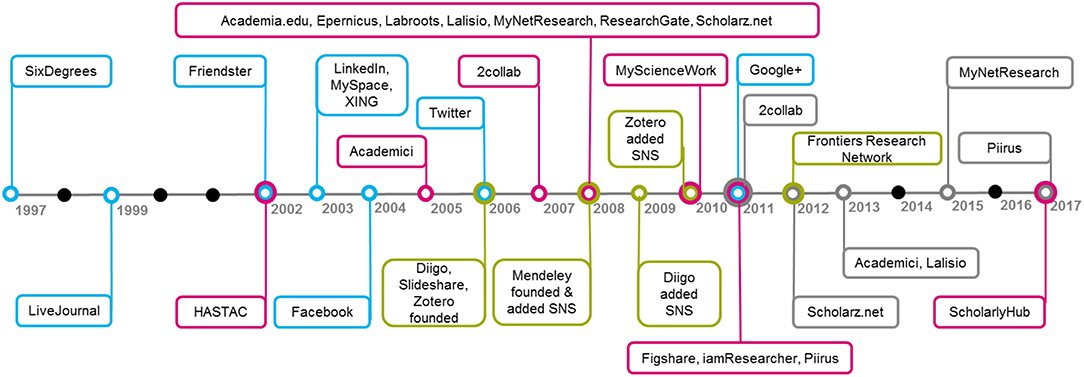
Figure 1. Timeline showing the launch dates (magenta) and discontinuation dates (gray) of ASNS. Other academic platforms which subsequently added social networking are shown in green, and launch dates of major generic SNS in cyan. Updated from Jordan (2017a).
Of the services framed from the outset as ASNS, the market is now dominated by two platforms: Academia.edu and ResearchGate. Both platforms launched in 2008 and initially saw steady growth, each reaching 2 million registered users in 2012 (Jordan, 2017a). At the same time, Mendeley (as a leading bibliographic tool which added social networking) also exceeded 2 million users (Jordan, 2017a). Since 2012, growth has accelerated (Jordan, 2017b) and at the time of writing, Academia.edu invites site visitors to join over 64 million existing users (Academia.edu, 2018), while ResearchGate states that it has over 15 million members (ResearchGate, 2018). These platforms lead the field in terms of user numbers and international reach, although the platforms are primarily Anglophone and other localized platforms exist [such as the state-mandated Lattes platform in Brazil; (Lazzari Barlete and de Azevedo, 2018)].
Academia.edu and ResearchGate are both for-profit venture capital-funded technology startup companies. While Academia.edu has received $17.8 million dollars in investment to-date (Crunchbase, 2018a), ResearchGate has secured $87.6 million dollars, including high-profile investors such as Bill Gates and Wellcome (Crunchbase, 2018b). In 2013, Elsevier bought Mendeley, primarily a bibliographic tool but also an ASNS (Shaw, 2013) as part of their strategy to acquire a wide range of scholarly online tools and establish themselves as a platform (Robertson, 2018). However, the business model of ASNS and their intentions to monetise the networks remains opaque.
The functionalities offered by the platforms varies and has changed over time. Initially, Academia.edu was billed as a genealogical site for researchers (Kincaid, 2008), and used a visual interface to map academic relationships in this manner, which has since been discontinued. In contrast, the first TechCrunch article focusing upon ResearchGate drew a parallel with LinkedIn (Rao, 2009). Academia.edu and ResearchGate both fundamentally rely upon profiles, which publications can be uploaded to in addition to personal information, and the ability to follow others. Other functionalities include posting questions, informal peer review, metrics, and job postings. Despite the network being a defining characteristic, the platforms position themselves in competition with the scholarly publishing industry rather than social media. As such, the platforms represent a form of “black” or “guerilla” Open Access publishing (Penn, 2018). However, hosting copyrighted material has brought the platforms into direct conflict with scholarly publishers. In 2013, Elsevier began issuing takedown notices to Academia.edu users who had uploaded articles which infringed their copyright (Solon, 2013). Similarly, a group of five publishing houses initiated formally raised concerns and called for action with ResearchGate in 2017 (Matthews, 2017). While the initial conflict between Academia.edu and Elsevier was viewed to an extent as a positive act of resistance against traditional publishers, such sentiment had changed by 2016. The #DeleteAcademiaEdu hashtag emerged as a backlash in response to suggestions that the platform would offer greater visibility to users' papers in exchange for a fee (Mangiafico, 2016). The hashtag served as a reminder that ASNS are for-profit businesses, ultimately looking to find ways to monetise the network.
Ten years since the launch of two of the major ASNS, it is now timely therefore to reassess the platforms regarded as “Facebook for academics.” Caught between aspiring to be SNS or publishing platforms and with various different capabilities and features, what do ASNS actually “do” in terms of how academics integrate them into their practice? The major ASNS platforms have increasingly been the focus of research themselves, which provides a way of understanding what academic social networking can offer. This paper will turn to the body of empirical studies which have focused upon aspects of ASNS in order to address the role that they play, their benefits and limitations.
Scope of the Review
To explore what is currently known about how ASNS are used in practice, a review of the research literature on the topic was undertaken. This approach was used in order to provide a comprehensive and critical assessment of the current field (Kamler and Thomson, 2006). The collection of sources to include in the literature review was compiled during August 2018, building upon and updating an earlier literature review on the topic (Jordan, 2017c).
The first step required searching academic databases for articles on the topic (academic social networking sites) and specific platforms (Academia.edu, Mendeley, ResearchGate). The Open University library online database, the Education Resources Information Center, and Google Scholar were used to conduct the searches. The search results were checked in turn (at the abstract level) by the researcher, and those with an empirical basis were recorded for inclusion in the review. Review papers or position papers which discuss the affordances and design of platforms were not included. Studies (typically surveys) which explore academics' use of social media more broadly, without distinguishing between platforms, were also excluded. These distinctions were made as the underpinning focus of this paper is upon evidence for the platforms' actual, rather than potential, use, and what is distinct about ASNS in particular.
This first round of reading also gave an initial sense of patterns and commonalities within the body of literature, which formed the basis of emergent themes for the review. In identifying themes, informed by the research question, the focus was upon which aspect of ASNS formed the basis of each study. At this point, some clear distinctions of sub-groups within the field were already evident. The themes show parallels with an earlier literature review, mainly undertaken in 2014 (Jordan, 2017c), although the field has since evolved (scholarly metrics through ASNS being an area which has received a much greater focus in recent years, for example). The publications identified for inclusion in the review were then read in full by the researcher and assigned to thematic categories. Themes were identified by a process of induction, close-reading and constant comparison of categories [in a manner after Grounded Theory approaches; (Charmaz, 2014)] throughout assessing the 66 publications included in the review. As the literature review was intended to be comprehensive, it was important in defining the themes that all of the publications could be assigned to at least one category. The final five thematic categories were reapplied to the collection at the end to ensure consistency. The themes form the basis of the analysis and discussion in proceeding sections of the paper.
To provide a resource for reference and to allow the community to build on this collection moving forwards, this paper is also accompanied by an online bibliographic tool. The tool comprises the references, outward links to full papers where possible, and ways to visualize and search the collection (Figure 2). It also offers users the opportunity to submit additional items to the collection. The tool is hosted at http://www.katyjordan.com/academicnetworks.
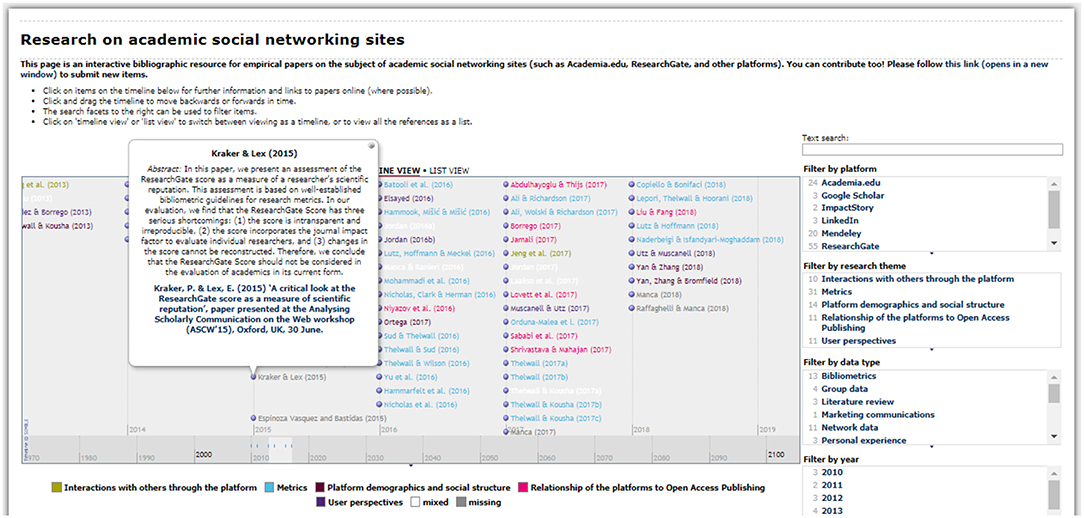
Figure 2. Screen capture of the online bibliography, displaying items on a timeline color-coded according to themes. Clicking on an item on the timeline displays citation information, and an outward link to the publications' location online. The panel to the right comprises faceted browsing to filter the records on display, and text search.
Academia.edu, Mendeley and ResearchGate were the main platforms examined in the empirical studies included in this review. The distribution of publication dates for the collection of papers, according to platform, is shown in Figure 3. This illustrates how the topic of ASNS in general has increasingly become the focus of research in recent years, with ResearchGate receiving most attention.
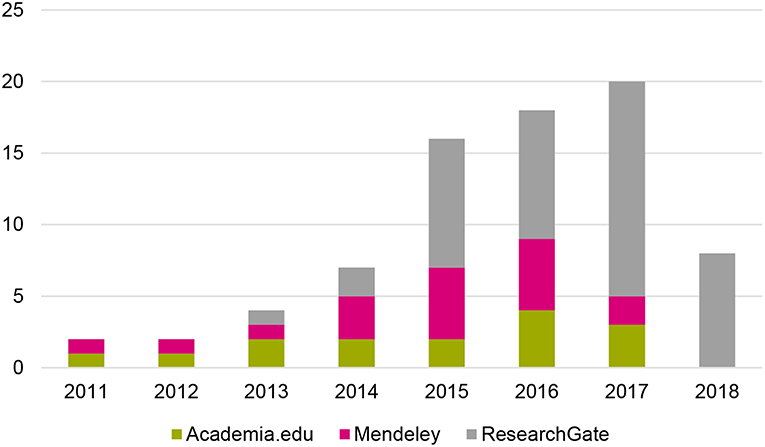
Figure 3. Number of publications, per platform, per year, included in the research literature collection and thematic analysis. Note that 2018 is not a complete year as the data were collected during August.
The publications were categorized according to the data used for each study, and five distinct research themes. The frequency of data types are cross-tabulated according to platform in Table 1. In the next section, the research themes will be introduced and the findings of the studies will be discussed, arranged according to the themes.
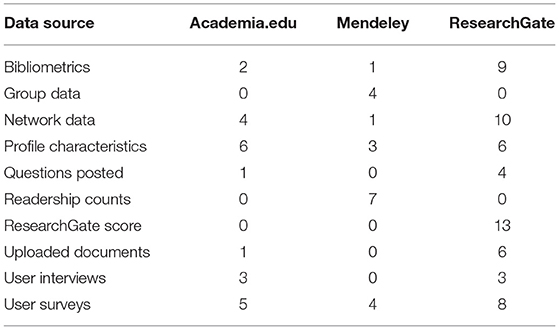
Table 1. Frequency of data types used in the studies, cross-tabulated according to platform.
Research Themes
Five themes were identified within the body of empirical publications included in the review. The majority of studies aligned exclusively with one of the five themes. The five themes, and the number of studies which contributed to each theme, are as follows:
• Relationship of the platforms to Open Access publishing (10);
• Metrics (27);
• Interactions with others through the platform (10);
• Platform demographics and social structure (14);
• User perspectives (9).
While the themes were distinct, they were also underpinned by broader concepts of whether the role of the ASNS is primarily as a publishing platform or a social network.
Relationship of the Platforms to Open Access Publishing
This theme includes publications which examine practical aspects of ASNS as Open Access publishing platforms. Providing online hosting space for academics to upload their papers as a form of self-archiving is a key part of the services offered by Academia.edu and ResearchGate and the studies here address issues related to its uptake in practice. Related to the platforms' Open Access role is the issue of metrics, which has received intense research focus and will be discussed in detail as a theme in its own right in the next section.
Several studies have examined the extent to which academics choose to upload papers to ASNS. Shrivastava and Mahajan (2017) provide a case study of a single department (the Department of Physics and Astrophysics at the University of Delhi). Of the departments' 173 members, 49 of members of the Department with ResearchGate profiles had no publication information associated with their profiles, while 94 had not uploaded any full-text documents (Shrivastava and Mahajan, 2017). It is not clear to what extent this reflects reluctance of the users to upload their publications, or simply the academic profile of the department (less senior members being less likely to have accrued a substantial publication record, for example). Lovett et al. (2017) surveyed faculty members at the University of Rhode Island, reporting that 72.5% of those who were ResearchGate users had uploaded full-texts, although only approximately half (47.0%) of the total faculty members were ResearchGate users. These results suggest that while individual scholars are using ASNS as an Open Access platform, there is considerable variation in the extent of uptake across the Higher Education sector.
There is also a question of where ASNS sit in relation to the broader ecosystem of online repositories and bibliographic resources, particularly institutional repositories. Borrego (2017) compared the coverage of 13 top Spanish Universities outputs made available through institutional repositories and ResearchGate. ResearchGate outperformed institutional repositories in terms of availability of papers, with 54.8% of the papers published during 2014 being available as full-texts through ResearchGate compared to only 11.1% being available to download through institutional repositories, despite a potential 84.5% of the papers being publishing in outlets that would support archiving. Lovett et al. (2017) also drew comparisons between ResearchGate and institutional repository depositing, with ResearchGate again outperforming institutional deposits (20.3% of faculty having uploaded full texts to ResearchGate, compared to 15.4% via institutional provision). Relatively few faculty members (6.3%) used both, while the majority (70.6%) had not used either. The authors attribute the lower uptake of institutional Open Access to the institutional gatekeepers' preference for author-accepted versions of manuscripts, while academics prefer to distribute the final version (although this is more likely to have attendant copyright issues) (Lovett et al., 2017). Similarly, Laakso et al. (2017) present a case study of online archiving of articles by 125 academics associated with the Hanken School of Economics in Finland. Focusing on 587 publications listed in the institutional database for the years 2012, 2013, and 2014, ASNS platforms most frequently used to host papers, compared to the institutional repository. Full-text versions of 15.8% of the 587 papers were found on ASNS, compared to 9.9% at the institutional repository. Again, this reflects low uptake of Open Access overall, but greater use of ASNS compared to institutional repositories.
As noted in the introduction, copyright infringement has brought both Academia.edu and ResearchGate into conflict with academic publishers. Jamali (2017) examined the extent of the problem, in a study which assessed the copyright status of a random sample of 500 English articles available on ResearchGate. 21.6% of the sampled articles were published in Open Access journals; of the non-Open Access articles, 15.6% were pre-prints, 6.1% post-prints and 78.3% were final published PDFs, which may reflect academics' preferences to share the final version (Lovett et al., 2017). As a result, 51.3% of the non-Open Access articles infringed the publishers' copyright. Laakso et al. (2017) also examined which versions were made available in their sample, which also reflected a preference for final published versions, with 75.2% of the full-text articles in the sample hosted on ASNS being published versions. Sababi et al. (2017) sampled the documents on ResearchGate associated with four leading global universities, which demonstrated wide variation in the versions and Open Access status of uploaded documents according to institution.
Two further studies have considered which papers academics choose to share through ASNS, in broader terms than their publication status. Thelwall and Kousha (2017a) address this through a large-scale ad hoc sample of 68,731 publications within ResearchGate. The analysis suggests that there are disciplinary differences in the extent of article sharing through the platform, with greater coverage in the Natural and Physical Sciences compared to the Social Sciences and Arts and Humanities. There is also a temporal effect, in that there is much greater representation of publications from recent years (Thelwall, 2017a). Furthermore, ResearchGate offers users the option to foreground particular publications as “featured research.” Liu and Fang (2018) examined the factors associated with the publications academics choose to place as featured research. Their sample drew upon 2,708 ResearchGate members from a selection of American Higher Education Institutions, which included 95,424 publications in total, 11,821 of which were designated as featured research. How recently the article had been published, the academics' authorship position, number of citations and reputation of the publisher were all found to be associated with featured research (Liu and Fang, 2018).
While metrics will be addressed in the next section, it is worth noting here that two studies have examined the citation advantage associated with hosting publications on the platforms. A research team associated with Academia.edu (Niyazov et al., 2016) examined a sample of 31,216 papers. Papers uploaded to Academia.edu were reported to receive a boost to citations when compared to papers not available online, with the degree of the effect increasing over time (up to 69% after 5 years). When comparing papers uploaded to Academia.edu to those hosted elsewhere online, the Academia.edu papers received an average citation boost of 58% after 5 years (Niyazov et al., 2016). Sababi et al. (2017) examined the citation advantage at ResearchGate through sampling the documents hosted in relation to four universities reflecting locations across the globe. Although the analysis was more limited in scope than Niyazov et al. (2016), the study reports an increased citation rate associated with the availability of Open Access papers through the platform (Sababi et al., 2017).
Abdulhayoglu and Thijs (2017) present a novel application for ASNS within the online scholarly ecosystem, demonstrating that ResearchGate profiles can be used as a way of confirming the identities of authors and dealing with disambiguation between authors with similar names for bibliometric analysis. While the study provides proof-of-concept for this application, the authors note that its efficacy can be impeded by users opting not to provide full publication lists on the platform (Abdulhayoglu and Thijs, 2017), which would be exacerbated by the tendency for more recent research to be uploaded by users (Thelwall and Kousha, 2017a; Liu and Fang, 2018).
To summarize, research into the availability of academic publications through ASNS shows that academics while there is variation in the extent of uploading documents, are more likely to upload their papers to ASNS than to institutional repositories. The studies here also suggest that academics prefer to share the final manuscript rather than author accepted manuscript (which is typically preferred by institutions). While ASNS do not prevent uploading final manuscripts, posting them online carries the greatest risks in terms of copyright. Hosting Open Access papers through ASNS may be associated with a higher citation rate.
Metrics
Metrics is the most prevalent theme within the body of literature related to ASNS. As online platforms, there are a wealth of ways in which ASNS can record the digital traces of how users access the different types of materials hosted on the sites. The interest in metrics derived from the platforms mirrors the concept of bibliometrics as a reflection of academic prestige. Relating metrics from ASNS to traditional measures of prestige may be useful as if they are aligned, the platforms may be a useful source for early indicators of high impact research. Platform metrics may serve as a way of internationalizing comparisons, or allow the performance of individuals to be gauged relative to other (institutional) measures. However, as the functionalities of the platforms offer more than just access to papers, ASNS also show potential for different ways of measuring engagement beyond parallels with citation counts and impact factors.
Mendeley offers the opportunity to quantify engagement with individual papers through readership counts, which have been shown to be a good proxy for citation counts. Thelwall and Wilson (2016) looked at citation counts and Mendeley readership metrics for 332,975 medical research papers and found a significant correlation between the two. A similar study examined correlation between readership and citation counts in Humanities and Social Sciences; while both exhibited a positive correlation between citations and readership, the correlation was stronger in Social Sciences (Mohammadi and Thelwall, 2014). Despite the correlation, a proportion of papers which do not fit the trend remain, which may be due in part to differences in use of either traditional metrics or Mendeley by different communities (Thelwall, 2017a). Thelwall and Sud (2016) examined temporal differences in Mendeley readership counts, reporting good potential for readership counts as early indicators of future citation counts. In the month of publication, articles receive a great deal more attention through Mendeley readership counts compared to citations in Scopus (Thelwall, 2017b).
As a platform, ResearchGate provides the widest range of metrics, at a number of different levels, including individual papers, individual academics, and institutions. A number of studies, drawing different samples of users, have shown views in ResearchGate to be correlated with citations in Scopus (Shrivastava, 2015; Batooli et al., 2016; Thelwall and Kousha, 2017a). Thelwall and Kousha (2017a) suggest that view counts may represent a genuinely novel metric through the site, although view counts may still be linked to academic seniority (Hammook et al., 2016). ResearchGate is now building its own citation database in order to derive metrics such as h-index itself, although it does not perform as well as more established databases at present (Thelwall and Kousha, 2017b).
One of the main characteristics of ResearchGate is its own metric, the RG Score. ResearchGate does not explicitly state how the score is calculated, although it appears to be mainly based upon the impact factor of the journals an academic has published in, and activity in discussions mediated by the site (Jordan, 2015b; Nicholas et al., 2016; Orduna-Malea et al., 2017; Copiello and Bonifaci, 2018). Several studies have examined correlations between RG Scores and other measures of academic prestige and impact. Yu et al. (2016) sampled 300 members in the field of Supply Chain Management, reporting positive correlations between RG Score and both Research Excellence Framework (the current system of auditing research quality of the UK Higher Education sector; REF 2021, 2019) performance and Quacquarelli Symonds rankings of their institutions. Naderbeigi and Isfandyari-Moghaddam (2018) sampled 304 members of Sharif University of Technology, comparing RG Scores to members' h-index scores, drawn from Web of Science, Scopus, and Google Scholar. All yielded positive correlations. Shrivastava (2015) sampled RG scores from 173 members of the Department of Physics and Astrophysics at the University of Delhi, reporting correlations between RG Score and reads, profile views, number of full texts, and followers.
ResearchGate also displays aggregate “Total RG Score” figures for institutional pages, although reliability issues have been identified with the institutional RG score. Onyancha (2015) focused upon 23 South African Universities, reporting positive correlations between institutional RG Scores and both Web of Science citation statistics and the Webometrics Ranking of World Universities' ranking. However, Ali et al. (2017) compared the RG score of 350 Higher Education institutions in Pakistan to their positions within the 2015 ranking of Pakistani Higher Education institutions and Quacquarelli Symonds rankings, reporting no correlation. Both findings may be explained by a subsequent study by Lepori et al. (2018), which examined the RG scores of 2,258 European and 4,355 US Higher Education institutions. Institutional RG scores were found to be correlated with the number of publications rather than their quality (Lepori et al., 2018).
While understanding the extent to which ASNS-based metrics are a reliable reflection of traditional measures of impact and scholarly worth, ASNS are not simply repositories of papers and the affordances of the platforms, particularly as social networks, offer potentially novel ways of measuring impact. For example, the digital traces of interactions through ASNS can potentially tell academics exactly who their audience is through the site. Mendeley profiles have been used as a way of gauging the extent of international readership (Thelwall and Maflahi, 2015) or uptake by different demographic groups (Mohammadi et al., 2015). Mohammadi et al. (2015) examined readership in terms of categories relating to academic job positions, finding that the majority of readers are early career academics (postgraduate students and postdoctoral researchers). Thelwall and Maflahi (2015) undertook a large-scale analysis of readership of papers via Mendeley across a range of disciplines, to examine whether readers of articles tend to be based in the same countries as their authors. The findings show that papers are indeed disproportionately read by those in the same countries as the authors (Thelwall and Maflahi, 2015). This finding is also interesting in that it challenges a traditional assumption that international collaboration yields higher quality, higher impact research; it may simply be a case of having a greater potential readership (Thelwall and Maflahi, 2015). Sud and Thelwall (2016) focus upon Biochemistry in order to test this statistically, which confirmed that whilst greater impact was correlated with larger teams, international partnerships did not have an effect. In combination with research to examine users' reasons for bookmarking papers, such approaches have potential to be indicative of other types of scholarly impact, such as use in teaching (Mohammadi et al., 2015, 2016).
In addition to using information from profiles, the network structure of ASNS offers possibilities for alternative ways of thinking about scholarly impact. Hoffmann et al. (2015) sampled the network of connections at ResearchGate between 55 academics at a Swiss public university, in order to examine the relationship between social network analysis metrics and online activity or bibliometric measures. Results showed that more active participants showed greater network centrality; higher centrality was also related to measures of publication downloads on the platform. Centrality measures were also correlated with bibliometric measures of impact, and related to academic seniority (Hoffmann et al., 2015; Lutz et al., 2016). The authors further expand upon this work by considering a larger sample of academics at the same institution, examining the same network and bibliometric measures with the addition of webometric measures derived from coverage on social media platforms. Activity levels and bibliometric measures were again significantly correlated with centrality, while webometric measures were not (Lutz and Hoffmann, 2015, 2018).
Overall, metrics through ASNS show a good degree of correlation with traditional bibliometrics and measures of prestige, such as impact factors, citation counts and rankings. Aggregate RG scores, such as those at the institutional level, are an exception and less reliable, appearing to be affected by institution size. However, ASNS metrics may be an effective way of gauging individual performance, although correlation with traditional metrics will also match their inherent biases. Social network metrics show promise as a novel way of gauging scholarly impact.
Interactions With Others Through the Platform
This theme comprises two main types of papers: studies which focus upon the asking and answering of questions through the platforms, and those which consider the formation of groups. Each type is highly platform-specific. Whilst it is worth noting that these functions do not represent the full range of ways in which informal communication can occur between users via the platforms, they represent the only ways which have been subject to research so far.
Academia.edu and ResearchGate initially both offered the facility for users to be able to post questions to the community. However, Academia.edu discontinued this feature in 2015, and only one study of questions via Academia.edu has been published (Jordan, 2015a). Jordan (2015a) used a grounded theory approach to analyse a random sample of 300 questions posed on Academia.edu, both in terms of the subject matter and question type. The subject matter of questions was found to be highly academic-focused; the most prevalent themes being questions relating to factual and conceptual questions, finding resources, promoting things, and research-related questions. In comparison to generic SNS (Morris et al., 2010), question types were more frequently focused on factual knowledge rather than seeking opinions (Jordan, 2015a).
The ability to pose and answer questions remains active at ResearchGate and it is likely to continue, as question activity is a key contribution to the RG Score, a key “unique selling point” of their platform (as discussed in the “Metrics” theme). Goodwin et al. (2014) examined the effect of changes to the user interface design upon communication via the site. ResearchGate initially used a group-based structure to facilitate discussions; this changed to topic-based discussions, and more recently to “question and answer” style posts. While sharing of information or opinions was equally likely in each mode, the move away from group-based discussions was marked by a lack of social cues and less courteous interactions (Goodwin et al., 2014). In a related study, Li et al. (2015) analyzed a sample of 1,021 answers posted on ResearchGate to examine characteristics of “quality” answers (quality being defined by the number of upvotes received). The authority of respondents, posting quicker and longer responses were positively associated with quality. Objectivity and fact is again important in the ASNS context [c.f. (Jordan, 2015a)], as answers containing social elements were negatively associated with quality (Li et al., 2015). Further detail including the content of answers and disciplinary differences is examined through an analysis of 1,128 ResearchGate posts (Jeng et al., 2017). Disciplinary differences were not pronounced across the three disciplinary areas included in the sample (library and information services, history of art, and astrophysics). The responses were more likely to be associated with the intention of the original poster, and elicited a range of different resources, mainly contact information for leaders in fields, references to academic literature, links to Wikipedia articles, and images (Jeng et al., 2017).
However, there is evidence to suggest that ResearchGate users who take part in the posting and answering of questions represent a minority of users. Alheyasat (2015) used a web crawler to amass a large sample of questions (82,682) and answers (506,765) posed on ResearchGate. The sample revealed that approximately four percent of the total registered users have ever posted a question or answer, and the distribution is steeply unequal and is claimed to follow a power law. The analysis also drew upon participants' profiles to reveal that the majority (60%) of academics posing and answering questions are associated with institutions in India, followed by academics from the Middle East (28%) (Alheyasat, 2015).
The second type of studies within this theme are focused upon groups, specifically at Mendeley. Oh and Jeng (2011) analyzed the membership of 21,906 public groups on the platform, in order to examine their size and the extent of interdisciplinary membership. Group size was found to follow a highly skewed distribution, while group size correlated with an increase in number of disciplines present. Most groups have only one member (Oh and Jeng, 2011), which may be a cautionary note against the utility of using groups as a proxy for collaboration.
Jiang et al. (2013) further explore the influence of academic discipline upon group membership by using a network analysis approach based upon the number of members in common between two groups. Gao et al. (2015) provide an update to these studies via analysis of an updated scraped Mendeley data set. The observations made by Oh and Jeng (2011) in relation to group size persist; Gao et al. (2015) also examined the number of papers shared in groups, which also exhibit a strong skew toward smaller collections.
Two studies have extended this work to include social factors in relation to Mendeley groups. Jeng et al. (2012) coded a sample of public Mendeley group descriptions (529) in terms of categories derived from social group theories. The most frequent types of description were “directive descriptions” (52.3%), followed by “affective-emotional descriptions” (14.6%), “achievement-oriented descriptions” (13.1%), and “self-presented descriptions” (6.3%) (Jeng et al., 2012). All except self-presentation were significantly associated with group growth in terms of members, while all except achievement-oriented were significantly associated with growth in terms of number of papers (Jeng et al., 2012). In order to complement the web scraped studies, Jeng et al. (2015) conducted a survey of members of public groups on Mendeley in order to explore their reasons for participation in groups. 146 responses were received, which showed a range of reasons for group participation, although general willingness to engage socially via the site remained low (Jeng et al., 2015).
Studies within the theme of interactions with others through platforms are focused upon two highly platform-specific functionalities. Mendeley affords the ability to form groups, while ResearchGate allows users to post and answer questions (Academia.edu also had this function, but it has been discontinued). Skewed distributions of participation are seen for both; a substantial majority of ResearGate users do not pose questions, and most Mendeley groups have one member. Academia.edu and ResearchGate both now support forms of open peer review and commenting on specific publications, although this has not yet been examined.
Platform Demographics and Social Structure
Studies within this theme have focused on characterizing the population of academics who choose to become users of ASNS, and the type of social network which the platforms foster. By addressing these issues, inferences can be made about the relationship between the platforms and formal academia, such as questions of the extent to which the platforms represent a novel, egalitarian space or replicate the hierarchies present in academia.
As ASNS profiles are rich in personal information relevant to academics' professional status, understanding the demographics of the user population has been addressed through web scraping of profile characteristics. Almousa (2011) presents an analysis of 29,133 Academia.edu profiles drawn from four disciplinary areas (Anthropology, Chemistry, Computer Science, Philosophy), and four levels of academic seniority (faculty members, postdoctoral researchers, graduate students, independent researchers). Aspects of profiles were quantified and expressed numerically. This included the extent of profile completion, research interests, relationships (number of followers and number of people the user is following), following (number of nonhumans they are following—i.e., questions, papers), and activity frequency. Anthropology and Philosophy academics were found to be more active users than Chemistry or Computer Science. Across disciplines, faculty members and postdoctoral researchers were most active, particularly in terms of uploading material. Postdoctoral researchers foster the greatest number of relationships (following others), while graduate students show the lowest levels of use (Almousa, 2011).
Also focusing upon Academia.edu, Menendez et al. (2012) collected and analyzed data from 30,428 profiles, quantifying profile characteristics and testing for differences based on categorical factors including academic seniority, country development category, and university ranking category. In contrast to Almousa (2011), the number of questions asked and number of questions users are following did not differ statistically according to academic position (Menendez et al., 2012). These two items were however the exception; all other items demonstrated statistically significant differences based on position, with more senior academics consistently being more proliferate in each respect than more junior scholars. The analysis also suggested that the site preserves hierarchies based upon university ranking and country development (Menendez et al., 2012).
Thelwall and Kousha (2013) examined whether Academia.edu reflects norms associated with academia or social media, through analysis of the profiles of all 30,167 academics associated with the research interest “Philosophy.” Results reflect those of Almousa (2011) and Menendez et al. (2012): students post fewer items to their profiles and gain fewer views compared to faculty. Additionally, Thelwall and Kousha (2013) examined differences in terms of gender, on the basis that females have been shown to have an advantage in social media more generally, although female philosophers were found to have fewer profile views than males. This approach was extended to Law, History and Computer Science, which revealed a mixed picture (Thelwall and Kousha, 2013). The authors therefore concluded that while academic norms prevail, Academia.edu reflects a hybrid of academic and social media norms (Thelwall and Kousha, 2013). Thelwall and Kousha (2015) address the question of whether ASNS preserve existing hierarchies in the context of ResearchGate. ResearchGate metrics were found to correlate with university ranking scores; and while some countries are disproportionately using the site (examples include Brazil and India), others are not (notably China and Russia) (Thelwall and Kousha, 2015).
Disciplinary differences have also been reported in terms of the population of Academia.edu and ResearchGate; Arts and Humanities academics preferring Academia.edu, Natural and Physical scientists preferring to use ResearchGate, and Social Scientists using both (Jordan, 2014b; Van Noorden, 2014). Ortega (2015) studied a sample of over 6,000 academics (associated with Consejo Superior de Investigaciones Científicas) on Academia.edu, Google Scholar, Mendeley and ResearchGate. Similarly, for the category “Humanities and Social Sciences,” Academia.edu is the most popular platform, while ResearchGate is most popular in the Natural Sciences. Additionally, Google Scholar was notably more popular in “Physical S&T” and “Natural Resources,” while Mendeley levels were relatively low across all subject areas. Ortega (2017) builds upon the 2015 study to examine temporal differences in the institutional population at Academia.edu, Google Scholar Citations and ResearchGate. The results suggest that over time the differences in disciplinary populations observed at different sites may equilibrate over time, as growth of the initially well represented subjects slowed in the sample while growth increased in under-represented areas. Growth rates also showed differences according to job position and academic seniority, with Academia.edu showing an increase in more senior academics, while ResearchGate shows growth in terms of more junior academics and graduate students (Ortega, 2017).
Analysis of the platforms' population in terms of profiles characteristics tells only half of the story for ASNS, as their defining characteristics are both the ability to create a profile and also to create links between profiles. The earliest study to consider network structure in the context of ASNS focused upon 42 ResearchGate users affiliated with the South Eastern European University in Macedonia (Kadriu, 2013). Connections between academics were defined when two academics shared a particular research interest (not as follower-following relationships), and at the time was primarily dominated by Computer Scientists and their research topics (Kadriu, 2013).
Considering network structure in terms of follower-following relationships, Jordan (2014a) sampled the networks of Open University-affiliated academics present on Academia.edu, Mendeley and Zotero. Although the Zotero sample included too few connections to be able to visualize a network, trends in network structure were present in both the Academia.edu and Mendeley networks, indicating that subject area and academic seniority play a role in network structure (Jordan, 2014a). Clusters within the networks were found to be largely defined by subject areas, while more senior academics were found to have more followers and occupy more centralized positions within the networks (Jordan, 2014a). Although this study was limited to one HEI and exploratory in nature, its results have been corroborated at another institution [(Hoffmann et al., 2015); see “Metrics” section].
In order to explore the differences in network structure according to subject area and academic seniority in further detail and understand the processes which led to the networks' creation, follow-on work considered trends in structure of individual academics' personal (ego-) networks (Jordan, 2017c). Ego-networks represent all the profiles an individual is following and their followers, and any follower-following connections that exist between those profiles. ASNS ego-networks were collected for 55 academics, who had opted-in to the study through an initial survey (Jordan, 2016a). The sample was constructed to span a range of different disciplines and job positions. Due to disciplinary preferences, either ResearchGate or Academia.edu networks were sampled, depending on which the individual primarily used. Twitter ego-networks were also collected, as a contrasting form of online networking site extensively used professionally by academics. The ego-networks from ASNS were smaller and contained more clearly defined clusters within them, whereas the Twitter networks were larger and less dense. Follow-up interviews with a sub-sample of participants revealed that the clusters with ASNS ego-networks are more frequently defined by institutional affiliations, in contrast with Twitter where subject areas typically define clusters (Jordan, 2017c). Again, differences in network structure were found according to academic seniority, with the most senior academics in the sample (Professors) having disproportionately far more followers than academics they follow, and lower clustering (fewer links between individuals) within their ego-networks. Differences in brokerage positions occupied by participants between ASNS and Twitter indicate that academics adopt a role of outward transmission of information on ASNS, while both receiving and passing on information within Twitter networks (Jordan, 2016a).
Some of the basic network metrics have also been examined at a much larger scale recently. Yan and Zhang (2018) scraped profile information from a large sample of ResearchGate users (87,083) across 61 U.S. universities. Although social network data was not explicitly analyzed, the data included figures for follower and following counts. Comparisons were drawn according to the research activity level of the academics' institutions, with greater levels of followers (and interestingly, lower levels of followees) being associated with higher research active institutions. Academics were also found to be most likely to connect with others from the same institution (Yan and Zhang, 2018).
Yan et al. (2018) provide further analysis of the follower-following data by expressing the figures as a ratio, allowing users to be categorized according to a typology of three user types: Information Source users (high followers, low following), Friend users (similar followers and following), and Information Seeker users (low followers, high following). Users were found to typically adopt Information Source (37.98%) or Friend (54.21%) roles, while Information Seekers were relatively rare (7.81%). The categories are also related to other profiles metrics, with higher levels of reputation and popularity being associated with higher levels of followers to followees. The data were further analyzed to look for links between the research activity status of institutions and prevalence of the different user types. The prevalence of Information Seekers remains similar (albeit low) across different research activity levels, while the proportion of Friend users increases with increasing research activity (Yan et al., 2018). The authors suggest that this data could be a potential way of gauging institutional prestige. However, given differences according to seniority found by other studies, the differences according to institution may reflect different student-staff ratios within departments rather than prestige as such.
Research into the demographics of the platforms suggests that they mirror the hierarchies of formal academia. Other forms of social media, such as Twitter, may provide greater opportunity for less senior academics or students to be an active part of a professional network. There are also notable disciplinary differences in platform use, with ResearchGate being favored by the Natural Sciences, and Academia.edu favored by the Humanities.
User Perspectives
The themes discussed so far have been dominated by methods based on data extracted online. The significance of the data and platforms as perceived by the users themselves is less frequently considered, although this is an area which appears to be growing in interest. Note that while surveys of academics' online digital practices are not new, ASNS have often been conflated with social media more generally, which introduces uncertainty and imprecision in the results, when in practice how academics use even technically very similar platforms may be very different. It may be a reflection of the level of popularity now enjoyed by the main ASNS platforms that they are increasingly the specific focus of user research.
Studies within this theme are primarily concerned with understanding why and how academics use ASNS. The earliest study within this theme is Nández and Borrego (2013), who sampled Academia.edu users affiliated with 12 Catalan universities, and circulated a questionnaire to those who included an email address in their profile (293 responses were recorded). Participants were asked to select their reasons for using the site, the most frequent being “to get in touch with other researchers (67%), to disseminate research output (61%) and to follow other researchers' activities (59%)” (Nández and Borrego, 2013). The authors also note that 40 percent cited CV dissemination, with statistically significant differences according to job position, being a higher priority for students and non-tenured, part-time staff (Nández and Borrego, 2013). Reasons which gave agreement levels of under 20 percent included finding collaborators, finding jobs, and disseminating teaching materials.
A survey undertaken by Nature Publishing Group mirrors the priorities identified by Nández and Borrego (2013) with a much larger sample of academics (3,509) and provides a key baseline in the field (Nature Publishing Group, 2014; Van Noorden, 2014). Depending on which sites participants' reported using, a section of the survey asked participants about the ways in which they use specific sites (Nature Publishing Group, 2014). Twitter was strongly used for a range of active professional practices, while ASNS showed a similar use profile to LinkedIn (Van Noorden, 2014). The data were originally presented in Nature as radar charts, although the sub-samples per site also included responses from academics who had never used the site. The radar charts are shown, redrawn from the original data (Nature Publishing Group, 2014) and excluding non-users, in Figure 4.
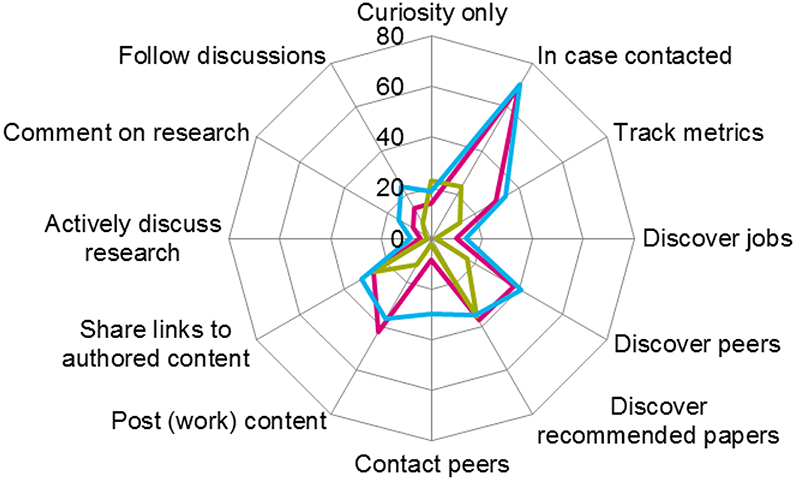
Figure 4. Percentage of respondents (from a sub-sample of the Nature survey) who use different SNS for particular purposes. Academia.edu shown in magenta, Mendeley in green, and ResearchGate in blue. Redrawn from raw data (Nature Publishing Group, 2014).
Although the profile of uses in Figure 4 differs slightly for Mendeley, Academia.edu and ResearchGate demonstrate a similar footprint. The uses which score most highly relate to being contactable and discovering others, and sharing content. Two of the themes discussed in this paper are present, with tracking metrics being moderately important, while discussions and actively interacting with others do not score highly overall.
Sharing publications has consistently proved to be a major reason why academics surveyed in different contexts use ASNS, including in the Arab (Elsayed, 2016), Italian (Manca and Ranieri, 2016) and Finnish (Laakso et al., 2017) Higher Education sectors. As discussed in the “relationship of the platforms to Open Access publishing” section, there is some evidence that users prefer to share the final publisher version of papers, although this brings attendant copyright issues. Metrics have received increased focus in recent years, and their importance to users presents a varied picture. The recent study by Laakso et al. (2017), discussed earlier in the Open Access theme, also included 10 semi-structured interviews and a survey completed by 43 participants. The survey asked participants to indicate their level of agreement with several statements about why they used ASNS. Enhanced dissemination and citation of publications generated the highest agreement levels, reflecting the findings of earlier studies. However, tracking metrics gave the highest disagreement, although this had emerged as being of high importance to the interview participants (Laakso et al., 2017).
Sharing work and enhancing citations also emerged as the highest priorities within a larger-scale online survey about ResearchGate use (Muscanell and Utz, 2017). The survey data were also analyzed to examine links between site use and career progression; no links were found, although the data indicated links to stress and productivity (Muscanell and Utz, 2017). To focus in on this issue, Utz and Muscanell (2018) present a related study which examined links between emotions and observing ResearchGate metrics, based on 419 responses to an online survey. The results suggest that academics experience envy as a result of seeing the achievements of others, seeing their own achievements invoked pride, and that a differential between the two serves to enhance motivation (Utz and Muscanell, 2018). Given the emphasis placed on metrics as a selling point of sites and research into understanding their value in relation to traditional bibliometrics, further research into user perspectives of ASNS-based metrics and trust would be useful.
Two studies have taken a more conceptual approach to “how” academics use ASNS in relation to their expression of personal or professional identities online. Manca and Ranieri (2016) surveyed the Italian Higher Education sector about their levels of use of a range of social media platforms in terms of personal, professional and teaching use. ResearchGate and Academia.edu were grouped together, and lower levels of use were reported overall in relation to teaching compared to personal or professional uses. The data suggest a relationship between participants' teaching experience and level of personal use of the sites, while age was related to the level of personal use. Gender was found to be important in all three uses, with females demonstrating higher personal, professional and teaching uses of academic SNS. In order to understand the trends in personal network structures introduced in the previous section, Jordan (2016b, 2017c) carried out co-interpretive interviews with a sample of 18 participants. Within this group, the view that ASNS represent an exclusively professional view of identity predominated, akin to a CV (Jordan, 2016b). This was found to be particularly important for graduate students and early career academics, whose precarity meant that they may not have an official institutional online profile (Jordan, 2017c). In addition to viewing the role of ASNS profiles as a CV, the metaphor of a portable repository for publications was also prevalent, both for early career researchers for similar reasons, and for more senior academics as an easier and faster route to sharing than through institutional repositories (Jordan, 2017c).
From research into academics' perceptions of ASNS, the predominant picture which emerges is one of profiles providing a static, business card-like expression of professional identity and showcasing publications. This suggests that the social networking aspects of the platforms is under-used at present, which may limit the opportunities for novel and active interactions or collaborations in practice.
Conclusions
Through exploring the empirical research via the five themes discussed here, this paper provides an overview of the issues relating to the use of ASNS. By shining a light on the strengths and limitations of ASNS through the themes, academics will be better informed as to whether engaging with the platforms will benefit their academic practice, and how their use sits in relation to the broader ecosystem of scholarly tools at their disposal. The review also highlights gaps in the existing literature which would be a useful focus for future research in the field.
The best characterized and most widely used benefits relating to the role of platforms for dissemination of academic publications. As an additional mode of Open Access publishing, ASNS offer benefits in terms of speed and control in comparison to academic repositories, and enhanced reach and citations. Exploring correlations between platform metrics and traditional bibliometrics has been the focus of a large proportion of work in this area. However, there is a question of whether more metrics which serve to reinforce the biases present in traditional bibliometrics and citation practices are really desirable. The potential for enhanced insights into impact and metrics is a corollary of the platforms' role as Open Access publishers, through greater understanding of the particular audiences engaging with publications, although this is not well researched at present.
The themes also highlight the fact that ASNS are more than just publishing platforms, although the more social aspects of the platforms may be under-used and under-studied at present but potentially of importance to users. In relation to ways in which academics can interact through the sites, group formation at Mendeley and posting questions and answers at ResearchGate have been highlighted. Although interacting with others through the platforms is undertaken by a minority of users at present, such functions may be allowing users who wish to do so to draw upon the knowledge of others across the globe and beyond their local networks.
There is also some evidence that being part of the network supported by ASNS may provide access to academic knowledge and legitimacy to participants who are in less privileged positions in their “offline” academic positions. For example, ASNS have been shown to be valued as a way of providing students, early career and precarious academics with a place to host their online professional identity when their institutions do not provide this for them. Whether this repositioning of placing the individual academic in control of their identity and impact is effective or simply reflects the neoliberalisation of Higher Education is an interesting question (Hammarfelt et al., 2016).
The body of literature also highlights areas which would be useful for future research. The number of papers published in relation to ResearchGate dwarfs the number of studies focused on Academia.edu, despite the latter leading the field in terms of number of registered users (Jordan, 2017b). The majority of studies have drawn upon large-scale datasets derived directly from public pages on the sites, while there has been less focus on academics' own views and interpretations. For example, readily available quantitative data has led to a disproportionate focus on metrics, while academics' perceptions of trust and value of metrics remain unclear. The question of whether a prospective candidate should put their RG Score on their CV depends more upon how it will be perceived by the reader than on its correlation with traditional bibliometrics.
Related to metrics, the analytics capabilities of Academia.edu promise further insight into specific details and demographics of those engaging with publications through the platform, although no published research has addressed this to-date, and likely reflects the fact that academics must pay a fee in order to access this information. Similarly, the Mendeley API and ResearchGate questions have provided accessible data in relation to collaboration and interaction through the sites, although other functions exist which remain to be examined empirically, such as the “sessions” function to gather feedback on draft publications at Academia.edu, and the “projects” function for collaboration via ResearchGate.
Finally, one of the key areas for ASNS to make a unique contribution to Higher Education has been their potential to connect academics across the globe. Across the body of literature, there is evidence of good if variable uptake worldwide. The literature may suggest that the relative importance of different affordances of ASNS (such as being able to track metrics, or ask questions, for example) varies according to scholarly cultures. Further international and comparative research would be valuable moving forward as the sites grow in popularity worldwide and to understand ASNS as a global, not Western-centric, phenomenon. This reflects a limitation of the review here in that only Anglophone papers could be included due to the authors' capabilities. There is, for example, a growing body of Spanish-speaking research (Raffaghelli and Manca, 2018). The accompanying online bibliographic tool is open for contributions and may be a way of promoting collaboration and information sharing on the topic across sectors. By reviewing the empirical research drawing on the first 10 years of ASNS, it is hoped that this paper will provide future studies in a range of contexts with an overview to-date and help the field moving forwards.
Author Contributions
The author confirms being the sole contributor of this work and has approved it for publication.
Funding
This research was funded in part by a doctoral studentship from the Centre for Research in Education and Educational Technology at the Open University, UK, and a Society for Research in Higher Education (SRHE) Newer Researchers Award grant.
Conflict of Interest Statement
The author declares that the research was conducted in the absence of any commercial or financial relationships that could be construed as a potential conflict of interest.
References
Abdulhayoglu, M. A., and Thijs, B. (2017). Use of ResearchGate and Google CSE for author name disambiguation. Scientometrics 111, 1965–1985. doi: 10.1007/s11192-017-2341-y
Academia.edu (2018). Academia.eduHomepage. Available online at: https://www.academia.edu/
Alheyasat, O. (2015). Examination expertise sharing in academic social networks using graphs: the case of ResearchGate. Contempor. Eng. Sci. 8, 137–151. doi: 10.12988/ces.2015.515
Ali, M. Y., Wolski, M., and Richardson, J. (2017). Strategies for using ResearchGate to improve institutional research outcomes. Lib. Rev. 66, 726-739. doi: 10.1108/LR-07-2017-0060
Almousa, O. (2011). “Users' classification and usage-pattern identification in academic social networks,” in Proceedings of the 2011 IEEE Jordan conference on Applied Electrical Engineering and Computing Technologies (AEECT), 6–8 December (Amman). doi: 10.1109/AEECT.2011.6132525
Batooli, Z., Ravandi, S. N., and Bidgoli, M. S. (2016). Evaluation of scientific outputs of Kashan University of Medical Sciences in Scopus citation database based on Scopus, ResearchGate, and Mendeley scientometric measures. Electr. Phys. 8, 2048–2056. doi: 10.19082/2048
Borrego, Á. (2017). Institutional repositories versus ResearchGate: the depositing habits of Spanish researchers. Learned Publis. 30, 185–192. doi: 10.1002/leap.1099
boyd, d., and Ellison, N. B. (2007). Social network sites: definition, history and scholarship. J. Comput. Media. Commun. 13, 210–230. doi: 10.1111/j.1083-6101.2007.00393.x
Charmaz, K. (2014). Constructing Grounded Theory: A practical guide through qualitative analysis, 2nd Edn. London: SAGE.
Copiello, S., and Bonifaci, P. (2018). A few remarks on ResearchGate score and academic reputation. Scientometrics 114, 301–306. doi: 10.1007/s11192-017-2582-9
Crunchbase (2018a). Academia.edu. Crunchbase Website. Available online at: https://www.crunchbase.com/organization/academia-edu
Crunchbase (2018b). ResearchGate. Crunchbase Website. Available online at: https://www.crunchbase.com/organization/researchgate#section-overview
Ellison, N. B., and boyd, d. (2013). “Sociality through Social Network Sites,” in The Oxford Handbook of Internet Studies. ed W. H. Dutton (Oxford: Oxford University Press), 151–172. doi: 10.1093/oxfordhb/9780199589074.001.0001
Elsayed, A. M. (2016). The use of academic social networks among Arab researchers. Soc. Sci. Comput. Rev. 34, 378–391. doi: 10.1177/0894439315589146
Gao, H., Hu, C., and Jiang, T. (2015). “An exploratory study of paper sharing in Mendeley's public groups,” in Proceedings of iConference 2015, 24–27 March (Newport Beach, CA).
Goodwin, S., Jeng, W., and He, D. (2014). “Changing communication on ResearchGate through interface updates,” in Proceedings of the Association for Information Science and Technology (ASIS&T 2014) Annual Meeting, 31 October−5 November (Seattle, WA). doi: 10.1002/meet.2014.14505101129
Hammarfelt, B., de Rijcke, S., and Rushforth, A. D. (2016). Quantified academic selves: the gamification of research through social networking services. Inform. Res. 21. Available online at: http://www.informationr.net/ir/21-2/SM1.html#.XHWPUYj7Ryw
Hammook, Z., Mišić, J., and Mišić, V. B. (2016). “Student/supervisor collaboration and usage patterns of publications available on ResearchGate,” in Proceedings of 2016 IEEE Wireless Communications and Networking Conference, 3–6 April 2016 (Doha). doi: 10.1109/WCNC.2016.7564814
Hoffmann, C. P., Lutz, C., and Meckel, M. (2015). A relational altmetric? Network centrality on ResearchGate as an indicator of scientific impact. J. Assoc. Inform. Sci. Technol. 67, 765–775. doi: 10.1002/asi.23423
Jamali, H. R. (2017). Copyright compliance and infringement in ResearchGate full-text journal articles. Scientometrics 112, 241–254. doi: 10.1007/s11192-017-2291-4
Jeng, W., DesAutels, S., He, D., and Li, L. (2017). Information exchange on an academic social networking site: a multidiscipline comparison on Researchgate Q&A. J. Assoc. Inform. Sci. Technol. 68, 638–652. doi: 10.1002/asi.23692
Jeng, W., He, D., and Jiang, J. (2015). User participation in an academic social networking service: a survey of open group users on Mendeley. J. Assoc. Inform. Sci. Technol. 66, 890–904. doi: 10.1002/asi.23225
Jeng, W., He, D., Jiang, J., and Zhang, Y. (2012). “Groups in Mendeley: owners' descriptions and group outcomes,” in Proceedings of the Association for Information Science and Technology (ASIS&T 2012) Annual Meeting, 28–31 October (Baltimore, MD).
Jiang, J., Ni, C., He, D., and Jeng, W. (2013). “Mendeley group as a new source of interdisciplinarity study: how disciplines interact on Mendeley?,” in Proceedings of the 13th ACM/IEEE-CS Joint Conference on Digital Libraries, 22–26 July (Indianapolis, IN).
Jordan, K. (2014a). Academics and their online networks: exploring the role of academic social networking sites. First Monday 19. doi: 10.5210/fm.v19i11.4937
Jordan, K. (2014b). Academics' awareness, perceptions and uses of social networking sites: analysis of a social networking sites survey dataset. SSRN, 1–29. doi: 10.2139/ssrn.2507318
Jordan, K. (2015a). “What do academics ask their online networks? An analysis of questions posed via Academia.edu,” in Paper Presented at the 2015 ACM Web Science Conference, 28 June−1 July (Oxford).
Jordan, K. (2015b). “Exploring the ResearchGate score as an academic metric: Reflections and implications for practice,” in Paper presented at the Analysing Scholarly Communication on the Web workshop (ASCW'15), 30 June (Oxford). Available online at: http://oro.open.ac.uk/43538/
Jordan, K. (2016a). “Academics' online connections: Characterising the structure of personal networks on academic social networking sites and Twitter,” in Proceedings of the 10th International Conference on Networked Learning 2016. eds S. Cranmer, N. B. Dohn, M. de Laat, T. Ryberg, and J. A. Sime, 414–421. Available online at: http://oro.open.ac.uk/46312/
Jordan, K. (2016b). “Digital scholarship and the social networking site: how academics conceptualise their networks on academic social networking sites and Twitter,” in Proceedings of the 17th Annual Conference of the Association of Internet Researchers, 5–8 October 2016 (Berlin). Available online at: http://oro.open.ac.uk/46730/
Jordan, K. (2017a). Academic social networking sites timeline. figshare. doi: 10.6084/m9.figshare.1460787.v1
Jordan, K. (2017b). Number of users at Academia.edu and ResearchGate. Figshare. doi: 10.6084/m9.figshare.4769815.v1
Jordan, K. (2017c). Understanding the Structure and Role of Academics' Ego-Networks on Social Networking Sites. Ph.D. thesis, The Open University. Available online at: http://oro.open.ac.uk/48259/
Kadriu, A. (2013). “Discovering value in academic social networks: a case study in ResearchGate,” in Proceedings of the ITI 2013 35th International Conference on Information Technology Interfaces, 24–27 June (Cavtat).
Kamler, B., and Thomson, P. (2006). Helping Doctoral Students Write: Pedagogies for Supervision. Oxford: Routledge.
Kincaid, J. (2008). Academia.edu: A Geni for Researchers. TechCrunch website. Available online at: https://techcrunch.com/2008/09/16/academiaedu-a-geni-for-researchers/
Laakso, M., Lindman, J., Shen, L. C.„ Nyman, L., and Björk, B.-C. (2017). Research output availability on academic social networks: implications for stakeholders in academic publishing. Electr. Markets 27, 125–133. doi: 10.1007/s12525-016-0242-1
Lazzari Barlete, A., and de Azevedo, M. (2018). “Higher education, platforms and the academic profession in Latin America: a case for platform academic capitalism,” in Presentation at Capitalism, Social Science and the Platform University, Homerton College, University of Cambridge (Cambridge), 13–14.
Lepori, B., Thelwall, M., and Hoorani, B. H. (2018). Which US and European Higher Education Institutions are visible in ResearchGate and what affects their RG score? J. Informetr. 12, 806–818. doi: 10.1016/j.joi.2018.07.001
Li, L., He, D., Jeng, W., Goodwin, S., and Zhang, C. (2015). “Answer quality characteristics and prediction on an academic Q&A site: a case study on ResearchGate,” in Proceedings of the 24th International Conference on World Wide Web, 18–22 May (Florence). doi: 10.1145/2740908.2742129
Liu, X. Z., and Fang, H. (2018). Which academic papers do researchers tend to feature on ResearchGate? Inform. Res. 23. Available online at: http://www.informationr.net/ir/23-1/paper785.html
Lovett, J. A.„ Rathemacher, A. J.„ Boukair, D., and Lang, C. (2017). Institutional repositories and academic social networks: Competition or complement? A study of Open Access policy compliance vs. ResearchGate participation. J. Librarianship Scholarly Commun. 5:eP2183. doi: 10.7710/2162-3309.2183
Lutz, C., and Hoffmann, C. P. (2015). “Connected for success? How network centrality on ResearchGate relates to bibliometrics, altmetrics and webometrics,” in Paper Presented at the XXXV INSNA Sunbelt Conference, 23–28 June (Brighton).
Lutz, C., and Hoffmann, C. P. (2018). Making academic social capital visible: relating SNS-based, alternative and traditional metrics of scientific impact. Soc. Sci. Comput. Rev. 36, 632–643. doi: 10.1177/0894439317721181
Lutz, C., Hoffmann, C. P., and Meckel, M. (2016). Academic social capital? Relating centrality on ResearchGate to established impact measures. Acad. Manage. Proc. 2016:16592. doi: 10.5465/ambpp.2016.16592abstract
Manca, S., and Ranieri, M. (2016). “Yes for sharing, no for teaching!”: social media in academic practices. Internet Higher Educ. 29, 63–74. doi: 10.1016/j.iheduc.2015.12.004
Mangiafico, P. (2016). Should you #DeleteAcademiaEdu? On the Role of Commercial Services in Scholarly Communication. Impact of Social Sciences Blog. Available online at: http://eprints.lse.ac.uk/65314/1/Should%20you%20DeleteAcademiaEdu.pdf
Matthews, D. (2017). Publishers Seek Removal of Millions of Papers From ResearchGate. Times Higher Education. Available online at: https://www.timeshighereducation.com/news/publishers-seek-removal-millions-papers-researchgate
Menendez, M., de Angeli, A., and Menestrina, Z. (2012). “Exploring the virtual space of academia,” in Proceedings of the 10th International Conference on the Design of Cooperative Systems, 30 May−1 June (Marseille). doi: 10.1007/978-1-4471-4093-1_4
Mohammadi, E., and Thelwall, M. (2014). Mendeley readership altmetrics for the social sciences and humanities: research evaluation and knowledge flows. J. Assoc. Inform. Sci. Technol. 65, 1627–1638. doi: 10.1002/asi.23071
Mohammadi, E., Thelwall, M., Haustein, S., and Larivière, V. (2015). Who reads research articles? An altmetrics analysis of Mendeley user categories. J. Assoc. Inform. Sci. Technol. 66, 1832–1846. doi: 10.1002/asi.23286
Mohammadi, E., Thelwall, M., and Kousha, K. (2016). Can Mendeley bookmarks reflect readership? A survey of user motivations. J. Assoc. Inform. Sci. Technol. 65, 1198–1209. doi: 10.1002/asi.23477
Morris, M. R., Teevan, J., and Panovich, K. (2010). “What do people ask their social networks, and why? A survey study of status message Q&A behaviour,” in Proceedings of CHI 2010, 10–15 April (Atlanta, GA).
Muscanell, N., and Utz, S. (2017). Social networking for scientists: an analysis on how and why academics use ResearchGate. Online Inform. Rev. 41, 755–759. doi: 10.1108/OIR-07-2016-0185
Naderbeigi, F., and Isfandyari-Moghaddam, A. (2018). Researchers' Scientific Performance in ResearchGate: The Case of a Technology University. Library Philosophy and Practice, 1752. Available online at: http://digitalcommons.unl.edu/libphilprac/1752/
Nández, G., and Borrego, A. (2013). Use of social networks for academic purposes: a case study. Electr. Lib. 31, 781–791. doi: 10.1108/EL-03-2012-0031
Nature Publishing Group (2014). NPG 2014 Social Networks survey. figshare. doi: 10.6084/m9.figshare.1132584
Nicholas, D., Clark, D., and Herman, E. (2016). ResearchGate: reputation uncovered. Learned Pub. 29, 173–182. doi: 10.1002/leap.1035
Niyazov, Y., Vogel, C., Price, R., Lund, B., Judd, D., Akil, A., et al. (2016). Open Access meets discoverability: citations to articles posted to Academia.edu. PLoS ONE 11:e0148257. doi: 10.1371/journal.pone.0148257
Oh, J. S., and Jeng, W. (2011). “Groups in academic social networking services: an exploration of their potential as a platform for multi-disciplinary collaboration,” in Paper presented at 2011 IEEE SocialCom, 9–11 October (Boston, MA). doi: 10.1109/PASSAT/SocialCom.2011.202
Onyancha, O. B. (2015). Social media and research: an assessment of the coverage of South African universities in ResearchGate, Web of Science and the Webometrics Ranking of World Universities. South Afr. J. Lib. Inform. Sci. 81, 8–20. doi: 10.7553/81-1-1540
Orduna-Malea, E., Martín-Martín, A., Thelwall, M., and López-Cózar, E. D. (2017). Do ResearchGate scores create ghost academic reputations? Scientometrics 112, 443–460. doi: 10.1007/s11192-017-2396-9
Ortega, J. L. (2015). Disciplinary differences in the use of academic social networking sites. Online Inform. Rev. 39, 520–536. doi: 10.1108/OIR-03-2015-0093
Ortega, J. L. (2017). Toward a homogenization of academic social sites: a longitudinal study of profiles in Academia.edu, Google Scholar Citations and ResearchGate. Online Inform. Rev. 41, 812–825. doi: 10.1108/OIR-01-2016-0012
Penn, L. (2018). Alternative ways of obtaining scholarly articles and the impact on traditional publishing models from a UK/European perspective. Serials Rev. 44, 40–50. doi: 10.1080/00987913.2018.1433906
Raffaghelli, J. E., and Manca, S. (2018). “Exploring the geographies of academic social network sites from a socio-technical perspective: an investigation of scientific literature in Spanish,” in Proceedings of the 11th International Conference on Networked Learning 2018, eds M. Bajić, N. B. Dohn, M. de Laat, P. Jandrić, and T. Ryberg (Zagreb), 409–416.
Rao, L. (2009). Professional Network ResearchGate is a LinkedIn for Scientists. TechCrunch. Available online at: https://techcrunch.com/2009/05/14/professional-network-researchgate-is-the-linkedin-for-scientists/
REF 2021 (2019). Research Excellence Framework 2021 Homepage. Available online at: https://www.ref.ac.uk/
ResearchGate (2018). ResearchGate Recruiting Solutions. ResearchGate website. Available online at: https://solutions.researchgate.net/recruiting/
Robertson, S. (2018). “The production of scientific knowledge and value in an era of platform capitalism,” in Presentation at Capitalism, Social Science and the Platform University, Homerton College, University of Cambridge (Cambridge), 13–14.
Sababi, M., Marashi, S.-A., Pourmajidian, M., Tabatabaei, S., Darki, F., Sadrzadeh, M. R., et al. (2017). How accessibility influences citation counts: the case of citations to the full text articles available from ResearchGate. Res. Pol. Eval. 5, 1–12. doi: 10.13130/2282-5398/7997
Shaw, C. (2013). Elsevier Buys Mendeley: Your reaction. The Guardian. Available online at: https://www.theguardian.com/higher-education-network/blog/2013/apr/10/elsevier-buys-mendeley-academic-reaction
Shrivastava, R. (2015). Relationship amongst ResearchGate altmetric indicators and Scopus bibliometric indicators: the case of Panjab University Chandigarh (India). N. Lib. World 116, 564–577. doi: 10.1108/NLW-03-2015-0017
Shrivastava, R., and Mahajan, P. (2017). An altmetric analysis of ResearchGate profiles of physics researchers: a study of University of Delhi (India). Perform. Measure. Metrics 18, 52–66. doi: 10.1108/PMM-07-2016-0033
Solon, O. (2013). Elsevier Clamps Down on Academics Posting Their Own Papers online. Wired magazine. Available online at: https://www.wired.co.uk/article/elsevier-versus-open-access
Sud, P., and Thelwall, M. (2016). Not all international collaboration is beneficial: the Mendeley readership and citation impact of biochemical research collaboration. J. Assoc. Inform. Sci. Technol. 67, 1849–1857. doi: 10.1002/asi.23515
Thelwall, M. (2017a). Why do papers have many Mendeley readers but few Scopus-indexed citations and vice versa? J. Libr. Inform. Sci. 49, 144–151. doi: 10.1177/0961000615594867
Thelwall, M. (2017b). Are Mendeley reader counts high enough for research evaluations when articles are published? Aslib J. Inform. Manage. 69, 174–183. doi: 10.1108/AJIM-01-2017-0028
Thelwall, M., and Kousha, K. (2013). Academia.edu: social network or academic network? J. Assoc. Inform. Sci. Technol. 65, 721–731. doi: 10.1002/asi.23038
Thelwall, M., and Kousha, K. (2015). ResearchGate: disseminating, communicating and measuring scholarship? J. Assoc. Inform. Sci. Technol. 66, 876–889. doi: 10.1002/asi.23236
Thelwall, M., and Kousha, K. (2017a). ResearchGate articles: age, discipline, audience size, and impact. J. Assoc. Inform. Sci. Technol. 68, 468–479. doi: 10.1002/asi.23675
Thelwall, M., and Kousha, K. (2017b). ResearchGate versus Google Scholar: which finds more early citations? Scientometrics 112, 1125–1131. doi: 10.1007/s11192-017-2400-4
Thelwall, M., and Maflahi, N. (2015). Are scholarly articles disproportionately read in their own country? An analysis of Mendeley readers. J. Assoc. Inform. Sci. Technol. 66, 1124–1135. doi: 10.1002/asi.23252
Thelwall, M., and Sud, P. (2016). Mendeley readership counts: an investigation of temporal and disciplinary differences. J. Assoc. Inform. Sci. Technol. 67, 3036–3050. doi: 10.1002/asi.23559
Thelwall, M., and Wilson, P. (2016). Mendeley readership Altmetrics for medical articles: an analysis of 45 fields. J. Assoc. Inform. Sci. Technol. 67, 1962–1972. doi: 10.1002/asi.23501
Utz, S., and Muscanell, N. L. (2018). Your co-author received 150 citations: Pride, but not envy, mediates the effect of system-generated achievement messages on motivation. Front. Psychol. 9:628. doi: 10.3389/fpsyg.2018.00628
Van Noorden, R. (2014). Online collaboration: scientists and the social network. Nature 512, 126–129. doi: 10.1038/512126a
Yan, W., and Zhang, Y. (2018). Research universities on the ResearchGate social networking site: an examination of institutional differences, research activity level, and social networks formed. J. Informetr. 12, 385–400. doi: 10.1016/j.joi.2017.08.002
Yan, W., Zhang, Y., and Bromfield, W. (2018). Analyzing the follower–followee ratio to determine user characteristics and institutional participation differences among research universities on ResearchGate. Scientometrics 115, 299–316. doi: 10.1007/s11192-018-2637-6
Keywords: social networking, digital scholarship, open access publishing, academic social network sites, academia.edu, researchgate, mendeley
Citation: Jordan K (2019) From Social Networks to Publishing Platforms: A Review of the History and Scholarship of Academic Social Network Sites. Front. Digit. Humanit. 6:5. doi: 10.3389/fdigh.2019.00005
Received: 28 October 2018; Accepted: 12 February 2019;
Published: 12 March 2019.
Edited by:
Richard Holliman, The Open University, United KingdomReviewed by:
Clare Wilkinson, University of the West of England, United KingdomAnn Grand, University of Exeter, United Kingdom
Copyright © 2019 Jordan. This is an open-access article distributed under the terms of the Creative Commons Attribution License (CC BY). The use, distribution or reproduction in other forums is permitted, provided the original author(s) and the copyright owner(s) are credited and that the original publication in this journal is cited, in accordance with accepted academic practice. No use, distribution or reproduction is permitted which does not comply with these terms.
*Correspondence: Katy Jordan, a2F0eS5qb3JkYW5Ab3Blbi5hYy51aw==