 Elvira S. Poloczanska1,2*
 Michael T. Burrows3Christopher J. Brown4
 Jorge García Molinos3,5,6
 Benjamin S. Halpern7,8,9
 Ove Hoegh-Guldberg2
 Carrie V. Kappel7
 Pippa J. Moore10,11
 Anthony J. Richardson1,12
 David S. Schoeman13
 William J. Sydeman14,15
- 1Commonwealth Scientific and Industrial Research Organisation, Oceans and Atmosphere, Brisbane, QLD, Australia
- 2The Global Change Institute, University of Queensland, Brisbane, QLD, Australia
- 3Scottish Association for Marine Science, Oban, UK
- 4Australian Rivers Institute, Griffith University, Nathan, QLD, Australia
- 5Center for Environmental Biology and Ecosystem Studies, National Institute for Environmental Studies, Tsukuba, Japan
- 6Arctic Research Center, Hokkaido University, Sapporo, Japan
- 7National Center for Ecological Analysis and Synthesis, University of California, Santa Barbara, Santa Barbara, CA, USA
- 8Bren School of Environmental Science and Management, University of California, Santa Barbara, Santa Barbara, CA, USA
- 9Imperial College London, Ascot, UK
- 10Institute of Biological, Environmental and Rural Sciences, Aberystwyth University, Aberystwyth, UK
- 11Centre for Marine Ecosystems Research, Edith Cowan University, Perth, WA, Australia
- 12Centre for Applications in Natural Resource Mathematics, School of Mathematics and Physics, The University of Queensland, Brisbane, QLD, Australia
- 13School of Science and Engineering, University of the Sunshine Coast, Maroochydore, QLD, Australia
- 14Farallon Institute, Petaluma, CA, USA
- 15Bodega Marine Laboratory, University of California, Davis, Bodega Bay, CA, USA
Climate change is driving changes in the physical and chemical properties of the ocean that have consequences for marine ecosystems. Here, we review evidence for the responses of marine life to recent climate change across ocean regions, from tropical seas to polar oceans. We consider observed changes in calcification rates, demography, abundance, distribution, and phenology of marine species. We draw on a database of observed climate change impacts on marine species, supplemented with evidence in the Fifth Assessment Report of the Intergovernmental Panel on Climate Change. We discuss factors that limit or facilitate species' responses, such as fishing pressure, the availability of prey, habitat, light and other resources, and dispersal by ocean currents. We find that general trends in species' responses are consistent with expectations from climate change, including shifts in distribution to higher latitudes and to deeper locations, advances in spring phenology, declines in calcification, and increases in the abundance of warm-water species. The volume and type of evidence associated with species responses to climate change is variable across ocean regions and taxonomic groups, with predominance of evidence derived from the heavily-studied north Atlantic Ocean. Most investigations of the impact of climate change being associated with the impacts of changing temperature, with few observations of effects of changing oxygen, wave climate, precipitation (coastal waters), or ocean acidification. Observations of species responses that have been linked to anthropogenic climate change are widespread, but are still lacking for some taxonomic groups (e.g., phytoplankton, benthic invertebrates, marine mammals).
Introduction
Anthropogenic greenhouse gas emissions have resulted in profound changes in the physical and chemical properties of the ocean that have serious implications for marine species, with concomitant risks to marine industries dependent on those species (Hartmann et al., 2013; Rhein et al., 2013; Hoegh-Guldberg et al., 2014; Pörtner et al., 2014). The global ocean has absorbed 93% of the extra energy arising from anthropogenic greenhouse gas emissions, resulting in an increase in average global sea surface temperatures since the beginning of the twentieth century, that approaches 1°C (0.89°C over the period 1901–2012; IPCC, 2013). The ocean has also taken up ~30% of anthropogenic carbon dioxide (CO2) that has been released into the atmosphere, decreasing ocean pH, and fundamentally changing ocean carbonate chemistry in all ocean regions, particularly in the cooler, high latitude waters (IPCC, 2013). Other chemical and physical changes in the ocean attributed to anthropogenic forcing include declines in dissolved oxygen concentrations (Andrews et al., 2013) and alteration of ocean circulation (Cai et al., 2005; Wu et al., 2012). These anthropogenic changes represent risks to marine life and ecosystems (Poloczanska et al., 2013; Gattuso et al., 2015; Nagelkerken and Connell, 2015).
General expectations for biological and ecological responses to warming oceans include poleward distribution shifts, earlier spring events and delayed autumn events at mid to high latitudes, and reductions in body sizes of marine ectotherms (O'Connor et al., 2014; Pörtner et al., 2014). Ocean acidification is expected to reduce calcification in marine calcifiers such as corals and coccolithophores as well as influence a range of other processes such as growth and reproduction (Kroeker et al., 2013). Meta-analyses, applied across diverse species and ecosystems, have provided strong evidence of global fingerprints of recent climate change on natural systems including those in the ocean (Parmesan and Yohe, 2003; Rosenzweig et al., 2008; Poloczanska et al., 2013). Marine organisms have, on average, expanded the leading edges of their distributions by 72.0 ± 13.5 km per decade (generally polewards), while marine phenology in spring has advanced by 4.4 ± 1.1 days decade (Poloczanska et al., 2013). Yet responses are variable among taxonomic groups and among ocean regions, suggesting biological interactions, as well as marine ecosystem functions and the goods and services marine systems provide, may be substantially reorganized at regional scales.
Many factors can influence responses to changes in the environment, including species' generation time, dispersal ability, physiological tolerances, habitat and food preferences, and the composition of existing or receiving communities in the case of range shifts (O'Connor et al., 2009; Gerber et al., 2014; Alexander et al., 2015; Nagelkerken et al., 2015). Marine species often have complex life-cycles, as many have a dispersive planktonic stage, with distinct life stages potentially occupying different habitats, each with different exposures and sensitivities to changing climate (Rijnsdorp et al., 2009). The detection and attribution of biological responses to climate change is thus challenging given the idiosyncratic responses of species and populations at local and regional levels, the potential for changes in species interactions, and uncertainty in climatic trends at regional or local scales (Brown et al., 2011; Parmesan et al., 2011; Hansen et al., 2015). Organisms are subjected to the multiple interacting aspects of a changing climate, the effects of which may be synergistic or even antagonistic depending on species sensitivities and ecological processes (Fulton, 2011; Seabra et al., 2015). The picture is further complicated by the interaction of climate change with many other human pressures at regional and local scales that affect our oceans, such as fishing pressure, eutrophication, and habitat modification (Halpern et al., 2008). Furthermore, modes of climatic variability, e.g., Pacific Decadal Oscillation (PDO), Atlantic Multi-decadal Oscillation (AMO) and El Niño-Southern Oscillation (ENSO), which are major drivers of regional ecology, influence statistical uncertainty in climate change signals at regional scales (Bindoff et al., 2013). The interplay of these modes of variability can have strong influence on marine ecosystems. For example, the Gulf of Alaska and Bering Sea fluctuated from one of the warmest years in the past century (2005) to one of the coldest (2008) in the space of 3 years driven by the modes of ENSO and PDO and other factors, with associated changes in plankton, fish and seabird communities (McKinnell and Dagg, 2010; Batten and Walne, 2011). Considerable evidence exists for thresholds in individual species and ecosystem responses to regimes of climate and extremes of weather associated with altered ecosystem structure and function (Smith, 2011). For example, a marine “heatwave” event off Western Australia during the austral summer of 2011 which was due to a combination of a record-strength Leeuwin Current, a near-record La Niña event and anomalously high air-sea flux into the ocean, resulted in a reduction in habitat-forming macroalgae and a tropicalization of fish communities (Pearce and Feng, 2013; Wernberg et al., 2013).
Here, we consider the observed responses of marine ecosystems and species to climate change across oceans, from the boreal regions with their highly seasonal peaks in primary production to oligotrophic tropical seas. The ocean represents a vast region that stretches from the high tide mark to the deepest oceanic trench (11,030 m), and occupies 71% of the Earth's surface. In our discussion of ecological responses and knowledge gaps, we restrict our focus to pelagic and mesopelagic waters, and for continental shelf systems we also include the benthos and intertidal. Evidence of climate-change impacts is sparse in the deep sea due to logistical challenges of working in this environment which, when coupled with the size of the habitat, requires fuller consideration than we could have committed in this review.
We draw on a marine climate-change impacts database (hereafter “MCID”), comprising 1900 observations of marine ecological impacts of climate change from 235 peer-reviewed publications and including examples where responses were equivocal (not consistent with theoretical expectations under climate change) or zero (Poloczanska et al., 2013). We also refer to the information, synthesis and conclusions of the “ocean chapters” of Fifth Assessment Report (AR5) of the Intergovernmental Panel on Climate Change (IPCC), namely Chapter 3 (Observations: Ocean) of Working Group I (Rhein et al., 2013) and Chapters 6 (Ocean Systems) and 30 (The Ocean) of Working Group II (Hoegh-Guldberg et al., 2014; Pörtner et al., 2014). These are available from a single site (https://ipcc-wg2.gov/publications/ocean/). Below, we discuss observations of ecological responses in the ocean (changes in abundance, distribution, phenology, demography, and calcification). We discuss factors that limit or facilitate ecological responses, such as the availability of prey, habitat and other resources, or dispersal by ocean currents. We consider the consequences of large-scale change in ocean ecosystems and conclude by identifying key knowledge gaps.
Marine Climate Change Impacts Database (MCID)
We use the Marine Climate Change Impacts Database (MCID) analyzed in Poloczanska et al. (2013) which comprised of 1735 observations of marine ecological impacts of climate change from 208 peer-reviewed publications. To develop MCID, Poloczanska et al. synthesized all available studies (published during 1990–2010) of the consistency of marine ecological observations of change that were tested, or at a minimum discussed, in relation to expected impacts of recent climate change. We updated MCID with a further 27 publications published during 2011–2015, giving a total of 1900 observations from 235 publications (Figure 1; Supplementary Tables S1–S3). We extracted information on the taxonomic group, study period, location, class of response, and statistical significance of the observed change (Poloczanska et al., 2013). We included instances of marine taxa responding in a direction consistent with theoretical expectations under climate change, in a manner inconsistent (equivocal) with expectations, and taxa demonstrating no response as long as the observation was considered in relation to climate change. Data were available for every ocean, however most reports were from Northern Hemisphere temperate oceans.
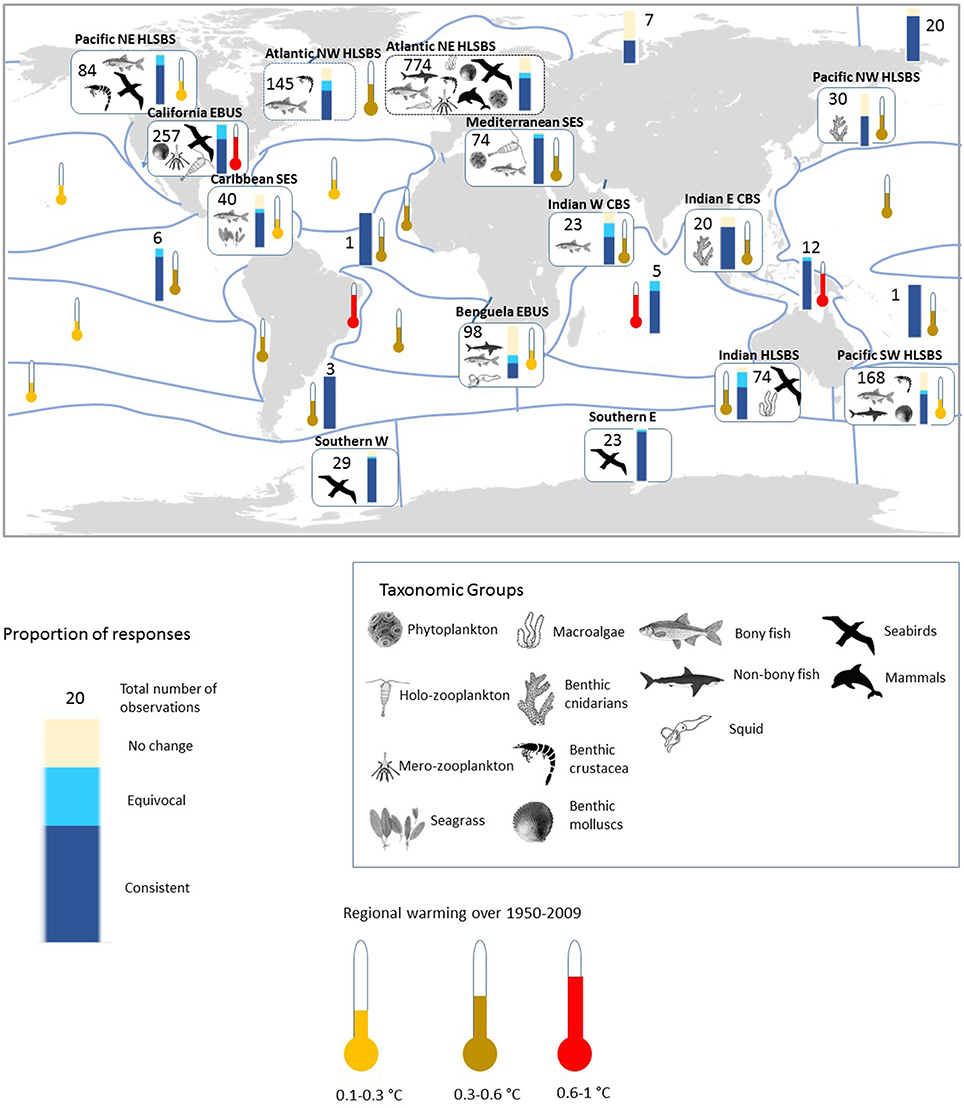
Figure 1. Global distribution of marine ecological impacts across ocean regions. Distribution of climate change responses (including equivocal and no responses) in the abundance, distribution, phenology, demography, and calcification of marine species from the marine climate-change impacts meta-database of Poloczanska et al. (2013) updated with recent literature. The proportion of consistent (dark blue), equivocal (light blue), and no change (pale yellow) observations shown for each region. Numbers are total numbers of observed responses in each region—no number means no regional observations. Taxonomic groups with 10 or more observations in each region are indicated with symbols. Descriptions of taxonomic groups and criteria for selection of observations are given in Poloczanska et al. (2013). Regional temperature increase (all months) over 1950–2009 is shown in three categories: low (yellow 0.1–0.3°C), medium (orange 0.3–0.6°C), and high (red 0.6–1.0°C). The ocean separated into regions based on ecosystem structure and productivity, as well as key oceanographic features. HLSBS, high latitude spring bloom system; EBUS, eastern boundary upwelling system; SES, semi-enclosed sea; CBS, coastal boundary system. A full description of ocean regionalization and the calculation of regional warming increases are given in Hoegh-Guldberg et al. (2014) (Figure 30-1 and Table 30-1) and (Hoegh-Guldberg et al., 2014).
To be included in our database, a study had to meet three criteria: (i) authors inferred or directly tested for trends in biological and climatic variables; (ii) data after 1990 were included thus recent climate change effects considered; and (iii) observations spanned at least 19 years in order to minimize the chance of bias resulting from short-term biological responses to natural climate variability. We included data from continuous data series [number of years with datapoints n(yr) > 80% of timespan of study in years], comparisons of two periods in time [n(yr) < 20% of timespan and clustered at the start and end of timespan] and intermittent data series [20% < n(yr) < 80% of timespan], if they met our criteria. We did not restrict our search to only studies that applied a statistical test of a relationship between observed climate change and observed biological response. Most studies supplied multiple lines of evidence from theory, process-understanding, historical overview and experimental and field results, to contextualize findings of a response to climate change. From each paper, we classified responses into classes: calcification, demography, abundance, distribution, and phenology. If species were encountered more than once within each response class for each ocean region, we retained only the observation from the longest time series or most robust analysis (regionalization is shown in Figure 1 and details given in Hoegh-Guldberg et al., 2014).
Rates of change for distribution and phenology, in kilometers per decade or days per decade, were obtained from individual studies in the database where possible, either directly as reported in the text, calculated from figures, or by contacting a study's authors. For distribution shifts, positive values (km per decade) indicate an expansion of distributions and negative, a contraction. For phenology, positive values indicate a delay (days per decade) and negative an advancement. Null responses (0 km or days per decade) were also recorded.
Long-Term Observations
Long-term observations of ecological responses to climate change are rare and biased toward high-latitude spring-bloom systems of the Northern Hemisphere (Edwards et al., 2010; Richardson et al., 2012; Poloczanska et al., 2013). Even here, long-term data sets are biased toward European and North American shelf waters (Figure 1). These shelf seas, which include the North Sea, Mediterranean Sea, and Labrador-Newfoundland Shelf, are among the longest- and most intensively-studied marine regions and are also among the fastest-warming of ocean regions (Belkin, 2009) (Table 30-1 in Hoegh-Guldberg et al., 2014). Responses to climate change are widely reported from these regions, particularly the north-east Atlantic high-latitude spring-bloom system (41% of MCID), where many long-term survey and monitoring programs are in operation. Several of these are multi-species programs, including fisheries catch records, fisheries-related surveys (e.g., van Hal et al., 2010), regional scientific surveys (e.g., Genner et al., 2004) and Continuous Plankton Recorder surveys (e.g., Beaugrand, 2009) The Continuous Plankton Recorder survey (CPR), in operation since 1931, monitors near-surface plankton communities and has provided valuable insight into climate responses of lower trophic levels across the open ocean (Edwards and Richardson, 2004; Richardson and Schoeman, 2004; Beaugrand et al., 2009; Edwards et al., 2010). Other programs in the north-east Atlantic that have sampled intensively over many years at local sites, such as the Helgoland Roads program (since 1962; Wiltshire et al., 2010), or research programs of the Marine Biological Association (earliest records from 1888; Southward et al., 2005), provide evidence of change across multiple taxonomic groups, higher trophic levels and adult life stages. Examples from other ocean regions, include the California Cooperative Oceanic Fisheries Investigations programme (CalCOFI) which samples plankton in the California Current upwelling system. Programmes such as Continuous Plankton Recorder and CalCOFI were initiated from a desire to understand the population dynamics of commercial fish stocks (Southward et al., 2005).
Equatorial and southern hemisphere regions are sparsely observed with respect to long-term biological variables. The few exceptions include a long history of marine records from coastal waters of south-eastern Australia in the south-west Pacific high-latitude spring-bloom system (Pitt et al., 2010; Johnson et al., 2011; Last et al., 2011) and from the Benguela eastern boundary upwelling system (Yemane et al., 2014). Many southern seabirds are well studied at their breeding colonies, such as penguin breeding colonies in Australia (south-west Pacific high-latitude spring-bloom system, e.g., Chambers et al., 2013) and Antarctica (Southern Ocean, e.g., Forcada and Trathan, 2009).
Although reef-building corals are conspicuous for their sensitivity to recent thermal stress, in terms of mass coral-bleaching, few observations for reef-building corals were included in MCID (3%). This likely reflects a scarcity of published long time series from these systems, despite a good mechanistic understanding of mass coral reef bleaching and mortality in response to thermal stress (Hoegh-Guldberg, 1999). However, retrospective studies, represented by analysis of cores taken from living corals (Lough, 2010), as well as baselines constructed from sediment cores for calcifying plankton (Moy et al., 2009), are supplying valuable information on both past local climates and biological responses of these organisms.
Ecological Responses Across Ocean Regions
Ecological responses to climate change are varied and many (Parmesan and Yohe, 2003; Parmesan, 2006; Pörtner et al., 2014). Observations related to abundance and distribution (including depth shifts) of marine species were widely reported in MCID (41 and 40%), while less evidence exists for changes in phenology (14%), demography (3%), and calcification (2%), largely due to the historical emphasis on certain measurements in marine research. Suites of these responses occur in concert, for example, coincident shifts in phenology and demography (Beaugrand, 2009). Observed responses of species to climate change across ocean regions show considerable variability both within and between taxonomic groups (Figures 2, 3; Poloczanska et al., 2013). Species responses are complex and likely tempered by ecological characteristics, trophic interactions and resource availability, as well as other anthropogenic stressors, such as pollution and fishing. Fishing is a pervasive stressor in marine ecosystems (Worm et al., 2009; Branch et al., 2010) and its effects appear to increase sensitivities of ecological responses to climate change (Hsieh et al., 2008; Rijnsdorp et al., 2009; Hermant et al., 2010; Bates et al., 2014a).
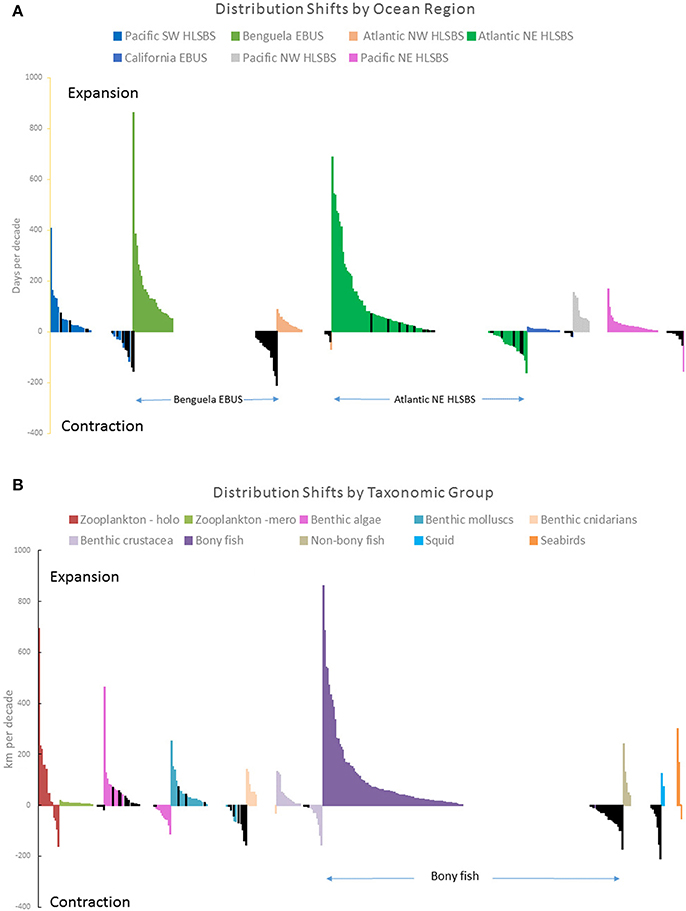
Figure 2. Observed shifts in species distributions (km per decade) by (A) ocean regions and (B) taxonomic groups. Data from Poloczanska et al. (2013) updated with recent literature (2011–2015). Colored bars are consistent with expectations under climate change, black bars are equivocal, and zero values are no change. A description of ocean regions are given Fig 30-1 in Hoegh-Guldberg et al. (2014). Total number of observations = 659.
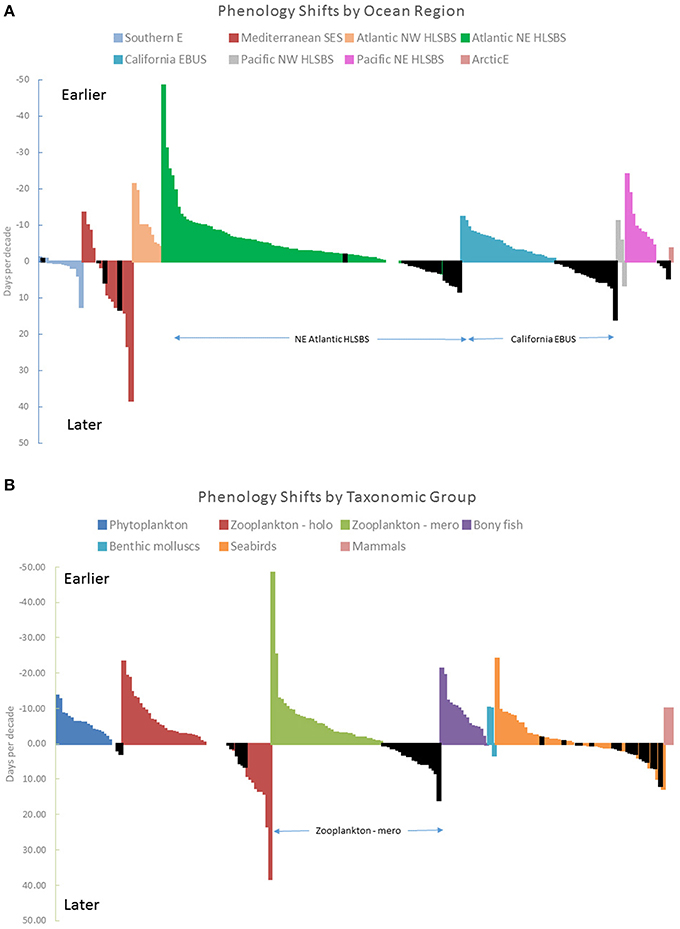
Figure 3. Observed shifts phenology (days per decade) by (A) ocean regions and (B) taxonomic groups. Data from Poloczanska et al. (2013) and updated with recent literature (2011–2015). Colored bars are consistent with expectations under climate change, black bars are equivocal, and zero values are no change. A description of ocean regions are given Figure 30-1 in Hoegh-Guldberg et al. (2014). Total number of observations = 257.
Light is an abiotic factor that strongly influences the response of some marine species to climate change, particularly at higher latitudes. Seasonal fluctuations in the intensity, duration, and spectral composition of light change with latitude, and act as important phenological cues for a range of marine species, sometimes in combination with temperature. Light regime thresholds likely trigger events such as reproduction and migration (Davenport et al., 2005), in addition to temperature thresholds. Thus, temperature-driven shifts in distribution and phenology of species can be constrained by the influence of the seasonality of light on photoperiod, particularly at high latitudes (Figure 4; Saikkonen et al., 2012; Sundby et al., 2016). For example, in polar oceans, extreme light seasonality results in a short annual window of primary productivity and therefore food availability, thus restricting the potential for temperature-driven invasion of the high Arctic waters by species from lower latitudes (Kaartvedt, 2008).
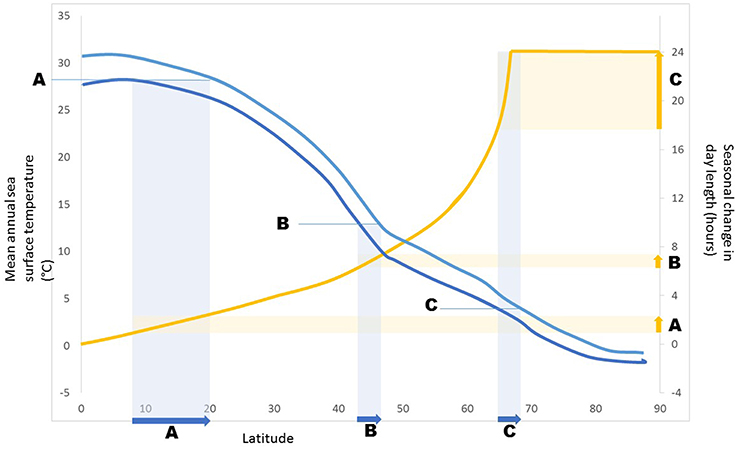
Figure 4. Interaction among regional warming, latitudinal shifts, and seasonality in light for three hypothetical marine species. Dark blue line = current (1980–2005) zonal (5° latitude bands) mean annual sea surface temperature (SST) from Hadley Centre Sea Ice and Sea Surface Temperature data set (HadISST). Light blue line = future (2075–2100) zonal mean annual SST using ensemble data given in García Molinos et al. (2015). Temperature data for the Northern Hemisphere. Orange line = seasonal change in daylength, from the equator (no change) to polar seas (24 h daylight in summer to 0 h in winter) modified from Saikkonen et al. (2012). The shaded areas and arrows indicate shifts in latitude and daylength experienced as a species tracks its thermal niche. Species A lives in the tropics (29°C), to track its thermal niche requires a relatively large latitudinal shift (>10°) but experiences an intermediate change in light seasonality (~1 h). Species C is a sub-polar species (4°C), it requires an intermediate shift in latitude (~3°) to track its thermal niche but experiences a large change in light seasonality over this distance (>7 h). Species B lives in temperate regions (13°C) and experiences an intermediate change in light seasonality (<1 h) over an intermediate change in latitude (~3°) as it shifts distribution to track temperature.
Sensitivity of marine ectotherms (the majority of marine life) to temperature is well established. Thermal tolerance windows of marine fish and invertebrates roughly match the ambient temperature variability driven by climate regime and seasonality (Pörtner et al., 2014). The widest windows are found in species at temperate latitudes, where seasonality in temperature is strong. Polar species have the narrowest thermal windows and low energy-demand lifestyles, making them particularly sensitive to relatively small changes in temperature. Tropical species also have relatively narrow thermal windows and some species inhabit the warmest waters globally thus are near physiological temperature tolerance limits (Storch et al., 2014). The thermal range tolerated by a species can vary among life stages, with early stages (e.g., egg and larvae) generally being more sensitive (Pörtner and Peck, 2010). Similar sensitivities of early life stages are observed in response to changes in other environmental variables such as pH (Kroeker et al., 2013). Most observational studies consider just a single aspect and metric of climate change, generally annual mean sea surface temperature change (Brown et al., 2011; Poloczanska et al., 2013; Seabra et al., 2015), while the combined and indirect effects of environmental stressors on species and ecosystems are understudied and less well understood (Crain et al., 2008; Wernberg et al., 2012; Nagelkerken et al., 2015). Evidence suggests that sensitivities of fish and other ectotherms to temperature are generally increased when exposed to additional climate-change stressors such as reduced oxygen or ocean acidification and vice versa (Pörtner and Peck, 2010; Deutsch et al., 2015).
The ability of a species to colonize new areas as physical and chemical environments change will be regulated by rates of reproduction and dispersal, allied with the intrinsic capacity for a species to colonize and establish in new habitats and ecological communities. Factors such as high dispersal ability and large geographic ranges are hypothesized to influence the ability of a species to extend its range (O'Connor et al., 2012). Although some generalizations with regard to life-history and ecological traits are evident (Bates et al., 2014b), studies applying trait-based approaches to predict range expansions generally show low explanatory power (Angert et al., 2011; Pinsky et al., 2013). However, a study from south-east Australia identified species' traits common among range-shifting species, in particular swimming ability (thus dispersal potential), omnivory and initial range size (thus ecological generalization) (Sunday et al., 2015).
While the multiple factors that influence a species' ability to track climate change make simple prediction difficult, the use of multiple lines of evidence can inform understanding of species responses and increase confidence in the role of climate change (O'Connor et al., 2014; Hansen et al., 2015). Such lines of evidence include simple predictions holding true (e.g., abundance of warm-water species should increase and cold-water species should decrease), field and experimental studies showing species and populations are sensitive to past warm and cool periods (Southward et al., 1995; Hawkins et al., 2009) and theoretical tests of population models showing predicted outcomes in nature (Poloczanska et al., 2008; Wethey and Woodin, 2008). In some cases, these lines of evidence provide understanding of the underlying mechanism(s) driving change, such as seasonal temperature thresholds for reproduction and recruitment success (Ling, 2008; Wethey et al., 2011). Below we discuss the evidence for changes in calcification, demography, abundance, distribution, and phenology.
Calcification
Ocean acidification will challenge marine calcifiers to grow and maintain their tests, shells and skeletons made from calcium carbonate. Experimental studies generally show negative responses of heterotrophs and calcified autotrophs to acidification, although results are highly variable and, of concern, show a trend overall toward enhanced sensitivity when thermal stress increases (Harvey et al., 2013; Kroeker et al., 2013; Nagelkerken and Connell, 2015). Observations of changing calcification are sparse in MCID (2%), with studies from tropical corals in the Indian (including Red Sea), Pacific and Atlantic (Caribbean) Oceans dominating (36 of 40 observations); the remaining 4 observations were of phytoplankton in the north-east Atlantic (Halloran et al., 2008; Iglesias-Rodriguez et al., 2008) and zooplankton in the west Indian Ocean coastal boundary system (de Moel et al., 2009).
The skeletons of corals, contain valuable information on past environmental conditions and the calcification rates of species (Lough, 2010). Generally, cores from massive corals (e.g., Porites spp.) and sections from branching corals have revealed declines in calcification and/or growth rates (26 of 36 observations) consistent with expectations from warming and/or ocean acidification. The extension rates, calcification rates and skeletal density of corals are inter-related and need to be considered in combination to assess coral responses to changed environmental conditions (Lough and Cooper, 2011). Evidence of ocean acidification effects are currently scarce with temperature effects presently dominating. For example, in some cases, observed declines in coral calcification and/or growth rates have been ascribed solely to increasing temperature as thermal conditions exceed optimal conditions for growth, rather than the combined effects of warming and acidification. Examples come from the Andaman Sea (in the Indian east coastal boundary system), the Red Sea and waters of Western Australia in the Indian Ocean (Cooper et al., 2008, 2012; Tanzil et al., 2009; Cantin et al., 2010). Similar mechanisms may explain the increase in growth and/or calcifications rates observed in a few Porites colonies off western and eastern Australia. These are consistent with expectations from warming as regional temperatures rise toward optimal temperatures for coral growth (Cooper et al., 2012; D'Olivo et al., 2013).
Cores taken from tropical corals from the Great Barrier Reef off eastern Australia show decreased growth rates since the early 1970s, initially ascribed to the combined effects of ocean acidification and thermal stress (De'ath et al., 2009). However, subsequent investigation suggests that temperature and land-based effects (nutrient and sediment loading of coastal waters) presently dominate over the signal from ocean acidification (D'Olivo et al., 2013). Mid- and outer-shelf reefs, removed from the major effects of river systems, exhibit a long-term (60 year) increase in calcification potentially related to the warming of minimum temperatures, which benefits calcification (D'Olivo et al., 2013). Of concern, these reefs appear to be undergoing a transition to declining rates of calcification, raising concerns that thermal stress is starting to emerge and/or the impacts of ocean acidification are starting to manifest.
Despite experimental evidence indicating sensitivity of many taxonomic groups to ocean acidification (Harvey et al., 2013; Kroeker et al., 2013; Nagelkerken and Connell, 2015), little observational evidence of observed responses to recent ocean acidification exists outside of reef-building corals. Changes in the plankton species are currently dominated by sensitivity to temperature change as well as the effects of nutrient availability and predation (Beaugrand et al., 2012; Beare et al., 2013). No relationship has been found between extensive data (60 years) of marine planktonic calcifiers in the north-east Atlantic and pH trends. However, longer-term perspectives are drawn from retrospective analysis of calcifying plankton and do indicate some impacts of recent ocean acidification. Studies of sediment cores reveal a decrease in shell mass of the planktonic foraminifera, Globigerinoides ruber, in the western Arabian Sea over ~250 years, as would be anticipated with recent ocean acidification (de Moel et al., 2009). A decline in shell mass, compared to specimens that are some 50,000 years old, was also found in Globigerina bulloides using sediment cores in the Southern Ocean (south of Australia) and ascribed to recent ocean acidification (Moy et al., 2009).
The lack of empirical evidence for changes in calcification is not surprising, given the very recent emergence of ocean acidification as a concern and the slow development of technologies for long-term monitoring of ocean acidification (Andersson et al., 2015). However, experimental and theoretical evidences indicates that ocean acidification is a major risk to marine ecosystems (Gattuso et al., 2015). Projections of changing temperature and ocean acidification, coupled with physiological thresholds, plus key information from large scale mesocosm studies (Dove et al., 2013) suggest that many reef-building corals globally will be severely impacted by ocean acidification within decades (Hoegh-Guldberg, 2004). Studies at volcanic CO2 seeps and eruptions reveal a reduction in the abundance of calcifying invertebrates, including scleractinian corals and algae, along pH gradients (Hall-Spencer et al., 2008; Fabricius et al., 2014; Gil-Díaz et al., 2014). Further, herbarium records show a long-term (over three decades) decrease in calcification of the brown algae Padina pavonica from the Canary Islands coincident with a decrease in the pH of local ocean surface waters (Gil-Díaz et al., 2014). More broadly, a variety of lines of evidence from experimental and modeling studies indicate that ocean acidification will affect marine organisms over the twenty-first century, but the resulting long-term consequences for marine species' population dynamics and ecosystem functioning are yet to be identified and are areas of current research focus (Andersson et al., 2015; Riebesell and Gattuso, 2015).
Demography
Climate change will influence the demographics of marine species through differential effects on reproduction, growth and survival thus species abundance and population growth. Hypotheses regarding the response of populations to climate change include declines in recruitment/breeding success for populations near the equatorward edges of their ranges as temperatures warm, and corresponding increases near the poleward edges, although these will be tempered by a range of biotic and abiotic factors and differences in individual physiological responses (Poloczanska et al., 2013). Evidence of climate change impacts on demography of marine species, as recorded in MCID (3% of database), arises primarily from studies of recruitment variability in exploited fish and mollusc stocks and aspects of breeding for seabirds. Of the demography observations, 54% were measurements of reproductive success and productivity, 34% of observations were observations of growth and size parameters of organisms, and 12% were mortality measurements.
Recruitment may be a key process in driving population responses, in fish at least, to climate change (Rijnsdorp et al., 2009). Most fish spawn millions of eggs, and recruitment is influenced by growth and mortality integrated across the egg, larval, and post-larval phases, which can be highly sensitive to fluctuations in environmental conditions, particularly near range edges (Brunel and Boucher, 2006). For example, recent warming has allowed strong recruitment of subtropical wrasse, Choerodon rubescens, at the southern (polewards) edge of its range off Western Australia, where abundances of adult fish have historically been low or absent; in addition, its presence in angling catch records near its range edge has become more common in recent years (Cure et al., 2015). The increase in C. rubescens recruits coincides with warmer-than-average temperatures and an increase in intensity of the warm-water Leeuwin Current, the latter increasing seasonal advection of larvae and juveniles into newly-warming waters. Such patterns suggest that further warming could lead to a range expansion if suitable habitat is available. In Icelandic waters, a decade of warming has enhanced reproductive success of the monkfish, Lophius piscatorius, and expanded nursery and feeding habitats resulting in an increase in the monkfish stock near its poleward range edge, (Solmundsson et al., 2010). An enhanced delivery of eggs and larvae from distant stocks through changes in water inflow is also proposed as an additional mechanism.
In the north-east Atlantic, investigation of climate-driven recruitment variation (1970–1998) across 40 fish stocks belonging to nine species showed a general long-term decline in recruitment correlated with warming sea surface temperatures (Brunel and Boucher, 2007). While it is likely that fishing also played a role in observed trends in recruitment for some populations through depletion of spawning stock, for many such as cod, Gadus morhua, in the Irish Sea, the decline in recruitment commenced while stocks were still at high levels, implying a deterioration in favorable environmental conditions for early life stages. In contrast, recruitment for a few stocks, e.g., cod in the north-east Arctic, were positively correlated with strong year classes that preceded an increase in stock, suggesting that changes in the environment enhanced recruitment. The spawning intensity of Arcto-Norwegian cod, (using an egg production index from cod caught during the spawning season), is influenced by temperature with a recent (since 1976) decline in spawning in the southernmost areas and a northward displacement of spawning areas coincident with recent warming (Sundby and Nakken, 2008). Since 2003, cod spawning has been observed along the northernmost area, off the very top of Norway, which last occurred during the north Atlantic warm-period of the 1930–1950s.
An example of contrasting long-term responses of a fish species to ocean warming across a geographic range is that of the banded morwong, Cheilodactylus spectabilis, in south-east Australia and New Zealand (Neuheimer et al., 2011). Using growth rates over 90 years, estimated from otolith analysis, Neuheimer et al. (2011) showed that growth rates of fish living in the middle of the species' range increased with warming, while growth rates decreased in those living at the warm northern range edge. In the northern-most populations, warmer regional temperatures are no longer beneficial to growth due to greater metabolic cost and reduced energy for growth and reproduction.
Investigation of the long-term decline in recruitment of the bivalve Macoma balthica in the southern North Sea reveals the complexity of organismal response to changing climate. M. balthica has already disappeared from its equatorward range extremities along the southern French coast, with no or few individuals recorded at monitoring sites since the 1980s (Beukema et al., 2009). Evidence suggests that warmer temperatures decrease reproductive output (a direct physiological effect on adults) and advance spawning dates, resulting in a mismatch with both peak phytoplankton blooms and low predator abundance, the result being reduced food availability and increased predation pressure (Philippart et al., 2003). However, it is likely that the situation is more complex, with temperature also affecting mortality and growth rates of juvenile and adult life stages. For example, adult survival is reduced in warmer summers due to physiological stress, and winter weight loss by adults is higher when winters are milder. The latter results are driven by higher energetic demands, and thus reduced available energy for reproduction in the following spring (Beukema et al., 2009).
Numerous demographic responses to climate change have been observed for seabirds (Einoder, 2009; Chambers et al., 2014). For example, some of the longest seabird time series (spanning 50 years) are for Emperor penguin, Aptenodytes forsteri, colonies in Antarctica thus presenting data to investigate drivers of demographic responses (Barbraud and Weimerskirch, 2001; Barbraud et al., 2011). Loss of sea-ice reduces adult survival through multiple processes, including reduced food availability (abundance of krill, which form the base of Antarctic food webs, is lower in years with less winter-ice; Atkinson et al., 2004), but is also associated with increased hatching success, as the distance between colonies and foraging grounds (ice edge) is reduced. Overall however, long-term, climate-driven declines are expected for all Emperor penguin colonies this century as warming and sea ice loss continue (Jenouvrier et al., 2014).
Generally, climate change effects on seabird demography emerge through climate-mediated predator-prey interactions (Sydeman et al., 2015). Breeding success is negatively related to warming temperatures for fulmer, Fulmarus glacialis, (Lewis et al., 2009), manx shearwaters, Puffinus puffinus, (Riou et al., 2011), and black-legged kittiwakes, Rissa tridactyla, (Frederiksen et al., 2007) in the north-east Atlantic. These results are likely due to climate-driven changes in prey availability, although mechanisms differ among populations. For example, a reduction in fledging masses of manx shearwater chicks in the Celtic Sea was linked to higher sea surface temperatures in the preceding winter and a reduction in prey quality (Riou et al., 2011). A link between breeding productivity and winter sea surface temperatures in the preceding year was also shown for kittiwake breeding colonies in east Scotland and Orkney, but not for colonies in adjacent regions (west Scotland and east England) (Frederiksen et al., 2007). In addition, a positive relationship between breeding productivity and Calanus copepod abundance was found in East Scotland and a negative relationship in Orkney. Calanus is an important prey item of sandeels, Ammodytes marinus, the main food fed to kittiwake chicks, and relationships have been shown between sea surface temperature, sandeel abundance, and seabird breeding success (Arnott and Ruxton, 2002; Poloczanska et al., 2004). The unexpected finding in Orkney highlights that mechanisms are not fully understood, but variation in species' dependence on sandeel as prey among regions may help to explain the result.
Other examples of differing mechanisms by which climate change can influence foraging and diets of seabirds include flesh-footed shearwaters, Puffinus carneipes, in the eastern Indian Ocean and wandering albatross, Diomedea exulans, in the Southern Ocean (Weimerskirch et al., 2012; Bond and Lavers, 2014). Isotope analysis of the feathers of flesh-footed shearwaters from western and south Australia, where reproductive success has decreased and populations are in decline, shows that these seabirds have doubled their trophic niche and dropped a trophic level in 75 years (Bond and Lavers, 2014). By contrast, a recent increase in breeding success of wandering albatross in the Southern Ocean is linked to a strengthening and poleward shift of westerly wind fields. As a consequence, albatross travel rates (speed) have increased and foraging ranges shifted polewards, shortening the duration of foraging trips (Weimerskirch et al., 2012).
Abundance
Abundance changes were among the most commonly reported responses in MCID (41%). In a warming ocean, warm-water species are expected to increase and cold-water species decline. In MCID, species were classified as warm, cold or cosmopolitan relative to the region in which they were studied. Fifty-two percent of species classified as warm-water increased in abundance and 52% of cold-water species declined consistent with expectations under climate change; the remainder either showing no change or equivocal changes in abundance (Table 1). Of the cosmopolitan species, there was no bias in either direction with an equal number (39%) increasing and decreasing in abundance, with the remaining 22% showing no change.
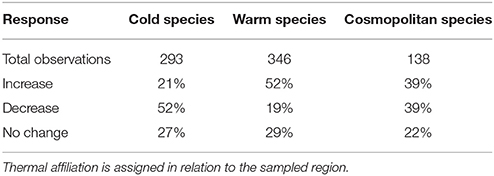
Table 1. Observations of changing abundance in species classified as cold, warm, and cosmopolitan in their thermal preferences.
Changes in abundance are observed as populations fluctuate across a range of time-scales from seasonal to decadal and beyond, reflecting the accumulation of demographic responses such as altered recruitment and survival. For example, fluctuations in abundances of intertidal invertebrates around the UK coastline have been observed during decadal warming and cooling periods (Hawkins et al., 2008, 2009). Poloczanska et al. (2008) investigated mechanisms underlying population fluctuations in two intertidal barnacle species and identified temperature impacts on recruitment as the dominant process influencing adult abundances. The presence of the cold-water barnacle, Semibalanus balanoides, which recruits to UK rocky shores in large numbers in early spring, can depress abundance of its later-recruiting, warm-water competitor, Chthamalus spp., through temperature-driven interference competition. S. balanoides recruits overgrow and undercut recruits of the subordinate Chthamalus spp. and effects are stronger during cool periods when S. balanoides recruitment success and juvenile survival are higher (Connell, 1961). Recent declines in abundance of S. balanoides in south-eastern UK and northern France are linked to warming as the frequency of recruitment failure increases, and with projected warming, S. balanoides could become locally extinct by 2050 (Poloczanska et al., 2008). Evidence of similar mechanisms are shown in other taxonomic groups. For example, variability in abundances of 20 flatfish species in the Bay of Biscay, north-east Atlantic (1987–2006), were linked to sea surface temperatures in the year of their birth, suggesting that larval survival and recruitment processes influenced adult abundances (Hermant et al., 2010).
Considerable evidence exists for changes in abundances of planktonic groups linked to recent warming. Declines in cold-water species and increases in warm-water species have been observed for mysids in Mediterranean caves (Chevaldonné and Lejeusne, 2003) and zooplankton communities in the north-east Atlantic (Beaugrand, 2003). Longer-term evidence of changes in foraminifera over ~1400 years, reconstructed from sediment samples, revealed an increase in abundances of tropical/subtropical species over the last 100 years, and more recent declines in temperate/subpolar species (Field et al., 2006). In Antarctic waters the extent and duration of sea ice, as well as temperature, influences primary production. These effects cascade through Southern Ocean food webs. The density of krill has likely declined in the southwest Atlantic sector (1926–2003), while densities of salps, a warmer-water group, have likely increased (Atkinson et al., 2004) however, the magnitude of the decline is uneder debate (Constable et al., 2014). Krill density is influenced by seasonally important food sources; phytoplankton in the water column during summer and phytoplankton under winter sea ice (Atkinson et al., 2004). Both these food sources are declining with warming temperatures and decreasing sea ice extent.
Observations of changing abundance may be an early warning that large-scale shifts in distribution are about to occur, or that they are occurring (Bates et al., 2014b, 2015; Lenoir and Svenning, 2014), and indeed are often used to infer distribution shifts. For example, data spanning multiple decades from coastal localities off south-eastern South Africa (Lloyd et al., 2012), Rhode Island in north-west Pacific (Collie et al., 2008), the northern Gulf of Mexico (Fodrie et al., 2010), and south-east Australia (Last et al., 2011) all demonstrate increases in the abundance of warmer-water species and decreases in cooler-water species coincident with local warming temperatures leading authors to postulate that range shifts are occurring. In the South African example, regional warming was most pronounced during the Austral summer and was influenced by a southern extension of the warm-water Agulhas Current, as evidenced in a 178 km shift in the 27°C isotherm over the 19-year period (Lloyd et al., 2012). The abundance of temperate reef-fish species decreased over this period while that of tropical species increased. For south-east Australian waters Last et al. (2011), gathered data from a range of sources including spear-fishing competitions, scientific surveys and commercial catch, and showed evidence of southward distributional shifts and increased abundances of 45 fish species. The rapid warming of ocean temperatures in the region are driven, in part, by a southward extension of the warm East Australian Current by 350 km over 1944–2002. In both the South African and Australian examples, the observed shifts in the major current systems, driven by changes in westerly wind fields and an intensification of ocean gyre systems, have an anthropogenic signal (Cai et al., 2005; Rouault et al., 2009; Wu et al., 2012).
Distribution
Shifts in species distributions in relation to climate change are widely-reported (41% of MCID) with observational evidence from leading (polewards) and trailing (equatorwards) edges of species' distributions and from measurements at the centers of species distributions. Generally, where quantified data were available, leading edges are expanding (71 of 97 observations) and measurements taken within species ranges (centers) showed either polewards displacements (113 of 253 observations) or no change (104 of 253 observations), consistent with theoretical expectations under climate change (Figure 2). At trailing edges however, observations of expansions (26 of 83 observations), contractions (28), or no change (29) were similar (Figure 2). Differences in consistency of observations among range edges may be explained by differing processes (e.g., colonization vs. extinction) and detectability (Bates et al., 2014b, 2015).
The role of climate change in driving distribution shifts in marine biodiversity is currently garnering considerable attention (e.g., Bates et al., 2013; Poloczanska et al., 2013; Lenoir and Svenning, 2014) given the potential ramifications for fisheries, marine management, conservation, and policy (Cheung et al., 2010; Pinsky and Fogarty, 2012; García Molinos et al., 2015). The general expectation is that marine species will shift poleward, but some east-west distribution shifts and shifts toward the equator are expected in response to complex patterns of shifting isotherms, including areas of ocean surface cooling, and geographical barriers (Burrows et al., 2011, 2014; Pinsky et al., 2013). Depth shifts are expected where species can take refuge in cooler, deeper waters, or where local geographical features block latitudinal shifts. For example, in the northern Gulf of Mexico and Gulf of Maine, where the east-west coastlines prohibit poleward distributional shifts, demersal fish and invertebrate assemblages shifted deeper instead (Nye et al., 2009; Pinsky et al., 2013).
Ocean currents can rapidly advect phytoplankton and zooplankton, which include the early life stages of most marine ectotherms, as well as juveniles and adults vertebrates, thus facilitating marine distribution shifts (Berge et al., 2005; Banks et al., 2010; Sunday et al., 2015). Ocean currents have been implicated in observed species shifts in the north-east Atlantic (Beaugrand et al., 2009), north Pacific (Nye et al., 2009), and south-west Pacific (Johnson et al., 2011; Last et al., 2011). However, in many of these cases, changing temperature is the primary mechanism for the shift (Ling et al., 2008; Beaugrand, 2009), allowing larvae and juveniles to survive and thrive in new environments. For example, in south-Australia, the sea urchin Centrostephanus rodgersii spread from the mainland to Tasmania in the late 1970s and subsequently increased in both range and abundance coincident with regional warming (Johnson et al., 2011). The sequential poleward discovery of the sea urchin, a pattern of declining age, and a general poleward reduction in abundance along the eastern Tasmanian coastline is consistent with a model of range extension driven by recent change in patterns of larval dispersal (Ling et al., 2009b). Genetic studies indicate a high connectivity between pre- and post-extension zones, so the range shift appears to be an extension of the mainland population assisted by increased advection of larvae and warming of sea temperatures above the species' lower developmental threshold (Banks et al., 2010). The East Australian Current, which carries warm water and larvae and juveniles of marine organisms southward (Booth et al., 2007), has strengthened and penetrated further south since the 1940s (Ridgway, 2007), driven by a shift in westerly wind fields linked to greenhouse gas forcing (Cai et al., 2005; Wu et al., 2012). Consequently, coastal water temperatures in eastern Tasmania now fluctuate around the 12°C mark, which is the threshold for successful C. rodgersii larval development, during August when peak spawning occurs (Ling et al., 2008).
Range shifts of marine species, linked to warming temperatures, have been observed across all ocean regions (Poloczanska et al., 2013; Figure 2). Some of the highest rates of range expansion were observed for zooplankton in the north-east Atlantic, where the CPR survey has provided extensive data for climate change investigations. In response to anthropogenic ocean warming, warm-water calanoid copepod communities (108 species) extended poleward at rates of up to 231.6 km per decade, with corresponding declines in the abundances of cold-water species (Beaugrand et al., 2009). In particular, at higher latitudes such as south of Iceland and north of the North Sea, arctic/subarctic species have declined in abundance, while in the Bay of Biscay and southern Celtic Sea, subtropical species have increased in abundance. These rapid responses of zooplankton are attributed to their ecological characteristics, and particularly to the fact that they tend to be stenothermal, have short generation times (days to months) and be numerous and free-floating, so they can rapidly track shifts in environmental conditions (Mackas and Beaugrand, 2010). The redistribution of zooplankton has implications for marine food webs; warm-water species tend to be smaller and less energy-rich than polar/subpolar species. For example, changes in plankton communities driven by climate are a strong driver of cod, G. morhua, abundance in the North Sea (Beaugrand and Kirby, 2010).
The most concentrated evidence across taxonomic groups comes from the heavily studied North Sea in the north-east Atlantic, where waters have warmed just over 1°C in 40 years. This in turn has resulted in a shift in the 10°C isotherm of 217.5 km per decade (Beaugrand, 2009). Latitudinal distributional shifts were observed in a range of zooplankton (Beaugrand et al., 2009), exploited and non-exploited fish (Perry et al., 2005; Dulvy et al., 2008), and benthic invertebrates (Neumann et al., 2013; Hiddink et al., 2015), with ranges generally moving northwards (toward higher latitudes) as temperatures warm. Depth shifts, generally to deeper water, were also observed for benthic invertebrates (Beukema and Dekker, 2005; Hiddink et al., 2015) and demersal fish (Perry et al., 2005), with the whole demersal fish assemblage deepening by 3.6 m per decade (Dulvy et al., 2008). For demersal species, a latitudinal shift may necessarily incur a change in depth, depending on seabed topography. However, shifts in depth of individual species are often consistent with warming or cooling of deeper waters when taken into consideration with seabed bathymetry, local oceanography and species temperature preferences (Dulvy et al., 2008; Pinsky et al., 2013).
Fishing pressure can also strongly influence the distribution and abundance of fish populations, and acts in combination with temperature and thus challenge attribution of distribution shifts to climate change (ter Hofstede and Rijnsdorp, 2011). An example is the opposing shifts in flatfish species in the southern North Sea: over 90 years the distribution of plaice, Pleuronectes platessa, in the southern and central North Sea has shifted north-eastward by 142 km and deepened by 20 m, while sole, Solea solea, in the southern North Sea has shifted south-westward by 93 km and shoaled by < 10 m (Engelhard et al., 2011). The distribution shifts in plaice are explained by warming, but the observed shift in sole distribution is explained by both warming and fishing. The southern North Sea is very shallow (<35 m) and shows the greatest range in seasonal sea surface temperatures, i.e., some of the coolest North Sea temperatures in winter and warmest in summer. Recent warming in the southern section has facilitated the southward expansion of flatfish species, previously excluded by cold winter temperatures, into southern coastal areas. Similarly, the distribution of North Sea cod, G. morhua, has shifted northeastward and deepened over 100 years (Engelhard et al., 2014). The northward shift is explained by warming and the eastward shift by fishing, through a serial depletion of cod from the western section of its historical distribution.
Other ocean regions where examples of climate-driven range shifts were observed include the Bering Sea in the north-east Pacific high latitude spring bloom system, the Benguela eastern boundary upwelling system, around Japan in the north-west Pacific high-latitude spring-bloom regions, and in south-west Australia in the Indian Ocean high-latitude spring-bloom system (Figure 2A). In the highly productive Bering Sea on the fringes of the Arctic Ocean, the extent of the “cold pool” (<2°C water) on the shelf separates polar and subpolar fauna. The cold pool is formed as a consequence of winter sea ice and is maintained over summer (Hunt et al., 2010). The region appears to be warming, and the loss of sea ice and resultant poleward retreat of the cold pool is driving a community-wide poleward distribution shift in demersal fauna, with range extensions of subarctic fauna into former cold-pool areas (Wang et al., 2006; Mueter and Litzow, 2008; Grebmeier, 2012). Range extensions of up to 98 km per decade were observed across a range of demersal fish and invertebrates. However, variable responses among individual species in the community (some leading, some lagging temperature change, and some not responding) are probably the result of interacting factors such as population size, dispersal ability, dependence on habitat or prey availability, resource competition, migratory strategy, latitudinal gradient in light regime, and fisheries impacts.
Variable changes in distribution and depth were also observed in the demersal fish community in the Benguela Current over 1985–2010 (Yemane et al., 2014). In the northern section of the system, off Angola, both mean sea surface temperatures and bottom temperatures have warmed. Many of the fish species sampled shifted polewards and deeper. In the southern section, off Namibia and South Africa, where regional ocean temperatures are influenced cold upwelling, different responses were observed. Bottom waters off Namibia have gradually cooled whereas off South Africa a recent warming is observed following a period of cooling. By contrast, sea surface temperatures have warmed off Namibia and cooled off South Africa. In this region of the Benguela system, no clear direction was observed in fish responses; around half the species that showed changes in distribution shifted polewards and the rest shifted equatorwards. However, all the depth shifts observed off South Africa were into shallower warmer waters as were most of those off Namibia.
In Japanese waters in the north-west Pacific high-latitude spring bloom system, four taxonomic groups of corals expanded poleward into temperate waters since 1930 at rates of up to 140 km per decade, coincident with significant warming of sea surface temperatures, while five other taxonomic groups remained stable (Yamano et al., 2011). Range shifts may have been facilitated by increased transport and southern expansion of the warm-water Kuroshio Current. Impacts were also observed in subtidal macroalgae: expansions were noted in tropical species such as Sargassum spp. and contractions in the ranges of temperate species such as the kelps Ecklonia spp. (Tanaka et al., 2012). In the Indian Ocean high-latitude spring bloom system, contractions in macroalgae at the equatorwards (warm) edges of their distributions were also observed along the southern section of the west Australian coastline consistent with regional warming (Wernberg et al., 2011).
Phenology
Seasons in the ocean are changing (Stine et al., 2009; Burrows et al., 2011), but observations of changes in marine phenology are relatively rare compared to those on land (Parmesan, 2007; Chambers et al., 2013), only 14% of MCID are phenology observations. The majority of marine phenological studies come from the north-east Atlantic, across a range of trophic levels from plankton to seabirds, and from Antarctic seabird colonies (Figure 3). Sparser evidence also arises from studies of highly migratory fish such as salmon and tuna (Juanes et al., 2004; Dufour et al., 2010).
The timing and production of plankton communities at the base of marine food webs are driven by temperature, nutrient and light availability. At higher latitudes, such as those in the north-east Atlantic, strong seasonal variability in primary and secondary production, formed by successive peaks in abundance of plankton groups, is pronounced because of seasonally varying photoperiod and water-column stability (Racault et al., 2012). Efficient transfer of marine primary and secondary production to higher trophic levels, including commercial fish species, is synchronized with successive plankton peaks (Hjort, 1914; Cushing, 1990). The plankton community (66 plankton taxa, including seasonal fish and invertebrate larvae) in the central North Sea is responding to climate change (1958–2002), but with substantial variation among species and functional groups (Edwards and Richardson, 2004). Spring- and summer-blooming species showed either an advance to some degree in peak abundance or stasis, as was the case for the majority of diatom species. The greatest advancements were observed in fish eggs and larvae (12.9 and 9.5 days per decade), echinoderm larvae (10.3 days per decade), Ceratium spp. (phytoplankton, ~8.5 days per decade), and two diatom species (phytoplankton, ~7.4 days per decade). In contrast, delays were observed in autumn- and winter-peaking species, with Thalassiosira spp (phytoplankton) delaying by 6.5 days per decade and larvae of Limacina retroversa (benthic mollusc) delaying by 8.4 days per decade. Some species, e.g., Temora longicornis (copepod), showed no statistically significant delay.
The potential decoupling of production peaks, and thus prey availability, has potential to cascade through trophic webs, particularly given the fast spring advancements in fish and invertebrate larvae. These latter cases suggest that reproductive phenologies have also shifted. An example is the advance in spawning in the bivalve M. balthica in the southern North Sea, which leads to a mismatch with timing of the phytoplankton bloom and also reduces avoidance of peak predation pressure for recruits (Philippart et al., 2003). An advance in spring phenology and delay in autumn phenology, coincident with warming, is also shown in reproduction of two conspecific intertidal limpets near their range limits in south-west England over 60 years (Moore et al., 2011). Spring reproduction in warm-water Patella depressa advanced by 10.2 days per decade, leading to a longer reproductive season (multiple spawning events), while autumn-spawning cold-water P. vulgata delayed breeding by 3.3 days per decade. The rapid decline in sea surface temperatures in autumn is thought to be the phenological cue for P. vulgata spawning, thus spawning is delayed toward cooler conditions more favorable for successful reproduction. However, the delay could potentially lead to a mismatch with larval food sources, which, coupled with declines in the proportion of the population reproducing and increasing thermal stress of adults during summer might eventually lead to local extirpation. In a rare study of fish spawning phenology, Fincham et al. (2013) show a shift toward earlier spawning in four stocks of sole, S. solea, in the north-east Atlantic. Warming of winter temperatures was linked to an advancement of ~11 days per decade, through an effect on maturation rates, raising questions about potential mismatch with food sources and effects on juvenile survival.
Shifts in phenology for upper-trophic-level predators, such as seabirds, are variable, even among species breeding in the same region. Investigation of dates that the first eggs were laid (first egg date) of 10 species at two breeding colonies in the north-west North Sea showed advances of up to 8.4 days per decade for Arctic terns, Sterna paradisaea, European shags, Phalacrocorax aristotelis, and common guillemots, Uria aalge (Wanless et al., 2009). However, at the same colonies a number of delays in first egg date of up to 7 days per decade were noted amongst other species, including black-legged kittiwakes, R. tridactyla, northern fulmars, F. glacialis, and Atlantic puffins, Fratercula arctica, whilst no significant shift in phenology was recorded for remaining species. The species have different feeding methods, diets and dispersal patterns outside of the breeding season (e.g., local dispersal vs. long-distance migrant), and it is likely that an integration of environmental signals, including food availability across foraging grounds outside of breeding seasons, influences the timing of spring migrations and breeding phenologies.
The delays in seabird phenologies at Antarctic/sub-Antarctic breeding colonies appear, at first, to be inconsistent with the general expectation of earlier spring events (Barbraud and Weimerskirch, 2006; Hindell et al., 2012). Over 55 years, seabirds in the western Antarctic have, on average, delayed arrival by 1.6 days per decade, and first egg laying by 0.4 days per decade and no regional trend in temperature was found (Barbraud and Weimerskirch, 2006). However, some of the variation in arrival and egg laying was linked to a regional reduction in Antarctic sea ice and a lengthening of sea ice duration, which reduce access to and the quantity of marine food sources in early spring, thus presumably breeding condition of adult seabird.
Changes in phenology have been observed in other highly migratory species. Tuna are arriving earlier at productive feeding grounds in the north-east Atlantic by 5.6 days per decade (bluefin, Thunnus thynnus) and 2 days per decade (albacore, T. alalunga) (Dufour et al., 2010). These responses are linked to a regional climate shift toward warmer conditions. Earlier arrivals (up to 21 days per decade) into river systems have also been observed in Atlantic salmon, Salmo salar, breeding migrations to eastern North America. These shifts are positively correlated with warming temperatures (northern stocks) and river discharge rates (southern stocks), presumably reflecting the different migration patterns, and hence phenological triggers, of salmon populations (Juanes et al., 2004).
Discussion
The volume and type of evidence of species responses to climate change is variable across ocean regions and taxonomic groups (Figures 1–3). Much evidence derives from the north-east Atlantic, a region that is heavily fished and studied, thus hosting many long-term observation programmes. A lack of observations from other regions does not imply that climate change is not having an impact, but rather represents our current state of knowledge (Hansen and Cramer, 2015). Most investigations of marine biological impacts of climate change have focused on the impacts of changing temperature, with few observations of effects of changing oxygen, wave climate, precipitation (coastal waters) or ocean acidification (Brown et al., 2011), despite an extensive theoretical, experimental and modeling base for understanding impacts on marine species. For example, models suggest declining oxygen will impact distribution and biomass of marine species through physiological responses and compression of habitat, and will result in a decline in body size of marine fish (Stramma et al., 2010, 2012; Cheung et al., 2011; Gilly et al., 2013). In addition, oxygen decline and ocean acidification in tandem will increase metabolic demands on marine species, particularly in northern hemisphere high-latitude oceans (Deutsch et al., 2015).
Evidence of impacts on phytoplankton at the base of marine food webs is limited with only a few studies in MCID. These studies suggest that phenology, abundance and calcification of phytoplankton species are changing in response to climate change. There is currently limited evidence and low agreement on the future direction and magnitude of change in primary production across ocean regions (Boyd et al., 2014). However, climate change is projected to strongly influence primary production in a multitude of ways through changes in a range of atmospheric and oceanic processes, including sea ice extent, stratification, cloud cover and upwelling (e.g., Sydeman et al., 2014).
There is substantial evidence for changes in the distribution, abundance and phenology of zooplankton in response to climate change. However, some differences in responses are evident between holo-zooplankton and mero-zooplankton (Figures 2, 3). Holoplankton, or permanent members of plankton communities, show many and large shifts in distribution and phenology, which are generally consistent with expectations from climate change. These species may be particularly responsive to climate change given their short generation times, potential for rapid advection by ocean currents, and sensitivity to environmental conditions (Richardson, 2008; Beaugrand, 2009; Hays et al., 2015). In contrast, some of the largest shifts in phenology are seen in the meroplankton, the egg and larval stages of marine fish and invertebrates, but shifts in distribution are relatively small. We propose three factors that may influence results. First, most of the evidence for distribution shifts of meroplankton come from the California Current eastern boundary upwelling system (Hsieh et al., 2008, 2009), where thermal environments are complex given the upwelling of cold, nutrient-rich water that may reduce potential for distribution shifts. Second, many of the meroplankton species included are exploited as adults, and this may increase sensitivity to changing environmental conditions. In the California Current, larval fish species that are exploited as adults have greater distribution shifts that those that are unexploited (Hsieh et al., 2008). Third, the location and appearance of eggs and larvae in the plankton will ultimately be influenced by the location and timing of adult spawning. The capacity of adults to adjust or accommodate to changing environmental conditions may temper or exaggerate shifts in the timing of early life stages. Species may respond by first adjusting their phenological behavior, such as the timing of spawning, thus the timing of larval appearance in the plankton. Declines in abundance and distribution shifts may only occur once conditions change beyond physiological limits (Beaugrand, 2009).
How changes in the calcification, demography, abundance, distribution and phenology of the different life stages of marine species will manifest at an ecosystem level is a challenge for producing accurate predictions. Differential phenological responses across species will lead to temporal mismatches among trophic levels (Visser and Both, 2005; Thackeray et al., 2010). Climate change will alter the seasonal and temporal extent of areas favorable to reproduction, growth and survival for marine species (e.g., Shoji et al., 2011). Species may respond directly to changes in temperature and other climatic variables and also indirectly through changes in food and habitat resources (Stewart et al., 2014; Sydeman et al., 2015). Most marine species are ectothermic, so physiological functions are directly impacted by changes in ambient temperatures and other environmental variables (Pörtner and Knust, 2007; Pörtner and Peck, 2010). Direct impacts on metabolism and indirect impacts on food availability will alter growth rates and body sizes, and thus reproductive rates and ultimately population dynamics (Neuheimer et al., 2011; Rogers et al., 2011). Understanding the role of climatic variability and extremes, and their interaction with other stressors, in shaping species and ecosystem responses to long-term climatic change is important to predicting the ecological, social, and economic consequences of climate change at regional scales. Climate change will act with other anthropogenic stressors on marine ecosystems, such as fishing, pollution and intensification of shipping (risk of species introductions, Sorte et al., 2010) which also have potential to drive complex changes in ecosystems (Hoegh-Guldberg et al., 2014).
Observations of fish and other species moving to higher latitudes (Perry et al., 2005; Mueter and Litzow, 2008; Nye et al., 2009; Last et al., 2011; Magurran et al., 2015) are consistent with results of modeling exercises (Stenevik and Sundby, 2007; Cheung et al., 2009; García Molinos et al., 2015). The redistribution of species in response to temperature change, and in some cases also fishing pressure, has led to regional changes in species richness, particularly in northern hemisphere high-latitude spring-bloom systems (ter Hofstede et al., 2010; Simpson et al., 2011; Montero-Serra et al., 2015), and also to changes in community composition (Magurran et al., 2015). The high-latitude warming in the northern hemisphere over the past three decades has led to an increase in the size of fish stocks associated with some regional fisheries (Hoegh-Guldberg et al., 2014), and this may continue with further warming (Cheung et al., 2009; García Molinos et al., 2015) for some time into the future. In contrast, declines in species richness are projected in tropical areas, particularly in equatorial regions (García Molinos et al., 2015; Jones and Cheung, 2015). The redistribution of species with shifting climate zones will lead to the alteration of biotic interactions (Verges et al., 2014; García Molinos et al., 2015). For example, the climate-driven extension of the sea urchin, C. rodgersii, in south-east Australia has led to loss of macroalgae (kelp) beds through overgrazing, with loss of associated biodiversity (Ling, 2008). Intensive fishing of spiny lobsters Jasus edwardsii, the major predator of the urchin, may have reduced the resilience of kelp beds against the sea urchin threat (Ling et al., 2009a). In the north-east Atlantic, decline of the boreal intertidal barnacle, S. balanoides, with warming temperatures has resulted in an increase in abundance of a sub-dominant competing species (Poloczanska et al., 2008). In the Benguela Current, a temperature-driven shift in distribution of a coastal fish, Argyrosomus coronus, has resulted in an overlap with a related species, A. inodorus, during spawning events and thus a recent hybridization of these two species (Potts et al., 2014).
Climate change imposes strong selective pressures on species and populations, driving phenotypic and genetic responses (Chown et al., 2010). Plasticity in species traits and behavior are relatively well-studied and have been shown to allow species to compensate for changing climate (Crozier and Hutchings, 2014). For example, plasticity of foraging behavior has allowed the little Auk, Alle alle, to maintain fitness across a range of sea surface temperatures in the Greenland Sea (Gremillet et al., 2012). In the longer-term, as climate continues to change, evolutionary adaptation may be required. Trade-offs between phenotypic responses and genotypic responses will determine the capacity of individuals and populations to adjust to a rapidly changing climate (Chown et al., 2010; Chevin et al., 2013). Observations of evolutionary adaptation to modulate responses of marine species to climate change are notably lacking, despite increasing number of short-term experimental studies (Munday et al., 2013; Reusch, 2014).
Our review highlights the myriad and complex responses by species to recent changes in climate across ocean regions. We find that general trends in species responses that are consistent with expectations from climate change, including poleward and deeper distributional shifts, advances in spring phenology, declines in calcification and increases in the abundance of warm-water species. We also see the probable collapse of some ecosystems (e.g., coral reefs) if current changes in ocean conditions continue. Equally, we demonstrate that factors such as selection pressures for life history traits, resource availability, competition, predator-prey interactions and ocean currents also influence population and ecosystem dynamics, and whether a species can colonize and persist in new areas (Urban et al., 2007; Poloczanska et al., 2008; Burton et al., 2010; Comte et al., 2014). Observations of species responses that have been linked to anthropogenic climate change are widespread, but are still lacking for some taxonomic groups (e.g., phytoplankton, benthic invertebrates, marine mammals) and ocean regions (Figure 1; open ocean, tropics). Generally, responses to temperature are well studied, but notable gaps in observations and knowledge include responses to ocean acidification and changing oxygen concentration. Developing a greater capability for monitoring and understanding these changes will be critical for future management of ocean and coastal resources. The evidence of observed climate-change impacts is currently limited to the performance, phenology and distribution of marine organisms, with little understanding or evidence of evolutionary responses to recent climate change. The variability in responses across taxonomic groups are likely to lead to ecosystem reshuffling and shifts in ecosystem functions and benefits to people.
Author Contributions
EP: conceived the manuscript, wrote the first draft, updated the database. CB: wrote the manuscript, updated the database. All others: wrote the manuscript.
Conflict of Interest Statement
The authors declare that the research was conducted in the absence of any commercial or financial relationships that could be construed as a potential conflict of interest.
Supplementary Material
The Supplementary Material for this article can be found online at: http://journal.frontiersin.org/article/10.3389/fmars.2016.00062
References
Alexander, J. M., Diez, J. M., and Levine, J. M. (2015). Novel competitors shape species' responses to climate change. Nature 525, 515–518. doi: 10.1038/nature14952
Andersson, A. J., Kline, D. I., Edmunds, P. J., Archer, S. D., Bednarsek, N., Carpenter, R. C., et al. (2015). Understanding ocean acidification impacts on organismal to ecological scales. Oceanography 28, 16–27. doi: 10.5670/oceanog.2015.27
Andrews, O. D., Bindoff, N. L., Halloran, P. R., Ilyina, T., and Le Quere, C. (2013). Detecting an external influence on recent changes in oceanic oxygen using an optimal fingerprinting method. Biogeosciences 10, 1799–1813. doi: 10.5194/bg-10-1799-2013
Angert, A. L., Crozier, L. G., Rissler, L. J., Gilman, S. E., Tewksbury, J. J., and Chunco, A. J. (2011). Do species' traits predict recent shifts at expanding range edges? Ecol. Lett. 14, 677–689. doi: 10.1111/j.1461-0248.2011.01620.x
Arnott, S. A., and Ruxton, G. D. (2002). Sandeel recruitment in the North Sea: demographic, climatic and trophic effects. Mar. Ecol. Prog. Ser. 238, 199–210. doi: 10.3354/meps238199
Atkinson, A., Siegel, V., Pakhomov, E., and Rothery, P. (2004). Long-term decline in krill stock and increase in salps within the Southern Ocean. Nature 432, 100–103. doi: 10.1038/nature02996
Banks, S. C., Ling, S. D., Johnson, C. R., Piggott, M. P., Williamson, J. E., and Beheregaray, L. B. (2010). Genetic structure of a recent climate change-driven range extension. Mol. Ecol. 19, 2011–2024. doi: 10.1111/j.1365-294X.2010.04627.x
Barbraud, C., Gavrilo, M., Mizin, Y., and Weimerskirch, H. (2011). Comparison of emperor penguin declines between Pointe Geologie and Haswell Island over the past 50 years. Antarct. Sci. 23, 461–468. doi: 10.1017/S0954102011000356
Barbraud, C., and Weimerskirch, H. (2001). Emperor penguins and climate change. Nature 411, 183–186. doi: 10.1038/35075554
Barbraud, C., and Weimerskirch, H. (2006). Antarctic birds breed later in response to climate change. Proc. Natl. Acad. Sci. U.S.A. 103, 6248–6251. doi: 10.1073/pnas.0510397103
Bates, A. E., Barrett, N. S., Stuart-Smith, R. D., Holbrook, N. J., Thompson, P. A., and Edgar, G. J. (2014a). Resilience and signatures of tropicalization in protected reef fish communities. Nat. Clim. Chang. 4, 62–67. doi: 10.1038/nclimate2062
Bates, A. E., Bird, T. J., Stuart-Smith, R. D., Wernberg, T., Sunday, J. M., Barrett, N. S., et al. (2015). Distinguishing geographical range shifts from artefacts of detectability and sampling effort. Divers. Distrib. 21, 13–22. doi: 10.1111/ddi.12263
Bates, A. E., McKelvie, C. M., Sorte, C. J. B., Morley, S. A., Jones, N. A. R., Mondon, J. A., et al. (2013). Geographical range, heat tolerance and invasion success in aquatic species. Proc. R. Soc. B Biol. Sci. 280:20131958. doi: 10.1098/rspb.2013.1958
Bates, A. E., Pecl, G. T., Frusher, S., Hobday, A. J., Wernberg, T., Smale, D. A., et al. (2014b). Defining and observing stages of climate-mediated range shifts in marine systems. Glob. Environ. Change 26, 27–38. doi: 10.1016/j.gloenvcha.2014.03.009
Batten, S. D., and Walne, A. W. (2011). Variability in northwards extension of warm water copepods in the NE Pacific. J. Plankton Res. 33, 1643–1653. doi: 10.1093/plankt/fbr065
Beare, D., McQuatters-Gollop, A., van der Hammen, T., Machiels, M., Teoh, S. J., and Hall-Spencer, J. M. (2013). Long-Term trends in calcifying plankton and pH in the North Sea. PLoS ONE 8:e61175. doi: 10.1371/journal.pone.0061175
Beaugrand, G. (2003). Long-term changes in copepod abundance and diversity in the north-east Atlantic in relation to fluctuations in the hydroclimatic environment. Fish. Oceanogr. 12, 270–283. doi: 10.1046/j.1365-2419.2003.00248.x
Beaugrand, G. (2009). Decadal changes in climate and ecosystems in the North Atlantic Ocean and adjacent seas. Deep Sea Res. II Top. Stud. Oceanogr. 56, 656–673. doi: 10.1016/j.dsr2.2008.12.022
Beaugrand, G., and Kirby, R. R. (2010). Spatial changes in the sensitivity of Atlantic cod to climate-driven effects in the plankton. Clim. Res. 41, 15–19. doi: 10.3354/cr00838
Beaugrand, G., Luczak, C., and Edwards, M. (2009). Rapid biogeographical plankton shifts in the North Atlantic Ocean. Glob. Chang. Biol. 15, 1790–1803. doi: 10.1111/j.1365-2486.2009.01848.x
Beaugrand, G., McQuatters-Gollop, A., Edwards, M., and Goberville, E. (2012). Long-term responses of North Atlantic calcifying plankton to climate change. Nat. Clim. Chang. 3, 5. doi: 10.1038/nclimate1753
Belkin, I. M. (2009). Rapid warming of Large Marine Ecosystems. Prog. Oceanogr. 81, 207–213. doi: 10.1016/j.pocean.2009.04.011
Berge, J., Johnsen, G., Nilsen, F., Gulliksen, B., and Slagstad, D. (2005). Ocean temperature oscillations enable reappearance of blue mussels Mytilus edulis in Svalbard after a 1000 year absence. Mar. Ecol. Prog. Ser. 303, 167–175. doi: 10.3354/meps303167
Beukema, J. J., and Dekker, R. (2005). Decline of recruitment success in cockles and other bivalves in the Wadden Sea: possible role of climate change, predation on postlarvae and fisheries. Mar. Ecol. Prog. Ser. 287, 149–167. doi: 10.3354/meps287149
Beukema, J. J., Dekker, R., and Jansen, J. M. (2009). Some like it cold: populations of the tellinid bivalve Macoma balthica (L.) suffer in various ways from a warming climate. Mar. Ecol. Prog. Ser. 384, 135–145. doi: 10.3354/meps07952
Bindoff, N. L., Stott, P. A., AchutaRao, K. M., Allen, M. R., Gillett, N., Gutzler, D., et al. (2013). “Detection and attribution of climate change: from global to regional,” in Climate Change 2013: The Physical Science Basis. Contribution of Working Group I to the Fifth Assessment Report of the Intergovernmental Panel on Climate Change, eds T. F. Stocker, D. Qin, G.-K. Plattner, M. Tignor, S. K. Allen, J. Boschung, A. Nauels, Y. Xia, V. Bex, and P. M. Midgley (Cambridge; New York, NY: Cambridge University Press), 867–952.
Bond, A. L., and Lavers, J. L. (2014). Climate change alters the trophic niche of a declining apex marine predator. Glob. Chang. Biol. 20, 2100–2107. doi: 10.1111/gcb.12554
Booth, D. J., Figueira, W. F., Gregson, M. A., Brown, L., and Beretta, G. (2007). Occurrence of tropical fishes in temperate southeastern Australia: role of the East Australian Current. Estuar. Coast. Shelf Sci. 72, 102–114. doi: 10.1016/j.ecss.2006.10.003
Boyd, P. W., Sundby, S., and Pörtner, H. O. (2014). “Cross-chapter box on net primary production in the ocean,” in Climate Change 2014: Impacts, Adaptation, and Vulnerability. Part A: Global and Sectoral Aspects. Contribution of Working Group II to the Fifth Assessment Report of the Intergovernmental Panel of Climate Change, eds C. B. Field, V. R. Barros, D. J. Dokken, K. J. Mach, M. D. Mastrandrea, T. E. Bilir, M. Chatterjee, K. L. Ebi, Y. O. Estrada, R. C. Genova, B. Girma, E. S. Kissel, A. N. Levy, S. Maccracken, P. R. Mastrandrea, and L. L. White (Cambridge; New York, NY: Cambridge University Press), 133–136.
Branch, T. A., Watson, R., Fulton, E. A., Jennings, S., McGilliard, C. R., Pablico, G. T., et al. (2010). The trophic fingerprint of marine fisheries. Nature 468, 431–435. doi: 10.1038/nature09528
Brown, C. J., Schoeman, D. S., Sydeman, W. J., Brander, K., Buckley, L. B., Burrows, M., et al. (2011). Quantitative approaches in climate change ecology. Glob. Chang. Biol. 17, 3697–3713. doi: 10.1111/j.1365-2486.2011.02531.x
Brunel, T., and Boucher, J. (2006). Pattern of recruitment variability in the geographical range of the exploited northeast Atlantic fish species. J. Sea Res. 55, 156–168. doi: 10.1016/j.seares.2005.07.003
Brunel, T., and Boucher, J. (2007). Long-term trends in fish recruitment in the north-east Atlantic related to climate change. Fish. Oceanogr. 16, 336–349. doi: 10.1111/j.1365-2419.2007.00435.x
Burrows, M. T., Schoeman, D. S., Buckley, L. B., Moore, P., Poloczanska, E. S., Brander, K. M., et al. (2011). The pace of shifting climate in marine and terrestrial ecosystems. Science 334, 652–655. doi: 10.1126/science.1210288
Burrows, M. T., Schoeman, D. S., Richardson, A. J., Molinos, J. G., Hoffmann, A., Buckley, L. B., et al. (2014). Geographical limits to species-range shifts are suggested by climate velocity. Nature 507, 492–495. doi: 10.1038/nature12976
Burton, O. J., Phillips, B. L., and Travis, J. M. J. (2010). Trade-offs and the evolution of life-histories during range expansion. Ecol. Lett. 13, 1210–1220. doi: 10.1111/j.1461-0248.2010.01505.x
Cai, W., Shi, G., Cowan, T., Bi, D., and Ribbe, J. (2005). The response of the Southern Annular Mode, the East Australian Current, and the southern mid-latitude ocean circulation to global warming. Geophys. Res. Lett. 32, L23706. doi: 10.1029/2005GL024701
Cantin, N. E., Cohen, A. L., Karnauskas, K. B., Tarrant, A. M., and McCorkle, D. C. (2010). Ocean warming slows coral growth in the central Red Sea. Science 329, 322–325. doi: 10.1126/science.1190182
Chambers, L. E., Altwegg, R., Barbraud, C., Barnard, P., Beaumont, L. J., Crawford, R. J. M., et al. (2013). Phenological changes in the Southern Hemisphere. PLoS ONE 8:e75514. doi: 10.1371/journal.pone.0075514
Chambers, L., Dann, P., Cannell, B., and Woehler, E. (2014). Climate as a driver of phenological change in southern seabirds. Int. J. Biometeorol. 58, 603–612. doi: 10.1007/s00484-013-0711-6
Cheung, W. W. L., Dunne, J., Sarmiento, J. L., and Pauly, D. (2011). Integrating ecophysiology and plankton dynamics into projected maximum fisheries catch potential under climate change in the Northeast Atlantic. ICES J. Mar. Sci. 68, 1008–1018. doi: 10.1093/icesjms/fsr012
Cheung, W. W. L., Lam, V. W. Y., Sarmiento, J. L., Kearney, K., Watson, R., and Pauly, D. (2009). Projecting global marine biodiversity impacts under climate change scenarios. Fish Fish. 10, 235–251. doi: 10.1111/j.1467-2979.2008.00315.x
Cheung, W. W. L., Lam, V. W. Y., Sarmiento, J. L., Kearney, K., Watson, R., Zeller, D., et al. (2010). Large-scale redistribution of maximum fisheries catch potential in the global ocean under climate change. Glob. Chang. Biol. 16, 24–35. doi: 10.1111/j.1365-2486.2009.01995.x
Chevaldonné, P., and Lejeusne, C. (2003). Regional warming-induced species shift in north-west Mediterranean marine caves. Ecol. Lett. 6, 371–379. doi: 10.1046/j.1461-0248.2003.00439.x
Chevin, L. M., Collins, S., and Lefevre, F. (2013). Phenotypic plasticity and evolutionary demographic responses to climate change: taking theory out to the field. Funct. Ecol. 27, 966–979. doi: 10.1111/j.1365-2435.2012.02043.x
Chown, S. L., Hoffmann, A. A., Kristensen, T. N., Angilletta, M. J., Stenseth, N. C., and Pertoldi, C. (2010). Adapting to climate change: a perspective from evolutionary physiology. Clim. Res. 43, 3–15. doi: 10.3354/cr00879
Collie, J. S., Wood, A. D., and Jeffries, H. P. (2008). Long-term shifts in the species composition of a coastal fish community. Can. J. Fish. Aquat. Sci. 65, 1352–1365. doi: 10.1139/F08-048
Comte, L., Murienne, J., and Grenouillet, G. (2014). Species traits and phylogenetic conservatism of climate-induced range shifts in stream fishes. Nat. Commun. 5:5023. doi: 10.1038/ncomms6053
Connell, J. H. (1961). The influence of interspecific competition and other factors on the distribution of the barnacle Chthamalus stellatus. Ecology 42, 710–723. doi: 10.2307/1933500
Constable, A. J., Melbourne-Thomas, J., Corney, S. P., Arrigo, K. R., Barbraud, C., Barnes, D. K. A., et al. (2014). Climate change and Southern Ocean ecosystems I: how changes in physical habitats directly affect marine biota. Glob. Chang. Biol. 20, 3004–3025. doi: 10.1111/gcb.12623
Cooper, T. F., De'ath, G., Fabricius, K. E., and Lough, J. M. (2008). Declining coral calcification in massive Porites in two nearshore regions of the northern Great Barrier Reef. Glob. Chang. Biol. 14, 529–538. doi: 10.1111/j.1365-2486.2007.01520.x
Cooper, T. F., O'Leary, R. A., and Lough, J. M. (2012). Growth of western Australian corals in the Anthropocene. Science 335, 593–596. doi: 10.1126/science.1214570
Crain, C. M., Kroeker, K., and Halpern, B. S. (2008). Interactive and cumulative effects of multiple human stressors in marine systems. Ecol. Lett. 11, 1304–1315. doi: 10.1111/j.1461-0248.2008.01253.x
Crozier, L. G., and Hutchings, J. A. (2014). Plastic and evolutionary responses to climate change in fish. Evol. Appl. 7, 68–87. doi: 10.1111/eva.12135
Cure, K., Hobbs, J.-P. A., and Harvey, E. S. (2015). High recruitment associated with increased sea temperatures towards the southern range edge of a Western Australian endemic reef fish Choerodon rubescens (family Labridae). Environ. Biol. Fishes 98, 1059–1067. doi: 10.1007/s10641-014-0339-3
Cushing, D. H. (1990). Plankton production and year-class strength in fish populations: an update of the match/mismatch hypothesis. Adv. Mar. Biol. 26, 249. doi: 10.1016/S0065-2881(08)60202-3
Davenport, J., Berggren, M. S., Brattegard, T., Brattenborg, N., Burrows, M., Jenkins, S., et al. (2005). Doses of darkness control latitudinal differences in breeding date in the barnacle Semibalanus balanoides. J. Mar. Biol. Assoc. U.K. 85, 59–63. doi: 10.1017/S0025315405010829h
de Moel, H., Ganssen, G. M., Peeters, F. J. C., Jung, S. J. A., Kroon, D., Brummer, G. J. A., et al. (2009). Planktic foraminiferal shell thinning in the Arabian Sea due to anthropogenic ocean acidification? Biogeosciences 6, 1917–1925. doi: 10.5194/bg-6-1917-2009
De'ath, G., Lough, J. M., and Fabricius, K. E. (2009). Declining coral calcification on the Great Barrier Reef. Science 323, 116–119. doi: 10.1126/science.1165283
Deutsch, C., Ferrel, A., Seibel, B., Pörtner, H.-O., and Huey, R. B. (2015). Climate change tightens a metabolic constraint on marine habitats. Science 348, 1132–1135. doi: 10.1126/science.aaa1605
D'Olivo, J. P., McCulloch, M. T., and Judd, K. (2013). Long-term records of coral calcification across the central Great Barrier Reef: assessing the impacts of river runoff and climate change. Coral Reefs 32, 999–1012. doi: 10.1007/s00338-013-1071-8
Dove, S. G., Kline, D. I., Pantos, O., Angly, F. E., Tyson, G. W., Hoegh-Guldberg, O., et al. (2013). Future reef decalcification under a business-as-usual CO2 emission scenario. Proc. Natl. Acad. Sci. U.S.A. 110, 15342–15347.
Dufour, F., Arrizabalaga, H., Irigoien, X., and Santiago, J. (2010). Climate impacts on albacore and bluefin tunas migrations phenology and spatial distribution. Prog. Oceanogr. 86, 283–290. doi: 10.1016/j.pocean.2010.04.007
Dulvy, N. K., Rogers, S. I., Jennings, S., Stelzenmuller, V., Dye, S. R., and Skjoldal, H. R. (2008). Climate change and deepening of the North Sea fish assemblage: a biotic indicator of warming seas. J. Appl. Ecol. 45, 1029–1039. doi: 10.1111/j.1365-2664.2008.01488.x
Edwards, M., Beaugrand, G., Hays, G. C., Koslow, J. A., and Richardson, A. J. (2010). Multi-decadal oceanic ecological datasets and their application in marine policy and management. Trends Ecol. Evol. 25, 602–610. doi: 10.1016/j.tree.2010.07.007
Edwards, M., and Richardson, A. J. (2004). Impact of climate change on marine pelagic phenology and trophic mismatch. Nature 430, 881–884. doi: 10.1038/nature02808
Einoder, L. D. (2009). A review of the use of seabirds as indicators in fisheries and ecosystem management. Fish. Res. 95, 6–13. doi: 10.1016/j.fishres.2008.09.024
Engelhard, G. H., Pinnegar, J. K., Kell, L. T., and Rijnsdorp, A. D. (2011). Nine decades of North Sea sole and plaice distribution. ICES J. Mar. Sci. 68, 1090–1104. doi: 10.1093/icesjms/fsr031
Engelhard, G. H., Righton, D. A., and Pinnegar, J. K. (2014). Climate change and fishing: a century of shifting distribution in North Sea cod. Glob. Chang. Biol. 20, 2473–2483. doi: 10.1111/gcb.12513
Fabricius, K. E., De'ath, G., Noonan, S., and Uthicke, S. (2014). Ecological effects of ocean acidification and habitat complexity on reef-associated macroinvertebrate communities. Proc. Biol. Sci. 281:20132479. doi: 10.1098/rspb.2013.2479
Field, D. B., Baumgartner, T. R., Charles, C. D., Ferreira-Bartrina, V., and Ohman, M. D. (2006). Planktonic foraminifera of the California Current reflect 20th-century warming. Science 311, 63–66. doi: 10.1126/science.1116220
Fincham, J. I., Rijnsdorp, A. D., and Engelhard, G. H. (2013). Shifts in the timing of spawning in sole linked to warming sea temperatures. J. Sea Res. 75, 69–76. doi: 10.1016/j.seares.2012.07.004
Fodrie, F. J., Heck, K. L., Powers, S. P., Graham, W. M., and Robinson, K. L. (2010). Climate-related, decadal-scale assemblage changes of seagrass-associated fishes in the northern Gulf of Mexico. Glob. Chang. Biol. 16, 48–59. doi: 10.1111/j.1365-2486.2009.01889.x
Forcada, J., and Trathan, P. N. (2009). Penguin responses to climate change in the Southern Ocean. Glob. Chang. Biol. 15, 1618–1630. doi: 10.1111/j.1365-2486.2009.01909.x
Frederiksen, M., Edwards, M., Mavor, R. A., and Wanless, S. (2007). Regional and annual variation in black-legged kittiwake breeding productivity is related to sea surface temperature. Mar. Ecol. Prog. Ser. 350, 137–143. doi: 10.3354/meps07126
Fulton, E. A. (2011). Interesting times: winners, losers, and system shifts under climate change around Australia. ICES J. Mar. Sci. 68, 1329–1342. doi: 10.1093/icesjms/fsr032
García Molinos, J., Halpern, B. S., Schoeman, D. S., Brown, C. J., Kiessling, W., Moore, P. J., et al. (2015). Climate velocity and the future of global redistribution of marine biodiversity. Nat. Clim. Change 61, 83–88. doi: 10.1038/nclimate2769
Gattuso, J. P., Magnan, A., Billé, R., Cheung, W. W. L., Howes, E. L., Joos, F., et al. (2015). Contrasting futures for ocean and society from different anthropogenic CO2 emissions scenarios. Science 349:aac4722. doi: 10.1126/science.aac4722
Genner, M. J., Sims, D. W., Wearmouth, V. J., Southall, E. J., Southward, A. J., Henderson, P. A., et al. (2004). Regional climatic warming drives long-term community changes of British marine fish. Proc. R. Soc. Lond. B Biol. Sci. 271, 655–661. doi: 10.1098/rspb.2003.2651
Gerber, L. R., Mancha-Cisneros, M. D. M., O'Connor, M. I., and Selig, E. R. (2014). Climate change impacts on connectivity in the ocean: implications for conservation. Ecosphere 5:art33. doi: 10.1890/ES13-00336.1
Gil-Díaz, T., Haroun, R., Tuya, F., Betancor, S., and Viera-Rodríguez, M. A. (2014). Effects of ocean acidification on the brown alga Padina pavonica: Decalcification due to acute and chronic events. PLoS ONE 9:e108630. doi: 10.1371/journal.pone.0108630
Gilly, W. F., Beman, J. M., Litvin, S. Y., and Robison, B. H. (2013). Oceanographic and biological effects of shoaling of the oxygen minimum zone. Ann. Rev. Mar. Sci. 5, 393–420. doi: 10.1146/annurev-marine-120710-100849
Grebmeier, J. M. (2012). Shifting patterns of life in the Pacific Arctic and Sub-Arctic Seas. Ann. Rev. Mar. Sci. 4, 63–78. doi: 10.1146/annurev-marine-120710-100926
Gremillet, D., Welcker, J., Karnovsky, N. J., Walkusz, W., Hall, M. E., Fort, J., et al. (2012). Little auks buffer the impact of current Arctic climate change. Mar. Ecol. Prog. Ser. 454, 197–206. doi: 10.3354/meps09590
Halloran, P. R., Hall, I. R., Colmenero-Hidalgo, E., and Rickaby, R. E. M. (2008). Evidence for a multi-species coccolith volume change over the past two centuries: understanding a potential ocean acidification response. Biogeosciences 5, 1651–1655. doi: 10.5194/bg-5-1651-2008
Hall-Spencer, J. M., Rodolfo-Metalpa, R., Martin, S., Ransome, E., Fine, M., Turner, S. M., et al. (2008). Volcanic carbon dioxide vents reveal ecosystem effects of ocean acidification. Nature 454, 96–99. doi: 10.1038/nature07051
Halpern, B. S., Walbridge, S., Selkoe, K. A., Kappel, C. V., Micheli, F., D'Agrosa, C., et al. (2008). A global map of human impact on marine ecosystems. Science 319, 948. doi: 10.1126/science.1149345
Hansen, G., and Cramer, W. (2015). Global distribution of observed climate change impacts. Nat. Clim. Chang. 5, 182–185. doi: 10.1038/nclimate2529
Hansen, G., Stone, D., Auffhammer, M., Huggel, C., and Cramer, W. (2015). Linking local impacts to changes in climate: a guide to attribution. Reg. Environ. Change 16, 527–541. doi: 10.1007/s10113-015-0760-y
Hartmann, D. L., Klein Tank, A. M. G., Rusticucci, M., Alexander, L. V., BroÌĹnnimann, S., Charabi, Y., et al. (2013). “Observations: atmosphere and surface,” in Climate Change 2013: The Physical Science Basis. Contribution of Working Group I to the Fifth Assessment Report of the Intergovernmental Panel on Climate Change, eds T. F. Stocker, D. Qin, G.-K. Plattner, M. Tignor, S. K. Allen, J. Boschung, A. Nauels, Y. Xia, V. Bex, and P. M. Midgley (Cambridge; New York, NY: Cambridge University Press), 159–254.
Harvey, B. P., Gwynn-Jones, D., and Moore, P. J. (2013). Meta-analysis reveals complex marine biological responses to the interactive effects of ocean acidification and warming. Ecol. Evol. 3, 1016–1030. doi: 10.1002/ece3.516
Hawkins, S. J., Moore, P. J., Burrows, M. T., Poloczanska, E., Mieszkowska, N., Herbert, R. J. H., et al. (2008). Complex interactions in a rapidly changing world: responses of rocky shore communities to recent climate change. Clim. Res. 37, 123–133. doi: 10.3354/cr00768
Hawkins, S. J., Sugden, H. E., Mieszkowska, N., Moore, P. J., Poloczanska, E., Leaper, R., et al. (2009). Consequences of climate-driven biodiversity changes for ecosystem functioning of North European rocky shores. Mar. Ecol. Prog. Ser. 396, 245–259. doi: 10.3354/meps08378
Hays, G. C., Richardson, A. J., and Robinson, C. (2015). Climate change and marine plankton. Trends Ecol. Evol. 20, 337–344. doi: 10.1016/j.tree.2005.03.004
Hermant, M., Lobry, J., Bonhommeau, S., Poulard, J. C., and Le Pape, O. (2010). Impact of warming on abundance and occurrence of flatfish populations in the Bay of Biscay (France). J. Sea Res. 64, 45–53. doi: 10.1016/j.seares.2009.07.001
Hiddink, J. G., Burrows, M. T., and García Molinos, J. (2015). Temperature tracking by North Sea benthic invertebrates in response to climate change. Glob. Chang. Biol. 21, 117–129. doi: 10.1111/gcb.12726
Hindell, M. A., Bradshaw, C. J. A., Brook, B. W., Fordham, D. A., Kerry, K., Hull, C., et al. (2012). Long-term breeding phenology shift in royal penguins. Ecol. Evol. 2, 1563–1571. doi: 10.1002/ece3.281
Hjort, J. (1914). Fluctuations in the great fisheries of northern Europe. Rapports Procès Verbaux des Réunions Conseil Permanent International l'Exploration Mer 20, 1.
Hoegh-Guldberg, O. (1999). Climate change, coral bleaching and the future of the world's coral reefs. Mar. Freshw. Res. 50, 839–866. doi: 10.1071/MF99078
Hoegh-Guldberg, O. (2004). Coral reefs in a century of rapid environmental change. Symbiosis 37, 1–31.
Hoegh-Guldberg, O., Cai, R., Poloczanska, E. S., Brewer, P. G., Sundby, S., Hilmi, K., et al. (2014). “The ocean,” in Climate Change 2014: Impacts, Adaptation, and Vulnerability. Part B: Regional Aspects. Contribution of Working Group II to the Fifth Assessment Report of the Intergovernmental Panel on Climate Change, eds V. R. Barros, C. B. Field, D. J. Dokken, M. D. Mastrandrea, K. J. Mach, T. E. Bilir, M. Chatterjee, K. L. Ebi, Y. O. Estrada, R. C. Genova, B. Girma, E. S. Kissel, A. N. Levy, S. MacCracken, P. R. Mastrandrea, and L. L. White (Cambridge, UK; New York, NY: Cambridge University Press), 1655–1731.
Hsieh, C. H., Kim, H. J., Watson, W., Di Lorenzo, E., and Sugihara, G. (2009). Climate-driven changes in abundance and distribution of larvae of oceanic fishes in the southern California region. Glob. Chang. Biol. 15, 2137–2152. doi: 10.1111/j.1365-2486.2009.01875.x
Hsieh, C. H., Reiss, C. S., Hewitt, R. P., and Sugihara, G. (2008). Spatial analysis shows that fishing enhances the climatic sensitivity of marine fishes. Can. J. Fish. Aquat. Sci. 65, 947–961. doi: 10.1139/f08-017
Hunt, G. L., Allen, B. M., Angliss, R. P., Baker, T., Bond, N., Buck, G., et al. (2010). “Bering sea,” in Marine Ecosystems of the North Pacific Ocean, eds S. M. McKinnell and M. J. Dagg (Sidney, BC: PICES Special Publication), 393.
Iglesias-Rodriguez, M. D., Halloran, P. R., Rickaby, R. E. M., Hall, I. R., Colmenero-Hidalgo, E., Gittins, J. R., et al. (2008). Phytoplankton calcification in a high-CO2 world. Science 320, 336–340. doi: 10.1126/science.1154122
IPCC (2013). Climate Change 2013: The Physical Science Basis. Contribution of Working Group I to the Fifth Assessment Report of the Intergovernmental Panel on Climate Change. Cambridge; New York, NY: Cambridge University Press.
Jenouvrier, S., Holland, M., Stroeve, J., Serreze, M., Barbraud, C., Weimerskirch, H., et al. (2014). Projected continent-wide declines of the emperor penguin under climate change. Nat. Clim. Chang. 4, 715–718. doi: 10.1038/nclimate2280
Johnson, C. R., Banks, S. C., Barrett, N. S., Cazassus, F., Dunstan, P. K., Edgar, G. J., et al. (2011). Climate change cascades: Shifts in oceanography, species' ranges and subtidal marine community dynamics in eastern Tasmania. J. Exp. Mar. Biol. Ecol. 400, 17–32. doi: 10.1016/j.jembe.2011.02.032
Jones, M. C., and Cheung, W. W. L. (2015). Multi-model ensemble projections of climate change effects on global marine biodiversity. ICES J. Mar. Sci. 72, 741–752. doi: 10.1093/icesjms/fsu172
Juanes, F., Gephard, S., and Beland, K. (2004). Long-term changes in migration timing of adult Atlantic salmon (Salmo salar) at the southern edge of the species distribution. Can. J. Fish. Aquat. Sci. 61, 2392–2400. doi: 10.1139/f04-207
Kaartvedt, S. (2008). Photoperiod may constrain the effect of global warming in arctic marine systems. J. Plankton Res. 30, 1203–1206. doi: 10.1093/plankt/fbn075
Kroeker, K. J., Kordas, R. L., Crim, R., Hendriks, I. E., Ramajo, L., Singh, G. S., et al. (2013). Impacts of ocean acidification on marine organisms: quantifying sensitivities and interaction with warming. Glob. Chang. Biol. 19, 1884–1896. doi: 10.1111/gcb.12179
Last, P. R., White, W. T., Gledhill, D. C., Hobday, A. J., Brown, R., Edgar, G. J., et al. (2011). Long-term shifts in abundance and distribution of a temperate fish fauna: a response to climate change and fishing practices. Glob. Ecol. Biogeogr. 20, 58–72. doi: 10.1111/j.1466-8238.2010.00575.x
Lenoir, J., and Svenning, J. C. (2014). Climate-related range shifts – a global multidimensional synthesis and new research directions. Ecography 38, 15–28. doi: 10.1111/ecog.00967
Lewis, S., Elston, D. A., Daunt, F., Cheney, B., and Thompson, P. M. (2009). Effects of extrinsic and intrinsic factors on breeding success in a long lived seabird. Oikos 118, 521–528. doi: 10.1111/j.1600-0706.2008.17308.x
Ling, S. D. (2008). Range expansion of a habitat-modifying species leads to loss of taxonomic diversity: a new and impoverished reef state. Oecologia 156, 883–894. doi: 10.1007/s00442-008-1043-9
Ling, S. D., Johnson, C. R., Frusher, S., and King, C. K. (2008). Reproductive potential of a marine ecosystem engineer at the edge of a newly expanded range. Glob. Chang. Biol. 14, 1–9. doi: 10.1111/j.1365-2486.2008.01543.x
Ling, S. D., Johnson, C. R., Frusher, S. D., and Ridgway, K. R. (2009a). Overfishing reduces resilience of kelp beds to climate-driven catastrophic phase shift. Proc. Natl. Acad. Sci. U.S.A. 106, 22341–22345. doi: 10.1073/pnas.0907529106
Ling, S. D., Johnson, C. R., Ridgway, K., Hobday, A. J., and Haddon, M. (2009b). Climate-driven range extension of a sea urchin: inferring future trends by analysis of recent population dynamics. Glob. Chang. Biol. 15, 719–731. doi: 10.1111/j.1365-2486.2008.01734.x
Lloyd, P., Plagányi, É. E., Weeks, S. J., Magno-Canto, M., and Plagányi, G. (2012). Ocean warming alters species abundance patterns and increases species diversity in an African sub-tropical reef-fish community. Fish. Oceanogr. 21, 78–94. doi: 10.1111/j.1365-2419.2011.00610.x
Lough, J. M. (2010). Climate records from corals. Wiley Interdiscip. Rev. Clim. Change 1, 318–331. doi: 10.1002/wcc.39
Lough, J. M., and Cooper, T. F. (2011). New insights from coral growth band studies in an era of rapid environmental change. Earth Sci. Rev. 108, 170–184. doi: 10.1016/j.earscirev.2011.07.001
Mackas, D. L., and Beaugrand, G. (2010). Comparisons of zooplankton time series. J. Mar. Syst. 79, 286–304. doi: 10.1016/j.jmarsys.2008.11.030
Magurran, A. E., Dornelas, M., Moyes, F., Gotelli, N. J., and McGill, B. (2015). Rapid biotic homogenization of marine fish assemblages. Nat. Commun. 6:8405. doi: 10.1038/ncomms9405
McKinnell, S. M., and Dagg, M. J. (eds.) (2010). Marine Ecosystems of the North Pacific Ocean 2003-2008. PICES Special Publication No. 4, Sidney, BC: North Pacific Marine Science Organization (PICES).
Montero-Serra, I., Edwards, M., and Genner, M. J. (2015). Warming shelf seas drive the subtropicalization of European pelagic fish communities. Glob. Chang. Biol. 21, 144–153. doi: 10.1111/gcb.12747
Moore, P. J., Thompson, R. C., and Hawkins, S. J. (2011). Phenological changes in intertidal con-specific gastropods in response to climate warming. Glob. Chang. Biol. 17, 709–719. doi: 10.1111/j.1365-2486.2010.02270.x
Moy, A. D., Howard, W. R., Bray, S. G., and Trull, T. W. (2009). Reduced calcification in modern Southern Ocean planktonic foraminifera. Nat. Geosci. 2, 276–280. doi: 10.1038/ngeo460
Mueter, F. J., and Litzow, M. A. (2008). Sea ice retreat alters the biogeography of the Bering Sea continental shelf. Ecol. Appl. 18, 309–320. doi: 10.1890/07-0564.1
Munday, P. L., Warner, R. R., Monro, K., Pandolfi, J. M., and Marshall, D. J. (2013). Predicting evolutionary responses to climate change in the sea. Ecol. Lett. 16, 1488–1500. doi: 10.1111/ele.12185
Nagelkerken, I., and Connell, S. D. (2015). Global alteration of ocean ecosystem functioning due to increasing human CO2 emissions. Proc. Natl. Acad. Sci. U.S.A. 112, 13272–13277. doi: 10.1073/pnas.1510856112
Nagelkerken, I., Russell, B. D., Gillanders, B. M., and Connell, S. D. (2015). Ocean acidification alters fish populations indirectly through habitat modification. Nat. Clim. Chang. 6, 89–93. doi: 10.1038/nclimate2757
Neuheimer, A. B., Thresher, R. E., Lyle, J. M., and Semmens, J. M. (2011). Tolerance limit for fish growth exceeded by warming waters. Nat. Clim. Chang. 1, 110–113. doi: 10.1038/nclimate1084
Neumann, H., de Boois, I., Kroencke, I., and Reiss, H. (2013). Climate change facilitated range expansion of the non-native angular crab Goneplax rhomboides into the North Sea. Mar. Ecol. Prog. Ser. 484, 143–153. doi: 10.3354/meps10299
Nye, J. A., Link, J. S., Hare, J. A., and Overholtz, W. J. (2009). Changing spatial distribution of fish stocks in relation to climate and population size on the Northeast United States continental shelf. Mar. Ecol. Prog. Ser. 393, 111–129. doi: 10.3354/meps08220
O'Connor, M. I., Holding, J. M., Kappel, C. V., Duarte, C. M., Brander, K., Brown, C. J., et al. (2014). Strengthening confidence in climate change impact science. Glob. Ecol. Biogeogr. 24, 64–76. doi: 10.1111/geb.12218
O'Connor, M. I., Piehler, M. F., Leech, D. M., Anton, A., and Bruno, J. F. (2009). Warming and resource availability shift food web structure and metabolism. PLoS Biol. 7:e1000178. doi: 10.1371/annotation/73c277f8-421a-4843-9171-403be1a014c7
O'Connor, M. I., Selig, E. R., Pinsky, M. L., and Altermatt, F. (2012). Toward a conceptual synthesis for climate change responses. Glob. Ecol. Biogeogr. 21, 693–703. doi: 10.1111/j.1466-8238.2011.00713.x
Parmesan, C. (2006). Ecological and evolutionary responses to recent climate change. Annu. Rev. Ecol. Evol. Syst. 37, 637–669. doi: 10.1146/annurev.ecolsys.37.091305.110100
Parmesan, C. (2007). Influences of species, latitudes and methodologies on estimates of phenological response to global warming. Glob. Chang. Biol. 13, 1860–1872. doi: 10.1111/j.1365-2486.2007.01404.x
Parmesan, C., Duarte, C., Poloczanska, E., Richardson, A. J., and Singer, M. C. (2011). COMMENTARY: Overstretching attribution. Nat. Clim. Chang. 1, 2–4. doi: 10.1038/nclimate1056
Parmesan, C., and Yohe, G. (2003). A globally coherent fingerprint of climate change impacts across natural systems. Nature 421, 37–42. doi: 10.1038/nature01286
Pearce, A. F., and Feng, M. (2013). The rise and fall of the “marine heat wave” off Western Australia during the summer of 2010/2011. J. Mar. Syst. 11, 139–156. doi: 10.1016/j.jmarsys.2012.10.009
Perry, A. L., Low, P. J., Ellis, J. R., and Reynolds, J. D. (2005). Climate change and distribution shifts in marine fishes. Science 308, 1912–1915. doi: 10.1126/science.1111322
Philippart, C. J. M., van Aken, H. M., Beukema, J. J., Bos, O. G., Cadee, G. C., and Dekker, R. (2003). Climate-related changes in recruitment of the bivalve Macoma balthica. Limnol. Oceanogr. 48, 2171–2185. doi: 10.4319/lo.2003.48.6.2171
Pinsky, M. L., and Fogarty, M. (2012). Lagged social-ecological responses to climate and range shifts in fisheries. Clim. Change 115, 883–891. doi: 10.1007/s10584-012-0599-x
Pinsky, M. L., Worm, B., Fogarty, M. J., Sarmiento, J. L., and Levin, S. A. (2013). Marine taxa track local climate velocities. Science 341, 1239–1242. doi: 10.1126/science.1239352
Pitt, N. R., Poloczanska, E. S., and Hobday, A. J. (2010). Climate-driven range changes in Tasmanian intertidal fauna. Mar. Freshw. Res. 61, 963–970. doi: 10.1071/MF09225
Poloczanska, E. S., Brown, C. J., Sydeman, W. J., Kiessling, W., Schoeman, D. S., Moore, P. J., et al. (2013). Global imprint of climate change on marine life. Nat. Clim. Chang. 3, 919–925. doi: 10.1038/nclimate1958
Poloczanska, E. S., Cook, R. M., Ruxton, G. D., and Wright, P. J. (2004). Fishing vs. natural recruitment variation in sandeels as a cause of seabird breeding failure at Shetland: a modelling approach. ICES J. Mar. Sci. 61, 788–797. doi: 10.1016/j.icesjms.2004.03.030
Poloczanska, E. S., Hawkins, S. J., Southward, A. J., and Burrows, M. T. (2008). Modeling the response of populations of competing species to climate change. Ecology 89, 3138–3149. doi: 10.1890/07-1169.1
Pörtner, H. O., and Knust, R. (2007). Climate change affects marine fishes through the oxygen limitation of thermal tolerance. Science 315, 95–97. doi: 10.1126/science.1135471
Pörtner, H. O., and Peck, M. A. (2010). Climate change effects on fishes and fisheries: towards a cause-and-effect understanding. J. Fish Biol. 77, 1745–1779. doi: 10.1111/j.1095-8649.2010.02783.x
Pörtner, H. O., Karl, D., Boyd, P. W., Cheung, W., Lluch-Cota, S. E., Nojiri, Y., et al. (2014). “Ocean systems,” in Climate Change 2014: Impacts, Adaptation, and Vulnerability. Part A: Global and Sectoral Aspects. Contribution of Working Group II to the Fifth Assessment Report of the Intergovernmental Panel of Climate Change, eds C. B. Field, V. R. Barros, D. J. Dokken, K. J. Mach, M. D. Mastrandrea, T. E., Bilir, M., Chatterjee, K. L., Ebi, Y. O., Estrada, R. C., Genova, B., Girma, E. S., Kissel, A. N., Levy, S., Maccracken, P. R., Mastrandrea, and L. L. White (Cambridge; New York, NY: Cambridge University Press), 411–484.
Potts, W. M., Henriques, R., Santos, C. V., Munnik, K., Ansorge, I., Dufois, F., et al. (2014). Ocean warming, a rapid distributional shift, and the hybridization of a coastal fish species. Glob. Chang. Biol. 20, 2765–2777. doi: 10.1111/gcb.12612
Racault, M. F., Le Quere, C., Buitenhuis, E., Sathyendranath, S., and Platt, T. (2012). Phytoplankton phenology in the global ocean. Ecol. Indic. 14, 152–163. doi: 10.1016/j.ecolind.2011.07.010
Reusch, T. B. H. (2014). Climate change in the oceans: evolutionary versus phenotypically plastic responses of marine animals and plants. Evol. Appl. 7, 104–122. doi: 10.1111/eva.12109
Rhein, M., Rintoul, S. R., Aoki, S., Campos, E., Chambers, D., Feely, R. A., et al. (2013). “Observations: Ocean,” in Climate Change 2013: The Physical Science Basis. Contribution of Working Group I to the Fifth Assessment Report of the Intergovernmental Panel on Climate Change, eds T. F. Stocker, D. Qin, G.-K. Plattner, M. Tignor, S. K. Allen, J. Boschung, A. Nauels, Y. Xia, V. Bex, and P. M. Midgley (Cambridge; New York, NY: Cambridge University Press), 255–316.
Richardson, A. J. (2008). In hot water: zooplankton and climate change. ICES J. Mar. Sci. 65, 279–295. doi: 10.1093/icesjms/fsn028
Richardson, A. J., Brown, C. J., Brander, K., Bruno, J. F., Buckley, L., Burrows, M. T., et al. (2012). Climate change and marine life. Biol. Lett. 8, 907–909. doi: 10.1098/rsbl.2012.0530
Richardson, A. J., and Schoeman, D. S. (2004). Climate impact on plankton ecosystems in the Northeast Atlantic. Science 305, 1609–1612. doi: 10.1126/science.1100958
Ridgway, K. R. (2007). Long-term trend and decadal variability of the southward penetration of the East Australian Current. Geophys. Res. Lett. 34:L13613. doi: 10.1029/2007GL030393
Riebesell, U., and Gattuso, J. P. (2015). COMMENTARY: Lessons learned from ocean acidification research. Nat. Clim. Chang. 5, 12–14. doi: 10.1038/nclimate2456
Rijnsdorp, A. D., Peck, M. A., Engelhard, G. H., Mollmann, C., and Pinnegar, J. K. (2009). Resolving the effect of climate change on fish populations. ICES J. Mar. Sci. 66, 1570–1583. doi: 10.1093/icesjms/fsp056
Riou, S., Gray, C. M., Brooke, M. D., Quillfeldt, P., Masello, J. F., Perrins, C., et al. (2011). Recent impacts of anthropogenic climate change on a higher marine predator in western Britain. Mar. Ecol. Prog. Ser. 422, 105–112. doi: 10.3354/meps08968
Rogers, L. A., Stige, L. C., Olsen, E. M., Knutsen, H., Chan, K. S., and Stenseth, N. C. (2011). Climate and population density drive changes in cod body size throughout a century on the Norwegian coast. Proc. Natl. Acad. Sci. U.S.A. 108, 1961–1966. doi: 10.1073/pnas.1010314108
Rosenzweig, C., Karoly, D., Vicarelli, M., Neofotis, P., Wu, Q. G., Casassa, G., et al. (2008). Attributing physical and biological impacts to anthropogenic climate change. Nature 453, 353–357. doi: 10.1038/nature06937
Rouault, M., Penven, R., and Pohl, B. (2009). Warming in the Agulhas Current system since the 1980s. Geophys. Res. Lett. 36, 5. doi: 10.1029/2009GL037987
Saikkonen, K., Taulavuori, K., Hyvonen, T., Gundel, P. E., Hamilton, C. E., Vanninen, I., et al. (2012). Climate change-driven species' range shifts filtered by photoperiodism. Nat. Clim. Chang. 2, 239–242. doi: 10.1038/nclimate1430
Seabra, R., Wethey, D. S., Santos, A. M., and Lima, F. P. (2015). Understanding complex biogeographic responses to climate change. Sci. Rep. 5:12930. doi: 10.1038/srep12930
Shoji, J., Toshito, S., Mizuno, K., Kamimura, Y., Hori, M., and Hirakawa, K. (2011). Possible effects of global warming on fish recruitment: shifts in spawning season and latitudinal distribution can alter growth of fish early life stages through changes in daylength. ICES J. Mar. Sci. 68, 1165–1169. doi: 10.1093/icesjms/fsr059
Simpson, S. D., Jennings, S., Johnson, M. P., Blanchard, J. L., Schon, P. J., Sims, D. W., et al. (2011). Continental shelf-wide response of a fish assemblage to rapid warming of the sea. Curr. Biol. 21, 1565–1570. doi: 10.1016/j.cub.2011.08.016
Smith, M. D. (2011). The ecological role of climate extremes: current understanding and future prospects. J. Ecol. 99, 651–655. doi: 10.1111/j.1365-2745.2011.01833.x
Solmundsson, J., Jonsson, E., and Bjornsson, H. (2010). Phase transition in recruitment and distribution of monkfish (Lophius piscatorius) in Icelandic waters. Mar. Biol. 157, 295–305. doi: 10.1007/s00227-009-1317-8
Sorte, C. J. B., Williams, S. L., and Carlton, J. T. (2010). Marine range shifts and species introductions: comparative spread rates and community impacts. Glob. Ecol. Biogeogr. 19, 303–316. doi: 10.1111/j.1466-8238.2009.00519.x
Southward, A. J., Hawkins, S. J., and Burrows, M. T. (1995). Seventy years' observations of changes in distributions and abundance of zooplankton and intertidal organisms in the western English Channel in relation to rising sea temperature. J. Therm. Biol. 20, 127–155. doi: 10.1016/0306-4565(94)00043-I
Southward, A. J., Langmead, O., Hardman-Mountford, N. J., Aiken, J., Boalch, G. T., Dando, P. R., et al. (2005). “Long-term oceanographic and ecological research in the western English Channel,” in Advances in Marine Biology, Vol. 47 eds A. J. Southward, P. A. Tyler, C. M. Young, and L. A. Fuiman (London: Academic Press Ltd-Elsevier Science Ltd), 1–105.
Stenevik, E. K., and Sundby, S. (2007). Impacts of climate change on commercial fish stocks in Norwegian waters. Mar. Policy 31, 19–31. doi: 10.1016/j.marpol.2006.05.001
Stewart, J. S., Hazen, E. L., Bograd, S. J., Byrnes, J. E. K., Foley, D. G., Gilly, W. F., et al. (2014). Combined climate- and prey-mediated range expansion of Humboldt squid (Dosidicus gigas), a large marine predator in the California Current System. Glob. Chang. Biol. 20, 1832–1843. doi: 10.1111/gcb.12502
Stine, A. R., Huybers, P., and Fung, I. Y. (2009). Changes in the phase of the annual cycle of surface temperature. Nature 457, 435–U1. doi: 10.1038/nature07675
Storch, D., Menzel, L., Frickenhaus, S., and Portner, H. O. (2014). Climate sensitivity across marine domains of life: limits to evolutionary adaptation shape species interactions. Glob. Chang. Biol. 20, 3059–3067. doi: 10.1111/gcb.12645
Stramma, L., Prince, E. D., Schmidtko, S., Luo, J., Hoolihan, J. P., Visbeck, M., et al. (2012). Expansion of oxygen minimum zones may reduce available habitat for tropical pelagic fishes. Nat. Clim. Chang. 2, 33–37. doi: 10.1038/nclimate1304
Stramma, L., Schmidtko, S., Levin, L. A., and Johnson, G. C. (2010). Ocean oxygen minima expansions and their biological impacts. Deep Sea Res. I Oceanogr. Res. 57, 587–595. doi: 10.1016/j.dsr.2010.01.005
Sunday, J. M., Pecl, G. T., Frusher, S., Hobday, A. J., Hill, N., Holbrook, N. J., et al. (2015). Species traits and climate velocity explain geographic range shifts in an ocean-warming hotspot. Ecol. Lett. 18, 944–953. doi: 10.1111/ele.12474
Sundby, S., Drinkwater, K. F., and Kjesbu, O. S. (2016). The North-Atlantic spring-bloom system – where the changing climate meets the winter dark. Front. Mar. Sci. 3:28. doi: 10.3389/fmars.2016.00028
Sundby, S., and Nakken, O. (2008). Spatial shifts in spawning habitats of Arcto-Norwegian cod related to multidecadal climate oscillations and climate change. ICES J. Mar. Sci. 65, 953–962. doi: 10.1093/icesjms/fsn085
Sydeman, W. J., García-Reyes, M., Schoeman, D. S., Rykaczewski, R. R., Thompson, S. A., Black, B. A., et al. (2014). Climate change and wind intensification in coastal upwelling ecosystems. Science 345, 77–80. doi: 10.1126/science.1251635
Sydeman, W. J., Poloczanska, E. S., Reed, T., and Thompson, S. A. (2015). Climate change and marine vertebrates. Science 350, 772–777. doi: 10.1126/science.aac9874
Tanaka, K., Taino, S., Haraguchi, H., Prendergast, G., and Hiraoka, M. (2012). Warming off southwestern Japan linked to distributional shifts of subtidal canopy-forming seaweeds. Ecol. Evol. 2, 2854–2865. doi: 10.1002/ece3.391
Tanzil, J. T. I., Brown, B. E., Tudhope, A. W., and Dunne, R. P. (2009). Decline in skeletal growth of the coral Porites lutea from the Andaman Sea, South Thailand between 1984 and 2005. Coral Reefs 28, 519–528. doi: 10.1007/s00338-008-0457-5
ter Hofstede, R., Hiddink, J. G., and Rijnsdorp, A. D. (2010). Regional warming changes fish species richness in the eastern North Atlantic Ocean. Mar. Ecol. Prog. Ser. 414, 1–9. doi: 10.3354/meps08753
ter Hofstede, R., and Rijnsdorp, A. D. (2011). Comparing demersal fish assemblages between periods of contrasting climate and fishing pressure. ICES J. Mar. Sci. 68, 1189–1198. doi: 10.1093/icesjms/fsr053
Thackeray, S. J., Sparks, T. H., Frederiksen, M., Burthe, S., Bacon, P. J., Bell, J. R., et al. (2010). Trophic level asynchrony in rates of phenological change for marine, freshwater and terrestrial environments. Glob. Chang. Biol. 16, 3304–3313. doi: 10.1111/j.1365-2486.2010.02165.x
Urban, M. C., Phillips, B. L., Skelly, D. K., and Shine, R. (2007). The cane toad's (Chaunus Bufo marinus) increasing ability to invade Australia is revealed by a dynamically updated range model. Proc. R. Soc. B Biol. Sci. 274, 1413–1419. doi: 10.1098/rspb.2007.0114
van Hal, R., Smits, K., and Rijnsdorp, A. D. (2010). How climate warming impacts the distribution and abundance of two small flatfish species in the North Sea. J. Sea Res. 64, 76–84. doi: 10.1016/j.seares.2009.10.008
Verges, A., Steinberg, P. D., Hay, M. E., Poore, A. G. B., Campbell, A. H., Ballesteros, E., et al. (2014). The tropicalization of temperate marine ecosystems: climate-mediated changes in herbivory and community phase shifts. Proc. R. Soc. B Biol. Sci. 281:20140846. doi: 10.1098/rspb.2014.0846
Visser, M. E., and Both, C. (2005). Shifts in phenology due to global climate change: the need for a yardstick. Proc. R. Soc. B Biol. Sci. 272, 2561–2569. doi: 10.1098/rspb.2005.3356
Wang, M. Y., Overland, J. E., Percival, D. B., and Mofjeld, H. O. (2006). Change in the arctic influence on Bering Sea climate during the twentieth century. Int. J. Climatol. 26, 531–539. doi: 10.1002/joc.1278
Wanless, S., Frederiksen, M., Walton, J., and Harris, M. P. (2009). Long-term changes in breeding phenology at two seabird colonies in the western North Sea. Ibis 151, 274–285. doi: 10.1111/j.1474-919X.2008.00906.x
Weimerskirch, H., Louzao, M., de Grissac, S., and Delord, K. (2012). Changes in wind pattern alter albatross distribution and life-history traits. Science 335, 211–214. doi: 10.1126/science.1210270
Wernberg, T., Russell, B. D., Thomsen, M. S., Gurgel, C. F. D., Bradshaw, C. J. A., Poloczanska, E. S., et al. (2011). Seaweed communities in retreat from ocean warming. Curr. Biol. 21, 1828–1832. doi: 10.1016/j.cub.2011.09.028
Wernberg, T., Smale, D. A., and Thomsen, M. S. (2012). A decade of climate change experiments on marine organisms: procedures, patterns and problems. Glob. Chang. Biol. 18, 1491–1498. doi: 10.1111/j.1365-2486.2012.02656.x
Wernberg, T., Smale, D. A., Tuya, F., Thomsen, M. S., Langlois, T. J., de Bettignies, T., et al. (2013). An extreme climatic event alters marine ecosystem structure in a global biodiversity hotspot. Nat. Clim. Chang. 3, 78–82. doi: 10.1038/nclimate1627
Wethey, D. S., and Woodin, S. A. (2008). Ecological hindcasting of biogeographic responses to climate change in the European intertidal zone. Hydrobiologia 606, 139–151. doi: 10.1007/s10750-008-9338-8
Wethey, D. S., Woodin, S. A., Hilbish, T. J., Jones, S. J., Lima, F. P., and Brannock, P. M. (2011). Response of intertidal populations to climate: Effects of extreme events versus long term change. J. Exp. Mar. Biol. Ecol. 400, 132–144. doi: 10.1016/j.jembe.2011.02.008
Wiltshire, K. H., Kraberg, A., Bartsch, I., Boersma, M., Franke, H. D., Freund, J., et al. (2010). Helgoland Roads, North Sea: 45 Years of Change. Estuar. Coasts 33, 295–310. doi: 10.1007/s12237-009-9228-y
Worm, B., Hilborn, R., Baum, J. K., Branch, T. A., Collie, J. S., Costello, C., et al. (2009). Rebuilding Global Fisheries. Science 325, 578–585. doi: 10.1126/science.1173146
Wu, L. X., Cai, W. J., Zhang, L. P., Nakamura, H., Timmermann, A., Joyce, T., et al. (2012). Enhanced warming over the global subtropical western boundary currents. Nat. Clim. Chang. 2, 161–166. doi: 10.1038/nclimate1353
Yamano, H., Sugihara, K., and Nomura, K. (2011). Rapid poleward range expansion of tropical reef corals in response to rising sea surface temperatures. Geophys. Res. Lett. 38:L04601. doi: 10.1029/2010GL046474
Keywords: climate change, range shifts, phenology, ocean acidification, demography, abundance
Citation: Poloczanska ES, Burrows MT, Brown CJ, García Molinos J, Halpern BS, Hoegh-Guldberg O, Kappel CV, Moore PJ, Richardson AJ, Schoeman DS and Sydeman WJ (2016) Responses of Marine Organisms to Climate Change across Oceans. Front. Mar. Sci. 3:62. doi: 10.3389/fmars.2016.00062
Received: 04 December 2015; Accepted: 18 April 2016;
Published: 04 May 2016.
Edited by:
Nuria Marba, Consejo Superior de Investigaciones Cientificas, SpainReviewed by:
Fernando Tuya, Universidad de Las Palmas de Gran Canaria, SpainAdriana Verges, University of New South Wales, Australia
Copyright © 2016 Poloczanska, Burrows, Brown, García Molinos, Halpern, Hoegh-Guldberg, Kappel, Moore, Richardson, Schoeman and Sydeman. This is an open-access article distributed under the terms of the Creative Commons Attribution License (CC BY). The use, distribution or reproduction in other forums is permitted, provided the original author(s) or licensor are credited and that the original publication in this journal is cited, in accordance with accepted academic practice. No use, distribution or reproduction is permitted which does not comply with these terms.
*Correspondence: Elvira S. Poloczanska, ZWx2aXJhLnBvbG9jemFuc2thQGNzaXJvLmF1