 Camilla Novaglio1,2*
 Anthony D. M. Smith1,2
 Stewart Frusher2,3
 Francesco Ferretti4Neil Klaer1,3
 Elizabeth A. Fulton1,2
- 1Ocean and Atmosphere, Commonwealth and Industrial Research Organization, Hobart, TAS, Australia
- 2Center for Marine Socio-ecology, University of Tasmania, Hobart, TAS, Australia
- 3Institute for Marine and Antarctic Studies, University of Tasmania, Hobart, TAS, Australia
- 4Hopkins Marine Station, Stanford University, Pacific Grove, CA, United States
Understanding the full extent of past ecological changes in human-influenced marine systems is needed to inform present management policies, but is often hampered by the scarcity of information about exploitation practices and population status over the entire history of fishing. The history of commercial fishing in South East Australia is relatively recent and thus easier to document. Our aim is to reconstruct such history and to use this information to understand general patterns and consequences of fishing exploitation. Intense exploitation of marine resources arrived in South East Australia with European colonization in the early 1800s, and unregulated sealing, whaling and oyster dredging resulted in the first documented significant impact on local marine populations. Exploitation extended to demersal resources in 1915 when the trawl fishery developed. Between the early 1800s and the 1980s, some of the exploited stocks collapsed, but fishing moved further offshore and in deeper waters as technology improved and new resources became available or were discovered. This phase of fisheries expansion masked the unsustainable nature of some fishing industries, such as trawling and whaling, and postponed the need for management regulations. From the 1990s onward, an increasing awareness of the depleted nature of some fisheries led to the establishment of management strategies aiming at a more sustainable exploitation of target stocks and, from the mid-2000s onwards, management strategies were revised and improved to better address the effect of fishing on multiple components of marine ecosystems. This led to the recovery of some depleted populations and to increased habitat protection. The relatively short history of fishing exploitation and the small scale of the fishing industry in South East Australia played a significant role in limiting the magnitude of fishing impacts on local populations and helped to achieve recoveries when fisheries restrictions were imposed. However, the experience in South East Australia also shows that ecological improvements for some depleted populations can be slow, suggesting that the time to recovery may be longer than expected despite relatively low historical and present levels of exploitation, favorable social conditions and a large investment in resource management and scientific research.
Introduction
Humans began fishing so long ago that the early effects of fishing and the true extent of impacts on marine systems are often unknown (e.g., Pauly, 1995; Jackson et al., 2001, 2011). Aboriginal settlements along coastal areas and first European colonies outside of Europe depended on the extraction of marine resources for survival, almost certainly impacting marine populations, but seldom left (conventional) records informing on the magnitude of these changes (Jenkins, 1921; Aguilar, 1986; Attenbrow, 2010; Erlandson and Rick, 2010).
Historical reconstructions of fisheries and fish populations are essential to define the scale of anthropogenic impacts on natural systems, and to inform current ecological assessments and management targets. In the Gulf of California, Mexico, for example, the analysis of retrospective records revealed that exploitation reduced the abundance of whales, sea lions, turtles, large sharks, groupers, and oysters far more than previously known (Sáenz–Arroyo et al., 2005; Sáenz-Arroyo et al., 2006). At a global scale, historical reconstructions of whole ecosystems (e.g., kelp forests and benthic communities) shed light on the consequences that past changes in ecosystem structure are having on their function today (Jackson et al., 2001), thus stressing the importance of historical analyses as pre-requisites for ecosystem assessment and management (Jackson et al., 2001; McClenachan et al., 2012; Fortibuoni et al., 2017).
In South East Australia (including the states of New South Wales, Victoria, and Tasmania; Figure 1), studies with a historical perspective have revealed important long-term ecological changes, and documented the challenges of fisheries administration that inevitably limited resource protection in early periods. For example, the analysis of historical data revealed that intensive beach seining and gillnetting along the coast of Tasmania lead to a consistent range reduction for some species and a loss of predatory reef fishes between the 1800s and the 2000s (Last et al., 2011). Also, the lack of knowledge about exploited marine resources, and management objectives dominated by socio-economic rather than ecological considerations, were responsible for substantial decreases in the abundance of some of the species targeted by the trawl fishery between 1915 and 1961 (Klaer, 2001, 2006; Jacobsen, 2010).
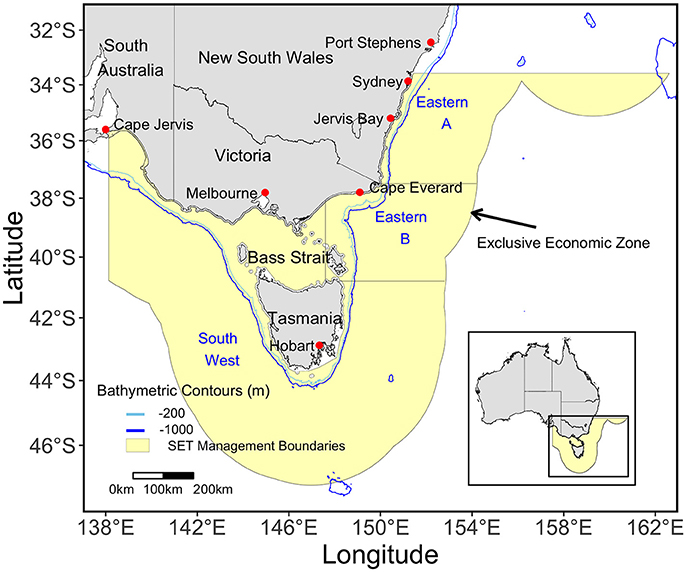
Figure 1. Map of South East Australia showing main fishing locations, South East Trawl (SET) fishery management boundaries and sectors.
These studies (and other key syntheses; e.g., Smith and Smith, 2001 detailing the trawl fishery) narrates important chapters of fishing in South East Australia, but the whole story still needs to be framed and interpreted, so that the broad impact of fisheries on marine populations of the region can be traced. Such a story is the focus of our study, which specifically aims at identifying and describing South East Australian main fisheries in terms of landings, economic (rather than cultural) value and ecological impacts through time. Although our work considers the South East Australian region, it can also provide insight in understanding general patterns and consequences of exploitation that may be pertinent to other regions. This is because the history of commercial fishing in South East Australia is shorter than in many other temperate systems (e.g., Mediterranean, Black, and North Seas; Cardinale et al., 2014; Holm et al., 2014) and can be documented from end to end, and thus used to fill in information gaps occurring in marine systems with a longer history of exploitation.
We initially review Aboriginal and colonial fisheries (including coastal fisheries and the hunting of marine mammals) to about 1900, and their impacts on marine populations. Then, we explore the history of bottom trawling and its management from 1915 to the present, searching for the causes, timing and scale of demersal resource depletion. Next, we briefly consider other important commercial and recreational fisheries of the twentieth and twenty-first century targeting demersal and pelagic stocks in this region. Finally, we compare the history of South East Australian fisheries with other fishing histories worldwide. The history of fishing in South East Australia followed a similar course to that described in other parts of the world. However, the later development of this industry had important implications for resource exploitation and management, with possible repercussions on the present status of marine populations in the region.
Aboriginal Fisheries and Fisheries of the Colonies
Aboriginal Fisheries
Aboriginals arrived in South East Australia more than 35,000 years ago. It is unclear when they started to use marine resources of the region as contemporary coastal zones have been submerged by sea-level rise following the Last Glacial Period (30,000 to 18,000 years ago; O'Connell et al., 2010; Johnson and McFarlane, 2015). The earliest archeological records of marine resource exploitation in coastal regions of South East Australia come from excavation of middens and date back about 8,000–11,000 years (Attenbrow, 2012; Johnson and McFarlane, 2015), and revealed that a wide range of marine species composed a consistent part of the diet of coastal inhabitants (Attenbrow, 2010; Johnson and McFarlane, 2015). Archeological records and studies in the published literature on past and present Aboriginal fishing in South East Australia are scarce (Henry and Lyle, 2003; O'Connell et al., 2010; Schnierer and Egan, 2016) and here we present information to the best of our knowledge.
When Europeans arrived in New South Wales in 1788, Sydney (Figure 1) and its environs had an aboriginal population of about 3,000 (Attenbrow, 2010), the biggest settlement in the region. These were skilled fishers using hand spears, and hooks and line, who fished from rock platforms in shallow waters or from bark canoes. Main targets were snapper (Sparus aurata) and yellowfin bream (Acanthopagrus australis), although flatheads (Platycephalidae), leatherjackets (Monacanthidae), seals, and crustaceans (i.e., crabs and lobsters) were also popular items. Shellfish, such as oysters, cockles, mussels, limpets, and abalone were a fundamental source of protein, and Aboriginals collected them along the shores or while free diving. Occasionally, beached whales were also consumed (Thompson, 1893; Attenbrow, 2010).
In Tasmania, in the late 1600s (hence well before European colonization) there were circa 5,000 aboriginals (Johnson and McFarlane, 2015) who mainly lived along the coast. Unlike populations from the Australian mainland, Tasmanian Aboriginals' main marine activities were hunting seals and collecting shellfish (mainly abalone) and rock lobsters in near-shore waters. Finfish was part of the aboriginal diet prior to 3,700 years ago and after European colonization, but we have no archeological records indicating this habit between these periods (Taylor, 2007; Johnson and McFarlane, 2015). Whether this food resource had been temporarily abandoned is still debated among experts. Some postulate a dietary shift toward higher-energy foods, such as seals and seabirds, due to cooler climatic conditions (Johnson and McFarlane, 2015). Others argue that fish were cooked on beaches and bones burned or washed away, thus leaving no tracks in archeological remains (among the many theories; Taylor, 2007).
The relatively small past Aboriginal population of South East Australia exploited marine resources for subsistence, and although it is reasonable to hypothesize that they had a small footprint at the broader regional scale, we have no record confirming this.
Today, Indigenous cultural fisheries are recognized as one of the three Australian fishing sectors along with the commercial and recreational sectors. Yet information on Indigenous fisheries is mostly lacking and research and improved management is strongly needed (Nursey-Bray, 2011; Schnierer, 2011). Present Aboriginal fisheries are small-scale fisheries of high cultural value; operate mainly in estuaries, rivers and coastal areas, and target a wide range of marine species, including (in South East Australia) flathead, snapper, bream (Acanthopagrus spp.), mullet (Mugilidae), whiting (Sillaginidae), prawns, lobsters, crabs, abalone, and pipis (Plebidonax deltoides) (Noble et al., 2016; Schnierer and Egan, 2016). Most of these species overlap with those targeted by the commercial and recreational sectors, but no estimates of Aboriginal fishing harvest in South East Australia are available (Schnierer, 2011; Schnierer and Egan, 2016).
Sealing and Whaling
Seal and whale hunting by Europeans were likely the first large-scale human impact on marine resources in Australia (Thompson, 1893; Gill, 1967). These industries arose soon after British settlers established the colony of Sydney in New South Wales in 1788, and of Hobart in Tasmania in 1804. The primary product was oil, the first valuable export from the new colonies (Thompson, 1893; Gill, 1967).
The sealing industry had an intense albeit short history. Large colonies of fur seals (Arctocephalus pusillus doriferus and A. australis forsteri), southern elephant seals (Mirounga leonina), and Australian sea lions (Neophoca cinerea) were discovered along the Bass Strait shore and islands (Figure 1) in 1797, and on Macquarie Island in 1810. The sealing industry developed rapidly and mainly targeted fur seals, but by the early 1830s unregulated harvest exhausted seal populations, collapsing the industry, and finally ending this valuable trade (Gill, 1967; Ling, 1999b). By then, the industry had killed about 243,000 fur and 10,000 elephant seals in Bass Strait, and 199,000 fur seals at Macquarie Island. These figures accounted for about 33% of the recorded harvest in southern Australia and New Zealand (Ling, 1999a,b). Annual estimates in fur seal catches are shown in Figure 2 (data from Ling, 1999b) and are indicative of the evolution of the sealing industry. These values are from seal skin cargoes that were landed in Sydney and Hobart and should be regarded as underestimates because not accounting for foreign vessels fishing in Australian waters (e.g., English vessels) and because some harvest was most likely unreported (Ling, 1999b). Millions more seals were harvested in Antarctic waters, whose populations also potentially interacted with Australian ecosystems (Biuw et al., 2007). In 1975, all seals in Australian Commonwealth and State waters became protected (Kirkwood et al., 2010). While fur seal populations are showing clear signs of recovery since then (Kirkwood et al., 2010), breeding colonies of southern elephant seal and Australian sea lion have not returned to Bass Strait (Ling, 1999a,b).
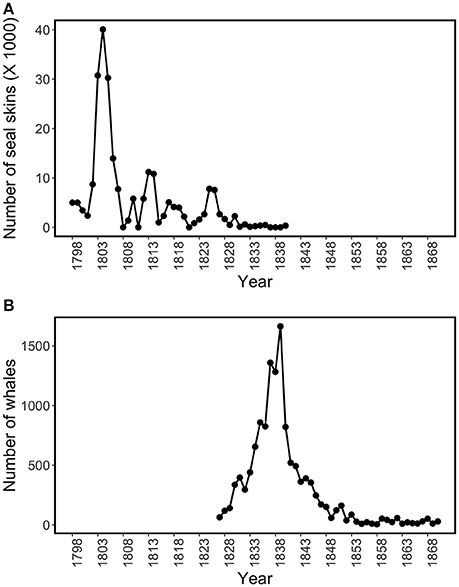
Figure 2. Annual harvest of (A) fur seals and (B) southern right whales in South East Australia. (A) shows the number of seal skins landed from Bass Strait by colonial vessels between 1798 and 1948; data from Ling (1999b). (B) shows the number of southern right whales killed along the south-east Australian coast during the colonial bay whaling industry; data from Carroll et al. (2014).
In other countries, commercial sealing began well before Australian colonies were formed, and was, in some instances, of an even greater scale (Roberts, 2007). The first records date back to the 800s in Scandinavia, Greenland, and Iceland, where walrus (Odobenus rosmarus) was the main target species. Between the 1400s and the late 1700s sealing had spread in the Arctic Ocean, and throughout the Atlantic, from Newfoundland to the South Georgia Islands, where about 1.2 million seals had been killed (more than double the number of seals killed over the history of sealing in South East Australia). At the turn of the nineteenth century sealing reached the Pacific, Indian, and the Southern Ocean (e.g., South Shetlands Islands). Among the most heavily exploited regions was Juan Fernandez, off the coast of Chile, where about 3 million seals were killed in only seven years in the 1790s (more than six times the seals killed in South East Australia).
The whaling industry contributed to the economy of the Australian colonies for a longer period. At first, a poor knowledge of the South East Australian coast and limited capital for developing an offshore whale fishery confined domestic whaling to local bays (Thompson, 1893; Colwell, 1969), where southern right whales (Eubalaena australis) gathered (Thompson, 1893; Dakin, 1934). The first bay whaling stations were established in the Derwent estuary in 1804 (Colwell, 1969), and by 1841 there were 35 whaling stations around the coast of Tasmania and others in New South Wales (e.g., Twofold Bay) and Victoria (e.g., Portland Bay) (Thompson, 1893; Dakin, 1934; Colwell, 1969). By the mid-1840s, intense harvest had exhausted the local stocks of southern right whales, and the industry began to decline (Thompson, 1893). Bay whaling continued to operate, although on a smaller scale, until the end of the century. During its history, this industry killed about 13,000 southern right whales in the region (Carroll et al., 2014). Annual catches in southern right whale for the bay whaling industry are reported in Figure 2 (data from Carroll et al., 2014), and show the rise and decline of this industry. These estimates derive from several sources, including oil exports that have been converted into number of whales killed and may not account for all removals, hence should be considered as indicative.
By the 1800s, whaling was a well-established activity along the coast of Europe, North America, and in the Arctic (Roberts, 2007). In these regions, whaling developed so long ago that early records are quite scarce, but we know that Norwegians and Basques were among the first and most famous whalers (Aguilar, 1986; Roberts, 2007). For instance, the Basque inshore whaling industry targeting right and bowhead whales (Eubalaena glacialis, and Balaena mysticetus) began in the 1050s in the Bay of Biscay, and extended to the shores of Newfoundland in the 1530s (Aguilar, 1986; Roberts, 2007). Within the next seventy years about 40,000 whales were harvested in Newfoundland (Aguilar, 1986), and by the 1700s the North Atlantic whale fishery was in decline. Whales were still abundant elsewhere, and offshore whaling companies later moved to the Pacific and the Southern Hemisphere (Roberts, 2007), where history repeated itself.
In the late 1790s, British, American, and French whalers established Sydney and Hobart as the main ports for the exploitation of Australian and New Zealand offshore stocks, and in the 1820s the improved economic condition of the Australian colonies allowed colonial whalers to join this offshore industry (Thompson, 1893; Colwell, 1969; Carroll et al., 2014). In the 1850s, more than 80 whaling vessels were sailing out of Port Jackson (Sydney), and another 40 out of Hobart. All were targeting sperm whales (Physeter macrocephalus) and the Australian and New Zealand populations of southern right whales (Thompson, 1893; Colwell, 1969; Bach, 1976), which migrated to offshore feeding grounds during summer (Carroll et al., 2014). From 1830 to 1900, whaling killed about 58,000 southern right whales, with 82% of this removal occurring within the first 20 years (Carroll et al., 2014). By 1850, the southern right whale population (for the whole Southern Hemisphere) declined to about 6% of its former abundance (Scott Baker and Clapham, 2004). Also, the global population of sperm whales decreased to about 71% of its original level by 1880 (Whitehead, 2002).
In the late 1800s, explosive harpoons, steam-driven whaling vessels and the compressor (used to pump gas into the whale carcass to prevent it from sinking) were developed. These new technologies, and the discovery in 1904 of extensive stocks of whales in the Southern Ocean boosted a large scale whaling industry (Clapham and Baker, 2002), which killed approximately 2 million whales in the Southern Hemisphere between 1904 and 1964 (Clapham and Baker, 2002; Rocha et al., 2015) and most likely caused shifts in the body size distribution of whale populations (Clements et al., 2017). Southern right whales became protected in Australian waters in 1935 after the industry had collapsed and whales' abundance steeply declined, while commercial exploitation of sperm whales continued until 1980, when a ban on whaling of all species in Australian waters was introduced (Whale Protection Act. 1980; Suter, 1982). This ban was driven by an increasing awareness of the need to conserve overexploited and remaining whale populations and a change in public and political attitude toward whales, which were perceived as social and intelligent animals (Suter, 1982). In 1986, the International Whaling Commission (IWC), established in 1946 to regulate whaling worldwide, introduced an international moratorium on commercial whaling that is still in place today (although a few nations are not bound by it; Rocha et al., 2015).
Since the first whaling operations in South East Australia, the industry had evolved dramatically. It grew from a domestic fishery operating in coastal bays to a large international fishery targeting offshore stocks over a broad geographical region. Southern right and sperm whales were the main targets, and the abundance of the southern right whale population, in particular, experienced a steep decline after intense harvest. Concurrent with the development of the fishery, fishing technologies had markedly improved and management restrictions changed from virtually no regulations to a full fishing ban over the time span of less than 150 years.
Colonial Finfish Fisheries
Fishing for finfish was a form of livelihood for the first European settlers in South East Australia, though remained a marginal activity for the first 150 years of settlement (Tenison-Woods, 1882; Thompson, 1893; Tull and Polacheck, 2001). Coastal fisheries existed throughout the colonial period, but records are sparse. Those that do exist (e.g., surviving diaries from the convict fleets; Tench, 1793 in Hill, 2008) indicate that the few fishers who were amongst the earliest settlers hardly adapted to the native Australian ecosystems, which had a high relative composition of chondrichthyes (sharks and rays) and invertebrates (especially crustaceans) compared to temperate ecosystems in the northern hemisphere. This led them to ultimately focus on landing large rays or switch to targeting bird life (Hill, 2008). Even after settlements started to expand, fisheries did not expand proportionally. The limited scale of the fish trade was mostly due to the small colonial population (190,000 inhabitants in New South Wales and 68,000 in Tasmania in 1850; Bach, 1976), the wealth of agricultural and pastoral products, and greater job opportunities offered by these land-based industries (Dannevig, 1909; Tull and Polacheck, 2001).
In 1880, a New South Wales colonial Royal Commission was formed to assess local fish stocks and to determine whether fisheries could be developed further. A wide range of people involved in fisheries were interviewed to gather information. At that time, about 8 line-fishing and 27 seine boats fished in the numerous bays of Port Jackson, and regularly supplied the Sydney Fish Market. All the main fishing grounds were between Port Stephens and Jervis Bay (about 200 km north and south of Sydney, respectively; Figure 1). Other locations along the coast and further from Sydney were so remote that they remained almost unknown to professional fishermen until the turn of the nineteenth century (Fisheries Inquiry Commission, 1880). The primary target species of line fisheries was snapper, considered the most abundant and valuable of all fish, and caught within 10 miles of the coast and in depths to about 60 m. Net fishing included the use of seine, drift, and stake nets (nets fixed on the ground and stretched across river streams) and was limited to beaches and bays. Among other common target species were sea mullet (Mugil cephalus), yellowfin bream, whitings, black fish (Girella elevata), garfish (Hyporhamphus australis), and flatheads (Fisheries Inquiry Commission, 1880). In bays of Port Jackson, fishermen reported a consistent decline in catches, particularly of the once very abundant snapper, in years preceding the 1880 commission (although precise information on the timing and extent of this decline is lacking). Much of the problem was blamed on the use of nets, and to prevent a further decline of fish stocks, the colonial Government introduced the Fishery Act 1881, a formal attempt to safeguard marine resources of the region (Tenison-Woods, 1882; Thompson, 1893). Regulations included minimum mesh size, minimum weight for target species, and the requirement of an annual boat license (Tenison-Woods, 1882; Thompson, 1893).
Following the example of the Royal Commission in New South Wales, in 1882 a Royal Commission into the Fisheries of Tasmania was formed (Fisheries Inquiry Commission, 1883). At that time the island's population was still small (115,000 inhabitants; Fenton, 2011), and fishing was restricted to the Derwent and Tamar River estuaries and to near shore waters in the south east of the Island. The main fishing gears used were oyster dredges, lobster traps, seines, and handlines. Oysters, southern rock lobsters (Jasus edwardsii), and striped and bastard trumpeters (Latris lineata and Latridopsis forsteri) were the main target species. As fishing played a marginal role in the Tasmanian economy, the Royal Commission assessed marine resources when many were almost untouched, except for the native oyster beds, already extensively overfished, and the kingfish stock (identified as gemfish, Rexea solandri, or barracouta, Thyrsites atun, as the two species are morphometrically similar), which was declining in inlet waters (Fisheries Inquiry Commission, 1883).
In summary, at the end of the 1800s, Australian fisheries resources were still relatively unexploited. While a few coastal stocks close to Sydney and Hobart had been intensively exploited, everything else beyond these regions and offshore was still unexplored and unexploited. At the turn of the century, the newly formed Commonwealth of Australia (which included the six previously separate British self-governing colonies) recognized the need to develop a trawl fishery in its waters, given that in Europe trawling had been a remunerative fishing activity for centuries (Harrison, 1991; Roberts, 2007). In 1906, for example, more than 10,000 steam trawling vessels fished in Great Britain, landing nearly 400,000 t of demersal fish (Thurstan et al., 2010). Thus, between 1909 and 1914, the Commonwealth Government decided to invest in exploratory trawl surveys, which were initially conducted in the continental shelf of South East Australia and recorded fish catches sufficient to justify the development of a trawl fishery in the region (Dannevig, 1909).
Bottom Trawling
Steam Trawling
Following exploratory fishing, the New South Wales Government imported three steam trawlers in 1915, and industrial fishing commenced. It was the beginning of the South East Trawl Fishery (SET), which later developed into Australia's major finfish fishery in terms of landings (e.g., Klaer, 2001; Tilzey and Rowling, 2001). This fishery was the main source of impact on marine communities of the regions, and therefore it is here described in more detail. The SET reached a peak in landings of 62,269 t in 1990, though 40,000 t were of orange roughy (Hoplostethus atlanticus), a species that became overexploited within the next 4 years. Today landings are much lower. In 2015, the fishery landed 7,318 t of fish, with a gross value of production (GVP) of 33 million AUD (decreasing from 53 million AUD in 2013; Patterson et al., 2015, 2016). For comparison, in 2014, the United Kingdom's bottom trawl fishing production was 170,000 t of fish (Elliott et al., 2014). Many factors can influence bottom trawl fishing production, but this comparison clearly highlights the much smaller scale of the South East Australian trawl fishery compared to other trawling industries.
The SET had a troubled start. After having lost capital, the New South Wales Government sold the fleet in 1923 to private enterprises, and by 1929, 17 vessels were operating and targeting mainly tiger flathead (Platycephalus richardsoni), latchet (Pterygotrigla polyommata), and chinaman leatherjacket (Nelusetta ayraud) (Klaer, 2001; Gowers, 2008). During War World II the trawling fleet declined as the U.S. Army requisitioned men, vessels and fuel, and by 1943 only one steam trawler and a few Danish seiners (bottom purse seiners) introduced in 1933 were operating. Soon after WWII the number of steam trawlers stabilized to about 10, but in 1961 the steam trawling period ended due to increased operational costs and the collapse of the flathead stock in the mid-1940s. For the next decade only Danish seiners were active because they were more economical to operate than trawlers and were better able to exploit inshore fishing grounds (e.g., Klaer, 2001; Tilzey and Rowling, 2001) (Figure 3). Following extensive investigation, overfishing and the use of inappropriate net mesh sizes were identified as main causes of the tiger flathead collapse. The introduction of minimum mesh size regulations, together with the demise of the steam trawl fleet, led to a recovery of the stock during the 1960s and 1970s (Tilzey, 1994).
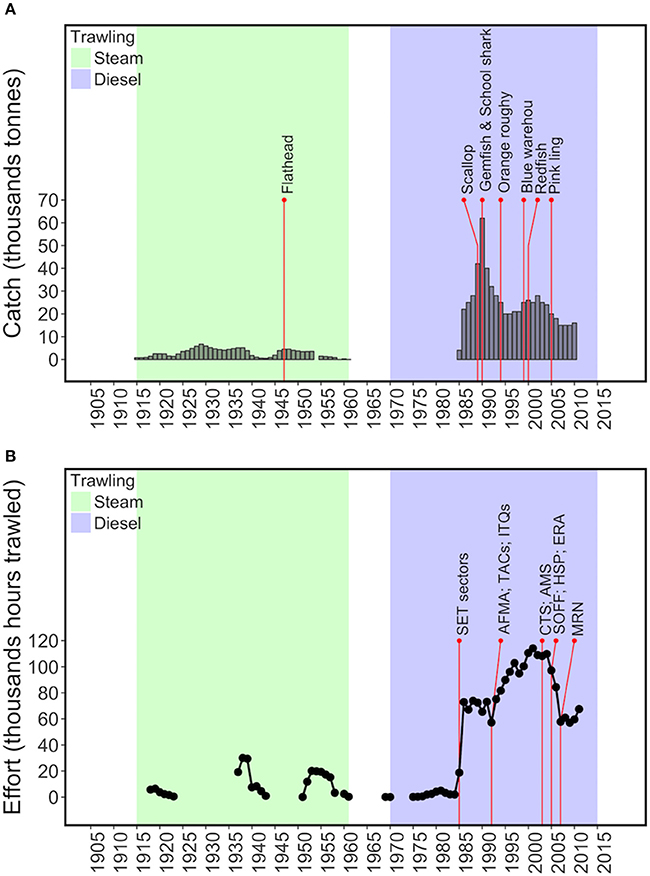
Figure 3. Temporal distribution of SET (A) retained catch and (B) commercial effort. (A) shows years when target stocks of the trawl or other fisheries (scallop and school shark) were first classified as overfished (or close to be overfished as for pink ling); while (B) reports main fishery management actions and policy directions. Data for the steam trawling period are from Klaer (2006), catch data for the diesel powered period are from Patterson et al. (2015) and fishing effort data for the diesel power period are from the Australian Fisheries Management Authority, AFMA. Between 1961 and 1971 only a few Danish seiners were active, and catch and effort data within this decade are from such vessels. However, detailed catch and effort data for this period is not available and thus values are underestimates. Full catch reconstruction for the entire period are included in some individual species assessments for the region. SET, South East Trawl fishery; CTS, Commonwealth Trawl Sector; AFMA, Australian Fisheries Management Authority; TAC, Total Allowable Catch; ITQ, Individual Transferable Quota; AMS, Alternative Management Strategy; SOFF, Securing Our Fishing Future; HSP, Harvest Strategy Policy; ERA, Ecological Risk Assessment; MRN, Marine Reserve Network.
Over the history of steam trawling, fishing grounds had expanded southwards, reaching Cape Everard (Figure 1), and into deeper waters. Catch rates declined by half between the early 1920s and the late 1950s, and the catch composition changed over time (Klaer, 2001). Whereas, flathead, latchet and chinaman leatherjacket dominated early catches, redfish (Centroberyx affinis), and jackass morwong (Nemadactylus macropterus) formed the bulk of later catches (Klaer, 2001). Fishing vessels and practices generally remained similar. A Vigneron-Dahl modification to the otter trawl gear (leading to a wider spread) was introduced in 1925 and may have increased efficiency by a factor of about 30%. Vessels increased in average size from 200 t in the 1920s to over 300 t in the 1950s (Klaer, 2004). Other undocumented changes to gear, fisher knowledge, and ability to locate fish have likely increased fishing efficiency. If accounted for in catch rates, these would increase the already substantial declines in abundance, particularly evident for certain species and times, during the steam trawl period.
Diesel Powered Trawling
In 1971, the first purpose-built diesel-powered otter trawler was introduced to the SET and this trawling method rapidly expanded through the 1970s. Large spawning migrations of gemfish were discovered off New South Wales in waters between 300 and 400 m depth, and this species became the main target during winter months. Soon, the fishery expanded to waters around Tasmania and western Bass Strait and to depths of about 600 m (Figure 4). By 1976, gemfish had become the main commercial species in the SET, and by 1982 the number of vessels involved in the fishery rose to 180 (Tilzey and Rowling, 2001). This growth was helped by the absence of major management restrictions (Tilzey, 1994; Grieve and Richardson, 2001).
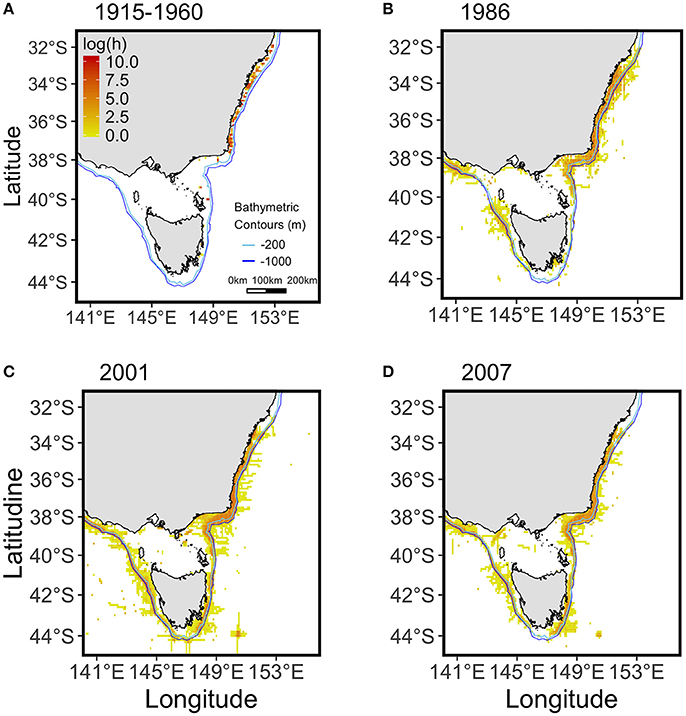
Figure 4. Spatial distribution of trawling effort in cumulative (log of) hours trawled for four representative periods of the trawling industry: (A) 1915-1960, the steam trawling period; (B) 1986, the discovery of orange roughy stocks; (C) 2001, the peak of trawling effort; and (D) 2007, reduction in trawling effort following management restrictions. Data for the steam trawling period are from Klaer (2006) and for the diesel power period are from the Australian Fisheries Management Authority, AFMA.
The very rapid development of the fishery, followed by declines in fishing yields, raised questions about its long-term profitability, and emphasized the need for control over the expansion of the trawl fishery to underutilized areas. This moved the Commonwealth Government to intervene in the SET management (Grieve and Richardson, 2001). Hence, in 1985, the Commonwealth Government defined the SET boundaries and three management sectors (Eastern Sector A, Eastern Sector B, and South West Sector, Figure 1); set entry criteria for each sector; and issued new fishing licenses only for the South West Sector, still considered underexploited (Tilzey, 1994; Grieve and Richardson, 2001). In 1986, abundant stocks of orange roughy and blue grenadier (Macruronus novaezelandiae) were discovered on the continental slopes off Tasmania and Victoria, and the trawl fishery expanded in the South West Sector (Tilzey, 1994; Tilzey and Rowling, 2001).
In the 1980s, catch rates of eastern gemfish stocks, together with spawners' mean length declined. This led to the implementation of Total Allowable Catch (TAC) limits for this stock in 1988, and Individual Transferable Quota (ITQ) allocations a year later (Tilzey, 1994). TACs and ITQs were also introduced for orange roughy in 1990 and for 15 other target species in 1992 (Caton et al., 1997). Concurrently, the Australian Fisheries Management Authority (AFMA) was created as a statutory authority for the management of fisheries and target stocks under Commonwealth jurisdiction (Grieve and Richardson, 2001; Patterson et al., 2016). The use of ITQ was then in its infancy, and Australia, together with the Netherlands, Iceland, Canada, and New Zealand, was among the pioneers (Chu, 2009).
During the 1990s, trawling expanded to deep waters and the number of vessels declined (from 180 in 1982 to 108 in 1997). Through this period, average vessel tonnage and horsepower increased, as did fishing efficiency, with vessels employing more sophisticated electronic fishing and navigation systems (e.g., since the mid-1980s, net-sonde and GPS started to be used) (Tilzey and Rowling, 2001). Fishing effort increased steadily, but the average catch remained fairly stable at about 20,000-25,000 t (excluding large catches of orange roughy between 1986 and 1994; Figures 3, 4) (Larcombe et al., 2001; Patterson et al., 2016). This stability masked shifting species composition as, by the late 1990's, catches of orange roughy, eastern gemfish, and blue warehou (Seriolella brama) had collapsed, and those of redfish and pink ling (Genypterus blacodes), other main target species, had experienced steep declines (redfish catches also collapsed in 2000; Figure 3) (Caton and McLoughlin, 1999; Punt, 2007; Little and Rowling, 2008; Upston et al., 2014; Patterson et al., 2016). Despite these species being then classified as over or fully fished (Caton and McLoughlin, 1999), often TACs either remained at their original levels or increased, suggesting that socio-economic management objectives often prevailed over sustainability aims (Tilzey and Rowling, 2001). See Table 1 for a summary of key management steps for the SET.
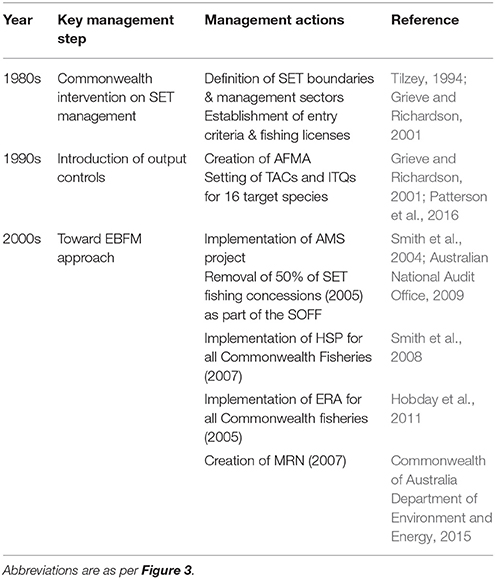
Table 1. Key management steps for the South East Trawl fishery.
The Trawl Fishery Today
In 2003, the SET fishery merged into the broader Southern and Eastern Scalefish and Shark Fishery (SESSF). This saw all of the main Commonwealth demersal fisheries (i.e., those managed by the Commonwealth of Australia as opposed to State Governments) brought under the same management objectives. Accordingly, the SET fishery became the Commonwealth Trawl Sector (CTS) of the SESSF (Patterson et al., 2016). Following 30 years of increased exploitation, the status of many CTS fish stocks had deteriorated. At that time, many Australian fisheries were facing similar problems, i.e., depletion of fish resources and low profitability, and this situation called for radical management changes. Changes were also arising from a number of new policy directions that aimed at a wider consideration of the impacts of ocean-related activities on all aspects of the natural environment (Smith et al., 2007), reflecting a worldwide trend to ecosystem based fisheries management (EBFM; Pikitch et al., 2004).
The need to restore Australian, particularly Commonwealth, fisheries and ecosystems resulted in several major management reviews and initiatives. In 2004, the Alternative Management Strategy (AMS) project was funded to carefully review the SESSF management plan and identify management options that would lead to better ecological, economic, and social outcomes (Smith et al., 2004; Fulton et al., 2014); and in 2005, AFMA initiated a process to implement both a Harvest Strategy Policy (HSP, initially implemented as a harvest strategy framework in the SESSF) to set species and stock specific catch limits (Smith et al., 2008), and an ecological risk assessment (ERA) to address the broader ecological effect of fishing (Hobday et al., 2011). Concurrently, the Securing Our Fishing Future (SOFF) structural adjustment package (Australian National Audit Office, 2009) was announced, and the fishery buyback component of the package resulted in the removal of 50% of the fishing concessions from the CTS, which in turn reduced fishing effort by an almost equal amount (Figure 3).
Since the mid 2000s, TACs and/or landings for most quota species have decreased and the number of quota stocks assessed has increased (from 24 to 37, in the SESSF; Smith et al., 2008, 2013; Patterson et al., 2016). Total landings have been below TACs for some quota species, and this possibly reflects the tendency to target a few high-valued species until their TACs is reached (e.g., orange roughy), while TACs for other species remain not fully fished. In terms of ecological improvements, by 2013 none of the quota stocks assessed was classified as subject to overfishing (i.e., fishing mortality above the limit reference point). However, trends in the number of stocks classified as overfished (i.e., biomass below the limit reference point) remained almost constant with seven SESSF stocks still overfished in 2015 (Patterson et al., 2016). Among these are orange roughy (eastern stock), eastern gemfish, blue warehou, and redfish, all primary target species of the CTS and currently subject to explicit stock recovery strategies, including zero or low commercial TACs (AFMA, 2017). Orange roughy (eastern stock) is showing signs of recovery (AFMA, 2017).
Meanwhile, the ERA assessed the impact of fishing on a range of habitats and target, bycatch, threatened and endangered species, and the subsequent environmental risk management responses resulted in increased spatial management of the fishery with the introduction of area closures and habitat protection (Hobday et al., 2011). In addition, in 2012 the South-East Commonwealth Marine Reserves Network (MRN) was established in the SESSF region. The reserves cover an area of 388,464 km2 across a depth range of 40–4,600 m and include a range of zonings, from “sanctuary” to “multiple use” zones. This placed major restrictions on commercial fisheries (Commonwealth of Australia Department of Environment and Energy, 2015), especially the demersal fisheries.
While broad scale fishery-independent trawl surveys of the kind undertaken in Europe and the USA have not been a feature of Australian fisheries management, possibly due to limited demersal resources and hence economic value of this fishery, an understanding of how today's fish community compares to that of pre-fishing is possible via observations from ad-hoc scientific surveys. Throughout the history of trawling, a range of bottom trawl surveys has been carried out in South East Australia. Some of these studies preceded the beginning of the SET, whereas others assessed demersal resources at different stages after commercial exploitation began (data and data description are available in Novaglio et al., 2015). Importantly, this information covers the entire history of trawling and has been used to quantify long-term changes in fish communities of the region. For instance, a comparison of pre-fishing communities (sampled between 1898 and 1915) with those sampled in the 1980s and 2000s showed shifts in community composition, and steep declines in the abundance of commercial species, such as flathead, morwongs (Cheilodactylidae), and gurnards (Triglidae), most likely due to fishing (Novaglio, 2016). In another study, the application of species-area relationships to the survey data revealed changes in community structure, in terms of richness, evenness, species abundance and spatial distribution, as trawl fishing established and intensified (Novaglio et al., 2016).
Other Fisheries of the Twentieth and Twenty-First Centuries
During the last century trawling has been the major fishing activity by landed weight in South East Australia, but is far from being the only fishery and it is not even the most profitable. Traps, hooks, and lines and other means of net fishing have been and still are important fishing methods in the region. Hooks and lines have been used to catch fish from the period of first European colonization, long before the development of trawling. At present, the Scalefish Hook Sector (ScHS), which uses drop-line and demersal long-line, spatially overlaps and shares most of its target species with the CTS. Its production is relatively small and, in 2016, amounted to about 650 t of fish landed (Patterson et al., 2016).
A shark fishery, today known as the Shark Gillnet and Hook Sector (SGHS), developed in the 1930s in Victoria. The fishery expanded to the waters of Tasmania and South Australia in the mid-1940s due to the high demand for food production and vitamin A from shark liver oil during WWII. The main fishing method was long-lining, replaced by gillnetting from the 1960s onwards, and the main target species was school shark (Galeorhinus galeus), replaced in the 1970s by gummy shark due to a high content of mercury and steep decline of school shark (Walker, 1999; Patterson et al., 2016). During the 1980s, school shark was again the main target species, but became overexploited by 1990 (Walker, 1999; Patterson et al., 2016), and is today assessed as overfished (although the assessment is uncertain; AFMA, 2017). School shark has been under a rebuilding strategy since 2008, and management arrangements include a low incidental TAC that aims to reduce school shark bycatch while targeting gummy shark (AFMA, 2017). At present, the SGHS, also targeting elephantfish (Callorhinchus milii) and sawshark (Pristiophoridae), is an important sector of the SESSF in terms of landings and economic value. The fishery landed about 2,000 t of fish in 2015, with a GVP of about 17 million AUD (Patterson et al., 2016).
In Tasmanian and Victorian waters in particular, southern rock lobster, abalone, and scallop (Pectinidae) have all been the basis of particularly valuable State-managed fisheries. Southern rock lobster and abalone fisheries remain the most profitable fisheries in South East Australia, delivering high-quality products for export. For instance, in 2012, the GVP for the Tasmanian and Victorian rock lobster fisheries combined amounted to about 77 million AUD, and for the abalone fisheries to about 106 million AUD (Hartmann et al., 2013; Tarbath and Gardner, 2015; Victorian Fisheries Authority, 2016). Tasmania is by far the major producer and its rock lobster and abalone fisheries alone outreach the CTS in GVP (143 compared to 53 million AUD, in 2012). In contrast, the once valuable commercial scallop fishery, which opened in 1973, collapsed in the late 1980s, and since then has been at times closed to aid recoveries. The fishery is at present restricted to limited areas and seasons (Patterson et al., 2016).
The commercial rock lobster fishery began during the 1830s, when rock lobsters were collected by hand or using hoop nets in shallow waters within about 80 km of Hobart (Frijlink and Lyle, 2013). In 1925, the use of lobster pots was legalized in Tasmania, and annual catches rose from 39 t to 1,080 t in 15 years (Frijlink and Lyle, 2013). By then, the fishery had steadily expanded along the East and North West Tasmanian coast, and around the Bass Strait islands (Frijlink and Lyle, 2013). After WWII, the rock lobster fishery bloomed and catches further increased due to a higher number of licensed vessels and pots employed and technological advances, such as the adoption of diesel engines and on-board refrigerators (Phillips et al., 2002; Frijlink and Lyle, 2013). The total annual catch reached 2,000 t in 1967 but catch rates steeply declined (Frijlink and Lyle, 2013), and to protect the profit of established fisherman, the fishery, which was then managed by limits on size and number of pots and by seasonal closures, became limited entry (Phillips et al., 2002). However, fishing effort (and power) kept growing as licensed fishers invested in bigger and better equipped boats, driven (at least in part) by increased lobster demand and price resulting from the development of an export market to Asia in the 1980s (Phillips et al., 2002; Frijlink and Lyle, 2013). This expansion led to concerns about economic overfishing and, to further protect profits, TACs and ITQs were introduced in 1998 (Phillips et al., 2002). Between 1998 and 2006 fishing effort decreased and catch rates increased (with TAC at about 1,500 t constraining catches). However, after 2006, the rock lobster biomass declined and, between 2009 and 2012, the TAC was reduced by about 30%. The decrease in abundance was likely due to a prolonged period of very low recruitment (Hartmann et al., 2013).
The wild abalone industry developed in South East Australia about the 1960s. The main target species are blacklip (Haliotis rubra, dominating the catches), greenlip (H. leavigata), brownlip (H. conicopora), and roes (H. roei) abalone (Mayfield et al., 2012), which are harvested by divers generally in waters less than 20 m deep. The combined abalone commercial harvest of Tasmania and Victoria reached a peak of about 6,000 t in 1984, following the development of a live market to Asia, and stabilized at about 4,000 t from 1990 onwards. However, in Victoria catches have been declining since 2007 due to an outbreak of AVG (Abalone Viral Ganglioneuritis) and the proclamation of MPAs has also limited fishing effort (Mayfield et al., 2012). Today, management regulations include fishing effort and size limits, TACs and ITQs (introduced in 1985 in Tasmania and in 1988 Victoria), and access rights (established in 1994; Mayfield et al., 2012). Importantly, this resource has been sustainably exploited for the last 50 plus years (Mayfield et al., 2012).
South East Australian pelagic fisheries can be divided into small pelagic and tuna fisheries. The historical barracouta (Thyrsites atun) fishery was the predominant (small) pelagic fishing activity in the first half of the 1900s in waters off western Victoria and around Tasmania, and ceased around the 1970s (Grant et al., 1978; Tilzey and Rowling, 2001). Small pelagic fisheries using purse seine and midwater trawl gears and targeting Australian sardine (Sardinops sagax), mackerel (Trachurus spp.) and redbait (Emmelichthys spp.) arose in the 1980s. Catches were around 12,000 t in the early 1990s and declined below 2,000 t per year afterwards due to lack of market demand and processing facilities (Patterson et al., 2016). In 2014 a factory trawler was introduced and landings peaked again at about 12,000 t in 2016, though this was still well below the set TAC (Haward et al., 2013; Patterson et al., 2016). In contrast to the diminutive small pelagic fishery, tuna fisheries in the region, which developed in the 1950s and gained importance since, have a substantial economic value (Tuck, 2004; Patterson et al., 2016). Currently, fishing gears used for tuna are long-line and purse seine. While tropical tunas are landed, Southern Bluefin tuna (Thunnus maccoyii) is the most valuable targeted species and the 2015 catch of this species amounted to about 5,500 t with a GVP of 37 million AUD (Patterson et al., 2016). Similar numbers were reached for the eastern tuna and billfish fishery, which extends along the whole east coast of Australia and mainly catches swordfish (Xiphias gladius) and yellowfin tuna (Thunnus albacares) (Patterson et al., 2016).
Finally, recreational fishing has been an increasingly important component of the total fisheries harvests in South East Australia. Despite growing awareness of the significance of recreational fisheries in Australia through the 1990s, information and assessments remained scarce until 2000, when Commonwealth, state and territory fisheries agencies implemented the National Recreational Fishing Survey (NRFS; Henry and Lyle, 2003). The survey provided the first estimates of Australian recreational catch, effort and rate of fishing participation by state, and thus established an important baseline against which trends can be compared (Lyle et al., 2014). In 2000 the rate of recreational fishing participation was about 17% of the population in New South Wales, 12% in Victoria and 29% in Tasmania (Henry and Lyle, 2003), and fisheries targeted a broad range of invertebrates (e.g., squids, abalone, and lobsters) and finfishes (Henry and Lyle, 2003), with flatheads being the primary finfish species group recreationally harvested in South East Australia. In 2000, the estimated annual recreational harvest of finfish for New South Wales, Victoria and Tasmania combined was about 14,000 t, compared with the total CTS catch of about 30,000 t. The estimated annual recreational harvest does not include species that have been captured and released or discarded due to size and bag limits, poor eating quality or for ethical reasons, though release rates might be high for some species (e.g., 80% for sharks and rays and 44% for flatheads Australian-wide; Henry and Lyle, 2003). Estimates of annual catches for the recreation fishing sector are uncertain due to a range of factors including rough conversion of fish numbers (reported by fishers) into weight (more useful for comparison with other fisheries) and difficulties in tracking fishing operations. For this reason, estimates of recreational catch should be considered with caution.
Since 2000, various fisheries agencies in Australia have conduced state-wide surveys that provided comparable information to those reported in the NRFS. In South East Australia, these surveys were performed in New South Wales and Tasmania (West et al., 2013; Lyle et al., 2014). The most recent available data are for 2013-14 (West et al., 2013; Lyle et al., 2014) and show a decline in recreational fishing participation, effort and catches in both states. Fishing participation declined to about 12% (from 17%) of the population in New South Wales and to about 22% (from 29%) in Tasmania; the decline was partially driven by changing demography (e.g., population aging) and reflects a common trend to other Australian states. Fishing effort (measured as the sum of days spent fishing for each recreational fisher) has also decreased by about 40% between 2000 and 2013-14 in New South Wales and by about 33% in Tasmania. Line fishing has remained by far the predominant fishing method in both states although a range of other activities, such as pot and dive fishing, and the use of gillnets, were reported. Total catch decreased in time, but the catch composition remained fairly constant with some variation among fish groups (e.g., increase in squid catches due to increased appreciation of these as a food item). Breams and flatheads remained the most commonly caught group of species in New South Wales and Tasmania respectively, and flatheads dominated Tasmanian catches by weigh. For the 2013-14 survey, indicative estimates of harvest by weight (instead of numbers) are available only for the most commonly caught fish species and amount to around 1,600 t in New South Wales and 500 t in Tasmania (representing underestimates of the total recreational harvest). The rate of release after capture was about 56% in New South Wales and 44% in Tasmania. For some species, recreational harvest was significant and exceeded or equaled state commercial fisheries catches; while for other commercially targeted species recreational catches were minimal. For instance, recreational harvest of flathead was double the commercial catch in New South Wales and more than six times in Tasmania. These comparisons highlight the importance of recreational fisheries, for some species in particular, and the need to include recreational harvest in stock and ecological assessments.
Discussion
The history of South East Australian fisheries followed a similar course to exploitation histories described worldwide (Jackson et al., 2001; Lotze and Milewski, 2004), but it is better documented because it occurred in more recent years. As such, this history offers a rare and illustrative case study to understand general patterns of fishing development and regulation.
In South East Australia, the Aboriginal era was characterized by small-scale, subsistence fisheries, and lasted until the end of the eighteenth century. At that time, and as had previously happened in the Americas, the arrival of European colonists marked the beginning of intensive exploitation of large vertebrates and shellfish (Jackson et al., 2001; Lotze and Milewski, 2004; Lotze et al., 2006). Initial extraordinary profits and a general lack of management restrictions promoted overexploitation of some marine populations (e.g., whales, fur seals, oysters, and snappers) and contributed to the extirpation of others, such as the southern elephant seal and the Australian sea lion colonies of Bass Strait. Subsequently, the advent of new technologies (e.g., steam whalers and trawlers, and then diesel engines) allowed expansion of fishing into deep seas and open oceans (Tilzey and Rowling, 2001; Clapham and Baker, 2002; Roberts, 2007), thus facilitating the exploitation of stocks once unreachable. In South East Australia, exploitation extended to demersal resources when a trawling industry developed on the continental shelf of New South Wales in 1915 and expanded to southern and deeper waters in the 1970s. Meanwhile, other fisheries, such as shark fishing and whaling, established or increased their range, thus increasing impacts on both demersal and pelagic ecosystems. During this phase of fishing expansion, steep declines in the abundance of target species and stock collapses (e.g., southern right whale, tiger flathead, and school shark) were masked by the availability or discovery of other resources to be exploited, hiding the unsustainable nature of the fishing industry (in both ecological and economic terms), and in some cases postponing the need for management regulations.
In more recent years (i.e., from the 1990s onwards), awareness of the effect of fishing on marine life grew worldwide (Pikitch et al., 2004; Lotze et al., 2006) and the willingness to restore depleted ecosystems often prevailed over short-term economic interests. In South East Australia, the quota system implemented in the SET in the early 1990s to protect individual stocks from overexploitation was revised and improved in 2005, and, concurrently, new regulations designed to address the effect of fishing on multiple components of marine ecosystems (e.g., reduction in fishing effort and area closures) were introduced. Following the introduction of more explicit management strategies, the number of stocks assessed in South East Australia has increased, those subject to overfishing has decreased (to none for the SESSF; Patterson et al., 2016), and some of the depleted mammal and fish populations and key ecological taxa are showing signs of recovery (e.g., seal populations, eastern orange roughy stock, and benthos habitat-formers; Kirkwood et al., 2010; Bax and Hedge, 2015; Patterson et al., 2016). At present, about 6% of the stocks assessed in Australia are overfished (Flood et al., 2014), while about 85% of those assessed in Mediterranean European countries are currently overfished (Colloca et al., 2013). This comparison highlights a marked difference in stock status, and potentially management actions and their outcomes among countries.
Australian fisheries have been regarded as overall well-managed and sustainable fisheries, particularly compared to those worldwide (e.g., Alder et al., 2010). In South East Australia, this may be due to a range of factors including the relatively late beginning of the fishing industry. Fisheries of South East Australia developed when considerable fishing knowledge, skills and technologies were already available (e.g., steam and diesel engine, refrigeration, vessels, and nets able to work in tough sea conditions), and thus fishing effort moved to more remote and deeper waters after relatively few years of exploitation and possibly before most resources were too depleted to be recovered. The opposite situation can be observed, for example, in the Mediterranean and Black Seas, which have been heavily exploited for thousands of years (Holm et al., 2014). However, the availability of advanced skills and technologies at the start of exploitation also implied that exploitation on targeted stocks suddenly shifted from none to being significant, with little time for fisheries to gradually learn and adjust. As such, some high-valued species that are particularly sensitive to the effect of fishing, such as gemfish and orange roughy (Clark, 2001), became depleted very quickly. There has been a concerted effort in the last decade to recover these and other depleted populations (i.e., AMS, HSP, ERA, and SOFF; see Figure 3). While overfishing is under direct management control and has quickly ceased, recoveries of quota species from overfished status have not been as evident. Among the possible reasons are ecological characteristics of some quota stocks, such as long generation times, which imply slow recoveries; recoveries being dependent on environmental conditions driving recruitment; and a lack of information on stock status when the assessment relies on commercial catch data (e.g., CPUE) and TACs are set to zero or very low levels (AFMA, 2017).
With the availability of fishing technologies, investments in fishery research began at the onset of exploitation, resulting in the development of some innovative management legislation able to buffer some of the effects of fishing on populations. For instance, the 1880 New South Wales Royal Commission assessed fisheries and resources of the region after only a few years of colonial exploitation, and among the outcomes were management restrictions that regulated the rock lobster fishery in Tasmania (e.g., size and effort limits), and that ensured its sustainability through time (Phillips et al., 2002). In addition, these early investments resulted in the collection of data on the pre-fishing status of marine resources. Such information is essential for quantifying the full extent of fishing-induced ecological changes on communities, and hence to tailor todays' management objectives (e.g., Jackson et al., 2001). For example, the 1910 Endeavour expedition surveyed demersal resources of the continental shelf of South East Australia before the development of the trawling industry, and the 1976 Kapala expedition did the same on the continental slope (Novaglio et al., 2015). These data have been used to assess the historical impact of fishing on communities of the region (Andrew et al., 1997; Graham et al., 2001; Novaglio, 2016; Novaglio et al., 2016).
A range of other ecological and social factors had clear implications for the exploitation and management of South East Australian marine resources. Notably, the low productivity of Australian marine ecosystems (Chavez et al., 2011) and the narrow continental shelf characterizing the South East Australian region precluded the extensive development of fisheries capturing thousands to millions of tons of fish as has happened in many other regions of the world (e.g., China, Indonesia, and United States; FAO, 2016). In addition, Australian governments and private enterprises had favored the development of more profitable land-based industries, such as mining and agriculture, which attracted a greater amount of capital and offered greater job opportunities (Dannevig, 1909; Tull and Polacheck, 2001; Barber et al., 2015). Hence fishing intensity has been relatively limited. As such, fisheries have not been as deeply embedded in the Australian culture and economy as they have in many other societies (e.g., the many fishery-dependent communities of Mediterranean and North European countries; Brookfield et al., 2005; Natale et al., 2013) and employment in the fishing industry has promptly shifted to other industries when necessary. For example, in 2005 fishing effort was drastically reduced, with much of the employment absorbed by the booming mining industry (Australian National Audit Office, 2009).
The short yet complex history of fishing exploitation in South East Australia highlights unavoidable and common challenges in developing and managing fisheries, and provides examples of failures and successes. As such, this review may serve to inform the evolution of fisheries elsewhere (e.g., in developing countries, where fisheries are rising and growing fast; FAO, 2016), and thus avoid common pitfalls in fisheries development and management. Among the most evident lessons is the importance of the early adoption of fisheries management, supported by fisheries research, allowing timely response to early declines in fish stocks, and enforcement of regulations aimed at protecting key ecological species and habitats, besides target stocks. Early assessments of marine resources provide an essential baseline against which fishing impacts and management effectiveness can be properly quantified. Lastly, fisheries should be managed taking into account (i) ecosystem functional limits, such as productivity, which may constrain sustainable exploitation, and (ii) the current availability of a wide range of fishing skills and modern technologies, which can consistently speed up overexploitation of marine resources.
Despite the more recent focus on management and the large investment in research to recover depleted populations, and despite some favorable conditions such as the relatively small scale of Australian fisheries and hence low fishing intensity, the experience in South East Australia shows that ecological improvements for depleted populations can be slow, suggesting that the time to recovery may be longer than expected, even for what may be regarded as a well-managed fishery.
Author Contributions
CN, AS, SF, and FF: Conceived the study; CN: Wrote the first draft of the manuscript and produced figures and tables. All authors wrote sections of the manuscripts, contributed to manuscript revision, read and approved the submitted version.
Funding
Funding for this study was provided by the Oceans and Atmosphere Flagship, Commonwealth Scientific and Industrial Research Organization, the Institute for Marine and Antarctic Studies, and the Lenfest Ocean Program.
Conflict of Interest Statement
The authors declare that the research was conducted in the absence of any commercial or financial relationships that could be construed as a potential conflict of interest.
Acknowledgments
We thank Dr. Anthony Harrison for his assistance in locating historical reports and material, Drs. Jeremy Lyle, Emma Lee, and Simon Goldsworthy for providing key references, Drs. Malcolm Tull and Simon Jennings for their thoughtful comments on an early version of this manuscript, and Drs. Ruth Thurstan, Brett Molony, and Nazil Demirel for their constructive reviews.
References
AFMA. (2017). Southern and Eastern Scalefish and Shark Fishery Wildlife Trade Operation. Canberra, ACT: Australian Fisheries Management Authority, 117.
Aguilar, A. (1986). A Review of Old Basque Whaling and Its Effect on the Right Whales (Eubalaena glacialis) of the North Atlantic. Reports of the International Whaling Commission, 191–199.
Alder, J., Cullis-Suzuki, S., Karpouzi, V., Kaschner, K., Mondoux, S., Swartz, W., et al. (2010). Aggregate performance in managing marine ecosystems of 53 maritime countries. Mar. Policy 34, 468–476. doi: 10.1016/j.marpol.2009.10.001
Andrew, N. L., Graham, K. J., Hodgson, K. E., and Gordon, G. N. G. (1997). Changes after Twenty Years in Relative Abundance and Size Composition of Commercial Fishes Caught During Fishery Independent Surveys on SEF Trawl Grounds. Cronulla, NWS: New South Wales Agriculture and Fisheries, 109.
Attenbrow, V. (2010). Sydney's Aboriginal Past: Investigating the Archaeological and Historical Records. Kensington, NSW: University of New South Wales Press.
Attenbrow, V. (2012). The Aboriginal prehistory and archaeology of Royal National Park and environs: a review. Proc. Linn. Soc. New South Wales 134, 39–64. Available online at: https://openjournals.library.sydney.edu.au/index.php/LIN/article/view/6079
Australian National Audit Office (2009). Administration of the Securing our Fishing Future Structural Adjustment Package Assistance Programs. Audit Report No.39, Canberra, ACT, 100.
Bach, J. (1976). A Maritime History of Australia. Melbourne, VIC: Thomas Nelson (Australia) Limited.
Barber, J., Penney, K., Witteveen, B., Bernie, K., Bragatheswaran, G., Martin, K., et al. (2015). Resources and Energy Major Projects. Canberra, ACT: Department of Industry, 24.
Bax, N. J., and Hedge, P. (eds.) (2015). Marine Biodiversity Hub, National Environmental Research Program, Final Report 2011–2014. Report to Department of the Environment, Canberra, ACT, 92.
Biuw, M., Boehme, L., Guinet, C., Hindell, M., Costa, D., Charrassin, J. B., et al. (2007). Variations in behavior and condition of a Southern Ocean top predator in relation to in situ oceanographic conditions. Proc. Natl. Acad. Sci. U.S.A. 104, 13705–13710. doi: 10.1073/pnas.0701121104
Brookfield, K., Gray, T., and Hatchard, J. (2005). The concept of fisheries-dependent communities: a comparative analysis of four UK case studies: Shetland, Peterhead, North Shields and Lowestoft. Fish. Res. 72, 55–69. doi: 10.1016/j.fishres.2004.10.010
Cardinale, M., Bartolino, V., Svedäng, H., Sundelöf, A., Poulsen, R. T., and Casini, M. (2014). A centurial development of the North Sea fish megafauna as reflected by the historical Swedish longlining fisheries. Fish Fish. 16, 522–533. doi: 10.1111/faf.12074
Carroll, E. L., Jackson, J. A., Paton, D., and Smith, T. D. (2014). Two intense decades of 19th century whaling precipitated rapid decline of right whales around New Zealand and East Australia. PLoS One 9:e96729. doi: 10.1371/journal.pone.0096729
Caton, A., and McLoughlin, K. (1999). Fishery Status Report 1999. Department of Agriculture, Fisheries and Forestry, Bureau of Rural Science, Canberra, ACT, 250.
Caton, A., McLoughlin, K., and Staples, D. (1997). Fishery Status Report 1997. Department of Primary Industry and Energy, Bureau of Resource Science, Canberra, 139.
Chavez, F. P., Messié, M., and Pennington, J. T. (2011). Marine primary production in relation to climate variability and change. Ann. Rev. Mar. Sci. 3, 227–260. doi: 10.1146/annurev.marine.010908.163917
Chu, C. (2009). Thirty years later: the global growth of ITQs and their influence on stock status in marine fisheries. Fish Fish. 10, 217–230. doi: 10.1111/j.1467-2979.2008.00313.x
Clapham, P. J., and Baker, C. S. (2002). “Modern whaling,” in Encyclopedia of Marine Mammals, eds W. F. Perrin, B. Würsig, and J. G. M. Thewissen (New York, NY: Academic Press), 1328–1332.
Clark, M. (2001). Are deepwater fisheries sustainable? — the example of orange roughy (Hoplostethus atlanticus) in New Zealand. Fish. Res. 51, 123–135. doi: 10.1016/S0165-7836(01)00240-5
Clements, C. F., Blanchard, J. L., Nash, K. L., and Hindell, M. A. (2017). Body size shifts and early warning signals precede the historic collapse of whale stocks. Nat. Ecol. Evol. 1, 1–6. doi: 10.1038/s41559-017-0188
Colloca, F., Cardinale, M., Maynou, F., Giannoulaki, M., Scarcella, G., Jenko, K., et al. (2013). Rebuilding mediterranean fisheries: a new paradigm for ecological sustainability. Fish Fish. 14, 89–109. doi: 10.1111/j.1467-2979.2011.00453.x
Commonwealth of Australia Department of Environment Energy (2015). South-East Commonwealth Marine Reserve Network. Available online at: http://www.environment.gov.au/topics/marine/marine-reserves/south-east
Dakin, W. J. (1934). Whalemen Adventurers: The Story of Whaling in Australian Waters and Other Southern Seas Related Thereto, from the Days of Sails to Modern Times. Sydney, NSW: Angus & Robertson.
Dannevig, H. C. (1909). Report by the Director of Fisheries on Fishing Experiment carried out by the F.I.S. “Endeavour,” for the period 12th March to 7th September, 1909. The Parliament of the Commonwealth of Australia, Melbourne, VIC, 26.
Elliott, M., Ellis, G., Murray, A., Pilgrim, S., Reade, S., Williamson, K., et al. (2014). UK Sea Fisheries Statistics. Marine Management Organisation, London, 175.
Erlandson, J. M., and Rick, T. C. (2010). Archaeology meets marine ecology: the antiquity of maritime cultures and human impacts on marine fisheries and ecosystems. Ann. Rev. Mar. Sci. 2, 231–251. doi: 10.1146/annurev.marine.010908.163749
FAO. (2016). The State of World Fisheries and Aquaculture 2016. Food and Agriculture Organization, Rome, 243.
Fenton, J. (2011). A History of Tasmania: From Its Discovery in 1642 to the Present Time. Cambridge: Cambridge University Press.
Fisheries Inquiry Commission (1880). Report of the Royal Commission Appointed on the 8th January, 1880, to Inquire into and Report upon the Fisheries of this Colony: Together with the Minutes of Evidence and Appendices. Government Printer, Sydney, NSW, 128.
Fisheries Inquiry Commission (1883). Report of the Commissioners: Together with General and Critical Observations on the Fisheries of the Colony; Classified Catalogue of all the Known Species; Abstract of the minutes of Proceedings of the Commission; Evidence Taken before Commission. Government Printer, Hobart, TAS, 86.
Flood, M., Stobutzki, I., Andrews, J., Ashby, C., Fletcher, R., Gardner, C., et al. (2014). Status of Key Australian Fish. Stocks Reports 2014. Canberra, ACT: Fisheries Research and Development Corporation, 620.
Fortibuoni, T., Giovanardi, O., Pranovi, F., Raicevich, S., Solidoro, C., and Libralato, S. (2017). Analysis of long-term changes in a Mediterranean marine ecosystem based on fishery landings. Front. Mar. Sci. 4:33. doi: 10.3389/fmars.2017.00033
Frijlink, S., and Lyle, J. M. (2013). Establishing Historical Baselines for Key Recreational and Commercial Fish Stocks in Tasmania. Institute for Marine and Antarctic Studies, Hobart, TAS, 119.
Fulton, E. A., Smith, A. D., Smith, D. C., and Johnson, P. (2014). An integrated approach is needed for Ecosystem Based Fisheries Management: insights from ecosystem-level management strategy evaluation. PLoS ONE 9:e84242. doi: 10.1371/journal.pone.0084242
Gill, J. C. H. (1967). Notes on the sealing industry of early Australia. J. R. Hist. Soc. Queensland 8, 218–245.
Gowers, R. J. (2008). Selling the untold wealth in the seas: a social and cultural history of the South-east Australian shelf trawling industry, 1915-1961. Environ. Hist. 14, 265–287. doi: 10.3197/096734008X303764
Graham, K. J., Andrew, N. L., and Hodgson, K. E. (2001). Changes in relative abundance of sharks and rays on Australian South East Fishery trawl grounds after twenty years of fishing. Mar. Freshw. Res. 52, 549–561. doi: 10.1071/MF99174
Grant, C. J., Cowper, T. R., and Reid, D. D. (1978). Age, growth of snoek, Leionura atun (Euphrasen), in South-eastern Australian Waters. Mar. Freshw. Res. 29, 435–444. doi: 10.1071/MF9780435
Grieve, C., and Richardson, G. (2001). Recent history of Australia's South East Fishery; a manager's perspective. Mar. Freshw. Res. 52, 377–386. doi: 10.1071/MF00070
Harrison, A. J. (1991). The Commonwealth Government in the Administration of Australian Fisheries: A Sort of Mongrel Socialism. Royal Australian Institute of Public Administration, Canberra, ACT.
Hartmann, K., Gardner, C., and Hobday, D. (2013). Fishery Assessment Report: Tasmanian Rock Lobster Fishery 2011/12. Institute for Marine and Antarctic Studies, Hobart, TAS, 59.
Haward, M., Jabour, J., Mcdonald, J., Haward, M., Jabour, J., and Mcdonald, J. (2013). Small fish in a big pond: lessons from the Abel Tasman controversy. Australian J. Maritime Ocean Affairs 5, 22–27. doi: 10.1080/18366503.2013.10815727
Henry, G., and Lyle, J. (2003). National Recreational and Indigenous Fishing Survey. Department of Agriculture, Fisheries and Forestry, Canberra, ACT, 188.
Hill, D. (2008). 1788: The Brutal Truth of the First Fleet. Sydney, NSW: William Heinemann, Random House Australia.
Hobday, A. J., Smith, A. D. M., Stobutzki, I. C., Bulman, R., Daley, J. M., Dambacher, R. A., et al. (2011). Ecological risk assessment for the effects of fishing. Fish. Res. 108, 372–384. doi: 10.1016/j.fishres.2011.01.013
Holm, P., Marboe, A. H., Poulsen, B., and Mackenzie, B. R. (2014). “Marine animal populations: a new look back in time,” in Life in the World's Oceans: Diversity, Distribution, and Abundance. ed A. McIntyre (West Sussex: Wiley-Blackwell), 2–23.
Jackson, J. B., Kirby, M. X., Berger, W. H., Bjorndal, L. W., Botsford, B. J., Bourque, R. H., et al. (2001). Historical overfishing and the recent collapse of coastal ecosystems. Science 293, 629–638. doi: 10.1126/science.1059199
Jackson, J. B. C., Sala, E., and Alexander, K. E. (2011). Shifting Baselines: The Past and the Future of Ocean Fisheries. Washington, DC: Island Press.
Jacobsen, L. L. (2010). Steam Trawling on the South-East Continental Shelf of Australia; An Environmental History of Fishing, Management and Science in NSW, 1865 – 1961. Dissertation thesis, University of Tasmania.
Jenkins, J. T. (1921). A History of the Whale Fisheries: From the Basque Fisheries of the Tenth Century to the Hunting of the Finner Whale at the Present Date. London: H.F. and G. Witherby.
Johnson, M., and McFarlane, I. (2015). Van Diemen's Land: An Aboriginal History. Sydney, NSW: University of New South Wales Press.
Kirkwood, R., Pemberton, D., Gales, R., Hoskins, A. J., Mitchell, T., Shaughnessy, P. D., et al. (2010). Continued population recovery by Australian fur seals. Mar. Freshw. Res. 61, 695–701. doi: 10.1071/MF09213
Klaer, N. L. (2001). Steam trawl catches from south-eastern Australia from 1918 to 1957: trends in catch rates and species composition. Mar. Freshw. Res. 52, 399–410. doi: 10.1071/MF00101
Klaer, N. L. (2004). Abundance indices for main commercial fish species caught by trawl from the south-eastern Australian continental shelf from 1918 to 1957. Mar. Freshw. Res. 55, 561–571. doi: 10.1071/MF03182
Klaer, N. L. (2006). Changes in the Structure of Demersal Fish Communities of the South East Australian Continental Shelf from 1915 to 1961. Dissertation thesis, University of Canberra.
Larcombe, J. W. P., McLoughlin, K. J., and Tilzey, R. D. J. (2001). Trawl operations in the South East Fishery, Australia: spatial distribution and intensity. Mar. Freshw. Res. 52, 419–430. doi: 10.1071/MF99169
Last, P. R., White, W. T., Gledhill, D. C., Hobday, A. J., Brown, R., Edgar, G. J., et al. (2011). Long-term shifts in abundance and distribution of a temperate fish fauna: a response to climate change and fishing practices. Glob. Ecol. Biogeogr. 20, 58–72. doi: 10.1111/j.1466-8238.2010.00575.x
Ling, J. K. (1999a). Elephant seal oil cargoes from King Island, Bass Strait, 1802-1819; with estimates of numbers killed and size of the original population. Pap. Proc. R. Soc. Tasmania 133, 51–56.
Ling, J. K. (1999b). Exploitation of fur seals and sea lions from Australian, New Zealand and adjacent subantarctic islands during the eighteenth, nineteenth and twentieth centuries. Aust. Zool. 31, 325–350. doi: 10.7882/AZ.1999.036
Little, L. R., and Rowling, K. (2008). Eastern Gemfish (Rexea solandri) Stock Assessment Based on 2008 Survey Data. Commonwealth Scientific and Industrial Research Organisation, Hobart, TAS, 44.
Lotze, H. K., and Milewski, I. (2004). Two centuries of multiple human impacts and successive changes in a North Atlantic food web. Ecol. Appl. 14, 1428–1447. doi: 10.1890/03-5027
Lotze, H. K., Lenihan, H. S., Bourque, B. J., Bradbury, R. H., Cooke, R. G., Kay, M. C., et al. (2006). Depletion, degradation, and recovery potential of estuaries and coastal seas. Science 312, 1806–1809. doi: 10.1126/science.1128035
Lyle, J. M., Tracey, S. R., Stark, K. E., and Wotherspoon, S. (2014). 2012-13 Survey of Recreational Fishing in Tasmania. Institute for Marine and Antarctic Studies, Hobart, TAS, 107.
Mayfield, S., Mundy, C., Gorfine, H., Hart, A. M., and Worthington, D. (2012). Fifty years of sustained production from the Australian abalone fisheries. Rev. Fish. Sci. 20, 220–250. doi: 10.1080/10641262.2012.725434
McClenachan, L., Ferretti, F., and Baum, J. K. (2012). From archives to conservation: why historical data are needed to set baselines for marine animals and ecosystems. Conserv. Lett. 5, 349–359. doi: 10.1111/j.1755-263X.2012.00253.x
Natale, F., Carvalho, N., Harrop, M., Guillen, J., and Frangoudes, K. (2013). Identifying fisheries dependent communities in EU coastal areas. Mar. Pol. 42, 245–252. doi: 10.1016/j.marpol.2013.03.018
Noble, M., Duncan, P., Perry, D., Prosper, K., Rose, D., Schnierer, S., et al. (2016). Culturally significant fisheries: keystones for management of freshwater social-ecological systems. Ecol. Soc. 21:22. doi: 10.5751/ES-08353-210222
Novaglio, C. (2016). Evaluating Baseline Conditions and Resulting Changes in Demersal Fish Communities of South East Australia. Dissertation thesis, University of Tasmania.
Novaglio, C., Ferretti, F., Smith, A. D. M., and Frusher, S. (2016). Species-area relationships as indicators of human impacts on demersal fish communities. Diver. Distrib. 22, 1186–1198. doi: 10.1111/ddi.12482
Novaglio, C., Smith, A. D. M., Frusher, S., and Ferretti, F. (2015). Bottom trawl surveys: catch and effort data for South East Australia between 1898 and 1996. MarLIN Information Network. Available online at: http://www.marlin.csiro.au/geonetwork/srv/eng/search - !253fa409-5f2b-2559-e053-08114f8c376e.
Nursey-Bray, M. (2011). Social contexts and customary fisheries: marine protected areas and indigenous use, Australia. Environ. Manage. 47, 671–683. doi: 10.1007/s00267-010-9545-8
O'Connell, J. F., Allen, J., and Hawkes, K. (2010). “Pleistocene Sahul and the origins of seafaring,” in The Global Origins and Development of Seafaring. eds A. Anderson, J. Barrett, and K. Boyle (Cambridge: McDonald Institute for Archaeological Research Cambridge), 57–68.
Patterson, H., Georgeson, L., Stobutzki, I., and Curtotti, R. (2015). Fishery Status Report 2015. Australian Bureau of Agricultural and Resource Economics and Sciences, Canberra, ACT, 509.
Patterson, H., Noriega, R., Georgeson, L., Stobutzki, I., and Curtotti, R. (eds.) (2016). Fishery Status Reports 2016. Australian Bureau of Agricultural and Resource Economics and Science, Canberra, ACT, 532.
Pauly, D. (1995). Anecdotes and the shifting base-line syndrome of fisheries. Trends Ecol. Evol. 10:430. doi: 10.1016/S0169-5347(00)89171-5
Phillips, G., Kriwoken, L., and Hay, P. (2002). Private property and public interest in fisheries management: the Tasmanian rock lobster fishery. Mar. Policy 26, 459–469. doi: 10.1016/S0308-597X(02)00026-X
Pikitch, E. K., Santora, C., Babcock, E. A., Bakun A., Bonfil, R., Conover D. O., et al. (2004). Ecosystem-based fishery management. Science 305, 346–347. doi: 10.1126/science.1098222
Punt, A. E. (2007). “12. Updated stock assessment of blue warehou (Seriolella brama) based on data up to 2006,” in Stock Assessment for the Southern and Eastern Scalefish and Shark Fishery: 2006-2007. ed G. N. Tuck (Hobart, TAS: Australian Fisheries Management Authority and Commonwealth Scientific and Industrial Research Organisation Marine and Atmospheric Research), 187.
Rocha, R. C. Jr., Clapham, P. J., and Ivashchenko, Y. (2015). Emptying the oceans: a summary of industrial whaling catches in the 20th century. Mar. Fish. Rev. 76, 37–48. doi: 10.7755/MFR.76.4.3
Sáenz–Arroyo, A., Roberts, C. M., Torre, J., and Cariño-Olvera, M. (2005). Using fishers' anecdotes, naturalists' observations and grey literature to reassess marine species at risk: the case of the Gulf grouper in the Gulf of California, Mexico. Fish Fish. 6, 121–133. doi: 10.1111/j.1467-2979.2005.00185.x
Sáenz-Arroyo, A., Roberts, C. M., Torre, J., Cariño-Olvera, M., and Hawkins, J. P. (2006). The value of evidence about past abundance: marine fauna of the Gulf of California through the eyes of 16th to 19th century travelers. Fish Fish. 7, 128–146. doi: 10.1111/j.1467-2979.2006.00214.x
Schnierer, S. (2011). Aboriginal Fisheries in New South Wales: Determining Catch, Cultural Significance of Species and Traditional Fishing Knowledge Needs. Final report to the Fisheries Research Development Corporation. Southern Cross University, Lismore, NSW, 89.
Schnierer, S., and Egan, H. (2016). Composition of the Aboriginal harvest of fisheries resources in coastal New South Wales, Australia. Rev. Fish Biol. Fish. 26, 693–709. doi: 10.1007/s11160-016-9452-z
Smith, A. D. M., and Smith, D. C. (2001). A complex quota-managed fishery: science and management in Australia's South-east Fishery. Introduction and overview. Mar. Freshw. Res. 52, 353–360. doi: 10.1071/MF01029
Smith, A. D. M., Fulton, E. J., Hobday, A. J., Smith, D. C., and Shoulder, P. (2007). Scientific tools to support practical implementation of Ecosystem Based Fisheries Management. ICES J. Mar. Sci. 64, 633–639. doi: 10.1093/icesjms/fsm041
Smith, A. D. M., Sachse, M., Smith, D. C., Prince, J. D., Knuckey, I. A., Baelde, P., et al. (2004). Alternative Management Strategies for the Southern and Eastern Scalefish and Shark Fishery Qualitative Assessment, Stage 1. Commonwealth Scientific and Industrial Research Organisation report to Australian Fisheries Management Authority, Hobart, TAS, 94.
Smith, A. D. M., Smith, D. C., Haddon, M., Knuckey, I. A., Sainsbury, K. J., and Sloan, S. R. (2013). Implementing harvest strategies in Australia: 5 years on. ICES J. Mar. Sci. 71, 195–203. doi: 10.1093/icesjms/fst158
Smith, A. D. M., Smith, D. C., Tuck, G. N., Klaer, N., Punt, A. E., Knuckey, I., et al. (2008). Experience in implementing harvest strategies in Australia's south-eastern fisheries. Fish. Res. 94, 373–379. doi: 10.1016/j.fishres.2008.06.006
Scott Baker, C., and Clapham, P. J. (2004). Modelling the past and future of whales and whaling. Trends Ecol. Evol. 19, 365–371. doi: 10.1016/j.tree.2004.05.005
Suter, K. D. (1982). Australia' s new whaling policy formulation and implementation. Mar. Policy 6, 287–302.
Tarbath, D., and Gardner, C. (2015). Tasmanian Abalone Fishery Assessment. Institute for Marine and Antarctic Studies, Hobart, TAS, 192.
Taylor, R. (2007). The polemics of eating fish in Tasmania: the historical evidence revisited. Aboriginal Hist. 31, 1–26. Available online: https://press.anu.edu.au/publications/aboriginal-history-journal-volume-31
Tench, W. (1793). A Complete Account of the Settlement at Port Jackson, in New South Wales: Including an Accurate Description of the Situation of the Colony, of the Natives, and of Its Natural Productions. London: G.N. Pall-Mall and G.S. Cornhill.
Tenison-Woods, J. E. (1882). Fish and Fisheries of New South Wales. Sydney: Thomas Richards Government Printer.
Thompson, L. G. (1893). History of the Fisheries of New South Wales: With a Sketch of the Laws by which They Have Been Regulated. Charles Potter, Government Printer, Sydney, NSW.
Thurstan, R. H., Brockington, S., and Roberts, C. M. (2010). The effects of 118 years of industrial fishing on UK bottom trawl fisheries. Nat. Commun. 1:15. doi: 10.1038/ncomms1013
Tilzey, R. D. J., and Rowling, K. R. (2001). History of Australia's South East Fishery: a scientist's perspective. Mar. Freshw. Res. 52, 361–375. doi: 10.1071/MF99185
Tilzey, R. D. (1994). The South East Fishery: A Scientific Review with Particular Reference to Quota Management. Canberra, ACT: Bureau of Rural Sciences.
Tuck, G. N. (2004). A Comprehensive Study of the Ecological Impacts of the Worldwide Pelagic Longline Industry: Southern Hemisphere Studies. Commonwealth Scientific and Industrial Research Organisation Marine and Atmospheric Research, Hobart, TAS, 243.
Tull, M., and Polacheck, T. (2001). “The potential for historical studies of fisheries in Australia and New Zealand,” in The Exploited Seas: New Directions for Marine Environmental History, eds P. Holm, T. D. Smith, and D. J. Starkey (St. John's, NL: International Maritime Economic History Association / Census of Marine Life), 181–205.
Upston, J., Punt, A. E., Wayte, S., Ryan, T., Day, J., and Sporcic, M. (2014). Orange Roughy (Hoplostethus atlanticus) Eastern Zone Preliminary Stock Assessment Incorporating Data up to 2014. Commonwealth Scientific and Industrial Research Organisation Marine and Atmospheric Research, Hobart, TAS, 66.
Victorian Fisheries Authority (2016). Commercial Fish Production Information Bulletin. Available online at: https://vfa.vic.gov.au/commercial-fishing/fisheries-victoria-commercial-fish-production.
Walker, T. (1999). “Galeorhinus galeus fisheries of the world,” in Case Study of the Management of Elasmobranch Fisheries ed R. Shotton (Rome:Food and Agriculture Organization), 728–773.
West, L. D., Stark, K. E., Murphy, J. J., and Lyle, J. M. (2013). Survey of Recreational Fishing in New South Wales and the ACT, 2013/14. New South Wales Department of Primary Industries, 150.
Keywords: ecological baseline, fishing history, fisheries management and sustainability, long-term fishing impacts, Aboriginal and colonial fisheries, bottom trawling, marine historical ecology
Citation: Novaglio C, Smith ADM, Frusher S, Ferretti F, Klaer N and Fulton EA (2018) Fishery Development and Exploitation in South East Australia. Front. Mar. Sci. 5:145. doi: 10.3389/fmars.2018.00145
Received: 30 January 2018; Accepted: 10 April 2018;
Published: 25 April 2018.
Edited by:
Simone Libralato, National Institute of Oceanography and Experimental Geophysics, ItalyReviewed by:
Ruth H. Thurstan, University of Exeter, United KingdomBrett W. Molony, Department of Fisheries, Western Australia, Australia
Nazli Demirel, Istanbul University, Turkey
Copyright © 2018 Novaglio, Smith, Frusher, Ferretti, Klaer and Fulton. This is an open-access article distributed under the terms of the Creative Commons Attribution License (CC BY). The use, distribution or reproduction in other forums is permitted, provided the original author(s) and the copyright owner are credited and that the original publication in this journal is cited, in accordance with accepted academic practice. No use, distribution or reproduction is permitted which does not comply with these terms.
*Correspondence: Camilla Novaglio, Y2FtaWxsYS5ub3ZhZ2xpb0BnbWFpbC5jb20=