 João Canning-Clode
 Pedro Sepúlveda3,4
 João Monteiro
- 1MARE - Marine and Environmental Sciences Centre, Agência Regional para o Desenvolvimento da Investigação Tecnologia e Inovação, Funchal, Portugal
- 2Smithsonian Environmental Research Center, Edgewater, MD, United States
- 3OSPAR Convention Interssessional Correspondence Group on Marine Litter Co-convenor, London, United Kingdom
- 4Direção Regional do Ambiente e Alterações Climáticas, Funchal, Portugal
Introduction
The persistence and global presence of plastic materials in both aquatic (Andrady, 2011; Akindele et al., 2019) and terrestrial ecosystems (Al-Jaibachi et al., 2018) has resulted in the conception of a new era—“The Plasticene” (Reed, 2015). The idea of a “Plasticene” era has been receiving growing support in recent years as research confirms the long-term persistence of plastic pollution and contaminants in the marine environment and suggests that discarded plastics can be traceable through future fossil records (Corcoran et al., 2014). Researchers are still finding new forms of plastic pollution and contamination worldwide (Gestoso et al., 2019; Haram et al., 2020), but one thing is clear: tackling plastic pollution in the marine environment requires concerted strategies and strong actions from policy makers and stakeholders on a global scale. Indeed, several efforts are already in place at the international, regional, and national levels, with several instruments [e.g., United Nations Convention on the Law of the Sea (UNCLOS), United Nations Environment Programme (UNEP), Regional Sea Programme, and the European Union Marine Strategy Framework Directive (MSFD)] being developed in recent decades to reduce and manage marine litter (Chen, 2015).
The incessant and growing delivery of plastic trash and debris to our oceans is recognized now as one of the most relevant pollution problems across the planet, impacting marine life through its ingestion, entanglement, or suffocation (Kühn et al., 2015; Rochman et al., 2016; Villarrubia-Gómez et al., 2018). In addition, marine litter is now considered a growing vector for the introduction of non-indigenous species with transoceanic rafting, potentially amplifying species invasions at a global scale (Carlton et al., 2017) and can promote microbial colonization by pathogens implicated in outbreaks of coral disease (Lamb et al., 2018).
In recent years, discussions and debates regarding marine litter have intensified around the globe. Governments, industries, scientists, and the public are increasingly seeking strategies and policies to respond to marine plastic pollution by reducing or banning single-use plastic (SUP) (Chen, 2015; Newman et al., 2015; European Commission, 2018; Tiller et al., 2019; UNEP–United Nations Environment Programme, 2019). In 2018 alone, environmental actions have reached hundreds of millions of people, with countries and several companies making commitments to ban SUP, which estimates suggest will represent 80% of all marine litter, by 2025 (UNEP–United Nations Environment Programme, 2019).
A New Challenge
In late 2019, reports emerged of a new coronavirus in China (Chen et al., 2020) that rapidly transformed into a global pandemic with millions of infections and hundreds of thousands of casualties worldwide (e.g., 16.5 million infections and 650 thousand deaths as of 28 July 2020; Dong et al., 2020; WHO, 2020a). This COVID-19 outbreak represents one of the first global pandemics of a highly contagious disease in an era when plastics and disposable items are widely used. Globally, regulations and health recommendations in many countries currently require the use of disposable personal protective equipment (PPE) in professional health care, home care (WHO, 2020c), and the general population (WHO, 2020b) and the use of disposable items (e.g., bags, containers, cups, and plastic cutlery) for restaurants and other businesses to operate safely. As a result, and without clear instructions and disposing systems in place, numerous media outlets worldwide have been reporting on the surge of masks, gloves, visors, and other PPE and SUP items being found in beaches, coastlines, and rivers (e.g., CGTN, 2020; CNN, 2020; Euronews, 2020). This suggests that the wide use of PPE and the improper disposal of these single-use items may shift the main sources of marine litter pollution and potentially promote a spike in plastic pollution in the near future.
The growing use of PPE and its inappropriate disposal, therefore representing a new type of SUP, can be illustrated by our Internet query focused on “News” reports. To verify a possible trend in the use of PPE and littering, we conducted a search on “Google News” for news published online between January 2018 and May 2020 that included the criteria “PPE” OR “Personal Protection Equipment” AND “Litter.” Independently, we also conducted a similar query with the phrase “Marine Litter” to assess a possible correlation with the previously described search. These queries were conducted in English and the number of hits under the link “news” were registered on a monthly basis.
The results of this Internet query indicate that: (i) the number of news items focusing on “marine litter” fluctuate with no discernible pattern between 2018 and 2020; (ii) there is a similar fluctuation in the news associated with “PPE” and “litter,” which seems to follow the fluctuation of those on “marine litter” for the period from January 2018 to December 2019; and (iii) there is a massive increase in the number of news reporting “PPE” and “litter” in 2020 (Figure 1). More importantly, this increasing trend in news related to PPE and litter seems to have taken off after the first COVID-19 reports in December 2019 and increased significantly during the period when most countries enforced containment measures (i.e., in March–April 2020 when mandatory confinement, travel bans, border closing, and lockdowns took place). Interestingly, there is also a spike in the number of news during the month of May, when several countries started softening confinement measures and people were allowed to circulate more freely, allowing the public to use recreational areas and, in many cases, with requirements to use masks and/or other PPE. The queries do not provide robust data for the analysis of trends in litter contamination or composition, but they do illustrate an increase in the public concern toward the issue and that poor PPE disposal as a source of litter contamination must be considered.
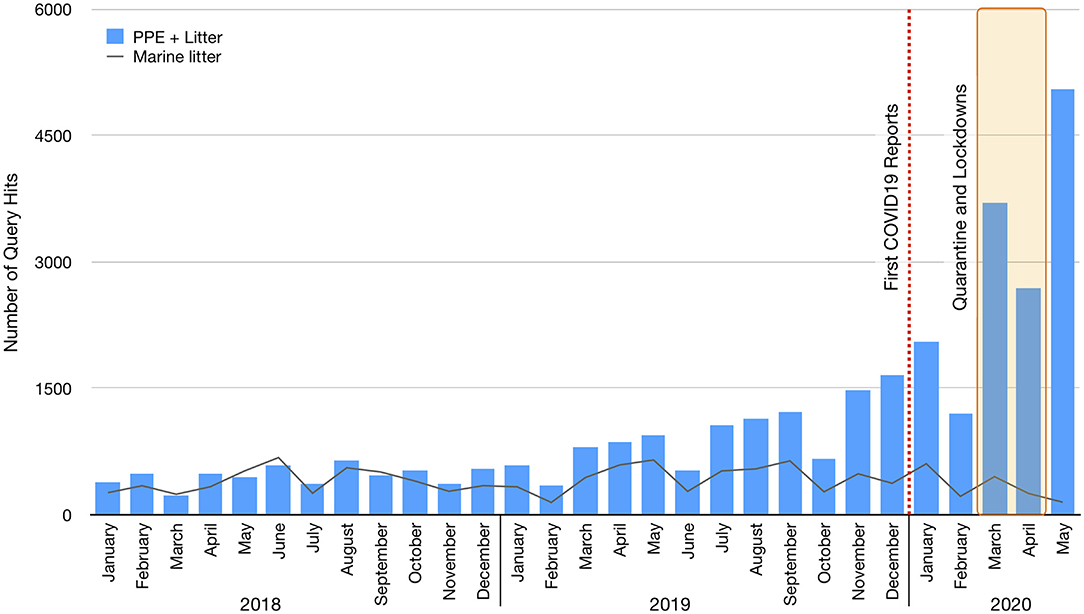
Figure 1. Google News query hits per month on PPE and litter (blue columns) and on marine litter (solid line) for the period from January 2018 to May 2020. Queries in the News section included the criteria “PPE” OR “Personal Protection Equipment” AND “Litter” AND “Marine Litter”, respectively. The dashed red line marks the first COVID-19 reports in China, while orange box marks the period when most countries enforced containment measures (i.e., mandatory confinement, travel bans, border closing, and lockdowns).
Discussion
The COVID-19 global pandemic is now considered the most significant global health crisis to date in this century and the greatest challenge for the human population since World War II (Chakraborty and Maity, 2020). In addition to being a global health calamity, the COVID-19 pandemic will have severe economic, environmental, political, social, and cultural implications (Chakraborty and Maity, 2020).
While human health management requires full dedication and new practices, it is equally necessary to recognize that this global pandemic is promoting a global increase in the use of PPE and other SUP items, which in turn will likely become sources of plastic pollution, magnifying marine litter issues and the consequences to marine biodiversity. Inappropriate waste management practices and poor disposal of SUP and other plastic items are two of the key aspects of the growing marine litter problem (Chen, 2015; Newman et al., 2015; Tiller et al., 2019; UNEP–United Nations Environment Programme, 2019), making the scale of the current news and media reports on discarded PPE worrisome relative to the concerted efforts to tackle plastic pollution in the marine environment.
In this context, and considering the current need for single-use and disposable items during this global pandemic to minimize unintended consequences, stakeholders and policy makers must advance new “green” solutions and recycling streams of PPE and other SUP items. With many countries taking action to reopen their economic activities, we urge all stakeholders—international organizations, regional conventions, and national governments—to: (i) maintain a firm and steady course, not relieving or postponing any target or expected timeline implementation for previous agreements, measures, or goals (e.g., action plans signed under UNEP Global Partnership on Marine Litter, EU Strategy for Plastics in the Circular Economy, EU Single Use Plastic Directive, and Paris Agreement) to avoid major setbacks in marine litter and circular economy achievements and (ii) promote adequate recycling streams and waste management (e.g., the EU revision process of the Packaging and Packaging Waste Directive) at a time when the global use of PPE and other SUP has increased exponentially.
Finally, it is equally important to consider that ongoing marine litter monitoring programs [e.g., OSPAR Commission, MSFD, UNEP, and National Oceanic and Atmospheric Administration (NOAA)] were likely affected by this COVID-19 outbreak, with many countries forced to stop their field campaigns. This interruption will likely lead to time gaps between having monitoring data available and the ongoing intensification of the problem of PPE and SUP litter. Moreover, to the best of our knowledge, disposable PPE such as gloves, masks, visors, and other equivalent items are not included in marine litter monitoring programs for beaches, rivers, and seafloor as specific categories (UNEP et al., 2009; Opfer et al., 2012; European Commission, 2013; Lippiatt et al., 2013), which may lead to an undiagnosed source of pollution if the current litter classification tables are maintained. We therefore support litter monitoring programs in different regions to include specific categories for PPE items in order to properly identify litter sources, which is essential in designing solutions to reduce plastic intake in the environment and in assessing the indirect impacts of the COVID-19 outbreak in marine ecosystems. Our recommendation to quickly adjust monitoring programs includes not only updating the lists of litter categories but also preparing monitoring teams (i.e., staff, researchers, volunteers, and citizen scientists) for the potential increase in PPE litter and how to adequately deal with these items that may be potentially contaminated with COVID-19.
The COVID-19 global pandemic has already made significant impacts on many aspects of people's day-to-day lives and their overall livelihood. It is the authors' opinion that action must be taken swiftly to address the rise in PPE use and other potential sources of marine pollution resulting from the current health recommendations.
Author Contributions
JC-C and JM: conceptualization, methodology, writing—original draft preparation, and writing—review and editing. PS: conceptualization, writing—original draft preparation, and writing—review and editing. SA: methodology. All authors contributed to the article and approved the submitted version.
Funding
JC-C was funded by national funds through FCT—Fundação para a Ciência e a Tecnologia, I.P., under the Scientific Employment Stimulus—Institutional Call—[CEECINST/00098/2018]. SA was supported by the CleanAtlantic INTERREG (Atlantic Area) project. JM was supported by a post-doctoral research fellowship by Agência Regional para o Desenvolvimento da Investigação, Tecnologia e Inovação (ARDITI—M1420-09-5369-FSE-000001). This study also had the support of Fundação para a Ciência e Tecnologia (FCT) through the strategic project [UIDB/04292/2020] granted to MARE UI&I. Finally, we thank James T. Carlton, Greg Ruiz, and two reviewers for helpful comments.
Conflict of Interest
The authors declare that the research was conducted in the absence of any commercial or financial relationships that could be construed as a potential conflict of interest.
References
Akindele, E. O., Ehlers, S. M., and Koop, J. H. E. (2019). First empirical study of freshwater microplastics in West Africa using gastropods from Nigeria as bioindicators. Limnologica 78:125708. doi: 10.1016/j.limno.2019.125708
Al-Jaibachi, R., Cuthbert, R. N., and Callaghan, A. (2018). Up and away: ontogenic transference as a pathway for aerial dispersal of microplastics. Biol. Lett. 14:20180479. doi: 10.1098/rsbl.2018.0479
Andrady, A. L. (2011). Microplastics in the marine environment. Mar. Pollut. Bull. 62, 1596–1605. doi: 10.1016/j.marpolbul.2011.05.030
Carlton, J. T., Chapman, J. W., Geller, J. B., Miller, J. A., Carlton, D. A., McCuller, M. I., et al. (2017). Tsunami-driven rafting: transoceanic species dispersal and implications for marine biogeography. Science 357, 1402–1406. doi: 10.1126/science.aao1498
CGTN (2020). Is the Pandemic Triggering a Spike in Plastic Pollution? Available online: https://newseu.cgtn.com/news/2020-05-22/Is-the-pandemic-triggering-a-spike-in-plastic-pollution–QBobeagfok/index.html (accessed July 8, 2020).
Chakraborty, I., and Maity, P. (2020). COVID-19 outbreak: migration, effects on society, global environment and prevention. Sci. Tot Environ. 728:138882. doi: 10.1016/j.scitotenv.2020.138882
Chen, C.-L. (2015). “Regulation and management of marine litter,” in Marine Anthropogenic Litter, eds M. Bergmann, L. Gutow, and M. Klages (Cham: Springer International Publishing), 395–428. doi: 10.1007/978-3-319-16510-3_15
Chen, N., Zhou, M., Dong, X., Qu, J., Gong, F., Han, Y., et al. (2020). Epidemiological and clinical characteristics of 99 cases of 2019 novel coronavirus pneumonia in Wuhan, China: a descriptive study. Lancet 395, 507–513. doi: 10.1016/S0140-6736(20)30211-7
CNN (2020). Coronavirus Is Causing a Flurry of Plastic Waste. Campaigners Fear It May Be Permanent. Available online at: https://edition.cnn.com/2020/05/04/world/coronavirus-plastic-waste-pollution-intl/index.html (accessed July 8, 2020).
Corcoran, P. L., Moore, C. J., and Jazvak, K. (2014). An anthropogenic marker horizon in the future rock record. GSA Today 24, 4–8. doi: 10.1130/GSAT-G198A.1
Dong, E., Du, H., and Gardner, L. (2020). An interactive web-based dashboard to track COVID-19 in real time. Lancet Infect. Dis. 20, 533–534. doi: 10.1016/S1473-3099(20)30120-1
Euronews (2020). Surge in Marine Plastic Waste as People Discard PPE Used to Ward Off Covid-19. Available online at: https://www.euronews.com/2020/06/25/surge-in-marine-plastic-waste-as-people-discard-ppe-used-to-ward-off-covid-19 (accessed July 8, 2020).
European Commission (2013). JRC Scientific and Policy Reports. Guidance on Monitoring of Marine Litter in European Seas. A guidance document within the Common Implementation Strategy for the Marine Strategy Framework Directive. MSFD Technical Subgroup on Marine Litter. European Union.
European Commission (2018). European Strategy for Plastics. Available online at: https://ec.europa.eu/environment/waste/plastic_waste.htm (accessed July10, 2020).
Gestoso, I., Cacabelos, E., Ramalhosa, P., and Canning-Clode, J. (2019). Plasticrusts: a new potential threat in the Anthropocene's rocky shores. Sci. Tot Environ. 687, 413–415. doi: 10.1016/j.scitotenv.2019.06.123
Haram, L. E., Carlton, J. T., Ruiz, G. M., and Maximenko, N. A. (2020). A plasticene lexicon. Mar. Polluti. Bull. 150:110714. doi: 10.1016/j.marpolbul.2019.110714
Kühn, S., Bravo Rebolledo, E. L., and van Franeker, J. A. (2015). “Deleterious effects of litter on marine life,” in Marine Anthropogenic Litter, eds M. Bergmann, L. Gutow, and M. Klages (Cham: Springer International Publishing), 75–116. doi: 10.1007/978-3-319-16510-3_4
Lamb, J. B., Willis, B. L., Fiorenza, E. A., Couch, C. S., Howard, R., Rader, D. N., et al. (2018). Plastic waste associated with disease on coral reefs. Science 359, 460–462. doi: 10.1126/science.aar3320
Lippiatt, S., Opfer, S., and Arthur, C. (2013). Marine Debris Monitoring and Assessment. NOAA Technical Memorandum NOS-OR&R-46.
Newman, S., Watkins, E., Farmer, A., Brink, P., ten, and Schweitzer, J.-P. (2015). “The Economics of Marine Litter,” in Marine Anthropogenic Litter, eds M. Bergmann, L. Gutow, and M. Klages (Cham: Springer International Publishing), 367–394. doi: 10.1007/978-3-319-16510-3_14
Opfer, S., Arthur, C., and Lippiatt, S. (2012). NOAA Marine Debris Shoreline Survey Field Guide. National Oceanic and Atmospheric Administration.
Reed, C. (2015). Dawn of the plasticene age. New Sci. 225, 28–32. doi: 10.1016/S0262-4079(15)60215-9
Rochman, C. M., Browne, M. A., Underwood, A. J., van Franeker, J. A., Thompson, R. C., and Amaral-Zettler, L. A. (2016). The ecological impacts of marine debris: unraveling the demonstrated evidence from what is perceived. Ecology 97, 302–312. doi: 10.1890/14-2070.1
Tiller, R., Arenas, F., Galdies, C., Leitão, F., Malej, A., Romera, B. M., et al. (2019). Who cares about ocean acidification in the Plasticene? Ocean Coast. Manage. 174, 170–180. doi: 10.1016/j.ocecoaman.2019.03.020
UNEP, Cheshire, A. C., Adler, E., Barbière, J., Cohen, Y., Evans, S., et al. (2009). UNEP/IOC Guidelines on Survey and Monitoring of Marine Litter. UNEP Regional Seas Reports and Studies, No. 186; IOC.
UNEP–United Nations Environment Programme (2019). Programme Performance Report 2018. Published by the UN Environment Programme.
Villarrubia-Gómez, P., Cornell, S. E., and Fabres, J. (2018). Marine plastic pollution as a planetary boundary threat – The drifting piece in the sustainability puzzle. Mar. Policy 96, 213–220. doi: 10.1016/j.marpol.2017.11.035
WHO (2020a). (2020) Coronavirus Disease 2019 (COVID-19). World Health Organization. Situation Report 51.
WHO (2020b). Advice on the Use of Masks in the Context of COVID-19. World Health Organization. Interim guidance.
Keywords: COVID-19, personal protection equipment (PPE), marine pollution, single-use plastic, plastic pollution, Coronavirus, marine litter
Citation: Canning-Clode J, Sepúlveda P, Almeida S and Monteiro J (2020) Will COVID-19 Containment and Treatment Measures Drive Shifts in Marine Litter Pollution? Front. Mar. Sci. 7:691. doi: 10.3389/fmars.2020.00691
Received: 29 May 2020; Accepted: 30 July 2020;
Published: 25 August 2020.
Edited by:
Di Jin, Woods Hole Oceanographic Institution, United StatesReviewed by:
Susan Farady, University of New England, United StatesKate Mulvaney, United States Environmental Protection Agency (EPA), United States
Copyright © 2020 Canning-Clode, Sepúlveda, Almeida and Monteiro. This is an open-access article distributed under the terms of the Creative Commons Attribution License (CC BY). The use, distribution or reproduction in other forums is permitted, provided the original author(s) and the copyright owner(s) are credited and that the original publication in this journal is cited, in accordance with accepted academic practice. No use, distribution or reproduction is permitted which does not comply with these terms.
*Correspondence: João Canning-Clode, amNhbm5pbmctY2xvZGVAbWFyZS1jZW50cmUucHQ=