Abstract
Developing solutions to the complex and uncertain problems facing marine and coastal social-ecological ecosystems requires new forms of knowledge production and integration. While progress has been made both in terms of successfully producing integrated marine research and connecting that knowledge to decision-makers, a number of significant challenges remain that prevent the routine development and implementation of successful integrated research practice. Based on our own experiences as social researchers working within interdisciplinary research teams, we contend that one of the main barriers to successful integrative marine research relates to understanding, and where possible reconciling, the different epistemologies that unpin how knowledge is created or discovered in different disciplines. We therefore aim to provide an accessible introduction to the concept of epistemology, with a focus on its importance and influence to integrated marine research practice. Specifically, we present and discuss five questions of research design that relate to epistemology in integrative research practices: (1) What is the object of study we seek to create knowledge about; (2) how do we create knowledge; (3) who accepts knowledge as ‘true’ and how?; (4) how do we determine the epistemology underpinning marine science; and (5) what are the implications of epistemology for applied integrative marine science? We demonstrate the application of each question through a hypothetical case study of marine restoration, focusing on coral transplanting. Finally, we offer readers a simple heuristic to guide them, irrespective of career stage or discipline, to understand and account for epistemology when participating in integrative marine research practices.
Introduction
Coastal and marine ecosystems provide critical goods and services that underpin human well-being and prosperity (Barbier et al., 2011; Cracknell, 2019) and are considered part of the basic global life support system for more than 40% of the world’s population (Seto, 2011; Neumann et al., 2015). Despite their importance to humanity, increased pressures (e.g. from climatic changes and coastal development) threaten the long-term persistence of these ecosystems and the goods and services they provide (Halpern et al., 2008). The scale and nature of contemporary challenges facing coastal and marine ecosystems are complex, unpredictable and uncertain (Nash et al., 2017, 2020). Thus, identifying, developing and implementing solutions to navigate these challenges to ensure societal well-being and prosperity represent an equally significant challenge.
In response to these challenges, the community of scientists who study marine social-ecological systems are often seeking to support decision-making processes via the knowledge created within their research and practice (Cvitanovic et al., 2015). Traditionally, this knowledge has been confined to single academic disciplines, but more integrated approaches to knowledge production (e.g. interdisciplinary research) are recognised as necessary to deal with the complexity and unpredictability of social-ecological systems (Dick et al., 2016; Norström et al., 2020). In particular, recognition is increasing in relation to the value and importance of integrating social dimensions of marine conservation into research activities (Bennett, 2016; Bennett et al., 2019), and the ways in which marine social science can support this endeavour (McKinley et al., 2020).
Increased efforts are therefore being made throughout the marine research community to collaborate across disciplines to integrate knowledge systems. Progress is being made both in terms of successfully producing integrated marine research (e.g. Cinner et al., 2018; Barnes et al., 2019; Bodin et al., 2019) and also in connecting that knowledge to decision-makers to support evidence-informed decision-making processes (Cvitanovic and Hobday, 2018). Yet, a number of significant barriers and challenges remain that prevent the routine implementation of successful integrated research (e.g. Alexander et al., 2019). Building capacity to overcome these challenges is critical in enabling improved interdisciplinary marine research processes (e.g. Blythe and Cvitanovic, 2020).
‘Epistemology’ as a Barrier to Integrative Research
Based on our own experiences as social researchers working within interdisciplinary research teams, we contend that one of the main barriers to successful integrative research processes relates to reconciling the different epistemologies that unpin how knowledge is created (see also Elsawah et al., 2020). Epistemology is the branch of philosophy that asks: how do we know what we know? It is concerned with how we can ensure that knowledge is both adequate and legitimate (Maynard, 1994), by considering: (a) what constitutes a knowledge claim, including the assumptions that are made; (b) how knowledge is produced or acquired; and (c) how the extent of its applicability can be determined.
Epistemology is important in developing solutions to contemporary challenges facing complex socio-ecological systems where a range of disciplines and practices converge, with their own methods and assumptions regarding the adequacy and legitimacy of knowledge (e.g. Teel et al., 2018; Moon et al., 2019b). Yet, the concept of epistemology tends to be absent from the natural (including marine) science literature, arguably because the natural sciences tend to be underpinned by the dominant epistemology of (post) positivism (see also objectivism below) (Evely et al., 2008). With increased focus on the implementation of integrated research practices, it is necessary to improve awareness and understanding of epistemology more broadly throughout the marine conservation community, particularly where different epistemologies arise. In doing so, we can explore how these different epistemologies influence research and practice and identify more effective strategies for converging disciplines founded upon divergent assumptions.
Aims and Paper Structure
To assist in overcoming these challenges, and in accordance with the aims of this Special Issue that focuses on promoting integrated research by marine early career researchers, we aim to provide an accessible introduction to the concept of epistemology, with a focus on its importance and influence to integrated marine research practice. We do so through by presenting five questions that researchers should consider. First (Question 1), we consider the role and importance of epistemology for achieving integrative marine research and the types of knowledge we create within marine sciences. We then (Question 2) consider the process of creating that knowledge, and the circumstances under which it can be ‘justified’ as a true belief. We then explore (Question 3) who it is that can accept knowledge as ‘true’, before (Question 4) offering a simple heuristic for identifying the epistemology of the marine research in which we engage and then finally what epistemology means for the application of integrated marine research and practice (Question 5).
To demonstrate how each of these considerations can apply in practice we use a hypothetical case study of marine restoration, and in particular, coral transplanting. Marine restoration approaches that aim to build reef resilience to the increasing threat of climate change (e.g. rising sea surface temperatures, ocean acidification, increased storm activity) are growing in diversity and popularity (West and Salm, 2003; van Oppen et al., 2015; McLeod et al., 2019). One of the more widely applied approaches is coral transplantation (Epstein et al., 2003; Rinkevich, 2005), which has been shown to be effective (when appropriately managed) at restoring coral cover, diversity and reef structural complexity at small scales (e.g. <100 m; Boström-Einarsson et al., 2020). This work involves either the direct transplantation of coral fragments onto the target reef or via a nursery where coral fragments grow to a suitable size before transplantation (i.e. coral gardening; Tunnicliffe, 1981; Bruno, 1998; Meesters et al., 2015). Despite this approach showing some success, it has been criticised because it has rarely been implemented at a spatial scale large enough to have a meaningful influence (Precht et al., 2005; Edwards and Gomez. 2007; Omori, 2011; Bayraktarov et al., 2016), focuses on short-term (e.g. coral survivorship) rather than long-term outcomes for coral reef communities (Hein et al., 2017) and does not mitigate the cause of declining reef condition (i.e. rising carbon dioxide emissions; Edwards and Gomez, 2007; Braverman, 2016). From an integrative research perspective, such work could also be criticised for its lack of attention to the socio-political context in which any transplantation work takes place. For example, a transplant program might only focus on what success looks like, rather than how success is achieved. Successful transplanting might, for instance, require funding (e.g. investment from policy-makers), monitoring (e.g. commitment from citizen scientists) and community support (e.g. social license to operate).
Question 1: What Is the Object of Study We Seek to Create Knowledge About?
The first step in considering the role and importance of epistemology for achieving integrative marine research is to consider what it is that we seek to study in the marine sciences. The natural sciences focus on the biophysical dimensions of systems, where the object of study is usually physical (i.e. tangible, material). In a marine setting, objects could include substrate types (e.g. assessing changes in coral cover, Pisapia et al., 2019), marine organisms (e.g. to understand patterns of fish behaviour, Pratchett et al., 2014) or attributes such as wave energy (e.g. Fulton and Bellwood, 2005). The focus on physical objects stems from the aims of natural science to understand and describe natural phenomena, which is typically achieved through observation and experimentation focused on establishing a high level of validity and reliability in the knowledge (Table 1 and Figure 1).
TABLE 1
| Quantitative data measures | Definition (Lincoln and Guba, 1985) | Qualitative data measures | Definition (Guba, 1981, pp. 79–80) |
| Reliability | Does the method, applied to the same units, consistently yield similar measurements over and over? (Reliability is a pre-cursor for validity – an unreliable measure cannot be valid) | Dependability | How can one determine whether the findings of an inquiry would be consistently repeated if the inquiry were replicated with the same (or similar) subjects (respondents) in the same (or similar) context? |
| Objectivity | Would multiple observers agree on the phenomenon of cause and effect? | Confirmability (where relevant) | How can one establish the degree to which the findings of an inquiry are a function solely of the subjects (respondents) and conditions of the inquiry and not of the biases, motivations, interests, perspectives and so on of the inquirer? |
| Internal validity | Can the variations in the outcome (dependent) variable be attired to controlled variation in an independent variable? Can we infer truth or falsity of cause and effect between two variables? | Credibility | How can one establish confidence in the ‘truth’ of the findings of a particular inquiry for the subjects (respondents) with which and the context in which the inquiry was carried out? |
| External validity/generalisability | To what extent can we infer that the causal relationship can be generalised across other persons, settings and times? | Transferability | How can one determine the degree to which the findings of a particular inquiry may have applicability in other contexts or with other subjects (respondents)? |
Measures and definitions of research quality.
FIGURE 1
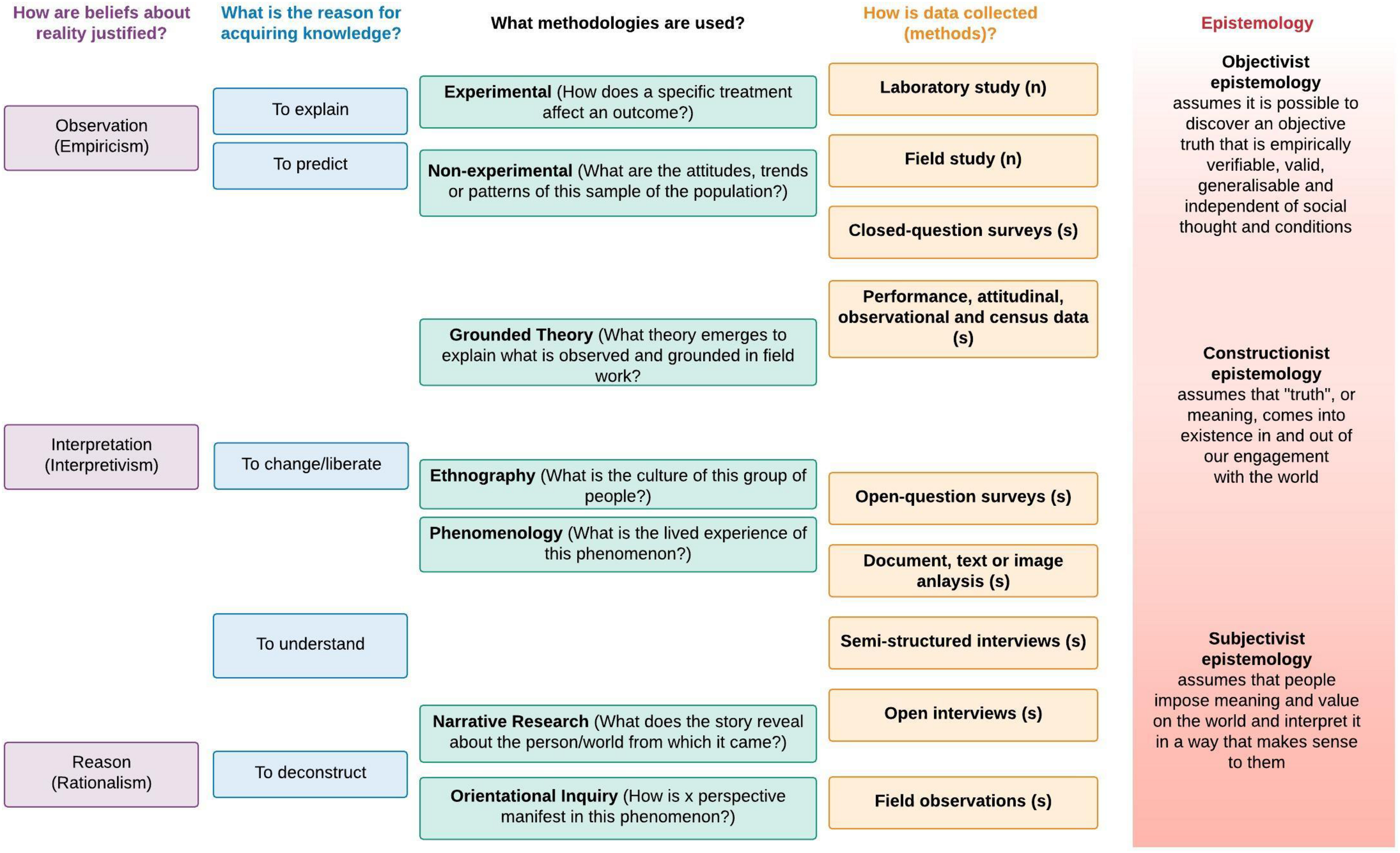
A heuristic device (developed as one example of the diversity of ways that epistemology can be applied) to assist with understanding the epistemology of integrative marine science. By locating the aims of the research (reason for acquiring knowledge), the methodologies or methods used, or the ways in which beliefs are justified, it becomes possible to understand the assumptions underpinning the research (i.e. epistemology). ‘n’ denotes common methods in natural science; ‘s’ denotes common methods in the social sciences.
The social sciences focus on human dimensions of the system, which can include relationships with biophysical elements. Human dimensions can be physical and observable (e.g. a person’s behaviour), and non-physical and non-observable (e.g. a person’s beliefs). When looking at physical objects, a researcher from the social sciences might choose to conduct a large survey of a representative sample to make generalised observations about the population (e.g. levels of ocean literacy among school aged children and their implications for marine stewardship, Guest et al., 2015). When looking at non-physical objects, a researcher might be interested in understanding the worldviews and/or motivations of a small sample of people (e.g. a recreational fishing community, McNeill et al., 2019). A researcher could examine both physical and non-physical objects, for example, they might observe particular behaviours (i.e. physical), and then ask people to explain what motivated them to undertake those behaviours (i.e. non-physical) (e.g. observing the behaviours of scuba divers on a coral reef, and then seeking to understand what motivated certain behaviours such as making contact with the substrate).
An integrated object of study might be coral reef resilience, which could be considered an outcome (i.e. goal achievement, compared to an output which is an implementation behaviour, Moon et al., 2017). The research might look at social and ecological threats to a coral reef community, where coral transplants become one of a number of possible solutions. Aspects of the system that are examined might include physical, measurable parameters (e.g. coral transplant survivorship, coral cover) (Omori, 2011; Boström-Einarsson et al., 2020), as well as social and cultural factors that explain perceptions of different management interventions on reef user experience, stewardship and social resilience (Hein et al., 2017).
Question 2: How Do We Create Knowledge About the Objects of Study in the Marine Sciences?
The second step is to think about the process of creating that knowledge. It can be helpful to think, quite broadly, about knowledge as a ‘justified, true belief’ (see Parikh and Renero, 2017). That is, the way in which an individual/group ‘knows’ something is true. To understand this concept let us consider the beliefs of a coral ecologist working with coral transplants. Firstly, they might start with a belief that transplanting corals on to a reef is an effective approach for building reef resilience and adapting to the effects of climate change. Secondly, they might seek to justify this belief as true. They might start to take monthly photographs of transplanted corals and collect environmental data (e.g. daily water temperature) for a prolonged period of time (i.e. 3 to 5 years). Thirdly, they might seek to determine whether observed trends are unique to the coral reef they sample, or whether these trends have been observed at other coral reef transplantation sites. Here, they are seeking to create knowledge beyond their study location to determine the extent to which their belief applies. Epistemology then relates to the nature of the knowledge that (a group of) people create or discover. In the above example, epistemology relates to how the belief was generated (i.e. that coral transplanting is effective), the extent to which it corresponded to (a) reality (i.e. local observation), and what evidence, testimony or observation was used to justify the belief as true.
It is entirely possible, however, that two coral reef ecologists with access to the same data, could create knowledge in different ways. This possibility arises from the nature of the beliefs they hold, which they seek to justify as true (i.e. knowledge) (see Williamson, 2002). For example, one ecologist might have a belief, on the basis of decades of experience, observation and experimentation, that irrespective of changing climatic conditions, existing coral structure and species composition could be managed to build reef resilience to changing environmental conditions. Another ecologist might have a belief that such restoration efforts (including coral transplantation) would be an ineffective response to the coral reef crisis, also based on decades of scientific research, because rising ocean temperatures will continue to present increasing threats until at least 2050. Here, different actors are constructing their knowledge from both their objective observations of ‘reality’ and their subjective reasoning, with different outcomes for what we (seek to) learn. Armstrong (1973) points out that beliefs might be best viewed as maps by which we steer; in other words, beliefs are action-guiding, influencing what we seek to create knowledge about. What this brief example points to is that people can construct meaning of the same object or phenomenon in different ways on the basis of their cultural, historical and social perspectives, and interactions with human communities (e.g. their social network) (Crotty, 1998; Creswell and Creswell, 2017). It therefore becomes necessary to consider how different beliefs are justified (e.g. via reason, emotion, perception and language) and accepted as knowledge within an ‘epistemic community’ (Question 3).
Question 3: Who Accepts Knowledge as ‘True’ and How?
The third step in achieving integrative marine research is seeking to understand who accepts knowledge as ‘true’ and how they do so. Building on the above section, if knowledge takes on different forms (e.g. objective, constructed and subjective, Figure 1), then how do we decide what is knowledge? Generally speaking, for knowledge to be ‘accepted’ (i.e. justified, true beliefs), an epistemic community is required. An epistemic community is a group of people who are considered experts in a knowledge domain, for example, within a discipline (e.g. physics, ecology, anthropology, political science, sociology and law), industry (e.g. aquaculture, beef, soy, inshore fisheries and diving tourism) or cultural group (e.g. religious and indigenous). The important role of epistemology here is asking us to be involved in an ongoing examination of ‘what I know’, ‘how I know it’ and ‘how it corresponds (or not) with the knowledge of others’? (Patton, 2002). This last question is particularly important in integrated research, where different knowledge sets often collide.
For knowledge to be justified as true, the epistemic community evaluates the creation, generation or discovery of new knowledge, makes corrections where necessary and ensures that the knowledge meets certain criteria (Popper, 1963). Different epistemic communities use different criteria to evaluate knowledge. Much of the knowledge created in the natural sciences is evaluated according to criteria such as reliability, internal and external validity, objectivity and generalisability (see Moon et al., 2019b) (Table 1). These criteria are also important to social science research that generates quantitative data. Yet, because of the different objects of study, some social science research (particularly that which generates qualitative data) use different criteria to evaluate knowledge, which include dependability, credibility, confirmability and transferability, and relate, respectively, to the criteria used in the generation of quantitative data (Table 1). Sampling strategies, for example, are often different in the natural (e.g. representative) versus social (e.g. purposive) sciences because of the different aims (and objects of study) of research within these fields. Yet even with unique evaluation frameworks across disciplines to account for the differences in how knowledge is created and assessed, it will not always be the case that individuals will assess knowledge in the same way within those frameworks. Peer review, for instance, can often result in different reviewers providing very different critiques of the same body of work, where one might accept the findings of the research where another rejects them, even though they apply the same evaluative frameworks.
By recognising that (groups of) people create or discover and assess knowledge in a variety of ways, we can begin to open our minds to multiple ways of knowing, all of which can be validated in different ways within and across defined epistemic communities. Of course, it is not necessary to agree with how different epistemic communities validate and accept knowledge (or even develop their beliefs), just as they do not have to agree with how your epistemic community does so. Yet recognising other ways of knowing can assist with developing productive collaborations. This recognition can reduce confusion (e.g. ‘But I have some scientific evidence – won’t that change your mind?’), a lack of communication (e.g. ‘You are ignoring the legitimacy of my knowledge [and that of my epistemic community] and so I cannot engage with you anymore’) and conflict (e.g. ‘We are completely opposed on this issue and so my only option is to exit from the process’).
Question 4: How Do We Determine the Epistemology Underpinning Marine Science?
Epistemology is the bridge between thinking and reality – it is a theory of knowledge that allows us to determine whether we can create knowledge that corresponds with something that is ‘real’ (constructivism, Figure 1). The assumptions that are associated with epistemology, and thus underpin research, are critical to understand. We have provided a simple heuristic device to assist in understanding the epistemology of marine research and what it means in terms of research practice and outcomes (Figure 1, see also Moon and Blackman, 2014). The intention here is not to be comprehensive, but to provide a simple map of how to get a sense of where researchers’ assumptions might lie in relation to how they have sought to create knowledge. The device offers three broad epistemologies: objectivism, constructionism and subjectivism (Crotty, 1998). It then points to how beliefs tend to be justified (i.e. observation, interpretation and reason), why knowledge is acquired, and the common methodologies and methods employed. By locating the nature of the research within the device, it becomes possible to start to consider the assumptions that have been made during knowledge creation or discovery, which can be further examined in the literature (e.g. Bohensky and Maru, 2011; Moon and Blackman, 2014; Teel et al., 2018; Martin, 2019; Mathevet and Marty, 2020).
Using this heuristic device, we can consider the epistemologies that underpin, for example, coral restoration research. Most commonly, this field of research fits with objectivist (or post-positivist), and to a lesser extent constructionist, epistemology (Figure 1). A review by Boström-Einarsson et al. (2020) found that of the 362 coral restoration case studies, most were focused on improving the restoration approach using empirical observational data (e.g. coral transplant growth and survival rates). For example, objectives of the Gomez et al. (2011) included an assessment of the survivorship and growth of Montipora digitata with respect to prevailing environmental conditions, density of transplantation and surface orientation (objectivist epistemology, which assumes it is possible to discover an objective truth that is empirically verifiable, valid, generalisable and independent of social thought and conditions, Figure 1).
In contrast, there are studies that seek to understand why some coral transplantation projects fail and others succeed using constructionist epistemology (that assumes ‘truth’ or meaning comes into existence in and out of our engagements with the world, Figure 1), by considering the social, cultural and economic landscape. For example, Hein et al. (2019) used targeted key-informant interviews where respondents were asked closed questions (e.g. how long have you been working in the location, what’s your diver experience), scalar questions (e.g. rate attributes of local reefs in terms of coral and fish abundance) and open-ended questions (e.g. opinions on specific aspects of the restoration efforts) to assess the potential socio-ecological benefits (and limitations) of coral restoration (Figure 1). The aim of the work was to characterise stakeholder’s perceptions of the benefits and limitations of reef restoration efforts. Participants recommended improved consideration of socio-cultural dimensions in goal setting (see above).
Integrated marine research can include multiple epistemologies. Moon and Browne (2021), for example, developed a sequential method, eliciting mental models from coral reef ecologists and managers in a way that provided an understanding and exploration of the diversity of knowledge of complex carbonate coral reef systems. They then sought to find similarities between different knowledges to develop a shared model of the system to predict how these systems will respond to climatic change (objectivism). One of the benefits of this method was in supporting participants to see how they constructed their own knowledge of the system and how those constructions were similar or different to others, providing opportunities for exploration and discussion of knowledge assumptions.
Question 5: What Are the Implications of Epistemology for Applied Integrative Marine Science?
A number of benefits arise from understanding the role of epistemology in the application of integrated marine science (see Table 2). We briefly discuss two important ones here. Firstly, an understanding of epistemology can increase our awareness of the partiality of our knowledge, which can only ever be provisional, qualified and even uncertain due to the nature of research questions and designs that only focus on a part of the system (Figure 1). In recognising that we only know a part of the story, we can start to foster a greater sense of humility to the claims of authority in our research, and engage in more genuine approaches to integration among disciplines (Moon et al., 2019a). Yanow (2009) suggests that we can embrace humility through a reflective practice that moves from the language of certainty to one of inquiry, involving an interrogation of our self, our epistemological assumptions, and our ways of thinking and doing. For example, the majority of coral reef ecologists working on coral transplants measure success using coral growth and survivorship over 1 to 2 years (Boström-Einarsson et al., 2020). Although these metrics provide some insight into the success of the project at a small spatial and temporal scale, there has been limited focus in assessing the long-term implications (>5 years) at larger (ecosystem) scales (Boström-Einarsson et al., 2020) and within different social-ecological contexts. Improving knowledge on, for example, the reproductive output of transplanted fragments or measuring changes in structural complexity (Okubo and Onuma, 2015), would provide a more holistic assessment of the impact of coral transplantation for reef resilience and related ecosystem services (e.g. biodiversity and coastal protection). To improve the acceptability of the approach, inclusion of social, political, economic and cultural factors, as discussed above, will also be critical in determining what factors contribute to a higher chance of program success.
TABLE 2
| Questions | Exploratory questions |
| 1. What is the object of study? | • What is it that the researcher seeks to create knowledge about? |
| • Why and how do they determine the object of study? | |
| • What is the object of study – is it tangible or intangible? | |
| 2. How do we create knowledge? | • What beliefs underpin the research? |
| • How have the researchers sought to justify their beliefs as true? | |
| 3. Who accepts knowledge as ‘true’ and how? | • What methods of data collection have been used? How were they justified? |
| • What sampling strategies were adopted? Why and what were the considerations made for ensuring reliability? | |
| • How did the researchers identify and reflect bias in designing and implementing the research? | |
| • Who determines whether the methods, results and truth claims are valid? | |
| • What criteria were used to assess the quality of the truth claims? | |
| 4. How do we determine the epistemology underpinning marine science? | • What assumptions about reality underpin the research? |
| • What methodologies were used? | |
| • What methods were used? | |
| • What was the nature of data collected (e.g. qualitative and/or quantitative) | |
| • How was the data analysed and interpreted? | |
| 5. What are the implications of epistemology for applied integrative marine science? | • How was the transferability of the data determined? |
| • In what ways could the data be applied (e.g. can it be generalised to the population or is it context or site-specific?) | |
| • How were different stakeholders engaged in the research process? | |
| • How were marginalised groups considered and engaged? |
Questions to ask in understanding the epistemology of marine science.
Secondly, an understanding of epistemology provides opportunities to consider power relations in research and practice. Academic knowledge is only one type of knowledge, yet it is often privileged above others, such as Indigenous, experiential and cultural knowledge. For example, Shackeroff and Campbell(2007, p. 346) argue that the legacy of colonialism has positioned Westerners as superior and non-Westerners as an inferior but necessary ‘other’, where ‘traditional ecological knowledge’ is considered to ‘fill in some knowledge gaps, but cannot challenge Western knowledge’. Within marine conservation and restoration projects (including coral transplantation), the early involvement of stakeholders is considered crucial to their success (Bayraktarov et al., 2019). Despite the known value of these sources of knowledge, a review of four well-established (8 to 12 years) coral restoration projects in different regions of the world identified the lack of community awareness, communication with the public and partnerships (e.g. local community groups) as limitations to project success (Hein et al., 2019). Acknowledging that different epistemic communities generate or hold credible and legitimate knowledge can aid in overcoming such power imbalances and ensure respectful and appropriate inclusion of different knowledge systems (Cornell et al., 2013). Certainly, it is also the case that we need to work more closely with indigenous people regarding their ontologies and worldviews to challenge Western academic knowledge (see Henry and Pene, 2001; Todd, 2016; Gewin, 2021).
Conclusion
Navigating the challenges facing marine social-ecological systems for ecosystem integrity and human well-being and prosperity necessitates the integration of the natural and social sciences (McKinley et al., 2020). While progress has been made in this regard, significant barriers to integrative marine research practice remain (e.g. Alexander et al., 2019). We argue that integrative research is not just about integrating different types of science but also about integrating different epistemologies. We have supported this proposition by drawing on our own personal experiences, as well as a hypothetical case study relating to marine restoration and coral reef transplanting, demonstrating the value of considering a range of practical questions in understanding the concept of epistemology, its implications for integrative marine research and practice, and the critical aspects that marine researchers should consider when embarking on integrated marine research endeavours. We also present a simple heuristic (Figure 1) to support this process, with exploratory questions for researchers to ask when working in integrative teams (Table 2). While further research is needed, particularly into the approaches or methods that could be used to enable different epistemologies (and indeed ontologies) to either integrate or work alongside each other, we hope that by sharing these perspectives and examples, drawing on the broader evidence base and developing a simple heuristic, that we have provided an accessible introduction to the concept of epistemology that can support marine researchers of all career stages embark on successful integrative research practices.
Statements
Data availability statement
The original contributions presented in the study are included in the article/supplementary material, further inquiries can be directed to the corresponding author/s.
Author contributions
KM and DB conceived of the idea of this manuscript. KM and CC wrote the manuscript with editorial contributions from all authors. NB provided case study content.
Conflict of interest
The authors declare that the research was conducted in the absence of any commercial or financial relationships that could be construed as a potential conflict of interest.
References
1
Alexander K. A. Hobday A. J. Cvitanovic C. Ogier E. Nash K. L. Cottrell R. S. et al (2019). Progress in integrating natural and social science in marine ecosystem-based management research.Mar. Freshw. Res.7071–83. 10.1071/mf17248
2
Armstrong D. M. (1973). Belief, Truth and Knowledge.Cambridge: Cambridge University Press.
3
Barbier E. B. Hacker S. D. Kennedy C. Koch E. W. Stier A. C. Silliman B. R. (2011). The value of estuarine and coastal ecosystem services.Ecol. Monogr.81169–193.
4
Barnes M. L. Bodin Ö McClanahan T. R. Kittinger J. N. Hoey A. S. Gaoue O. G. et al (2019). Social-ecological alignment and ecological conditions in coral reefs.Nat. Commun.10:2039.
5
Bayraktarov E. Saunders M. I. Abdullah S. Mills M. Beher J. Possingham H. P. et al (2016). The cost and feasibility of marine coastal restoration.Ecol. Appl.261055–1074. 10.1890/15-1077
6
Bayraktarov E. Stewart-Sinclair P. J. Brisbane S. Boström-Einarsson L. Saunders M. I. Lovelock C. E. et al (2019). Motivations, success, and cost of coral reef restoration.Restor. Ecol.27981–991. 10.1111/rec.12977
7
Bennett N. J. (2016). Using perceptions as evidence to improve conservation and environmental management.Conserv. Biol.30582–592. 10.1111/cobi.12681
8
Bennett N. J. Cisneros-Montemayor A. M. Blythe J. Silver J. J. Singh G. Andrews N. et al (2019). Towards a sustainable and equitable blue economy.Nat. Sustain.2991–993.
9
Blythe J. Cvitanovic C. (2020). Five organizational features that enable successful interdisciplinary marine research.Front. Mar. Sci.7:539111. 10.3389/fmars.2020.539111
10
Bodin Ö Alexander S. M. Baggio J. Barnes M. L. Berardo R. Cumming G. S. et al (2019). Improving network approaches to the study of complex social–ecological interdependencies.Nat. Sustain.2551–559. 10.1038/s41893-019-0308-0
11
Bohensky E. L. Maru Y. (2011). Indigenous knowledge, science, and resilience what have we learned from a decade of international literature on “integration”?Ecol. Soc.16:6.
12
Boström-Einarsson L. Babcock R. C. Bayraktarov E. Ceccarelli D. Cook N. Ferse S. C. A. et al (2020). Coral restoration – a systematic review of current methods, successes, failures and future directions.PLoS One15:e0226631. 10.1371/journal.pone.0226631
13
Braverman I. (2016). Biopolarity: coral scientists between hope and despair.Anthropol. Now826–40. 10.1080/19428200.2016.1242908
14
Bruno J. F. (1998). Fragmentation in Madracis mirabilis (Duchassaing and Michelotti): how common is size-specific fragment survivorship in corals?J. Exp. Mar. Biol. Ecol.230169–181. 10.1016/s0022-0981(98)00080-x
15
Cinner J. E. Adger W. N. Allison E. H. Barnes M. L. Brown K. Cohen P. J. et al (2018). Building adaptive capacity to climate change in tropical coastal communities.Nat. Clim. Chang.8117–123. 10.1038/s41558-017-0065-x
16
Cornell S. Berkhout F. Tuinstra W. Tàbara J. D. Jäger J. Chabay I. et al (2013). Opening up knowledge systems for better responses to global environmental change.Environ. Sci. Policy2860–70. 10.1016/j.envsci.2012.11.008
17
Cracknell D. (2019). By the Sea: The Therapeutic Benefits of Being in, on and by the Water.London: Octopus Publishing Group Ltd.
18
Creswell J. W. Creswell J. D. (2017). Research Design: Qualitative, Quantitative, and Mixed Methods Approaches.Thousand Oaks, CA: Sage.
19
Crotty M. (1998). The Foundations of Social Research: Meaning and Perspectives in the Research Process.London: SAGE.
20
Cvitanovic C. Hobday A. J. (2018). Building optimism at the environmental science-policy-practice interface through the study of bright spots.Nat. Commun.9:3466.
21
Cvitanovic C. Hobday A. J. van Kerkhoff L. Marshall N. A. (2015). Overcoming barriers to knowledge exchange for adaptive resource management; the perspectives of Australian marine scientists.Mar. Policy5238–44. 10.1016/j.marpol.2014.10.026
22
Dick M. Rous A. M. Nguyen V. M. Cooke S. J. (2016). Necessary but challenging: multiple disciplinary approaches to solving conservation problems.FACETS167–82. 10.1139/facets-2015-0003
23
Edwards A. J. Gomez E. D. (2007). Reef Restoration Concepts and Guidelines: Making Sensible Management Choices in the Face of Uncertainty. Coral Reef Targeted Research & Capacity Building for Management Program.St. Lucia, QL: The Coral Reef Targeted Research
24
Elsawah S. Filatova T. Jakeman A. J. Kettner A. J. Zellner M. L. Athanasiadis L. N. et al (2020). Eight grand challenges in socio-environmental systems modeling.Socio Environ. Syst. Model.2:16226. 10.18174/sesmo.2020a16226
25
Epstein N. Bak R. P. M. Rinkevich B. (2003). Applying forest restoration principles to coral reef rehabilitation.Aquat. Conserv.13387–395. 10.1002/aqc.558
26
Evely A. C. Fazey I. Pinard M. Lambin X. (2008). The influence of philosophical perspectives in integrative Research: a conservation case study in the Cairngorms national park.Ecol. and Soc.13:52.
27
Fulton C. J. Bellwood D. R. (2005). Wave-induced water motion and the functional implications for coral reef fish assemblages.Limnol. Oceanogr.50255–264. 10.4319/lo.2005.50.1.0255
28
Gewin V. (2021). How to include indigenous researchers and their knowledge.Nature589315–317. 10.1038/d41586-021-00022-1
29
Gomez E. D. Yap H. T. Cabaitan P. C. Dizon R. M. (2011). Successful transplantation of a fragmenting coral, Montipora digitata, for reef rehabilitation.Coast. Manag.39556–574. 10.1080/08920753.2011.600240
30
Guba E. G. (1981). Criteria for assessing the trustworthiness of naturalistic inquiries.ECTJ2975–91.
31
Guest H. Lotze H. K. Wallace D. (2015). Youth and the sea: ocean literacy in Nova Scotia, Canada.Mar. Policy5898–107. 10.1016/j.marpol.2015.04.007
32
Halpern B. S. Walbridge S. Selkoe K. A. Kappel C. V. Micheli F. D’Agrosa C. et al (2008). A global map of human impact on marine ecosystems.Science319948–952.
33
Hein M. Y. Birtles A. Willis B. L. Gardiner N. Beeden R. Marshall N. A. (2019). Coral restoration: socio-ecological perspectives of benefits and limitations.Biol. Conserv.22914–25. 10.1016/j.biocon.2018.11.014
34
Hein M. Y. Willis B. L. Beeden R. Birtles A. (2017). The need for broader ecological and socioeconomic tools to evaluate the effectiveness of coral restoration programs.Restor. Ecol.25873–883. 10.1111/rec.12580
35
Henry E. Pene H. (2001). Kaupapa Maori: locating indigenous ontology, epistemology and methodology in the academy.Organization8234–242. 10.1177/1350508401082009
36
Lincoln Y. S. Guba E. G. (1985). Naturalistic Inquiry.Newbury Park, CA: SAGE.
37
Martin V. Y. (2019). Four common problems in environmental social research undertaken by natural scientists.BioScience7013–16. 10.1093/biosci/biz128
38
Mathevet R. Marty P. (2020). Can environmental and conservation research do without social scientists? A comment on Victoria Y. Martin (2019).BioScience70:277.
39
Maynard M. (1994). “Methods, practices and epistemology: the debate about feminism and research,” in Researching Women’s Lives From a Feminist Perspective, edsMaynardM.PurvisJ., (London: Taylor & Francis), 10–26.
40
McKinley E. Acott T. Yates K. L. (2020). Marine social sciences: looking towards a sustainable future.Environ. Sci. Policy10885–92. 10.1016/j.envsci.2020.03.015
41
McLeod E. Anthony K. R. N. Mumby P. J. Maynard J. Beeden R. Graham N. A. J. et al (2019). The future of resilience-based management in coral reef ecosystems.J. Environ. Manag.233291–301.
42
McNeill A. Clifton J. Harvey E. S. (2019). Specialised recreational fishers reject sanctuary zones and favour fisheries management.Mar. Policy107:103592. 10.1016/j.marpol.2019.103592
43
Meesters H. Gerardus W. Smith S. R. Becking L. E. (2015). A Review of Coral Reef Restoration Techniques. Report No. IMARES UR C028/14). Wageningen: IMARES.
44
Moon K. Adams V. M. Cooke B. (2019a). Shared personal reflections on the need to broaden the scope of conservation social science.People Nat.1426–434. 10.1002/pan3.10043
45
Moon K. Blackman D. (2014). A guide to understanding social science research for natural scientists.Conserv. Biol.281167–1177. 10.1111/cobi.12326
46
Moon K. Blackman D. A. Adams V. M. Colvin R. M. Davila F. Evans M. C. et al (2019b). Expanding the role of social science in conservation through an engagement with philosophy, methodology, and methods.Methods Ecol. Evol.10294–302. 10.1111/2041-210x.13126
47
Moon K. Browne N. K. (2021). Developing shared qualitative models for complex systems.Conserv. Biol.10.1111/cobi.13632(in press).
48
Moon K. Dickinson H. Blackman D. (2017). Not Another Review About Implementation? Reframing the Research Agenda. Issues Paper Series: University of New South Wales Issues Paper No. 1. Canberra, NSW: Public Service Research Group.
49
Nash K. L. Blythe J. L. Cvitanovic C. Fulton E. A. Halpern B. S. Milner-Gulland E. J. et al (2020). To achieve a sustainable blue future, progress assessments must include interdependencies between the sustainable development goals.One Earth2161–173. 10.1016/j.oneear.2020.01.008
50
Nash K. L. Cvitanovic C. Fulton E. A. Halpern B. S. Milner-Gulland E. J. Watson R. A. et al (2017). Planetary boundaries for a blue planet.Nat. Ecol. Evol.11625–1634.
51
Neumann B. Vafeidis A. T. Zimmermann J. Nicholls R. J. (2015). Future coastal population growth and exposure to sea-level rise and coastal flooding – a global assessment.PLoS One10:e0118571. 10.1371/journal.pone.0118571
52
Norström A. V. Cvitanovic C. Löf M. F. West S. Wyborn C. Balvanera P. et al (2020). Principles for knowledge co-production in sustainability research.Nat. Sustain.3182–190.
53
Okubo N. Onuma A. (2015). An economic and ecological consideration of commercial coral transplantation to restore the marine ecosystem in Okinawa, Japan.Ecosyst. Serv.1139–44. 10.1016/j.ecoser.2014.07.009
54
Omori M. (2011). Degradation and restoration of coral reefs: experience in Okinawa, Japan.Mar. Biol. Res.73–12. 10.1080/17451001003642317
55
Parikh R. Renero A. (2017). “Justified true belief: plato, gettier, and turing,” in Philosophical Explorations of the Legacy of Alan Turing: Turing 100, edsFloydJ.BokulichA., (Cham: Springer International Publishing), 93–102. 10.1007/978-3-319-53280-6_4
56
Patton M. Q. (2002). Qualitative Research & Evaluation Methods.Thousand Oaks, CA: SAGE.
57
Pisapia C. Burn D. Pratchett M. S. (2019). Changes in the population and community structure of corals during recent disturbances (February 2016-October 2017) on Maldivian coral reefs.Sci. Rep.9:8402.
58
Popper K. R. (1963). Conjectures and Refutations. The Growth of Scientific Knowledge.London: Routledge & Kegan Paul.
59
Pratchett M. S. Hoey A. S. Cvitanovic C. Hobbs J.-P. A. Fulton C. J. (2014). Abundance, diversity, and feeding behavior of coral reef butterflyfishes at Lord Howe Island.Ecol. Evol.43612–3625. 10.1002/ece3.1208
60
Precht W. E. Aronson R. B. Miller S. L. Keller B. D. Causey B. (2005). The folly of coral Restoration programs following natural disturbances in the Florida keys national marine sanctuary.Ecol. Restor.2324–28. 10.3368/er.23.1.24
61
Rinkevich B. (2005). Conservation of coral reefs through active restoration measures:? recent approaches and last decade progress.Environ. Sci. Technol.394333–4342. 10.1021/es0482583
62
Seto K. C. (2011). Exploring the dynamics of migration to mega-delta cities in Asia and Africa: contemporary drivers and future scenarios.Glob. Environ. Change21S94–S107.
63
Shackeroff J. Campbell L. (2007). Traditional ecological knowledge in conservation research: problems and prospects for their constructive engagement.Conserv. Soc.5343–360.
64
Teel T. L. Anderson C. B. Burgman M. A. Cinner J. Clark D. Estévez R. A. et al (2018). Publishing social science research in conservation biology to move beyond biology.Conserv. Biol.326–8. 10.1111/cobi.13059
65
Todd Z. (2016). An indigenous feminist’s take on the Ontological turn: ‘Ontology’ is just another word for colonialism.J. Hist. Sociol.294–22. 10.1111/johs.12124
66
Tunnicliffe V. (1981). Breakage and propagation of the stony coral Acropora cervicornis.Proc. Natl. Acad. Sci. U.S.A.782427–2431. 10.1073/pnas.78.4.2427
67
van Oppen M. J. H. Oliver J. K. Putnam H. M. Gates R. D. (2015). Building coral reef resilience through assisted evolution.Proc. Natl. Acad. Sci. U.S.A.1122307–2313. 10.1073/pnas.1422301112
68
West J. M. Salm R. V. (2003). Resistance and resilience to coral bleaching: implications for coral reef conservation and management.Conserv. Biol.17956–967. 10.1046/j.1523-1739.2003.02055.x
69
Williamson T. (2002). Knowledge and its Limits.Oxford: Oxford University Press on Demand.
70
Yanow D. (2009). Ways of knowing:passionate humility and reflective practice in research and management.Am. Rev. Public Adm.39579–601. 10.1177/0275074009340049
Summary
Keywords
interdisciplinary studies, research philosophy, social science, methodology, epistemic communities
Citation
Moon K, Cvitanovic C, Blackman DA, Scales IR and Browne NK (2021) Five Questions to Understand Epistemology and Its Influence on Integrative Marine Research. Front. Mar. Sci. 8:574158. doi: 10.3389/fmars.2021.574158
Received
19 June 2020
Accepted
11 February 2021
Published
12 March 2021
Volume
8 - 2021
Edited by
Rowan Trebilco, Centre for Marine Socioecology, Australia
Reviewed by
Gerald Gurinder Singh, Memorial University of Newfoundland, Canada; Matthew David Tietbohl, King Abdullah University of Science and Technology, Saudi Arabia; Laura E. Dee, University of Minnesota Twin Cities, United States
Updates
Copyright
© 2021 Moon, Cvitanovic, Blackman, Scales and Browne.
This is an open-access article distributed under the terms of the Creative Commons Attribution License (CC BY). The use, distribution or reproduction in other forums is permitted, provided the original author(s) and the copyright owner(s) are credited and that the original publication in this journal is cited, in accordance with accepted academic practice. No use, distribution or reproduction is permitted which does not comply with these terms.
*Correspondence: Katie Moon, katieamoon@gmail.com
This article was submitted to Marine Conservation and Sustainability, a section of the journal Frontiers in Marine Science
Disclaimer
All claims expressed in this article are solely those of the authors and do not necessarily represent those of their affiliated organizations, or those of the publisher, the editors and the reviewers. Any product that may be evaluated in this article or claim that may be made by its manufacturer is not guaranteed or endorsed by the publisher.