Abstract
In recent decades, scientists and practitioners have increasingly focused on identifying and codifying the best ways to manage activities in marine systems, leading to the development and implementation of concepts such as the social-ecological systems approach, ecosystem-based management, integrated management, marine spatial planning, participatory co-management, and the precautionary approach. To date, these concepts appear as separate entities: they have parallel literature streams; have been applied most often individually in attempts to improve governance and management; and in many ways, seem to be competing for attention. This patchwork of approaches may be hindering effective ocean governance. We propose that desirable features from these frameworks could be woven together to form the basis of more effective and equitable ocean governance arrangements across contexts, sectors, and scales. This article synthesizes the efforts of an IMBeR (Integrated Marine Biosphere Research Project) conference session and working group, that brought together experts in these diverse concepts with the objective of producing a synthesis of how they could be more effectively integrated for improved ocean sustainability outcomes. We reviewed and compared the concepts in terms of (a) the need to achieve a comprehensive suite of sustainability objectives, (b) similarities and differences in their scope, and (c) their place in practical management, policy and regulation. Achieving greater cross-sectoral integration, or a more holistic perspective on management for sustainability is at the core of each concept. All deal with aspects of governance and most, with improved participation in governance. The major differences in the origin and historical application of each concept are reflected in the degree of implicit or explicit focus given to different objectives of sustainability. Overall, the concepts are especially strong for ecological and institutional or governance considerations, moderately strong for economic aspects, and weakest for the social-cultural pillar of full spectrum sustainability. There is no panacea, and no emergent hierarchy among concepts. Some concepts fit better with top-down legislation-based efforts, others with more bottom-up stakeholder driven efforts. The selection of the core concepts for a situation will depend in a large part on which concepts are specified, or demand focus, in the legal and policy context of the situation (or area) of interest. No matter how influential or dominant a single concept might be, pragmatically, different concepts will be used in different areas, and there may always be the need for a combination of concepts and objectives woven together to achieve a cohesive quilt of sustainability.
Introduction
Achieving sustainability of social-ecological systems (SESs) in a changing world is a major challenge of the anthropocene (e.g., Ostrom, 2009; Leach et al., 2018). This challenge includes evolving perspectives of what sustainability actually entails, diverse and often conflicting values and perspectives on societal benefits and their equitable distribution, trade-offs among human activities and with conservation concerns, and recent acknowledgment of the need to account for global change (e.g., Ommer et al., 2012; Nash et al., 2017; Barange et al., 2018). This is a complex and transdisciplinary problem. It involves overcoming some historical legacies of governance of coastal and marine activities, including a fractured governance and management milieu (i.e., different activities governed and managed by different groups in different ways), an incomplete and disparate suite of objectives (some being normative), an insufficient ability to resolve conflicts and a lack of structure for evaluating cumulative impacts of multiple activities (Stephenson et al., 2019). In addition, the impacts of climate change on ecological systems are having profound effects on human systems including infrastructures, food systems, human wellbeing, and the suite of benefits that humans derive from the ocean (e.g., Allison and Bassett, 2015; Barange et al., 2018; Babcock et al., 2019; Díaz et al., 2019; IPCC, 2019). These include major changes in the physical environment (e.g., temperature, currents, sea-level, storms, and ocean acidification), which are impacting the distributions, productivity, and phenology of populations and species (IPCC, 2019). This dynamic nature of the ocean places management in a novel space with respect to decision making in the face of extreme and uncertain change. This is further confounded by an increasing human population, migration to the coasts, competition for space, transboundary considerations, and the recent emphasis on Blue Growth and the Blue Economy (Wenhai et al., 2019). Human-kind seems, at present, without the tools, or even a plan, to achieve sustainability in a fast-changing world (e.g., Barange et al., 2018; Doubleday and Connell, 2020).
Several concepts or approaches related to sustainability and management have emerged in the marine literature in recent decades, including ecosystem-based (or ecosystem approach to) management (EAM or EBM; FAO, 2003; McLeod and Leslie, 2005; Arctic Council, 2013; Long et al., 2015; Marshak et al., 2016; AORA, 2019), SESs approach (Berkes and Folke, 1998; Colding and Barthel, 2019), integrated management (IM; United Nations, 1982; Stephenson et al., 2019; Winther et al., 2020), marine spatial planning (MSP; Douvere, 2008; Santos et al., 2019), participatory co-management (PCM; Osherenko, 1998; Plummer and Armitage, 2007) and the precautionary approach (PA; Trouwborst, 2007; VanderZwaag, 2019). These are typically discussed in isolation or as separate entities – they have different origins in schools of thought and hence parallel literature streams, they have been most often applied individually in attempts to improve governance and management, and they seem to be competing for attention. To our knowledge, there has been no attempt to synthesize or integrate these ideas, despite the potential for knowledge-sharing and improving ocean governance.
In this article, which originated from a workshop/session at the IMBeR (Integrated Marine Biosphere Research Project) 2019 Open Science Conference, we focus on the relationships among concepts most commonly applied to the great challenge of “Sustainability under global change for the benefit of society”.1 To improve our understanding of sustainable ocean governance, we, the co-author team, examined a range of concepts for synergies, complementarities, and differences. We chose the suite of prominent concepts mentioned above as representative of the diversity in perspectives and approaches to coastal management and sustainability (we provide summarized histories and relevant attributes of the concepts in Appendix A as background to the main focus of the article). We considered inclusion of other concepts [for example, resilience (e.g., Holling, 1973; Lloyd et al., 2013), ecosystem services (e.g., Granek et al., 2009), adaptive governance (e.g., Österblom and Folke, 2013), sustainable livelihoods (e.g., Allison and Horemans, 2006), social license (e.g., Kelly et al., 2017), “DPSIR” (e.g., Patricio et al., 2016), and variations on concepts (such as integrated ecosystem assessment, and a range of co-management forms)]; however, we posit that the six concepts selected are representative of the spectrum of approaches that have evolved over the past few decades and remain in use today.
We reviewed the need to achieve a comprehensive suite of sustainability objectives and compared this group of concepts in terms of differences in their scope of considerations, their range of applications to date, and their place in practical management, policy and regulation. We hypothesize that the various concepts are complementary, and that they have the potential to form a “quilt” of sustainable ocean governance, where they can be “stitched together” in patterns that achieve a contextual and cohesive manner or design.
The Need for a Quilt: Sustainability Through Good Ocean Governance
Sustainability has emerged as the ultimate explicit goal, or desired outcome, of marine management in most countries, but the concept is complex (Nash et al., 2020). Maintaining the quality of life that the ocean has provided to human-kind, and distributing its benefits more equitably, all while sustaining the integrity of ocean ecosystems, has demanded a shift in how ocean resources and coastal areas are visualized, managed, governed, and used (IOC/UNESCO, 2011). The declaration of the upcoming UN Decade of Ocean Science for Sustainable Development (UNESCO, 2018) represents global acknowledgment of this challenge as a priority. International agreements and sustainable development legislation of many nations require sustainability goals across SESs with consideration of ecological, economic, social, cultural, and institutional aspects (e.g., García et al., 2014; Stephenson et al., 2018). The broad scope and complex interrelationships among the dimensions of sustainability suggest the need for comprehensive and coherent integrative approaches to support management decision-making. We propose that the primary need for a “quilt” is to ensure that a whole-of-system approach can be achieved by integrating multiple objectives into governance patterns or arrangements that can effectively implement a number of tools to achieve sustainability. In doing so, such a quilt should address the full scope of ecological, economic, social (including cultural) and institutional or governance considerations that comprise full-spectrum sustainability.
Table 1 integrates the scope of sustainability and governance considerations from the literature and the UN Sustainable Development Goals (SDGs; United Nations, 2018) with examples from relevant international agreements. Sustainability considerations incorporated in Table 1 include the broad scope of “triple bottom line” (Halpern et al., 2013), “four pillar” (Stephenson et al., 2018), or “full-spectrum” sustainability (Foley et al., 2020). Therefore Table 1 includes 13 sustainability components, or objectives; the commonly accepted ecological objectives of productivity, biodiversity, and habitat; economic objectives of financial viability, distribution of benefits, regional economic benefits, and livelihoods; social (including cultural) objectives of sustainable communities, health and well-being and ethical values and finally, explicit institutional objectives of achieving management obligations (including to Indigenous Peoples), the need for good governance [as described for example by Armitage et al. (2019) and effective management decision-making (e.g., Kenchington and Crawford, 1993)].
TABLE 1
| Sustainability objectives from literature which recognize these aspects | Examples in UN SDG Targets4 | Examples from International agreements |
| Ecological | ||
|
|
||
|
1. Productivity and trophic structure
1 (including considerations such as population structure and the maintenance of ecological processes that support trophic structure) 2. Biodiversity (including species diversity, size diversity, and genetic diversity)1 3. Habitat and ecosystem integrity (including consideration of natural ecosystem services, vulnerable ecosystems, preservation of critical habitats1, ecosystem connections2, control of invasive species, noise, contaminants, changing sea dynamics, oxygen, eutrophication, and general protection of the aquatic environment). |
SDG 14 (life below water) including: 14.2 sustainably manage and protect marine and coastal ecosystems to avoid significant adverse impacts, including by strengthening their resilience, and take action for their restoration in order to achieve healthy and productive oceans 14.1 prevent and significantly reduce marine pollution of all kinds 14.3 Minimize and address the impacts of ocean acidification SDG 13 (climate action) |
Maintenance of the ecological processes that support both biodiversity and resource productivityb The coastal state… shall ensure through proper conservation and management measures that the maintenance of the living resources in the exclusive economic zone is not endangered by over-exploitationc Improve the status of biodiversity by safeguarding ecosystems, species and genetic diversitya States…should apply a precautionary approach widely to conservation, management, and exploitation of living aquatic resources in order to protect them and preserve the aquatic environmentb Prevention, reduction, and control of pollution and other hazards to the marine environment, including the coastline, and of interference with the ecological balance of the marine environmentc Achieve Good Environmental Status of EU marine waters: “where these provide ecologically diverse and dynamic oceans and seas which are clean, healthy and productive”g |
|
|
||
| Economic | ||
|
|
||
|
4. Financial value and viability
1 (emphasizing the performance of individual/private operations) 5. Distribution of access and benefits1 (including allocation, equitable trading relationships, equity and fairness in distribution of access and benefits, and intergenerational equitability3) 6. Regional economic benefits1 [including the perspective of the place of fishing and other marine activities within regional economic development (employment, income, human capital, and labor) as well as synergies with other sectors, such as tourism, through the integration of regional community resources] 7. Livelihoods1 [ongoing continuity of employment within the fishing (harvesting and processing) and other coastal sectors] |
SDG 8 (sustained, inclusive and sustainable economic growth, full and productive employment and decent work for all) SDG 14, including: 14.6 prohibit certain forms of fisheries subsidies which contribute to overcapacity and overfishing, eliminate subsidies 14b provide access for small-scale artisanal fishers to marine resources and markets 14.7 increase the economic benefits to small island developing states and least developed countries from the sustainable use of marine resources SDG 10 (reduced inequalities) SDG 5 (gender equality) SDG 9 (industry, innovation, and infrastructure) |
States should…protect the rights of fishers and fishworkers…to a secure and just livelihoodd Governance should ensure both human and ecosystem well-being and equityb Excess fishing capacity is avoided and exploitation of the stocks remains economically viabled States should develop… institutional and legal frameworks in order to determine the possible uses of coastal resources and to govern access to them taking into account the rights of coastal fishing communities and their customary practicesd |
|
|
||
| Social/cultural | ||
|
|
||
|
8. Sustainable communities
1 (including the importance of the contribution of fishing and other marine activities to the well-being of dependent communities, social capital, informed citizenry, and cultural heritage) 9. Health and well-being1 (including working conditions/occupational safety and general health within a wider community context) 10. Ethical values1 [including basic human interests in welfare, safety, freedom and justice and encompassing aspects of just access, the right to food (food security) and food safety] |
SDG 11 (sustainable cities and communities) SDSG 3 (good health/wellbeing) SDG 12 (responsible consumption/production) |
…respect, preserve and maintain knowledge, innovations and practices of indigenous and local communities embodying traditional lifestyles relevant for the conservation and sustainable use of biological diversitya The requirement to satisfy human well-being (compatible with ecosystem requirements) is central to the concept of sustainable development, and it recognizes that uses can be sustainable only if they are of value to human beings and contribute to their well-beingb Improve human well-being and equity (Tech4:2)b “Ethical” issues in fisheries include the basic human interests in welfare, freedom and justice, and include aspects ranging from ecosystem well-being and conservation through wellbeing and just access, to equity, social efficiency, right to food and food safetye |
|
|
||
| Institutional/governance | ||
|
|
||
|
11. Obligations to law and Indigenous peoples (including attention to cultures1, legitimacy, and stability3) 12. Good governance structure (including growing interest in collaboration, inclusiveness, shared stewardship, and participation in management1, appropriate temporal and spatial scales2, appropriate stakeholder and disciplinary involvement2, adaptive management2, openness, participation, transparency, accountability3) 13. Effective decision-making processes (reflecting the need for democratic, participatory, transparent, openly communicated, integrated, structured decision-making1, use of best available (scientific) knowledge2, recognition of coupled social-ecological systems2, accounting for uncertainty and the dynamic nature of ecosystems2, efficiency, flexibility3, ability to address conflicts/trade-offs and cumulative effects) |
SDG 16 (peace, justice, and strong institutions) SDG 14c enhance the conservation and sustainable use of oceans and their resources by implementing international law as reflected in the United Nations Convention on the Law of the Sea, which provides the legal framework for the conservation and sustainable use of oceans and their resources SDG 14.5 conserve at least 10% of coastal and marine areas, consistent with national and international law SDG 14.4 effectively regulate harvesting and end overfishing, illegal, unreported and unregulated fishing, and destructive fishing practices SDG 16 + 17 (partnership for the goals) |
States should seek to identify relevant domestic parties having a legitimate interest in the use and management of fisheries resources and establish arrangements for consulting them to gain their collaboration in achieving responsible fisheriesd,f Management agencies (…need to facilitate capacity building and empower all stakeholders to ensure equitable participationb States should…ensure that decision making processes are transparent and achieve timely solutions to urgent mattersd,f States…should facilitate consultation and the effective participation of industry, fishworkers, environmental, and other interested organizations in decision making with respect to the development of laws and policies related to fisheries management, development, international lending, and aidd |
The scope of “sustainability through good governance” is expressed across ecological, economic, social-cultural, and institutional or governance objectives of full-spectrum sustainability as represented in literature syntheses, with relevant examples in the UN SDGs, and phrases from international agreements.
Similarities and Differences in Scope of Concepts
The author team held a workshop in June 2019 (IMBeR meeting) which included specialist presentations and subsequent discussions of the concepts. We were interested in exploring how various sustainability-related concepts compare, and how they contribute to sustainable ocean governance and management. The group was motivated to continue deliberation as an informal “working group” and did this in a series of face-to-face and virtual meetings, and email exchanges that continued for over a year. We worked to achieve consensus on the similarities and differences in the six core concepts listed above.
Table 1 and the background on concepts summarized in Appendix A (and articulated in detail in Supplementary Table 1) were used to determine the similarities and differences in scope of the core concepts, with respect to the 13 sustainability objectives (first column of Table 1), using the collective expert knowledge of this team of authors. The authors co-developed the concept summary over a period of several months via virtual meetings and sub-teams, which also served to deepen understanding of concepts for which some authors considered themselves less familiar. Each author then independently ranked the degree to which they considered each concept included each of the 13 sustainability objectives listed in Table 1. After considering several qualitative scoring options, a three-level rubric was used, where: 0 = no consideration, 1 = implicit consideration, 2 = explicit consideration of the objectives.
Figure 1 shows the degree of agreement, and disagreement, among authors regarding the extent to which they perceive concepts to include the various objectives of full-spectrum sustainability. Whilst the authors used all three scores, the predominant scores were 1 (implicit consideration, 44%) and 2 (explicit consideration, 39%). We evaluated patterns in the individual scores and were satisfied that differences in disciplinary expertise, or associations among authors did not lead to clustering in scoring patterns.
FIGURE 1
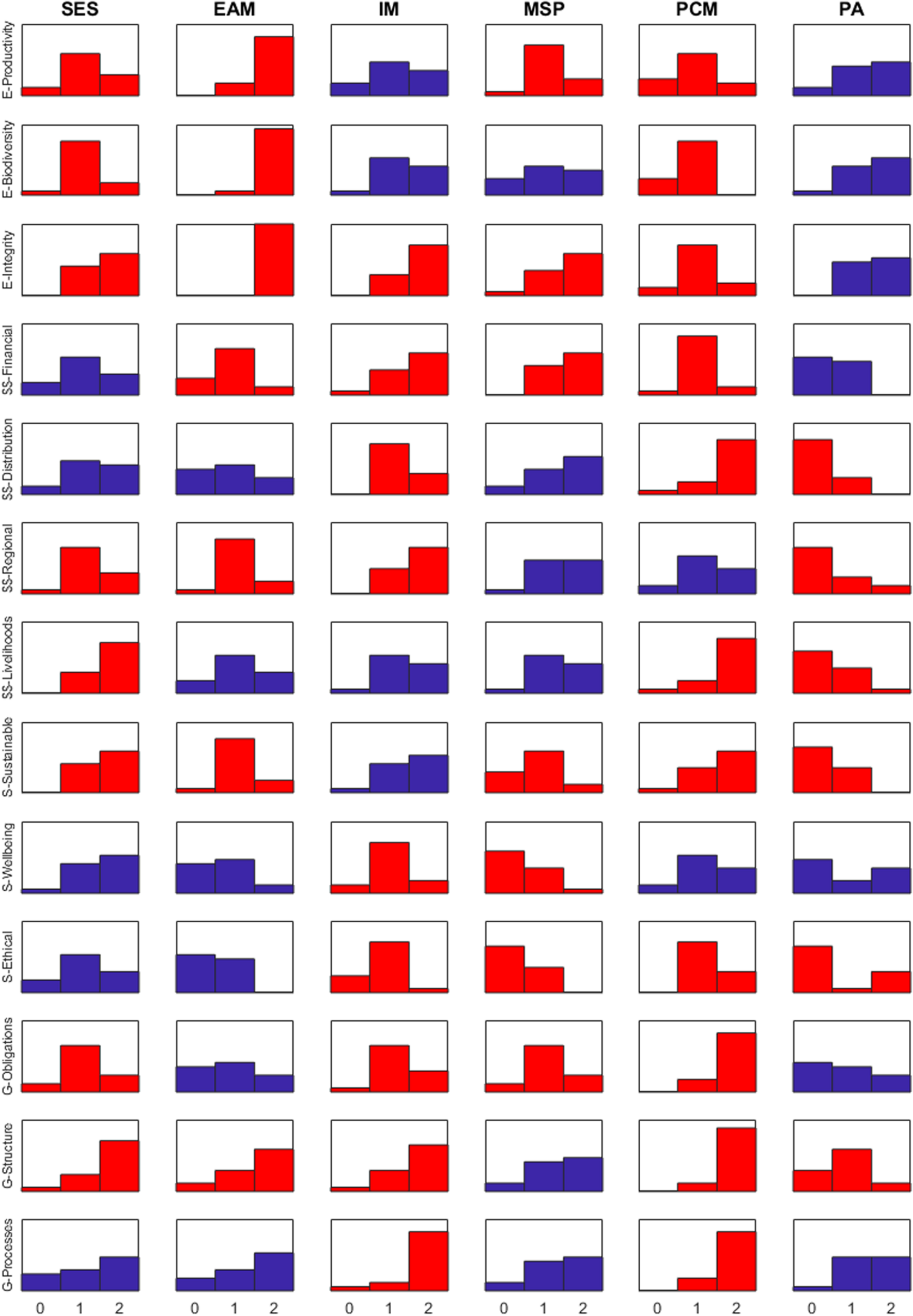
Agreement among authors for the objectives (rows) considered in each concept (column). Frequencies of 17 authors’ rankings of the degree to which concepts emphasize each of the 13 sustainability objectives defined in Table 1. Left bar represents no consideration (score 0), middle bar represents implicit consideration (score 1), and right bar represents explicit consideration (score 2). SES, social-ecological systems; EAM, ecosystem approach to management; IM, integrated management; MSP, marine spatial planning; PCM, participatory co-management; PA, precautionary approach. The codes on the y-axis represent elements; E (Ecological), $$ (Economic), S (Social), and G (governance). Cells in red represent higher score agreement among participants (greater than or equal to 9 of 17 to a single score).
Scoring patterns across authors revealed the inclusion of each objective in each concept, and the agreement among authors (Figure 1). A spread of scores (i.e., 0, 1, and 2) indicates lack of consensus (blue subplots), while concentration of scores for objective-concept pairs indicated agreement (red subplots). Objective-pair concepts with predominantly scores of 2 (or 0) indicate inclusion (or absence) of the objective. There was consensus that EAM considers ecological aspects explicitly while PCM and SES consider those objectives only implicitly. PCM and IM cover institutional/governance aspects explicitly whereas PA is weak on economic, social, and cultural considerations. In general, there was less agreement on the degree to which social and economic aspects were considered in the concepts (more blue subplots in these rows).
The greatest consensus among the group was in respect to the scope of PCM and IM, with least agreement on the scope of the PA. With respect to objectives, there was greatest agreement on the considerations of habitat/ecosystem integrity, sustainable communities and governance structure, and least agreement for health/wellbeing and effective decision-making (Figure 1).
Each of the concepts aspire to improve sustainability but are founded within different disciplinary foci. Further, there are varying levels of implicit assumption(s) that these concepts would be undertaken in the appropriate governance/ecological/economic/social and cultural context. Consequently, different disciplinary experience or history will affect the perceptions of implicit or explicit inclusion of the sustainability objectives – hence, the variation displayed in Figure 1. Much of the lack of apparent consensus in the group relates to whether the objectives are considered explicitly or implicitly. Most authors agreed that most objectives were either explicit or implicit in all concepts (and in their implementation in practice). In only two cases (health and wellbeing, and ethical considerations in PA) was there a split in which some considered it explicit and others considered it to be absent (i.e., a U-shape histogram in Figure 1).
Figure 2 synthesizes the group’s determination of the relative attention of these concepts to full-spectrum sustainability. All concepts consider (explicitly or implicitly) ecological, economic, social-cultural, and institutional or governance aspects, but the results indicate that the concepts differ substantially in emphasis and therefore in their attention to the diverse sustainability objectives. EAM was considered to most strongly reflect ecological aspects, whilst PCM and IM most strongly reflected institutional or governance considerations. None of the concepts were strong in consideration of economic or social considerations, and the attention to social and cultural aspects was generally lowest. The concept of IM was considered to be the most balanced in consideration of the four dimensions of sustainability.
FIGURE 2
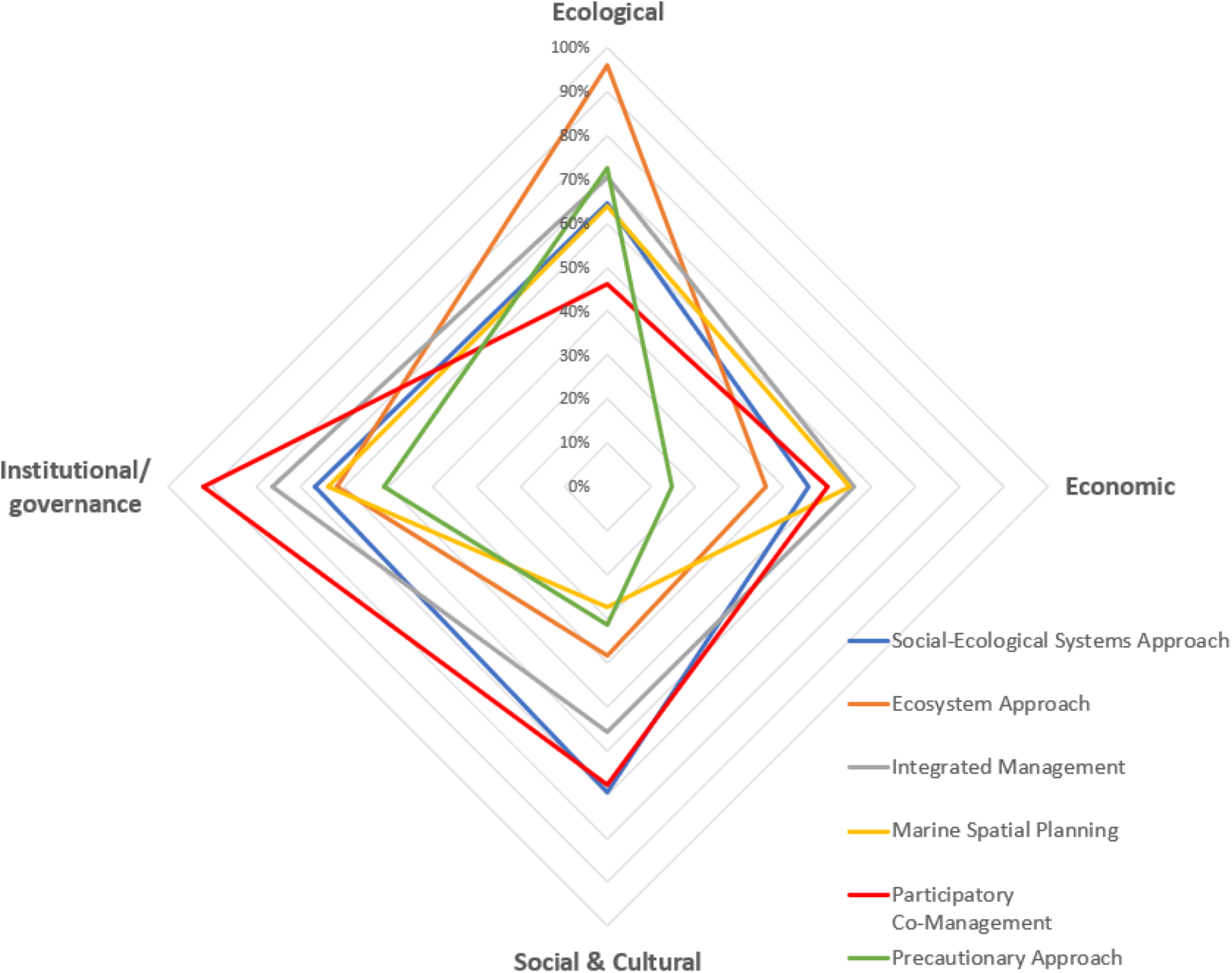
Relative emphasis of concepts related to full-spectrum sustainability, derived from scores of 17 co-authors. Each axis shows the percentage of the possible maximum score that could have been obtained from scoring by all objectives in each group for each concept by 17 co-authors. For example, the maximum score (2) for each of the three ecological objectives is 102. If the observed score was 51 for a concept, then the axis value would be 50%. Elements of the four axes are articulated in Table 1.
The Pattern(s) of “Practical Management,” Policy and Regulation
During the workshop and subsequent deliberations, the authors noted that the core concepts have all been advocated to improve sustainability and management. We observe that as the scope of sustainability has increased and as governance has evolved over time, these diverse concepts have been proposed in attempts to resolve major deficiencies. Use of these concepts is confounded by their differences in origin, disciplinary basis and historical application and development. Some are more aspirational (e.g., SES), some are applied (e.g., MSP); some are explicit in policies (e.g., PA), whilst others are not (e.g., PCM).
We attempted to place the concepts along a continuum, or in a hierarchy, that considers the degree to which they provide the framework or context for management, a strategy for practical management, or a tool or action of management, but this proved elusive. While some concepts are more theoretical and others more applied, the concepts have been implemented across a spectrum of situations and consequently, their uses have evolved over time. We determine that each of the concepts provide some context and may be used strategically or tactically in different situations.
Social-ecological systems provides an overarching theoretical context for sustainability that explicitly includes the societal and natural systems, but it is generally not specified in policy documents. As noted in Appendix A, this concept has been used more as an evaluative tool than as a practical framework for implementation of sustainability. This likely reflects the continued difficulty of agreeing on societal value systems at the level of policy documents, leaving implementation to specific management cases where various categories of tradeoffs can directly be addressed. As a consequence, outcomes will be uneven, as reflected in the low agreement in scoring of the social/cultural objectives depicted in Figure 1.
Participatory co-management focuses on the critical aspect of good governance, and in doing so enables many of the other objectives required for full-spectrum sustainability. While not prevalent in policy documents or legislation, it was considered by our team of authors to be one of the most comprehensive of the concepts (Figure 1; i.e., it included 11 of the 13 sustainability objectives, explicitly or implicitly).
Precautionary approach was considered to be the narrowest of the concepts in disciplinary scope, likely reflective of the fact that it emerged in the mid-1990s to improve governance of ecological aspects. The diverse interpretations of the PA in the literature and in national policies further underscore the variation in our results. Importantly, in those cases where it is applied, it continues to provide critical guidance for decision-making around ecological sustainability.
Marine spatial planning is popular in the practical implementation of solutions around multiple, conflicting objectives, but is also considered in some cases to be a framework for implementing other concepts (including IM and EAM). This concept offers a relatively reductive, technocratic approach from the field of “planning.” It may include diverse objectives and may be applied in collaborative or participatory governance arrangements, but its emphasis is on plan implementation, and thus, it is relatively narrow in scope compared to some other concepts.
At the moment, sustainability may be most comprehensively and practically implemented through EAM and IM which occur commonly in international agreements, increasingly in national legislation and policy, and claim to offer practical frameworks for management. Both are being implemented through regional management plans (in the case of IM) or in integrated ecosystem assessments (for EAM). However, while the definitions are growing more comprehensive and more similar (e.g., Smith et al., 2017; Stephenson et al., 2019), and in spite of attempts to promote these as overarching and common frameworks, the comprehensive definitions have generally (to date) been applied more narrowly with a focus on ecological considerations. Case studies are now emerging where the challenging process of full-spectrum sustainability is being carried through to implementation [e.g., Integrated Management of the NSW Marine Estate (Brooks et al., 2020); Canadian North Pacific Coast Integrated Management Plan (Appendix A); and US Integrated Ecosystem Assessments (Harvey et al., 2016)].
Discussion: Toward a Quilt of Sustainable Ocean Governance
A typical quilt is made of patches of material that are layered, arranged spatially, and stitched together in a way that forms patterns not only of color, but also of stitching (or quilting) on an item that is complete and intact (i.e., with no gaps). In the same way, we recognize that ocean governance consists of diverse objectives and concepts that can be assembled and used together in different ways to form a comprehensive governance approach with management outcomes that relate to – or “cover” – the whole system.
The concepts discussed in this article emerged from different situations and have been used (most often singly and differently) to fill perceived gaps or deficiencies in management for sustainability…to “patch things up.” Here, we have collated differences and similarities to compare across these concepts and objectives, to guide their future application to achieve management goals and sustainability targets. We have demonstrated that while there are differences in opinions among our group with respect to the specific details, the concepts differ in their attention to the various aspects or objectives of sustainability. Our results depicted in Figures 1, 2 show not only the relative strengths of the concepts, but that overall, the concepts that are especially strong for two pillars (ecology and institutional or governance), weaker for economic aspects, and weakest for the social-cultural pillar of full spectrum sustainability.
We note that different groups are using these approaches from different perspectives and in different ways. There are differences in opinion in the literature regarding the dominance or hierarchy of concepts, with claims that the overarching concept or the prime concept for implementation is, or should be, SES (e.g., Ostrom, 2009), EAM (e.g., CBD, 2003), IM (e.g., Brooks et al., 2020; Winther et al., 2020), and MSP (e.g., Domínguez-Tejo et al., 2016). The concepts differ in their “visibility” and acceptance in different parts of the world, much of this reflects the difference in explicit reference to the concepts in legislation. For example, PA and EAM are widespread in legislation and international agreements, whilst IM and MSP are less commonly specified, and SES and PCM are most often only implicit. These regional legislative differences in reference to concepts have contributed to differences in their use and application, and to the confusion that currently exists. Further, we suggest that groups have invested in, and therefore become set and attached to, their use of a particular approach, or “comfortable patches” (akin to a patch or color on the quilt), which has contributed to the isolation of approaches. The results of this study offer a means to view this suite of approaches with an understanding of their relationships (similar and dissimilar) with other approaches, tools and outcomes.
These concepts have evolved over time. While there is a range of definitions, the definitions are becoming more comprehensive, and the broad recent definitions of EAM and IM are now very similar (e.g., Smith et al., 2017; Stephenson et al., 2019). We predict that the concepts will continue to evolve to include the objectives of full spectrum sustainability. However, to date, differences between the broad comprehensive definitions (i.e., of what the concept is intended to do) and the narrower scope of their implementation remain.
In this article, we have tried to identify the strengths and weaknesses of core concepts. We conclude that there is no panacea, and that no matter how influential or dominant a single concept might be, pragmatically different concepts will be used in different areas, and there may always be the need for a combination (patchwork quilt) of concepts and objectives used together to achieve and improve sustainability. The selection of the core concepts for a situation will depend in large part on which concepts are specified, or demand focus, in the legal and policy context of the situation (area) of interest. But we suggest there is scope in the implementation of any of these concepts to supplement with, or borrow from, other concepts to achieve full spectrum sustainability. For example, the application of EAM could include institutional considerations (as found in PCM), and social/cultural considerations (from SES) and economic objectives (more prevalent in IM/MSP) to be comprehensive. We suggest that the quilt is a good analogy – and that practitioners with knowledge of the relative strengths and weaknesses of concepts can arrange patches as required to form a complete and effective management system. That arrangement may be different (different patterns) for different situations, places and issues to be addressed.
Governance and management of marine activities have evolved rapidly over the last two decades, with the realization that improved coastal and ocean management can only be achieved through a more comprehensive and consistent approach to management across the numerous and dynamic activities occurring within and affecting marine systems (e.g., Maxwell et al., 2015; Brooks et al., 2020). This is a fundamental departure from the generally accepted mode of individual activity-based marine (especially fisheries) management, which most often focuses on ecological aspects of sustainability of a single species/fishery. Today’s broader perspective recognizes the need to engage with the multiple facets of sustainability and multiple activities, and the focus has now shifted to the more explicit incorporation of governance, economic, and social equity/participatory objectives in an endeavor to effectively implement broader outcomes (e.g., Hobday et al., 2018). The objective of “sustainability” in the modern context of sustainable development implies an adequate performance of ecological, economic, social-cultural, and institutional objectives (also referred to as full-spectrum, four pillar or “triple” bottom line sustainability). This demands the use of a SESs context, and a focus on governance and practical management.
Improved governance and management to achieve full-spectrum sustainability is the key to meeting the targets of the SDGs. In this article we have articulated the full scope of objectives (Table 1), evaluated the relative strength of sustainability-related concepts, and proposed the use of a quilt of approaches for better addressing ocean sustainability and the related SDGs. We are staring at a great opportunity of knowledge integration and improvement of the quilt of approaches with the UN Decade of Ocean Science for Sustainable Development (2021–2030), not only among scientists but also across different sectors. We suggest that it is useful to think of the quilt, comprised of the objectives and elements considered in this article, as compiling “best practice,” and as the basis for a coherent approach sustainability in the face of global change. The patterns may look differently in different situations, but they will be recognizable as the quilt(s) of sustainable ocean governance.
The co-authors of this article embody diverse disciplinary expertise and experience of the concepts discussed; most of the authors had direct experience in application of one or two concepts. Through participation in the symposium, resulting discussions, and the development of the concept summaries, we sought to overcome differences in understanding in order to compare concepts. Despite this experience, we are mostly researchers and not managers, therefore our approach to ranking some of the objectives (in Figure 1) may differ from other groups who might repeat this exercise. We encourage scientists, managers, and stakeholders to use, refine and expand this quilt idea by experimenting with it in different geographical and regulatory contexts. Others may also be interested in comparing additional sustainability-related concepts and in using other methods for reflecting agreement among group members. Such additional analyses could add depth or “color” (additional patches) to the quilt of sustainable ocean governance.
The challenge of integrating the diverse objectives of full spectrum sustainability articulated in Table 1 is an inter- and transdisciplinary one. The consideration of ecological, economic, social/cultural, and institutional objectives, in an integrated way in coastal and ocean management evaluations and decision making, requires the integration of diverse stakeholders, disciplinary expertise and methods. Therefore, a major challenge in designing and creating the quilt of sustainable ocean governance requires forming and supporting teams that are interdisciplinary (across natural and social sciences and the humanities), and transdisciplinary (interdisciplinary collaboration and co-creation of knowledge with stakeholders) approaches. However, these approaches are challenging in practice across many aspects (Grilli et al., 2019; Kelly et al., 2019), and are not yet commonly used by coastal and ocean assessment and management agencies. There have been increasing calls for interdisciplinary research proposals, and development of interdisciplinary initiatives, but until recently, functional interdisciplinarity has been haphazard and reliant on hard work and focus, as much as on serendipity. It is our hope that an appreciation of the history, core objectives, and similarities/differences of concepts should help to reduce the time required to establish interdisciplinary and transdisciplinary collaborations, in efforts to design (both comprehensive and coherent) quilts suitable for and across different regions.
Conclusion
Full-Spectrum Sustainability Remains a Critical Governance Challenge
There is increasing international interest in and attention to sustainability (e.g., SDGs). Sustainability requires consideration of ecological, economic, social (including cultural), and institutional objectives. We identified 13 objectives from literature, SDGs and international agreements, and evaluated how these diverse considerations are included in the six sustainability-related concepts (SES, EAM, IM, MSP, PCM, and PA). Achieving greater cross-sectoral integration, or a more holistic perspective on management for sustainability is at the core of each concept. All deal with aspects of governance, and most with improved participation in governance. Sustainability is a transdisciplinary problem that requires additional disciplinary capacities and methods in coastal and ocean management agencies.
No Single Concept Is a Panacea for Sustainability
The co-authors of this article found it difficult to have consensus on whether some sustainability objectives were explicit or implicit in concepts, because the six concepts differ in their origins, use and scope (or emphasis) on the diverse objectives of sustainability. Overall, the concepts are especially strong for two pillars (ecology and institutional/governance), weaker for economic aspects, and weakest for the social-cultural pillar of full spectrum sustainability. Practitioners should be aware of the relative strengths and foci of the different sustainability concepts. Sustainability concepts are evolving, and further progress will undoubtedly be iterative. Our results revealed no “continuum” or “hierarchy” with respect to the concepts considered in the article. Pragmatically, different concepts will be used in different areas depending upon the particular needs and focus sought.
Sustainability Requires a Quilt of Concepts and Objectives
We identify that, ideally, there may always be the need for a combination (i.e., a patchwork quilt) of concepts and objectives used together to achieve and improve sustainability outcomes. While some concepts are more prominent in legislation, and the selection of the core concepts for a situation will undoubtedly depend in large part on which concepts are specified in the legal and policy context of the situation (area) of interest, to achieve sustainability in its most comprehensive interpretation, a combination – or quilt – of conceptual approaches is optimal. We suggest that there is scope in the implementation of any of these concepts, for practitioners to supplement the concept, in efforts to achieve full spectrum sustainability. We propose that the quilt is a strong analogy – and that practitioners with knowledge of the relative strengths and weaknesses of concepts can arrange patches as required, to collaboratively form a complete and effective management system. We recommend that it is useful to think of the quilt, comprised of the objectives and elements considered in this article, as compiling “best practice,” and as the basis for a coherent approach to sustainability in the face of global change.
Statements
Author contributions
RS, AH, IP, and CC convened the workshop session from which this manuscript arose. All authors participated in deliberations following the workshop, in defining and comparing sustainability concepts, and in writing the manuscript.
Acknowledgments
This contribution arose from a workshop at the 2nd IMBeR Open Science meeting in Brest France in 2019. This article was conceived and developed while RS was visiting researcher at CSIRO Oceans and Atmosphere in Hobart. We appreciate the contribution from David VanderZwaag. AJ gratefully acknowledges funding by the South African Research Chairs Initiative of the Department of Science and Innovation and the National Research Foundation, through grant No. 65238. EA was supported by the Nippon Foundation’s Ocean Nexus Program at EarthLab, University of Washington and the CGIAR research program on fish in agrifood systems.
Conflict of interest
RL manages the independent consultancy Skillmarine. The remaining authors declare that the research was conducted in the absence of any commercial or financial relationships that could be construed as a potential conflict of interest.
Supplementary material
The Supplementary Material for this article can be found online at: https://www.frontiersin.org/articles/10.3389/fmars.2021.630547/full#supplementary-material
Footnotes
1.^The theme of this volume is “Sustainability under global change for the benefit of society.”
References
1
Allison E. H. Bassett H. R. (2015). Climate change in the oceans: human impacts and responses.Science350778–782. 10.1126/science.aac8721
2
Allison E. H. Horemans B. (2006). Putting the principles of the sustainable livelihoods approach into fisheries development policy and practice.Mar. Policy30757–766. 10.1016/j.marpol.2006.02.001
3
AORA (2019). Working Group on the Ecosystem Approach to Ocean Health and Stressors. Vision Document June 2019: 36. ICES. 10.1016/j.marpol.2006.02.001
4
Arctic Council (2013). Advancing Ecosystem Based Management in the Work of the Arctic Council. ACSAO-SE04 Stockholm Doc 3.7d Mar 2013. Tromsø, NO: Arctic Council.
5
Armitage D. A. Berkes F. Doubleday N. (2007). Adaptive Co-Management: Collaboration, Learning and Multi-Level Governance. Vancouver, BC: University of British Columbia Press.
6
Armitage D. Okamoto D. K. Silver J. J. Francis T. B. Levin P. S. Punt A. E. I et al (2019). Integrating governance and and quantitative evaluation of resource management strategies to improve social and ecological outcomes.Bioscience69523–532. 10.1093/biosci/biz059
7
Babcock R. C. Bustamante R. H. Fulton E. A. Fulton D. J. Haywood M. D. E. Hobday A. J. et al (2019). Severe continental-scale impacts of climate change are happening now: extreme climate events impact marine habitat forming communities along 45% of Australia’s Coast.Front. Mar. Sci.6:411. 10.3389/fmars.2019.00411
8
Barange M. Bahri T. Beveridge M. C. M. Cochrane K. L. Funge-Smith S. Poulain F. et al (2018). Impacts of Climate Change on Fisheries and Aquaculture: Synthesis of Current Knowledge, Adaptation and Mitigation Options. FAO Fisheries and Aquaculture Technical Paper 627. Rome: FAO.
9
Berkes F. (2011). “Restoring unity,” in World Fisheries: A Social-Ecological Analysis, edsOmmerR. E.PerryR. I.CochraneK.CuryP. (Hoboken, NJ: Wiley-Blackwell), 2–9.
10
Berkes F. Folke C. (1998). Linking Social and Ecological Systems: Management Practices and Social Mechanisms for Building Resilience.Cambridge: Cambridge University Press.
11
Berkes F. George P. J. Preston R. J. (1991). The evolution of theory and practice of the joint administration of living resources.Alternatives18, 12–18.
12
Bernal P. A. (2015). “State ocean strategies and policies for the open ocean,” in Routledge Handbook of Ocean Resources and Management, ed.SmithH. D. (London: Routledge).
13
Blythe J. Cohenab P. Erikssonac H. Cinnerb J. Bosoa D. Schwarza A.-M. et al (2017). Strengthening post-hoc analysis of community-based fisheries management through the social-ecological systems framework.Mar. Policy82, 50–58.
14
Brooks K. Barclay K. Grafton R. Gollan N. (2020). Transforming coastal and marine management: deliberative democracy and integrated management in New South Wales, Australia.Mar. Policy2020:104053. 10.1016/j.marpol.2020.104053
15
CBD (2003). Convention on Biological Diversity. UN Decade on Biodiversity: Strategic Plan 2011-2020. Available online at: http://www.cbd.int/sp/targets(accessed February 8, 2021). 10.1016/j.marpol.2020.104053
16
Colding J. Barthel S. (2019). Exploring the social-ecological systems discourse 20 years later.Ecol. and Soc.24:2. 10.5751/ES-10598-240102
17
Cox M. Villamayor-Tomasb S. Epsteinc G. Evansd L. Bane N. C. Fleischmanf F. et al (2016). Synthesising theories of natural resource management and governance.Glob. Environ. Change39:4556.
18
Daily G. C. (1997). Nature’s Services: Societal Dependence on Natural Ecosystems. Washington, DC: Island Press.
19
Davenport R. B. May P. H. Nogueira P. Nunes P. C. (2016). A policy mix to prevent a non-commons tragedy for collective forest reserves in agrarian settlements in northwest Mato Grosso — Um mix de politicas para evitar a privatizagao dos recursos naturais nas reservas florestais coletivas dos assentamentos rurais.Rev. Econom. Contempor.20, 405–429.
20
deFur P. L. Kaszuba M. (2002). Implementing the precautionary principle.Sci. Total Environ.288, 155–165.
21
Díaz S. Settele J. Brondízio E. S. Ngo H. T. Agard J. Arneth A. et al (2019). Pervasive human-driven decline of life on Earth points to the need for transformative change.Science366:eaax3100. 10.1126/science.aax3100
22
Domínguez-Tejo E. Metternicht G. Johnston E. Hedge L. (2016). Marine spatial planning advancing the ecosystem-based approach to coastal zone management: a review.Mar. Policy72115–130. 10.1016/j.marpol.2016.06.023
23
Doubleday Z. A. Connell S. D. (2020). Shining a bright light on solution science in ecology.One Earth216–19. 10.1016/j.oneear.2019.12.009
24
Douvere F. (2008). The importance of marine spatial planning in advancing ecosystem-based sea use management.Mar. Policy32762–771. 10.1016/j.marpol.2008.03.021
25
Ehler C. N. Douvere F. (2009). Marine Spatial Planning: A Step-by-Step Approach Toward Ecosystem-Based Management. Intergovernmental Oceanographic Commission and Man and the Biosphere Programme, 2009. Manual and Guides No. 53. Paris: UNESCO.
26
EU (2008). Directive 2008/56/EC of the European Parliament and of the Council of 17 June 2008 Establishing a Framework for Community Action in the Field of Marine Environmental Policy (Marine Strategy Framework Directive). Official Journal of the European Union, 2008. L164(19-40). Available online at: http://data.europa.eu/eli/dir/2008/56/oj
27
EU-MSFD (2008). EU Marine Strategy Framework Directive 2008. Available online at: https://ec.europa.eu/environment/marine/eu-coast-and-marine-policy/marine-strategy-framework-directive/index_en.htm(accessed February 8, 2021).
28
FAO (1995). Food and Agriculture Organization of the United NationsCode of Conduct for Responsible Fisheries.Rome: FAO.
29
FAO (1999). Food and Agriculture Organization of the United Nations Technical Guidelines for Responsible Fisheries 8: Indicators for Sustainable Development of Marine Capture Fisheries.Rome: FAO.
30
FAO (2003). Food and Agriculture Organization of the United Nations Technical Guidelines for Responsible Fisheries - Supplement 2) Fisheries Management - The Ecosystem Approach to Fisheries.Rome: FAO.
31
FAO (2005). Ethical issues in fisheries. FAO Ethics Series #4.Rome: FAO.
32
Fleischman F. Boenning K. Garcia-Lopez G. A. Mincey S. Schmitt-Harsh M. Daedlow K. et al (2010). Disturbance, response, and persistence in self-organized forested communities: analysis of robustness and resilience in five communities in southern Indiana.Ecol. Soc.15:9.
33
Foley P. Pinkerton E. Wiber M. G. Stephenson R. L. (2020). Full-spectrum sustainability: an alternative to fisheries management panaceas.Ecol. Soc.25:1. 10.5751/ES-11509-250201
34
Folke C. Hahn T. Olsson P. Norberg J. (2005). Adaptive governance of social-ecological systems.Annu. Rev. Environ. Resourc.30, 441–473.
35
García C. Tavera-Escobar H. Vieira C. Rincón C. Renteria E. (2014). Fostering ethno-territorial autonomy: a Colombian case study of community-based conservation of mangroves.J. Latin Ame. Geogr.13117–152. 10.1353/lag.2014.0019
36
Granek E. F. Polasky S. Kappel C. V. Reed D. J. Stoms D. M. Koch E. W. et al (2009). Ecosystem services as a common language for coastal ecosystem-based management.Conserv. Biol.24207–216.
37
Grilli N. M. Xavier L. Y. Jacobi P. R. Turra A. (2019). Integrated science for coastal management: discussion on a local empirical basis.Ocean Coast. Manag.167219–228. 10.1016/j.ocecoaman.2018.10.009
38
Grumbine R. E. (1994). What is ecosystem management?Conserv. Biol.8, 27–38. 10.1016/j.ocecoaman.2018.10.009
39
Halpern B. S. Klein C. J. Brown C. J. Beger M. Grantham H. S. Mangubhai S. et al (2013). Achieving the triple bottom line in the face of inherent trade-offs among social equity, economic return, and conservation.Proc. Natl. Acad. Sci. U.S.A.1106229–6234. 10.1073/pnas.1217689110
40
Harvey C. J. Kelble C. R. Schwing F. B. (2016). Implementing “the IEA”: using integrated ecosystem assessment frameworks, programs, and applications in support of operationalizing ecosystem-based management.ICES J. Mar. Sci.74398–405. 10.1093/icesjms/fsw201
41
Hobday A. J. Fleming A. Ogier E. M. Thomas L. Hartog J. R. Hornborg S. et al (2018). Perceptions regarding the need for broad sustainability assessments of Australian fisheries.Fish. Res.208247–257. 10.1016/j.fishres.2018.08.006
42
Holling C. S. (1973). Resilience and stability of ecological systems.Annu. Rev. Ecol. Evol. Syst.41–23. 10.1007/978-3-030-54560-4_1
43
Hoogesteger J. (2015). Normative structures, collaboration and conflict in irrigation; a case study of the Pillaro North Canal Irrigation System, Ecuadorian Highlands.Int. J. Common.9, 398–415. 10.1007/978-3-030-54560-4_1
44
ICES (2005). Guidance on the application of the ecosystem approach to management of human activities in the european marine environment.ICES Cooperat. Res. Rep.223:22. 10.1007/978-3-030-54560-4_1
45
IOC/UNESCO (2011). A Blueprint for Ocean and Coastal Sustainability.Paris: IOC/UNESCO.
46
IPCC (2019). Special Report on the Ocean and Cryosphere in a Changing Climate. IPCC Working Group II / IPCC Secretariat. Available online at: https://www.ipcc.ch/srocc/(accessed February 8, 2021).
47
Kelly R. Mackay M. Nash K. L. Cvitanovic C. Allison E. H. Armitage D. et al (2019). Ten tips for developing interdisciplinary socio-ecological researchers.Soc. Ecol. Pract. Res.1149–161. 10.1007/s42532-019-00018-2
48
Kelly R. Pecl G. T. Fleming A. (2017). Social licence in the marine sector: a review of understanding and application.Mar. Policy8121–28. 10.1016/j.marpol.2017.03.005
49
Kenchington R. Crawford D. (1993). On the meaning of integration in coastal zone management.Ocean Coast. Manag.21125–126.
50
Leach M. Reyers B. Bai X. Brondizio E. S. Cook C. Díaz S. et al (2018). Equity and sustainability in the Anthropocene:a social-ecological systems perspective on their intertwined futures.Glob. Sustain.1:e13.
51
Lloyd M. G. Peel D. Duck R. W. (2013). Towards a social-ecological resilience framework for coastal planning.Land Use Policy30925–933. 10.1016/j.landusepol.2012.06.012
52
Long R. D. Charles A. Stephenson R. L. (2015). Key principles of marine ecosystem-based management.Mar. Policy5753–60. 10.1016/j.marpol.2015.01.013
53
Marshak A. R. Link J. S. Shuford R. Monaco M. E. Johannesen E. Bianchi G. et al (2016). International perceptions of an integrated, multi-sectoral, ecosystem approach to management.ICES J. Mar. Sci.74414–420. 10.1093/icesjms/fsw214
54
Marshall S. (2012). Science, pseudo-science and urban design.Urb. Design Int.17, 257–271. 10.1093/icesjms/fsw214
55
Maxwell S. M. Hazen E. L. Lewison R. L. Dunn D. C. Bailey H. Bograd S. J. et al (2015). Dynamic ocean management: defining and conceptualizing real-time management of the ocean.Mar. Policy5842–50. 10.1016/j.marpol.2015.03.014
56
McCord P. Dell’Angelo J. Baldwin E. Evans T. (2016). Polycentric transformation in Kenyan water governance: a dynamic analysis of institutional and social-ecological change.Policy Stud. J.45, 633–658. 10.1016/j.marpol.2015.03.014
57
McLeod K. Leslie H. (2005). Ecosystem-Based Management for the Oceans.Washington, DC: Island Press.
58
Nash K. L. Blythe J. L. Cvitanovic C. Fulton E. A. Halpern B. S. Gulland E. J. M. et al (2020). To achieve a sustainable blue future, progress assessments must include interdependencies between the sustainable development goals.One Earth2161–173. 10.1016/j.oneear.2020.01.008
59
Nash K. L. Cvitanovic C. Fulton E. A. Halpern B. S. Milner-Gulland E. J. Watson R. A. et al (2017). Planetary boundaries for a blue planet.Nat. Ecol. Evol.11625–1634.
60
NPFMC (2009). North Pacific Fishery Management CouncilFishery Management Plan for Fish Resources of the Arctic Management Area. Anchorage, AK: NPFMC.
61
Oberlack C. Walter P. L. H. Schmerbeck J. Tiwari B. (2015). Institutions for sustainable forest governance: robustness, equity, and cross-level interactions in Mawlyngbna, Meghalaya, India.Int. J. Common.9, 670–697.
62
Ommer R. E. Perry R. I. Murray G. Neis B. (2012). Social-ecological dynamism, knowledge, and sustainable coastal marine fisheries.Curr. Opin. Environ. Sustain.4316–322. 10.1016/j.cosust.2012.05.010
63
Olsen E. Silje H. Hoel A. H. Buhl-Mortensen L. Ingolf R. (2016). How integrated ocean governance in the barents sea was created by a drive for increased oil production.Mar. Policy71, 293–300. 10.1016/j.cosust.2012.05.010
64
Osherenko G. (1998). Sharing Power with Native Users: Co-Management Regimes for Native Wildlife. CARC Policy Paper no.5. Ontario, CA: Canadian Arctic Resources Committee.
65
Österblom H. Folke C. (2013). Emergence of global adaptive governance for stewardship of regional marine resources.Ecol. Soc.18:4.
66
Ostrom E. (2009). A general framework for analyzing sustainability of social-ecological systems.Science325419–422. 10.1126/science.1172133
67
ParksCanada (2018). Gwaii Haanas Gina Waadluxan KilGuhlGa Land-Sea-People Management Plan 2018. Available online at: www.pc.gc.ca/en/pn-np/bc/gwaiihaanas/info/consultations10.1126/science.1172133
68
Partelow S. Glaser M. Arce S. S. Barboza R. Schlüter A. (2018). Mangroves, fishers, and struggle for adaptive co-management: applying the social-ecological systems framework to a marine extractive research (RESEX) in Brazil.Ecol. Soc.23:19. 10.1126/science.1172133
69
Partelow S. Winkler K. J. (2016). Interlinking ecosystem services and Ostrom-s framework through orientation in sustainability research.Ecol. Soc.21:27. 10.1126/science.1172133
70
Patricio J. Elliott M. Mazik K. Papadopoulou K.-N. Smith C. J. (2016). DPSIR - two decades of trying to develop a unifying framework for marine environmental management?Front. Mar. Sci.3:177. 10.3389/fmars.2016.00177
71
Peel J. (2005). The Precautionary Principle in Practice: Environmental Decision-Making and Scientific Uncertainty. Alexandria, NSW: Federation Press.
72
Pinkerton E. (1989). Co-Operative Management of Local Fisheries: New Direction in Improved Management and Community Development. Vancouver, BC: University of British Columbia Press.
73
Plummer R. Armitage D. A. (2007). Charting the new territory of adaptive co-management: a Delphi study.Ecol. Soc.12:10.
74
Santos C. F. Ehler C. Agardy C. N. Andrade T. Orbach F. Crowder M. K. et al (2019). “Marine spatial planning,” in World Seas: An Environmental Evaluation, ed.SheppardC. (Cambridge, MA: Academic Press), 569–571.
75
Silvia L. Rojos M. L. Ibáñez Martin M. M. Scordo F. Andrea Huamantinco Cisneros M. Luján Bustos M. et al (2017). Characterization of an artisanal fishery in Argentina using the social-ecological systems framework.Int. J. Common.11, 1–69.
76
Smith D. C. Fulton E. A. Apfel P. Cresswell I. D. Gillanders B. M. Haward M. et al (2017). Implementing marine ecosystem-based management: lessons from Australia.ICES J. Mar. Sci.741990–2003. 10.1093/icesjms/fsx113
77
Stephenson R. L. Hobday A. J. Cvitanovic C. Alexander K. A. Begg G. A. Bustamante R. H. et al (2019). A practical framework for implementing and evaluating integrated management of marine activities.Ocean Coast. Manag.177127–138. 10.1016/j.ocecoaman.2019.04.008
78
Stephenson R. L. Paul S. Wiber M. Angel E. Benson A. J. Charles A. et al (2018). Evaluating and implementing social-ecological systems: a comprehensive approach to sustainable fisheries.Fish Fish.19853–873. 10.1111/faf.12296
79
Trouwborst A. (2007). The precautionary principle in general international law: combating the babylonian confusion.Rev. Eur. Commun. Intern. Environ. Law16185–195. 10.1111/j.1467-9388.2007.00553.x
80
UNESCO (2018). The Science We Need for the Ocean We Want: The United Nations Decade of Ocean Science for Sustainable Development (2021-2030).Paris: IOC/UNESCO.
81
United Nations (1982). United Nations Convention on the Law of the Sea. Available online at: https://www.un.org/depts/los/convention_agreements/texts/unclos/unclos_e.pdf(accessed February 8, 2021).
82
United Nations (1995). “United Nations general assembly agreement for the implementation of the provisions of the United Nations convention on the law of the sea of 10 December 1982 relating to the conservation and management of straddling fish stocks and highly migratory fish stocks,” in Proceedings of the United Nations Conference on Straddling Fish Stocks and Highly Migratory Fish Stocks, New York, NY.
83
United Nations (2015). Agenda for Sustainable Development. Available online at: https://sustainabledevelopment.un.org/post2015/transformingourworld(accessed February 8, 2021).
84
United Nations (2018). The Sustainable Development Agenda. Available online at: https://www.un.org/sustainabledevelopment/development-agenda/(accessed February 8, 2021).
85
VanderZwaag D. L. (2019). “Edging towards principled ocean governance: law of the sea and beyond,” in The Future of Ocean Governance and Capacity Development International Ocean Institute - Canada, ed.McConnellM. L. (Suva: International Ocean Institute), 117–127. 10.1163/9789004380271_022
86
Wenhai L. Caroline C. Maria B. Wang T. Chen M. Kelli P. et al (2019). Successful blue economy examples with an emphasis on international perspectives.Front. Mar. Sci.6:261. 10.3389/fmars.2019.00261
87
Winther J.-G. Dai M. Rist T. (2020). Integrated Ocean Management. Washington, DC: World Resources Institute.
88
Winther J.-G. Dai M. Rist T. Hoel A. H. Li Y. Trice A. et al (2020). Integrated ocean management for a sustainable ocean economy.Nat. Ecol. Evol.41451–1458.
Appendix
TABLE A
| Key definition | Scope of consideration | Primary applications | |
| SES | Integrated complex systems that include social (human) and ecological (biophysical) subsystems in a two-way feedback relationship (Berkes, 2011). | - Gives equal attention to the social and the ecological system and the interlinkages between them. - Links with ecosystem services (Daily, 1997; Partelow and Winkler, 2016), resilience (Berkes and Folke, 1998), and other environmental governance theories (Folke et al., 2005; Cox et al., 2016). |
Evaluation of community-based systems such as conflict and collaboration in situations including: - Irrigation systems (Hoogesteger, 2015; McCord et al., 2016), - Small-scale fisheries (Blythe et al., 2017; Silvia et al., 2017; Partelow et al., 2018), - Forestry (Fleischman et al., 2010; Oberlack et al., 2015; Davenport et al., 2016) |
| EAM | Integrated adaptive management approach to help marine managers consider trade-offs to protect and sustain diverse and productive ecosystems and the services they provide. Informed by science, it incorporates the entire ecosystem, including humans, into management decisions (FAO, 2003; Marshall, 2012). | - Aims to balance human activities and environmental stewardship in a multiple-use context (Smith et al., 2017); - Has evolved to be fully inclusive of ecological, social, economic, and governance considerations and inherently recognizes coupled social-ecological systems with stakeholders involved in an integrated and adaptive management process where decisions reflect societal choice. |
- First implemented in the management of terrestrial parks (Grumbine, 1994); - Started to be considered in the marine world during the 1990s, epitomized by: Canada’s Oceans Act South Africa’s Marine Living Resources Act and Australia’s Ocean policy. - Written into the common fisheries policy and has been implemented as the Marine Strategy Framework Directive (Europe) (ICES, 2005; EU, 2008). |
| IM | Approach that links planning, decision-making, and management arrangements across sectors in a unified framework, to enable a more comprehensive view of sustainability and the consideration of cumulative effects and trade-offs (Stephenson et al., 2019). | - Encompasses the interconnectedness of natural systems, human systems, and management (Bernal, 2015), - Emphasizes practical management of multiple sectors to achieve diverse objectives, - Brings together relevant actors from government, business, academia, and civil society from the entire spectrum of ocean-related human activities (Winther et al., 2020). |
- Integrated Management of the Australian NSW Marine Estate (Brooks et al., 2020) - Integrated Management for the Barent’s Sea (Olsen et al., 2016) - Integrated Management Plan for the North Sea - Pacific Coast: Marine Plan Partnership for the North Pacific Coast - Integrated Management of the Canadian North. |
| MSP | A public process of analyzing and allocating the spatial and temporal distribution of human activities in marine areas to achieve ecological, economic, and social objectives that have been specified through a political process (Douvere, 2008). | - Recognizes the legal, political, economic, and ecological complexity of ocean governance (Ehler and Douvere, 2009), - Should entail a cyclical and iterative approach incorporating new information over time and adapting its objectives and measures according to the evolution of the socio-ecological system. |
- It was first stimulated by international and national interest in developing marine protected areas (MPAs), such as the Great Barrier Reef Marine Park (Australia) (Douvere, 2008). - Currently, approximately 80 countries have implemented MSP in some form: - Belgium, Germany, the Netherlands, Norway, China, and Belize (where MSP covers the majority of the maritime space), and - United States, Canada, and Croatia (where MSP is in place just for a particular area under national jurisdiction). |
| PCM | A system of rights and obligations for those with a shared interest or stake in a resource (e.g., fishery). A collection of rules indicating actions that different actors (e.g., state and community) are expected to follow (e.g., compliance with quotas). Procedures through which to make collective decisions (Osherenko, 1998). | - Requires sharing of power and responsibility between government and local resource users (Berkes et al., 1991); - Draws attention to numerous applied and policy-orientated attributes: 1) ensuring the engagement of a diversity of actors that are relevant, appropriate, and connected to the primary issues of concern; 2) creating an accessible process for deliberation and decision making in terms of space, timing, neutrality and the language used; 3) linking actors vertically and horizontally; 4) recognizing that co-management is a long-term process and that there is ample evidence it takes a decade or more to actually develop; 5) highlighting the importance of learning and the need to learn through complexity; 6) encouraging the establishment of a legal foundation for co-management as opposed to voluntary notions of engagement. |
- There are numerous descriptions of co-management in the literature, in wildlife, forests, parks and fisheries and ocean: - The Bolt Decision in Washington State, USA, in the 1970s, - Canada’s Arctic starting from the late 1970s (Pinkerton, 1989; Armitage et al., 2007), - The Gwaii Haanas Land-Sea-People plan which establishes a cooperative agreement between the Haida Nation and the federal government (Canada) (ParksCanada, 2018). |
| PA | In order to protect the environment, the precautionary approach shall be widely applied by States according to their capabilities. Where there are threats of serious or irreversible damage, lack of full scientific certainty shall not be used as a reason for postponing cost-effective measures to prevent environmental degradation. | - Calls for proactive measures to be taken where there is scientific uncertainty on the environmental impacts of proposed activities or use of the environment; - Aims to ensure environmental protection through taking early actions and preventing environmental risks at an early stage, even when scientific uncertainties about the risks remain (Trouwborst, 2007); - Provides critical guidance for making environmental decisions under uncertainty (Peel, 2005). |
- Environmental protection of the North Sea in the 1980s (deFur and Kaszuba, 2002), - The North Pacific Fishery Management Council in the United States in the new Fishery Management Plan for Fish Resources of the Arctic Management Area (2009) (NPFMC, 2009). - The Protocol to the London Convention on ocean dumping (1996); - UN Sustainable Fisheries Resolution 61/105 in December 2006 and the International Guidelines for the Management of Deep-Sea Fisheries on the High Seas (2008). |
Key definitions, scope, and applications for six sustainability concepts: SES, social-ecological systems approach; EAM, ecosystem approach to management; IM, integrated management; MSP, marine spatial planning; PCM, participatory co-management; and PA, precautionary approach.
Further information is provided in Supplementary Information File S1 (Available online at: https://www.frontiersin.org/articles/10.3389/fmars.2021.630547/full#supplementary-material).
Summary
Keywords
ecosystem based management, integrated management, social-ecological system, marine spatial planning, precautionary approach, participatory co-management, IMBeR
Citation
Stephenson RL, Hobday AJ, Allison EH, Armitage D, Brooks K, Bundy A, Cvitanovic C, Dickey-Collas M, Grilli NdM, Gomez C, Jarre A, Kaikkonen L, Kelly R, López R, Muhl E-K, Pennino MG, Tam JC and van Putten I (2021) The Quilt of Sustainable Ocean Governance: Patterns for Practitioners. Front. Mar. Sci. 8:630547. doi: 10.3389/fmars.2021.630547
Received
17 November 2020
Accepted
29 January 2021
Published
05 March 2021
Volume
8 - 2021
Edited by
Antonio Di Franco, Stazione Zoologica Anton Dohrn, Italy
Reviewed by
Julie Reimer, Memorial University of Newfoundland, Canada; Claudia Baldwin, University of the Sunshine Coast, Australia
Updates
Copyright
© 2021 Stephenson, Hobday, Allison, Armitage, Brooks, Bundy, Cvitanovic, Dickey-Collas, Grilli, Gomez, Jarre, Kaikkonen, Kelly, López, Muhl, Pennino, Tam and van Putten.
This is an open-access article distributed under the terms of the Creative Commons Attribution License (CC BY). The use, distribution or reproduction in other forums is permitted, provided the original author(s) and the copyright owner(s) are credited and that the original publication in this journal is cited, in accordance with accepted academic practice. No use, distribution or reproduction is permitted which does not comply with these terms.
*Correspondence: Robert Stephenson, robert.stephenson@dfo-mpo.gc.ca
This article was submitted to Marine Conservation and Sustainability, a section of the journal Frontiers in Marine Science
Disclaimer
All claims expressed in this article are solely those of the authors and do not necessarily represent those of their affiliated organizations, or those of the publisher, the editors and the reviewers. Any product that may be evaluated in this article or claim that may be made by its manufacturer is not guaranteed or endorsed by the publisher.