Abstract
The Beibu Gulf in China is rich in fish resources. However, only a small number of commercially developed fish stocks have been specifically assessed owing to limited data and expertise. In this study, 19 perciform fish populations in the Beibu Gulf were assessed using a length-based Bayesian biomass (LBB) estimator method, which is a new approach to evaluate a fishery’s status using length frequency (LF) data. The results showed that only 21% of the evaluated stocks were healthy and 79% were overfished. In particular, 26 and 21% of the assessed species had collapsed and were grossly overfished, respectively. Only 11 and 21% of the assessed species were slightly overfished and overfished, respectively. The ratios between the mean and optimum length (Lmean/Lopt) and between the mean length at first capture and the mean length, which maximizes catch and biomass (Lc/Lc_opt), were below one in 14 out of the 19 stocks, suggesting a truncated length structure and fishing of undersized individuals. The ratio of the 95th percentile length to asymptotic length L95th/Linf was close to one (>0.9) in 10 of 19 stocks, suggesting that at least some large fish were still present. Our research confirmed that the fishery resources in the Beibu Gulf were seriously overfished and provided evidence that LBB was an efficient method to evaluate the fishery resources. Fishery managers need to take specific measures to restore fishery resources.
Introduction
World fisheries, including freshwater, marine, and capture fisheries, as well as aquaculture, provide approximately 17% of the total animal protein consumed by humans, and around 56.6 million people are directly engaged in fisheries (Kang et al., 2018). After decades of rapid development, China has become the largest contributor to global marine fishing (FAO, 2019). At present, China’s marine catch exceeds 15 million tons (Wang Y. et al., 2020). However, since the 1970s, many of China’s marine fishery resources have been over exploited and the structure of the fish community has greatly changed (Kang et al., 2018; Zhang et al., 2020); the catches of some traditionally important economic fish have decreased significantly (Jin et al., 2015; Zhang et al., 2020). Only approximately 12% of the global fisheries are properly managed through stock assessments results (Kindong et al., 2020). Therefore, stock assessment is essential for the management of fisheries resources.
The South China Sea is located at the center of the Indo Western Pacific region and is the third largest marginal sea in the world (Li et al., 2019). It is rich in marine biodiversity, with more than 8,600 species of animals and plants (Ng and Tan, 2000). Perciformes play an important role in the structure of fish resources in the South China Sea, which have complex feeding habits, feeding on phytoplankton and zooplankton as well as other Marine animals such as invertebrates and fish. There are 979 species of Perciformes in the whole South China Sea, accounting for 42.2% of the total species (2321) (Ma et al., 2006). There are more than 300 species of Perciformes in the Beibu Gulf in the South China Sea, accounting for more than 50% of the total fish species, and most of them are economically important fish (Sun et al., 2010).
In China, only a small number of commercially developed fish resources have been specifically assessed, owing to limited data and expertise (Liang et al., 2020). Recently, two methods have been applied to the assessment of fishery resources in China. One is the maximum sustainable yield (MSY) model, which uses a time series of catch and auxiliary data to estimate the MSY (Ju et al., 2020b; Liang et al., 2020; Zhai et al., 2020); The other is the length-based Bayesian biomass (LBB) model, which uses length frequency (LF) data to estimate asymptotic length, length at first capture, relative natural mortality and relative fishing mortality (Ju et al., 2020a; Kindong et al., 2020; Liang et al., 2020; Wang Y. et al., 2020, 2021; Zhang et al., 2020, 2021; Wang X. et al., 2021). Size measurement is the basic requirement for marine fishery resource surveys in China (Jin et al., 2012), and LF data are usually easier to obtain and cheaper than other data types (Liang et al., 2020). This allows the LBB method to be used to evaluate the commercial fishery resources in China’s marine waters where there is little knowledge of other parameters (Zhang et al., 2020). LBB is a newly developed Bayesian biomass estimation method based on length, which needs no data except LF (Froese et al., 2018). The growth and mortality parameters and the relative stock size are estimated using a Bayesian Monte Carlo Markov chain (MCMC). Furthermore, LBB results can be informative for other data poor stock assessment models that use priors for the status of the biomass [e.g., AMSY or Catch-MSY (CMSY)], regarding the relative biomass (B/B0) in a certain year.
In this study, we applied the LBB method to 19 Perciform fish populations in the Beibu Gulf to explore the extent of biomass depletion caused by fisheries, and to provide evidence for potential alternative harvest policies.
Materials and Methods
Data Sources
The data were collected by four surveys with single bottom trawls of “Beiyu 60011” from 2010 to 2011, which had the same selectivity as when fishing commercially. The main engine power of the survey vessel was 514.5 kW, the mouth of the bottom towing net was 42 × 7 m, and the mesh size (inner diameter) was 40 mm. At each station, a trawl was towed for 2 h at a speed of 3 kn. The survey area was in the northern part of the South China Sea (20.75° N–21.25° N, 112.75° E–114.25° E) and 18 survey stations were established (Figure 1). Samples were identified to species level in the laboratory, and their standard body length was measured. The scientific names of the species in this study were verified from the FishBase,1 as summarized in Table 1. The specific LF data is shown in Supplementary Material 1.
FIGURE 1
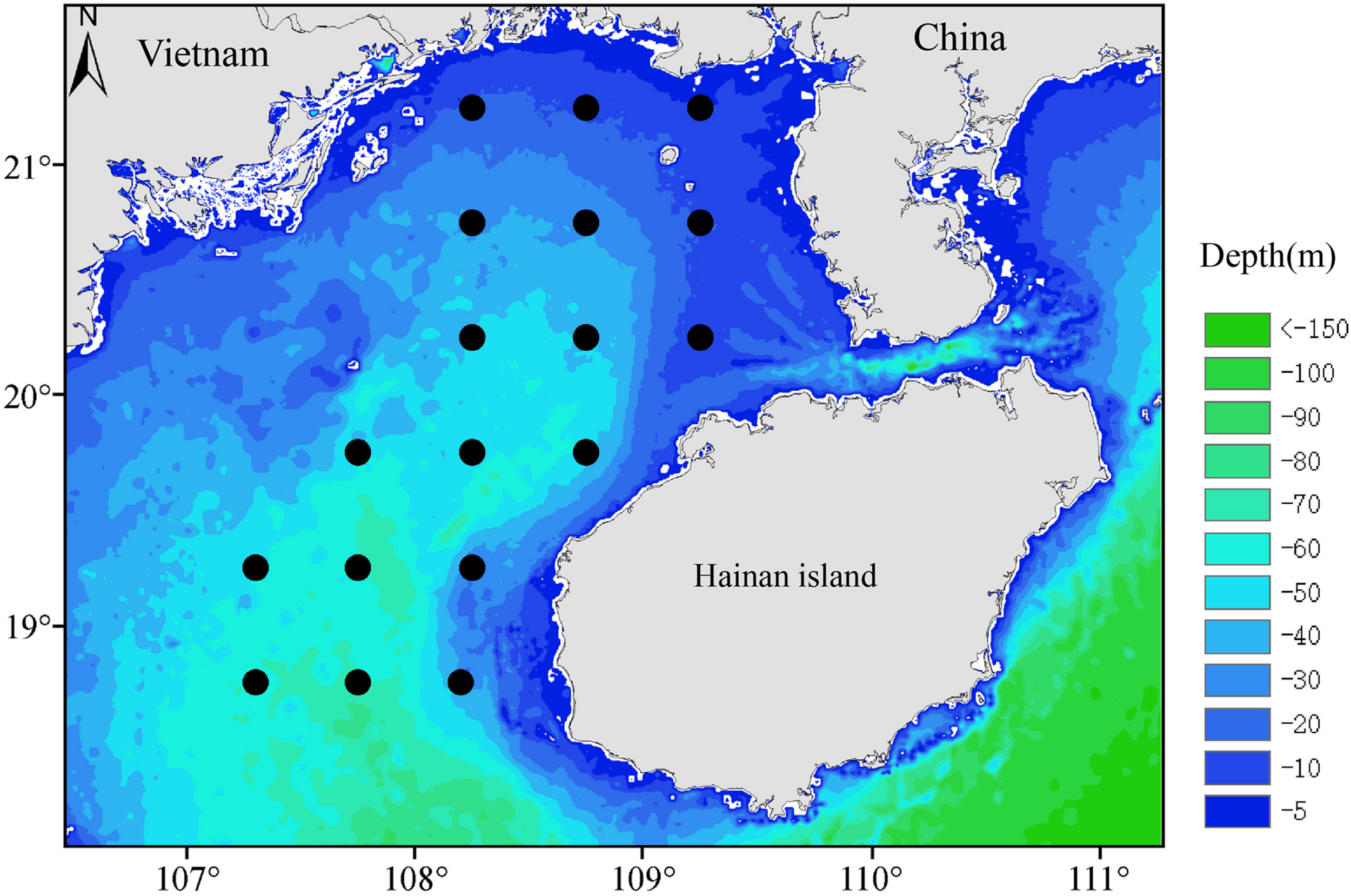
Location of the 18 stations (bold dots) with the bottom trawl in the South China Sea.
TABLE 1
| Scientific name | Min (mm) | Max (mm) | Class interval | Number | L inf (cm) | Z/K prior | M/K prior | F/K prior | Lc prior | Alpha prior |
| Acropoma japonicum | 27 | 91 | 3 | 162 | 11 | 2.2 | 1.5 | 0.661 | 5.05 | 25.4 |
| Pennahia microcephalus | 59 | 236 | 5 | 333 | 29.4 | 3 | 1.5 | 1.47 | 8.67 | 57.2 |
| Ariomma indica | 78 | 152 | 5 | 186 | 17 | 3.9 | 1.5 | 2.44 | 9.69 | 29.5 |
| Branchiostegus argentatus | 76 | 298 | 5 | 263 | 30.2 | 9 | 1.5 | 7.53 | 9.69 | 65.8 |
| Decapterus maruadsi | 71 | 292 | 5 | 772 | 33.3 | 1.6 | 1.5 | 0.118 | 10.7 | 32.4 |
| Parastromateus niger | 94 | 268 | 5 | 111 | 28.6 | 8.4 | 1.5 | 6.92 | 11.7 | 35.4 |
| Johnius belangerii | 75 | 170 | 5 | 553 | 17.2 | 1.1 | 1.5 | 0.3 | 9.95 | 36.1 |
| Nemipterus japonicus | 64 | 209 | 5 | 828 | 21.2 | 4.4 | 1.5 | 2.93 | 9.69 | 21.4 |
| Nemipterus peronii | 65 | 150 | 5 | 240 | 15 | 2 | 1.5 | 0.498 | 7.96 | 20.6 |
| Nemipterus virgatus | 62 | 286 | 5 | 669 | 30.8 | 7.2 | 1.5 | 5.72 | 10.7 | 17.9 |
| Evynnis cardinalis | 41 | 196 | 10 | 1309 | 20 | 4 | 1.5 | 2.51 | 8.16 | 15.2 |
| Pennahia anea | 72 | 166 | 5 | 168 | 20.1 | 1 | 1.5 | 0.3 | 11 | 22.1 |
| Pennahia pawak | 65 | 203 | 5 | 1845 | 20.7 | 2.3 | 1.5 | 0.789 | 8.67 | 42.2 |
| Siganus fuscescens | 82 | 201 | 5 | 117 | 24.3 | 3.5 | 1.5 | 2.04 | 12.2 | 44.9 |
| Terapon theraps | 60 | 206 | 5 | 1083 | 20.7 | 6.7 | 1.5 | 5.22 | 9.44 | 23 |
| Trachurus japonicus | 65 | 188 | 5 | 809 | 20 | 1.8 | 1.5 | 0.295 | 11 | 20.4 |
| Trichiurus japonicus | 65 | 257 | 5 | 168 | 30.3 | 8.6 | 1.5 | 7.1 | 11.2 | 80.6 |
| Upeneus bensasi | 77 | 145 | 5 | 143 | 14.7 | 2.8 | 1.5 | 1.32 | 9.95 | 45.7 |
| Upeneus moluccensis | 60 | 184 | 5 | 370 | 18.8 | 4.9 | 1.5 | 3.41 | 8.93 | 23.7 |
Basic information and priors of 19 species used in this present study.
In this study, all analyses were performed using the R-code (LBB_28. R), which can be downloaded from http://oceanrep.geomar.de/44832/ along with a New User Guide.
Declaration Statement
Our manuscript was based on survey cruise data and no live vertebrates or higher invertebrates were involved; therefore, we believe an ethical review process was not required for our study.
General Description of the LBB Method
The LBB estimator is a new method to analyze the LF data of economic fishery catches (Liang et al., 2020). The LBB model is suitable for species that grow throughout their lives, such as most economic fish and invertebrates, and only LF data is needed to evaluate them (Froese et al., 2018). It estimates asymptotic body length (Linf), first catch body length (Lc), relative natural mortality (M/K) and relative fishing mortality (F/M) in the age range represented by LF samples. These parameters were used as inputs to estimate the ratio (B/B0) of the depletion or currently developed biomass to the undeveloped biomass using the standard fishery equation (von Bertalanffy, 1938; Beverton and Holt, 1957).
These parameters can be used to estimate the Lc of the maximum catch and the ratio of MSY to undeveloped biomass (BMSY/B0). Froese et al. (2018) considered that no significant difference is found between the estimated relative biomass of LBB and the “true value” in all cases assessed in their study, and the value in the simulation data is similar to the independent estimated value of the complete inventory assessment. The median maximum body length of the validation year is used as the prior value of Linf instead of the default absolute maximum body length (Froese et al., 2018; see also Froese et al., 2019).
The LBB method first estimates the asymptotic body length Linf, the first catch body length Lc, the average M/K and the F/K in the past few years, provided that 50% of the individuals are caught by fishing gear. If the value of Linf can be obtained from independent studies, it can be introduced as a prior value to reduce the uncertainty of LBB evaluation. With these parameters, the relative size of the current population can be calculated from the standard fishery equation.
In this study, we only show the basic equations below. The detailed methods can be found in Froese et al. (2018).
First, it is assumed that the growth in length follows von Bertalanffy’s (1938) growth equation, in the form assigned by Beverton and Holt (1957):
where Lt is the length at age t, Linf is the asymptotic length, K is the rate at which Linf is approached, and t0 is the theoretical age at zero length (Liang et al., 2020).
If the fishing gear is completely selective, the catch on the body length curve is a function of the total mortality related to K. The equation of this curve is as follows:
where NL is the number of survivors to length L, NLstart is the number at length Lstart with full selection; that is, from which all individuals entering the gear are retained by the gear, and Z/K is the ratio of the total mortality rate Z to somatic growth rate.
In addition to the parameters in Equation 2, the catch affected by partial selection is the selectivity function of fishing gear (assumed to be trawl type) of each species given by the function in Equation 3:
where SL is the fraction of individuals that are retained by the gear at length L, and α describes the steepness of the ogive (Froese et al., 2018).
To estimate Linf, Lc, α, M/K and F/K simultaneously, Equation 2 must be replaced by a difference equation fitting the whole fishing quantity curve:
and
where Li is the number of individuals at length i, Li–1 is the number at the previous length, where C refers to the number of individuals vulnerable to the gear and all other parameters are as described above (Froese et al., 2018).
Finally, according to the estimated values of Linf and M/K, the Lopt with the maximum biomass of the undeveloped population is obtained from Equation 6:
On the basis of a given fishing pressure (F/M) and Equation 6, the mean length at first capture, which maximizes catch and biomass (Lc_opt), can be obtained from:
Estimates of Lc_opt are used below to calculate a proxy for the relative biomass that can produce the MSY (Froese et al., 2018).
Parameter F/M > 1 indicates that the assessed stocks are being overfished, and parameter B/B0 < 1 indicates that the current biomass is lower than that unfished biomass. In particular, B/B0 < 0.5 indicates that the existing biomass of the stocks is already at a very low level. If the ratios (Lmean/Lopt and Lc/Lc_opt) are below 1 indicate a truncated length structure and fishing mortality concentrated on small individuals. If the parameter of the 95th percentile length to asymptotic length L95th/Linf is close to one (>0.9), this suggests that there are at least some large fish in this region. The stock status was evaluated according to the estimated value of B/BMSY, showed in Table 2 (Froese et al., 2018; Palomares et al., 2018; Ju et al., 2020a; Liang et al., 2020; Wang Y. et al., 2020, 2021).
TABLE 2
| B/BMSY | Stock status |
| ≥1 | Healthy |
| 0.8–1.0 | Slightly overfished |
| 0.5–0.8 | Overfished |
| 0.2–0.5 | Grossly overfished |
| ≤0.2 | Collapsed |
The definition of the stock status based on the B/BMSY in the present study.
The relative biomass and first catch length estimated by LBB can be directly used to manage the stock with limited data, as follows (Wang Y. et al., 2020):
If relative stock size B/B0 is smaller than BMSY/B0 (B/BMSY < 1), the catches should be reduced;
If the mean length at first capture Lc is smaller than Lc_opt, then fishing can be started with a larger individual size.
Results
In this study, the stock resources of 19 Perciformes living in the Beibu Gulf were evaluated using the LBB method. The parameters Lmean/Lopt, Lc/Lc_opt, L95th/Linf, B/B0, B/BMSY, F/M, F/K, and Z/K were obtained (Table 3). The ratios Lmean/Lopt and Lc/Lc_opt were below one in 14 out of the 19 stocks, suggesting a truncated length structure and fishing of undersized individuals. The ratio of the 95th percentile length to asymptotic length L95th/Linf was close to one (>0.9) in 10 out of 19 stocks, suggesting that at least some large fish were still present. The ratio B/B0 was smaller than BMSY/B0 in 19 stocks, suggesting these fish species included in this study are being low biomass. Furthermore, the relative biomass (B/B0) for nineteen of the species in the Beibu Gulf evaluated here was 0.25 on average, which indicated a depletion rate of 75%.
TABLE 3
| Scientific name | Lmean/Lopt | Lc/Lc_opt | L95th/Linf | B/B0 | B/BMSY | F/M | F/K | Z/K | Assessment |
| Acropoma japonicum | 0.84 | 0.8 | 0.82 | 0.32 | 0.89 | 1 | 1.5 | 3.09 | Slightly overfished |
| Pennahia microcephalus | 0.61 | 0.45 | 0.83 | 0.2 | 0.53 | 1.3 | 1.8 | 3.35 | Overfished |
| Ariomma indica | 0.97 | 0.95 | 0.9 | 0.24 | 0.66 | 1.7 | 2.5 | 3.96 | Overfished |
| Branchiostegus argentatus | 0.6 | 0.48 | 0.9 | 0.043 | 0.12 | 4.4 | 6.5 | 7.9 | Collapsed |
| Decapterus maruadsi | 0.72 | 0.6 | 0.91 | 0.28 | 0.77 | 0.99 | 1.6 | 3.11 | Overfished |
| Parastromateus niger | 0.75 | 0.69 | 0.94 | 0.053 | 0.15 | 5.5 | 9.1 | 10.8 | Collapsed |
| Johnius belangerii | 1 | 1.2 | 0.6 | 0.85 | 2.3 | 0.13 | 0.16 | 1.42 | Healthy |
| Nemipterus japonicus | 0.95 | 0.93 | 0.88 | 0.17 | 0.48 | 2.4 | 4 | 5.7 | Grossly overfished |
| Nemipterus peronii | 1.3 | 1.5 | 0.93 | 0.72 | 2 | 0.3 | 0.63 | 2.8 | Healthy |
| Nemipterus virgatus | 0.74 | 0.68 | 0.93 | 0.042 | 0.12 | 6.2 | 10 | 11.6 | Collapsed |
| Evynnis cardinalis | 0.89 | 0.84 | 0.98 | 0.065 | 0.17 | 5.9 | 7.8 | 9.08 | Collapsed |
| Pennahia anea | 0.92 | 0.88 | 0.83 | 0.24 | 0.64 | 1.6 | 2.1 | 3.4 | Overfished |
| Pennahia pawak | 0.82 | 0.75 | 0.99 | 0.34 | 0.94 | 0.88 | 1.4 | 2.93 | Slightly overfished |
| Siganus fuscescens | 0.8 | 0.74 | 0.82 | 0.12 | 0.33 | 2.8 | 3.9 | 5.36 | Grossly overfished |
| Terapon theraps | 0.91 | 0.86 | 0.96 | 0.09 | 0.25 | 4.3 | 7.2 | 8.88 | Grossly overfished |
| Trachurus japonicus | 1 | 1.1 | 9.2 | 0.43 | 1.2 | 0.88 | 1.2 | 2.55 | Healthy |
| Trichiurus japonicus | 0.65 | 0.55 | 0.86 | 0.049 | 0.13 | 4.6 | 6.8 | 8.3 | Collapsed |
| Upeneus bensasi | 1.1 | 1.2 | 0.91 | 0.37 | 1 | 1.2 | 1.9 | 3.58 | Healthy |
| Upeneus moluccensis | 1 | 0.98 | 0.96 | 0.17 | 0.49 | 2.4 | 4.9 | 6.98 | Grossly overfished |
Estimates of 19 fish species for 2011 given by LBB.
Figures 2–5 are the specific evaluation results of LBB method. The blue line in the figures represents the fit of the data and the LBB estimation, and the red line is the evaluation from the LBB method of population resources. Figure 2 shows similar results for five species. The LBB model gives a good fit. The parameter B/BMSY ranges from 0.12 to 0.17, and the estimated value of F/M is far greater than one. Therefore, the status of the stock of these five species (Branchiostegus argentatus, Parastromateus niger, Nemipterus virgatus, Evynnis cardinalis, and Trichiurus japonicus) is “collapsed.” The results for four similar species are shown in Figure 3. The estimated value of B/BMSY ranges from 0.25 to 0.49, and the estimated value of F/M is greater than 1. It is considered that the resource status of these four species (Nemipterus japonicus, Siganus fuscescens, Terapon theraps, Upeneus moluccensis) is “grossly overfished.” The results of six similar species are shown in Figure 4. The estimated values of the parameter B/BMSY range from 0.53 to 0.94, and the estimated value of F/M is close to 1. It is considered that the resource states of Acropoma japonicum and Pennahia pawak are “slightly overfished,” while Pennahia microcephalus, Ariomma indica, Decapterus maruadsi, and Pennahia anea are “overfished.” Finally, Figure 5 shows the results of four similar species where the parameter B/BMSY ranges from 1 to 2.3. Our assessment considers that the resource status of these species (Johnius belangerii, Nemipterus peronii, Trachurus japonicus, and Upeneus bensasi) is “healthy.”
FIGURE 2
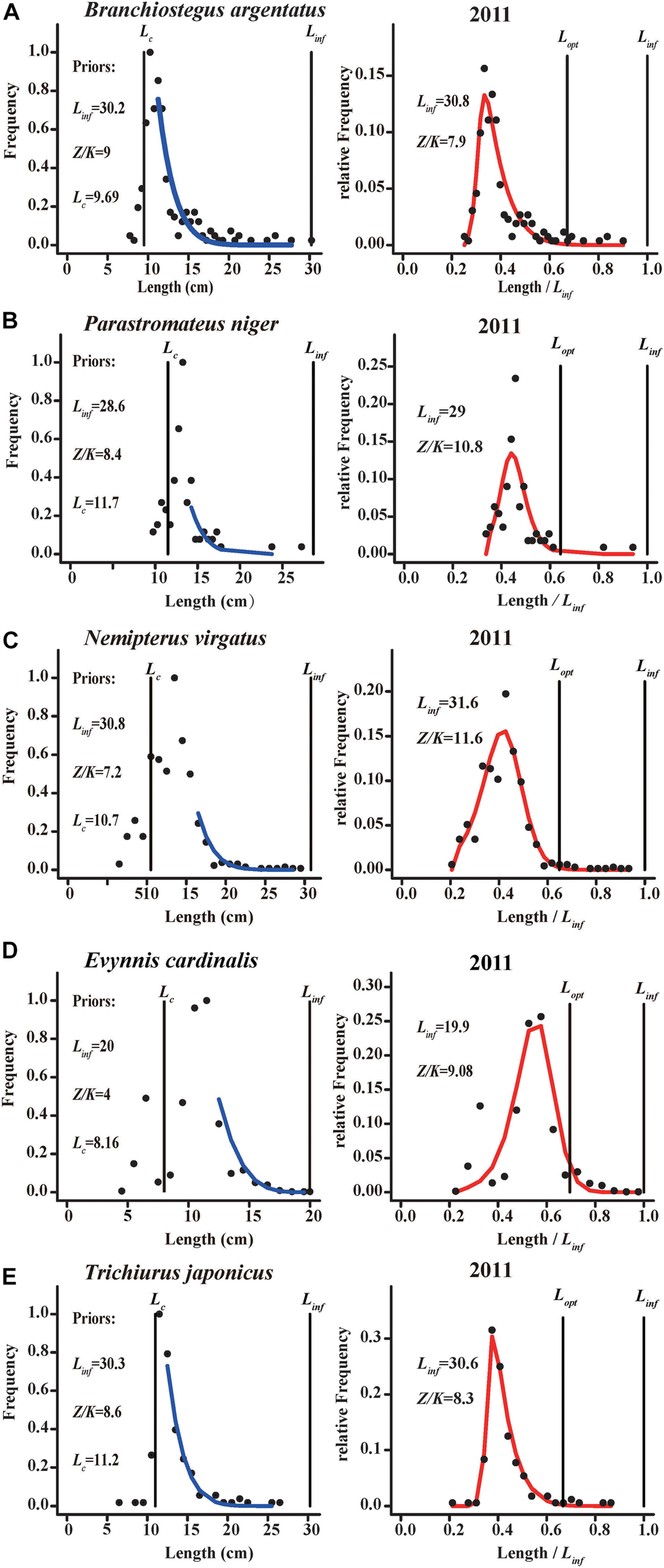
The assessment results of five “collapsed” species with length-based Bayesian biomass (LBB) method in Beibu Gulf. The blue line (left) represents the fit of the data and the LBB estimation, and the red line (right) is the evaluation from the LBB method of stock resources. (A–E) Presents the result of Branchiostegus argentatus, Parastromateus niger, Nemipterus virgatus, Evynnis cardinalis, and Trichiurus japonicus, respectively.
FIGURE 3
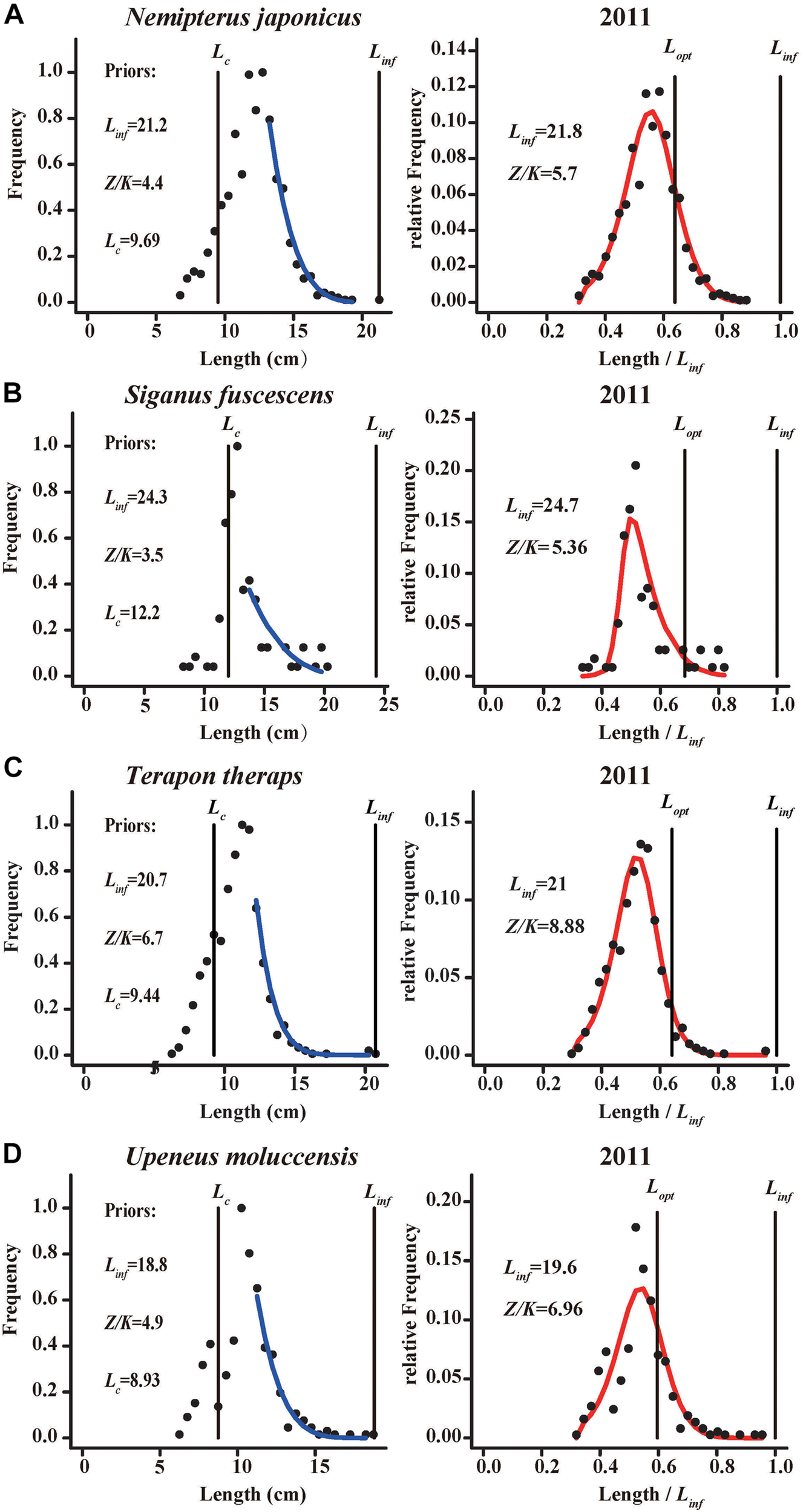
The assessment results of four “grossly overfished” species with LBB method in Beibu Gulf. (A–D) Presents the result of Nemipterus japonicus, Siganus fuscescens, Terapon theraps, and Upeneus moluccensis, respectively.
FIGURE 4
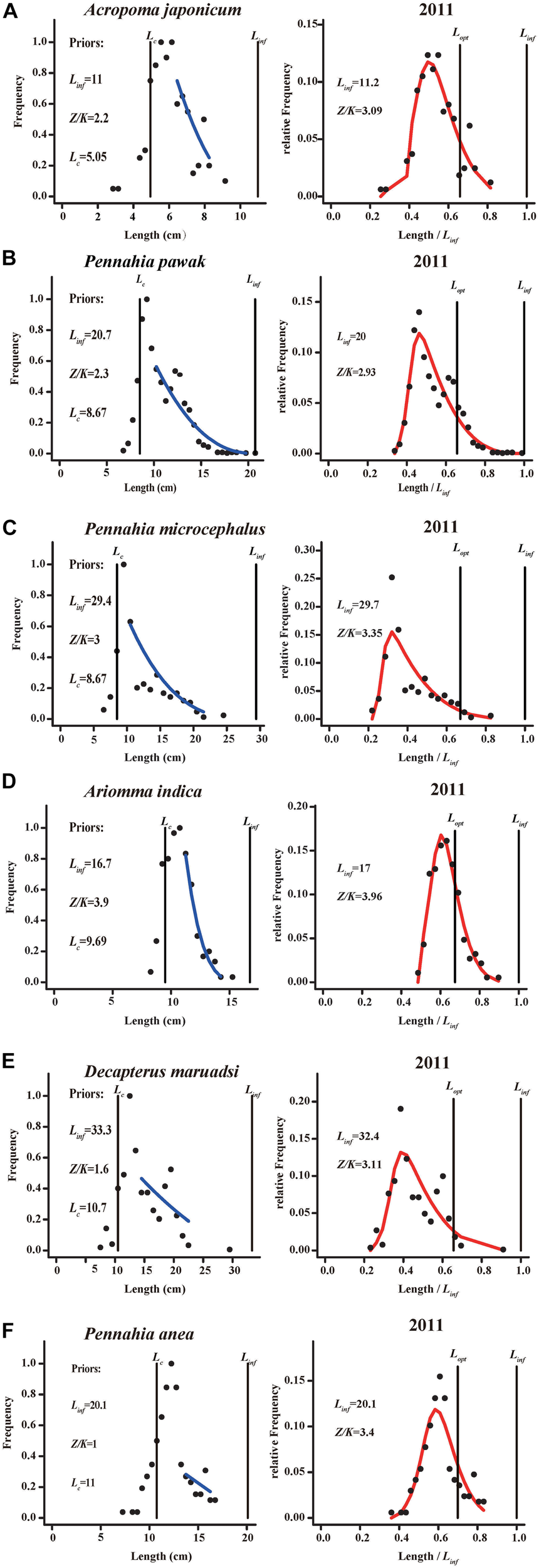
The assessment results of two “slightly overfished” species and four “overfished” species with LBB method in Beibu Gulf. (A,B) Presents the result of Acropoma japonicum and Pennahia pawak, respectively. (C–F) Presents the result of Pennahia microcephalus, Ariomma indica, Decapterus maruadsi, and Pennahia anea, respectively.
FIGURE 5
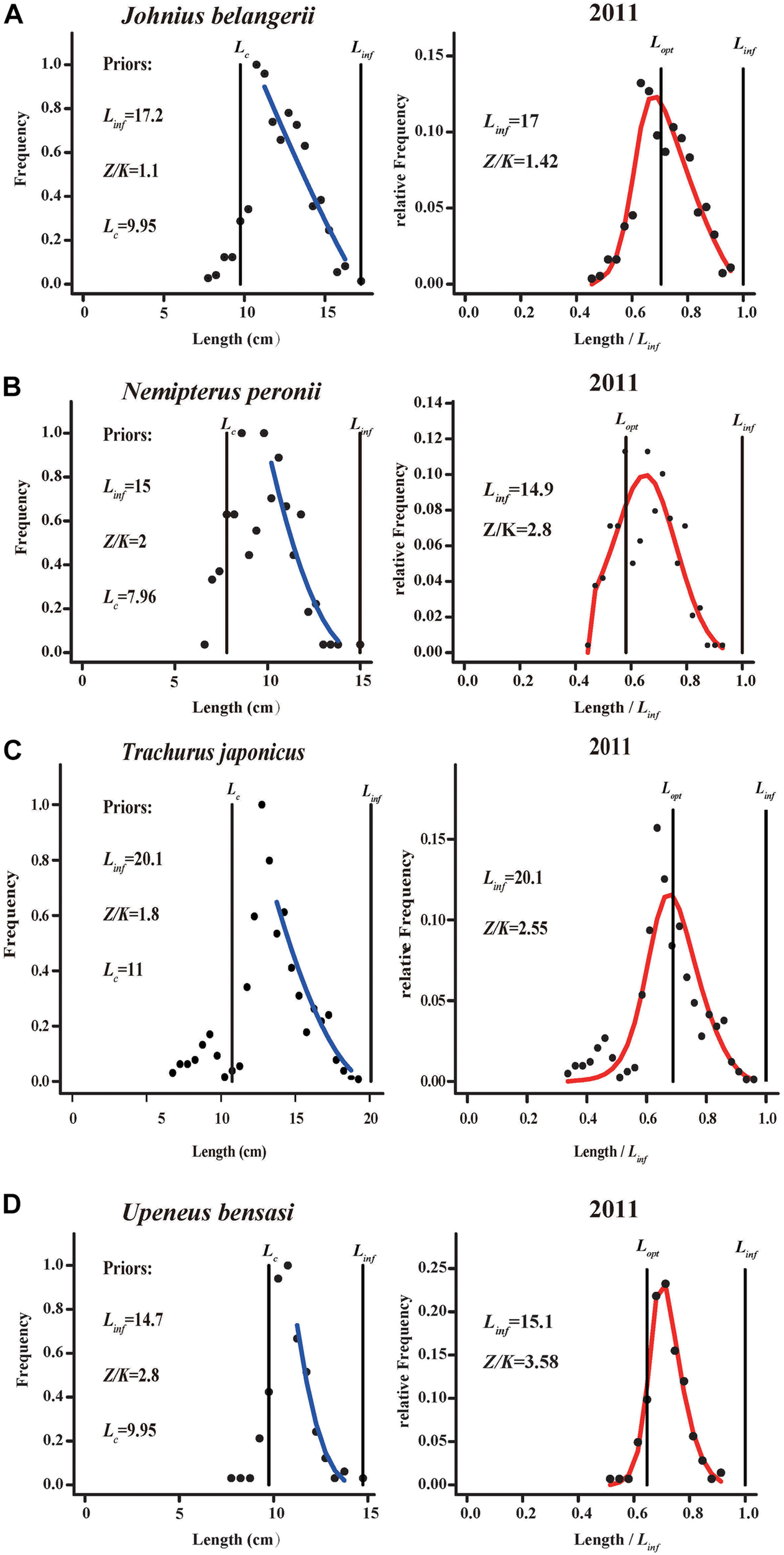
The assessment results of four “healthy” species with LBB method in Beibu Gulf. (A–D) Presents the result of Johnius belangerii, Nemipterus peronii, Trachurus japonicus, and Upeneus bensasi, respectively.
Discussion
Most coastal fish populations in China cannot be evaluated comprehensively because of a lack of data (Liang et al., 2020). However, the LBB method can effectively evaluate the population with limited LF data (Ju et al., 2020a; Liang et al., 2020; Wang Y. et al., 2020, 2021; Zhang et al., 2020, 2021; Wang X. et al., 2021). The stock status was given in the LBB model based on the parameter B/BMSY, which had been described in detail in previous studies (Froese et al., 2018; Wang Y. et al., 2021).
In this study, the LBB method was used to evaluate the resource status of 19 Perciformes in the Beibu Gulf. The results showed that only 21% of the evaluated stocks were healthy and 79% were overfished. In particular, 26 and 21% of the assessed species were exhausted and severely overfished, respectively, while only 11 and 21% of the assessed species were slightly overfished and overfished, respectively. Zhang et al. (2021) assessed the resources of 10 species around the Nansha Islands, South China Sea. It was considered that the resources of 80% of the species assessed were overfished. According to Ju et al. (2020a), 80% of the five shark stocks living around Taiwan, South China Sea, were overfished; Zhang et al. (2020) evaluated 20 stock resources in Min River Estuary and found that 65% of the stock was overfished. The results of this study are consistent with these reports indicate most fish living in the South China Sea are facing overfishing pressures (Table 4). The ratio B/B0 was smaller than BMSY/B0 in all 19 stocks, suggesting the fish species included in this study are being low biomass. The relative biomass (B/B0) for the 19 species in the Beibu Gulf evaluated here was 0.25 on average, which indicated a depletion rate of 75%. This result was consistent with the 84% average depletion reported by Zhai and Pauly (2019). The ratios Lmean/Lopt and Lc/Lc_opt were below one in 14 out of the 19 stocks, suggesting a truncated length structure and fishing of undersized individuals. However, the ratio of the 95th percentile length to asymptotic length L95th/Linf was close to one (>0.9) in 10 out of 19 stocks, suggesting that at least some large fish were still present.
TABLE 4
| Scientific name | Assessment methods | Study area | Time | Stock status | This Study | References |
| Acropoma japonicum | None | None | None | None | Slightly overfished | None |
| Pennahia microcephalus | LBB | Beibu Gulf | 2006–2014 | Overfished | Overfished | Wang Y. et al., 2021 |
| Ariomma indica | Electronic Length Frequency Analysis | The South China Sea | 2003 | Overfished | Overfished | Huang and Chen, 2005 |
| Branchiostegus argentatus | Resource Survey | The South China Sea | 1993–1994; 1997–1999 | Healthy | Collapsed | Wu and Xie, 2002 |
| Branchiostegus argentatus | Resource Survey | Mid-Southern East China Sea | 1994 | Healthy | Collapsed | Lin et al., 1996 |
| Decapterus maruadsi | Electronic Length Frequency Analysis | Beibu Gulf | 1992–2012 | Overfished | Overfished | Geng et al., 2018 |
| Parastromateus niger | Resource Survey | The South China Sea | 1972–1984 | Healthy | Collapsed | Lu et al., 1986 |
| Johnius belangerii | None | None | None | None | Healthy | None |
| Nemipterus japonicus | Beverton-Holt Y/R Analysis | Pakistan | 2014 | Healthy | Grossly overfished | Ali et al., 2014 |
| Nemipterus peronii | None | None | None | None | Healthy | None |
| Nemipterus virgatus | Schaefer Model; Fox Model; Schnute Model | The South China Sea | 2008–2017 | Overfished | Collapsed | Wu et al., 2021 |
| Evynnis cardinalis | LBB | Beibu Gulf | 2006–2018 | Overfished | Collapsed | Wang X. et al., 2020 |
| Pennahia anea | Resource Survey | Northern South China Sea | 2008–2009 | Overfished | Overfished | Tuuli et al., 2011 |
| Pennahia pawak | Electronic Length Frequency Analysis | Beibu Gulf | 2008–2009; 2018–2019 | Healthy | Slightly overfished | Yi et al., 2021 |
| Siganus fuscescens | None | None | None | None | Grossly overfished | None |
| Terapon theraps | None | None | None | None | Grossly overfished | None |
| Trachurus japonicus | Resource Survey | Northern South China Sea | 1997–1999 | Healthy | Healthy | Chen and Qiu, 2004 |
| Trichiurus japonicus | YPR And SPR | Sea Of Japan | 2003–2011 | Overfished | Collapsed | Watari et al., 2017 |
| Upeneus bensasi | Resource Survey | Beibu Gulf | 2007 | Healthy | Healthy | Zhu et al., 2008 |
| Upeneus moluccensis | None | None | None | None | Grossly overfished | None |
Comparison of fishery resource assessment studies for 19 species.
In this study, five stocks (Branchiostegus argentatus, Parastromateus niger, Nemipterus virgatus, Evynnis cardinalis, and Trichiurus japonicus) had collapsed. Branchiostegus argentatus belongs to the warm-temperate fish, living in the middle and lower layers, and its maximum body length is 27.3 (see text footnote 1). In the 1990s, the resource status was healthy (Lin et al., 1996; Wang, 2002). However, because the mesh size used is less than 5 cm, its larvae are also caught in large quantities (Lin et al., 1996). With the increase in fishing intensity, the stocks of Branchiostegus argentatus are almost exhausted. Parastromateus niger is a pelagic fish that migrates in warm water in the open sea. It is one of the fish species with high economic value in the South China Sea. Its stock resources were rich from 1972 to 1984, but with the increasing catch (Lu et al., 1986), the resources by 2011 were overburdened, and the biomass was at a very low level. Nemipterus virgatus is one of the five major economic fishes in the northern South China Sea. Overfishing occurred in the 5 years from 2008 to 2017, especially in 2012, which was consistent with our assessment results (Wu et al., 2021). Evynnis cardinalis is mainly distributed in the South China Sea and the South East China Sea and is one of the important species for the bottom trawl fishery. Wang X. et al. (2020) evaluated the stock resources in Beibu Gulf from 2006 to 2018 by the LBB method, and the results showed that the resources were overfished, especially in 2010 and 2011, which is consistent with our evaluation. Trichiurus japonicus is a warm water pelagic fish, which is one of the most valuable fish species in the northern South China Sea.
Four stocks (Nemipterus japonicus, Siganus fuscescens, Terapon theraps, and Upeneus moluccensis) are grossly overfished. Nemipterus japonicus is widely distributed through the Indian Ocean and West Pacific. Ali et al. (2014) analyzed the population resources in the Indian Ocean from 1986 to 2014, but not in the South China Sea. Similarly, although Siganus fuscescens, Terapon theraps, and Upeneus moluccensis occupy an important economic position in China’s fisheries (Ma and Liu, 2006), the specific assessment of their resources has not been reported before.
The resource status of four stocks (Pennahia microcephalus, Ariomma indica, Decapterus maruadsi, and Pennahia anea) is overfished. Pennahia microcephalus is widely distributed in the Indo-West Pacific tropical regions, including the East China Sea and the South China Sea. It is one of the dominant commercial fish species throughout the coastal area of Southeast China (Yan et al., 2009). Wang M. D. et al. (2021) used the LBB method to evaluate its resource status in the Beibu Gulf. The results showed that the white croaker was overfished from 2006 to 2014, especially after 2009, which was consistent with the results of this study. Ariomma indica is a bottom fish, living in warm water. It is one of the most common economic fish in the South China Sea and also the main fishing target of bottom trawlers in the South China Sea (Lin, 2003). Decapterus maruadsi is one of the most common croakers currently on retail sale in Hong Kong, and its resources were overfished in 2008–2009 (Tuuli et al., 2011).
In this study, two stocks (Acropoma japonicum and Pennahia pawak) were slightly overfished, and four stocks (Johnius belangerii, Nemipterus peronii, Trachurus japonicus, and Upeneus bensasi) were healthy. Acropoma japonicum is one of the dominant species in the Beibu Gulf (Zhang et al., 2016; Cai et al., 2018), but there are few reports on its stocks. Pennahia pawak is a relatively stable resource species in the Beibu Gulf, which has important ecological status and economic benefits. On the basis of the analysis of fishery biology, Yi et al. (2021) thought that the resources of Pennahia pawak were lightly exploited. Johnius belangerii is one of the main economic species of fishing in China. With the overfishing of offshore waters, its resources have begun to decline (Guo et al., 2017). Nemipterus peronii is widely distributed in the Indo Western Pacific, from the Red Sea to Taiwan and northern Australia, and its maximum body length is 29 cm (see text footnote 1). Trachurus japonicus is one of the main upper middle economic species in the northern South China Sea, and its resource status was healthy from 1997 to 1999 (Chen and Qiu, 2004). Upeneus bensasi is one of the main economic fishes in Beibu Gulf of China. Its resources were in a healthy state in 2008 (Zhu et al., 2008).
The Bayesian estimation model based on body length (LBB) is a new method to analyze the LF data of economic fishery catches (Froese et al., 2018). The advantages of the LBB model are as follows: (1) the results of relative biomass or stock state have been verified by simulation and actual stocks; (2) there is no significant difference between the predicted LBB and the simulated B/B0; (3) the prediction of stock status by LBB is similar to that of other models; (4) LBB makes a preliminary estimation of the status of the fish group according to the LF data of the fishery; and (5) the results of LBB provide objective B/B0 priors for other evaluation methods such as CMSY and AMSY (Froese et al., 2017, 2018). The LBB method only needs body length and frequency to evaluate the fish resources in a certain region, which solves the problem that some regions cannot evaluate the fishery germplasm resources owing to the lack of available data. However, the LBB model is not always accurate because it only inputs length and frequency data. If the LBB method is combined with other models, the results will be more reliable (Wang Y. et al., 2020, 2021).
Conclusion
The stock status of 19 species of Perciformes living in the Beibu Gulf was evaluated by the LBB method. Among the 19 fish stocks assessed, 15 were overfished and only 4 were healthy. The resources of Branchiostegus argentatus, Parastromateus niger, Nemipterus virgatus, Evynnis cardinalis, and Trichiurus japonicus have collapsed because of long-term overfishing, and the existing biomass is at a low level. Fishery managers need to take specific measures, such as limiting the size of fishing nets and reducing the operation time of fishing vessels, to restore fishery resources. However, the resource status of Johnius belangerii, Nemipterus peronii, Trachurus japonicus, and Upeneus bensasi is relatively healthy, and the population development rate is relatively low. There is still room for development of these fisheries. Therefore, we can appropriately increase the catch of these populations, so as to reduce the fishing pressure on depleted fish species in the South China Sea. Although LBB can easily and quickly evaluate the status of fishery resources, the assessment results may not be accurate because only the frequency of fish body length is used. It needs to be combined with other models or methods to obtain more accurate resource assessment results.
Publisher’s Note
All claims expressed in this article are solely those of the authors and do not necessarily represent those of their affiliated organizations, or those of the publisher, the editors and the reviewers. Any product that may be evaluated in this article, or claim that may be made by its manufacturer, is not guaranteed or endorsed by the publisher.
Statements
Data availability statement
The original contributions presented in the study are included in the article/Supplementary Material, further inquiries can be directed to the corresponding author.
Ethics statement
The animal study was reviewed and approved by Guangdong Ocean University.
Author contributions
GH and HZ analyzed the LF data and completed the first draft. HZ provided guidance on data analysis and structure of the manuscript. JW, YC, and JL provided suggestions on the revision of the manuscript. JW, YC, and JL helped to collect the original length data. All authors are contributed to revise the manuscript.
Funding
This study was supported by the National Natural Science Foundation of China (Nos. 42090044 and 31702347), the Strategic Priority Research Program of the Chinese Academy of Sciences (No. XDB42000000), Youth Innovation Promotion Association CAS (No.2020211), and the start-up project of Guangdong Ocean University (No. R19006).
Acknowledgments
We thank numerous colleagues for their generous support of this study and thank the editor and reviewers for their constructive suggestions to our work.
Conflict of interest
The authors declare that the research was conducted in the absence of any commercial or financial relationships that could be construed as a potential conflict of interest.
Supplementary material
The Supplementary Material for this article can be found online at: https://www.frontiersin.org/articles/10.3389/fmars.2021.731837/full#supplementary-material
Footnotes
References
1
Ali K. M. Liu Q. Hussain M. K. Saleem C. M. Zhang K. (2014). Population dynamics of Japanese threadfin bream Nemipterus japonicus from Pakistani waters.Acta Oceanol. Sin.3349–57. 10.1007/s13131-014-0401-1
2
Beverton R. J. H. Holt S. J. (1957). On the Dynamics of Exploited Fish Populations.Ministry of Agriculture, Fishesries and Food, Series II, XIX. London: Fishery Investigations, 533.
3
Cai Y. Xu S. Chen Z. Xu Y. Jiang Y. Yang C. (2018). Current status of community structure and diversity of fishery resources in offshore northern South China Sea.South China Fish. Sci.1410–18.
4
Chen G. Qiu S. (2004). Growth, mortality and rational utilization of horse mackerel in northern South China Sea.J. Zhejiang Ocean Univ.2435–40.
5
FAO (2019). FAO Yearbook.Rome: Fishery and Aquaculture Statistics, 2017.
6
Froese R. Demirel N. Coro G. Kleisner K. M. Winker H. (2017). Estimating fisheries reference points from catch and resilience.Fish Fish.18506–526. 10.1111/faf.12190
7
Froese R. Winker H. Coro G. Demirel N. Tsikliras A. C. Dimarchopoulou D. et al (2018). A new approach for estimating stock status from length frequency data.ICES J. Mar. Sci.752004–2015. 10.1093/icesjms/fsy078
8
Froese R. Winker H. Coro G. Demirel N. Tsikliras A. C. Dimarchopoulou D. et al (2019). On the pile-up effect and priors for Linf and M/K: response to a comment by Hordyk et al. on “A new approach for estimating stock status from length-frequency data”.ICES J. Mar. Sci.76461–465. 10.1093/icesjms/fsy199
9
Geng P. Zhang K. Chen Z. Xu Y. Sun M. (2018). Interannual change in biological traits and exploitation rate of Decapterus maruadsi in Beibu Gulf. South China Fish. Sci.14, 1–9. 10.12131/20180106
10
Guo H. Xu M. Shen Y. Ye N. Cao Y. (2017). Preliminary study on the biological characteristics of Johnius belangerii in Liusha Bay.J. Hainan Trop. Ocean Univ.2410–18.
11
Huang Z. R. Chen Z. Z. (2005). Stock actuality of Ariomma indica (Da) in southwestern continental shelf of Nansha Islands. J. Shanghai Fish. Univ.14, 472–476.
12
Jin X. Dou S. Shan X. Wang Z. Wan R. Bian X. (2015). Hot spots of frontiers in the research of sustainable yield of Chinese inshore fishery.Prog. Fish. Sci.36124–131. 10.11758/yykxjz.20150119
13
Jin X. Li X. Zhao X. Cheng J. Li S. Zhang H. (2012). Technical Specification for Marine Fishery Resource Survey.Beijing: Ministry of Agriculture of the People’s Republic of China.
14
Ju P. Chen M. Tian Y. Zhao Y. Yang S. Xiao J. (2020a). Stock status estimating of 5 shark species in the waters around Taiwan using a length-based bayesian biomass estimation (LBB) method.Front. Mar. Sci.7:632. 10.3389/fmars.2020.00632
15
Ju P. Tian Y. Chen M. Yang S. Liu Y. Xing Q. et al (2020b). Evaluating stock status of 16 commercial fish species in the coastal and offshore waters of Taiwan using the CMSY and BSM methods.Front. Mar. Sci.7:618. 10.3389/FMARS.2020.00618
16
Kang B. Liu M. Huang X. X. Li J. Yan Y. R. Han C. C. et al (2018). Fisheries in Chinese seas: what can we learn from controversial official fisheries statistics?Rev. Fish Biol. Fish.28503–519. 10.1007/s11160-018-9518-1
17
Kindong R. Gao C. Pandong N. Ma Q. Tian S. Wu F. et al (2020). Stock status assessments of five small pelagic species in the Atlantic and Pacific Oceans using the length-based bayesian estimation (LBB) method.Front. Mar. Sci.7:592082. 10.3389/fmars.2020.592082
18
Li Y. Wang C. Zou X. Feng Z. Yao Y. Wang T. et al (2019). Occurrence of polycyclic aromatic hydrocarbons (PAHs) in coral reef fish from the South China Sea.Mar. Pollut. Bull.139339–345. 10.1016/j.marpolbul.2019.01.001
19
Liang C. Xian W. Liu S. Pauly D. (2020). Assessments of 14 exploited fish and invertebrate stocks in Chinese waters using the LBB method.Front. Mar. Sci.7:314. 10.3389/fmars.2020.00314
20
Lin F. L. Lin W. Z. Wang Y. X. (1996). Status and prospectives for Silver horsehead, Branchiostegus argentatus (Cuvier et Valenciennes) resource off sea of South-Central in East China Sea.Mod. Fish. Inf.1113–14.
21
Lin Z. J. (2003). Stock changes of Indian Driftfish Ariomma Indica in Northern South China Sea.J. Trop. Oceanogr.2271–75.
22
Lu Z. B. Yan Y. M. Dai Q. (1986). A study on fishery and biology of Fomio niger.J. Fujian Fish.18–15.
23
Ma C. H. You K. Li F. Q. Zhang M. Z. (2006). Dynamic data-exchange between WinCC and supervisory systems by the OPC interfaces.J. Ocean U. China.36665–670.
24
Ma Q. Liu J. (2006). Introduction and prospect of the systerm atics study of Siganidae in China.South China Fish. Sci.268–74.
25
Ng P. K. L. Tan K. S. (2000). The state of marine biodiversity in the South China Sea.Bull. Zool.83–7.
26
Palomares M. L. D. Froese R. Derrick B. Nöel S.-L. Tsui G. Woroniak J. et al (2018). A Preliminary Global Assessment of the Status of Exploited Marine Fish and Invertebrate Populations.A Report Prepared by the Sea Around Us for Oceana. Vancouver, BC: The University of British Columbia, 64.
27
Sun D. F. Zhu W. C. Ai H. Li N. N. Dong L. N. Shi B. R. (2010). Taxonomic diversity of fish species in Beibu Gulf.Guangdong Agric. Sci.374–7.
28
Tuuli C. D. Mitcheson Y. S. Liu M. (2011). Reproductive biology of the greyfin croaker Pennahia anea in the northern South China Sea.Ichthyol. Res.58302–309. 10.1007/s10228-011-0228-0
29
von Bertalanffy L. (1938). A quantitative theory of organic growth (inquiries on growth laws. II.).Hum. Biol.10181–213. 10.2307/41447359
30
Wang M. D. Wang X. H. Sun D. R. Wang Y. Z. Chen X. J. Du Y. F. et al (2021). Assessment of Pennahia macrocephalus stock in Beibu Gulf by length Bayesian biomass estimation method.South China Fish. Sci.1720–27.
31
Wang X. He Y. Du F. Liu M. Bei W. Cai Y. et al (2021). Using LBB tools to assess miter squid stock in the northeastern South China Sea.Front. Mar. Sci.7:518627. 10.3389/fmars.2020.518627
32
Wang X. Qiu Y. Du F. Sun D. Wang Y. (2020). Using length-based Bayesian biomass method to estimate Evynnis cardinalis population parameters in the Beibu Gulf, South China Sea.J. Fish. China441654–1662.
33
Wang Y. Liang C. Xian W. Wang Y. (2021). Using the length-based Bayesian Biomass estimator method for the assessments of seven fish stocks from the Yangtze Estuary and its adjacent waters.Front. Mar. Sci.8:679299. 10.3389/fmars.2021.679299
34
Wang Y. Wang Y. Liu S. Liang C. Zhang H. Xian W. (2020). Stock assessment using LBB method for eight fish species from the Bohai and Yellow Seas.Front. Mar. Sci.7:164. 10.3389/fmars.2020.00164
35
Wang Y. X. (2002). A study on resources investigation of Branchiostegus argentatus (Cuiver), Taius tumifrons (Temminck et Schlegel) and Nemipterus virgatus (Houttuyn) in southern part of east China Sea.Mod. Fish. Inf.1717–20.
36
Watari S. Tokumitsu S. Hirose T. Ogawa M. Makino M. (2017). Stock structure and resource management of hairtail Trichiurus japonicus based on seasonal broods around the Bungo Channel, Japan. Fish. Sci.83, 865–878. 10.1007/s12562-017-1140-y
37
Wu H. Lv J. Zhang J. Lin C. Peng Y. Wang Z. (2021). A study on maximum sustainable yield and total allowable catch of Nemipterus virgatus in the northern South China Sea.Ocean Dev. Manag.3885–89.
38
Wu G. Xie Q. (2002). Preliminary study on fisheries biology of yellow horsehead Branchiostegus argentatus on the fishing ground off northeast Fujian. Mar. Fish.2, 63–65.
39
Yan Y. Wu Y. Lu H. Jin X. (2009). Using otolith weight to predict the age of Pennahia macrocephalus in the mouth of the Beibu Gulf.Chin. J. Oceanol. Limnol.27342–349. 10.1007/s00343-009-9210-3
40
Yi X. Qiu K. Zhou X. Zhao C. Deng Y. Zhang R. et al (2021). Analysis of fishery biology of Pennahia pawak in Beibu Gulf.J. Shanghai Ocean Univ.30515–524.
41
Zhai L. Liang C. Pauly D. (2020). Assessments of 16 exploited fish stocks in chinese waters using the CMSY and BSM methods.Front. Mar. Sci.7:483993. 10.3389/FMARS.2020.483993
42
Zhai L. Pauly D. (2019). Yield-per-recruit, utility-per-recruit and relative biomass of 21 exploited fish species in China’s coastal seas.Front. Mar. Sci.6:724. 10.3389/fmars.2019.00724
43
Zhang J. Yao Z. Lin L. Li Y. Song P. Zhang R. et al (2016). Spatial distribution of biomass and fishery biology of commercial fish in the mouth of Beibu Bay and the southwestern waters of the Nansha Islands.J. Ocean Univ. China46158–167.
44
Zhang K. Zhang J. Shi D. Chen Z. (2021). Assessment of coral reef fish stocks from the Nansha Islands, south China Sea, using length-based Bayesian biomass estimation.Front. Mar. Sci.7:610707. 10.3389/fmars.2020.610707
45
Zhang L. Ren Q. Liu M. Xu Q. Kang B. Jiang X. (2020). Fishery stock assessments in the min river estuary and its adjacent waters in southern China using the length-based Bayesian estimation (LBB) method.Front. Mar. Sci.7:507. 10.3389/fmars.2020.00507
46
Zhu L. Lu H. Hou G. Xu W. (2008). Investigation on the fishery biology of Upeneus bensari in Beibu Gulf.J. Zhejiang Ocean Univ.27123–127.
Summary
Keywords
Beibu Gulf, LBB method, overfishing, stock assessment, fishery resources
Citation
Hou G, Zhang H, Wang J, Chen Y and Lin J (2021) Stock Assessment of 19 Perciformes in the Beibu Gulf, China, Using a Length-Based Bayesian Biomass Method. Front. Mar. Sci. 8:731837. doi: 10.3389/fmars.2021.731837
Received
28 June 2021
Accepted
10 August 2021
Published
27 August 2021
Volume
8 - 2021
Edited by
JInghui Fang, Yellow Sea Fisheries Research Institute, Chinese Academy of Fishery Sciences (CAFS), China
Reviewed by
Martina Scanu, University of Bologna, Italy; Siquan Tian, Shanghai Ocean University, China
Updates
Copyright
© 2021 Hou, Zhang, Wang, Chen and Lin.
This is an open-access article distributed under the terms of the Creative Commons Attribution License (CC BY). The use, distribution or reproduction in other forums is permitted, provided the original author(s) and the copyright owner(s) are credited and that the original publication in this journal is cited, in accordance with accepted academic practice. No use, distribution or reproduction is permitted which does not comply with these terms.
*Correspondence: Hui Zhang, zhanghui@qdio.ac.cn
This article was submitted to Marine Fisheries, Aquaculture and Living Resources, a section of the journal Frontiers in Marine Science
Disclaimer
All claims expressed in this article are solely those of the authors and do not necessarily represent those of their affiliated organizations, or those of the publisher, the editors and the reviewers. Any product that may be evaluated in this article or claim that may be made by its manufacturer is not guaranteed or endorsed by the publisher.