Introduction
Mangrove forests are inherently dynamic and are often regarded as complex social-ecological systems. Being located at the interface between the land and the sea, they need to keep up with changes in sea-level (Saintilan et al., 2020) and other gradual or extreme events to be successful, and so do mangrove rehabilitation and restoration (hereafter referred to as “R/R”) initiatives. However, both the starting condition before R/R activities and the evaluation of their success, may be subject to misconceptions or at least require special attention. We highlight three such points of attention that are seldomly, if ever, emphasised in the scientific literature: shifted baselines, faunal assemblages and human poverty and uncertainty.
Shifted Baselines
Numerous R/R targets or mangrove health assessments, unfortunately, rely on the earliest remote sensing imagery available or on past vegetation data to establish which areas sustainably rejuvenate and which must be restored (Wang et al., 2019). Dated years to decades ago, the site conditions documented in these previous studies do not necessarily represent anymore a reliable baseline. A wide suite of anthropogenic impacts, including forest and beach encroachment and other forms of land reclamation (Richards and Friess, 2016; Goldberg et al., 2020) and river diversion (Dahdouh-Guebas et al., 2005), are known to affect mangroves to the extent that referring to historic mangrove cover or composition makes no sense.
Natural processes may also change the baselines for successful R/R initiatives. For example, gradual or abrupt sedimentary processes may have significantly changed the intertidal topography and the consequent inundation regime of the target sites. Subsequently, mangrove areas once dominated by mid-intertidal species could now only host species characteristic of the upper or lower intertidal zone (Nehru and Balasubramanian, 2018). Where tectonic events have subsided the entire coastal zone, terrestrial areas once uninhabitable for mangrove species would be frequently inundated and have become an ideal place to afforest mangroves. In contrast, reporting historic mangrove presence in areas that are emerged or submerged nowadays would constitute false pretence upon which to attempt successful R/R (Kodikara et al., 2017; Chakraborty et al., 2019).
We recognise that in pathways of R/R a synergism exists between (i) mangrove vegetation succession, (ii) anthropogenic drivers of change, and (iii) shifted baselines. Vegetation succession in mangroves involves rapid or slow changes from pioneering species to climax vegetation and their complex interactions with the natural environment (Berger et al., 2006). Biotic and abiotic drivers, including for example plant-animal interactions (Cannicci et al., 2008), changes in sea-level and geomorphology (Ellison, 2019; Rogers et al., 2019), or extreme events (Abhik et al., 2021) can return a mangrove forest back to a previous successional stage. In addition, anthropogenic drivers of rapid or gradual ongoing change can strongly interact with development, growth and succession of mangrove plant communities (Dahdouh-Guebas and Koedam, 2002). But we draw specific attention to the shifted baselines, which forms a third type of complexity. We advocate that mangrove R/R targets should rely on the local conditions at the time of restoration and should be planned with the intention to build resilience under certain and sometimes even imminent change. In addition to these shifted or shifting baselines, the complexity of mangroves warrants that R/R targets transcend mere numbers of seedlings planted in Guinness World Records style (Guinness World Records, 2012). Instead, they should integrate objectively verifiable indicators of ecosystem functioning and service provision, including proxies of thriving or deteriorating faunistic assemblages (e.g., macrobenthos) and human communities (e.g., poverty, land tenure conflicts).
Crabs Cannot be Planted
Mangroves do not only host a unique tree diversity but an equally unique set of resident and visiting faunal communities such as mangrove crab assemblages that are adapted to intertidal life. These macrobenthic communities act as ecosystem engineers and enhance the oxygenation and bioturbation of the soil, which in turn contributes to habitat creation through soil accretion, composition and biogeochemistry and to viability of mangrove trees and associated organisms. The faunal components are thus critical for mangrove ecosystem service provision.
We emphasise that the presence of viable faunal assemblages, and by extension other biotic ecosystem components, is the result of a slow recruitment conditional of successful R/R of mangrove vegetation, i.e., they are not “planted” along with the trees. Considering their redundancy-vulnerability relationship (Figure 1), a lack of recruitment of invertebrate fauna, leading to a low diversity, could result in significant negative consequences in the viability and resilience of rehabilitated mangrove forests, and cascading effects for adjacent ecosystems (Cannicci et al., 2021). Therefore, R/R targets should consider the selection of sites connected to healthy mangroves in which faunal communities can act as source populations. The latter is an example of panarchy, known to play an important role in the resilience of an ecosystem through the so-called “remember” process. This process enables undisturbed adjacent forest patches help a focal recovering patch “remember” what a functional mangrove forest is (Dahdouh-Guebas et al., 2021). However, shifted baselines could make it impossible to reach R/R targets in terms of macrobenthic recruitment, for example in areas that are continuously flooded (Nehru and Balasubramanian, 2018).
Figure 1
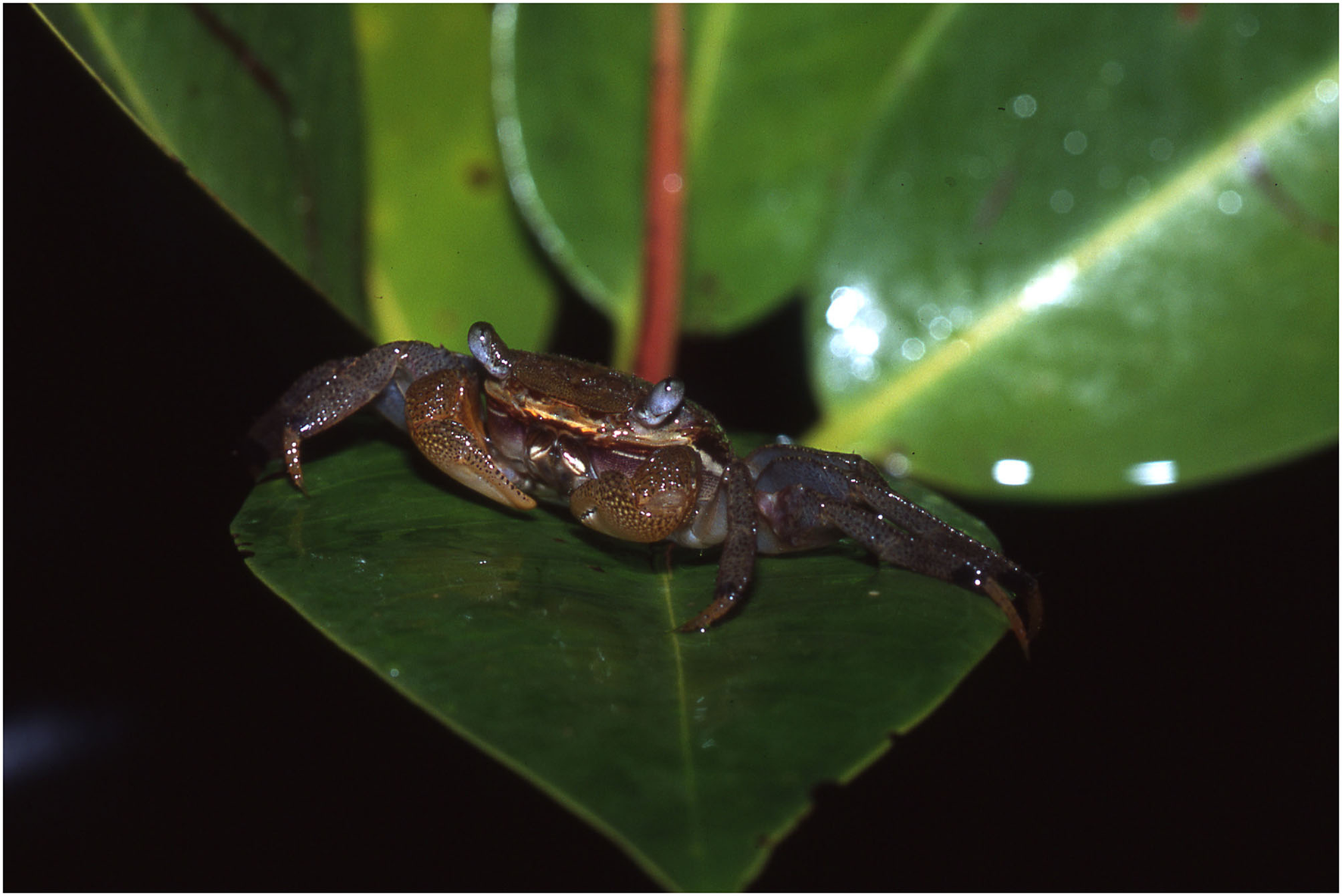
The Sri Lankan tree climbing crab Perisesarma dussumieri, here on a Rhizophora apiculata mangrove tree. The invertebrate faunal community in Sri Lankan mangroves has an extremely high level of functional vulnerability, suggesting a potentially rapid decrease of functional diversity (Cannicci et al., 2021).
Mangrove Restoration is Not Always a Priority for Poor People
In current times of change and uncertainty, people living within and adjacent to mangrove forests are often struggling to make a living. Quite often, mangrove conservation, or restoration, are unfortunately not a priority under these poverty conditions, bringing daily food to the family and enhanced well-being is (Kibria et al., 2019)! Even when local villagers recognise the benefits of mangrove ecosystem functions, goods and services, projects that bring economic security, however short-term they might be, have been prioritised over mangrove conservation in some countries (Foell et al., 1999; Dahdouh-Guebas et al., 2002; Richards and Friess, 2016). Uncertainty about uncontrollable events such as climate change, natural hazards and the COVID-19 pandemic further contribute to poverty on the one hand and to lack of motivation to practise conservation and R/R activities on the other hand (Vandebroek et al., 2020; Boongaling Agaton and Azcuna Collera, 2022).
In addition to the community ecological “health” considerations in terms of flora, fauna and microbiota, the socio-economic setting should equally be healthy and resilient. Community-based R/R efforts only make sense if the social, human and financial capital to maintain and renew the recovering sites are guaranteed. However, as evidenced from peer-reviewed literature, the latter forms of capital are among the least studied in mangrove social-ecological systems (Faridah-Hanum et al., 2019). Documentation of cash-flow profiling of mangrove goods (Satyanarayana et al., 2021) or of land tenure conflicts (Lovelock and Brown, 2019) are a few examples of social science studies that may help reveal and avoid social conflicts in mangrove R/R initiatives.
Discussion and Conclusion
Mangrove shorelines are essential for human well-being, but despite conservation optimism (Friess et al., 2020), efforts to restore them in a holistic framework have been largely unsuccessful. We emphasise that “before and after”-assessments are paramount in the success of R/R initiatives, yet they often remain disregarded. We advocate that R/R projects should always include the following prior assessments:
-
a thorough assessment of current ecological and environmental conditions that enable mangrove trees to grow in the R/R sites selected for (re)afforestation;
-
a nearby source site from which newly planted mangroves can recruit associated invertebrates, but also micro-organisms and even mangrove propagules from non-planted species;
-
a social, human and financial capital aimed at medium to long-term resilience.
Funding
FD-G was supported by the Belgian National Science Foundation FNRS (FNRS-FRFC MIS F.4508.11 and FNRS-PDR T.0262.18), the Belgian Federal Science Policy Office's project MAMAFOREST: MAnaging MAngrove Forests with Optical and Radar Environmental SaTellites (BELSPO, SR/00/323), and the Flemish Interuniversity Council for University Development Cooperation GREENDYKE: The use of natural barriers for coastal protection in Sri Lanka Project (ZEIN2008PR347). SC was supported by the Hong Kong Government Environment and Conservation Fund Project 69/2016 and by internal HKU Research Assessment Exercise improvement funds and seed funds. FD-G and SC were supported by the Erasmus Mundus Masters Course/Joint Master Degree in Tropical Biodiversity and Ecosystems (TROPIMUNDO).
Publisher's Note
All claims expressed in this article are solely those of the authors and do not necessarily represent those of their affiliated organizations, or those of the publisher, the editors and the reviewers. Any product that may be evaluated in this article, or claim that may be made by its manufacturer, is not guaranteed or endorsed by the publisher.
Statements
Author contributions
All authors listed have made a substantial, direct, and intellectual contribution to the work and approved it for publication.
Acknowledgments
The authors thank the many colleagues, students, and collaborators for their invaluable help in the field and for fruitful discussion and constructive criticisms throughout the years. The authors also thank the reviewers for their constructive peer-review.
Conflict of interest
The authors declare that the research was conducted in the absence of any commercial or financial relationships that could be construed as a potential conflict of interest.
References
1
Abhik S. Hope P. Hendon H. H. Hutley L. B. Johnson S. Drosdowsky W. et al . (2021). Influence of the 2015–2016 El Niño on the record-breaking mangrove dieback along northern Australia coast. Sci. Rep.11:20411. 10.1038/s41598-021-99313-w
2
Berger U. Adams M. Grimm V. Hildenbrandt H. (2006). Modelling secondary succession of neotropical mangroves: Causes and consequences of growth reduction in pioneer species. Perspect. Plant Ecol. Evol. Syst.7, 243–252. 10.1016/j.ppees.2005.08.001
3
Boongaling Agaton C. Azcuna Collera A. (2022). Now or later? Optimal timing of mangrove rehabilitation under climate change uncertainty. For. Ecol. Manag.503:119739. 10.1016/j.foreco.2021.119739
4
Cannicci S. Burrows D. Fratini S. Lee S. Y. Smith T. J. III Offenberg J. et al . (2008). Faunal impact on vegetation structure and ecosystem function in mangrove forests: a review. Aquat. Bot.89, 186–200. 10.1016/j.aquabot.2008.01.009
5
Cannicci S. Lee S. Y. Bravo H. Cantera-Kintz J. R. Dahdouh- Guebas F. Fratini S. et al . (2021). A functional analysis reveals extremely low redundancy in global mangrove invertebrate fauna. Proc. Natl. Acad. Sci. U. S. A.118:e2016913118. 10.1073/pnas.2016913118
6
Chakraborty S. Sahoo S. Majumdar D. Saha S. Roy S. (2019). Future mangrove suitability assessment of Andaman to strengthen sustainable development. J. Clean. Prod.234, 597–614. 10.1016/j.jclepro.2019.06.257
7
Dahdouh-Guebas F. Hettiarachchi S. Sooriyarachchi S. Lo Seen D. Batelaan O. Jayatissa L. P. et al . (2005). Transitions in ancient inland freshwater resource management in Sri Lanka affect biota and human populations in and around coastal lagoons. Curr. Biol.15, 579–586. 10.1016/j.cub.2005.01.053
8
Dahdouh-Guebas F. Hugé J. Abuchahla G. M. O. Cannicci S. Jayatissa L. P. Kairo J. G. et al . (2021). Reconciling nature, people and policy in the mangrove social-ecological system through the adaptive cycle heuristic. Estuar. Coasta. Shelf Sci.248:106942. 10.1016/j.ecss.2020.106942
9
Dahdouh-Guebas F. Koedam N. (2002). A synthesis of existent and potential mangrove vegetation structure dynamics from Kenyan, Sri Lankan and Mauritanian case-studies. Proc. R. Acad. Overseas Sci.48, 487–511. Available online at: http://www.kaowarsom.be/documents/BULLETINS_MEDEDELINGEN/2002-4.pdf
10
Dahdouh-Guebas F. Zetterström T. Rönnbäck P. Troell M. Wickramasinghe A. Koedam N. (2002). Recent changes in land-use in the Pambala-Chilaw Lagoon complex (Sri Lanka) investigated using remote sensing and GIS: conservation of mangroves vs. development of shrimp farming. Environ. Dev. Sustain.4, 185–200. 10.1023/A:1020854413866
11
Ellison J. C.. (2019). “Biogeomorphology of mangroves,” in Coastal Wetlands: an Ecosystem Integrated Approach, eds G. M. E. Perillo, E. Wolanski, and D. R. Cahoon, C.S. Hopkinson (Amsterdam: Elsevier Science), 687–715. 10.1016/B978-0-444-63893-9.00020-4
12
Faridah-Hanum I. Yusoff F. M. Fitrianto A. Ainuddin N. A. Gandaseca S. Zaiton S. et al . (2019). Development of a comprehensive mangrove quality index (MQI) in Matang Mangrove: Assessing mangrove ecosystem health. Ecol. Ind.102, 103–17. 10.1016/j.ecolind.2019.02.030
13
Foell J. Harrison E. Stirrat R. L. (1999). Participatory Approaches to Natural Resource Management - The Case of Coastal Zone Management in the Puttalam District. Summary findings of DFID-funded research ‘participatory mechanisms for sustainable development of coastal ecosystems' (Project R6977), School of African and Asian studies, University of Sussex, Falmer, Brighton, U.K. 48 p.
14
Friess D. Yando E. S. Abuchahla G. M. O. Adams J. B. Cannicci S. Canty S. W. J. et al . (2020). Mangroves give cause for conservation optimism, for now. Curr. Biol.30, R135–R158. 10.1016/j.cub.2019.12.054
15
Goldberg L. Lagomasino D. Thomas N. Fatoyinbo T. (2020). Global declines in human-driven mangrove loss. Glob. Change Biol.26, 5844–5855. 10.1111/gcb.15275
16
Guinness World Records. (2012). Most Mangrove Trees Planted Within One Hour. Available online at: https://www.guinnessworldrecords.com/world-records/101647-most-mangrove-trees-planted-within-one-hour-team (accessed June 9, 2021).
17
Kibria A. S. M. G. Costanza R. Groves C. Behie A. M. (2019). Does higher access ensure greater wellbeing? – in the perspective of forest ecosystem services of the Sundarbans mangrove forest, Bangladesh. Ocean Coast. Manag.177, 22–30. 10.1016/j.ocecoaman.2019.04.019
18
Kodikara K. A. S. Mukherjee N. Jayatissa L. P. Dahdouh-Guebas F. Koedam N. (2017). Have mangrove restoration projects worked? An in-depth study in Sri Lanka. Restorat. Ecol.25, 705–716. 10.1111/rec.12492
19
Lovelock C. E. Brown B. M. (2019). Land tenure considerations are key to successful mangrove restoration. Nat. Ecol. Evol.3, 1135–1135. 10.1038/s41559-019-0942-y
20
Nehru P. Balasubramanian P. (2018). Mangrove species diversity and composition in the successional habitats of Nicobar Islands, India: a post-tsunami and subsidence scenario. For. Ecol. Manag.427, 70–77. 10.1016/j.foreco.2018.05.063
21
Richards D. R. Friess D. A. (2016). Rates and drivers of mangrove deforestation in Southeast Asia, 2000–2012. Proc. Natl. Acad. Sci. U. S. A.113, 344–349. 10.1073/pnas.1510272113
22
Rogers K. Kelleway J. J. Saintilan N. Megonigal J. P. Adams J. B. Holmquist J. R. et al . (2019). Wetland carbon storage controlled by millennial scale variation in relative sea-level rise. Nature567, 91–95. 10.1038/s41586-019-0951-7
23
Saintilan N. Khan N. S. Ashe E. Kelleway J. J. Rogers K. Woodroffe C. D. et al . (2020). Thresholds of mangrove survival under rapid sea level rise. Science368, 1118–1121. 10.1126/science.aba2656
24
Satyanarayana B. Quispe-Zuñiga M. R. Hugé J. Sulong I. Mohd-Lokman H. Dahdouh-Guebas F. (2021). Mangroves fueling livelihoods: A socio-economic stakeholder analysis of the charcoal and pole production systems in the world's longest managed mangrove forest. Front. Ecol. Evol.9:621721. 10.3389/fevo.2021.621721
25
Vandebroek I. Pieroni A. Stepp J. R. Hanazaki N. Ladio A. Nóbrega Alves R. R. et al . (2020). Reshaping the future of ethnobiology research after the Covid-19 pandemic. Nat. Plants6, 723–730. 10.1038/s41477-020-0691-6
26
Wang L. Jia M. Yin D. Tian J. (2019). A review of remote sensing for mangrove forests: 1956–2018. Remote Sens. Environ.231:111223. 10.1016/j.rse.2019.111223
Summary
Keywords
mangrove, restoration, rehabilitation, social-ecological system, macrobenthos, poverty, sustainability, shifting baselines
Citation
Dahdouh-Guebas F and Cannicci S (2021) Mangrove Restoration Under Shifted Baselines and Future Uncertainty. Front. Mar. Sci. 8:799543. doi: 10.3389/fmars.2021.799543
Received
21 October 2021
Accepted
19 November 2021
Published
10 December 2021
Volume
8 - 2021
Edited by
Wen-Cheng Wang, National Taiwan Normal University, Taiwan
Reviewed by
Joanna Ellison, University of Tasmania, Australia
Updates
Copyright
© 2021 Dahdouh-Guebas and Cannicci.
This is an open-access article distributed under the terms of the Creative Commons Attribution License (CC BY). The use, distribution or reproduction in other forums is permitted, provided the original author(s) and the copyright owner(s) are credited and that the original publication in this journal is cited, in accordance with accepted academic practice. No use, distribution or reproduction is permitted which does not comply with these terms.
*Correspondence: Farid Dahdouh-Guebas Farid.Dahdouh-Guebas@ulb.be
†These authors have contributed equally to this work
This article was submitted to Marine Conservation and Sustainability, a section of the journal Frontiers in Marine Science
Disclaimer
All claims expressed in this article are solely those of the authors and do not necessarily represent those of their affiliated organizations, or those of the publisher, the editors and the reviewers. Any product that may be evaluated in this article or claim that may be made by its manufacturer is not guaranteed or endorsed by the publisher.