Introduction
Plastic waste is ubiquitous in the environment – it can be found in sediments (Brandon et al., 2019), the atmosphere (Brahney et al., 2020; Evangeliou et al., 2020; Brahney et al., 2021), polar ice (Materić et al., 2022), the oceans (Eriksen et al., 2014; Fischer et al., 2015; Courtene-Jones et al., 2021), the human body (Ragusa et al., 2021; Zhang et al., 2021; Leslie et al., 2022), and in organisms across taxa. Without a new approach, about 710 million metric tons of plastics will enter the environment between 2016 and 2040 (Lau et al., 2020), leading to negative repercussions at all levels of biological organization (Bucci et al., 2020).
Global plastics production without sufficient waste management constitutes an “uncontrolled experiment” by humanity (Geyer et al., 2017). Based on trends in plastics production, plastics entering the environment, unwanted impacts on Earth system processes, and insufficient monitoring and safety assessment, Persson et al. (2022) assert that society has exceeded the planetary boundary for plastics. Though scientists are still determining proper control variables to measure the exceedance of this planetary boundary, immediate action is needed (Lau et al., 2020; Persson et al., 2022). Consistent with research needs (Villarrubia-Gómez et al., 2018; Persson et al., 2022), this article aims to 1) summarize the physical and chemical burdens posed by plastic pollution, focusing on the marine environment and society; 2) utilize the planetary boundaries approach as a call-to-action for global protection; and 3) suggest novel interventions to reduce plastic pollution, organized for the first time to our knowledge, by the four pathways toward global sustainability (Folke et al., 2021). We focus on the marine environment and society to understand impacts from plastics’ source, society, to a major sink – the ocean (Weiss et al., 2021).
Plastics, plastics, everywhere
Plastics are synthetic organic polymers that provide many societal benefits (Andrady and Neal, 2009). Plastics are categorized by chemical/material properties and size. Macroplastics are >5 mm3 and include everyday items (e.g., furniture, textiles) (Khalid Ageel et al., 2022), fishing gear (Valderrama Ballesteros et al., 2018; Kuczenski et al., 2022), roads (Evangeliou et al., 2020; Brahney et al., 2021), pipes (Al-Malack, 2001), housing insulation (Huang and Tsuang, 2014), and paints (Dibke et al., 2021; Paruta et al., 2022) – plastics are ubiquitous.
Microplastics are < 5 mm3 (Arthur et al., 2009). Primary microplastics are intentionally produced (Rochman et al., 2019) and include pre-production pellets, synthetic turf (Thomas et al., 2019), and microbeads (Rochman et al., 2015). Secondary microplastics are generated through use or weathering (e.g., tire wear, microfibers) (Jahnke et al., 2017; Sobhani et al., 2020). Some ship hull coatings (Dibke et al., 2021; Turner, 2021) and biodegradable plastics (Wei et al., 2021) are engineered to produce microplastics.
The physical and chemical burdens of marine plastic pollution
Microplastics enter the food web at all trophic levels (Cole et al., 2013; Desforges et al., 2015; Cox et al., 2019). Plastic ingestion can lead to abrasion, scarring (Neilson et al., 2009), perforation (Brandão et al., 2011; Wilcox et al., 2018), dismemberment (Law, 2017), restricted mobility (Neilson et al., 2009), suffocation (Gregory, 2009), and gastrointestinal obstruction (Stamper et al., 2009). Microplastics and nanoplastics (<100 nm) internalized via respiration or ingestion may translocate within the body (Browne et al., 2013; Pitt et al., 2018; Messinetti et al., 2019; Zeytin et al., 2020) and transfer across trophic levels (Nelms et al., 2018; Athey et al., 2020). Plastics ingestion and translocation may ultimately result in death (Bucci et al., 2020). Susceptibility depends on an animal’s life history, foraging ecology, and behavior, as well as plastics’ chemical composition, size, shape, and distribution (Allen et al., 2017; Savoca et al., 2017; Bucci et al., 2020; Diana et al., 2020).
At least 2,400 of the 10,000 compounds associated with plastics are toxins, endocrine disruptors, teratogens, or carcinogens (Hahladakis et al., 2018; Groh et al., 2019; Wiesinger et al., 2021). Depending on environmental conditions and chemical properties, plastics can leach plasticizers, contaminants, and proprietary compounds that are toxic to marine larvae (Li et al., 2016; Ward et al., 2022), impair embryonic development in fish, sea urchin, and mussels (Feng et al., 2012; Nobre et al., 2015; Gandara e Silva et al., 2016), and decrease the growth and photosynthetic capacity of important marine cyanobacteria (Tetu et al., 2019).
Proprietary organotins are used to produce certain plastics (e.g., polyesters, polyvinyl chloride) (Piver, 1973). Organotins are acutely toxic to marine animals at low concentrations (micrograms/liter), chronically toxic at lower concentrations (tens of nanograms/liter), and teratogenic and endocrine disrupting at very low levels (<10 nanograms/liter) (McClellan-Green et al., 2006). Plastics can adsorb environmental pollutants (e.g., heavy metals, persistent organic pollutants) (Rochman et al., 2013; Rochman et al., 2014), which may undergo trophic transfer (Athey et al., 2020). Society is not keeping pace with the safety assessments needed for chemicals associated with plastics (Wiesinger et al., 2021).
The societal burden of plastic pollution: Human health and environmental justice
Microplastics have been reported in human lung tissue (Amato-Lourenço et al., 2021), stool and colectomy samples (Schwabl et al., 2019; Ibrahim et al., 2021), blood (Leslie et al., 2022), and placentas (Ragusa et al., 2021). Plastics impact humans health across levels of biological organization (Morrison et al., 2022), including molecular and cellular processes (Banerjee and Shelver, 2021), tissue and organ systems (Wright and Kelly, 2017), and physiological responses (Karbalaei et al., 2018). Studies characterizing plastics’ impact on human health are preliminary and primarily rely on laboratory experiments that simplify real-world exposures (WHO, 2022).
Marginalized communities are disproportionately exposed to plastic-associated pollutants (Calafat et al., 2008), which has recently received high-profile attention, including from the Biden administration in the United States (U.S.) (Singer, 2011; Keehan, 2018; Castellon, 2021). For example, “Cancer Alley” in Louisiana is an industrialized corridor of concentrated petrochemical and plastics manufacturing industries (U.S. EPA, 2014; Terrell and James, 2020). Residents have an increased cancer risk from air pollution compared to 95% of the U.S. population (U.S. EPA, 2014; Terrell and James, 2020). Over 20% of Cancer Alley residents live in poverty (Terrell and James, 2020), while the U.S. average in 2020 was 11.4% (Census.gov, 2022). Other environmental injustices include high-income countries exporting plastic waste to lower-income countries (Brooks et al., 2018; Kaza et al., 2018; Law et al., 2020), landfill citing locations (Bullard, 2018), impacts to indigenous peoples (e.g., land take, ecosystem destruction) (UNEP, 2021a), and occupational hazards to waste pickers (UNEP, 2021a). Marginalized communities often live and work in unsafe conditions due to exposure to transboundary plastic-associated pollutants.
Discussion
Here we detail interventions to reduce plastic pollution (Figure 1), which are organized for the first time (to our knowledge) by the four pathways toward global sustainability (Folke et al., 2021). This framework incorporates the interconnectedness of humans and nature to promote resilient, sustainable change (Folke et al., 2021). We focus on interventions infrequently discussed in the scientific literature because further innovation is needed to reduce plastic waste (Lau et al., 2020). Interventions should undergo small-scale experimentation to inform change at broader levels of governance (Folke et al., 2021). For this study, a team of interdisciplinary plastic pollution researchers selected interventions through discussion and review.
Figure 1
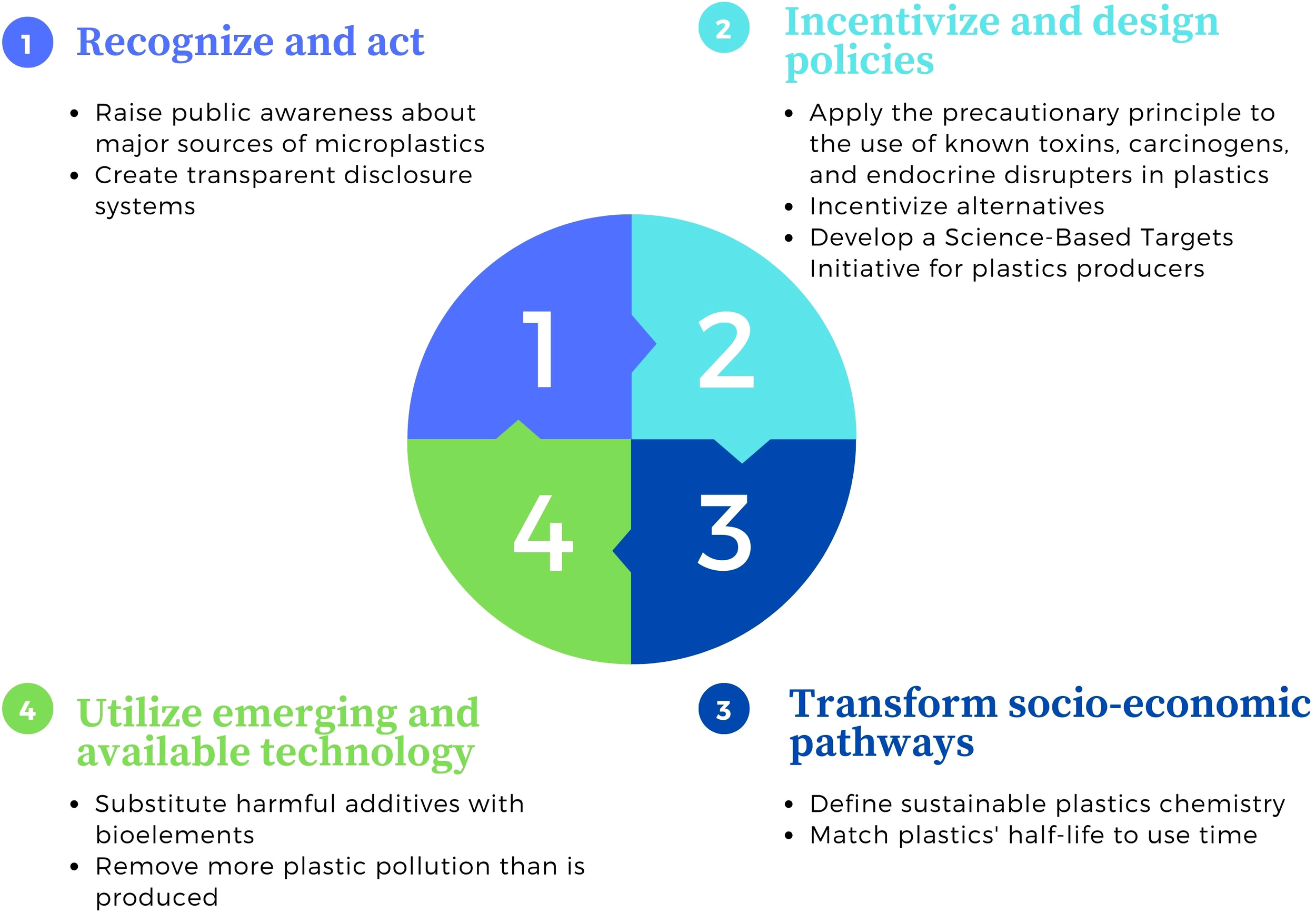
Suggested interventions organized by the four pathways toward global sustainability developed by Folke et al. (2021).
Pathway 1: “Recognize and act on the fact that societal development is embedded in and critically dependent on the biosphere” (Folke et al., 2021).
-
Raise public awareness about major sources of microplastics. Scientists recently found that paints (Dibke et al., 2021; Turner, 2021) and roads (Evangeliou et al., 2020) are significant microplastics sources (Lau et al., 2020; Paruta et al., 2022). Nongovernmental organizations should run campaigns or outreach programs to raise public awareness. Although non-plastic alternatives may not be available (or widespread) yet for paints and roads, awareness may help to spur action (e.g., research and development grants for alternatives). For example, social norms contributed to the voluntary phaseout of plastic microbeads in personal care products (Dauvergne, 2018a).
-
Create transparent disclosure systems. Management systems that provide transparency and accountability for the plastics value chain should be created, building on the Plastic Disclosure Project (2022). Corporate disclosures may accelerate science-based policy by reducing the opaqueness of global supply chains (Dauvergne, 2018b).
Pathway 2: “Create incentives and design policies that enable societies to collaborate towards just and sustainable futures within planetary boundaries” (Folke et al., 2021).
-
Apply the precautionary principle to the use of known toxins, carcinogens, and endocrine disrupters in plastics. Policies should require independent labs to test additives with unknown environmental and human health impacts before use, similar to the European Commission Regulation No 1223/2009 for cosmetics (EC, 2009). Findings should be shared publicly, potentially reducing the chances of regrettable substitution.
-
Incentivize alternatives. Policies that tax plastic products nudge consumer behavior to avoid plastics rather than to reflect its’ social cost (Rivers et al., 2017; Mogomotsi et al., 2019; Diana et al., 2022). Because determining plastics’ social cost is difficult, plastic should be priced at an estimate of the price necessary to meet plastics reduction targets by making alternatives more cost-effective (Monast and Virdin, 2022). Further investment should promote reusable alternatives. Governments should consider reducing perverse incentives (Sterner, 2003), such as subsidies or tax exemptions supporting unnecessary, problematic, or harmful plastics (UNEP, 2021b).
-
Develop a Science-Based Targets Initiative for plastics producers. Modeled off the Science-Based Targets Initiative (2021) for greenhouse gases, companies should adopt sector-specific targets backed by independent scientists to reduce plastic pollution. Targets should be specific, measurable, assignable, realistic, time-related (Doran, 1981), and adaptive.
Pathway 3: “Transform the current pathways of social, economic, cultural development into financially incentivized stewardship of human actions that enhance the resilience of the biosphere” (Folke et al., 2021).
-
Define sustainable plastics chemistry. Stakeholders should contribute to defining sustainable chemistry (Hogue, 2019) to inform safer plastics production (Anastas et al., 2021). Financial incentives could incentivize safer plastics production.
-
Match plastics’ half-life to use time. Governments should subsidize products that match plastic’s half-life to its approximate use time. For example, a plastic bag has a half-life of 4.6 years when buried on land (Chamas et al., 2020) but may only be used for hours. Measurement and reporting of plastics degradation time, microplastic generation, and degradation products should be standardized.
Pathway 4: “Make active use of emerging and converging technologies for enabling the societal stewardship transformation” (Folke et al., 2021).
-
Substitute harmful additives with bioelements. Biologically compatible elements (i.e., bioelements) should be used to generate polymers (Gadomska-Gajadhur and Ruśkowski, 2020) because biological systems use and maintain these molecules. Substantial removal of non-biocompatible compounds before selling a product should be required. Financial incentives could improve affordability.
-
Remove more plastic pollution than is produced. Similar to the CEO Water Mandate, which dictates a net positive impact on stressed watersheds (UN Global Compact, 2022), a voluntary program (van’t Veld and Kotchen, 2011) should be developed that requires companies to responsibly clean-up an excess of the plastic types produced. Plastic types should be organized by recycling category, a measure (e.g., weight per surface area), or product types. Clean-ups that utilize technologies to collect marine debris (Schmaltz et al., 2020; Dijkstra et al., 2021) should minimize bycatch and ecological impacts (Falk-Andersson et al., 2020). Recovered plastics should be recycled, repurposed, bioremediated (Sheth et al., 2019), or stored responsibly. This program may disincentivize unnecessary plastics production because plastics clean-up can be difficult and costly (Cordier and Uehara, 2019; Falk-Andersson et al., 2020). Monitoring and enforcement should supplement the program.
Conclusions
Society has exceeded the planetary boundary for plastics – this can result in irreversible damage to the marine environment and human health due to physical and chemical burdens. The enormity of the problem and the remaining uncertainties of its effects should not deter us from action. Rather, we should redouble our efforts by connecting with experts across fields through open communication and a shared commitment to solutions. We must incorporate diverse viewpoints, including industry representatives and experts who are geographically distributed and be unafraid to test innovative approaches. This article shares novel strategies to add to the growing discourse (e.g., Bergmann et al., 2022; Zhu and Rochman, 2022) on tools to consider as we draft an international treaty to reduce plastic pollution (Simon et al., 2021). Through extensive cross-sector and transdisciplinary collaboration and transboundary coordination, society can begin to pave the way toward global plastics sustainability.
Funding
This work was funded through a pre-catalyst award from the Nicholas Institute for Environmental Policy Solutions (MD-D and JV) and Duke Bass Connections (JS). Open-access funding was obtained through Duke University Compact for Open Access Publishing Equity Fund (ZD). Research reported in this publication was supported by the National Institute Of Environmental Health Sciences of the National Institutes of Health under Award Number T32ES021432. The content is solely the responsibility of the authors and does not necessarily represent the official views of the National Institutes of Health.
Acknowledgments
We thank the Duke University Plastic Pollution Working Group for bringing the authors together.
Publisher’s note
All claims expressed in this article are solely those of the authors and do not necessarily represent those of their affiliated organizations, or those of the publisher, the editors and the reviewers. Any product that may be evaluated in this article, or claim that may be made by its manufacturer, is not guaranteed or endorsed by the publisher.
Statements
Author contributions
ZD, DR, JV, JS and MD-D. conceived of the article. ZD, DR, MD-D, JV, EH-S, GM, JS, JP, KC, MM and RK contributed to writing the article. All authors contributed to the article and approved the submitted version.
Conflict of interest
The authors declare that the research was conducted in the absence of any commercial or financial relationships that could be construed as a potential conflict of interest.
References
1
Allen A. S. Seymour A. C. Rittschof D. (2017). Chemoreception drives plastic consumption in a hard coral. Mar. pollut. Bull.124, 198–205. doi: 10.1016/j.marpolbul.2017.07.030
2
Al-Malack M. H. (2001). Migration of lead from unplasticized polyvinyl chloride pipes. J. Hazard Mater82, 263–274. doi: 10.1016/s0304-3894(00)00366-6
3
Amato-Lourenço L. F. Carvalho-Oliveira R. Júnior G. R. dos Santos Galvão L. Ando R. A. Mauad T. (2021). Presence of airborne microplastics in human lung tissue. J. Hazardous Materials416, 126124. doi: 10.1016/j.jhazmat.2021.126124
4
Anastas P. T. Saltzberg M. Subramaniam B. (2021). Plastics are not bad. bad plastics are bad. ACS Sustain. Chem. Eng.9, 9150–9150. doi: 10.1021/acssuschemeng.1c03046
5
Andrady A. L. Neal M. A. (2009). Applications and societal benefits of plastics. Philos. Trans. R Soc. Lond B Biol. Sci.364, 1977–1984. doi: 10.1098/rstb.2008.0304
6
Arthur C. Baker J. Bamford H. (2009) Proceedings of the international workshop on the occurrence, effects, and fate of microplastic marine debris (National Oceanic and Atmospheric Administration). Available at: https://marinedebris.noaa.gov/sites/default/files/publications-files/TM_NOS-ORR_30.pdf (Accessed March 5, 2020).
7
Athey S. N. Albotra S. D. Gordon C. A. Monteleone B. Seaton P. Andrady A. L. et al . (2020). Trophic transfer of microplastics in an estuarine food chain and the effects of a sorbed legacy pollutant. Limnol. Oceanogr. Lett.5, 154–162. doi: 10.1002/lol2.10130
8
Banerjee A. Shelver W. L. (2021). Micro- and nanoplastic induced cellular toxicity in mammals: A review. Sci. Total Environ.755, 142518. doi: 10.1016/j.scitotenv.2020.142518
9
Bergmann M. Almroth B. C. Brander S. M. Dey T. Green D. S. Gundogdu S. et al . (2022). A global plastic treaty must cap production. Science376, 469–470. doi: 10.1126/science.abq0082
10
Brahney J. Hallerud M. Heim E. Hahnenberger M. Sukumaran S. (2020). Plastic rain in protected areas of the united states. Science368, 1257–1260. doi: 10.1126/science.aaz5819
11
Brahney J. Mahowald N. Prank M. Cornwell G. Klimont Z. Matsui H. et al . (2021). Constraining the atmospheric limb of the plastic cycle. Proc. Natl. Acad. Sci. U.S.A.118, e2020719118. doi: 10.1073/pnas.2020719118
12
Brandão M. L. Braga K. M. Luque J. L. (2011). Marine debris ingestion by magellanic penguins, spheniscus magellanicus (Aves: Sphenisciformes), from the Brazilian coastal zone. Mar. Pollut. Bull.62, 2246–2249. doi: 10.1016/j.marpolbul.2011.07.016
13
Brandon J. A. Jones W. Ohman M. D. (2019). Multidecadal increase in plastic particles in coastal ocean sediments. Sci. Adv.5, eaax0587. doi: 10.1126/sciadv.aax0587
14
Brooks A. L. Wang S. Jambeck J. R. (2018). The Chinese import ban and its impact on global plastic waste trade. Sci. Adv.4, eaat0131. doi: 10.1126/sciadv.aat0131
15
Browne M. A. Niven S. J. Galloway T. S. Rowland S. J. Thompson R. C. (2013). Microplastic moves pollutants and additives to worms, reducing functions linked to health and biodiversity. Curr. Biol.23, 2388–2392. doi: 10.1016/j.cub.2013.10.012
16
Bucci K. Tulio M. Rochman C. M. (2020). What is known and unknown about the effects of plastic pollution: A meta-analysis and systematic review. Ecol. Appl.30, e02044. doi: 10.1002/eap.2044
17
Bullard R. D. (2018). Dumping in Dixie: Race, class, and environmental quality. 3rd Edition (Routledge: Westview Press).
18
Calafat A. M. Ye X. Wong L.-Y. Reidy J. A. Needham L. L. (2008). Exposure of the U.S. population to bisphenol a and 4-tertiary-octylphenol: 2003-2004. Environ. Health Perspect.116, 39–44. doi: 10.1289/ehp.10753
19
Castellón I. G. (2021). Cancer alley and the fight against environmental racism. Vill. Envtl. LJ32, 15.
20
Census.gov (2022). Income and Poverty in the United States: 2020. Accessed: https://www.census.gov/library/publications/2021/demo/p60-273.html#:~:text=The%20official%20poverty%20rate%20in,from%2010.5%20percent%20in%202019.
21
Chamas A. Moon H. Zheng J. Qiu Y. Tabassum T. Jang J. H. et al . (2020). Degradation rates of plastics in the environment. ACS Sustain. Chem. Eng.8, 3494–3511. doi: 10.1021/acssuschemeng.9b06635
22
Cole M. Lindeque P. Fileman E. Halsband C. Goodhead R. Moger J. et al . (2013). Microplastic ingestion by zooplankton. Environ. Sci. Technol.47, 6646–6655. doi: 10.1021/es400663f
23
Cordier M. Uehara T. (2019). How much innovation is needed to protect the ocean from plastic contamination? Sci. Total Environ.670, 789–799. doi: 10.1016/j.scitotenv.2019.03.258
24
Courtene-Jones W. Maddalene T. James M. K. Smith N. S. Youngblood K. Jambeck J. R. et al . (2021). Source, sea and sink–a holistic approach to understanding plastic pollution in the southern Caribbean. Sci. Total Environ.797, 149098. doi: 10.1016/j.scitotenv.2021.149098
25
Cox K. D. Covernton G. A. Davies H. L. Dower J. F. Juanes F. Dudas S. E. (2019). Human consumption of microplastics. Environ. Sci. Technol.53, 7068–7074. doi: 10.1021/acs.est.9b01517
26
Dauvergne P. (2018a). The power of environmental norms: Marine plastic pollution and the politics of microbeads. Environ. Politics27, 579–597. doi: 10.1080/09644016.2018.1449090
27
Dauvergne P. (2018b). Why is the global governance of plastic failing the oceans? Global Environ. Change51, 22–31. doi: 10.1016/j.gloenvcha.2018.05.002
28
Desforges J. W. Galbraith M. Ross P. S. (2015). Ingestion of microplastics by zooplankton in the northeast pacific ocean. Arch. Environ. Contamination Toxicol. New York69, 320–330. doi: 10.1007/s00244-015-0172-5
29
Diana Z. Sawickij N. Rivera N. A. Hsu-Kim H. Rittschof D. (2020). Plastic pellets trigger feeding responses in sea anemones. Aquat. Toxicol.222, 105447. doi: 10.1016/j.aquatox.2020.105447
30
Diana Z. Vegh T. Karasik R. Bering J. D. Llano Caldas J. Pickle A. et al . (2022). The evolving global plastics policy landscape: An inventory and effectiveness review. Environ. Sci. Policy134, 34–45. doi: 10.1016/j.envsci.2022.03.028
31
Dibke C. Fischer M. Scholz-Böttcher B. M. (2021). Microplastic mass concentrations and distribution in German bight waters by pyrolysis–gas chromatography–mass Spectrometry/Thermochemolysis reveal potential impact of marine coatings: Do ships leave skid marks? Environ. Sci. Technol.55, 2285–2295. doi: 10.1021/acs.est.0c04522
32
Dijkstra H. van Beukering P. Brouwer R. (2021). In the business of dirty oceans: Overview of startups and entrepreneurs managing marine plastic. Mar. Pollut. Bull.162, 111880. doi: 10.1016/j.marpolbul.2020.111880
33
Doran G. (1981) There’s a S.M.A.R.T. way to write management’s goals and objectives. Available at: https://community.mis.temple.edu/mis0855002fall2015/files/2015/10/S.M.A.R.T-Way-Management-Review.pdf.
34
Eriksen M. Lebreton L. C. M. Carson H. S. Thiel M. Moore C. J. Borerro J. C. et al . (2014). Plastic pollution in the world’s oceans: More than 5 trillion plastic pieces weighing over 250,000 tons afloat at Sea. PloS One9, e111913. doi: 10.1371/journal.pone.0111913
35
European Commission (2009) Regulation (EC) no 1223/2009 of the European parliament and of the council of 30 November 2009 on cosmetic products (recast) (Text with EEA relevance)Text with EEA relevance. Available at: https://eur-lex.europa.eu/legal-content/EN/TXT/?uri=CELEX:02009R1223-20190813.
36
Evangeliou N. Grythe H. Klimont Z. Heyes C. Eckhardt S. Lopez-Aparicio S. et al . (2020). Atmospheric transport is a major pathway of microplastics to remote regions. Nat. Commun.11, 3381. doi: 10.1038/s41467-020-17201-9
37
Falk-Andersson J. Larsen Haarr M. Havas V. (2020). Basic principles for development and implementation of plastic clean-up technologies: What can we learn from fisheries management? Sci. Total Environ.745, 141117. doi: 10.1016/j.scitotenv.2020.141117
38
Feng D. Rittschof D. Orihuela B. Kwok K. W. H. Stafslien S. Chisholm B. (2012). The effects of model polysiloxane and fouling-release coatings on embryonic development of a sea urchin (Arbacia punctulata) and a fish (Oryzias latipes). Aquat. Toxicol.110–111, 162–169. doi: 10.1016/j.aquatox.2012.01.005
39
Fischer V. Elsner N. O. Brenke N. Schwabe E. Brandt A. (2015). Plastic pollution of the kuril–kamchatka trench area (NW pacific). Deep Sea Res. Part II: Topical Stud. Oceanogr.111, 399–405. doi: 10.1016/j.dsr2.2014.08.012
40
Folke C. Polasky S. Rockström J. Galaz V. Westley F. Lamont M. et al . (2021). Our future in the anthropocene biosphere. Ambio50, 834–869. doi: 10.1007/s13280-021-01544-8
41
Gadomska-Gajadhur A. Ruśkowski P. (2020). Biocompatible catalysts for lactide polymerization–catalyst activity, racemization effect, and optimization of the polymerization based on design of experiments. Organic Process Res. Dev.24, 1435–1442. doi: 10.1021/acs.oprd.0c00149
42
Gandara e Silva P. P. Nobre C. R. Resaffe P. Pereira C. D. S. Gusmão F. (2016). Leachate from microplastics impairs larval development in brown mussels. Water Res.106, 364–370. doi: 10.1016/j.watres.2016.10.016
43
Geyer R. Jambeck J. R. Law K. L. (2017). Production, use, and fate of all plastics ever made. Sci. Adv.3, e1700782. doi: 10.1126/sciadv.1700782
44
Gregory M. R. (2009). Environmental implications of plastic debris in marine settings- entanglement, ingestion, smothering, hangers-on, hitch-hiking and alien invasions. Philos. Trans. R. Soc. B: Biol. Sci.364, 2013–2025. doi: 10.1098/rstb.2008.0265
45
Groh K. J. Backhaus T. Carney-Almroth B. Geueke B. Inostroza P. A. Lennquist A. et al . (2019). Overview of known plastic packaging-associated chemicals and their hazards. Sci. Total Environ.651, 3253–3268. doi: 10.1016/j.scitotenv.2018.10.015
46
Hahladakis J. N. Velis C. A. Weber R. Iacovidou E. Purnell P. (2018). An overview of chemical additives present in plastics: Migration, release, fate and environmental impact during their use, disposal and recycling. J. Hazardous Materials344, 179–199. doi: 10.1016/j.jhazmat.2017.10.014
47
Hogue C. (2019). “Differentiating between green chemistry and sustainable chemistry in congress,” in Chemical & engineering news. Available at: https://cen.acs.org/environment/green-chemistry/Differentiating-between-green-chemistry-sustainable/97/web/2019/07.
48
Huang Y.-C. T. Tsuang W. (2014). Health effects associated with faulty application of spray polyurethane foam in residential homes. Environ. Res.134, 295–300. doi: 10.1016/j.envres.2014.07.015
49
Ibrahim Y. S. Tuan Anuar S. Azmi A. A. Wan Mohd Khalik W. M. A. Lehata S. Hamzah S. R. et al . (2021). Detection of microplastics in human colectomy specimens. JGH Open5, 116–121. doi: 10.1002/jgh3.12457
50
Jahnke A. Arp H. P. H. Escher B. I. Gewert B. Gorokhova E. Kühnel D. et al . (2017). Reducing uncertainty and confronting ignorance about the possible impacts of weathering plastic in the marine environment. Environ. Sci. Technol. Lett.4, 85–90. doi: 10.1021/acs.estlett.7b00008
51
Karbalaei S. Hanachi P. Walker T. R. Cole M. (2018). Occurrence, sources, human health impacts and mitigation of microplastic pollution. Environ Scie Poll Res25 (36), 36046–36063.
52
Kaza S Yao LC Bhada-Tata P Van Woerden F (2018). A Global Snapshot of Solid Waste Management to 2050. Urban Development;. Washington, DC: World Bank. https://openknowledge.worldbank.org/handle/10986/30317. License: CC BY 3.0 IGO.
53
Keehan C. J. (2018). Lessons from cancer alley: How the clean air act has failed to protect public health in southern Louisiana. Colo. Nat. Resour. Energy Envtl. L. Rev.29, 341.
54
Khalid Ageel H. Harrad S. Abou-Elwafa Abdallah M. (2022). Occurrence, human exposure, and risk of microplastics in the indoor environment. Environ. Science: Processes Impacts24, 17–31. doi: 10.1039/D1EM00301A
55
Kuczenski B. Vargas Poulsen C. Gilman E. L. Musyl M. Geyer R. Wilson J. (2022). Plastic gear loss estimates from remote observation of industrial fishing activity. Fish Fish.23, 22–33. doi: 10.1111/faf.12596
56
Lau W. W. Y. Shiran Y. Bailey R. M. Cook E. Stuchtey M. R. Koskella J. et al . (2020). Evaluating scenarios toward zero plastic pollution. Science369, 1455–1461. doi: 10.1126/science.aba9475
57
Law K. L. (2017). Plastics in the marine environment. Annu. Rev. Mar. Sci.9, 205–229. doi: 10.1146/annurev-marine-010816-060409
58
Law K. L. Starr N. Siegler T. R. Jambeck J. R. Mallos N. J. Leonard G. H. (2020). The united states’ contribution of plastic waste to land and ocean. Sci. Adv.6, eabd0288. doi: 10.1126/sciadv.abd0288
59
Leslie H. A. van Velzen M. J. M. Brandsma S. H. Vethaak A. D. Garcia-Vallejo J. J. Lamoree M. H. (2022). Discovery and quantification of plastic particle pollution in human blood. Environ. Int.163, 107199. doi: 10.1016/j.envint.2022.107199
60
Li H.-X. Getzinger G. J. Ferguson P. L. Orihuela B. Zhu M. Rittschof D. (2016). Effects of toxic leachate from commercial plastics on larval survival and settlement of the barnacle amphibalanus amphitrite. Environ. Sci. Technol.50, 924–931. doi: 10.1021/acs.est.5b02781
61
Materić D. Kjær H. A. Vallelonga P. Tison J.-L. Röckmann T. Holzinger R. (2022). Nanoplastics measurements in northern and southern polar ice. Environ. Res.208, 112741. doi: 10.1016/j.envres.2022.112741
62
McClellan-Green P. Romano J. Rittschof D. (2006). Imposex Induction in the Mud Snail, Ilyanassa obsoleta by Three Tin Compounds. Bull Environ Contam Toxicol76, 581–588. doi: 10.1007/s00128-006-0959-1
63
Messinetti S. Mercurio S. Scarì G. Pennati A. Pennati R. (2019). Ingested microscopic plastics translocate from the gut cavity of juveniles of the ascidian Ciona intestinalis. The European Zoological Journal86, 189–195. doi: 10.1080/24750263.2019.1616837
64
Mogomotsi P. K. Mogomotsi G. E. Phonchi N. D. (2019). Plastic bag usage in a taxed environment: Investigation on the deterrent nature of plastic levy in maun, Botswana. Waste Manag Res.37, 20–25. doi: 10.1177/0734242X18801495
65
Monast J. Virdin J. (2022). “Pricing plastics pollution: Lessons from three decades of climate policy,” in Connecticut Law review. Connecticut Law Review. Available at: https://opencommons.uconn.edu/law_review/524.
66
Morrison M. Trevisan R. Ranasinghe P. Merril G. B. Santos J. Hong A. et al . (2022). A growing crisis for One Health: impacts of plastic pollution across layers of biological function. Frontiers in Marine Science. doi: 10.3389/fmars.2022.980705
67
Neilson J. L. Straley J. M. Gabriele C. M. Hills S. (2009). A non-lethal entanglement of humpback whales ( megaptera novaeangliae ) in fishing gear in northern southeast Alaska. J. Biogeogr.36, 452–464. doi: 10.1111/j.1365-2699.2007.01820.x
68
Nelms S. E. Galloway T. S. Godley B. J. Jarvis D. S. Lindeque P. K. (2018). Investigating microplastic trophic transfer in marine top predators. Environ. pollut.238, 999–1007. doi: 10.1016/j.envpol.2018.02.016
69
Nobre C. R. Santana M. F. M. Maluf A. Cortez F. S. Cesar A. Pereira C. D. S. et al . (2015). Assessment of microplastic toxicity to embryonic development of the sea urchin Lytechinus variegatus (Echinodermata: Echinoidea). Mar. pollut. Bull.92, 99–104. doi: 10.1016/j.marpolbul.2014.12.050
70
Paruta P. Pucino M. Boucher J. (2022). Plastic paints the environment, EA- environmental action, ISBN 978-2-8399-3494-7. EA - Environmental Action.
71
Persson L. Carney Almroth B. M. Collins C. D. Cornell S. de Wit C. A. Diamond M. L. et al . (2022). Outside the safe operating space of the planetary boundary for novel entities. Environ. Sci. Technol.56, 1510–1521. doi: 10.1021/acs.est.1c04158
72
Pitt J. A. Kozal J. S. Jayasundara N. Massarsky A. Trevisan R. Geitner N. et al . (2018). Uptake, tissue distribution, and toxicity of polystyrene nanoparticles in developing zebrafish (Danio rerio). Aquat. Toxicol.194, 185–194. doi: 10.1016/j.aquatox.2017.11.017
73
Piver W. (1973). Organotin compounds: industrial applications and biological investigation. Environ. Health Perspect.19, 61–79. doi: 10.1289/ehp.730461
74
Plastic Disclosure Project (2022). Available at: https://www.plasticdisclosure.org/understake-the-pdp.
75
Ragusa A. Svelato A. Santacroce C. Catalano P. Notarstefano V. Carnevali O. et al . (2021). Plasticenta: First evidence of microplastics in human placenta. Environ. Int.146, 106274. doi: 10.1016/j.envint.2020.106274
76
Rivers N. Shenstone-Harris S. Young N. (2017). Using nudges to reduce waste? the case of toronto’s plastic bag levy. J. Environ. Manage.188, 153–162. doi: 10.1016/j.jenvman.2016.12.009
77
Rochman C. M. Brookson C. Bikker J. Djuric N. Earn A. Bucci K. et al . (2019). Rethinking microplastics as a diverse contaminant suite. Environ. Toxicol. Chem.38, 703–711. doi: 10.1002/etc.4371
78
Rochman C. M. Hentschel B. T. Teh S. J. (2014). Long-term sorption of metals is similar among plastic types: Implications for plastic debris in aquatic environments. PloS One; San Francisco9, e85433. doi: 10.1371/journal.pone.0085433
79
Rochman C. M. Hoh E. Hentschel B. T. Kaye S. (2013). Long-term field measurement of sorption of organic contaminants to five types of plastic pellets: Implications for plastic marine debris. Environ. Sci. Technol.47, 1646–1654. doi: 10.1021/es303700s
80
Rochman C. M. Kross S. M. Armstrong J. B. Bogan M. T. Darling E. S. Green S. J. et al . (2015). Scientific evidence supports a ban on microbeads. Environ. Sci. Technol.49, 10759–10761. doi: 10.1021/acs.est.5b03909
81
Savoca M. S. Tyson C. W. McGill M. Slager C. J. (2017). Odours from marine plastic debris induce food search behaviours in a forage fish. Proc. Biol. Sci.284, 20171000. doi: 10.1098/rspb.2017.1000
82
Schmaltz E. Melvin E. C. Diana Z. Gunady E. F. Rittschof D. Somarelli J. A. et al . (2020). Plastic pollution solutions: emerging technologies to prevent and collect marine plastic pollution. Environ. Int.144, 106067. doi: 10.1016/j.envint.2020.106067
83
Schwabl P. Köppel S. Königshofer P. Bucsics T. Trauner M. Reiberger T. et al . (2019). Detection of various microplastics in human stool. Ann. Intern. Med.171, 453–457. doi: 10.7326/M19-0618
84
Science-Based Targets Initiative (2021)Ambitious corporate climate action. In: Science based targets. Available at: https://sciencebasedtargets.org/ (Accessed April 8, 2021).
85
Sheth M. U. Kwartler S. K. Schmaltz E. R. Hoskinson S. M. Martz E. J. Dunphy-Daly M. M. et al . (2019). Bioengineering a future free of marine plastic waste. Front. Mar. Sci.6. doi: 10.3389/fmars.2019.00624
86
Simon N. Raubenheimer K. Urho N. Unger S. Azoulay D. Farrelly T. et al . (2021). A binding global agreement to address the life cycle of plastics. Science373, 43–47. doi: 10.1126/science.abi9010
87
Singer M. (2011). Down cancer alley: The lived experience of health and environmental suffering in louisiana's chemical corridor. Med. Anthropol. Q.25 (2), 141–163. doi: 10.1111/j.1548-1387.2011.01154.x
88
Sobhani Z. Lei Y. Tang Y. Wu L. Zhang X. Naidu R. et al . (2020). Microplastics generated when opening plastic packaging. Sci. Rep.10, 1–7. doi: 10.1038/s41598-020-61146-4
89
Stamper M. A. Spicer C. W. Neiffer D. L. Mathews K. S. Fleming G. J. (2009). Morbidity in a juvenile green sea turtle (Chelonia mydas) due to ocean-borne plastic. J. Zoo wildlife Med.40, 196–198. doi: 10.1638/2007-0101.1
90
Sterner T. (2003). Policy instruments for environmental and natural resource management (Washington, DC: Resources for the Future: World Bank; Stockholm, Sweden : Swedish International Development Cooperation Agency, c2003). Available at: https://find.library.duke.edu/catalog/DUKE008570824.
91
Terrell K. A. James W. (20221). Racial disparities in air pollution burden and COVID-19 deaths in Louisiana, USA, in the context of long-term changes in fine particulate pollution. Environ. Justice15, env.2020.0021. doi: 10.1089/env.2020.0021
92
Tetu S. G. Sarker I. Schrameyer V. Pickford R. Elbourne L. D. Moore L. R. et al . (2019). Plastic leachates impair growth and oxygen production in prochlorococcus, the ocean’s most abundant photosynthetic bacteria. Commun. Biol.2, 1–9. doi: 10.1038/s42003-020-0789-4
93
Thomas K. Irvin-Barnwell E. Guiseppi-Elie A. Ragin-Wilson A. Zambrana J. (2019). “Synthetic turf field recycled tire crumb rubber research under the federal research action plan,” in Final report part 1 - tire crumb rubber characterization appendices, vol. Volume 2. (Washington, DC: U.S. Environmental Protection Agency). Available at: https://cfpub.epa.gov/si/si_public_record_report.cfm?Lab=NERL&dirEntryId=346618. EPA/600/R-19/051.2.
94
Turner A. (2021). Paint particles in the marine environment: An overlooked component of microplastics. Water Res. X12, 100110. doi: 10.1016/j.wroa.2021.100110
95
UNEP (2021a). NEGLECTED: Environmental justice impacts of marine litter and plastic pollution (Nairobi: UNEP - UN Environment Programme). Available at: http://www.unep.org/resources/report/neglected-environmental-justice-impacts-marine-litter-and-plastic-pollution.
96
UNEP (2021b). “From pollution to solution,” in A global assessment of marine litter and plastic pollution(Nairobi: The United Nations Environment Programme).
97
UN Global Compact (2022) CEO Water mandate. Available at: https://ceowatermandate.org.
98
U.S. EPA (2014) EJSCREEN: Environmental justice screening and mapping tool (US EPA). Available at: https://www.epa.gov/ejscreen (Accessed October 25, 2020).
99
Valderrama Ballesteros L. Matthews J. L. Hoeksema B. W. (2018). Pollution and coral damage caused by derelict fishing gear on coral reefs around koh Tao, gulf of Thailand. Mar. pollut. Bull.135, 1107–1116. doi: 10.1016/j.marpolbul.2018.08.033
100
van’t Veld K. Kotchen M. J. (2011). Green clubs. J. Environ. Economics Manage.62, 309–322. doi: 10.1016/j.jeem.2011.03.009
101
Villarrubia-Gómez P. Cornell S. E. Fabres J. (2018). Marine plastic pollution as a planetary boundary threat–the drifting piece in the sustainability puzzle. Mar. Policy96, 213–220.
102
Ward C. S. Diana Z. Ke K. M. Orihuela B. Schultz T. P. Rittschof D. (2022). Microbiome development of seawater-incubated pre-production plastic pellets reveals distinct and predictive community compositions. Front. Mar. Sci.8. doi: 10.3389/fmars.2021.807327
103
Wei X.-F. Bohlén M. Lindblad C. Hedenqvist M. Hakonen A. (2021). Microplastics generated from a biodegradable plastic in freshwater and seawater. Water Res.198, 117123. doi: 10.1016/j.watres.2021.117123
104
Wiesinger H. Wang Z. Hellweg S. (2021). Deep dive into plastic monomers, additives, and processing aids. Environmental science & technology55 (13), 9339–9351.
105
Weiss L. Ludwig W. Heussner S. Canals M. Ghiglione J.-F. Estournel C. et al (2021). The missing ocean plastic sink: Gone with the rivers. Science373, 107–111. doi: 10.1126/science.abe0290
106
Wilcox C. Puckridge M. Schuyler Q. A. Townsend K. Hardesty B. D. (2018). A quantitative analysis linking sea turtle mortality and plastic debris ingestion. Sci. Rep.8 (1), 1–11.
107
World Health Organization (WHO) (2022). Dietary and inhalation exposure to nano- and microplastic particles and potential implications for human health (Geneva: World Health Organization). Licence: CC BY- NC-SA 3.0 IGO.
108
Wright S. L. Kelly F. J. (2017). Plastic and human health: A micro issue? Environ. Sci. Technol.51, 6634–6647.
109
Zeytin S. Wagner G. Mackay-Roberts N. Gerdts G. Schuirmann E. Klockmann S. et al . (2020). Quantifying microplastic translocation from feed to the fillet in European sea bass dicentrarchus labrax. Mar. pollut. Bull.156, 111210.
110
Zhang N. Li Y. B. He H. R. Zhang J. F. Ma G. S. (2021). You are what you eat: Microplastics in the feces of young men living in Beijing. Sci. Total Environ.767, 144345. doi: 10.1016/j.scitotenv.2020.144345
111
Zhu X. Rochman C. (2022). Emissions inventories of plastic pollution: A critical foundation of an international agreement to inform targets and quantify progress. Environ. Sci. Technol, 3309–12. doi: 10.1021/acs.est.2c01038
Summary
Keywords
plastic pollution, planetary boundaries, interventions, transdisciplinary, policy, microplastics, additives, sustainability
Citation
Diana Z, Karasik R, Merrill GB, Morrison M, Corcoran KA, Vermeer D, Hepler-Smith E, Jayasundara N, Pare J, Virdin J, Eward WC, Somarelli JA, Dunphy-Daly MM and Rittschof D (2022) A transdisciplinary approach to reducing global plastic pollution. Front. Mar. Sci. 9:1032381. doi: 10.3389/fmars.2022.1032381
Received
30 August 2022
Accepted
10 October 2022
Published
28 October 2022
Volume
9 - 2022
Edited by
Richard M. K. Yu, The University of Newcastle, Australia
Reviewed by
Siu Gin Cheung, City University of Hong Kong, Hong Kong SAR, China
Updates
Copyright
© 2022 Diana, Karasik, Merrill, Morrison, Corcoran, Vermeer, Hepler-Smith, Jayasundara, Pare, Virdin, Eward, Somarelli, Dunphy-Daly and Rittschof.
This is an open-access article distributed under the terms of the Creative Commons Attribution License (CC BY). The use, distribution or reproduction in other forums is permitted, provided the original author(s) and the copyright owner(s) are credited and that the original publication in this journal is cited, in accordance with accepted academic practice. No use, distribution or reproduction is permitted which does not comply with these terms.
*Correspondence: Daniel Rittschof, ritt@duke.edu
This article was submitted to Marine Pollution, a section of the journal Frontiers in Marine Science
Disclaimer
All claims expressed in this article are solely those of the authors and do not necessarily represent those of their affiliated organizations, or those of the publisher, the editors and the reviewers. Any product that may be evaluated in this article or claim that may be made by its manufacturer is not guaranteed or endorsed by the publisher.