Error in Figure 2
In the published article, there was an error in Figure 2 and its caption. One of the carcass observations in the western Singapore Strait was not shown in the original figure. The date of observation was erroneously captured: “Distribution of live and carcass observations in Singapore between 1954 and 2020. Insert shows the section of the eastern Johor Strait where the most dugong observations were recorded. Records which were not accompanied with location information are not represented in this figure. Insert A: Hotspots of dugong observations revealed through Euclidean-based hierarchical distance clustering. EJS, WJS, ESS and WSS refers to the eastern and western Johor Strait and the eastern and western Singapore Strait respectively. Numbers depict the counts per observation in each broad locality.” The corrected Figure 2 and its caption appear below:
Figure 2
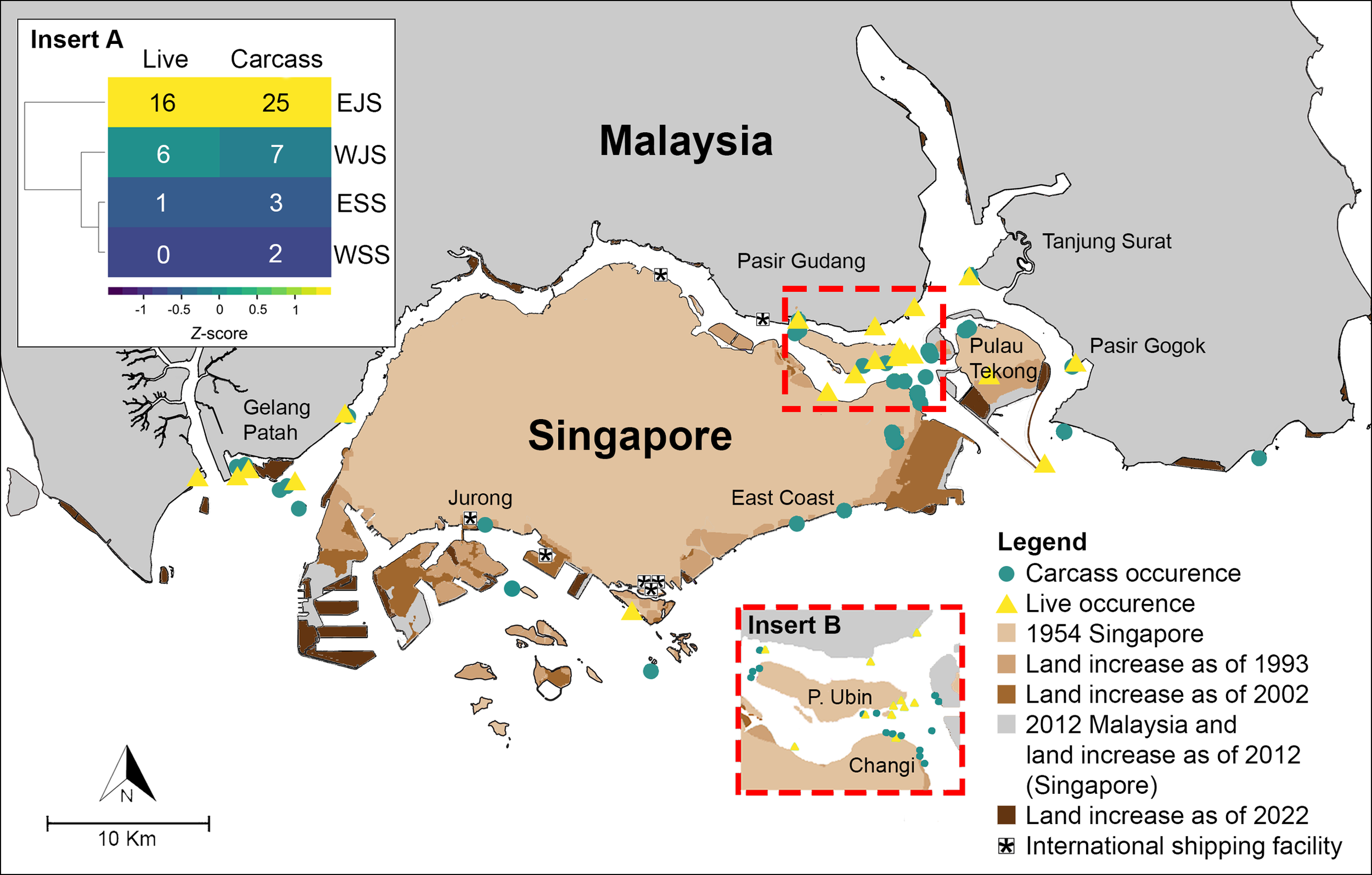
Distribution of live and carcass observations in Singapore between 1954 and 2021, overlayed on historical shoreline changes. Insert shows the section of the eastern Johor Strait where the most dugong observations were recorded. Records which were not accompanied with location information are not represented in this figure. Insert A: Hotspots of dugong observations revealed through Euclidean-based hierarchical distance clustering. EJS, WJS, ESS and WSS refers to the eastern and western Johor Strait and the eastern and western Singapore Strait respectively. Numbers depict the counts per observation in each broad locality.
The authors apologize for this error and state that this does not change the scientific conclusions of the article in any way. The original article has been updated.
Text Correction
In the published article, there was an error in paragraph three of the Discussion: “Variations per tidal cycle and exposure times of intertidal seagrass meadow at night during this period are the highest in the year (van Maren and Gerritsen, 2012; McKenzie et al., 2016). This reduces the number of high tides after dusk — an optimal foraging period for dugongs, due to the increased accessibility to intertidal meadows and lowered chances of predation (Wirsing et al., 2007b; Sheppard et al., 2009; Sheppard et al., 2010; Derville et al., 2022).” The correct sentence appears below:
“Variations per tidal cycle and the exposure of intertidal seagrass meadow during non-daylight hours are the highest during the Southwest monsoon (van Maren and Gerritsen, 2012; McKenzie et al., 2016). This reduces the duration of high tides that occur during non-daylight hours – an optimal foraging period due to the increased accessibility to intertidal meadows and lowered chances of predation (Wirsing et al., 2007b; Sheppard et al., 2009; Sheppard et al., 2010; Derville et al., 2022).”
The authors apologize for this error and state that this does not change the scientific conclusions of the article in any way. The original article has been updated.
Reference Correction
In the published article, the reference for GBIF.org was incorrectly written as GBIF.org (2022) GBIF occurrence download. Available at: https://github.com/ropensci/rgbif (Accessed January 11, 2022). It should be GBIF.org (2022) GBIF occurrence download. https://doi.org/10.15468/dl.xazg6k Available at: https://github.com/ropensci/rgbif (Accessed April 05, 2022).
The authors apologize for this error and state that this does not change the scientific conclusions of the article in any way. The original article has been updated.
Publisher’s note
All claims expressed in this article are solely those of the authors and do not necessarily represent those of their affiliated organizations, or those of the publisher, the editors and the reviewers. Any product that may be evaluated in this article, or claim that may be made by its manufacturer, is not guaranteed or endorsed by the publisher.
Summary
Keywords
distribution, coastal anthropogenic activities, feeding trails, Johor Strait, Singapore Strait, seagrass, threats, coastal development
Citation
Ng SZH, Ow YX and Jaafar Z (2022) Corrigendum: Dugongs (Dugong dugon) along hyper-urbanized coastlines. Front. Mar. Sci. 9:1048988. doi: 10.3389/fmars.2022.1048988
Received
20 September 2022
Accepted
10 October 2022
Published
27 October 2022
Approved by
Frontiers Editorial Office, Frontiers Media SA, Switzerland
Volume
9 - 2022
Updates
Copyright
© 2022 Ng, Ow and Jaafar.
This is an open-access article distributed under the terms of the Creative Commons Attribution License (CC BY). The use, distribution or reproduction in other forums is permitted, provided the original author(s) and the copyright owner(s) are credited and that the original publication in this journal is cited, in accordance with accepted academic practice. No use, distribution or reproduction is permitted which does not comply with these terms.
*Correspondence: Sirius Z. H. Ng, sirius.ng@u.nus.edu; Zeehan Jaafar, jaafarz@nus.edu.sg
This article was submitted to Marine Megafauna, a section of the journal Frontiers in Marine Science
Disclaimer
All claims expressed in this article are solely those of the authors and do not necessarily represent those of their affiliated organizations, or those of the publisher, the editors and the reviewers. Any product that may be evaluated in this article or claim that may be made by its manufacturer is not guaranteed or endorsed by the publisher.