Abstract
The shipping industry plays a vital role in the world trading system and in maintaining the stability of global supply chains. However, we cannot ignore the damage it brings to the marine environment. With a focus on protecting the marine environment, the sustainable development of shipping companies has also drawn growing attention. This study examines the sustainable shipping management practice system and develops a comprehensive framework to evaluate the significance of influencing elements and prioritizes those factors. This paper adopts a fuzzy analytic hierarchy process method. It establishes a total of 11 sub-index systems from three aspects: the external policy pressure of shipping companies, the ecological design of shipping services, and the cross-functional green management within shipping companies. We used the fuzzy analytic hierarchy process (FAHP) to analyze data collected from 37 experts in the Chinese shipping industry. The findings show that external policy pressure is the most critical factor influencing sustainable shipping management, followed by eco-design and cross-functional green management. These factors have a big impact and provide management references for shipping company managers and policymakers. They also give the government a company perspective when creating pertinent regulations.
1 Introduction
With ocean shipping playing an essential role in logistics transportation now, it plays a vital role in maintaining global industrial supply chain stability (Tong, 2022). However, since the COVID-19 pandemic, the world economy has been seriously adversely affected (Pang et al., 2021), and the shipping industry also has faced unprecedented challenges. The impact of COVID-19 on the shipping industry includes, but is not limited to, a decrease in maritime trade volumes (Elmi et al., 2022), terminal closures (Dulebenets, 2022), soaring freight rates (Jin et al., 2022), decreased passenger activity (Chen et al., 2022), and disruptions in global supply chains (Cullinane and Haralambides, 2021).
However, as the aftermath of COVID-19 on the world economy wanes, the demand for shipping services is gradually increasing. The effects of the shipping industry on the environment and society are still a topic of discussion. It’s thought that pollutants like greenhouse gases and shipping waste greatly impact the marine ecosystem (Wan et al., 2016; Wu et al., 2020). Researchers regard sustainability as the long-term and ultimate goal of human beings, and the sustainability of the marine environment has also received increasing attention from society (Iannaccone et al., 2020; Tran et al., 2020; Tong, 2022). As a result, policymakers have implemented and tightened various regulations, focusing on the sustainable management of shipping companies.
We cannot overstate the importance of environmental stewardship in contemporary organizations (Jackson et al., 2011; Khatoon et al., 2022). Existing research suggests that environmental practices can improve firm efficiency and provide a competitive advantage (Faleye and Trahan, 2011; Shin et al., 2017; Khatoon et al., 2022). Therefore, companies are becoming increasingly aware of the strategic importance of environmental management practices (Sroufe, 2003; Kleindorfer et al., 2005; Pagell & Gobeli, 2009; Yang et al., 2011). ISO 14001 is the most important environmental management standard, requiring companies to focus on their environmental responsibilities (Nawrocka and Parker, 2009). In addition, environmental law has developed into a specialized legal field, among which UN member states adopted marine protection and sustainable development goals in September 2015 (Ebbesson, 2010; Shamsuzzaman and Islam, 2018).
Regulations about marine environment include different conventions, declarations, and agreements covering the international marine and coastal environment sectors, including the United Nations Convention on the Law of the Sea in 1982 (LOSC), the United Nations Conference on Environment and Development (UNCED), the International Maritime Organization Convention (IMO), and the Convention on Biological Diversity (CBD), among others (Shamsuzzaman and Islam, 2018). As a critical stakeholder, international shipping companies also play an essential role in global sustainable development (Yuen et al., 2018; Wang et al., 2020). Therefore, all these regulations encourage shipping companies to focus on sustainable shipping management (SSM).
Existing studies have researched the impact of the formulation and implementation of environmental management initiatives on corporate performance, but most focus on the financial and business performance of the organization (Yang et al., 2011; Yuen et al., 2019; Tran et al., 2020). In contrast, there is a lack of comprehensive research on the sustainable management of shipping companies. This study refers to the existing research on the company SSM and constructs a framework of influencing factors. In exploring how organizations respond to external policy pressures, this study uses the widely-used institutional theory to investigate organizational adopting and disseminating practices. In contrast to other approaches, such as the resource-based view and dynamic capability theory, we adopted the institutional theory to illustrate how social pressures rather than political and economic factors influence an organization’s behaviors and decisions (Tuczek et al., 2018; Yang et al., 2021). This approach is more in line with the purpose of this study, which looks at how shipping companies implement SSM in the face of strict external marine protection regulations. In addition, we introduce the concepts of eco-design and cross-functional green management more comprehensively in the service products and internal management provided by shipping companies, used to consider the influencing factors applicable in SSM. This research fully explores the system of sustainable shipping management from three levels—external environment, service product design, and internal management— to identify the influencing factors, screen their priorities, and determine the sustainable development strategies of shipping companies based on the results.
This study adopts the fuzzy analysis hierarchical process (FAHP) method to solve the above research problems. Researchers use the FAHP for problem-solving, alternative solutions, prioritization, conflict resolution, participatory decision-making, and decision support, and its application has many practical advantages (Haya and Fujii, 2020). This study is crucial because it systematically establishes a structure for evaluating SSM from various aspects, filling the research gap in maritime company development. Researching the practical implications of such a comprehensive evaluation index framework is also important.
The study consists of the following parts. First, section 2 presents a related literature review. Section 3 details the FAHP method and its application in this study. Then, Section 4 presents the findings and discussions. Lastly, Section 5 provides a conclusion and this study’s limitations, including the scope of future research.
2 Literature review
This paper provides a thorough analysis and collation of existing research findings to identify sustainability factors in the development of maritime enterprises. There are global-scale discussions on concepts related to sustainable development, such as sustainable shipping management, company environmental performance, and institutional pressure. Although existing research has studied these concepts, problems have also arisen. For example, how sustainable is the shipping enterprise? Also, how does one carry out the sustainable development of a shipping company?
To answer those questions, we refer to the extensive research on sustainability and use the concept of sustainable shipping management (SSM) in existing research to measure it (Li et al., 2017; Su et al., 2020; Aslam et al., 2022; Waqas et al., 2022). We reviewed the existing literature and proposed a more comprehensive framework (institutional pressure, eco-design of shipping services, cross-functional green management) to contribute to the current literature.
2.1 Sustainable shipping management
Many studies indicate that companies should strive for profit, and social and environmental responsibility, i.e., to adopt a management style that seeks sustainable development through social and environmental responsibility (Carter and Rogers, 2008; Balkyte and Tvaronaviciene, 2010; Shin et al., 2017; Dmytriyev et al., 2021). For example, Shin et al. (2017) studied customers’ perceptions of the shipping industry’s sustainable activity responses. They argued that environmental and social responsibility could improve customer satisfaction and repurchase intentions, leading to a company’s improved financial performance and sustainability. In addition, there is also research on shipping companies’ sustainable shipping management at the level of resource development and supply chain management—SSM adopts an organization’s activities and principles to solve social and environmental issues in its operations to seek sustainable development (Tran et al., 2020).
It is worth noting that internal and external factors influence the company’s choice of corporate environmental work objectives. Among these are an understanding of the company’s larger-scale operations, environmental ambitions, and financial capacity (Nawrocka and Parker, 2009). Moreover, according to existing research, when considering the conditions for SSM enhancement from the perspective of resources, one needs to consider internal tangible and intangible resources, relational resources, and technical resources (Hart, 1995; Tran et al., 2020). This consideration is also known as sustainable resource development, supply chain collaboration, and sustainable technology development, which can significantly impact the SSM of shipping companies. Also, one needs to consider stakeholder support and participation when using a shipping company’s positioning perspective to describe its expected future path, that is, to meet the sustainability needs of stakeholders (Tran et al., 2020).
Researchers have also shown SSM in so many aspects as having a positive impact on company performance (Yang et al., 2011; Shin et al., 2017; Yuen et al., 2019; Tran et al., 2020; Petera et al., 2021). Several factors will impact the achievement of corporate green goals and sustainable development, including government regulation and market competition (Klassen and McLaughlin, 1996; Meng et al., 2019; Ma and Men, 2022), product development that considers the process and environmental performance (Kiurski et al., 2017; Rodrigues et al., 2017; Fung et al., 2021), and internal management that emphasizes the coordination of functional departments (Darnall et al., 2008). However, there has been no systematic review of these factors, so it is impossible to determine the magnitude of the impact of each element on SSM based on existing research. Therefore, one must consider these influencing factors in a complete evaluation system.
2.2 Institutional pressure
As early as the mid-1970s, some scholars put forward institutional theory (IT) when studying organizations. They argued that external factors of “social health” largely shaped organizations’ internal structures and procedures, not only external factors relating to the economic goals of cost minimization and profit maximization (Meyer and Rowan, 1977; Dimaggio and Powell, 1983; Guerreiro et al., 2021). A key element of IT includes social behavior, which helps to build a structure’s rules, values, and norms, and provides legitimacy to organizations that abide by those rules (Meyer and Rowan, 1977; Guerreiro et al., 2021). Existing research indicates that organizations oriented toward environmental management are better at environmental sustainability than those without environmental management (Nawrocka and Parker, 2009; Ahmed et al., 2021). From a government perspective, regulations related to environmental management indicate that the government is aware of regulatory needs or opportunities that sustainable management systems can address. Regulators at all levels provide possible controls for sustainable development frontrunners, one of the benefits to the organization (Nawrocka and Parker, 2009). In general, under such institutional pressure, organizations gain legitimacy and benefits by actively seeking to meet society’s expectations, which has led to an emphasis on company environmental sustainability performance.
Existing research shows that challenging environmental practices such as green product design and adopting green manufacturing processes emphasizing technology and outcomes are susceptible to internal pressures driven by resource and technology scarcity (Flynn et al., 1995; Meng et al., 2019; Ma and Men, 2022). In addition, the management principles or soft environmental management of sustainable policies adopted by a company to improve the environment, such as sustainable information collection, sustainable information disclosure, employee training, and employee participation, are more susceptible to external pressures from the government and market (Klassen and McLaughlin, 1996; Trumpp et al., 2015; Ma and Men, 2022). There are also studies on the impact of government regulations and regulatory measures in the research on supply chain management and regional ecology (Govindan et al., 2014; Mathiyazhagan et al., 2014; Haya and Fujii, 2020), but rarely research on the impact of this on the performance of shipping companies from the perspective of maritime law.
We should note that existing studies have called for the need to formulate appropriate environmental policies, such as mandatory disclosure of environmental information and punishment of environmental violations, to encourage companies to achieve better environmental sustainability (Li et al., 2017). For example, Meng and Zhang (2022) call for governments to make environmental disclosures mandatory for companies by enacting laws and policies. Therefore, in addition to the existing studies on the influencing factors of the environmental performance of shipping enterprises from the aspects of enterprise economy and technology, a more scientific and comprehensive approach to accurately judge the influencing factors of the sustainable management of shipping enterprises is to consider external policy pressures and how management and employees react to it.
According to institutional theory, the impact of regulations and norms on corporate behavior is in three categories: formal laws and regulations, social norms, and informal social knowledge (Mudambi and Navarra, 2002). The enforcement intensity refers to implementing different conventions, declarations, and agreements, established between various countries and world organizations. Numerous studies have shown that institutional pressures from a company’s external environment can reshape organizational behavior (Okhmatovskiy and David, 2012; Colwell and Joshi, 2013; Bertassini et al., 2021). Therefore, in this study, we assert that the intensity of implementing conventions and agreements such as UNCLOS and the IMO Convention will reshape the sustainable management of shipping companies. In addition, Soares et al. (2021) asserted that social norms influence organizational behavior.
In this study, we believe that the initiatives of marine environmental organizations and other societal pressures to regulate environmental protection impact shipping companies’ sustainable shipping management behavior. Furthermore, the knowledge (cognitive level) of top management and their employees within an organization can impact its behavior (Contractor et al., 2020). We believe that the environmental knowledge of shipping company management and employees is an essential factor influencing sustainable shipping management. In light of this, we divide the factors that affect the sustainable management of shipping companies into three points: intensity of law enforcement (laws and regulations), normative pressures of the shipping company, and informal social knowledge of the shipping company.
2.3 Eco-design of shipping services
The early stages of a product’s development define 80% of its sustainability performance; therefore, company product design must address the sustainability of processes and environmental performance (Rodrigues et al., 2017; Enyoghasi and Badurdeen, 2021; Fung et al., 2021). As such, researchers have proposed the concept of sustainable shipping management to enhance the competitive advantage of shipping companies by lowering costs and providing differentiated services (Lindstad et al., 2016; Lam and Wong, 2018; Yuen et al., 2019; Wang et al., 2021). For example, Wang et al. (2021) proposed that shipping firms create an external sustainable image to enhance competitive advantage while managing sustainably internally. Thus, to provide shipping services, shipping companies must consider sustainability and competitive advantages, which is how to introduce eco-design.
Eco-design is one of a series of initiatives for sustainable development. Its significance is to consider environmental issues during product development and related processes without compromising standards such as function, quality, cost, etc., to reduce the product life cycle’s environmental impact (Pigosso et al., 2013; Pigosso et al., 2015; Kiurski et al., 2017; Manzardo et al., 2021; Zeng et al., 2021). In addition, eco-design work is beneficial for companies to gain potential commercial benefits in developing new markets, increasing innovation levels, reducing costs, and compliance (Carroll and Shabana, 2010; Heras-Saizarbitoria et al., 2011; Plouffe et al., 2011).
Existing research has recognized the importance of eco-design and its practice and has mostly focused on product and process-oriented performance research in manufacturing firms (Boks, 2006; Boks and Stevels, 2007; Manzardo et al., 2021; Zeng et al., 2021). But it remains unclear how to integrate eco-design into business processes based on a continuous improvement framework. Therefore, there are also studies on the eco-design management model based on maturity, which explores the best practices of eco-design from three aspects: management practices, operational practices, and methods and tools (Pigosso et al., 2013). In Rodrigues et al. (2017) follow-up study, the researchers combined literature research and experts’ opinions to summarize 62 performance indicators of the ecological design process based on implementation, which is currently a more detailed and operable ecological practice performance indicator system. However, all evaluations do not consider the company’s higher-level operating systems and strategies (e.g., cost structure, marketing and operating strategies, stakeholders, etc.).
Existing studies have pointed out that internal and external stakeholders play a crucial role in promoting corporate environment-related performance (Klewitz and Hansen, 2014; Kiurski et al., 2017; Nguyen et al., 2021). For example, a study of interviews with 32 printing companies concluded that company owners are important drivers of environmental practices (Kiurski et al., 2017), while production tools and methods that conform to environmental practices are also effective in terms of cost (Borchardt et al., 2011). Research by Nguyen et al. (2021) also confirms that stakeholder engagement and board frequency influence an organization’s environmental performance. Moreover, many studies have shown that organizations should fully consider the eco-design of shipping service products at the corporate strategy and operational levels. Therefore, based on previous research, this study refers to the thematic grouping of eco-design practices by Rodrigues et al. (2019) and proposes four indicators: incentives and awareness for eco-design of shipping services, marketing and communication for eco-design of shipping services, portfolio management of shipping services, and value chain management of shipping services.
2.4 Cross-functional green management
Due to the development of enterprise products and services, organizations must be constantly vigilant about market conditions (Srivastava et al., 1998; Payne and Frow, 2005). A competitive market requires the support of different functional areas and promoting internal interdependence between departments (Kang et al., 2021), which involves integration between various functional departments of the company (De Clercq et al., 2011). Cross-functional integration aims to improve coordination between different departments to meet corporate goals (Bergstrom, 1984; Yue et al., 2022). Thus, companies should also consider coordinating their internal functional departments when practicing green management. In terms of organizational capability, companies with high internal integration are better equipped to disseminate, interpret, utilize, and evaluate information and knowledge acquired from external stakeholders (Du et al., 2018; Nguyen et al., 2018).
Studies also show that companies with a high level of internal coordination and communication will be more capable of improving their green management performance if they integrate internally (Johnsen, 2009; Xu et al., 2022). For example, Xu et al. (2022), in a study on supply chain management, verified that cross-functional coordination as a critical mediator effectively influences coercive, normative, and imitative pressures on green innovation. In addition, research shows that cross-functional management positively impacts corporate knowledge sharing, organizational innovation, and corporate operational performance (Love and Roper, 2009; Nguyen et al., 2018; Li et al., 2022).
Some studies have investigated the mechanism of cross-functional management within a company from different dimensions. For example, researchers have combined social capital theory, information theory, and other theories to study cross-functional management and coordination from multiple perspectives involving horizontal and vertical structures, cognition, and relationships, and the impact on knowledge sharing, enterprise innovation, etc. (Nguyen et al., 2018; Li et al., 2022). However, in corporate green development, a company’s internal functional departments must formulate coordinated green efforts, such as consistent green strategies and coordinated green processes to achieve green goals (Darnall et al., 2008; Xu et al., 2022). In addition, a company should include the specific implementation measures and subsequent maintenance of cross-functional green management in the scope of management in this area, which is equally important. Accordingly, this study proposes the four indicators based on existing research: establishment of cross-functional environmental policies, responsibilities fulfillment and commitment of cross-functional environmental policies, development and maintenance of the relationship with the other functions, and environmental issues in the delivery process.
3 Methodology
We applied the fuzzy analytic hierarchy process (FAHP), a method combining fuzzy set theory and AHP, to analyze the factor importance in the SSM framework. While AHP is a common technique used by scholars because it works favorably for multi-criteria decision-making, researchers have reported its assessment performance for complex problems to be less satisfactory because the crisp set in AHP can only be unary, which cannot effectively reflect vague or “not well defined” judgments (Munier and Hontoria, 2021). Fuzzy AHP can help address this issue by extending the crisp set to a fuzzy set in which the membership function ranges from [0,1] (i.e., ), thus, allowing an infinite membership function. Scholars have commended this approach because of its simplicity and similarity to human reasoning in multi-criteria analysis (e.g., Jakhar and Barua, 2014; Majumdar et al., 2021). We can summarize the main procedure of fuzzy AHP as follows.
The first step is to originate and define the research objective and construct the AHP model accordingly. In doing so, we extensively reviewed the relevant literature and proposed the initial model. After that, three experts (two senior managers from the industry and one professor at a marine engineering university in South Korea) reviewed our proposed model. The experts have at least 15 years of work experience. Based on their feedback, we carefully revised the model. Finally, our model includes three main criteria: institutional pressure with three sub-criteria, eco-design for shipping services with four sub-criteria, and cross-functional green management with four sub-criteria. Figure 1 shows the details of the model and Table 1 sorts out the sub-indicators and their interpretations.
Figure 1
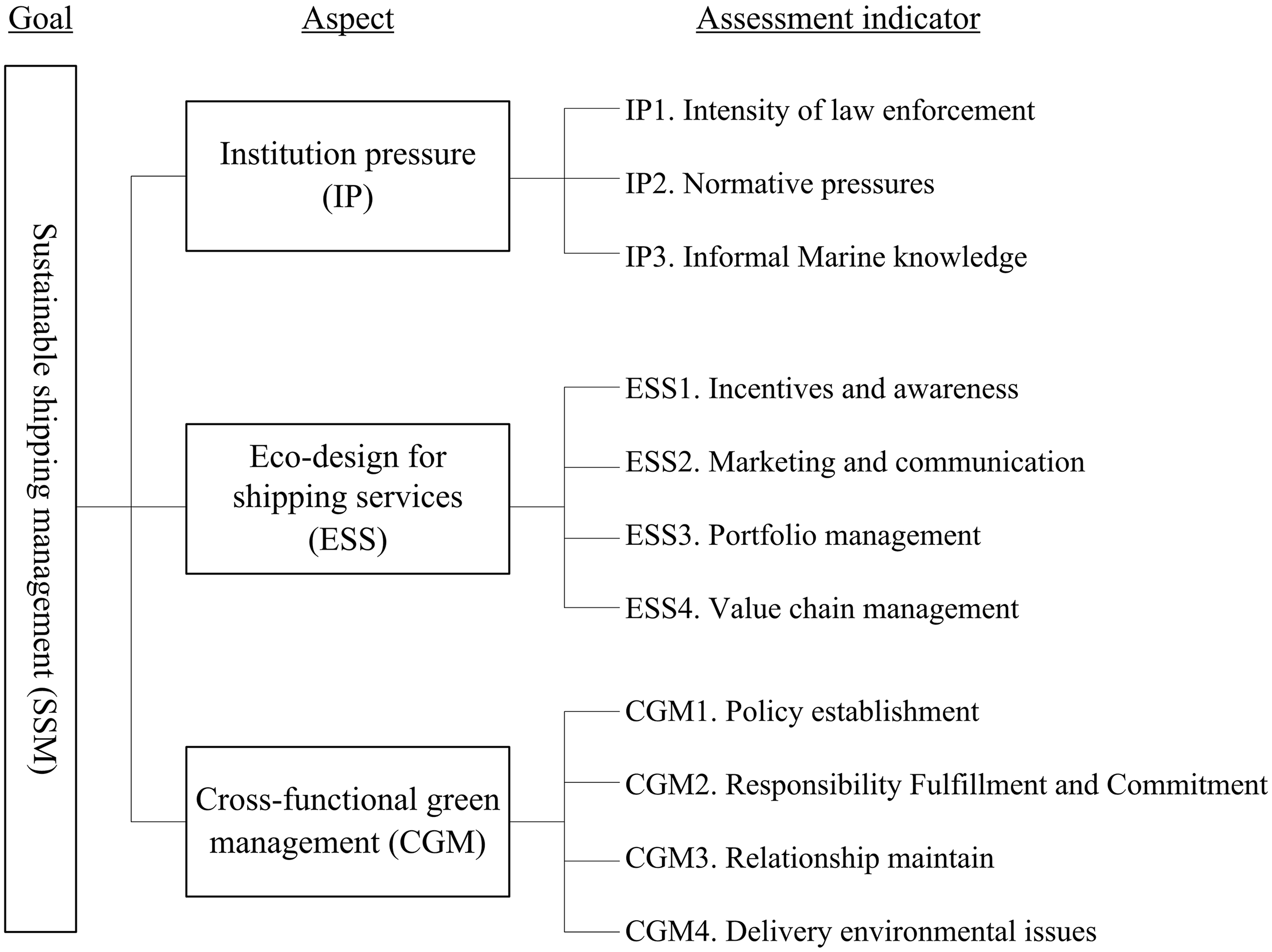
The hierarchical structure for SSM.
Table 1
| Aspect | Assessment Indicator | Definition | Source |
|---|---|---|---|
| Institutional pressure (IP) | IP1. Intensity of law enforcement | Implementing maritime conventions, such as the United Nations Convention on the Law of the Sea and the IMO Convention. | Contractor et al., 2020; Mudambi & Navarra, 2002 |
| IP2. Normative pressures | Marine Environmental Protection Group initiatives and other marine norms pressure shipping companies to protect the environment. | ||
| IP3. Informal marine knowledge | Marine environmental knowledge of shipping company management and employees. | ||
| Eco-design for shipping services (ESS) | ESS1.Incentives and awareness | Increase consciousness and awareness about the opportunities and benefits of integrating environmental issues in product development. | Pigosso et al., 2013; Rodrigues et al., 2017 |
| ESS2. Marketing and communication | Communicate the environmental performance and benefits as part of the total value proposition of the product, exploring green marketing opportunities. | ||
| ESS3. Portfolio management | Strategically consider the product’s environmental performance in the shipping company’s portfolio management. | ||
| ES4. Value chain management | Consider the environmental aspects in the identification, qualification and management of suppliers. | ||
| Cross-functional green management(CGM) | CGM1. Policy establishment | Establish green goals, actions and performance measurements across departments within the company. | De Clercq et al., 2011; Pinto et al., 1993; Yue et al., 2022 |
| CGM2. Responsibility fulfillment and commitment | Emphasize cross-functional decision-making autonomy and the fulfillment of shared responsibility, such as the extent to which functional managers perceive knowledge exchange with peers in other departments and shared goals related to the organization’s overall well-being. | ||
| CGM3. Relationship maintenance | Coordinate cross-functionally among shipping enterprise departments and emphasize effective and collaborative relationships between departments. | ||
| CGM4. Delivery environmental issues | Companies’ commercial interests are linked to the sustainability of shipping services. |
The indicators affecting sustainable shipping management (SSM) and definitions from literature.
Next, we applied a pair-wise comparison method to compare each criterion with others. Based on responses, we formulated an N × N pair-wise comparison matrix as follows.
where aij=1, when i=j and , otherwise. i, j=1,2,…n. However, this matrix is only valid when the consistency ratio (CR) is below 0.1. To measure CR, we used the method Gogus and Boucher (1998) recommended, and the calculation is as follows.
Where RI is the random index (Table 2), n is the matrix size, w is the weight vectors, and Λmax is the maximum eigenvalue (Saaty, 1980). For instance, if the matrix size is three (n = 3), we would use RI = 0.52 for the CR calculation.
While there are numerous methods to calculate the fuzzy number (e.g., triangular, trapezoidal, Gaussian), we employed the triangular fuzzy number (TFN) in this study because of its computational simplicity in operating the crisp numbers into a fuzzy set. The following shows the TFN calculation. Table 3 reports the fuzzy comparison measures (Gumus, 2009).
Table 3
| Linguistics Terms | Triangular Fuzzy Numbers |
|---|---|
| Perfect | (8, 9, 10) |
| Absolute | (7, 8, 9) |
| Very good | (6, 7, 8) |
| Fairly good | (5, 6, 7) |
| Good | (4, 5, 6) |
| Preferable | (3, 4, 5) |
| Not bad | (2, 3, 4) |
| Weak advantage | (1, 2, 3) |
| Equal | (1, 1, 1) |
Fuzzy comparison measures.
where l, u, and m are lower, modal, and upper values, respectively (l ≤ m ≤ u).
The basic operation of TFN for constructing a fuzzy comparison matrix is as follows (Majumdar et al., 2021).
Let and represent two TFNs.
, for addition
, for subtraction
, for multiplication
, for division
, for inverse
For example, for and , the result for the addition of summing two TFNs is To determine the criteria weights, we first calculated each criteria’s fuzzy geometric mean, then calculated the fuzzy weights. The formula for fuzzy geometric mean calculation is below.
Assume that is the fuzzy set of n responses for criteria i, the fuzzy geometric mean of this criteria is , and the fuzzy weights are .
Finally, we defuzzied and normalized the calculated weights to show the relative importance of the criterion. Following Hsieh et al. (2004), we applied the center of area method to determine the best nonfuzzy performance (BNP) values, and the calculation is as follows.
Based on the BNP values, we can derive the importance ranking of each criterion after normalization. Finally, after calculating the importance weights of each criterion and sub-criterion, we can obtain the global importance scores of the sub-criteria by multiplying the local scores of the sub-criteria with the importance weights of the criteria.
4 Results
We collected the data used in this study through a questionnaire survey with employees of shipping companies and researchers in maritime transportation. The questionnaire included three sections. The first section introduced the purpose of our study and covered anonymity and confidentially. Respondents who clicked “agree” were directed to the next section, which asked about their demographic characteristics, such as sector, work experience, and position. The last section requested the respondents to compare and rate the importance of the constructs of the model. Initially, we sent an invitation with a link to the survey to 100 employees and 100 researchers. A month later, we sent the link again to remind potential participants who had not yet completed the questionnaire and to inform them that they had 15 days to complete the survey. Eventually, we received 46 responses, a response rate of 23%. Because there were nine incomplete answers, our final dataset contained 37 replies.
Table 4 shows the demographics of the 37 respondents. The respondents’ positions included 51.35% in director roles and above, 29.73% in manager roles, and the remaining held non-managerial positions. The respondents’ work experience ranged from more than ten years (24.32%) to five-to-ten years (56.76%) and less than five years (18.92%). Furthermore, 59.46% of the respondents came from companies with 101–200 employees, while 18.92% and 21.62% were from companies with more than 200 employees and companies with less than 100 employees, respectively.
Table 4
| Profile Information | Number of Respondents (n=37) | Percentage (%) |
|---|---|---|
| Job position | ||
| Director and above | 19 | 51.35 |
| Manager | 11 | 29.73 |
| Non-manager | 7 | 18.92 |
| Working experience in the company (years) | ||
| >10 | 9 | 24.32 |
| 5–10 | 21 | 56.76 |
| <5 | 7 | 18.92 |
| Firm’s size (number of employees) | ||
| >200 | 7 | 18.92 |
| 101–200 | 22 | 59.46 |
| <100 | 8 | 21.62 |
Demographics of respondents.
Following Zhao et al. (2022), we calculated the response consistency ratio and weights based on mean values. The analysis results are in Table 5.
Table 5
| Criteria | Criteria Score | Sub-criteria | Local Score | Global Score | Global Rank |
|---|---|---|---|---|---|
| Institutional pressure | 0.549 | IP1. Intensity of law enforcement | 0.343 | 0.188 | 2 |
| IP2. Normative pressures | 0.356 | 0.195 | 1 | ||
| IP3. Informal social knowledge | 0.301 | 0.165 | 3 | ||
| Eco-design for shipping services | 0.288 | ESS1.Incentives and awareness | 0.211 | 0.061 | 7 |
| ESS2. Marketing and communication | 0.314 | 0.090 | 5 | ||
| ESS3. Portfolio management | 0.422 | 0.122 | 4 | ||
| ESS4. Value chain management | 0.053 | 0.015 | 10 | ||
| Cross-functional green management | 0.163 | CGM1. Policy establishment | 0.223 | 0.036 | 9 |
| CGM2. Responsibility fulfillment and commitment | 0.387 | 0.063 | 6 | ||
| CGM3. Relationship maintenance | 0.337 | 0.055 | 8 | ||
| CGM4. Delivery environmental issues | 0.063 | 0.010 | 11 |
Fuzzy AHP analysis results.
Overall, the results of consistency ratio tests for all criteria were below 0.1 (ranging from 0.019 to 0.071), suggesting consistent matrices. Table 5 reports the local and global weights of the criteria. For the main criteria, we found institutional pressure as the most critical factor (0.549), followed by eco-design for shipping services (0.288) and cross-functional green management (0.163). The findings of this analysis point to the importance of external policy pressure in supporting the adoption of SSM. Thus, companies must simultaneously consider the eco-design of shipping services and internal cross-functional green management.
We then took a closer look at the importance weights of the sub-criteria. First, normative pressure (0.356) was the most important sub-criteria of institutional pressure, followed by intensity of law enforcement (0.343) and informal social knowledge (0.301). Notably, these factors also ranked in the top three globally. This finding demonstrates that institutional theory’s emphasis on normative pressure, law enforcement, and informal social knowledge is essential for shipping businesses to consider if they wish to maintain a decent, sustainable development. In descending order, the sub-criteria of eco-design for shipping services are portfolio management (0.422), marketing and communication (0.314), incentives and awareness (0.211), and value chain management (0.053). This result demonstrates the importance of considering the investment portfolio when implementing eco-design into shipping services, emphasizing the marketing of eco-service items, and raising staff understanding of eco-design. Lastly, the cross-functional green management criterion results indicated that the most crucial sub-criterion is responsibility fulfillment and commitment (0.387). Following this is relationship maintenance (0.337), policy establishment (0.223), and delivery environmental issues (0.063). Therefore, companies must carefully execute the plan and maintain a good link between corresponding responsibilities for the successful implementation of cross-functional green management. Of course, companies must also consider environmental concerns while developing and implementing green goals.
5 Discussion
5.1 Theoretical contributions
This study makes a lot of significant literary contributions. First, this work enriches the study of SSM and FAHP. This study constructed a comprehensive SSM operational framework, including external environment, product design, and internal management, and used the FAHP method to analyze the priority of implementing SSM, thereby filling a research gap on SSM operation from the perspective of company management strategy. According to the study, external policy pressures have a more significant impact on shipping companies’ SSMs than eco-design of shipping services and cross-functional green management, which is in line with businesses reacting quickly to environmental change (Shin et al., 2017; Murillo–Avalos et al., 2021).
Second, this study advances the use of institutional theory in shipping companies. In this study, we investigated the antecedents that influence SSM using the three levels of rules and regulations, social norms, and social knowledge mentioned in institutional theory. Our findings also indicate that the most important component, followed by the eco-design of shipping services and internal cross-functional green management, is the degree to which companies implement marine-related rules and regulations. Companies that frequently break laws and regulations risk harsh penalties and even lose their reputation in an atmosphere of strictly-enforced external marine-related laws and regulations. Therefore, shipping companies must be aware of external policy influences since these outcomes impact their interests.
Third, this work advances the field of product eco-design research. This study broadens the research scope of eco-design by applying the idea to shipping businesses in the service industry, in contrast to earlier studies that concentrated on manufacturing. The investment portfolio of shipping services is undoubtedly the most crucial component in investigating specific influencing factors, followed by the value chain of shipping services, thus, the environmental practices of suppliers. Such outcomes are consistent with studies showing how business stakeholders substantially influence corporate environmental practices (Klewitz and Hansen, 2014; Kiurski et al., 2017). In addition, marketing and communication efforts should focus on delivering service products.
Fourth, this study builds on prior cross-functional management research to add to the knowledge of sustainable growth inside maritime organizations. Cross-functional cooperation from the standpoint of green management, particularly research on shipping businesses, is rarely included in existing studies, which frequently concentrate on cross-sectoral cooperation and coordination. The investigation demonstrates that cross-functional commitment and responsibility fulfillment significantly influence green management. It also indicates that setting goals is not as crucial for internal work as putting them into practice. Maintaining positive relationships between cooperative departments will be helpful for the promotion and implementation of cross-functional green management, which is another critical role of cross-functional relationships that reflects the “social attributes” of cross-functional relationships within the company.
5.2 Managerial implications
The study has some managerial ramifications as well. This research evaluated the sustainability of shipping firms and created a management framework for improved SSM implementation. The analysis aids in understanding the principle elements and supporting variables that influence SSM from the perspectives of three crucial business strategies: the external environment, service goods, and cross-departmental cooperation. By highlighting the most persuasive sustainability variables and their relative weight concerning other factors, the findings assist managers, strategists, and politicians in making strategic sustainability decisions.
According to the study, the external environment directly influences the implementation of SSM, which may also be related to the serious consequences that companies face after breaching laws and regulations. Although long-term legal pressure cannot solve the problem of sustainable development, shipping companies could develop a good sustainable development strategy by strengthening the implementation of relevant regulations in the short term. As a result, this study offers the government some company viewpoints regarding putting marine environmental protection laws into practice, making the creation and application of legislation more useful.
Additionally, we found two vital influencing factors: the design of the investment portfolio of shipping services and the internal commitment and fulfillment of cross-functional duties. This finding shows a crucial link between the environmental awareness of stakeholders and product design, i.e., more consideration of environmental performance in product design will be effective. Therefore, while cross-departmental cooperation should establish green goals, it should also supervise the performance of corresponding responsibilities.
By putting these sustainable development aspects into practice, shipping company managers will be better able to recognize and address challenges posed by the external environment, product design, and cross-functional management.
6 Conclusion
Existing studies lack the overall framework of SSM. Therefore, to fill the research gap, this study systematically established a general architecture for evaluating SSM from all aspects, examined SSM practices, and screened their priorities. We used the FAHP method to create 11 sub-index systems from three views: external policy pressure of shipping companies, eco-design of shipping services, and cross-functional green management within shipping companies. The findings show that external policy pressure is the most critical factor influencing sustainable shipping management, followed by eco-design and cross-functional green management. These results expand the research on sustainable shipping and related theories and serve as a basis for policy formulation by shipping industry managers and governments.
There are some gaps in this investigation. First, the framework structure of the research method’s evaluation indicators still has limits. The actual situation is still confusing since shipping business operations are complex, despite that this study examined pertinent aspects from as many viewpoints as feasible. For instance, in the area of eco-design, it is more important to consider the characteristics of the service industry and identify more specific and targeted operability indicators to guide the ecological design practice of shipping enterprise services because the service industry differs from the traditional manufacturing industry. Compared to typical businesses, shipping firms have distinct functional departments. The integration and cooperation between the functional departments of shipping corporations have been the subject of focused research.
Second, this study focuses on sustainable management in the shipping industry, and the findings are applicable to research related to the shipping industry. We suggest follow-up research analysis or verification of whether this study’s results apply to other fields, thus expanding the literature on sustainable management.
Third, although scholars have explored the causes of reducing shipping pollution through various methods, there is still value in analyzing the mechanisms of its impact on organizations. In the current complex business and market environment, we encourage more theories to explore sustainable shipping, including organizational information processing theory, contingency theory, dynamic capability theory, etc.
Statements
Data availability statement
The raw data supporting the conclusions of this article will be made available by the authors, without undue reservation.
Ethics statement
Ethical review and approval were not required for the study on human participants in accordance with the local legislation and institutional requirements. Written informed consent for participation was not required for this study in accordance with the national legislation and the institutional requirements.
Author contributions
LW: Conceptualization, methodology, writing (original draft, review, and editing). JY: Methodology, writing (original draft), resources. HZ: Writing (review and editing), resources, investigation. QP: Software, writing (original draft, review, and editing), investigation. MF: Conceptualization, methodology, investigation, formal analysis, data curation. All authors contributed to the article and approved the submitted version.
Conflict of interest
The authors declare that the research was conducted in the absence of any commercial or financial relationships that could be construed as a potential conflict of interest.
Publisher’s note
All claims expressed in this article are solely those of the authors and do not necessarily represent those of their affiliated organizations, or those of the publisher, the editors and the reviewers. Any product that may be evaluated in this article, or claim that may be made by its manufacturer, is not guaranteed or endorsed by the publisher.
References
1
Ahmed M. Guo Q. Qureshi M. A. Raza S. A. Khan K. A. Salam J. (2021). Do green HR practices enhance green motivation and proactive environmental management maturity in hotel industry? Int. J. Hospitality Manage.94, 102852. doi: 10.1016/j.ijhm.2020.102852
2
Aslam S. Rehman R. U. Naeem M. A. Taghizadeh-Hesary F. (2022). Nexus of corporate environmental strategy, environmental performance, and financial performance. Singapore Economic Rev. 1–21. doi: 10.1142/S0217590822500291
3
Balkyte A. Tvaronaviciene M. (2010). Perception of competitiveness in the context of sustainable development: Facets of “Sustainable competitiveness.”J. Of Business Economics And Manage.11, 341–365. doi: 10.3846/jbem.2010.17
4
Bergstrom R. P. (1984). Restoring our competitive edge–competing through manufacturing. Eds. HayesR. H.WheelwrightS. C., 93 (6), 87. Manufacturing Engineering.
5
Bertassini A. C. Ometto A. R. Severengiz S. Gerolamo M. C. (2021). Circular economy and sustainability: The role of organizational behaviour in the transition journey. Business Strategy Environ.30, 87. doi: 10.1002/bse.2796
6
Boks C. (2006). The soft side of ecodesign. J. Cleaner Production14, 1346–1356. doi: 10.1016/j.jclepro.2005.11.015
7
Boks C. Stevels A. (2007). Essential perspectives for design for environment. experiences from the electronics industry. Int. J. Production Res.45 (18–19), 4021–4039. doi: 10.1080/00207540701439909
8
Borchardt M. Wendt M. H. Pereira G. M. Sellitto M. A. (2011). Redesign of a component based on ecodesign practices: Environmental impact and cost reduction achievements. J. Cleaner Production19, 49–57. doi: 10.1016/j.jclepro.2010.08.006
9
Carroll A. B. Shabana K. M. (2010). The business case for corporate social responsibility: A review of concepts, research and practice. Int. J. Manage. Rev.12, 85–105. doi: 10.1111/j.1468-2370.2009.00275.x
10
Carter C. R. Rogers D. S. (2008). A framework of sustainable supply chain management: Moving toward new theory. Int. J. Phys. Distribution Logistics Manage.38, 360–387. doi: 10.1108/09600030810882816
11
Chen Q. Ge Y. E. Lau Y. Y. Dulebenets M. A. Sun X. Kawasaki T. et al . (2022). Effects of COVID-19 on passenger shipping activities and emissions: Empirical analysis of passenger ships in Danish waters. Maritime Policy Manage., 1–21. doi: 10.1080/03088839.2021.2021595
12
Colwell S. R. Joshi A. W. (2013). Corporate ecological responsiveness: Antecedent effects of institutional pressure and top management commitment and their impact on organizational performance. Business Strategy Environ.22, 73–91. doi: 10.1002/bse.732
13
Contractor F. J. Dangol R. Nuruzzaman N. Raghunath S. (2020). How do country regulations and business environment impact foreign direct investment (FDI) inflows? Int. Business Rev.29 (2), 101640. doi: 10.1016/j.ibusrev.2019.101640
14
Cullinane K. Haralambides H. (2021). Global trends in maritime and port economics: The COVID-19 pandemic and beyond. Maritime Economics Logistics23, 369–380. doi: 10.1057/s41278-021-00196-5
15
Darnall N. Henriques I. Sadorsky P. (2008). Do environmental management systems improve business performance in an international setting? J. Of Int. Manage.14, 364–376. doi: 10.1016/j.intman.2007.09.006
16
De Clercq D. Thongpapanl N. Dimov D. (2011). A closer look at cross-functional collaboration and product innovativeness: Contingency effects of structural and relational context. J. Product Innovation Manage.28, 680–697. doi: 10.1111/j.1540-5885.2011.00830.x
17
Dimaggio P. J. Powell W. W. (1983). The iron cage revisited – institutional isomorphism and collective rationality in organizational fields. Am. Sociological Rev.48, 147–160. doi: 10.2307/2095101
18
Dmytriyev S. D. Freeman R. E. Hörisch J. (2021). The relationship between stakeholder theory and corporate social responsibility: Differences, similarities, and implications for social issues in management. J. Manage. Stud.58, 1441–1470. doi: 10.1111/joms.12684
19
Dulebenets M. A. (2022). Multi-objective collaborative agreements amongst shipping lines and marine terminal operators for sustainable and environmental-friendly ship schedule design. J. Cleaner Production342, 130897. doi: 10.1016/j.jclepro.2022.130897
20
Du L. Z. Zhang Z. L. Feng T. W. (2018). Linking green customer and supplier integration with green innovation performance: The role of internal integration. Business Strategy And Environ.27, 1583–1595. doi: 10.1002/bse.2223
21
Ebbesson J. (2010). The rule of law in governance of complex socio-ecological changes. Global Environ. Change-Human Policy Dimensions20, 414–22. doi: 10.1016/j.gloenvcha.2009.10.009
22
Elmi Z. Singh P. Meriga V. K. Goniewicz K. Borowska-Stefańska M. Wiśniewski S. et al . (2022). Uncertainties in liner shipping and ship schedule recovery: A state-of-the-Art review. J. Mar. Sci. Eng.10, 563. doi: 10.3390/jmse10050563
23
Enyoghasi C. Badurdeen F. (2021). Industry 4.0 for sustainable manufacturing: Opportunities at the product, process, and system levels. Resources Conserv. Recycling166, 105362. doi: 10.1016/j.resconrec.2020.105362
24
Faleye O. Trahan E. A. (2011). Labor-friendly corporate practices: Is what is good for employees good for shareholders? J. Business Ethics101, 1–27. doi: 10.1007/s10551-010-0705-9
25
Flynn B. B. Schroeder R. G. Sakakibara S. (1995). The impact of quality management practices on performance and competitive advantage. Decision Sci.26, 659–691. doi: 10.1111/j.1540-5915.1995.tb01445.x
26
Fung Y. N. Chan H. L. Choi T. M. Liu R. (2021). Sustainable product development processes in fashion: Supply chains structures and classifications. Int. J. Production Economics231, 107911. doi: 10.1016/j.ijpe.2020.107911
27
Gogus O. Boucher T. O. (1998). Strong transitivity, rationality and weak monotonicity in fuzzy pair-wise comparisons. Fuzzy Sets Syst.94, 133–144. doi: 10.1016/S0165-0114(96)00184-4
28
Govindan K. Kaliyan M. Kannan D. Haq A. N. (2014). Barriers analysis for green supply chain management implementation in Indian industries using analytic hierarchy process. Int. J. Production Economics147, 555–568. doi: 10.1016/j.ijpe.2013.08.018
29
Guerreiro M. S. Rodrigues L. L. Craig R. (2021). Institutional theory and IFRS: An agenda for future research. Spanish J. Finance Accounting – Rev. Espanola Financiacion Y Contabilida50 (1), 65–88. doi: 10.1080/02102412.2020.1712877
30
Gumus A. T. (2009). Evaluation of hazardous waste transportation firms by using a two-step fuzzy-AHP and TOPSIS methodology. Expert Syst. Appl.36 (2), 4067–4074. doi: 10.1016/j.eswa.2008.03.013
31
Hart S. L. (1995). A natural-resource-based view of the firm. Acad. Manage. Rev.20, 986–1014. doi: 10.2307/258963
32
Haya L. M. Y. Fujii M. (2020). Assessment of coral reef ecosystem status in the pangkajene and kepulauan regency, spermonde archipelago, Indonesia, using the rapid appraisal for fisheries and the analytic hierarchy process. Mar. Policy118, 104028. doi: 10.1016/j.marpol.2020.104028
33
Heras-Saizarbitoria I. Molina-Azorin J. F. Dick G. P. M. (2011). ISO 14001 certification and financial performance: Selection-effect versus treatment-effect. J. Cleaner Production19, 1–12. doi: 10.1016/j.jclepro.2010.09.002
34
Hsieh T.-Y. Lu S.-T. Tzeng G.-H. (2004). Fuzzy MCDM approach for planning and design tenders selection in public office buildings. Int. J. Project Manage.22 (7), 573–584. doi: 10.1016/j.ijproman.2004.01.002
35
Iannaccone T. Landucci G. Tugnoli A. Salzano E. Cozzani V. (2020). Sustainability of cruise ship fuel systems: Comparison among LNG and diesel technologies. J. Cleaner Production260, 121069. doi: 10.1016/j.jclepro.2020.121069
36
Jackson S. E. Renwick D. W. S. Jabbour C. J. C. Muller–Camen M. (2011). State-of-the-art and future directions for green human resource management: Introduction to the special issue. Z. fur Personalforschung25, 99–116. doi: 10.1688/1862-0000_ZfP_2011_02_Jackson
37
Jakhar S. K. Barua M. K. (2014). An integrated model of supply chain performance evaluation and decision-making using structural equation modelling and fuzzy AHP. Production Plann. Control25 (11), 938–957. doi: 10.1080/09537287.2013.782616
38
Jin L. Chen J. Chen Z. Sun X. Yu B. (2022). Impact of COVID-19 on china’s international liner shipping network based on AIS data. Transport Policy121, 90–99. doi: 10.1016/j.tranpol.2022.04.006
39
Johnsen T. E. (2009). Supplier involvement in new product development and innovation: Taking stock and looking to the future. J. Purchasing Supply Manage.15, 187–197. doi: 10.1016/j.pursup.2009.03.008
40
Kang M. G. Lee G. Hwang D. W. Wei J. Huo B. F. (2021). Effects of cross-functional integration on NPD success: Mediating roles of customer and supplier involvement. Total Qual. Manage. Business Excellence32 (13–14), 1515–1531. doi: 10.1080/14783363.2020.1736543
41
Khatoon A. Khan N. A. Parvin F. Wahid M. S. Jamal M. T. Azhar S. (2022). Green HRM: Pathway towards environmental sustainability using AHP and FAHP in a nascent parsimony. Int. J. Manpower43 (3), 805–826. doi: 10.1108/IJM-04-2020-0164
42
Kiurski J. S. Marić B. B. Oroš I. B. Kečić V. S. (2017). The ecodesign practice in Serbian printing industry. J. Cleaner Production149, 1200–1209. doi: 10.1016/j.jclepro.2017.02.193
43
Klassen R. D. McLaughlin C. P. (1996). The impact of environmental management on firm performance. Manage. Sci.42, 1199–1214. doi: 10.1287/mnsc.42.8.1199
44
Kleindorfer P. R. Singhal K. Van Wassenhove L. N. (2005). Sustainable operations management. Production Operations Manage.14, 482–489. doi: 10.1111/j.1937-5956.2005.tb00235.x
45
Klewitz J. Hansen E. G. (2014). Sustainability-oriented innovation of SMEs: A systematic review. J. Cleaner Production65, 57–75. doi: 10.1016/j.jclepro.2013.07.017
46
Lam J. S. L. Wong H. N. (2018). Analysing business models of liner shipping companies. Int. J. Shipping Transport Logistics10, 237–256. doi: 10.1504/IJSTL.2018.090078
47
Lindstad H. Asbjornslett B. E. Stromman A. H. (2016). Opportunities for increased profit and reduced cost and emissions by service differentiation within container liner shipping. Maritime Policy Manage.43, 280–294. doi: 10.1080/03088839.2015.1038327
48
Li S. Y. Wang K. D. Huo B. F. Zhao X. D. Cui X. L. (2022). The impact of cross - functional coordination on customer coordination and operational performance: An information processing view. Industrial Management & Data Systems122 (1), 167–193. doi: 10.1108/IMDS-04-2021-0265
49
Li D. Zhao Y. Sun Y. Yin D. (2017). Corporate environmental performance, environmental information disclosure, and financial performance: Evidence from China. Hum. Ecol. Risk Assessment: Int. J.23, 323–339. doi: 10.1080/10807039.2016.1247256
50
Love J. H. Roper S. (2009). Organizing innovation: Complementarities between cross-functional teams. Technovation29, 192–203. doi: 10.1016/j.technovation.2008.07.008
51
Majumdar A. Sinha S. K. Shaw M. Mathiyazhagan K. (2021). Analysing the vulnerability of green clothing supply chains in south and southeast Asia using fuzzy analytic hierarchy process. Int. J. Production Res.59 (3), 752–771. doi: 10.1080/00207543.2019.1708988
52
Ma Y. Men J. Z. (2022). The drivers of firms’ environmental management: Soft environmental management vs. hard environmental management. Polish J. Environ. Stud.31 (1), 749–761. doi: 10.15244/pjoes/139743
53
Manzardo A. Marson A. Zuliani F. Bacenetti J. Scipioni A. (2021). Combination of product environmental footprint method and eco-design process according to ISO 14006: The case of an Italian vinery. Sci. Total Environ.799, 149507. doi: 10.1016/j.scitotenv.2021.149507
54
Mathiyazhagan K. Govindan K. Haq A. N. (2014). Pressure analysis for green supply chain management implementation in Indian industries using analytic hierarchy process. Int. J. Production Res.52, 188–202. doi: 10.1080/00207543.2013.831190
55
Meng X. H. Zeng S. X. Xie X. M. Zou H. L. (2019). Beyond symbolic and substantive: Strategic disclosure of corporate environmental information in China. Business Strategy Environ.28, 403–417. doi: 10.1002/bse.2257
56
Meng J. Zhang Z. (2022). Corporate environmental information disclosure and investor response: Evidence from china’s capital market. Energy Economics108, 105886. doi: 10.1016/j.eneco.2022.105886
57
Meyer J. W. Rowan B. (1977). Institutionalized organizations: Formal structure as myth and ceremony. Am. J. Sociol.83, 340–363. doi: 10.1086/226550
58
Mudambi R. Navarra P. (2002). Institutions and international business: A theoretical overview. Int. Business Rev.11, 635–646.
59
Munier N. Hontoria E. (2021). Uses and limitations of the AHP method (Midtown Manhattan, New York City: Springer).
60
Murillo–Avalos C. L. Cubilla–Montilla M. Sanchez M. A. C. Vicente–Galindo P. (2021). What environmental social responsibility practices do Large companies manage for sustainable development? Corporate Soc. Responsibility Environ. Manage.28, 153–168. doi: 10.1002/csr.2039
61
Nawrocka D. Parker T. (2009). Finding the connection: Environmental management systems and environmental performance. J. Cleaner Production17, 601–607. doi: 10.1016/j.jclepro.2008.10.003
62
Nguyen T. H. Elmagrhi M. H. Ntim C. G. Wu Y. (2021). Environmental performance, sustainability, governance and financial performance: Evidence from heavily polluting industries in China. Business Strategy Environ.30, 2313–1332. doi: 10.1002/bse.2748
63
Nguyen N. P. Ngo L. V. Bučić T. Phong N. D. (2018). Cross-functional knowledge sharing, coordination and firm performance: The role of cross-functional competition. Ind. Marketing Manage.71, 123–134. doi: 10.1016/j.indmarman.2017.12.014
64
Okhmatovskiy I. David R. J. (2012). Setting your own standards: Internal corporate governance codes as a response to institutional pressure. Organ. Sci.23, 155–176. doi: 10.1287/orsc.1100.0642
65
Pagell M. Gobeli D. (2009). How plant managers’ experiences and attitudes toward sustainability relate to operational performance. Production Operations Manage.18, 278–299. doi: 10.1111/j.1937-5956.2009.01050.x
66
Pang Q. Meng H. Fang M. Xing J. Yao J. (2021). Social distancing, health concerns, and digitally empowered consumption behavior under COVID-19: A study on livestream shopping technology. Front. Public Health9. doi: 10.3389/fpubh.2021.748048
67
Payne A. Frow P. (2005). A strategic framework for customer relationship management. J. Marketing69, 167–176. doi: 10.1509/jmkg.2005.69.4.167
68
Petera P. Wagner J. Pakšiová R. (2021). The influence of environmental strategy, environmental reporting and environmental management control system on environmental and economic performance. Energies14 (15). doi: 10.3390/en14154637
69
Pigosso D. C. A. McAloone T. C. Rozenfeld H. (2015). Characterization of the state-of-the-art and identification of main trends for ecodesign tools and methods: Classifying three decades of research and implementation. J. Indian Institute Sci.95, 405–427.
70
Pigosso D. C. A. Rozenfeld H. McAloone T. C. (2013). Ecodesign maturity model: A management framework to support ecodesign implementation into manufacturing companies. J. Cleaner Production59, 160–173. doi: 10.1016/j.jclepro.2013.06.040
71
Pinto M. B. Pinto J. K. Prescott J. E. (1993). Antecedents and consequences of project team cross-functional cooperation. Manage. Sci.39, 1281–1297. doi: 10.1287/mnsc.39.10.1281
72
Plouffe S. Lanoie P. Berneman C. Vernier M. F. (2011). Economic benefits tied to ecodesign. J. Cleaner Production19, 573–579. doi: 10.1016/j.jclepro.2010.12.003
73
Rodrigues V. P. Pigosso D. C. A. McAloone T. C. (2017). Measuring the implementation of ecodesign management practices: A review and consolidation of process-oriented performance indicators. J. Cleaner Production156, 293–309. doi: 10.1016/j.jclepro.2017.04.049
74
Rodrigues V. P. Pigosso D. C. A. McAloone T. C. (2019). Business cases for ecodesign implementation: A simulation-based framework. J. Cleaner Production234, 1045–1058. doi: 10.1016/j.jclepro.2019.06.289
75
Saaty T. L. (1980). The Analytic Hierarchy Process: Planning, Priority Setting. Resource Allocation. (RWS Publications).
76
Shamsuzzaman M. M. Islam M. M. (2018). Analysing the legal framework of marine living resources management in Bangladesh: Towards achieving sustainable development goal 14. Mar. Policy87, 255–262. doi: 10.1016/j.marpol.2017.10.026
77
Shin Y. Van Thai V. Grewal D. Kim Y. (2017). Do corporate sustainable management activities improve customer satisfaction, word-of-mouth intention and repurchase intention? empirical evidence from the shipping industry. Int. J. Logistics Manage.28 (2), 555–570. doi: 10.1108/IJLM-11-2015-0220
78
Soares A. L. V. Mendes L. Gretzel U. (2021). Technology adoption in hotels: Applying institutional theory to tourism. Tourism Rev.76, 669–680. doi: 10.1108/TR-05-2019-0153
79
Srivastava R. K. Shervani T. A. Fahey L. (1998). Market-based assets and shareholder value: A framework for analysis. J. Marketing62, 2–18. doi: 10.2307/1251799
80
Sroufe R. (2003). Effects of environmental management systems on environmental management practices and operations. Production Operations Manage.12, 416–431. doi: 10.1111/j.1937-5956.2003.tb00212.x
81
Su X. F. Xu A. X. Lin W. H. Chen Y. C. Liu S. T. Xu W. X. (2020). Environmental leadership, green innovation practices, environmental knowledge learning, and firm performance. SAGE Open10 (2). doi: 10.1177/2158244020922909
82
Tong H. (2022). The future development and restructuring of the international shipping industry: Conference report. Mar. Policy137, 104956. doi: 10.1016/j.marpol.2022.104956
83
Tran T. M. T. Yuen K. F. Wang X. Q. Li K. X. (2020). The antecedents of sustainable shipping management and organisational performance: Resource accumulation and orientation perspectives. Int. J. Phys. Distribution Logistics Manage.50, 833–854. doi: 10.1108/IJPDLM-03-2020-0066
84
Trumpp C. Endrikat J. Zopf C. Guenther E. (2015). Definition, conceptualization, and measurement of corporate environmental performance: A critical examination of a multidimensional construct. J. Business Ethics126, 185–204. doi: 10.1007/s10551-013-1931-8
85
Tuczek F. Castka P. Wakolbinger T. (2018). A review of management theories in the context of quality, environmental and social responsibility voluntary standards. J. Cleaner Production176, 399–416. doi: 10.1016/j.jclepro.2017.12.161
86
Wang X. Wong Y. D. Li K. X. Yuen K. F. (2021). Shipping industry’s sustainability communications to public in social media: A longitudinal analysis. Transport Policy110, 123–134. doi: 10.1016/j.tranpol.2021.05.031
87
Wang X. Q. Yuen K. F. Wong Y. D. Li K. X. (2020). How can the maritime industry meet sustainable development goals? an analysis of sustainability reports from the social entrepreneurship perspective. Transportation Res. Part D – Transport Environ.78, 102173. doi: 10.1016/j.trd.2019.11.002
88
Wan Z. Zhu M. Chen S. Sperling D. (2016). Three steps to a green shipping industry. Nature530, 275–277. doi: 10.1038/530275a
89
Waqas M. Honggang X. Ahmad N. Khan S. A. R. Ullah Z. Iqbal M. (2022). Triggering sustainable firm performance, supply chain competitive advantage, and green innovation through lean, green, and agile supply chain practices. Environ. Sci. pollut. Res.29, 17832–17853. doi: 10.1007/s11356-021-16707-z
90
Wu X. F. Zhang L. P. Luo M. F. (2020). Discerning sustainability approaches in shipping. Environ. Dev. Sustainability22, 5169–5184. doi: 10.1007/s10668-019-00419-z
91
Xu Y. Chin W. Liu Y. He K. (2022). Do institutional pressures promote green innovation? the effects of cross-functional coopetition in green supply chain management. Int. J. Phys. Distribution Logistics Manage. doi: 10.1108/IJPDLM-03-2022-0104
92
Yang M. G. Hong P. Modi S. B. (2011). Impact of lean manufacturing and environmental management on business performance: An empirical study of manufacturing firms. Int. J. Production Economics129, 251–261. doi: 10.1016/j.ijpe.2010.10.017
93
Yang Y. Jia F. Chen L. J. Wang Y. C. Xiong Y. (2021). Adoption timing of OHSAS 18001 and firm performance: An institutional theory perspective. Int. J. Production Economics231, 107870. doi: 10.1016/j.ijpe.2020.107870
94
Yue X. C. Huo B. F. Ye Y. X. (2022). The impact of coercive pressure and ethical responsibility on cross-functional green management and firm performance. J. Business Ind. Marketing. doi: 10.1108/JBIM-09-2021-0446
95
Yuen K. F. Li K. X. Xu G. Wang X. Wong Y. D. (2019). A taxonomy of resources for sustainable shipping management: Their interrelationships and effects on business performance. Transportation Res. Part E: Logistics Transportation Rev.128, 316–332. doi: 10.1016/j.tre.2019.06.014
96
Yuen K. F. Thai V. V. Wong Y. D. Wang X. Q. (2018). Interaction impacts of corporate social responsibility and service quality on shipping firms’ performance. Transportation Res. Part A: Policy And Pract.113, 397–409. doi: 10.1016/j.tra.2018.04.008
97
Zeng T. Durif F. Robinot E. (2021). Can eco-design packaging reduce consumer food waste? an experimental study. Technol. Forecasting Soc. Change162, 120342. doi: 10.1016/j.techfore.2020.120342
98
Zhao R. Gao Y. Jia Fu Gong Yu (2022). Service design of green and low-carbon intracity logistics: An AHP approach. Int. J. Logistics Res. Appl. 1–22. doi: 10.1080/13675567.2022.2129
Summary
Keywords
sustainable shipping management, fuzzy analytic hierarchy process, institution pressure, eco-design, cross-functional
Citation
Wang L, Yao J, Zhang H, Pang Q and Fang M (2023) A sustainable shipping management framework in the marine environment: Institutional pressure, eco-design, and cross-functional perspectives. Front. Mar. Sci. 9:1070078. doi: 10.3389/fmars.2022.1070078
Received
14 October 2022
Accepted
29 December 2022
Published
17 January 2023
Volume
9 - 2022
Edited by
Yen-Chiang Chang, Dalian Maritime University, China
Reviewed by
Maxim A. Dulebenets, Florida Agricultural and Mechanical University, United States; Mehran Idris Khan, Dalian Maritime University, China
Updates
Copyright
© 2023 Wang, Yao, Zhang, Pang and Fang.
This is an open-access article distributed under the terms of the Creative Commons Attribution License (CC BY). The use, distribution or reproduction in other forums is permitted, provided the original author(s) and the copyright owner(s) are credited and that the original publication in this journal is cited, in accordance with accepted academic practice. No use, distribution or reproduction is permitted which does not comply with these terms.
*Correspondence: Mingjie Fang, mj_fang@korea.ac.kr
This article was submitted to Marine Affairs and Policy, a section of the journal Frontiers in Marine Science
Disclaimer
All claims expressed in this article are solely those of the authors and do not necessarily represent those of their affiliated organizations, or those of the publisher, the editors and the reviewers. Any product that may be evaluated in this article or claim that may be made by its manufacturer is not guaranteed or endorsed by the publisher.