Abstract
The introduction of several alternative marine fuels is considered an important strategy for maritime decarbonization. These alternative marine fuels include liquefied natural gas (LNG), liquefied biogas (LBG), hydrogen, ammonia, methanol, ethanol, hydrotreated vegetable oil (HVO), etc. In some studies, nuclear power and electricity are also included in the scope of alternative fuels for merchant ships. However, the operation of alternative-fuel-powered ships has some special risks, such as fuel spills, vapor dispersion and fuel pool fires. The existing international legal framework does not address these risks sufficiently. This research adopts the method of legal analysis to examine the existing international legal regime for regulating the development of alternative-fuel-powered ships. From a critical perspective, it evaluates and predicts the consequences of these policies together with their shortcomings. Also, this research explores the potential solutions and countermeasures that might be feasible to deal with the special marine environmental risks posed by alternative-fuel-powered ships in the future.
1 Introduction
Emissions arising from maritime transport continue to significantly contribute to air pollution (IMO, 2021). The introduction of several alternative marine fuels and renewable energy is considered an important strategy for maritime decarbonization (OECD, 2016; Chen et al., 2019). Especially after the International Maritime Organization (IMO) adopted its initial strategy for reducing the emissions of greenhouse gas (GHG) from ships, transitioning to the use of alternative fuels and energy sources has become a realistic need for many shipping companies (IMO, 2018). These cleaner alternative marine fuels and energy include liquefied natural gas (LNG), liquefied biogas (LBG), hydrogen, ammonia, methanol, ethanol, hydrotreated vegetable oil (HVO), fuel cells, nuclear power, wind power, solar power, and electricity (ITF, 2018; Wang and Wright, 2021; Al-Enazi et al., 2021; Santos et al., 2022) (Figure 1). The use of alternative fuels and energy in the context of carbon neutrality focuses on reducing carbon emissions from the shipping sector but ignores the other potential risks to the marine environment that these “carbon-clean” alternative fuels and energy might involve. The operation of alternative-fuel-powered ships also has some special risks, such as alternative marine fuel spills on water, fuel vapor dispersion, and fuel pool fires. Although the chances of marine environmental damage as a result of marine fuels leakage may be somewhat limited, other kinds of damage, such as methane slip-induced atmospheric contamination and unforeseeable damage to human health and property due to the toxicity of ammonia (Yadav and Jeong, 2022), remain a tangible possibility requiring attention and needing to be addressed.
Figure 1
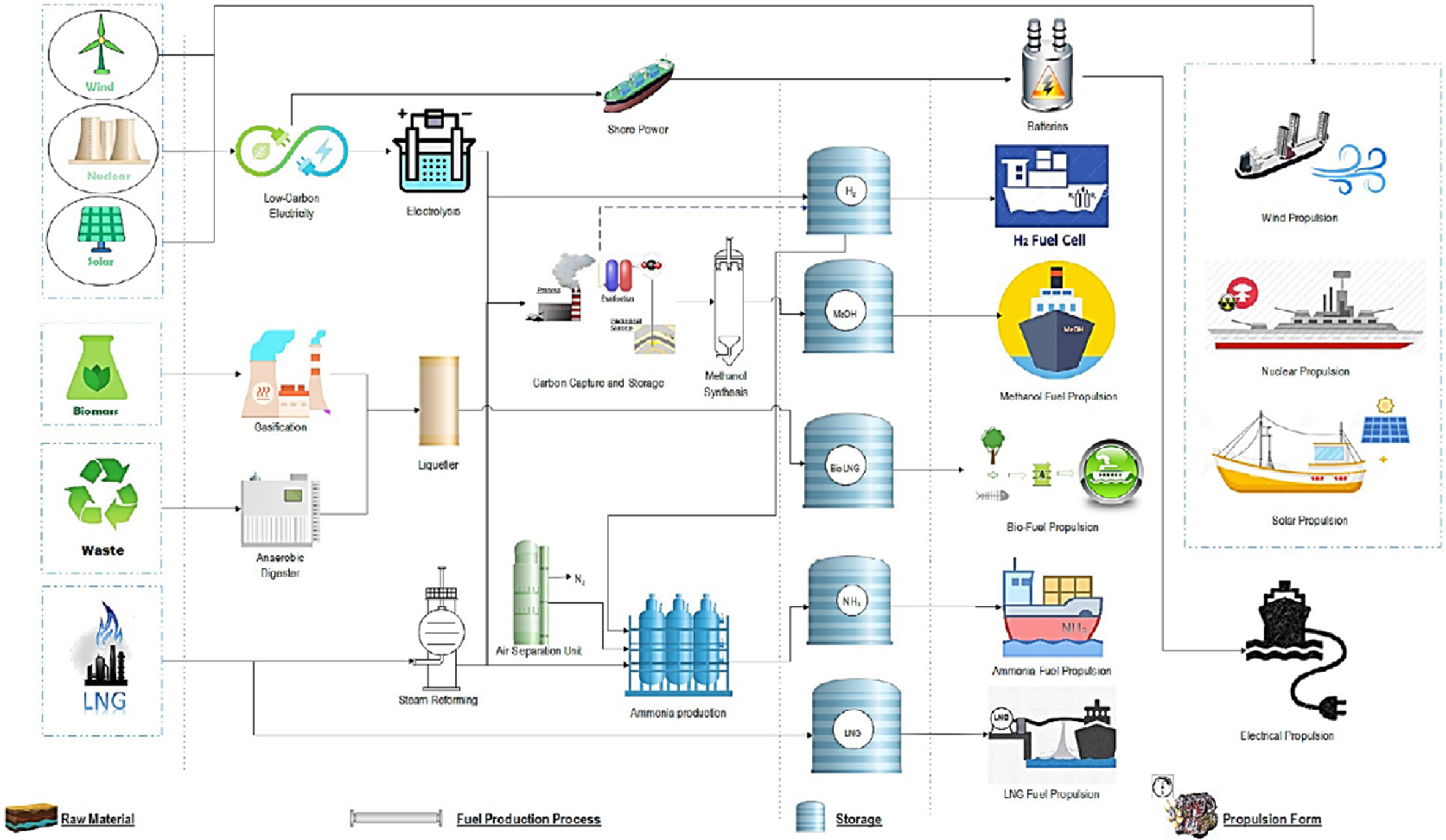
Technologies and fuels on a pathway to maritime decarbonization. Source: Department for Transport, 2019; Al-Enazi et al., 2021.
The legal system and rule of law play important roles in protecting the marine environment (Chang and Shi, 2020). Existing international legal regimes have significantly influenced the regulation over vessel-source pollution, the transportation of hazardous and noxious substances (HNSs), and marine environmental protection. However, although there are many international conventions in place covering the use of alternative marine fuels and energy, many issues related to their potential environmental risks remain. These issues include the lack of common legal standards for methanol contamination, an insufficient legal framework for the regulation of biofuel, solar power and electric ships, the need for a delicate balance between the establishment of safety zones around bunkering infrastructures and freedom of navigation, and the inadequate liability and compensation framework for marine environmental damage induced by alternative-fuel-powered ships (Xu et al., 2015). These potential shortcomings and insufficiencies embedded in the existing international legal framework make it difficult to formulate an effective regulatory regime to address the emerging challenges in the era of carbon neutrality.
In this context, this research aims to address the following three main questions: (1) What are the conventions, protocols, and resolutions that constitute the existing international legal framework for pollution prevention and the remedies for alternative-fuel-powered ship-induced environmental risks and incidents? (2) Can the existing legal framework effectively address the environmental risks and challenges that alternative fuels may pose? (3) What might be the potential implications and possible ways to move ahead? This research primarily uses a legal analysis approach to analyze the international legal framework regulating environmental risks and incidents stemming from alternative-fuel-powered ships and to analyze the potential shortcomings and insufficiencies that might be embedded in the existing framework, including the complicated structure of the institutional framework, some inconsistent legislative principles and approaches, the parallel application of different fuel and energy conventions for multifuel and hybrid power ships, deficiencies in pollution prevention and bunkering safety regulation, the failure to resolve the potential tension between bunkering facility regulation and freedom of navigation, the lack of international environmental enforcement standards related to alternative fuels, deficiencies in the liability and compensation system for pollution damage, and inadequate international cooperation in pollution prevention and response. On this basis, this research explores the potential implications and solutions that might be feasible to deal with the special marine environmental risks posed by alternative-fuel-powered ships.
2 Literature review, materials and analytical framework
2.1 Literature review
The maritime sector is a key asset for the global economy (Prussi et al., 2021). Four fifths of the total world trade must be completed by maritime transportation, so sea transportation plays an important role in the development of the global economy (UNCTAD, 2017). The increasingly strict GHG emission regulations set for ships are making ship owners/operators find new efficient methods of fulfilling these requirements (Ushakov et al., 2019). Currently, the maritime industry is urgently searching for clean, reliable and affordable alternative fuels and energy (Al-Enazi et al., 2021). Therefore, alternative fuels and energy are essential for decarbonization in international shipping (Wang and Wright, 2021). Many countries have focused on alternative marine fuels, such as the USA (Bicer et al., 2016), Japan (Tanaka, 2013), Europe (Prussi et al., 2021), Australia (Paul et al., 2018), China (Yang et al., 2019), Poland (Miętkiewicz, 2021), Norway (Laribi and Guy, 2020), etc. Existing research and practice on alternative marine fuels and energy mainly focus on the follows:
First, existing research examines the advantages and applicability of alternative marine fuels and energy. Studies have shown that due to the regulation of sulfur emissions, the use of LNG as a maritime fuel has increased (Anderson et al., 2015). LNG is a highly efficient and clean low-carbon energy source (Zhu et al., 2022), and scholars contend that LNG is one of the best solutions compared with others (Wattum, 2011; Kumar et al., 2011; Schinas and Butler, 2016). At the port of Heraklion, through empirical research, compared with gas emissions after using LNG and marine diesel oil, Livaniou et al. (2022) found that the SO2, CO2, CO, NOx, HC, CH4, and PM emissions of LNG were reduced by 76%. LNG is widely accepted because it also fulfils other regulations, such as those concerningCO2 and NOx, and is the cheapest fuel (Bas et al., 2017). Overall, LNG is the most researched alternative shipping fuel by scholars in the past. However, scholars have paid more attention to other alternative shipping fuels, including methanol, ammonia and hydrogen fuels. (Ampah et al., 2021). There is already an increasing global demand for ammonia, which can be used as a versatile marine fuel (Cheliotis et al., 2021), especially in the United States and Europe (Al-Enazi et al., 2021). Furthermore, “a sustainable global energy future can be attained by utilizing hydrogen fuel in addition to other clean fuels” (Al-Enazi et al., 2021).
Second, existing research also analyzes the disadvantages of alternative marine fuels, given that there are still many obstacles and difficulties in their application to shipping. Researchers find that, indeed, not all alternative fuels make a ship more climate-friendly (Martin, 2021) and LNG could be a rather dangerous liquid (Zhu et al., 2021). During the methanol manufacturing process, a large amount of GHG emissions is also produced (Martin, 2021). Scholars point out that cost (Valera-Medina et al., 2018; Prussi et al., 2021; Bicer et al., 2016; Salmon and Bañares-Alcántara, 2021; Martin, 2021) and GHG emissions (Pavlenko et al., 2020; Prussi et al., 2021; Bicer et al., 2016; Jang et al., 2021) are the most critical issues in the use of alternative marine fuels. Other aspects are also crucial: technical maturity (Desai, 2017; Biofuels International, 2019; Manouchehrinia et al., 2020; Valera-Medina et al., 2021; Van Hoecke et al., 2021; IEA, 2022), safety regulation (Deniz and Zincir, 2016), the expertise needed (Prussi et al., 2021), etc. Moreover, the wide application of alternative marine fuels may encounter legal obstacles (Valera-Medina et al., 2021; Al-Enazi et al., 2021) and need to comply with the requirements under international conventions and related agreements (Chang, 2020). Alternative marine fuels often lack sufficient support from domestic legislation (Paul et al., 2018).
Third, existing research studies propose the potential directions, methods and measures to solve the problems existing in the wide application of alternative marine fuels. Given the economic cost of alternative marine fuels, scholars suggest that simultaneous operations should be used to reduce costs (Fan et al., 2021) and the promotion of alternative marine fuels can be realized through the establishment of marine energy funds (Yang et al., 2019). For GHG emissions, a “technology warming potential” approach (Thomson et al., 2015) and risk assessment framework (Wu et al., 2021a) can be adopted, and the use of dual-fuel engines is proposed as an efficient method (Mestemaker et al., 2020). In response to technical problems, it is recommended to incentivize technological innovations by formulating corresponding laws (Thomson et al., 2015; Lindstad et al., 2020; Xu and Mukherjee, 2020), which may in turn supports safety control, loss prevention and emergency response (Wu et al., 2021b). In summary, facilitating the adoption of alternative fuels calls for effective policy and technical frameworks created from a system-wide perspective (Wang and Wright, 2021).
The research above shows that compared with traditional diesel oil, alternative marine fuels and energy have certain advantages. However, their widespread use and promotion will not be smooth sailing since the use of alternative marine fuels and energy still needs to take into account economic costs, technical conditions, legal systems and other factors. Therefore, scholars have made useful suggestions on how to overcome these difficulties. Existing research proposals are basically focused on further reducing carbon emissions and measuring and responding to economic costs, as well as measures for technological innovation. There lacks sufficient research focusing on the other potential risks to the marine environment that these alternative fuels and energy might have and how the existing international institutional framework functions in regulating these special environmental risks.
2.2 Methods, materials and analytical framework
“International law and institutions serve as the main framework for international cooperation and collaboration between members of the international community in their efforts to protect the local, regional and global marine environment” (Chang, 2012). Rule of law has been considered one of the most important elements of good ocean governance (Chang, 2012). Therefore, this research chooses to explore in depth the use of alternative fuels and energy for maritime decarbonization from an international law perspective. It uses a legal analysis approach to analyze the international legal instruments in place that cover the use of alternative marine fuels and energy as well as related marine environmental issues, and it tries to determine whether there are shortcomings and insufficiencies embedded in the current international legal framework and whether the existing institutional framework is well equipped for entering the era of maritime carbon neutrality. The materials used for the research are mainly the international conventions, protocols, resolutions and other relevant instruments that involve pollution prevention, safety regulation, pollution liability and compensation for the use of alternative fuels and energy in maritime transport. These international legal instruments are collected from the official websites of the United Nations Treaty Collection, IMO and International Atomic Energy Agency (IAEA). However, many related legal instruments are temporarily absent, such as the special regulatory frameworks for ships using electricity, solar power, offshore wind energy, biofuels or fuel cells. This absence also highlights the problem of the “legislative lag” of the international legal regime in the face of emerging issues in the era of carbon neutrality (Abel, 1982).
In addition to Section 1 and Section 2, the following sections provide a critical examination of relevant matters from an international law perspective. Section 3 analyzes the special environmental risks that may exist in the operation of ships using alternative fuels and energy for maritime decarbonization. Section 4 analyzes the international legal framework regulating the use of alternative fuels and energy as well as its potential environmental risks in maritime transport. Section 5 examines the shortcomings and insufficiencies embedded in the current international legal framework, showing how they might bring difficulties in formulating an effective regulatory regime to cope with the emerging challenges in the era of carbon neutrality. Section 6 proposes some potential implications and tentative ways that might be feasible to move forward in the future.
3 Special marine environmental risks posed by alternative-fuel-powered ships
Alternative fuels and energy can help achieve low-carbon and zero-carbon emission goals, but their use often requires corresponding high-cost technical and operational measures as a safety guarantee (Xing et al., 2021; Salmon and Bañares-Alcántara, 2021). Most importantly, the use of alternative marine fuels and energy in the context of carbon neutrality focuses on reducing carbon emissions from the shipping sector but often ignores the other potential risks to the marine environment that these “carbon-clean” alternative fuels and energy might involve (Figure 2). Carbon-free fuels and energy such as hydrogen, solar energy, and wind energy may achieve the target of zero-carbon shipping; however, it is currently difficult to fully replace carbon-based fuels such as diesel oil and LNG, both technically and economically (Al-Enazi et al., 2021). Solar energy and wind energy may not be widely used on ships of all types of routes due to the high restrictions on ship size and routes. The production cost of electrolyzing water to produce green hydrogen is prohibitive. Additionally, life cycle assessment studies have found that although alternative fuels such as hydrogen and electricity do not cause pollution when working as fuels on board, there are still significant GHG emissions during their production or transportation. Moreover, biofuels, ammonia, and electricity may have negative impacts on acidification potential and eutrophication during production and disposal. In addition to natural environmental pollution, the inherent characteristics of various alternative fuels make their use on board present other marine risks to the crew and other people. Factors such as different ship types, speeds, and routes may impede the contribution of various alternative fuels to environmental risks, but from a macro perspective, these environmental risks cannot be ignored.
Figure 2
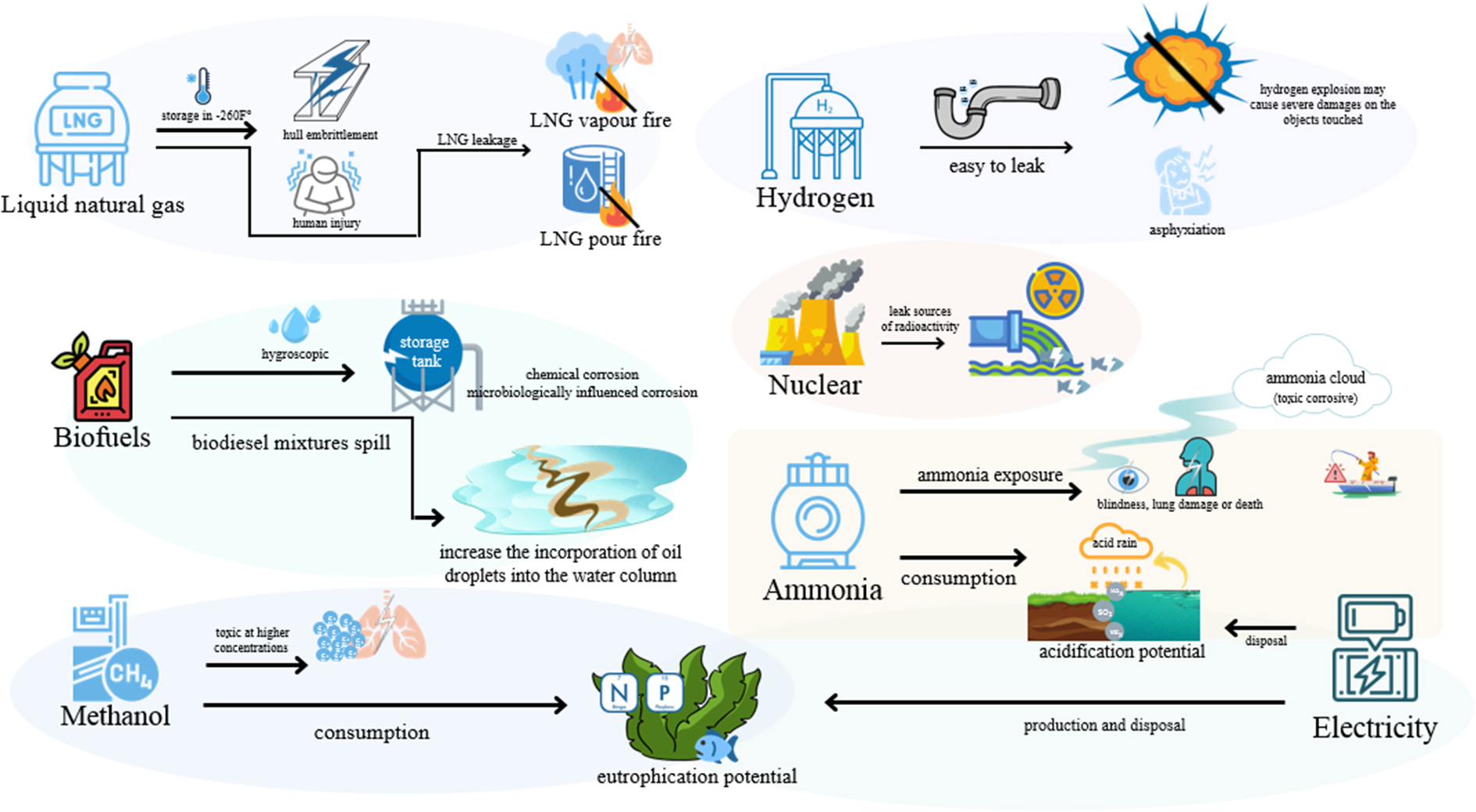
Special marine environmental risks posed by alternative-fuel-powered ships. Source: Authors’ Compilation.
3.1 LNG
Methane slips occur throughout the LNG supply chain. Measures such as recovery, processing and liquefaction, the transport of natural gas, engine operation (Lowell et al., 2013), and safe maintenance operations (Pavlenko et al., 2020) emit carbon dioxide and methane. As a GHG, methane is approximately 28-34 times more potent than carbon dioxide (UNECE, 2022). A report by the International Council on Clean Transportation (ICCT) noted that “the most popular LNG ship engine, particularly for cruise ships, emits between 70% and 82% more life cycle GHG emissions over the short term than engines powered by clean distillate fuels” (Pavlenko et al., 2020). While it does indeed reduce carbon dioxide emissions, as a carbon-based fuel, LNG continues to emit carbon dioxide (Balcombe et al., 2022) and can only be used as a mitigation option (Bouman et al., 2017; Hwang et al., 2020).
In addition, in accidents during ship-to-ship LNG bunkering or LNG ship collisions, LNG leaks can cause significant hazards. First, inhalation of LNG vapor by humans may cause asphyxiation or severe lung damage (Luketa-Hanlin, 2006). Second, as LNG is stored at temperatures below -260 F°, direct exposure to extremely cold temperatures can lead to serious human injury and hull material embrittlement (Luketa-Hanlin, 2006). Third, downwind dispersed LNG vapor that reaches its flammable limits and is ignited by a spark or any other ignition source will lead to a vapor fire and cause damage to the surrounding hull or personnel through “thermal radiation, burn damage, overpressures, etc.” (Sun et al., 2017). Fourth, it is likely an LNG pool fire could occur if LNG leaks during bunkering and if there are nearby sources of ignition, for example, sparks from engine combustion or the burning of substances from extreme heat waves (Sun et al., 2017).
3.2 Ammonia
On the one hand, as an alternative fuel, ammonia has a strong acidification potential, and the deposition of acidic pollutants will reduce the productivity of natural ecosystems such as soil, groundwater, and surface water. Nitrogen oxides and sulfur dioxide caused by the compressors of gas transportation and during the production of high-pressure (HP) steam are the most important reasons for the acidification potential of ammonia fuel (Makhlouf et al., 2015). The “acidification potential of ammonia-fueled vehicles is higher than that of gasoline and diesel vehicles” (Bicer and Dincer, 2018).
On the other hand, ammonia is a toxic corrosive gas, and thus, whether transported by the sea or burned as fuel for ships, there is an accident risk of exposure to ammonia. When ammonia comes into contact with wet surfaces, its corrosive and exothermic properties can immediately cause severe irritation and burns to the eyes, skin, mouth, and respiratory mucous membranes (National Research Council Committee on Acute Exposure Guideline Levels, 2008). When a large amount of ammonia is uncontrollably released, clouds of ammonia will form, which may have a large and unpredictable impact due to air movement, putting the safety of people and animals underneath the clouds at risk (Nowatzki, 2008). In an ammonia storage tank collision, the potentially lethal area of the ammonia cloud may extend to hundreds of meters, causing serious injury and death even far from the release point (National Research Council Committee on Acute Exposure Guideline Levels, 2008). Even if regulations and protocols exist for the safe transport and handling of ammonia, it is indisputable that ammonia is highly toxic to humans and poses a risk to marine transportation efforts.
3.3 Biofuels
Biofuels come from biomass and can be regenerated from crops or biological waste, such as growing maize to produce ethanol and using animal waste products (Varuvel et al., 2012). Large-scale cultivation of the same plants may cause pests, while the use of fertilizers and pesticides will pollute water sources and potentially reduce biodiversity (Vollebergh, 1997; Wang et al., 2022a). The production of energy crops produces GHGs, of which N2O emissions are usually high. The production of wheat ethanol produces even higher total GHG emissions than the production of gasoline (Vollebergh, 1997).
Furthermore, the challenges posed by biofuels include fuel instability, microbiologically influenced corrosion (Eide et al., 2014), and emulsion properties. Because water is essential for microbial growth, biofuels are inherently more hygroscopic than fossil fuels. It is difficult to completely remove water from biofuel systems, and the presence of water causes chemical corrosion and microbiologically influenced corrosion in storage tanks (Sørensen et al., 2011), increasing the risk of contamination from fuel spills at sea.
In the case of biodiesel – “a mixture of fatty acid methyl esters”, once a biodiesel spills, samples of seawater from contaminated waters would be “indistinguishable from a fossil diesel spill for a short period”, hindering effective efforts for “spill source identification and forensic investigations” (DeMello et al., 2007). However, the good news is that relevant experiments predict that biodiesel will be consumed by marine bacteria (DeMello et al., 2007). In the case of a spill of biodiesel mixtures with oil derivatives, biodiesel’s “low speed of amendment may increase the incorporation of oil droplets into the water column”, facilitating the “downward transport of oil into the water column” (DeMello et al., 2007). Hence, it may extend the contaminated marine area and worsen the effects of oil pollution on marine organisms.
3.4 Hydrogen
GHG emissions from hydrogen fuel depend to a large extent on the energy source of hydrogen, with the majority of emissions coming from steam methane reforming and liquefaction processes (Hwang et al., 2020). At present, the use of fossil fuels is the main method of producing hydrogen energy, such as coal gasification and steam methane reforming (Hwang et al., 2020; Van Hoecke et al., 2021), which lead to a large amount of GHG emissions during the process of producing harmless hydrogen fuel.
Safety is also worth considering when bunkering, storing and using hydrogen fuel on board. The flammable and diffusible nature of hydrogen may affect the integrity of the hull and the safety of the crew. Hydrogen molecules are so small that they can easily leak through pipes or storage joints and cracks. Although hydrogen is nontoxic, it may reach flammable concentrations (between 4% and 75% in air) and ignition temperatures and then burn, or it may cause asphyxiation by displacing oxygen from the air when leaking into a closed environment (Hydrogen Tools, 2022). The energy required to burn hydrogen is so small that even the sparks from a crew member’s cigarette may ignite it (Hydrogen Tools, 2022). When a ship collides, the pressurized storage system for hydrogen may leak, and once hydrogen explodes and burns, even in an open environment, hydrogen flames can severely damage the objects touched, including the hull, cargo, personnel, etc.
3.5 Nuclear
The use of nuclear-powered ships and offshore nuclear-powered platforms may lead to marine radioactive contamination in the absence of adequate nuclear safety measures. Particularly in exceptional circumstances, such as extreme weather, collisions, external threats, or operational errors, nuclear-powered ships and offshore nuclear-powered platforms may leak sources of radioactivity, leading to serious marine pollution incidents. When a reactor melts down and the main containment is breached, nuclear fuel may leak from the core into the surrounding environment and widespread marine pollution is likely to result. “Radioactive wastes are not biodegradable, nor is there any possibility of removing them from the sea once they have entered it. These substances vary in their effect, but in general, they are absorbed by marine organisms, often becoming concentrated as they move up the food chain, and affecting the growth, reproduction and mortality of marine life” (Churchill et al., 2022).
3.6 Electricity
Electric ships may not have harmful environmental effects during navigation, but during the production and disposal of electric energy, they have harmful effects in terms of acidification, eutrophication of water bodies and toxicity to humans. The main cause is the disposal of spoil from lignite mining in surface landfills (Bicer and Dincer, 2018). Eutrophication is a process that disrupts the aquatic ecological balance, in which large quantities of nitrogen- and phosphorus-containing compounds are discharged into the water, causing algae and other aquatic organisms to proliferate and consume too much oxygen in the water, causing fish plankton to die from a lack of oxygen. In turn, their decomposing bodies cause water pollution.
3.7 Methanol
GHG emissions from methanol are largely determined by the raw materials used to manufacture it and the conversion process (Martin, 2021). Methanol from natural gas has the same degree of global warming potential as heavy diesel fuels, while e-methanol and biomethanol have a lower global warming potential. However, biomethanol fuels operating in marine engines also carry the risk of methane slips.
Methanol biodegrades rapidly, but it is toxic at higher concentrations. Thus, in the event of a collision, grounding, or other ship accident resulting in methanol leakage, there may be localized marine environmental impacts before dilution (Brynolf et al., 2014). Moreover, the eutrophication potential produced by methanol and biomethanol fuels is approximately twice as high as that of LNG (Brynolf et al., 2014), which may lead to imbalances in marine water ecosystems. Additionally, the low flash point of methanol makes it a risk of fire on ships.
4 Existing international legal framework regulating alternative-fuel-powered ships related to marine pollution
Marine pollution resulting from ships powered by alternative fuels and energy is subject to the regulation of a series of international conventions, protocols and resolutions (Table 1), including both maritime conventions regulating vessel-source pollution, atmospheric pollution, waste management, dumping, the transportation of HNSs, and marine environmental protection and conventions and resolutions specifically regulating ships using various fuels and energy types. These conventions form a fairly complex legal system for the regulation of alternative-fuel-powered ships in the era of carbon neutrality.
Table 1
| Category | Conventions |
|---|---|
| Marine pollution related conventions | 1972 Convention on the Prevention of Marine Pollution by Dumping of Wastes and Other Matter (London Convention) |
| 1973 International Convention for the Prevention of Pollution from Ships (MARPOL) | |
| 1973 Protocol Relating to Intervention on the High Seas in Cases of Marine Pollution by Substances Other Than Oil | |
| 1974 International Convention for the Safety of Life at Sea (SOLAS) | |
| 1982 United Nations Convention on the Law of the Sea (UNCLOS) | |
| 1996 International Convention on Liability and Compensation for Damage in Connection with the Carriage of Hazardous and Noxious Substances by Sea (HNS Convention) | |
| 2000 Protocol on Preparedness, Response and Co-operation to Pollution Incidents by Hazardous and Noxious Substances (OPRC-HNS Protocol) | |
| Nuclear fuel related conventions | 1960 Convention on Third Party Liability in the Field of Nuclear Energy (Paris Convention) |
| 1962 Convention on the Liability of Operators of Nuclear Ships | |
| 1963 Vienna Convention on Civil Liability for Nuclear Damage (Vienna Convention) | |
| 1963 Convention Supplementary to the Paris Convention (Brussels Supplementary Convention) | |
| 1971 Convention Relating to Civil Liability in the Field of Maritime Carriage of Nuclear Material | |
| 1979 Convention on the Physical Protection of Nuclear Material | |
| 1986 Convention on Early Notification of Nuclear Accident | |
| 1986 Convection on Assistance in the Case of a Nuclear Accident or Radiological Emergency | |
| 1994 Convention on Nuclear Safety | |
| 1997 Joint Convention on the Safety of Spent Fuel Management and on the Safety of Radiation Waste Management | |
| 1997 Convention on Supplementary Compensation for Nuclear Damage (CSC) | |
| Gas fuel related conventions | 1983 International Code for the Construction and Equipment of Ships Carrying Liquefied Gases in Bulk (IGC Code) |
| 2015 International Code of Safety for Ships Using Gases or Other Low-Flashpoint Fuels (IGF Code) |
Alternative fuels and energy-related international conventions, protocols, and resolutions.
Source: Authors’ Compilation.
In the maritime convention system, the most important is the 1982 United Nations Convention on the Law of the Sea (UNCLOS), which is considered as the “constitution of the oceans”. It sets a general framework for regulating the pollution that may arise from ships using alternative fuels and energy. A general duty established by the UNCLOS is that “states have the obligation to protect and preserve the marine environment” (UNCLOS, 1982, Article 192). States are required to adopt all necessary measures to “prevent, reduce and control pollution of the marine environment from any source” (UNCLOS, 1982, Article 194). It also defines the jurisdictional rights and obligations in regulating marine pollution resulting from ships and other various sources, “both legislative and enforcement, of flag, coastal and port states” (UNCLOS, 1982, Articles 207-234; Churchill et al., 2022). Responsibility and liability for fulfilling international obligations regarding marine pollution and for ensuring the availability of legal recourse and prompt and adequate compensation for causing marine environmental damage are imposed on states (UNCLOS, 1982, Article 235). In addition, alternative-fuel-powered ships are subject to a series of international maritime conventions regulating pollution from ships adopted under the auspices of the IMO (Bai and Li, 2021). For example, the 1973 International Convention for the Prevention of Pollution from Ships (MARPOL, 1973) aims to prevent marine pollution from both the routine operation of ships and their accidental discharge of harmful substances. In particular, Annex VI of the MARPOL is one of the main international legal instruments regulating air pollution control for ships. The 1974 International Convention for the Safety of Life at Sea (SOLAS, 1974) specifically stipulates the navigation safety requirements for ships carrying dangerous goods and nuclear-powered ships. If an issue involves the dumping of fuel waste and spent fuel, the treatment of high seas pollution, and the cooperative handling of pollution incidents, alternative-fuel-powered ships may also be subject to the 1972 Convention on the Prevention of Marine Pollution by Dumping of Wastes and Other Matter (London Convention, 1972), the 1973 Protocol Relating to Intervention on the High Seas in Cases of Marine Pollution by Substances Other Than Oil (Protocol relating to intervention on the high seas in cases of marine pollution by substancesother than oil, 1973) and the 2000 Protocol on Preparedness, Response and Co-operation to Pollution Incidents by Hazardous and Noxious Substances (OPRC-HNS Protocol, 2000). In terms of liability and compensation for marine environmental damage, alternative-fuel-powered ships may also be subject to the 1996 International Convention on Liability and Compensation for Damage in Connection with the Carriage of Hazardous and Noxious Substances by Sea (HNS Convention). This convention establishes a two-tier system for compensation for environmental damage in the event of accidents at sea: The first tier is paid by compulsory insurance taken out by shipowners, and the second tier is paid from a fund composed of collective contributions from the receiver and titleholder of the HNS cargo. This compensation also goes further in that “it covers not only pollution damage but also the risks of fire and explosions, including loss of life or personal injury as well as loss of or damage to property” (HNS Convention, 1996; IMO, 2022d). However, it is worth noting that two considerations negatively impact the role of the HNS Convention in regulating alternative fuels: The first is that the HNS Convention is considered to apply only to issues arising in connection with the carriage of HNS as cargo rather than as marine fuel, which may question the applicability of the convention to alternative marine fuels (Xu et al., 2017); and the second is that the Convention has not yet come into force.
Ships using different alternative fuels and energy propulsion are also regulated by their respective special fuel and energy category conventions. As shown in Table 1, nuclear-powered ships and offshore nuclear-powered platforms may involve the application of a series of nuclear-related international conventions. These international conventions set the institutional framework for the use of nuclear energy facilities in terms of nuclear safety, the notification and handling of nuclear accidents, nuclear liability, the safety management of radioactive waste and spent fuel, and the maritime transportation of nuclear material. Notably, however, these conventions involving nuclear energy are not all inclusive in their scope of application; that is, their scope of application is controversial (Handrlica, 2019). If interpreted strictly, then many important nuclear liability conventions, for example, the 1960 Convention on Third Party Liability in the Field of Nuclear Energy (Paris Convention, 1960) and the 1963 Vienna Convention on Civil Liability for Nuclear Damage (Vienna Convention, 1963), may apply only to land-based nuclear installations (Handrlica, 2019). Since nuclear-powered ships and nuclear-powered platforms are not land-based nuclear installations, they may not necessarily be covered by these nuclear liability conventions.
The international legal framework regulating ships using gas fuel and low-flashpoint fuels involves the 1983 International Code for the Construction and Equipment of Ships Carrying Liquefied Gases in Bulk (IGC Code), the 2015 International Code of Safety for Ships Using Gases or Other Low-Flashpoint Fuels (IGF Code) and MARPOL Annex VI – Prevention of Air Pollution from Ships. Although the objective is to “provide an international standard for the safe carriage by sea in bulk of liquefied gases” (IMO, 2022a), the IGC Code has introduced a special chapter regulating the use of cargo as a marine fuel, providing several safety requirements for the use of LNG in propelling machinery spaces (Xu et al., 2015). While the old version of the IGC Code permitted the use of LNG as fuel only in the main propulsion plant of gas carriers, the revised version of the IGC Code permits the use of other nontoxic gas cargoes as fuel. However, this means that ammonia and other toxic gas cargoes are not permitted to be used as fuel under the IGC Code (Yadav and Jeong, 2022). The IGF Code establishes a series of functional requirements and regulations for the design, construction, operation, maintenance, bunkering process and seafarer training of ships which use gases and other low-flashpoint fuels but mainly from a safe operation and navigation perspective. With corresponding amendments to the SOLAS, the IGF Code has become a mandatory part of the SOLAS since 2015. In addition, as mentioned above, MARPOL Annex VI regulates atmospheric pollution from ships. It sets limits on SOx and NOx emissions from ships, designates SOx “emission control areas”, prohibits any “deliberate emissions of ozone-depleting substances”, sets requirements for international air pollution prevention certificates, and streamlines the enforcement practices for regulatory states (Thomson et al., 2015).
In addition to the abovementioned conventions and protocols, customary international law may also have influence in regulating alternative-fuel-powered ships’ marine environmental risks. For example, if coastal states or port states fail to effectively set safe navigation areas or issue navigation warnings based on the particularity of alternative-fuel-powered ships or fail to carry out effective supervision and pollution control over areas around bunkering infrastructures and therefore cause dangers to the navigation safety of alternative-fuel-powered ships or marine pollution, then they might be required to assume responsibilities under customary international law. In the Corfu Channel case (1949), the International Court of Justice (ICJ) imposed an obligation on the Albanian authorities to notify “for the benefit of shipping in general, the existence of a minefield in Albanian territorial waters” and warn “the approaching British warships of the imminent danger to which the minefield exposed them”. Such an obligation of managing environmental risks and giving “warning of known environmental hazards” has been considered by some scholars as a customary international law obligation for the following reasons (Birnie et al., 2009): First, as ICJ stated in the Corfu Channel case, such an obligation is based on “certain general and well-recognized principles, namely: elementary considerations of humanity, even more exacting in peace than in war; the principle of the freedom of maritime communication; and every state’s obligation not to allow knowingly its territory to be used for acts contrary to the rights of other states” (Corfu Channel case, 1949). Second, in the International Law Commission’s Draft Articles on Prevention of Transboundary Harm from Hazardous Activities, such an obligation is also imposed on the state in the territory of which the transboundary harm origins (International Law Commission, 2001). The International Law Commission pointed in the commentaries that such an obligation has been widely adopted in a series of international and regional conventions (International Law Commission, 2001). For these reasons, these scholars note that “it is legitimate to view the Corfu Channel case as authority for a customary obligation to give warning of known environmental hazards” (Birnie et al., 2009). If convincing evidences support such a customary obligation, it might be applied to the above-mentioned cases involving alternative-fuel-powered ships and bunkering infrastructures. In this sense, customary international law could also have a crucial influence when dealing with marine pollution issues related to alternative-fuel-powered ships and even when shaping the development of the whole international legal framework concerning the use of alternative fuels for maritime decarbonization. However, it is also worth mentioning that proving that a rule or an obligation “has become so generally accepted as to render it a norm of customary international law binding on all states” is often of very high threshold (Xue, 2003). The high standard of proof therefore may make the application of customary international law be of uncertainty and controversy. In particular, considering that alternative-fuel-powered ships are quite new things in practice, customary international law rule sometimes may either appear to be “too vague to be very effective” or face the problem of insufficient authoritative evidence to prove long-term state practices (Churchill et al., 2022).
5 Insufficiencies embedded in the existing international legal framework
In the context of moving toward carbon neutrality, various alternative fuels and energy sources have been used for ship propulsion in practice. However, the relevant international legal framework seemingly fails to catch up with the pace of alternative fuel application in practice, and it has several shortcomings and insufficiencies in dealing with the potential pollution of the marine environment caused by alternative-fuel-powered ships.
5.1 Complicate institutional framework and application confusion
As mentioned above, pollution from ships using alternative fuels and energy for propulsion is subject to a series of maritime conventions, fuel-specific conventions, and principles and rules in customary international law. These conventions constitute a structurally complex institutional framework. Multiple stakeholders, including regulators of flag states, coastal states and port states, ship owners and operators, and victims suffering as a result of marine pollution, must face the issue of institutional complexity and its related confusion regarding convention application.
From the perspective of the institutional framework regulating marine pollution, the traditional pollution source-based approach could bring confusions. Under the existing framework, marine pollution is divided into several specific categories based on different pollution sources: pollution from ships, pollution from land-based sources, pollution from seabed activities, pollution from dumping, and atmospheric pollution. Based on these different sources, different legal rules have been established to regulate marine pollution (Churchill et al., 2022; Tanaka, 2019). However, in practice, the pollution source-based approach could lead to uncertainties in regulating ships propelled by alternative fuels and energy. For example, some gas-fueled ships emit methane into the atmosphere during navigation, causing atmospheric pollution and the greenhouse effect. Whether pollution should be regulated based on vessel-source pollution or atmospheric pollution may raise uncertainty. Another example illustrating the problems faced by the pollution source-based approach involves bunkering infrastructures and floating refueling platforms. In international law, there are disputes over the positioning of floating bunkering platforms in terms of whether they should be defined as ships, artificial islands, facilities, or structures (Morris and Kindt, 1978; Kindt, 1983; IAEA, 2013; Luo and Liu, 2020; Song, 2021). In the Case concerningPassage through the Great Belt (1991), the issues of whether “floating oil rigs” should be identified as ships and enjoy the same right of free passage as ships were raised before the ICJ. However, because the case was settled out of court, the ICJ did not adjudicate the merits of the case. The different positionings of floating bunkering platforms and related disputes will raise issues for pollution regulation under the traditional pollution source-based approach: Should these platforms be regulated based on vessel-source pollution or land-based pollution? If considered as vessel-source pollution, can floating nuclear platforms be covered by existing nuclear liability conventions, as some scholars disagree with the broader interpretation of the nuclear liability conventions and argue that these conventions apply only to land-based nuclear installations? (Handrlica, 2019) In this sense, the traditional pollution-source-based approach is seemingly not well equipped to clearly and effectively deal with the marine environmental risks and pollution problems that may result from alternative-fuel-powered ships.
From the perspective of the institutional framework regulating ships and their pollution control, inconsistent approaches and fragmentation issues may also create confusions. For example, nuclear-powered ships and offshore nuclear-powered platforms are subject to both conventions concerning nuclear safety and nuclear liability formulated under the auspices of the IAEA and conventions concerning navigation safety, radioactive material transport, and nuclear-powered ships formulated under the support of the IMO. The former often impose liabilities on the operator of nuclear installations, while the latter are inclined to impose liabilities on shipowners. The different approaches to the liability assumption may result in confusion. Another example for such confusion concerns the multifuel and hybrid power ships. With the development of multifuel and hybrid power ships, the propulsion power sources of ships may not be limited to one type. The latest 49/60 DF four-stroke engine developed by the German engine manufacturer MAN Energy Solutions can run on LNG, diesel, biofuel blends and synthetic natural gas, offering flexible fuel options for maritime decarbonization (MAN Energy Solutions, 2022). However, the use of multiple fuels in the same ship indicates that the ship may be bound by different international conventions regulating the use of specific energy sources, including the traditional oil pollution conventions, gas fuel conventions, and conventions on HNS transportation. Multifuel and hybrid power ships are more likely to face the problem of a “convention maze” in their pollution control regulation. In addition, the international regulatory framework regulating alternative-fuel-powered ships and their pollution control has the problem of unbalanced development. The alternative fuels and energy that were put into application decades ago, such as nuclear power and LNG, are subject to abundant international rules, while emerging fuels and energy, such as wind power, electricity and biofuels, lack sufficient regulatory rules.
5.2 Deficiencies in regulation based on pollution-prevention and safety grounds
Not only does the navigation of some alternative-fuel-powered ships, in particular ships using gas fuels such as LNG, hydrogen or ammonia, involve safety and marine pollution risks, but their bunkering process in coastal and port bunkering infrastructures is also dangerous. Considering that vessel-source pollution can sometimes endanger the safety and security of coastal states and port states, these states are empowered to regulate foreign ships based on safety and security factors according to UNCLOS (Bodansky, 1991; Becker, 2005). The IGF Code also establishes certain rules to ensure the safety of ships using gases and other low-flashpoint fuels during navigation and bunkering process.
However, under the existing international legal framework, the safety and pollution-prevention regulations over ships propelled by alternative fuels and energy are largely inadequate. Although certain relevant rules can be found scattered in some conventions, many problems such as disputes over the applicability of the rules, the ratification deadlock of conventions and the limited number of contracting parties subject to mandatory constraints, have plagued the effective regulation of alternative-fuel-powered ships. Furthermore, the existing legal framework places oversight on the high seas in the hands of the flag state. However, “experience shows flag states often fail to provide adequate oversight with so-called ‘flags of convenience’ offering low-cost registration, loose environmental and operational requirements, and weak enforcement” (Hutchins, 2021). Hence, regulation and oversight over alternative-fuel-powered ships in areas beyond national jurisdictions may be of serious flaws. Additionally, scholars have noted that the “comprehensive operational guidance on the interface between a bunker vessel and a receiving vessel is woefully inadequate” (Xu et al., 2015).
Moreover, regulation of alternative-fuel-powered ships based on pollution control and bunkering safety grounds may also create tensions with freedom of navigation, reflecting the ongoing contest between the “freedom of navigation of maritime states” and the “regulation of coastal states” (Bodansky, 1991; Zhang and Wang, 2022). However, the existing international legal framework is not effectively equipped to cope with relevant emerging challenges. For example, considering that there are safety and environmental risks associated with the bunkering process for some alternative-fuel-powered ships, especially gas-fueled ships, a question in international law that may arise is whether coastal states are allowed to adopt regulatory measure such as traffic separation schemes or establishment of safety zones around bunkering infrastructures based on navigation safety and environmental considerations. UNCLOS allows coastal states to establish a “maximum 500-meter safety zone around artificial installations or structures” in their exclusive economic zone or on the continental shelf (UNCLOS, 1982, Articles 60, 80). If authorized by the “generally accepted international standards or as recommended by the competent international organization”, the breadth of safety zones can exceed 500 meters (UNCLOS, 1982, Article 60). However, in terms of the safety zone issue for the deployment of bunkering facilities and infrastructures in the ocean, there is a lack of relevant “applicable international standards”, “generally accepted international standards” or recommendations from the IMO. In the lack of relevant international standards and guidelines, if coastal states are allowed to have discretion in deploying bunkering facilities and infrastructures, it is likely to result in safety zones with a wide variety of breadth, which may negatively affect navigation, fishing and marine scientific research activities in surrounding waters. If coastal states vigorously promote the development of alternative fuels and energy and build many bunkering and charging facilities in the ocean, it could even lead to a potential effect of “closing off large areas of the sea to navigation” (Todd, 2012). Therefore, to ensure the safe use of alternative marine fuels and to mitigate potential tensions between coastal states’ pollution regulation and maritime states’ freedom of navigation, the formulation of relevant rules is called for to more precisely define the regulatory authorities of coastal and port states over alternative-fuel-powered ships and their bunkering process.
5.3 Lack of international environmental enforcement standards
Compared with traditional crude oil and diesel, alternative marine fuels are quite new, and their environmental impact assessment involves many cutting-edge issues and even issues that are currently unknown to humankind. This also implies that their usage will pose a series of challenges to international law when dealing with relevant marine environmental protection issues.
“Generally accepted international standards” for the safety level of harmful substances discharged or emitted by some alternative-fuel-powered ships into the marine environment are lacking. For instance, in terms of whether LNG can be considered an absolute clean fuel and what emission standard should be set for potential methane slips and contamination, there are many controversies. A report by the World Bank points out that LNG plays only a limited role in maritime decarbonization because of its methane leakage problem; additionally, “over 20-year and 100-year time horizons, methane is respectively 86 times and 36 times more potent a GHG than CO2” (Englert et al., 2021). Using ammonia as fuel not only involves toxicity and the danger of an explosion but also may cause air pollution, acid rain, photochemical smog and other environmental problems due to the immaturity of current ammonia combustion-related technology (Valera-Medina et al., 2021). These special environmental impacts of marine alternative fuels other than carbon reduction may pose difficulties for the environmental impact assessment process. They also indicate the difficulty in establishing “generally accepted international standards” to ensure the safety level of harmful substances discharged or emitted by alternative-fuel-powered ships.
Moreover, under existing technology and skills, it often may not be easy to accurately assess the long-term effects of marine pollution caused by accidents involving some alternative-fuel-powered ships. In cases of alternative fuel leakages or marine accidents, some short-term pollution consequences, such as pollution of the surrounding waters or the death of fish, can be observed. However, “constrained by the inadequacies of existing science, skills and technology”, much about the long-term marine environmental impacts remains unknown. This implies that the precise evaluation of harmful substances in the ocean and the precise determination of long-term damage to the marine environment might be incomprehensive (Fossi et al., 2020; Wang et al., 2022b). Difficulties in precisely assessing environmental impacts and establishing emission standards for harmful substances discharged or emitted that could be generally accepted may affect many issues in international law, such as accountability, the establishment of legal standing, and the determination of compensation amounts.
5.4 Insufficiencies in the liability and compensation system
Marine pollution caused by alternative-fuel-powered ships may involve multiple parties, including flag states, coastal states, ship owners and operators, the owners and operators of bunkering facilities, bunker suppliers, insurance companies, and protection and indemnity (P&I) clubs. How to divide responsibilities among these multiple parties and determine who shoulder the liabilities for marine environmental pollution caused by alternative-fuel-powered ships concerns the “environmental justice for the ocean” (Hale, 2011; Rudolph et al., 2020).
However, different from the unified international legal framework for oil pollution liability, a comprehensive legal framework for ships using alternative fuels and energy is lacking (Xu et al., 2017). A series of key issues concerning liability and compensation for environmental damage remains unclear, including whether the liability of ship owners and operators is fault-based. Are liabilities channeled exclusively to ship owners and operators, as in a nuclear accident? Is the fuel supplier liable? In the event of an accident during bunkering, how are the responsibilities allocated? Are there mandatory insurance requirements? Is there a need to establish a compensation fund? If the environmental damage is enormous, is the flag state subject to supplementary liability? Does the coastal state have additional responsibility for marine pollution from bunkering facilities? Are there any limitations on liability? While existing gas fuel conventions have introduced binding regulations on the use of gases and other low-flashpoint fuels, these measures are primarily concerned with ship safety rather than liability and compensation (Xu et al., 2015). Although several nuclear liability conventions stipulate liability and compensation, some scholars oppose a broad interpretation of these conventions for transportable nuclear-powered ships or platforms (Handrlica, 2019). Therefore, it is quite controversial whether the liability conventions can be applied to nuclear-powered ships or floating nuclear platforms. The liability and compensation framework for biofuel and electric ships is even more lacking. Although the HNS Convention establishes the relevant system of pollution liability and compensation for a large number of substances, it has not yet come into effect, and it is generally considered to apply only to the case of HNS being carried as cargo. The extent to which it applies to marine fuels remains controversial (Xu et al., 2017; Xu and Mukherjee, 2020).
In addition to the problems in pursuing liability and compensation under existing international conventions, the potential dilemma of legal relief can be seen based on past judicial precedents, especially when the damage is enormous and the relevant countries are required to bear supplementary state responsibility. For transboundary environmental compensation, the claimable damage is often required to be “significant damage” or “material damage”, as ruled in the Trail Smelter case (1941) and the Lake Lanoux case (1957). Merely showing the “risk of potential damage” is not “sufficient to be entitled to a legal relief” (Xue, 2003). The burden of proof is placed on the affected parties, for whom it can sometimes be quite challenging to prove significant or material damage and its causal link with the operation of or an incident involving a ship (Gupta and Schmeier, 2020). Moreover, the Bering Sea Fur Seals Fisheries case (1893) and the Nuclear Tests case (1974) raised the issue of “whether a state had standing to bring an environmental claim to prevent damage to an area beyond national jurisdiction” (Sands et al., 2018). Requiring the affected parties to prove that they have legal standing to the claim could pose difficulties for claims and remedies for marine pollution caused by ships using alternative fuels in areas beyond a state’s national jurisdiction. Additionally, restricted by the current level of science, technology and skills, the precise damage may be difficult to assess, and currently, internationally recognized uniform standards and specific guidelines for accurate environmental impact assessments are lacking. This situation may also pose challenges to international judicial bodies in adjudicating marine pollution claims involving alternative-fuel-powered ships.
5.5 Inadequate international cooperation in pollution prevention and response
Cooperation among states is crucial when large-scale marine pollution occurs (Churchill et al., 2022). Coping with marine pollution from alternative-fuel-powered ships also requires extensive cooperation from the international community. UNCLOS provides a general framework for international cooperation in coping with pollution to the marine environment by requiring states that are aware of “imminent danger to the marine environment” to notify the affected states and competent international organizations and to cooperate in “eliminating the effects of pollution and preventing or minimizing the damage” (UNCLOS, 1982, Articles 198, 199). In particular, the 2000 OPRC-HNS Protocol aims to establish a special global framework to promote international cooperation in dealing with marine pollution caused by HNSs. However, some of its response measures or even the “organizational framework for command, control, and co-ordination” follows the principles of the International Convention on Oil Pollution Preparedness, Response and Co-operation (OPRC Convention, 2018). It has been questioned whether “the conventional resources established for oil spill response may not be applicable to many HNS spills” (Regional Marine Pollution Emergency Response Centre for the Mediterranean Sea, 2018). Moreover, the limited number of contracting parties in the OPRC-HNS Protocol, which currently only 41 states have ratified, may limit the practical functioning of the protocol in promoting global cooperation to cope with large-scale marine pollution caused by HNSs.
In addition to the insufficiency in cross-state cooperation, the existing international legal framework is insufficient in promoting cooperation by the private sector to jointly deal with marine pollution induced by alternative-fuel-powered ships, effectively achieve risk sharing and transfer, and enhance compensation capacity. The insurance industry and the mutual insurance system for the shipping and energy industries can effectively share and transfer risks for pollution accidents, facilitating victims in obtaining compensation. These compensation mechanisms from the private sector, therefore, play an important role in ex post pollution accident relief. In the International Law Commission’s Draft Principles on the Allocation of Loss in the Case of Transboundary Harm Arising out of Hazardous Activities, insurance and “industry-wide funds” have been proposed as feasible measures for ensuring “prompt and adequate compensation” for transboundary damage arising from hazardous activities (International Law Commission, 2006). Although mandatory insurance is provided for in the nuclear liability conventions and HNS Convention, the applicability of these conventions to alternative-fuel-powered ships is currently debated, as mentioned above. There is also a series of emerging issues that need to be resolved, such as whether shipowners using alternative fuels for ship propulsion should be required to have mandatory insurance, whether the flag state should be required to undertake supplementary financial security, and whether the “flag of convenience” may undermine the state’s supplementary financial security. In this sense, alternative-fuel-powered ships and their special environmental risks may pose many new challenges to the interaction and cooperation between the insurance industry, energy industries and maritime transport.
6 Implications and the way forward
The use of alternative fuels brings many challenging issues to ocean governance from a rule of law perspective. The existing international law framework has many insufficiencies in dealing with these new challenges. Therefore, a further improvement in the existing international legal regime is called for to effectively prevent marine pollution and ensure prompt and adequate compensation for marine environmental damage to ensure the implementation of marine environmental justice in the era of carbon neutrality in maritime transport.
6.1 Reforming the legal framework for ex ante pollution prevention
As mentioned above, the existing international legal framework regulating marine pollution caused by alternative-fuel-powered ships has several insufficiencies in safety management and pollution prevention and control because rules made decades ago make it difficult to foresee how the use of alternative fuels will affect shipping safety and the marine environment. UNCLOS could not provide a sufficiently concrete framework for the regulation of alternative-fuel-powered ships. Although the MARPOL has more specific regulations for the prevention of atmospheric pollution from ships, it mainly focuses on the control of air pollution that may be caused by the discharge of NOx, SOx and ozone-depleting substances. For some substances whose pollution effects are not yet clear, such as methane and ammonia, there are insufficient regulations. The OPRC-HNS Protocol cannot play a more important role because of its limited number of ratifying countries. Special nuclear conventions are embroiled in a debate over their applicability. Special gas fuel conventions focus more on the use of gases as cargo than as fuels, and effective regulations for emerging gas fuels such as hydrogen, ammonia, and methane are lacking. The complicated institutional framework and relevant insufficiencies have impeded effective pollution regulation of alternative-fuel-powered ships. Therefore, a reform of the legal framework for pollution prevention concerning alternative-fuel-powered ships under the auspices of the IMO is called for.
At present, the IMO has begun to promote the inclusive development of gas fuel regulations. During the eighth session of the IMO Sub-Committee on Carriage of Cargoes and Containers held in September 2022, the Sub-Committee continued its work to promote the inclusiveness of the IGF Code, making the code go beyond its initial focus on LNG to encompass more relevant marine fuel types. “Interim guidelines for the safety of ships using methyl/ethyl alcohol fuel” have been included in the code, and relevant rules on the use of LPG, hydrogen and ammonia are being developed (IMO, 2022b). In addition to establishing rules for gas fuels, the diversification of alternative fuels calls for the IMO to play in the rule-making process to promote effective regulation for pollution prevention and control of alternative-fuel-powered ships.
First, many existing international rules for alternative fuels are still missing, and there is a need to establish relevant legal standards for the use of these alternative fuels, for example, legal standards for methane emissions, regulations to prevent methanol contamination, regulations to mitigate the toxicity risks of ammonia during storage, a legal framework for biofuel regulation, safety regulation and pollution control for the bunkering process, and the coordination of bunkering safety zones with freedom of navigation.
Second, it is also necessary to promote coordination with existing nuclear conventions to prevent the problem of regulatory fragmentation for nuclear-powered ships and ships fueled by other hazardous substances (Wang et al., 2022b). The current nuclear safety and nuclear liability conventions have many deficiencies in the regulation of nuclear-powered ships and nuclear-powered platforms. Whether some traditional principles for dealing with nuclear accidents can be applied to these ships is uncertain. For example, will the operator exclusive liability principle exonerate shipowners from liabilities, and will the principle of the installation state’s supplementary liability become invalid in the case of a flag of convenience? All these issues require further coordination and integration of the rules between the IMO and IAEA to solve the potential regulatory dilemma for nuclear energy ships and floating nuclear power platforms.
Third, gradually promoting the further multilateralization of many important conventions is important, as doing so could help lay the foundations for establishing a more comprehensive legal framework for the international community to jointly address the variety of issues brought by alternative-fuel-powered ships in the future. For example, the international navigation of alternative-fuel-powered ships and the transnational nature of marine pollution mean that a single state cannot address marine pollution related to alternative-fuel-powered ships. Encouraging more countries to ratify the OPRC-HNS Protocol, demonstrate cooperative preparedness, and respond to pollution incidents involving hazardous materials on more multilateral platforms is urgently needed.
6.2 Establishing the legal framework for in-process environmental impact monitoring
Effective marine environment impact monitoring not only helps to quickly discover pollution but also serves as an important basis for judicial institutions to determine the damage to the marine environment as well as liability and compensation after a pollution accident occurs. At the current stage, it is almost impossible to establish “generally accepted international standards” to determine the safety level of every harmful substance discharged or emitted by alternative-fuel-powered ships. Nevertheless, establishing an effective regulatory framework for monitoring the environmental impact of alternative-fuel-powered ships and integrating new technologies for navigation safety and pollution control in the era of intelligent shipping may provide a feasible path for the international community to jointly address pollution accidents involving alternative-fuel-powered ships.
At present, the IMO has formulated a series of technical and operational measures to reduce and control carbon emissions from maritime transport, including the energy efficiency existing ship index, the enhanced ship energy efficiency management plan, the designation of emission control areas, the carbon intensity indicator rating scheme, and the establishment of the multi-donor trust fund to support technical cooperation and capacity-building activities (Shi and Gullett, 2018; IMO, 2022c). Despite some imperfections (Shi and Gullett, 2018), these measures play an important role in regulating carbon emissions from shipping and can be considered as a reference in regulating other harmful substances discharged or emitted by alternative-fuel-powered ships. Technical and operational measures, such as adopting an effective monitoring program to supervise the methane slips of LNG-fueled ships, monitoring NOx emissions from ammonia fuel, supervising methanol contamination situations, and monitoring the concentration of hydrogen and ammonia fuels in the air mixture to prevent the risk of an explosion and toxic emissions, could assist in controlling pollution and provide an effective database for dealing with special environmental risks and environmental impact assessments (Liu, 2022).
6.3 Improving the legal framework for ex post liability and compensation
In terms of liability and damage compensation in pollution accidents caused by alternative-fuel-powered ships, the many insufficiencies in the existing international legal framework have negatively affected relief for victims and the realization of environmental justice after pollution accidents. The most important problem is that the existing conventions on civil liability and compensation have not only fallen into a deadlock regarding ratification but also have controversies regarding their application to alternative-fuel-powered ships. For example, although the 1962 Convention on the Liability of Operators of Nuclear Ships tried to address liability issues related to nuclear-powered ships, the ratification of the convention has fallen into a deadlock, and it has not yet entered into force (Handrlica, 2009). Furthermore, the existing nuclear liability conventions are often deemed to apply only to nuclear installations, and whether they can be broadly interpreted to cover nuclear-powered ships is highly controversial (Handrlica, 2009). The same situation also exists when HNSs are used as marine fuels. By establishing a two-tier structured liability mechanism, the HNS Convention has established a rather comprehensive framework for the liability and compensation caused by HNSs. The convention covers a wide variety of substances including oils, LNG, LPG, and liquid substances defined as noxious or with a low flashpoint, and therefore, many alternative fuels can seemingly be covered by the convention. However, the HNS Convention is considered to apply only to HNSs as cargo, and whether it covers HNSs as marine fuels is controversial (Xu et al., 2017; Xu and Mukherjee, 2020). Furthermore, the HNS Convention is not in effect because the number of ratifying states is not yet sufficient. Therefore, initiatives by the international community are needed to address the conspicuous gap left by the existing international legal framework. Measures such as adopting a new international convention that addresses the liability and compensation issues of alternative marine fuels or extending the application scope of the HNS Convention to make it applicable to HNS-related alternative marine fuels have been proposed as solutions to address the existing gap in international law (Xu and Mukherjee, 2020).
However, it must also be recognized that regardless of which of the above measures is adopted, the measure may not be implemented in a short period due to the inconsistent principles and approaches that exist. The premise of establishing a comprehensive international legal framework for liability and compensation for alternative-fuel-powered ships is that the international community needs to first seek a more unified framework for the basic principles and approaches in dealing with liability and compensation issues. At present, the international community has achieved a large degree of unity regarding some aspects, such as mandatory insurance, limitations of liability, and the use of compensation funds as supplements. However, on several issues, there are still inconsistent principles and approaches. For example, in the existing liability system, the HNS Convention follows the oil pollution conventions and adopts a shipowner liability approach, while the nuclear-powered ship convention follows nuclear liability conventions and adopts an operator liability approach. The different approaches may especially confuse multifuel and hybrid power ships. Similarly, in terms of the compensation fund contribution, the HNS Convention requires the cargo receiver or LNG titleholder to pay for the contribution, while the nuclear liability conventions require the installation state to pay for the collective fund contribution (HNS Convention, 1996, Articles 18, 19; Jacobsson, 2019). Nevertheless, neither of these two approaches seems to be suitable for dealing with pollution damage caused by alternative-fuel-powered ships because there are no receivers for the fuels that are consumed during transport. Furthermore, the flag of convenience states would not be willing to pay for state contributions. The establishment of a comprehensive international legal framework for liability and compensation first needs to solve these inconsistencies in principles and approaches.
In addition, the bunkering process is one of the potential sources of pollution risks. Because of the involvement of multiple parties, such as the owner and operator of the bunkering facility, the country in whose territorial land or waters the bunkering facility is located, and alternative-fuel-powered ships and their flag state, fuel bunkering will pose further challenges to the liability and compensation framework. Therefore, a corresponding international legal framework is urgently needed to allocate the obligations and responsibilities in the bunkering process, clarify whether the bunkering facility operator has to obtain mandatory insurance, ascertain whether a compensation fund needs to be established, and determine whether the state where the bunkering facility is located has to assume supplementary liability for pollution damage.
7 Conclusions
With increasing government commitments to achieving carbon neutrality, transitioning to the use of alternative fuels and energy sources has become a realistic choice for many shipping companies. The use of alternative marine fuels and energy in the era of carbon neutrality focuses on reducing carbon emissions from the shipping sector, but such a transition may ignore the other potential risks to the marine environment that these “carbon-clean” alternative fuels and energy might involve. Environmental risks such as methane slip-induced atmospheric contamination and the unforeseeable damage to property and human health due to the toxicity of ammonia remain a tangible possibility requiring attention and needing to be addressed.
Although there are many international conventions in place covering the use of alternative marine fuels and energy, this research has found that there are several shortcomings and insufficiencies embedded in the current international legal framework, which might pose difficulties in formulating an effective regulatory regime to cope with the emerging challenges in the era of carbon neutrality. These insufficiencies mainly include the complicated structure of the institutional framework, some inconsistent legislative principles and approaches, the parallel application of different fuel and energy conventions for multifuel and hybrid power ships, deficiencies in pollution prevention and bunkering safety regulation, the failure to resolve the potential tension between bunkering facility regulation and freedom of navigation, the lack of international environmental enforcement standards related to alternative fuels, deficiencies in the liability and compensation system for pollution damage, and inadequate international cooperation in pollution prevention and response.
This research reviews some special environmental risks that may exist in the operation of ships using alternative fuels and the insufficiencies of the existing international legal regime in tackling these potential risks. It also tries to highlight the potential implications and propose several ways that might be feasible to move forward. Nevertheless, although the international law perspective provides a lens through which to reflect the improvement of regulation over alternative-fuel-powered ships, international law alone is not a panacea to address all their special environmental risks, as many international legal instruments per se are struggling with problems such as insufficient contracting parties, lack of legal-binding effect or failure to fulfill by the parties. Therefore, formulating a more effective international response mechanism to address alternative-fuel-powered ships’ special environmental risks involves multidimensional issues concerning science and technology, political economy and power politics in international relations. Consequently, it calls for more cross-disciplinary research to further improve the international institutions concerning the regulation of alternative-fuel-powered ships. It is hoped that this research from an international law perspective could shed light on future research about regulating the use of alternative fuels, improving the international legal regime, and promoting the capability of the international community to respond to the special environmental risks of alternative fuels in the era of carbon neutrality.
Statements
Data availability statement
The original contributions presented in the study are included in the article/supplementary material. Further inquiries can be directed to the corresponding author.
Author contributions
All authors listed have made a substantial, direct, and intellectual contribution to the work and approved it for publication.
Funding
This study was supported by the National Social Science Foundation of China (Grant No.19ZDA167 and No.22AZD108) and the Shanghai Social Science Foundation (Grant No.2021BFX006).
Conflict of interest
The authors declare that the research was conducted in the absence of any commercial or financial relationships that could be construed as a potential conflict of interest.
Publisher’s note
All claims expressed in this article are solely those of the authors and do not necessarily represent those of their affiliated organizations, or those of the publisher, the editors and the reviewers. Any product that may be evaluated in this article, or claim that may be made by its manufacturer, is not guaranteed or endorsed by the publisher.
References
1
Abel R. L. (1982). Law as lag: Inertia as a social theory of law. Michigan Law Review.80, 785–809. doi: 10.2307/1288246
2
Al-Enazi A. Okonkwo E. C. Bicer Y. Al-Ansari T. (2021). A review of cleaner alternative fuels for maritime transportation. Energy Rep.7, 1962–1985. doi: 10.1016/j.egyr.2021.03.036
3
Ampah J. D. Yusuf A. A. Afrane S. Jin C. Liu H. (2021). Reviewing two decades of cleaner alternative marine fuels: Towards IMO’s decarbonization of the maritime transport sector. J. Cleaner Production320, 128871. doi: 10.1016/j.jclepro.2021.128871
4
Anderson M. Salo K. Fridell E. (2015). Particle- and gaseous emissions from an LNG powered ship. Environ. Sci. Technol.49, 12568–12575. doi: 10.1021/acs.est.5b02678
5
Bai J. Li X. (2021). IMO’s marine environmental regulatory governance and china’s role: An empirical study of china’s submissions. Sustainability13, 10243. doi: 10.3390/su131810243
6
Balcombe P. Heggo D. A. Harrison M. (2022). Total methane and CO2 emissions from liquefied natural gas carrier ships: The first primary measurements. Environ. Sci. Technol.56, 9632–9640. doi: 10.1021/acs.est.2c01383
7
Bas G. De Boo K. Vaes-Van de Hulsbeek A. M. Nikolic I. (2017). MarPEM: An agent based model to explore the effects of policy instruments on the transition of the maritime fuel system away from HFO. Transport. Res. Part D: Transport. Environ.55, 162–174. doi: 10.1016/j.trd.2017.06.017
8
Becker M. (2005). The shifting public order of the oceans: Freedom of navigation and the interdiction of ships at sea. Harvard Int. Law J.46, 131–230. Available at: https://www.researchgate.net/publication/28201953_The_Shifting_Public_Order_of_the_Oceans_Freedom_of_Navigation_and_the_Interdiction_of_Ships_at_Sea.
9
Bering Sea Fur Seals Fisheries Arbitration (1893). Reports of international arbitral awards, (the United States of America: United Nations) Vol. XXVIII.
10
Bicer Y. Dincer I. (2018). Life cycle assessment of ammonia utilization in city transportation and power generation. J. Cleaner Production170, 1594–1601. doi: 10.1016/j.jclepro.2017.09.243
11
Bicer Y. Dincer I. Zamfirescu C. Vezina G. Raso F. (2016). Comparative life cycle assessment of various ammonia production methods. J. Cleaner Production135, 1379–1395. doi: 10.1016/j.jclepro.2016.07.023
12
Biofuels International (2019) in 15 October 2022. Available at: https://biofuels-news.com/news/fuelling-a-circular-economy/.
13
Birnie P. Boyle A. Redgwell C. (2009). International law and the environment (New York: Oxford University Press).
14
Bodansky D. M. (1991). Protecting the marine environment from vessel source pollution: UNCLOS III and beyond. Ecol. Law Quarterly18, 719–777. Available at: https://digitalcommons.law.uga.edu/fac_artchop/523.
15
Bouman E. A. Lindstad E. Rialland A. I. Strømman A. H. (2017). State-of-the-art technologies, measures, and potential for reducing GHG emissions from shipping: A review. Transport. Res. Part D: Transport. Environ.52, 408–421. doi: 10.1016/j.trd.2017.03.022
16
Brynolf S. Fridell E. Andersson K. (2014). Environmental assessment of marine fuels: liquefied natural gas, liquefied biogas, methanol and bio-methanol. J. Cleaner Production74, 86–95. doi: 10.1016/j.jclepro.2014.03.052
17
Chang Y. (2012). Ocean governance: A way forward (Springer: Dordrecht).
18
Chang Y. (2020). The exploitation of oceanic methane hydrate: Legal issues and implications for China. Int. J. Mar. Coast. Law.35, 1–34. doi: 10.1163/15718085-BJA10003
19
Chang Y. Shi X. (2020). Rule of law and the marine environmental networks: Conference report. Mar. Policy113, 103778. doi: 10.1016/j.marpol.2019.103778
20
Cheliotis M. Boulougouris E. Trivyza N. L. Theotokatos G. Livanos G. Mantalos G. et al . (2021). Review on the safe use of ammonia fuel cells in the maritime industry. Energies14, 3023. doi: 10.3390/en14113023
21
Chen J. Zheng T. Garg A. Xu L. Li S. Fei Y. (2019). Alternative maritime power application as a green port strategy: Barriers in China. J. Cleaner Production213, 825–837. doi: 10.1016/j.jclepro.2018.12.177
22
Churchill R. Lowe V. Sander A. (2022). The law of the Sea (Manchester: Manchester University Press).
23
Corfu Channel case (1949) in 10 November 2022. (Leyden: A.W. SIJTHOFF'S Publishing Company) Available at: https://www.icj-cij.org/public/files/case-related/1/001-19490409-JUD-01-00-EN.pdf.
24
DeMello J. A. Carmichael C. A. Peacock E. E. Nelson R. K. Arey J. S. Reddy C. M. (2007). Biodegradation and environmental behavior of biodiesel mixtures in the sea: An initial study. Mar. pollut. Bulletin54, 894–904. doi: 10.1016/j.marpolbul.2007.02.016
25
Deniz C. Zincir B. (2016). Environmental and economical assessment of alternative marine fuels. J. Cleaner Production113, 438–449. doi: 10.1016/j.jclepro.2015.11.089
26
Department for Transport (2019). Clean maritime plan. (London: Crown copyright).
27
Desai B. H. (2017). Yearbook of international environmental law Vol. 28 (U.K.: Oxford University Press), 498–505. doi: 10.1093/yiel/yvy072
28
Eide M. S. Chryssakis C. Endresen Ø. (2014). CO2 abatement potential towards 2050 for shipping, including alternative fuels. Carbon Manage.4, 275–289. doi: 10.4155/cmt.13.27
29
Englert D. Losos A. Raucci C. Smith T. (2021) in 15 October 2022 (Washington: World Bank). Available at: https://openknowledge.worldbank.org/handle/10986/35437.
30
Fan H. Enshaei H. Jayasinghe S. G. (2021). Safety philosophy and risk analysis methodology for LNG bunkering simultaneous operations: A literature review. Saf. Sci.136, 105150. doi: 10.1016/j.ssci.2020.105150
31
Fossi M. C. Vlachogianni T. Galgani F. Innocenti F. D. Zampetti G. Leone G. (2020). Assessing and mitigating the harmful effects of plastic pollution: The collective multi-stakeholder driven Euro-Mediterranean response. Ocean Coast. Manage.184, 105005. doi: 10.1016/j.ocecoaman.2019.105005
32
Gupta J. Schmeier S. (2020). Future proofing the principle of no significant harm. international environmental agreements: Politics. Law Economics20, 731–747. doi: 10.1007/s10784-020-09515-2
33
Hale B. (2011). Fukushima daiichi, normal accidents, and moral responsibility: Ethical questions about nuclear energy. Ethics Policy Environ.14, 263–265. doi: 10.1080/21550085.2011.605850
34
Handrlica J. (2009). Facing plans for multiplying nuclear-powered vessels: lessons gained from the Brussels convention on the liability of operators of nuclear ships of 1962. Int. J. Nucl. Law.2, 313–333. doi: 10.1504/IJNUCL.2009.032288
35
Handrlica J. (2019). Transportable nuclear power plants: an enigma of international nuclear liability law. J. World Energy Law Business12, 465–479. doi: 10.1093/jwelb/jwz018
36
HNS Convention (1996) International convention on liability and compensation for damage in connection with the carriage of hazardous and noxious substances by Sea. Available at: https://www.imo.org/en/About/Conventions/Pages/International-Convention-on-Liability-and-Compensation-for-Damage-in-Connection-with-the-Carriage-of-Hazardous-and-Noxious-.aspx (Accessed 10 November 2022).
37
Hutchins T. E. (2021). Crafting an international legal framework for renewable energy on the high seas. Environ. Law.51, 485–514. Availabe at: https://www.jstor.org/stable/27027147.
38
Hwang S. S. Gil S. J. Lee G. N. Lee J. W. Park H. Jung K. H. et al . (2020). Life cycle assessment of alternative ship fuels for coastal ferry operating in republic of Korea. J. Mar. Sci. Engineer.8, 660. doi: 10.3390/jmse8090660
39
Hydrogen Tools (2022) in 16 October 2022. Available at: https://h2tools.org/bestpractices/hydrogen-compared-other-fuels.
40
IAEA (2013) in 16 October 2022 (Vienna: IAEA). Available at: https://www.iaea.org/publications/10516/legal-and-institutional-issues-of-transportable-nuclear-power-plants-a-preliminary-study.
41
IEA (2022) in 20 October 2022. ( IEA) Available at: http://wds.iea.org/wds/pdf/RDD_Documentation.pdf.
42
IMO (2018). Available at: https://wwwcdn.imo.org/localresources/en/OurWork/Environment/Documents/Resolution%20MEPC.304(72)_E.pdf (Accessed 10 October 2022).
43
IMO (2021). Fourth IMO GHG study 2020 (London: International Maritime Organization).
44
IMO (2022a) IGC code. Available at: https://www.imo.org/en/OurWork/Safety/Pages/IGC-Code.aspx (Accessed 16 October 2022).
45
IMO (2022b) Meeting summaries, Sub-committee on carriage of cargoes and containers (CCC 8), 8th session, 14-23 septembe. Available at: https://www.imo.org/en/MediaCentre/MeetingSummaries/Pages/CCC-8th-session.aspx (Accessed 15 October 2022).
46
IMO (2022c) Greenhouse gas emissions. Available at: https://www.imo.org/en/OurWork/Environment/Pages/GHG-Emissions.aspx (Accessed 15 October 2022).
47
IMO (2022d) International convention on liability and compensation for damage in connection with the carriage of hazardous and noxious substances by Sea (HNS). Available at: https://www.imo.org/en/About/Conventions/Pages/International-Convention-on-Liability-and-Compensation-for-Damage-in-Connection-with-the-Carriage-of-Hazardous-and-Noxious-.aspx (Accessed 16 October 2022).
48
International Law Commission (2001) Draft articles on prevention of transboundary harm from hazardous activities 2001. Available at: https://legal.un.org/ilc/texts/instruments/english/commentaries/9_7_2001.pdf (Accessed 10 November 2022).
49
International Law Commission (2006) Draft principles on the allocation of loss in the case of transboundary harm arising out of hazardous activities 2006. Available at: https://cil.nus.edu.sg/wp-content/uploads/2021/08/2006-Draft-Principles-on-the-Allocation-of-Loss-in-the-Case-of-Transboundary-Harm-Arising-Out-of-Hazardous-Activities.pdf (Accessed 10 November 2022).
50
ITF (2018). Decarbonising maritime transport: Pathways to zero-carbon shipping by 2035. international transport forum policy papers (Paris: OECD Publishing). doi: 10.1787/b1a7632c-en
51
Jacobsson M. (2019) The international convention on liability and compensation for damage in connection with the carriage of hazardous and noxious substances by sea (HNS convention). international foundation for the law of the Sea summer academy 2019. Available at: https://www.iflos.org/wp-content/uploads/SumAc19-HNS-handout.pdf (Accessed 15 October 2022).
52
Jang H. Jeong B. Zhou P. Ha S. Nam D. (2021). Demystifying the lifecycle environmental benefits and harms of LNG as marine fuel. Appl. Energy292, 116869. doi: 10.1016/j.apenergy.2021.116869
53
Kindt J. W. (1983). Floating nuclear power plants: US and international regulations. Mar. Policy7, 90–100. doi: 10.1016/0308-597X(83)90020-9
54
Kumar S. Kwon H. T. Choi K. H. Lim W. Cho J. H. Tak K. et al . (2011). LNG: An eco-friendly cryogenic fuel for sustainable development. Appl. Energy88, 4264–4273. doi: 10.1016/j.apenergy.2011.06.035
55
Lake Lanoux Arbitration (1957). Reports of international arbitral awards, (United Nations), Vol. XII Available at: https://legal.un.org/riaa/cases/vol_XII/281-317_Lanoux.pdf.
56
Laribi S. Guy E. (2020). Promoting LNG as a marine fuel in Norway: Reflections on the role of global regulations on local transition niches. Sustainability12, 9476. doi: 10.3390/su12229476
57
Lindstad E. Eskeland G. S. Rialland A. Valland A. (2020). Decarbonizing maritime transport: The importance of engine technology and regulations for LNG to serve as a transition fuel. Sustainability12, 8793. doi: 10.3390/su12218793
58
Liu X. (2022). The supervision and multi-sectoral guarantee mechanism of the global marine sulphur limit: Assessment from Chinese shipping industry. Front. Mar. Sci.9. doi: 10.3389/fmars.2022.1028388
59
Livaniou S. Chatzistelios G. Lyridis D. V. Bellos E. (2022). LNG vs. MDO in marine fuel emissions tracking. Sustainability14, 3860. doi: 10.3390/su14073860
60
London Convention . (1972). Convention on the prevention of marine pollution by dumping of w astes and other matter. Available at: https://wwwcdn.imo.org/localresources/en/OurWork/Environment/Documents/LC1972.pdf (Accessed 10 November 2022).
61
Lowell D. Wang H. Lutsey N. (2013) Assessment of the fuel cycle impact of liquefied natural gas as used in international shipping (International Council on Clean Transportation). Available at: https://theicct.org/wp-content/uploads/2021/06/ICCTwhitepaper_MarineLNG_130513.pdf (Accessed 15 October 2022).
62
Luketa-Hanlin A. (2006). A review of large-scale LNG spills: Experiments and modeling. J. Hazardous Materials132, 119–140. doi: 10.1016/j.jhazmat.2005.10.008
63
Luo G. Liu L. (2020). On the legal system of safety zone of the floating nuclear power plant. Pacific J.28, 1–13. doi: 10.14015/j.cnki.1004-8049.2020.10.001
64
Makhlouf A. Serradj T. Cheniti H. (2015). Life cycle impact assessment of ammonia production in Algeria: A comparison with previous studies. Environmental Impact Assessment Review Vol. 50, 35–41. doi: 10.1016/j.eiar.2014.08.003
65
MAN Energy Solutions (2022) MAN 49/60DF engine. Available at: https://www.man-es.com/marine/products/man-49-60 (Accessed 15 October 2022).
66
Manouchehrinia B. Dong Z. Gulliver T. A. (2020). Well-to-Propeller environmental assessment of natural gas as a marine transportation fuel in British Columbia, Canada. Energy Rep.6, 802–812. doi: 10.1016/j.egyr.2020.03.016
67
MARPOL (1973) International convention for the prevention of pollution from ships. Available at: https://treaties.un.org/pages/showDetails.aspx?objid=0800000280291139 (Accessed 10 November 2022).
68
Martin A. (2021) A step forward for green methanol and its potential to deliver deep GHG reductions in maritime shipping. Available at: https://theicct.org/a-step-forward-for-green-methanol-and-its-potential-to-deliver-deep-ghg-reductions-in-maritime-shipping%E2%80%AF/ (Accessed 12 October 2022).
69
Mestemaker B. T. W. Goncalves Castro M. B. Van Den Heuvel H. N. Visser K. (2020). Dynamic simulation of a vessel drive system with dual fuel engines and energy storage. Energy194, 116792. doi: 10.1016/j.energy.2019.116792
70
Miętkiewicz R. (2021). LNG supplies’ security with autonomous maritime systems at terminals’ areas. Saf. Sci.142, 105397. doi: 10.1016/j.ssci.2021.105397
71
Morris M. K. Kindt J. W. (1978). The law of the sea: Domestic and international considerations arising from the classification of floating nuclear power plants and their breakwaters as artificial islands. Virginia J. Int. Law.19, 299–320. Available at: https://heinonline.org/HOL/P?h=hein.journals/vajint19&i=309.
72
National Research Council (US) Committee on Acute Exposure Guideline Levels (2008)Ammonia acute exposure guideline levels. In: Acute exposure guideline levels for selected airborne chemicals (Washington: National Academies Press). Available at: https://www.ncbi.nlm.nih.gov/books/NBK207883/ (Accessed 15 October 2022).
73
Nowatzki J. (2008) Anhydrous ammonia: Managing the risks. NDSU extension circular. Available at: https://www.ndsu.edu/agriculture/ag-hub/publications/anhydrous-ammonia-managing-risks (Accessed 15 October 2022).
74
Nuclear Tests Case (1974) ICJ reports. Available at: https://www.icj-cij.org/en/case/59 (Accessed 10 November 2022).
75
OECD (2016). The ocean economy in 2030 (Paris: OECD Publishing). doi: 10.1787/9789264251724-en
76
OPRC-HNS Protocol . (2000). Protocol on preparedness, response and Co-operation to pollution incidents by hazardous and noxious substances 2000 (OPRC-HNS protocol). Available at: https://cil.nus.edu.sg/wp-content/uploads/2019/02/2000-OPRC-HNS.pdf.
77
OPRC Convention . (2018). International convention on oil pollution preparedness, response and Co-operation (OPRC convention). Available at: https://www.imo.org/en/About/Conventions/Pages/International-Convention-on-Oil-Pollution-Preparedness,-Response-and-Co-operation-(OPRC).aspx (Accessed 10 November 2022).
78
Paris Convention (1960) in 10 November 2022. Available at: https://treaties.un.org/doc/Publication/UNTS/Volume%201519/volume-1519-I-13706-English.pdf.
79
Passage through the Great Belt (1991). Available at: https://www.icj-cij.org/en/case/86 (Accessed 10 November 2022).
80
Paul R. M. Enshaei H. Jayasinghe S. G. (2018). Liquefied natural gas as a marine fuel in Australia: Developing a conceptual framework for strategic decision-making. Ocean Yearbook Online Vol. 32. 497–527. doi: 10.1163/22116001-03201020
81
Pavlenko N. Comer B. Zhou Y. Clark N. Rutherford D. (2020) The climate implications of using LNG as a marine fuel (International Council on Clean Transportation). Available at: https://www.stand.earth/sites/stand/files/20200128-ICCT-StandEarth-Climate-Implications-LNG-As-Marine-Fuel.pdf (Accessed 15 October 2022).
82
Protocol relating to intervention on the high seas in cases of marine pollution by substances other than oil. (1973) Available at: https://treaties.un.org/doc/Publication/UNTS/Volume%201313/volume-1313-I-21886-English.pdf (Accessed 10 November 2022).
83
Prussi M. Scarlat N. Acciaro M. Kosmas V. (2021). Potential and limiting factors in the use of alternative fuels in the European maritime sector. J. Cleaner Production291, 125849. doi: 10.1016/j.jclepro.2021.125849
84
Regional Marine Pollution Emergency Response Centre for the Mediterranean Sea (2018) Guidelines on the implementation of the OPRC convention and the OPRC-HNS protocol. Available at: https://www.rempec.org/en/knowledge-centre/online-catalogue/rempec-wg-43-inf-6-guidelines-on-the-implementation-of-the-oprc-convention-and-the-oprc-hns-protocol-second-draft.pdf (Accessed 15 October 2022).
85
Rudolph T. B. Ruckelshaus M. Swilling M. Allison E. H. Österblom H. Gelcich S. et al . (2020). A transition to sustainable ocean governance. Nat. Commun.11, 3600. doi: 10.1038/s41467-020-17410-2
86
Sørensen G. Pedersen D. V. Nørgaard A. K. Sørensen K. B. Nygaard S. D. (2011). Microbial growth studies in biodiesel blends. Bioresource Technol.102, 5209–5264. doi: 10.1016/j.biortech.2011.02.017
87
Salmon N. Bañares-Alcántara R. (2021). Green ammonia as a spatial energy vector: A review. Sustain. Energy Fuels5, 2814–2839. doi: 10.1039/D1SE00345C
88
Sands P. Peel J. Fabra A. MacKenzie R. (2018). Principles of international environmental law (Cambridge: Cambridge University Press). doi: 10.1017/9781108355728
89
Santos V. A. Silva P. P. Serrano L. M. V. (2022). The maritime sector and its problematic decarbonization: A systematic review of the contribution of alternative fuels. Energies15, 3571. doi: 10.3390/en15103571
90
Schinas O. Butler M. (2016). Feasibility and commercial considerations of LNG-fueled ships. Ocean Engineer.122, 84–96. doi: 10.1016/j.oceaneng.2016.04.031
91
Shi Y. Gullett W. (2018). International regulation on low-carbon shipping for climate change mitigation: Development, challenges, and prospects. Ocean Dev. Int. Law49, 134–156. doi: 10.1080/00908320.2018.1442178
92
SOLAS (1974) International convention for the safety of life at Sea. Available at: https://treaties.un.org/doc/Publication/UNTS/Volume%201184/volume-1184-I-18961-English.pdf (Accessed 10 November 2022).
93
Song T. H. (2021). “A preliminary study of the international legal issues arising from china’s plans to deploy FNPPs in the south China Sea,” in Marine scientific research, new marine technologies and the law of the Sea. Eds. ZouK.TelesetskyA. (Leiden, Boston: Brill Nijhoff), 65–104.
94
Sun B. Guo K. Pareek V. K. (2017). Hazardous consequence dynamic simulation of LNG spill on water for ship-to-ship bunkering. Process Saf. Environ. Protection107, 402–413. doi: 10.1016/j.psep.2017.02.024
95
Tanaka N. (2013). Big bang in japan’s energy policy. Energy Strategy Rev.1, 243–246. doi: 10.1016/j.esr.2013.03.005
96
Tanaka Y. (2019). The international law of the Sea (Cambridge: Cambridge University Press).
97
Thomson H. Corbett J. J. Winebrake J. J. (2015). Natural gas as a marine fuel. Energy Policy87, 153–167. doi: 10.1016/j.enpol.2015.08.027
98
Todd P. (2012). Marine renewable energy and public rights. Mar. Policy36, 667–672. doi: 10.1016/j.marpol.2011.10.020
99
Trail Smelter Arbitration (1941). Reports of international arbitral awards, Vol. III. (United Nations), Available at: https://legal.un.org/riaa/cases/vol_III/1905-1982.pdf.
100
UNCLOS (1982) United nations convention on the law of the Sea. Available at: https://www.un.org/depts/los/convention_agreements/texts/unclos/unclos_e.pdf (Accessed 10 November 2022).
101
UNCTAD (2017) Review of maritime transport 2017 (Geneva: United Nations Publication). Available at: https://unctad.org/system/files/official-document/rmt2017_en.pdf (Accessed 10 October 2022).
102
UNECE (2022) Methane management: The challenge. Available at: https://unece.org/challenge (Accessed 15 October 2022).
103
Ushakov S. Stenersen D. Einang P. M. (2019). Methane slip from gas fuelled ships: A comprehensive summary based on measurement data. J. Mar. Sci. Technol.24, 1308–1325. doi: 10.1007/s00773-018-00622-z
104
Valera-Medina A. Amer-Hatem F. Azad A. K. Dedoussi I. C. Joannon M. Fernandes R. X. et al . (2021). Review on ammonia as a potential fuel: From synthesis to economics. Energy Fuels35, 6964–7029. doi: 10.1021/acs.energyfuels.0c03685
105
Valera-Medina A. Xiao H. Owen-Jones M. David W. I. F. Bowen P. J. (2018). Ammonia for power. Prog. Energy Combustion Sci.69, 63–102. doi: 10.1016/j.pecs.2018.07.001
106
Van Hoecke L. Laffineur L. Campe R. Perreault P. Verbruggen S. W. Lenaerts S. (2021). Challenges in the use of hydrogen for maritime applications. Energy Environ. Sci.14, 815–843. doi: 10.1039/D0EE01545H
107
Varuvel E. G. Mrad N. Tazerout M. Aloui F. (2012). Experimental analysis of biofuel as an alternative fuel for diesel engines. Appl. Energy94, 224–231. doi: 10.1016/j.apenergy.2012.01.067
108
Vienna Convention (1963) Vienna Convention on civil liability for nuclear damage. Available at: https://www.iaea.org/sites/default/files/infcirc500.pdf (Accessed 10 November 2022).
109
Vollebergh H. (1997). Environmental externalities and social optimality in biomass markets: Waste-to-energy in the Netherlands and biofuels in France. Energy Policy25, 605–621. doi: 10.1016/S0301-4215(97)00052-9
110
Wang Y. Cao Q. Liu L. Wu Y. Liu H. Gu. Z. et al . (2022a). A review of low and zero carbon fuel technologies: Achieving ship carbon reduction targets. Sustain. Energy Technol. Assessments54, 102762. doi: 10.1016/j.seta.2022.102762
111
Wang Y. Wright L. A. (2021). A comparative review of alternative fuels for the maritime sector: Economic, technology, and policy challenges for clean energy implementation. World2, 456–481. doi: 10.3390/world2040029
112
Wang Q. Zhang H. Huang J. (2022b). Japan's nuclear wastewater discharge: Marine pollution, transboundary relief and potential implications from a risk management perspective. Ocean Coast. Manage.228, 106322. doi: 10.1016/j.ocecoaman.2022.106322
113
Wattum M. (2011) LNG as fuel in global trades for höegh car carriers (Norwegian University of Science and Technology master thesis). Available at: http://hdl.handle.net/11250/238066 (Accessed 12 October 2022).
114
Wu J. Bai Y. Zhao H. Hu X. Cozzani V. (2021a). A quantitative LNG risk assessment model based on integrated Bayesian-Catastrophe-EPE method. Saf. Sci.137, 105184. doi: 10.1016/j.ssci.2021.105184
115
Wu J. Cai J. Yuan S. Zhang X. Reniers G. (2021b). CFD and EnKF coupling estimation of LNG leakage and dispersion. Saf. Sci.139, 105263. doi: 10.1016/j.ssci.2021.105263
116
Xing H. Stuart C. Spence S. Chen H. (2021). Alternative fuel options for low carbon maritime transportation: Pathways to 2050. J. Cleaner Production297, 126651. doi: 10.1016/j.jclepro.2021.126651
117
Xue H. Q. (2003). Transboundary damage in international law (New York: Cambridge University Press). doi: 10.1017/CBO9780511494642
118
Xu J. Mukherjee P. K. (2020). “The international legal regime governing shipboard LNG,” in Maritime law in motion. Eds. MukherjeeP. K.MejiaM. Q.XuJ. (Cham: Springer), 691–702. doi: 10.1007/978-3-030-31749-2_33
119
Xu J. Testa D. Mukherjee P. K. (2015). The use of LNG as a marine fuel: The international regulatory framework. Ocean Dev. Int. Law.46, 225–240. doi: 10.1080/00908320.2015.1054744
120
Xu J. Testa D. Mukherjee P. K. (2017). Use of LNG as marine fuel: Civil liability considerations from an international perspective. J. Environ. Law.29, 129–153. doi: 10.1093/jel/eqx001
121
Yadav A. Jeong B. (2022). Safety evaluation of using ammonia as marine fuel by analysing gas dispersion in a ship engine room using CFD. J. Int. Maritime Safety Environ. Affairs Shipping6, 99–116. doi: 10.1080/25725084.2022.2083295
122
Yang X. Liu N. Zhang P. Guo Z. Ma C. Hu P. et al . (2019). The current state of marine renewable energy policy in China. Mar. Policy100, 334–341. doi: 10.1016/j.marpol.2018.11.038
123
Zhang H. Wang Q. (2022). Maritime safety management of foreign vessels in China: New institutional developments and potential implications. Ocean Coast. Manage.218, 106023. doi: 10.1016/j.ocecoaman.2021.106023
124
Zhu M. Huang L. Huang Z. Shi F. Xie C. (2022). Hazard analysis by leakage and diffusion in liquefied natural gas ships during emergency transfer operations on coastal waters. Ocean Coast. Manage.220, 106100. doi: 10.1016/j.ocecoaman.2022.106100
125
Zhu R. Hu X. Bai Y. Li X. (2021). Risk analysis of terrorist attacks on LNG storage tanks at ports. Saf. Sci.137, 105192. doi: 10.1016/j.ssci.2021.105192
Summary
Keywords
alternative-fuel-powered ships, maritime decarbonization, marine environmental risks, greenhouse gas emissions, international legal regime
Citation
Wang Q, Zhang H, Huang J and Zhang P (2023) The use of alternative fuels for maritime decarbonization: Special marine environmental risks and solutions from an international law perspective. Front. Mar. Sci. 9:1082453. doi: 10.3389/fmars.2022.1082453
Received
28 October 2022
Accepted
02 December 2022
Published
04 January 2023
Volume
9 - 2022
Edited by
Shih-Ming Kao, National Sun Yat-sen University, Taiwan
Reviewed by
Tsung Han Tai, Shandong University, China; Huey-Shain Chung, National Taiwan Ocean University, Taiwan
Updates
Copyright
© 2023 Wang, Zhang, Huang and Zhang.
This is an open-access article distributed under the terms of the Creative Commons Attribution License (CC BY). The use, distribution or reproduction in other forums is permitted, provided the original author(s) and the copyright owner(s) are credited and that the original publication in this journal is cited, in accordance with accepted academic practice. No use, distribution or reproduction is permitted which does not comply with these terms.
*Correspondence: Pengfei Zhang, shippinglaw@163.com
This article was submitted to Marine Affairs and Policy, a section of the journal Frontiers in Marine Science
Disclaimer
All claims expressed in this article are solely those of the authors and do not necessarily represent those of their affiliated organizations, or those of the publisher, the editors and the reviewers. Any product that may be evaluated in this article or claim that may be made by its manufacturer is not guaranteed or endorsed by the publisher.