Abstract
Regulatory and non-regulatory frameworks are used extensively to establish standards and guidelines for the technical measures implemented to manage freshwater and marine activities to achieve environmental policy objectives. Scientific and technical knowledge about the effectiveness of such measures is needed to ensure the success of these objectives, and yet there is general lack of scientific information on the effectiveness of technical measures. Used as conditions of approval for a variety of industry sectors, regulations and environmental quality guidelines establish the outcomes that are expected for the technical measures used in the daily activities of a given worksite. This paper suggests that the science to determine the effectiveness of technical measures should be framed from the requirements established in regulations and environmental quality guidelines. Such studies should also use methods, indicators and metrics that are often part of those requirements. This paper also puts forth that a more focused scientific effort is needed to determine the effectiveness of technical measures given the thousands of technical measures used to manage a wide range of activities.
Introduction
Technical measures are controls, procedures, barriers, safeguards, and specifications that are implemented to address environmental policy objectives as well as health and safety concerns (Silva and Acheampong, 2015). The success of environmental legislation and policies depends greatly on the effectiveness of the technical measures implemented by development projects and industrial activities through regulations and guidelines (Cormier et al., 2022). Issued as authorizations, licenses, or permits, regulations and guidelines are used to establish the conditions of approval to undertake such projects or manage the daily activities of industry to comply with legislation. These conditions typically establish the outcomes that are expected for the technical measures that are implemented for these projects and activities. Ultimately, individuals and corporate entities have the responsibility to implement technical measures that are tailored to the specific activities of their worksite to comply with their conditions of approval (Smyth et al., 2015; Burdon et al., 2018).
Much of the environmental monitoring in natural resource management has been directed toward assessing the compliance of proponent activities against the conditions of permits, licenses, and authorizations to determine if these are appropriate (Van den Bosch and Matthews, 2017; Himberg et al., 2018). While compliance to law and regulations is clearly important, we propose that compliance is not likely to achieve management objectives if the outcomes of technical measure that are implemented in a worksite do not correspond with the outcomes that are expected in regulations and guidelines (Rytwinski et al., 2015; Theis et al., 2019). While this statement may seem self-evident, many of the technical measures currently in use have not been scientific evaluated for their effectiveness while others may still be using outdated information that has not been subject to review (Reichenberger et al., 2007; Gwimbi and Nhamo, 2016; Evans et al., 2021). There are likely several reasons for the paucity of information on the effectiveness of technical measures, we suspect that one important reason is that there is little guidance on how to frame scientific assessments of effectiveness for technical measures (May et al., 2017; Cormier et al., 2018; Getty and Morrison-Saunders, 2020).
Before exploring ways to frame the science for the effectiveness of technical measures, it is important to consider a working definition of effectiveness (Cormier et al., 2017). Effectiveness is used interchangeably to mean different things in policy, decision-making or environmental management (Giebels et al., 2016; Bigard et al., 2017). Effectiveness is sometimes used to express the performance of environmental conservation programs (Katsanevakis et al., 2020). In other situations, effectiveness may also be expressed in terms of the measures used to reduce the environmental impacts of an activity or the pressures from multiple activities (Borgwardt et al., 2019; Duarte and Sánchez, 2020; Elliott et al., 2020). Effectiveness of technical measures implemented to prevent and mitigate environmental impacts from the activities within a worksite is very different from the effectiveness of marine plans to reduce the pressures generated by multiple activities to address environmental effects (Stelzenmüller et al., 2021). In order to frame the science for technical measure effectiveness; it would be important to describe the role of technical measures in contrast to environmental policies and management plans.
In this paper, we aim to open discussions on how to frame science for evaluating the effectiveness of technical measures within the context of regulatory frameworks. We define components of such frameworks in terms of policies, plans and programs and describe the use of technical measures within the administration of regulatory programs. We do this in order to improve clarity on the role of technical measures and what we mean by the effectiveness of technical measures. We draw on a selection of Canadian codes of practice, regulations and environmental quality guidelines to demonstrate that these provide the expected outcomes required to frame scientific studies of technical measures effectiveness. We also discuss the importance of indicators, metrics, and methods established in such instruments to measure the outcomes of technical measures to ensure that the evidence generated is relevant to regulatory decision-making.
Understanding policies, regulatory and non-regulatory frameworks and technical measures
Figure 1 is used to understand the importance of the effectiveness for technical measures used in the implementation of regulatory and non-regulatory frameworks in contrast to the development of environmental management strategies (e.g. Fish and Fish Habitat Protection Policy Statement, August 2019 and European Marine Strategy Framework Directive (MSFD) (EU, 2008; EU, 2017; DFO, 2019a)). The questions asked by a manager having been given the mandate to develop such strategies (Figure 1: left pointing arrow) are not the same as for the regulator tasked with identifying the conditions of approval for development projects and industry activities (Figure 1: Right pointing arrow) (Cormier et al., 2022). A regulator has to review the technical measures being proposed for a given development project to determine if these can effectively meet the requirements of the regulations and environmental quality guidelines. In such a regulatory implementation, the focus shifts from scientific, technical, and management assumptions of what is needed for a management strategy to the assumptions that the expected outcomes established in regulations and guidelines can adequately protect and conserve the environment. The regulator works from the premise that the expected outcomes are de facto tolerance levels given the type activity being proposed for the worksite.
Figure 1
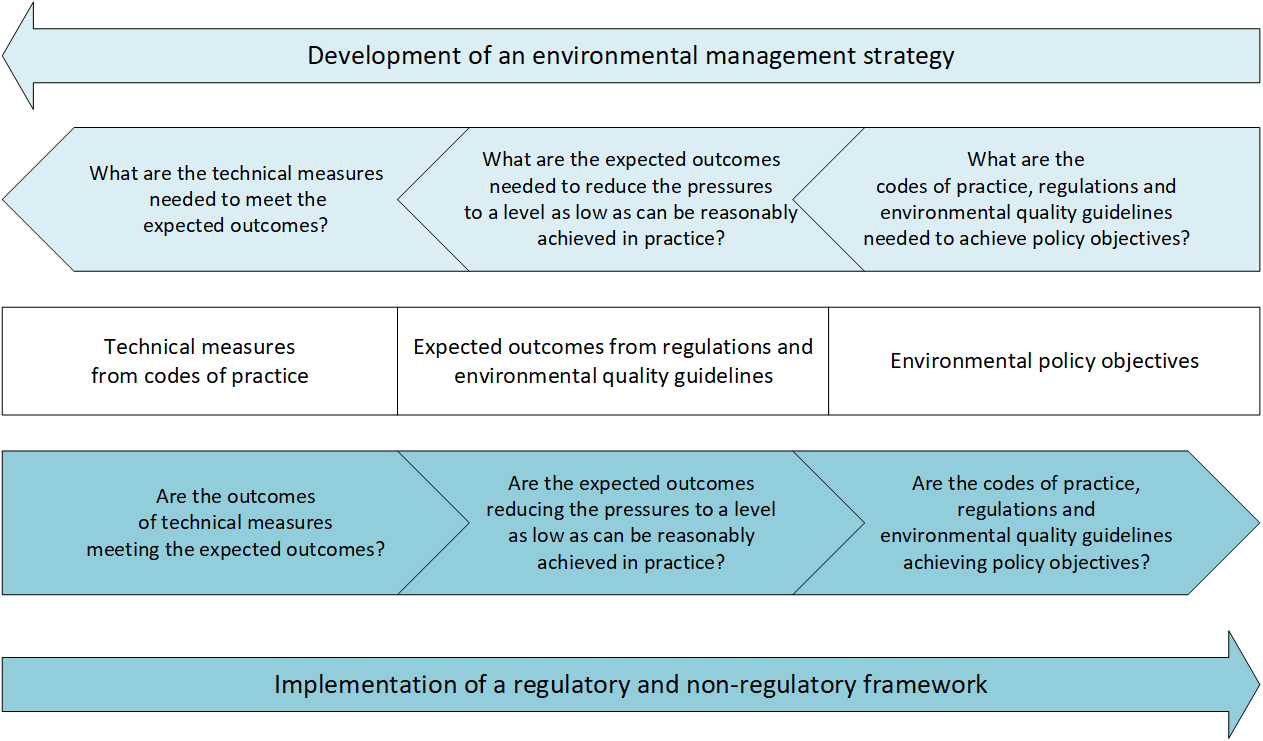
The difference between the questions for developing an environmental management strategy versus the implementation of regulatory and non-regulatory frameworks.
In risk management (IEC/ISO, 2019), minimum tolerance levels for acceptable risks are used when risk cannot be eliminated and that technical measures can only reduce the risks to a level “As Low As Reasonably Practicable” (ALARP) (Baybutt, 2014). Pressures are considered as the mechanisms and rates of change to the aquatic environment that occur in an area once avoidance and mitigation measures have been employed (Cormier et al., 2022) such as the disturbance of species due to human presence, mortality or injury to wild species, physical disturbance to seabed and input of substances, litter or energy (e.g. MSFD Table 2a. Anthropogenic pressures on the marine environment (EU, 2017)). Here, an expected outcome established in a regulation or an environmental quality guideline could be considered as the tolerance levels for the effectiveness of the technical measures used to reduce the pressures by operational activities within a worksite. Not discussed here is the scientific advisory processes used to establish such tolerance levels in the development regulations and environmental quality guidelines where new scientific knowledge would be needed to trigger a review of the regulations and guidelines.
The following examples are used to illustrate the differences between environmental policies (Table 1), regulations and environmental quality guidelines (Table 2), and technical measures (Table 3). In this paper, the science to determine the effectiveness of technical measures is framed around the question “Are the outcomes of technical measures meeting the expected outcomes?” (Figure 1).
Table 1
| Policy | Why action is needed | Summarized Objectives |
|---|---|---|
| United Nations Sustainable Development Goals 14 Life below water (UN, 2015) | The ocean drives global systems that make the Earth habitable for humankind. Our rainwater, drinking water, weather, climate, coastlines, much of our food, and even the oxygen in the air we breathe, are all ultimately provided and regulated by the sea. | Conserve and sustainably use oceans, seas and marine resources for sustainable development in terms of the targets for marine pollution, ocean acidification, harvesting and overfishing, conserving coastal and marine areas, fisheries subsidies, and marine resources including capacity for scientific research and technologies, access for small scale artisanal fisheries and implementation of UNCLOS |
| Marine Strategy Framework Directive (EU, 2008; EU, 2017) | The marine environment is a precious heritage that must be protected, preserved and, where practicable, restored with the ultimate aim of maintaining biodiversity and providing diverse and dynamic oceans and seas which are clean, healthy and productive. | Achieve or maintain good environmental status in the marine environment in terms of biological diversity, non-indigenous species, commercially exploited fish and shellfish, marine food webs, eutrophication, sea-floor integrity, hydrographical conditions, pollution effects, fish and seafood, marine litter, as well as energy and noise |
| Canadian Fish and Fish Habitat Protection Policy Statement, August 2019 (DFO, 2019a) | Fish have long had economic, environmental, cultural and spiritual value to Canadians. Indigenous peoples have been fishing for many generations in Canada's oceans, along the coasts, in lakes, and in rivers. Commercial and recreational fisheries generate billions of dollars every year for the Canadian economy. Importantly, the productivity of a fishery is inextricably linked to the health of the habitat in which fish reside. Fish need suitable places to live, feed, and reproduce. They also need unobstructed corridors to migrate between these places. | Conserve and protect fish and fish habitat from habitat degradation, habitat modification, aquatic invasive species, overexploitation of fish, pollution, and climate change |
Examples of environmental policy rationales and objectives (EU, 2008; UN, 2015; EU, 2017; DFO, 2019a).
Table 2
| Regulations and environmental quality guidelines | Expected outcome |
|---|---|
|
Canadian Environmental Protection Act, 1999
(S.C. 1999, c. 33) (Canada, 2019) |
Part 7: Controlling Pollution and Managing Wastes. Division 1 – Nutrients Division 2 – Protection of the Marine Environment from Land-based Sources of Pollution Division 3 – Disposal at Sea |
|
Fisheries Act
Potato Processing Plant Liquid Effluent Regulations (C.R.C., c. 829) (Canada, 2019) |
Schedule I: Authorized Deposits of Deleterious Substances levels for biochemical oxygen demanding matter and total suspended particulate matter |
|
Fisheries Act
Metal and Diamond Mining Effluent Regulations (SOR/2002-222) (Canada, 2019) |
Schedule 4: Maximum authorized concentrations of prescribed deleterious substances |
| Canadian environmental quality guidelines for the protection of aquatic life in freshwater and marine systems (CCME, 2022) | Establishing guidelines for a variety of substances, total particulate matter, temperature, pH, nutrients, etc. |
Examples of regulations and environmental quality guidelines (Canada, 2019; Canada, 2021; CCME, 2022).
Table 3
| Codes of Practice | Controls, procedures, barriers, safeguards, and specifications |
|---|---|
| Fish and fish habitat protection standards and codes of practice (DFO, 2019b) | Measures to protect fish and fish habitatBeaver dams removalCulvert maintenanceEnd of pipe fish protection screens for small water intakes in freshwater Routine maintenance dredgingTemporary cofferdams and diversion channelsTemporary stream crossings |
| Environmental Code of Practice for Metal Mines (ECCC, 2009) | Mine life cycle activitiesEnvironmental concerns through the mine life cycleRecommended environmental management practices |
| New Brunswick Watercourse and Wetland Alteration Guidelines (NB, 2012) | Site and water managementSurface erosion and sediment controlsTiming of instream workMigratory and sensitive periods for aquatic speciesGuidelines for the type of watercourse and wetland alterations |
| Erosion and sediment control manual for transportation (AB, 2011) | Selection of BMP for erosion and sediment controlPermanent erosion and sediment control plan |
| Stream corridor restoration: Principles, Processes, and Practice (USDA, 2001) | Restoration techniques and criteria |
Examples of technical measures from codes of practice (USDA, 2001; ECCC, 2009; AB, 2011; NB, 2012; DFO, 2019b).
Environmental policy objectives
Environmental policy objectives are typically found in international conventions and agreements as well as national legislation and policies (Cormier et al., 2022). Such policies provide the rationale for the actions that are needed and the objectives that are to be achieved. However, they do not specify how those objectives are to be achieved. The development of such policies are informed by the scientific advisory and peer review processes and assessments at various scales to reach a consensus as to the evidence used to formulate the advice (UN, 2021; DFO, 2022a; ICES, 2022; OSPAR, 2022). There is a long history of such advisory processes used to ensure the independence of the science used and the advice provided (CSTA, 1999; Rose and Parsons, 2015; Gluckman, 2016).
Table 1 summarizes three examples of such policies for discussion purposes. Although their rationale and objectives are similar, they differ mainly in terms of the spatial scale and the effects that are of concern (e.g. biological diversity, pollution, etc.).
Expected outcomes of regulations and environmental quality guidelines
Under the authority of legislation, regulations are used in the application and enforcement of that legislation (Canada, 2019; Canada, 2021). For example, regulations may include prohibitions for specific activities and standards for the release of substances as well as methods for monitoring those standards. Regulations are typically used by one competent authority as conditions for authorizations, licenses or permits. In contrast, environmental quality guidelines provide policy direction that may be adopted across multiple jurisdictions and industries (CCME, 2022). Similar to as in the case for regulations, they may also establish standards for environmental quality. Indicators and metrics outlined in regulations and guidelines can be used to gauge the effectiveness of the technical measures implemented to manage operational activities within a worksite or the collective pressures generated by multiple activities within a management area. These indicators and metrics are not necessarily the same as the ones used to assess environmental impacts and effects.
The development of regulations and environmental quality guidelines are also informed by scientific advisory and peer review processes similar to the ones discussed above. However, the type of advice for such regulations and guidelines is about how much disturbance or change can be tolerated considering scientific uncertainties and the potential for impacts and effects (DFO, 2014). In principle, the development of regulations and environmental quality guidelines aims to achieve a balance between regulations that are too stringent to implement and regulations that are insufficient to protect people and the environment (Gouldson et al., 2009; UNECE, 2012).
Table 2 provides examples of regulations and guidelines that establish expected outcomes for very different development projects and industry activities. Expected outcomes are much more specific in terms of tolerance levels that are established for very specific causes of environmental impacts. As mentioned earlier, it is up to the individuals or corporate entities to engineer and implement technical measures that can meet the requirements of the regulations and environmental quality guidelines.
Industry codes of practice for technical measures
Here, the term code of practice is used generically as best industry practices, industry standards, standard operating procedures, quality management programs, etc. Codes of practice provide practical guidance as to how the operational activities are to be controlled within a worksite to comply with regulations and environmental quality guidelines. The keyword here is “practice”. Codes of practice are to put into practice the technical measures needed to meet the expected outcomes of regulations and environmental quality guidelines (Cormier et al., 2022).
The development of codes of practice also requires the input of scientists, engineers, and regulators considering the environmental implications of failing to meet the expected outcomes and the practical implementation of the technical measures in the daily operational activities of a worksite. The technical measures outlined in a code of practice provide guidance for the engineering needed to tailor these measures to the worksite of a development project or industry activity. In an environmental context, every worksite is located in very different environmental situations. Although the effectiveness of a technical measure to meet an expected outcome seems straightforward, these measures may not be reliable in every environmental situation where additional measures may be needed to meet the conditions of approval.
Table 3 provides examples of different codes of practices. These contain technical measures to address very specific activities. Some are for very small undertakings such as removing a beaver dam while others involve large industry activities such as construction, operation, and decommissioning in mining.
Framing the science for the effectiveness of technical measures
Up to this point, we discussed the roles of regulations and environmental quality guidelines in setting requirements and the role of codes of practices that outline the type of technical measures needed to meet these requirements. In the following, we examine the practical application of these ideas and concepts to demonstrate how the expected outcomes established in regulations and environmental quality guidelines are used to frame a study that would be needed to determine effectiveness. The examples presented start with the more prescribed requirements of a regulation in contrast to an environmental quality guideline and restoration techniques.
Potato processing plant liquid effluent regulations
Under the authority of the Canadian Fisheries Act (Canada, 2019), deleterious substances are managed by limiting the daily amounts to be deposited through regulations. As a policy objective, the Fish and Fish Habitat Protection and Pollution Prevention provisions of the Act prohibits the deposit of deleterious substances to fish unless the deposit has been authorized by regulation. These regulations establish the conditions that individuals and corporate entities must comply with having the responsibility to engineer their processes in such a way that their effluents do not exceed the authorized daily deposits. In this example, we used the potato processing regulation for liquid effluent established in 2009 (Table 4). For discussion purposes, the expected outcomes of this regulation are considered here as tolerance levels to avoid the degradation or alteration of the quality of fresh and marine waters for such operational activity.
Table 4
| Technical measures | Measured Outcomes | Expected outcome |
|---|---|---|
| Authorized Deposit of Deleterious Substances5 Subject to these Regulations, the owner of a plant of a class set out in Column I of Schedule I may deposit a deleterious substance prescribed by section 4 if(a) the actual daily deposit of each deleterious substance, determined in accordance with subsection 11(1), does not exceed the authorized daily deposit of that substance for that class of plant as set out in Column III of that Schedule;(b) the average daily deposit of each deleterious substance during a month, determined in accordance with subsection 11(2), does not exceed the authorized average daily deposit of that substance for that class of plant as set out in Column IV of that Schedule; and(c) the pH of each composite sample of effluent, determined in accordance with subsection 9(3), is between 6.0 and 9.0. | InterpretationBiochemical oxygen demanding matter means the substance contained in the effluent from a plant that results from the operation of a plant and that will exert a biochemical oxygen demand;Total suspended matter means the non-filterable residue that results from the operation of a plant, that is contained in the effluent from that plant. | Schedule IPotato Chips Plant:Authorized actual daily depositBiochemical Oxygen Demanding Matter: 1.5 kg/tonne of raw potatoes processedTotal Suspended Matter: 2.1 kg/tonne of raw potatoes processesAuthorized average daily depositBiochemical Oxygen Demanding Matter: 0.5 kg/tonne of raw potatoes processedTotal Suspended Matter: 0.7 kg/tonne of raw potatoes processesOther Potato Products Plants: Canned potato products, dehydrated potato products, frozen potato products and potato starchAuthorized actual daily deposit Biochemical Oxygen Demanding Matter: 2.7 kg/tonne of raw potatoes processedTotal Suspended Matter: 2.4 kg/tonne of raw potatoes processesAuthorized average daily depositBiochemical Oxygen Demanding Matter: 0.9 kg/tonne of raw potatoes processedTotal Suspended Matter: 0.8 kg/tonne of raw potatoes processesSchedule IIAnalytical Test Methods For Determining Presence and Concentrations of Deleterious Substances in EffluentsBiochemical Oxygen Demanding Matter (BOD): APHA Section 507Total Suspended Matter: AHPA Section 208DAHPA: Standard Methods for the Examination of Water and Waste Water, 14th Edition (1975), published jointly by the American Public Health Association, American Water Works Association and the Water Pollution Control Federation |
Fisheries Act (R.S.C., 1985, c. F-14): Potato Processing Plant Liquid Effluent Regulations (C.R.C., c. 829)* (Canada, 2019).
*The information presented here is to be used within the context of this paper discussion only. Please refer to the actual regulations for its application.
A potato processing plant has to meet authorized deposits for biochemical oxygen demanding matter and total suspended matter. Biochemical oxygen demanding matter and total suspended matter would be the indicators of effectiveness for the expected outcomes of the technical measures implemented to control the processes of the plant. In this example, the regulation also prescribes the standard analytical methods (e.g. APHA) that would be needed for such a study. The technical measures would be considered effective when their outcomes meet the expected outcomes of the regulation consistently over time. Given that the regulation prescribes the standard analytical methods, the results of any other scientifically valid indicator and metric would not be admissible to determine the effectiveness of the technical measures in meeting the requirements of the regulation.
Water quality guidelines for total particulate matter
Since 1964, the Canadian Council of Ministers for the Environment (CCME, 2022) has established a broad range of environmental quality guidelines for use in the various jurisdictions of the country. The Canadian Water Quality Guidelines for the Protection of Aquatic Life covers a broad range of water quality issues that can be used in freshwater and marine environments. Compared to a regulation, an environmental quality guideline does not have the force of law; but, can still be used to identify the expected outcomes needed to study the effectiveness of technical measures. In this example, we use the CCME guideline for total particulate matter (Table 5). Updated in 2002, this guideline provides tolerance levels for suspended sediment, turbidity, bedload sediments, and streambed substrate for freshwater, estuarine and marine environments. The levels established in the guidelines are calculated against natural background levels.
Table 5
| Technical measure | Measured Outcome | Expected outcome |
|---|---|---|
| Install sediment and erosion controls prior to beginning the work and maintain controls until all banks and exposed soils have been stabilized | Changes in sediment concentration above background levels of the water course during the activities within the worksite |
Suspended Sediments for clear flow
Maximum increase of 25 mg·L-1 from background levels for any short-term exposure (e.g., 24-h period). Maximum average increase of 5 mg L-1 from background levels for longer term exposures (e.g. input lasting between 24 hours and 30 days. Suspended sediments for high flow Maximum increase of 25 mg·L-1 from background levels at any time when background levels are between 25 and 250 mg·L-1. Should not increase more than 10% of background levels when background is >250 mg·L-1. Nephelometric turbidity unites (NTU) for clear flow Maximum increase of 8 NTUs from background levels for a short-term exposure (e.g., 24 hours period). Maximum average increase of 2 NTUs from background levels for a longer term exposure (e.g., 30 day period). Nephelometric turbidity unites (NTU) for high flow Maximum increase of 8 NTUs from background levels at any one time when background levels are between 8 and 80 NTUs. Should not increase more than 10% of background levels when background is >80 NTUs. |
Canadian Water Quality Guidelines for the Protection of Aquatic Life - Total Particulate Matter (CCME, 2002).
Adapted from multiple sediment and erosion control technical measures (AB, 2011; NB, 2012; DFO, 2022b), the concentration of sediments or the increase in Nephelometric turbidity units (NTU) of the watercourse would be the indicators of effectiveness for the expected outcomes of the sediment and erosion controls implemented within a worksite. The study would also have to establish the background levels for the same indicators and would need to track the number of times and duration that those levels were exceeded. Although this particular guideline may not prescribe standard analytical methods as discussed for the potato effluent regulation, the indicators and metrics used for such study would, nevertheless, have to match those of the guideline. The sediment and erosion controls would be considered effective when their outcomes are below the expected outcomes established in the guideline.
Stream corridor restoration
Revised in 2001, the stream corridor restoration manual provides a wide range of restoration techniques for instream practices, streambank treatment, water management, channel reconstruction and other stream corridor measures (USDA, 2001). For example, a development project near any watercourse most often require temporary changes of a watercourse and its banks during the construction phase of the project. Once the construction is completed, the temporary changes need to be restored to return the watercourse to a state and function essential to support aquatic life.
This restoration manual is used as our final example because effectiveness in this situation is not simply related to the expected outcome of one or more indicators. Adapted from technical measures outlined in multiple watercourse alteration guidelines (AB, 2011; NB, 2012; DFO, 2022b), the recommended techniques and criteria established in this manual would be used to evaluate the effectiveness of the stream geomorphology restoration in terms of the techniques and criteria used. Although monitoring would be required to determine the success of the restoration in terms of the return of aquatic life in the longer term, the restoration would be considered to be effective through the application of the recommended techniques and practices.
Discussion
The expected outcomes of technical measures are established by regulations and environmental quality guidelines. As such, those expected outcomes should ultimately frame the science needed to determine the effectiveness of technical measures. As shown for the potato effluent regulation, the total particulate matter guideline, and the stream restoration techniques, the expected outcomes may be expressed as one or more indicators or as techniques and criteria. Regulations can also prescribe the indicators, the metrics and the analytical methods to be used for such a study. Management would not be able to use other scientifically valid indicators, metrics and methods in a regulatory decisions. The latter could not be used as evidence of non-compliance with regulatory requirements when such a study did not use the prescribed analytical methods in regulations.
Expected outcomes established in regulations and environmental quality guidelines are tolerance levels considering the policy objectives that are being sought. The total particulate matter guideline (e.g. CCME) is a good example because it provides tolerance levels for the magnitude of change and duration in the increase in sediments and turbidity above background levels in relation to the exposure of the aquatic organisms that were considered when these were established. As long as the outcome of the implemented sediment and erosion controls remain below the tolerance levels for sediment and turbidity, the increase and duration of the changes in sediment and turbidity is considered tolerable given the need to protect aquatic life. This would imply that the sediment and erosion controls of a worksite are effectively reducing the quantity of sediment laden water reaching a watercourse to levels as lows as can be reasonably expected in practice. However, the science to establish such tolerance level would have been based on the sublethal and lethal effects of habitat impairments caused by suspended sediments and habitat sedimentation within the context of a policy for the protection of fish and fish habitats (CCME, 2002; DFO, 2019a).
Once a regulation and an environmental quality guideline are in effect, their expected outcomes are used systematically as conditions of approval for thousands of development projects and industry activities from that moment onwards (Cormier et al., 2022). The same can be said of the technical measures outlined in codes of practice. As long as the technical measures meet the expected outcomes, they are considered effective. For the three examples provided (Tables 4, 5, 6), they have been used for decades with updates in the last ten years or so. Changes to expected outcomes and technical measures require scientific studies that are dedicated to effectiveness in order to provide the justification for updating regulations and environmental quality guidelines and for improving technical measures outlined in codes of practice.
Table 6
| Technical measure | Measured Outcome | Expected outcome |
|---|---|---|
| Restore stream geomorphology (i.e., restore the bed and banks, gradient and contour of the waterbody) to its initial state | Changes to the geomorphology and habitat structure of a watercourse |
Appendix A: Techniques
Instream Practices: Boulder Clusters, Weirs or Sills, Fish Passages, Log/Brush/Rock Shelters, Lunker Structures, Migration Barriers, Tree Cover, Deflectors, Control Measures Streambank Treatment: Bank Shaping and Planting, Branch Packing, Brush Mattresses, Coconut Fiber Roll, Dormant Post Plantings, Vegetated Gabions, Joint Plantings, Live Cribwalls, Live Stakes, Live Fascines, Log, Rootwad, and Boulder Revetments, Riprap, Stone Toe Protection, Tree Revetments, Vegetated Geogrids Water Management: Sediment Basins, Water Level Control Channel Reconstruction: Maintenance of Hydraulic Connections, Stream Meander Restoration Stream Corridor Measures: Livestock Exclusion or Management, Riparian Forest Buffers, Flushing for Habitat Restoration |
Stream Corridor Restoration: Principles, Processes, and Practices (USDA, 2001).
Conclusions
Technical measures are used to manage thousands of activities and their pressures in both freshwater and marine environments. Technical knowledge is needed to understand the effectiveness of technical measures in meeting the requirements of regulations and environmental quality guidelines. This need does not preclude the importance of the scientific knowledge used to establish the expected outcomes of these regulations and guidelines. The science to determine the effectiveness of technical measures is very different from ongoing scientific research on impacts and effects. Effective technical measures are needed to deliver programs for the protection and conservation of aquatic life and their habitats in both freshwater and marine environments. These programs have to provide a comprehensive suite of regulations, environmental quality guidelines and codes of practice to provide guidance for those that have to engineer and tailor technical measures to their activities and worksites to effectively reduce their pressures.
In this paper, we demonstrate the importance of using regulations and guidelines to frame the science needed to determine the effectiveness of technical measures using a few examples. We recognize that there would also be a need for scientific research to inform management decisions to establish the tolerance levels used in regulations and guidelines and also to revise the levels that are already in place. We consider that this paper is a small step in moving from the current science-policy interface providing scientific knowledge for policy to a needed science-management interface of structured scientific and technical frameworks to establish tolerance levels and to determine the effectiveness of technical measures.
Statements
Author contributions
RC, TT and MM contributed to the conception of the work, the analysis of causality and the writing of the paper. All authors contributed to the article and approved the submitted version.
Acknowledgments
We would also like to thank the International Council for the Exploration of the Sea (ICES) for the insights generated through multiple workshops related to this topic.
Conflict of interest
The authors declare that the research was conducted in the absence of any commercial or financial relationships that could be construed as a potential conflict of interest.
Publisher’s note
All claims expressed in this article are solely those of the authors and do not necessarily represent those of their affiliated organizations, or those of the publisher, the editors and the reviewers. Any product that may be evaluated in this article, or claim that may be made by its manufacturer, is not guaranteed or endorsed by the publisher.
References
1
AB . (2011). Erosion and sediment control manual. Available at: https://open.alberta.ca/dataset/aaae5384-c0e0-4421-9fd8-6ab835c6f3af/resource/5ae2cd05-f29f-4f71-a88f-08ac702125a9/download/2011-erosion-sediment-control-manual-june-2011.pdf.
2
Baybutt P. (2014). “The ALARP principle in process safety’,” in Process safety progress, vol. 33. (111 RIVER ST, HOBOKEN 07030-5774, NJ USA: WILEY-BLACKWELL), 36–40. doi: 10.1002/prs.11599
3
Bigard C. Pioch S. Thompson J. D. (2017). The inclusion of biodiversity in environmental impact assessment: Policy-related progress limited by gaps and semantic confusion. J. Environ. Management. Elsevier Ltd200, 35–45. doi: 10.1016/j.jenvman.2017.05.057
4
Borgwardt F. Robinson L. A. Trauner D. Teixeira H. Nogueira A. J. A. Lillebø A. I. et al . (2019). Exploring variability in environmental impact risk from human activities across aquatic ecosystems. Sci. Total Environment.652, 1396–1408. doi: 10.1016/J.SCITOTENV.2018.10.339
5
Burdon D. Barnard S. Boyes S. J. Elliott M. (2018). Oil and gas infrastructure decommissioning in marine protected areas: System complexity, analysis and challenges. Mar. Pollut. Bulletin. Elsevier135, 739–758. doi: 10.1016/j.marpolbul.2018.07.077
6
Canada . (2019). Fisheries act (R.S.C. 1985, c. f-14) (Canada). Available at: https://laws-lois.justice.gc.ca/eng/acts/f-14/.
7
Canada . (2021). Canadian Environmental protection act 1999 (S.C. 1999, c. 33) (Canada). Available at: https://laws-lois.justice.gc.ca/eng/acts/c-15.31/.
8
CCME . (2002). ‘Canadian water quality guidelines for the protection of aquatic life - total particulate matter’ (Canadian Council of Ministers of the Environment, Canadian Environmental Quality Guidelines), 13. Available at: https://ccme.ca/en/res/total-particulate-matter-en-canadian-water-quality-guidelines-for-the-protection-of-aquatic-life.pdf.
9
CCME . (2022). Canadian Environmental quality guidelines. Available at: https://ccme.ca/en/resources#.
10
Cormier R. Elliott M. Borja Á. (2022). Managing marine resources sustainably – the “Management response-footprint pyramid” covering policy, plans and technical measures. Front. Mar. Sci.9. doi: 10.3389/fmars.2022.869992
11
Cormier R. Stelzenmüller V. Creed I. F. Igras J. Rambo Callies H. U. Johnson L. B. (2018) ‘The science-policy interface of risk-based freshwater and marine management systems: From concepts to practical tools’. J Environ ManageElsevier, 226, 340–346. doi: 10.1016/j.jenvman.2018.08.053
12
Cormier R. Kelble C. R. Anderson M. R. Allen J. I. Grehan A. Gregersen Ó. (2017). Moving from ecosystem-based policy objectives to operational implementation of ecosystem-based management measures. ICES J. Mar. Sci.74 (1), 406–413. doi: 10.1093/icesjms/fsw181
13
CSTA . (1999). Science advice for government effectiveness (SAGE). Available at: https://publications.gc.ca/site/eng/84765/publication.html.
14
DFO . (2014). “Science advice for managing risk and uncertainty in operational decisions of the fisheries protection program,” in CSAS science advisory report 2014/015. (Ottawa, Canada: Canadian Science Advisory Secretariat). Available at: http://waves-vagues.dfo-mpo.gc.ca/Library/363993.pdf.
15
DFO . (2019a). Fish and fish habitat protection policy statement. Available at: http://www.dfo-mpo.gc.ca/pnw-ppe/policy-politique-eng.html.
16
DFO . (2019b). Standards and codes of practice, projects near water. Available at: https://www.dfo-mpo.gc.ca/pnw-ppe/practice-practique-eng.html.
17
DFO . (2022a). Canadian Science advisory secretariat (CSAS). Available at: https://www.dfo-mpo.gc.ca/csas-sccs/index-eng.htm.
18
DFO . (2022b). Standards and codes of practice. Available at: https://www.dfo-mpo.gc.ca/pnw-ppe/practice-practique-eng.html.
19
Duarte C. G. Sánchez L. E. (2020). Addressing significant impacts coherently in environmental impact statements. Environ. Impact Assess. Review. Elsevier82, 106373. doi: 10.1016/j.eiar.2020.106373
20
ECCC (2009) Environmental code of practice for metal mines. Available at: http://www.nrcan-rncan.gc.ca/mms-smm/tect-tech/%5Cnsat-set/med-ndd-eng.htm.
21
Elliott M. Borja Á. Cormier R. (2020). ‘Activity-footprints, pressures-footprints and effects-footprints – walking the pathway to determining and managing human impacts in the sea’. Mar. Pollut. Bulletin. Elsevier155, 111201. doi: 10.1016/j.marpolbul.2020.111201
22
EU . (2008). Directive 2008/56/EC of the European parliament and of the council of 17 June 2008 establishing framework for community action in the field of marine environmental policy (Marine strategy framework directive). Off. J. Eur. Union. Europe: Off. J. Eur. Union, 22.
23
EU . (2017). Commission directive (EU) 2017/845 of 17 may 2017 amending directive 2008/56/EC of the European parliament and of the council as regards the indicative lists of elements to be taken into account for the preparation of marine strategies. Off. J. Eur. Union, L125/27–L125/33.
24
Evans K. Cormier R. Dunstan P. Fulton E. Schmidt J. Simcock A. et al . (2021). “Cumulative effects’, in united nations,” in Second world ocean assessment, volume II (New York: United Nations), 395–420. Available at: https://www.un.org/regularprocess/woa2launch.
25
Getty R. Morrison-Saunders A. (2020). Evaluating the effectiveness of integrating the environmental impact assessment and mine closure planning processes’. Environ. Impact Assess. Rev.82, 106366. doi: 10.1016/j.eiar.2020.106366
26
Giebels D. van Buuren A. Edelenbos J. (2016). Knowledge governance for ecosystem-based management: Understanding its context-dependency. Environ. Sci. Policy55, 424–435. doi: 10.1016/j.envsci.2015.08.019
27
Gluckman P. (2016). The science-policy interface. Science353 (6303), 969–969. doi: 10.1126/science.aai8837
28
Gouldson A. Morton A. Pollard S. J. T. (2009). Better environmental regulation - contributions from risk-based decision-making. Sci. Total Environment. Elsevier B.V.407 (19), 5283–5288. doi: 10.1016/j.scitotenv.2009.06.013
29
Gwimbi P. Nhamo G. (2016). Benchmarking the effectiveness of mitigation measures to the quality of environmental impact statements: lessons and insights from mines along the great dyke of Zimbabwe. Environment Dev. Sustainability. Springer Netherlands18 (2), 527–546. doi: 10.1007/s10668-015-9663-9
30
Himberg H. Puntus O. Guantai J. Naber H. Rahill B. (2018) Environmental regulation and standards, monitoring, inspection, compliance, and enforcement, guidance notes on tools for pollution management. Available at: https://www.worldbank.org/en/home.
31
ICES . (2022). Ecosystem overviews. Available at: https://www.ices.dk/advice/ESD/Pages/Ecosystem-overviews.aspx.
32
IEC/ISO . (2019). “IEC 31010: 2019 risk management - risk assessment techniques,” in International electrotechnical commission (Geneva, Switzerland: IEC 31010), 105.
33
Katsanevakis S. Coll M. Fraschetti S. Giakoumi S. Goldsborough D. Mačić V. et al . (2020). Twelve recommendations for advancing marine conservation in European and contiguous seas. Front. Mar. Sci.7. doi: 10.3389/fmars.2020.565968
34
May J. Hobbs R. J. Valentine L. E. (2017). Are offsets effective? an evaluation of recent environmental offsets in Western Australia. Biol. Conserv. Elsevier Ltd206, 249–257. doi: 10.1016/j.biocon.2016.11.038
35
NB . (2012). Watercourse and wetland alteration technical guidelines. Available at: https://www2.gnb.ca/content/dam/gnb/Departments/env/pdf/Water-Eau/WatercourseWetlandAlterationTechnicalGuidelines.pdf.
36
OSPAR . (2022). Protecting and conserving the north-East Atlantic and its resources. Available at: https://www.ospar.org/.
37
Reichenberger S. Bach M. Skitschak A. Frede H.-G. (2007). ‘Mitigation strategies to reduce pesticide inputs into ground- and surface water and their effectiveness; a review’. Sci. Total Environment. Elsevier384 (1–3), 1–35. doi: 10.1016/J.SCITOTENV.2007.04.046
38
Rose N. A. Parsons E. C. M. (2015). “Back off, man, i’m a scientist!” when marine conservation science meets policy. Ocean Coast. Management. Elsevier Ltd115, 71–76. doi: 10.1016/j.ocecoaman.2015.04.016
39
Rytwinski T. van der Ree R. Cunnington G. M. Fahrig ,. L. Findlay C. S. Houlahan J. et al . (2015). Experimental study designs to improve the evaluation of road mitigation measures for wildlife. J. Environ. Management. Elsevier Ltd154, 48–64. doi: 10.1016/j.jenvman.2015.01.048
40
Silva E. Acheampong R. A. (2015). ‘Developing an inventory and typology of land-use planning systems and policy instruments in OECD countries’ Vol. 94 (OECD Environment Working Papers).
41
Smyth K. Christie N. Burdon D. Atkins J. P. Barnes R. Elliott M. (2015). Renewables-to-reefs? – decommissioning options for the offshore wind power industry. Mar. Pollut. Bulletin. Elsevier Ltd90 (1–2), 247–258. doi: 10.1016/j.marpolbul.2014.10.045
42
Stelzenmüller V. Cormier R. Gee K. Shucksmith R. Gubbins M. Yates K. L. et al . (2021). Evaluation of marine spatial planning requires fit for purpose monitoring strategies’. J. Environ. Management. Elsevier Ltd278 (P2), 111545. doi: 10.1016/j.jenvman.2020.111545
43
Theis S. Ruppert J. L. W. Roberts K. N. Minns C. K. Koops M. Poesch M. S. (2019). ‘Compliance with and ecosystem function of biodiversity offsets in north American and European freshwaters’. Conserv. Biol.0 (0), 1–12.
44
UN . (2015). Resolution adopted by the general assembly. Available at: https://www.un.org/sustainabledevelopment/sustainable-development-goals/.
45
UN . (2021). Second world oceans assessment, volume I and volume II (United Nations). Second.
46
UNECE . (2012). Risk management in regulatory frameworks: Towards a better management of risks. Available at: http://www.unece.org/fileadmin/DAM/trade/Publications/WP6_ECE_TRADE_390.pdf.
47
USDA . (2001). Stream corridor restoration: Principles, processes, and practices. SuDocs no (Federal Interagency Stream Restoration Working Group). Available at: https://www.nrcs.usda.gov/wps/portal/nrcs/detailfull/national/water/?cid=stelprdb1043244 (Accessed July 30, 2021).
48
Van den Bosch K. Matthews J. W. (2017). An assessment of long-term compliance with performance standards in compensatory mitigation wetlands. Environ. Management. Springer US59 (4), 546–556. doi: 10.1007/s00267-016-0804-1
Summary
Keywords
technical measures, regulations, expected outcomes, effectiveness science, environmental quality guidelines
Citation
Cormier R, Tunney T and Mallet M (2022) Framing the science for technical measures used in regulatory frameworks to effectively implement government policy. Front. Mar. Sci. 9:898010. doi: 10.3389/fmars.2022.898010
Received
16 March 2022
Accepted
12 December 2022
Published
23 December 2022
Volume
9 - 2022
Edited by
Peter Ridd, Retired, Australia
Reviewed by
Stephen James Malcolm, Centre for Environment, Fisheries and Aquaculture Science (CEFAS), United Kingdom; Yvonne L. deReynier, National Marine Fisheries Service (NOAA), United States
Updates
Copyright
© 2022 Cormier, Tunney and Mallet.
This is an open-access article distributed under the terms of the Creative Commons Attribution License (CC BY). The use, distribution or reproduction in other forums is permitted, provided the original author(s) and the copyright owner(s) are credited and that the original publication in this journal is cited, in accordance with accepted academic practice. No use, distribution or reproduction is permitted which does not comply with these terms.
*Correspondence: Roland Cormier, Roland.Cormier@dfo-mpo.gc.ca
This article was submitted to Marine Affairs and Policy, a section of the journal Frontiers in Marine Science
Disclaimer
All claims expressed in this article are solely those of the authors and do not necessarily represent those of their affiliated organizations, or those of the publisher, the editors and the reviewers. Any product that may be evaluated in this article or claim that may be made by its manufacturer is not guaranteed or endorsed by the publisher.