Biofouling, the accumulation of organisms on wetted surfaces, is a ubiquitous challenge for submerged anthropogenic marine structures that can result in reduced efficiency, increased fuel consumption, and greenhouse gas emissions from vessels. In addition, it causes the weakening and corrosion of maritime infrastructure, detrimental effects to aquaculture, and translocation of harmful non-indigenous species. The impacts of marine non-indigenous species (including macro and micro-organisms) on economic, environmental, and socio-cultural values have led to the formation of national and international regulations and guidelines to manage the risks associated with the vessel biofouling pathway.
The objective of this Research Topic was to address the impact and management of marine biofouling towards sustainable transportation and energy, to fill the gaps in the literature, and hence contribute to and update the evidence-base in this field (Figure 1).
Figure 1
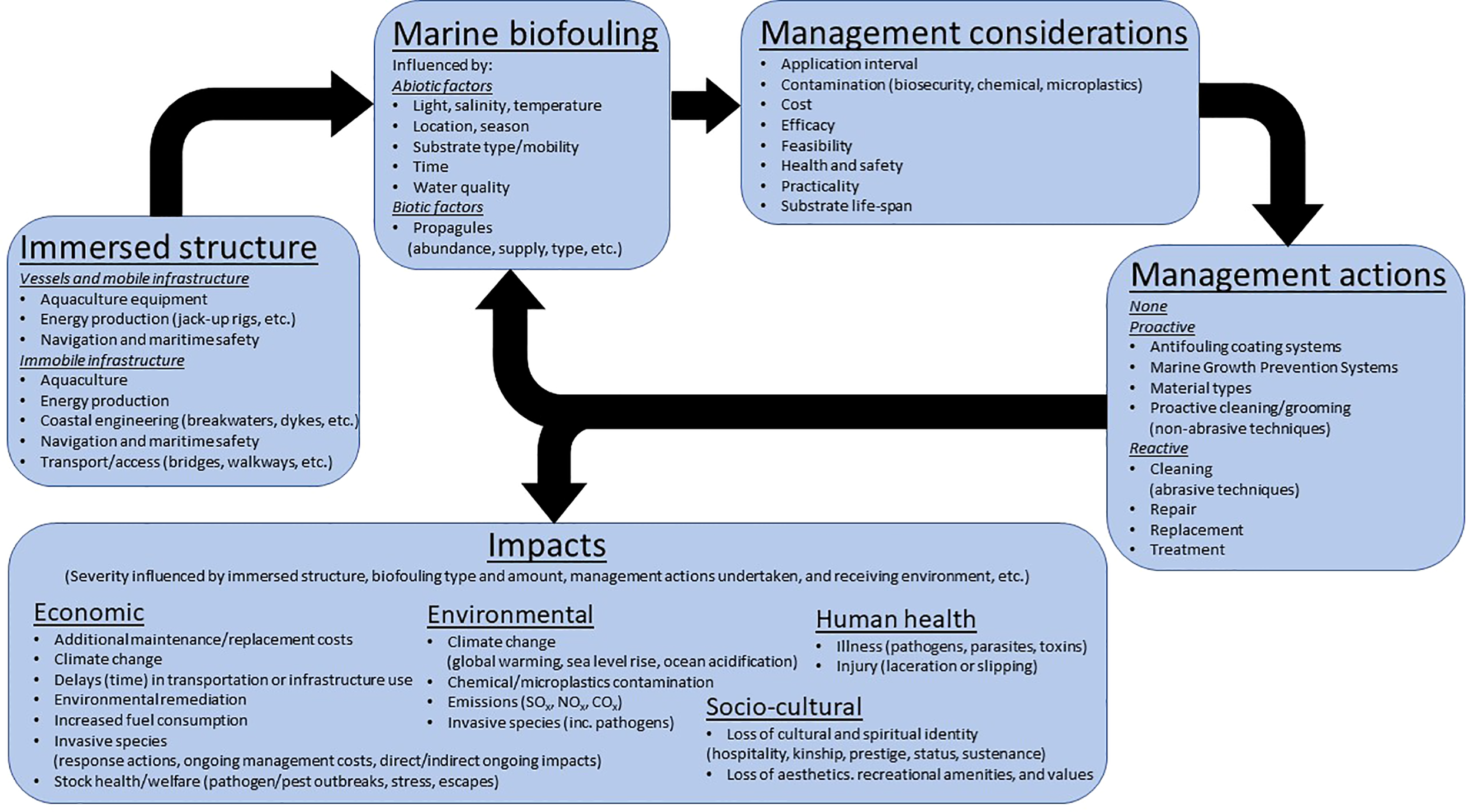
Influences, management considerations, and impacts of marine biofouling on immersed structures.
Due to the aforementioned negative effects, it is desirable to minimize the accumulation of biofouling on marine vessels (Davidson et al., 2021; Riley et al., 2022; Chan et al., 2022) and structures (Hopkins et al., 2021; Briand et al., 2022). Fouling-control coatings are predominantly used to manage marine biofouling on vessels. An ideal coating should be effective against biofouling organisms over the duration of the in-service period and remain smooth enough to improve the surface properties of the vessels and structures to which they are applied. Biocidal active ingredients continue to receive considerable scrutiny at national and international regulatory levels, however, a balance must be achieved regarding the benefits of coating efficacy, which includes environmental benefits, and potential impacts to environmental values (Arabshahi et al., 2021; Gomez-Banderas et al., 2022). Other management strategies being considered across the variety of marine structures include, but are not limited to, marine growth prevention systems (Davidson et al., 2021), native species enhancement (Hopkins et al., 2021), bubble nets (Hopkins et al., 2021), acoustics (Hopkins et al., 2021), ultra-violet light (Whitworth et al., 2022), and proactive and reactive in-water cleaning technologies (Tamburri et al., 2021; Swain et al., 2022; Ralston et al., 2022).
The application of new biofouling management strategies for marine vessels, and mobile and immobile structures, require assessments of efficacy, practicality, feasibility, and environmental impacts (Arabshahi et al., 2021; Hopkins et al., 2021; Gomez-Banderas et al., 2022; Ralston et al., 2022) to enable evidence-based decision making (Tamburri et al., 2021; Swain et al., 2022; Gomez-Banderas et al., 2022).
Publisher’s Note
All claims expressed in this article are solely those of the authors and do not necessarily represent those of their affiliated organizations, or those of the publisher, the editors and the reviewers. Any product that may be evaluated in this article, or claim that may be made by its manufacturer, is not guaranteed or endorsed by the publisher.
Statements
Author contributions
All authors listed have made a substantial, direct, and intellectual contribution to the work and approved it for publication.
Acknowledgments
The Research Topic co-editors acknowledge the contributions of the manuscript authors to advancing knowledge of marine biofouling and its management.
Conflict of interest
The authors declare that the research was conducted in the absence of any commercial or financial relationships that could be construed as a potential conflict of interest.
Summary
Keywords
biofouling, marine, management, impacts, evidence-based decision making
Citation
Demirel YK, Hunsucker KZ, Lejars M and Georgiades E (2022) Editorial: Impact and Management of Marine Biofouling. Front. Mar. Sci. 9:958812. doi: 10.3389/fmars.2022.958812
Received
01 June 2022
Accepted
14 June 2022
Published
07 July 2022
Volume
9 - 2022
Edited and reviewed by
Rui Rosa, University of Lisbon, Portugal
Updates
Copyright
© 2022 Demirel, Hunsucker, Lejars and Georgiades.
This is an open-access article distributed under the terms of the Creative Commons Attribution License (CC BY). The use, distribution or reproduction in other forums is permitted, provided the original author(s) and the copyright owner(s) are credited and that the original publication in this journal is cited, in accordance with accepted academic practice. No use, distribution or reproduction is permitted which does not comply with these terms.
*Correspondence: Eugene Georgiades, eugene.georgiades@mpi.govt.nz
This article was submitted to Marine Biology, a section of the journal Frontiers in Marine Science
Disclaimer
All claims expressed in this article are solely those of the authors and do not necessarily represent those of their affiliated organizations, or those of the publisher, the editors and the reviewers. Any product that may be evaluated in this article or claim that may be made by its manufacturer is not guaranteed or endorsed by the publisher.