Abstract
The 2030 Agenda for Sustainable Development sets out a transformative vision which has yet to be realised for SDG14 and oceans. Recognition of the “indivisibility” of the Goals and enhanced integration of ocean governance support this transformation, but require at least multidisciplinary, or probably transdisciplinary, approaches. For regions which are highly dependent on development finance, a powerful leverage point for a transdisciplinary transformation is in the design of development investments. The work presented here identifies design features of ocean development-financed projects involving substantial amounts of research in two Pacific Small Island Developing States (SIDS): Fiji and the Solomon Islands. Transdisciplinary approaches were closely aligned to what is established as Mode 2 research modalities which focus on participation and multi-knowledge systems, as opposed to Mode 1 which have a predominantly scientific basis. From the literature an analytical indicator framework was developed which scored projects on their Modes of research within four categories: Product, Process, Policy and People. This framework was applied to five development-financed projects, and permitted the balance of Mode 1 and Mode 2 to be assessed and significant differences between projects identified. The work surfaces project features which can be embedded in the design of ocean investments which promote transdisciplinarity. This tractable and practical recognition of transdisciplinarity has connotations to the UN Ocean Decade in its ability to deliver on its transformation rhetoric. With capacity weaknesses and constrained financial resources in developing countries, and urgent ocean-related challenges especially in SIDS, moving to designed-in transdisciplinary and transformational outcomes remains a priority.
1 Introduction
1.1 Transformation through integration
The UN 2030 Agenda for Sustainable Development sets out a transformative vision which has yet to be realized for SDG14 (“life below water”). In the 2030 Agenda, the 17 Sustainable Development Goals (SDGs) represent a set of interrelated and indivisible development Goals, although the strength of the connections between the Goals are uneven (McGowan et al., 2019). Recognition of this “indivisibility” of the goals, means that more integrated approaches are required for this envisioned transformation to sustainable development. SDG14 is highly integrated to other SDGs, especially in SIDS (Small Island Developing States) which are reliant on the ocean (e.g. Singh et al., 2018; Singh et al., 2021). Thus, the global high-level policy frame demands enhanced integration of ocean knowledge, management and governance to support this transformation explicit in Agenda 2030.
Present formalized knowledge systems, derived from universities and research institutes, are “arguably failing humanity” when compared to global challenges (e.g. Fazey et al., 2020). For more integrated outcomes it is necessary to traverse traditional scientific discipline boundaries and combine or connect multiple disciplines. The necessity of working towards integrated approaches for more sustainable outcomes, has been embedded into some mechanisms of support, such as the UK Research and Innovation Global Interdisciplinary Research Hubs (UKRI, 2019) through which this work was undertaken, and the Belmont Forum which is a partnership of funding organizations, international science councils, and regional consortia which has a Vision to support international transdisciplinary research providing knowledge for understanding, mitigating and adapting to global environmental change.
A review of transdisciplinary funding mechanisms concluded that research funding agencies that have a critical role to play by directly supporting and incentivizing transdisciplinary research (OECD, 2020). In addition, the OECD review concluded with respect to developing transdisciplinary approaches that “the UN and other international bodies…. can play an important role in building consensus and catalyzing action” and that this “requires changes not only within science systems but also support and engagement from other sectors of society”.
This United Nations Decade of Ocean Science for Sustainable Development (2021-2030) has a Vision for the “Science We Need for the Ocean We Want” and a Mission which includes “transformative ocean science solutions” (UNESCO, 2022a). The Decade requires financial resources in the region of US $5-7 billion over the first 5 years to fully meet the needs of implementation. The Decade has a process of endorsing existing initiatives and projects (UNESCO, 2021; UNESCO, 2022b). Resource mobilization has secured US $855 million, primarily through existing project endorsement, and a further US $15 million in new funds to support Decade action. A significant resource mobilization gap of >80% is apparent over the remaining 5 first years of the Decade; significant additional funds will be required to meet its objectives (UNESCO, 2022b).
With the UN sustainable development transformation being predicated on more integrated knowledge and outcomes, and consequently increasing levels of knowledge and understanding which traverse traditional discipline boundaries our research focuses on the research design of the financial resource gap of the Decade. In a perpetually resource limited environment, efficient and effective investments become a priority. In Decade terms, this translates to how best design future programmes, or design criteria to endorse relevant projects, which ensure this integration-dividend is captured and the transformation of Agenda 2030 advanced.
1.2 Transdisciplinarity for oceans
The Decade identifies that transdisciplinarity is the key to transformative knowledge; it states that one of the barriers to overcome to achieve SDG14 is that transdisciplinary approaches to ocean science require a systematic change to framing problems, identifying resources and disseminating results (UNESCO, 2022a). Transdisciplinary research has been defined as a comprehensive, multi-perspective, problem- and solution-oriented approach that transcends disciplinary boundaries and bridges science with practice (Pohl, 2011; Franke et al., 2022). The process of joint knowledge production between experts from different disciplines (Coghlan and Brydon-Miller, 2014), sectors, and decision levels, including joint problem formulation, knowledge generation, application in both scientific and societal practice, mutual quality control of scientific rigor, social robustness, and practical relevance leads to transdisciplinary co-production (Polk, 2015). This concept of ‘transdisciplinarity’ was developed in the 1970s (Jantsch, 1972; Piaget, 1972) before the principle of sustainable development (Brundtland, 1987) further encouraged integrative approaches.
Transdisciplinary research has been perceived to (1) tackle real life problems, (2) address the complexity of these problems by involving a variety of actors from science and practice and accounting for the diversity of their perspectives, and (3) create knowledge that is solution-oriented, socially robust, and transferable to both scientific and societal practice (Pohl and Hadorn, 2007; Lang et al., 2012; Berni, 2016). While there is still ongoing debate on definitions, transdisciplinarity can be differentiated from multidisciplinary, where knowledge stays within discipline boundaries, and interdisciplinarity, in which knowledge is a synthesis of disciplines in a coordinated and coherent whole. In many ways, transdisciplinarity transcends discipline boundaries by creating new integrated knowledge (e.g. Bammer, 2005 and Jahn et al., 2012); this is a fundamental essence of the transformation urged by Agenda 2030, and implicit in the UN Ocean Decade.
While the precise definition and role of transdisciplinary is becoming somewhat normalized but still debated within academia, approaches or tools to measure of assess transdisciplinary approaches are limited. Transdisciplinary studies are still relatively rare, making up <10% of coastal and marine published work (Riechers et al., 2022). Many of these studies articulate on transdisciplinarity and codeveloping solutions-oriented science (e.g. Arkema and Ruckelshaus, 2017, for the Caribbean ocean conservation; Syddall et al., 2021, for Pacific tuna fisheries), sometimes focusing on specific components of transdisciplinarity (such as knowledge integration in Swedish water research, Hoffmann et al., 2017). Whereas, other research discusses the form of projects that would promote transdisciplinarity (e.g. Brink et al, 2018 for ecosystem services and planning; Wolff et al., 2019, for management of river valleys; Franke et al., 2022; on marine real-work laboratories to support the UN Decade), but refrain from developing systematic analytical approaches or tools to assess and evaluate transdisciplinary progress.
1.3 Towards transdisciplinarity by design
Considerable time and effort were expended by the authors, and the broader team involved in the One Ocean Hub project, in framing and structuring transdisciplinarity in a practical and functional way to support development outcomes. A working definition emerged from this project through a collaborative deliberative analysis, involving one of the authors; “Transdisciplinarity is a collaborative research process between researchers and the individuals the research is supposed to engage, benefit, or consider, together developing a co-designed knowledge generation process” (Strand et al., 2022).
However, progression towards an analytical framework which had the potential to identify and characterize the transdisciplinary nature of ocean development investments was frustratingly elusive (Maharaj and Hills, 2021). This maybe reflects the challenge of moving from a well-found theoretical and conceptual basis of transdisciplinarity formulated in the past, to practical application in contemporary sustainability settings. In our context, literature prior to the emergence of transdisciplinary research agendas, decades ago, provided an entry point in practical application of transdisciplinary.
One major approach to transdisciplinarity stems from a March 2000 congress in Zurich, Switzerland, attended by ~800 people from more than 42 countries, including industry, government, and academics from nearly 40 disciplines (Klein, 2004). The goal of the conference was to develop transdisciplinary practice, promote transdisciplinary research, and create favorable institutional structures and power incentives (du Plessis et al., 2013; Segalàs-Coral and Tejedor, 2012). An approach was developed, subsequently termed the Zurich approach, for which the Network for Transdisciplinary Research (td-net) is still maintained by the Swiss Academies of Arts and Sciences (SAAS, 2022).
In formulation the Zurich approach fundamentally drew on the Mode approach to knowledge generation (Gibbons, 1994; Gibbons et al., 1994). In summary, the Mode approach identifies two polarized styles or approaches. Mode 1 focuses on problems of academic interest, which are implemented in disciplinary ways and involve scientists doing science as the normative process and organizational fixed hierarchical institutional arrangements. Whereas Mode 2 involves problems located within the domain of the solution, change-orientation in knowledge and practice and more transient institutional arrangement, and transdisciplinary research methods (Gibbons, 1994; Gibbons et al., 1994). Differentiation between Mode 1 and 2 in projects and initiatives was tractable (e.g. Mitchell, 2020); this was our entry point into contemporary ocean development investments.
The Mode 2 approach to knowledge production was embedded in the Zurich definition of transdisciplinarity and deliberation and discourse around transdisciplinarity were mainly fueled by Mode 2 knowledge production (Jahn et al., 2012). Gibbons and his colleagues “generalized key features of transdisciplinarity – heterogeneity, social responsibility and contextuality – into a new way to produce scientific knowledge (Jahn et al., 2012). Consequently, the authors took the Mode approach as a practical bifurcation for knowledge generation; with the structure and process of Model 1 obviating transdisciplinarity, whereas the structure of Mode 2 being obligate to, or at least promulgator of, transdisciplinary approaches.
1.4 Research aim and approach
The primary aim of the research presented here was to elaborate a tractable and practicable approach for the UN Ocean Decade to identify transdisciplinary investments which could meet its stated transformative agenda. A secondary aim was to provide an approach which could be used by development partners and governments more widely in designing transformative ocean-related interventions for developing countries.
This study was targeted at two Pacific SIDS which were selected as they were the two target countries in the region of the One Ocean Hub project supporting this work: Fiji and the Solomons Islands (the latter classified as a Least Developed Country). SIDS tend to have a strong reliance on ocean resources and, the South Pacific/developing country focus constrains itself to tractable and practical approaches due to the “persistent disparities in ocean science capacity” (Harden-Davies et al., 2022) and urgency of action. The approach of the authors was to journey through the bewildering array of generic discourse of transdisciplinary to create tangible and practical ways forward, which could be appreciated by development partners and in government offices in the South Pacific and elsewhere.
The unit of analysis was recently completed Overseas Development Assistance (ODA) supported ocean-related projects which were interrogated to determine their blend of Modes. To achieve this a literature review identified design features necessary to promulgate transdisciplinary approaches in ocean development projects, and then recently completed ocean-related development projects were interrogated.
2 Methodology
2.1 Development of indicators
An extensive literature analysis of published journal papers and books was conducted in order to extract the characteristics or features of Mode 1 and Mode 2. Each publication was reviewed in order to identify constituent indicators. The analysis identified and extracted features or characteristics which the authors conferred to being indicative of either Mode 1 or 2. Consolidation of the list of Mode 1 and 2 candidate indicators removed overlapping or nested indicators through aggregation undertaken by the authors. Following this consolidation process, there remained 31 indicators for Mode 1 and 37 indicators for Mode 2; indicative source references for each indicator were retained (Table 1). Although the literature on which the indicators emerged was extensive, some possible indicators may have been missed in other un-read publications. However, it is a working assumption that the 30+ indicators for Mode 1 and 2 were adequate to characterise the project approach.
Table 1
| MODE 1 | ||
|---|---|---|
| Group | Indicators | Summary description and indicative reference |
| Product | a. Stepwise research b. Conventional output c. Scientific knowledge d. Ascientific validity e. Bio-social separation f. Production led g. Research non-ultilitarian Academic problem-setting |
a. One discovery may build upon another (Gibbons et al., 1994) b. Conventional and applied research outcomes (Kelemen and Bansal, 2002) c. Production of scientific knowledge (Gibbons et al., 1994, Osborne, P., 2015, Hessels and van Lente, 2008) d. Adding to the base of disciplinary knowledge with replicability and validity (Kelemen and Bansal, 2002) e. Permits for a more realistic description of material– biophysical and socio-cultural, epistemic structures, within separate disciplines (Ostrom, 2007, Scholz, 2011) f. With respect to usage, production precedes consumption (Kelemen and Bansal, 2002) g. Not intended to support practice and that potential use do not influence research design (Kelemen and Bansal, 2002) Problems are set and solved in a context governed by the largely academic, interests (Gibbons et al., 1994) |
| Process | a. Communication specialism b. Peer accessibility c. Consensus d. Knowledge specialisation e. Knowledge reliability f. Cognitive norms g. Pragmatic conformity h. Disciplinary challenges i. Discipline aligned j. Science application Technology transfer |
a. Discrete areas of specialization communication wise (Gibbons et al., 2001) b. All research must be communicable in a form that can be understood by one’s colleagues (Gibbons et al., 2001) c. Requires consensus, even if a limited one (Gibbons et al., 2001) d. Knowledge accumulated through the professionalization of specialisation largely institutionalized in universities (Gibbons et al., 1994) e. Notion of reliable knowledge which preserves and upholds the integrity of scientific findings (Gibbons et al., 2001) f. Follows cognitive and social norms in the production, legitimation and diffusion of knowledge of this kind (Gibbons et al., 1994; Huff, 2000) g. Impermeable and paradigmatic conformity mostly within the limits of single disciplinary boundary (Kelemen and Bansal, 2002) h. The source of the intellectually challenging problems, arises largely within disciplines (Gibbons et al., 2001) i. Traditional disciplinary structure of science and technology (Gibbons et al., 1994) j. Pure science, generated in theoretical/experimental environments, is applied (Etzkowitz and Leydesdorff, 1997, Knorr-Cetina, 1999) Technology is transferred (Etzkowitz and Leydesdorff, 1997, Knorr-Cetina, 1999) |
| Policy | a. Institutional hierarchy b. Fixed structure c. Institutional channels d. Analytical focus e. Weak accountability f. Separate science |
a. Organisationally enforces hierarchy (Gibbons et al., 1994) b. Tends to preserve its form specifically during project implementation duration (Gibbons et al., 1994) c. Results are communicated through institutional channels following bureaucracy (Gibbons et al., 1994) d. Less reflexive (Gibbons et al., 2001) e. Socially less accountable (Gibbons et al., 2001) f. Socially less accountable (Gibbons et al., 2001) |
| People | a. Mainly academics b. Discipline based c. Professional level d. Individualistic e. Skill homogeneity Exclusive orientation |
a. Research team composed of disciplinary experts and expatriates like scientists and academic leaders (Gibbons et al., 1994) b. Over-rigid and hierarchical disciplinary boundary work (Gibbons et al., 1994) c. Highly trained individuals (Huff, 2000) d. Supports individualism within disciplinary boundaries (Huff, 2000) e. Homogeneity of training (Gibbons et al., 1994) Homogeneity of training (Gibbons et al., 1994) |
| MODE 2 | ||
| Characteristics | Indicators | References |
| Product | a. Diverse range of intellectual products which are of interest to social, scientific, economic and political domains b. Transient knowledge c. High applicability d. Transdisciplinary knowledge e. New norms f. Highly integrateable g. Discoveries unconfined to disciplines h. Balanced creatively i. In-house expertise Sensitivity |
a. More diverse set of intellectual and social demands where results are communicated to those who have participated in the course (Gibbons et al., 1994) b. Production of transient knowledge (Kelemen and Bansal, 2002) c. Applied and applicable research outcome (Kelemen and Bansal, 2002) d. Knowledge created is transdisciplinary and from a broader range of considerations (Gibbons et al., 1994) e. New norms emerge that are appropriate to transdisciplinary knowledge Gibbons et al., 1994) f. The determinants of a potential solution involve the integration of different skills in a framework of action (Gibbons et al., 1994) g. The discoveries lie outside the confines of any particular discipline and practitioners need not return to it for validation (Gibbons et al., 1994) h. The creative act lies just as much in the capacity to mobilize and manage these perspectives and methodologies, their ‘external’ orchestration, as in the development of new theories or conceptualisations, or the refinement of research methods, the ‘internal’ dynamics of scientific creativity (Knorr-Cetina, 1999) i. Knowledge is embodied in the expertise of individual researchers and research teams as well as conventional research products like journal articles or patents (Knorr-Cetina, 1999) Sensitivity to the impact of the research is built in from the start (Gibbons et al., 1994) |
| Process | a. Transdisciplinary b. Accountability and transparency c. Vital processing period d. Composite and multidimensional e. Highly inclusive f. Contextual knowledge production g. Supports mutual learning h. Capacity and consensus building i. Heterogenous group j. Permeable research boundaries k. Best practices Collaborative |
a. More diverse set of intellectual and social demands (Gibbons et al., 1994) b. Results are communicated to those who have participated in the course (Gibbons et al., 1994) c. The diffusion of the results is initially accomplished in the process of their production and subsequent diffusion occurs primarily as original practitioners move to new problem contexts (Gibbons et al., 1994) d. Quality control process is composite and multidimensional (Gibbons et al., 1994) e. Socially extended process which accommodates many interests in a given application process (Gibbons et al., 1994) f. Knowledge is generated within a context of application (Etzkowitz and Leydesdorff, 1997; Knorr-Cetina, 1999) g. Mutual learning among scientists and practitioners about a complex, societally relevant problem may be seen as the kernel of transdisciplinary processes (Scholz, 2000; Scholz et al., 2000). h. Capacity building among all participants; consensus building about what the main problems are, including their genesis and transformation, strategies for mitigating emerging conflicts in a process (Scholz and Steiner, 2015) i. Heterogeneity of skills and expertise to the problem-solving process (Gibbons et al., 2001) j. Transdisciplinary and permeable research boundaries (Kelemen and Bansal, 2002) k. Theoretical perspectives and practical methodologies to solve problems (Knorr-Cetina, 1999) l. Policy-oriented collaborative research processes in a greater variety of contexts (Russell et al., 2008) |
| Policy | a. Feedback encouraged b. Permits more freedom c. Change valued d. Quality control e. Context of application |
a. Both practitioners and social policy professionals facilitate the flow of feedback, learning and reflexivity (Gibbons et al., 1994; Tranfield and Starkey, 1998) b. Emergence of loose organizational structures, flat hierarchies, and open-ended chains of command (Gibbons et al., 2001) c. Research and situated learning are embedded with action or change processes (Eden and Huxham, 1996) d. Quality control is exercised as a socially extended process (Gibbons et al., 1994) Additional criteria are added through the context of application which now incorporates a diverse range of intellectual interests as well as other social, economic or political ones (Gibbons et al., 1994) |
| People | a. Socially accountable and reflexive b. Social scientists c. Cross, multi and transdisciplinary group d. Pluralist and participatory e. Team based f. Heterogeneous mixture g. Mutual learning h. Elements of relationality i. Creative and cooperative j. Quite flexible |
a. Socially accountable and reflexive (Gibbons et al., 1994) b. Pluralist and participatory (Kelemen and Bansal, 2002) c. Creativity is manifested as a group phenomenon with the individual’s contribution seemingly subsumed (Gibbons et al., 1994) d. Characterised by transdisciplinarity (Gibbons et al., 1994) e. Institutionalised in a more heterogeneous and flexible socially distributed system (Gibbons et al., 1994) f. Correlated to the socially distributed knowledge production system (Gibbons et al., 1994) g. Facilitated process of mutual learning between science and society that relates a targeted multidisciplinary or interdisciplinary research process (Jantsch, 1972; Scholz, 2000; Klein et al., 2001) h. Multi-stakeholder discourse for developing socially robust orientations about a specific real-world issue (Jantsch, 1972; Scholz, 2000; Klein et al., 2001) i. Creation of a more cooperative mode of knowledge production (Gibbons et al., 1994; Eden and Huxham, 1996; Tranfield and Starkey, 1998) j. Considerable flexibility in the approach (Gibbons et al., 1994) |
The groups, indicators and descriptions for Mode 1 and Mode 2 which make up the 4P framework.
Subjective iterative shuffling of the indicators was undertaken by the authors to try to identify coherent higher-level groupings of indicators. This process concluded with identifying four groupings of indicators which applied to both the Modes: Product, Process, Policy and People. The authors termed this the 4P framework and it was used as the basis of interrogation of specific ocean development projects (Table 1).
2.2 Selection of ocean-related projects
Development projects which included an ocean component in the South Pacific region and which were supported by Overseas Development Assistance were selected for interrogation by the 4P framework.
The project selection criteria were:
-
The project was targeted at Fiji and Solomon Islands which were One Ocean Hub target countries.
-
The project had to be recently completed so that final documentation was accessible.
-
The project appeared to involve multiple ocean-relevant disciplines.
-
The project included a research-type component, in that creating new knowledge and understanding was an objective.
Extensive internet search and then targeted discussions with local contacts (usually Project Manager/Director or Technical Staff who were involved in implementation of the projects) by the authors through email or direct conversation to establish the correct documents to review, led to the selection of the following projects for which comprehensive reporting was available:
-
1) National Marine Ecosystem Service Valuation (MESV) for Fiji and Solomon Islands, a part of the Marine and Coastal Biodiversity Management in Pacific Island Countries (MACBIO) project.
-
2) National Ecosystem and Socio-Resilience Analysis and Mapping (ESRAM) for Fiji and Solomon Islands, a part of Pacific Ecosystems-based Adaptation to Climate Change (PEBACC) project.
-
3) Reweaving the Ecological Mat (REM) project for Fiji.
2.3 Application of the 4P framework
Each project output was reviewed in detail to identify the presence of each of the 68 indicators in the 4P framework. Differences between the exact wording of indicators and the reporting documents were permitted for inclusion if the sense of use was similar. The presence of each indicator was verified by an extracted reference from the official project documents. To reduce possible bias, the initial findings obtained were sent to the other author for verification.
This process provides a dataset of the presence/absence of 68 indicators, across two Modes and four groupings, from five projects: MESV-Fiji, MESV-Solomon Islands, ESRAM-Fiji, ESRAM-Solomon Islands and REM-Fiji. Samples of text from project documents which helped to identify presence of indicators are provided (Table 2). All indicators were assumed to be independent and were equally weighted in the subsequent analysis, as there was no rational a priori basis for weighting.
Table 2
| CHARACTERISTICS | MODE 1 INDICATORS | ||
|---|---|---|---|
| MESV (Fiji) | ESRAM (Solomon Islands) | REM (Fiji) | |
| Product | 4.1. Fiji-MESV, pg 3: Under the MACBIO project, IUCN Oceania is primarily responsible for conducting national economic assessments of marine and coastal ecosystem services in all five MACBIO countries, including conducting a data gap analysis. National reports on the value of marine and coastal ecosystem services will be provided to countries to inform marine spatial planning and marine resource management in general. This is one of those reports. | 3.10 ESRAM-SI, pg 16: Figure 1-1 shows the key components of the PEBACC project, which are: (1) ecosystem and socio-economic resilience analysis and mapping (ESRAM) study – baseline study for adaptation planning at national, provincial and community levels; (2) EbA options assessment – EbA options analysed, prioritised and plans developed; (3) implementation plans – EbA plans implemented with demonstrated benefits; and (4) communications and outreach products developed to promote integration of EbA options into climate change policies, plans and projects | 4.1 REM-PS, pg 3: The primary purpose is to introduce and profile the project and garner support of the church and civil society leaders for the project through bilateral meetings, briefings and discussions. This is the primary purpose of these visits. The follow-up visits are for monitoring purposes and to conduct further awareness and training on the project. Regional and international conference. The purpose is to reflect, establish networks, advocate for development alternatives, and to profile the project and the work of the churches on development and ecology. These are also opportunities to learn and share experiences on development and ecology from the Pacific region. |
| Process | 3.2. Fiji-MESV, pg 69: A range of activities address the three broad areas which are implemented in an integrated manner that combines scientific research to inform policy with communication as a means of disseminating research information. | 3.1 ESRAM-SI, pg 16: communications and outreach products developed to promote integration of EbA options into climate change policies, plans and projects (SPREP 2016). | 3.1 REM-PS, pg 3: Regional conference for advocacy training, including media advocacy, and advocacy strategising. This is crucial to enhancing the profile of the project and to raising questions in the region about development and ecology. Part of this advocacy strategy is to build a regional network on development and ecology among church and civil society leaders, and the dissemination of information and relevant media articles. Policy briefs on various aspects of development and the ecology. These policy briefs are mainly for churches and civil society. |
| Policy | 2.1. Fiji-MESV, pg B: The MACBIO Project has undertaken economic assessments of Fiji’s marine and coastal ecosystem services and supports the integration of results into national policies and development. 2.7. Fiji-MESV, pg 10: There are three regional organisations that play a major role in use and management of marine and coastal resources, the Secretariat of the Pacific Community (SPC), the Pacific Islands Forum Fisheries Agency (FFA) and the Secretariat of the Pacific Regional Environment Program (SPREP). (Gillett and Tauati, 2018). The SPC has an active role in assisting member countries with marine and coastal fisheries development and management and also in developing scientific research and data collection on the state of marine resources. The FFA is more oriented to assisting member countries in management of tuna resources, including surveillance, economic and legal aspects. SPREP has been charged by the governments and administrations of the Pacific region to help with the protection and sustainable development of the region’s environment. Other regional organisations, such as the University of the South Pacific (USP), have different levels of involvement in marine and coastal resources. planning. | 2.1 ESRAM-SI, pg 48: Effective institutional administrations are imperative for environmental management and enforcement of environmental legislation and policies. | 2.1 REM-CN, pg 2: Since the 2006 political coup in Fiji, there have been a number of developments that have impacted upon structures and relationships in regional politics and implicitly on the leadership and stewardship task of the faith-based Christian organisations in the Pacific. For example, the increasing influence of the Melanesian Spearhead Group (MSG) and the emergence of the Pacific Islands Development Forum (PIDF) have presented challenges to existing regional bodies such as the Pacific Islands Forum Secretariat (PIFS) and the reshaping and refocusing of political and developmental issues and interests on what are regarded as regional creations. In addition, the Forum’s Pacific Plan, which acted as a guiding framework for governance, economic development, the environment and security in the region, came to an end in 2013. Gender based violence affects two out of every three women in the Pacific and is a major threat to peace and justice in the region. Gender based violence reflects systemic power inequities in social relations. These power inequities are further exacerbated by deteriorating social relations linked to poverty, economic exploitation, poor education and drug and alcohol abuse. |
| People | 1.1. Fiji-MESV, pg 12: The responsibility of preparing the NBSAP was delegated to the DoE, which was guided by a steering committee that included representatives of a broad range of government departments, NGOs, academics and UNDP (DoE, 2007). | 1.1 ESRAM-SI, pg 10: With assistance from SPREP, this and the subsequent volumes (Volumes 2 and 3) are the result of a collaboration between BMT WBM, our subconsultants, and the numerous communities, government and other stakeholder representatives who have been involved in the project to date. Key project team personnel involved in the ESRAM process | 1.2 REM-PS, pg 2: This project argues the point that indigenous and Christian ecological frameworks (knowledge, ethics and practices), have much to contribute to addressing the ‘ecological and developmental crises. Ecology as understood in most Pacific indigenous communities is both the relationship among the people in a community, and the relationship with their natural environment. |
| CHARACTERISTICS | MODE 2 INDICATORS | ||
| MESV (Fiji) | ESRAM (Solomon Islands) | REM (Fiji) | |
| Product | Not available | 4.1 ESRAM-SI, pg 16: communications and outreach products developed to promote integration of EbA options into climate change policies, plans and projects | 3.7 REM-PS, pg 3: Activities: Networking, profiling and bilateral meetings • The primary purpose is to introduce and profile the project and garner support of the church and civil society leaders for the project through bilateral meetings, briefings and discussions. This is the primary purpose of these visits. The follow-up visits are for monitoring purposes and to conduct further awareness and training on the project. • Regional and international conference. The purpose is to reflect, establish networks, advocate for development alternatives, and to profile the project and the work of the churches on development and ecology. These are also opportunities to learn and share experiences on development and ecology from the Pacific region. Education, training, awareness • In-country conferences for churches and civil society organisations. These national conferences are essential, both to introduce the project to a wider audience in the countries mentioned, and hence to foster interest and ownership, and also to strategically plan with the churches how such a project can be implemented at their local communities, why it is crucial and how it can shape internal policies relating to development and the ecology, and the health of their people. • Training workshops on developing ‘ecological indicators’. The ecological indicators meant here relate to environmental and physical health of people and the health of relationship between people and their environment. • Public lectures on the broad theme ‘development and the ecology’ and related topics that will further the discussions and debates on a revised developmental mandate, content and strategies. Its aim is to raise awareness on the need to review how development is understood and the need for alternative thinking about development. Advocacy • Regional conference for advocacy training, including media advocacy, and advocacy strategising. environment and their people. |
| Process | 1. Fiji-MESV, pg13: In 2002, the SPC proposed a community-based fisheries management programme for Fiji (King et al., 2002). The programme considered an integrated approach built on participative learning activities that are employed in Fiji by NGOs in dealing with communities. | 3.2 ESRAM-SI, pg 11: communications and outreach products developed to promote integration of EbA options into climate change policies, plans and projects. | 3.1 REM-CN, pg 3: However, what is peculiarly sad in the Pacific is the progressive abandonment of indigenous and faith-based ecological frameworks (knowledge, ethics and practices) as legitimate ways to deal with the fissures in the ecological framework of Pacific people. The social context in which this follow-up project is situated is basically a crisis of this ecological framework, understood here to mean the myriad human relationships, and the values and ethics that govern and define that relationship, and their relationship with the environment. |
| Policy | Not available | 2.3 ESRAM-SI, pg 11: Task 1 Ecosystem baseline and threat assessment; Identify the current state of ecosystems, trends and drivers of change with root causes, scenarios, governance factors. Identify ecosystem types, ecosystem services and threats. Identify ecosystem services that are valued by the community. | 2.1 REM-PS, pg 3: Advocacy: Regional conference for advocacy training, including media advocacy, and advocacy strategising. This is crucial to enhancing the profile of the project and to raising questions in the region about development and ecology. Part of this advocacy strategy is to build a regional network on development and ecology among church and civil society leaders, and the dissemination of information and relevant media articles. Policy briefs on various aspects of development and the ecology. These policy briefs are mainly for churches and civil society. The focuses will include but not limited to |
| People | 1.1. Fiji-MESV, pg 21: To this end, the ecosystem service valuation included the participation of government staff and local resource managers at every opportunity to permanently augment the capacity of country nationals to use ecosystem data and economic valuation in development of policies and resource management decision-making. | 1.1 ESRAM-SI, pg 28: Ecosystem valuations can assist resource managers to deal with the effects of market failures (i.e. inability of a market to reflect the full social costs or benefits of goods or services), by measuring their costs to society, in terms of lost economic benefits (King and Mazzotta, 2000). These costs to society can then be imposed on those who are responsible or can be used to establish the value of actions to reduce or eliminate environmental impacts. | 1.2 REM-PS, pg 2: The well-being and wholeness of these myriad relationships are dependent on the ethics and values systems that govern them. So, if there is bad political and community governance, and lack of social justice, the consequences are likely to be seen in how the community treats their natural environment, and the stewardship of their land and sea resources. Conversely, if there is a lack of appreciation of the natural environment and its significant role and contribution to the well-being and wholeness in the lives of the community, then the consequences are reflected somehow in how the community governs itself, how it treats its people, the sharing of its resources and its dispense of justice. communities and their natural environments. |
Example compilation of edited extracts from the reports on which indicator presence was determined, divided into the 4P groups for brevity.
2.4 Statistical analysis
Statistical analysis was undertaken to determine the difference between Mode 1 and Mode 2 indicators by project. χ2 analyses were undertaken between each project pair, with the null hypothesis that the expected distribution of indicators present for Mode 1 and for Mode 2 was equal between pairwise projects. A Bonferroni adaptation was applied to the significance level of the χ2 value to reduce the chance of obtaining false-positive results (type I errors) when multiple pairwise tests are performed on a single set of data (Sokal and Rohlf, 1995). The Bonferroni adaptation involved dividing the χ2 value by the total number of pairwise tests undertaken for each of the threshold significant levels (P<0.05 to P<0.001); this meant that higher χ2 values were required to be significant.
3 Results
3.1 Analysis of indicators
The presence of each of the 68 indicators in each of the 5 analysed projects is presented (Figure 1). The presence of multiple Mode 1 indicators can be seen in all of the projects, although REM has only two (Figure 1A). However, REM demonstrates presence of all Mode 2 indicators, with other projects demonstrating varying frequencies of Mode 2 indicators (Figure 1B).
Figure 1
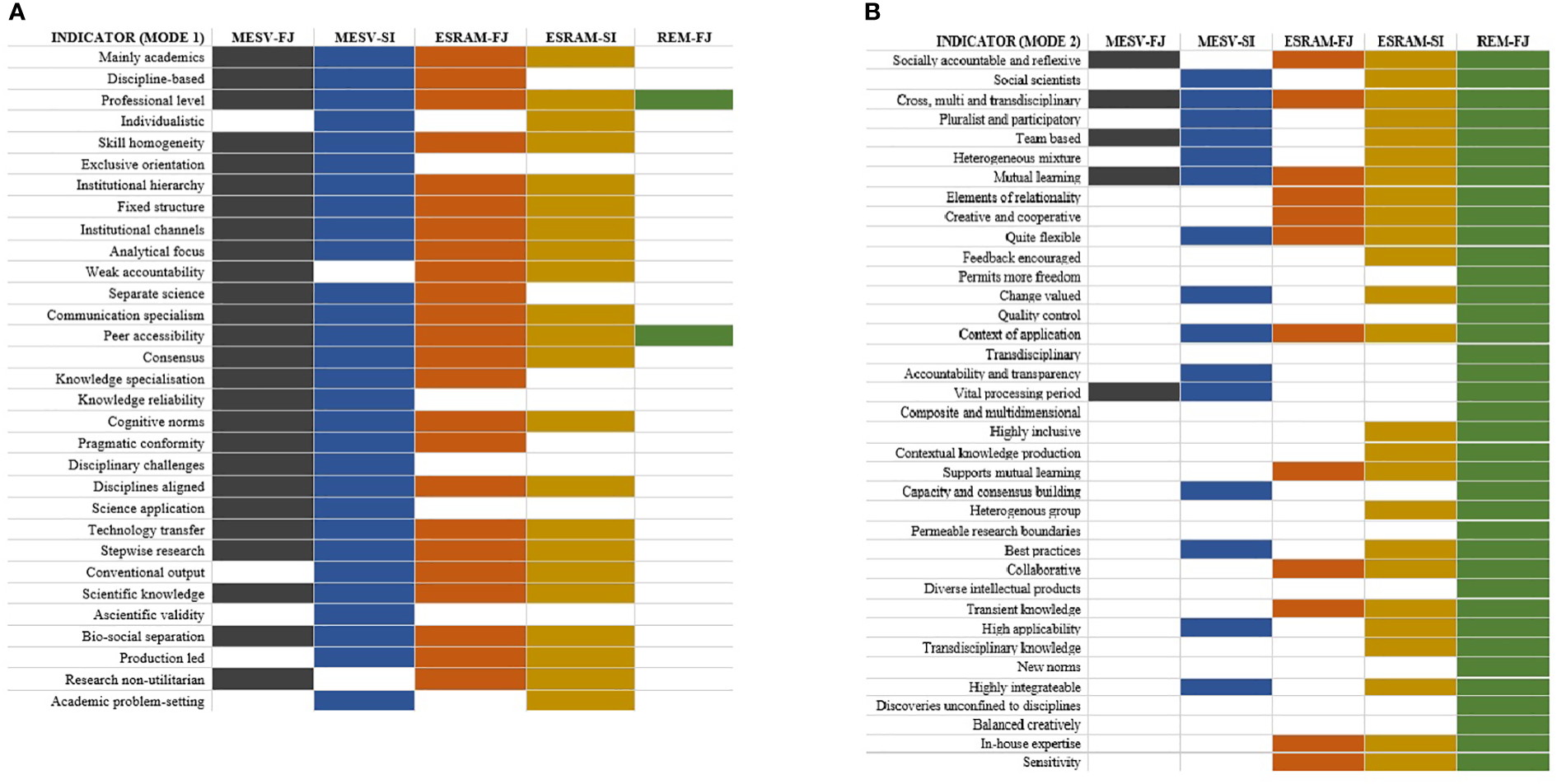
Presence of indicators derived from reports of each of the 5 analysed projects for Mode 1 (A) and Mode 2 (B) (FJ = Fiji, SI = Solomon Islands).
3.2 Comparative analysis by Mode
The percentage of Mode 1 and 2 indicators present for were determined (Figure 2). All projects had a combination or mix of Mode 1 and Mode 2 indicators. In four of the five projects Mode 1 indicators were more prevalent than Mode 2. However, in the REM project all Mode 2 indicators were present.
Figure 2
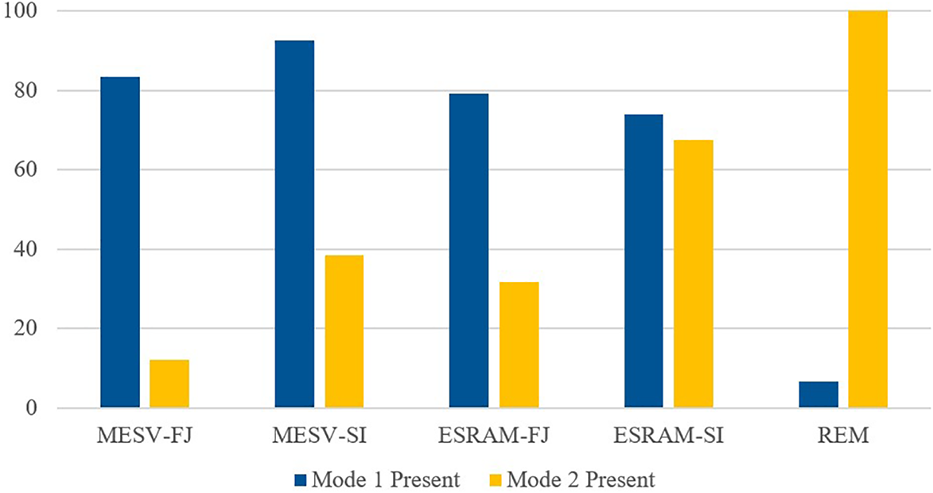
The percentage of indicators present in Mode 1 and Mode 2 for each of the 5 projects.
MESV-FJ and REM were dominated by one research Mode (Mode 1 and Mode 2, respectively), whereas the three other projects had more of a mix of Modes; ESRAM-SI had a near equal balance of Mode 1 and Mode 2 indicators. In the analysed sample of projects, there seemed to be a trade-off between Mode I and Mode 2, with either one Mode dominating or a moderate balance between the two Modes.
The χ2 analysis showed highly significant (P<0.001) differences between REM and all other projects in terms of indicators (Table 3). There was also significant differences in the same programme (ESRAM and MESV) but implemented in Fiji and Solomon Islands suggesting that national-level design and implementation approaches are a significant factor in project delivery, even when they are under a common multi-country programme. ESRAM-SI, with its relatively similar balance of Mode 1 and Mode 2 indicators, was significantly different to MESV-FI, having notably more Mode 2 indicators, but also significantly different to REM partly through having more Mode 1 indicators. This suggested that ESRAM-SI holds a central point which is significantly different to projects dominated by Mode 1 and by Mode 2, and thus in a statistical sense the Mode model is not just bipolar but a continuum.
Table 3
| MESV-FJ | MESV-SI | ESRAM-FJ | ESRAM-SI | |
|---|---|---|---|---|
| MESV-SI | * | – | – | – |
| ESRAM-FJ | NSD | NSD | – | – |
| ESRAM-SI | *** | NSD | * | – |
| REM | *** | *** | *** | *** |
The significance of pairwise χ2 tests between projects for Mode 1 and Mode 2 indicators: with NSD = not significantly different; * = P<0.05; ** = P<0.001; and *** = P<0.0001", (χ2 with 3 degrees of freedom, P values with Bonferroni adaptation).
3.3 Analysis by 4P grouping
The percentage presence of indicators with each of the 4P groups for Mode 1 and Mode 2 was determined to indicate of the relative strength of that group in each project. The MESV project in Fiji and Solomon Islands demonstrated a balance towards Mode 1 with all the 4P groups in Mode 1 having a high percentage of indicators present (over 80%, except Product in Fiji) (Figure 3). In fact all possible Mode 1 indicators were present for Process (100%) and Policy (100%) in Fiji, and Process (100%) and People (100%) in Solomon Islands. Whereas, the presence of Mode 2 indicators in MESV was low being 0 to 40%, except for the People group in Solomon Islands (Figure 3B). Comparing MESV between the two countries, the Solomon Islands has a stronger presence of Mode 2 indicators compared to Fiji. The absence of Mode 2 Product and Policy groups in Fiji, and the People focus on Solomon Islands, again reflect differences in implementation between the countries.
Figure 3
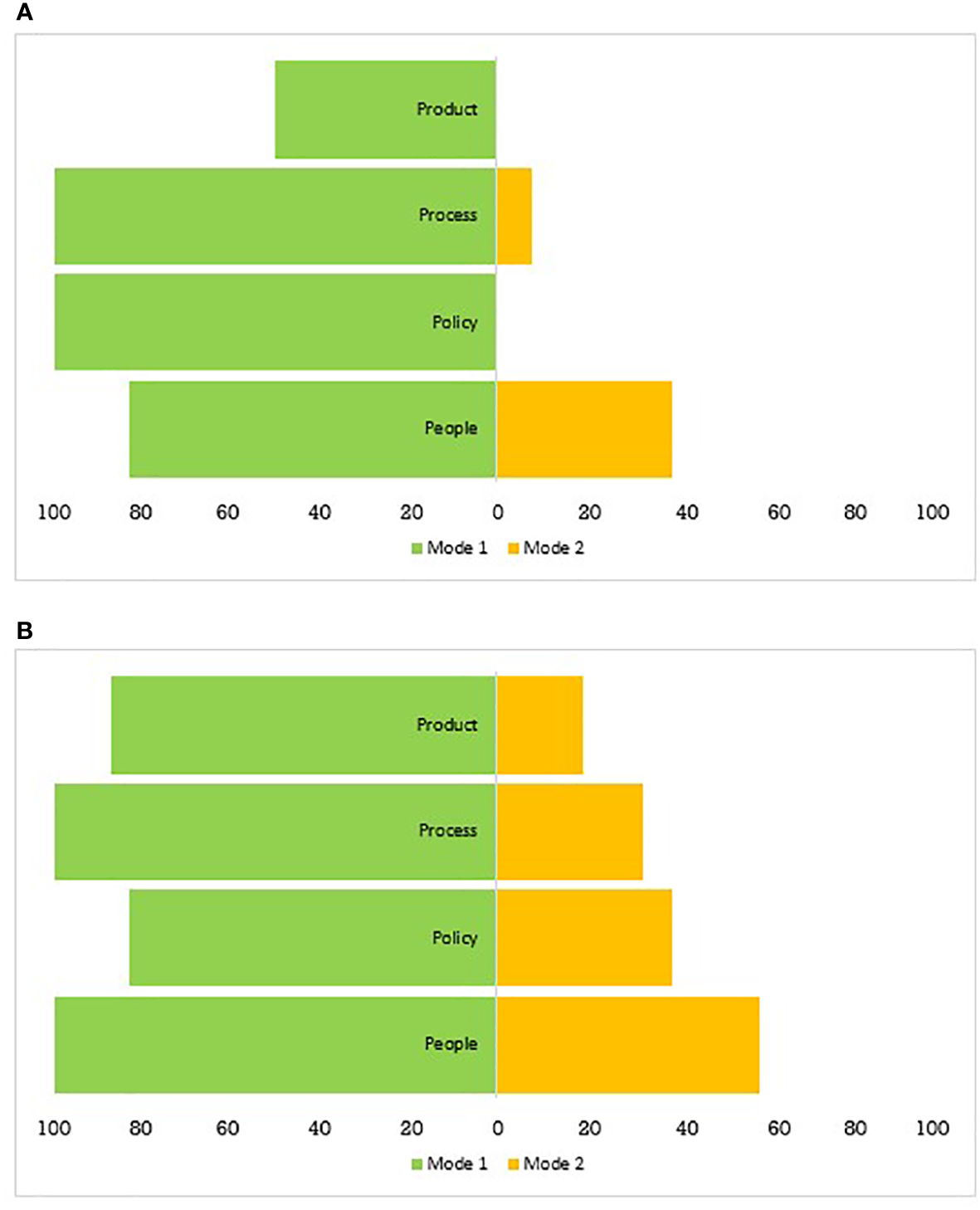
National Marine Ecosystem Service Valuation (MESV) analysis using showing percentage presence of indicators Mode 1 and Mode 2 in the 4P groups: (A) Fiji, (B) Solomon Islands.
4P analysis of the ESRAM project demonstrated a similar general trend to MESV, with differences between the project in the way it was implemented between the two countries and the Solomon Islands demonstrating stronger Mode 2 elements compared to Fiji (Figure 4).
Figure 4
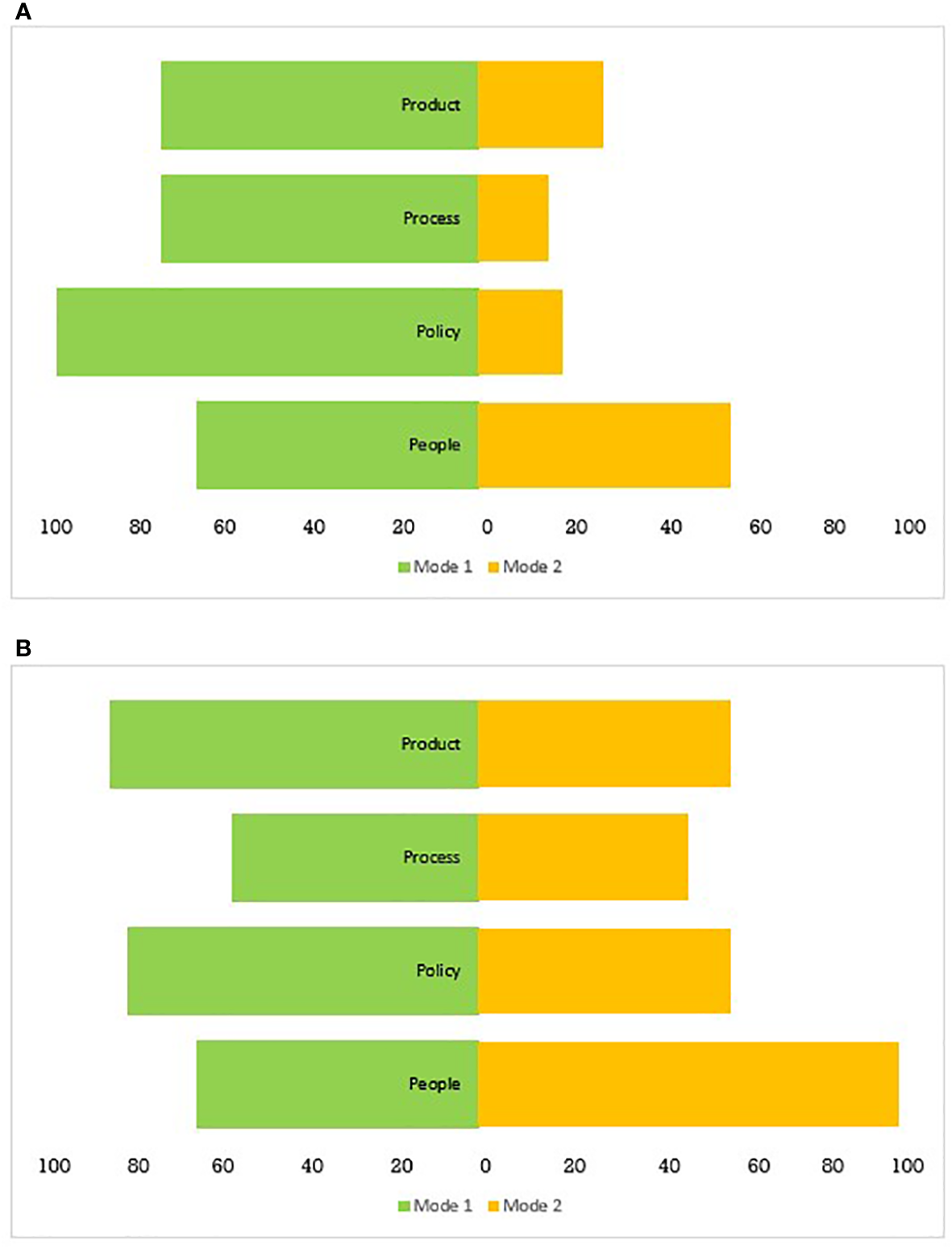
National Ecosystem and Socio-Resilience Analysis and Mapping (ESRAM) analysis using showing percentage presence of indicators Mode 1 and Mode 2 in the 4P groups: (A) Fiji, (B) Solomon Islands.
The REM project was focused on Fiji. The analysis indicates much stronger Mode 2 bias in its implementation compared to both MESV and ESRAM (Figure 5). The REM project demonstrates presence of all of the Mode 2 indicators in each of the 4P categories. There were some small elements of Mode I in REM, with <20% of Mode I indicators present in Process and People groups.
Figure 5
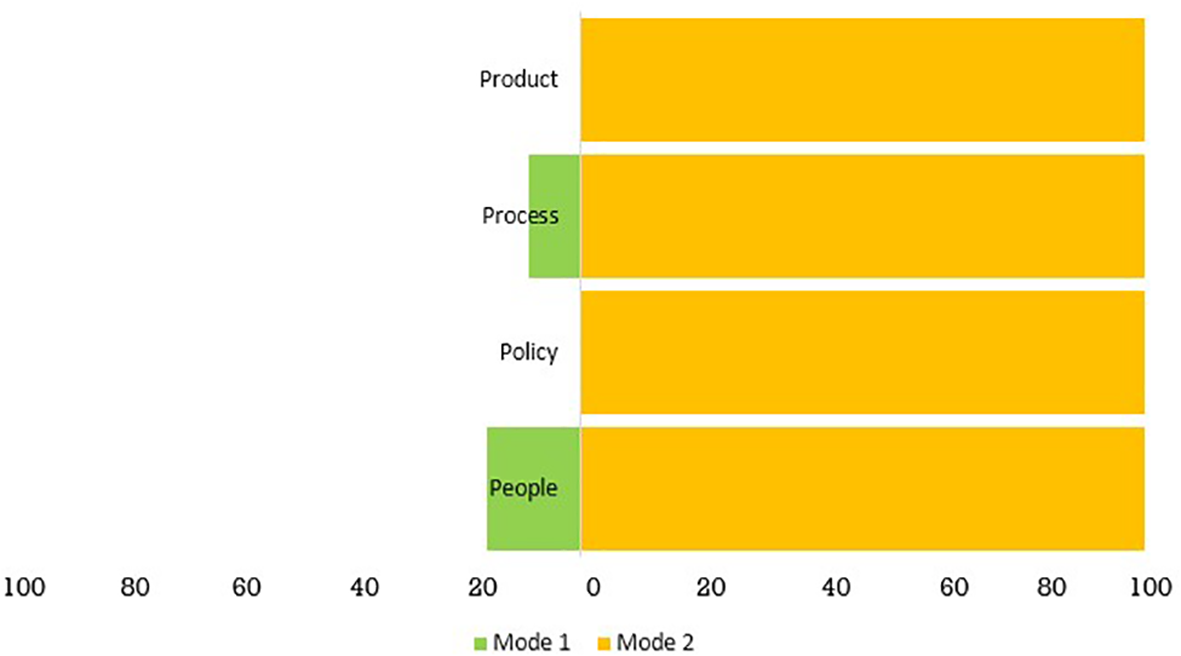
Reweaving the Ecological Mat (REM) analysis showing percentage presence of indicators Mode 1 and Mode 2 in the 4P groups.
4 Discussion
4.1 A lens into transdisciplinarity
Literature analysis confirmed that there was a major distinction between Modes. Mode 1 indicators reflect a more scientifically based and academic led venture, while Mode 2 indicators emphasized diversity, mutualism and social aspects of research which had transdisciplinarity at the core. The analysis presented here was conducted using the 4P’s Framework which captures these literature-derived differential characteristics between Mode 1 and 2. Projects like MESV-FJ proved to be mainly Mode 1 with a focus on scientific knowledge generation in this case in relation to ecosystem service economic valuation, while REM-FJ proved to be predominantly Mode 2 with strong elements of collaboration and mutual learning. The ESRAM-SI project had a relatively balanced blend between Mode 1 and Mode 2 drawing on both knowledge production and collaborative learning, and demonstrating that projects can reflect a mix of Mode and 2 approaches. In our project examples, we found a range from discipline-focused scientific knowledge production, to socialized holistic and transdisciplinary knowledge and understanding advancement.
It is envisaged that the 4P framework might provide a useful framework for assessing the blend of Mode 1 and Mode 2, with provision of designing-in further Mode 2 characteristics which promote transdisciplinary outcomes. The framework has relevance before, during (such as mid-term review) and after project completion and used to incrementally progress the transdisciplinary nature of ocean investments. The potential of the 4P’s framework is that it represents a practical tool for advancing the design of ocean-related investment which promote transdisciplinary and thus the sustainable development transformation as per Agenda 2030. Implicit in this framework are some key requirements for development project design, such as multi-stakeholder involvement and participation, and inclusion of a diversity of ocean-based knowledge.
To achieve the Agenda 2030-style transformation, further investigation of practical implementation of multiple disciplinary approaches in development contexts need to be progressed. Present knowledge systems are not fit-for-purpose for the global challenges and need vast and rapid shift in focus (Fazey et al., 2020). The 4Ps framework captures many elements of disciplinarity drawn from the literature, yet further frameworks and tools in securing transformative design of ocean investments can further progress transdisciplinarity. For example, Norström et al. (2020) focus on principles of knowledge co-production to address complex sustainability problems, Cundill et al. (2015) focus on team composition and the social process of learning, and Rigolot (2020) places transdisciplinarity centrally in Mode 2, but as “a way of being” within a broader discipline of “integration and implementation sciences” (i2S).
Yet, to promote transdisciplinarity further as a practical instrument for transformative outcomes, there is a need for empirical and experiential studies on transdisciplinarity. Complementary to sematic and conceptual progression, future work needs to clarify the roles and responsibilities of involved actors (Hoffmann et al., 2017), and include personal values and ethics (Wolff et al., 2019). To move towards transdisciplinary, substantive epistemological shifts will be required which traverse sustainability- and development-based knowledge generation, and involve a collaboration of scientists, funders, governments and international organizations (OECD, 2020). The holistic but practical nature of the 4P framework has the potential to be an instrument with multiple entry points for promoting transformative approaches for sustainable development. With further research the 4P framework could be used to reflect on the design and implementation of past initiatives, or for setting guidelines or guardrails for the design of new initiatives which aim to inculcate transdisciplinarity as a mechanism for promoting transformative outcomes.
4.2 Transdisciplinarity and the UN ocean decade
The UN Decade notes the need to move beyond “business as usual” and towards “transformative ocean science” with the UN 2030 Agenda being positioned as the “central framework” (UNESCO, 2022a). As most of the financial resources are based on external initiatives which are endorsed by the Decade, the procedure for endorsement of initiatives is paramount in shaping the Decade and its outcomes. Agenda 2030 emphasizes the need for transformational endeavors, and transdisciplinarity is seen as one way to progress such transformation, yet this is weakly reflected in the endorsement criteria. It should also be noted that endorsement calls revolve around the 10 challenges stated by the UN Decade, which include reducing pollution, protecting biodiversity, developing equitable ocean economies and expanding Global Ocean Observing, but the criteria are tacit on the epistemological revolution required in knowledge-systems and transdisciplinarity for transformative outcomes (in the sense of e.g. Fazey et al., 2020).
General terminology in the UN Decade endorsement criteria, state, for example, that initiatives will “contribute to the achievement of the SDGs”, and that initiatives should lead to “uptake of science and ocean knowledge for policy, decision making, management and/or innovation” (UNESCO, 2020). This is alongside more specific criteria related to other features, including co-design, data access, partnerships and overcome barriers to diversity and equity. The need for integrated, multiple-discipline or transdisciplinary approaches for transformative action is not explicitly mentioned in the endorsement criteria. The Decade rhetoric on ocean knowledge for transformation does not seem to be fully balanced with the constituent project endorsement criteria.
Furthermore, contrary to the need for strong leadership in securing the future of the oceans, the endorsement procedure represents passive absorbance of existing funded initiatives. Only in the case of “Potential Decade Actions” are initiatives at the design stage and have not secured financial resources. The work presented here has demonstrated tractable ways of analyzing project design to determine if it prevents, or promotes, transdisciplinary, or for revising project design such that transdisciplinarity is promoted. The opportunity for driving forward transdisciplinary approaches with transformational outcomes is apparent within the Decade. However, mass endorsement of projects based on generalist guidelines may help to reduce the significant Decade financing gap, but will passively track “business-as-usual” and fail to meet the high-level rhetoric and ambition of the Decade and Agenda 2030.
5 Conclusions
Defining tractable ways forward from dialogues around transdisciplinarity to meet the Agenda 2030 challenge for integrated outcomes remains a challenge. The work presented here attempts to provide a practical process contributing to the design and assessment of transdisciplinary ocean-investments. With limited capacity and constrained financial resources in developing countries, and urgent ocean-related challenges especially in SIDS, moving from “business-as-usual” approaches to transdisciplinary and transformational outcomes is a priority. Expanding further ocean-based knowledge, may not be a sufficient path to transdisciplinary and transformational outcomes; this has connotations to filling the financing gap in the UN Ocean Decade, as well as shaping significant investments by development partners into oceans.
Statements
Data availability statement
The original contributions presented in the study are included in the article/supplementary material. Further inquiries can be directed to the corresponding author.
Author contributions
JH initially conceived the study and it was further developed by PM. The 4P’s framework was developed under the guidance of JH by PM. Data analysis and visualisation was carried out by JH and PM. All authors contributed to the article and approved the submitted version.
Funding
This research was funded by the One Ocean Hub project. The One Ocean Hub is a collaborative research for sustainable development project funded by UK Research and Innovation (UKRI) through the Global Challenges Research Fund (GCRF) (Grant Ref: NE/S008950/1). GCRF is a key component in delivering the UK AID strategy and puts UK-led research at the heart of efforts to tackle the United Nations Sustainable Development Goals.
Acknowledgments
We would also like to especially acknowledge the wider One Ocean Hub team, especially those from The University of the South Pacific, the Pacific stakeholders who were involved in preliminary workshops, and Dr Megan Seneque for the many deliberations which have helped shape this work.
Conflict of interest
The authors declare that the research was conducted in the absence of any commercial or financial relationships that could be construed as a potential conflict of interest.
Publisher’s note
All claims expressed in this article are solely those of the authors and do not necessarily represent those of their affiliated organizations, or those of the publisher, the editors and the reviewers. Any product that may be evaluated in this article, or claim that may be made by its manufacturer, is not guaranteed or endorsed by the publisher.
References
1
Arkema K. K. Ruckelshaus M. (2017). “Transdisciplinary research for conservation and sustainable development planning in the Caribbean,” in Conservation for the Anthropocene Ocean. Chapter 16, 333–357. doi: 10.1016/B978-0-12-805375-1.00016-7
2
Bammer G. (2005). Integration and implementation sciences: building a new specialization. Ecol. Soc.10 (2), 6. doi: 10.5751/es-01360-100206
3
Berni L. E. V. (2016). Mediação Ativa Transdisciplinar (MAT) para o diálogo entre ciência e saberes tradicionais. InC.EccoR.SilvaF. N.QuadrosE. G.SignatesL. (orgs.). Religião, Saúde e Terapias Integrativas. Vol.2. Goiânia: Editora Espaço Acadêmico
4
Brink E. Wamsler C. Adolfsson M. Axelsson M. Beery T. Björn H. et al . (2018). On the road to ‘research municipalities’:analysing transdisciplinarity in municipal ecosystem services and adaptation planning. Sustainability Science13, 765–784. doi: 10.1007/s11625-017-0499-0
5
Brundtland G. H. (1987). Our common future, united nations world commission on environment and development. 400.
6
Coghlan D. Brydon-Miller M. (2014). “Mode 1 and mode 2 knowledge production,” in The SAGE encyclopedia of action research (London: SAGE Publications Ltd), 1–2. doi: 10.4135/9781446294406.n236
7
Cundill G. Roux D. J. Parker. J. N. (2015). Nurturing communities of practice for transdisciplinary research. Ecol. Society20, 22. doi: 10.5751/ES-07580-200222
8
DoE (2007). Fiji National biodiversity strategy and action plan (NBSAP) (Suva: Government of Fiji), 1–124.
9
du Plessis H. Sehume J. Martin L. (2013). The concept and application of transdisciplinarity in intellectual discourse and research (Johannesburg, South Africa: Real African Publishers).
10
Eden C. Huxham C. (1996). “Action research for the study of organisations,” in Handbook of organisations studies. Eds. CleggS.HardyC.NordW. (London: Sage), 526–542.
11
Etzkowitz H. Leydesdorff L. (1997). The university in the global knowledge economy (London: Printer).
12
Fazey I. Schäpke N. Caniglia G. Hodgson A. Kendrick I. Lyon C. et al . (2020). Transforming knowledge systems for life on earth: Visions of future systems and how to get there. Energy Res. Soc. Sci.70, 1–18. doi: 10.1016/j.erss.2020.101724
13
Franke A. Peters K. Hinkel J. Hornidge A.-K. Schlüter A. Zielinski O. et al . (2022). Making the UN ocean decade work? the potential for, and challenges of, transdisciplinary research and real-world laboratories for building towards ocean solutions. People Nat. doi: 10.1002/pan3.10412
14
Gibbons M. (1994). The new production of knowledge: The dynamics of science and research in contemporary societies (Stockholm, Sweden: Sage Publications). http://www.schwartzman.org.br/simon/gibbons.pdf.
15
Gibbons M. Limoge C. Nowotny H. Schwartzman S. Scott P. Trow P. (1994). The new production of knowledge: The dynamics of science and research in contemporary societies (London, England: Sage).
16
Gibbons M. Nowotny H. Welti M. (2001). “The potential of transdisciplinarity,” in Transdisciplinarity: Joint problem solving among science, technology, and society. Eds. KleinJ. T.HäberliR.ScholzR. W.Grossenbacher-MansuyW.BillA. (Birkhäuser: Schwerpunktprogramm Umwelt), 67–80. Programme Prioritaire Environnement / Priority Programme EnvironmentBasel. doi: 10.1007/978-3-0348-8419-8_7
17
Gillett R. Tauati M. I. (2018). Fisheries of the pacific islands: Regional and national information. FAO Fisheries and Aquaculture Technical Paper No. 625 (Apia, Western Samoa: Food and Agriculture Organisation of the United Nations). 1–412. https://www.fao.org/3/i9297en/I9297EN.pdf.
18
Harden-Davies H. Amon D. J. Vierros M. Bax N. J. Hanich Q. Hills J. et al . (2022). “Capacity development in the ocean decade and beyond: Key questions about meanings, motivations, pathways, and measurements,” in Earth system governance, vol. 12, 1–7. doi: 10.1016/j.esg.2022.100138
19
Hessels L. K. van Lente H. (2008). Rethinking new knowledge production: A literature review and a research agenda. Res. Policy37, 740–760. doi: 10.1016/j.respol.2008.01.008
20
Hoffmann S. Pohl C. Hering J. G. (2017). Methods and procedures of transdisciplinary knowledge integration: Empirical insights from four thematic synthesis processes. Ecol. Soc.22, 20–27. doi: 10.5751/ES-08955-220127
21
Huff A. S. (2000). Changes in organisational knowledge production. Acad. Manage. Rev.25, 288–293 Available at: https://josephmahoney.web.illinois.edu/BADM504_Fall%202019/Huff2000.pdf.
22
Jahn T. Bergmann M. Keil F. (2012). Transdisciplinarity: between mainstreaming and marginalization. Ecol. Economics79, 1–10. doi: 10.1016/j.ecolecon.2012.04.017
23
Jantsch E. (1972). Inter- and transdisciplinary university: a systems approach to education and innovation. Policy Sci.1, 403–428. doi: 10.1007/BF01956879
24
Kelemen M. Bansal P. (2002). The conventions of management research and their relevance to management practice. Br. J. Manage.13, 97–108. doi: 10.1111/1467-8551.00225
25
King D. M. Mazzotta M. J. (2000). Ecosystem valuations. Valuation of Ecosystem Services. Essentials, Section 2. (USA: US Department of Agriculture Natural Resources Conservation Service and National Oceanographic and Atmospheric Administration). Available at: https://www.ecosystemvaluation.org/.
26
King M. Fa’asili U. Smith A. Ropeti E. Izumi M. Victor S. et al . (2000). A community-based ecosystem approach to fisheries management: Guidelines for Pacific Island Countries: Guidelines for Pacific Island Countries. (Noumea, New Caledonia: Secretariat of the Pacific Community), 1–65 https://coastfish.spc.int/component/content/article/58-a-community-based-ecosystemapproach-to-fisheries-management-guidelines-for-pacific-island-countries.
27
Klein J. T. (2004). Prospects for transdisciplinarity. Futures36, 515–526. doi: 10.1016/j.futures.2003.10.007
28
Klein J. T. Grossenbacher-Mansuy W. Haberll R. Bill A. Scholz R.W. Welti M et al . (2001). Transdisciplinarity: Joint problem solving among science, technology, and society an effective way for managing complexity (Germany: Birkhauser Verlag), 1–8. doi: 10.1007/978-3-0348-8419-8_2
29
Knorr-Cetina K. (1999). Epistemic cultures: How the sciences make knowledge (USA: Harvard University Press), 352. https://www.hup.harvard.edu/catalog.php?isbn=9780674258945.
30
Lang D. J. Wiek A. Bergmann M. Stauffacher M. Martens P. Moll P. et al . (2012). Transdisciplinary research in sustainability science: practice, principles, and challenges. Sustainability Sci.7, 25–43. doi: 10.1007/s11625-011-0149-x
31
Maharaj P. N. Hills J. M. (2021)The development of a transdisciplinary framework for sustainable and integrated ocean development in the pacific. In: . Available at: https://oneoceanhub.org/the-development-of-a-transdisciplinary-framework-for-sustainable-and-integrated-ocean-development-in-the-pacific/.
32
McGowan P. J. K. Stewart G. B. Long G. Grainger M. J. (2019). An imperfect vision of indivisibility in the sustainable development goals. Nat. Sustainability2, 43–45. doi: 10.1038/s41893-018-0190-1
33
Mitchell A. S. (2020). Mode-2 knowledge production within community-based sustainability projects: Applying textual and thematic analytics to action research conversations. Administrative Sci.10, 90. doi: 10.3390/admsci10040090
34
Norström A. V. Cvitanovic C. Löf M. F. West S. Wyborn C. Balvanera P. et al . (2020). Principles for knowledge co-production in sustainability research. Nat. Sustainability3, 182–190. doi: 10.1038/s41893-019-0448-2
35
OECD (2020). Societal challenges using transdisciplinary research (OECD Publishing, Paris, France: OECD Science, technology and Industry Policy). Paper Number 88. 1–80. https://www.oecd-ilibrary.org/docserver/0ca0ca45-en.pdf?expires=1675672767&id=id&accname=guest&checksum=2C8D27AA7C19EFFC015319090026C8C5.
36
Osborne P. (2015). Problematizing disciplinarity, transdisciplinary problematics. special issue: Transdisciplinary problematics. Theory Culture Soc.32, 3–35. doi: 10.1177/0263276415592245
37
Ostrom E. (2007). A diagnostic approach for going beyond panaceas. PNAS (The National Academy of Sciences of the USA)104, 15181–15187. doi: 10.1073/pnas.070228810
38
Piaget J. (1972). “The epistemology of interdisciplinary relationships,” in Nterdisciplinarity: Problems of teaching and research in universities (Paris: Organization for Economic Cooperation and Development), 127–139.
39
Pohl C. (2011). What is progress in transdisciplinary research? Futures43, 618–626. doi: 10.1016/j.futures.2011.03.001
40
Pohl C. Hadorn G. H. (2007). Principles for designing transdisciplinary research (Munich, Germany: Oekom Verlag), 1–129. doi: 10.14512/9783962388638
41
Polk M. (2015). Transdisciplinary co-production: designing and testing a transdisciplinary research framework for societal problem solving. Futures65, 110–122. doi: 10.1016/j.futures.2014.11.001
42
Riechers M. Betz L. Gould R. K. Loch T. K. Lam D. P. M. Lazzari N. et al . (2022). Reviewing relational values for future research: insights from the coast. Ecol. Soc.27, 44. doi: 10.5751/ES-13710-270444
43
Rigolot C. (2020). Transdisciplinarity as a discipline and a way of being: complementarities and creative tensions. Humanities Soc. Sci. Commun.7, 100. doi: 10.1057/s41599-020-00598-5
44
Russell A. W. Wickson F. Carew A. L. (2008). Transdisciplinary: Context, contradictions and capacity. Futures40, 460–472. doi: 10.1016/j.futures.2007.10.005
45
SAAS (2022). Network for transdisciplinary research (House of Academics, Bern, Switzerland: Swiss Academics of Arts and Sciences). Available at: https://transdisciplinarity.ch/en/about-td-net/.
46
Scholz R. W. (2000). “Mutual learning as a basic principle of transdisciplinarity,” in Transdisciplinarity: joint problem-solving among science, technology and society. workbook II: mutual learning sessions. Eds. ScholzR. W.Ha¨berli,. R.BillA.WeltiW. (Zurich: Haffmans Sachbuch), 13–17.
47
Scholz R. W. (2011). Environmental literacy in science and society: From knowledge to decisions (Cambridge: Cambridge University Press).
48
Scholz R. W. Steiner G. (2015). The real type and ideal type of transdisciplinary processes: part I - theoretical foundations. Sustainability Sci.10, 527–544. doi: 10.1007/s11625-015-0326-4
49
Scholz R. W. Ha¨berli R. Bill A. Welti M. (2000). “Transdisciplinarity: Joint problem-solving among science, technology and society,” in Workbook II: Mutual learning sessions, vol. 2. (Verlag, Zurich: Haffmans Sachbuch).
50
Segalàs-Coral J. Tejedor G. (2012). “Sustainable technology innovation course. constructive and community-oriented learning postgraduate education,” in 4th International Conference on Education and New Learning Technlogies. EDULEARN12 Proceedings, Barcelona, Spain, 2nd-4th July 2012. https://library.iated.org/publications/EDULEARN12/start/875.
51
Singh G. G. Cisneros-Montemayor A. M. Swartz W. Cheung W. Guy J. A. Kenny T.-A. et al . (2018). A rapid assessment of co-benefits and trade-offs among sustainable development goals. Mar. Policy93, 223–231. doi: 10.1016/j.marpol.2017.05.030
52
Singh G. G. Oduber M. Cisneros-Montemayor A. M. Ridderstaat J. (2021). Aiding ocean development planning with SDG relationships in small island developing states. Nat. Sustainability4, 573–582. doi: 10.1038/s41893-021-00698-3
53
Sokal R. R. Rohlf F. J. (1995). Biometry. 3rd Edition (New York: W.H. Freeman).
54
Strand M. Ortega-Cisneros K. Niner H. J. Wahome M. Bell J. Currie J. C. et al . (2022). Transdisciplinarity in transformative ocean governance research–reflections of early career researchers. ICES J. Mar. Sci.79 (8), 2163–2177. doi: 10.1093/icesjms/fsac165
55
Syddall V. Thrush S. Fisher K. (2021). Transdisciplinary analysis of pacific tuna fisheries: A research framework for understanding and governing oceans as social-ecological systems. Mar. Policy134, 104783. doi: 10.1016/j.marpol.2021.104783
56
Tranfield D. Starkey K. (1998). The nature, social organisation and promotion of management research: Towards policy. Br. J. Management9, 341–353. doi: 10.1111/1467-8551.00103?saml_referrer
57
UKRI (2019). UKRI GCRF global interdisciplinary research hubs: Building global research communities to develop innovative and sustainable solutions for international development (UK: UK Research and Innovation/GCRF), 1–32. Available at: https://www.ukri.org/wp-content/uploads/2021/08/UKRI-190821-GlobalChallengesResearchFundHubBooklet-June2019.pdf.
58
UNESCO (2021). Implementation Plan, Summary: The United Nations Decade of Ocean Science for Sustainable Development (2021-2030) (Paris, France: Intergovernmental Oceanographic Commission of the United Nations Educational, Scientific and Cultural Organization), 1–20. Available at: https://en.unesco.org/ocean-decade.
59
UNESCO (2022a). The contribution of the UN decade of ocean science for sustainable development to the achievement of the 2030 agenda (UNESCO) (Paris, France: Intergovernmental Oceanographic Commission of the United Nations Educational, Scientific and Cultural Organization), 1–28. Available at: https://unesdoc.unesco.org/ark:/48223/pf0000381919.
60
UNESCO (2022b). Ocean decade progress report 2021-2022 (UNESCO). (Paris, France: Intergovernmental Oceanographic Commission of the United Nations Educational, Scientific and Cultural Organization), 1–67. Available at: https://www.oceandecade.org/wp-content/uploads/2022/06/Endorsed-Actions-June-2022_rev20220722.pdf.
61
Wolff M. G. Cockburn J. J. De Wet C. Bezerra J. C. Weaver M. J. T. Finca A. et al . (2019). Exploring and expanding transdisciplinary research for sustainable and just natural resource management. Ecol. Society24, 14. doi: 10.5751/ES-11077-240414
Summary
Keywords
ocean, policy, transdisciplinary, transdisciplinarity, Pacific, development, SIDS
Citation
Hills JM and Maharaj PN (2023) Designing transdisciplinarity for transformative ocean governance. Front. Mar. Sci. 10:1075759. doi: 10.3389/fmars.2023.1075759
Received
20 October 2022
Accepted
31 January 2023
Published
16 February 2023
Volume
10 - 2023
Edited by
Helena Calado, University of the Azores, Portugal
Reviewed by
Christian T. K.-H. Stadtlander, Independent Researcher, Destin, FL, United States; Maria Gabriela Palomo, Independent Researcher, Buenos Aires, Argentina
Updates
Copyright
© 2023 Hills and Maharaj.
This is an open-access article distributed under the terms of the Creative Commons Attribution License (CC BY). The use, distribution or reproduction in other forums is permitted, provided the original author(s) and the copyright owner(s) are credited and that the original publication in this journal is cited, in accordance with accepted academic practice. No use, distribution or reproduction is permitted which does not comply with these terms.
*Correspondence: Jeremy Maxwell Hills, jeremy.hills@usp.ac.fj
†These authors have contributed equally to this work and share first authorship
This article was submitted to Marine Affairs and Policy, a section of the journal Frontiers in Marine Science
Disclaimer
All claims expressed in this article are solely those of the authors and do not necessarily represent those of their affiliated organizations, or those of the publisher, the editors and the reviewers. Any product that may be evaluated in this article or claim that may be made by its manufacturer is not guaranteed or endorsed by the publisher.