Abstract
Human rights matter for marine conservation because people and nature are inextricably linked. A thriving planet cannot be one that contains widespread human suffering or stifles human potential; and a thriving humanity cannot exist on a dying planet. While the field of marine conservation is increasingly considering human well-being, it retains a legacy in some places of protectionism, colonialism, and fortress conservation. Here, we i) provide an overview of human rights principles and how they relate to marine conservation, ii) document cases where tensions have occurred between marine conservation goals and human rights, iii) review the legal and ethical obligations, and practical benefits, for marine conservation to support human rights, and iv) provide practical guidance on integrating human rights principles into marine conservation. We argue that adopting a human rights-based approach to marine conservation, that is integrating equity as a rights-based condition rather than a charitable principle, will not only help meet legal and ethical obligations to respect, protect, and fulfil human rights, but will also result in greater and more enduring conservation impact.
1 Background
Under what circumstances, if any, is it acceptable to implement marine protected areas in Indigenous marine territories without consultation or consent? When is it appropriate to stop local fishers from harvesting food within marine protected areas? Do these circumstances change if fishers face extreme food insecurity or malnutrition? Do rules differ for migrant fishers without long-term connections to place? Do past rights abuses need to be addressed by conservation programs acting today? And what methods are considered appropriate to enforce environmental restrictions? Shooting, public flogging, or vessel rammings? Fines on those who are already food insecure? These actions are all reported to have been carried out in recent years in the name of marine conservation (e.g., Sand, 2012; Cross, 2016; Hill, 2017; Kamat, 2018; Sowman and Sunde, 2018; Crosman et al., 2022; Talukdar et al., 2022). But how much are these issues a question of legal obligation, moral discretion, or practical decision-making (Newing and Perram, 2019)?
The field of marine conservation, and the conservation sector more broadly, retains a legacy in some places of protectionism, colonialism, and fortress conservation (e.g., Chapin, 2004; Springer et al., 2011; Singleton et al., 2017; Tauli-Corpuz et al., 2020). These practices often incur great social costs on Indigenous Peoples and other local rights holders by violating human rights to life, health, water, food, and adequate standard of living, non-discrimination, and cultural rights. Furthermore, opportunities to participate in decision-making and management is frequently fraught with difficulties and compensation is often not commensurate with the harm caused. These conflicts between communities and governments or implementing partners of fortress conservation continue to surface, as do reports of arbitrary detention, illegal searches, intimidation and coercion, and violence.
Yet conservation policy and practice is increasingly turning a corner in its understanding of justice and human well-being (e.g., Tan, 2021; Bennett, 2022; Ruano-Chamorro et al., 2022). Many within the conservation movement view social and environmental justice issues as inextricably intertwined – a thriving planet cannot be one that contains widespread human suffering or stifles human potential; and a thriving human population cannot exist on a dying planet (Forum For the Future, 2022). Effective and equitable conservation principles are now embedded within the Convention for Biological Diversity (CBD), such as with the Post-2020 Global Biodiversity Framework acknowledging “a human rights-based approach respecting, protecting and fulfilling rights, and being mindful of diverse world views, values and knowledge systems, including different conceptualizations of nature and people’s relationship with it” (CBD, 2022). Community-based and co-management principles are now considered priorities by many leading conservation organizations. Yet despite best intentions, as 196 countries around the world continue to negotiate the successor to the Strategic Plan – the CBD Post-2020 Global Biodiversity Framework – that will guide conservation policy over the next 30 years, there remains limited understanding of how effective and equitable conservation unfolds in practice.
Human rights recognize the inherent value of each person, regardless of background, geography, appearance, or beliefs. They are based on principles of dignity, equality, and mutual respect, shared across cultures, religions, and philosophies (U.N., 1948). Further, rights are just that – rights – and as such international law requires that they should be respected, protected, and fulfilled by governments, who are the primary ‘duty-bearers’ (Newing and Perram, 2019). Yet other institutions, including conservation organizations, also have a responsibility to respect rights (i.e., ‘do no harm’), meaning a responsibility to avoid causing rights violations, and avoid contributing to human rights violations by others (Newing and Perram, 2019). While calls to adopt human rights principles are growing in the conservation sector, most center on terrestrial issues (e.g. Tauli-Corpuz et al., 2020), with far fewer focusing on how these concepts relate to marine conservation issues and the blue economy.
In this essay, we argue that adopting human rights principles is key for progressing effective and equitable marine conservation outcomes, and that there are strong legal, ethical, and practical reasons for marine conservation practitioners to support human rights. While we primarily use the intersection between the small-scale fisheries (SSF) sector and international conservation NGOs (hereafter, NGOs) (Box 1) to explore these topics, we also acknowledge the breadth of ways in which marine conservation and human rights can intersect. This essay is divided into five components:
-
First, we provide an overview of human rights and a human rights-based approach (HRBA) and how they relate to marine conservation (i.e., what are human rights and an HRBA, who is responsible for supporting human rights, and how is it relevant to marine conservation)?.
-
Second, drawing examples from SSF, we present a series of case studies that document tensions between marine conservation and human rights, and key social impacts that have accrued when human rights are not sufficiently supported (i.e., exposing impacts of not supporting human rights).
-
Third, we outline legal and ethical obligations to respect human rights law as the bottom line, regardless of whether it leads to improved biodiversity conservation outcomes, while considering the rights of future generations (i.e., why we must respect human rights).
-
Fourth, we review the evidence that supporting the rights of people, including by acknowledging the leading role of many Indigenous Peoples in conservation, is an effective tool for positive and enduring marine conservation impact (i.e., practical benefits).
-
Lastly, we provide some practical guidance on incorporating an HRBA into marine conservation, including steps and tools that can be used to operationalize marine conservation programs that are interested in adopting this approach (i.e., how to do it).
Box 1 International conservation NGOs and small-scale fisheries.
One lens by which to investigate relationships between human rights and marine conservation is through interactions between the small-scale fisheries (SSF) sector and international conservation NGOs. Arguably, the largest group of ocean users and those most vulnerable to human rights violations by marine conservation actions, in both scale and degree, are small-scale fishers (Ratner et al., 2014; Cohen et al., 2019) (Figure 1). This sector typically includes self-employed fishers involved in locally-based artisanal fishing and encompassing all activities along the value chain – pre-harvest, harvest, and post-harvest (FAO, 2015). These women and men account for 90% of the world’s fishers (approximately 492 million people are dependent at least partially on SSF for their livelihoods), 40% of global catch (FAO, 2022), and 5.8 million small-scale fishers earn less than USD 1 per day (FAO, 2022). They tend to be firmly rooted in local communities, traditions, and values, and as such provide employment and food and nutrition security to local economies (FAO, 2015). Yet despite their potential as critical allies for ocean conservation, small-scale fishers have been consistently sidelined from dialogue between international environmental and economic actors with stronger political and economic influence (e.g., conservation, energy, mining, and tourism). For example, fishers are often excluded from access to other employment opportunities, from equitable access to land, and have weak political representation (Allison et al., 2012). Their dependence on natural production systems also introduces substantial uncertainty and risk in livelihoods and exposes them to environmental or socio-economic shocks including failures in policy or governance. All of this makes it difficult for small-scale fishers to have their voices heard, defend their rights, and secure the sustainable use of the fisheries on which they depend (FAO, 2015).
Figure 1
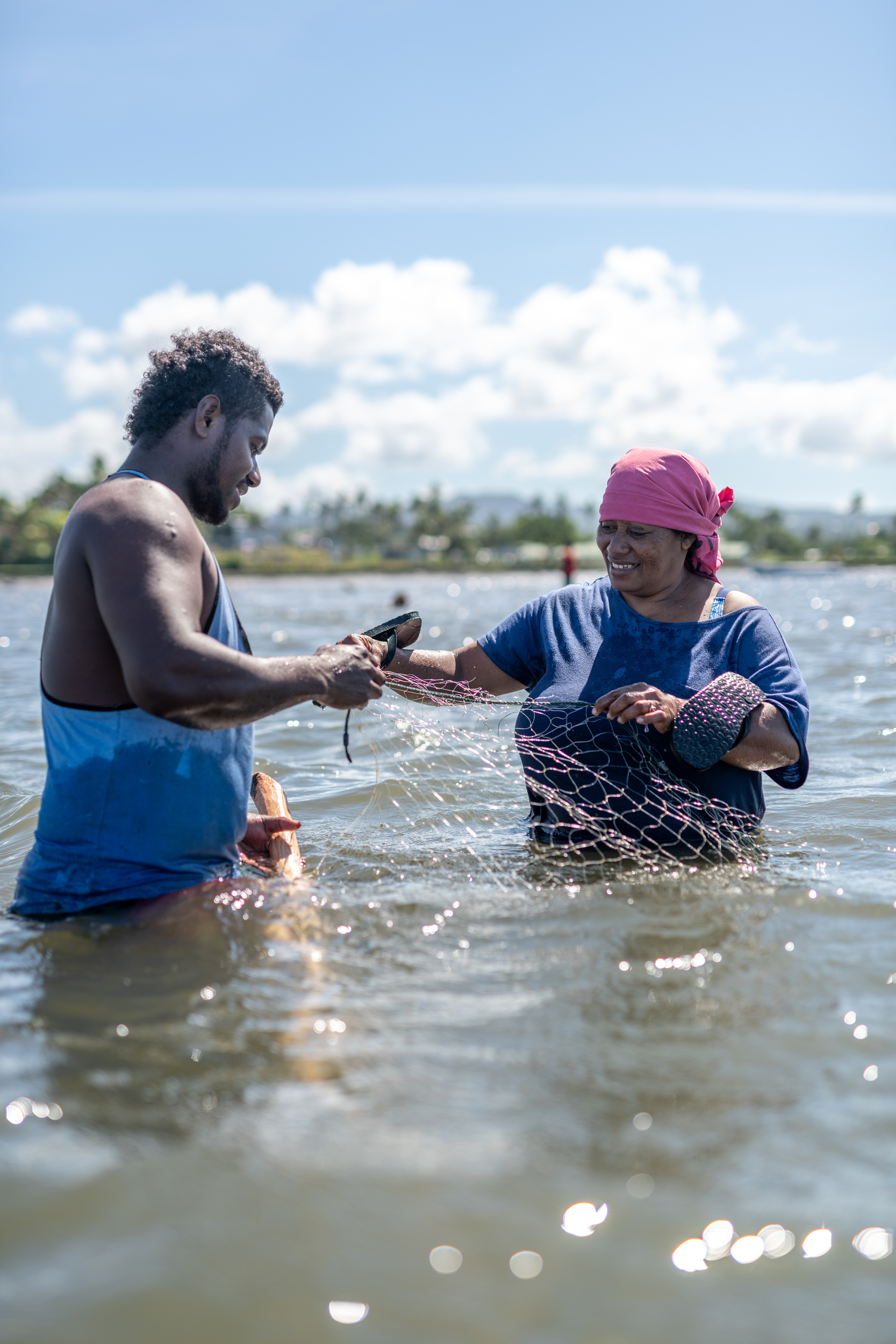
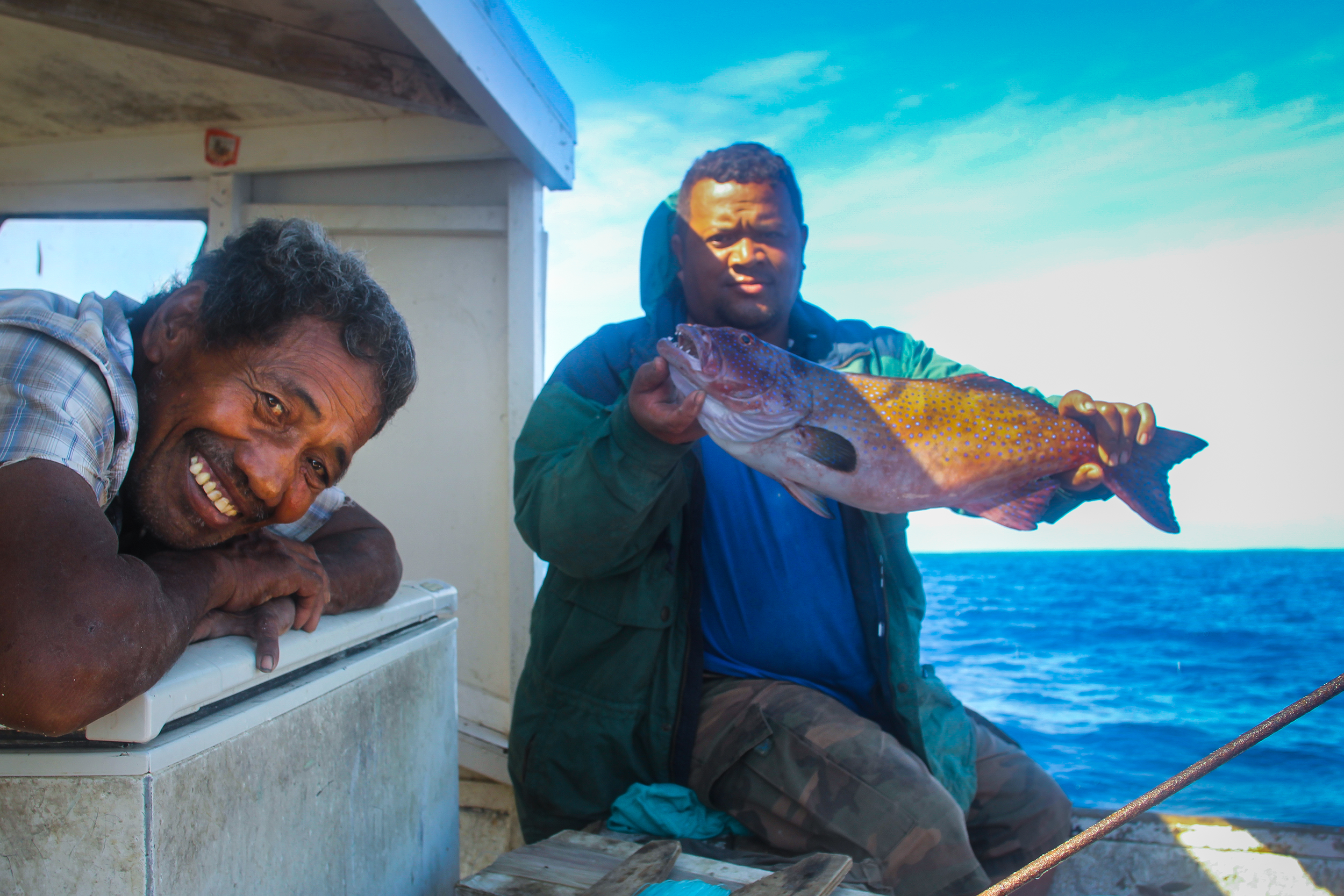
Woman and man fishing in Fiji. Photographer: Tom Vierus, WIldlife Conservation Society.
International conservation NGOs are now a key force in the global marine conservation movement, with budgets in the billions of dollars, and existing relationships with national governments, multinational corporations, and a voice in the international policy arena (Chapin, 2004; Singleton et al., 2017; Larsen and Brockington, 2018). Accordingly, the extent to which NGOs view people as ‘allies’ versus ‘opportunity costs’ has substantial bearing on how people and nature intersect. Increasingly, international conservation NGOs work in (and increasingly with) communities in developing countries, and can be in a strong position of local influence and power, particularly when the state has weak governance or is poorly resourced (Singleton et al., 2017). While the primary mandate of most conservation NGOs is to preserve values of nature (i.e., biodiversity and wilderness) (Allison et al., 2020), they are also increasingly held to account to do so in a way that respects and promotes international human rights standards. This includes through supportive processes, such as through the Conservation Initiative on Human Rights (CIHR) (Springer et al., 2011), as well as guiding policy documents, such as the Voluntary Guidelines for Securing Sustainable Small-Scale Fisheries (FAO, 2015). While larger conservation NGOs nominally support the CIHR and SSF Guidelines, integrating human rights into overarching policies has been slow, and many policies are yet to be institutionalized (Singleton et al., 2017). Regardless, international NGOs have great potential to act as a conduit for communication between people made vulnerable and other parties, although to do so in many instances they are required to rebuild the trust of communities and demonstrate genuine commitment to people-as-well-as parks (Singleton et al., 2017).
2 A human rights-based approach to marine conservation
2.1 What are human rights?
Human rights are possessed by all persons, by virtue of their common humanity, to live a life of freedom and dignity (Winer et al., 2007). They are universal and non-discriminatory (held equally by all human beings), inalienable (they cannot be taken away), unconditional (they do not depend on behaviour), indivisible (they all have equal status) and interdependent and interrelated (they are all equally important and they cannot be separated) (U.N., 2003; Newing and Perram, 2019). They embrace principles of participation and inclusion (all people are entitled to participate in, contribute to, and enjoy the realization of their rights), as well as that of accountability and Rule of Law (States and other duty-bearers are answerable for the observance of human rights) (U.N., 2003).
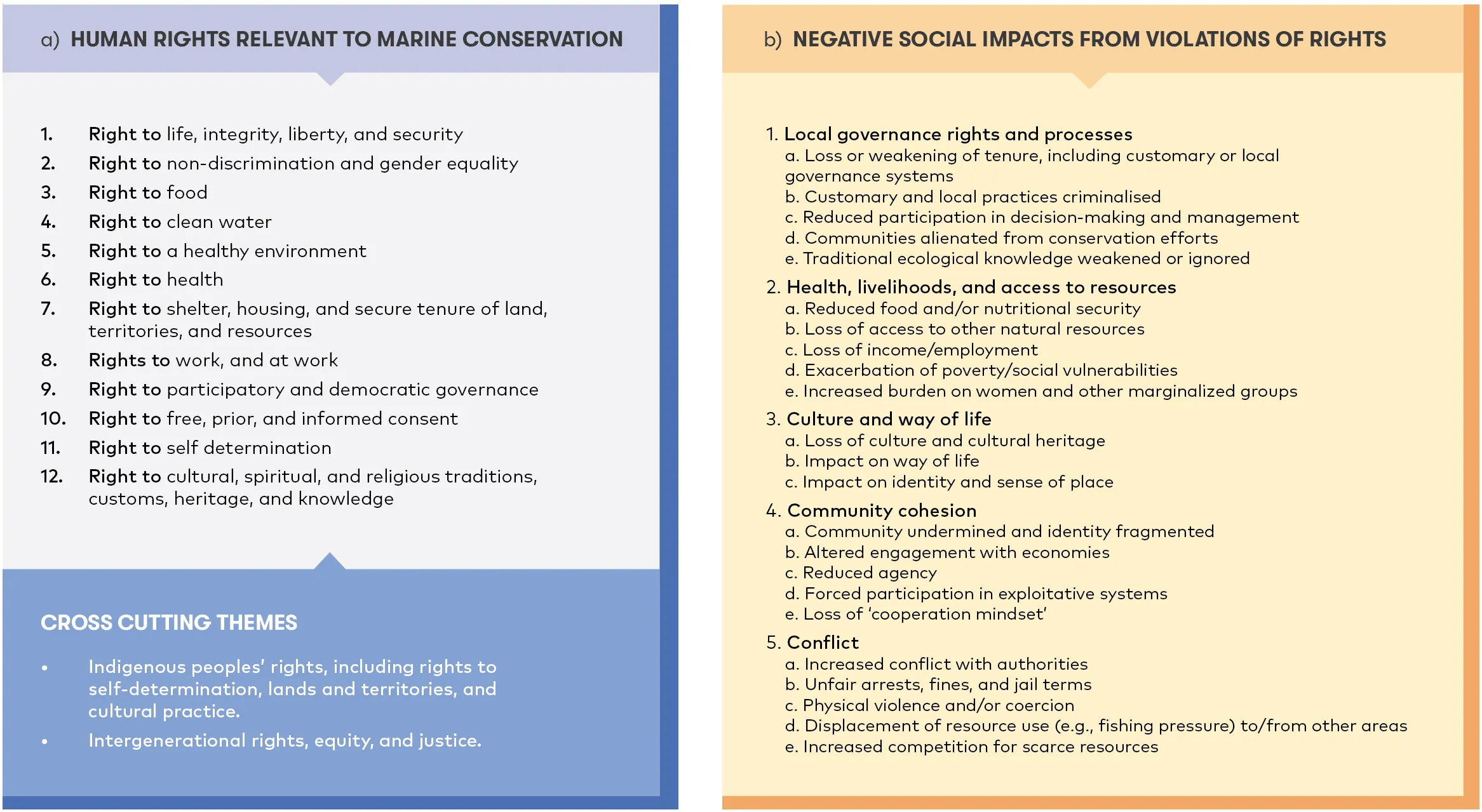
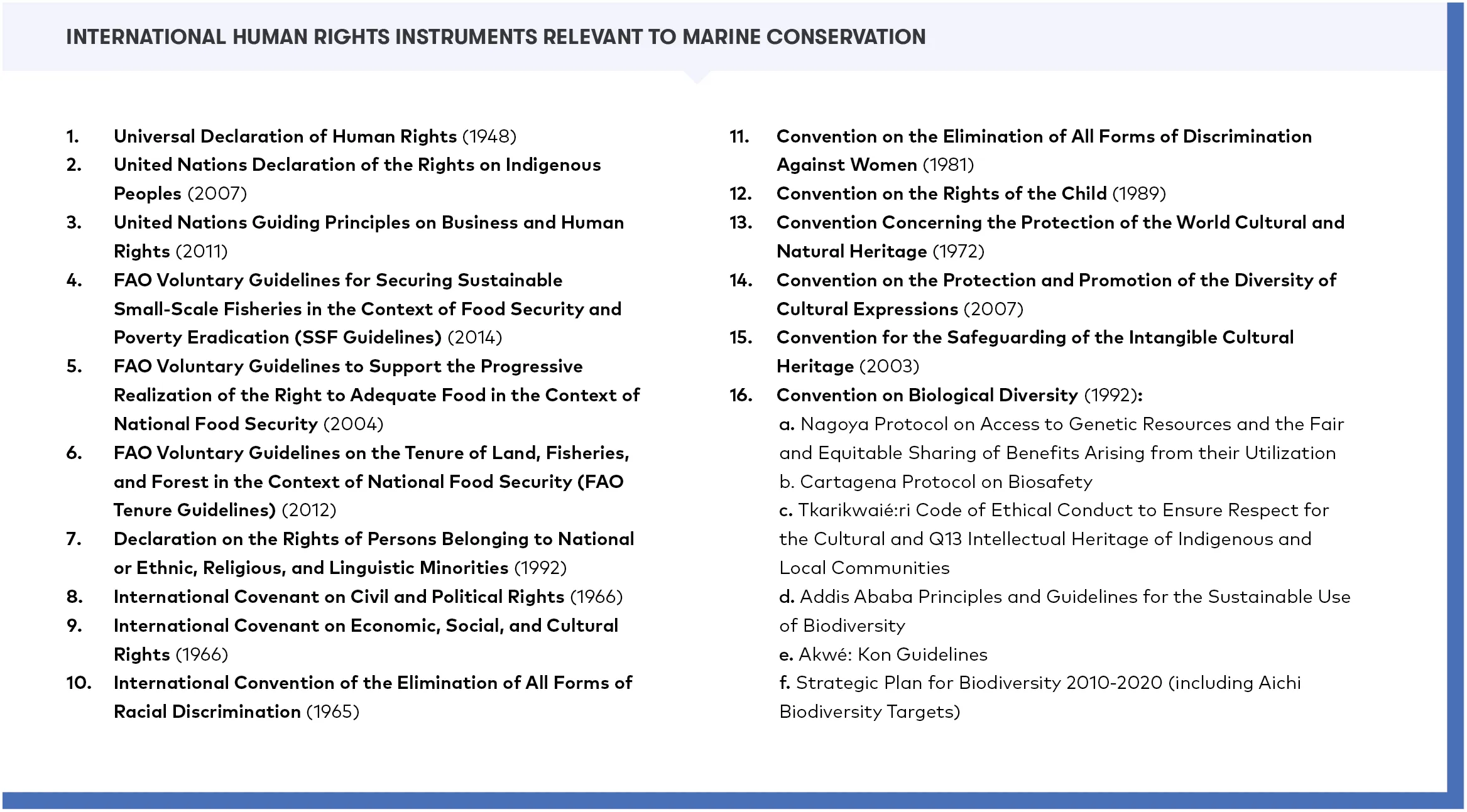
The Universal Declaration of Human Rights, ratified in 1948, includes the right to life (Article 3); freedom from discrimination (Article 7); the right to not be “arbitrarily deprived of his [sic] property” (Article 17b); and the right to adequate standard of living and health, including food (Article 25a). In addition to individual rights there are also collective rights enshrined in legally binding agreements (e.g., International Covenant on Economic, Social, and Cultural Rights, adopted 1966) as well as commitments (e.g., United Nations Declaration on the Rights of Indigenous Peoples, adopted 2007), including: the right of all peoples to determine their own future; the right to own, possess, manage and use ancestral lands and natural resources; the right to participate in the management and conservation of resources on their lands; and more broadly; the right to participate effectively in decision-making in all matters that would affect their rights (Newing and Perram, 2019). Recently, the United Nations General Assembly also declared access to clean and healthy environment a universal human right (U.N., 2022a). Table 1 lists 12 international human rights standards that are of strong relevance in a marine conservation context and the negative social impacts that can accrue if they are violated. Table 2, adapted from Jonas et al. (2016), outlines key international instruments with human rights implications in the context of marine conservation.
Table 1
|
(A) Human rights of strong relevance for marine conservation and (B) the negative social impacts that can accrue from violations of these rights.
Note lists are non-exhaustive. Adapted from Jonas et al. (2016) and Sowman and Sunde (2018).
Table 2
|
Key international instruments with human rights implications for marine conservation.
Note list is non-exhaustive.
2.2 What responsibilities pertain to human rights?
As rights, international law requires “duty bearers”, that is the actors collectively responsible for the realization of these rights, to respect (refrain from taking action that violates), protect (prevent the violation by others), and fulfil (enable people to claim and enjoy) the rights of “rights holders”, that is the individuals that have particular entitlements in relation to duty bearers (Winer et al., 2007) (Figure 2). Duty bearers are defined as an “entity or individual having a particular obligation or responsibility to respect, promote and realize human rights and to abstain from human rights violations. The term is most used to refer to State actors, but non-State actors can also be considered duty bearers” (U.N., 2017). Hence States are the primary duty bearers, and bear responsibility for implementing national laws that uphold human rights obligations. There is also growing recognition that states should take responsibility for the human rights effects of their policies in other countries, particularly regarding the obligations to respect and protect (Campese, 2009).
Figure 2
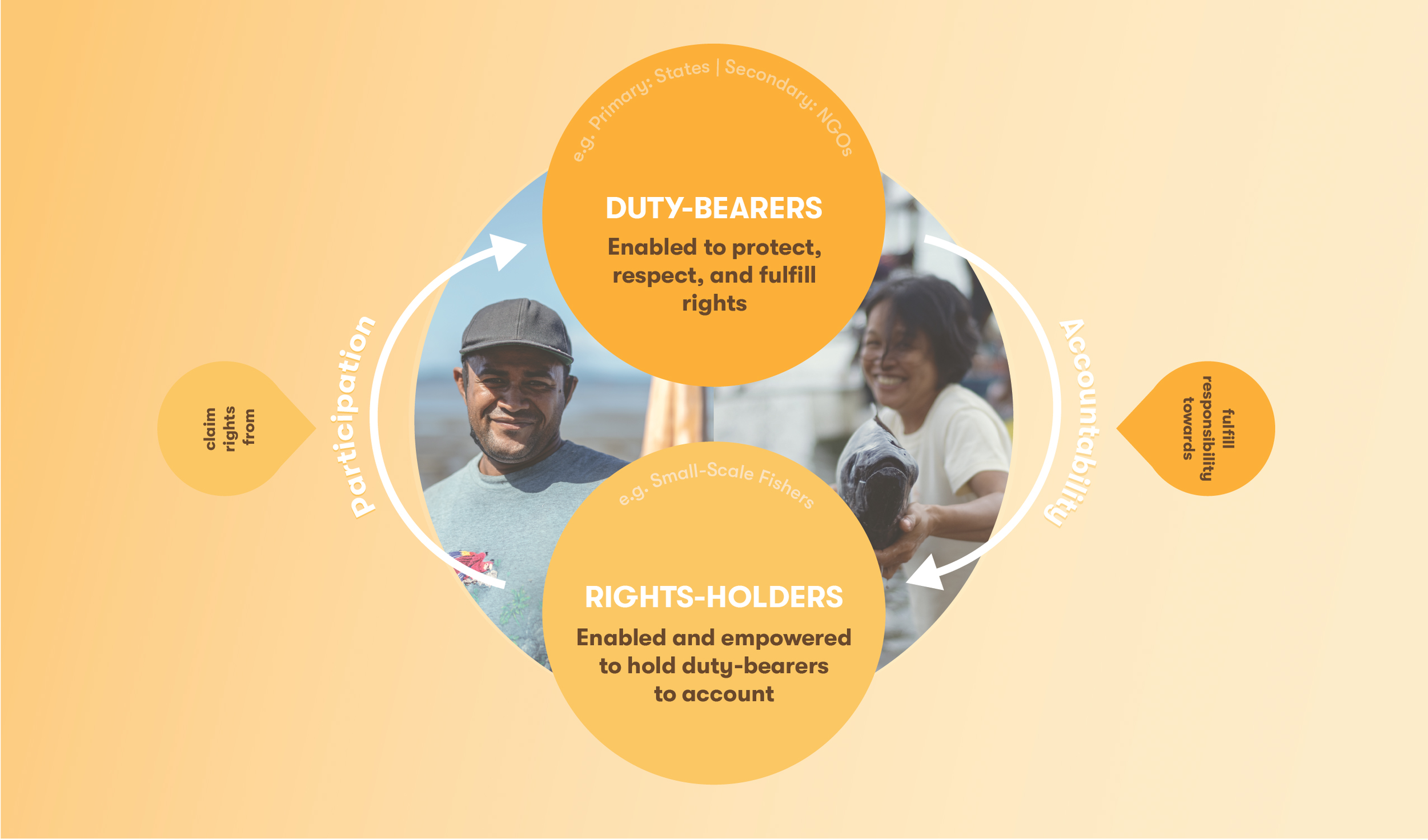
The relationship between Duty-Bearers and Rights-Holders. Photographers: Tom Vierus (left) and Rebecca Weeks (right).
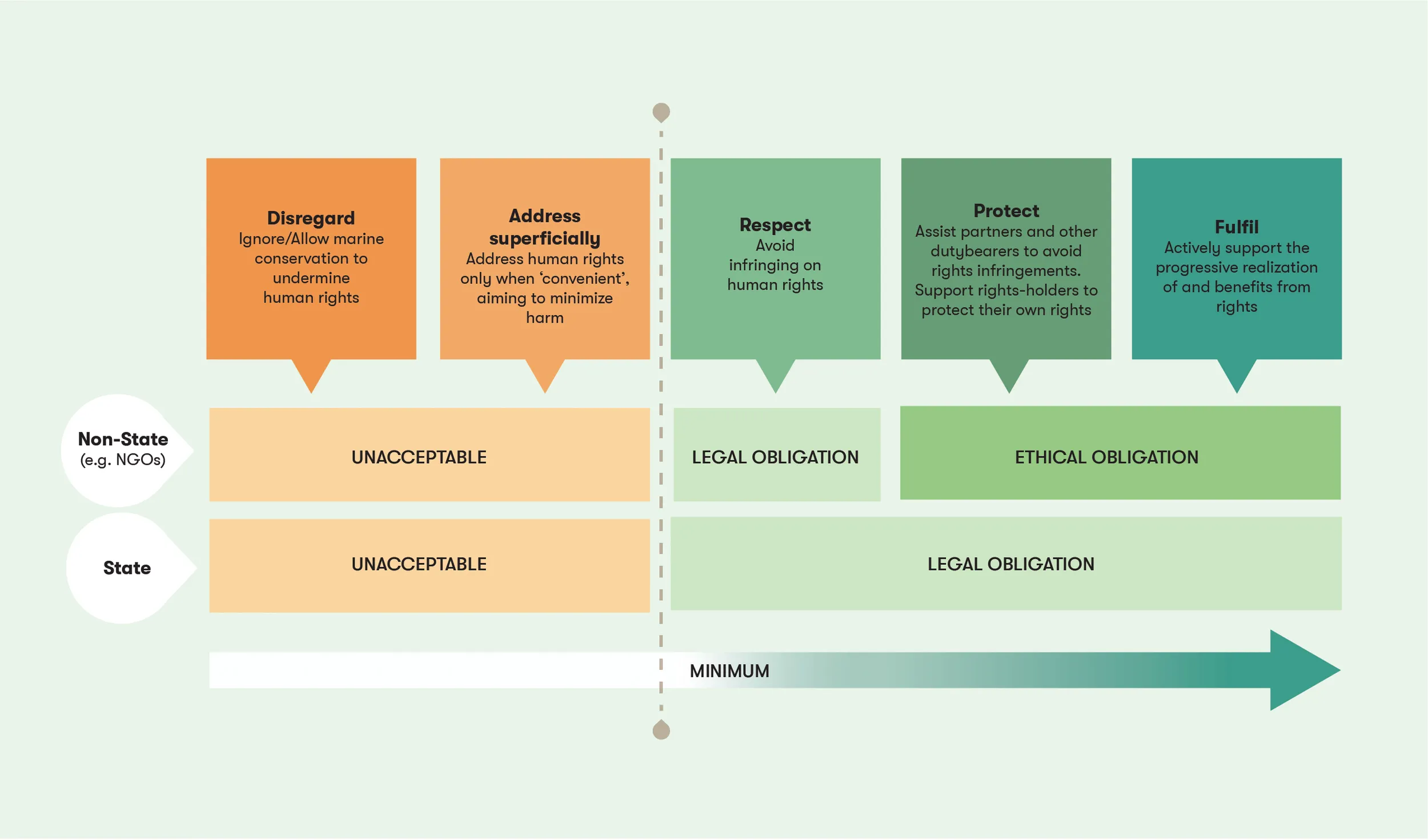
Non-State actors are also increasingly being called to account to respect, protect, and fulfil human rights, and the increasingly powerful role of non-state conservation actors (e.g., NGOs) must carry increased human rights responsibility, even if ultimate responsibility lies with the state (Campese, 2009). For ‘for profit’ businesses, the United Nations Guiding principles on Business and Human Rights sets out responsibilities and makes clear the “responsibility to respect” (U.N., 2011; Jonas et al., 2016). Yet no formal human rights framework for accountability currently exists for ‘non profit’ NGOs as a negotiated and adopted document. Despite this limitation, with time it is likely that a more progressive interpretation will emerge, with NGOs, like businesses, requiring a minimum duty to respect human rights. Regardless, this responsibility warrants a minimum acceptable standard for the conduct of non-State actors rather than a level to aspire to. Non-State accountability should also neither weaken the role of the state, nor absolve responsibilities of states, since only states provide the institutional, policy, and legal framework within which civil society exists and exercises its rights (Campese, 2009).
Rights holders are the individuals or groups that have particular entitlements in relation to duty bearers. In the context of SSF, rights holders are the small-scale fishers, fish workers, their organizations, and the communities they are part of (FAO, 2015). They need to know their rights and be able to claim them. For instance, they should be able to participate in decision-making processes in a non-discriminatory and transparent manner, including access to free, prior, and informed consent (Hanna and Vanclay, 2013; U.N., 2014). They also need to be aware of ways to claim their right to food, to an adequate standard of living, and to decent working conditions, among others. Yet rights holders also bear certain responsibilities (U.N., 2022b), such as not infringing on the rights of others, raising challenging questions pertaining to marine conservation (Campese, 2009). For example, how can communities respect the rights of others, and fulfil their own, when resources are insufficient? Further, if rights holders are already struggling with scarcity, then how can they respect the rights of future generations to those same resources?
2.3 What is a human rights-based approach?
The Office of the United Nations High Commissioner for Human Rights (OHCHR) describes a HRBA in the context of development as:
“a conceptual framework for the process of human development that is normatively based on international human rights standards and operationally directed to promoting and protecting human rights. It seeks to analyse inequalities that lie at the heart of development problems and redress discriminatory practices and unjust distributions of power that impede development progress. Under the HRBA, the plans, policies and processes [of conservation] are anchored in a system of rights and corresponding obligations established by international law, including all civil, cultural, economic, political and social rights, and the right to development. HRBA requires human rights principles (universality, indivisibility, equality and non-discrimination, participation, accountability) to guide United Nations development cooperation, and focus on developing the capacities of both ‘duty-bearers’ to meet their obligations, and ‘rights-holders’ to claim their rights.” (OHCHR, 2006, p. 15).
In simple terms, extending an HRBA to conservation practice means that conservation policies, governance and management do not violate human rights and that those implementing such policies actively seek ways to support and promote human rights in their design and implementation (Human Rights in Biodiversity Working Group, 2022). Regarding SSF, an HRBA is operationalized through the Voluntary Guidelines for Securing Sustainable Small-Scale Fisheries in the Context of Food Security and Poverty Eradication (SSF Guidelines) (FAO, 2015). These guidelines were developed through a participatory process incorporating more than 4000 fishers, fish workers, and fisher representatives from 120 countries and represent a global consensus on principals and guidance for SSF governance and development (FAO, 2015).
The United Nations Statement of Common Understanding towards a Human Rights-Based Approach (U.N., 2003) provides a consensus-based interpretation of how an HRBA should be operationalized for development, also pertaining to conservation:
First, “all programmes … should further the realisation of human rights as laid down in the Universal Declaration of Human Rights and other international human rights instruments”. This means that conservation programs only incidentally contributing to the realization of human rights do not necessarily constitute an HRBA. Within an HRBA the explicit aim of activities is to contribute directly to the realization of one or several human rights (although not necessarily exclusively).
Second, “Human rights standards contained in, and principles derived from, the Universal Declaration of Human Rights and other international human rights instruments guide all … programs in all sectors and in all phases of the programming process”. This includes all program sectors, such as: sustainable resource management, water and sanitation, governance, and nutrition. This also includes all phases, such as: planning, design (including goal setting, objectives, and strategies), implementation, and monitoring and evaluation.
Third, programs enable “duty-bearers to meet their obligations and of rights-holders to claim their rights”. This means that conservation programs incorporating an HRBA identify rights-holders (and their entitlements) and duty-bearers (and their obligations), and work towards strengthening the capacities of rights-holders to make their claims, and of duty-bearers to meet their obligations.
According to The United Nations Statement of Common Understanding towards an HRBA (U.N., 2003), the following elements are necessary, specific, and unique to an HRBA:
-
A. Assessment and analysis to identify the human rights claims of rights-holders and the corresponding human rights obligations of duty-bearers as well as the immediate, underlying, and structural causes of the non-realization of rights.
-
B. Programmes to assess the capacity of rights-holders to claim their rights, and of duty-bearers to fulfill their obligations. They then develop strategies to build these capacities.
-
C. Programmes to monitor and evaluate both outcomes and processes guided by human rights standards and principles.
-
D. Programming informed by the recommendations of international human rights bodies and mechanisms.
Other elements of good programming practices that are also essential under an HRBA, include (U.N., 2003):
-
1. People are recognized as key actors in their own development, rather than passive recipients of commodities and services.
-
2. Participation is both a means and a goal.
-
3. Strategies are empowering, not disempowering.
-
4. Both outcomes and processes are monitored and evaluated.
-
5. Analysis includes all stakeholders.
-
6. Programmes focus on marginalized, disadvantaged, and excluded groups.
-
7. The development process is locally owned.
-
8. Programmes aim to reduce disparity.
-
9. Both top-down and bottom-up approaches are used in synergy.
-
10. Situation analysis is used to identity immediate, underlying, and basic causes of development problems.
-
11. Measurable goals and targets.
-
12. Strategic partnerships are developed and sustained.
-
13. Programmes support accountability to all stakeholders.
2.4 A human rights-based approach to co-management
Rather than replacing other conservation approaches, such as co-management, an HRBA instead enhances them by stressing the legal framework that includes obligations and declarations to human rights underpinning these approaches (Figure 3). We suggest that many of the good practice elements essential to an HRBA are also common to most local and collaborative governance strategies. For example, effective local and collaborative governance should support: the recognition of people as key actors in their own development, participation both as a means and a goal, empowerment, and focus on marginalized, disadvantaged, or excluded groups. Hence while an HRBA and local and collaborative governance may not be equivalent, they both often occur in ways that respect, protect, and fulfill rights, and hence are supportive of the same principles. Furthermore, adopting an explicit an HRBA within the marine conservation sector would also help bolster political, social, and economic support for nature stewardship by marginalized groups not or unable to be associated with local and collaborative governance arrangements.
Figure 3
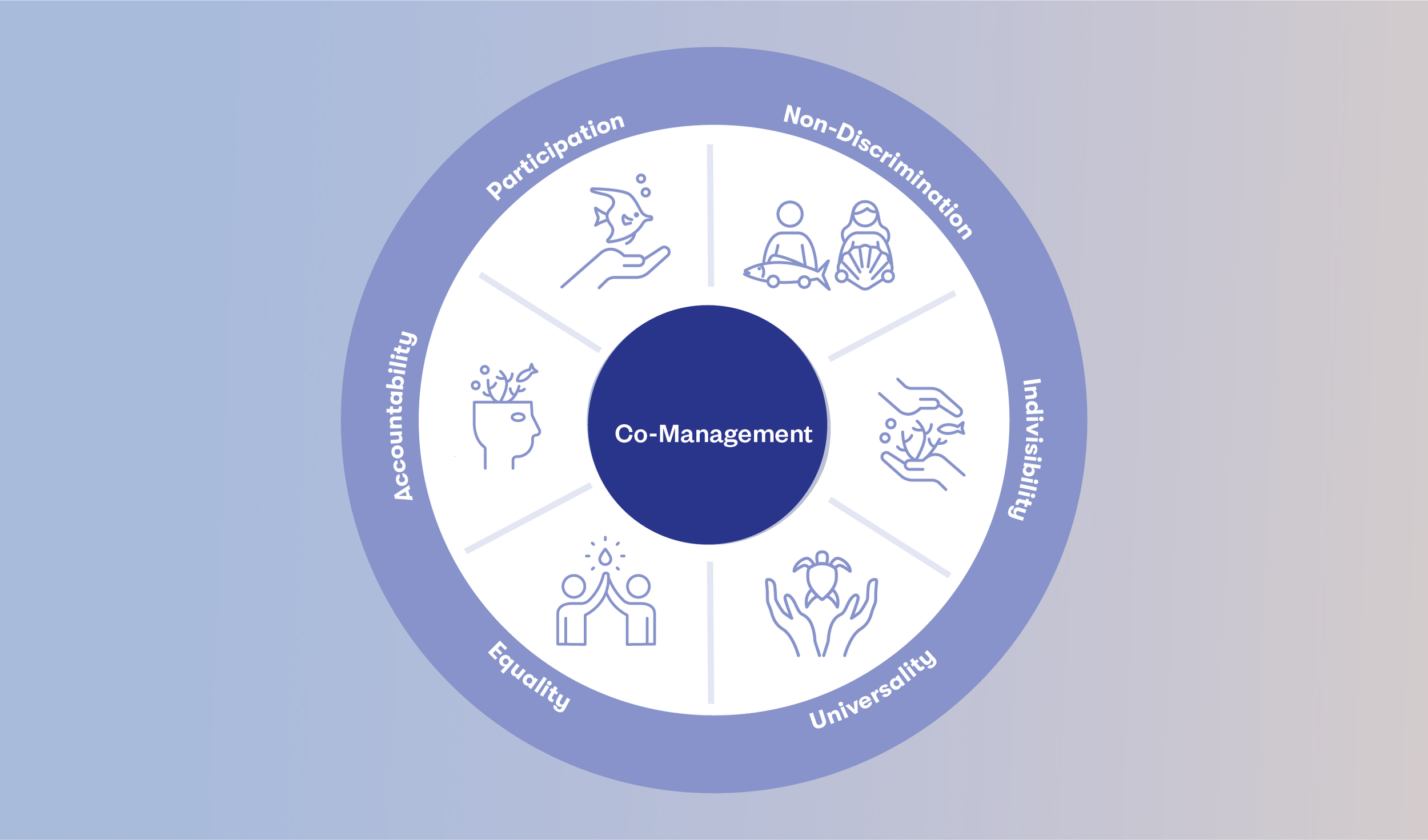
A Human Rights-Based Approach enhances practices such as co-management by stressing the legal framework and human rights obligations that underpin these approaches.
3 Case studies: How human rights issues manifest in marine conservation
Tensions between marine conservation and human rights range from subtle to overt. They are heavily context dependant, and in many instances it is difficult to clearly identify infringements by State or non-State actors and whether they relate directly to marine conservation. Issues are often wicked, meaning they are difficult to delineate from bigger problems, they are not solved once in perpetuity, it can be unclear when they are solved, or even what solving it means, and solutions from one context might not be applicable in any other (Rittel and Webber, 1973). The aim of this section is not to imply rampant human rights abuses in the conservation sector, but rather emphasize the need to be aware of what rights are, and which ones conservation groups need to be sensitive to. Table 3 provides some case studies of where marine conservation initiatives have introduced recent tensions with human rights, acknowledging the many uncertainties, opinions, and externalities around each issue.
Table 3
| Context | Details | Potential rights infringed upon | Negative social impacts | References |
|---|---|---|---|---|
| Orango National Park, Bijagos archipelago, Guinea-Bissau | Small-scale fishers working in the West African Bijagós Archipelago are predominantly regional in-migrants, having settled on the islands in the 1990s from Senegal, Sierra Leone, and Liberia. Aspirations and realities of migrant SSF differ from the Indigenous islanders, for whom fishing comprises only periodic employment. In 1996 a UNESCO Biosphere reserve was established, and four years later IUCN category 2 protection implemented across many islands. This coincided with plans to limit SSF, which was seen as a threat to marine megafauna. Following implementation, armed members of the Ministry of Fisheries forcibly dismantled fishing villages, burning houses, stores, and fishing materials. Following the violent evictions, relocation resulted in increased resource use beyond reserve boundaries and deteriorating relations between fishers and Indigenous islanders. Violent conflict eventually occurred in which Indigenous Bijagos men stormed and burned a migrant fishing camp. Eventually the government (composed of mainland ethnicities) perceived that the Indigenous Bijagos had no right to evict fishers from ‘national’ land. Continued alienation of resource users (Hind et al., 2010), prioritization of NGO donor goals above local needs (Benson, 2012), tendencies to undermine local access to development (Bennett and Dearden, 2014), and inattention to alternative livelihood pathways (Brown et al., 2013) continue to limit support for the MPA. Ultimately both migrant small-scale fishers and indigenous islanders have felt disempowered since the designation of Orango National Park, while various government agencies all appear to be vying for a stake in the control of management and the profits from fishing licenses. In this instance co-management could foster support but cannot be seen as a silver bullet since it also increases risk of marginalization of migrant fishers. | • Right to food • Right to shelter, housing, and secure tenure of land, territories, and resources • Right to freedom from conflict and violence • Right to free, prior, and informed consent |
• Weakening of local governance systems • Reduced food security • Loss of access to natural resources • Loss of income • Exacerbation of poverty • Increased conflict with authorities • Physical violence • Displacement of resource use |
Bennet and Dearden, 2014; Benson, 2012; Brown et al., 2013; Cross, 2016; Hind et al., 2010 |
| Hilsa sanctuaries, Bangladesh | The anadromous Hilsa (Tenualosa ilisha) shad is the national fish of Bangladesh. Its fishery comprises 1% of the national GDP, with half a million fishers directly dependent and a further two million indirectly dependent on Hilsa for their livelihoods. Substantial fisheries decline due to overharvest, changes in habitat suitability, and climactic variability has reduced catches and income, contributing to chronic poverty, and resulted in increased social tension, debt cycles, and reduced food security. Since 2005, six Hilsa sanctuaries, along with seasonal closures, were established with the aim of protecting habitat for reproduction, juvenile growth, and nature preservation. Fishers largely view the bans as necessary to preserve the fishery into the future and acknowledge that they improve the health of the system in general. However, most Hilsa fishers are also among the most marginalized and vulnerable members in coastal communities, relying solely on fishing for income and facing extreme stratification, discrimination, and social exclusion, as well as being largely landless and unable to transition to other occupations. Hence despite widespread acknowledgement of the importance of the closures by many small-scale fishers (Talukdar et al., 2022), during the closed season, many struggle to generate alternate incomes, resulting in decreased food security and increased poverty. While various government projects have aimed to mitigate access restrictions through food supplies and some access to training and microcredits, the general view is these have been insufficient to offset losses. | • Right to food • Right to shelter, housing, and secure tenure of land, territories, and resources • Right to a healthy environment |
• Reduced food security • Loss of access to natural resources • Loss of income • Exacerbation of poverty |
Ali et al., 2015; Bhuyan and Islam, 2016; Roy et al., 2015; Islam et al., 2016; Islam et al., 2017; Mozumder et al., 2018; Van Brakel et al., 2018 |
| Redang Island Marine Park (RIMP), Malaysia | The Redang Island Archipelago was declared a marine protected area in 1994, and the narratives around its inception and persistence highlight subtle ways in which the tourism industry can commodify nature conservation at the expense of various human rights considerations. First, RIMP was created without any consultation from islanders, leading to marginalization from decision making processes. Further, local resource use was restricted, divorcing fishers from their means of production. Meanwhile, financial benefits from tourism were drained from local communities through a process that commodified nature conservation to a point where only those with sufficient resources could access the MPA and primary capital is accumulated by tourism operators and indirectly by the state. Although islanders are often invoked by government as the main beneficiaries of nature-based tourism, they are often indentured in the lowest end of the money economy. Appropriation of coastal lands also increasingly exclude islanders, whilst tourists, tourism operators, volunteers, and researchers are allowed to visit to complete the various activities they associate with the area (e.g., work, dive, snorkel, conduct research). Commercial tourism operators are therefore able to profit from a process of dispossession through the linking of publicly owned and protected lands and waters with privately controlled rights to operate and a source of cheap ‘freed’ wage labour no longer tied to the fishing industry. | • Right to free, prior, and informed consent • Right to shelter, housing, and secure tenure of land, territories, and resources • Rights to work, and at work • Right to a healthy environment |
• Weakening of local governance systems • Alienation from conservation efforts • Loss of access to natural resources • Loss of income • Displacement of resource use • Impact on identity and sense of place |
Hill, 2017 |
| Chagos Archipelago, British Indian Ocean Territory (BIOT) | The Indigenous Chagosian population of the archipelago was forcibly and unlawfully deported in 1968-1973 by the UK government to create a colony that provided a strategic naval base for the United States (Diego Garcia). In 2010 Chagos Archipelago was then declared a 544,000 km2 Marine Protected Area (notably not including the area surrounding the naval base). While the UK maintains the park was created for environmental and conservation purposes, according to confidential UK-US diplomatic documents disclosed by Wikileaks in December 2010, an ulterior motive was also to prevent resettlement claims by Chagos Islands former inhabitants and their descendants. Conservation justification has indeed been based on the present uninhabited and ‘pristine’ nature of these islands, and it has been argued that since Chagosian displacement happened 50 years ago and the MPA was only created recently, that it is not being used in this manner. Yet these documents clearly asserted that “establishing a marine park would, in effect, put [an end] to resettlement claims of the archipelago’s former residents”, and that the “environmental lobby is far more powerful than the Chagossians’ advocates”. It was also stated that “establishing a marine reserve might, indeed … be the most effective long-term way to prevent any of the Chagos Islands’ former inhabitants or their descendants from resettling in the BIOT”. In 2019 the international court of justice deemed the recolonization of Chagos Islands by the UK and their incorporation into a new colony unlawful and ordered the UK to withdraw its colonial administration within six months, which as of writing has not occurred. | • Right to shelter, housing, and secure tenure of land, territories, and resources • Right to free, prior, and informed consent • Right to self-determination |
• Forced displacement • Loss of tenure and local governance system • Loss of culture and cultural heritage • Impact on way of life • Impact of identity and sense of place • Forced participation in exploitative systems |
Sand, 2012; Twyman-Ghoshal, 2022 |
| Marine protected areas established in South Africa during apartheid | Most MPAs in South Africa were established during apartheid, leading to racially-biased spatial planning with devastating consequences for predominantly black small-scale fishing communities. Social hardships and inequities are still being experienced today, undermining legitimacy of marine conservation in South Africa and frustrating plans for expanding MPA networks. Langebaan lagoon MPA – In the 1960s local authorities created a special zone to protect traditional net fishers from increasing numbers of recreational fishers in the lagoon. In 1976 the lagoon was declared a marine reserve, and the net fishing zone was incorporated into a sanctuary by conservation authorities. In 2005 net fishing was banned within the sanctuary zone, which traditional fishers depended on for their livelihoods. In 2016 a Cape Town High Court judge ruled that preventing local net fishers from accessing traditional fishing grounds while allowing a recreational fishery that is not restricted in numbers was irrational and discriminatory. As of 2018 the state departments concerned had not met with the fishers and negotiated new zonation and regulations. Dwesa-Cwebe MPA – Established in 1991, it deprived seven communities of the material basis of their culture and resources upon which they depended for their livelihoods. In 2000, despite a Land Claim Settlement Agreement confirming recognition of communities’ rights to participate in co-management, the MPA was promulgated as complete ‘no-take’, six months prior to signing the agreement. In March 2016, two judges of the Eastern Cape High Court confirmed the communities’ customary fishing rights. Hluleka MPA – Approximately 450 households were removed when the MPA was established in 1976, and in 2000 Hluleka was declared no-take without any consultation with the local community, heavily impacting their food security. Table Mountain National Park MPA (Karbonkelberg reserve) – Established in 2004 without recognition of traditional fishers’ customary use rights who had been resettled elsewhere in 1950. Most traditional fishers cannot easily access areas outside the reserve and hence must continue to fish ‘illegally’ to supply food and basic income. The response of the fisheries authority has been to increase law enforcement efforts and administer fines and confiscate boats, gear, and catches. Tsitsikamma MPA – Established in 1964 and the oldest and largest MPA in South Africa. In 2001 the entire coastal area was declared ‘no-take’, denying access to all adjacent communities to their traditional fishing grounds and reducing income and nutrition security, as well as impacting their culture and way of life. |
• Right to non-discrimination • Right to free, prior, and informed consent • Right to self-determination • Right to shelter, housing, and secure tenure of land, territories, and resources • Rights to work, and at work • Right to food |
• Forced displacement • Loss or weakened tenure and local governance • Impact of cultural identity • Reduced food and/or nutritional security • Reduced food and/or nutritional security • Loss of income/employment • Exacerbation of poverty • Impact on way of life • Impact on identity and sense of place |
Sowman and Sunde, 2018 |
| Gulf of Mannar Marine National Park, India | The Gulf of Mannar Marine National Park consists of 19 small coral reef islands along the Indian coastline near Sri Lanka, in Tamil Nadu. Communities of artisanal fishers in this area have historically depended on near-shore marine resources for their livelihoods and subsistence, as well as shelter from adverse weather and as a reliable source of freshwater for communities. In 1975 researchers identified traditional fishing, firewood collection, and seaweed harvest by fishers in the islands as threats to the Gulf of Mannar’s biodiversity. They highlighted an urgent need to protect islands as ‘islands of science’ devoid of human interference. The MPA was formally established in 1986, during the height of the Sri Lankan civil war, and management and enforcement imposed restrictions on livelihood practices, leading to the customary rights of artisanal fishers being withdrawn and their traditional practices framed as destructive. In 2002, the UNDP and Global Environmental Facility (GEF) jointly funded the Gulf of Mannar Biosphere Reserve Trust, which classified 248 artisanal villages into ‘threat’ categories: villages with full-time artisanal fishers were classified as “high threat”, while those with part-time fishers as “medium threat” and “low threat’’ depending on resource dependence. This project brought conservation and security agencies together to implement alternative livelihood and community development programs. However, these programs were also intertwined with counter-insurgency, rewarding people for reporting on illegal activities, including both those related to the MPA, as well as arms and narcotics trafficking. The end result of these processes was that many fishers who used to fish within these islands became food and livelihood insecure, were placed in greater risk when fishing in open areas, and villages had less secure access to freshwater. Alleged beatings and verbal abuse have also been reported for fishers who are caught poaching from within the park. | • Right to freedom from conflict and violence • Right to food • Right to clean water • Right to shelter, housing, and secure tenure of land, territories, and resources • Right to self-determination |
• Loss or weakening of tenure • Customary practices criminalized • Loss of access to important food sources • Impact of way of life • Increased conflict with authorities • Unfair arrests, fines, and jail terms • Displacement of resource use |
Muralidharan and Rai (2020); Gupta and Sharma (2008); Bavinck and Vvekanandan (2011) |
| Gahirmatha Marine Sanctuary, India | The coast of Odisha hosts the largest rookery of sea turtles in the world. Large congregations of olive ridley sea turtles (Lepidochelys olivacea) migrate and reproduce along the coast of Odisha, India, particularly around the significant rookeries in Gahirmatha and Rushikulya. The industrialized trawling and gillnet industries along this same coast led to thousands of turtles drowning from entanglements with trawling nets and their carcases littering the beaches of Odisha. In 1997, the Gahirmatha Marine Sanctuary was established, which nominally protected turtles within its boundaries, but enabled the continued harvest of shrimp by trawlers outside its boundaries. Olive ridley sea turtles are highly migratory, travelling thousands of kilometres from their feeding grounds near Sri Lanka, and the small spatial area of the park provided only limited protection from industrial fishing bycatch and hence negligible conservation impact. In satisfying discourse between three powerful actors – the state, the industrial sector, and international conservation organizations aiming to expand protected area coverage – the process inadvertently overlooked the rights of local fishers. Small-scale fishers intensely oppose the MPA because they have borne the brunt of the restrictions and penalties it imposes without adequate compensation or state support for their sector. Small-scale fishers in the region are not engaged in trawling and are hence not a significant threat to turtles. Yet records of arrests and fines between 2002 and 2012 indicate that only 4 and 11 per cent of all compounded boats and fines are from trawlers, respectively, while 39 and 18 per cent are from small-scale fishing crafts, respectively, despite acknowledgement by government that trawlers are the worst offenders. This uneven application of conservation rules has increased through time, and since 2006 punitive measures have focused almost solely on small-scale fishers. | • Right to food • Right to a healthy environment • Rights to work, and at work • Right to free, prior, and informed consent |
• Customary and/or local practices criminalized • Undermined participation in decision-making • Communities alienated from conservation efforts • Loss of access to important food sources • Unfair arrests, fines, and jail terms • Displacement of resource use |
(Chhotray, 2016; Ramesh and Rai, 2017) |
Examples of tensions between marine conservation and human rights, with focus on small-scale fisheries and marine protected areas.
Also included for each case are some of the pertinent rights and social impacts from Table 1 (Note this is non-exhaustive).
4 Legal and ethical obligations for marine conservationists to support human rights
4.1 Legal obligations for marine conservationist to support human rights
Legal obligations for marine conservationists to support human rights standards depend on the nature of those practising conservation. State actors engaged in marine conservation are the primary duty-bearers, and hence are obligated to respect, protect, and fulfill, human rights as the bottom-line. Non-State actors such as marine conservation NGOs must meet the minimum standard of respecting human rights. This means that they must “avoid infringing on the human rights of others and should address adverse human rights impacts with which they are involved” (Jonas et al., 2016; U.N., 2012). For example, when implementing a marine protected area that will limit the livelihoods, or nutritional security, of vulnerable peoples, conservation organizations have a legal responsibility to provide viable, sustainable, and better alternatives. Failure to do so constitutes a violation of these basic rights. The duty to respect rights is therefore categorical – whether support is given from the conservation sector should not be based on the ability to fulfil the needs of the sector. Not only are conservation organizations themselves signatories to various declarations, but they are also entities incorporated in countries that are signatories to various declarations affirming these rights (e.g., Universal Declaration of Human Rights, 1948; U.N., 2007; Convention on the Elimination of All Forms of Discrimination Against Women, 1981), as well as entities that operate in countries that are also signatories to these declarations (Newing & Perram, 2019).
While we acknowledge that the primary mandate of conservation NGOs is often not human wellbeing, the legal obligation to respect rights while practicing conservation is irrespective of overarching objectives – hence claims of ends justifying means are insufficient in this respect (Allison et al., 2012). We also acknowledge that not practicing conservation and having resources depleted may also infringe on the rights of others, specifically individual and community rights to a healthy environment, or the rights of future generations, leading to issues of trade-offs that can be difficult to resolve. While in many instances there are indeed common interests between conservationists and small-scale fishers, Indigenous Peoples, and local communities (see section five), it is critical to acknowledge genuine conflicts of interest where these exist and work towards negotiated settlements, with full respect for rights as the bottom line (Newing and Perram, 2019). This is not to say that international human rights law is perfect nor subject to change, but it should be acknowledged that these laws are the result of over half a century of negotiation and consensus building.
4.2 Ethical obligations for marine conservationists to support human rights
In practice, international human rights law can often be difficult to uphold. With many governments flagrantly violating human rights, why should marine conservation organizations in those same countries be bound to uphold them? Yet as nominal agents of positive global change, we argue that in addition to legal obligations, marine conservationists also have deep ethical obligations to support human rights. The ethical argument for marine conservation supporting human rights is based on the generalized principle that it is morally wrong for one people to dispossess, subjugate, or exterminate another people to promote their own ideological views (Diamond, 2005). While a key aim of conservation is to address the harms society is perceived to have inflicted upon nature, it must be acknowledged that this is only one issue, and only one way of viewing our interactions with non-human nature, among many (Allison et al., 2020) (Box 2). Just and equitable conservation is hence a moral imperative because it acknowledges the existing differences in how human-nature relations are understood.
Box 2 Western and Non-Western values of nature.
A fundamental premise in western philosophy is the differentiation between humankind and nature (Colchester, 1994; Redford, 1991). While this framework originated with the wilds in conflict with society, in the 19th century ideas were popularized considering wilderness as a place of refuge, with intrinsic value away from impacts wrought by society (Adams and Mulligan, 2003; Allison et al., 2020). These viewpoints underpin the modern western conservation movement, and hence have implications for how western countries conduct conservation today. For example, most western conservation organizations place principal value on concepts of ‘biodiversity’ and ‘wilderness’ (Callicott, 1990), although this does not disregard the importance for other cultures and societies of these same values. Rather it suggests that only two of the many intrinsic (e.g., diversity, animal welfare, Gaia, Mother Earth), instrumental (e.g., food, energy, and materials), and relational (e.g., way of life, social cohesion, cultural identity, sense of place) ways in which humanity can value nature (Allison et al., 2020) are promoted by western conservation, and thus a major portion of the global conservation movement. Understanding and acknowledging this makes clear the dynamic ways by which people value their place in nature (e.g., Smith, 1998). Thus while biodiversity and wilderness may be considered paramount for western conservationists, other values can be just as fundamental for different cultures and societies (Foale, 2001). Acknowledging this is a key step towards integrating equity, in particular recognitional equity, into modern conservation. In contrast, for many cultures it is difficult to distinguish society from nature, particularly those grounded within their local environment (Jupiter, 2017). In these instances, the intrinsic value of biodiversity and wilderness may not be shared, or may be difficult to meaningfully separate from ‘sustainable use’ (Foale et al., 2016; Jupiter, 2017) (Figure 4). Organizations proceeding to impose ‘fortress’ conservation to preserve primarily western values can therefore lead to substantial social impacts by perpetuating un-equal relationships, dispossessing peoples of their cultural and spiritual values, as well as limiting access to resources (Foale, 2001; Wilkie, 2017). Further, while most conservation projects focus on the global south (Chapin, 2004; Larsen and Brockington, 2018), accountability (i.e., funding, support, most head offices) is generally based in developed, western countries. While many of these organizations invest heavily in country programs, hiring nationals from those countries, there are often complex dynamics of power and privilege between headquarters and field programs, and these can be exacerbated by the often colonial nature of philanthropy and aid.
Figure 4
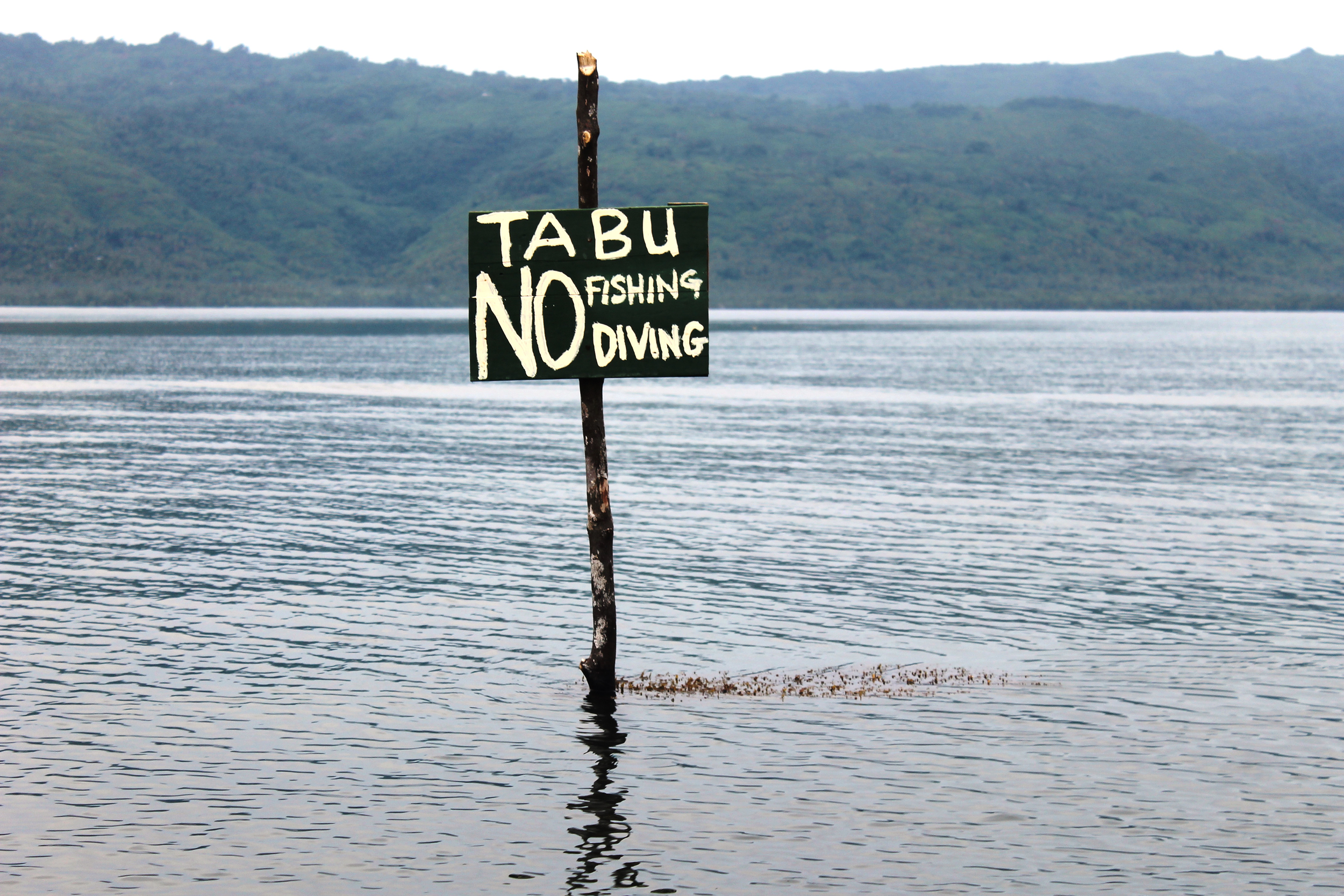
Signpost in Malaita province, Solomon Islands, marking a ‘Tabu’ area in which fishing is prohibited. This traditional practice is rooted in sustainable resource management. Photo courtesy of Jan van der Ploeg.
Equity and justice refer to the right and fair treatment of people (and nature see Sikor et al., 2014) – including the processes, application, and outcomes of public policy and organizational practices (e.g., Schlosberg, 2004; Fraser, 2009) – and hence provides foundational moral arguments for why human rights are important in marine conservation (Bennett, 2022). Pursuing equitable conservation requires attention to the three dimensions of justice that make up contemporary framings of environmental justice and equity, as well as how they relate to an HRBA (e.g., Bennett et al., 2021, Schlosberg, 2004; Pascual et al., 2014; Sikor et al., 2014). Recognitional justice relates to the status afforded to the human dignity of all peoples and the diversity of human experiences, including local rights, values, visions, knowledge, needs, and livelihoods in policy and practice (Pascual et al., 2014; Martin et al., 2016). Procedural justice is concerned with the fairness of how decisions are made and by whom (Ruano-Chamorro et al., 2022). This involves participation in decision-making by all relevant actors in rule and decision-making and good governance processes such as transparency and accountability (Seufert, 2013). Distributional justice relates to the fairness of how costs and benefits (including material, non-material, objective, subjective), opportunities, risks and responsibilities are distributed among different groups, including current and future generations (Gurney et al., 2021a). As an example of application to an HRBA, pursuing recognitional justice in conservation requires assessing the alignment between ontologies of human-nature relationships embedded in conservation and those held by different stakeholders and rightsholders. While conservation approaches, such as protected areas, tend to be underpinned by the western world view of humans as apart from nature, ontologies of human-nature relations held by many Indigenous cultures place humans as part of nature, and hence other management approaches endorsing sustainable use may be more applicable in these contexts.
Practically, the ethical imperative to support an HRBA in marine conservation means moving beyond minimum standards for respecting rights. It requires marine conservation to proactively support work to protect and fulfil rights. Protecting rights requires securing Indigenous Peoples and local communities tenure and governance authority over the resources in question. For example, protecting rights can be achieved by encouraging and building the capacity of partners (including other duty bearers and state actors) to respect rights, such as by specific rights-based actions in contractual arrangements, or through supporting rights holders themselves to build capacity and governance systems for protecting their own rights. Fulfillment of rights means Indigenous Peoples and local communities can both exercise their rights and subsequently benefit from those rights. Rights can be fulfilled by marine conservation organizations that identify areas to synergize conservation objectives and human rights objectives, so that conservation goals are reached in a way that also strengthens people’s rights. This can be achieved, for example, not only by supporting fisheries co-management initiatives that increase the health of marine ecosystems and strengthen traditional tenure rights (Cinner et al., 2012), but also enable fisheries to benefit from those resource improvements through overall abundance and food security or value-chain additions. Table 4 provides a spectrum along which marine conservation actions can occur in relation to respecting, protecting, and fulfilling human rights, as well as where the legal and ethical obligations lie.
Table 4
|
Legal and ethical obligations for state and non-state actors to support human rights in marine conservation.
5 Practical benefits for marine conservationist to support human rights
At the outset it is important to recognize that supporting human rights in conservation should be viewed as an end in and of itself, and not just a means to achieve conservation targets. This is not to say conservation organizations will conduct projects solely based on supporting human rights, their missions require conservation outcomes. But recognizing the critical role of Indigenous Peoples and local communities in conservation and including human rights and conservation targets alongside one another within conservation projects should be the norm rather than the exception.
The marine conservation sector increasingly recognizes the practical benefits that many local communities and fishers provide in maintaining biodiversity. In many instances fishers and local communities have long and deep histories of nature stewardship that situate them as global leaders in maintaining biodiversity and other natural values through collaborative governance systems, ancestral territorial management systems, and traditional knowledge and practices (Gurney et al., 2021b). Indeed, an increasingly large body of empirical evidence (e.g., Dawson et al., 2021; Oldekop et al., 2016) shows that supporting the rights of local people leads to consistently positive and enduring conservation impacts, and the marine sector is replete with evidence demonstrating biodiversity and ecosystem benefits from fisheries co-management, community-based marine conservation, and locally managed marine areas (e.g., Cinner et al., 2019; Villaseñor-Derbez et al., 2019; Gilchrist et al., 2020; Smallhorn‐West et al., 2020a; Cohen et al., 2021).
Whilst the marine conservation sector and one of the key tools it employs (i.e., MPAs) are underpinned by a primary objective of biodiversity conservation, there are many other forms of nature stewardship with other priorities and goals (e.g., maintain cultural practice, sustainable harvesting) that are also highly effective at maintaining biodiversity and ecosystem health, and in many cases more effective (Gurney et al., 2021b). These approaches, particularly when rooted in local customary practices, can lead to better conservation and social impacts, and can successfully navigate the complex interplay between people and marine ecosystems like coral reefs (Kapono et al., 2022). For example, global meta-analysis of 171 published studies of 165 protected areas demonstrated that protected areas associated with positive socioeconomic outcomes were also more likely to report positive conservation outcomes (Oldekop et al., 2016). In these studies, positive conservation outcomes were more likely to occur when protected areas adopted co-management regimes, empowered local people, reduced economic inequalities, and maintained cultural and livelihood benefits. Likewise, a review of 12 large MPAs (>10,000 km2) found correlations between participation, well-being, and ecosystem health (Ban et al., 2017). A review of 65 MPAs from the Pacific found that community-based and co-management governance was just as likely as centralized governance to produce positive ecological impacts (Smallhorn-West et al., 2020a). A systematic review of 169 publications investigating governance and conservation outcomes found that when interventions were controlled externally and involved strategies to change local practices and supersede customary institutions, they tended to result in relatively ineffective conservation at the same time as producing negative social outcomes (Dawson et al., 2021). This review suggested that equitable conservation represents the primary pathway to effective long-term conservation of biodiversity, and that it is most effective when fostering solutions that reinforce the role, capacity, and rights of Indigenous Peoples and local communities.
Despite the significant practical benefits for marine conservationists to support human rights, these arguments should not be relied upon absolutely to justify adopting these approaches. For example, the current view held by most western conservation organizations appears to be that deep spiritual connections and cultural knowledge will foster strong environmental stewards, and that fishers, local communities, and Indigenous Peoples can often be allies and stewards because of these connections (Dawson et al., 2021). Yet this raises the important risk that if these movements fail in the future to drive positive impacts towards resource recovery, then they will lose value and be exchanged for strategies with greater impact. Indigenous knowledge is tremendously important for many reasons: it reflects the accumulated wisdom of unique cultures; it echoes the experiences of groups whose survival is threatened; and it offers important insights into sustainable use (Davis, 2009; U.N., 2014). But it is not always a given that cultural inhibitions will prevent adoption of unsustainable practices, or that alternate visions of nature-human balance will always conform to western interpretation of conservation (nor should they). Further, resource users who have been dispossessed, such as migrant fishers or refugees may not have long-term connections to their environment. Hence, it is reckless to invoke assumptions about the environmental practices of various peoples to justify treating them fairly, since if these assumptions are refuted, it is still wrong to mistreat people (Diamond, 2005). In this context, tensions remain about when the right to a healthy environment comes into conflict with other rights and conservation as a practice will need to evolve ways for understanding and balancing these nuanced situations.
6 Integrating human rights into marine conservation
Practically, what does an HRBA mean for how marine conservation organizations conduct their business, while ensuring they respect, protect, and fulfill people’s rights? Importantly, an HRBA is not a specific method or toolkit, but rather a lens through which to view how institutions attempt to influence power relations and how rights-holders hold the more powerful (i.e., duty-bearers) to account. Hence in the context of conservation, an HRBA provides the legal and ethical principles that motivate, guide, and bound what conservation actions are possible and socially beneficial. For example, whenever a project aims to support gender equity, they could be doing so out of a charitable desire to support women who have been marginalized or made vulnerable, or because they recognize that women have equal rights under international law – and hence are implicitly applying an HRBA. In this section we offer several suggestions for approaches and mechanisms that, if adopted, could significantly improve the uptake of human rights principles in marine conservation, including an HRBA.
6.1 Sequence investments in human rights and marine conservation
Pursuing a human rights-based agenda in marine conservation requires a diagnostic process in which those made vulnerable by the current societal structures are themselves the principal agents of change (Andrew et al., 2007; Allison et al., 2012). The key is to locate and target binding constraints on sustainable resource and conservation objectives and address those constraints first. Failure to do so will result in further actions also being subject to those same binding constraints (Hausmann et al., 2006). While in some instances this will still mean beginning with explicitly conservation focused projects, it is wrong to assume this will always be the most effective place to start (Allison et al., 2012). In many instances there are multiple dimensions of challenge for those who have been made vulnerable, many of which are external to specific marine issues. For example, vulnerability assessments of African fishing communities showed that concerns over the state of fish stocks were not found to be priorities in communities facing high crime rate, disease, climate change, and insecure resource access (Goulden, 2006; Thorpe et al., 2007; Mills et al., 2011; Barratt, 2012). In such circumstances, the need for conservation measures to halt overfishing may not be tied to the status of the fishery, but rather to these external factors. Marine conservationists aiming to support marginalized groups to effectively participate in conservation will therefore need to address the root causes of their vulnerabilities and insecurities (Allison et al., 2012). Solutions that work in a more developed system with secure fundamental rights, can fail, or exacerbate, both vulnerabilities and sustainability issues if applied where basic human rights are missing (Ratner and Baran, 2008).
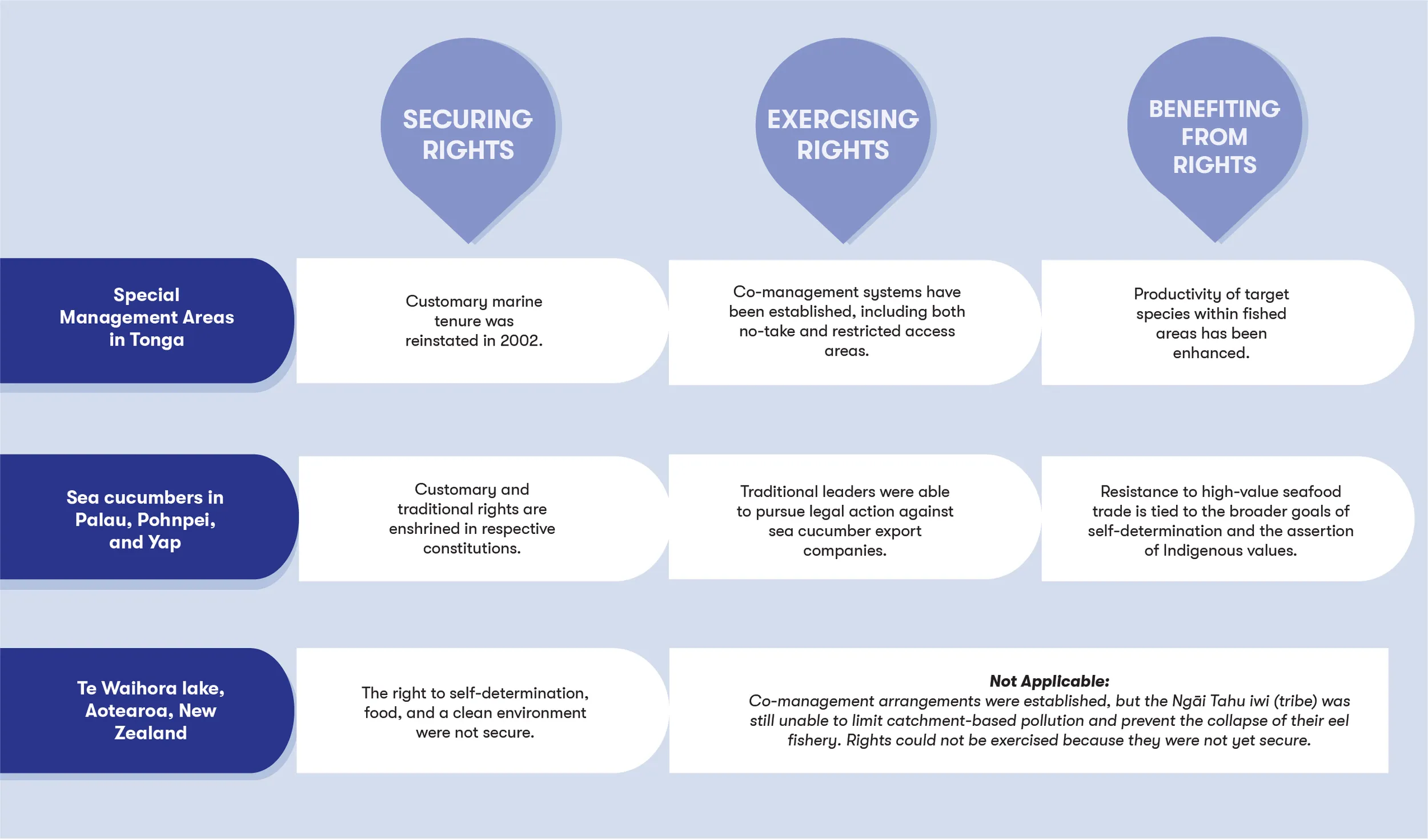
Sequencing marine conservation interventions implies that securing basic human rights is a necessary first step to ultimate conservation impact. Only once basic rights are secure can people then exercise those rights by addressing issues such as resource governance failures (e.g., impacts from external actors), including weak tenure rights, which can then begin to lead to biodiversity outcomes (Allison et al., 2012). For example, benefits will not accrue from even a perfectly designed co-management scheme if people are continuously subject to acts of violence and dispossession that limit their ability to participate in co-management. Likewise, only once people have both secure rights and the ability to exercise those rights is it useful to address remaining market failures that exacerbate sustainability and conservation issues, so that people and ecosystems can then begin to benefit from those rights. Investing out of sequence, for example by addressing market failures without first (or also) securing basic rights and then enabling people to exercise those rights will only accelerate depletion of resources by connecting them to more lucrative markets, hence further marginalizing vulnerable groups without tangible benefits for conservation (Karnad et al., 2021).
It is important to note that in some cases deep-rooted issues may also need to be tackled in parallel. For example, it is infeasible to wait until gender equality has been addressed before acting on the environment. In these instances, care needs to be taken to ensure rights issues are addressed while conservation actions occur, and to ensure those actions do not widen gender inequalities.
Three examples, two successful and one unsuccessful, highlight how this process can unfold in practice (Table 5). Note additional examples of these processes are also available in Allison et al. (2012) from Lake Victoria (Uganda, Kenya, and Tanzania), Philippines, and Chile.
Table 5
|
Examples of sequential investments in human rights and marine conservation.
6.1.1 Special management areas in Tonga
During the 1980s and 1990s there were unsuccessful attempts to implement top-down, exclusionary MPAs in Tonga, and due to weak governance and limited respect for local fishing practices this only resulted in ‘paper parks’ (Likiliki and Haraldsson, 2006; Smallhorn-West & Govan, 2018). In 2002, Tonga implemented a two-part approach to local marine management that reinstated customary tenure and embraced participatory design principles, called the Special Management Area program (Likiliki and Haraldsson, 2006; Taufa and Tupou, 2018) (Figure 5). In exchange for implementing no-take reserves, the government also granted communities exclusive access to fishing zones around the reserves in which they could control resource use and regulations. This two-part system therefore supported securing legal access rights for fishers (i.e., acknowledging their right to fishing areas) in conjunction with developing co-management arrangements that enabled them to exercise those rights (i.e., the mechanism by which they could apply their rights). As such the program generated substantial local support so that by 2019 it had grown to include over 50% of coastal communities and more than 100 no-take or community fishing zones configured primarily in areas of historically high fishing pressure (Smallhorn-West et al., 2019, Smallhorn-West et al., 2020). Twenty years after its initial implementation there have been consistent benefits in biodiversity, fisheries biomass, density, and productivity in no-take reserves (Smallhorn-West, Stone, et al., 2020b), as well as enhanced fisheries productivity in areas that continue to be fished (Smallhorn-West et al., 2022c).
Figure 5
Small-scale fishers from the Lofanga Special Management Area in the Ha’apai island group of Tonga. Photographer: Patrick Smallhorn-West.
6.1.2 Sea cucumber fisheries in Palau, Pohnpei, and Yap
Sea cucumber or bêche-de-mer fisheries are notorious for ‘boom-bust’ cycles throughout the Pacific that provide limited local benefits (Crona et al., 2016), increase conflict within communities (Kaplan-Hallam et al., 2017), and increase inequity among fishers (Ferguson, 2021). In Palau, Pohnpei, and Yap, commercial harvest of sea cucumbers occurred intermittently throughout the 20th century for export to Asian markets. Yet despite overwhelming short-term financial incentives to harvest for export, in all three instances fishers, youth, elected and traditional leaders, and civil society organizations coordinated to ban the trade at its peak, using public protest, court battles, and customary and statutory law (Ferguson et al., 2022) (Figure 6). Because the rights of fishers and communities were sufficiently secured within customary and statutory law so that they could then proceed to exercise their right through local institutions and assertion of Indigenous values, they were able to then benefit from these actions, re-commonizing the resource and preventing fisheries collapse.
Figure 6
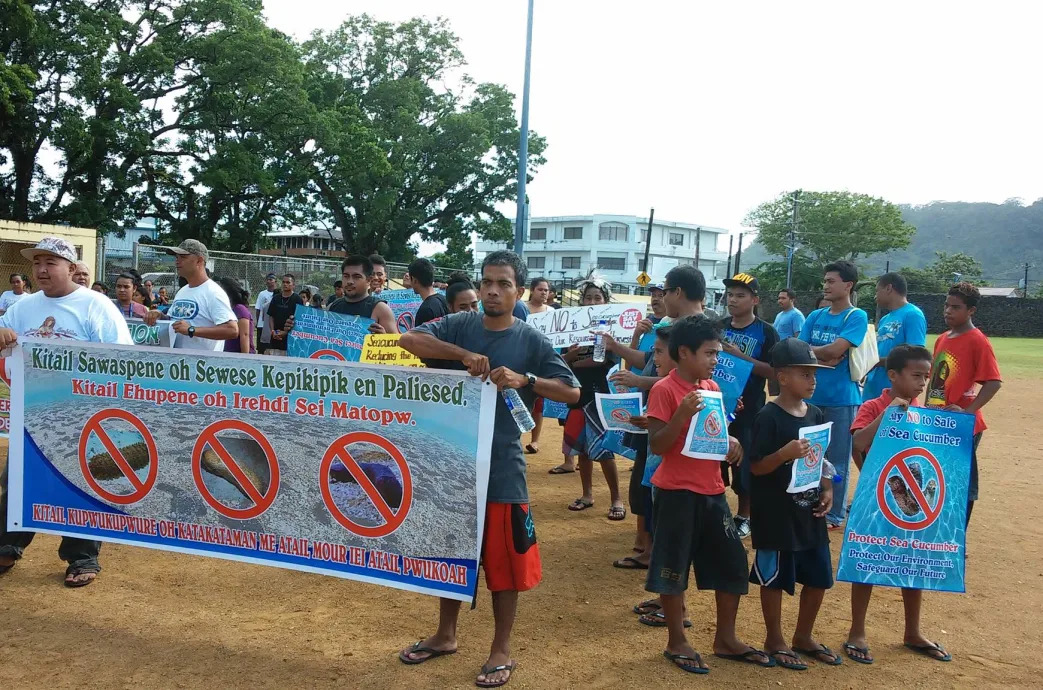
Citizens protest the sea cucumber trade in Pohnpei (source: “Block Unsustainable Sea Cucumber Harvest, Pohnpei”, Indiegogo Campaign). From Ferguson et al., 2022.
6.1.3 Te Waihora lake, Aotearoa (Lake Ellesmere, New Zealand)
Te Waihora is a Māori owned and governed coastal lake managed through the Indigenous-state co-governance agreement between the Ngāi Tahu iwi (tribe) and the Canterbury Regional Council (Lomax et al., 2015) (Figure 7). Historically, Te Waihora contained New Zealand’s most robust eel fishery. However, from 2000 – 2015 there was a dramatic expansion in dairy farming across the Te Waihora drainage basin, resulting in increased agricultural runoff and the eventual pollution driven collapse of the fishery. A government funded analysis stated that for the fishery to recover, Te Waihora required a 76% reduction in nitrogen and 50% reduction in phosphorous, requiring every dairy in the region to be shutdown. The Regional Council then requested a compliance exemption, on the grounds that the “social and economic consequences” would be “too severe” for farmers. This example demonstrates the problem with investing out of sequence: co-management in this case was ineffectual because the rights of the Ngāi Tahu iwi to control their coastal resources were not actually secure from upstream pollution sources. Hence these co-management arrangements failed because they were still subject to the same binding constraint of insecure resource rights – in this case the ability to manage water quality.
Figure 7

View of agricultural land adjacent to Te Waihora lake, Aotearoa (Lake Ellsemere, New Zealand).
6.2 Implement social safeguards and human rights impact assessments
Social safeguards are a set of mutually reinforcing processes designed to respect and protect the rights of people whose lives may be impacted by development or conservation actions (Wilkie et al., 2022). They act as a mechanism by which to identify and implement measures to avoid and mitigate adverse social impacts from conservation policy and practice. Globally acknowledged best-practice standards currently consider seven key social safeguards (World Bank, 2017). These include: 1) free, prior, and informed consent (U.N., 2007); 2) avoiding physical and economic displacement of rights-holders from their territories and homelands; 3) grievance redress in the face of impacts; 4) gender impact risk assessment; 5) human rights training for staff; 6) ensuring confidential source or informant consent; and 7) human subject’s protections in research.
Human rights impact assessments analyse the effects activities, including conservation activities, have on rights-holders (Harrison, 2011). This includes assessment of activities that directly and intentionally aim to alter human rights conditions, as well as actions that may have unintended human rights consequences. Impact assessments embrace counterfactual framing by asking ‘what would have happened in the absence of the intervention’? This faming can assess past activities (ex post), as well as planned future activities (ex ante). A common theme to human rights impact assessments is their evidence-based nature and concern with attempting to measure actual or potential human rights impacts (Bakker et al., 2009). The techniques by which this is done vary, as does the analytical rigour, but at the very least the goal is to use evidence to systematically bring human rights framing into program cycles (Landman, 2003).
While social safeguards and human rights impact assessments are necessary, they should not be applied formulaically or as one-size-fits-all solutions. Rather, they should be tailored to local ecological, social, cultural, and historical contexts, since projects differ both in their objectives and the risks they pose to affected communities (Humphrey, 2016). Applying single top-down standards can therefore lead to inadvertent rights violations (Wilkie et al., 2022). For example, attempting to impose a free, prior, and informed consent process on communities that requires naming of fishing access rights would be inappropriate in contexts where access rights are viewed as fluid. Likewise, different conservation interventions also require different safeguards, based on their risks to rights-holders. For example, informant intelligence on poaching from marine parks in conflict zones poses much greater risks than does understanding patterns of fish consumption for research subjects. Lastly, the most appropriate methodology to employ in each context should reflect the interests and preferred protocols of the rights-holders themselves, and risks will be best avoided or mitigated when rights-holders take the lead in determining relevant safeguards and assessment priorities for conservation in their context.
7 Conclusions
Acknowledging the contextuality of marine conservation activities, what generalized guidance might foster greater support for human rights and an HRBA in the sector? In simple terms, what does ‘doing’ marine conservation that embraces human rights principles look like? We suggest that, in general, marine conservation practices that are aligned with an HRBA and respecting, protecting, and fulfilling people’s rights will have many of the following characteristics (note this list is non-exhaustive):
-
1. Acknowledges that all people have basic rights that must be supported and understands that conservationists are duty-bound to respect those rights.
-
2. Supports the empowerment of fishers, Indigenous Peoples, and local communities, as leaders of nature stewardship in their own right, as well as being allies in support of biodiversity conservation.
-
3. Acknowledges that not all people in situations of vulnerability have deep connections to country, but all people still have fundamental rights regardless of their ability to support conservation.
-
4. Inherent respect for anti-racism, non-discrimination, diversity and gender equality principles.
-
5. Recognizes people as key actors in their own development, rather than passive recipients of commodities and services.
-
6. Focuses supportive actions towards those most marginalized, disadvantaged, and excluded.
-
7. Promotes long-term environmental and social security over short-term targets, since short-termism exacerbates inequitable results and leads to net negatives over time.
-
8. Acknowledges that increased vulnerability reduces people’s agency to adopt sustainable practices, and hence securing human rights can be a good conservation investment.
-
9. Implements policies and actions that address the root causes of vulnerabilities and insecurities.
-
10. Understands that conservation gains achieved through human rights violations will increase disenfranchisement, widen inequalities, potentially increase resource dependence, and heighten resistance to current and future conservation activities.
Conversely marine conservation policies and programs that fail to uphold human right-based principles in a meaningful way will have many of the following characteristics: (but are not limited to, and ranging from overt to subtle):
-
1. Overt violations of people’s rights, including forced displacement, food insecurity, increased poverty, violence, or coercion.
-
2. Respect for human rights only if they help achieve conservation targets, or through superficial or tick the box approaches, but not as a bottom line that cannot be crossed.
-
3. View people (including fishers, Indigenous Peoples, and local communities) fundamentally as opportunity costs and hazards that limit conservation from ‘getting done’, rather than allies in the process.
-
4. A focus on western concepts of nature, including intrinsic values of biodiversity and wilderness, as of greater importance than other values or concepts of nature stewardship. For example, by viewing the values of fishers and local communities as secondary to the ‘main goal’ of biodiversity conservation.
-
5. Paternalistic interactions with stakeholders, for example by external actors ‘knowing best’ and ‘doing’ conservation in regions with little engagement or understanding of local context, desires, or needs.
-
6. A lack of free, prior, and informed consent of stakeholders.
-
7. Limited or no acknowledgement of, or offset of, socioeconomic costs incurred by people from conservation actions. This includes failing to address the root causes of vulnerabilities.
-
8. Failure to account for the vulnerability of those affected, nor understanding that those marginalized and disadvantaged typically bear disproportionate costs.
-
9. Limited understanding of equity and justice principles, that is an understanding of social, economic, and political conditions that influence peoples pre-existing status.
-
10. Unwillingness to acknowledge positionality and historic transgressions by conservation actors, including the need to recognize intergenerational trauma.
As 196 countries around the world continue to negotiate the CBD Post-2020 Biodiversity Framework that will guide future conservation policy, we argue that human rights in general, and an HRBA specifically, should be a foundational component of effective and equitable conservation policy. While an HRBA cannot resolve all issues, it provides a useful framework for understanding key issues and grievances, as well as a minimum standard that should not be ‘traded-off’ in negotiations (Filmer-Wilson and Anderson, 2005). While some might argue this can be a slower pathway to conservation impact, inclusive and broader reaching processes that focus on the underlying or distal drivers of poverty and vulnerability can bring much more lasting outcomes. Conversely, if conservation gains are achieved through human rights violations, then this will only increase disenfranchisement, widen inequalities, potentially increase resource dependence, and heighten resistance to current and future conservation activities, ultimately leading to non-compliance and ineffective biodiversity conservation.
We acknowledge the interdependence of nature and people – that biological and cultural diversity are interconnected and mutually reinforcing. We acknowledge that Indigenous Peoples and local communities frequently represent the most active defenders of nature, and we believe that respecting and protecting their rights is the best pathway to achieving durable conservation impact. We also believe that conservation stakeholders are uniquely positioned to address human rights issues at this juncture in history – many are acknowledging the injustices of the past, are taking corrective action, and are seeking ways to move towards just and regenerative conservation that embraces principles of equity and respect.
Statements
Ethics statement
Written informed consent was obtained from the individual(s) for the publication of any identifiable images or data included in this article.
Author contributions
PSW, EA, GG, HN, HP, AT & SR conceived the initial form of this manuscript. DK, HK, ASL, SM, HW, and KP contributed to follow up versions and provided input on writing, language, and arguments. All authors contributed to the final version of this manuscript.
Funding
This work was undertaken as part of the CGIAR Research Initiative on Resilient Aquatic Food Systems for Healthy People and Planet, and funded by CGIAR Trust Fund donors. Funding support for this work was provided by CGIAR Trust Fund donors, the Wildlife Conservation Society, and the Australian Research Council Centre for Excellence in Coral Reef Studies, James Cook University.
Acknowledgments
In the spirit of reconciliation, we acknowledge that many of us live and work on unceded lands. We therefore acknowledge the Traditional Owners and Custodians of the land and sea country on which we work, and pay our respects to their Elders, past, present, and emerging.
Conflict of interest
Author Sangeeta Mangubhai was employed by company Talanoa Consulting.
The remaining authors declare that the research was conducted in the absence of any commercial or financial relationships that could be construed as a potential conflict of interest.
Publisher’s note
All claims expressed in this article are solely those of the authors and do not necessarily represent those of their affiliated organizations, or those of the publisher, the editors and the reviewers. Any product that may be evaluated in this article, or claim that may be made by its manufacturer, is not guaranteed or endorsed by the publisher.
References
1
Adams W. B. Mulligan M. (2012). Decolonizing nature: Strategies for conservation in a post-colonial era. Routledge.
2
Ali M. Y. Rahmatullah R. Asadujjaman M. Bablu M. G. U. Sarwer M. G. (2015). Impacts of banning period on the socio-economic condition of hilsa fishermen in shakhchor union of lakshmipur sadar upazila, Bangladesh. Middle-East J. Sci. Res.23, 2479–2483.
3
Allison E. H. Kurien J. Ota Y. Adhuri D. S. Bavinck J. M. Cisneros Montemayor A. et al . (2020). The human relationship with our ocean planet. Blue paper commissioned by the High Level Panel for A Sustainable Ocean Economy. Available at: https://oceanpanel.org.
4
Allison E. H. Ratner B. D. Åsgård B. Willmann R. Pomeroy R. Kurien J. (2012). Rights-based fisheries governance: From fishing rights to human rights. Fish Fisheries13 (1), 14–29. doi: 10.1111/j.1467-2979.2011.00405.x
5
Andrew N. L. Béné C. Hall S. J. Allison E. H. Heck S. Ratner B. D. (2007). Diagnosis and management of small-scale fisheries in developing countries. Fish Fisheries8 (3), 227–240. doi: 10.1111/j.1467-2679.2007.00252.x
6
Bakker S. Van Den Berg M. Düzenli D. Radstaake M. (2009). Human rights impact assessment in practice: The case of the health rights of women assessment instrument (HeRWAI). J. Hum. Rights Pract.1 (3), 436–458. doi: 10.1093/jhuman/hup017
7
Ban N. C. Davies T. E. Aguilera S. E. Brooks C. Cox M. Epstein G. et al . (2017). Social and ecological effectiveness of large marine protected areas. Global Environ. Change43, 82–91. doi: 10.1016/j.gloenvcha.2017.01.003
8
Barratt C. (2012). Netting the benefits now or later? Exploring the relationship between risk and sustainability in lake Victoria fisheries, uganda. in. Risk Afr. Multi-disciplinary Empirical Approaches.
9
Bavinck M. Vivekanandan V. (2011). Conservation, conflict and the governance of fisher wellbeing: Analysis of the establishment of the Gulf of Mannar National Park and Biosphere Reserve. Environmental Management47(4), 593–602.
10
Bennett N. J. (2022). Mainstreaming equity and justice in the ocean. Front. Mar. Sci.9, 587. doi: 10.3389/fmars.2022.873572
11
Bennett N. J. Blythe J. White Campero C. S.C. (2021). Blue growth and blue justice: Ten risks and solutions for the ocean economy. Marine Policy125, p.104387.
12
Bennett N. J. Dearden P. (2014). Why local people do not support conservation: community perceptions of marine protected area livelihood impacts, governance and management in Thailand. Marine Policy44, 107–116
13
Benson C. (2012). Conservation NGOs in Madang, Papua New Guinea: understanding community and donor expectations. Society & Natural Resources25, 71–86
14
Bhuyan S. Islam S. (2016). Present status of socio-economic conditions of the fishing community of the meghna river adjacent to narsingdi district. Bangladesh. J. Fish. Livest. Prod4 (4), 1–5.
15
Brown N. K. Gray T. S. Stead S. M. (2013). Co-management and adaptive co-management: two modes of governance in a Honduran marine protected area. Marine Policy39, 128–134.
16
Callicott J. B. (1990). Whither conservation ethics? Conserv. Biol.4 (1), pp.15–pp.20.
17
Campese J. (2009). Rights-based approaches: Exploring issues and opportunities for conservation. CIFOR.
18
CBD (2022). Post-2020 GLobal biodiversity framework.
19
Chapin M. (2004) A challenge to conservationists. Available at: www.worldwatch.org.
20
Chhotray V. (2016). Justice at Sea: Fishers’ politics and marine conservation in coastal Odisha, India. Maritime Studies15, 1–24.
21
Cinner J. E. Lau J. D. Bauman A. G. Feary D. A. Januchowski-Hartley F. A. Rojas C. A. et al . (2019). Sixteen years of social and ecological dynamics reveal challenges and opportunities for adaptive management in sustaining the commons. Proc. Natl. Acad. Sci.116 (52), pp.26474–26483. doi: 10.1073/pnas.1914812116
22
Cinner J. E. McClanahan T. R. MacNeil M. A. Graham N. A. Daw T. M. Mukminin A. et al . (2012). Comanagement of coral reef social-ecological systems. Proc. Natl. Acad. Sci.109 (14), 5219–5222. doi: 10.1073/pnas.1121215109
23
Cohen P. J. Allison E. H. Andrew N. L. Cinner J. Evans L. S. Fabinyi M. et al . (2019). Securing a just space for small-scale fisheries in the blue economy. Front. Mar. Sci.6, 171. doi: 10.3389/fmars.2019.00171
24
Cohen P. J. Roscher M. Wathsala Fernando A. Freed S. Garces L. Jayakody S. et al . (2021). Characteristics and performance of fisheries co-management in Asia: Synthesis of knowledge and case studies: Bangladesh, Cambodia, Philippines and Sri Lanka. Food Agric. Org.
25
Colchester M. (1994). Salvaging Nature: indigenous peoples, protected areas and biodiversity conservation. Available at: https://www.researchgate.net/publication/284691747.
26
Crona B. I. Basurto X. Squires D. Gelcich S. Daw T. M. Khan A. et al . (2016). Towards a typology of interactions between small-scale fisheries and global seafood trade. Mar. Policy65, 1–10. doi: 10.1016/j.marpol.2015.11.016
27
Crosman K. M. Jurcevic I. Van Holmes C. Hall C. C. Allison E. H. (2022). An equity lens on behavioral science for conservation. Conserv. Lett.15 (5), e12885. doi: 10.1111/conl.12885
28
Cross H. (2016). Displacement, disempowerment and corruption: Challenges at the interface of fisheries, management and conservation in the bijagós archipelago, Guinea-Bissau. Oryx50 (4), 693–701. doi: 10.1017/S003060531500040X
29
Davis W. (2009). The wayfinders: Why ancient wisdom matters in the modern world. House Anansi.
30
Dawson N. M. Coolsaet B. Sterling E. J. Loveridge R. Gross-Camp N. D. Wongbusarakum S. et al . (2021). The role of indigenous peoples and local communities in effective and equitable conservation. Ecology and Society26 (3), 19. doi: 10.5751/ES-12625-260319
31
Diamond J. (2005). Collapse: How Societies Choose to Fail or Succeed. Viking Penguin, USA.
32
FAO (2015). Voluntary Guidelines for Securing Sustainable Small-Scale Fisheries in the Context of Food Security and Poverty Eradiction, Committee on World Food Security. Retrieved from https://policycommons.net/artifacts/2132725/voluntary-guidelines-for-securing-sustainable-small-scale-fisheries-in-the-context-of-food-security-and-poverty-eradiction/2888023/ on 07 Feb 2023. CID: 20.500.12592/6trcbc.
33
FAO (2022). The state of the worlds fisheries and aquaculture 2022. Towards Blue Transformation.
34
Ferguson C. E. (2021). A rising tide does not lift all boats: Intersectional analysis reveals inequitable impacts of the seafood trade in fishing communities. Front. Mar. Sci.8, 246. doi: 10.3389/fmars.2021.625389
35
Ferguson C. E. Bennett N. J. Kostka W. Richmond R. H. Singeo A. (2022). The tragedy of the commodity is not inevitable: Indigenous resistance prevents high-value fisheries collapse in the pacific islands. Global Environ. Change73, 102477. doi: 10.1016/j.gloenvcha.2022.102477
36
Filmer-Wilson E. Anderson M. (2005). Integrating human rights into energy and environment programming: A reference paper. Nova York: PNUD.
37
Foale S. (2001). ‘Where's our development?’ landowner aspirations and environmentalist agendas in Western Solomon islands. Asia Pacific J. Anthropology2 (2), pp.44–pp.67.
38
Foale S. Dyer M. Kinch J. (2016). The value of tropical biodiversity in rural Melanesia. Valuation Stud.4 (1), pp.11–pp.39. doi: 10.3384/VS.2001-5992.164111
39
Forum for the future & wbcsd (2022). A compass for just and regenerative business, Vol. 25.
40
Fraser N. (2009). Scales of justice: Reimagining political space in a globalizing world Vol. Vol. 31) (USA: Columbia University Press).
41
Gilchrist H. Rocliffe S. Anderson L. G. Gough C. L. (2020). Reef fish biomass recovery within community-managed no take zones. Ocean Coast. Manage.192, 105210. doi: 10.1016/j.ocecoaman.2020.105210
42
Goulden M. C. (2006). Livelihood diversification, social capital and resilience to climate variability amongst natural resource dependent societies in Uganda (Doctoral dissertation, university of East Anglia).
43
Gupta C. Sharma M. (2012). Contested coastlines: Fisherfolk, nations and borders in South Asia. Routledge India.
44
Gurney G. G. Darling E. S. Ahmadia G. N. Agostini V. N. Ban N. C. Blythe J. et al . (2021b). Biodiversity needs every tool in the box: use OECMs. Nature595 (7869), 646–649.
45
Gurney G. G. Mangubhai S. Fox M. Kim M. K. Agrawal A. (2021a). Equity in environmental governance: perceived fairness of distributional justice principles in marine co-management. Environ. Sci. Policy124, 23–32. doi: 10.1016/j.envsci.2021.05.022
46
Hanna P. Vanclay F. (2013). Human rights, indigenous peoples and the concept of free, prior and informed consent. Impact Assess. Project Appraisal31 (2), 146–157. doi: 10.1080/14615517.2013.780373
47
Harrison J. (2011). Human rights measurement: Reflections on the current practice and future potential of human rights impact assessment. J. Hum. Rights Pract.3 (2), 162–187. doi: 10.1093/jhuman/hur011
48
Hausmann R. Rodrik D. Velasco A. (2006). Getting the diagnosis right. Finance Dev.43 (1), 12.
49
Hill A. (2017). Blue grabbing: reviewing marine conservation in redang island marine park, Malaysia. Geoforum79, 97–100. doi: 10.1016/j.geoforum.2016.12.019
50
Hind E. J. Hiponia M. C. Gray T. S. (2010). From community-based to centralised national management—A wrong turning for the governance of the marine protected area in Apo Island, Philippines? Marine policy34(1), pp.54–62.
51
Human rights in biodiversity working group . (2022). Implementing a human rights-based approach.
52
Humphrey C. (2016). Time for a new approach to environmental and social protection at multilateral development banks. Overseas Dev. Institute April.
53
Islam M. M. Islam N. Sunny A. R. Jentoft S. Ullah M. H. Sharifuzzaman S. M. (2016). Fishers’ perceptions of the performance of hilsa shad (Tenualosa ilisha) sanctuaries in Bangladesh. Ocean Coast. Manage.130, 309–316. doi: 10.1016/j.ocecoaman.2016.07.003
54
Islam M. M. Shamsuzzaman M. M. Mozumder M. M. H. Xiangmin X. Ming Y. Jewel M. A. S. (2017). Exploitation and conservation of coastal and marine fisheries in Bangladesh: Do the fishery laws matter? Mar. Policy76, 143–151. doi: 10.1016/j.marpol.2016.11.026
55
Jonas H. Makagon J. Roe D. (2016). Conservation standards. From Rights to Responsibilities. London: IIED
56
Jupiter S. (2017). Culture, kastom and conservation in Melanesia: What happens when worldviews collide? Pacific Conserv. Biol.23 (2), 139–145.
57
Kamat V. R. (2018). Dispossession and disenchantment: The micropolitics of marine conservation in southeastern Tanzania. Mar. Policy88, 261–268. doi: 10.1016/j.marpol.2017.12.002
58
Kaplan-Hallam M. Bennett N. J. Satterfield T. (2017). Catching sea cucumber fever in coastal communities: Conceptualizing the impacts of shocks versus trends on social-ecological systems. Global Environ. Change45, 89–98. doi: 10.1016/j.gloenvcha.2017.05.003
59
Kapono C. Kain M. Raj S. Rao M. (2022) Centring indigenous-led governance of coral reefs. Available at: https://ocean.economist.com/governance/articles/prioritising-indigenous-led-governance-of-coral-reefs.
60
Karnad D. Gangadharan D. Krishna Y. C. (2021). Rethinking sustainability: From seafood consumption to seafood commons. Geoforum126, 26–36.
61
Landman T. (2003). Studying human rights (UK: Routledge).
62
Larsen P. B. Brockington D. (2018). Anthropology of conservation NGOs (Germany: Springer Verlag).
63
Likiliki P. M. Haraldsson G. (2006). Fisheries co-management and the evolution towards community fisheries management in Tonga. Reykjavik Iceland: United Nations University.
64
Lomax A. Johnston K. A. Hughey K. Taylor K. J. W. (2015). Te Waihora/Lake Ellesmere: state of the lake 2015 (New Zealand: Waihora Ellesmere Trust).
65
Martin A. Coolsaet B. Corbera E. Dawson N. M. Fraser J. A. Lehmann I. et al . (2016). Justice and conservation: The need to incorporate recognition. Biol. Conserv.197, 254–261. doi: 10.1016/j.biocon.2016.03.021
66
Mills D. Béné C. Ovie S. Tafida A. Sinaba F. Kodio A. et al . (2011). Vulnerability in African small-scale fishing communities. J. Int. Dev.23 (2), 308–313. doi: 10.1002/jid.1638
67
Mozumder M. M. H. Wahab M. A. Sarkki S. Schneider P. Islam M. M. (2018). Enhancing social resilience of the coastal fishing communities: A case study of hilsa (Tenualosa ilisha h.) fishery in Bangladesh. Sustainability10 (10), 3501. doi: 10.3390/su10103501
68
Muralidharan R. Rai N. D. (2020). Violent maritime spaces: Conservation and security in gulf of mannar marine national park, India. Political Geogr.80, 102160. doi: 10.1016/j.polgeo.2020.102160
69
Newing H. Perram A. (2019). What do you know about conservation and human rights? Oryx53 (4), 595–596. doi: 10.1017/S0030605319000917
70
Oldekop J. A. Holmes G. Harris W. E. Evans K. L. (2016). A global assessment of the social and conservation outcomes of protected areas. Conserv. Biol.30 (1), 133–141. doi: 10.1111/cobi.12568
71
Pascual U. Phelps J. Garmendia E. Brown K. Corbera E. Martin A. et al . (2014). Social equity matters in payments for ecosystem services. Bioscience64 (11), 1027–1036. doi: 10.1093/biosci/biu146
72
Ramesh M. Rai N. D. (2017). Trading on conservation: A marine protected area as an ecological fix. Mar. Policy82, 25–31. doi: 10.1016/j.marpol.2017.04.020
73
Ratner B. D. Åsgård B. Allison E. H. (2014). Fishing for justice: Human rights, development, and fisheries sector reform. Global Environ. Change27, 120–130. doi: 10.1016/j.gloenvcha.2014.05.006
74
Ratner B. D. Baran E. (2008). From sound economics to sound management: Practical solutions to small-scale fisheries governance in the developing world. MAST6(2), 29–33
75
Redford K. H. (1991). The ecologically noble savage. Cultural survival Q.15 (1), 46–48.
76
Rittel H. W. Webber M. M. (1973). Dilemmas in a general theory of planning. Policy Sci.4 (2), 155–169. doi: 10.1007/BF01405730
77
Roy N. C. Rahman M. A. Haque M. M. Momi M. A. Habib A. Z. (2015). Effects of incentive based hilsa shad (Tenualosa ilisha) management and conservation strategies in Bangladesh. J. Sylhet Agric. Univ2, 69–77.
78
Ruano-Chamorro C. Gurney G. G. Cinner J. E. (2022). Advancing procedural justice in conservation. Conserv. Lett.15 (3), e12861. doi: 10.1111/conl.12861
79
Sand P. H. (2012). Fortress conservation trumps human rights? the “marine protected area” in the chagos archipelago. J. Environ. Dev.21 (1), 36–39. doi: 10.1177/1070496511435666
80
Schlosberg D. (2004). Reconceiving environmental justice: Global movements and political theories. Environ. politics13 (3), 517–540. doi: 10.1080/0964401042000229025
81
Seufert P. (2013). The FAO voluntary guidelines on the responsible governance of tenure of land, fisheries and forests. Globalizations10 (1), 181–186. doi: 10.1080/14747731.2013.764157
82
Sikor T. Martin A. Fisher J. He J. (2014). Toward an empirical analysis of justice in ecosystem governance. Conserv. Lett.7 (6), 524–532. doi: 10.1111/conl.12142
83
Singleton R. L. Allison E. H. Le Billon P. Sumaila U. R. (2017). Conservation and the right to fish: International conservation NGOs and the implementation of the voluntary guidelines for securing sustainable small-scale fisheries. Mar. Policy84, 22–32. doi: 10.1016/j.marpol.2017.06.026
84
Smallhorn-West P. F. Bridge T. C. Malimali S. A. Pressey R. L. Jones G. P. (2019). Predicting impact to assess the efficacy of community-based marine reserve design. Conserv. Lett.12 (1), e12602. doi: 10.1111/conl.12602
85
Smallhorn-West P. Govan H. (2018). Towards reducing misrepresentation of national achievements in marine protected area targets. Mar. Policy97, 127–129. doi: 10.1016/j.marpol.2018.05.031
86
Smallhorn-West P. F. Sheehan J. Malimali S. A. Halafihi T. Bridge T. C. Pressey R. L. et al . (2020b). Incentivizing co-management for impact: mechanisms driving the successful national expansion of tonga's special management area program. Conserv. Lett.13 (6), e12742. doi: 10.1111/conl.12742
87
Smallhorn-West P. F. Stone K. Ceccarelli D. M. Malimali S. A. Halafihi T. I. Bridge T. C. et al . (2020c). Community management yields positive impacts for coastal fisheries resources and biodiversity conservation. Conserv. Lett.13 (6), e12755. doi: 10.1111/conl.12755
88
Smallhorn-West P. F. Weeks R. Gurney G. Pressey R. L. (2020a). Ecological and socioeconomic impacts of marine protected areas in the south pacific: Assessing the evidence base. Biodiversity Conserv.29 (2), 349–380. doi: 10.1007/s10531-019-01918-1
89
Smallhorn-West P. Cohen P. J. Morais R. A. Januchowski-Hartley F. A. Ceccarelli D. M. Malimali S. A. et al . (2022). Hidden benefits and risks of partial protection for coral reef fisheries.
90
Smith D. M. (1998). An athapaskan way of knowing: Chipewyan ontology. Am. Ethnologist25 (3), 412–432. doi: 10.1525/ae.1998.25.3.412
91
Sowman M. Sunde J. (2018). Social impacts of marine protected areas in south Africa on coastal fishing communities. Ocean Coast. Manage.157, 168–179. doi: 10.1016/j.ocecoaman.2018.02.013
92
Springer J. Campese J. Painter M. (2011). Conservation and human rights: Key issues and contexts. Scoping Paper Conserv. Initiative Hum. Rights.
93
Talukdar A. Schneider P. Begum A. Kawsar M. A. Sultana M. A. Sumon T. A. et al . (2022). The premium of hilsa sanctuary: A socio-economic and ecological evaluation from the meghna estuary, Bangladesh. Sustainability14 (13), 7782. doi: 10.3390/su14137782
94
Tan K. C. (2021). Just conservation: The question of justice in global wildlife conservation. Philosophy Compass16 (2), e12720. doi: 10.1111/phc3.12720
95
Taufa S. V. Tupou M. (2018). An analysis of property rights in the special management area (SMA) in Tonga. Mar. Policy95, 267–272. doi: 10.1016/j.marpol.2018.05.028
96
Tauli-Corpuz V. Alcorn J. Molnar A. Healy C. Barrow E. (2020). Cornered by PAs: Adopting rights-based approaches to enable cost-effective conservation and climate action. World Dev.130, 104923. doi: 10.1016/j.worlddev.2020.104923
97
Thorpe A. Andrew N. L. Allison E. H. (2007). Fisheries and poverty reduction. CABI Rev.2, 85. doi: 10.1079/PAVSNNR20072085
98
Twyman-Ghoshal A. (2022). How the US and UK worked together to recolonize the chagos islands and evict chagossians. Conversation.
99
U.N . (1948). Universal declaration of human rights. UN Gen. Assembly302 (2), 14–25.
100
U.N. (2003). The human rights based approach to development cooperation towards a common understanding among UN agencies.
101
U.N. (2007). United nations declaration on the rights ofindigenous peoples (New York, USA: United Nations Publications).
102
U.N. (2011). Guiding principles on business and human rights.
103
U.N. (2014). Implementing the UN declaration on the rights of indigenous peoples handbook for parliamentarians n° 23.
104
U.N. (2017) UNterm. Available at: https://unterm.un.org/unterm/Display/record/UNHQ/duty_bearer/705FF93874A4C03685256F2300549B9B.
105
U.N. (2022a) UN General assembly declares access to clean and healthy environment a universal human right | | UN news. Available at: https://news.un.org/en/story/2022/07/1123482.
106
U.N. (2022b) UN Human rights office. Available at: https://www.ohchr.org/en/ohchr_homepage.
107
U.N. (2012). Office of the high commissioner for human rights 2012. the corporate responsibility to respect human rights: An interpretive guide (United Nations Publications).
108
UNSDG (2022) Human rights-based approach. (n.d.). Available at: https://unsdg.un.org/2030-agenda/universal-values/human-rights-based-approach.
109
Van Brakel M. L. Nahiduzzaman M. Haque A. M. Mustafa M. G. Rahman M. J. Wahab M. A. (2018). Reimagining large-scale open-water fisheries governance through adaptive comanagement in hilsa shad sanctuaries. Ecol. Soc.23 (1). doi: 10.5751/ES-09917-230126
110
Villaseñor-Derbez J. C. Aceves-Bueno E. Fulton S. Suarez A. Hernández-Velasco A. Torre J. et al . (2019). An interdisciplinary evaluation of community-based TURF-reserves. PLoS One14 (8), e0221660. doi: 10.1371/journal.pone.0221660
111
Wilkie D. (2017) Sins of the father: Conservation and human rights then and now | HuffPost impact. Available at: https://www.huffpost.com/entry/sins-of-the-father-conser_b_9131684.
112
Wilkie D. Kretser H. E. Painter M. O'Brien F. Holmes A. Mastro K. et al . (2022). Tailoring social safeguards in conservation to reflect the local context and level of risk. Conserv. Sci. Pract.4 (8), e12747. doi: 10.1111/csp2.12747
113
Winer N. Turton D. Brockington D. (2007). Conservation principles and humanitarian practice. Policy Matters15, 232–240.
114
Women, U.N. (1981). Convention on the elimination of all forms of discrimination against women (CEDAW). UN Women.
115
World Bank (2017). World bank environmental and social framework (, Washington, D.C, USA: The World Bank).
Summary
Keywords
small-scale fisheries, co-management, community-based management, marine protected areas, fortress conservation, human rights-based approach, ocean equity, blue justice
Citation
Smallhorn-West P, Allison E, Gurney G, Karnad D, Kretser H, Lobo AS, Mangubhai S, Newing H, Pennell K, Raj S, Tilley A, Williams H and Peckham SH (2023) Why human rights matter for marine conservation. Front. Mar. Sci. 10:1089154. doi: 10.3389/fmars.2023.1089154
Received
04 November 2022
Accepted
27 January 2023
Published
31 March 2023
Volume
10 - 2023
Edited by
Stanislao Bevilacqua, University of Trieste, Italy
Reviewed by
Robin Kundis Craig, University of Southern California, United States; Lida Teneva, Independent Researcher, Sacramento, CA, United States
Updates
Copyright
© 2023 Smallhorn-West, Allison, Gurney, Karnad, Kretser, Lobo, Mangubhai, Newing, Pennell, Raj, Tilley, Williams and Peckham.
This is an open-access article distributed under the terms of the Creative Commons Attribution License (CC BY). The use, distribution or reproduction in other forums is permitted, provided the original author(s) and the copyright owner(s) are credited and that the original publication in this journal is cited, in accordance with accepted academic practice. No use, distribution or reproduction is permitted which does not comply with these terms.
*Correspondence: Patrick Smallhorn-West, patrick.smallhornwest@jcu.edu.au
This article was submitted to Marine Conservation and Sustainability, a section of the journal Frontiers in Marine Science
Disclaimer
All claims expressed in this article are solely those of the authors and do not necessarily represent those of their affiliated organizations, or those of the publisher, the editors and the reviewers. Any product that may be evaluated in this article or claim that may be made by its manufacturer is not guaranteed or endorsed by the publisher.