Abstract
The insights gained from individual tracking can improve the conservation of released young green sea turtles by providing detailed data on migration route, feeding place and habitat distribution. During the fishing moratorium from May 1 to August 16 in 2021, we used satellites to track 6 juvenile green sea turtles released from China’s Huidong Sea Turtle Nature Reserve, and located and reconstructed their migration routes and foraging sea areas. The tracking data shows that the longest tracking time is 91 days, the shortest time is 10 days, and the total tracking time is 213 days, of which three (50%) obtained tracking data for more than one month, and the total movement distances (statistics LC3-LCB) ranges from 124 to 4627 km, while the accurate movement distances (counted by dot pitch above LC0) ranged from 39.5-2331 km. The average daily movement distances ranges from 3.95 to 51.4 km, and the average speed varies between 0.16 to 2.14 km/h. The green turtles released from the China Turtle Bay migrate along the northern coastline of the South China Sea or go straight to the South China Sea. After a month or so, they migrate from Huidong Turtle Bay to Hainan Lingao, Beibu Gulf and Xisha Islands. The northern coast of the South China Sea is one of the migration routes of green sea turtles. Beibu Bay, Zhanjiang Port, Daya Bay, Red Bay, Nan’ao Island, Zhelin Bay and Xisha Islands are important foraging places for green sea turtles. The protection of migration routes and important foraging grounds is one of the key measures to protect sea turtles.
Introduction
Fisheries bycatch of non-target species in the commercial fleet is a major source of anthropogenic injury and mortality for sea turtles (Prosdocimi et al., 2021). Fishing moratorium and hatchery release are important measures for the conservation of marine species including sea turtles. The summer fishing moratorium system in the South China Sea has been implemented since 1999, and the fishing moratorium has experienced a gradual extension process. Before 2008, the fishing moratorium was from 12:00 on June 1st to 12:00 on August 1st, a total of 2 months. Since 2009, the summer fishing moratorium in the South China Sea has been extended to two and a half months, and the fishing moratorium was from 12:00 on May 16th to 12:00 on August 1st, and all types of fishing boats except single-layer gillnets and fishing tackle should be closed simultaneously in the South China Sea north of 12 degrees north latitude. In 2017, the fishing closure time in the South China Sea (including the Beibu Gulf) from 12 degrees north latitude to the “junction line of the Fujian and Guangdong Seas” under the jurisdiction of Guangdong Province was adjusted to 12:00 on May 1 to 12:00 on August 16, for a total of three and a half months, all types of operations are closed simultaneously except fishing tackle. In order to improve the survival rate of marine animal released to wild, release activities are generally carried out during fishing moratorium to avoided human interference as much as possible.
There are five species of sea turtles in China, including loggerhead (Caretta caretta), hawksbill (Eretmochelys imbricata), olive ridley (Lepidochelys olivacea), green turtle (Chelonia mydas) and leatherback (Dermochelys coriacea). All sea turtle species were classified as vulnerable, endangered, or critically endangered species in the 2014 IUCN Red List (Vilaça et al., 2021). In China, the “National Key Protected Wildlife List” revised in 2021 has upgraded all sea turtles to first-level key protected wild animals (Xing et al., 2021). With the joint efforts of government departments, environmental protection organizations, experts and the public, sea turtle populations will be restored and developed gradually (Xia, 2017; Luo, 2020). To protect sea turtles, both propaganda and education and stricter law enforcement must be strengthened (Xia and Lin, 2020).
Huidong Sea Turtle National Nature Reserve is the only breeding farm of sea turtle in China, it has bred and released green sea turtles since 1985. So far, more than 60000 green sea turtles have been released to the South China Sea to increase the wild population of the green sea turtle. The life history of sea turtles is long, mysterious and little-known (Xia et al., 2008). It can be roughly divided into different developmental stages of hatchling, juvenile, sub-adult and adult turtles according to the age. And its home ranges include foraging places, habitat sites, breeding sites and overwintering sites (Doherty et al., 2020), where reached by foraging, breeding or overwintering migration.
Satellite telemetry has been used to track in-water movements of all seven species of sea turtle and has provided insights into migratory behaviors, locations of foraging grounds and migratory corridors, oceanographic influences on movement patterns (Mettler et al., 2019). The migration corridor between habitats (Yeh et al., 2021) is essential for maintaining populations, protecting biodiversity, and implementing ecosystem-based management (Block et al., 2016). Ng et al. (2018) identified the importance of several key nesting and foraging sites, together with the migratory corridors, of green sea turtles in the South China Region and advocated for the protection of these habitats in response to the immediate conservation need of the species. The spread of green sea turtles is a complex process, which is affected by many factors such as food habits, ocean currents, seasons, and its own swimming ability (Hirth, 1997; Gredzens & Shaver, 2020). Iverson et al. (2019) obtained 26 trajectories of 25 adult female loggerhead turtles after nesting in the Gulf of Mexico and found that the sea turtles tend to move in shallow water during their migration, and occasionally dive into deep water, perhaps to rest or forage on the way. Suhaimi et al. (2020) simulated the spread of green sea turtle cubs in Chaga Lake Pond during each monsoon season and speculated that green sea turtle cubs will have the highest success rate during the release period of the northeast monsoon season. Survival rate and causes of death of 26 released turtles were evaluated using satellite tracking (Robinson et al., 2021). The insights gained from individual tracking can improve the conservation of released green sea turtles by providing detailed data on migration route, foraging ground and habitat distribution.
Materials and methods
During the fishing moratorium in the South China Sea in 2021, six green sea turtles equipped with satellite trackers were released on the beach of Huidong Turtle Bay, China. The turtles used in this study were collected from the coast of South China through rescue or breeding at China Sea Turtle Bay during 2010 to 2017 (Table 1). Transmitters used in this study were purchased from two manufacturers, both of which were located through Argos. The platform transmitter terminal (PTT) with IDs 210324, 210325 and 210322 were K2G series of Lotek produced in New Zealand. The PTT with IDs 220639, 220640, and 220642 were SPOT series of Wildlife produced in United States (Table 1), of which the turtles with IDs 210325 and 220639 took part in the QR code marking experiment to verify the effect of QR tag during June 8th, 2022 to July 28th, 2022 and proved that the first month is most important period after turtle released (Xia et al., 2022). The method of launcher installation refers to the quick glue dispensing way of Xia et al. (2012).
Table 1
| Release date | Release site | PTT ID | PTT type | Turtle source |
|---|---|---|---|---|
| 2021.5.3 | HuidongTurtle Bay | 210324 | K2G 276, Lotek | Rescue in Zhanjiang, 2010 |
| 2021.6.8 | Turtle Bay Beach | 210325 | K2G 276, Lotek | Rescuein Zhanjiang, 2013 |
| 2021.6.8 | HuidongTurtle Bay | 220639 | SPOT-287,Wildlife | Rescuein Zhanjiang, 2014 |
| 2021.7.23 | HuidongTurtle Bay | 210322 | K2G 276, Lotek | Rescue in Zhanjiang, 2010 |
| 2021.7.23 | HuidongTurtle Bay | 220640 | SPOT-387,Wildlife | Breeding in Huidong, 2017 |
| 2021.8.11 | HuidongTurtle Bay | 220642 | SPOT-395,Wildlife | Rescue in Hong Kong, 2015 |
Information of 6 green sea turtles tracked during fishing moratorium.
The migration routes and foraging area of all tracked green sea turtles were located and reconstructed. Since all released turtles were juveniles, the out-of-water mode (Haul-out) was set to “Disabled”. According to the character of Argos satellites coverage, working hours were set to UTC 00:00:00-03:59:59, 09:00:00-14:59:59 and 21:00:00-23:59:59 with 15 second transmission interval and 200 times daily transmission. Migration maps were drawn by websites such as https://wildlifecomputers.com/&https://www.seaturtle.org.stat. The total migratory distances of sea turtles were manually calculated from the Argos points on Google Maps. The accuracy of location (abbreviation: LC) was divided into seven levels: LC3 (less than 250 meters), LC2 (250-500 meters), LC1 (500-1500 meters), LC0 (greater than 1500 meters), LC A, LC B and LC Z (low accuracy, for reference only). The movement distances (km) were described in rough movement distances (from LC3 to LCB) and precise movement distances (counted by Dot pitch above LC0).
Result
Moving track
The green sea turtle fitted with the transmitter ID210324 (green sea turtles are below identified with an ID number) was released at Huidong Turtle Bay on May 3rd, 2021. The turtle stayed in Honghai Bay, reaching as far as Shanwei Port on May 5th and 6th, and then it swam back to the sea area between Turtle Bay and Xiaoxing Mountain on May 7th. On May 8th and 9th, the turtle headed to Daya Bay, and arrived in Sanmen Island on May 14th, then arrived in Pinghai Bay via Ping Island, Dalajia. On May 15th, the turtle headed to Honghai Bay via Shenggao Island and Turtle Bay, and disappeared at the sea gate of Kaozhou Bay in Dongshan Sea on May 17th (Figure 1).
Figure 1
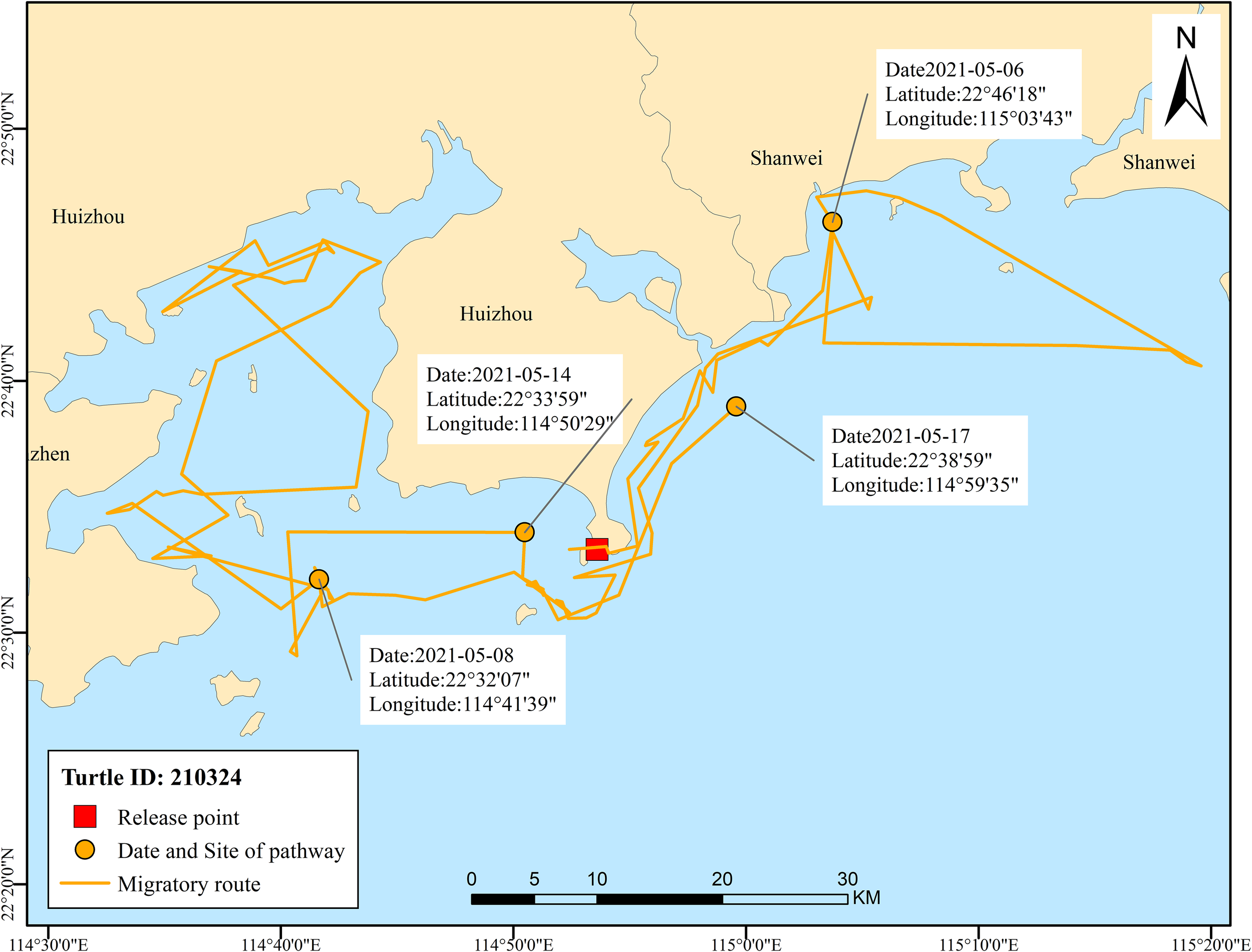
Migration map of green sea turtle with transmitter ID 210324.
The green turtle with ID 220639 (Figure 2) was released at Huidong Turtle Bay on June 8th, 2021, and arrived in Dongshan Sea at 18:01, then swam near the sea gate of Kaozhou Bay. Afterwards, the turtle lived in Honghai Bay for 6 days, reaching as far as Changsha Bay in Shanwei. On June17th, the turtle arrived in the Pearl River Estuary via Daya Bay, Dapeng Bay and the sea area of Hong Kong, and migrated to the southwest via Zhuhai, Aomen and Shangchuan&Xiachuan Island. It arrived in Xinghan village, Zhanjiang on June 26th, and arrived in Zhanjiang Port on June 30th. On July 4th, the turtle arrived in Nanshi Bay, and then arrived Yugu Port, Lingao County on July 7th, via Qiongzhou Strait. The green sea turtle lived in the sea area of Mong Cai, Vietnam and Campha, Vietnam for few days. Then the turtle swam to the sea on July 31th. On August 8th, it was located at the midpoint of the line connecting Huangmei, Vietnam and Yingge Bay, Hainan, about 160km away from the coast. Then the sea turtle headed northward and went deep into the Beibu Gulf. On August 26th, the turtle arrived in Ha Long Bay, Vietnam, and then headed for Thanh Hoa via Haiphong. On September 5th, the turtle arrived in the north of Mae Island, Vietnam, and disappeared at the southeast of the sea area of Huangmei.
Figure 2
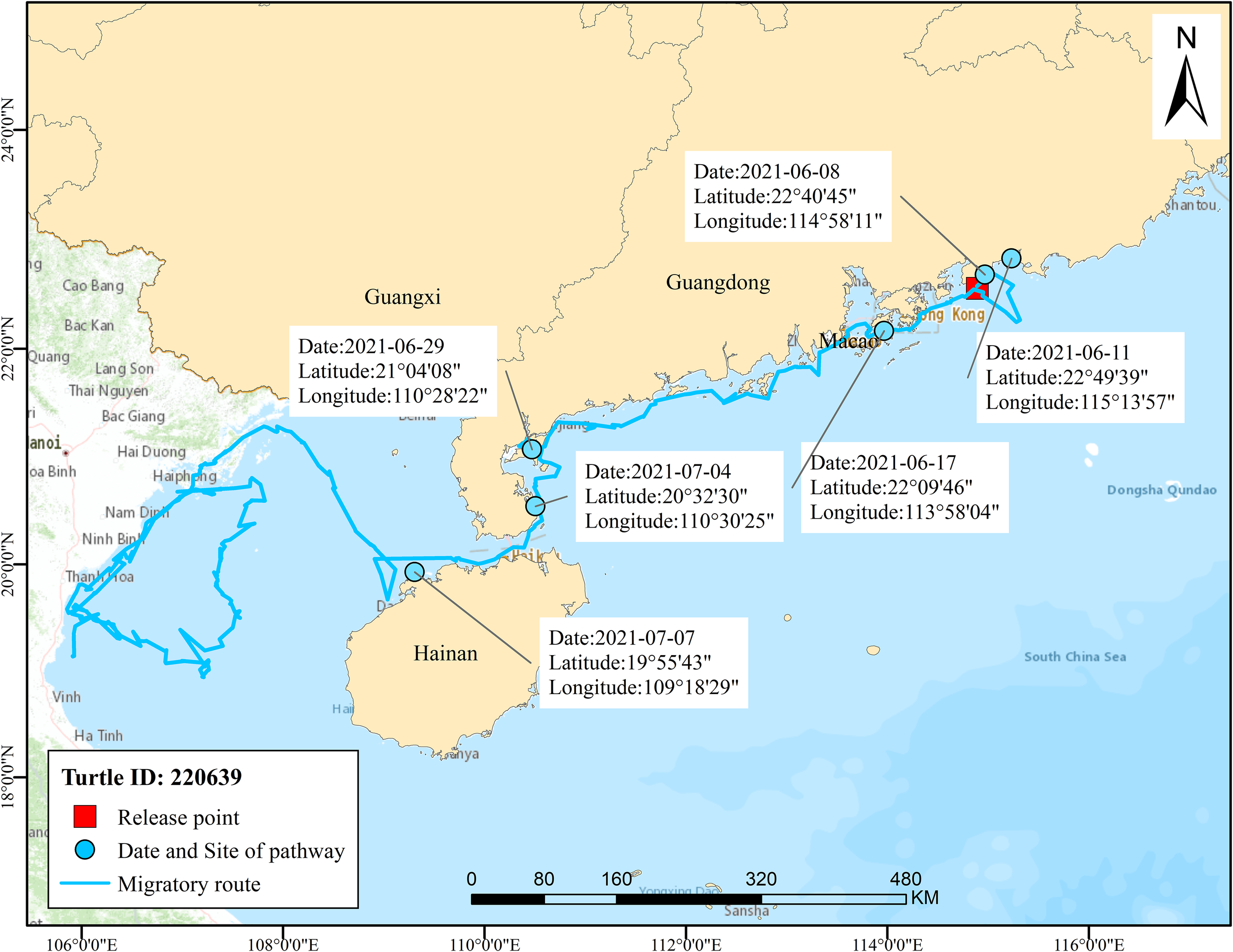
Migration map of green sea turtle with transmitter ID220639.
The green sea turtle with ID 210325 (Figure 3) was released at Huidong Turtle Bay on June 8th, 2021. Since then, the turtle has been active in the sea area near Turtle Bay. On June 16th, the turtle was located near Pinghai town and then disappeared for 17 days. On July 4th, it appeared in the sea area of Dongsha Island at the site 21.399°N, 115.286°E with no iconic island. It then migrated southward to the west and arrives at Surf Reef of Xisha Islands on July 18th, and disappeared from now on.
Figure 3
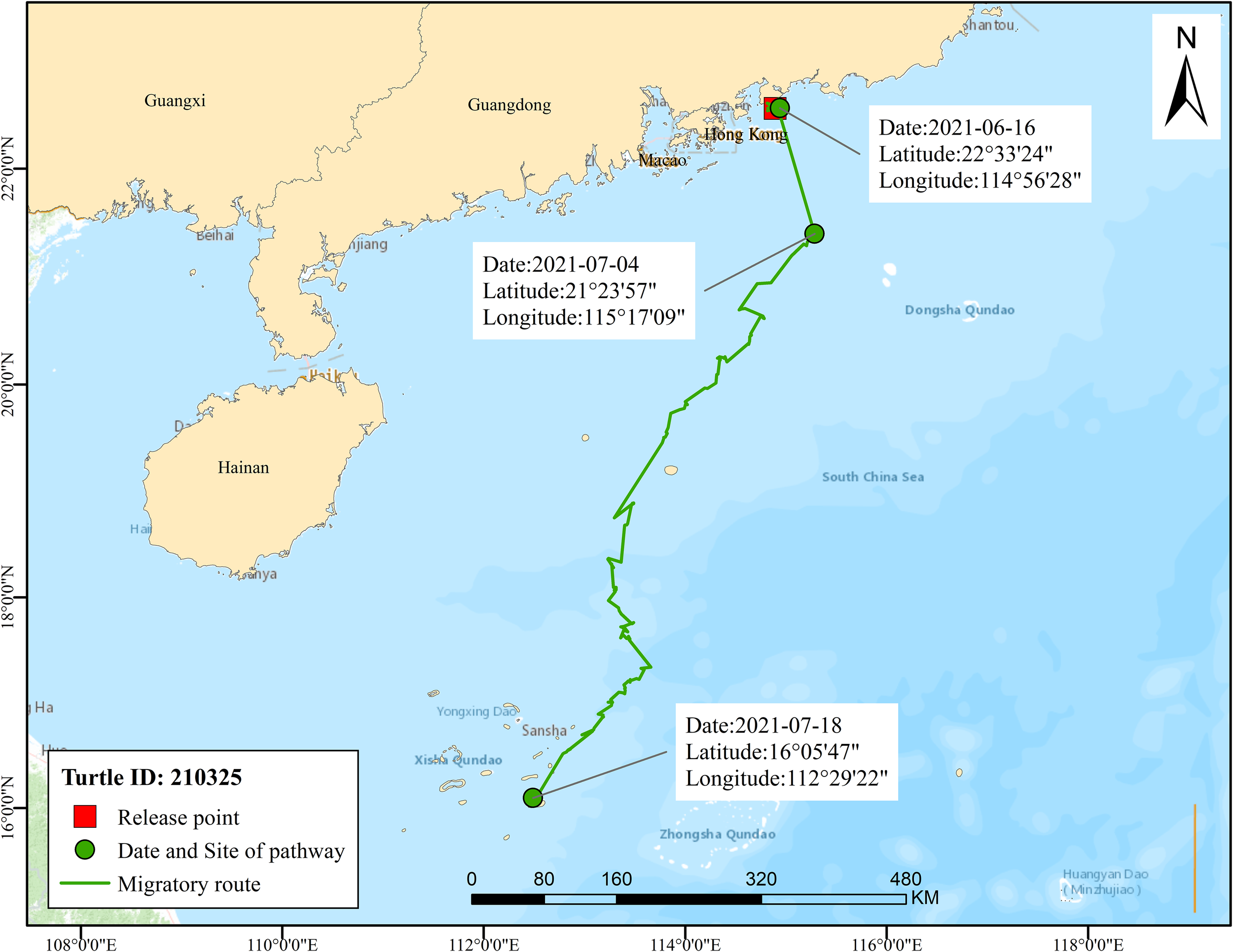
Migration map of green sea turtle with transmitter ID210325.
The green sea turtle with ID 210322 (Figure 4) was released at Huidong Turtle Bay at 18:00 on July 23rd, 2021, and arrived in Shiliu Bay at 20:06. On July 24th, the turtle was in Dongshan Sea, and headed west to the north of Sanmen Island on July 25th. Satellite tracking showed that the turtle was near Dongshan Business Hotel in Shenzhen, and then disappeared for more than 20 days. The last transmission was at 600m west of Dalajiao Island on August 24th.
Figure 4
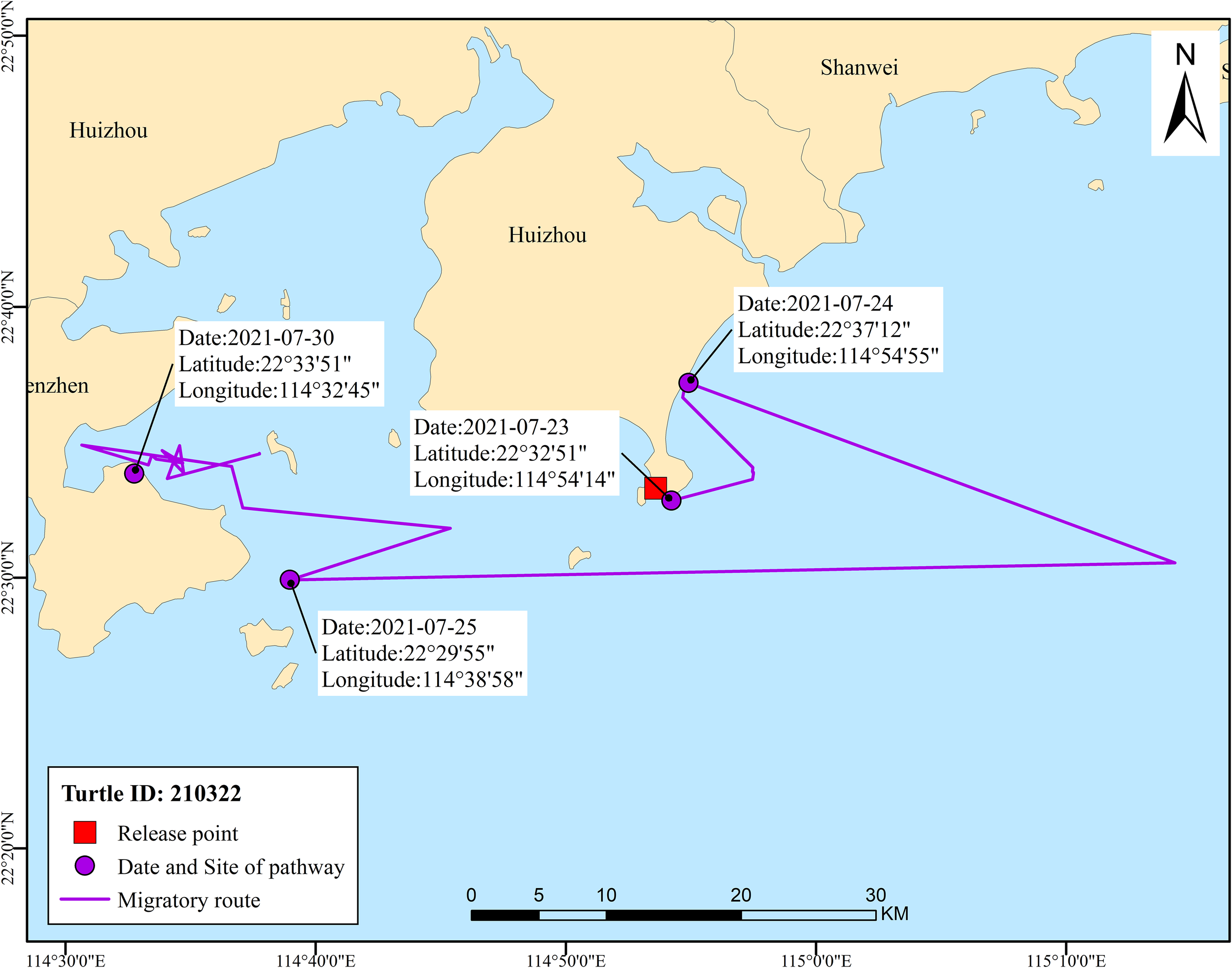
Migration map of green sea turtle with transmitter ID210322.
The breeding green sea turtle born in 2017, which was fitted with the Wildlife tracker ID 220640 (Figure 5), was released at Huidong Turtle Bay on July 23rd, 2021. The turtle headed to the Dongshan Sea, and arrived in Mangyu Island in Honghai Bay on July 24th, then passed north of Jiangmu Island on July 24th. On July 25th, the turtle arrived in Shanwei Port, and lived in Pinqing Lake from July 25th to 29th. The turtle left Shanwei port on July 31st, and arrived in Honghai Bay on August 1st. On August 10th, the turtle reached 3.2km southwest of Nan’ao Island, and headed northeast to Chishi Bay. From August 12th to August 13th, the turtle crossed the Nan’ao cross-sea Bridge, and lived among Wuyu Island, Huyu Island, Yuanyu Island and Fengyu Island on the morning of August 13th; the turtles migrate all the way to Zhelin Bay, Raoping via Shanwei, Shantou, Chaozhou (Figure 6). On August 14th, the turtle arrived in Xiaojinmen Waterway on Xunzhou Island, and arrived in Dajinmen Waterway on August 14th. Two days later, the turtle signal disappeared in the raft.
Figure 5
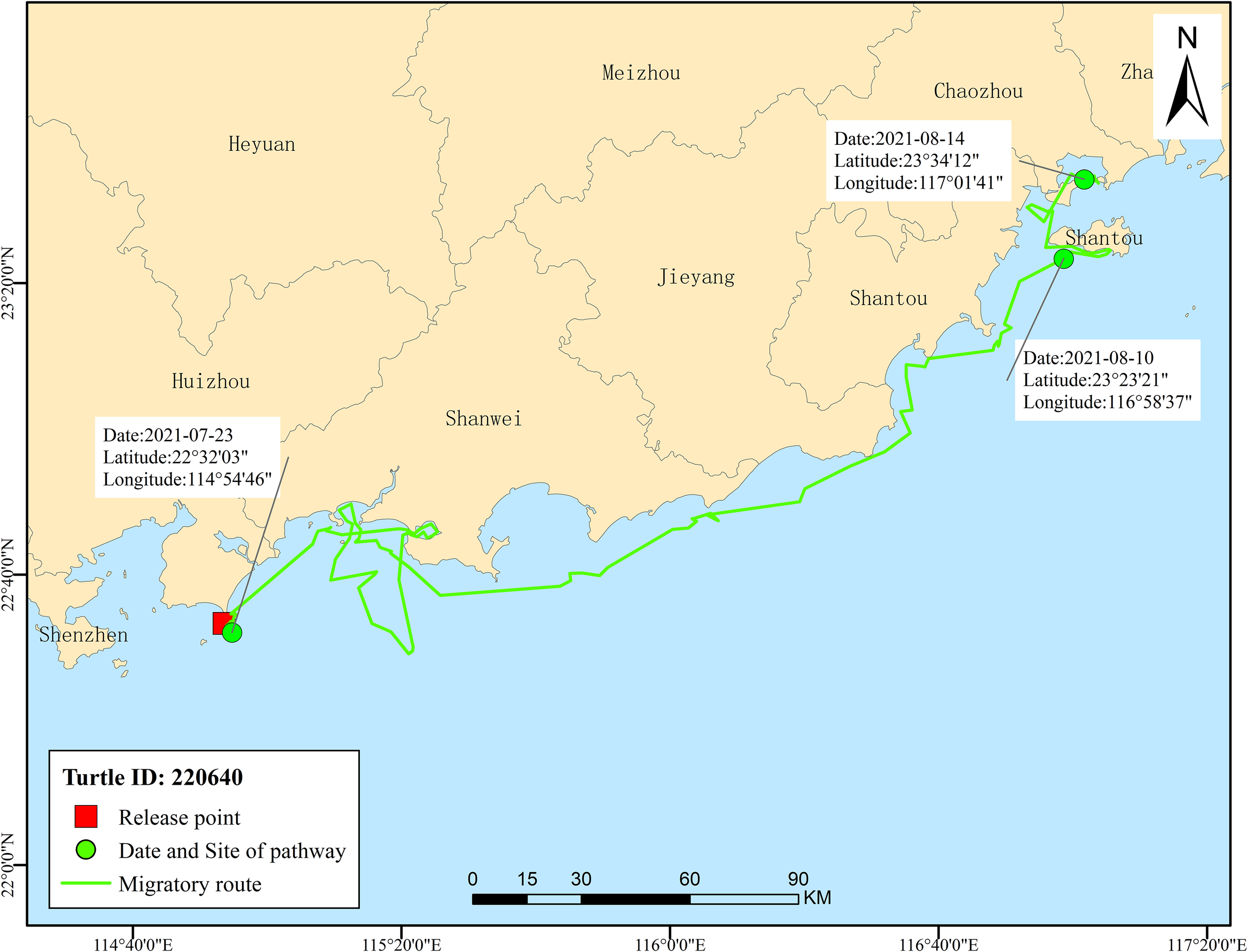
Migration map of green sea turtle with transmitter ID220640.
Figure 6
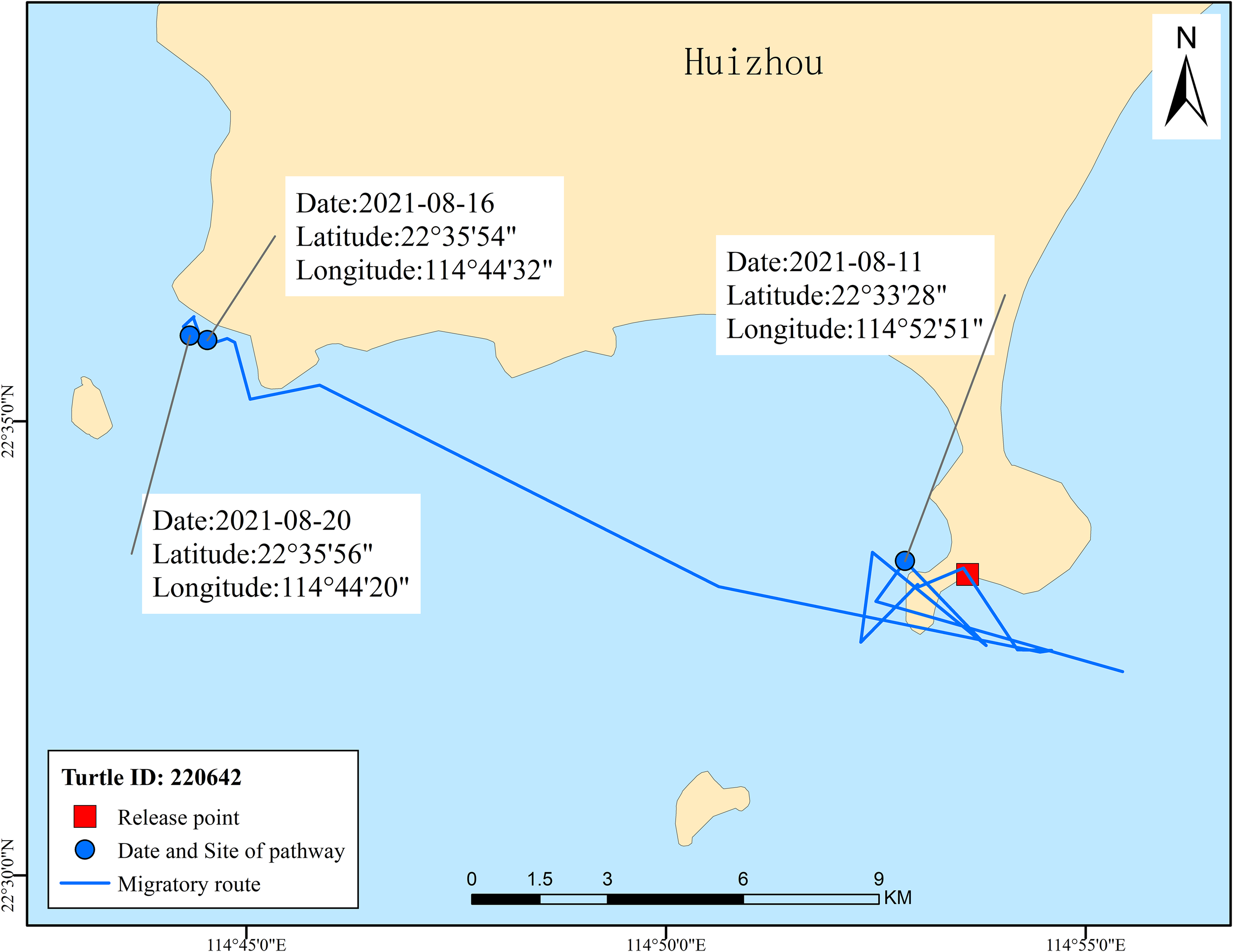
Migration map of green sea turtle with transmitter ID220642.
The green sea turtle with ID 220642 (Figure 6) was released at Huidong Turtle Bay on August 11th, 2021. The turtle swam to the 2.3km south by east of Daxingshan and returned to the shipyard (22,558°N,114.881°E). Then, it passed Fortress Hill again and reached to 1.3km directly opposite turtle Bay on August 11th. After many such tracks, the turtle arrived near the Ping Hai Power Plant in Hutoujiao on August 13th, and then its signal lost for 3 days. The turtle reappeared at a site that 380m away from the wharf (22.598°N, 114.742°E) on August 16th. On August 17th, it disappeared for a day without signal, and reappeared at a site outside this wharf on August 18th. On August 19th, the turtle swam out of the wharf and back to the north-west corner of the wharf, where is the open drain of the Pinghai power plan and dangerous for it. It sent the last transmission signal at the jetty of power plant wharf on August 20th and received no signal since then.
Movement analysis
The green sea turtles released from the Huidong Turtle Bay move along the northern coastline of the South China Sea or go straight to the South China Sea. After a month or so, they move from Huidong Turtle Bay to Hainan Lingao, Beibu Gulf and Xisha Islands. The tracking data (Table 2) shows that the longest tracking time was 91 days, the shortest time was 10 days, and the total tracking time was 213 days, of which 3 (50%) obtained tracking data for more than one month. The total movement distances (statistics with LC3-LCB) ranged from 124 to 4627 km, while the accurate movement distances (counted by dot pitch above LC0) ranged from 39.5-2331km. The average daily movement distances ranges from 3.95 to 51.4 km, and the average speed varies between 0.16 to 2.14 km/h.
Table 2
| PTT ID | Tracking days | Destination of migration | Rough movement distances (km) | Accurate movement distances (km) | Daily mileage (km) | Average speed (km/h) |
|---|---|---|---|---|---|---|
| 210324 | 15 | Dongshan sea | 388 | 211 | 14.1~25.87 | 0.59~1.08 |
| 210325 | 41 | Xisha Langhuadui | 1497 | 935 | 23.24~36.51 | 0.97~1.52 |
| 220639 | 91 | Coastal of Vinh City, Thanh Hoa, Vietnam | 4627 | 2331 | 25.9~51.4 | 1.08~2.14 |
| 210322 | 33 | Da La Jia island | 213 | 173 | 5.24~6.45 | 0.22~0.27 |
| 220640 | 23 | Zhelin Bay, Chaozhou | 1039 | 461 | 20~45.17 | 0.83~1.88 |
| 220642 | 10 | Pinghai Power Plant | 124 | 39.5 | 3.95~12.4 | 0.16~0.52 |
Analysis of tracking data of six green sea turtles.
Discussion
Turtle migration strategy
Nutritional level of green sea turtle is related to habitat change of individual development (Hirth, 1997). Green sea turtle hatchlings are mainly carnivorous or omnivorous, while sub-adults and adults are mainly herbivorous. Sea turtles use different areas for feeding and habitation, and young green sea turtles feed along offshore reef coasts or in seaweed habitats (Lamont et al., 2015). Chambault et al. (2018) found that the sea areas with seagrass beds usually have green sea turtles. Six green sea turtles tracked in this study were juveniles between 4 and 12 years old, and their migration was foraging migration. Two migration strategies were found: Some turtles such as ID220639 and ID220640 migrated along the coastline, feeding as they go. Other turtles stayed in the nearby waters, replenished sufficient nutrients, and then went straight to the open sea. These were consistent with the migratory patterns found from five turtles by Parker et al. (2015).
Analysis on the migration routes and foraging site
Turtles can correct their migratory direction and return to their meaningful migration corridors, which show a directional response soon after being released (Luschi et al., 2020; Siegwalt et al., 2020). Seagrass beds are distributed in the Beibu Gulf of Guangxi and play a very important role in protecting biodiversity (Liu, 2011; Guo, 2019). The Beibu Gulf is typical mangrove marine ecosystem. Mangroves, seagrass and coral reefs coexist along the coastline of the Beibu Gulf (Lin et al., 2020). The sea areas with seagrass beds basically have green sea turtles (Chambault et al., 2018). Chan (2004) and Chan et al. (2007) believe that the center of Beibu Gulf is foraging grounds for green sea turtles from the northern part of the South China Sea.
In our study, 3 of the 6 sea turtles such as turtles with ID210324, ID220639 and ID220640 were active in the waters around Daya Bay and Red Bay, and the others were migrating along the coastal waters of Western and Eastern Guangdong or toward the Paracel Islands (Figure 7). The turtle with ID 220639 stayed in the Red Bay for 6 days after it was released, and then it swam in Zhelin Bay and Zhanjiang Port for 5 days and lived in Beibu Bay from July 1 to September 6 until lost its signal. Tuttle with ID 220640 moved northeast along the coast, and then lived near Nan’ao Island and Zhelin Bay from August 10 to August 16. The turtle with ID 220642 and 210322 almost only swam in Daya Bay during tracing time, of which ID220642 lasted 10 days and ID210322 lasted more than one month. Route of ID 210322 turtle was shorter than others and was all in Daya Bay and Red Bay. Sea turtle with ID210325 relies on feeding on sargassum and other phytoplankton drifting in the ocean to replenish energy during its migration to Xisha Islands.
Figure 7
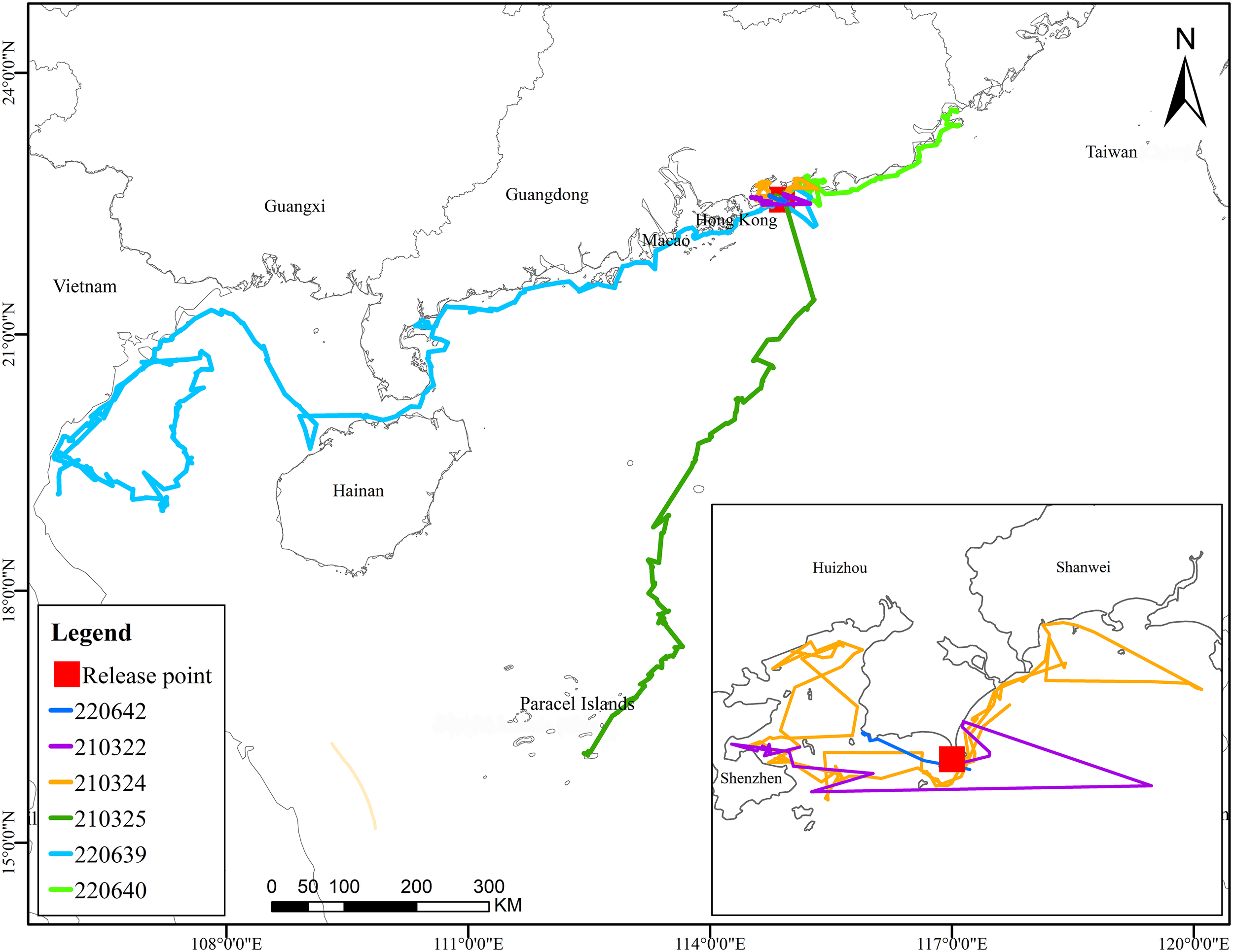
Migration routes of 6 green sea turtles.
The satellite tracker has a high positioning accuracy, because that the green sea turtles frequently go out of water to exchange air when they migrate for a long distance. By analyzing the migratory movements and the staying time in the dense areas of data points, several important foraging habitats for green sea turtles in the northern waters of the South China Sea can be determined: Beibu Bay, Zhanjiang Port, Daya Bay, Red Bay, Nan’ao Island, and Zhelin Bay (Figure 8). Ng et al. (2018) also stressed the important habitat use as foraging grounds of green sea turtles in Guangdong coastline, including Daya Bay, Mirs Bay, and Shanwai, as well as Hainan Island. Schofield et al. (2020) found that male sea turtles tend to forage near the coast and breeding sites. These important foraging habitats showed in this paper are consistent with distribution of seagrass beds or seaweed farms with rich marine biodiversity.
Figure 8
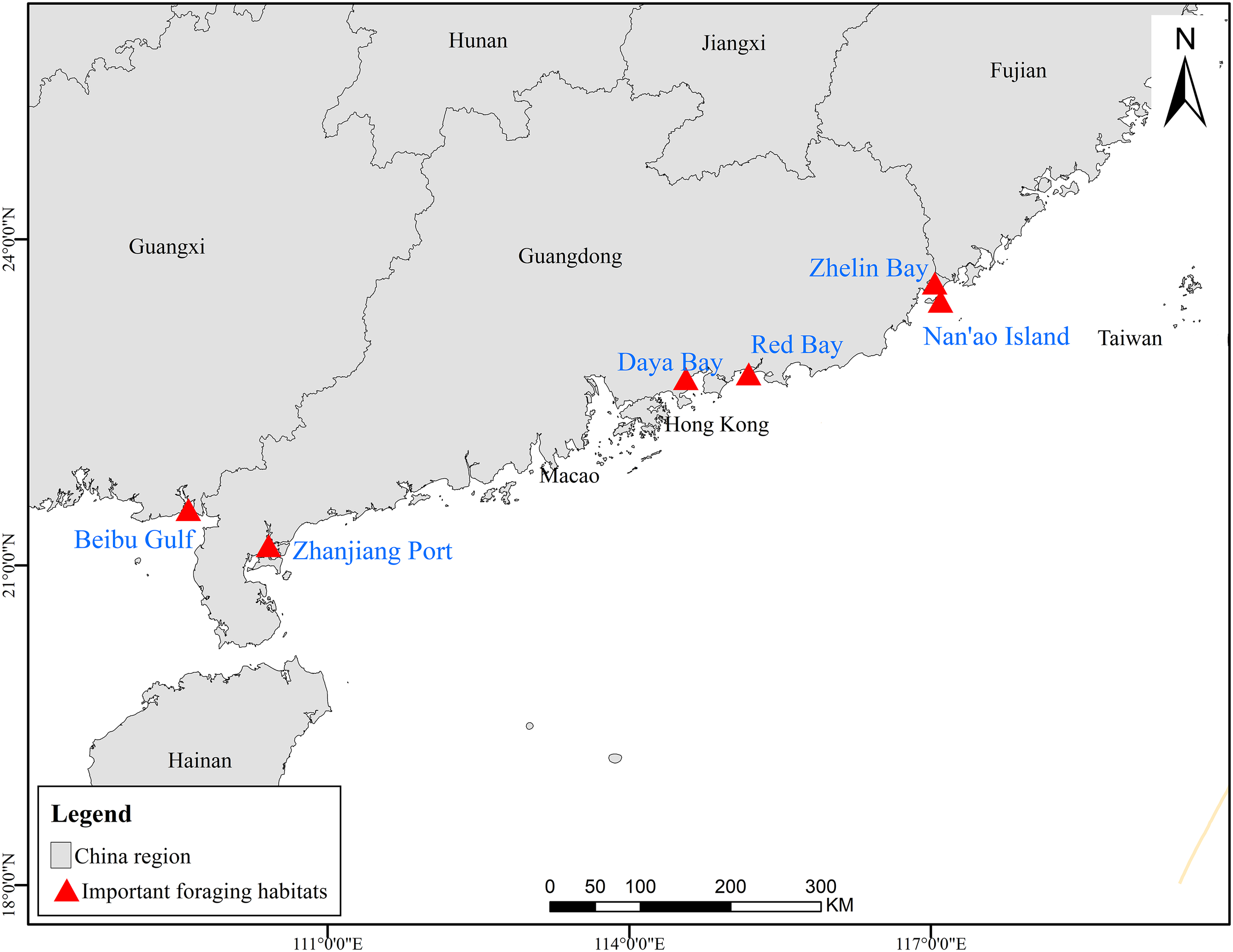
Important foraging habitats in the South China Sea.
Significance of fishing moratorium on turtle release
Fishing moratorium and hatchery release are important measures for the conservation of the green sea turtles. The existing summer fishing moratorium is from 12:00 on May 1 to 12:00 on August 16 each year in the north of latitude 12 degrees in South China Sea. Fishing moratorium is the breeding season of various marine organisms. During this period, marine animals have favorable conditions like abundant food for survival and growth, fewer fishing boats, less human interference and threat. Meanwhile, some predators are larva and small, which is conducive to improving the survival rate of released species. Fishing moratorium is the best time for sea turtles to multiply and release. Zhelin Bay is rich in seaweed which is the green sea turtle favorite food (Zheng et al., 2013). However, there are dense aquaculture facilities such as fishing rafts, and the turtle lost its signal here. Shanwei Port and Ma Gong Port are rich in plankton, and have a variety of high-quality algae such as red worms, eucheuma, gelidium, and seaweed. It is an excellent place for fish, shrimp, crabs, shellfish and sea turtles to inhabit. The turtle with ID220642 released on August 11th, 2021 had an accident at the jetty of the power plant wharf (22.599°N, 114.739°E) and lost its single on August 20th after the fishing moratorium.
Satellite tracking technology has greatly promoted the monitoring and research of migratory species (Ma, 2016). During the 2021 China’s Fishing moratorium, 6 juvenile green sea turtles were released from China’s Huidong Sea Turtle Nature Reserve, and their migration routes and foraging areas were reconstructed by satellites tracking. It is possible to understand the time and space patterns, and identify important utilization areas such as migratory passages, foraging grounds, breeding grounds to made suitable protected areas and rationally plan the space of marine site, which is good to provide targeted suggestions for setting a fishing ban (Reynolds et al., 2017; Song et al., 2018). Unfortunately, the survival rate of released animal is always influenced by environmental conditions and human interference.
According our research, the released sea turtles can migrate from Huidong Turtle Bay to Beibu Gulf, Hainan Lingao and Xisha Islands in about a month, indicating that within one month after release is a critical period for sea turtles to adapt to the wild environment in the South sea of China. The planned release of sea turtles during fishing moratorium is beneficial to the survival of released individual.
In summary, Beibu Bay, Zhanjiang Port, Daya Bay, Red Bay, Nan’ao Island and Zhelin Bay are considered to be important foraging habitats for green sea turtle in South China Sea. Fishing moratorium is the best time for released, when can improve survival drastically.
Statements
Data availability statement
The original contributions presented in the study are included in the article/supplementary material. Further inquiries can be directed to the corresponding authors.
Ethics statement
Ethical review and approval was not required for the animal study because the paper does not harm animal welfare. We studied the migratory movement and foraging grounds of green sea turtles in South China using satellite telemetry, which provides very useful data for conservation.
Author contributions
DY and HH conceived the study and drafted the manuscript. ZX and ZW carried out the field work. CN, KY and XL participated in the data analysis. XY and ZW contributed to breeding and released turtles. All authors approved the manuscript for publication. All authors contributed to the article and approved the submitted version.
Funding
This work was supported by the Science and Technology Innovation Project of Guangdong Forestry (2020KJCX005, 2022KJCX021); Science and Technology Planning Project of Huizhou, Guangdong Province, China (2020SC0302019); Science and Technology Planning Project of Guangdong Province, China (2019B121202004) and GDAS Special Project of Science and Technology Development (2018GDASCX-0107)
Conflict of interest
Author XY was employed by the company Xiyan Natural Resources Technology Guangzhou Co., Ltd.
The remaining authors declare that the research was conducted in the absence of any commercial or financial relationships that could be construed as a potential conflict of interest.
Publisher’s note
All claims expressed in this article are solely those of the authors and do not necessarily represent those of their affiliated organizations, or those of the publisher, the editors and the reviewers. Any product that may be evaluated in this article, or claim that may be made by its manufacturer, is not guaranteed or endorsed by the publisher.
References
1
Block B. A. Holbrook C. M. Simmons S. E. Holland K. N. Ault J. S. Costa D. P. et al . (2016). Toward a national animal telemetry network for aquatic observations in the united states. AnimBiotelem4 (1), 1–8. doi: 10.1186/s40317-015-0092-1
2
Chambault P. de Thoisy B. Huguin M. Martin J. Bonola M. Etienne D. et al . (2018). Connecting paths between juvenile and adult habitats in the Atlantic green turtle using genetics and satellite tracking. EcolEvol8 (24), 12790–12802. doi: 10.1002/ece3.4708
3
Chan S. (2004). “Green turtles in Hong Kong,” in Hong Kong: Agriculture, fisheries and conservation Department/Friends of the country parks, 2nd ed. (Hong Kong: Cosmos Books Ltd.), 127.
4
Chan S. K. F. Cheng I. J. Zhou T. Wang H. J. Gu H. X. Song X. J. (2007). A comprehensive overview of the population and conservation status of sea turtles in China. Chelonian Conserv. Bi6 (2), 185–198. doi: 10.2744/1071-8443(2007)6[185:acootp]2.0.co;2
5
Doherty P. D. Broderick A. C. Godley B. J. Hart K. A. Phillips Q. Sanghera A. et al . (2020). Spatial ecology of sub-adult green turtles in coastal waters of the Turks and Caicos islands: implications for conservation management. Front. Mar. Sci.690. doi: 10.3389/fmars.2020.00690
6
Gredzens C. Shaver D. J. (2020). Satellite tracking can inform population-level dispersal to foraging grounds of post-nesting kemp's ridley sea turtles. Front. Mar. Sci.7. doi: 10.3389/fmars.2020.00559
7
Guo Y. X. (2019). Eco-economic value evaluation of seagrass beds in guangxi beibu gulf and protection countermeasures. Modern Agric. Sci. Technol.02, 170–173. doi: 10.3969/j.issn.1007-5739.2019.02.107
8
Hirth H. F. (1997). “Synopsis of the biological data on the green turtle chelonia mydas (Linnaeus 1758),” in Fish and Wildlife Service, Washington. USFWS biological report, 3–120.
9
Iverson A. R. Fujisaki I. Lamont M. M. Hart K. M. (2019). Loggerhead sea turtle (Caretta caretta) diving changes with productivity, behavioral mode, and sea surface temperature. PloS One14 (8), e0220372. doi: 10.1371/journal.pone.0220372
10
Lamont M. M. Fujisaki I. Stephens B. S. Yu K. Hackett C. (2015). Home range and habitat use of juvenile green turtles (Chelonia mydas) in the northern gulf of Mexico. AnimBiotelem3 (1), 1–12. doi: 10.1186/s40317-015-0089-9
11
Lin W. Feng Y. Yu K. Lan W. Wang Y. Mo Z. N. et al . (2020). Long-lived radionuclides in marine sediments from the beibu gulf, south China Sea: Spatial distribution, controlling factors, and proxy for transport pathway. Mar. Geology424, 106157. doi: 10.1016/j.margeo.2020.106157
12
Liu R. Y. (2011). Progress of marine biodiversity studies in China seas. Biodiversity Sci.19 (6), 614–626. doi: 10.3724/SP.J.1003.2011.13185
13
Luo Y. (2020). Work together to build a sound sea turtle protection system. Ocean Fishery2020 (3), 32–34. doi: 10.3969/j.issn.1672-4046(s).2020.05.013
14
Luschi P. Sözbilen D. Cerritelli G. Ruffier F. Başkale E. Casale P. (2020). A biphasic navigational strategy in loggerhead sea turtles. Sci. rep-UK10, 18130. doi: 10.1038/s41598-020-75183-6
15
Ma K. (2016). Biodiversity monitoring relies on the integration of human observation and automatic collection of data with advanced equipment and facilities. Biodiversity Sci.24 (11), 1201–1202. doi: 10.17520/biods.2016343
16
Mettler E. Clyde-Brockway C. E. Honarvar S. Paladino F. V. (2019). Migratory corridor linking Atlantic green turtle, chelonia mydas, nesting site on bioko island, equatorial Guinea to ghanaian foraging grounds. PloS One14 (6), e0213231. doi: 10.1371/journal.pone.0213231
17
Ng C. K. Y. Lam J. C. W. Zhang X. H. Gu H. X. Li T. H. Ye M. B. et al . (2018). Levels of trace elements, methylmercury and polybrominated diphenyl ethers in foraging green turtles in the south China region and their conservation implications. Environ. pollut.234, 735–742. doi: 10.1016/j.envpol.2017.11.100
18
Parker D. M. Balazs G. H. Frutchey K. A. R. E. N. Kabua E. M. M. A. Langridrik M. Boktok K. (2015). Conservation considerations revealed by the movements of post-nesting green turtles from the republic of the Marshall islands. Micronesica3, 1–9. doi: 10.1371/journal.pone.0213231
19
Prosdocimi L. Teryda N. S. Navarro G. S. Carthy R. R. (2021). Use of remote sensing tools to predict focal areas for sea turtle conservation in the south-western Atlantic. Aquat Conserv.31 (4), 830–840. doi: 10.1002/aqc.3478
20
Reynolds S. D. Norman B. M. Beger M. Franklin C. E. Dwyer R. G. (2017). Movement, distribution and marine reserve use by an endangered migratory giant. Divers. Distrib23 (11), 1268–1279. doi: 10.1111/ddi.12618
21
Robinson D. P. Hyland K. Beukes G. Vettan A. Baverstock W. (2021). Satellite tracking of rehabilitated sea turtles suggests a high rate of short-term survival following release. PloS One16 (2), e0246241. doi: 10.1371/journal.pone.0246241
22
Schofield G. Klaassen M. Papafitsoros K. Lilley M. K. Katselidis K. A. Hays G. C. (2020). Long-term photo-id and satellite tracking reveal sex-biased survival linked to movements in an endangered species. Ecology101 (7), e03027. doi: 10.1002/ecy.3027
23
Siegwalt F. Benhamou S. Girondot M. Jeantet L. Martin J. Bonola M. et al . (2020). High fidelity of sea turtles to their foraging grounds revealed by satellite tracking and capture-mark-recapture: New insights for the establishment of key marine conservation areas. Biol. Conserv.250, 108742. doi: 10.1016/j.biocon.2020.108742
24
Song R. Yao J. Wu K. Zhang X. Lü Z. Zhu Z. et al . (2018). Evaluation of the effectiveness of marine protected areas: Methodologies and progress. Biodiversity Sci.26 (3), 286–294. doi: 10.17520/biods.2018005
25
Suhaimi N. S. Daud N. R. Akhir M. F. Rusli M. U. (2020). Oceanic dispersal model of green turtle hatchlings in the south China Sea. Malaysian Appl. Biol.49 (4), 41–55. doi: 10.55230/mabjournal.v49i4.1566
26
Vilaça S. T. Piccinno R. Rota-Stabelli O. Gabrielli. M. Benazzo. A. Matschiner. M. et al . (2021). Divergence and hybridization in sea turtles: Inferences from genome data show evidence of ancient gene flow between species. Mol. Ecol2021 (30), 6178–6192. doi: 10.1111/mec.16113
27
Xia Z. R. (2017). Scientific conservation can restore sea turtle populations. Ocean Fishery5, 46–47. doi: 10.3969/j.issn.1672-4046.2017.05.013
28
Xia Z. R. Gu H. X. LI P. P. (2008). Resources and protection of Sea turtles in the world. Chin. J. Wildlife29 (6), 312–316. doi: 10.19711/j.cnki.issn.2310-1490.2008.06.010
29
Xia Z. R. Lin R. J. (2020). A historical review of sea turtle resources in huidong harbor turtle reserve. Oceans Fisheries2020 (7), 76–77. doi: 10.3969/j.issn.1672-4046(s).2020.07.048
30
Xia Z. R. Yu H. Q. Yang F. Liu X. F. Yu D. M. Hu H. J. (2022). Application of Quick Response Code in Sea Turtle Conservation: Overcoming Limitations of Existing Individual Markers. Front. Mar. Sci.8:818185. doi: 10.3389/fmars.2021.818185
31
Xing Y. K. Wang L. L. Liu M. Zhao L. L. Kang B. (2021). Global prediction of spatial distribution and migratory corridors of green turtles based on species distribution modeling. J. Fishery Sci. China28 (10), 1337–1345. doi: 10.12264/JFSC2021-0153
32
Yeh F. C. Lin L. Zhang T. Green R. Martin F. Shi H. (2021). Advancing sea turtle conservation in the south China Sea via US-China diplomacy. Environ. Prog. Sustain40 (5), e13643. doi: 10.1002/ep.13643
33
Zheng F. Y. Qiu G. L. Fan H. Q. Zhang. W. (2013). Diversity, distribution and conservation of Chinese seagrass species. Biodiversity Sci.21 (5), 517–526. doi: 10.3724/SP.J.1003.2013.10038
Summary
Keywords
released turtle, satellite tracking, migratory route, foraging ground, conservation
Citation
Yu D, Xia Z, Yang X, Ng CKY, Yang K, Wu Z, Liu X and Hu H (2023) Migratory movements and foraging grounds of endangered green sea turtles in South China Sea based on satellite telemetry during fishing moratorium. Front. Mar. Sci. 10:1105264. doi: 10.3389/fmars.2023.1105264
Received
22 November 2022
Accepted
16 January 2023
Published
14 February 2023
Volume
10 - 2023
Edited by
Bin Xia, Qingdao Agricultural University, China
Reviewed by
Qingzhi Wang, Liaoning Ocean and Fisheries Research Institute, China; Gang Li, South China Sea Institute of Oceanology, Chinese Academy of Sciences (CAS), China; Weijun Wang, Ludong University, China
Updates
Copyright
© 2023 Yu, Xia, Yang, Ng, Yang, Wu, Liu and Hu.
This is an open-access article distributed under the terms of the Creative Commons Attribution License (CC BY). The use, distribution or reproduction in other forums is permitted, provided the original author(s) and the copyright owner(s) are credited and that the original publication in this journal is cited, in accordance with accepted academic practice. No use, distribution or reproduction is permitted which does not comply with these terms.
*Correspondence: Zhongrong Xia, 450123161@qq.com; Huijian Hu, 13922339577@139.com
†These authors have contributed equally to this work
This article was submitted to Marine Fisheries, Aquaculture and Living Resources, a section of the journal Frontiers in Marine Science
Disclaimer
All claims expressed in this article are solely those of the authors and do not necessarily represent those of their affiliated organizations, or those of the publisher, the editors and the reviewers. Any product that may be evaluated in this article or claim that may be made by its manufacturer is not guaranteed or endorsed by the publisher.