Abstract
Previous research has shown that the general population are more likely to learn about certain species groups (such as sharks) from popular media as opposed to their own first-hand experience. Yet, personal encounters with these animals can drastically affect people’s beliefs and behaviors. This study surveyed 380 members of the public to assess their previous experience of encountering sharks and stingrays in the wild as well as at zoos and aquaria, and tested how said experiences influenced their behavioral intentions of tolerance for these particular elasmobranchs. Results indicated that self-reported experience having previously encountered these species groups in the wild was predictive of all assessed behavioral indicators of tolerance for sharks and rays. Self-reported previous encounters with captive animals were predictive of fewer behavioral intentions of tolerance, and only for the tolerance of sharks. Findings reveal the important role that first-hand interaction with these animals plays in humans’ tolerance to coexist and care for these animals and their habitat. Implications for conservation are discussed.
1 Introduction
Misperceptions and negative stigmas about sharks and their behavior are pervasive and continue to proliferate despite copious research that suggests such attributions are grossly exaggerated (Carmi et al., 2022). Such prejudice no doubt contributes to the anthropogenic behaviors that are both directly and indirectly responsible for the critical declines in chondrichthyan populations over the past few decades, most notably climate change and overfishing (Dulvy et al., 2021; Shiffman et al., 2020). These dangers are compounded by sharks’ enhanced vulnerability to extinction by grace of their low rate of reproduction, relatively later age of maturity, and high mortality rates (Friedrich et al., 2014). As a result, these species are more difficult to protect and have a harder road to recovery than most in the face of ongoing threats. Myers et al (2007) not only observed the disturbing declines in shark populations, but also detail the far-reaching, top-down, negative consequences for an ecosystem without one of its key apex predators. Stingrays, another notable chondrichthyan species group who share ecosystems with sharks, are similarly in concerning decline. Consequently, to ensure a healthy ocean, and therefore a healthy planet, humans need to act in such a way as to promote the conservation of these animals and their habitats. While many behaviors can support this wider goal (e.g., using public transport, participating in clean-up initiatives, composting, etc.), this work focuses on behaviors associated with tolerance of these elasmobranchs. Specifically, this exploratory, survey-driven study assessed self-reported previous experience of encountering a shark or stingray (whether in the wild or in a controlled facility such as a zoo or aquarium) to determine whether the type of experience or the species group affected people’s tolerance toward these animals in the form of coexistence behaviors.
Acuña-Marreo et al (2018) put forward a theoretical framework of the cognitive, affective, and experiential underpinnings of shark conservation (see Figure 1). This theory encapsulates macro-level contributors (such as the wider social and ecological context in which people are interacting with sharks), and micro-level interpersonal factors such as intrinsic (i.e., cognitions and affects) and extrinsic (personal experiences and knowledge) precursors. These personal antecedents interact with one another to motivate various, interrelated behavioral components that support shark conservation, including a desire to learn more about these species, support for their protection, and key to this specific study, tolerance. This study therefore tests the pathways from the extrinsic antecedent of experience to the behavioral component of tolerance.
Figure 1
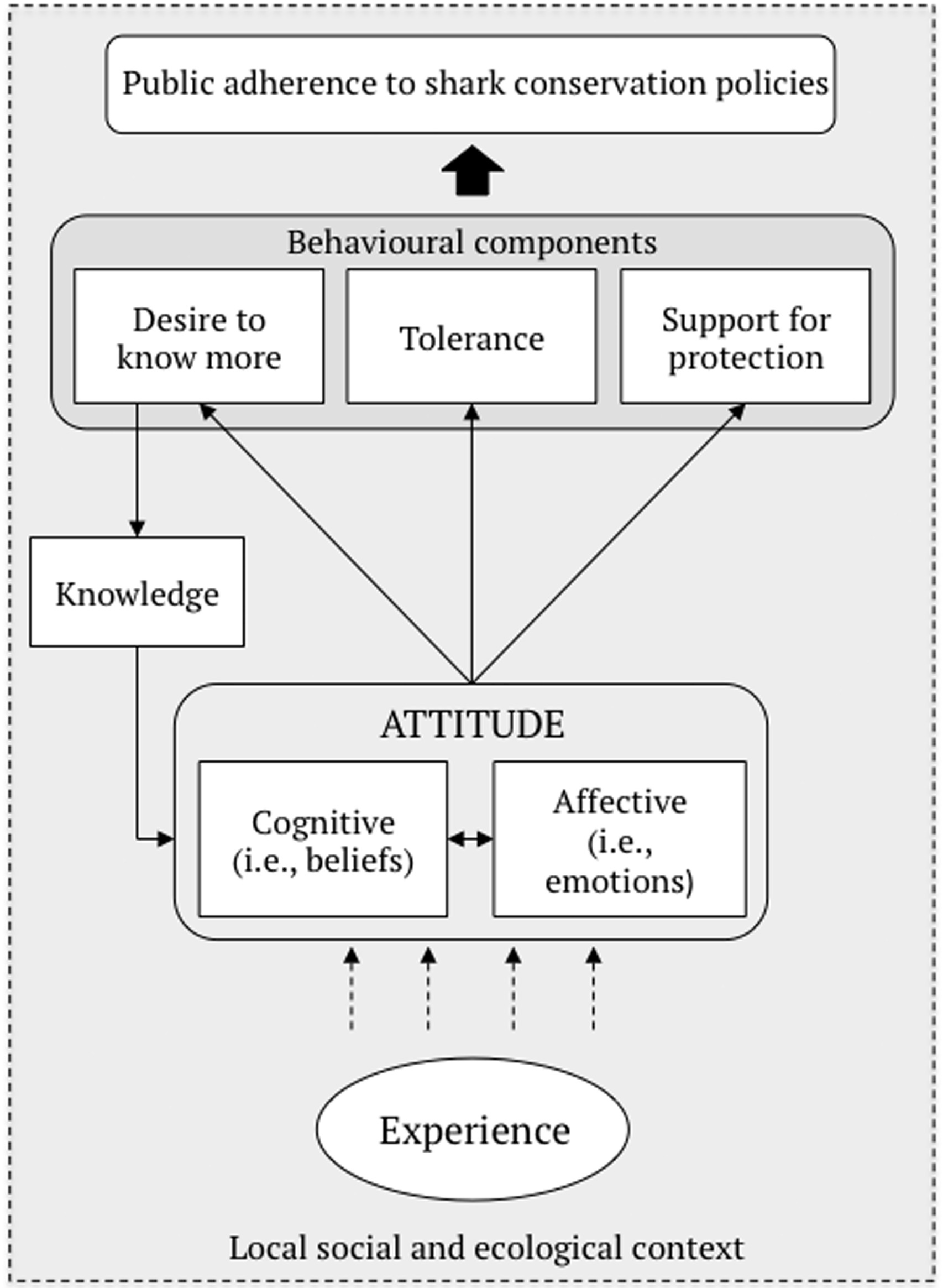
The Acuña-Marrero et al. (2018) theoretical framework of the intrinsic and extrinsic human factors underlying shark conservation. Reprinted from Marine Policy, Vol. 91, Acuña-Marrero, de la Cruz-Modino, Smith, Salinas-de-León, Pawley, and Anderson, ‘Understanding human attitudes towards sharks to promote sustainable coexistence’, pp. 122-128, 2018, with permission from Elsevier.
Tolerance is “the state of neutral or positive attitude manifested as a neutral to positive behavior towards wildlife despite their real or potential negative impacts” (Bhatia et al., 2020, p. 6). This construct therefore inherently encompasses both intrinsic (attitudinal) and extrinsic (experiential) antecedents to tolerance behaviors. The authors have examined the effect of such intrinsic factors as cognitive beliefs elsewhere (Hancock et al., 2023), and so this work focuses instead on the extrinsic factor of previous experience with these animals to investigate its effects on behavioral tolerance of wildlife in terms of coexistence (i.e., willingness to put oneself in the same space as these animals at different thresholds of perceived risk, either within one-month or within 24-hours of a confirmed sighting). Operationalizing the dependent measures as behavioral intentions of coexistence is not typical. In the literature, tolerance for wildlife has been operationalized as an attitude (psychological tendency to evaluate something as favorable or disfavorable), a belief (subjective acceptance that something is true), an affect (a pleasant, unpleasant, or neutral feeling), or a behavior (observable actions or reactions; Brenner and Metcalf, 2020; Slagle and Bruskotter, 2019). Heberlein (2012) stressed that attitudes are not always reliable predictors of behavioral change, which increases the risk of overestimating tolerance if operationalized exclusively as an attitude; while defining tolerance exclusively as observable behaviors may therefore underestimate tolerance (Slagle and Bruskotter, 2019). To mitigate these risks, this study therefore adopted the aforementioned Bhatia et al (2020) definition of tolerance that encapsulates both attitudinal and behavioral factors, and operationalized tolerance as a behavioral intention of coexistence.
As a result, the novelty and importance of this work lie in the following considerations: it concurrently 1) differentiates between self-reported experience with wild versus captive animals (in the wild/at the beach versus in a zoo/aquarium), 2) examines cross-taxa effects (sharks versus stingrays), and 3) the pro-conservation behaviors are focused on coexistence with the animals themselves, rather than behaviors focused on conservation of the planet as a whole (e.g., recycling, etc.). While past research has observed that personal encounters with wild terrestrial predators can increase tolerance (Johansson et al., 2019), this study is the first study to examine this relationship with aquatic predators. Moreover, this study does not limit this investigation to a single species, broadening the scope to establish whether a personal experience with one type of animal can increase tolerance across species groups (i.e., could encountering a stingray increase tolerance for sharks and vice versa)? and across contexts (i.e., could encountering a captive animal increase tolerance for those inhabiting the wild)?.
Analyses herein juxtapose experiences with sharks and stingrays. These taxonomic groups were selected for comparison given the notable discrepancies between the real and perceived risks posed by these respective elasmobranchs in their engagement with humans. To clarify, people harbor misconceptions of sharks as savage, insatiable predators with a predilection for human prey (López de la Lama et al., 2018). Yet, there were only 799 unprovoked shark attacks throughout the world in the decade spanning 2010-2019 (International Shark Attack File Attacks & Fatalities, n.d). Compare this figure with the 10,000 injuries inflicted annually by encounters with stingrays at only a few beaches in California; a conservative estimate given that these numbers entail only reported cases, the true number may be much higher (Lowe et al., 2007; Lowe et al., unpub. data; Eriksson et al., unpub. data). Numerically speaking, the odds of being injured by a stingray are then at least an order of magnitude higher when compared to the odds of being injured by a shark, and yet these incidents are rarely – if ever – broadcast as news as shark bite events often are. Consequently, investigating any differences between the two taxonomic groups in terms of interactions with them and tolerance of them can shed an interesting light on how best to ensure that people’s understanding of these fish and their behaviors is accurate.
Knowledge therefore constitutes a critical counterweight against the negative, learned misconceptions that currently underlie popular opinion about sharks. Enhancing knowledge through education is the most effective method by which to redress the misinformation that biases the public’s perceptions and undermines support for sharks’ conservation (Panoch and Pearson, 2017; Afonso et al., 2020). Rectifying misconceptions in the general public is critically important as research shows that even motivated and interested parties with a working knowledge of coastal and oceanic issues, such as recreational anglers and scuba divers, can still be misinformed (Drymon and Scyphers, 2017), or act in such a way that is detrimental to the safety of both animals and humans in direct encounters (Lucrezi et al., 2020). The need for accurate, clear education becomes increasingly pressing considering that people are less likely to learn about sharks from their own personal experience than they are via the media, which has been shown to perpetuate negative stereotypes and misinformation (Shiffman et al., 2020; Whitenack et al., 2021; Evans, 2015).
Jarvis (2019) and Aich (2021) attest that without personal experience to inform them, the vacuum in the general public’s understanding of sharks is filled by popular and social media. Jarvis (2019) explains that this knowledge base, across history, is consequently largely fiction (paintings, the film Jaws, etc.), but even non-fiction like news reports and the Discovery Channel’s Shark Week – demonize and frame sharks as monsters. According to Neff (2015), this enduring trend is most likely due to the staunchly entrenched, though incorrect, belief that sharks actively and purposefully prey on humans. Empirically speaking, Beall et al. (2023) found that tolerance of sharks was significantly influenced by social media (i.e., YouTube videos), but that the effects were highly dependent on (positive versus negative) framing. To this end, research has further shown that even high-profile events meant to be positive, educational, and supportive of shark conservation, such as the Discovery Channel’s Shark Week programming, still portray sharks negatively more often than positively (Whitenack et al., 2021). News media as well disproportionately report shark attacks as opposed to conservation messages (Muter et al., 2013). It is no wonder then that public attitudes continue to be so negative toward these species when people more often learn about them from the media rather than their own experience (Evans, 2015).
Knowledge gained through personal experience is therefore incredibly important. Research consistently shows that it can successfully change people’s beliefs about animals and the perceived risk of interacting with them (Hoberg et al., 2021; Skupien et al., 2016). Moreover, direct exposure to wild animals in their natural habitat seems to have a greater impact on people than strategies that seek to inform and educate alone such as classroom-based educational programs (Johansson et al., 2019). Even brief experiences with animals in the wild can have short- and long-term effects on cognitions, feelings, behaviors (Apps et al., 2018) and environmental practices (Ballantyne et al., 2011).
Apps et al (2018) analyzed survey responses from 136 participants after a white shark (Carcharodon carcharias) cage-diving experience in Australia. The experience allowed participants to view wild white sharks from the deck of the vessel, from a specialized underwater viewing platform onboard the vessel, and/or from within a cage in the water itself. Importantly, the tour material did not contain any explicit conservation messages or calls to action. The results indicated not only more positive attitudes and concern for the sharks, but an observed increase in seven of the eight pro-shark conservation behaviors assessed. Koeneke Hoenicka et al (2022) similarly observed a pre-post positive shift in perceptions toward white sharks following a cage-diving experience in a sample from South Africa. Personal experience of encountering sharks at aquaria or zoos can have similar positive effects. Neves et al (2023) found that encountering sharks at an aquarium, wherein emphasis was placed on their social behaviors, led to more positive perceptions of sharks.
There are comparatively far fewer studies addressing the effects of experience with stingrays on their perceptions and conservation. Semeniuk et al (2009) interviewed tourists at the Stingray City Sandbar (SCS), a popular sandbar and stingray-feeding location in the Cayman Islands. The study sought to solicit tourists’ preferences for wildlife-management strategies in hypothetical viewing experiences. Results indicated common themes of a desire to continue the practice of feeding and handling wild stingrays and concern for the animals and the impact of the tourism practices. These findings therefore indirectly suggest that encountering stingrays in the wild promotes tolerance of them.
Personal experience consequently has a powerful effect on pro-conservation attitudes and tolerance. However, there are different kinds of experiences with animals; for example, observing a captive animal in a man-made facility (i.e., zoo or aquarium), engaging with a wild animal with safeguards in place (e.g., cage-diving, field excursions that track a radio telemetered animal, etc.), or an encounter with a wild animal in its natural habitat without such protections. Touch tanks, for example, are educational experiences designed and implemented at aquarium facilities that use personal interaction (touching, petting, feeding) with animals as a teaching tool (Biasetti et al., 2020; Rowe and Kisiel, 2012). These structured facilities, accompanied by appropriate staff instruction and oversight, enable safe and direct personal experience (Marcelline, 2021). People are then able to have a safe, positive, first-hand encounter with these animals without the ubiquitous fear of injury - oftentimes, stingrays in such tanks have had their stingers removed. On the other hand, in the wild, such a risk of injury cannot be similarly mitigated. The two types of experiences therefore remain categorically different. It also has not been established whether such experiences with one animal would influence people’s tolerance of other taxa. Consequently, this paper examined self-reported personal experiences of encountering animals of different species groups (sharks versus stingrays) in disparate conditions (in the wild versus in aquaria/zoos) to determine their effects on pro-conservation behavioral intentions of tolerance focused on coexistence (i.e., willingness to be in the water with the animal) at varying levels of perceived risk (i.e., within 30-days or within 1-day of a confirmed sighting). This work therefore constitutes the first study to examine previous experience as a predictor of tolerance in the form of behavioral intentions of coexistence with specific taxa. It was hypothesized that previous experience would predict greater tolerance, that the effect would be taxa-specific, and that previous encounters with wild animals would be more impactful when compared to those with captive animals.
These research questions are not only critical to understand in the present day, but will also become more important in the future. Climate change is significantly affecting the geographic range and displacement of an unprecedented number of species (Matthew et al., 2022). The number of non-protected encounters with wildlife will not only increase dramatically but will also occur in novel geographic locations where there is perhaps little to no established local knowledge for how to predict, educate, inform, manage, and react to such eventualities. Appropriate education, using findings from the present study and current literature, will be key to preventing the negative effects of such inevitable human-wildlife interactions.
2 Materials and methods
The description of the dataset parallels that of Hancock et al (2023) as follows in this section, with some modifications. Ethical approval was granted by the university’s Institutional Review Board, and all participants provided informed consent before completing the survey.
2.1 Participants
Recruitment yielded four hundred and thirty participants who agreed to complete the survey. However, due to attrition, 50 participants were not included; having provided informed consent to participate, they subsequently provided no further data. As a result, analyses were conducted on a sample of 380 participants (243 females, 122 males, and 15 participants who opted not to specify their sex). Ages ranged from 18-82 years old with an average age of 35.3 years (SD = 15.2 years). Fifty-five participants chose not to identify their ages.
California residents comprised 74% of the analytical sample (281), 19.2% of participants were from other states in the US (73), 4.4% were from other countries (17), and 2.4% of participants did not disclose their place of residence. With regard to the sample’s racial and ethnic composition, 62% (234) of respondents were Caucasian, 14% (52) were Hispanic/Latinx, 7% (27) were Asian/Asian-American, 2% (8) were African-American, 9% (34) identified as Mixed or Multi-Ethnic, 3% (12) self-identified as Other, and 3% (13) chose not to disclose their ethnicity. Concerning highest level of education, 31% (119) of participants reported completing a high school or General Educational Development (GED) degree, 34% (129) completed a Bachelor’s degree, 19% (73) held a Master’s degree, 7% (24) had earned a doctoral degree, 8% (30) specified Other, and 1% (5) did not disclose their level of education.
Recruitment took place both in-person and digitally. In-person efforts were conducted via 20 educational facilities hosted at various California beach facilities (beaches and piers). Digital recruitment included the posting of advertisement flyers via the CSULB Shark Lab’s website and social media accounts (e.g., Instagram, Facebook), and internal participant pool recruitment and management systems (i.e., SONA). In each case, participants were provided a Quick Response (QR) code that would allow them to complete the 65-item survey on a digital device. Data were collected via Qualtrics software (Qualtrics XM; Seattle, WA) over a three-month period in 2021 (June-August). Most participants self-reported completing the survey at home (314, 82.6%), while others reported completing it at the beach facilities (15, 3.9%), at an aquarium or zoo (3, 0.8%), or other, most often specified as school, work, or a hotel (45, 11.8%). Three participants (0.9%) chose not to disclose the location in which they took part in the study. Just a note that these estimates may not accurately reflect the location from which each participant was recruited as the QR code afforded the ability to be recruited in one place but complete the survey in a different location. Further issues pertaining to recruitment and representativeness are discussed in greater detail in the limitations section.
One notable and important consideration regarding data collection that must be disclosed and emphasized was the IRB-mandated option for participants to refrain from answering any particular item on the questionnaire. The Institutional Review Board allows for participants to opt to abstain from answering any item they deem to be discomforting. Adherence to this provision therefore necessarily resulted in missing cases in certain analyses. Additional considerations about this issue and its effects are also further discussed in the forthcoming limitations section.
2.2 Experimental design
This study was exploratory in nature, seeking to determine whether self-reported previous encounters with different taxa influenced tolerance for animals in the form of coexistence behaviors, whether those effects were species group-specific or generalizable across taxa, and whether the context of the experience (in the wild versus at a man-made facility) had differential effects. Given the study’s exploratory nature and the survey-based method of data collection, this study was quasi-experimental. The predictor variables of previous encounters with animals were idiosyncratic, self-reported, and not experimentally manipulated.
2.3 Variables
The independent variables were self-reported previous encounters with animals in the wild or at a controlled facility assessed separately for sharks and stingrays. Participants answered yes/no questions with regard to these factors for the broader taxonomic group of sharks and stingrays. Participants were not instructed or primed to picture any particular species within these groups. Future work will be dedicated to investigating any potential inter-species differences through experimental manipulation. These initial efforts, however, were devoted to simply establishing a link between the extant factor of experience (and its characteristics) and tolerance in the form of coexistence. The survey items therefore read:
-
‘Have you ever previously seen a shark in person at the beach?’
-
‘Have you ever previously seen a shark in person at an aquarium or zoo?’
-
‘Have you ever previously seen a stingray in person at the beach?’
-
‘Have you ever previously seen a stingray in person at an aquarium or zoo?’
Demographic variables were also assessed as predictors. These subject variables included participants’ self-reported sex, age, and level of education.
The dependent variables included four behavioral intentions of tolerance in the form of coexistence across taxonomic groups and at different levels of perceived risk (i.e., the closer in space and time one would willingly choose to be near the animal). Consequently, the variables were operationalized as the willingness to physically enter the waters at a beach wherein there had been a 1) verified shark sighting within the last month, 2) a verified shark sighting within the last 24-hours, 3) a verified stingray sighting with the last month, and 4) a verified stingray sighting within the last 24-hours. Each of these behavioral intentions was framed as a forced, dichotomous choice (yes/no) to represent a one-shot decision point. The survey in its entirety is available via Supplementary Data Sheet 1.
3 Results
Univariate analyses of the sample are detailed in Table 1. The data showed that the sample was roughly evenly divided between those individuals who had encountered a wild shark and those who had not (52% versus 45.8%). These numbers may in fact be an underestimation of the frequency of shark and stingray encounters off of California beaches. Shark sightings are frequent and even higher in the summer due to warmer waters. Rex et al (2023) observed via drones across 26 different California beaches in the two-year period spanning 2019-2021 that daily human-shark co-occurrence in the water at shark aggregation sites was 97%. Stingray encounters are greater at many beaches, since only injury reports are recorded (conservative estimate is 10,000 stingray injuries treated per year across southern California) with many beach districts lacking recorded treatment statistics. A majority of the sample reported having encountered a wild stingray (62.1%). Virtually all participants (94% and above) had encountered both captive sharks and stingrays at human-made facilities in the past. Regarding the dependent measures, most individuals reported a willingness to enter the waters at a beach within 30 days of a confirmed shark sighting (82.4%), while that willingness diminished to 52.1% when the sighting was more recent (within the past 24 hours). Notably, however, this percentage still encompasses a slight majority of respondents. This trend holds true for willingness to enter the water with a wild stingray; a greater percentage of individuals were willing to do so within 30 days of a sighting (86.6%) when compared to within a day (65.5%).
Table 1
| Independent Variables | ||
|---|---|---|
| Previous Encounter with Wild Shark | N | % |
| No Experience | 200 | 52.6 |
| Previous Experience | 174 | 45.8 |
| Did Not Disclose | 6 | 1.6 |
| Previous Encounter with Wild Stingray | N | % |
| No Experience | 141 | 37.1 |
| Previous Experience | 236 | 62.1 |
| Did Not Disclose | 3 | 0.8 |
| Previous Encounter with Captive Shark | N | % |
| No Experience | 13 | 3.4 |
| Previous Experience | 359 | 94.5 |
| Did Not Disclose | 8 | 2.1 |
| Previous Encounter with Captive Stingray | N | % |
| No Experience | 16 | 4.2 |
| Previous Experience | 358 | 94.2 |
| Did Not Disclose | 6 | 1.6 |
| Dependent Variables | ||
| Entering water within 30 days of shark sighting | N | % |
| Unwilling | 64 | 16.8 |
| Willing | 313 | 82.4 |
| Did Not Disclose | 3 | 0.8 |
| Entering water within 24 hours of shark sighting | N | % |
| Unwilling | 178 | 46.8 |
| Willing | 198 | 52.1 |
| Did Not Disclose | 4 | 1.1 |
| Entering water within 30 days of stingray sighting | N | % |
| Unwilling | 48 | 12.6 |
| Willing | 329 | 86.6 |
| Did Not Disclose | 3 | 0.8 |
| Entering water within 24 hours of stingray sighting | N | % |
| Unwilling | 129 | 33.9 |
| Willing | 249 | 65.5 |
| Did Not Disclose | 2 | 0.5 |
Univariate analyses of independent and dependent variables.
Bivariate Pearson correlations were conducted to determine whether the demographic variables of sex, age, and level of education were associated with the predictor variables (i.e., types of experiences). Table 2 illustrates that age was significantly correlated with three of the four previous experience variables (wild shark, wild stingray, captive shark), sex was significantly correlated with experiences with wild animals (sharks and stingrays), and level of education was significantly correlated with previous experience with a captive stingray. All coefficients of these significant correlations qualify as negligible to weak (Akoglu, 2018; and see Table 2).
Table 2
| 95% Confidence Interval | |||||
|---|---|---|---|---|---|
| Sex: Male = 0, Female = 1 LOE: Level of Education * indicates significance level of <.05 ** indicates significance level of <.01 ***indicates significance level of <.001 |
Pearson Correlation Coefficient |
p-value | Lower Bound | Upper Bound | |
| Sex | Previous Experience with Wild Shark | -0.186 | <.001*** | -0.282 | -0.085 |
| Previous Experience with Wild Stingray | -0.213 | <.001*** | -0.307 | -0.114 | |
| Previous Experience with Captive Shark | 0.032 | 0.543 | -0.070 | 0.133 | |
| Previous Experience with Captive Stingray | -0.013 | 0.807 | -0.114 | 0.089 | |
| Age | Previous Experience with Wild Shark | 0.146 | 0.009** | 0.037 | 0.251 |
| Previous Experience with Wild Stingray | 0.193 | <.001*** | 0.085 | 0.295 | |
| Previous Experience with Captive Shark | 0.129 | 0.021* | 0.019 | 0.236 | |
| Previous Experience with Captive Stingray | 0.075 | 0.180 | -0.035 | 0.183 | |
| LOE | Previous Experience with Wild Shark | 0.070 | 0.178 | -0.032 | 0.170 |
| Previous Experience with Wild Stingray | -0.002 | 0.964 | -0.103 | 0.099 | |
| Previous Experience with Captive Shark | -0.027 | 0.599 | -0.129 | 0.075 | |
| Previous Experience with Captive Stingray | -0.118 | 0.022* | -0.217 | -0.017 | |
Correlations of demographic variables with experience-based predictors.
Forward stepwise binary logistic regression analyses were conducted via maximum likelihood, iteratively with a 95% confidence interval. Certain subject variables including sex, age, and level of education have been consistently shown in the literature to reliably predict pro-conservation behaviors (Kim et al., 2013). As a result, these factors were included in the first block of each analysis. In none of the models did sex, age, or level of education prove to be a significant predictor and therefore are not reported further. The second block then included the four independent variables of interest: self-reported previous experience with a 1) wild shark, 2) wild stingray, 3) captive shark, and 4) captive stingray.
3.1 Tolerance for sharks at the distal temporal threshold (30-days)
The model for self-reported previous experience on people’s willingness to enter the water within one-month of a shark sighting was significant with the average correct percentage of classification being 83.3%. Model significance statistics and significant predictors are reported in Table 3. Specifically, a history of encountering a wild shark was associated with a 403% increase in the odds of willingly sharing the water with a shark within 30-days of a confirmed sighting. A previous encounter with a wild stingray was associated with a 205% increase in the odds of entering the water at a beach within 30-days of a shark sighting. Finally, having previously encountered a captive stingray at an aquarium or zoo was associated with the odds of going into the water under these same parameters increasing by 332%.
Table 3
| Chi-square | p-value | Cox & Snell R2 | Nagelkerke R2 | |||||
|---|---|---|---|---|---|---|---|---|
| 52.56 | <0.001 | 0.15 | 0.25 | |||||
| Predictor | B | S.E. | Wald | df | p-value | Exp(B) | 95% Confidence Interval | |
| Lower Bound | Upper Bound | |||||||
| Previous encounter with a wild shark | 1.62 | 0.48 | 11.25 | 1 | <0.001 | 5.03 | 1.96 | 12.97 |
| Previous encounter with a wild stingray | 1.12 | 0.36 | 9.49 | 1 | 0.002 | 3.05 | 1.50 | 6.20 |
| Previous encounter with a captive stingray | 1.46 | 0.74 | 3.87 | 1 | 0.049* | 4.32 | 1.01 | 18.55 |
Final binary logistic regression model for coexistence tolerance of sharks at the 30-day threshold according to previous experience with wild sharks, wild stingrays, and captive stingrays.
The alpha level was <.05, and the Bonferroni adjusted alpha level was 0.025 for the interpretation of the p-values. Any predictors not significant at the adjusted alpha level are marked with an asterisk and should be interpreted with caution.
3.2 Tolerance for sharks at the proximal temporal threshold (24-hours)
The model for self-reported previous experience on people’s willingness to enter the water within 24-hours of a shark sighting was significant with the average correct percentage of classification being 69.6%. Model significance statistics and significant predictors are reported in Table 4. Results indicated that having previously encountered a wild shark was associated with a 201% increase in the odds of willingly entering the waters within one-day of a confirmed shark sighting. Similarly, previous experience of seeing a wild stingray in-person was associated with a 144% increase in the odds of going into the water within 24-hours of a confirmed shark sighting.
Table 4
| Chi-square | p-value | Cox & Snell R2 | Nagelkerke R2 | |||||
|---|---|---|---|---|---|---|---|---|
| 61.17 | <0.001 | 0.18 | 0.24 | |||||
| Predictor | B | S.E. | Wald | df | p-value | Exp(B) | 95% Confidence Interval | |
| Lower Bound | Upper Bound | |||||||
| Previous encounter with a wild shark | 1.10 | 0.27 | 16.39 | 1 | <0.001 | 3.01 | 1.77 | 5.12 |
| Previous encounter with a wild stingray | 0.89 | 0.28 | 10.19 | 1 | 0.001 | 2.44 | 1.41 | 4.22 |
Final binary logistic regression model for coexistence tolerance of sharks at the 24-hour threshold according to previous experience with wild sharks and stingrays.
The alpha level was <.05, and the Bonferroni adjusted alpha level was 0.025 for the interpretation of the p-values. Any predictors not significant at the adjusted alpha level are marked with an asterisk and should be interpreted with caution.
3.3 Tolerance for stingrays at the distal temporal threshold (30-days)
The model for self-reported previous experience on people’s willingness to enter the water within 1-month of a stingray sighting was significant with the average correct percentage of classification being 87.4%. Model significance statistics and significant predictors are reported in Table 5. One previous experience with a wild shark was associated with a 197% increase in the odds of occupying the water within 30-days of a stingray sighting. Previously encountering a stingray in the wild was similarly associated with a 297% increase in the odds of going into the water within one-month of a stingray sighting.
Table 5
| Chi-square | p-value | Cox & Snell R2 | Nagelkerke R2 | |||||
|---|---|---|---|---|---|---|---|---|
| 31.10 | <0.001 | 0.09 | 0.18 | |||||
| Predictor | B | S.E. | Wald | df | p-value | Exp(B) | 95% Confidence Interval | |
| Lower Bound | Upper Bound | |||||||
| Previous encounter with a wild shark | 1.09 | 0.50 | 4.70 | 1 | 0.03* | 2.97 | 1.11 | 7.92 |
| Previous encounter with a wild stingray | 1.38 | 0.42 | 10.75 | 1 | 0.001 | 3.97 | 1.74 | 9.06 |
Final binary logistic regression model for coexistence tolerance of stingrays at the 30-day threshold according to previous experience with wild sharks and stingrays.
The alpha level was <.05, and the Bonferroni adjusted alpha level was 0.025 for the interpretation of the p-values. Any predictors not significant at the adjusted alpha level are marked with an asterisk and should be interpreted with caution.
3.4 Tolerance for stingrays at the proximal temporal threshold (24-hours)
The model for self-reported previous experience on people’s willingness to enter the water within 24-hours of a stingray sighting was significant with the average correct percentage of classification being 74.4%. Model significance statistics and significant predictors are reported in Table 6. Results showed that having at least one self-reported previous wild shark encounter was associated with an 82% increase in the odds of going into the water at the beach within 24-hours of a confirmed stingray sighting. Moreover, a previous encounter with a wild stingray was associated with a 408% increase in the odds of entering the water in the same circumstances.
Table 6
| Chi-square | p-value | Cox & Snell R2 | Nagelkerke R2 | |||||
|---|---|---|---|---|---|---|---|---|
| 65.58 | <0.001 | 0.19 | 0.26 | |||||
| Predictor | B | S.E. | Wald | df | p-value | Exp(B) | 95% Confidence Interval | |
| Lower Bound | Upper Bound | |||||||
| Previous encounter with a wild shark | 0.60 | 0.30 | 3.90 | 1 | 0.048* | 1.82 | 1.01 | 3.31 |
| Previous encounter with a wild stingray | 1.63 | 0.29 | 31.22 | 1 | <0.001 | 5.08 | 2.87 | 8.99 |
Final binary logistic regression model for coexistence tolerance of stingrays at the 24-hour threshold according to previous experience with wild sharks and stingrays.
The alpha level was <.05, and the Bonferroni adjusted alpha level was 0.025 for the interpretation of the p-values. Any predictors not significant at the adjusted alpha level are marked with an asterisk and should be interpreted with caution.
4 Discussion
As so many of the factors that are actively threatening shark and stingray populations are anthropogenic, it is therefore vital to understand, precipitate, and perpetuate human behaviors that promote the conservation of our planet’s biodiversity; this is even more true of protecting keystone species who play significant roles in maintaining the health of their respective ecosystems. Pro-conservation behaviors vary greatly in terms of form and function. Consequently, it is not surprising that such behaviors are predicated on a complex interplay of intrinsic and extrinsic factors such as attitudes, beliefs, previous experience, and knowledge (Acuña-Marrero et al., 2018). The results from this study are in keeping with the established literature which attests to the impact of previous encounters with animals on people’s tolerance of them. This work, however, constitutes the first study to concurrently 1) operationalize pro-conservation tolerance as coexistence behaviors with regard to sharks and stingrays, 2) to study the effect of the encounter’s context (with a wild versus captive animal), and 3) to determine if the effect of the experience is generalizable across species groups. Findings from this study will be useful for conservation professionals and organizations, informing how best to frame conservation messages and identifying opportunities for how and when these experiences can best support conservation behaviors.
4.1 Effects of previous experiences with sharks and stingrays
Self-reported encounters with wild sharks and stingrays were predictive of all assessed behavioral indicators of tolerance for coexistence with sharks and rays. Contrastingly, previous experiences with the same taxonomic groups who were instead captive in a zoo or aquarium were predictive of fewer tolerance behaviors. In fact, experience with a captive animal was only predictive in one case: previous experience with a captive stingray influenced tolerance of sharks at the more distal temporal threshold of 30 days, the lower perceived level of risk. Consequently, the hypotheses that previous experience would lead to greater tolerance, and that encounters with wild animals would be more predictive when compared to those with captive animals were both supported. However, the hypothesis that previous experience with one species group would be specific to the tolerance of only that taxon was not supported. For all assessed behaviors, regardless of level of perceived risk, encounters with both wild sharks and wild stingrays were indeed predictive of the tolerance of both taxa. Moreover, in the only instance wherein experience with a captive animal (stingray) was significant, it was for the prediction of tolerance for sharks (at the 1-month threshold), demonstrating that this effect is not taxon-specific and consequently did not support the final hypothesis. Of particular note and importance is the consistently great changes in the odds ratios of these behavioral intentions. All but one of the significant predictors were associated with a two order of magnitude increase in the odds of behavioral tolerance, and that one exception itself was still associated with an increase of one order of magnitude. These rises are impressive and provide encouragement to empirically examine these relationships further, not only across other taxa but across other behaviors that are critical to animal conservation.
Research has shown that first-hand experience of encountering animals can significantly influence people’s attitudes and perceptions of them, making them more positive and accurate. Johansson et al (2019) for instance found this to be the case for brown bears (Ursus arctos). Their results showed that the largest reduction in negative affect (i.e., fear) was observed in participants who completed a walk to see a radio-tagged, wild bear in its natural habitat when compared to other interventions such as a walk in the bears’ habitat without encountering them or observing a captive bear in a wildlife enclosure. Therefore, the greatest reduction in avoidance (and therefore greatest increase in tolerance) was the result of encountering a wild bear, versus a captive one or exposure to the environment only. Encouragingly, data suggest these constituted lasting changes as a three-month follow-up indicated no later increase in avoidance.
Skupien and associates (2016) observed similar effects for the American alligator (Alligator mississippiensis), a littoral predator. Participants were randomly assigned to one of three conditions: a classroom group who learned from a lecture about American alligators in an outdoor learning area and were presented the opportunity to touch a captive juvenile alligator; a field group who heard the same lecture as the classroom group but also had the opportunity to encounter a live, wild, tagged adult alligator; and a control group of individuals recruited by convenience from local beaches. The field excursion group reported significantly lower perceptions of perceived risk from the animals, greatest positive beliefs and attitudes about them, and the highest potential for coexistence. It should be noted that the Skupien et al. (2016) coexistence items were broader, addressing the relationship between humans and alligators generally (e.g., “it is safe for alligators to live around people”, p. 270), whereas the coexistence behaviors in the present study were more personal and targeted (i.e., “would you be willing to engage in activities in the water at a beach where sharks have been reported within the last 24 hours?”).
Therefore, it has been observed for both terrestrial and littoral carnivores that previous personal encounters can promote people’s tolerance of them, the present findings are the first to support the assertion that this relationship is also true for oceanic predators. The findings from this study are in keeping with Apps et al (2018) who observed this direct link between first-hand experience with white sharks and pro-shark conservation behaviors (e.g., corresponding with the government regarding sharks). With regard to sharks, the results from the present study expand upon the breadth of pro-conservation tolerance behaviors to include those concerning coexistence. Moreover, this work established that such experiences influence such pro-conservation behaviors beyond a single species group (sharks and stingrays). Consequently, these results add additional support for the recommendation to integrate safe, direct experience with these animals as a way to influence attitudes and promote behaviors vital for their conservation (Hoenicka et al., 2022; Randler et al., 2012; Sponarski et al., 2016).
Furthermore, the relatively high level of tolerance toward wild sharks observed in this sample from California, though operationalized differently, is commensurate with surveys conducted at other key shark aggregation sites such as Australia and South Africa. Simmons et al (2021) assessed people’s support for differential management strategies in multiple hypothetical human-shark interaction scenarios in an Australian population. Participants reported a strong preference for non-invasive management techniques such as education and monitoring when compared to invasive methods that pose increased risks to the animals’ health and well-being (e.g., nets and drumlines). In South Africa, Lucrezi and Gennari (2022) found that despite half of participants reporting an entrenched fear of sharks, only a minority expressed support for harmful mitigation strategies, and this support may have only been due to misunderstandings about the nature of these techniques. Similarly, in a sample from two sea-side cities in South Africa, Sheridan et al (2021) observed a prominent predilection (87%) for the use of non-lethal management strategies.
Buckley et al (2020) attest that while animal encounters at controlled facilities can lead to robust attitudinal changes in humans, they do not reliably incite changes in behavioral intentions. This assertion is largely supported in this study as well, as only a single behavioral intention was predicted by an animal encounter at an aquarium or zoo. Furthermore, it was a cross-taxa effect: an experience with a captive stingray influenced only tolerance behavioral intentions for sharks, and only at the more distal threshold of perceived risk. Again, an interesting avenue of future research would be to juxtapose experiences at the aquarium or zoo based on the level of interposition; for example, seeing a shark or stingray in a tank versus participating in a direct encounter such as a touch tank or touch pool experience (Rowe and Kisiel, 2012). The data suggest that these touch tank facilities (with direct, safe interaction) could make all the difference in promoting pro-conservation attitudes and behaviors when compared to merely observing the animals in their tanks. These findings need to be interpreted with caution as very few participants in the current sample lacked experience with captive sharks (3.4%) and stingrays (4.2%). However, the current findings provide data that justify the call for further empirical research to clarify these relationships given the important conservation impact they can have.
In their work with humpback whale (Megaptera novaeangliae) encounters, Hoberg et al (2021) attempted to delineate which aspects of the experience with an animal could be driving its effects on pro-environmental behaviors. They found not one factor responsible, but instead an interplay of both engagement and reflection. Previous experience itself may not then constitute a single magic bullet; rather experiences need to be designed to include vital components to prompt desirable change. Ballantyne et al (2011) also determined that ‘reflective engagement’ was associated with both short- and long-term pro-conservation outcomes as it involves both cognitive and affective processing. These results were derived from assessing experiences with whales and turtles (no specific species identified) both in the wild (whale watching, turtle nesting and hatching experience) and at controlled facilities (aquarium, marine theme park). Future research should investigate these research questions in both contexts to see if the relevant, underlying factors are the same for carnivores and/or predatory species.
Another major point of contention is the argument that changes in behavioral intentions do not necessarily equate to changes in behaviors. This is a valid point, but a change in behavioral intentions is a necessary but not sufficient first step in producing behavioral change. For example, Hughes (2013) found that the majority (10/13) of pro-conservation behavioral intentions did not lead to increases in the corresponding behaviors in the three months following a wildlife viewing experience with turtles (no specific species identified). However, it should be noted that these pro-conservation behaviors were not targeted to the animals’ conservation, but rather the conservation of the environment (e.g., recycling, picking up litter, etc.). Contrasting Hughes’s findings with those from the present study, it was observed here that previous encounters with animals in the wild were predictive of all coexistence behavioral intentions assessed, pro-conservation behaviors directly related to the animals themselves. Results therefore provide further credence to the interesting possibility that attitudes about conserving the planet versus conserving animals may be different, producing these discrepant findings (Hancock et al., 2023). Future research should therefore study these prospective differences experimentally. Finally, previous experience does not have to change the behaviors themselves to be useful. It can be enough that they confront and correct the misperceptions or negative attitudes that stand as barriers to successful conservation (Carmi et al., 2022; Neves et al., 2022). Regarding shark and stingray conservation, rather than having a campaigner, meaningful change can manifest from having only a supporter (Sutcliffe and Barnes, 2018).
Finally, it is important to consider that people are not the only ones who can change in the wake of human-animal interactions. Basak et al (2022) conducted a longitudinal study in Poland analyzing the frequency with which residents encountered wildlife, their associated attitudes, and the behaviors of the animals. They found that over a period of ten years, the frequency of encounters increased, attitudes were slightly more positive, and animals’ primary reactions changed from fleeing/running away to not being afraid and remaining in the area; some even described as acting friendly toward humans. With specific regard to sharks, Bruce and Bradford (2013) observed notable behavioral changes in white sharks (Carcharodon carcharias) before and after a significant increase in cage-diving operations off the coast of Australia. Leveraging drone technology, Rex et al (2023) observed thousands of human-shark co-occurrences at multiple southern California beaches over the course of 26 months. Juvenile white sharks (Carcharodon carcharias) and humans were in close proximity to each other on 97% of the days with no bite events or evidence of aggression. This reciprocal influence of human-animal interaction on the behaviors of both parties adds another dimension to the dynamic nature of such encounters that warrants further study. Moreover, further longitudinal studies, like that conducted by Basak et al (2022), are not only necessary for studying how interactions with marine wildlife change over time, but will become increasingly important to revise conservation strategies and messaging in anticipation of the dynamic shifts in human-wildlife interaction prompted by climate change (Matthew et al., 2022).
4.2 Cross-taxa tolerance
One unexpected but very important finding in this study is the extent to which past personal encounters with a wild animal consistently engendered cross-taxa tolerance. It was hypothesized that personal experiences would increase tolerance for that species group, and that species group only. While encounters with one species group did increase tolerance for that same species group, the same experience consistently increased tolerance for the other species group as well. Namely, personal encounters with sharks and rays were both significant predictors for every behavioral intention of tolerance assessed. These results are surprising and hold powerful implications for the design and implementation of conservation strategies (and see section 4.5).
4.3 Demographic variables
Past research has indicated that certain subject variables such as sex, age, and level of education are linked to pro-environmental attitudes and behaviors. Studies have shown that younger (Giannelloni, 1995), more highly educated (Gifford and Nilsson, 2014), and female (Kim et al., 2013) individuals are more likely to espouse pro-environmental beliefs and conduct pro-environmental behaviors. Smith and Kingston (2021), however, point to recent literature which suggests that the age effect may be reversing, with older individuals more likely to act sustainably, perhaps due to climate change (Wiernik et al., 2013; Kim et al., 2013).
In the present study, sex was significantly correlated with previous experiences with wild sharks and stingrays. The negative correlation coefficient suggests that males are more likely to have reported encountering these animals when compared to females. These sex differences are in keeping with similar literature which demonstrates that males are more comfortable taking greater risks in general (Byrnes et al., 1999), and specifically with animals that have reputations for being dangerous (Herzog Jr. et al., 1991; Hancock et al., 2023). Age was significantly correlated with three of the four types of previous experience predictors. Positive correlation coefficients suggest that age was associated with greater experience with wild animals (both sharks and rays) and captive sharks. Finally, level of education was significantly negatively correlated with self-reported experience with a captive stingray. However, while the correlations were significant in these cases, the coefficients all qualified as negligible to weak (Akoglu, 2018; Schober et al., 2018). Therefore, coupling these negligible to weak correlations with the fact that all demographic factors were included in the first block of each binary logistic regression model, and in each case were not significant predictors, leads to the conclusion that the associations amongst these predictor variables did not influence the regression results.
None of the demographic predictors were significant predictors in this study, despite previous research observing their effects on pro-environmental attitudes and behaviors. This discrepancy may have been due to key differences in theoretical constructs and sampling. In terms of constructs, many of these studies operationalize pro-environmental attitudes exclusively in relation to a macro-level ecosystem (i.e., the environment), whereas the present operationalization was at the micro-level of specific species groups (i.e., sharks and stingrays). As a result, it is plausible that attitudes and behavioral intentions toward the environment coincide with, but are not the same as, attitudes toward specific taxa, varying between these micro and macro levels (Hancock et al., 2023). Future research should address this research question empirically. Finally, with regard to sampling, each study has varying sample sizes and representativeness considerations that could account for this discrepancy. For example, the Kim et al (2013) study sampled a narrower age range (18-33 years of age) of a specialized population (i.e., students) when compared to the present study (18-82 years of age; general population).
4.4 Limitations
For necessary context, this work is part of a larger program of research designed to study the etiology of safety issues concerning California’s ocean recreation communities. Naturally, one key safety concern is the wildlife who live in the state’s coastal ecosystems. No other work had yet addressed the public’s attitudes, perceptions, and behavioral intentions towards sharks and stingrays in California. This research consequently produced baseline data to be used for comparison not only over time, but also to data from other common aggregation sites for these species such as Massachusetts, Australia, and South Africa. Consequently, given the goal of establishing a baseline, the present study is exploratory in nature and quasi-experimental as the variables utilized herein were subject variables inherent to the participants and were not experimentally manipulated. Future studies in this program of research will be dedicated to experimental manipulation of these and other variables.
One key limitation of this study stems from the fact that the present predictor variable of ‘previous experience’ was very broad. Disclosing whether one has seen a shark or stingray at the beach does not address the context of the encounter, whether part of an organized activity with preventative safety measures in place (e.g., a cage-diving expedition) or simply at the beach with no safety barrier between the person and the animal. Though the factor was significant in any case, this distinction of degree of interposition (in the wild, in the wild but with formal barriers/control methods in place, in a zoo/aquarium where the animal is captive) could be important, especially in relation to predatory animals (Skupien et al., 2016; Johansson et al., 2019). Future work should address this issue experimentally.
The behavioral intentions were operationalized as a forced, dichotomous choice (yes/no) rather than as a continuous measure. This was a purposeful methodological decision taken for reasons of ecological validity, presenting a one-shot decision wherein the person has the desire to express tolerance or not. As a result of this imposed restriction in the response range, the true extent of tolerance may have been truncated. Future studies in this program of research have redressed this limitation by implementing both continuous and dichotomous responses to more accurately assess the variability in tolerance for these animals.
In-person recruitment efforts were largely conducted at the beach and at beach-adjacent facilities like piers. Accessing and/or completing the questionnaire in such close physical proximity to the ocean might be driving the differential effects of wild versus captive animals. Additionally, the decision to coexist in the water with said animals may have therefore also felt more feasible and immediate. Results could have been different if participants were primarily recruited from zoo or aquarium visitors. Future experimental work should investigate this potential effect by experimentally comparing responses from individuals purposefully recruited from these two different types of activities.
Data were collected during the summer of 2021 when effects of the COVID-19 Pandemic were still being keenly felt. In California, COVID cases continued to climb over the course of the summer and remained elevated throughout the season. Many individuals may have consequently refrained from traveling to beach facilities during this time for health reasons. As a result, the representativeness of the sample may be rightfully called into question. To address this limitation going forward, the program of research is collecting data from California beach facilities each year, and to date has secured four years of data for comparison.
Finally, the sample could have readily been subject to self-selection bias, which occurs when people disproportionately place themselves into a particular group (Elston, 2021). While research assistants did approach people at the beach using a convenience sampling method, it is also true that people who were already interested in or supportive of sharks and stingrays may have disproportionately approached the Shark Shack educational programs where the information to access the questionnaire was presented. This bias may have been even more influential on the digital recruitment efforts given the methodological issues inherent to online recruitment (Bethlehem, 2010).
4.5 Implications and recommendations for elasmobranch conservation
Successful conservation of any species is dependent not only on the environment, but on the anthropogenic socio-political landscape that so significantly impacts the animals and their habitats. Carlson et al (2019) affirm how humans’ attitudes, perceptions, and behaviors are the linchpin for successful shark conservation. With populations increasing due to effective recovery efforts, so too do the chances of human-animal interactions, and consequently potential human-wildlife conflicts. Such conflicts can rapidly shift opinion against the species or increase support for harmful mitigation strategies (Dickman, 2010; Treves et al., 2006), both of which are outcomes antithetical to effective conservation. As a result, conservationists need to be proactive through education and outreach about establishing mental models in the public about 1) the animal’s typical behavior in the wild, 2) the safe and appropriate way that a person should behave if they encounter said animal, 3) what behaviors signal a potential human-wildlife conflict and how to respond to prevent or deescalate such a situation, and 4) how likely such an encounter is to occur given the conditions of the area or the status of the animal population. Instilling this understanding and preparing people to successfully anticipate a human-wildlife conflict scenario in a safe way before they even occur can not only prevent such conflicts but can also mitigate any negative shifts in opinion that can later undermine conservation.
Research has shown that personal experience with these animals is a powerful complement to this education. Promoting opportunities to have safe, first-hand experience encountering these animals in the wild is recommended for the greatest promotion of tolerance, one of several critical precursors for successful conservation (Acuña-Marrero et al., 2018). Present results also suggest that exposure to captive animals would be beneficial for enhancing tolerance, though to a lesser extent than experience with wildlife. When warnings are issued for beach goers to vacate the water due to the presence of a shark, as is often the case at common aggregation areas, such an occasion therefore provides a powerful instructional opportunity. Once lifeguards have ensured that all individuals have heeded the warning and are out of the water, and have fulfilled their other safety-critical duties, they can then present information about the animals or provide resources for the public to consult to learn more about them for the greatest benefit to conservation attitudes and behaviors. These efforts would complement already established practices of educating the public following an interaction with wildlife which include information about the most likely places to encounter the animals, the animals’ anatomy and behavioral reactions to such encounters, and how to preempt an incident (e.g., how to perform the stingray shuffle; City of Del Mar Community Services Department, personal communication, April 18, 2024). Content should include facts about real versus perceived risks posed by the animals to manage expectations appropriately, as well as information pursuant to human-wildlife conflict mitigation strategies that safeguard the animals’ well-being (Jorgensen et al., 2022).
5 Conclusions
Through education and outreach, conservationists need to work to ensure that the public’s perceptions of sharks and stingrays, their behaviors, and the perceived and actual risks they pose to humans are accurate. Misperceptions about their perceived risk which are learned from popular fiction and biased media reporting are deeply rooted, highly persistent, and extremely damaging to conservation both directly (justifying support of lethal mitigation strategies; Neff, 2015) and indirectly (increased difficulty securing limited conservation funding; Papageorgiou et al., 2022). Past research as well as the results from the present study attest that personal experience with these animals can be a powerful tool in confronting and correcting these detrimental fallacies and promote behavioral intentions that bolster conservation efforts. This work constitutes the first study to examine self-reported previous experience (in the wild and at controlled facilities) as a predictor of tolerance in the form of behavioral intentions of coexistence with specific taxa, and juxtaposes sharks and stingrays given the notable discrepancies in the public’s perceptions of them. Results indicated that self-reported previous encounters with wild sharks and stingrays were predictive of all coexistence behaviors assessed. Having previous exposure to a wild shark or stingray at the beach consistently led to increased willingness to personally go into the water with both species regardless of how recently the animal was sighted there. For wild animals, the effect of experience therefore generalized across taxa. Previous experience with a captive animal, however, was a cross-taxa effect; a previous encounter with a captive stingray was predictive of coexistence tolerance for sharks only (and only at the lower perceived risk level of within a 30-day sighting). These findings can help in the formulation of conservation messages and promotional materials, as well as the design and messaging of animal-centric experiences like aquarium or zoo exhibits as well as cage-diving or other ecotourism ventures that seek to promote conservation through first-hand experience. Humans’ first-hand experiences with wild animals are projected to increase as the result of climate change considerations, diminishing areas of viable wildlife habitats, and the recovery of wild populations (Nyhus, 2016). Further research into human-animal interactions and their effects on humans’ pro-conservation behaviors is therefore critical to ensure successful conservation of sharks and stingrays and the wider oceanic ecosystems that rely on them.
Statements
Data availability statement
The datasets presented in this article are not readily available because they are currently restricted per Institutional Review Board stipulations. Access may be granted pending IRB approval. Requests to access the datasets should be directed to GH, Gabriella.Hancock@csulb.edu.
Ethics statement
The studies involving humans were approved by the Institutional Review Board of California State University, Long Beach. The studies were conducted in accordance with the local legislation and institutional requirements. The ethics committee/institutional review board waived the requirement of written informed consent for participation from the participants or the participants’ legal guardians/next of kin because the survey was administered online without the ability to provide a signature. The IRB therefore approved the participants’ ability to provide their informed consent by clicking ‘yes’ after reading the formal statement.
Author contributions
GH: Conceptualization, Data curation, Formal analysis, Funding acquisition, Investigation, Methodology, Project administration, Resources, Software, Supervision, Validation, Visualization, Writing – original draft, Writing – review & editing. KD: Project administration, Writing – review & editing. DL: Project administration, Writing – review & editing. CL: Funding acquisition, Project administration, Resources, Writing – review & editing.
Funding
The author(s) declare financial support was received for the research, authorship, and/or publication of this article. Support for this work comes from the State of California Shark Beach Safety Program. This funding agency had no involvement in the study design, data collection, analysis or interpretation of data, the writing of this work, or the decision as to the publication outlet.
Acknowledgments
The authors would like to thank Carmen Machado, Sydney Roberts, Christian Schmitz, and Jennifer Truong for their assistance with data collection and post-processing.
Conflict of interest
The authors declare that the research was conducted in the absence of any commercial or financial relationships that could be construed as a potential conflict of interest.
Publisher’s note
All claims expressed in this article are solely those of the authors and do not necessarily represent those of their affiliated organizations, or those of the publisher, the editors and the reviewers. Any product that may be evaluated in this article, or claim that may be made by its manufacturer, is not guaranteed or endorsed by the publisher.
Supplementary material
The Supplementary Material for this article can be found online at: https://www.frontiersin.org/articles/10.3389/fmars.2024.1501367/full#supplementary-material
References
1
Acuña-Marrero D. de la Cruz-Modino R. Smith A. N. Salinas-de-León P. Pawley M. D. Anderson M. J. (2018). Understanding human attitudes towards sharks to promote sustainable coexistence. Mar. Policy91, 122–128. doi: 10.1016/j.marpol.2018.02.018
2
Afonso A. S. Roque P. Fidelis L. Veras L. Conde A. Maranhão P. et al . (2020). Does lack of knowledge lead to misperceptions? Disentangling the factors modulating public knowledge about and perceptions toward sharks. Front. Mar. Sci.7. doi: 10.3389/fmars.2020.00663
3
Aich R. S. (2021). Beauty will save the Jaws, reflections on Great White Shark demystification. Academia Lett.2, 2869. doi: 10.20935/AL
4
Akoglu H. (2018). User's guide to correlation coefficients. Turkish J. Emergency Med.18, 91–93. doi: 10.1016/j.tjem.2018.08.001
5
Apps K. Dimmock K. Huveneers C. (2018). Turning wildlife experiences into conservation action: Can white shark cage-dive tourism influence conservation behaviour? Mar. Policy88, 108–115. doi: 10.1016/j.marpol.2017.11.024
6
Ballantyne R. Packer J. Falk J. (2011). Visitors’ learning for environmental sustainability: Testing short-and long-term impacts of wildlife tourism experiences using structural equation modelling. Tourism Manage.32, 1243–1252. doi: 10.1016/j.tourman.2010.11.003
7
Basak S. M. Hossain M. S. O'Mahony D. T. Okarma H. Widera E. Wierzbowska I. A. (2022). Public perceptions and attitudes toward urban wildlife encounters – A decade of change. Sci. Total Environ.834, 155603. doi: 10.1016/j.scitotenv.2022.155603
8
Beall J. M. Pharr L. D. von Furstenberg R. Barber A. Casola W. R. Vaughn A. et al . (2023). The influence of YouTube videos on human tolerance of sharks. Anim. Conserv.26 (2), 154–164. doi: 10.1111/acv.12808
9
Bethlehem J. (2010). Selection bias in web surveys. Int. Stat. Rev.78, pp.161–pp.188. doi: 10.1111/j.1751-5823.2010.00112.x
10
Bhatia S. Redpath S. M. Suryawanshi K. Mishra C. (2020). Beyond conflict: Exploring the spectrum of human–wildlife interactions and their underlying mechanisms. Oryx54, 621–628. doi: 10.1017/S003060531800159X
11
Biasetti P. Florio D. Gili C. de Mori B. (2020). The ethical assessment of touch pools in aquariums by means of the ethical matrix. J. Agric. Environ. Ethics33, 337–353. doi: 10.1007/s10806-020-09823-2
12
Brenner L. J. Metcalf E. C. (2020). Beyond the tolerance/intolerance dichotomy: incorporating attitudes and acceptability into a robust definition of social tolerance of wildlife. Hum. Dimensions Wildlife25, 259–267. doi: 10.1080/10871209.2019.1702741
13
Bruce B. D. Bradford R. W. (2013). The effects of shark cage-diving operations on the behaviour and movements of white sharks, Carcharodon carcharias, at the Neptune Islands, South Australia. Mar. Biol.160, 889–907. doi: 10.1007/s00227-012-2142-z
14
Buckley K. A. Smith L. D. Crook D. A. Pillans R. D. Kyne P. M. (2020). Conservation impact scores identify shortfalls in demonstrating the benefits of threatened wildlife displays in zoos and aquaria. J. Sustain. Tourism28, 978–1002. doi: 10.1080/09669582.2020.1715992
15
Byrnes J. P. Miller D. C. Schafer W. D. (1999). Gender differences in risk taking: A meta-analysis. psychol. Bull.125, 367. doi: 10.1037/0033-2909.125.3.367
16
Carlson J. K. Heupel M. R. Young C. N. Cramp J. E. Simpfendorfer C. A. (2019). Are we ready for elasmobranch conservation success? Environ. Conserv.46, 264–266. doi: 10.1017/S0376892919000225
17
Carmi N. Becker N. Cohen S. Zemah-Shamir Z. Zemah-Shamir S. (2022). Shattering negative stigmas and creating empathy and willingness to advocate for unpopular endangered species: Evidence from shark watching in Israel. Ann. Leisure Res.27, 1–20. doi: 10.1080/11745398.2022.2145977
18
Dickman A. J. (2010). Complexities of conflict: The importance of considering social factors for effectively resolving human–wildlife conflict. Anim. Conserv.13, pp.458–pp.466. doi: 10.1111/j.1469-1795.2010.00368.x
19
Drymon J. M. Scyphers S. B. (2017). Attitudes and perceptions influence recreational angler support for shark conservation and fisheries sustainability. Mar. Policy81, 153–159. doi: 10.1016/j.marpol.2017.03.001
20
Dulvy N. K. Pacoureau N. Rigby C. L. Pollom R. A. Jabado R. W. Ebert D. A. et al . (2021). Overfishing drives over one-third of all sharks and rays toward a global extinction crisis. Curr. Biol.31, 4773–4787. doi: 10.1016/j.cub.2021.08.062
21
Elston D. M. (2021). Participation bias, self-selection bias, and response bias. J. Am. Acad. Dermatol. doi: 10.1016/j.jaad.2021.06.025
22
Evans S. (2015). Shark week and the rise of infotainment in science documentaries. Communication Res. Rep.32, 265–271. doi: 10.1080/08824096.2015.1052903
23
Friedrich L. A. Jefferson R. Glegg G. (2014). Public perceptions of sharks: Gathering support for shark conservation. Mar. Policy47, 1–7. doi: 10.1016/j.marpol.2014.02.003
24
Giannelloni J.-L. (1995). The combined effect of age, level of education and personal values on the attitudes towards the protection of the environment. Actes de la 24e conférence EMAC, Cergy-Pontoise, 373–389.
25
Gifford R. Nilsson A. (2014). Personal and social factors that influence pro-environmental concern and behaviour: A review. Int. J. Psychol.49, 141–157. doi: 10.1002/ijop.12034
26
Hancock G. M. Dudley K. D. Long D. Lowe C. G. (2023). An etiological examination of behavioral intentions to support shark and stingray conservancy: the effects of beliefs in elasmobranchs’ cognitive and affective capacities. Front. Mar. Sci.10, 1178539. doi: 10.3389/fmars.2023.1178539
27
Heberlein T. A. (2012). Navigating environmental attitudes (USA: Oxford University Press).
28
Herzog H. A. Jr. Betchart N. S. Pittman R. B. (1991). Gender, sex role orientation, and attitudes toward animals. Anthrozoös4, 184–191. doi: 10.2752/089279391787057170
29
Hoberg R. Kannis-Dymand L. Mulgrew K. Schaffer V. Clark E. (2021). Humpback whale encounters: Encouraging pro-environmental behaviours. Curr. Issues Tourism24, 1918–1929. doi: 10.1080/13683500.2020.1808597
30
Hoenicka M. A. K. Andreotti S. Carvajal-Chitty H. Matthee C. A. (2022). The role of controlled human-animal interactions in changing the negative perceptions towards white sharks, in a sample of White Shark cage diving tours participants. Mar. Policy143, 105130. doi: 10.1016/j.marpol.2022.105130
31
Hughes K. (2013). Measuring the impact of viewing wildlife: do positive intentions equate to long-term changes in conservation behaviour? J. Sustain. Tourism21, pp.42–pp.59. doi: 10.1080/09669582.2012.681788
32
International Shark Attack File Attacks & Fatalities. Available online at: https://www.floridamuseum.ufl.edu/shark-attacks/trends/fatalities/ (accessed April 10, 2024).
33
Jarvis J. L. (2019). Shark fin soup: Collective imagination in the transnational public sphere. Global Media Journal: Canadian Edition11 (1).
34
Johansson M. Flykt A. Frank J. Støen O. G. (2019). Controlled exposure reduces fear of brown bears. Hum. Dimensions Wildlife24, 363–379. doi: 10.1080/10871209.2019.1616238
35
Jorgensen S. J. Micheli F. White T. D. Van Houtan K. S. Alfaro-Shigueto J. Andrzejaczek S. et al . (2022). Emergent research and priorities for shark and ray conservation. Endangered Species Res.47, 171–203. doi: 10.3354/esr01169
36
Kim S. Jeong S. H. Hwang Y. (2013). Predictors of pro-environmental behaviors of American and Korean students: The application of the theory of reasoned action and protection motivation theory. Sci. Communication35, 168–188. doi: 10.1177/1075547012441692
37
López de la Lama R. de la Puente S. Riveros J. C. (2018). Attitudes and misconceptions towards sharks and shark meat consumption along the Peruvian coast. PloS One13, e0202971. doi: 10.1371/journal.pone.0202971
38
Lowe C. G. Moss G. J. Hoisington G. IV Vaudo J. J. Cartamil D. P. Marcotte M. M. et al . (2007). Caudal spine shedding periodicity and site fidelity of round stingrays, Urobatis halleri (Cooper), at Seal Beach, California: implications for stingray-related injury management. Bulletin South. California Acad. Sci.106, 16–26. doi: 10.3160/0038-3872(2007)106[16:CSSPAS]2.0.CO;2
39
Lucrezi S. Bargnesi F. Burman F. (2020). I would die to see one": A study to evaluate safety knowledge, attitude, and behavior among shark scuba divers. Tourism Mar. Environments15, 127–158. doi: 10.3727/154427320X15779149069752
40
Lucrezi S. Gennari E. (2022). Perceptions of shark hazard mitigation at beaches implementing lethal and nonlethal shark control programs. Soc. Anim.30, 646–667. doi: 10.1163/15685306-BJA10046
41
Marcelline M. A. (2021). Looking into the water: Examining visitor reflections of touch tank experiences. MuseumsForward1, 1–22. Available online at: http://hdl.handle.net/1773/49533.
42
Matthew R. Hsiao E. Le Billon P. Saintz G. (2022). Species on the move: Environmental change, displacement and conservation. Ann. Am. Assoc. Geographers112, 1553–1575. doi: 10.1080/24694452.2021.1999200
43
Muter B. A. Gore M. L. Gledhill K. S. Lamont C. Huveneers C. (2013). Australian and US news media portrayal of sharks and their conservation. Conserv. Biol.27, 187–196. doi: 10.1111/j.1523-1739.2012.01952.x
44
Myers R. A. Baum J. K. Shepherd T. D. Powers S. P. Peterson C. H. (2007). Cascading effects of the loss of apex predatory sharks from a coastal ocean. Science315, 1846–1850. doi: 10.1126/science.1138657
45
Neff C. (2015). The Jaws Effect: How movie narratives are used to influence policy responses to shark bites in Western Australia. Aust. J. Political Sci.50, 114–127. doi: 10.1080/10361146.2014.989385
46
Neves J. Giger J. C. Alves V. Soares N. (2023). Focusing on social behaviors: Improving the perceived warmth of sharks in an aquarium setting. Animals13, 2455. doi: 10.3390/ani13152455
47
Neves J. McGinnis T. Giger J. C. (2022). Changing trends: Beliefs and attitudes toward sharks and implications for conservation. Ethnobiology Conserv.11. doi: 10.15451/ec2022-05-11.11-1-11
48
Nyhus P. J. (2016). Human-wildlife conflict and coexistence. Annu. Rev. Environ. Resour.41, pp.143–pp.171. doi: 10.1146/annurev-environ-110615-085634
49
Panoch R. Pearson E. L. (2017). Humans and sharks: Changing public perceptions and overcoming fear to facilitate shark conservation. Soc. Anim.25, 57–76. doi: 10.1163/15685306-12341441
50
Papageorgiou M. GT E. B. Snape R. Hadjioannou L. (2022). Increased knowledge affects public attitude and perception towards elasmobranchs and support for conservation. Mediterr. Mar. Sci.23, 637–649. doi: 10.12681/mms.28749
51
Randler C. Hummel E. Prokop P. (2012). Practical work at school reduces disgust and fear of unpopular animals. Soc. Anim.20, 61–74. doi: 10.1163/156853012X614369
52
Rex P. T. May J. H. III Pierce E. K. Lowe C. G. (2023). Patterns of overlapping habitat use of juvenile white shark and human recreational water users along southern California beaches. PloS One18, e0286575. doi: 10.1371/journal.pone.0286575
53
Rowe S. Kisiel J. (2012). “Family engagement at aquarium touch tanks—exploring interactions and the potential for learning,” in Understanding interactions at science centers and museums (Rotterdam, The Netherlands: Sense Publishers), 63–77.
54
Schober P. Boer C. Schwarte L. A. (2018). Correlation coefficients: Appropriate use and interpretation. Anesth. Analgesia126, 1763–1768. doi: 10.1213/ANE.0000000000002864
55
Semeniuk C. A. Haider W. Beardmore B. Rothley K. D. (2009). A multi-attribute trade-off approach for advancing the management of marine wildlife tourism: A quantitative assessment of heterogeneous visitor preferences. Aquat. Conservation: Mar. Freshw. Ecosyst.19, 194–208. doi: 10.1002/aqc.990
56
Sheridan K. O’Riain M. J. Needham M. D. (2021). Recreationist perceptions of lethal and non-lethal management of sharks in two of South Africa’s marine areas. Mar. Policy132, 104633. doi: 10.1016/j.marpol.2021.104633
57
Shiffman D. S. Bittick S. J. Cashion M. S. Colla S. R. Coristine L. E. Derrick D. H. et al . (2020). Inaccurate and biased global media coverage underlies public misunderstanding of shark conservation threats and solutions. iScience23, 101205. doi: 10.1016/j.isci.2020.101205
58
Simmons P. Mehmet M. Curley B. Ivory N. Callaghan K. Wolfenden K. et al . (2021). A scenario study of the acceptability to ocean users of more and less invasive management after shark-human interactions. Mar. Policy129, 104558. doi: 10.1016/j.marpol.2021.104558
59
Skupien G. M. Andrews K. M. Larson L. R. (2016). Teaching tolerance? Effects of conservation education programs on wildlife acceptance capacity for the American alligator. Hum. Dimens. Wildl. 21 (3), 264–279.
60
Slagle K. Bruskotter J. T. (2019). Tolerance for wildlife: A psychological perspective. Human–wildlife interactions: Turning conflict into coexistence23, 85–106.
61
Smith M. A. Kingston S. (2021). Demographic, attitudinal, and social factors that predict pro-environmental behavior. Sustainability Climate Change14, 47–54. doi: 10.1089/scc.2020.0063
62
Sponarski C. C. Vaske J. J. Bath A. J. Loeffler T. A. (2016). Changing attitudes and emotions toward coyotes with experiential education. J. Environ. Educ.47, 296–306. doi: 10.1080/00958964.2016.1158142
63
Sutcliffe S. R. Barnes M. L. (2018). The role of shark ecotourism in conservation behaviour: Evidence from Hawaii. Mar. Policy97, 27–33. doi: 10.1016/j.marpol.2018.08.022
64
Treves A. Wallace R. B. Naughton-Treves L. Morales A. (2006). Co-managing human-wildlife conflicts: A review. Hum. Dimensions Wildlife11, 383–396. doi: 10.1080/10871200600984265
65
Whitenack L. B. Mickley B. L. Saltzman J. Kajiura S. M. Macdonald C. C. Shiffman D. S. (2021). Sharks, lies, and videotape: A content analysis of 32 years of Shark Week documentaries. bioRxiv, 2021–2008. doi: 10.1101/2021.08.18.456878
66
Wiernik B. Ones S. D. and Dilchert S. (2013). Age and environmental sustainability: A meta-analysis. J. managerial Psychol.28, 826–856. doi: 10.1108/JMP-07-2013-0221
Summary
Keywords
conservation, human-animal interaction, sharks, stingrays, conservation psychology
Citation
Hancock GM, Dudley KD, Long D and Lowe CG (2024) Self-reported previous experiences with sharks and stingrays predict behavioral intentions of tolerance: differential effects of wild versus captive marine predators. Front. Mar. Sci. 11:1501367. doi: 10.3389/fmars.2024.1501367
Received
24 September 2024
Accepted
11 November 2024
Published
29 November 2024
Volume
11 - 2024
Edited by
Yaisel Juan Borrell Pichs, University of Oviedo, Spain
Reviewed by
Carlos Enrique Carleos Artime, University of Oviedo, Spain
Serena Lucrezi, North-West University, South Africa
Updates
Copyright
© 2024 Hancock, Dudley, Long and Lowe.
This is an open-access article distributed under the terms of the Creative Commons Attribution License (CC BY). The use, distribution or reproduction in other forums is permitted, provided the original author(s) and the copyright owner(s) are credited and that the original publication in this journal is cited, in accordance with accepted academic practice. No use, distribution or reproduction is permitted which does not comply with these terms.
*Correspondence: Gabriella M. Hancock, Gabriella.Hancock@csulb.edu
Disclaimer
All claims expressed in this article are solely those of the authors and do not necessarily represent those of their affiliated organizations, or those of the publisher, the editors and the reviewers. Any product that may be evaluated in this article or claim that may be made by its manufacturer is not guaranteed or endorsed by the publisher.