Abstract
Shark bite incidents in Hawaiian waters exhibit a significant seasonal pattern, with October experiencing a disproportionate spike in bites despite no corresponding increase in ocean recreational activity. Analysis of 30 years of bite records (1995–2024) reveals that 20% of all incidents occurred in October, a frequency 2 to 4 times higher than in any other month. Statistical modeling confirms October’s significantly elevated bite probability and count. Tiger sharks (Galeocerdo cuvier) are the primary driver of this pattern, accounting for at least 63% of October bites. This seasonal trend aligns with peak tiger shark sightings at ecotourism sites and the partial migration of mature females from the Northwestern Hawaiian Islands, suggesting a potential link to reproductive cycles. Parturition during September–October may increase encounters via two mechanisms: (1) a temporary rise in nearshore adult female abundance and (2) heightened foraging by postpartum individuals recovering from energy depletion. These findings provide ecological insight into seasonal shark bite risk and highlight potential biological drivers warranting further investigation.
1 Introduction
Globally, three large coastal shark species - the great white (Carcharodon carcharias), tiger (Galeocerdo cuvier), and bull (Carcharhinus leucas) - account for most recorded unprovoked bites (McPhee, 2014; Midway et al., 2019; Tucker et al., 2022). In the inhabited Main Hawaiian Islands, tiger sharks are among the most common large coastal species (Papastamatiou et al., 2006) and prominent in incident reports (Hawaii DLNR-DAR Data, 2025). For this reason, tiger sharks are the natural focal species for examining seasonal bite risk in Hawaii. In parallel, prior work indicates that the Main Hawaiian Islands are important pupping grounds, that tiger shark reproduction occurs in late summer-autumn (Whitney and Crow, 2007), and that partially migrating mature females can shift into nearshore habitats during this period (Papastamatiou et al., 2013) - features that could plausibly alter encounter rates with ocean users.
Against this backdrop, I test five hypotheses: (1) shark-bite incidents in Hawaii exhibit a statistically significant spike in October; (2) tiger sharks are the primary contributors to this seasonal peak; (3) monthly bite occurrence shows a long-term increase; (4) sea-surface temperature anomalies explain monthly variation in bites; and (5) the spike is biologically driven by the reproductive cycle and associated body-condition dynamics of adult female tiger sharks, specifically, parturition-related movements and elevated postpartum foraging.
2 Observed seasonal pattern
Hawaii shark bite records from the past three decades (1995–2024) show a marked spike in incidents during October, even though there is no evidence of increased in-water recreational activities during this time of year (Figure 1A). Of the 165 unprovoked shark bites recorded in Hawaiian waters between January 1995 and October 2024, 32 (20%) occurred in October, a frequency 2 to 4 times higher than in any other month. A variety of shark species contributed to these 165 incidents, with tiger sharks (Galeocerdo cuvier) accounting for 77 (47%) of the total bites, unidentified species for 54 (33%), and requiem sharks (Carcharhinus spp.) for 27 (16%). Rare cases were attributed to cookiecutter sharks (Isistius spp., n = 6) and white sharks (Carcharodon carcharias, n = 1)(Hawaii DLNR-DAR Data, 2025).
Figure 1
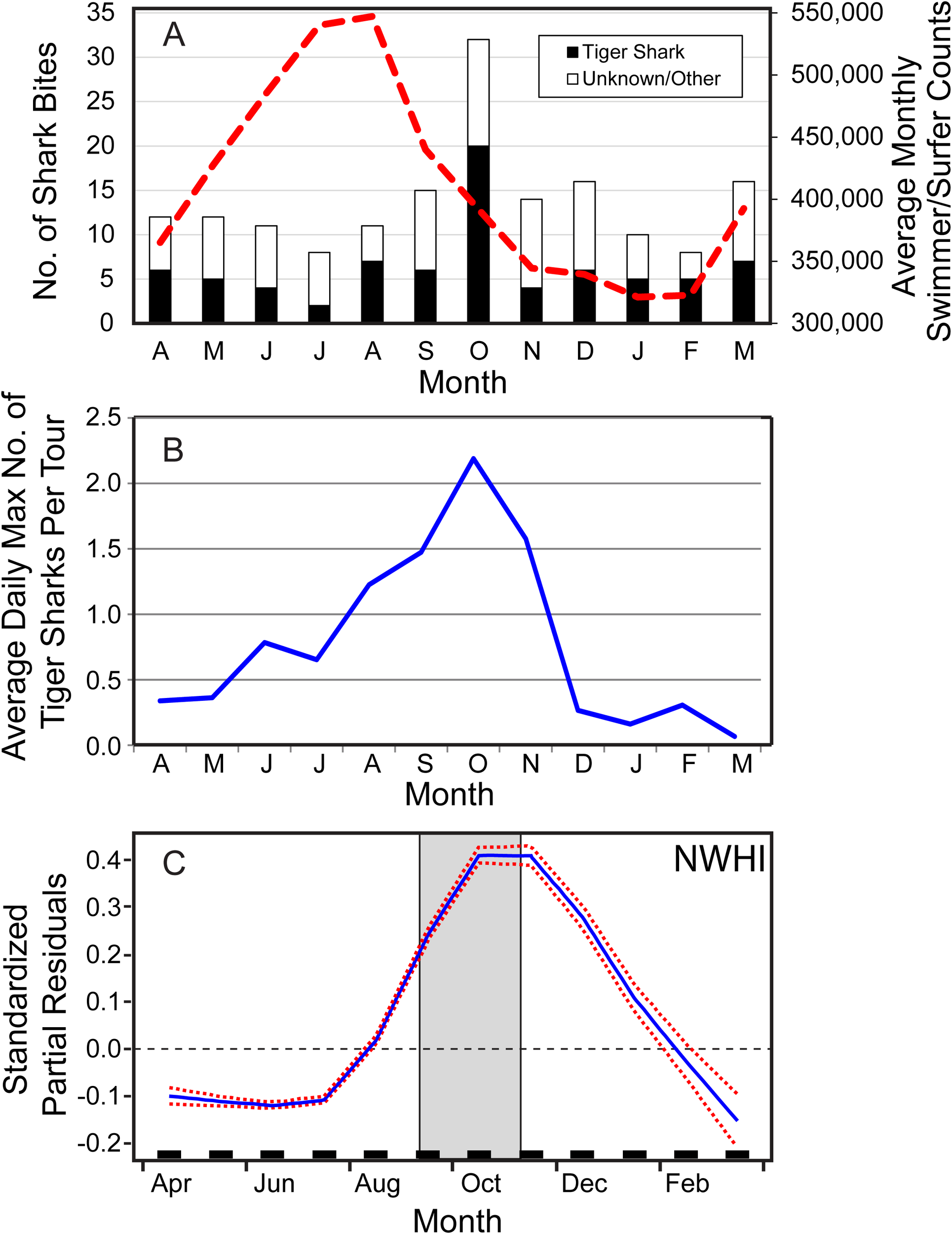
(A) Aggregate monthly shark bite frequencies in Hawaiian waters from January 1995 to October 2024. Shaded bars are confirmed tiger shark bites. Open bars are bites attributed to other/unidentified shark species. (Hawaii DLNR-DAR data). Red dashed line indicates monthly average swimmer and surfer counts in waters surrounding Oahu 1998-99 (Honolulu Ocean Safety Division Data) (B) Average peak daily sightings (no. of individuals) of tiger sharks at shark ecotourism sites located 3-5km off the north coast of Oahu island. (C) GAMMs showing the influence of season on utilization distributions of female tiger sharks tagged in the remote Northwestern Hawaiian Islands (NWHI). The shaded area shows the time period of parturition. Adapted from Papastamatiou et al., 2013.
Statistical analysis confirms that this seasonal pattern is significantly different from an even distribution of bites throughout the year (Chi-squared = 32.5, df = 11, p < 0.001). Additionally, October experiences a disproportionately high number of incidents (Rao’s Spacing Test of Uniformity, U = 303.8961, p < 0.001). To further investigate this pattern, a hurdle model was used to assess the probability of shark bites occurring in each month, while a zero-inflated ordinal regression examined the likelihood of multiple bites within a month. The hurdle model confirmed that October had significantly higher odds of at least one shark bite compared to other months (β = 1.92, SE = 0.54, p < 0.001). Additionally, the zero-inflated ordinal regression indicated that when shark bites did occur, October was significantly associated with a higher count of incidents (β = 1.46, SE = 0.62, p = 0.018).
Over the 30-year study period, shark bites were recorded in 125 (35%) of 358 months, with October alone accounting for 17 (14%) of these months, despite comprising just 8.5% of the total months. More than half (57%) of all Octobers had at least one bite, compared to 6% to 10% for other months. Moreover, October had the highest rate of multiple bite incidents, with 7 (23%) of the 31 months that recorded more than one bite. Nine (30%) of the 30 Octobers in the dataset had multiple bites, and October ties the record for the highest number of bites in a single month (four) occurring in both 2014 and 2015, with September (four bites in 2019).
Of the six months with the highest shark bite counts, four were in October, while the remaining two were in September and November. Notably, these are the only other months in the dataset with more than two shark bites in a single month, further emphasizing the seasonal clustering of incidents.
These results strongly support the conclusion that both the probability of shark bites and the number of incidents per month peak in October, highlighting a recurring seasonal trend that warrants further ecological investigation.
3 Effects of sea temperature and long-term trends (1995–2024)
To evaluate whether sea temperature helps explain monthly variation in shark bite frequency, I analyzed 1995–2024 data using a two-part hurdle model that (i) modeled the probability of any bite in a month (logistic) and (ii) modeled the number of bites given an incident occurred (count model), while controlling for seasonality with sine/cosine terms and including a linear year term. Monthly Hawaii SST, obtained from the NOAA OI SST V2 High Resolution Dataset, was expressed as an anomaly relative to each calendar month’s long-term mean to isolate temperature departures from normal seasonal conditions. In the occurrence model, ‘Year’ was a statistically significant predictor (β = 0.034, SE = 0.017, OR = 1.035, 95% CI = 1.000–1.071, p = 0.046), indicating a long-term rise in the odds of any bite month (0.1 bites per year average increase). ‘SST anomaly’ was not significant (β = 0.265, SE = 0.344, OR = 1.303, 95% CI = 0.664–2.555, p = 0.430). In the count-intensity model (months with ≥1 bite), neither ‘Year’ (β = 0.017, SE = 0.026, IRR = 1.017, 95% CI = 0.967–1.070, p = 0.503) nor ‘SST anomaly’ (β = –0.029, SE = 0.102, IRR = 0.971, 95% CI = 0.794–1.187, p = 0.772) was significant. Importantly, the October effect remained after controlling for year, seasonality, and SST anomalies, confirming that temperature does not account for the seasonal spike.
4 Which species are responsible for this pattern?
Tiger sharks are the primary driver of the October spike in shark bites. Of the 77 confirmed tiger shark bites between January 1995 and October 2024, 20 (28%) occurred in October (Figure 1A), a frequency 3 to 10 times higher than in any other month. Tiger sharks also account for 63% of all shark bites recorded in October, reinforcing their dominant role in this seasonal trend. Additionally, 9 (28%) of the October bites involved unidentified species, some of which may have also been tiger sharks. In contrast, only three reef shark bites were documented in October.
The distribution of tiger shark bites throughout the year deviates significantly from an even monthly pattern (Chi-squared = 34.7, df = 11, p < 0.001), further supporting a strong seasonal effect. If shark bites were evenly distributed across months, the expected number of tiger shark bites in October would be more than three times lower than what was observed. Outside of October, tiger shark bite frequency remains relatively low. In the past 30 years, only one May and one November recorded more than a single confirmed tiger shark bite.
Size estimates were available for 16 (80%) of the 20 confirmed tiger shark bites in October, with individuals ranging from 2.4 to 4.6 m and a mean size of 3.2 m. Although these estimates were provided by bite victims or witnesses under highly stressful conditions, and therefore do not permit reliable sex determination, the consistent pattern is that most sharks involved were described as large individuals. Notably, nine of the sixteen sharks (56%) exceeded the 3.3 m minimum size for female sexual maturity (Whitney and Crow, 2007), and an additional three were estimated to be over 3.0 m.
5 Is the October spike in Hawaii shark bites driven by changes in tiger shark abundance, behavior, or both?
The seasonal spike in shark bites in the Main Hawaiian Islands during October may result from increased tiger shark abundance due to seasonal migration, changes in behavior such as intensified foraging, or a combination of both factors. Several independent lines of evidence suggest that tiger shark abundance and/or behavior shifts during this period, potentially increasing encounter rates with ocean users.
First, tiger shark sightings at shark ecotourism sites along Oahu’s north coast peak in October (Figure 1B). Ecotourism operators, who consistently track shark presence year-round, report their highest tiger shark counts during this month (Meyer et al., 2009). Operators report near-zero detections (<0.04/day) from December–May but >2 sharks per day in October, an increase of two orders of magnitude (Figure 1B). Tours may go weeks without a shark in low season, whereas in October multiple individuals, identified by their unique stripe patterns, are seen daily. Second, this peak in sightings coincides with a seasonal partial migration of mature female tiger sharks from the Northwestern Hawaiian Islands (NWHI) to the Main Hawaiian Islands (MHI) (Papastamatiou et al., 2013, Figure 1C). Acoustic tracking data indicate that a subset of the adult female tiger shark population moves from the remote, uninhabited NWHI to the more populated MHI during this time of year, while other demographic groups (juveniles, mature males, and mature females captured in the MHI) do not exhibit this seasonal movement (Papastamatiou et al., 2013). Notably, mature males and resident MHI females show the highest probability of inter-island movement in January, coinciding with the mating season, rather than in autumn (Papastamatiou et al., 2013).
6 Discussion
The simultaneous occurrence of the October spike in shark bites, peak tiger shark sightings at ecotourism sites, and peak movement probability of mature females from the NWHI to the MHI aligns with tiger shark parturition in Hawaii (September-October; Whitney and Crow, 2007). This temporal overlap suggests that parturient and postpartum females may contribute to the increased shark bite rate observed in October. Although these individuals are unlikely to account for all bites during this period, their presence may elevate risk when combined with the baseline year-round bite probability.
Although the sex and reproductive status of sharks involved in bite incidents remain unknown, the prevalence of large, likely sexually mature individuals suggests that parturition could be a key biological factor contributing to short-term increases in bite incidents. Two primary mechanisms could contribute to this pattern: (1) a temporary increase in the abundance of large adult females in nearshore waters used for ocean recreation and (2) a physiological state that increases foraging behavior in parturient and postpartum females.
6.1 Mechanism 1: increased abundance of large adult females near shore
Tiger shark pupping occurs primarily in the Main Hawaiian Islands, as evidenced by the routine capture of neonates in these waters and the absence of this age class in the NWHI (Supplementary Figure S1). Large female tiger sharks routinely utilize nearshore habitats in popular ocean recreation areas (Meyer et al., 2018). Their nursery habitat, however, is more diffuse than that of many other coastal shark species, occurring broadly across continental shelf areas rather than being confined to discrete bays or lagoons (Driggers et al., 2008; Natanson et al., 2023). In some regions, such as the Main Hawaiian Islands and the Bahamas, these shelf habitats appear to serve as recurring pupping grounds (Papastamatiou et al., 2013; Sulikowski et al., 2016). The temporary influx of late-term females into Main Hawaiian Island insular shelf waters during the pupping season could heighten the likelihood of human encounters and bite incidents, particularly if these individuals exhibit heightened foraging activity.
6.2 Mechanism 2: heightened foraging in postpartum females
Female tiger sharks are ovoviviparous, with embryos developing inside the uterus and receiving additional nutrition beyond the initial yolk sac provisions (Castro et al., 2016). Unlike most carcharhinid sharks, which rely on placental nourishment, tiger sharks utilize a unique maternal provisioning strategy called embryotrophy, in which embryos imbibe an energy-rich fluid within their egg cases (Castro et al., 2016). This process enables embryos to undergo substantial weight increases before birth - 2119% in wet weight and 1092% in dry weight (Castro et al., 2016). Tiger shark mature oocytes weigh approximately 70g compared to late-term embryo weights of around 1.5kg (Castro et al., 2016). Reported litter sizes range from 3 (Whitney and Crow, 2007) to 82 (Bigelow and Schroeder, 1948), with mean values typically between 30 and 50 embryos per litter (Springer, 1940; Bigelow and Schroeder, 1948; Clark and von Schmidt, 1965; Simpfendorfer, 1992; Whitney and Crow, 2007). Gestation lasts 15–16 months (Whitney and Crow, 2007), suggesting that pregnancy imposes substantial and prolonged energetic demands on females. There is no evidence that tiger sharks suppress feeding near parturition to reduce the risk of cannibalism, as very late-term gravid females are routinely captured on baited hooks in Hawaii and elsewhere (C. Meyer, pers. obs.).
The liver functions as both a buoyancy and energy storage organ in sharks (Gallagher et al., 2014; Gleiss et al., 2017). Limited data on gestating tiger sharks from Philippine waters (Kauffman, 1950) suggest a pattern consistent with that observed in other shark species: the percentage of liver weight relative to body weight was highest (26%) in a female with early-stage embryos and declined to 20-21% in two females carrying well-developed pups. These observations, although based on only three individuals, indicate that liver mass may peak early in pregnancy and progressively decline as gestation advances. Studies on various other shark species have also documented a decline in liver condition during gestation as maternal energy reserves are depleted to sustain developing embryos (e.g. Odontaspis taurusCadenat, 1956; Mustelus spp. Smale and Compagnon, 1997; Etmopterus spinaxAranha et al., 2009; Etmopterus pusillusCoelho and Erzini, 2007; Carcharhinus obscurusHussey et al., 2009). Liver depletion by the end of gestation may leave postpartum female tiger sharks in poor nutritional condition, necessitating increased foraging to regain energy reserves. This heightened post-birth feeding drive could help explain the seasonal spike in Hawaii shark bites observed in October.
Importantly, the mechanisms of increased female abundance in nearshore waters and the potential for heightened postpartum foraging activity are not mutually exclusive. Rather, they may act in concert to produce a temporary but pronounced seasonal effect that increases shark bites during October.
Although parturition and postpartum foraging are plausible drivers of the October spike in tiger shark bites, other ecological factors may also contribute. For example, seasonal increases in the availability of preferred prey, such as large reef fishes, turtles, or marine mammals, could draw sharks into coastal habitats used for recreation. These factors were not quantified in the present study, but they could act alongside reproductive movements to elevate the seasonal abundance of large tiger sharks in coastal areas, thereby increasing the probability of human-shark encounters.
7 Conclusion
Shark bites on humans in Hawaiian waters and elsewhere are rare events, and the timing of individual incidents is highly unpredictable. However, an aggregate analysis of three decades of data shows a statistically significant spike in Hawaii shark bites during October. This pattern may be driven by seasonal changes in tiger shark abundance and behavior, particularly parturition-related movements that may increase abundance of adult females in coastal waters, where postpartum foraging needs may increase the likelihood of bite interactions with ocean users. Although the shark bite risk is statistically elevated in October, it remains extremely low in absolute terms. Awareness of this seasonal pattern can inform safer ocean use, emphasizing vigilance, particularly for solo ocean recreation activities. Ocean users should be aware that large tiger sharks are more likely to be present in nearshore waters of the Main Hawaiian Islands during October, and extra caution is advisable during this month, particularly for high-risk activities such as surfing, swimming, or diving alone in coastal areas. Future research should further investigate the ecological and behavioral drivers of this phenomenon to refine risk mitigation strategies. For example, large female tiger sharks observed close to shore during the pupping season should be examined using non-invasive ultrasound techniques to determine pregnancy status, as has been done in other elasmobranch studies (e.g., Sulikowski et al., 2024), to directly test reproductive state as a driver of seasonal bite patterns.
Statements
Data availability statement
Publicly available datasets were analyzed in this study. This data can be found here: https://dlnr.hawaii.gov/sharks/shark-incidents/incidents-list/. Additional data underlying Figures 1 and S1 will be made available by the author upon reasonable request, without undue reservation.
Author contributions
CM: Conceptualization, Data curation, Formal Analysis, Investigation, Methodology, Validation, Writing – original draft, Writing – review & editing.
Funding
The author(s) declared that financial support was not received for this work and/or its publication.
Acknowledgments
I thank the Hawaii Department of Land and Natural Resources Division of Aquatic Resources (DLNR-DAR) for compiling shark bite records and making them publicly available.
Conflict of interest
The authors declared that this work was conducted in the absence of any commercial or financial relationships that could be construed as a potential conflict of interest.
Generative AI statement
The author(s) declare that Generative AI was not used in the creation of this manuscript.
Any alternative text (alt text) provided alongside figures in this article has been generated by Frontiers with the support of artificial intelligence and reasonable efforts have been made to ensure accuracy, including review by the authors wherever possible. If you identify any issues, please contact us.
Publisher’s note
All claims expressed in this article are solely those of the authors and do not necessarily represent those of their affiliated organizations, or those of the publisher, the editors and the reviewers. Any product that may be evaluated in this article, or claim that may be made by its manufacturer, is not guaranteed or endorsed by the publisher.
Supplementary material
The Supplementary Material for this article can be found online at: https://www.frontiersin.org/articles/10.3389/fmars.2025.1587902/full#supplementary-material
Supplementary Figure 1Size-frequency distributions of tiger sharks captured in the Main Hawaiian Islands (MHI – top blue) and Northwestern Hawaiian Islands (NWHI – bottom red). Tiger shark size distributions are shown for individuals caught in the MHI (O‘ahu, Maui, Hawai‘i Island) and NWHI (French Frigate Shoals, Kure Atoll, Lisianski Atoll, Mokumanamana, Pearl and Hermes Reef), all sampled using identical fishing gear. A substantially greater proportion of sharks captured in the NWHI (85%) exceeded the minimum female size at maturity (≥330 cm), compared to 39% in the MHI. No sharks <200 cm were captured in the NWHI, whereas sharks in this smaller size class comprised 23% of the MHI sample. These patterns indicate a marked regional shift toward larger, mature individuals in the NWHI relative to the MHI.
References
1
Aranha A. Menezes G. Pinho M. R. (2009). Biological aspects of the velvet belly lantern shark, etmopterus spinax (Linnaeus 1758) off the azores, north aast Atlantic. Mar. Biol. Res.5, 257–267. doi: 10.1080/17451000802433175
2
Bigelow H. B. Schroeder W. C. (1948). “ Lancelets, cyclostomes, and sharks,” in Fishes of the western north atlantic. Ed. Tee-VanJ. ( Sears Foundation for Marine Research, Yale University, New Haven), 576pp.
3
Cadenat J. (1956). Note d’ichtyologie ouest-africaine: 14. Remarques biologiques sur le requin sable Carcharias (Odontaspis), taurus Rafinesque 1810. Bull. Inst. Fr. Afr. Noire.18, 1249–1256.
4
Castro J. I. Sato K. Bodine A. B. (2016). A novel mode of embryonic nutrition in the tiger shark, Galeocerdo cuvier. Mar. Biol. Res.12, 200–205. doi: 10.1080/17451000.2015.1099677
5
Clark E. von Schmidt K. (1965). Sharks of the central Gulf coast of Florida. Mar. Sci. Bull.15, 13–83.
6
Coelho R. Erzini K. (2007). Population parameters of the smooth lantern shark, Etmopterus pusillus, in southern Portugal (NE Atlantic). Fisheries Res.86, 42–57. doi: 10.1016/j.fishres.2007.04.006
7
Driggers W. B. III Ingram G. W. Jr. Grace M. A. Gledhill C. T. Henwood T. A. Horton C. N. et al . (2008). Pupping areas and mortality rates of young tiger sharks Galeocerdo cuvier in the western North Atlantic Ocean. Aquat. Biol.2, 161–170. doi: 10.3354/ab00045
8
Gallagher A. J. Wagner D. N. Irschick D. J. Hammerschlag N. (2014). Body condition predicts energy stores in apex predatory sharks. Conserv. Physiol.2, 1–8. doi: 10.1093/conphys/cou022
9
Gleiss A. C. Potvin J. Goldbogen J. A. (2017). Physical trade-offs shape the evolution of buoyancy control in sharks. Proc. R. Soc. B: Biol. Sci.284, 1–10. doi: 10.1098/rspb.2017.1345
10
Hawaii DLNR-DAR Data . (2025). Available online at: https://dlnr.hawaii.gov/sharks/shark-incidents/incidents-list/
11
Hussey N. E. Cocks D. T. Dudley S. F. J. McCarthy I. D. Wintner S. P. (2009). The condition conundrum: application of multiple condition indices to the dusky shark Carcharhinus obscurus. Mar. Ecol. Prog. Ser.380, 199–212. doi: 10.3354/meps07918
12
Kauffman D. E. (1950). Notes on the biology of the tiger shark, (Galeocerdo arcticus) from Philippine waters. Res. Rep. U. S. Fish Wildl. Serv.16, 10p.
13
McPhee D. (2014). Unprovoked shark bites: are they becoming more prevalent? Coast. Manage.42, 478–492. doi: 10.1080/08920753.2014.942046
14
Meyer C. G. Anderson J. M. Coffey D. M. Hutchinson M. R. Royer M. A. Holland K. N. (2018). Habitat geography around Hawaii’s oceanic islands influences tiger shark (Galeocerdo cuvier) spatial behaviour and shark bite risk at ocean recreation sites. Sci. Rep.8, 4945. doi: 10.1038/s41598-018-23006-0
15
Meyer C. G. Dale J. J. Papastamatiou Y. P. Whitney N. M. Holland K. N. (2009). Seasonal cycles and long-term trends in abundance and species composition of sharks associated with cage diving ecotourism activities in Hawaii. Environ. Conserv.36, 104–111. doi: 10.1017/S0376892909990038
16
Midway S. R. Wagner T. Burgess G. H. (2019). Trends in global shark attacks. PloS One14, e0211049. doi: 10.1371/journal.pone.0211049
17
Natanson L. J. Mccandless C. T. Kohler N. E. (2023). Distribution of the tiger shark (Galeocerdo cuvier) in the North Atlantic Ocean by season, sex, and life stage, based on tag and recapture data. Fish. Bull. 121, 145–160. doi: 10.7755/FB.121.4.1s2
18
Papastamatiou Y. P. Meyer C. G. Carvalho F. Dale J. J. Hutchinson M. R. Holland K. N. (2013). Telemetry and random-walk models reveal complex patterns of partial migration in a large marine predator. Ecology94, 2595–2606. doi: 10.1890/12-2014.1
19
Papastamatiou Y. P. Wetherbee B. M. Lowe C. G. Crow G. L. (2006). Distribution and diet of four species of carcharhinid shark in the Hawaiian Islands: evidence for resource partitioning and competitive exclusion. Mar. Ecol. Prog. Ser.320, 239–251. doi: 10.3354/meps320239
20
Simpfendorfer C. (1992). Biology of tiger sharks (Galeocerdo cuvier) caught by the Queensland shark meshing program off Townsville, Australia. Mar. Freshw. Res.43, 33–43. doi: 10.1071/MF9920033
21
Smale M. J. Compagnon L. J. V. (1997). Life history and diet of two southern African smoothhound sharks, Mustelus mustelus (Linnaeus 1758) and mustelus palumbes smith 1957 (Pisces: triakidae). South Afr. J. Mar. Sci.18, 229–248. doi: 10.2989/025776197784160992
22
Springer S. (1940). The sex ratio and seasonal distribution of some Florida sharks. Copeia1940, 188–194. doi: 10.2307/1437982
23
Sulikowski J. A. Perisic N. Askin A. Vossgaetter L. Bocchi F. Hussain Ali Didi H. et al . (2024). Identification of the first gestational ground for tiger sharks (Galeocerdo cuvier) in the Central Indian Ocean using a high-definition submersible ultrasound. Front. Mar. Sci.11, 1500176. doi: 10.3389/fmars.2024.1500176
24
Sulikowski J. A. Wheeler C. R. Gallagher A. J. Prohaska B. K. Langan J. A. Hammerschlag N. (2016). Seasonal and life-stage variation in the reproductive ecology of a marine apex predator, the tiger shark Galeocerdo cuvier, at a protected female-dominated site. Aquat. Biol.24, 175–184. doi: 10.3354/ab00648
25
Tucker J. P. Santos I. R. Kelaher B. P. Green M. Clark G. F. Butcher P. A. (2022). Increased shark bite survivability revealed by two centuries of Australian records. Sci. Rep.12, 14121. doi: 10.1038/s41598-022-16950-5
26
Whitney N. M. Crow G. L. (2007). Reproductive biology of the tiger shark (Galeocerdo cuvier) in Hawaii. Mar. Biol.151, 63–70. doi: 10.1007/s00227-006-0476-0
Summary
Keywords
shark bite seasonality, shark-human interactions, tiger shark (Galeocerdo cuvier), parturition and foraging behavior, shark bite risk factors
Citation
Meyer CG (2026) ‘Sharktober’: tiger shark parturition drives seasonality in shark bite incidents in Hawaiian waters. Front. Mar. Sci. 12:1587902. doi: 10.3389/fmars.2025.1587902
Received
05 March 2025
Revised
25 November 2025
Accepted
09 December 2025
Published
06 January 2026
Volume
12 - 2025
Edited by
Gregory Skomal, Massachusetts Division of Marine Fisheries, United States
Reviewed by
Peter Gausmann, Ruhr University Bochum, Germany
Patrick Rex, Atlantic White Shark Conservancy, United States
Julia Türtscher, Johannes Kepler Universitat Linz Universitatsbibliothek, Austria
Updates
Copyright
© 2026 Meyer.
This is an open-access article distributed under the terms of the Creative Commons Attribution License (CC BY). The use, distribution or reproduction in other forums is permitted, provided the original author(s) and the copyright owner(s) are credited and that the original publication in this journal is cited, in accordance with accepted academic practice. No use, distribution or reproduction is permitted which does not comply with these terms.
*Correspondence: Carl G. Meyer, carlm@hawaii.edu
Disclaimer
All claims expressed in this article are solely those of the authors and do not necessarily represent those of their affiliated organizations, or those of the publisher, the editors and the reviewers. Any product that may be evaluated in this article or claim that may be made by its manufacturer is not guaranteed or endorsed by the publisher.