Abstract
Siphonophores are gelatinous, colonial cnidarians distributed throughout the world’s oceans. They inhabit various water depths and are important predators in open waters, consuming multiple prey types. Siphonophore colonies are fragile and easily damaged during collection and preservation. They are composed of several morphologically different elements (zooids), which further hampers proper identification of collected specimens. As a result, siphonophores remain understudied, with significant knowledge gaps concerning distribution, trophic ecology, and life cycles. The objective of this work is to identify siphonophores occurring in the Gulf Stream off the Florida coast, reconstruct their molecular diversity using 16S rRNA barcoding, and shed light on their ecology. Siphonophore data were obtained through underwater photographs taken by scuba divers during hundreds of night drift dives. Additionally, samples of whole colonies were occasionally taken for molecular work. Overall, twenty-two siphonophore species were identified, and their morphology is described here based on in situ observations. Eight taxa have not previously been recorded in the study area, and one, Lilyopsis problematica sp. nov., is formally described here. Morphological identifications were corroborated with molecular methods, including phylogenetic analyses and calculation of genetic distances, which uncovered hidden diversity even within well-established taxa. The photography employed here documented ecological associations between siphonophores and other marine taxa (preying and being preyed upon), some of which have important ecological implications, such as the observation of larval Physalia physalis feeding on fish. Blackwater diving has proved to be a promising method for obtaining unique data on siphonophore biodiversity, morphology, and ecology in the upper layer of the epipelagic.
Lilyopsis problematica sp. nov. urn:lsid:zoobank.org:act:3F296CA7-6AC0-4C64-B9BB-641EC17F7BAE
1 Introduction
Siphonophores are gelatinous, mostly pelagic, colonial hydrozoans (Cnidaria, Hydrozoa, Siphonophorae). Their colonies are composed of multiple, functionally specialized individuals called zooids that remain interconnected by a shared stem, facilitating movement coordination and nutrient exchange. Siphonophores have traditionally been split into three suborders, distinguished based on the presence (Cystonectae, Physonectae) or absence (Calycophorae) of a gas-filled float (pneumatophore), and the presence (Calycophorae, Physonectae) or absence (Cystonectae) of jet-propulsive swimming bells, called nectophores (Mapstone, 2014). Other types of zooids shared among most siphonophores are feeding polyps equipped with tentacles (gastrozooids), polyps with secretory and defensive roles (palpons), reproductive medusoids (gonophores), and gelatinous zooids of unknown homology believed to play protective roles (bracts; Mapstone, 2014). To date, 197 siphonophore species have been described, with calycophorans being the most diverse, with 112 species (Schuchert et al., 2025). However, siphonophore diversity is estimated to be even greater (Appeltans et al., 2012), with new species described almost every year (e.g., Church et al., 2025), largely due to the application of an integrative taxonomic approach that combines morphological and molecular data.
Siphonophores are cosmopolitan, with most species inhabiting mesopelagic waters, but they can also occur in the epipelagic zone, where they are often found in high numbers (Mapstone, 2014). Because of their holoplanktonic life cycle, they are present in the water column throughout the year (Hosia and Båmstedt, 2008). Siphonophores are also known to exert strong predatory pressure on pelagic taxa and are key players in deep-sea food webs (Choy et al., 2017). Despite their broad distribution, perennial presence, and ecosystemic relevance (Hetherington et al., 2022), many aspects of siphonophore biology remain poorly understood. For example, their life cycles are insufficiently studied (Mańko et al., 2023), with many unknowns particularly in cystonect development (e.g., Munro et al., 2019). Similarly, although a series of recent works has revealed aspects of their trophic ecology (Damian-Serrano et al., 2021, 2022), the diets of many species remain speculative. This also applies to the diversity of siphonophore predators (Ayala et al., 2018) and their associated fauna (e.g., Mańko et al., 2017). The paucity of data on siphonophore biology likely stems from their patchy distribution and delicate nature, which renders them prone to damage, especially when sampled with traditional plankton nets (e.g., Hosia and Båmstedt, 2008). Even when successfully collected, their colonies often fall to pieces, and the polymorphic nature of their colonies further hampers taxonomic identification. A potential solution to this problem is the use of new sampling techniques such as underwater cameras (e.g., UVP, underwater video profiler) or underwater vehicles, e.g., ROVs (remotely operated vehicles; Hosia et al., 2017). However, these remain costly and are routinely employed in only a few locations globally, leaving the majority of the world’s ocean unsampled.
A potential solution for species that frequent the upper layers of the epipelagic comes with the development of blackwater diving (BWD). This technique takes advantage of the diurnal migration of pelagic fauna, which tends to aggregate in surface waters at nighttime, and leverages the global popularity of recreational diving by engaging research and diving communities simultaneously. The BWD has been successfully used to uncover aspects of fish larval ecology (Nonaka et al., 2021; Johnson et al., 2025) and has even facilitated the description of new species (Schuchert and Collins, 2021).
Here, we analyze a unique dataset of underwater photographs and specimens collected during blackwater dives in the Gulf Stream off the Florida coast to provide a baseline of siphonophore biodiversity using both molecular and morphological taxonomy, and to shed light on certain aspects of their biology, particularly their life cycles and ecological interactions.
2 Materials and methods
2.1 Study area
The present work was carried out off the east coast of Florida (Palm Beach), in waters under a strong influence of the Florida Current, an initial segment of the Gulf Stream. The Gulf Stream originates in the Gulf of Mexico, from which it outflows near the tip of Florida, where it merges with the Caribbean Current. It then turns northward and flows along the east coast of North America, first as the Florida Current, and then crosses the Atlantic Ocean as the North Atlantic Current and flows poleward. The Gulf Stream thus has an important role in transporting heat and salt to higher latitudes (Chi et al., 2021), as well as in delivering tropical zooplankton taxa farther north, shaping local biogeography (Mańko et al., 2022). Interestingly, neustonic siphonophores were used to mark the Gulf Stream route as early as the 19th century (Agassiz, 1883).
2.2 Data collection
A full description of the method used can be found in Schuchert and Collins (2021). Drift dives started at sunset, 5.5–12 km east of Palm Beach, from roughly 26.70N, 79.94W, and lasted between 80 and 120 min, covering transects of 2–17 km (up to 26.78N, 79.94W). The depth at the starting point was between 150 and 250 m, but all samples were collected only from the surface layer, i.e., down to 20 m. Specimens were collected over the course of 232 blackwater dives, throughout all seasons, between May 2017 and August 2025. Each collection event was limited in the number of specimens to be collected or photographed, irrespective of the observed diversity and abundance of siphonophores; thus, the data collected here cannot be used to infer temporal trends in their abundance.
During dives, photographs of siphonophores were taken using Nikon D500 or D800e cameras with Nikon AF Micro-NIKKOR 60 mm f/2.8D lenses in Nauticam housings, using various combinations of commercially available focus lights and strobes. Some of the photographed specimens were then collected in pre-numbered zip-lock bags and were subsequently preserved either in 95% ethanol (for molecular analyses) or 4% buffered formalin solution (for morphological vouchers). Identifiers of collected specimens start with BFLA, followed by sequential numbers, whereas identifiers of specimens photographed but not collected start with OHNC, also followed by sequential numbers. The entire collection of specimens was deposited at the Florida Museum of Natural History (USA, Florida, Gainesville), with catalogue numbers provided in Supplementary File 1, and sequencing data were deposited in NCBI’s GenBank (accession numbers in Supplementary File 1). Photos were taken by RC unless noted otherwise.
All marine invertebrates collected for this study were obtained from United States federal waters, and no permits were required.
2.3 Morphological identification
Specimens were classified, when possible, to species level and life cycle stage using relevant taxonomic keys for Siphonophorae (Bigelow, 1911; Totton and Bargmann, 1965; Kirkpatrick and Pugh, 1984; Pugh, 1999, 2019). Descriptions or newer redescriptions of individual species were additionally consulted (Carré, 1969; Pugh, 2003, 2005; Haddock et al., 2005; Mańko and Pugh, 2018; Munro et al., 2019; Hosia et al., 2024). Species involved in ecological relationships with siphonophores were likewise identified to the lowest taxonomic level possible, except for siphonophore prey, which was identified to the following categories: chaetognath, copepod, fish, hyperiid amphipod, large crustacean, zoea, thecosome pteropod, polychaete epitoke.
2.4 Molecular analyses
The DNA barcoding targeted c. 600 bp of the 16S mitochondrial RNA gene, as it is considered the standard barcode for hydrozoans and often outperforms COI (Zheng et al., 2014). All steps of the protocol were carried out by PS as described in Schuchert (2005, 2019), and Schuchert and Collins (2021). Briefly, DNA was extracted either from the nectophore (Calycophorae), pneumatophore or gastrozooids (Physonectae), or from tentacles (Cystonectae) using the CTAB method (Coffroth et al., 1992). PCRs were then run using Qiagen PCR kits with SHA and SHB primer pairs (5’-ACGGAATGAACTCAAATCATGT-3’; 5’-TCGACTGTTTACCAAAAACATA-3’, respectively; Cunningham and Buss, 1993) in 30–35 cycles (profile: 20 s 94°C, 45 s 50°C, and 120 s 68°C). Sanger sequencing was carried out by Macrogen Inc., and all new sequences have been deposited in GenBank (Supplementary File 1).
The sequencing data were analyzed in Geneious Prime 2025.0.2. First, blastn searches were run to verify taxonomic assignments. Then, a sequence database was prepared comprising: sequences generated here, the top five blastn hits for each sequence (with similarity >95%), and at least three sequences (if available) from each species described in each of the identified genera, also retrieved from NCBI’s GenBank.
Sequences were then split into three groups depending on their taxonomic assignment: Cystonectae, Agalmatidae + Forskaliidae, and Calycophorae, and analyzed separately. A set of sequences from related taxa (outgroups), constituting roughly 20% of the number of sequences within each group, was added from GenBank. All sequences within each group were then aligned using MAFFT (v7.490; Katoh et al., 2002) with the FFT-NS-Ix algorithm. Phylogenetic reconstructions were run for each group using the Maximum Likelihood method in IQTree v2.2.6, with ModelFinder (Minh et al., 2020); the chosen substitution models are given in the figure captions of the respective trees. Consensus trees were plotted with FigTree v1.4.4 and subsequently edited in CorelDraw v2021.
Lastly, the intra- and interspecific and intra- and intergeneric genetic distances were calculated for each species or genus included in the analysis (except for outgroups) using the Kimura 1980 (K2P) model. This analysis was performed in R using the following packages: ape v5.8-1, stringr v1.5.1, and tidyverse v2, and was run on alignments trimmed to positions with coverage >90% (Cystonectae 460 bp, Agalmatidae + Forskaliidae 532 bp, Calycophorae 605 bp).
3 Results
3.1 Morphological identification
In total, 118 siphonophore specimens could be identified solely from photographs, representing 22 species (Supplementary File 1): three in the suborder Cystonectae, six in the Physonectae, and thirteen in the Calycophorae. The most abundant in the photograph collection were Agalma okeniiEschscholtz, 1825, Forskalia edwardsiiKölliker, 1853, and Rhizophysa eysenhardtiiGegenbaur, 1859.
3.1.1 Cystonectae Haeckel, 1887
Family Physaliidae Brandt, 1835
Genus Physalia Lamarck, 1801
Physalia physalis (Linnaeus, 1758)
Synonymy: Pugh, 2019
Examined specimens: BFLA4504, siphonula; BFLA4505, siphonula; BFLA4717, siphonula; OHNC237, siphonula.
Description: Specimens between 3 and 6 mm in overall length. Blue colored (Figures 1A, B). Protozooid aligning axially with the pneumatophore and with a single tentacle (Figure 1B). Colony consisting mainly of pneumatophore and protozooid. Gastrozooids and palpons at the bud stage.
Figure 1
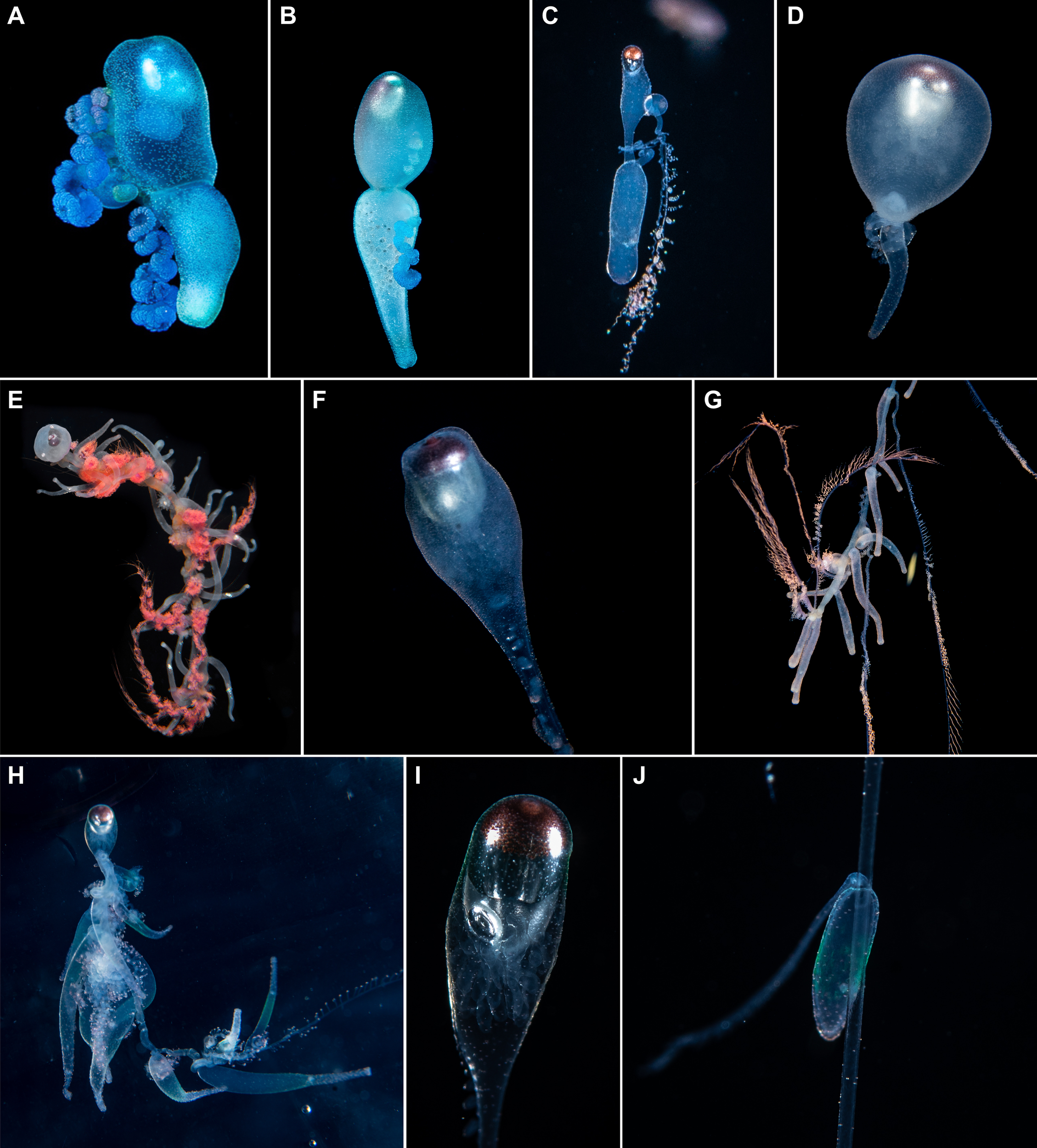
Diversity of cystonect siphonophores. (A)Physalia physalis siphonula larva (BFLA4504; photo by Deborah Dever). (B)Physalia physalis siphonula (BFLA4717; photo by Linda Ianniello). (C)Rhizophysa eysenhardtii late siphonula (OHNC31). (D) Early siphonula of Rhizophysa sp. (OHNC238, photo by Linda Ianniello). (E) Whole colony of R. eysenhardtii (BFLA4551; photo by Ned Deloach). (F) Pneumatophore close up of R. eysenhardtii (BFLA4789). (G) Posterior fragment of R. eysenhardtii stem (BFLA4795; photo by Linda Ianniello). (H) Entire colony of R. filiformis (BFLA4479). (I) Pneumatophore close up of R. filiformis (BFLA4479). (J) Gastrozooid with tentacle in R. filiformis (BFLA4479).
Family Rhizophysidae Brandt, 1835
Genus Rhizophysa Péron & Lesueur, 1807
Rhizophysa eysenhardtii Gegenbaur, 1859
Synonymy: Pugh, 2019
Examined specimens: BFLA4551, polygastric colony; BFLA4776, polygastric colony; BFLA4789, polygastric colony; BFLA4790, polygastric colony; BFLA4791, polygastric colony; BFLA4792, polygastric colony; BFLA4795, polygastric colony; BFLA4903, polygastric colony; BFLA4906, polygastric colony; BFLA4957, polygastric colony; OHNC217, polygastric colony; OHNC31, siphonula.
Description: Maximum total length not recorded. Pneumatophore opaque, length between 2–6 mm in length, oblong, with red/brown pigmentation at the apex (Figures 1E, F). Pneumatosaccus elongated, filling about ½ of pneumatophore’ height (Figure 1F). Villi present, filling the gastrovascular cavity (Figure 1F). With pinkish coloration, more prominent in the distal part of the gastrozooid (Figures 1E, G). White or pinkish dots on the surface of the whole colony (Figures 1E, G). Tentacles arising from the anteriolateral side of the gastrozooid (Figure 1G), already discernible in early siphonula (Figures 1C, D). Nematocyst pads on tentacles from light to vivid pink (Figures 1E, G). Gonodendra present with some pinkish coloration (Figure 1E).
Rhizophysa filiformis (Forskål, 1775)
Synonymy: Pugh, 2019
Examined specimens: BFLA4479, polygastric colony; BFLA4821, polygastric colony.
Description: Maximal total length over 100 mm. Pneumatophore length 7 mm, oblong, with red/brown pigmentation at the apex (Figures 1H, I). Some green fluorescence present. Pneumatosaccus oblong, filling about ½ of pneumatophore’ height (Figure 1I). Villi attached at the bottom ⅓ of the pneumatosaccus, filling the gastrovascular cavity (Figure 1I). Middle ⅓ of gastrozooid length with green fluorescence, peach colored distally (Figures 1H, J). White dots present on the colony surface of the whole colony and on gastrozooids (Figures 1H, J). Tentacles arising from the lateral side of the gastrozooid (Figure 1J). No tentacles or tentacular buds in the youngest gastrozooids. Tentilla pinkish (Figure 1H). Gondendra present (Figure 1H).
3.1.2 Physonectae Haeckel, 1888
Family Agalmatidae Brandt, 1835
Genus AgalmaEschscholtz, 1825
Agalma clausi Bedot, 1888
Synonymy: Mańko and Pugh, 2018
Examined specimens: BFLA4568, polygastric colony; BFLA4727, polygastric colony.
Description: Nectosome length 60 mm. Siphosome of similar length. Stem thinner in the siphosome than in the nectosome, ending with a small, elongated pneumatophore with orange pigmentation in the apical part (Figures 2A, B). Nectosome compact in appearance (Figure 2B). Nectophores in two alternating rows, each with Y-shaped nectosac (Figure 2A). Siphosome with bracts, some with stripes of red pigment spots, others with more random pigmentation (Figure 2A). Palpons with laterally attached palpacle (Figure 2D). Some with whitish dots on the surface, and all with white nematocysts at the tip (Figure 2D). Gastrozooids with green fluorescence around the mouth (Figure 2D). Tentilla tricornuate, pinkish, with a distinctly prominent involucrum (Figures 2A, C). Both male and female gonophores present (Figure 2D).
Figure 2
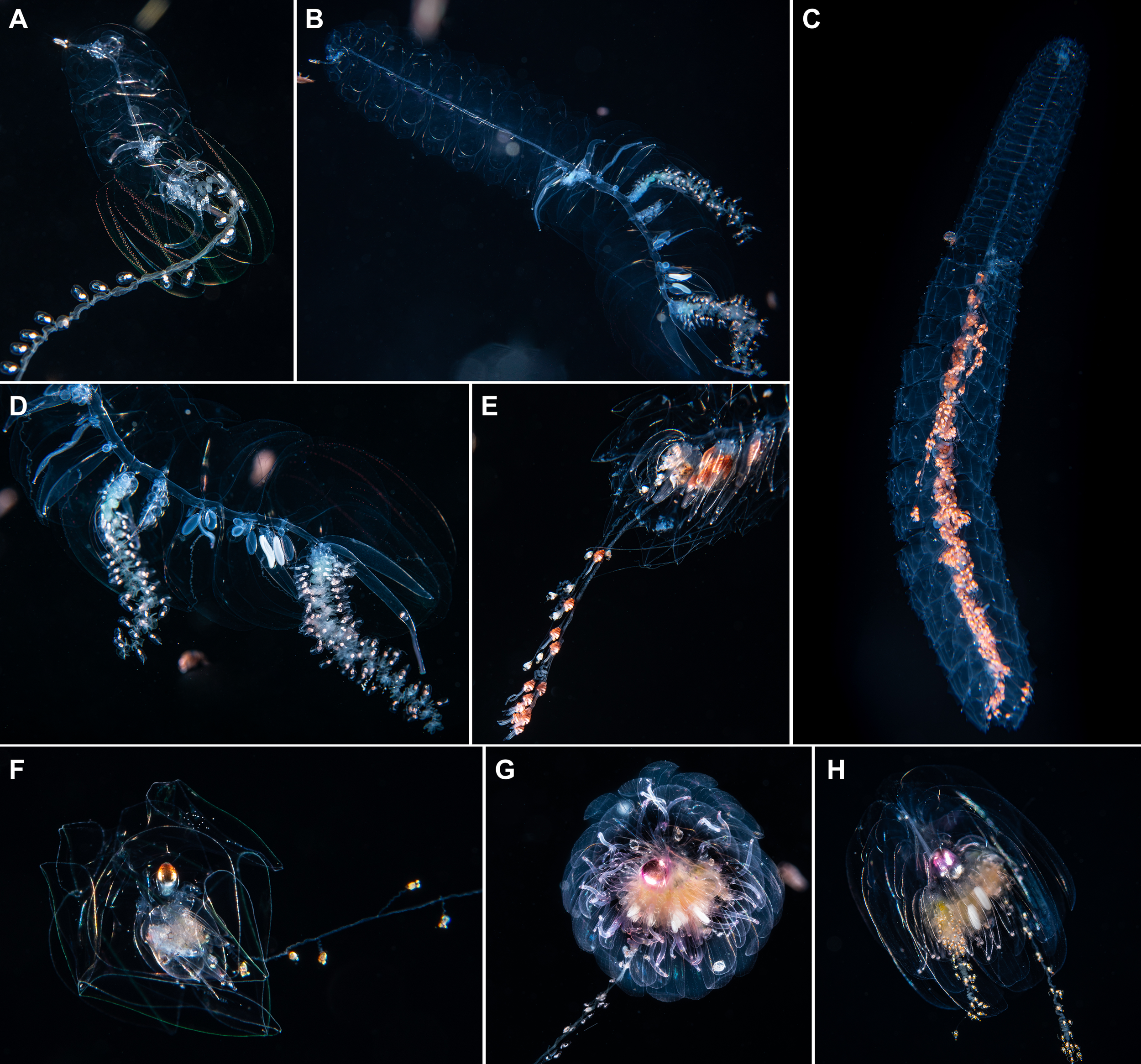
Agalma and Athorybia siphonophores. (A) Young A. clausi colony (BFLA4568). (B) Colony overview of A. clausi (BFLA4727). (C) Colony overview of A. okenii (BFLA4111). (D)Agalma clausi (BFLA4727) siphosome close-up. (E)Agalma okenii (BFLA4683) siphosome close-up. (F) Post-larval colony of A. okenii (OHNC47). (G) Top view of A. rosacea colony (BFLA3782). (H) Lateral view of A. rosacea (BFLA4724).
Agalma okenii Eschscholtz, 1825
Synonymy: Totton and Bargmann, 1965
Examined specimens: BFLA4111, polygastric colony; BFLA4144, polygastric colony; BFLA4224, post-larva; BFLA4683, polygastric colony; BFLA4769, polygastric colony; BFLA4787, post-larva; OHNC263, post-larva; OHNC268, polygastric colony; OHNC47, siphonula; OHNC48, post-larva;
Description: Total length 105 mm. Nectosome shorter than siphosome (Figure 2C). Stem of similar thickness in the siphosome and nectosome, ending with a small, elongated pneumatophore with orange pigmentation in its apical part (Figure 2F). Nectosome and siphosome compact in appearance (Figure 2A). Nectophores in two alternating rows, each with a Y-shaped nectosac (Figure 2C). Bracts without pigmentation (Figures 2C, F). Several palpons with palpacle attached basally (Figure 2E), some with whitish dots on the surface, and all with white nematocysts at the tip (Figure 2E). Tentilla tricornuate, orange in color when mature (Figures 2C, E, F). Larval tentilla smaller and brighter in color (Figure 2F). Both male and female gonophores present (Figure 2E).
Genus Athorybia Eschscholtz, 1829
Athorybia rosacea (Forskål, 1775)
Synonymy: (Totton and Bargmann, 1965)
Examined specimens: BFLA3782, polygastric colony; BFLA4340, polygastric colony; BFLA4376, polygastric colony; BFLA4724, polygastric colony; OHNC265, polygastric colony.
Description: Maximal length 15 mm. Colony round in appearance (Figures 2G, H). Pneumatophore large and round with pink or red pigmentation, showing green fluorescence in some specimens (Figures 2G, H). No nectosome. Siphosome compact (Figures 2G, H). Male gonophores white (Figure 2H). Palpons with nematocyst clusters in their distal part (Figure 2H). Tentilla yellow to orange (Figures 2G, H). Bracts long and narrow, convex, forming a crown covering the whole colony with meridional rows of nematocysts (Figures 2G, H). In some specimens, nematocyst rows showed green fluorescence.
Genus Nanomia A. Agassiz, 1865
Nanomia bijuga (delle Chiaje, 1844)
Synonymy: Mapstone, 2009
Examined specimens: BFLA4191.2, polygastric colony; BFLA4218, polygastric colony; BFLA4627, polygastric colony; BFLA5224, polygastric colony; OHNC253, polygastric colony; OHNC255, polygastric colony; OHNC257, polygastric colony.
Description: Maximum nectosome length 28 mm. Colony slender. Nectosome of similar length to the siphosome (Figure 3A). Nectosomal stem thinner than in the siphosome, ending with a small, elongated pneumatophore with orange pigmentation in the apical part (Figure 3A). Nectophores in two alternating rows with bean-shaped nectosacs (lateral view; Figure 3A). Several palpons between gastrozooids (Figure 3B). Tentilla unicornuate, orange in color (Figure 3B). Brownish pigmentation present on the stem, ostium of the nectophores, and gastrozooids (Figures 3A, B).
Figure 3
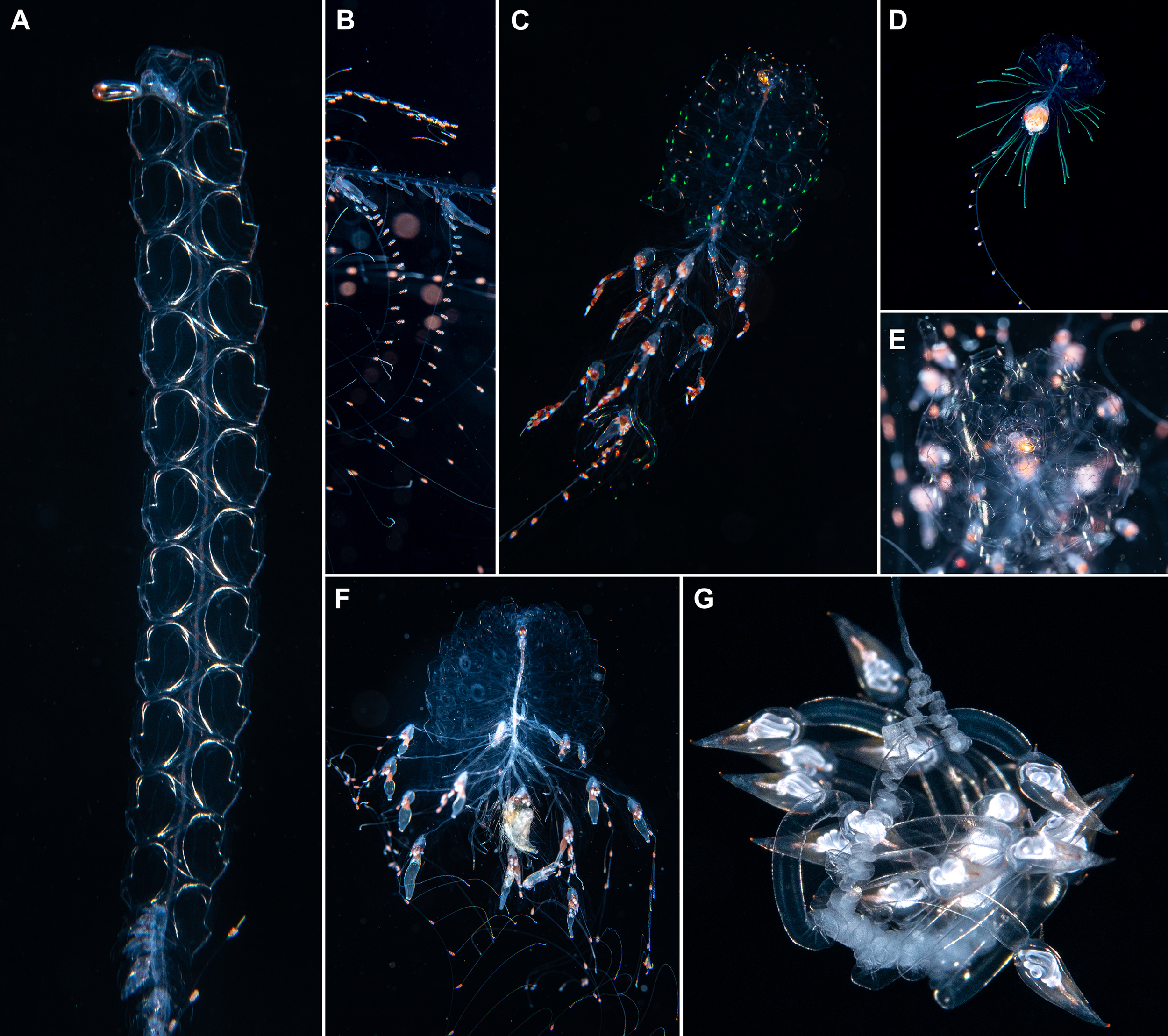
Other physonects observed in the study area. (A)Nanomia bijuga nectosome (BFLA4627). (B) Siphosome of N. bijuga (OHNC257). (C) Colony overview of F. edwardsii (BFLA4394). (D) Larval colony of F. edwardsii (OHNC143). (E) Top view of F. edwardsii nectosome (BFLA3789). (F) Colony overview of F. tholoides (OHNC251). (G) Piece of P. hydrostatica tentacle (OHNC220; photo by Deborah Devers).
Family Forskaliidae Haeckel, 1888
Genus ForskaliaKölliker, 1853
Forskalia edwardsii Kolliker, 1853
Synonymy: Pugh, 2003
Examined specimens: BFLA3789, polygastric colony; BFLA3832, polygastric colony; BFLA4162, polygastric colony; BFLA4195, polygastric colony; BFLA4198, polygastric colony; BFLA4275, polygastric colony; BFLA4295, polygastric colony; BFLA4394, polygastric colony; BFLA4898, polygastric colony; BFLA5019, polygastric colony; OHNC143, polygastric colony; OHNC241, polygastric colony; OHNC245, polygastric colony; OHNC256, polygastric colony; OHNC259, polygastric colony; OHNC262, polygastric colony; OHNC39, polygastric colony; OHNC59, polygastric colony;
Description: Maximum nectosome length 30 mm. Nectosome half the length of the siphosome (Figure 3C). Stem of similar thickness in the siphosome and nectosome, ending anteriorly with a small, oblong pneumatophore with orange pigmentation (Figures 3C, E). Orange pigmentation also present in the apical portion of the stem (Figure 3C). Nectophores arranged in a spiral (Figures 3C, E). Each nectophore bearing a yellow dot at the connection of the dorsal radial canal and ostial ring canal (Figure 3E). Some nectophores with two green fluorescent dots at the connection of the lateral radial and ring canals (Figure 3C). Radial canals straight (Figure 3E). Gastrozooids on long stalks, with orange pigmentation basally and occasional green fluorescence (Figure 3C). Bracts numerous and without pigmentation, but showing green fluorescence in larval colonies (Figure 3D). With gonophores of both sexes. Multiple palpons per cormidium, each with seemingly moniliform palpacles. Some palpons terminating with a bright red-colored process, also present in larval colonies (Figures 3C, D). Tentilla unicornuate, orange/brown in color (Figure 3C). Larval tentilla simple, with uncoiled cnidoband and without terminal process (Figure 3D).
Forskalia tholoides Haeckel, 1888
Synonymy: Pugh, 2003
Examined specimens: BFLA4876, polygastric colony; OHNC251 polygastric colony.
Description: Nectosome length estimated at 25 mm. Nectophores distinctly elongated, with nectosac occupying the lower ⅓ of nectophore length (Figure 3F). No yellow pigment spot on the nectophore. Colony colorless aside from brown hepatic stripes in gastrozooids and the tentillum cnidoband (Figure 3F). Palpons slender and lacking a red pigmented process (Figure 3F).
Remarks: Forskalia species are difficult to identify. The main traits distinguishing the species identified here are the yellow dot at the connection of the dorsal radial canal and ostial ring canal, found only in F. edwardsii, and the elongated nectophore with short nectosac, typical for F. tholoides (Pugh, 2003). However, as exact nectophore measurements were unavailable and the visibility of the yellow pigment spot may depend on the light source used for capturing photographs, the identity of Forskalia found here should be treated cautiously.
Family Physophoridae Eschscholtz, 1829
Genus PhysophoraForskål, 1775
Physophora hydrostatica Forskål, 1775
Synonymy: (Totton and Bargmann, 1965)
Examined specimens: OHNC220, tentacle.
Description: Total length – 40 mm. Tentilla on long stalks, with tightly coiled, encapsuled cnidoband (Figure 3G). With two lateral processes, both of which, as well as the distal end of the capsule, have red pigment at the tip.
Remarks: While discussing the differences between P. gilmeri and P. hydrostatica, Pugh (2005) wrote that lateral processes are typical for P. gilmeri. However, they were absent in the type specimen he described. He also wrote that lateral processes were observed before in P. hydrostatica, though only in very young developmental stages (the tentacle of the protozooid) and absent in some other young specimens. The structure of the tentillum in specimen OHNC220 is typical for P. hydrostatica (shape of the capsule, long stalks), and because there is no clear evidence that the lateral processes are absent in P. hydrostatica, the specimen was assigned to this species.
3.1.3 Calycophorae Leuckart, 1854
Family Abylidae L. Agassiz, 1862
Genus AbylaQuoy & Gaimard, 1827
Abyla trigona Quoy & Gaimard, 1827
Synonymy: Sears, 1953; Totton and Bargmann, 1965
Examined specimens: BFLA4856, polygastric colony; BFLA4862, polygastric colony; OHNC144, eudoxid (as Abyla sp.); OHNC242, eudoxid (as Abyla sp.); OHNC243, eudoxid (as Abyla sp.); OHNC248, eudoxid (as Abyla sp.); OHNC264, eudoxid (as Abyla sp.); OHNC266, eudoxid (as Abyla sp.);
Description: Polygastric stage: total length 20 mm, two nectophores present (Figure 4A). The anterior nectophore around half the length of the posterior nectophore, angular, height similar to width. Serrated ridges (Figure 4B). Somatocyst large, oval in shape, taking up most of the height of the nectophore (Figure 4B). Hydroecium deep (Figure 4B). Both hydroecium and nectosac reaching almost to the apex of the nectophore (Figure 4B). Posterior nectophore with strongly serrated ridges and with two hydroecial wings (Figure 4A). Six teeth on the comb, situated at the dorsal end of the right hydroecial wing (Figure 4A). Two rows of teeth on the left hydroecial wing (Figure 4A). Ostial teeth present (Figure 4A). Colorless tentilla (Figures 4A, B).
Figure 4
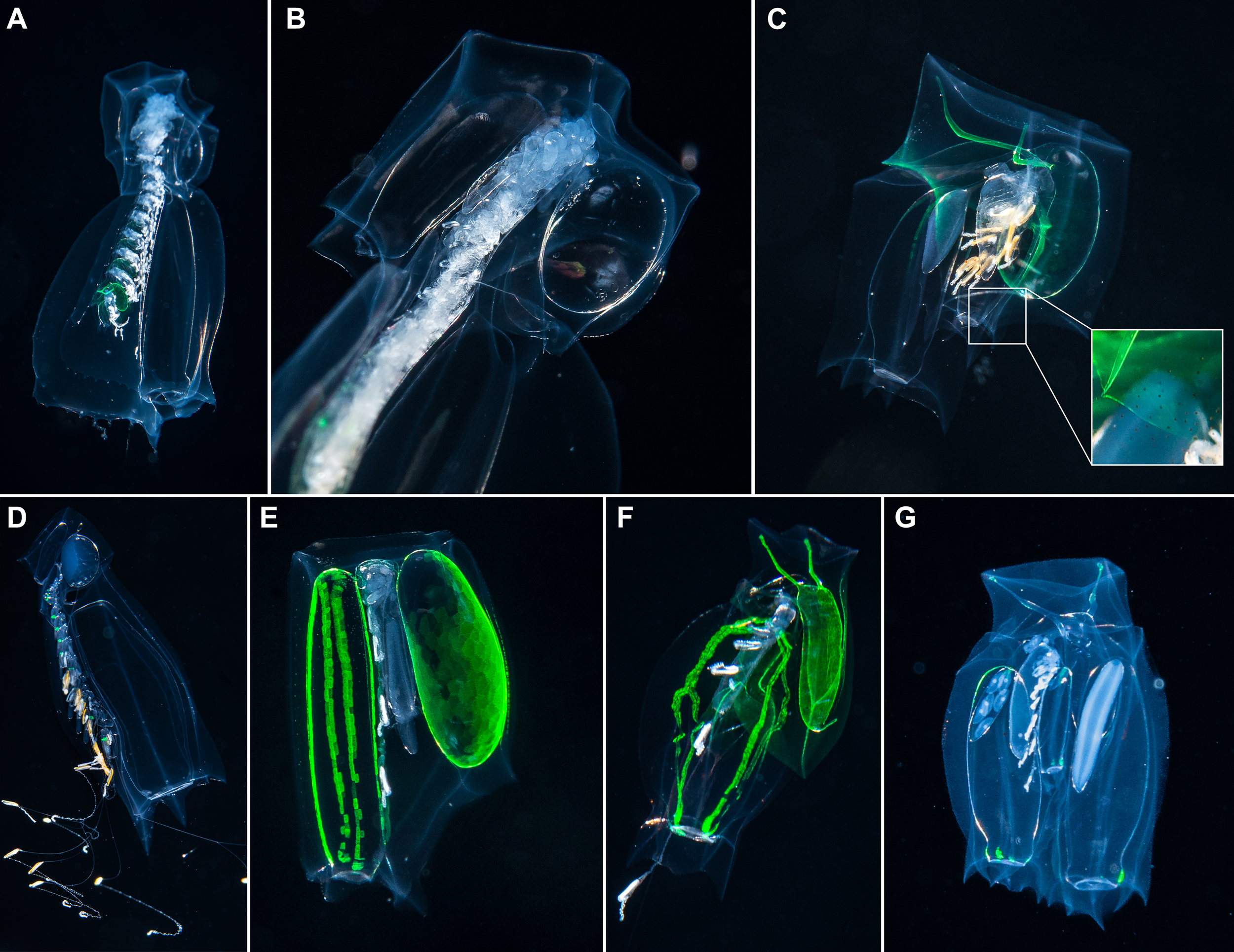
Abylid calycophorans. (A)Abyla trigona polygastric colony (BFLA4856). (B) Close-up on the A. trigona anterior nectophore (BFLA4856). (C) Eudoxid of Abyla sp. (BFLA4862) with inset showing surface of bract and gonophore (OHNC264). (D)Abylopsis tetragona polygastric colony (BFLA4384). (E) Anterior nectophore of C. leuckartii (BFLA4896; fluorescence amplified with blue focus lights). (F) Eudoxid stage of C. leuckartii (BFLA4294). (G) Eudoxid stage of Ceratocymba sp. (OHNC239).
Remarks: Although the eudoxid stage remains indistinguishable within Abyla species, eudoxid BFLA4862, found in the vicinity of the polygastric colony BFLA4856, likely belongs to the same species, A. trigona. The eudoxid (Figure 4C) measured 5–7 mm and had a trapezoidal apical facet of the bract, a large and oval phyllocyst that took up most of the height of the bract and had two characteristic processes angled upward (in about ⅔ of their length) towards the apico-ventral ridge (Figure 4C). Gonophore twice as long as wide (Figure 4C), and the surface of both bract and gonophore covered in dark orange spots (Figure 4C).
Genus Abylopsis Chun, 1888
Abylopsis tetragona (Otto, 1823)
Synonymy: Bigelow, 1911
Examined specimens: BFLA4384, polygastric colony; BFLA4879, polygastric colony; OHNC246, polygastric colony.
Description: Polygastric stage: total length 12 mm, width 4 mm. Both nectophores rigid, ridges slightly serrated (Figure 4D). Posterior nectophore more than twice as long as the anterior nectophore and broader. Anterior nectophore angular, cuboid, apical facet pentagonal. Hydroecium deep, around ⅖ of the nectophore length. Somatocyst round, reaching almost the apex of the nectophore, strongly narrowed in the apical part. Radial canals looped. Posterior nectophore with strongly serrated lamella. One of the radial canals blindly ending, curved at a 90° angle. Orange tentilla cnidoband. Green fluorescence at the gastrozooids’ base (Figure 4D).
Eudoxid stage: not observed.
Genus Ceratocymba Chun, 1888
Ceratocymba leuckartii (Huxley, 1859)
Synonymy: Sears, 1953
Examined specimens: BFLA4294, eudoxid; BFLA4426, eudoxid; BFLA4748, eudoxid; BFLA4896, polygastric colony; OHNC239, eudoxid.
Description: Polygastric stage: total length of the anterior nectophore 4.5 mm, almost twice as long as wide, angular, flattened laterally (Figure 4E). Apical facet flat and rectangular. Somatocyst large and oval, hydroecium deep, with base broader than the apical part. Hydroecium, nectosac, and somatocyst extending almost to the apex of the nectophore. Ridges serrated. Strong green fluorescence of the somatocyst and nectosac.
Eudoxid stage: total length 3–7 mm, apical facet of the bract triangular, concave, phyllocyst large, with two almost straight processes extending towards the apico-ventral ridge (Figure 4F). Another process on the distal end, shorter than the apical processes, extending to the dorsal ridge. Ridges serrated. The left lateral ridge complete. Pronounced dorsal and ventral ostial teeth. Ridges and teeth serrated. Strong green fluorescence all over the bract and gonophore (Figure 4F). Tentilla colorless.
Remarks: Eudoxids of Ceratocymba are relatively similar, with the primary difference being the extent of the left lateral ridge on the bract, either joining both apico-lateral and posterior ridges (C. leuckartii) or running only halfway, either from the apico-lateral ridge (C. dentata) or from the posterior ridge (C. sagittata). If the course of this particular ridge was obscured in the photograph, the identity of the eudoxid could not have been confirmed (see e.g., Figure 4G).
Family Diphyidae Quoy & Gaimard, 1827
Genus DiphyesCuvier, 1817
Diphyes bojani (Eschscholtz, 1825)
Synonymy: Moser, 1925; Totton and Bargmann, 1965
Examined specimens: BFLA4210, polygastric colony.
Description: Polygastric stage: total length around 10 mm. Two nectophores (Figure 5D). Five ridges on anterior nectophore, lightly serrated (Figure 5D). Apex pointed (Figure 5D). Hydroecium deep, reaching around ⅖ of the anterior nectophore length (Figure 5D). Somatocyst oblong. Both somatocyst and nectosac extending almost to the apex of the nectophore (Figure 5D). Posterior nectophore around half the length of the anterior nectophore. Green fluorescence on the apical part of the anterior nectophore (Figure 5D). Colorless tentilla.
Figure 5
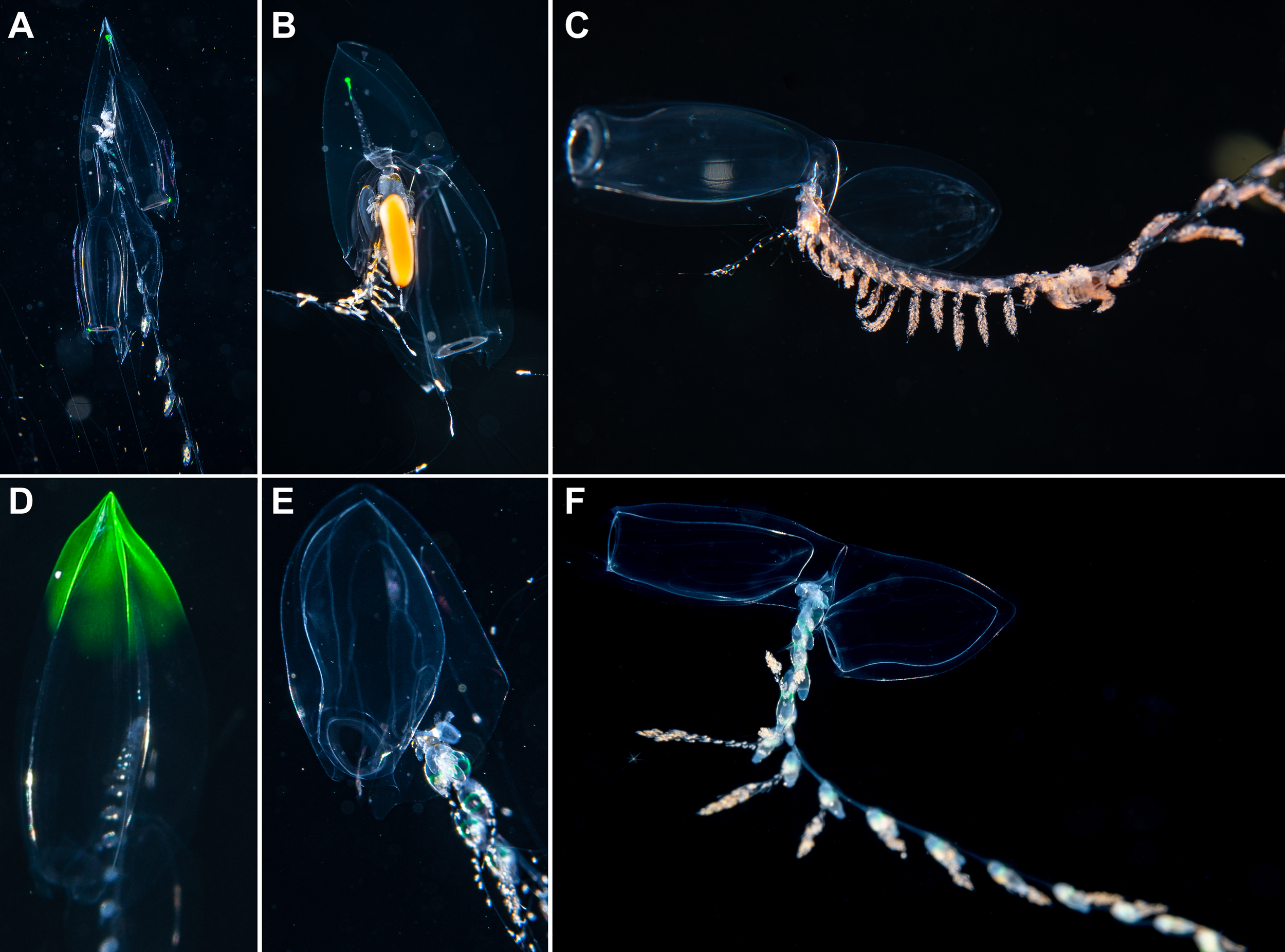
Diphyid siphonophores. (A) Polygastric colony of Diphyes dispar (BFLA4326). (B)Diphyes dispar eudoxid (BFLA4449). (C) Colony overview of Sulculeolaria biloba (BFLA4637). (D) Polygastric colony of Diphyes bojani (BFLA4210). (E) Anterior nectophore of Sulculeolaria monoica (BFLA4261). (F) Polygastric colony of Sulculeolaria monoica (BFLA4703; photo by Linda Ianniello).
Eudoxid stage: not observed.
Diphyes dispar Chamisso & Eysenhardt, 1821
Synonymy: Moser, 1925; Totton and Bargmann, 1965
Examined specimens: BFLA4191.1, polygastric colony; BFLA4326, polygastric colony; BFLA4449, eudoxid; OHNC267, eudoxid; OHNC35, polygastric colony.
Description: otal length around 20 mm. Two nectophores (Figure 5A). Five ridges on anterior nectophore, lightly serrated. Apex pointed. Hydroecium deep, reaching almost half of the anterior nectophore length. Nectosac ending with a filiform process (about ¼ of total nectosac length). It reaches almost to the apex of the nectophore, broadening at the apex of the nectosac. Somatocyst oblong, reaching past the base of the nectosac filiform process. Three ostial teeth present, dorsal one slightly more pronounced than laterals. Posterior nectophore shorter than anterior nectophore with very broad hydroecium (Figure 5A). Ostial teeth as in the anterior nectophore. Yellow tentilla. Green fluorescence on the filiform process of the nectosac in the anterior nectophore and in the lower part of the nectosac in both nectophores.
Eudoxid stage: total length 8 mm. Bract and gonophore of similar length (Figure 5B). Bract with pronounced hood. Phyllocyst filiform with a sphere at the apex, reaching ⅔ of the bract length. Gonophore with slightly serrated ridges. Ostial teeth and basal lamella present. Yellow tentilla.
Genus Sulculeolaria Blainville, 1830
Sulculeolaria biloba (Sars, 1846)
Synonymy: Totton and Bargmann, 1965
Examined specimens: BFLA4637, polygastric colony; OHNC258, polygastric colony.
Description: The length of the anterior nectophore 14 mm. Two nectophores (Figure 5C). Anterior nectophore of similar size as posterior nectophore and with rounded apex (Figure 5C). Nectosac curved and pointed at the apex (Figure 5C). Somatocyst small, oblong, reaching around ⅙ of the nectophore length (Figure 5C). No ostial teeth. Characteristic long commissural canals joining dorsal and lateral radial canals (Figure 5C). The highest point of the commissural canal reaches about ⅔ of the nectophore length (Figure 5C). Posterior nectophore with looped radial canals and without ostial teeth (Figure 5C). Orange tentilla (Figure 5C).
Sulculeolaria monoica (Chun, 1888)
Synonymy: Totton and Bargmann, 1965
Examined specimens: BFLA4261, polygastric colony; BFLA4270, polygastric colony; BFLA4522, polygastric colony; BFLA4703, polygastric colony, BFLA4900, polygastric colony, BFLA5232, polygastric colony.
Description: Total length 16–20 mm. Anterior nectophore of similar size as posterior nectophore and with rounded apex (Figures 5E, F). Nectosac curved near ostium and pointed at the apex (Figure 5E). Somatocyst small, often invisible in the pictures. Presence of ostial teeth. Commissural canals present, joining dorsal and lateral radial canals (Figures 5E, F). Posterior nectophore with looped radial canals and with ostial teeth (Figure 5F). Bright yellow tentilla (Figure 5F).
Remarks: This species is similar to S. turgida (Gegenbaur, 1854c), with the sole difference being lack of ostial teeth on nectophores in S. turgida, as opposed to 3–5 ostial teeth on each nectophore in S. monoica. In most cases analyzed here, the ostial teeth were apparent, but the identity of four specimens could not be determined; thus, more data are needed to exclude the presence of S. turgida in the region.
Family Hippopodiidae Kölliker, 1853
Genus HippopodiusQuoy & Gaimard, 1827
Hippopodius hippopus (Forskål, 1776)
Synonymy: Totton and Bargmann, 1965
Examined specimens: BFLA4380, polygastric colony.
Description: Total length 9 mm. Nectophores of inverted horseshoe shape, exhibiting blanching after contact (Figures 6A, B). Each nectophore with four rounded knobs above the ostium and two larger ventral apophyses (Figure 6A). Small nectosac (Figure 6A). Tentilla yellow (Figure 6A).
Figure 6
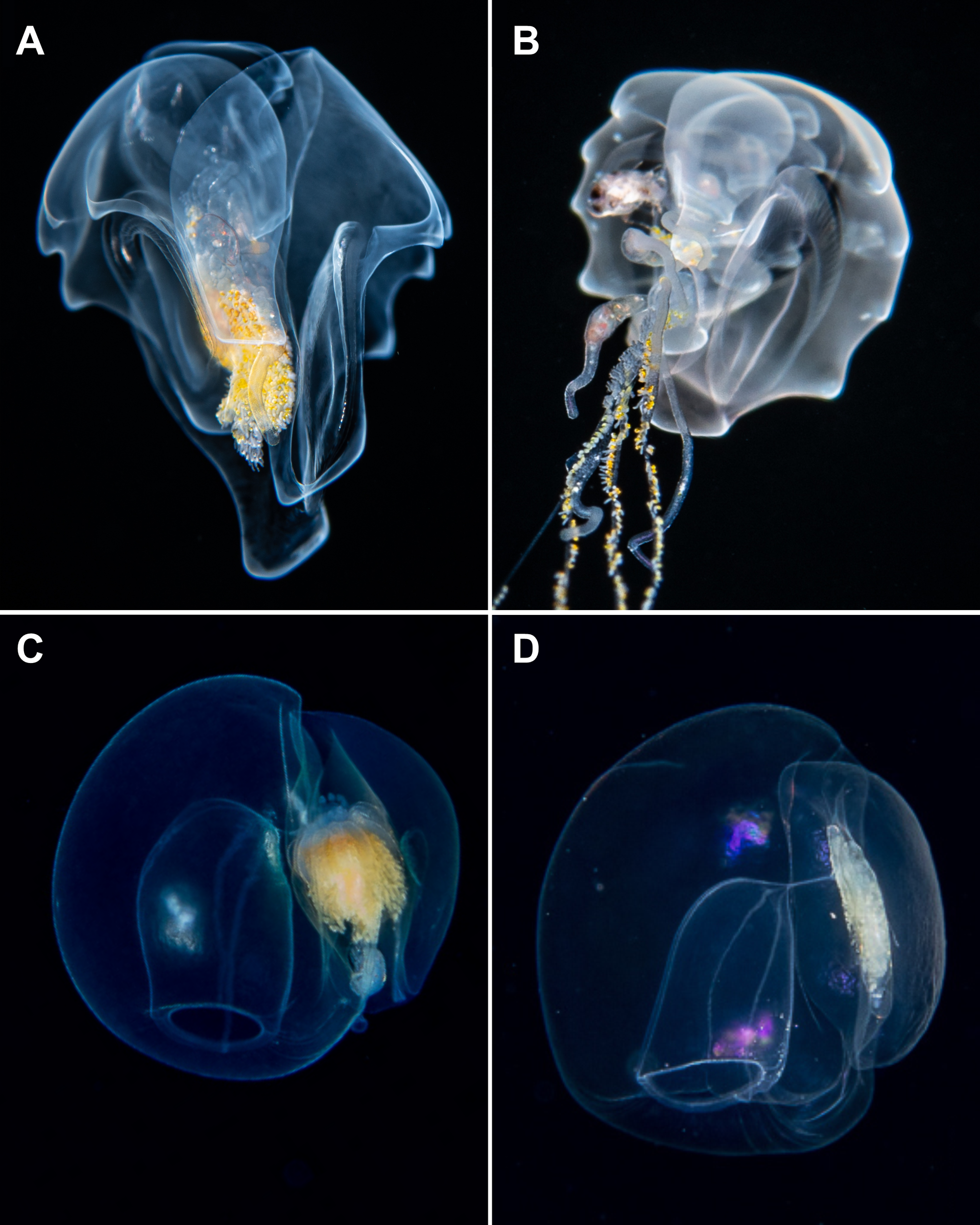
Prayid siphonophore diversity. (A)Hippopodius hippopus polygastric colony, lateral view (BFLA4380). (B)Hippopodius hippopus colony after being disturbed, showing blanching of nectophores. (C)Amphicaryon ernesti polygastric colony (OHNC147.1; photograph by Deborah Devers). (D)Amphicaryon peltifera polygastric colony (OHNC147.2; photograph by Deborah Devers).
Family Prayidae Kölliker, 1853
Genus Amphicaryon Chun, 1888
Amphicaryon ernesti Totton, 1954
Synonymy: Totton and Bargmann, 1965
Examined specimens: OHNC147.1, polygastric colony.
Description: Two nectophores present, larger, round larval nectophore and smaller, vestigial one (Figure 6C). The vestigial nectophore not enclosed by the larval nectophore. Lateral radial canals in the larval nectophore curved and convoluted in the apical part. The nectosac on the vestigial nectophore without an opening. Yellow tentilla.
Amphicaryon peltifera (Haeckel, 1880)
Synonymy: Totton and Bargmann, 1965
Examined specimens: OHNC147.2, polygastric colony.
Description: Two nectophores present, larger, round larval nectophore and smaller, vestigial one (Figure 6D). Larval nectophore longer than wide. The vestigial nectophore not enclosed by the larval nectophore. Lateral radial canals in the larval nectophore almost straight and not convoluted in the apical part. No nectosac on the vestigial nectophore. Colorless tentilla.
Genus Lilyopsis Chun, 1885
Lilyopsis problematica sp. nov.
Synonymy: Stephanophyes superba – Chun, 1888, 1891
Holotype: Specimen BFLA5286, deposited at the Florida Museum of Natural History under catalog number UF-18829.
Etymology: The specific epithet “problematica” refers to the puzzling set of traits exhibited by this species, which appear to be intermediate between the genera Stephanophyes and Lilyopsis.
Citation: Lilyopsis problematica Trochanowska, Mańko, Collins & Schuchert in Trochanowska et al.
Type locality: USA, Florida, about 10 km east of Palm Beach; WGS84 26.704, -79.936; depth 10 m.
Examined specimens: BFLA4221, polygastric colony; BFLA4223, polygastric colony; BFLA4279, polygastric colony; BFLA4700, polygastric colony; BFLA4811, polygastric colony; BFLA5285, polygastric colony; BFLA5286, polygastric colony;
Diagnosis: Prayid siphonophore with two homomorphic, conical nectophores, each with an extensive nectosac, shallow hydroecium, pronouncedly looped lateral radial canals, and an ascending mantle canal that bifurcates once and terminates in drop-shaped protuberances. Each cormidium includes a bract with spur, cormidial bell, gastrozooid with tentacle, and gonophores. Monoecious, with gonophores of both sexes appearing in random order between cormidia. Gonophores attached at a distance from gastrozooids. Cormidial bell simple, longer than wide, with wavy canals. Tentacle likely with heteromorphic tentilla. No palpons.
Description: Total colony length up to 40 mm (Figure 7A). Nectosome: Two conical nectophores of equal size, reaching up to 6 mm. Nectosac extensive, occupying most of the nectophore (Figures 7A, B). Ostium large, with pronounced velum, directed obliquely to the colony’s anterior–posterior axis. Hydroecium wide, shallow, and irregular. Pedicular canal curved upwards proximally, giving rise to the upper and lower radial canals. Lateral radial canals branch from the upper lateral canal close to the junction with the pedicular canal. The upper and lower canals are straight along their entire length. Lateral canals follow a complex course: first directed towards the lower surface of the nectophore, then curving upwards, nearly reaching the upper surface, looping sinusoidally towards the proximal surface, then bending again to reach the ostial ring canal (Figure 7B). Red-pigmented spots present along the lower half of the ostial ring canal, occasionally neighbored by whitish structures, likely tubercles.
Figure 7
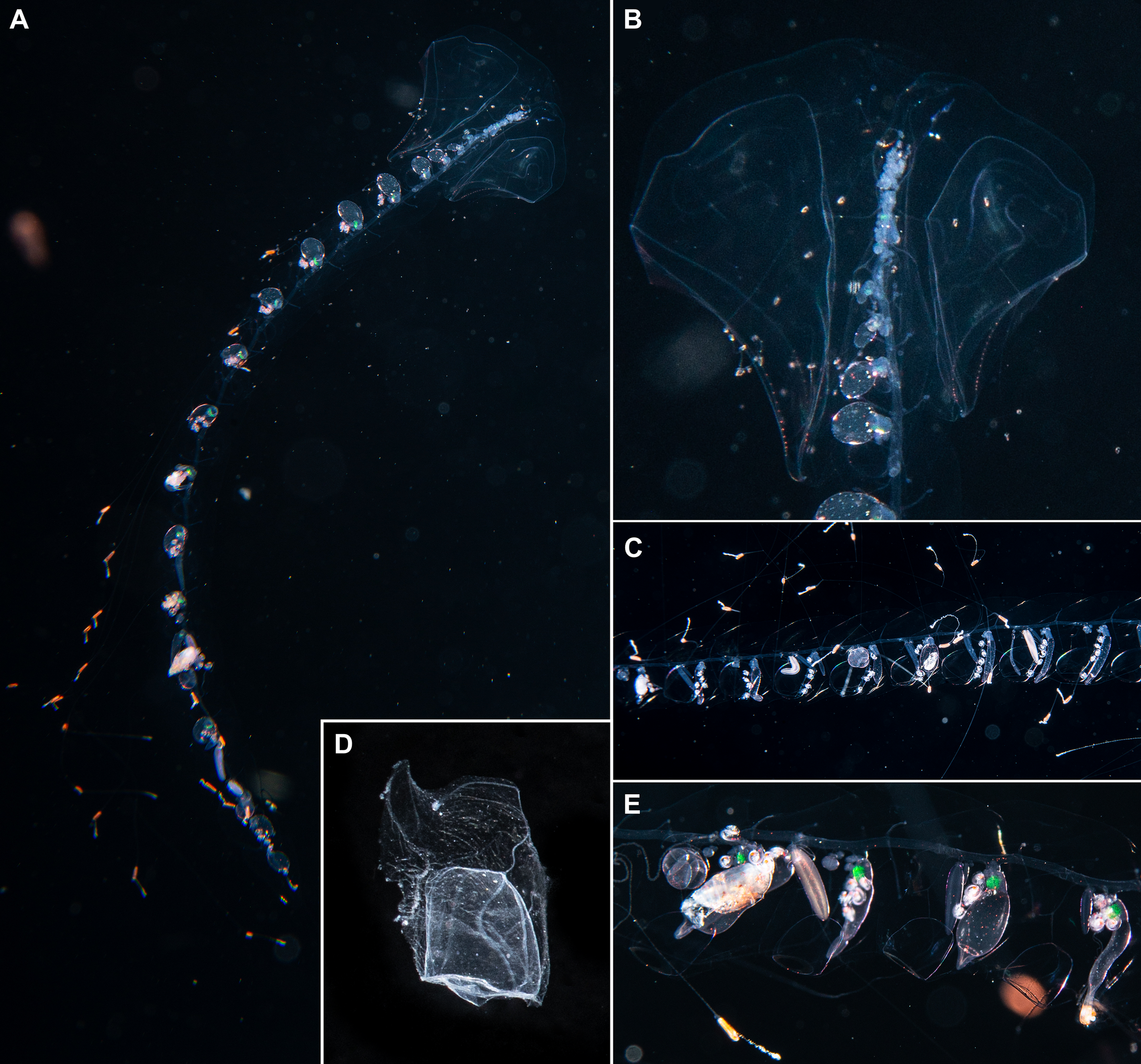
Morphology of Lilyopsis problematica sp. nov. (A) Overview of the entire colony (BFLA4223). (B) Close-up of the nectophores (BFLA4223). (C) Portion of the siphosome (BFLA4811). (D) Preserved cormidial bell (BFLA5286). (E) Portion of the siphosome with mature gonads (BFLA4223).
Siphosome: Each bract terminating with an elongated spur. Lateral bracteal canal running opposite to the hydroecial canal, perpendicular to the stem, and with a longitudinal bracteal canal in between. Gonophores of both sexes present, appearing in clusters of a few same-sex gonophores per cormidium (Figures 7C, E). Notably, gonophores appear separated from the gastrozooid (Figures 7C, E). Adjacent cormidia usually of different sex, but clusters of a few cormidia of the same sex also present. Male gonads orange when mature, distinctly elongate, extending well beyond the rim of the gonophore bell (Figure 7E). Female gonophores smaller, with 3–4 ovoid whitish eggs, not extending below the gonophore bell (Figure 7E). Red spots present on some of the gonophores (both male and female). Single cormidial bell per cormidium, more elongate than wide and nearly square in lateral view (without indentation), with red pigment spots paralleling the ostial ring canal and radial canals (Figures 7D, E). Three radial canals branching off from the pedicular canal; one of these branches off again, giving rise to the fourth canal (Figure 7D). Gastrozooids with a green fluorescent spot restricted to the base and red spots all over the entire surface (Figures 7A, E). Tentacle of older gastrozooids with round white tentilla at the base and orange, kidney-shaped tentilla distally (Figures 7A, C, E; either developmental sequence or heteromorphic tentilla as in Stephanophyes superba). Tentacle of younger gastrozooids with only roundish, white tentilla (Figure 7B).
Remarks: Detailed morphological analysis was hampered by rapid deterioration of specimens, particularly their nectophores and bracts, after collection and fixing. Consequently, the course of some canals (notably the mantle canal) and the shape of bracts could not be traced completely, and this will have to await the possibility of conducting in vivo examinations. To further add to the puzzling nature of this species, it does seem to share a number of traits with two genera, Lilyopsis and Stephanophyes (Table 1). Interestingly, in the original description (Chun, 1888) and subsequent redescription (Chun, 1891) of Stephanophyes superba, Chun noted that the species can be found in two morphotypes, which he interpreted as two life cycle stages. His conclusion was based on the size difference between the two forms. The larger form had a crown of four homomorphic nectophores with an ascending mantle canal branching multiple times and terminating in red-pigmented processes, tentacles with two tentillum types, and palpons, budding at the junction of cormidia, equipped with tentacles bearing tentilla. The smaller morphotype had only two nectophores, with an ascending mantle canal bifurcating only once, but unfortunately Chun did not provide a detailed description of other components of the colony, although he noted its close resemblance to the genus Lilyopsis (Chun, 1891). Based on the morphological and molecular data presented here (see subsequent section), we can confidently conclude that Chun’s smaller morphotype represents a separate species, described here as Lilyopsis problematica. We assign this species to the genus Lilyopsis because it lacks several diagnostic traits of Stephanophyes, notably the crown of more than two mature nectophores and palpons (Table 1), while simultaneously possessing a number of Lilyopsis-specific traits (Table 1, e.g., pair of homomorphic nectophores with a single bifurcation of the ascending mantle canal; Carré, 1969; Haddock et al., 2005). However, the close similarity of species from these two genera, highlighted by the discovery of L. problematica, calls for revision of both Lilyopsis and Stephanophyes, which may ultimately support their unification. This will have to await collection of more specimens and sequencing data, as no reference 16S rRNA sequences are available for other Lilyopsis species.
Table 1
| Lilyopsis medusa | Lilyopsis fluoracantha | Lilyopsis problematica | Stephanophyes superba | |
|---|---|---|---|---|
| Nectophore shape | conical, with extensive nectosac | conical, with extensive nectosac | conical, with extensive nectosac | conical, with extensive nectosac |
| Nectophore length | 7–8 mm | 15 mm | 6 mm | 40 mm |
| Ostial pigment spots | none | red, lower half of ostium | red, lower half of ostium | none |
| Number of mature nectophores | 2 | 2 | 2 | 4 |
| Number of ascending mantle canal bifurcations in mature nectophores | 1 | 1 | 1 | >5 |
| Terminal swellings of ascending mantle canal | transparent | transparent | transparent | red pigmented |
| Disjunct pedicular canal | absent | absent | ? | present |
| Descending mantle canal | absent | absent | ? | present |
| Number of bracteal canals | 6 | 6 | 6 | 6 |
| Bract’s spur | present, rounded | present, elongated | present, elongated | absent |
| Cormidial bell shape | wider than long | wider than long | longer than wide, nearly square in lateral view | longer than wide, with indentation on upper surface |
| Number of radial canals on cormidial bell | 2x latero-posteriors and 2x anterior canals | 2x latero-posteriors and 2x anterior canals | 2x anterior canals, 1x lower canal, later dividing into 2 canals. | 1x lower and 1x left lateral, later dividing into three canals |
| Course of radial canals on cormidial bell | straight | straight | wavy | sinuous |
| Pigment spots on cormidial bell | entire ostium | none | entire ostium | entire ostium |
| Gonophore attachment | at gastrozooid base | at gastrozooid base | at the distance from gastrozooid | at gastrozooid base |
| Palpons | absent | absent | absent | present |
| Gastrozooid tentilla | single type | single type | likely heteromorphic | heteromorphic |
| Fluorescence | none reported | entire surface of bracts and nectophores | strong at gastrozooid base | strong at gastrozooid base |
| Reference | Carré, 1969 | Haddock et al., 2005 | This study | Chun, 1891 |
Comparison of diagnostic traits among Lilyopsis and Stephanophyes species. ? denotes no data.
Genus Stephanophyes Chun, 1888
Stephanophyes superba Chun, 1888
Synonymy: Totton and Bargmann, 1965
Examined specimens: BFLA4375, polygastric colony; OHNC250, polygastric colony.
Description: Nectosome: Two nectophores of equal size, without ridges, cap shaped (Figure 8A). Nectosac occupying ⅖ of the nectophore length. Wide ostium with pronounced velum. Red-pigmented spots paralleling part of the ring canal. Ascending mantle canal branching multiple times, each branch terminating with a distal drop-shaped swelling (Figure 8B). Pedicular canal straight. Upper and lower canals branching off the pedicular canal. Symmetric lateral radial canals branching off from the upper radial canal. The lower and upper canals straight along their entire length. Lateral radial canals with a complex course.
Figure 8
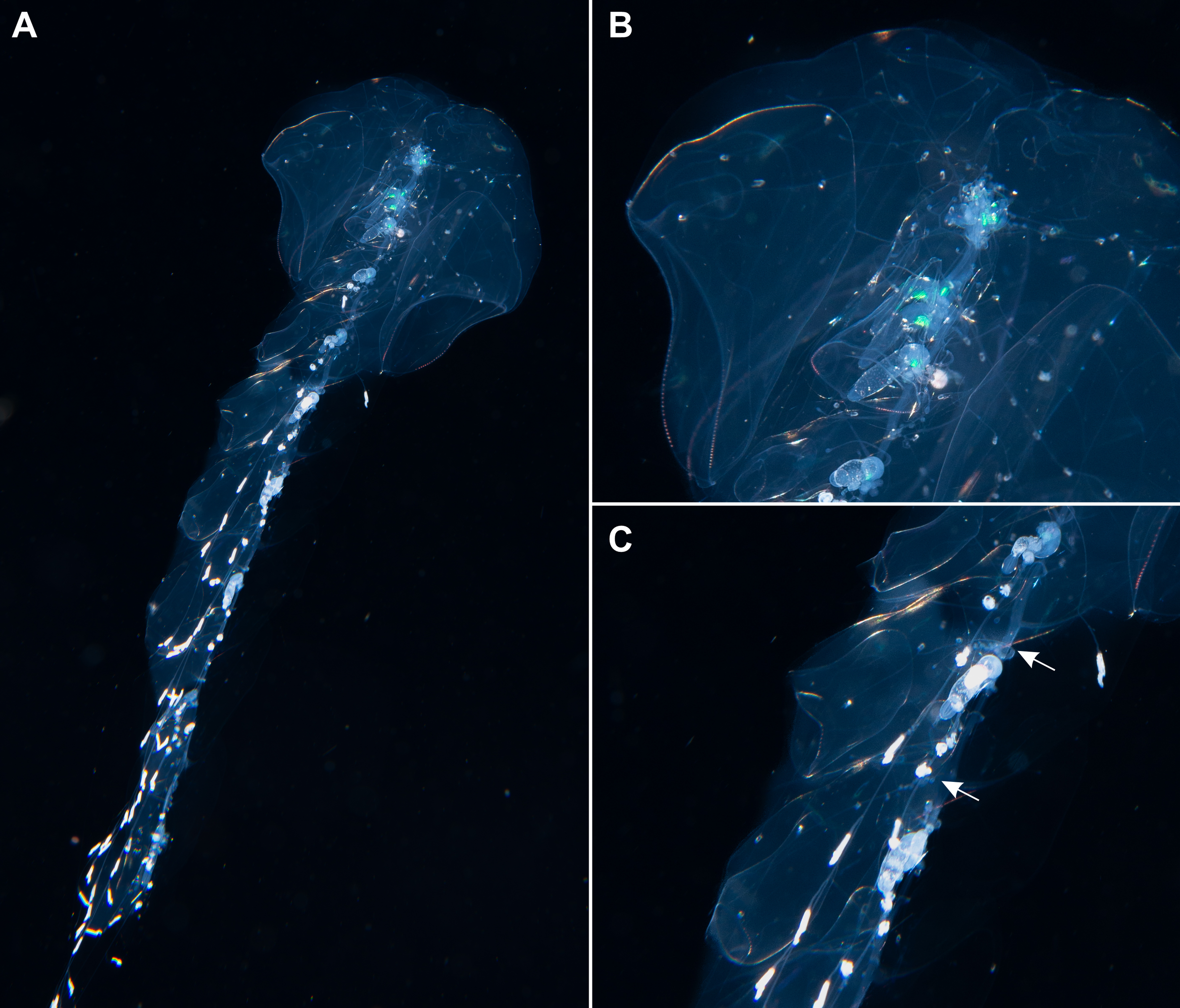
Morphology of Stephanophyes superba. (A) Overview of entire colony (OHNC250). (B) Close-up of one of nectophores showing bifurcating ascending mantle canal and acorn-shaped tentilla extending from young gastrozooids (OHNC250). (C) Close-up of stem portion, with intercormidial palpons indicated with white arrows (OHNC250).
Siphosome: Gastrozooids with long basigaster – up to ⅓ of the gastrozooid length. With green fluorescence at the base of each gastrozooid (Figure 8B). Palpons present (Figure 8C). Two types of tentilla on tentacles of older gastrozooids (Figure 8A) – one bigger, orange, kidney-shaped, typical of prayids, and another, smaller, colorless, acorn shaped. Younger gastrozooid tentacles only with acorn-shaped tentilla (Figure 8B). Palpon tentacles also with only acorn-shaped tentilla. Cormidial bells elongated, with a pronounced indentation along the upper surface (Figure 8C), with complex radial canals and with some red spots paralleling the ostial ring canal (Figure 8C).
Remarks: Stephanophyes superba usually has four nectophores forming a corona (Totton and Bargmann, 1965), while the two specimens found here, BFLA4375 and OHNC250, possessed only two. This could indicate either an earlier developmental stage of the colony or loss due to predation or damage. Additionally, according to Totton and Bargmann (1965), the somatocyst should have red pigmentation, which was not observed in these specimens. Despite these differences, molecular data from BFLA4375 confirm the identification of this specimen as S. superba.
3.2 Molecular analyses
Morphological identifications were verified by BLAST searches of the 39 16S rRNA sequences obtained here (Supplementary File 1) against NCBI’s GenBank database. Species-level matches (≥95% similarity) were recovered for 30 out of 39 sequences. For the remaining nine sequences—generated from C. leuckartii, D. bojani, L. problematica sp. nov., and S. monoica—no sequences were found in GenBank at the given threshold (95%), with the closest matches showing 80–85% similarity.
To further corroborate the taxonomic assignments, maximum likelihood phylogenetic analyses were run separately for particular clades/taxa: Cystonectae; Agalmatidae and Forskaliidae; and Calycophorae (Figures 9–11). Physalia BFLA4505 grouped with public P. physalis sequences, and together with other Physalia species, formed a sister group to Bathyphysa conifera (Figure 9). These two genera were recovered as sister to Rhizophysa, with most sequences generated here clustering with public data for R. eysenhardtii (Figure 9).
Figure 9
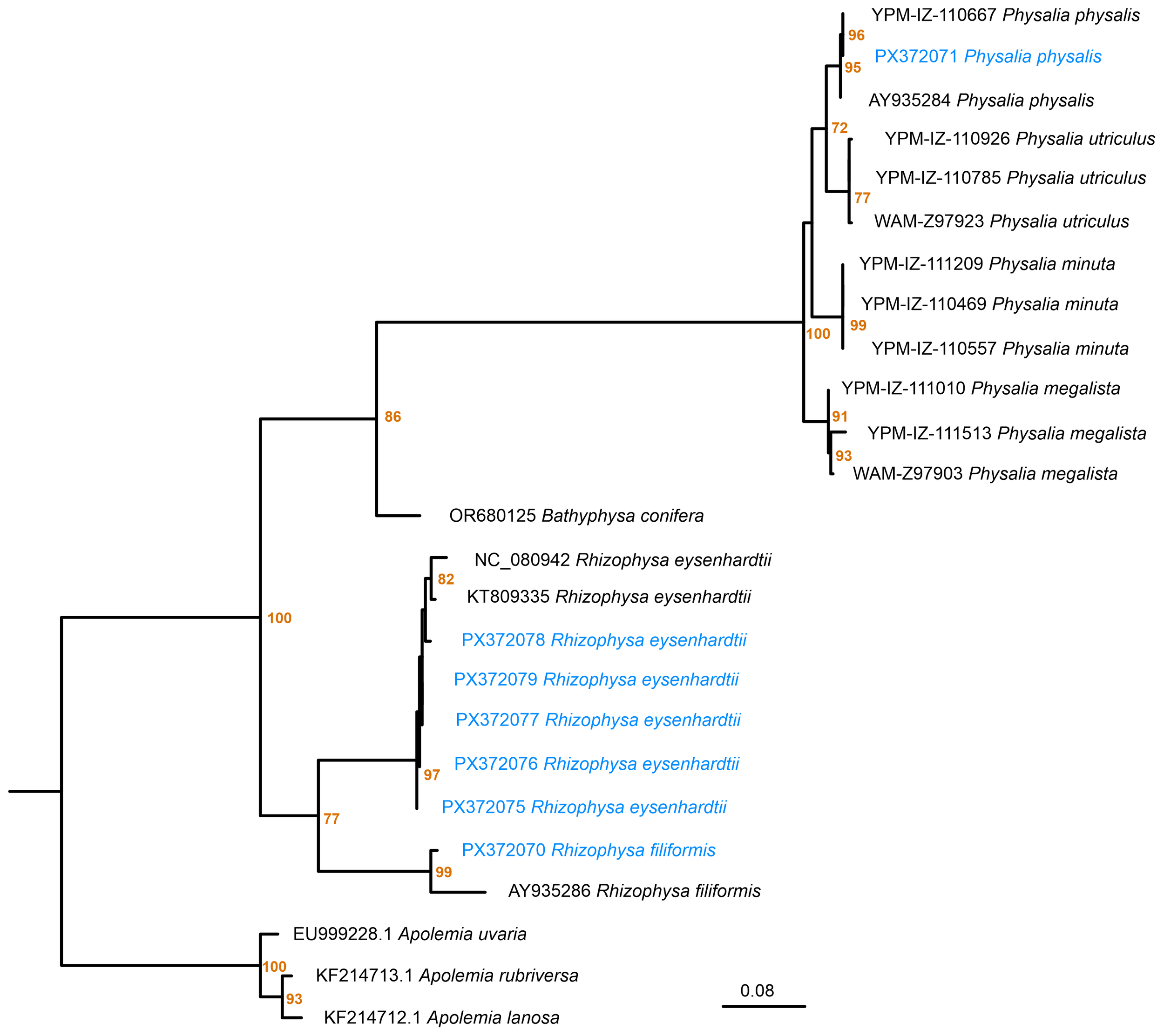
16S rRNA maximum likelihood phylogenetic tree (model HKY+F+I+G4) of Cystonectae. Labels correspond to GenBank accession numbers. Blue labels, sequences obtained during this study. Yellow labels, ultrafast bootstrap values (only values >70 are shown).
Figure 10
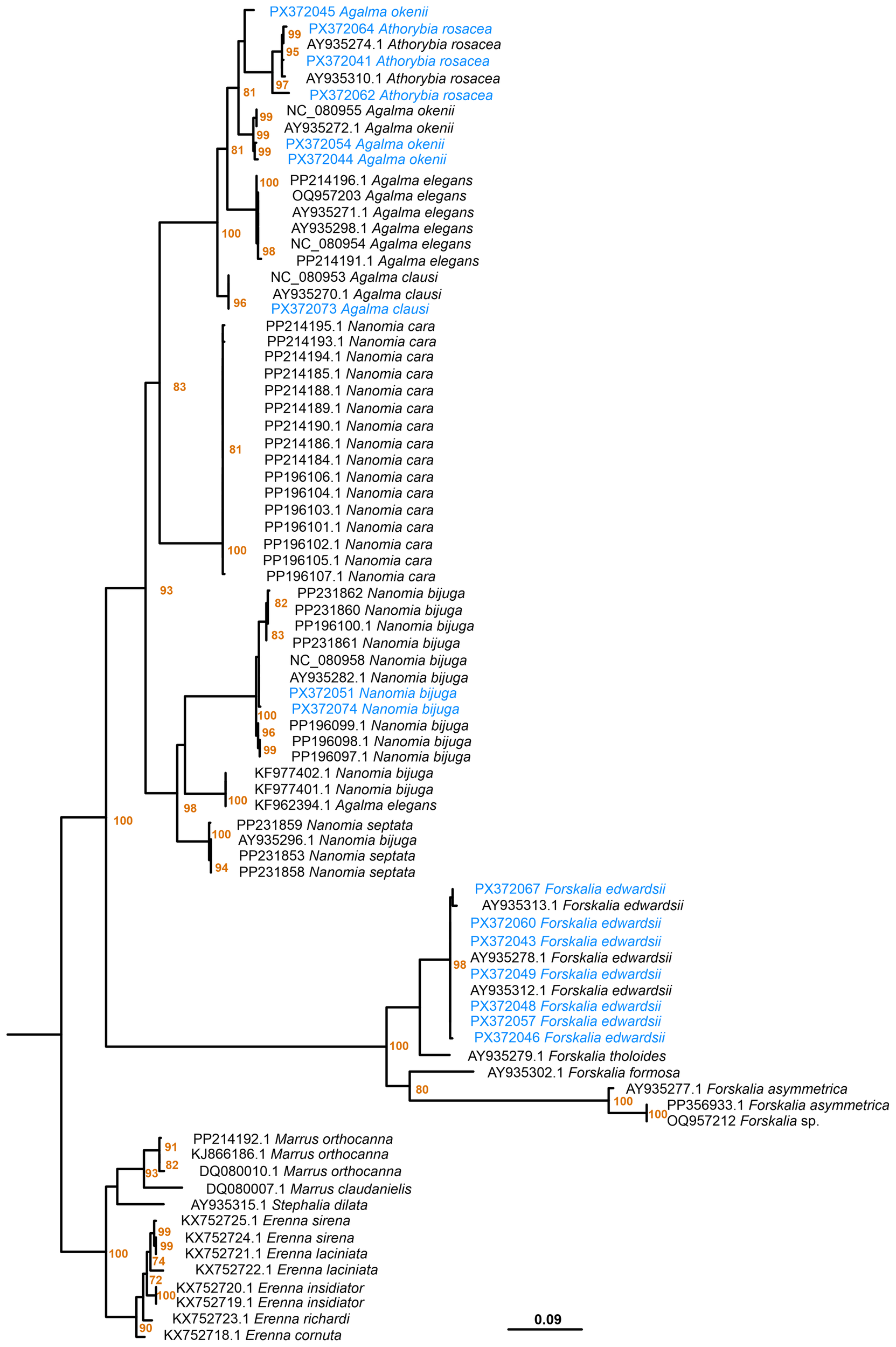
16S rRNA maximum likelihood phylogenetic tree (model GTR+F+I+G4) of Agalmatidae and Forskaliidae. Labels correspond to GenBank accession numbers. Blue labels, sequences obtained during this study. Yellow labels, ultrafast bootstrap values (only values >70 are shown).
Figure 11
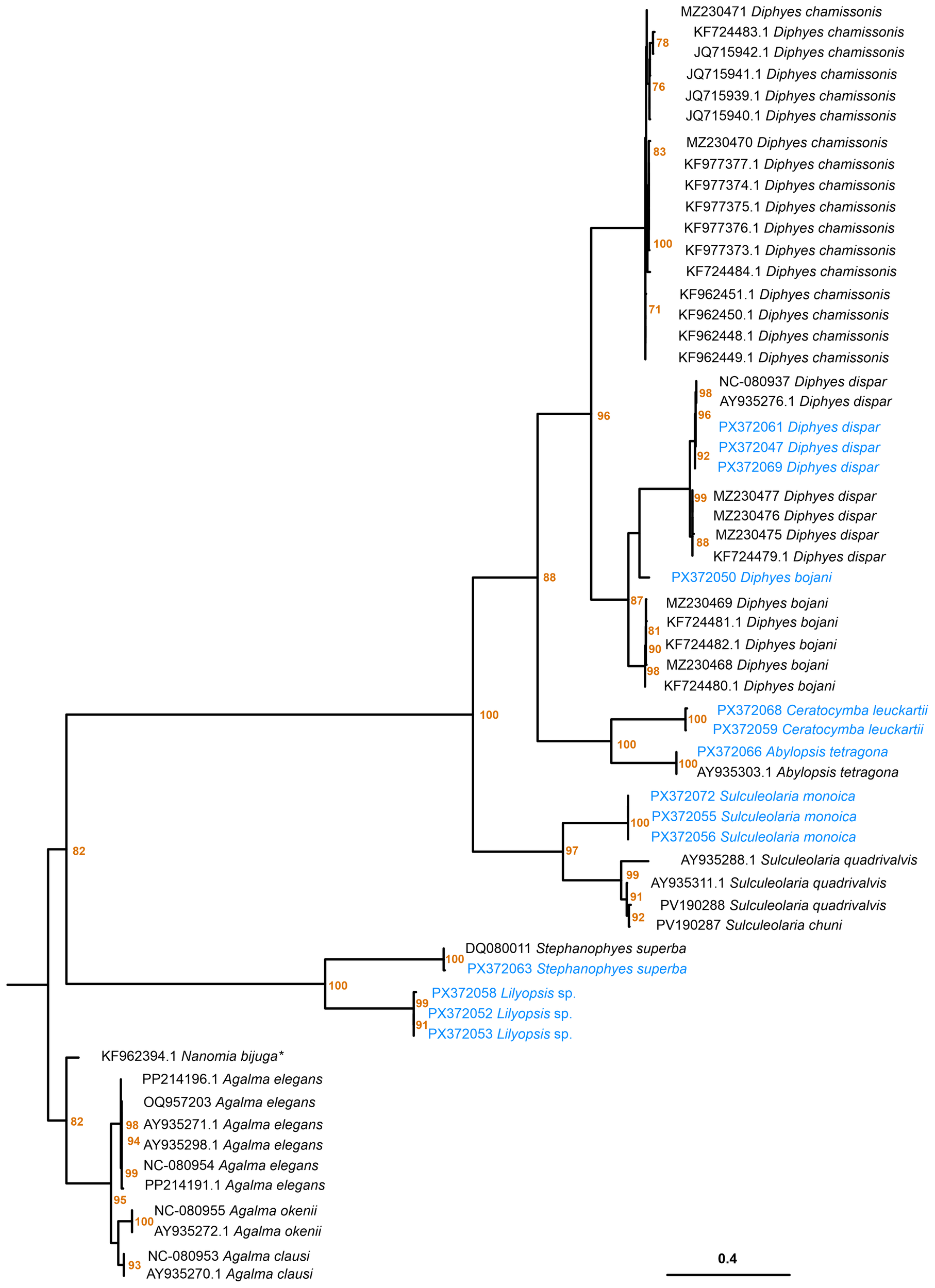
16S rRNA maximum likelihood phylogenetic tree (model TIM+F+G4) of some Calycophorae. Labels correspond to GenBank accession numbers. Blue labels, sequences obtained during this study. Yellow labels, ultrafast bootstrap values (only values >70 are shown). * denotes sequence originally identified as Agalma elegans.
All genus-level groups within the Agalmatidae + Forskaliidae tree were recovered with high support (Figure 10), with little intraspecific structure except for A. okenii, A. rosacea, and N. bijuga. One A. okenii sequence (BFLA4144) was found to be sister to A. rosacea, instead of grouping with other A. okenii. While most A. rosacea sequences from the present study clustered together, BFLA4340 was recovered as sister to the remaining Athorybia (Figure 10). Both N. bijuga sequences clustered with Atlantic N. bijuga sequences, forming a sister clade to Pacific N. bijuga (Figure 10). All F. edwardsii sequences from the present study clustered with F. edwardsii GenBank data (Figure 10).
Prayidae sequences included here formed a sister clade to other Calycophorae, with all Lilyopsis problematica sequences clustering together as sister to S. superba (Figure 11). Although there was no direct match for S. monoica in GenBank, all sequences from the present work grouped together as sister to other Sulculeolaria species (S. quadrivalvis and S. chuni). The two C. leuckartii identified here were recovered as sister to A. tetragona (Figure 11). All D. dispar sequences grouped together with GenBank-derived D. dispar sequences from the Atlantic Ocean, clearly differing from D. dispar sampled in the Kuroshio Current (Figure 11). Diphyes bojani (BFLA4210) formed a sister group to D. dispar instead of clustering with other D. bojani sequences, although similarly to D. dispar, all other D. bojani sequences came from the Pacific Ocean.
Genetic distances calculated for each species, genus, and species- and genus-pair (Supplementary File 2) offered additional support for morphology-based identification and shed light on potential cryptic variation. The highest mean genetic distance within species was found in R. filiformis (6.12%), nearly five times larger than that within its sister species R. eysenhardtii (1.21%). Similarly, while mean genetic distance within the two Nanomia species based on sequences included here was 0, the mean distance within N. bijuga was 3.65%. A comparable pattern—in which 16S rRNA sequences from a single species nested within a genus were clearly more diverse than those from other species in that genus—was also observed in Diphyes (D. bojani) and Forskalia (F. asymmetrica). This was further supported by intrageneric genetic distances, which in certain genera (Forskalia, Nanomia, Diphyes, Sulculeolaria) were much larger than in others (Supplementary File 2). Additionally, the mean intergeneric genetic distance between Lilyopsis (only L. problematica) and Stephanophyes (only S. superba) of 27.04% was comparable to other intergeneric distances within Calycophorae (e.g., Abylopsis–Diphyes 27.73%, Ceratocymba–Sulculeolaria 33.91%), supporting our assignment of the new species to the genus Lilyopsis (Supplementary File 2).
3.3 Ecological observations
The in situ photographs allowed documentation of numerous ecological relationships involving siphonophores. Nearly 55% of the 118 specimens observed were interacting with other taxa. Among those specimens, 64 siphonophores were in ecological relationships: 43 were captured actively feeding, and 41 were found either being preyed upon, parasitized, or involved in other relationships (Supplementary File 1).
Hyperiid amphipods were the most commonly consumed prey, found in gastrozooids of representatives of Cystonectae (R. eysenhardtii), Physonectae (A. okenii, F. edwardsii—Figure 12A, N. bijuga), and Calycophorae (D. dispar, L. problematica, S. biloba—Figure 12B, S. monoica). Other crustaceans consumed included copepods (Forskalia sp.—Figure 12D, F. edwardsii), zoea larvae (A. okenii, Figure 12C), and shrimp-like large crustaceans (F. edwardsii, S. superba, Sulculeolaria sp.—Figure 12I). Other prey items included chaetognaths (Forskalia sp., Figure 12D), thecosome pteropods (F. edwardsii, Sulculeolaria sp.—Figure 12E), and polychaete epitokes (Forskalia sp., F. edwardsii—Figure 12F, N. bijuga), likely captured accidentally while swarming the photographer’s lights. A few specimens were also observed consuming fish; these included polygastric colonies (F. tholoides, N. bijuga—Figure 12E, R. eysenhardtii) as well as siphonula of P. physalis, as indicated by the presence of fish scales in the protozooid (Figure 12G). The most diverse prey types were found in F. edwardsii gastrozooids.
Figure 12
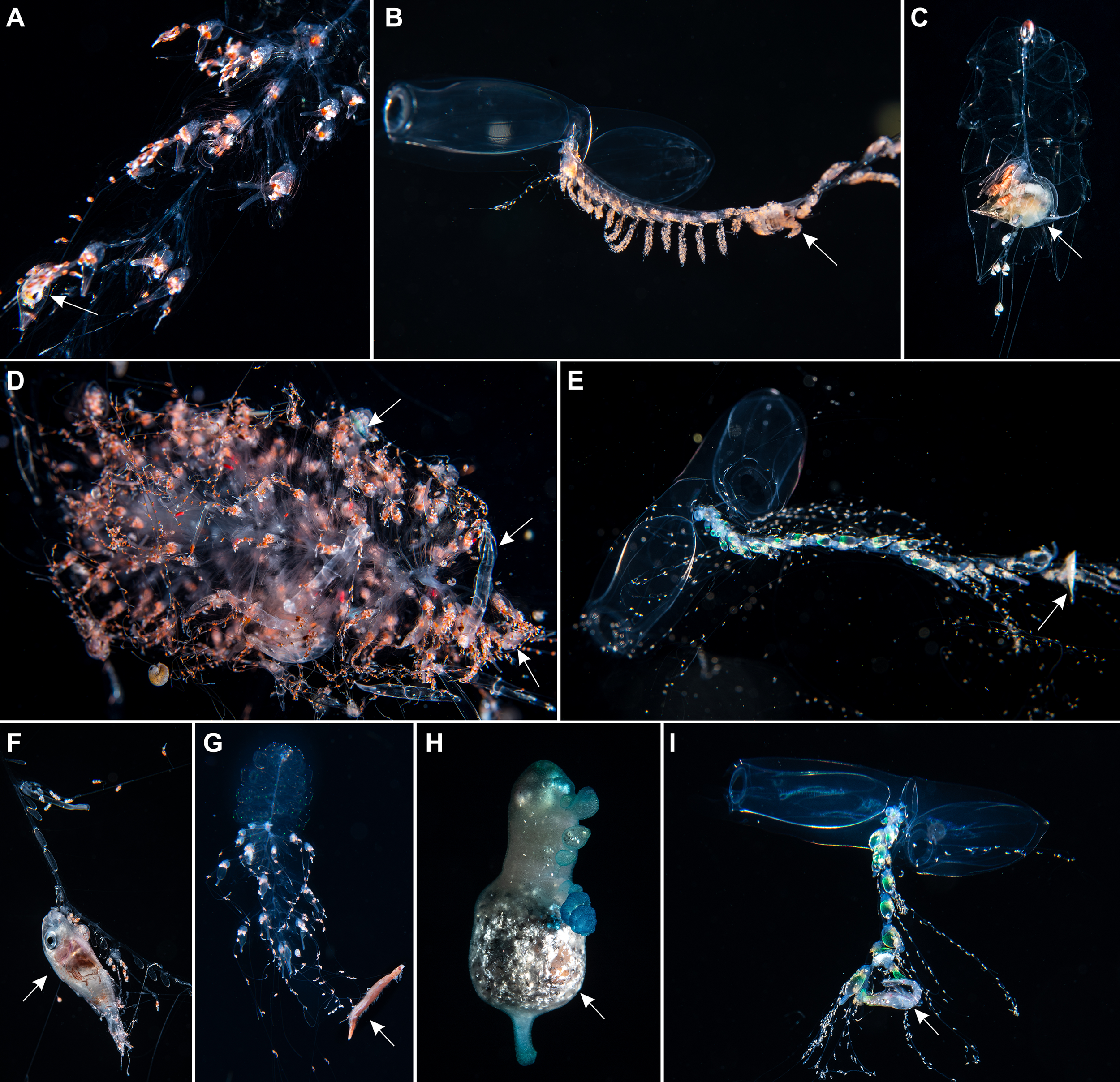
Prey of siphonophores. (A) Amphipod in Forskalia sp. gastrozooid (BFLA4295). (B) Amphipod in the gastrozooid of Sulculeolaria biloba (BFLA4637). (C) Agalma okenii (BFLA4787) preying on zoea. (D) Copepod (upper arrow), chaetognath (mid arrow), and amphipod (lower arrow) captured by F. edwardsii (BFLA4874). (E) Thecosome pteropod captured by Sulculeolaria monoica (BFLA5232). (F) Fish collected by Nanomia bijuga (OHNC253). (G) Epitoke captured by F. edwardsii (OHNC245). (H) Fish scales in Physalia physalis protozoid (BFLA4505; Deborah Dever photo). (I) Large crustacean in Sulculeolaria sp. gastrozooid (OHNC247). White arrows indicate position of prey.
Siphonophores were also observed in other relationships (Figure 13). In some cases the exact nature of these relationships could not be determined, as the observations were either too short or not sufficiently detailed. The most common relationship observed was that between amphipod crustaceans and siphonophores, with amphipods found on representatives of 13 siphonophore species (Supplementary File 1, Figures 13A, C, G, H). Amphipods were observed resting within nectophores (e.g., S. biloba, Figure 13A), sitting on the nectophore exumbrella (F. edwardsii, Figure 13C), crawling on the stem and gastrozooids (R. eysenhardtii, Figure 13G), or hidden among bracts (A. rosacea, Figure 13F). Importantly, amphipods are noticeably attracted to dive lights; thus their actual number on siphonophore colonies might have been lower. Other crustaceans observed were phyllosoma larvae (Figure 13B).
Figure 13
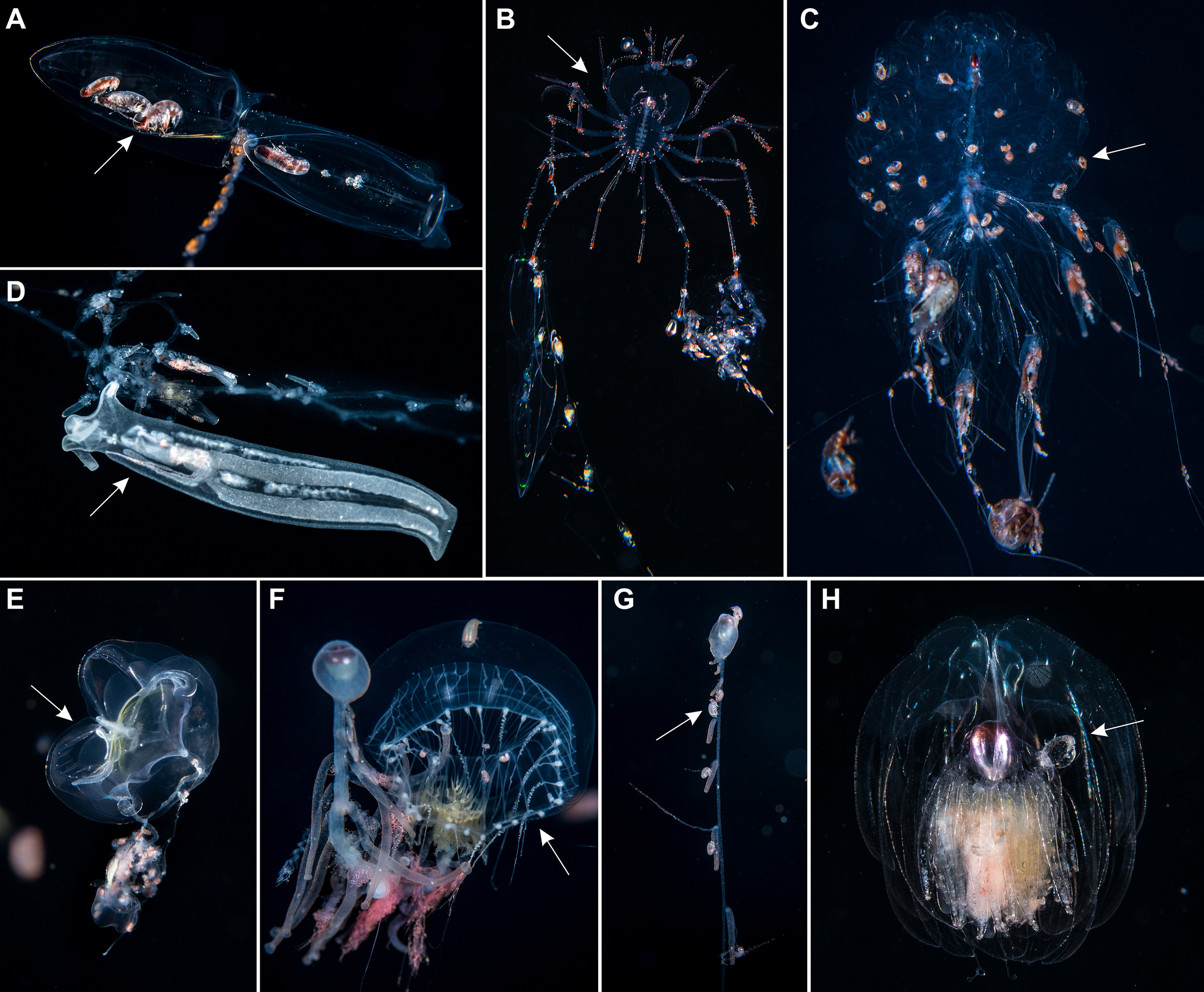
Diversity of ecological relationships involving siphonophores. (A) Amphipods inside both nectophores of S. biloba (OHNC258). (B) Phyllosoma larva holding colonies of D. dispar (BFLA4191) and N. bijuga. (C)Forskalia edwardsii (OHNC59) with amphipods on nectophores. (D)Cephalopyge trematoides consuming N. bijuga (BFLA5224; Andrea Whitaker photo). (E)Pseudaegina rhodina consuming N. bijuga (OHNC255). (F)Orchistoma pileus likely preying on R. eysenhardtii (BFLA4789). (G) Amphipods crawling on R. eysenhardtii (BFLA4776). (H) Amphipods hidden between A. rosacea bracts(OHNC265). White arrows point at animals interacting with siphonophores.
Siphonophores were also preyed upon by a pelagic nudibranch, Cephalopyge trematoides (N. bijuga, Figure 13D), as well as other gelatinous taxa: Pseudaegina rhodina (N. bijuga, Figure 13E) and Orchistoma pileus (R. eysenhardtii, Figure 13F).
4 Discussion
We identified 22 siphonophore species in the Gulf Stream waters off Florida, constituting approximately 11% of the total siphonophore diversity (Schuchert et al., 2025), including one species new to science, Lilyopsis problematica. We also found evidence of sympatric distributions within a few siphonophore genera and the likely presence of cryptic diversity in some species. In addition, underwater photography allowed us to uncover some aspects of siphonophore biology, such as the larval morphology of Rhizophysa sp., the diet of larval Physalia physalis, and novel ecological interactions between siphonophores and other pelagic fauna.
Siphonophore diversity in the Gulf Stream has been the topic of only a handful of studies (Supplementary File 3). Moore (1953) identified 19 species off the Miami coast. Interestingly, 17 out of 19 belonged to Calycophorae, while in our work, despite a similar number of siphonophore species identified (22), the proportion of calycophorans was lower (c. 59%; Supplementary File 1). Pugh and Gasca (2009) analyzed siphonophore fauna in the NE Gulf of Mexico and identified significantly larger diversity (45 species), including almost all of those found off Miami by Moore (1953; Moore et al., 1953), with a similarly high proportion of calycophores (70%). However, our study identified eight taxa not previously recorded from the region. These discrepancies likely stem from sampling methodology, as net collections tend to undersample, or damage beyond recognition, larger and more delicate colonies typical of Physonectae (e.g., Mackie et al., 1987; Hosia et al., 2017). Because of this, optical-based methods can often show higher diversity of gelatinous zooplankton than inferred from net-collected samples at the same stations (Hoving et al., 2019).
Our molecular analyses corroborated initial morphology-based identifications but indicated the presence of cryptic diversity within D. bojani, N. bijuga, and R. filiformis. The values of intraspecific genetic distances for each species analyzed here were generally higher (Supplementary File 2) than those reported in other planktonic hydrozoans (see Table 1 in Schuchert and Collins, 2021). This was particularly true for specimens assigned to R. filiformis, N. bijuga, and D. bojani (Supplementary File 2) and may be suggestive of hidden diversity. The observed high values could also be explained by the geographic distance between specimens, especially in the case of D. bojani, as all reference sequences were sourced from the coast of Japan and Taiwan (Grossmann et al., 2014). Similarly, the interspecific distances recovered here were, in some cases, for example in Agalma, lower than in other hydrozoans (Zhou et al., 2013; Zheng et al., 2014; Hosia et al., 2024).
We have also identified a number of cases of sympatric distribution within the genera Agalma, Amphicaryon, Diphyes, Forskalia, Rhizophysa, and Sulculeolaria. These results, taken together with a number of similar observations across siphonophores, for example Nanomia (Ahuja et al., 2025), Physalia (Church et al., 2025), Muggiaea (Gili et al., 1991), Vogtia (Pugh, 1991), and other gelatinous zooplankton (ctenophores; Johnson et al., 2022), suggest that co-occurrence of sister species might be more frequent than previously believed.
The unique data quality from in situ photography and hand collecting allowed us to shed light on the reproductive biology of cystonects. Although some data exist on Physalia life cycles (Totton, 1960; Munro et al., 2019; Oguchi et al., 2024), many aspects remain elusive, particularly the location where fertilization and early development occur. Virtually nothing is known about the life cycles of other cystonects (Totton and Bargmann, 1965). The results presented here showcase not only the first documentation of Rhizophysa larvae (Figures 1C, D), pointing to their morphological similarity to developing Physalia (Munro et al., 2019), but also contribute to the understanding of Physalia larval phenology.
Our data also helped uncover aspects of ecological interactions between siphonophores and other organisms. We documented active predation in thirteen siphonophore species, most notably providing the first evidence of active predation by larval Physalia on fish, as indicated by the presence of fish scales in the protozooid (Figure 12H). We show that, despite being diverse, prey items ingested by siphonophores were largely consistent with the literature (Purcell, 1981, Purcell, 2009; Hetherington et al., 2022). Physonects prey on the widest array of taxa, as they were shown to hunt crustaceans (copepods, krill, juvenile shrimps) and chaetognaths, and even fish larvae (Purcell, 1981). This was also observed here, as two species—Agalma okenii and Forskalia edwardsii—were found ingesting zoea larvae, copepods, and chaetognaths (Figures 12C, D; Supplementary File 1). However, we were also able to document novel trophic relationships, particularly active predation on fish by N. bijuga and F. tholoides (Figure 12F, Supplementary File 1). Calycophorae, on the other hand, prey mostly on small zooplankton (Hetherington et al., 2022), consistent with the observation of S. monoica preying on an unidentified thecosome pteropod (Figure 12E, Supplementary File 1). The surprising scarcity of active predation observations in the literature may stem from distinct diurnal trends of feeding across species. Indeed, Purcell (1981) showed such distinct behaviors in siphonophores and listed A. okenii as one of the species actively hunting for prey at night. Our personal observations seem to corroborate this notion, as most siphonophores seen during BWD were actively hunting.
We also documented a wide array of other types of interactions between siphonophores and pelagic fauna. We observed amphipods sitting either on external surfaces of a siphonophore colony (Figures 13C, G, H) or even within their nectophores (Figure 13A). Hyperiid amphipods are commonly associated with gelatinous fauna (Ohtsuka et al., 2009), with infestation rates reaching even 80% of all observed siphonophore specimens (Mańko et al., 2017). They were found to both consume gelatinous tissues and use them for maternal care purposes (Gasca and Haddock, 2004; Arai, 2005). Although our data were insufficient to identify the exact nature of the Siphonophorae–Amphipoda relationship, it is very likely that crustaceans were actively eating siphonophore tissues. We also found two cases where a lobster phyllosoma larva was carrying siphonophore colonies (Figure 13B, Supplementary File 1), consistent with previous records showing that phyllosoma can feed on siphonophores (Ates et al., 2007; O’Rorke et al., 2012; Johnson et al., 2025). Phyllosoma larvae were found associated with A. okenii (Biggs, 1976; Mańko et al., 2017), D. dispar (Biggs, 1976), and unidentified Prayidae species (Ates et al., 2007), rendering our observations of phyllosoma with C. leuckartii and N. bijuga novel records. We also provide a new record of the pelagic nudibranch Cephalopyge trematoides feeding on N. bijuga (Lalli and Gilmer, 1989; Arai, 2005; Figure 13D), and a potential predatory relationship between the hydromedusa O. pileus consuming Rhizophysa sp. (Figure 13F) and Pseudaegina rhodina consuming N. bijuga (Figure 13E). The interpretation of the former seems likely, given the extant record of O. pileus preying on another siphonophore, P. hydrostatica (Biggs, 1976).
The observational data provided here support the emerging notion of the ecological importance of siphonophores (e.g., Choy et al., 2017). Additionally, their high predatory efficiency highlights the potential impact they may exert on aquaculture and fisheries. Indeed, siphonophores have been implicated in mass mortality events of farmed salmon (Apolemia uvaria; Båmstedt et al., 1998) and in fouling fishing gear (Nanomia cara; Knutsen et al., 2018). By adding two widespread species (N. bijuga and F. tholoides) to the list of siphonophores preying on fish, our findings indicate that their relevance to aquaculture and fisheries is likely underestimated. Moreover, climate change–driven warming and the lateral shift of the Gulf Stream (Todd and Ren, 2023) may facilitate the spread of the diverse siphonophore community observed here into adjacent regions, potentially altering local pelagic ecosystems.
5 Conclusions
In this study, we applied blackwater diving, coupled with morphological and molecular analyses, to characterize the biodiversity of pelagic siphonophores in the Gulf Stream waters off Florida. Using this integrated approach, we identified 22 siphonophore species, including one new to science, Lilyopsis problematica. We also found evidence of sympatric distribution within a few siphonophore genera (Agalma, Amphicaryon, Diphyes, Forskalia, Rhizophysa, and Sulculeolaria) and the likely presence of cryptic diversity in some species (D. bojani, Nanomia bijuga, and R. filiformis).
In addition, our pioneering method of inferring siphonophore diversity from underwater photography yielded numerous novel ecological observations. We documented, for the first time, the larval morphology of Rhizophysa sp. and active predation by larval Physalia physalis. We also extended the list of piscivorous siphonophores (N. bijuga and F. tholoides) and recorded novel ecological interactions between siphonophores and other pelagic fauna.
Overall, our findings provide a new biodiversity baseline for siphonophores in the Gulf Stream, highlight their ecological importance, and validate the use of blackwater diving as a promising method for siphonophore research.
Statements
Data availability statement
The datasets presented in this study can be found in online repositories. The names of the repository/repositories and accession number(s) can be found in the article/Supplementary Material.
Ethics statement
The manuscript presents research on animals that do not require ethical approval for their study.
Author contributions
MT: Formal analysis, Visualization, Writing – original draft, Investigation. RC: Conceptualization, Investigation, Writing – review & editing. PS: Investigation, Writing – review & editing, Conceptualization. MM: Conceptualization, Investigation, Formal analysis, Supervision, Visualization, Writing – original draft.
Funding
The author(s) declared that financial support was not received for this work and/or its publication.
Acknowledgments
We would like to express our sincere gratitude to Ned Deloach, Deborah Dever, Linda Ianniello and Andrea Whitaker for contributing underwater photos to this study. We also wish to thank Gustav Paulay, Amanda Bemis and John Slapcinsky (Florida Museum of Natural History) for coordinating sample deposition and their shipment.
Conflict of interest
The authors declared that this work was conducted in the absence of any commercial or financial relationships that could be construed as a potential conflict of interest.
Generative AI statement
The author(s) declare that Generative AI was not used in the creation of this manuscript.
Any alternative text (alt text) provided alongside figures in this article has been generated by Frontiers with the support of artificial intelligence and reasonable efforts have been made to ensure accuracy, including review by the authors wherever possible. If you identify any issues, please contact us.
Publisher’s note
All claims expressed in this article are solely those of the authors and do not necessarily represent those of their affiliated organizations, or those of the publisher, the editors and the reviewers. Any product that may be evaluated in this article, or claim that may be made by its manufacturer, is not guaranteed or endorsed by the publisher.
Supplementary material
The Supplementary Material for this article can be found online at: https://www.frontiersin.org/articles/10.3389/fmars.2025.1706238/full#supplementary-material
References
1
Agassiz A. (1883). Exploration of the surface fauna of the Gulf-Stream under the auspices of the Coast Survey. Part I. The Porpitidae and Velellidae. Memoirs Museum Comp. Zoology.8, 1–16. doi: 10.5962/bhl.title.15857
2
Agassiz A. (1865). North American Acalephae. Illustrated Catalogue of the Museum of Comparative Zoölogy at Harvard College. 2, 1–234.
3
Agassiz L. (1862). Contributions to the natural history of the United States of America (Boston: Little Brown). 4, 1–380.
4
Ahuja N. Schultz D. T. Destanovic D. Church S. H. Picciani N. Munro C. et al . (2025). A chromosome-scale genome of Nanomia septata reveals extensive rearrangement but no clear driver of the unique colony-level organization of siphonophores. bioRxiv. doi: 10.1101/2025.05.01.651713
5
Appeltans W. Ahyong S. T. Anderson G. Angel M. V. Artois T. Bailly N. et al . (2012). The magnitude of global marine species diversity. Curr. Biol.22, 2189–2202. doi: 10.1016/j.cub.2012.09.036
6
Arai M. N. (2005). Predation on pelagic coelenterates: A review. J. Mar. Biol. Assoc. United Kingdom.85, 523–536. doi: 10.1017/S0025315405011458
7
Ates R. Lindsay D. J. Sekiguchi H. (2007). First record of an association between a phyllosoma larva and a Prayid siphonophore. Plankton Benthos Res.2, 67–69. doi: 10.3800/pbr.2.67
8
Ayala D. J. Munk P. Lundgreen R. B. C. Traving S. J. Jaspers C. Jørgensen T. S. et al . (2018). Gelatinous plankton is important in the diet of European eel (Anguilla Anguilla) larvae in the Sargasso Sea. Sci. Rep.8, 6156. doi: 10.1038/s41598-018-24388-x
9
Båmstedt U. Fosså J. H. Martinussen M. B. Fosshagen A. (1998). Mass occurrence of the physonect siphonophore Apolemia uvaria (Lesueur) in Norwegian waters. Sarsia. 83, 79–85. doi: 10.1080/00364827.1998.10413673
10
Bedot M. (1888). Sur l'Agalma clausi n. sp. Recueil Zoologique Suisse. 5 (1), 73–924.
11
Bigelow H. B. (1911). Reports on the scientific results of the expedition to the eastern tropical Pacific, in charge of Alexander Agassiz, by the U.S. Fish Commission Steamer “Albatross”, from October 1964, to March 1905, lieut. commander L.M. Garrett, U.S.N. commanding. XXIII. The Siphonophorae. Memoires Museum Comp. Zoology.38, 173–401. doi: 10.5962/bhl.title.48982
12
Biggs D. C. (1976). Nutritional ecology of Agalma okeni and other siphonophores from the epipelagic western north Atlantic Ocean (Woods Hole, Massachusetts: Massachusetts Institute of Technology and Woods Hole Oceanographic Institution).
13
Brandt J. F. (1835). Prodromus descriptionis animalium ab H. Mertensio observatorum : fascic. I. Polypos, Acalephas Discophoras et Siphonophoras, nec non Echinodermata continens. Recueil des Actes de la Séance Publique de l'Académie Impériale des Sciences de St. Pétersbourg. 1834, 201–275.
14
Carré C. (1969). Sur le genre Lilyopsis Chun 1885, avec un redescription de l’espèce Lilyopsis rosea Chun 1885 (Siphonophore, Prayinae) et une description de sa phase calyconula. Cah Biol. Mar.10, 71–81.
15
Chamisso A. Eysenhardt C. G. (1821). De animalibus quibusdam e classe vermium Linneana, in circumnavigatione Terrae, auspicante Comite N. Romanoff, duce Ottone di Kotzebue, annis 1815-1818 peracta, observatis. Fasciculus secundus, reliquos vermes continens. Nova Acta physico-medica Academiae Cesareae Leopoldino-Carolinae. 10, 33.
16
Chi L. Wolfe C. L. P. Hameed S. (2021). Has the Gulf Stream slowed or shifted in the altimetry era? Geophys Res. Lett.48, e2021GL093113. doi: 10.1029/2021GL093113
17
Choy C. A. Haddock S. H. D. Robison B. H. (2017). Deep pelagic food web structure as revealed by in situ feeding observations. Proc. Biol. Sci.284, 20172116. doi: 10.1098/rspb.2017.2116
18
Chun C. (1888). Berich uber eine nach den Canarischen Inseln im Winter 1887/88 ausgefuhrte Reise (Berlin: Verlag der Koniglichen Akademie der Wissenschaften).
19
Chun C. (1891). Die Canarischen Siphonophoren in monographischen Darstellungen. II. Die Monophydien. Abhandlungen der Senckenbergischen naturforschenden Gesellschaft. 1–100.
20
Chun C. (1885). Ueber die cyclische Entwickelung der Siphonophoren. 2. S.B. preuss. Akad. Wiss. 1885, 5II–29.
21
Church S. H. Abedon R. B. Ahuja N. Anthony C. J. Destanović D. Ramirez D. A. et al . (2025). Population genomics of a sailing siphonophore reveals genetic structure in the open ocean. Curr. Biol.35, 1–14. doi: 10.1016/j.cub.2025.05.066
22
Coffroth M. A. Lasker H. R. Diamond M. E. Bruenn J. A. Bermingham E. (1992). DNA fingerprints of a gorgonian coral: a method for detecting clonal structure in a vegetative species. Mar. Biol.114, 317–325. doi: 10.1007/BF00349534
23
Cunningham C. W. Buss L. W. (1993). Molecular evidence for multiple episodes of paedomorphosis in the family Hydractiniidae. Biochem. Systematics Ecol.21, 57–69. doi: 10.1016/0305-1978(93)90009-G
24
Cuvier G. L . (1817). Le règne animal distribué d'après son organisation : pour servir de base a l'histoire naturelle des animaux et d'introduction a l'anatomie comparée. 4. Deterville, Paris: Les Zoophytes, les Tables, et les Planches.
25
Damian-Serrano A. Haddock S. H. D. Dunn C. W. (2021). The evolution of siphonophore tentilla for specialized prey capture in the open ocean. Proc. Natl. Acad. Sci.118, e2005063118. doi: 10.1073/pnas.2005063118
26
Damian-Serrano A. Hetherington E. D. Anela Choy C. Haddock S. H. D. Lapides A. Dunn C. W. (2022). Characterizing the secret diets of siphonophores (Cnidaria: Hydrozoa) using DNA metabarcoding. PLoS One. 17, e0267761. doi: 10.1371/journal.pone.0267761
27
delle Chiaje S. (1844). Descrizione e notomia degli animali invertebrati della Sicilia citeriore: osservati vivi negli anni 1822-1830 (Naples: Stabilimento Tipografico di C. Batelli e comp.).
28
Eschscholtz J. F. (1825). Bericht über die zoologische Ausbeute während der Reise von Kronstadt bis St. Peter und Paul ( Isis von Oken) 1825 (6), 733–747.
29
Forskål P. (1775). Descriptiones Animalium, Avium, Amphibiorum, Piscium, Insectorum, Vermium; quae in Itinere Orientali Observavit Petrus Forskål. Post Mortem Auctoris editit Carsten Niebuhr. Adjuncta est materia Medica Kahirina. Mölleri, Hafniae.
30
Forskål P. Niebuhr C. (1776). Icones rerum naturalium, quas in itinere orientali depingi curavit Petrus Forskål. Prof. Haun. Post mortem auctoris ad regis mandatum aeri incisas editit Carsten Niebuhr. officina Mölleri, aulae typographi, prostat apud Cl. Philibert, Hauniae.
31
Gasca R. Haddock S. H. D. (2004). Associations between gelatinous zooplankton and hyperiid amphipods (Crustacea: Peracarida) in the Gulf of California. Hydrobiologia530–531, 529–535. doi: 10.1007/s10750-004-2657-5
32
Gegenbaur C. (1859). Neue Beiträge zur näheren Kenntniss der Siphonophoren. Novorum actorum Academiae Caesareae Leopoldino-Carolinae Germanicae Naturae Curiosorum. 27, 331–424.
33
Gegenbaur C. (1854c). Beiträge zur näheren Kenntniss der Schwimmpolypen (Siphonophoren). Zeitschrift für wissenschaftliche Zoologie. 5, 285–344.
34
Gili J. M. Pagès F. Fusté X. (1991). Mesoscale coupling between spatial distribution of planktonic cnidarians and hydrographic features along the Galician Coast (Northwestern Iberian Peninsula). Sci. Mar.55, 419–426. Available online at: http://hdl.handle.net/10261/28662.
35
Grossmann M. M. Collins A. G. Lindsay D. J. (2014). Description of the eudoxid stages of Lensia havock and Lensia leloupi (Cnidaria: Siphonophora: Calycophorae), with a review of all known Lensia eudoxid bracts. Syst. Biodivers.12, 163–180. doi: 10.1080/14772000.2014.902867
36
Haddock S. H. D. Dunn C. W. Pugh P. R. (2005). A re-examination of siphonophore terminology and morphology, applied to the description of two new prayine species with remarkable bio-optical properties. J. Mar. Biol. Assoc. United Kingdom85, 695–707. doi: 10.1017/S0025315405011616
37
Hetherington E. D. Damian-Serrano A. Haddock S. H. D. Dunn C. W. Choy C. A. (2022). Integrating siphonophores into marine food-web ecology. Limnol Oceanogr Lett.7, 81–95. doi: 10.1002/lol2.10235
38
Hosia A. Båmstedt U. (2008). Seasonal abundance and vertical distribution of siphonophores in western Norwegian fjords. J. Plankton Res.30, 951–962. doi: 10.1093/plankt/fbn045
39
Hosia A. Falkenhaug T. Baxter E. J. Pagès F. (2017). Abundance, distribution and diversity of gelatinous predators along the northern Mid-Atlantic Ridge: A comparison of different sampling methodologies. PLoS One. 12, 1–18. doi: 10.1371/journal.pone.0187491
40
Hosia A. Martell L. Mańko M. K. Haddock S. H. D. Haberlin D. Mapstone G. M. (2024). Unexpected diversity and novel lineages in the cosmopolitan genus Nanomia (Cnidaria: Siphonophorae: Physonectae). Front. Mar. Sci.11. doi: 10.3389/fmars.2024.1421514
41
Hoving H.-J. Christiansen S. Fabrizius E. Hauss H. Kiko R. Linke P. et al . (2019). The Pelagic In situ Observation System (PELAGIOS) to reveal biodiversity, behavior, and ecology of elusive oceanic fauna. Ocean Sci.15, 1327–1340. doi: 10.5194/os-15-1327-2019
42
Huxley T. H. (1859). The oceanic Hydrozoa; a description of the Calycophoridae and Physophoridae observed during the voyage of H.M.S. “Rattlesnake”, in the years 1846-50. (London: Ray Society).
43
Johnson G. D. Collins R. A. Brothers E. B. (2025). Putative Batesian mimicry of gelatinous zooplankton by larvae of marine fishes: a closer look based on in-situ images by blackwater photographers. J. Ocean Sci. Found.42, 91–119. doi: 10.5281/zenodo.14889573
44
Johnson S. B. Winnikoff J. R. Schultz D. T. Christianson L. M. Patry W. L. Mills C. E. et al . (2022). Speciation of pelagic zooplankton: Invisible boundaries can drive isolation of oceanic ctenophores. Front. Genet.13. doi: 10.3389/fgene.2022.970314
45
Katoh K. Misawa K. Kuma K. Miyata T. (2002). MAFFT: a novel method for rapid multiple sequence alignment based on fast Fourier transform. Nucleic Acids Res.15, 3059–3066. doi: 10.1093/nar/gkf436
46
Kirkpatrick P. A. Pugh P. R. (1984). Siphonophores and Velellids: keys and notes for the identification of the species (London: E.J. Brill/Dr. W. Backhuys).
47
Kölliker A . (1853). Die Schwimmpolypen oder Siphonophoren von Messina. 1–96. Leipzig: Wilhelm Engelmann.
48
Knutsen T. Hosia A. Falkenhaug T. Skern-Mauritzen R. (2018). Coincident mass occurrence of gelatinous zooplankton in northern Norway. Front. Mar. Sci.5. doi: 10.3389/fmars.2018.00158
49
Lalli C. M. Gilmer R. W. (1989). Pelagic Snails. The Biology of Holoplanktonic Gastropod Mollusks (Standford: Stanford University Press).
50
Mackie G. O. Pugh P. R. Purcell J. E. (1987). Siphonophore biology. Adv. Mar. Biol.24, 97–262. doi: 10.1016/S0065-2881(08)60074-7
51
Mańko M. K. Merchel M. Kwasniewski S. Weydmann-Zwolicka A. (2022). Oceanic fronts shape biodiversity of gelatinous zooplankton in the European arctic. Front. Mar. Sci.9. doi: 10.3389/fmars.2022.941025
52
Mańko M. K. Munro C. Leclère L. (2023). Establishing bilateral symmetry in hydrozoan planula larvae, a review of siphonophore early development. Integr. Comp. Biol.63, 975–989. doi: 10.1093/icb/icad081
53
Mańko M. K. Pugh P. R. (2018). Agalma clausi (Bedot 1888) (Siphonophora: Physonectae)—complementary description with notes on species distribution and ecology. Zootaxa.4441, 311–331. doi: 10.11646/zootaxa.4441.2.7
54
Mańko M. K. Słomska A. W. Jażdżewski K. (2017). Siphonophora of the Gulf of Aqaba (Red Sea) and their associations with crustaceans. Mar. Biol. Res.13, 480–485. doi: 10.1080/17451000.2017.1296577
55
Mapstone G. M. (2009). Siphonophora (Cnidaria: Hydrozoa) Canadian Pacific waters (Ottawa: NRC Research Press).
56
Mapstone G. M. (2014). Global diversity and review of Siphonophorae (Cnidaria: Hydrozoa). PLoS One. 9, e87737. doi: 10.1371/journal.pone.0087737
57
Minh B. Q. Schmidt H. A. Chernomor O. Schrempf D. Woodhams M. D. von Haeseler A. et al . (2020). IQ-TREE 2: new models and efficient methods for phylogenetic inference in the genomic era. Mol. Biol. Evol.37, 1530–1534. doi: 10.1093/molbev/msaa015
58
Moore H. B. (1953). Plankton of the Florida current. II siphonophora. Bull. Mar. Sci. Gulf Carribean. 2, 559–573.
59
Moore H. Owre H. Jones E. Dow T. (1953). Plankton of the Florida current. III. The control of the vertical distribution of zooplankton in the daytime by light and temperature. Bull. Mar. Sci.3, 83–95.
60
Moser F. (1925). “ Die siphonophoren der deutschen südpolar expedition 1901-3,” in Deutsche Sudpolar-Expedition 1901-1903. Ed. von DrygalskiE. ( Walter De Gruyter & Co, Berlin).
61
Munro C. Vue Z. Behringer R. R. Dunn C. W. (2019). Morphology and development of the Portuguese man of war, Physalia physalis. Sci. Rep.9, 1–12. doi: 10.1038/s41598-019-51842-1
62
Nonaka A. Milisen J. W. Mundy B. C. Johnson G. D. (2021). Blackwater diving: an exciting window into the planktonic arena and its potential to enhance the quality of larval fish collections. Ichthyology Herpetology.109, 138–156. doi: 10.1643/i2019318
63
O’Rorke R. Lavery S. Chow S. Takeyama H. Tsai P. Beckley L. E. et al . (2012). Determining the diet of larvae of western Rock Lobster (Panulirus cygnus) using high-throughput DNA sequencing techniques. PLoS One. 7, e42757. doi: 10.1371/journal.pone.0042757
64
Oguchi K. Yamamoto G. Kohtsuka H. Dunn C. W. (2024). Physalia gonodendra are not yet sexually mature when released. Sci. Rep.14, 23011. doi: 10.1038/s41598-024-73611-5
65
Ohtsuka S. Koike K. Lindsay D. Nishikawa J. Miyake H. Kawahara M. et al . (2009). Symbionts of marine medusae and ctenophores. Plankton Benthos Res.4, 1–13. doi: 10.3800/pbr.4.1
66
Otto A. W . (1823). Beschreibung einiger neuen Mollusken und Zoophyten. Nova Acta Leop. Carol. 11, 273–314.
67
Pugh P. R. (1991). Co-occurrence of hippopodiid siphonophores and their potential prey. Hydrobiologia216–217, 327–334. doi: 10.1007/BF00026482
68
Pugh P. R. (1999). “ Siphonophorae,” in South Atlantic Zooplankton. Ed. BoltovskoyD. ( Bchyuys Publishers, Leiden), 467–511.
69
Pugh P. R. (2003). A revision of the family Forskaliidae (Siphonophora, Physonectae). J. Nat. Hist37, 1281–1327. doi: 10.1080/00222930110120638
70
Pugh P. R. (2005). A new species of physophora (siphonophora: Physonectae: Physophoridae) from the North Atlantic, with comments on related species. Syst. Biodivers.2, 251–270. doi: 10.1017/S1477200004001483
71
Pugh P. R. (2019). A history of the sub-order Cystonectae (Hydrozoa: Siphonophorae). Zootaxa.4669, 1–91. doi: 10.11646/zootaxa.4669.1.1
72
Pugh P. R. Gasca R. (2009). “ Siphonophorae (Cnidaria) of the Gulf of Mexico,” in Gulf of Mexico–Origins, Waters, and Biota. Biodiversity. Eds. FelderD. R.CampD. K. ( Texas A&M University Press, College Station, Texas), 395–402.
73
Purcell J. E. (1981). Dietary composition and diel feeding patterns of epipelagic siphonophores. Mar. Biol.65, 83–90. doi: 10.1007/BF00397071
74
Purcell J. E. (2009). Extension of methods for jellyfish and ctenophore trophic ecology to large-scale research. Hydrobiologia.616, 23–50. doi: 10.1007/s10750-008-9585-8
75
Quoy J. R. C. Gaimard J. P. (1827). Observations zoologiques faites it bord de 'l'Astrolabe', en Mai 1826, dans le detroit de Gibraltar. Ann. Sci. Mag.10, 5–21.
76
Schuchert P. (2005). Species boundaries in the hydrozoan genus Coryne. Mol. Phylogenet Evol.36, 194–199. doi: 10.1016/j.ympev.2005.03.021
77
Schuchert P. (2019). The hydroid of the medusa Lizzia blondina Forbe. Mar. Biodiversity49, 1683–1693. doi: 10.1007/s12526-019-00936-0
78
Schuchert P. Choong H. Galea H. Hoeksema B. Lindsay D. Mańko M. K. et al . (2025). WoRMS - World Hydrozoa Database. 2025. doi: 10.14284/357
79
Schuchert P. Collins R. (2021). Hydromedusae observed during night dives in the Gulf Stream. Rev. Suisse Zoologie.128, 237–356. doi: 10.35929/RSZ.0049
80
Sears M. (1953). Notes on siphonophores. 2. A revision of the Abylinae. Bull. Museum Comp. Zoology.109, 1–119.
81
Todd R. E. Ren A. S. (2023). Warming and lateral shift of the Gulf Stream from in situ observations since 2001. Nat. Climate Change.13, 1348–1352. doi: 10.1038/s41558-023-01835-w
82
Totton A. K. (1954). Siphonophora of the Indian Ocean together with systematic and biological notes on related specimens from other oceans. Discov. Rep.27, 1–162.
83
Totton A. K. (1960). Studies on Physalia physalis (L.) part 1. Natural history and morphology. Discov. Rep.30, 301–367.
84
Totton A. K. Bargmann H. E. (1965). A synopsis of Siphonophora (Lodon: Trustees of the British Museum (Natural History).
85
Zheng L. He J. Lin Y. Cao W. Zhang W. (2014). 16S rRNA is a better choice than COI for DNA barcoding hydrozoans in the coastal waters of China. Acta Oceanologica Sin.33, 55–76. doi: 10.1007/s13131-014-0415-8
86
Zhou K. Zheng L. He J. Lin Y. Cao W. Zhang W. (2013). Detection of a new Clytia species (Cnidaria: Hydrozoa: Campanulariidae) with DNA barcoding and life cycle analyses. J. Mar. Biol. Assoc. United Kingdom.93, 2075–2088. doi: 10.1017/S0025315413000969
Summary
Keywords
biogeography, gelatinous zooplankton, reproductive biology, Cnidaria, DNA barcoding, Atlantic Ocean
Citation
Trochanowska M, Collins R, Schuchert P and Mańko MK (2026) Blackwater diving illuminates biodiversity and ecology of siphonophores in the Gulf Stream. Front. Mar. Sci. 12:1706238. doi: 10.3389/fmars.2025.1706238
Received
15 September 2025
Revised
25 November 2025
Accepted
03 December 2025
Published
08 January 2026
Volume
12 - 2025
Edited by
Min Hui, Chinese Academy of Sciences (CAS), China
Reviewed by
Tamar Guy-Haim, Israel Oceanographic and Limnological Research, Israel
Yan Sun, Chinese Academy of Sciences (CAS), China
Updates
Copyright
© 2026 Trochanowska, Collins, Schuchert and Mańko.
This is an open-access article distributed under the terms of the Creative Commons Attribution License (CC BY). The use, distribution or reproduction in other forums is permitted, provided the original author(s) and the copyright owner(s) are credited and that the original publication in this journal is cited, in accordance with accepted academic practice. No use, distribution or reproduction is permitted which does not comply with these terms.
*Correspondence: Maciej K. Mańko, maciej.manko@ug.edu.pl
Disclaimer
All claims expressed in this article are solely those of the authors and do not necessarily represent those of their affiliated organizations, or those of the publisher, the editors and the reviewers. Any product that may be evaluated in this article or claim that may be made by its manufacturer is not guaranteed or endorsed by the publisher.