Abstract
Estuaries and endorheic lakes are particularly vulnerable ecosystems whose existence depends on the balance of freshwater and seawater inflows, as well as climatic and anthropogenic factors. In the face of climate change and increasing economic pressure, their shallowing and degradation have become a key problem. The hydromineral base of the Kuyalnik estuary in the Black Sea consists of silt-sulfide peloids, representing a complex and dynamic system of interaction between the organomineral complex and sources of microbiota. In this regard, it became necessary to continually monitor the quality of the natural medicinal resources in the Kuyalnik estuary. The study of peloids after the release of Black Sea water made it possible to analyze the dynamics of changes in the physical, chemical, and microbiological indicators of peloids, their influence on the processes of peloidogenesis, evaluate the results of the measures taken, and create recommendations for further actions to preserve the unique properties of natural healing resources.
1 Introduction
Endorheic water bodies, particularly hypersaline lakes and estuaries, are vulnerable to climate change, as their water balance is influenced by the balance between water inflow and evaporation rates (Prange et al., 2020). A sharp decrease in water volume leads to an increase in salt content, changes in physicochemical composition, the development of anoxia and hypersalinity, and, ultimately, the disappearance of these lakes. Research indicates that this is part of a global trend driven not only by natural factors, such as climate change, but also by intense anthropogenic influence.
The Kuyalnik Estuary, situated on the northwestern coast of the Black Sea, north of Odessa, is a notable example of such a situation. Its ecosystem is under constant threat from disruptions to the water balance, leading to a critical drop in water levels and a loss in the quality of its brine and therapeutic mud (peloids) (Burkynskyi et al., 2019). The estuary formed at the mouth of the Velykyi Kuyalnik River and is an elongated, north-south endorheic lake. Its length, depending on the amount of water in different years, varies from 25 km to 30 km, with a maximum width of 2.5 km to 3 km. The most significant recorded depth of the estuary is 1.65 m. The determining factors in the water balance that shape the estuary’s hydrological regime are precipitation, river and lateral runoff, and evaporation (Cherkez et al., 2017). In particular, the regulation of the Bolshoy Kuyalnik River channel has significantly exacerbated the situation, depriving the estuary of its primary natural source of fresh water. The concept of “natural flow” for the rivers feeding the Kuyalnik estuary has virtually lost its meaning (Loboda et al., 2011; Hopchenko and Loboda, 2016).
To restore the Kuyalnik Estuary’s hydrological and hydrochemical regime, and in particular to preserve and restore its natural therapeutic resources (brine and peloids), a decision was made to commission a hydraulic structure that would ensure the estuary’s supply with seawater. The official launch of the sea-to-estuary connecting pipeline took place on December 24, 2014, and was intended as a temporary measure. It was an emergency measure to prevent the Kuyalnik Estuary from collapsing entirely. Today, it has become a permanent tool for maintaining the water balance in the Kuyalnik Estuary.
The primary therapeutic value of the Kuyalnik Estuary is associated with its unique peloids. Changes in water salinity are crucial for peloidogenesis, resulting in alterations in the composition and properties, and consequently, the therapeutic qualities of the peloids.
The purpose of this study is to analyze the current state of peloidogenesis in the Kuyalnytskyi estuary, considering the impact of climate change and anthropogenic factors, as well as changes resulting from the implementation of the “sea-estuary” hydraulic structure, which aims to fill the estuary with seawater.
2 Materials and methods
A sampling of peloids and several relevant studies were conducted according to methods developed by scientists of the State Non-profit Enterprise «Ukrainian Research Institute of Rehabilitation and Resort Therapy of the Ministry of Health of Ukraine», Odesa, Ukraine (Nikipelova et al., 2002; Nikipelova and Solodova, 2008; Nikolenko et al., 2010). Samples were taken 9 times from 2015 to 2021 in the southern part of the Kuyalnik estuary (near the beach of the Kuyalnik resort).
The following indicators were studied:
2.1 Physicochemical composition
The potentiometric method determined the pH and Eh values by directly immersing the ionomer electrodes into a sample of native peloids. The mineralization of the mud solution (the content of sodium and potassium, calcium and magnesium ions, chloride and bicarbonate ions) was measured by the titrimetric method according to the methods for water analysis (International Organization for Standardization, 1984; International Organization for Standardization, 1984; International Organization for Standardization, 1989; International Organization for Standardization, 1994).
The content of sulfate ions in the mud solution was determined by barium sulfate precipitation, followed by gravimetric determination (MVV 7.2-2/4389/2021 (GOST 4389-72, IDT, 2021)). The concentration of hydrogen sulfide was determined by the iodometric method (a weighed portion of peloids (5–10 g) was mixed with a small amount of water, 1 ml of 1% starch solution was added and titrated with 0.05 M iodine solution until the water layer above the peloids turned blue).
The conversion formulas from hydrogen sulfide determined content of iron sulfide and hydrotroilite.
The organic carbon content was determined by a spectrophotometric method based on the oxidation of organic substances with potassium dichromate in a strongly acidic medium (the Tyurin method modified by Orlov and Grindel) at a wavelength of 590 ± 10 nm.
2.2 Microbiological state
To analyze the microbiological components of the studied peloids, a series of successive tenfold dilutions was prepared using sterile water and inoculated into liquid and solid nutrient media. The study identified the number of saprophytic bacteria, including microorganisms that utilize organic nitrogen, oligocarbotrophic, lipid-splitting, heterotrophic, amylolytic, iron- and manganese-oxidizing, spore-forming, butyric acid-producing, carbohydrate-oxidizing, sulfate-reducing, tonic, ammoniacal denitrifying, cellulose-degrading, and methane-forming bacteria, as well as actinomycetes, yeasts, and micromycetes. The studies conducted, as well as the experimental designs, complied with generally accepted methods (DSTU 8447:2015, 2016; MV 10.2.1-113-2005, 2005; Nikolenko et al., 2010).
The number of viable cells of microorganisms was determined as the number of colony-forming units (CFU) with subsequent recalculation per 1 g of peloids.
Statistical processing of experimental data was carried out using the “STATISTICA 10” software. Cluster analysis was performed using the Cluster Analysis module; correlation coefficients were calculated using the “Corelation matrices” module (Hothorn and Everitt 2014)”.
All methods used for the studies are either international standards approved by the International Organization for Standardization or national standards approved by the National Standardization Body of Ukraine and do not require further validation.
3 Results
The therapeutic mud of the Kuyalnik Estuary formed during the late Holocene through the deposition of mineral-organic matter directly on the surface of alluvial facies, which formed the basis of ancient erosional forms (valleys). The mud deposits of the Kuyalnik Estuary are represented by two types of peloids: black silt and dark gray silt. The deposit is formed by the products of the destruction of rocks of Neogene age and younger, which occur above the modern erosional base and are exposed on the surface in the coastal cliffs of the Kuyalnik Estuary. These are predominantly alluvial-deluvial deposits of gullies and ravines (sands, sandy loams, loams, clays) and estuary and estuary-marine sediments.
The silt and pelitic fractions, which together make up the fine earth (silt portion), dominate the granulometric composition of the solid portion of the Kuyalnik Estuary peloids, which is typical of therapeutic muds (peloids) (Table 1).
Table 1
| Particle size, n·10-3, m | ||||
|---|---|---|---|---|
| more than 0,25 | Silt fraction | Pellitic fraction | ||
| 0,25 - 0,10 | 0,10 - 0,01 | 0,01 - 0,001 | less than 0,001 | |
| 0,20 | 0,21 | 26,00 | 22,00 | 18,00 |
Granulometric composition of the solid part of the Kuyalnik estuary peloids, %.
The decline in the Bolshoy Kuyalnik River’s flow, due to anthropogenic impacts (water intake, dams, and sand mining) and climate change, has led to a critical shortage of terrigenous sediments (sand, clay, and silt) entering the estuary. Modern sedimentation processes are characterized by a sharp predominance of chemical and biogenic sedimentation over terrigenous sedimentation, which alters the geochemical and mineralogical composition of bottom sediments. Natural healing resources of Ukraine: evidence-based medicine at a resort. The grain size distribution of the solid portion of the peloids confirms this shift, demonstrating a sharp dominance of finely dispersed fractions (characteristic of pelagic sedimentation). The combined proportion of pelitic and colloidal fractions (less than 0.01 × 10⁻³ m) reaches 40.00% (Table 1). The proportion of silt fractions is 26.00%. The presence of large particles transported by river runoff (sand and coarse silt) is extremely insignificant (only 0.41% in total), directly indicating a critical reduction in riverine terrigenous runoff.
Until 2014, the water level showed a stable negative trend, indicating a persistent predominance of evaporation over water inflow. 2014 marked a turning point in the hydrological regime, associated with the filling of the Kuyalnik Estuary with seawater (Figure 1).
Figure 1
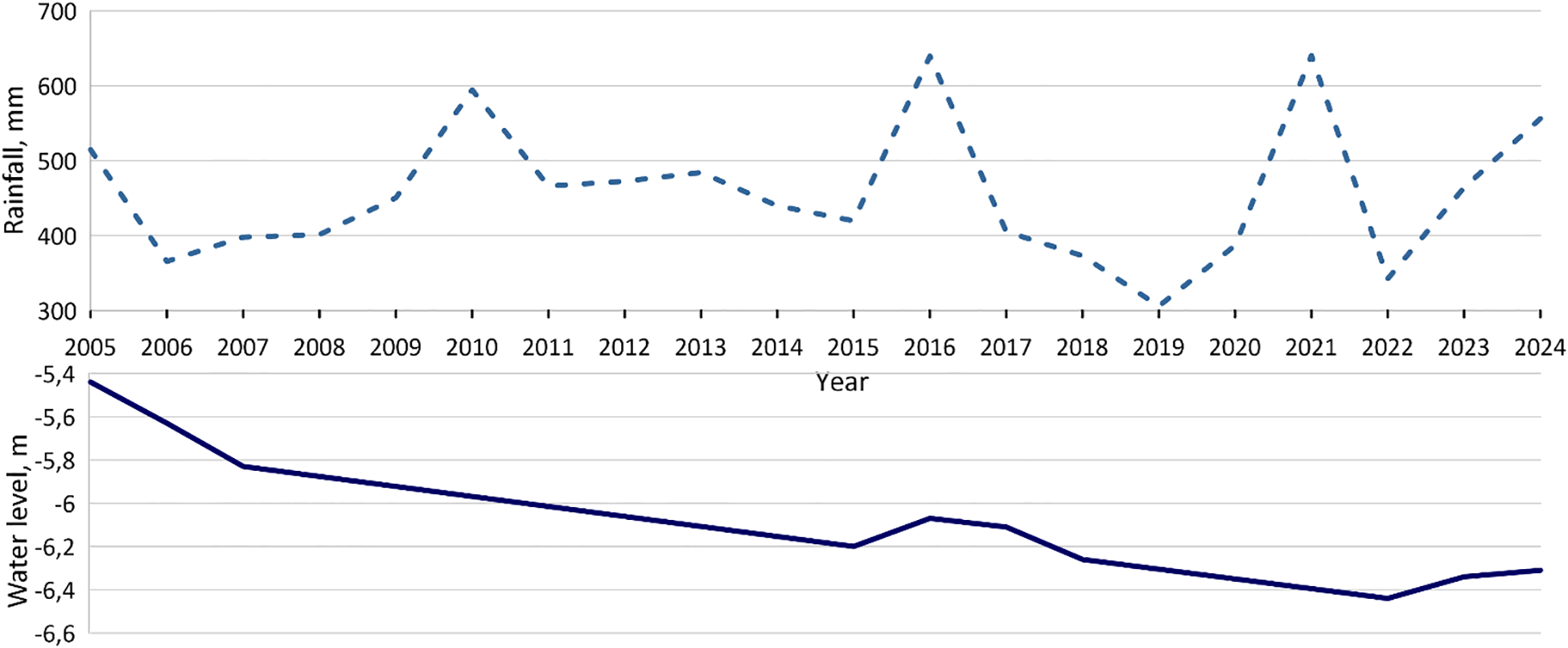
Dynamics of annual precipitation (upper graph) and water level (lower graph) in the Kuyalnik estuary for the period 2005-2024.
According to the results of physicochemical studies conducted from 2015 to 2021, a rapid increase in the total mineralization of brine was observed, from 74.87 g/L to 318.04 g/L. This indicates that although the mineralization of seawater (12.96-17.60 g/l) is significantly lower than that of brine, with large volumes of seawater supplied to the estuary, there is a significant increase in the amount of salts dissolved in the brine (Figure 2).
Figure 2
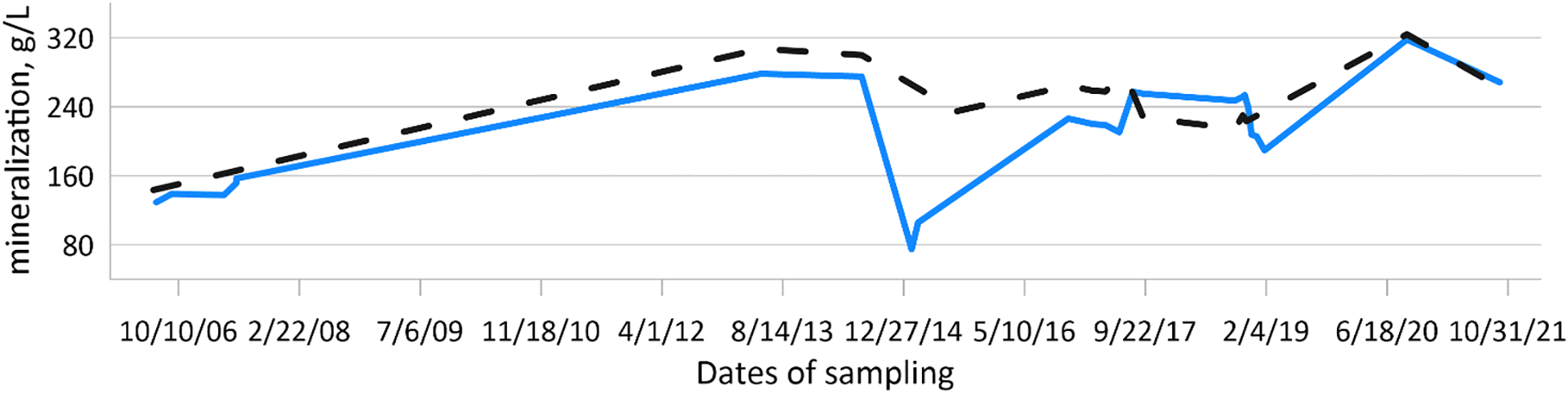
Dynamics of mineralization of peloids and brine of the Kuyalnik estuary from 2006 to 2021.
With increasing brine mineralization, a decrease in pH was observed, from 7.55 pH units in 2015 to 6.8-7.1 pH units in 2020-2021, and an increase in Eh from +370 to +415 mV. These changes may be due to the increased amount of free oxygen dissolved in seawater, which, upon entering the estuary, can stimulate oxidation processes.
Despite increased precipitation in 2016 (~630 mm), the water level began to decline again, reaching its lowest point in the entire observation period (~-6.4 m) in 2022. This confirms that maintaining the estuary’s water level requires a constant and significant external supply of water (fresh or seawater), as climatic conditions do not provide a sufficient balance. The seawater injected into the estuary in 2014 is insufficient. According to experts, approximately 20 million cubic meters of moisture evaporate in summer (Adobovskyi and Bohatova, 2013), and, according to the operating rules of the “estuary-sea” hydraulic structure, no more than 10 million cubic meters of seawater can be supplied to the Kuyalnik estuary in winter.
As shown in Figure 2, the estuary brine exhibits high volatility in mineralization, as it is directly dependent on weather conditions (precipitation, evaporation) and the hydrological balance (recharge by seawater and freshwater from rivers). Peloid mineralization is higher and more stable (inertial) than brine mineralization for most of the period, particularly during the seawater influx in 2014.
Thus, a temporary stabilization effect is observed, while the long-term natural trend toward salinization of the estuary (due to evaporation exceeding water inflow) quickly prevailed. A progressive increase in the estuary’s total salt reserves is observed, leading to accelerated salt precipitation (e.g., halite, bischofite) and subsequent salinization. Preserving the Kuyalnik Estuary is not a hydrotechnical task, but a hydrochemical one—reducing salinity below the limit values (the upper balneological norm is 150 g/L), which is only possible through desalination of the estuary by influx of freshwater or the implementation of measures to remove salt sediment.
The equivalent composition of the brine for the primary ions remained virtually unchanged over the observation period, except in 2016, when the sodium and potassium ion content increased by ~20 eq.%, while the magnesium ion content decreased by ~20 eq.% (Figure 3). This may be because the mass content of sodium and potassium ions in seawater is approximately 8 times greater than the magnesium ion content. Furthermore, the brine can be considered a multicomponent water-salt system that did not have time to return to its thermodynamic state within the short period of time (~2 years) following the introduction of seawater.
Figure 3
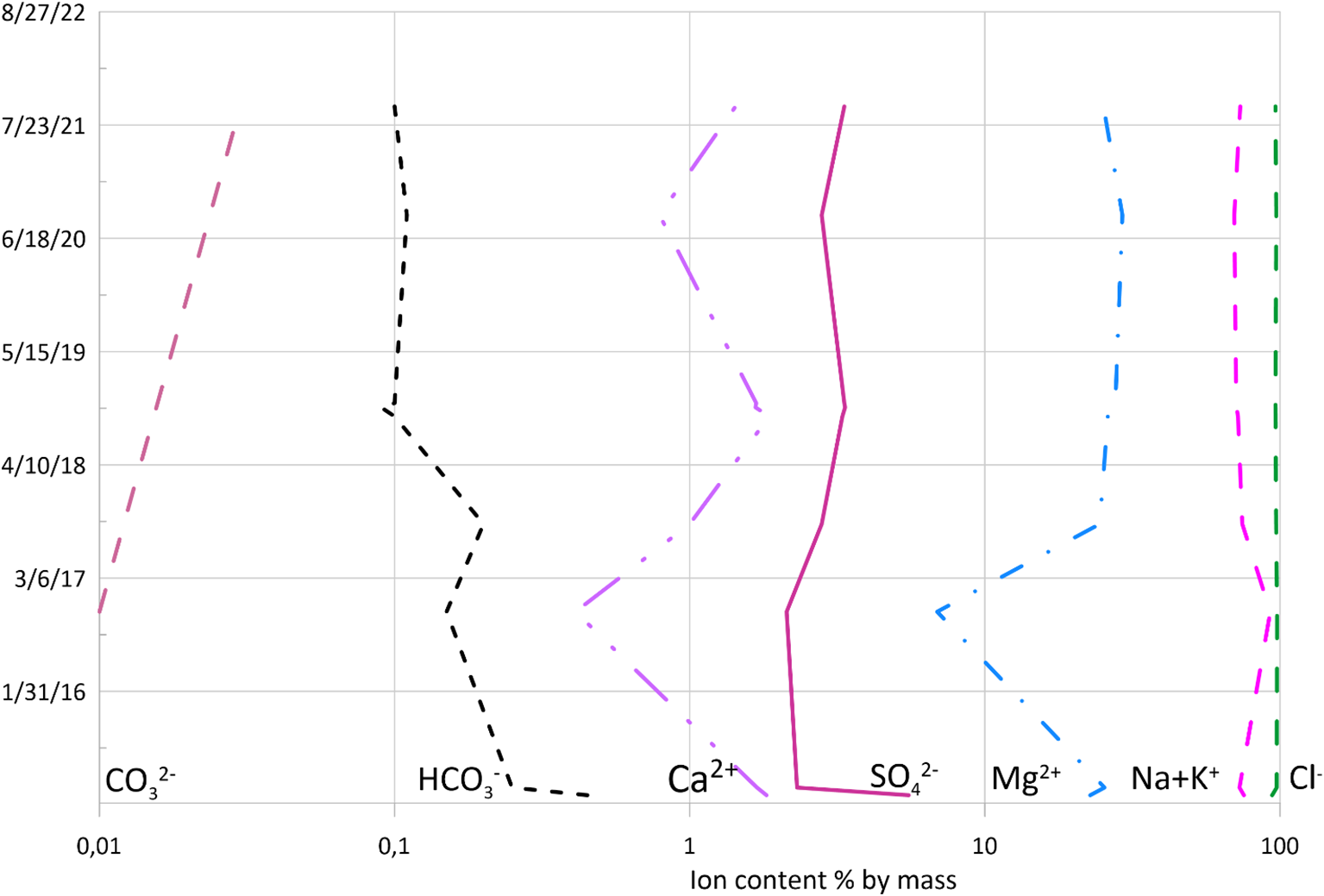
Changes in the ionic composition of the Kuyalnytskyi estuary brine for the period from 2015 to 2021.
As brine mineralization increases, aggregates (minerals) of the following salts precipitate:
-
– with mineralization from 200 to 300 g/L – calcium sulfates (CaSO4 2H2O – gypsum) and magnesium sulfates (MgSO4 7H2O – epsomite);
-
– with mineralization above 300 g/L – sodium chlorides (NaCl – halite) and magnesium chlorides (MgCl2 6H2O – bischofite) (Nikolenko et al., 2010).
The mineralization of the peloid mud solution gradually increased from 234.90 g/L in 2015 to 262.66-324.03 g/L in 2020–2021 and became equal to the mineralization of the brine. This can be explained by the fact that the mud solution is influenced by several biochemical and physicochemical factors (Babov et al., 2023).
The equivalent composition of the peloid mud solution for major ions also remained virtually unchanged over the observation period, except in 2018, when the concentration of sodium and potassium ions decreased by ~5 eq.%, while the concentration of magnesium ions increased by ~5 eq.% (Figure 4). This may be due to the brine slowly exchanging mineral components with the peloids, indicating the buffering effect of the peloids. The change in the equivalent composition of the brine in 2016 initiated a gradual redistribution of ions, which only became apparent in the mud solution composition in 2018.
Figure 4
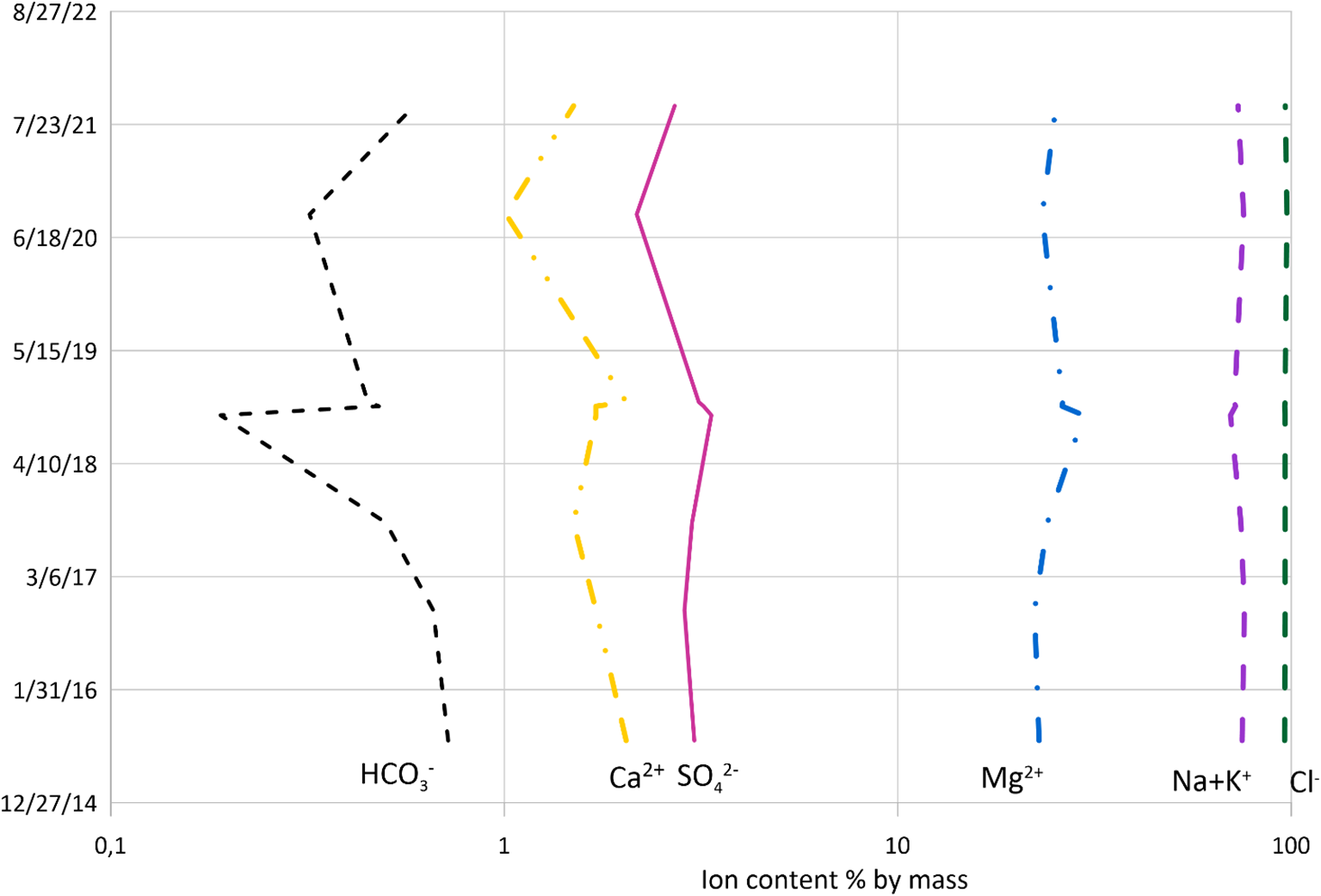
Changes in the ionic composition of the peloid solution of the Kuyalnytskyi estuary for the period from 2015 to 2008.
The decreasing trend in organic carbon content in the Kuyalnik Estuary peloids, from 1.83% in 2015 to 1.55% in 2021, is indicative of a deficiency in fresh organic matter. This deficiency and the slowdown in peloidogenesis are a direct consequence of complex environmental stress (Bayarsaikhan et al., 2016; Chen et al., 2017) caused by a critical reduction in river flow, extreme salinity, and shallowing.
In the peloids, a significant change in the hydrogen index (pH) values was observed; the reaction of the environment changed from neutral to slightly alkaline (7.15 pH units in 2015) to slightly acidic (5.75 pH units in 2021). A decrease in pH values affects the oxidation-reduction properties of peloids – the oxidation-reduction potential (Eh index). An increase in Eh values from -180 mV in 2015 to -110 mV in 2021 indicates a decrease in reduction and oxidation processes, which can negatively affect the process of peloidogenesis (Babov et al., 2020). These changes negatively affect peloidogenesis, since a decrease in reduction processes changes the general conditions of organomineral sedimentation, shifting the balance between aerobic and anaerobic processes (Babov et al., 2023).
Hydrogen sulfide is formed in peloid systems during the biochemical reduction of sulfates in an anaerobic environment and determines the biochemical activity of peloids. It reacts with iron compounds to form iron sulfide and hydrotroilite. The hydrogen sulfide content in the estuary peloids ranged from 0.09% to 0.17%; iron sulfide, from 0.16% to 0.31%; and hydrotroilite, from 0.16% to 0.25%.
The Kuyalnik Estuary’s peloids are an organomineral system formed under the influence of active microbial development. The formation of sulfur-containing silts involves dynamically interacting reducing microorganisms, producing a mixture of organic matter and minerals with medicinal properties (Kataržytė et al., 2024). Changes in the pH and Eh of the peloids primarily influence the development of anaerobic or facultative-anaerobic bacterial groups, providing metabolic support for the precipitation of minerals and sulfates.
Analysis of bacterioplankton over the corresponding time period revealed microbial cell counts fluctuating widely, from 1.4·106 to 140·106 CFU/ml. Bacterial counts in the estuary significantly exceeded those in both seawater and tidal freshwater springs. The highest microbial counts occurred during the summer months, when active development of the organomineral complex of peloids was observed.
In the Kuyalnik Estuary’s aquatic system, increasing salinity levels reduced the α-diversity of bacteria. It restructured the composition of assemblages, acting as a strong ecological filter that selects for salt-tolerant taxa, making their traits dominant. This finding is consistent with studies of controlled saline water gradients and natural lakes, which have repeatedly demonstrated a decrease in diversity with increasing salinity and a clear shift in patterns along the gradient (Zhong et al., 2016; Zhang et al., 2021).
Furthermore, not only the total mineralization parameter but also the type of ion is essential for the microbial spectrum. This is realized through the relationship between ion specificity and their effects on microbial toxicity and metabolism: sulfate salts may inhibit microbial respiration less than an equimolar amount of chloride salts, and the total amount of anions may promote the selective growth of halophytes in the microbiota. Thus, ion composition (Na+/Cl−− SO42−, HCO3−, Mg2+/Ca2+) is a key factor determining “who wins” along mineralization gradients (Mani et al., 2020; Akpolat et al., 2021).
The functional load of microbial associations during peloidogenesis corresponds to the following (Gorrasi et al., 2021):
-
support of redox processes, among which the leading role belongs to sulfate reduction, methanogenesis, and denitrification;
-
formation of exopolysaccharides and organomineral matrix;
-
biomineralization and formation of sulfide sludge.
Their combination forms the therapeutic potential of peloids.
Various biotopic niches (e.g., zones with microbial biofilms, which are a variant of microbial group development in an attached state, or bacteria in a planktonic (suspension) form of development) determine the local conditions of peloidogenesis.
Cyanoprokaryotes in the Kuyalnik Estuary ecosystem exhibit a diverse species composition. Representatives of this group of microorganisms are characterized by resistance to fluctuations in salinity, pH, and soprobability, and actively participate in the formation of peloids (Tsarenko et al., 2016; Vynogradova, 2016). A total of 93 species of the Cyanoprokaryota group have been identified in the estuary ecosystem, including amphibious and aquatic forms. Cyanobacteria play a key role in peloid structuring, forming surface biofilms (the surface layer of the peloid mass) and binding silt particles, thereby initiating the formation of an organic matrix, which serves as a matrix for mineral precipitation. Thus, cyanobacterial biofilms facilitate silt sedimentation, forming relatively large peloid aggregates.
It should be emphasized that biogenic sedimentation initiated by cyanoprokaryotes correlates with the results of particle size analysis (Table 1). The primary material for the formation of the solid core of modern muds originates from autochthonous processes within the estuary, including biogenic sedimentation (the waste products of halotolerant and halophilic organisms) and chemical precipitation (the formation of a mineral core from fine clay and salt particles).
Also, among the spectrum of cyanoprokaryotic species, 18 salinity indicators, three pH indicators, and 31 saprobity indicators are distinguished (Nikipelova et al., 2002). According to the index of the latter indicator, the Kuyalnik Estuary belongs to the oligo- and beta-oligosaprobic zone, indicating a moderate organic load and a relatively clean state. This reservoir is characterized by environmental sustainability (Ennan et al., 2022).
Over the years, a gradual, rather intensive development of a group of archaebacteria has been observed in the Kuyalnik Estuary. A particularly significant increase in the number of representatives of this group occurred in 2015, likely due to the influence of the active influx of seawater into the estuary. Archaebacteria introduced into the estuary with seawater were characterized by their adaptation to extreme salinity, thus forming a significant portion of the reservoir’s microbiota. However, in 2016, the formation of a salt crust on the bottom temporarily halted the exchange of substances between the water and the bottom layers, leading to a sharp decline in the number of microbes, both other bacterial species and archaea themselves (Kovalova et al., 2017).
The correlations between chemical parameters and microbial groups in the Kuyalnik Estuary peloids (Figure 5) revealed explicit ecological dependencies.
Figure 5
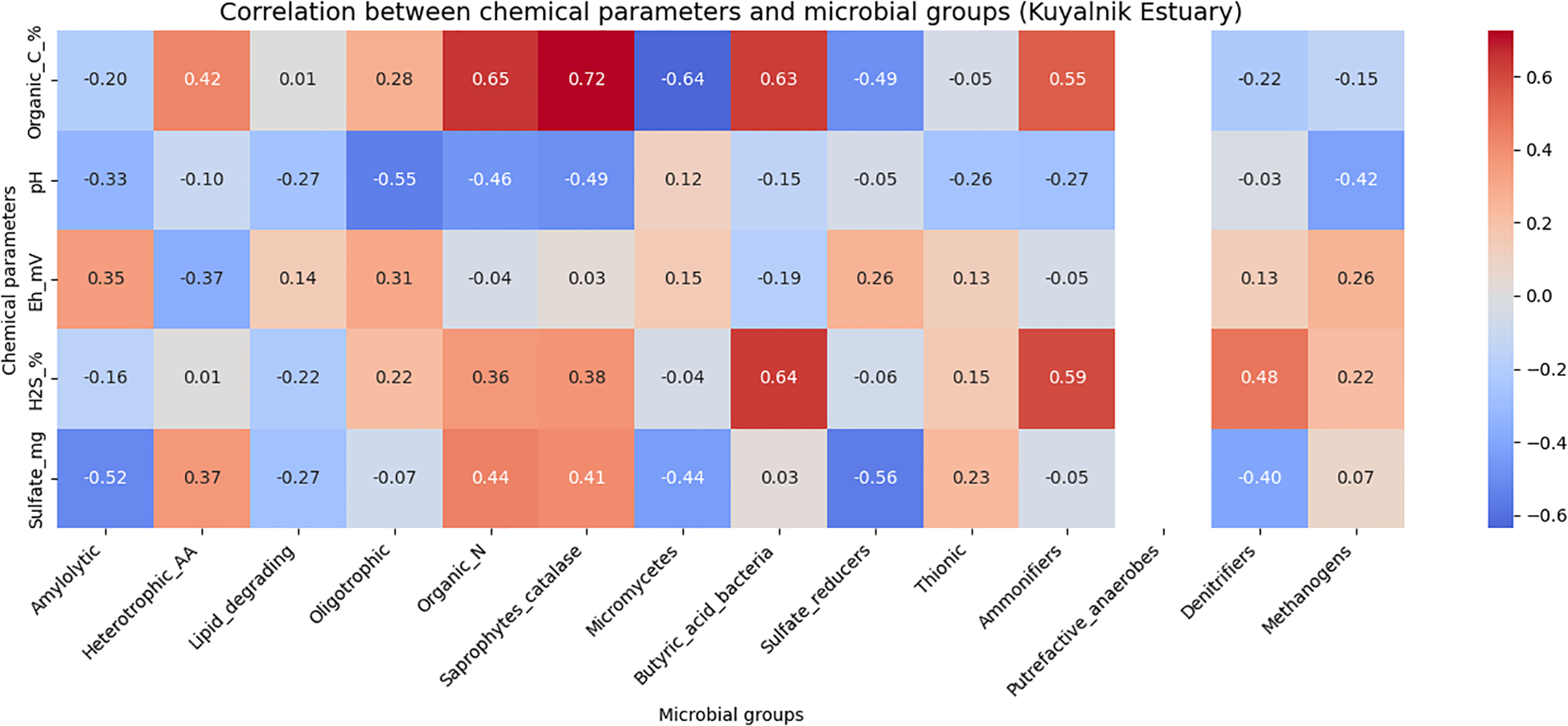
Correlation of chemical parameters and individual groups of microorganisms in the peloids of the Kuyalnik estuary.
Organic carbon showed strong positive correlations with saprophytes, oligotrophs, and amino acid-producing heterotrophs, reflecting its role as a substrate for heterotrophic metabolism. pH correlated positively with amylolytic and lipid-degrading bacteria, indicating that near-neutral conditions favor the enzymatic activity of these groups. In contrast, Eh (redox potential) displayed strong negative correlations with obligate anaerobes, such as butyric acid bacteria, methanogens, and putrefactive anaerobes. Still, positive correlations with aerobic saprophytes underscore the role of redox-driven microbial stratification. Hydrogen sulfide (H2S) concentrations were positively associated with sulfate-reducing and thionic bacteria, consistent with their metabolic reliance on sulfur cycling. Finally, sulfate ions (SO42−) supported sulfate-reducers and, to a lesser extent, methanogens, reflecting competition for electron acceptors under reducing conditions. Together, these correlations emphasize that the chemical composition of peloids strongly structures microbial community composition, balancing aerobic versus anaerobic guilds, and determining the potential for organic matter mineralization, sulfur cycling, and therapeutic mud properties.
4 Discussion
Estuaries and endorheic lakes are particularly vulnerable ecosystems, their existence dependent on the balance of freshwater and seawater inflows, as well as climatic and anthropogenic factors. With climate change and increasing economic pressure, their shallowing and degradation have become a key problem.
Reduced river flow due to irrigation and river regulation has led to catastrophic changes in the largest landlocked bodies of water in Eurasia. The Aral Sea has shrunk by more than 90% due to the diversion of water from the Amu Darya and Syr Darya (Micklin, 2007). Lake Urmia in Iran is facing a similar crisis due to excessive water withdrawal for agricultural purposes (AghaKouchak et al., 2015). Even such unique objects as the Dead Sea are experiencing significant anthropogenic impact: the extraction of potassium, bromine, magnesium, and salt has altered its geochemical regime and accelerated the decline in its water level (Lensky et al., 2005). Similar processes are observed in Lake Chad in Africa (Lemoalle and Bader, 2018), Lake Poyang in China (Zhang et al., 2014), and Lake Mar Chiquita in Argentina (Galizia et al., 2005).
Table 2 presents comparative data on the influence of climatic and anthropogenic factors on some endorheic lakes, as well as their consequences.
Table 2
| Lake/Estuary | Main reasons for the decline in level/area | Contribution of climatic factors (drought, rising temperatures, decreased precipitation) | Contribution of anthropogenic factors (irrigation, dams, diversions, pollution) | Consequences |
|---|---|---|---|---|
| Aral Sea | Diversion of Amu Darya and Syr Darya rivers; massive irrigation | Increased climate segmentation, rising temperatures, evaporation | Massive agricultural projects, irrigation, unsustainable water use policies | Salt storms, loss of flora/fauna, soil degradation, social catastrophe |
| Lake Urmia | Dams, agricultural needs, decreased river inflows | Irrigation, dams, water intakes, groundwater use | Dust storms, human health, migration, economic losses | Dust storms, human health, migration, economic losses |
| Great Salt Lake | Runoff diversion to urban/rural water, industry | Drought, decreased snowmelt, increased evaporation | Huge water consumption by agriculture; construction projects, salt mining | Loss of ecosystems, air quality, health, economic damage |
| Lake Poopó | Drought, water diversion, mining | Climate fluctuations (El Niño, etc.), warming | Irrigation, dams, mining, human activities | Complete drying, loss of livelihoods, cultural losses |
| Dead Sea | Reduced river flows, aridity, mineral extraction | Changes in precipitation, rising temperatures | Mineral extraction, tourism pressure, river damming | Subsidence of banks, karst processes, changes in geochemistry, deterioration of public health |
Comparative data on the impact of climatic and anthropogenic factors on some endorheic lakes.
All these cases demonstrate a global trend: enclosed and semi-enclosed bodies of water are proving to be “indicators” of climatic and economic change.
One method for combating estuary degradation is the targeted release of seawater into the estuary. In Ukraine, this was implemented at the Kuyalnytskyi Estuary (Odessa Oblast). Between 2014 and 2025, seawater from the Gulf of Odessa was pumped into the estuary through a pipeline.
The principal therapeutic value of the Kuyalnik Estuary is associated with its peloids. The question of how changes in salinity affect their composition and properties has global parallels. For example, peloids of Lake Tekergöl (Romania) are studied in terms of the influence of salinity and mineral composition on the content of microelements (Sr, Ba, Fe, Mn, etc.) (Onac et al., 2019). In Italy, the “maturation” of peloids was studied using different mineral waters (sulfate, bromine-iodine), which changed their physicochemical properties (Veniale et al., 2004). Modern studies also analyze the transdermal bioavailability of elements (such as Ca and Mg) from peloids, whose composition directly depends on the mineralization of the water (Pérez-Gregorio et al., 2024). In addition, experimental studies show that the physical characteristics of clay-peloid mixtures (hardness, adhesiveness) vary depending on the composition and mineralization of the water (Armijo et al., 2015).
Our research confirms this conclusion. Large volumes of seawater supplied to the estuary, even with relatively low mineralization (12.96-17.60 g/l), in the virtual absence of river water inflow, led to an increase in the total mineralization of the brine from 74.87 g/l to 318.04 g/l. A similar rapid increase in brine mineralization from 30 g/L to 104 g/L is observed in the Molochny Estuary region, which is also associated with deteriorating water exchange between the estuary and the Molochnaya River (Demchenko et al., 2015).
The increase in brine mineralization led to a decrease in pH from 7.55 pH units in 2015 to 6.8-7.1 pH units in 2020–2021 and an increase in Eh from +370 to +415, which may indicate the generation of oxidation processes. It should be noted that with the rise in brine mineralization in Lake Urmia, there was a corresponding decrease in pH values from 7–8 to 5 pH units, which correlates with our data (Yakushev et al., 2021).
A decrease in the organic carbon content of peloids from 1.83% in 2015 to 1.55% in 2021 may indicate an insufficient supply of fresh organic matter for peloidogenesis processes to occur (Bayarsaikhan et al., 2016; Chen et al., 2017).
Based on the results of studies of individual groups of microorganisms existing in the Kuyalnik Estuary and the determination of the relationship between the chemical composition of peloids and the structure of microbial associations, the following patterns were established. Thus, the content of organic carbon sources demonstrated a strong positive correlation with groups of saprophytes, oligotrophs, and heterotrophs producing amino acids, reflecting their participation as a substrate in heterotrophic metabolism (He et al., 2022). The following trend was observed for the pH of peloids, which varied from 7.15 to 5.75 pH units, and positively correlated with the number of representatives of the amylolytic and lipolytic bacterial groups. This obviously indicates a similarity in the conditions of their enzymatic activity (Ojovan et al., 2021).
In contrast, for the Eh value of peloids, in the range from -180 to -110 mV, strong negative correlations were recorded with the group of obligate anaerobes, namely butyric acid bacteria, methanogens, and putrefactive anaerobes, but positive correlations with aerobic saprophytic microorganisms. Hydrogen sulfide (H2S) concentrations, ranging from 0.09 to 0.17%, exhibited positive relationships with groups of sulfate-reducing and thiogenic organisms, consistent with their metabolic dependence on the sulfur cycle (Giampaoli et al., 2013). The sulfate ion (SO42−) content is maintained by sulfate-reducing microorganisms and, to a lesser extent, methanogens, which reproduce their competitive relationship for electron acceptors under reducing environmental conditions (Kushkevych et al., 2021). Overall, these correlations suggest that the chemical composition of peloids is primarily determined by microbial groups, specifically the ratio between aerobic and anaerobic groups, which in turn influences the processes of mineralization, organic matter formation, the sulfur cycle, and potential therapeutic properties.
Thus, changes in the mineral composition of peloids, particularly the content of sulfide and sulfate ions, against the background of increased overall mineralization of the corresponding environment, have led to changes in the initial composition of microbial associations. This, in turn, will lead to modifications during the formation of peloids, both quantitatively and qualitatively, which could also potentially alter their therapeutic properties.
Similar processes were observed in a study analyzing quantitative and qualitative changes in the main physicochemical composition of the endorheic lakes of the Eurasian region – the Aral and Dead Seas, as well as in Lakes Urmia and Issyk-Kul, demonstrating that changes in river flows, precipitation amounts, and evaporation rates lead to catastrophic consequences. Researchers have concluded that, although endorheic lakes are also affected by climate change, anthropogenic influences are the decisive factor. Water diversion for irrigation was the key cause of catastrophic changes in the Aral Sea and Lake Urmia. The Dead Sea, despite its size, suffers from mineral extraction (potassium, bromine, magnesium, and salt), which has altered its geochemical regime.
Our research indicates that restoring the Kuyalnik Estuary to its current state necessitates not only monitoring its hydrological regime but also a comprehensive understanding of its physicochemical and microbiological processes. Preserving its therapeutic properties requires a systematic approach, including monitoring, scientific research, and specific restoration measures, such as:
-
The release of seawater from the Black Sea, which was considered a temporary measure and was carried out during the winter-spring period, when the water temperature is below 8°C, must be continued. Still, provision must be made for the supply of a larger volume to maintain the hydrological regime of the estuary. According to expert estimates, approximately 20 million cubic meters of seawater evaporate from the estuary in the summer. In winter, according to the operating regulations of the “sea-estuary” hydraulic structure, no more than 10 million cubic meters of seawater can be supplied to the Kuyalnik estuary. Due to these restrictions, it is impossible to provide the Kuyalnik estuary with the volume of seawater necessary to restore its hydrological regime fully.
-
Considering that seawater inflows annually introduce significant amounts of salts, and that excessive salt precipitation and salt crust formation have already occurred, measures to reduce brine salinity are critical. A systematic approach is necessary, including both the mechanical removal of the salt crust from the estuary bottom and the direct removal of salt from the brine, i.e., the establishment of local salt production.
-
Оrganize continuous monitoring of the state of the healing natural resources of the Kuyalnik estuary, for timely response in order to preserve the peloid deposits.
However, targeted seawater inlet projects comparable to the Kuyalnik experiment have not yet been described in the scientific literature, which makes the conducted research unique in its significance.
5 Conclusion
The influx of seawater into the Kuyalnik Estuary, coupled with a lack of adequate freshwater supply, has led to an increase in the overall mineralization of the brine and changes in the physicochemical properties of the peloids, associated with the restructuring of microbial associations. This completely changed the type of sedimentation, making the estuary a predominantly autochthonous (internal) system for the formation of peloids. Preserving the therapeutic properties of the peloids requires a systematic approach, including regulating the amount of seawater, reducing salinity, and monitoring the composition of the peloids (including the presence of polluting substances, especially of organic origin).
Statements
Data availability statement
The original contributions presented in the study are included in the article/supplementary material. Further inquiries can be directed to the corresponding author.
Author contributions
KB: Conceptualization, Writing – original draft. OT: Methodology, Writing – original draft. APl: Writing – review & editing. MA: Formal analysis, Investigation, Writing – original draft. MR: Data curation, Formal analysis, Writing – original draft. APo: Formal analysis, Investigation, Writing – original draft.
Funding
The author(s) declared that financial support was not received for this work and/or its publication.
Conflict of interest
The authors declare that the research was conducted in the absence of any commercial or financial relationships that could be construed as a potential conflict of interest.
Generative AI statement
The author(s) declare that no Generative AI was used in the creation of this manuscript.
Any alternative text (alt text) provided alongside figures in this article has been generated by Frontiers with the support of artificial intelligence and reasonable efforts have been made to ensure accuracy, including review by the authors wherever possible. If you identify any issues, please contact us.
Publisher’s note
All claims expressed in this article are solely those of the authors and do not necessarily represent those of their affiliated organizations, or those of the publisher, the editors and the reviewers. Any product that may be evaluated in this article, or claim that may be made by its manufacturer, is not guaranteed or endorsed by the publisher.
References
1
Armijo F. Maraver F. Carretero M. I. Pozo M. Ramos M. Fernandez-Torán M. A. et al . (2015). The water effect on instrumental hardness and adhesiveness of clay mixtures for pelotherapy. Appl. Clay Sci. 114, 395–401. doi: 10.1016/j.clay.2015.06.019
2
Adobovskyi V. V. Bohatova Y. I. (2013). Features of the modern hydrological and hydrochemical regime of the Kuyalnytskyi Liman. Ukrainian Hydrometeorolog J.13, 127–137.
3
AghaKouchak A. Norouzi H. Madani K. Mirchi A. Azarderakhsh M. Nazemi A. et al . (2015). Aral Sea syndrome desiccates Lake Urmia: Call for action. J. Great Lakes Res.41, 307–311. doi: 10.1016/j.jglr.2014.12.007
4
Akpolat C. Fernández A. B. Caglayan P. Calli B. Birbir M. Ventosa A. (2021). Prokaryotic communities in the thalassohaline Tuz Lake, deep zone, and Kayacik, Kaldirim and Yavsan salterns (Turkey) assessed by 16S rRNA amplicon sequencing. Microorganisms9, 1525. doi: 10.3390/microorganisms9071525
5
Babov K. Arabadji M. Koieva K. Nikolenko S. Kysylevska A. Tsurkan O. et al . (2023). Dynamics of physicochemical and microbiological parameters of peloids of the Kuyalnytsky Estuary under the influence of the Black Sea’s water. Arabian J. Geosc16, 56. doi: 10.1007/s12517-022-11066-6
6
Babov K. Gushcha S. Koieva K. Strus O. Nasibulin B. Dmitrieva G. et al . (2020). Comparative assessment of biological activity of peloids of Ukraine of different genesis. Balneo Res. J.11, 467–471. doi: 10.12680/balneo.2020.380
7
Bayarsaikhan U. Ruhl A. S. Jekel M. (2016). Characterization and quantification of dissolved organic carbon releases from suspended and sedimented leaf fragments and of residual particulate organic matter. Sci. Total Environ.571, 269–274. doi: 10.1016/j.scitotenv.2016.07.148
8
Burkynskyi B. V. Babov K. D. Nikipelova O. M. Bezverkhnyuk T. M. Pogrebniy A. L. Khumarova N. I. et al . (2019). Kuyalnytskyi Liman: realities and prospects of recreational use. Odesa: Helvetica Publishing House, 314. doi: 10.31520/978-966-916-806-1
9
Chen M. Kim S.-H. Jung H.-J. Hyun J.-H. Choi J. H. Lee H.-J. et al . (2017). Dynamics of dissolved organic matter in riverine sediments affected by weir impoundments: Production, benthic flux, and environmental implications. Water Res.121, 150–161. doi: 10.1016/j.watres.2017.05.022
10
Cherkez Y. E. Medinets V. I. Tiuremina V. H. Pravednyi V. M. (2017). Assessment of subaqueous feeding volumes of the Kuyalnytskyi Liman by groundwater. Man and the Environment. Prob Neoecol3-4, 57–65. doi: 10.26565/1992-4224-2017-28-06
11
Demchenko V. O. Vinokurova S. V. Chernichko I. I. Vorovka V. P. (2015). Hydrological regime of Molochnyi Liman under anthropogenic and natural drivers as a basis for management decision-making. Environ. Sci. Pol46, 37–47. doi: 10.1016/j.envsci.2014.08.015
12
DSTU 8447:2015 . (2016). Food products – Method for determination of yeasts and moulds. Kyiv: SE “UkrNDNC” (in Ukrainian).
13
Ennan A. A.-A. Shikhaleeva G. M. Tsarenko P. M. Kiryushkina H. M. (2022). Algoflora of the Kuyalnik Estuary: Current state and long-term dynamics. Algologia32, 224–250. doi: 10.15407/alg32.03.224
14
Galizia M. Paoloni J. D. Fernandez Cirelli A. (2005). Climate variability and eutrophication in Mar Chiquita Lake, Argentina. J. Great Lakes Res.31, 196–202.
15
Giampaoli S. Valeriani F. GianFranceschi G. Vitali M. Delfini M. Festa M. et al . (2013). Hydrogen sulfide in thermal spring waters and its action on bacteria of human origin. Microchem J.108, 210–214. doi: 10.1016/j.microc.2012.10.022
16
Gorrasi S. Franzetti A. Ambrosini R. Pittino F. Pasqualetti M. Fenice M. (2021). Spatio-temporal variation of the bacterial communities along a salinity gradient within a thalassohaline environment (Saline di Tarquinia Salterns, Italy). Molecules26, 1338. doi: 10.3390/molecules26051338
17
He Q. Xiao Q. Fan J. Zhao H. Cao M. Zhang C. et al . (2022). The impact of heterotrophic bacteria on recalcitrant dissolved organic carbon formation in a typical karstic river. Sci. Total Environ.815, 152576. doi: 10.1016/j.scitotenv.2021.152576
18
Hopchenko E. D. Loboda N. S. (Eds.) (2016). Water regime and hydroecological characteristics of the Kuyalnytskyi Liman basin (Odesa: TES), 352.
19
International Organization for Standardization . ISO 6059:1984. (1984). Water quality – Determination of the sum of calcium and magnesium – EDTA titrimetric method. Geneva: ISO.
20
International Organization for Standardization . ISO 6058:1984. (1984). Water quality – Determination of calcium content – EDTA titrimetric method.Geneva: ISO.
21
International Organization for Standardization . ISO 9297:1989. (1989). Water quality – Determination of chloride – Silver nitrate titration with chromate indicator (Mohr's method). Geneva: ISO.
22
International Organization for Standardization . ISO 9963-1:1994. (1994). Water quality – Determination of alkalinity – Part 1: Determination of total and composite alkalinity.Geneva: ISO.
23
Kataržytė M. Rapolienė L. Kalvaitienė G. Picazo-Espinosa R. (2024). Microbial composition dynamics in peloids used for spa procedures in Lithuania: Pilot study. Int. J. Environ. Res. Public Health21, 335. doi: 10.3390/ijerph21030335
24
Kovalova N. V. Medinets V. I. Medinets S. V. Konareva O. P. Soltys I. E. (2017). Characteristics of bacterioplankton in the Kuyalnyk Estuary development in 2015–2017. Visnyk V. N. Karazin Kharkiv Natl. Univ. Ser. Ecol17, 20–28. doi: 10.26565/1992-4259-2017-17-02
25
Kushkevych I. Kovářová A. Dordevic D. Gaine J. Kollar P. Vítězová M. et al . (2021). Distribution of sulfate-reducing bacteria in the environment: Cryopreservation techniques and their potential storage application. Processes9, 1843. doi: 10.3390/pr9101843
26
Lemoalle J. Bader J. C. (2018). The Lake Chad hydrology under current climate change. Int. J. Water Resour Dev.34, 715–728.
27
Lensky N. G. Dvorkin Y. Lyakhovsky V. Gertman I. Gavrieli I. (2005). Water, salt, and energy balances of the Dead Sea. Water Resour Res.41, W12418. doi: 10.1029/2005WR004084
28
Loboda N. S. Hryb O. M. Sirenko A. M. (2011). Assessment of freshwater inflow to the Kuyalnytskyi Liman. Hydrology Hydrochem Hydroecol1, 51–59.
29
Mani K. Taib N. Hugoni M. Bronner G. Bragança J. M. Debroas D. (2020). Transient dynamics of Archaea and Bacteria in sediments and brine across a salinity gradient in a solar saltern of Goa, India. Front. Microbiol.11. doi: 10.3389/fmicb.2020.01891
30
Micklin P. (2007). The aral sea disaster. Annu. Rev. Earth Planet Sci.35, 47–72. doi: 10.1146/annurev.earth.35.031306.140120
31
MV 10.2.1-113-2005 . (2005). Sanitary and microbiological control of drinking water quality. Kyiv: Ministry of Health Ukraine (in Ukrainian).
32
MVV 7.2-2/4389/2021 (GOST 4389-72, IDT) . (2021). Drinking water. Methods for determining sulfate content. Odesa: Astroprint Publishing House (in Ukrainian).
33
Nikipelova O. M. Filipenko T. H. Solodova L. B. (2002). Manual on methods for control of natural mineral waters, artificially mineralized waters and beverages based on them. Part 1. Physico-chemical studies (Odesa: Ministry of Health of Ukraine; UkrNDIMRtaK), 96.
34
Nikipelova O. M. Solodova L. B. (2008). Manual on methods for control of peloids and preparations based on them. Part 1. Physico-chemical studies (Odesa: UHS named after Yu. Lypa), 100.
35
Nikolenko S. I. Hlukhivska S. M. Kovalova I. P. (2010). Manual on methods for control of therapeutic muds (peloids), brine and preparations based on them. Part 2. Microbiological studies (Odesa: Even), 88.
36
Ojovan B. Catana R. Neagu S. Cojoc R. Lucaci A. I. Marutescu L. et al . (2021). Metabolic potential of some functional groups of bacteria in aquatic urban systems. Fermentation7, 242. doi: 10.3390/fermentation7040242
37
Onac B. P. Cosma C. Veres D. Breban R. Tămaş T. (2019). Natural radioactivity of peloids from Techirghiol Lake (Romania). Environ. Geochem Health41, 1237–1249.
38
Pérez-Gregorio M. R. Mateos R. Franco J. M. Simal-Gándara J. (2024). Characterization of percutaneous absorption of elements from two tailored sulfurous therapeutic peloids. Int. J. Biometeorol68, 2545–2558.
39
Prange M. Wilke T. Wesselingh F. P. (2020). The other side of sea level change. Commun. Earth Environ.1, 69. doi: 10.1038/s43247-020-00075-6
40
Tsarenko P. M. Ennan A. A. Shikhaleyeva G. N. Barinova S. S. Gerasimiuk V. P. Ryzhko V. E. (2016). Cyanoprokaryota of the kuyalnyk estuary ecosystem (Ukraine). Int. J. Algae18, 337–352. doi: 10.1615/InterJAlgae.v18.i4.40
41
Veniale F. Barberis E. Carcangiu G. Morandi N. Setti M. Tamanini M. et al . (2004). Formulation of muds for pelotherapy: Effects of “maturation” by different mineral waters. Appl. Clay Sci.25, 135–148. doi: 10.1016/j.clay.2003.10.002
42
Vynogradova O. (2016). Cyanoprokaryota of the coastal solonets of the Kuialnik Estuary. Chornomorski Botanic J.12, 85–94. doi: 10.14255/2308-9628/16.121/9
43
Yakushev E. V. Andrulionis N. Y. Jafari M. Lahijani H. A. K. Ghaffari P. (2021). “ How climate change and human interaction alter chemical regime in salt lakes: Lake Urmia, Aral Sea, the Dead Sea, and Lake Issyk-Kul,” in The handbook of environmental chemistry. (Cham: Springer) 275–296. doi: 10.1007/698_2021_811
44
Zhang G. L. Bai J. H. Tebbe C. C. Zhao Q. Q. Jia J. Wang W. et al . (2021). Salinity controls soil microbial community structure and function in coastal estuarine wetlands. Environ. Microbiol.23, 1020–1037. doi: 10.1111/1462-2920.15281
45
Zhang Q. Ye X. Werner A. D. Li Y. Yao J. Li X. et al . (2014). An investigation of enhanced recessions in Poyang Lake: Comparison of Yangtze River and local catchment impacts. J. Hydrol517, 425–434. doi: 10.1016/j.jhydrol.2014.05.051
46
Zhong Z. P. Liu Y. Miao L. L. Wang F. Chu L. M. Wang J. L. et al . (2016). Prokaryotic community structure driven by salinity and ionic concentrations in plateau lakes of the Tibetan Plateau. Appl. Environ. Microbiol.82, 1846–1858. doi: 10.1128/AEM.03332-15
Summary
Keywords
peloids, physicochemical parameters, microbiota, Kuyalnik estuary, mineralogical composition, Black Sea
Citation
Babov K, Tsurkan O, Plakida A, Arabadzhy M, Rusakova M and Pogrebniy A (2025) Peloidogenesis in modern conditions of climate change and anthropogenic impact: long-term studies of the Kuyalnik estuary. Front. Mar. Sci. 12:1716358. doi: 10.3389/fmars.2025.1716358
Received
30 September 2025
Revised
04 November 2025
Accepted
24 November 2025
Published
09 December 2025
Volume
12 - 2025
Edited by
Sreenivasulu Ganugapenta, University of Malaysia Terengganu, Malaysia
Reviewed by
Alberto Sánchez-González, National Polytechnic Institute (IPN), Mexico
Željko Jaćimović, University of Montenegro, Montenegro
Updates
Copyright
© 2025 Babov, Tsurkan, Plakida, Arabadzhy, Rusakova and Pogrebniy.
This is an open-access article distributed under the terms of the Creative Commons Attribution License (CC BY). The use, distribution or reproduction in other forums is permitted, provided the original author(s) and the copyright owner(s) are credited and that the original publication in this journal is cited, in accordance with accepted academic practice. No use, distribution or reproduction is permitted which does not comply with these terms.
*Correspondence: Alexander Plakida, aplakida01@gmail.com
Disclaimer
All claims expressed in this article are solely those of the authors and do not necessarily represent those of their affiliated organizations, or those of the publisher, the editors and the reviewers. Any product that may be evaluated in this article or claim that may be made by its manufacturer is not guaranteed or endorsed by the publisher.