On June 28, 2025, Dr. Rushan Mirzovich Sabirov, Head of the Department of Zoology of Kazan Federal University, Russia, passed away after a prolonged illness at the age of 67. He was a bright scientist, graphic artist, great teacher, supervisor, talented administrator, and at the same time, a remarkable organizer, and a kind and compassionate man with magnetic charisma and cheerful personality. This is a great loss for his family, friends, colleagues and students, and for a wider scientific community and biological education in Kazan University.
Rushan was born in Kazan on January 27, 1958. Being fascinated by the natural world since childhood, he was admitted to the Biological Faculty of Kazan University in 1975. Already during his 1st study year, he chose the Department of Invertebrate Zoology. After an expedition to the White Sea in the summer of 1976, he began studying marine Mollusca. Rushan’s scientific supervisor was Prof. Vladimir L. Wagin (Nigmatullin and Sabirov, 2007), who was at the time the Head of the Department. In 1977, Rushan started working on Cephalopoda, which remained his favorite taxon throughout the scientific career. At this time Chingis M. Nigmatullin was his scientific co-supervisor of coursework (1978) and his diploma work (1980) on morphology of spermatophores in squids. Chingis and Rushan remained ever since a life-long friends and research collaborators. Upon receiving Diploma in biology with excellence in Kazan University in 1980, Rushan moved to Kaliningrad, where the multipurpose governmental funding program ‘Squid’ (Kolotovkin and Nigmatullin, 2002) had started earlier this year in the Atlantic Research Institute of Fisheries and Oceanography (AtlantNIRO). He worked in the Laboratory of Commercial Invertebrates in AtlantNIRO until December 1983. During these years, Rushan participated in three research surveys to the south-eastern Pacific, with the Humboldt squid Dosidicus gigas as main object of study. Ever since his very first survey experience with AtlantNIRO, he stood out owing to his favorable combination of professional and personal qualities, and thus in the next surveys he was already a survey leader.
In autumn 1984, due to tragic family circumstances, Rushan came back to his Alma Mater. In 1991–1996 he was appointed the Head of Invertebrate Section of the Zoological Museum of Kazan University. During this time, he actively taught and supervised students and advanced his own research. On October 31, 1995, he defended his PhD Thesis (Kandidat Biologicheskikh Nauk in Russian), titled ‘Spermatophorogenesis and reproductive strategy in males of ommatrephid squids (Oegopsida: Ommastrephidae)’ (Sabirov, 1995) in the Institute of Ecology and Evolution of the Russian Academy of Sciences in Moscow, under supervision of Kir N. Nesis and Ch. M. Nigmatullin. After his PhD defense, Dr. Sabirov was appointed a Lecturer and later a Senior Lecturer (March 1996 and September 1996, respectively) at the Department of Invertebrate Zoology, and in 1998 he was appointed an Associate Professor with official awarding of this scientific title in 2000 (Figure 1).
Figure 1
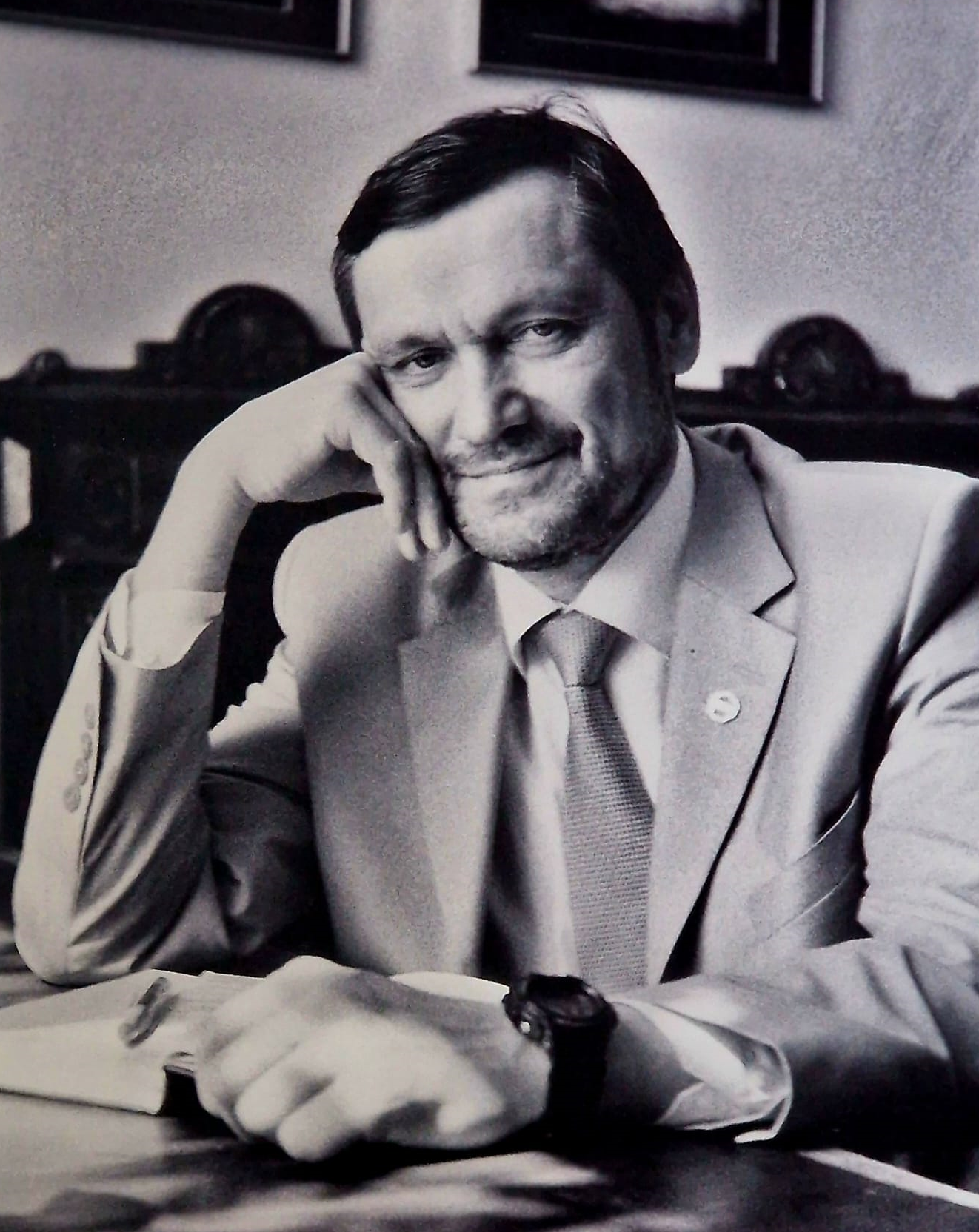
Dr. Rushan M. Sabirov. Photograph by Gerasimova A. N.
Since 2004, Dr. Rushan M. Sabirov served in high administrative positions in the Kazan University. He was a Dean of the Biological Faculty (2004–2012), then a Vice-Director in the Field of Biological Education of the Institute of Fundamental Medicine and Biology (2012–2019), and since 2019 a Dean of the Higher School of Biology within this institute. These were a challenging 20 years at Kazan University, when several impactful transitions occurred: specialty educational system was switched to two-tier baccalaureate and magistracy educational system; Kazan State University became Kazan Federal University; and Faculty of Biology became Institute of Fundamental Medicine and Biology. Due to insightful leadership of Dr. Sabirov, his organizational talent and his abilities to strategically plan for the years ahead, but also to react quickly to situational changes, development of the biological education in Kazan University gained strong foothold and is now among the top institutes country-wise. On the scientific-educational aspect, many new leading research laboratories were organized anew or reorganized, many country-wide and international scientific collaboration agreements were signed and put in action, and many young talented people were attracted to the vast field of life sciences. Last but not least, in his Department of Zoology, Rushan Sabirov was the Department Head since June 2009 to June 2025 (acting Head of Department since September 2008). During these years, the Department of Zoology of Kazan University flourished like never before with new laboratories, scientific collaborations agreements, awards, grants, and research projects. Dr. Sabirov’s exceptional organizational talent, with the creation of an informal atmosphere of friendliness and, at the same time, a focus on fulfilling the main purpose of the team’s work, predisposed the success.
In his research activities, Rushan was always characterized by preciseness, keen eye, attention to details, and crystal-clear hypotheses; he also had an ability to clearly recognize the main principal parts from other interesting, but still secondary parts of the studied problem. Being a natural morphologist, he amazed his colleagues with a surprisingly accurate way of distinguishing, explaining, and describing the three-dimensional structure of an organ or organism under study. As a rule, Rushan’s scientific publications were illustrated with his beautiful drawings (Figure 2), which accurately conveyed the complex structure of zoological objects, while also being admirable from an artistic point of view.
Figure 2
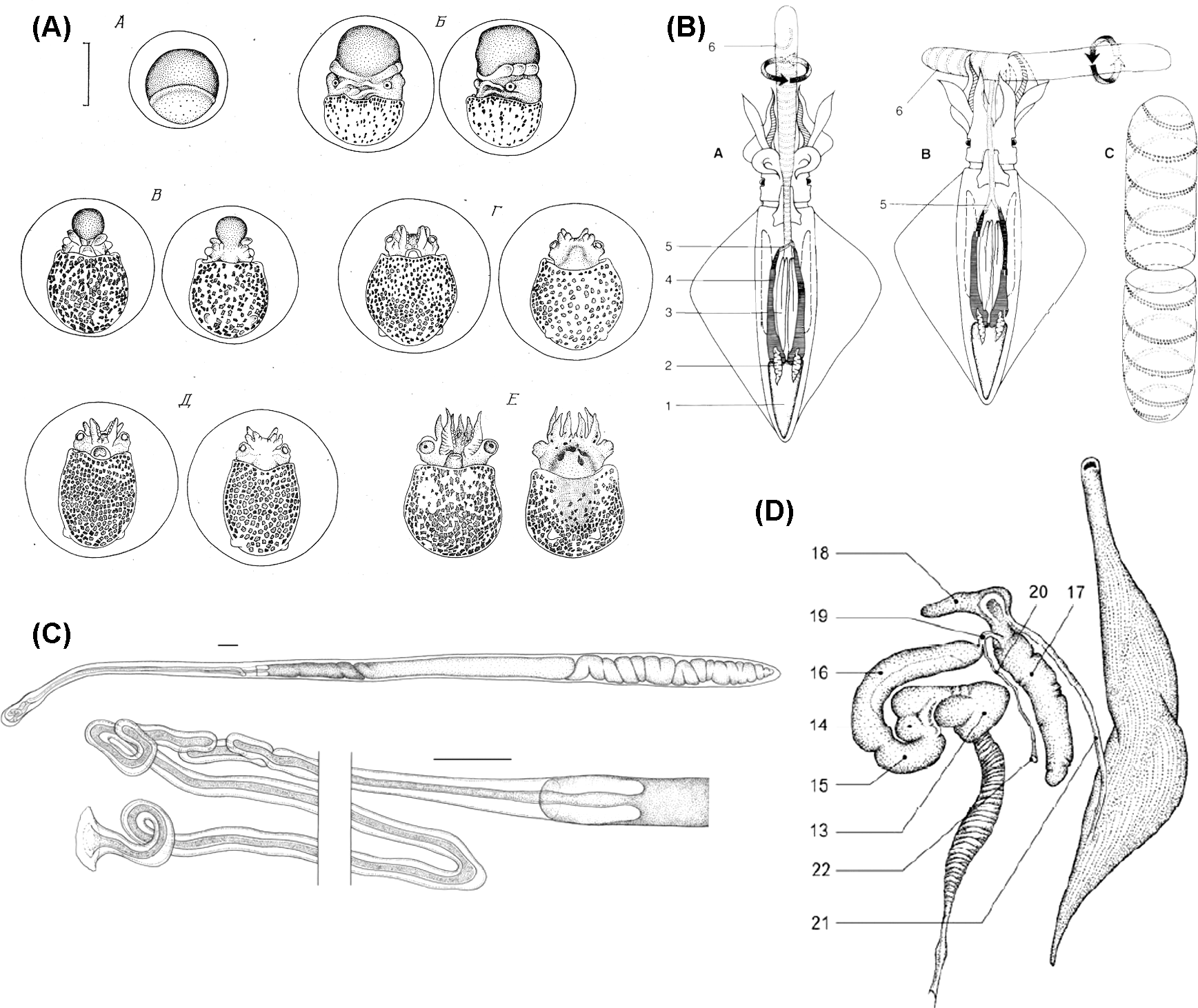
Original illustrations of oceanic squids by Dr. Rushan M. Sabirov, published in different scientific papers: (A) embryonic development of diamondback squid (Thysanoteuthis rhombus), every 24 h, from own onboard aquaria observations. Reproduced from “Эмбриональное развитие кальмара-ромба: А - Д - последовательные этапы эмбриогенеза, Е - выклюнувшаяся личинка. Масштаб 1 мм” (“Embryonic development of the diamondback squid: A–D – successive stages of embryogenesis, E – hatched larva. Scale bar is 1 mm”) by Rushan Mirzovich Sabirov, licensed under CC BY 4.0. (B) hypotheses how can females of diamondback squid spawn pelagic egg masses (such as the one shown at the right-most) in epipelagic layers. Reproduced from “Thysanoteuthis rhombus. Possible methods of egg mass construction by females. (A) Hypothesis 1. (B) hypothesis 2, (C) schematic diagram of egg mass. 1: Ovary; 2: oviduct; 3: nidamental glands; 4: oviductal glands; 5: secretion of oviductal glands with ripe eggs; 6: egg mass” by Chingiz M. Nigmatullin, Alexander I. Arkhipkin' and Rushan M. Sabirov, licensed under CC BY 4.0. (C) a spermatophore of Antarctic squid (Psychroteuthis glacialis) and (lower) magnified its ejaculatory tube. Reproduced from “Сперматофоры кальмаров: д – сперматофор” (“Squid spermatophores: d – spermatophore”), by Sabirov (2010), licensed under CC BY 4.0. (D) spermatophoric complex of organs of neon flying squid (Ommastrephes bartramii). Scales: 1 mm. Reproduced from “Половая система Ommastrephes bartrami (Teuthida) (b)” (“Reproductive system of Ommastrephes bartrami (Teuthida) (b)”) by Rushan Mirzovich Sabirov, licensed under CC BY 4.0.
His scientific vision was committed to an evolutionary approach, and to successfully indicate the heuristic, widely applied phenomena where initially they were not tracked. Rushan’s very wide scientific horizons and expert knowledge of general biological theory and its numerous applications allowed him work with ease on different animal taxa (see bibliography in the Supplementary File S1): indeed, while his main passion was marine zoology, he also worked with freshwater and even terrestrial taxa. Within marine taxa, as noted above, the main interest for Rushan were the cephalopods, and especially oceanic squids. In this group, his favorite research topic was functional morphology and evolution of the male reproductive system, with ommastrephid squids being the usual study taxon (Nigmatullin et al., 1991, 1996, 2003; Nigmatullin and Sabirov, 2002; Sabirov, 2007a, 2007b, 2009, 2010; Sabirov et al., 2012, 2017; Golikov et al., 2018). For instance, in his PhD Thesis (Sabirov, 1995), he described the structure of spermatophoric complex of organs and their allometric growth in maturing and mature stages of ontogeny; morphology and morphometry of spermatophores with their ontogenetic changes; and estimated spermatophore number in 17 ommastrephid species, including first time analysis of 10 species. Based on these results he revealed that spermatophore morphology can be used to track phylogeny of the family and to correctly assign otherwise hard-to-identify genera and species.
Rushan’s most important and promising publication series was a synthesis of the numerous studies of the structure of the reproductive system in male cephalopods of different groups (Sabirov, 2007b, 2009, 2010). There he described the specific structure of spermatophoric complex of organs in Nautilida, Cirrata, Incirrata, Sepiida and Teuthida, the evolutionary directions of their architectonics, with structural complexity of spermatophores, and improvements of their transfer mechanism to females. In general, he studied the ontogenetic development of the male reproductive system, from testis to spermatophores. Rushan established that evolution of accessory reproductive glands in male cephalopods proceeded in the direction of gradually lengthening their distal parts, along with a differentiation of these parts, and structure complication of produced sperm aggregates and changes in their transfer mechanisms. He demonstrated, how functional morphology of male reproductive system in cephalopods is connected on one hand to different reproductive strategy and on the other hand, to their morphological appearances, which in turn, is reflected in locomotory and motion-support mechanisms.
But, of course, Rushan was interested in all aspects of cephalopod biology. For example, one of his important findings was a description of egg masses and embryogenesis (observed during onboard aquaria incubation) of the diamondback squid Thysanoteuthis rhombus, followed by a general ecological discussion (Sabirov et al., 1987). He also actively participated in a recent revision of the Arctic and North Atlantic deep-sea Muusoctopus octopods and in a description of Muusoctopus aegir (Golikov et al., 2023). Rushan participated in meetings of the Cephalopod International Advisory Council (CIAC) in 2000 (Aberdeen, UK) and in 2012 (Florianópolis, Brazil) he attended in person, and in several others remotely as a coauthor of presentations (2015, 2018, 2022 and posthumously in 2025). Especially when he presented his work in person, he never failed to draw devoted attention. His admirable illustration skills were also of help in the public talks for large audiences, captivating the attention with ease.
In addition to marine studies, he participated in the preparation of the “Red Book of the Republic of Tatarstan” as the author of several chapters, as well as he published many other papers, chapters, reports and reviews related to nature conservation (Supplementary File S1). Wide academic and applied-academic, and education-related publication activity of Dr. Sabirov resulted in bibliography of ~370 items, including ~20 books, textbooks and practice books for students, and >70 papers in peer-reviewed scientific journals (Supplementary File S1) — >30% of published works are in English.
Despite a high level of publication activity, the most important results of the studies on the cephalopod male reproductive biology, unfortunately, have not yet been published. This occurred largely due to Rushan’s supreme internal responsibility for the teams he led and assigned organizational tasks. The main part of his time in the last >20 years has been occupied by the administrative and educational work in very ‘turbulent’ times in Kazan University with constant reforms. This excessive administrative burden, in many ways, did not allow Rushan to fully devote himself to his beloved science.
Rushan’s wide range of interests, broad erudition and high professionalism, as well as remarkable personal qualities made him an important public figure in Kazan and the Republic of Tatarstan. He regularly acted as an expert on ecology and related disciplines in government agencies and environmental organizations, primarily the Ministry of Ecology and Natural Resources of the Republic of Tatarstan.
To the students at Kazan University, Dr. Sabirov is well known as a great lecturer and outstanding teacher. His signature course was ‘Invertebrate Zoology’, which was read in 1st semester of the 1st year for bachelor students in biology and pedagogics, and often had >180 people in one auditorium for lectures and became one of the most recognizable biological disciplines in Kazan University. Located right at the beginning of the students’ path, it left unforgettable impression on students and set a high bar for future courses. He also taught many other courses for specialists, bachelor and master students, of course, among which functional and evolutionary morphology of invertebrates and comparative anatomy of invertebrates were his favorite.
Speaking of his activities in the higher education, it is also necessary to mention his dedication to the White Sea Field Station of Kazan University. The Station was founded in 1977 (Sabirov and Golikov, 2013), and since 1985, i.e. starting right after his return to Kazan University from Kaliningrad, he provided summer marine field practice for Kazan students on (almost) annual basis. The last such practice took place in the summer of 2021. Overall, in 1985–2021, Dr. Sabirov spent at least 30 field seasons on the White Sea Field Station. The students who passed this field practice always remember the happy moments, fantastic northern land- and seascapes, and unforgettable atmosphere. Dr. Sabirov’s lectures and practice lessons were the reasons for why many students came to science. Indeed, his legacy is carried on by an astonishing number of persons, for whom he was a scientific supervisor. Dr. Sabirov supervised >100 bachelor and master theses, specialist diplomas and qualification works and eight PhD theses. He was always kind, correct, respectful and a sincere Teacher, and will forever remain in their hearts and be remembered in their words and actions.
Rushan was a wonderful family man. His wife Sarya (married in 1984) was a reliable loving support in his life, and his two daughters brought him a lot of joy. Family and friends always had a special place in Rushan’s world, as his life motto was to love, care for and protect his close circle. In a wider sense, this applied also very well to his Department and the whole Faculty/Institute in general. He always took people’s problems to the heart and tried to help to the best of his ability, found time to hear everyone out and to counsel in all kinds of difficult situations, and always strived for win-win solutions and the best possible outcome. To add to this all, apart from a spectacular combination of professional and personal qualities, he was truly a man of many talents, who could draw (not only for professional purposes), but also a devoted singer (in particular as member for several years in the Capella Choir of Kazan University during his student times), a great cook, and he also could garden, and plan and build family buildings and work with technique extremely well. For a while, his dream was a big family house in the countryside, and it came true recently during the last few years, when such a house was built near Kazan. Rushan was optimistic and full of plans, regarding life in general and his house in particular, and regarding science and teaching. This tragic and unexpected loss is still hard to realize for his family, friends and colleagues, and in the scientific community he belonged to. Rushan will be immensely missed and forever remembered in our hearts.
Statements
Author contributions
AVG: Writing – original draft, Writing – review & editing. CMN: Writing – original draft, Writing – review & editing.
Funding
The author(s) declared that financial support was not received for this work and/or its publication.
Acknowledgments
The authors express their sincerest condolences to the family of Dr. Rushan Mirzovich Sabirov, and are grateful to them for help with clarifying some of the biography information: Sabirova Sarya Nurmukhametovna, Häußler (Sabirova) Albina Rushanovna and Shpet (Sabirova) Regina Rushanovna.
Conflict of interest
The authors declared that this work was conducted in the absence of any commercial or financial relationships that could be construed as a potential conflict of interest.
Generative AI statement
The author(s) declared that generative AI was not used in the creation of this manuscript.
Any alternative text (alt text) provided alongside figures in this article has been generated by Frontiers with the support of artificial intelligence and reasonable efforts have been made to ensure accuracy, including review by the authors wherever possible. If you identify any issues, please contact us.
Publisher’s note
All claims expressed in this article are solely those of the authors and do not necessarily represent those of their affiliated organizations, or those of the publisher, the editors and the reviewers. Any product that may be evaluated in this article, or claim that may be made by its manufacturer, is not guaranteed or endorsed by the publisher.
Supplementary material
The Supplementary Material for this article can be found online at: https://www.frontiersin.org/articles/10.3389/fmars.2025.1726010/full#supplementary-material
Supplementary File S1Full bibliography of Dr. Rushan M. Sabirov (in original languages: works in Russian, English and Spanish).
References
1
Golikov A. V. Gudmundsson G. Blicher M. E. Jørgensen L. L. Korneeva E. I. Olafsdottir S. H. et al . (2023). A review of the genus Muusoctopus (Cephalopoda: Octopoda) from Arctic waters. Zool. Lett.9, 21. doi: 10.1186/s40851-023-00220-x
2
Golikov A. V. Sabirov R. M. Blicher M. E. Gudmundson G. Zimina O. L. Zakharov D. V. (2018). First record of the whip-lash squid, Mastigoteuthis agassizii Verrill 1881 (Mollusca: Cephalopoda: Mastigoteuthidae) in the Subarctic Atlantic, with notes on its morphology and biology. J. Nat. Hist.52, 2317–2329. doi: 10.1080/00222933.2018.1536229
3
Kolotovkin B. M. Nigmatullin C. H. M. (2002). “ History and main results of the multipurpose governmental funding program ‘Squid’,” in Proceedings of the VI All-Russian Conference on Commercial Invertebrates, 133–137 (Moscow: All-Russian Institute of Fisheries and Oceanography).
4
Nigmatullin C. Arkhipkin A. I. Sabirov R. M. (1991). Structure of reproductive system of the squid Thysanoteuthis rhombus (Cephalopoda: Oegopsida). J. Zool. Lond.224, 271–283. doi: 10.1111/j.1469-7998.1991.tb04804.x
5
Nigmatullin C. Laptikhovsky V. V. Sabirov R. M. (1996). “ Reproductive biology of the commander squid,” in Fisheries biology of the commander squid and fishes in the slope communities of the western Bering Sea. Ed. ElizarovA. A. ( All-Russian Institute of Fisheries and Oceanography, Moscow), 101–124.
6
Nigmatullin C. Sabirov R. M. (2002). Cephalopod spermatophores, their functional, ontogenetic and evolutionary aspects (example: ommastrephid squids). Berliner Paläobiol. Abh.1, 85–87.
7
Nigmatullin C. Sabirov R. M. (2007). About Vladimir Lyvovich Wagin and his scientific heritage. Proc. Kazan. Uni. Nat. Sci. Ser.149, 13–30.
8
Nigmatullin C. Sabirov R. M. Zalygalin V. P. (2003). Ontogenetic aspects of morphology, size, structure and production of spermatophores in ommastrephid squids: an overview. Berliner Paläobiol. Abh.3, 225–240.
9
Sabirov R. M. (1995). Spermatophorogenesis and reproductive strategy in males of ommatrephid squids (Oegopsida: Ommastrephidae) (Moscow: Institute of Ecology and Evolution of the Russian Academy of Sciences).
10
Sabirov R. M. (2007a). Reproductive system in males of Cephalopoda. I. The history of investigation. Proc. Kazan. Uni. Nat. Sci. Ser.149, 33–50.
11
Sabirov R. M. (2007b). Views of male reproductive system structure in Cephalopoda: correlations and consequences. Proc. Kazan. Uni. Nat. Sci. Ser.149, 194–201.
12
Sabirov R. M. (2009). Reproductive system in males of Cephalopoda. II. Spermatophoric complex of organs. Proc. Kazan. Uni. Nat. Sci. Ser.151, 34–50.
13
Sabirov R. M. (2010). Reproductive system in males of Cephalopoda. III. Spermatophores. Proc. Kazan. Uni. Nat. Sci. Ser.152, 8–21.
14
Sabirov R. M. Arkhipkin A. I. Ju T. V. Schetinnikov A. S. (1987). Egg masses and embryonic development of diamondback squid Thysanoteuthis rhombus (Oegopsida, Thysanoteuthidae). Zool. J.66, 1155–1163.
15
Sabirov R. M. Golikov A. V. (2013). Morphology, systematics and ecology of marine invertebrates: students’ guide (Kazan: Kazan University Press).
16
Sabirov R. M. Golikov A. V. Nigmatullin C. Lubin P. A. (2012). Structure of the reproductive system and hectocotylus in males of lesser flying squid Todaropsis eblanae (Cephalopoda: Ommastrephidae). J. Nat. Hist.46, 1761–1778. doi: 10.1080/00222933.2012.700335
17
Sabirov R. M. Novikov A. A. Golikov A. V. (2017). Structure of male reproductive system in Spirula (Cephalopoda: Spirula spirula). Proc. Kazan. Uni. Nat. Sci. Ser.159, 433–442.
Summary
Keywords
Rushan M. Sabirov, obituary, bibliography, Kazan University, Cephalopoda, Invertebrate Zoology, Marine Biology, Ecology
Citation
Golikov AV and Nigmatullin CM (2025) Obituary: Dr. Rushan M. Sabirov (1958–2025). Front. Mar. Sci. 12:1726010. doi: 10.3389/fmars.2025.1726010
Received
15 October 2025
Revised
20 November 2025
Accepted
02 December 2025
Published
22 December 2025
Volume
12 - 2025
Edited by
Rui Rosa, University of Lisbon, Portugal
Reviewed by
Pablo Del Monte-Luna, Centro Interdisciplinario de Ciencias Marinas (IPN), Mexico
Vladimir Laptikhovsky, Centre for Environment, Fisheries and Aquaculture Science (CEFAS), United Kingdom
Updates
Copyright
© 2025 Golikov and Nigmatullin.
This is an open-access article distributed under the terms of the Creative Commons Attribution License (CC BY). The use, distribution or reproduction in other forums is permitted, provided the original author(s) and the copyright owner(s) are credited and that the original publication in this journal is cited, in accordance with accepted academic practice. No use, distribution or reproduction is permitted which does not comply with these terms.
*Correspondence: Alexey V. Golikov, golikov.ksu@gmail.com
Disclaimer
All claims expressed in this article are solely those of the authors and do not necessarily represent those of their affiliated organizations, or those of the publisher, the editors and the reviewers. Any product that may be evaluated in this article or claim that may be made by its manufacturer is not guaranteed or endorsed by the publisher.