Abstract
The coastal zone, as a typical land-sea interaction area, has experienced significant changes in habitat quality under the dual influence of climate change and human activities. Identifying the land-sea differences in the mechanisms influencing habitat quality in the coastal zone is essential for the development of targeted ecological protection strategies. Based on the integrated habitat quality assessment results for the Jiangsu coastal zone from 2010 to 2020, kernel density curves and Optimal Parameter Geographic Detector (OPGD) were employed to investigate the land-sea differences in the composition, spatiotemporal variations, and driving mechanisms of habitat quality. The results indicate that, in terms of composition, low-quality habitats are mainly distributed on land, while areas with medium to high habitat quality are concentrated in the sea; in terms of spatiotemporal changes, from 2010 to 2020, habitat quality degradation in the Jiangsu coastal zone is primarily manifested as the expansion of low-quality terrestrial habitats into natural areas, as well as the transition of high-quality marine habitats into suboptimal habitats; in terms of driving mechanisms, changes in terrestrial habitat quality are primarily driven by human activities, whereas marine changes are mainly influenced by natural factors such as topography and hydrodynamics, with indirect disturbances from human activities observed in specific years. These findings provide a scientific basis for the targeted formulation of coastal zone ecological protection policies.
1 Introduction
The coastal zone is the boundary area between land and sea, featuring rich ecological resources and important ecological functions (Costanza et al., 1997). However, coastal ecosystems are under unprecedented pressure due to global climate change and human activities (Halpern et al., 2008; Nicholls et al., 2008). Human activities such as land reclamation, port construction, and fishing have intensified the degradation of coastal ecosystems (Huang et al., 2021). Simultaneously, climate-driven challenges like sea level rise (Roy et al., 2023), extreme weather events (Adelekan and Fregene, 2015), and invasive species (Rius et al., 2014) further weaken coastal ecosystems’ resilience. These combined pressures have significantly diminished the ecological services provided by coastal zones, with habitat quality degradation being a major manifestation. Habitat quality refers to the environment’s ability to support the survival and development of organisms and is a key component of ecosystem function (Hillard et al., 2017). Degradation of habitat quality not only threatens biodiversity but also impairs essential coastal services like water purification, coastal protection, and carbon sequestration (Beaumont et al., 2013; Cunha et al., 2021; Worm et al., 2006). Therefore, assessing habitat quality and identifying its driving factors is essential for effective ecological management and implementing ecosystem-based coastal zone management strategies.
The ecological functions of the coastal zone rely on the interconnectedness of terrestrial, intertidal, and marine ecosystems. Therefore, to comprehensively assess habitat quality, it is essential to view the coastal zone as a unified ecosystem (de Andrés et al., 2023). However, habitat quality assessment in the coastal zone faces unique challenges due to the differences between terrestrial and marine ecosystems (Carr et al., 2003). Traditional assessment methods are often designed for single ecosystems (e.g., terrestrial or marine), with different evaluation focuses. Terrestrial habitat quality is mainly assessed using Land Use and Land Cover (LULC) data, integrated with 3S technologies and ecological models like InVEST and HSI (Wu et al., 2021b; Arenas-Castro and Sillero, 2021; Moreira et al., 2018). In contrast, marine habitat quality is typically assessed based on indicators such as water quality and benthic organisms, focusing on habitat condition and fishery sustainability (Dong et al., 2021; Sarkar et al., 2021). Marine habitat mapping has also become a key research area (Schill et al., 2021). Additionally, the cross-realm threat—due to the interaction of terrestrial and marine factors—must be considered in coastal habitat assessments. Failing to address this could lead to biased results and undermine the effectiveness of ecological protection and management policies (Tallis et al., 2008).
Human activities and natural environmental factors are the two main drivers of habitat quality degradation, with their impacts varying significantly across regions (Newbold et al., 2019). However, previous studies still have limitations in quantitatively assessing the intensity of these influencing factors (Calderon-Aguilera et al., 2012). The emergence of methods such as the GeoDetector (Chen and Liu, 2024a) and machine learning (Zhou et al., 2024) has made it possible to quantitatively analyze the driving mechanisms of habitat quality degradation. These methods provide insights into the intensity and regional differences in the impacts of human and natural factors on habitat quality, offering valuable tools for more refined assessments of habitat degradation.
Most existing studies focus on the independent assessment of habitat quality in either terrestrial or marine ecosystems. While some have attempted integrated coastal habitat quality assessments (Liao et al., 2023), few comparative studies examine the land-sea driving mechanisms. The Jiangsu coastal zone, characterized by its muddy coastlines and ecologically sensitive environment, has experienced fluctuating development intensity since 2010, shifting from a “development over protection” approach to one prioritizing both development and protection. This changing intensity of human activities has had varying impacts on habitat quality.
This study takes the Jiangsu coastal zone as a case to conduct an integrated assessment of habitat quality, addressing the limitations of traditional land-sea separated research. It quantitatively explores the impacts of human activities and natural factors, highlighting structural differences between terrestrial and marine areas in terms of habitat composition, spatiotemporal changes, and driving mechanisms, ultimately supporting the development of targeted ecological protection policies for coastal zones.
2 Materials and methods
2.1 Study area
Jiangsu Province, located in eastern China’s Yangtze River Delta, is bordered to the east by the Yellow Sea. Its coastal cities, from north to south, are Lianyungang, Yancheng, and Nantong. The region hosts three major ecosystems: forests, oceans, and wetlands, with unique sandy ridges and intertidal wetlands. The terrestrial study area is defined by the administrative boundaries of these coastal cities, while the marine area covers waters under Jiangsu’s jurisdiction (Figure 1).
Figure 1
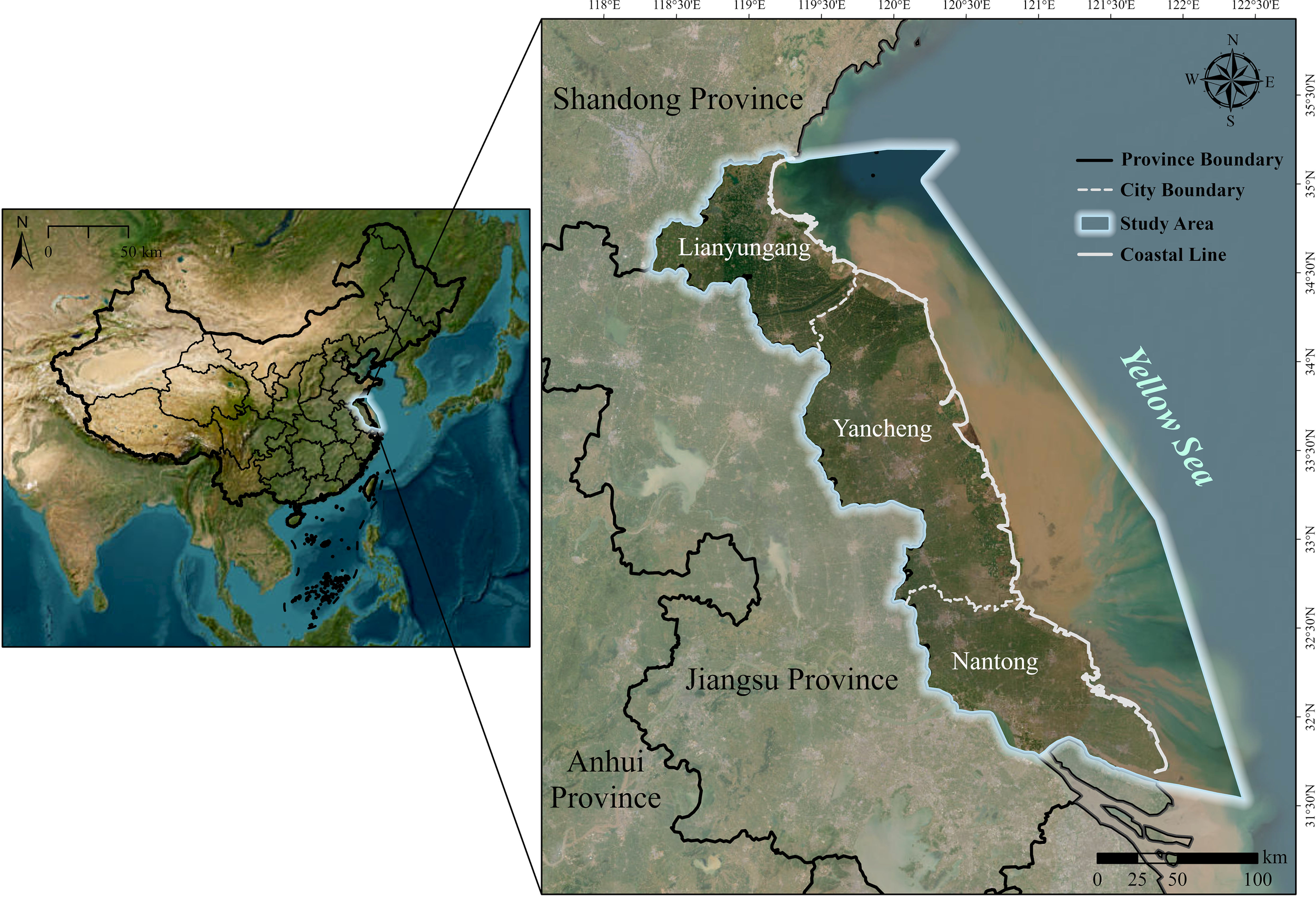
Study area.
2.2 Integrated evaluation method of coastal habitat quality
The Habitat Quality module in the InVEST model was used to assess the habitat quality of the study area. The model is based on habitat types, establishing a connection between habitat quality and threat sources. It analyzes habitat sensitivity and the impact of external threat factors, thereby providing insights into the spatial distribution of habitat quality in the region. The habitat quality index, ranging from 0 to 1, is used to represent regional habitat quality, with higher values indicating better habitat quality. The model’s calculation principles are detailed in the user guide. The calculation formula for habitat quality is as follows:
Here, Qxj represents the habitat quality of raster cell x within land (or marine) use type j. denotes the habitat suitability of land (or marine) use type j, reflecting the capacity of different habitat types to provide suitable conditions for species’ survival and reproduction. z is a normalization constant, set to 2.5, and K is the half-saturation constant, with a default value of 0.5. is the threat index of raster cell x within land (or marine) use type j, used to quantify the level of stress imposed by threat factors and the degree of habitat degradation (Nature Capital Project, 2025).
2.2.1 Coastal habitat classification
In territorial spatial development, the complex interactions between human activities and natural factors have created diverse combinations of biological and human living spaces at different scales (Liu et al., 2024). On land, land use types directly reflect the degree of human activity interference with regional habitat quality. In contrast, the three-dimensional nature of marine space challenges traditional two-dimensional spatial classification methods. While human activities influence the marine environment, their impact is limited, and most areas remain near-natural. To refine coastal habitat classification, this study introduced the benthic biodiversity index as a key biological factor, enhancing the classification of near-natural marine habitats. Holistically considering coastal landforms, natural ecological attributes, and human impacts, the study classified coastal habitats into 12 types. The definitions of each habitat types are presented in Table 1.
Table 1
| Habitat type | Definition |
|---|---|
| Terrestrial Natural Habitat (TN) | Natural terrestrial areas, including grasslands, forests, and rivers. |
| Terrestrial Low-Intensity Semi-Natural Habitat (TLSN) | Terrestrial areas subjected to light intensity human activities, including paddy fields. |
| Terrestrial High-Intensity Semi-Natural Habitat (THSN) | Terrestrial areas subjected to high intensity human activities, including dryland and aquaculture ponds. |
| Terrestrial Artificial Habitat (TA) | Terrestrial areas entirely dominated by human activities, including construction land and nearshore land reclamation zones. |
| Intertidal Natural Habitat (IN) | Natural intertidal areas with a benthic biodiversity index greater than 3. |
| Intertidal Low-Intensity Semi-Natural Habitat (ILSN) | Natural intertidal areas with a benthic biodiversity index between 1 and 3; open intertidal areas with a benthic biodiversity index greater than 2. |
| Intertidal High-Intensity Semi-Natural Habitat(IHSN) | Disturbance-based intertidal areas; open intertidal areas with a benthic biodiversity index lower than 2; natural intertidal areas with a benthic biodiversity index lower than 1. |
| Intertidal Artificial Habitat(IA) | Intertidal areas that have been completely modified by land reclamation and non-permeable structures. |
| Marine Natural Habitat(MN) | Natural marine areas with a benthic biodiversity index greater than 3. |
| Marine Low-Intensity Semi-Natural Habitat(MLSN) | Natural marine areas with a benthic biodiversity index between 1 and 3; open marine areas with a benthic biodiversity index greater than 2. |
| Marine High-Intensity Semi-Natural Habitat(MHSN) | Disturbance-based marine areas; open marine areas with a benthic biodiversity index lower than 2; natural marine areas with a benthic biodiversity index lower than 1. |
| Marine Artificial Habitat(MA) | Marine areas that have been completely modified by land reclamation and non-permeable structures. |
Coastal habitat classification.
Open intertidal (marine) areas refer to tourism and recreational zones, open aquaculture areas, and offshore wind farms. Disturbance-based intertidal (marine) areas refer to those other than reclaimed land and open intertidal (marine) areas.
2.2.2 Threat factors and relevant parameters
Referring to related studies (Zhang et al., 2020; Li et al., 2019; Lopes et al., 2023; Zhang et al., 2022), based on land use data and marine resource development data, 9 human activities were selected as habitat quality threat factors. The parameters of these threat factors and the sensitivity of different habitat types to them were shown in Table 2 and 3.
Table 2
| Threat factors | Maxium distance (km) | Weight | Decay type |
|---|---|---|---|
| T1 Construction land | 5 | 1 | Exponential |
| T2 Cropland | 2 | 0.5 | Linear |
| T3 Reclaimed land | 2 | 1 | Exponential |
| T4 Sewage outlets | 5 | 1 | Exponential |
| T5 Enclosed aquaculture | 2 | 0.7 | Exponential |
| T6 Permeable structures | 0.5 | 0.5 | Linear |
| T7 Harbors | 2 | 0.7 | Linear |
| T8 Offshore wind farms | 0.5 | 0.3 | Linear |
| T9 Open aquaculture | 0.5 | 0.3 | Linear |
Coastal habitat quality threats and relevant parameters.
Table 3
| Habitat type | Habitat score | Sensitivity to threat factors | ||||||||
|---|---|---|---|---|---|---|---|---|---|---|
| T1 | T2 | T3 | T4 | T5 | T6 | T7 | T8 | T9 | ||
| TN | 0.8 | 1 | 0.7 | 0.1 | 0.1 | 0 | 0 | 0 | 0 | 0 |
| TLSN | 0.6 | 1 | 0.2 | 0 | 0.2 | 0.2 | 0 | 0 | 0 | 0 |
| THSN | 0.4 | 1 | 0.1 | 0 | 0.1 | 0.1 | 0 | 0 | 0 | 0 |
| TA | 0 | 0 | 0 | 0 | 0 | 0 | 0 | 0 | 0 | 0 |
| IN | 0.9 | 0.3 | 0.5 | 1 | 1 | 0.7 | 0.5 | 0.4 | 0.6 | 0.2 |
| ILSN | 0.7 | 0.3 | 0.4 | 0.9 | 0.9 | 0.5 | 0.2 | 0.3 | 0.4 | 0.16 |
| IHSN | 0.5 | 0.3 | 0.3 | 0.8 | 0.8 | 0.4 | 0.1 | 0.2 | 0.3 | 0.12 |
| IA | 0 | 0 | 0 | 0 | 0 | 0 | 0 | 0.2 | 0 | 0 |
| MN | 1 | 0 | 0 | 0.9 | 0.9 | 0.6 | 0.3 | 0.4 | 0.5 | 0.2 |
| MLSN | 0.8 | 0 | 0 | 0.8 | 0.8 | 0.5 | 0.2 | 0.3 | 0.4 | 0.16 |
| MHSN | 0.6 | 0 | 0 | 0.7 | 0.7 | 0.4 | 0.1 | 0.2 | 0.3 | 0.12 |
| MA | 0 | 0 | 0 | 0 | 0 | 0 | 0 | 0 | 0 | 0 |
Coastal habitat types and sensitivity to threats.
2.3 Research method for spatiotemporal evolution of habitat quality
2.3.1 Kernel density estimation
The ridge plots were created using kernel density estimation (KDE) to analyze the distribution patterns of habitat quality along the Jiangsu coastline for the years 2010, 2015, and 2020, as well as the temporal changes in these patterns. For each sample point, its kernel density estimate was calculated to generate a smooth distribution of habitat quality. The formula is as follows (Parzen, 1962):
Where refers to the density estimate at point x, n is the number of samples, h is the bandwidth, K is the kernel function, is the coordinate of the i-th sample point.
2.3.2 Hotspot and coldspot analysis
Hotspot and coldspot analysis was used to reveal the Spatial Variation Characteristics of Habitat Quality Changes in the Jiangsu Coastal Zone from 2010 to 2020. The calculation formula is as follows (Getis and Ord, 1992):
Where and represent the mathematical expectation and variance of respectively; refers to the spatial weight. The greater than 2.58 is considered a hotspot area; between 1.96 and 2.58 is considered a secondary hotspot area; between -1.96 and 1.96 is considered a non-significant area; between -1.96 and -2.58 is considered a secondary coldspot area; and less than -2.58 is considered a coldspot area.
2.4 OPGD-based study of driving factors
2.4.1 Optimal parameter geographic detector
The geographic detector is a statistical method for detecting spatial differentiation and identifying driving factors, based on the principle that if an independent variable influences a dependent one, their spatial distributions should show similarity (Wang et al., 2010). It is effective for categorical variables and requires discretization for continuous ones, with the method and intervals influencing model accuracy (Gao et al., 2021). The Optimal Parameter Geographic Detector (OPGD) enhances the standard method by optimizing spatial discretization and scale, identifying the optimal parameters for analysis (Song et al., 2020). The OPGD model includes five components: optimal parameter optimization, factor detection, interaction detection, risk detection, and ecological detection. In this study, we focused on factor detection to assess the explanatory power of various factors on habitat quality and used interaction detection to explore their interactions, implemented via the GD package in R.
2.4.2 Selection of driving factors
The driving factors of habitat quality in the Jiangsu coastal zone are multifaceted, encompassing both natural and anthropogenic influences. For terrestrial habitat quality, we selected annual average temperature, annual precipitation, soil type, digital elevation model (DEM), population density, nighttime light index, and GDP as key driving factors (Ahmadi Mirghaed and Souri, 2022; Chen and Liu, 2024a; Zhao et al., 2022). For marine habitat quality, we focused on factors such as annual average sea surface current speed, sediment type, seafloor topography, marine development activities, shipping, fishing, and seawater eutrophication (LaFrance et al., 2014; Lecours et al., 2017; Luo et al., 2022). While seawater temperature and salinity are often considered critical factors in marine habitat quality (Brauko et al., 2020; Röthig et al., 2023), they were excluded from our factor selection due to limitations related to the spatial scale of our study.
2.5 Data sources
Land-use data for habitat classification were obtained from the Resources and Environmental Science Data Center, Chinese Academy of Sciences (http://www.resdc.cn). Marine resource development data were provided by the Jiangsu Department of Natural Resources. Benthic biodiversity data came from surveys and ecological monitoring (2006-2020), with station locations shown in Figure 2.
Figure 2
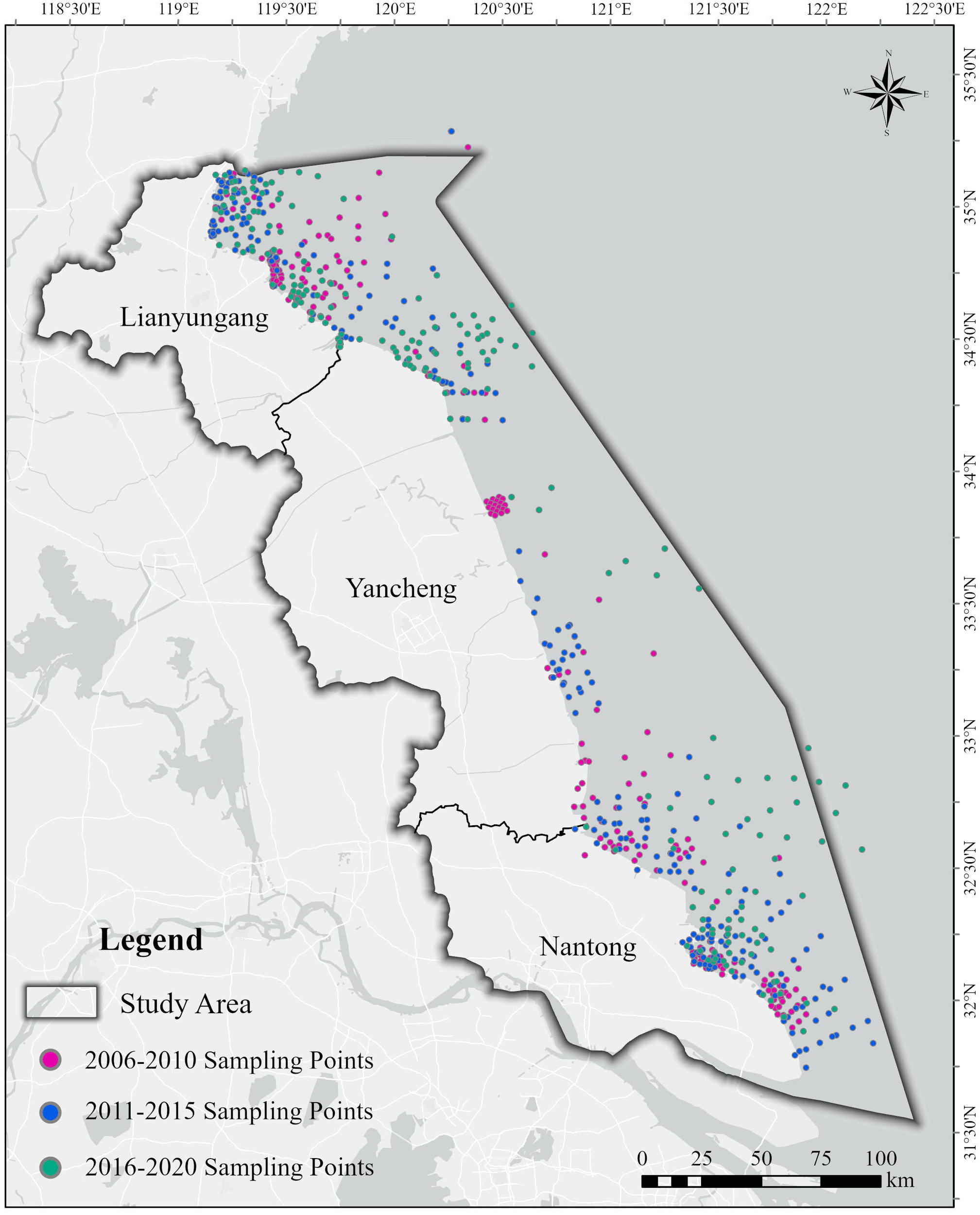
Distribution map of the comprehensive survey and ecological monitoring stations in Jiangsu.
Terrestrial habitat quality factors included annual average temperature, soil type, and DEM data from the Resources and Environmental Science Data Center. Precipitation data were from the Earth Resources Data Cloud (http://www.gis5g.com). Population density data were from WorldPop (https://hub.worldpop.org/), and nighttime lighting data were from Wu et al. (2022). GDP data combined per capita GDP and population density.
Marine habitat quality factors included average surface current velocity from the Hybrid Coordinate Ocean Model (HYCOM), sediment type data from Mei et al. (2020), seafloor topography from the Jiangsu Department of Natural Resources, and seawater eutrophication index from field sampling, as shown in Figure 2. Shipping and fishing data were from the Global Maritime Traffic Density Service (GMTDS).
3 Results
3.1 Spatiotemporal variation characteristics of coastal habitat quality
Figure 3A illustrates the spatial distribution pattern of habitat quality along the Jiangsu coastal zone, with habitat quality ranging from 0 to 1. It is classified into five levels: low [0, 0.2), lower [0.2, 0.4), moderate [0.4, 0.6), higher [0.6, 0.8), and high [0.8, 1]. Low-quality habitats were mainly distributed in the central urban areas of the three coastal cities and near-shore reclamation zones. Lower-quality habitats are mainly found in dryland and the surrounding paddy fields of urban centers. Moderate-quality habitats are primarily located in dryland and near-shore mudflats, while higher and high-quality habitats are mainly found in marine areas. Overall, habitat quality along the Jiangsu coast shows a gradual increase from land to sea, with lower and moderate-quality habitats predominantly on land, and higher and high-quality habitats predominantly in the marine areas. Note that in this study, the “coastal zone” refers to the entire spatial extent of the study area along the Jiangsu coast. The terrestrial and marine areas are separated by the officially coastline provided by government. Together, these two areas constitute the coastal zone.
Figure 3
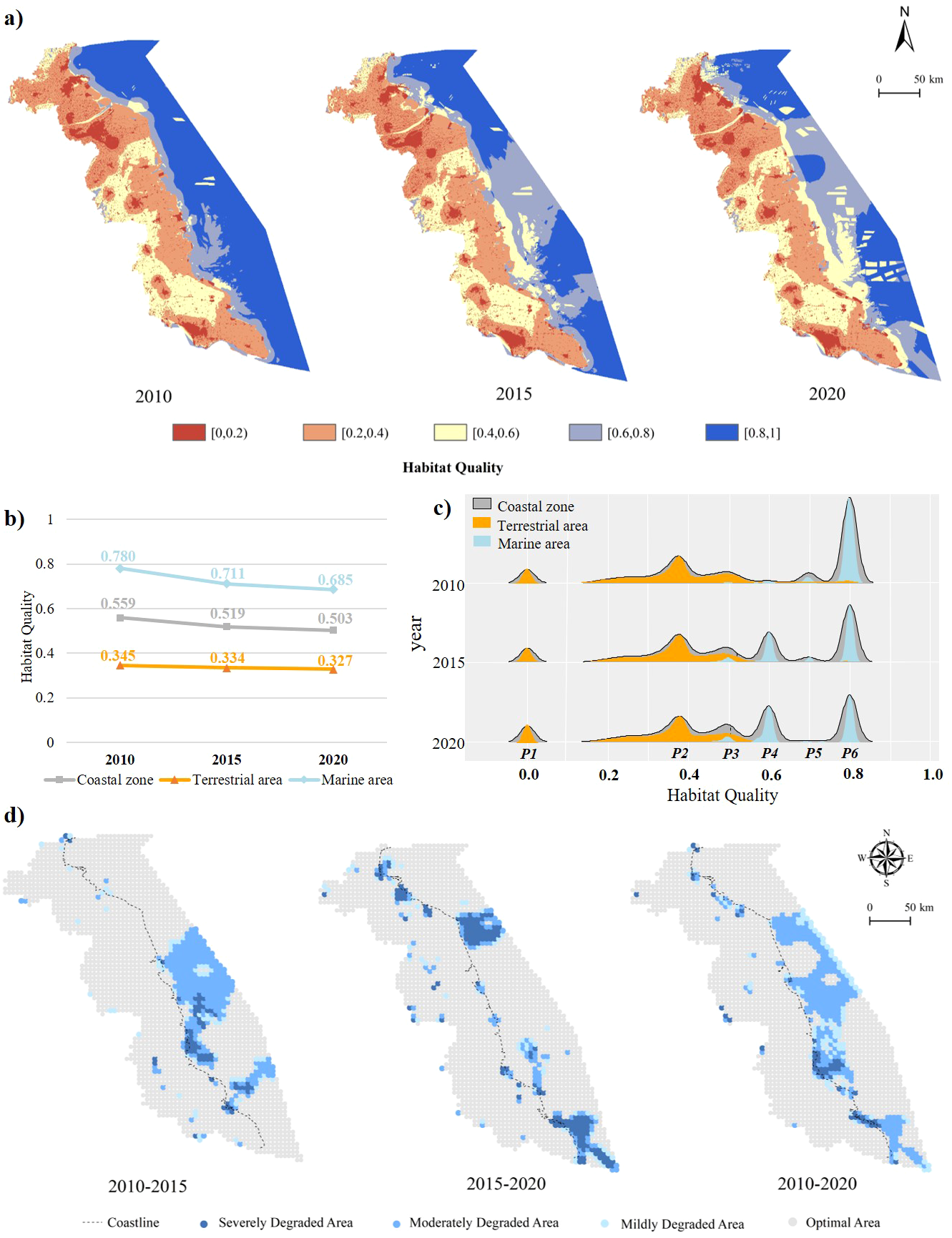
(A) Distribution of habitat quality classes in the Jiangsu Coastal zone. (B) Changes in the mean habitat quality in the Jiangsu coastal zone. (C) Ridge plot of habitat quality in the Jiangsu coastal zone. (D) Distribution of habitat quality degradation zones in the Jiangsu coastal zone.
From 2010 to 2020, habitat quality along the Jiangsu coastal zone showed a declining trend, with terrestrial habitat quality decreasing more gradually and marine habitat quality experiencing a more significant decline, particularly between 2010 and 2015 (Figure 3B). Kernel density estimation was used to further analyze the temporal dynamics of habitat quality from 2010 to 2020. The results indicated that habitat quality along the Jiangsu coast consistently exhibited multipolarization, with this feature becoming increasingly pronounced. The kernel density curve for terrestrial habitats showed a stable three-peak pattern from 2010 to 2020, with stable distances between peaks, while the height of peak P1 gradually increased. Additionally, the right tail of the density curve gradually diminished. For marine habitats, the kernel density curve was unimodal in 2010 but transitioned to a bimodal distribution in 2015 and 2020. The main peak (P6) decreased in height, and a new peak (P4) emerged at 0.6, with P6 continuing to decline while P4 steadily increased (Figure 3C).
Between 2010 and 2015, habitat degradation zones were mainly concentrated in the central marine areas of Jiangsu, accounting for 16.45% of the total study area. From 2015 to 2020, this proportion decreased to 13.19%, with degradation zones primarily concentrated in the northern marine areas of Yancheng and the southern marine areas of Nantong. The overall analysis from 2010 to 2020 indicates significant habitat degradation in the central and southern marine areas, which accounted for 19.12% of the total study area. Overall, habitat quality degradation along the Jiangsu coast displayed notable spatial heterogeneity, with varying trends across different time periods. Degraded habitats were mainly concentrated in marine areas, while terrestrial degradation zones were relatively dispersed (Figure 3D).
3.2 The driving mechanisms of spatiotemporal changes in coastal habitat quality
3.2.1 Driving mechanisms of spatiotemporal changes in terrestrial habitat quality
The factor detection results revealed that the nighttime light index is the primary driver of terrestrial habitat quality, although its relative contribution fluctuates across different years.
In 2010, the average annual temperature and nighttime light index (both with q-values of 0.12) were the most significant factors influencing terrestrial habitat quality, followed by soil type (q = 0.10). Additionally, population density (q = 0.09) and GDP (q = 0.07) also had notable effects on terrestrial habitat quality. In 2015, the nighttime light index and population density (both with q-values of 0.15) became the dominant factors affecting terrestrial habitat quality, with GDP coming next (q = 0.11). During this period, the influence of natural factors diminished. By 2020, the nighttime light index remained the leading influencing factor, with its explanatory power increasing to q = 0.17. Population density (q = 0.13) and GDP (q = 0.10) followed. A comparison across the 2010–2020 period indicated that human activities consistently exerted a stronger impact on terrestrial habitat quality than natural factors, with both human and natural influences showing a trend of initially increasing and then decreasing over time (Table 4).
Table 4
| Driving factors | Year | |||
|---|---|---|---|---|
| 2010 | 2015 | 2020 | ||
| Single Factor | NL | 0.117 | 0.151 | 0.166 |
| POP | 0.093 | 0.147 | 0.126 | |
| GDP | 0.073 | 0.107 | 0.091 | |
| TEM | 0.117 | 0.087 | 0.085 | |
| PRE | 0.029 | 0.103 | 0.071 | |
| DEM | 0.023 | 0.027 | 0.024 | |
| SOIL | 0.101 | 0.082 | 0.101 | |
| NF | 0.270 | 0.299 | 0.282 | |
| HA | 0.283 | 0.405 | 0.383 | |
Single-Factor detection results of terrestrial habitat quality influencing factors.
NL, nighttime light index; POP, population density; GDP, gross domestic product; TEM, annual average temperature; PRE, precipitation; DEM, digital elevation model; SOIL, soil type; NF, natural factor; HA, human activities.
The interaction detection results revealed that from 2010 to 2020, all factor combinations exhibited a two-factor nonlinear enhancement effect, with no factor acting independently. In 2010, the top three interactions were: soil type and average annual temperature, nighttime light index and average annual temperature, and soil type and nighttime light index. In 2015, the leading interactions were: nighttime light index and average annual temperature, soil type and nighttime light index, and nighttime light index and average annual precipitation. In 2020, the primary interactions were: nighttime light index and average annual temperature, nighttime light index and soil type, and nighttime light index and average annual precipitation. In 2010, individual factors such as average annual temperature, soil type, and nighttime light index had strong explanatory power for terrestrial habitat quality, with their combined effect enhancing habitat quality in a nonlinear manner. In 2015 and 2020, while the explanatory power of individual factors like average annual temperature, average annual precipitation, and soil type was relatively low, these factors played an important role as supporting elements in the interactions (Figure 4).
Figure 4
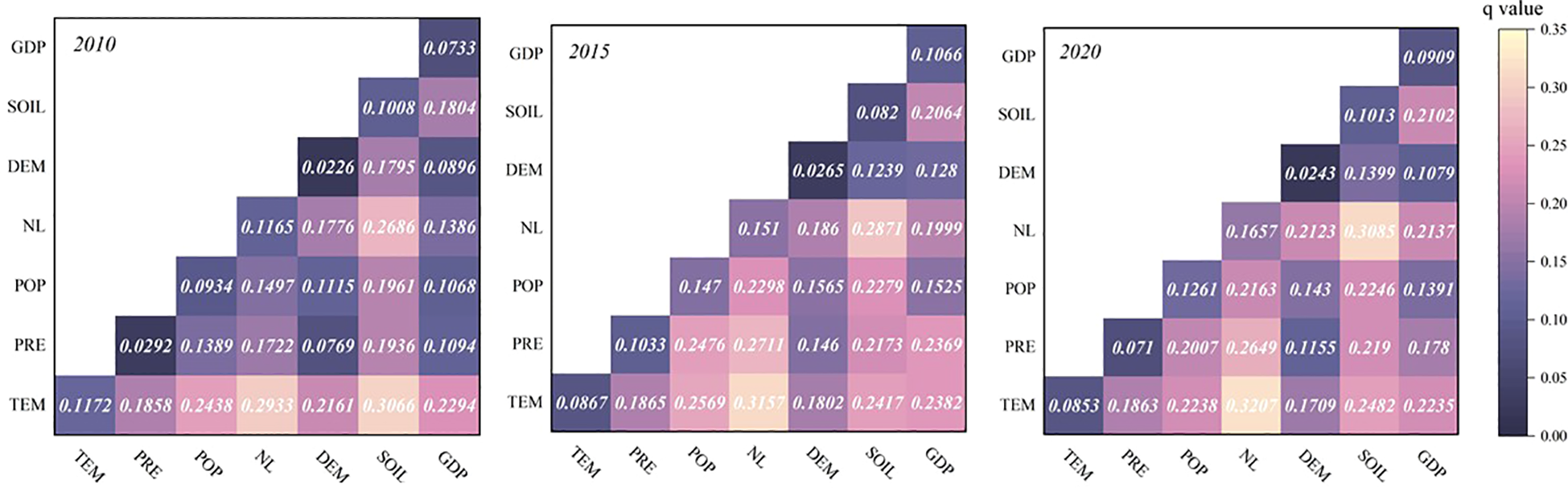
Interaction detection results of terrestrial habitat quality influencing factors.
3.2.2 Driving mechanisms of spatiotemporal changes in marine habitat quality
The factor detection results for the marine area indicated that, in 2010, DEM (q = 0.25) and marine development activities (q = 0.22) were the primary factors influencing marine habitat quality. In 2015, the eutrophication index (q = 0.25) emerged as the dominant influencing factor. By 2020, DEM (q = 0.22) once again became the leading factor influencing marine habitat quality. Over the period from 2010 to 2020, the influence of natural factors on marine habitat quality in Jiangsu initially decreased and then increased. In contrast, the explanatory power of human activity factors showed an initial increase followed by a decline. Overall, in both 2010 and 2020, natural factors had a stronger explanatory power for marine habitat quality in the study area than human activity factors. However, in 2015, human activities exerted a greater influence on marine habitat quality than natural factors (Table 5).
Table 5
| Driving factors | Year | |||
|---|---|---|---|---|
| 2010 | 2015 | 2020 | ||
| Single Factor | V | 0.155 | 0.091 | 0.149 |
| DEM | 0.250 | 0.127 | 0.224 | |
| MSS | 0.048 | 0.172 | 0.123 | |
| SHIP | 0.019 | 0.101 | 0.086 | |
| FISH | 0.017 | 0.061 | 0.065 | |
| DI | 0.221 | 0.076 | 0.137 | |
| EI | 0.075 | 0.254 | 0.143 | |
| NF | 0.529 | 0.391 | 0.496 | |
| HA | 0.332 | 0.491 | 0.430 | |
Single-Factor detection results of marine habitat quality influencing factors.
V, flow velocity; DEM, digital elevation model; MSS, sediment type; SHIP, shipping; FISH, fishing; DI, marine development activities; EI, eutrophication index.
The interaction detection results revealed that from 2010 to 2020, almost all factor combinations exhibited a two-factor nonlinear enhancement effect, with no factor acting independently. Specifically, in 2010, the top three interactions were: shipping and DEM, fishing and DEM, and flow velocity and DEM. DEM not only had high explanatory power as an individual factor but also played a crucial supporting role in the interactions. In 2015, the top three interactions were: the eutrophication index and flow velocity, the eutrophication index and DEM, and the eutrophication index and sediment type. During this period, the eutrophication index showed the strongest explanatory power as a single factor, and its explanatory power significantly increased after interacting with natural factors such as flow velocity and DEM. In 2020, the top three interactions were: flow velocity and DEM, flow velocity and sediment type, and flow velocity and the eutrophication index. Although flow velocity ranked second in terms of individual explanatory power, it became a key supporting factor in the interactions (Figure 5).
Figure 5
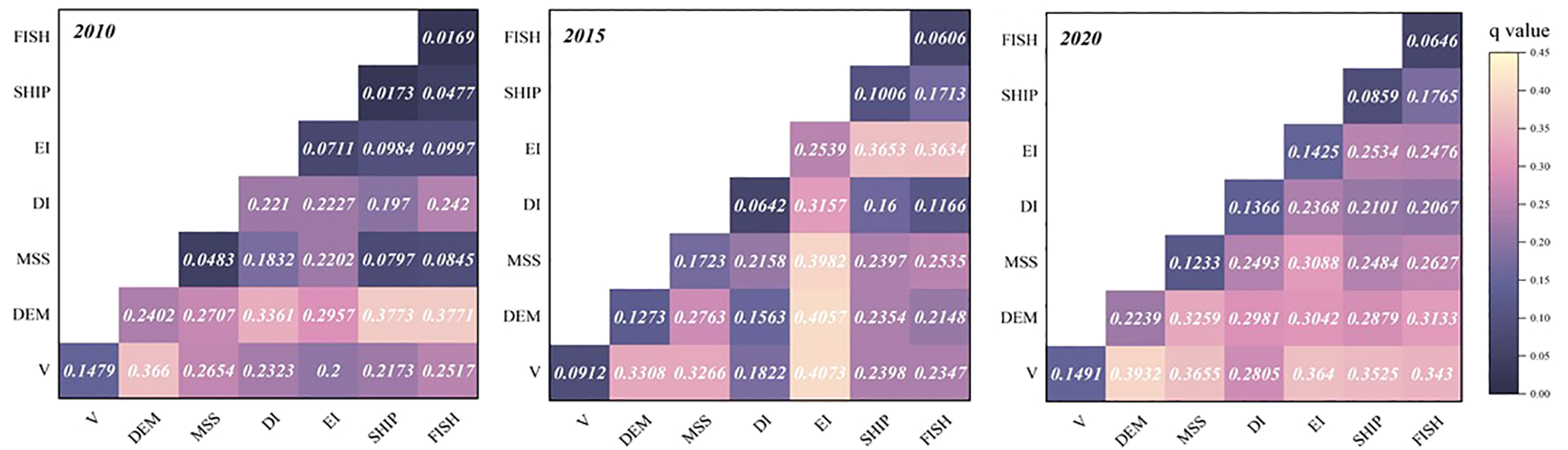
Interaction detection results of marine habitat quality influencing factors.
4 Discussion
4.1 Spatial pattern and temporal changes of habitat quality in the coastal zone
The results of this study revealed that between 2010 and 2020, habitat quality in the Jiangsu coastal zone showed a clear degradation trend, characterized by distinct land-sea differences in the degradation process. On land, the expansion of low-quality habitats led to the encroachment of natural habitats, while in the marine environment, high-quality habitat areas transitioned toward regions with lower habitat quality.
The expansion of artificial habitats on land, which encroached upon natural areas, was a key indicator of habitat quality degradation in the coastal zone. Urbanization and the resulting encroachment on natural habitats are the primary drivers of this degradation (Wu et al., 2021a). Urban expansion can directly or indirectly lead to the loss of natural habitats (van Vliet, 2019). In the study area, urban expansion primarily contributed to habitat loss indirectly. The terrestrial habitat quality degradation zones in the Jiangsu coastal zone are mainly located in the agricultural areas surrounding urban development zones, although their spatial extent is relatively small. The coastal areas of Jiangsu have a high level of urbanization, and the demand for the expansion of built-up land has decreased. Additionally, the optimization and upgrading of the industrial structure have played a positive role in this process. As traditional manufacturing industries gradually transition to high-tech sectors, the demand for land-intensive industrial expansion has significantly decreased. Moreover, the development of the tertiary sector increasingly relies on existing urban infrastructure rather than large-scale new land development. Research has shown that urbanization in the coastal areas of Jiangsu is highly coordinated with habitat quality (Li et al., 2024). Furthermore, the rate of terrestrial habitat quality degradation in the Jiangsu coastal zone has slowed since 2015. Since 2014, China’s land-use model has gradually shifted from extensive to more intensive and efficient patterns (Liu et al., 2018). This transition has, to some extent, curbed the rapid expansion of built-up land, slowing habitat quality degradation and promoting the efficient use of land resources.
The kernel density map of habitat quality in the study area’s marine environment revealed a distinct unimodal pattern in 2010, which gradually transformed into a bimodal distribution by 2015 and 2020, with a new peak emerging at 0.6. The height of this new peak continuously increased, while the height of the original peak at 0.8 progressively decreased. This shift suggested that the transition of high-quality marine habitat areas toward relatively higher-quality zones represented another manifestation of habitat quality degradation in the coastal zone. The spatial distribution map of habitat quality degradation indicated a strong correlation between marine habitat degradation zones and areas of declining benthic biodiversity, while there was little relationship with regions experiencing significant changes in development activity intensity. Furthermore, the spatial distribution of these degradation zones exhibited considerable irregularity, reflecting the indirect impact mechanism of marine development activities on habitat quality degradation. Benthic organisms, as sensitive ecological indicators, were capable of directly reflecting changes in water quality, sediment characteristics, and overall ecosystem stability (Jayachandran et al., 2020). Although development activities such as aquaculture and offshore wind farms had limited direct disturbance to localized areas, they could have profound effects on marine habitat quality by altering the overall marine environmental conditions, including water quality and sediment characteristics (Farr et al., 2021; Hao et al., 2024). The three-dimensional dynamics of marine space further exacerbated the irregular spatial distribution of these degradation zones.
Overall, the expansion of low-quality habitat areas on land, which encroach upon natural habitats, and the transition of high-quality marine habitat areas toward relatively lower-quality zones, both contributed to habitat quality degradation in the coastal zone.
4.2 Land-sea differences in the driving mechanisms of spatiotemporal changes in habitat quality
Climate change and human activities are two primary threats driving global biodiversity loss, with habitat quality responding differently to human activities and natural environmental changes across regions (Calderon-Aguilera et al., 2012; Phillips et al., 2017). The results of this study indicate that habitat quality in the coastal zone exhibits land-sea differences in its response to human activities and natural environmental changes: terrestrial habitats are primarily driven by human activities, whereas marine habitats are mainly governed by natural factors, and exhibit nonlinear responses under the influence of human activities.
From 2010 to 2020, terrestrial habitat quality exhibited a compound driving pattern characterized by human dominance with natural factors playing a supporting role. Results from the optimal-parameter Geodetector analysis indicated that nighttime light intensity, a typical proxy for human activity, was the primary driving factor across all three periods, with its explanatory power showing an ‘increasing–high-level stabilization’ trend. Specifically, in 2010, both temperature and nighttime light had relatively high explanatory power, followed by soil type, indicating a notable contribution of natural factors. By 2015, nighttime light and population density became the dominant factors, while the explanatory power of natural factors declined, reflecting a rapid intensification of human disturbances. In 2020, the explanatory power of nighttime light further increased, with GDP and population density following, establishing a stable, human-dominated driving pattern. Studies have shown that human activities are the primary driver of land habitat quality changes (Luo et al., 2024; Lin et al., 2024; Shi et al., 2024), primarily due to their long-term, widespread, and profound interventions in terrestrial ecosystems (Knapp et al., 2017). Regarding interaction mechanisms, human activities and natural factors exhibited a pronounced nonlinear enhancement effect. Although natural variables showed relatively low explanatory power in the single-factor analysis, they still played an important supporting role when interacting with indicators of human disturbance such as nighttime light intensity and population density. Due to inherent environmental conditions and long-standing agricultural practices, cropland has remained the dominant land type in the terrestrial area of the study region. While the intensification of economic development and construction activities continues to exert direct pressure on habitat quality, the strong sensitivity of agricultural land to natural factors—such as temperature, precipitation, and soil salinity—ensures that climatic factors still exert a critical influence on terrestrial habitat dynamics (Corwin, 2021). Although natural factors had weaker explanatory power than human activities in the single-factor analysis, they demonstrated a markedly enhanced effect in interactive combinations.
The driving mechanisms of marine habitat quality exhibit a phased pattern characterized as ‘natural-factor dominance → intensified human disturbance → return to natural-factor dominance.’ Single-factor analyses show that in 2010, marine habitat quality was primarily driven by DEM and marine development activities, indicating strong constraints from geomorphological settings alongside localized anthropogenic disturbances. In 2015, seawater eutrophication emerged as the dominant factor, highlighting the high sensitivity of marine ecosystems to water-quality degradation. By 2020, DEM once again became the leading driver. On one hand, topography determines the spatial distribution of marine development activities, with nearshore areas experiencing denser development and stronger human disturbance, while offshore areas witness a gradual decrease in development activities, resulting in weaker disturbances. On the other hand, topography influences benthic biodiversity and ecosystem stability by modulating processes such as flow velocity and sediment transport (Jones and Frid, 2009). From 2010 to 2015, the seawater eutrophication index became a major driver of marine habitat quality. Between 2010 and 2015, increasing coastal development activities in Jiangsu were accompanied by insufficient awareness and management measures, leading to the accumulation of nutrients, which significantly impacted the marine habitat quality in the study area. Although short-term eutrophication can increase marine primary productivity, the decomposition of algae leads to a decline in dissolved oxygen levels, eventually forming hypoxic zones that cause fish and other organisms to die, disrupting the balance of the habitat (Diaz and Rosenberg, 2008). This result highlights the non-linear response of marine habitat quality to human activities (Hunsicker et al., 2016). While marine habitat quality is predominantly governed by natural factors, when the intensity of human activities exceeds a certain threshold, the impact of human activities may surpass that of natural factors, becoming the primary driver of changes in marine habitat quality. In terms of interactive effects, current velocity consistently played a critical regulatory role. Flow velocity not only directly impacts sediment transport and benthic habitats but also significantly regulates habitat quality through complex interactions with other factors, such as sediment type and eutrophication indices (Luo et al., 2022). Marine habitat quality is primarily driven by natural factors, which can be attributed to the three-dimensional dynamics of marine ecosystems and the relatively low intensity of human activity interference. Compared to terrestrial ecosystems, marine ecosystems exhibit greater openness, allowing marine organisms to demonstrate strong resilience to localized disturbances (Carr et al., 2003). Additionally, human activities have a relatively short history in marine development, and the pressure exerted by human activities on marine ecosystems is inherently fragmented (Halpern et al., 2008). However, once human activities exceed a certain threshold, their impacts can surpass natural factors and become the dominant driver of marine habitat degradation.
Overall, the response of coastal habitat quality to changes in the natural environment and human activities exhibits land-sea differences. These differences are primarily attributed to variations in the intensity of human activities between land and sea, as well as differences in habitat sensitivity to external disturbances. The land-sea divergence in the mechanisms influencing coastal habitat quality provides a scientific basis for formulating targeted coastal ecological protection and restoration policies. For terrestrial habitats, more stringent environmental protection measures can be implemented in areas with high population density and rapid economic development, such as restricting the expansion of construction and agricultural land, promoting urban greening, and enhancing pollution control. In contrast, for marine habitats, greater attention should be paid to the impact of changes in natural factors, such as topography and hydrodynamic conditions, on habitat quality. Additionally, the non-linear response of marine habitat quality to human activities should also be considered.
4.3 Potential impacts of land-sea interactions and human-ecosystem interactions on coastal habitat quality
Current research has certain limitations. Firstly, while this study has explored the land-sea differences in the characteristics, spatiotemporal changes, and driving mechanisms of coastal habitat quality, the interactions between land and sea were not investigated in depth. Land-sea interactions play a significant role in coastal ecosystems, with impacts extending beyond changes in habitat quality to include material cycling, energy flow, and linked ecological processes. Future research should place greater emphasis on the dynamic processes of land-sea interactions and their combined effects on coastal habitat quality.
Secondly, in terms of driving mechanisms, although this study has quantitatively analyzed the influence of various driving factors, the nonlinear interactions between these factors still require further exploration. Particularly under the joint influence of human activities and natural processes, there may be synergistic or antagonistic relationships between different factors. These complex interactions were not fully reflected in this study, and future research could employ advanced techniques such as deep learning to conduct a more detailed analysis.
In conclusion, future studies need to more comprehensively integrate the land-sea interaction processes and multidimensional driving mechanisms to enhance the understanding of the evolutionary patterns of coastal habitat quality. Additionally, research should consider longer time scales and finer spatial resolutions to better reveal the dynamic characteristics of coastal ecosystems, thereby providing more robust support for scientific management and sustainable development.
5 Conclusion
This study, based on an integrated evaluation of habitat quality in the Jiangsu coastal zone from 2010 to 2020, combined kernel density curves and optimal parameter geographic detectors to systematically explore the composition, spatiotemporal variation, and driving mechanisms of habitat quality from both land and sea dimensions. In terms of composition, areas with low habitat quality in the coastal zone were primarily distributed on land, while regions with medium to high habitat quality were concentrated in the marine environment. Regarding spatiotemporal changes, habitat quality in the Jiangsu coastal zone showed an overall degradation trend between 2010 and 2020. On land, this was manifested as an expansion of low-quality habitat areas, while in the marine environment, high-quality habitats transitioned to moderately good-quality habitats.
In terms of driving mechanisms, the changes in terrestrial habitat quality were primarily driven by human activities, with natural factors playing a supplementary role. In contrast, marine habitat quality was predominantly influenced by the persistent dominance of topographic features, with significant indirect disturbances from human activities observed in 2015.
This study revealed structural differences in habitat quality composition, changes, and influencing factors between the land and marine areas of the coastal zone, providing scientific support for coastal ecological protection and sustainable development. Future research should further deepen the analysis of land-sea interaction processes and multidimensional driving mechanisms to provide more comprehensive support for the scientific management and sustainable development of the coastal zone.
Statements
Data availability statement
The original contributions presented in the study are included in the article/supplementary material. Further inquiries can be directed to the corresponding author/s.
Author contributions
HoZ: Data curation, Writing – review & editing, Conceptualization, Funding acquisition, Formal analysis, Writing – original draft. ZC: Writing – review & editing, Validation, Software, Data curation. YG: Validation, Writing – review & editing, Investigation. HaZ: Methodology, Conceptualization, Supervision, Writing – review & editing. MX: Funding acquisition, Project administration, Conceptualization, Writing – review & editing.
Funding
The author(s) declared that financial support was received for this work and/or its publication. This work was supported by Marine Science and Technology Innovation Research of Jiangsu Province (Grant No. JSZRHYKJ202103); and Postgraduate Research & Practice Innovation Program of Jiangsu Province (Grant No. KYCX24_1839).
Acknowledgments
We thank the reviewers for their constructive comments.
Conflict of interest
The author(s) declared that this work was conducted in the absence of any commercial or financial relationships that could be construed as a potential conflict of interest.
Generative AI statement
The author(s) declare that no Generative AI was used in the creation of this manuscript.
Any alternative text (alt text) provided alongside figures in this article has been generated by Frontiers with the support of artificial intelligence and reasonable efforts have been made to ensure accuracy, including review by the authors wherever possible. If you identify any issues, please contact us.
Publisher’s note
All claims expressed in this article are solely those of the authors and do not necessarily represent those of their affiliated organizations, or those of the publisher, the editors and the reviewers. Any product that may be evaluated in this article, or claim that may be made by its manufacturer, is not guaranteed or endorsed by the publisher.
References
1
Adelekan I. Fregene T. (2015). Vulnerability of artisanal fishing communities to flood risks in coastal southwest Nigeria. Climate Dev.7, 322–338. doi: 10.1080/17565529.2014.951011
2
Ahmadi Mirghaed F. Souri B. (2022). Effect of landscape fragmentation on soil quality and ecosystem services in land use and landform types. Environ. Earth Sci.81, 330. doi: 10.1007/s12665-022-10454-1
3
Arenas-Castro S. Sillero N. (2021). Cross-scale monitoring of habitat suitability changes using satellite time series and ecological niche models. Sci. Total Environ.784, 147172. doi: 10.1016/j.scitotenv.2021.147172
4
Beaumont N. J. Jones L. Garbutt A. Hansom J. D. Toberman M. (2013). The value of carbon sequestration and storage in coastal habitats. Estuarine Coast. Shelf Sci.137, 32–40. doi: 10.1016/j.ecss.2013.11.022
5
Brauko K. M. Cabral A. Costa N. V. Hayden J. Dias C. E. P. Leite E. S. et al . (2020). Marine heatwaves, sewage and eutrophication combine to trigger deoxygenation and biodiversity loss: A SW atlantic case study. Front. Mar. Sci.7. doi: 10.3389/fmars.2020.590258
6
Calderon-Aguilera L. E. Rivera-Monroy V. H. Porter-Bolland L. Martínez-Yrízar A. Ladah L. B. Martínez-Ramos M. et al . (2012). An assessment of natural and human disturbance effects on Mexican ecosystems: current trends and research gaps. Biodiversity Conserv.21, 589–617. doi: 10.1007/s10531-011-0218-6
7
Carr M. H. Neigel J. E. Estes J. A. Andelman S. Warner R. R. Largier J. L. (2003). Comparing marine and terrestrial ecosystems: implications for the design of coastal marine reserves. Ecol. Appl.13, S90–S107. doi: 10.1890/1051-0761(2003)013[0090:CMATEI]2.0.CO;2
8
Chen S. Liu X. (2024a). Spatio-temporal variations of habitat quality and its driving factors in the Yangtze River Delta region of China. Global Ecol. Conserv.52, e2978. doi: 10.1016/j.gecco.2024.e02978
9
Corwin D. L. (2021). Climate change impacts on soil salinity in agricultural areas. Eur. J. Soil Sci.72, 842–862. doi: 10.1111/ejss.13010
10
Costanza R. D’Arge R. de Groot R. Farber S. Grasso M. Hannon B. et al . (1997). The value of the world’s ecosystem services and natural capital. Nature387, 253–260. doi: 10.1038/387253a0
11
Cunha J. Cardona F. S. Bio A. Ramos S. (2021). Importance of protection service against erosion and storm events provided by coastal ecosystems under climate change scenarios. Front. Mar. Sci.8. doi: 10.3389/fmars.2021.726145
12
de Andrés M. Barragán Muñoz J. M. García Onetti J. Chavarria Zuniga L. D. (2023). Mapping services for an ecosystem based management along the Andalusian coastal zone (Spain). Ocean Coast. Manage.231, 106402. doi: 10.1016/j.ocecoaman.2022.106402
13
Diaz R. J. Rosenberg R. (2008). Spreading dead zones and consequences for marine ecosystems. Science321, 926–929. doi: 10.1126/science.1156401
14
Dong J. Sun X. Zhang Y. Zhan Q. Zhang X. (2021). Assessing benthic habitat ecological quality using four benthic indices in the coastal waters of Sanshandao, Laizhou Bay, China. Ecol. Indic.129, 107980. doi: 10.1016/j.ecolind.2021.107980
15
Farr H. Ruttenberg B. Walter R. K. Wang Y. White C. (2021). Potential environmental effects of deepwater floating offshore wind energy facilities. Ocean Coast. Manage.207, 105611. doi: 10.1016/j.ocecoaman.2021.105611
16
Gao F. Li S. Tan Z. Wu Z. Zhang X. Huang G. et al . (2021). Understanding the modifiable areal unit problem in dockless bike sharing usage and exploring the interactive effects of built environment factors. Int. J. Geographical Inf. Sci.35, 1905–1925. doi: 10.1080/13658816.2020.1863410
17
Getis A. Ord J. K. (1992). The analysis of spatial association by use of distance statistics. Geographical Anal.24, 189–206. doi: 10.1111/j.1538-4632.1992.tb00261.x
18
Halpern B. S. Walbridge S. Selkoe K. A. Kappel C. V. Micheli F. D’Agrosa C. et al . (2008). A global map of human impact on marine ecosystems. Science319, 948–952. doi: 10.1126/science.114934
19
Hao Z. Qian J. Zheng F. Lin B. Xu M. Feng W. et al . (2024). Human-influenced changes in pollution status and potential risk of sediment heavy metals in Xincun Bay, a typical lagoon of Hainan, China. Mar. pollut. Bull.199, 115949. doi: 10.1016/j.marpolbul.2023.115949
20
Hillard E. M. Nielsen C. K. Groninger J. W. (2017). Swamp rabbits as indicators of wildlife habitat quality in bottomland hardwood forest ecosystems. Ecol. Indic.79, 47–53. doi: 10.1016/j.ecolind.2017.03.024
21
Huang S. Wang X. Wu H. Peng C. Jefferson T. A. (2021). Habitat protection planning for Indo-Pacific humpback dolphins (Sousa chinensis) in deteriorating environments: Knowledge gaps and recommendations for action. Aquat. Conservation: Mar. Freshw. Ecosyst.32, 171–185. doi: 10.1002/aqc.3740
22
Hunsicker M. E. Kappel C. V. Selkoe K. A. Halpern B. S. Scarborough C. Mease L. et al . (2016). Characterizing driver-response relationships in marine pelagic ecosystems for improved ocean management. Ecol. Appl.26, 651–663. doi: 10.1890/14-2200
23
Jayachandran P. R. Jima M. Philomina J. Bijoy Nandan S. (2020). Assessment of benthic macroinvertebrate response to anthropogenic and natural disturbances in the Kodungallur-Azhikode estuary, southwest coast of India. Environ. Monit. Assess.192, 626. doi: 10.1007/s10661-020-08582-x
24
Jones D. Frid C. L. J. (2009). Altering intertidal sediment topography: effects on biodiversity and ecosystem functioning. Mar. Ecol. (Berlin West)30, 83–96. doi: 10.1111/j.1439-0485.2009.00306.x
25
Knapp S. Schweiger O. Kraberg A. Asmus H. Asmus R. Brey T. et al . (2017). Do drivers of biodiversity change differ in importance across marine and terrestrial systems - Or is it just different research communities’ perspectives? Sci. Total Environ.574, 191–203. doi: 10.1016/j.scitotenv.2016.09.002
26
LaFrance M. King J. W. Oakley B. A. Pratt S. (2014). A comparison of top-down and bottom-up approaches to benthic habitat mapping to inform offshore wind energy development. Continental Shelf Res.83, 24–44. doi: 10.1016/j.csr.2014.04.007
27
Lecours V. Devillers R. Edinger E. N. Brown C. J. Lucieer V. L. Rocchini D. et al . (2017). Influence of artefacts in marine digital terrain models on habitat maps and species distribution models: a multiscale assessment. Remote Sens. Ecol. Conserv.3, 232–246. doi: 10.1002/rse2.49
28
Li X. Hou X. Song Y. Shan K. Zhu S. Yu X. et al . (2019). Assessing changes of habitat quality for shorebirds in stopover sites: a case study in yellow river delta, China. Wetlands (Wilmington N.C.)39, 67–77. doi: 10.1007/s13157-018-1075-9
29
Li W. Wu J. Yuan Y. Duan B. Pan S. Chen W. et al . (2024). Global urbanization and habitat quality: interactive coercive relationships. Land13, 1943. doi: 10.3390/land13111943
30
Liao J. Zhang D. Su S. Liang S. Du J. Yu W. et al . (2023). Coastal habitat quality assessment and mapping in the terrestrial-marine continuum: Simulating effects of coastal management decisions. Ecol. Indic.156, 111158. doi: 10.1016/j.ecolind.2023.111158
31
Lin Y. Zhang X. Zhu H. Li R. (2024). Spatiotemporal evolution and mechanisms of habitat quality in nature reserve land: A case study of 18 nature reserves in hubei province. Land13, 363. doi: 10.3390/land13030363
32
Liu J. Jin X. Lin J. Liang X. Zhang X. Zhou Y. (2024). Identification and characteristic analysis of semi-natural habitats in China’s economically developed areas: New insights to inform cultivated land system ecological conservation. J. Environ. Manage.351, 119804. doi: 10.1016/j.jenvman.2023.119804
33
Liu Y. Li J. Yang Y. (2018). Strategic adjustment of land use policy under the economic transformation. Land Use Policy74, 5–14. doi: 10.1016/j.landusepol.2017.07.005
34
Lopes N. Li T. Zhang P. Matomela N. Ikhumhen H. O. Sa R. M. (2023). Predicting future coastal land use/cover change and associated sea-level impact on habitat quality in the Northwestern Coastline of Guinea-Bissau. J. Environ. Manage.327, 116804. doi: 10.1016/j.jenvman.2022.116804
35
Luo F. Chen Z. Wu H. Zhu F. Zeng J. Quan W. (2022). Hydrodynamic and sediment dynamic impact of human engineering activity on Liyashan oyster reefs, China. Front. Mar. Sci.9. doi: 10.3389/fmars.2022.1051868
36
Luo Y. Fang S. Wu H. Zhou X. He Z. Gao L. (2024). Spatial and temporal evolution of habitat quality and its shrinkage effect in shrinking cities: Evidence from Northeast China. Ecol. Indic.161, 111919. doi: 10.1016/j.ecolind.2024.111919
37
Mei X. Li X. Mi B. Zhao L. Wang Z. Zhong H. et al . (2020). Distribution regularity and sedimentary differentiation patterns of China seas surface sediments. Geology In China47, 1447–1462. doi: 10.12029/gc20200511
38
Moreira M. Fonseca C. Vergílio M. Calado H. Gil A. (2018). Spatial assessment of habitat conservation status in a Macaronesian island based on the InVEST model: a case study of Pico Island (Azores, Portugal). Land Use Policy78, 637–649. doi: 10.1016/j.landusepol.2018.07.015
39
Natural Capital Project . (2025). InVEST 3.17.2 User’s Guide. Stanford University, University of Minnesota, Chinese Academy of Sciences, The Nature Conservancy, World Wildlife Fund, Stockholm Resilience Centre and the Royal Swedish Academy of Sciences. doi: 10.60793/natcap-invest-3.17.2 (Accessed December 27, 2025).
40
Newbold T. Adams G. L. Albaladejo R. G. Boakes E. H. Braga F. G. Chapman A. et al . (2019). Climate and land-use change homogenise terrestrial biodiversity, with consequences for ecosystem functioning and human well-being. Emerging Topics Life Sci.3, 207–219. doi: 10.1042/ETLS20180135
41
Nicholls R. J. Wong P. P. Burkett V. Woodroffe C. D. Hay J. (2008). Climate change and coastal vulnerability assessment: scenarios for integrated assessment. Sustainability Sci.3, 89–102. doi: 10.1007/s11625-008-0050-4
42
Parzen E. (1962). On estimation of a probability density function and mode. Ann. Math. Stat33, 1065–1076. doi: 10.1214/aoms/1177704472
43
Phillips H. Newbold T. Purvis A. (2017). Land-use effects on local biodiversity in tropical forests vary between continents. Biodiversity Conserv.26, 2251–2270. doi: 10.1007/s10531-017-1356-2
44
Rius M. Clusella-Trullas S. McQuaid C. D. Navarro R. A. Griffiths C. L. Matthee C. A. et al . (2014). Range expansions across ecoregions: interactions of climate change, physiology and genetic diversity. Global Ecol. Biogeography23, 76–88. doi: 10.1111/geb.12105
45
Röthig T. Trevathan Tackett S. M. Voolstra C. R. Ross C. Chaffron S. Durack P. J. et al . (2023). Human-induced salinity changes impact marine organisms and ecosystems. Global Change Biol.29, 4731–4749. doi: 10.1111/gcb.16859
46
Roy P. Pal S. C. Chakrabortty R. Chowdhuri I. Saha A. Shit M. (2023). Effects of climate change and sea-level rise on coastal habitat: Vulnerability assessment, adaptation strategies and policy recommendations. J. Environ. Manage.330, 117187. doi: 10.1016/j.jenvman.2022.117187
47
Sarkar B. Islam A. Chandra Das B. (2021). Role of declining discharge and water pollution on habitat suitability of fish community in the Mathabhanga-Churni River, India. J. Cleaner Production326, 129426. doi: 10.1016/j.jclepro.2021.129426
48
Schill S. R. McNulty V. P. Pollock F. J. Lüthje F. Li J. Knapp D. E. et al . (2021). Regional high-resolution benthic habitat data from planet dove imagery for conservation decision-making and marine planning. Remote Sens. (Basel Switzerland)13, 4215. doi: 10.3390/rs13214215
49
Shi G. Chen C. Cao Q. Zhang J. Xu J. Chen Y. et al . (2024). Spatiotemporal dynamics and prediction of habitat quality based on land use and cover change in Jiangsu, China. Remote Sens. (Basel Switzerland)16, 4158. doi: 10.3390/rs16224158
50
Song Y. Wang J. Ge Y. Xu C. (2020). An optimal parameters-based geographical detector model enhances geographic characteristics of explanatory variables for spatial heterogeneity analysis: cases with different types of spatial data. GIScience Remote Sens.57, 593–610. doi: 10.1080/15481603.2020.1760434
51
Tallis H. Ferdana Z. Gray E. (2008). Linking terrestrial and marine conservation planning and threats analysis. Conserv. Biol.22, 120–130. doi: 10.1111/j.1523-1739.2007.00861.x
52
van Vliet J. (2019). Direct and indirect loss of natural area from urban expansion. Nat. Sustainability2, 755–763. doi: 10.1038/s41893-019-0340-0
53
Wang J. Li X. Christakos G. Liao Y. Zhang T. Gu X. et al . (2010). Geographical detectors-based health risk assessment and its application in the neural tube defects study of the Heshun Region, China. Int. J. Geographical Inf. Sci.24, 107–127. doi: 10.1080/13658810802443457
54
Worm B. Barbier E. B. Beaumont N. Duffy J. E. Folke C. Halpern B. S. et al . (2006). Impacts of biodiversity loss on ocean ecosystem services. Science314, 787–790. doi: 10.1126/science.1132294
55
Wu J. Li X. Luo Y. Zhang D. (2021a). Spatiotemporal effects of urban sprawl on habitat quality in the Pearl River Delta from 1990 to 2018 [Journal Article; Research Support, Non-U.S. Gov’t. Sci. Rep.11, 13981. doi: 10.1038/s41598-021-92916-3
56
Wu Y. Shi K. Chen Z. Liu S. Chang Z. (2022). Developing improved time-series DMSP-OLS-like data, (1992-2019) in China by integrating DMSP-OLS and SNPP-VIIRS. IEEE Trans. On Geosci. Remote Sens.60, 1–14. doi: 10.1109/TGRS.2021.3135333
57
Wu L. Sun C. Fan F. (2021b). Estimating the characteristic spatiotemporal variation in habitat quality using the invest model—A case study from Guangdong–Hong Kong–Macao Greater Bay Area. Remote Sens.13, 1008. doi: 10.3390/rs13051008
58
Zhang H. Li S. Liu Y. Xu M. (2022). Assessment of the habitat quality of offshore area in tongzhou bay, China: using benthic habitat suitability and the inVEST model. Water14, 1574. doi: 10.3390/w14101574
59
Zhang X. Song W. Lang Y. Feng X. Yuan Q. Wang J. (2020). Land use changes in the coastal zone of China’s Hebei Province and the corresponding impacts on habitat quality. Land Use Policy99, 104957. doi: 10.1016/j.landusepol.2020.104957
60
Zhao Y. Qu Z. Zhang Y. Ao Y. Han L. Kang S. et al . (2022). Effects of human activity intensity on habitat quality based on nighttime light remote sensing: A case study of Northern Shaanxi, China. Sci. Total Environ.851, 158037. doi: 10.1016/j.scitotenv.2022.158037
61
Zhou B. Chen G. Yu H. Zhao J. Yin Y. (2024). Revealing the nonlinear impact of human activities and climate change on ecosystem services in the karst region of southeastern yunnan using the XGBoost–SHAP model. Forests15, 1420. doi: 10.3390/f15081420
Summary
Keywords
habitat quality, driving mechanisms, land-sea interaction, spatial and temporal patterns, Jiangsu coastal zone
Citation
Zhang H, Chen Z, Ge Y, Zhang H and Xu M (2026) Spatiotemporal evolution characteristics and driving mechanisms of habitat quality in the Jiangsu coastal zone. Front. Mar. Sci. 12:1730861. doi: 10.3389/fmars.2025.1730861
Received
23 October 2025
Revised
10 December 2025
Accepted
15 December 2025
Published
09 January 2026
Volume
12 - 2025
Edited by
Rochelle Diane Seitz, College of William & Mary, United States
Reviewed by
Quanhong Liu, National University of Defense Technology, China
Fengshuo Yang, Shandong Jianzhu University, China
Updates
Copyright
© 2026 Zhang, Chen, Ge, Zhang and Xu.
This is an open-access article distributed under the terms of the Creative Commons Attribution License (CC BY). The use, distribution or reproduction in other forums is permitted, provided the original author(s) and the copyright owner(s) are credited and that the original publication in this journal is cited, in accordance with accepted academic practice. No use, distribution or reproduction is permitted which does not comply with these terms.
*Correspondence: Min Xu, xumin0895@njnu.edu.cn
Disclaimer
All claims expressed in this article are solely those of the authors and do not necessarily represent those of their affiliated organizations, or those of the publisher, the editors and the reviewers. Any product that may be evaluated in this article or claim that may be made by its manufacturer is not guaranteed or endorsed by the publisher.