Abstract
Due to the complexity of sedimentary evolution since the Last Glacial Maximum (LGM) in the Yangtze River Estuary (YRE), sedimentary responses across different regions have varied significantly, but the sedimentary record on the northern flank of the estuary remains incomplete. Here we integrate analyses of sedimentology, chemical weathering indices (CIA and K/Al), total organic carbon (TOC), and organic carbon isotopes (δ13Corg) from the QDQ2 core to reconstruct the regional environmental evolution from 36.1 to 8.4 cal kyr BP. Facies analysis demonstrates that QDQ2 succession documents environmental shift from terrestrial distributary channels to marine delta fronts. Sedimentary evidence of marine transgression during the Last Deglacial Period is identified, and facies shifts were driven by climate events and sea-level variations. Furthermore, the Gehu transgression did not influence the facies succession of study area. Instead, variations in CIA and K/Al ratios indicate modification in the hinterland chemical weathering intensity, likely driven by the warm climate characteristics of Marine Isotopic Stage 3a (MIS 3a).
1 Introduction
It is well established that estuaries are highly sensitive to sea-level fluctuations and extreme climatic events (Ye et al., 2024). The Yangtze River Estuary (YRE) provides an ideal region for reconstructing Late Quaternary environmental evolution, attributed to its tectonic stability and complete sedimentary sequences (Liu et al., 2020a; Ye et al., 2022; Gao et al., 2022). Regional sedimentation is profoundly influenced by the East Asian Monsoon, as evidenced by magnetic susceptibility variations that align with Milankovitch cycles (Li et al., 2011, 2024; Wan et al., 2025).
Previous work has established a framework of three alternating regressive-transgressive sequences since the Late Quaternary (Li et al., 2002; Lin et al., 2015). Key stratigraphic markers include the development of incised valleys since Marine Isotope Stage 4 (MIS 4) and the widespread “First Hard Clay Layer” (Li et al., 2002; Lin et al., 2015). Specifically, marine transgressions are well-documented during MIS 5e, MIS 3, and MIS 1 (Li et al., 2002; Liu et al., 2010a, b; Lin et al., 2015; Yu J et al., 2016; Zhao et al., 2017; Liao et al., 2018; Gao et al., 2020; Wang et al., 2021; Gao et al., 2022; Gao and Long, 2023; Chen et al., 2024). Despite the extensive investigation of Yangtze River Estuary (YRE), the intricate sedimentary evolution since the Last Glacial Maximum (LGM) has resulted in significant regional differences in sedimentary responses, leading to an incomplete sedimentary landscape on the northern flank of YRE (Ye et al., 2017; Zhao et al., 2017; Wang et al., 2020; Gao et al., 2022; Gao and Long, 2023). Accordingly, this contribution relies on a multi-proxy analysis (including sedimentology, geochronology, bulk geochemistry, TOC, and δ13Corg) to explore the sedimentary facies succession and controlling factors, in order to provide additional constraints on the sedimentary evolution history for the northern flank of YRE.
2 Geological settings
YRE is situated at the confluence of the Yangtze River and the East China Sea (Figure 1). Its sedimentary strata preserve records of basin-wide weathering, climate dynamics, sea-level changes, and sediment provenance (Yang et al., 2002; Li et al., 2011). YRE features gentle topography, with an average elevation of 3–5 m (Liu et al., 2023). YRE has experienced continuous subsidence since the Neogene, driven by the Himalayan Orogeny (Figure 1; Liu et al., 2023). This subsidence, coupled with a high sedimentation rate (1–3 mm/a), created ample accommodation space for thick, unconsolidated Quaternary deposits that thin westward (Liu et al., 2020b; Liu et al., 2023).
Figure 1
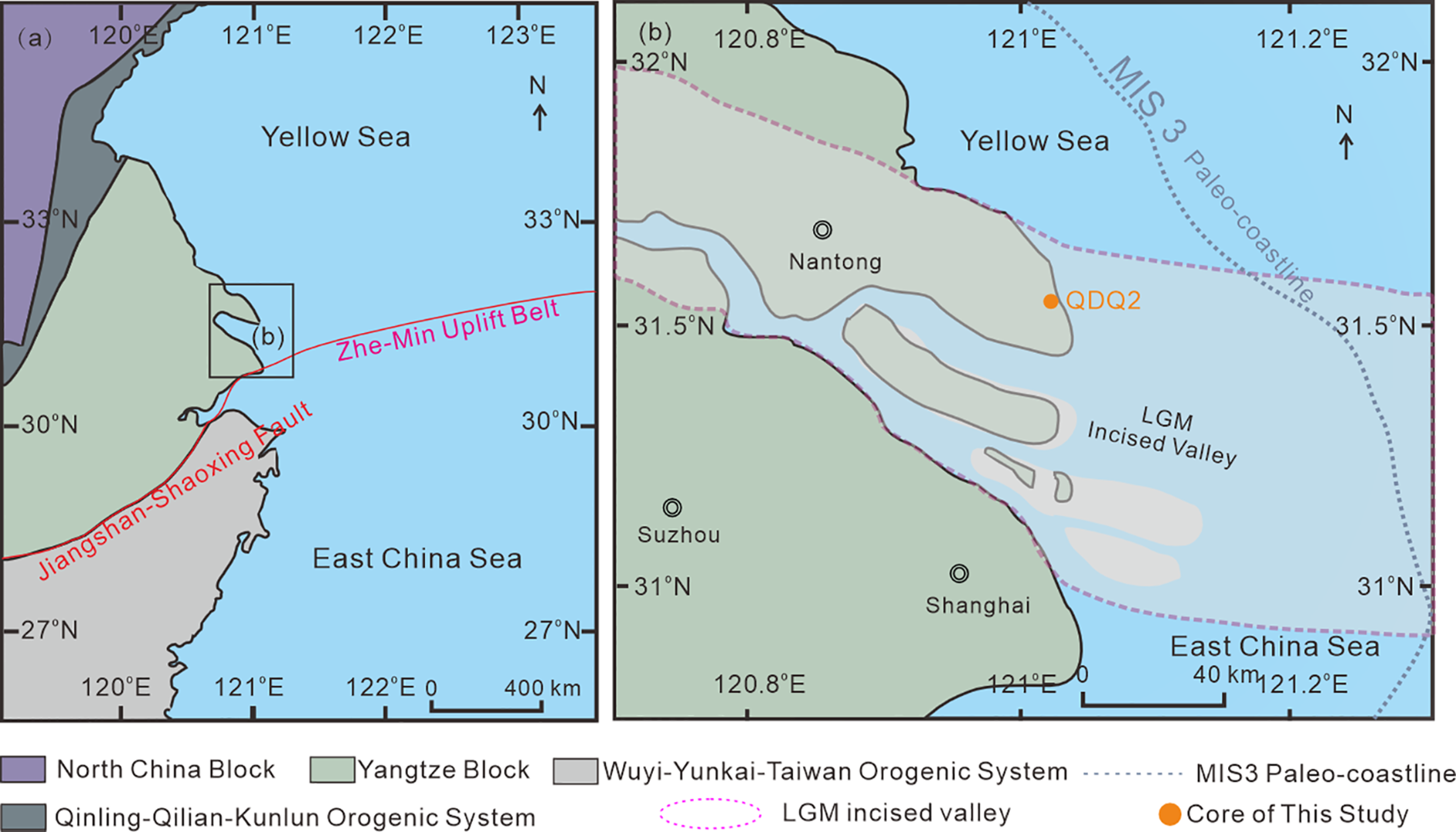
Map of tectonic units in eastern China and Yangtze River Estuary and borehole locations. (a) Geological map of eastern China; (b) Geological map of YRE region.
During the Late Quaternary, global glacial-interglacial cycles profoundly shaped the stratigraphic architecture (Li et al., 2011; Liu et al., 2023). Previous works have identified distinct marine transgressions in YRE, including the Taihu, Gehu (partial areas), and Zhenjiang transgressions (Li et al., 2011; Liu et al., 2023). During the Gehu transgression, the sea level stood ~20–40 m below the present (Zhao et al., 2017). While the southern flank was characterized by subtidal facies, the northern side was dominated by fluvial deposits (Sun et al., 2015; Zhao et al., 2017; Zhang et al., 2017). Subsequently, more than 120 m sea-level fall during the LGM initiated the deep incision of an incised valley system across the modern delta (Figures 1, 2; Lambeck et al., 2014). The last deglacial sea-level rise filled this incised valley, facilitating a progressive transition from fluvial to delta environments (Gao and Long, 2023). Following the onset of the Holocene, sea-level stabilization allowed YRE to prograde seaward, establishing its modern morphology (Li et al., 2002).
Figure 2
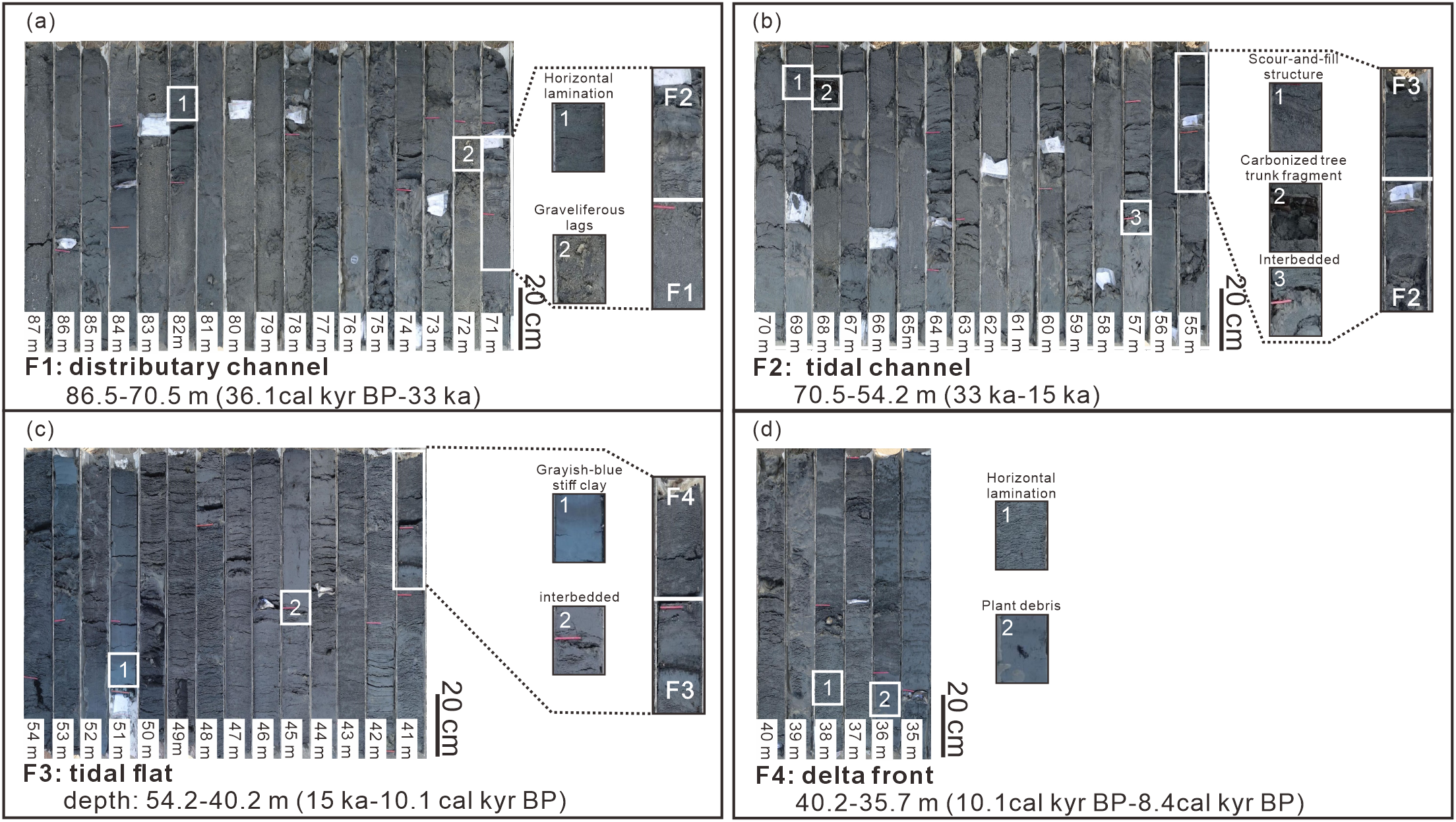
Lithofacies and sedimentary characteristics of QDQ2 core. (a) distributary channel; (b) tidal channel; (c) tidal flat; (d) delta front (age of 33 ka is referenced from Xu et al., 2016; age of 15 ka is referenced from Gao et al., 2022).
3 Methods and materials
3.1 Borehole description
In 2020, the Nanjing Center of the China Geological Survey recovered a 292 m continuous core (QDQ2) from Haijie Village, Jinhai Town, Nantong City, Jiangsu Province (121°50’23’’E, 31°50’23’’N; Figure 1). Core recovery rates were approximately 95% for muddy intervals and exceeded 85% for sandy sediments. To characterize sedimentary facies, detailed visual logging was implemented, focusing on key features such as grain size, color, and sedimentary structures.
3.2 Constraints on the chronological framework
To establish the chronological framework of the QDQ2 core, this study integrated three AMS14C dating results (Figure 2, Table 1). A dataset comprises one newly acquired sample (shell, ID: BF-33, depth: 37.2 m), and two samples previously reported by Chen et al. (2024) (ID: BF-36, depth: 40.2 m; ID: ZS-4, depths: 86–86.5 m). BF-33 was analyzed at Beta Analytic Inc. (USA) for AMS14C dating. To ensure temporal consistency across the dataset, all conventional radiocarbon ages were calibrated to calendar years using BetaCal 5.0 software and the Marine 20 calibration curve (Heaton et al., 2020).
Table 1
| Core | Lab code | Materials | Depth/m | Controversial age/yr BP | Calendar age/cal yr BP | Reference | |
|---|---|---|---|---|---|---|---|
| Median age | Corrected age | ||||||
| QDQ2 | Beta-705042 | Shell | 37.2 | 8900 ± 30 | 9,400 | 9,525–9,275 | This study |
| QDQ2 | Beta-705043 | Shell | 40.2 | 9460 ± 30 | 10,112 | 10,277–9,946 | Chen et al., 2024 |
| QDQ2 | Beta-705044 | Shell | 86.0–86.5 | 32490 ± 220 | 36,105 | 36630–35,580 | Chen et al., 2024 |
AMS14C dating results of the QDQ2 core.
3.3 Bulk rock elemental ratios
Chemical Index of Alteration (CIA) and K/Al ratios in sediments can serve as robust proxies for hinterland chemical weathering intensity (Zhang et al., 2008; Gao and Ding, 2008). A total of 28 samples were collected from the 35.7–86.5 m depth interval (Figure 3). Samples were fully digested using a mixed acid solution and analyzed for major elements via Inductively Coupled Plasma Optical Emission Spectroscopy (ICP-OES; Agilent 5800; Ministry of Environmental Protection of the People’s Republic of China, 2016). Analytical precision was monitored using standard reference materials (GSR-5). All geochemical analyses were performed by Nanjing Hanguang Testing Technology Co., Ltd. CIA proxy was, established by Nesbitt and Young (1982) to quantify the intensity of chemical weathering as archived in sediments and paleosols. This proxy reflects the cumulative weathering history of the source area, and it is based on the preferential leaching of mobile cations (e.g., Ca2+, Na+, and K+) during the transformation of feldspars to clay minerals (Nesbitt and Young, 1982). Meanwhile, immobile aluminum (Al) is residually enriched (Nesbitt and Young, 1982). Accordingly, CIA is calculated using molar proportions according to the following equation:
Figure 3
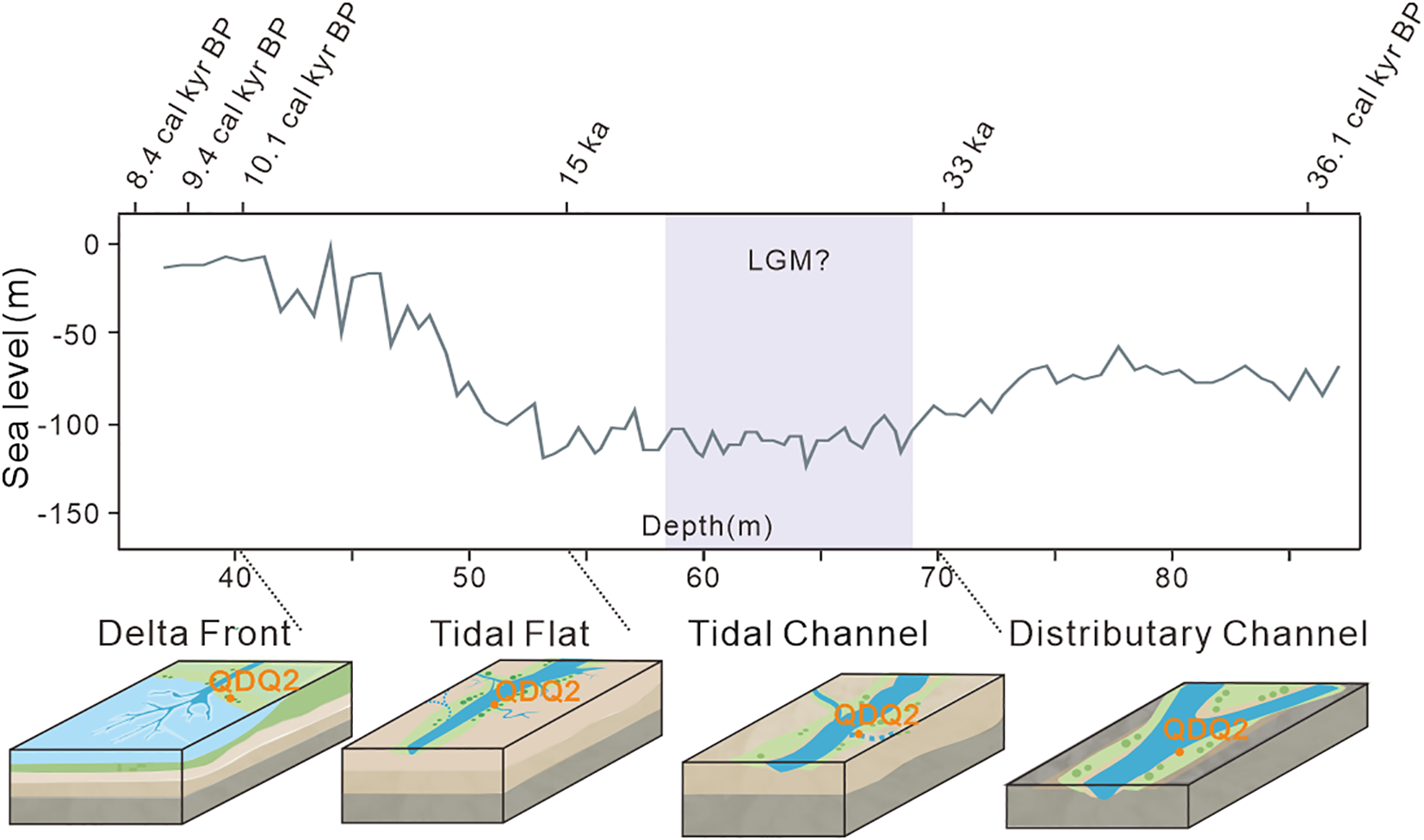
Facies succession of the QDQ2 core during ca. 36.1–8.4 cal kyr BP (the sea level change is referred from Miller et al., 2020; age of 33 ka is referenced from Xu et al., 2016; age of 15 ka is referenced from Gao et al., 2022).
In this equation, CaO* represents the molar proportion of CaO associated solely with the silicate fraction. Total CaO content requires correction for contributions from non-silicate phases (i.e., carbonates and phosphates). Following McLennan (1993), a correction for apatite is first applied using the equation:
Subsequently, a conditional correction is applied: if the remaining molar CaO is less than molar Na2O, the calculated value is retained. Conversely, if molar CaO exceeds Na2O, CaO* is defined as equivalent to Na2O. Consequently, a higher CIA typically signifies a more intense degree of chemical weathering in the source area (Nesbitt and Young, 1989).
In addition to CIA, K/Al ratio serves as a robust proxy for chemical weathering intensity (Wei et al., 2006). Potassium (K) is a mobile element that tends to be retained in weathering products during moderate chemical weathering phases (Nesbitt et al., 1980). Therefore, a reduction in K/Al ratio indicates a marked increase in chemical weathering intensity (Wei et al., 2006).
3.4 TOC and δ13Corg
For TOC analysis, dried samples (~0.5 g,<200 mesh) were treated with 20 mL of 1 M HCl for 24 hours to ensure complete removal of carbonate. The residue was rinsed with deionized water (3–5 times), oven-dried, and re-homogenized. Aliquots (~3 mg) were encapsulated in tin foil and analyzed using a Thermo Scientific FlashSmart Elemental Analyzer at the Hohai Sedimentary Geochemistry Lab, Hohai University. The Chinese standard GBW07402a (TC = 1.37%) was utilized to generate the calibration curve, resulting in a calibration factor of 0.99. Analytical precision, determined from repeated analyses of the standard was below 3%.
For δ13Corg analysis, sample pre-treatment was conducted at the Hohai Sedimentary Geochemistry Lab, Hohai University. Powdered samples (~2 g,<200 mesh) were acidified with 10% HCl, rinsed to neutrality with deionized water, centrifuged, and oven-dried. Isotopic measurements were performed using a Thermo Scientific Flash 2000 Elemental Analyzer coupled to a 253 Plus Isotope Ratio Mass Spectrometer at the Chengdu Center, China Geological Survey. Results are reported in δ-notation relative to the VPDB standard, normalized using international standards USGS40, IAEA600, and UREA. The analytical accuracy was ±0.2‰ (1 σ) with a precision better than 0.06‰.
4 Result and discussion
4.1 Constraints on the chronological framework
An in-situ shell sample recovered from 37.2 m yielded a calibrated age of 9,400 cal yr BP. The chronological framework was refined by integrating two previously published dates (Chen et al., 2024): 10,112 cal yr BP (ID: BF-36, depth: 40.2 m) and 36,100 cal yr BP (ID: ZS-4, depth: 86.0–86.5 m). These three control points are stratigraphically consistent (Figure 4, Table 1). Based on the sedimentation rate calculated for the 40.2–37.2 m interval (~0.23 kyr/m), the age at 35.7 m was extrapolated to be approximately 8.4 cal kyr BP. Consequently, the 86.5–35.7 m section spans a chronological range of 36.1–8.4 cal kyr BP (Figure 4).
Figure 4
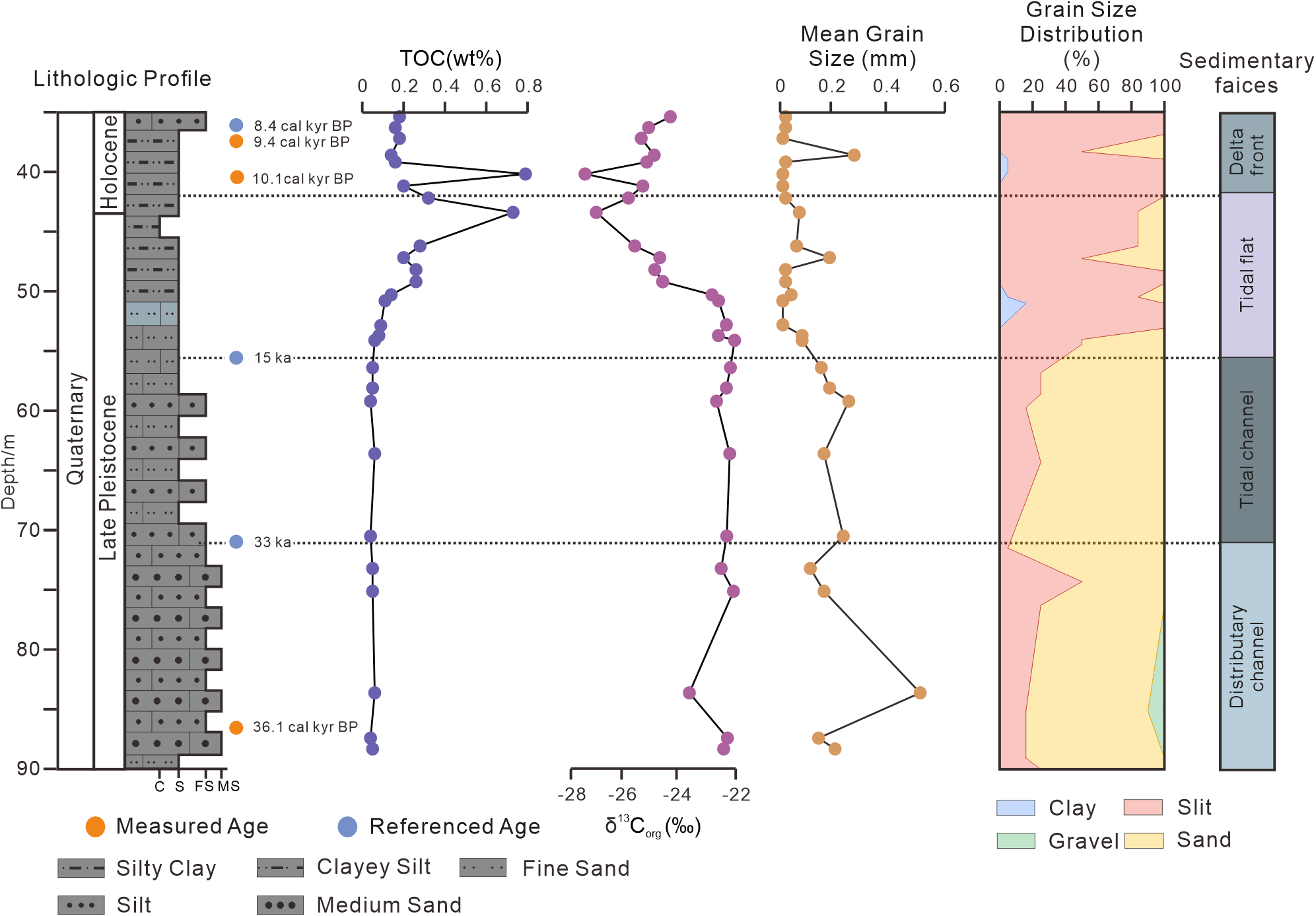
TOC, δ13Corg, and grain size data of QDQ2 core (grain size data referenced from Chen et al., 2024; age of 33 ka is referenced from Xu et al., 2016; age of 15 ka is referenced from Gao et al., 2022).
4.2 Sedimentary evolution in YRE
Based on lithofacies and grain size, four sedimentary facies (F1–F4) are identified in QDQ2 core (86.5–35.7 m; Figure 3). Concurrently, quantitative grain-size analysis reveals the hydrodynamic evolution of these facies (Figures 3, 4; Chen et al., 2024). Collectively, this succession records a progressive paleoenvironmental transition from terrestrial to marine settings (Figures 2, 4).
4.2.1 Sedimentary evolution of terrestrial fluvial environments during 36.1 cal kyr BP–15 ka
F1: Distributary channel (86.5–70.5 m).
Facies F1 is dominated by medium- to fine-grained quartz sand (Figure 4). It exhibits the coarsest mean grain size (0.1–0.5 mm) and the highest sand content (74%–95%) of the sequence. Sorting is poor (0.85–2.22) with positive skewness (-0.58–0.66; Supplementary Table S1). Physical structures include erosional cross-stratification, notably observed near 70 m (Figure 2). A gravel-bearing horizon (ca. 10% gravel; pebble diameter ~1 cm) is present at 83.6 m. Intervening intervals are generally massive or exhibit faint horizontal lamination. A basal contact is characterized by distinct erosion, whereas the upper boundary is gradational (Figure 2). F1 contains low TOC content (mean 0.05%) and δ13Corg values average -22.56‰ (Figure 4). Based on the aforementioned sedimentological and geochemical characteristics, F1 is interpreted as a distributary channel (Figure 4).
Radiocarbon dating yielded an age of 36.1 cal kyr BP at a depth of 86.5 m (Figure 4). Furthermore, through stratigraphic and grain-size correlation with CJK07 core (Xu et al., 2016), the 70.5 m horizon is assigned an age of approximately 33 ka. Consequently, the sedimentary interval from 86.5 to 70.5 m is interpreted to span the period from 36.1 cal kyr BP to 33 ka (Figures 3, 4). The coarse-grained texture, combined with basal erosion and graveliferous lags, indicates deposition by high-energy, channelized traction currents capable of bedload transport (Figures 2, 3; Miall, 2014). The presence of cross-stratification supports the interpretation of active bedform migration, while massive to faintly laminated intervals are attributed to rapid deposition rates from high-concentration suspension flows (Mill, 1996). The poor sorting and positive skewness are consistent with unidirectional fluvial flows (Figure 4, Supplementary Table S1). The gradational upper boundary reflects the progressive waning of hydrodynamic energy. The depleted δ13Corg values indicate a terrestrial-derived organic matter source, thereby precluding significant marine influence during this interval (Figure 4; Meyers, 1994). The extremely low TOC content suggests limited organic matter preservation, most likely attributable to the oxic conditions typical of active channel settings (Figure 4).
F2: Tidal channel (70.5–54.2 m).
Facies F2 comprises dark gray to gray silt and sand, with a grain size range of 0.08–0.25 mm, exhibiting a general fining-upward sequence (Figures 2, 4; Supplementary Table S1). Specifically, a lower interval is massive and coarse-grained, structurally similar to the underlying F1 (Figure 4). A distinct scour-and-fill structure is observed at 68.1 m, and a carbonized tree trunk fragment is preserved at 67.14–67.17 m (Figure 2). By contrast, an upper interval (59.49–54.2 m) transitions into interbedded fine sand and silt (Figures 2, 4). The boundaries of the two facies are gradational (Figure 2). TOC contents and mean δ13Corg values are approximately 0.5% and -22.3‰, respectively (Figure 4). Intergrating these sedimentological and geochemical features, F2 is interpreted as a tidal channel (Figure 2).
Similarly, based on lithostratigraphic and grain-size correlations with the EGQD14 core (Gao et al., 2022), the 54.2 m horizon is assigned an age of approximately 15 cal kyr BP (Figure 4). Consequently, the sedimentary interval from 70.5 to 54.2 m in QDQ2 core corresponds to the period from 33 to 15 ka (Figure 4). This interpretation represents a transition from the fluvial dominance of F1 to the overlying tidal flat environment (F3; Hill et al., 2001). Fining-upward trend and Transition from massive sands to rhythmic bedding suggest a progressive decrease in channel energy and incipient tidal modulation (Hill et al., 2001). A presence of the carbonized tree trunk in the lower interval indicates persistent, high-energy terrestrial input during the early stages of channel filling (Miall, 2014). δ13Corg values indicate a predominantly terrestrial organic source with negligible marine contribution, consistent with a channel system still dominated by riverine output (Meyers, 1994). Low TOC content reflects poor preservation, likely due to the oxidizing conditions maintained by the dynamic interplay of high-energy fluvial and tidal flows.
4.2.2 Sedimentary evolution of marine transgression events during 15 ka–8.4 cal kyr BP
F3: Tidal flat (54.2–40.2 m).
Relative to F1 and F2, Facies F3 exhibits a distinct lithological shift, characterized by dark gray, fine-grained sediments (silt and clayey silt) abundant in mica fragments, with a mean grain size of 0.01–0.2 mm (Figures 2, 4). Notably, F3 displays a more pronounced fining-upward trend compared to the underlying facies. A basal interval (53.75–50.0 m) consists of gray to grayish-blue, stiff, homogeneous silty clay (Figures 2, 4; Supplementary Table S1). Sedimentary structures are dominated by rhythmic clay-silt interlaminations, whereas the basal clay layer exhibits horizontal laminations (Figure 2). Geochemically, TOC content shows a steady increase (mean 0.29%; Figure 4). δ13Corg record exhibits a distinct negative excursion, with a mean value of -24.7‰ (Figure 4). An upper boundary of this facies is gradational (Figure 2). Collectively, the sedimentological, structural, and geochemical signatures of F3 point to a low-energy tidal flat, marking a distinct hydrodynamic shift in the depositional system (Figures 2, 3).
An age of 10.1 cal kyr BP at a depth of 40.2 m (Table 1). Consequently, the sedimentary interval from 54.2 to 40.2 m in QDQ2 core is constrained to the period from 15 ka to 10.1 cal kyr BP (Figure 4; Gao et al., 2022). The fine-grained texture and high mica content suggest that the sediment settled in a low-energy environment (Doyle et al., 1983). The rhythmic interlaminations are interpreted as tidal rhythmites formed under modulated tidal currents (Doyle et al., 1983). These are typical of tidal flats and are products of the last deglacial sea level rise (Zhao et al., 2017). Increased TOC content reflects enhanced preservation of organic matter, likely facilitated by rapid burial within the fine-grained matrix (Figure 4). Negative excursion in δ13Corg values is attributed to a shift in organic matter provenance from terrestrial-dominated to marine-influenced sources (Meyers, 1994). The gradational upper boundary suggests a progressive evolution of the depositional environment, and the basal boundary of F3 marks the beginning of the Last Deglaciation (Figures 2, 4; Lambeck et al., 2014; He and Lu, 2025).
F4: Delta front (40.2–35.7 m).
Facies F4 comprises dark gray silt and clayey silt with a mean grain size of ~0.05 mm (Figures 2, 4; Supplementary Table S1). Grain-size statistics show sorting values and skewness ranging from 0.59 to 2.45 and -0.40 to 0.18, respectively. Sedimentary structures are characterized by locally well-developed horizontal lamination. An upper interval contains abundant, well-preserved shells and bioclasts (Figure 2). Additionally, distinct layers of carbonized charcoal and plant debris occur at depths of 35.8 m and 40.0 m. Geochemically, TOC content reaches a maximum of 0.79% at 40.2 m (10.1 cal kyr BP; Figure 4). Concurrently, δ13Corg record exhibits a significant negative excursion (minimum -27.4‰; Figure 4). Considering the above features, F4 is interpreted as a low-energy subaqueous delta front, capping the succession (Figure 3).
An age of 9.4 cal kyr BP at a depth of 37.2 m (Table 1). Based on an estimated sedimentation rate of approximately 0.23 kyr/m, the upper boundary of this unit is extrapolated. Consequently, the sedimentary interval from 40.2 to 35.7 m in QDQ2 core is interpreted to span the period from 10.1 to 8.4 cal kyr BP (Figure 4). The fine-grained texture and grain-size data indicate a stable, low-energy hydrodynamic regime, dominated by suspension settling as evidenced by the horizontal lamination (Figures 2, 4; Supplementary Table S1; Zhu, 2020). The abundance of well-preserved marine fossils confirms a productive subaqueous marine environment (Figures 2, 4; Zhu, 2020). Peak in TOC content indicates a period of maximum preservation of organic matter (Figure 4). In this depositional context, negative excursion in δ13Corg is attributed to a further increase in marine organic carbon input (Figure 4; Meyers, 1994). Stratigraphically, this unit records the deepest-water environment formed during 36.1-8.4 cal kyr BP (Miller et al., 2020).
4.3 Response of weathering signals to sedimentary evolution
4.3.1 Cold and dry climate modes of terrestrial facies during 36.1 cal kyr BP–15 ka
The terrestrial interval (86.5–54.2 m; 36.1 cal kyr BP–15 ka) preserves a distinct climatic signature (Figure 3). This interval corresponds to globally cold and arid climate conditions during the global glacial stage (Gao et al., 2022; Gao and Long, 2023), thus suppressing chemical weathering (Gao and Long, 2023), which is evidenced by the lowest CIA (mean 27.93) and the highest K/Al ratios (mean 1.09; Figure 5; Nesbitt and Young, 1989).
Figure 5
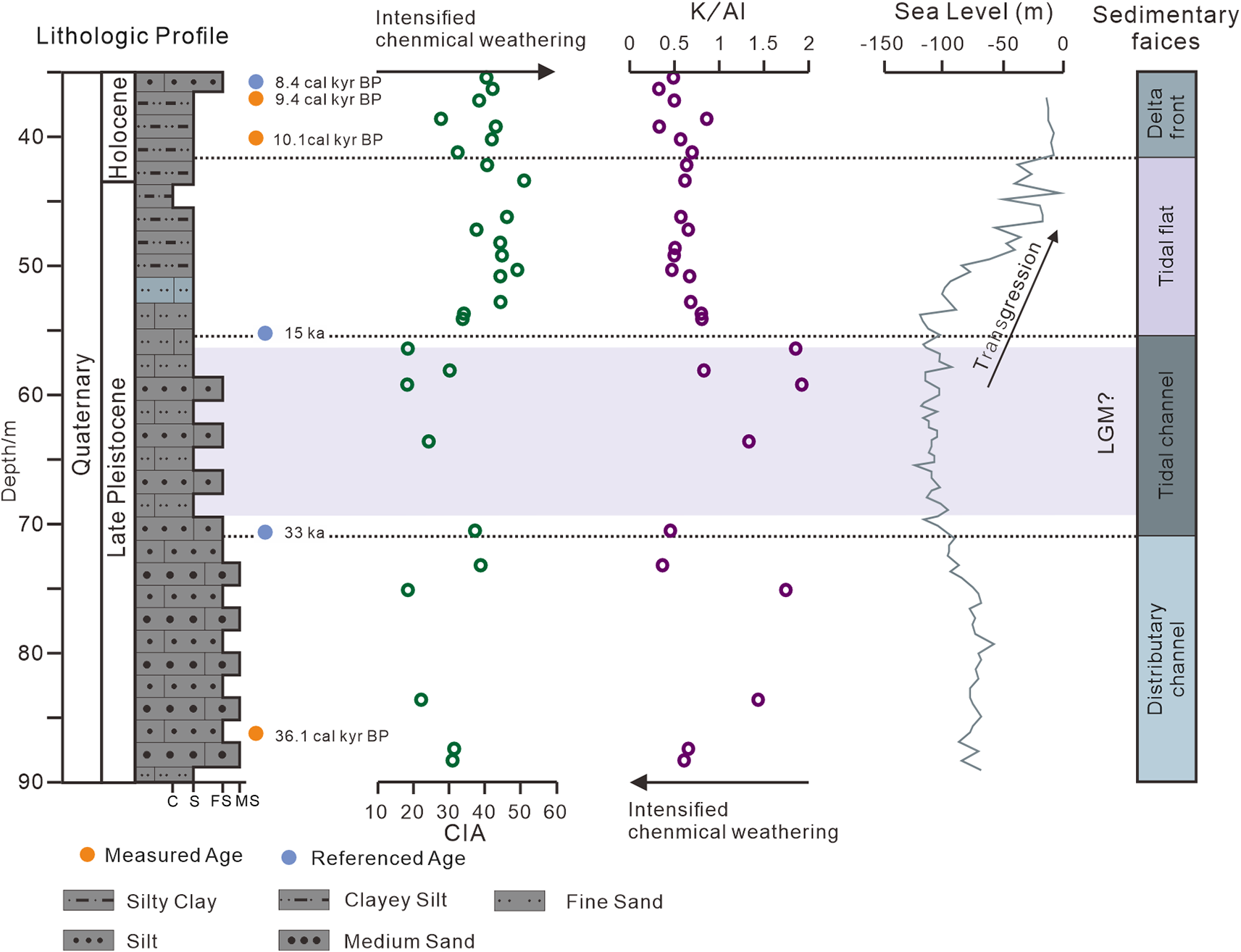
The CIA and K/Al ratios of QDQ2 core (the sea level change is referred from Miller et al., 2020; age of 33 ka is referenced from Xu et al., 2016; age of 15 ka is referenced from Gao et al., 2022).
The global cooling coincided with the LGM sea-level regression, which can expose the East China Sea continental shelf and trigger the deep incised valley system (Figure 6; Li et al., 2014; Miller et al., 2020; Wang et al., 2020). Although incision likely commenced during MIS 4, the LGM lowstand facilitated the maximum development of these distributary systems (Gao and Long, 2023). Consequently, the LGM depositional setting was dominated by distributary and tidal channels, characterized by widespread sedimentary hiatuses (Figures 3, 6; Gao and Long, 2023). The widespread formation of the incised valley confirms the regional extent of this incision event (Marden et al., 2014; Barboza et al., 2021; Yu et al., 2021; Zhou et al., 2024).
Figure 6
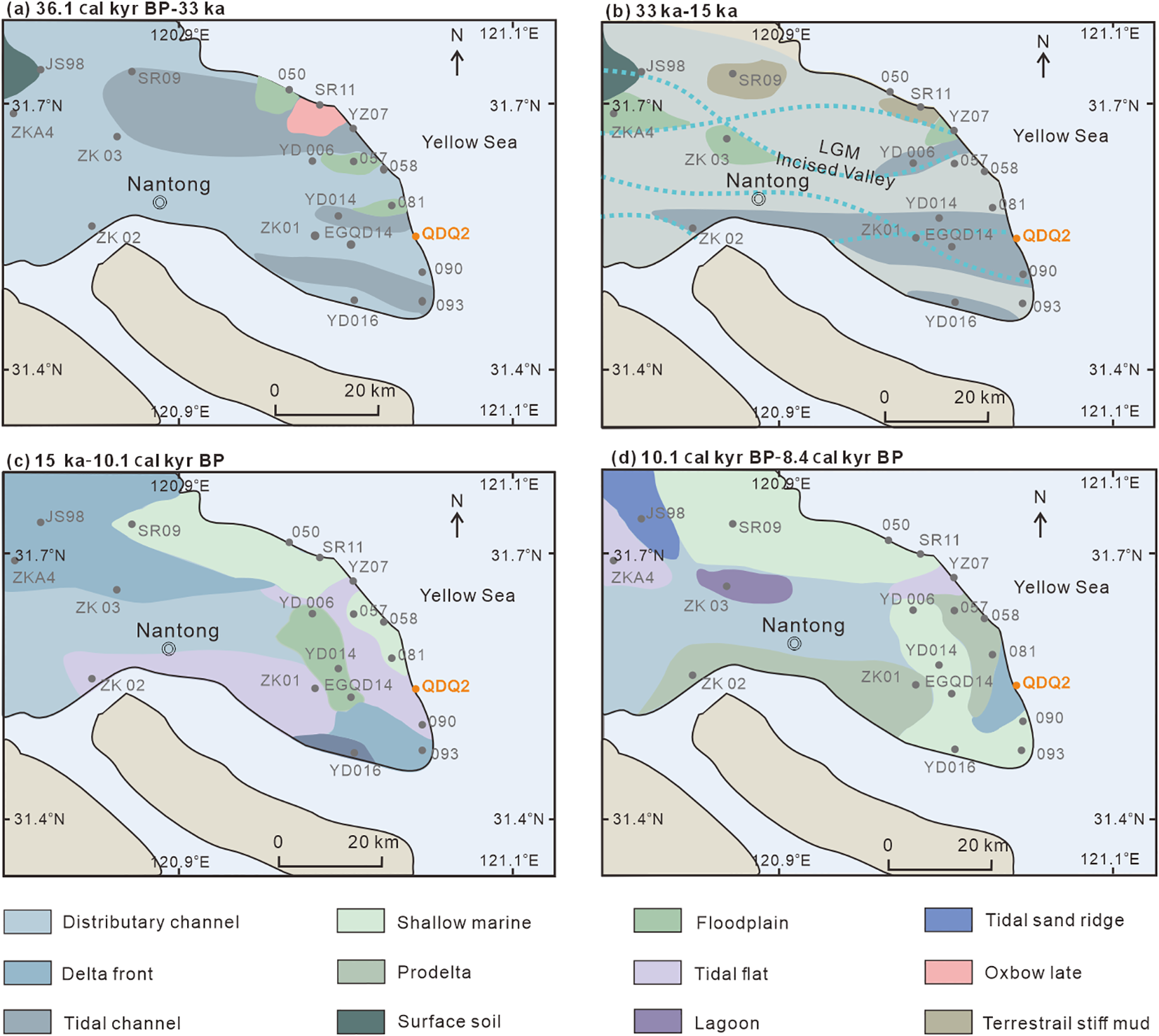
Four stages of evolution in YRE from 36.1 cal kyr BP to 8.4 cal kyr BP. (a) Facies distribution in YRE from 36.1 cal kyr BP to 33 ka; (b) Facies distribution in YRE from 33 ka to 15 ka; In (b), the shaded area indicates the extent of the LGM, and the blue dashed line represents the paleochannel; (c) Facies distribution in YRE from 15 ka to 10.1 cal kyr BP; (d) Facies distribution in YRE from 10.1 cal kyr BP to 8.4 cal kyr BP. The reference cores are as follows: SR09 and SR11 (Sun et al., 2015); YZ07 (Gao et al., 2020); YD014, YD016 and YD006 (Gao et al., 2022); EGQD14 (Gao et al., 2019); 093, 090, 081, 058, 057 and 050 (Wang and Li, 1998); ZK01 and ZK02 (Zhang et al., 2017); JS98 (Hori et al., 2001); ZK03 and ZKA04 (Jiang et al., 2014).
4.3.2 Warm and humid climate modes of marine facies transition during 15 ka–8.4 cal kyr BP
The interval from 54.2 to 35.7 m (15 ka–8.4 cal kyr BP) records a transition to marine-dominated environments (Figure 3). During this time, global climate warming resulted in ice sheet melting and sea-level increasing, the incised valley thus began to accumulate tidal-current deposits (Figure 3). This progressive inundation and the formation of tide-dominated estuaries, which inevitably led to a transformation in sedimentary facies in YRE (Figure 3; Li et al., 2002; Lambeck et al., 2014; Li et al., 2014; Miller et al., 2020; Xu et al., 2020).
A pronounced positive excursion in CIA values (mean 41.62), accompanied by a marked decrease in K/Al ratios (mean 0.58), indicates intensified chemical weathering in the Yangtze River source region (Figure 5; Nesbitt and Young, 1989). This enhanced weathering is consistent with warming climate and the rapid last deglacial sea-level rise (Figure 3; Miller et al., 2020), which provides strong evidence for the facies succession (Figure 5). This facies succession is corroborated by similar successions identified in EGQD14, ZK01, ZK02, and YZ07 cores (Figure 6; Zhang et al., 2017; Gao et al., 2020, 2022). This environmental reconstruction is also confirmed by the foraminiferal and pollen assemblages from CSJA3 core, which indicate an estuarine-littoral to lagoonal environment characterized by a warm, humid climate (Yu J et al., 2016). Similar paleoenvironmental conditions were also reconstructed from the SG7 core (Li et al., 2011).
4.3.3 Implications for gehu transgression
A subtle yet distinct geochemical excursion is preserved within the terrestrial F1 (75.5–70.0 m; Figure 5). The result reveals a fundamental decoupling between physical and chemical signals during this interval. Sedimentary facies, TOC, and δ13Corg are consistent with high-energy distributary channel deposits (F1), exhibiting no evidence of marine inundation (Figure 4). In contrast, geochemical proxies exhibit a shift, with elevated CIA values (mean 31.80) and decreased K/Al ratios (mean 0.85; Figure 5), indicating intensified chemical weathering in the source region. Chronostratigraphically, this interval corresponds to the Gehu transgression, a pre-LGM event occurring during the Late Pleistocene (Zhao et al., 2017). The Gehu transgression represents a sea-level rise event, supported by multi-level models that simulate the land-sea response to glacial cycles (Yu G et al., 2016). These models attribute the event to glacio-eustatic variations (Lin et al., 1989; Lambeck et al., 2001; Yu G et al., 2016). However, paleogeographic extent of the Gehu transgression, particularly its potential intrusion onto the northern flank of YRE, remains a topic of debate (Gao and Long, 2023).
Notably, the Gehu transgression can be ruled out due to the persistence of terrestrial facies (Figures 4, 5). Instead, the geochemical variance is best interpreted in the context of the warm, humid climate of MIS 3a, which enhanced chemical weathering rates in the Yangtze source region (Wang et al., 2001; Andersen et al., 2004; Ou et al., 2015).
To validate this climatic driver, stalagmite records from Hulu Cave document a strong East Asian Summer Monsoon pulse during this period (Wang et al., 2001), consistent with warming signals in the Tibetan Plateau—the primary headwater region of the Yangtze River (Shi and Yu, 2003). These climatic conditions account for the enhanced weathering observed in this interval (Figure 6). Furthermore, stratigraphic correlation with 090, 058, ZK01, ZK02, YD016, YD006, EGQD14, and YZ07 cores confirms that the sedimentary environment on the northern flank of the YRE remained a distributary channel throughout this period (Figure 6; Li and Wang, 1998; Zhang et al., 2017; Gao et al., 2020, 2022; Gao and Long, 2023). The warm, humid MIS 3a climate drove enhanced weathering in the Yangtze source region, whereas the magnitude of the associated Gehu transgression was insufficient to alter local sedimentary facies.
5 Conclusion
Based on the multi-proxy analysis of the QDQ2 core, the following conclusions regarding the Late Quaternary evolution of the northern YRE are derived:
-
A continuous, complete Transgressive Sequence spanning 36.1–8.4 cal kyr BP is identified. The sedimentary architecture evolves from terrestrial-dominated distributary channel (F1) and tidal channel (F2), transitioning upward into marine-dominated tidal flat (F3) and subaqueous delta front (F4). Variations in facies succession are primarily controlled by climate events and sea-level fluctuations.
-
The MIS 3a climate anomaly was sufficient to alter the geochemical weathering signal of the river sediment load, while the accompanying sea-level rise lacked the magnitude to inundate the northern flank of the incised valley.
Statements
Data availability statement
The original contributions presented in the study are included in the article/Supplementary Material. Further inquiries can be directed to the corresponding authors.
Author contributions
SL: Data curation, Investigation, Methodology, Writing – original draft, Writing – review & editing. GS: Funding acquisition, Resources, Supervision, Writing – review & editing. JC: Software, Methodology, Writing – review & editing. KL: Funding acquisition, Resources, Writing – review & editing. RJ: Funding acquisition, Resources, Writing – review & editing. XZ: Funding acquisition, Resources, Writing – review & editing. TH: Supervision, Writing – review & editing.
Funding
The author(s) declared that financial support was received for this work and/or its publication. This research was supported by National Natural Science Foundation of China (42572125), National Key Research and Development Program of China (2022YFF0800800), China Geological Survey, Ministry of Natural Resources (DD20240025 and DD20230201) and Jiangsu Provincial Department of Science and Technology (BE2022859).
Conflict of interest
The authors declared that this work was conducted in the absence of any commercial or financial relationships that could be construed as a potential conflict of interest.
Generative AI statement
The author(s) declared that generative AI was not used in the creation of this manuscript.
Any alternative text (alt text) provided alongside figures in this article has been generated by Frontiers with the support of artificial intelligence and reasonable efforts have been made to ensure accuracy, including review by the authors wherever possible. If you identify any issues, please contact us.
Publisher’s note
All claims expressed in this article are solely those of the authors and do not necessarily represent those of their affiliated organizations, or those of the publisher, the editors and the reviewers. Any product that may be evaluated in this article, or claim that may be made by its manufacturer, is not guaranteed or endorsed by the publisher.
Supplementary material
The Supplementary Material for this article can be found online at: https://www.frontiersin.org/articles/10.3389/fmars.2025.1750639/full#supplementary-material
References
1
Andersen K. K. Azuma N. Barnola J. M. Bigler M. Biscaye P. Caillon N. et al . (2004). High-resolution record of Northern Hemisphere climate extending into the last interglacial period. Nature431, 147–151. doi: 10.1038/nature02805
2
Barboza E. G. Dillenburg S. R. Lopes R. P. Rosa M. L. C. C. Caron F. Abreu V. et al . (2021). Geomor-phological and stratigraphic evolution of a fluvial incision in the coastal plainand inner continental shelf in southern Brazil. Mar. Geol.437, 106514. doi: 10.1016/j.margeo.2021.106514
3
Chen J. N. Sun G. Y. Wen Y. X. Li S. Q. Wang X. Y. Liu K. et al . (2024). Grain sizes characteristics of sediments from QDQ2 borehole in the Yangtze River Delta since the Late Pleistocene and their paleoenvironmental significance. East China Geol.45, 466–477. doi: 10.16788/j.hddz.32-1865/P.2024.21.019
4
Doyle L. J. Carder K. L. Steward R. G. (1983). The hydraulic equivalence of mica. J. Sedimentary Petrol.53, 643–648. doi: 10.1306/212f8251-2b24-11d7-8648000102c1865d
5
Gao L. Ding Z. L. (2008). Spatial Changes of Chemical Weathering Recorded by Loess Deposits in the Chinese Loess Plateau During the past 130–000 years. Quaternary Sci.28, 162–168. doi: 10.3321/j.issn:1001-7410.2008.01.018
6
Gao L. Long H. Tamura T. Ye L. T. Hou Y. D. Shen J. (2020). Refined chronostratigraphy of a late Quaternary Sedimentary sequence from the Yangtze River delta based on K-feldspar luminescence dating. Marine Geology.427, 106271. doi: 10.1016/j.margeo.2020.106271
7
Gao L. Long H. (2023). Luminescence chronology constraints on the sedimentary stratigraphy of the Yangtze River delta since the last interglacial. Quaternary Sci.43, 33–45. doi: 10.11928/j.issn.1001-7410.2023.01.03
8
Gao L. Long H. Hou Y. D. Feng Y. Y. (2022). Chronology constraints on the complex sedimentary stratigraphy of the paleo-Yangtze incised valley in China. Quaternary Sci. Rev. 287, 107573. doi: 10.1016/j.quascirev.2022.107573
9
Gao L. Long H. Zhang P. Tamura T. Feng W. L. Mei Q. Q. (2019). The sedimentary evolution of the Yangtze River delta since MIS 3: A new chronology evidence revealed by OSL dating. Quaternary Geochronol.49, 153–158. doi: 10.1016/j.quageo.2018.03.010
10
He K. Y. Lu H. Y. (2025). Sea level changes over the past 20,000 years and human activities in the eastern coastal zone of China. Prehistoric Archaeol.2, 43–59. doi: 10.3724/2097-3063.20250009
11
Heaton T. J. Köhler P. Butzin M. Bard E. Reimer R. W. Austin W. E. N. et al . (2020). Marine20—The marine radiocarbon age calibration curve (0–55,000 cal BP). Radiocarbon62, 779–820. doi: 10.1017/RDC.2020.68
12
Hill P. R. Lewis C. P. Desmarais S. Kauppaymuthoo V. Rais H. (2001). The mackenzie delta: sedimentary processes and facies of a high-latitude, fine-grained delta. Sedimentology48, 1047–1078. doi: 10.1046/j.1365-3091.2001.00408.x
13
Hori K. Saito Y. Zhao Q. H. Cheng X. R. Wang P. X. Sato Y. et al (2001). Sedimentary facies and Holocene progradation rates of the Changjiang (Yangtze) delta, China. Geomorphology41, 233–248. doi: 10.1016/S0169-555X(01)00119-2
14
Jiang R. Yang Z. L. Yu J. J. Lao J. X. Ke X. Zeng J. W. (2014). Stratigraphic division of Quaternary strata and paleoenvironment analysis for Xinghua-Tongzhou region in the north flank of the Yangze River delta. Resour. Survey Environment35, 263–269. doi: 10.3969/j.issn.1671-4814.2014.04.004
15
Lambeck K. Chappell J. (2001). Sea Level Change Through the Last Glacial Cycle. Science292, 679–686. doi: 10.1126/science.1059549
16
Li G. X. Li P. Liu Y. Qiao L. L. Ma Y. Y. Xu J. et al . (2014). Sedimentary system response to the global sea level change in the East China Seas since the last glacial maximum. Earth-Science Rev.139, 390–405. doi: 10.1016/j.earscirev.2014.09.007
17
Li C. X. Wang P. X. (1998). Study on the stratigraphy of the Yangtze River estuary during the Late Quaternary (Beijing: Science Press).
18
Li C. X. Wang P. Sun H. P. Zhang J. Q. Fan D. D. Deng B. (2002). Late Quaternary incised-valley fill of the Yangtze delta (China): Its stratigraphic framework and evolution. Sedimentary Geol.152, 133–158. doi: 10.1016/S0037-0738(02)00066-0
19
Li B. Wei Z. X. Li X. He Z. F. Zhang K. J. Wang Z. H. (2011). Records from quaternary sediment and palaeo-environment in the yangtze river delta. Quaternary Sci.31, 316–328. doi: 10.3969/j.issn.1001-7410.2011.02.14
20
Li X. S. Zhou Y. W. Han Z. Y. Yuan X. K. Yi S. W. Zeng Y. Q. et al . (2024). Loess deposits in the low latitudes of East Asia reveal the ~20-kyr precipitation cycle. Nat. Commun.15, 1023. doi: 10.1038/s41467-024-45379-9
21
Liao M. N. Yu G. Gui F. (2018). Palaeoecological records of transgressions in Core YZ07 from Changjiang River delta-radial sand ridges of the South Yellow Sea since the Late Pleistocene. Quaternary Sci.38, 732–745. doi: 10.11928/j.issn.1001-7410.2018.03.18
22
Lin J. X. Zhang S. L. Qiu J. B. Wu B. Y. Huang H. Z. Huang H. Z. et al . (1989). Quaternary marine transgressions and paleoclimate in the Yangtze River delta region. Quaternary Res.32, 296–306. doi: 10.1016/0033-5894(89)90096-3
23
Lin C. M. Zhang X. Xu Z. Y. Deng C. W. Yin Y. Cheng Q. Q. (2015). Sedimentary characteristics and accumulation conditions of shallow-biogenic gas for the late quaternary sediments in the changjiang river delta area. Adv. Earth Sci.30, 589–601. doi: 10.11867/j.issn.1001-8166.2015.05.0589
24
Liu J. Qiu J. D. Saito Y. Zhang X. Nian X. M. Wang F. F. et al . (2020a). Formation of the Yangtze Shoal in response to the post-glacial transgression of the paleo-Yangtze (Changjiang) estuary, China. Mar. Geol.423, 106080. doi: 10.1016/j.margeo.2019.106080
25
Liu J. Saito Y. Kong X. H. Wang H. Chun W. Yang Z. G. et al . (2010a). Delta development and channel incision during marine isotope stages 3 and 2 in the western South Yellow Sea. Mar. Geol.278, 54–76. doi: 10.1016/j.margeo.2010.09.003
26
Liu J. Saito Y. Kong X. H. Wang H. Xiang L. H. Wen C. et al . (2010b). Sedimentary record of environmental evolution off the Yangtze River estuary, East China Sea, during the last ∼13,000 years, with special reference to the influence of the Yellow River on the Yangtze River delta during the last 600 years. Quaternary Sci. Rev.29, 2424–2438. doi: 10.1016/j.quascirev.2010.06.016
27
Liu J. S. Xu H. Z. Jiang Y. M. Wang J. He X. J. (2020b). Mesozoic and Cenozoic basin structure and tectonic evolution in the East China Sea basin. Acta Geologica Sinica94, 675–691. doi: 10.3724/SP.J.0001-571720200312
28
Liu J. Zhang X. Ding X. Qiu J. D. Wang H. An Y. H. (2023). Sedimentary facies characteristics and dating of the late Quaternary sedimentary sequence in the nearshore coastal area of Nantong, Jiangsu Province, China. Mar. Geol. Quaternary Geol.43, 35–48. doi: 10.16562/j.cnki.0256-1492.2023051501
29
Marden M. Betts H. Palmer A. Taylor R. Bilderback E. Litchfield N. (2014). Post-Last Glacial Maximum fluvial incision and sediment generation in the unglaciated Waipaoa catchment, North Island, New Zealand. Geomorphology214, 283–306. doi: 10.1016/j.geomorph.2014.02.012
30
McLennan S. M. (1993). Weathering and Global Denudation. The Journal of Geology101, 295–303. Available online at: https://www.jstor.org/stable/30081153.
31
Meyers P. A. (1994). Preservation of elemental and isotopic identification of sedimentary organic matter. Chem. Geol.114, 289–302. doi: 10.1016/0009-2541(94)90059-0
32
Miall A. D. (2014). Fluvial Depositional Systems (Cham: Springer International Publishing).
33
Mill A. D. (1996). The Geology of Fluvial Deposits: Sedimentary Facies, Basin Analysis and Petroleum Geology (Berlin: Springer).
34
Miller K. G. Browning J. V. Schmelz W. J. Kopp G. S. Mountain G. S. Wright J. D. (2020). Cenozoic sea-level and cryospheric evolution from deep-sea geochemical and continental margin records. Science6, 1346. doi: 10.1126/sciadv.aaz1346
35
Ministry of Environmental Protection of the People’s Republic of China (2016). Solid Waste—Determination of 22 Metal Elements—Inductively Coupled Plasma Optical Emission Spectrometry (Beijing: China Environmental Science Press).
36
Nesbitt H. W. Markovics G. Price R. C. (1980). Chemical processes affecting alkalis and alkaline earths during continental weathering. Geochimica Cosmochimica Acta44, 1659–1666. doi: 10.1016/0016-7037(80)90218-5
37
Nesbitt H. W. Young G. M. (1982). Early Proterozoic climates and plate motions inferred from major element chemistry of lutites. Nature299, 715–717. doi: 10.1038/299715a0
38
Nesbitt H. W. Young G. M. (1989). Formation and diagenesis of weathering profiles. J. Geol.97, 129–147. doi: 10.1086/629290
39
Ou X. J. Zhou S. Z. Lai S. P. Zeng L. H. (2015). Discussions on Quaternary glaciations and their climatic responding in the Qinghai-Tibetan Plateau. Quaternary Sci.35, 12–28. doi: 10.11928/j.issn.1001-7410.2015.01.02
40
Shi Y. F. Yu G. (2003). Warm-Humid Climate and Transgressions during 40∼30 ka B.P. Their Potential Mechanisms Quaternary Sci.23, 1–11. doi: 10.3321/j.issn:1001-7410.2003.01.001
41
Sun Z. Y. Li G. Yin Y. (2015). The Yangtze River deposition in the southern Yellow Sea during Marine Oxygen Isotope Stage 3 and its implications for sea-level changes. Quaternary Res.83, 204–215. doi: 10.1016/j.yqres.2014.08.008
42
Wan S. M. Zhao D. B. Jin H. L. Sha Y. Y. Shi Z. G. Clift P. D. et al (2025). Interactive forces of temperature and topographic uplift shaped the East Asian monsoon rainfall evolution since the Oligocene. The Innovation Geoscience3, 100141. doi: 10.59717/j.xinn-geo.2025.100141
43
Wang Y. J. Cheng H. Edwards R. L. An Z. S. Wu J. Y. Shen S. S. et al . (2001). A high-resolution absolute-dated late pleistocene monsoon record from Hulu Cave. China. Science294, 2345–2348. doi: 10.1126/science.1064618
44
Wang P. X. Li C. X. (1998). Study on the Late Quaternary Estuary Stratigraphy of the Yangtze River (Beijing: Science Press).
45
Wang Z. B. Zhang J. Y. Mei X. Chen X. H. Zhao L. Zhang Y. et al . (2020). The stratigraphy and depositional environments of China’s sea shelves since MIS5(74-128) ka. Geol. China47, 1370–1394. doi: 10.12029/gc20200506
46
Wang H. Zheng X. M. Qian P. Wu C. Ren S. F. Zhao Q. (2021). An overview on the First Hard Soil Layer (FHSL) of the Late Pleistocene in the Yangtze River delta. Quaternary Sci.41, 1771–1780. doi: 10.11928/j.issn.1001-7410.2021.06.22
47
Wei G. J. Li X. H. Liu Y. Shao L. Liang X. R. (2006). Geochemical record of chemical weathering and monsoon climate change since the early Miocene in the South China Sea. Paleoceanography21, PA4214. doi: 10.1029/2006PA001300
48
Xu T. Y. Shi X. F. Liu C. G. Wu Y. H. Liu S. F. Fang X. S. et al . (2020). Stratigraphic framework and evolution of the mid–late Quaternary (since marine isotope stage 8) deposits on the outer shelf of the East China Sea. Mar. Geol.419, 106047. doi: 10.1016/j.margeo.2019.106047
49
Xu T. Y. Wang G. Q. Shi X. F. Wang X. Yao Z. Q. Yang G. et al . (2016). Sequence stratigraphy of the subaqueous Changjiang (Yangtze River) delta since the Last Glacial Maximum. Sedimentary Geol.331, 132–147. doi: 10.1016/j.sedgeo.2015.10.014
50
Yang S. Y. Jung H. S. Choi M. S. Li C. X. (2002). The rare earth element compositions of the Changjiang (Yangtze) and Huanghe (Yellow) river sediments. Earth Planetary Sci. Letters201, 407–419. doi: 10.1016/S0012-821X(02)00715-X
51
Ye L. T. Gao L. Han M. Y. Li Y. F. Xiao X. Y. Long H. (2024). The late Quaternary palynological record of the northern Yangtze Delta: Implications for palaeoclimate change in East Asia. CATENA234, 107630. doi: 10.1016/j.catena.2023.107630
52
Ye L. T. Gao L. Li Y. F. Wang G. Q. (2022). Palynology-based reconstruction of Holocene environmental history in the northern Yangtze Delta, China. Paleogeogr. Palaeoclimatol. Paleoecol.603, 111186. doi: 10.1016/j.palaeo.2022.111186
53
Ye L. T. Yu G. Liao M. N. Hu S. Y. Wang L. S. Gao L. (2017). Terrestrial-marine sedimentary cycles in the South Yellow Sea, China: implications for paleoenvironmental reconstruction since MIS 5. Turkish J. Earth Sci.26, 4. doi: 10.3906/yer-1608-18
54
Yu J. J. Lao J. X. Jiang R. Zeng J. W. Peng B. Ma X. et al . (2016). Reconstructing the late quaternary paleoenvironmental evolution of the northern wing of the Yangtze River delta based on multi-stratigraphic correlation. Geological Bull. China35, 1692–1704. doi: 10.12097/gbc.dztb-35-10-1692
55
Yu Y. Wang X. Y. Yi S. W. Miao X. D. Vandenberghe J. Li Y. Q. et al . (2021). Late Quaternary aggradation and incision in the headwaters of the Yangtze River, eastern Tibetan Plateau, China. GSA Bulletin134, 371–388. doi: 10.1130/B35983.1
56
Yu G. Ye L. T. Liao M. N. Wang L. S. Li Y. F. (2016). Quantitative reconstruction, simulation and mechanism study on the Late Pleistocene marine transgressions in the coastal plains of China. Quaternary Sci.36, 711–721. doi: 10.11928/j.issn.1001-7410.2016.03.20
57
Zhang X. Dalrymple R. W. Lin C. M. (2017). Facies and stratigraphic architecture of the late Pleistocene to early Holocene tide-dominated paleo-Changjiang (Yangtze River) delta. GSA Bull.130, 455–483. doi: 10.1130/B31663.1
58
Zhang W. X. Zhang H. C. Lei G. L. Yang L. Q. Niu J. Chang F. Q. et al . (2008). Elemental geochemistry and paleoenvironment evolution of shell bar section at qarhan in the qaidam basin. Quaternary Sci.28, 917–928. doi: 10.1109/IGARSS.2011.6049610
59
Zhao X. T. Hu D. G. Wu Z. H. Yang X. D. (2017). Reviews on the research of late cenozoic geology and environment of the Yangtze River delta area. J. Geomechanics23, 1–64. doi: 10.3969/j.issn.1006-6616.2017.01.001
60
Zhou Y. J. Han J. F. Shen Q. J. Xu Y. T. Tao Y. L. Lin P. H. et al . (2024). Orbital global change drove fluvial aggradation and incision in Tibetan upper Mekong River: Chronological perspectives. Quaternary Geochronol.82, 101546. doi: 10.1016/j.quageo.2024.101546
61
Zhu X. M. (2020). Sedimentary Petrology (Beijing: China University of Petroleum Press).
Summary
Keywords
climate change, last glacial maximum, sea level change, sedimentary evolution, transgression
Citation
Li S, Sun G, Chen J, Liu K, Jiang R, Zhou X and He T (2026) Sedimentary evolution and paleoclimate conditions in the Yangtze river estuary across the late Pleistocene to early Holocene. Front. Mar. Sci. 12:1750639. doi: 10.3389/fmars.2025.1750639
Received
20 November 2025
Revised
15 December 2025
Accepted
17 December 2025
Published
12 January 2026
Volume
12 - 2025
Edited by
Hailin Yang, Peking University, China
Reviewed by
Pengfei Ma, Tongji University, China
Junqiang Zhang, Linyi University, China
Updates
Copyright
© 2026 Li, Sun, Chen, Liu, Jiang, Zhou and He.
This is an open-access article distributed under the terms of the Creative Commons Attribution License (CC BY). The use, distribution or reproduction in other forums is permitted, provided the original author(s) and the copyright owner(s) are credited and that the original publication in this journal is cited, in accordance with accepted academic practice. No use, distribution or reproduction is permitted which does not comply with these terms.
*Correspondence: Gaoyuan Sun, sungy@hhu.edu.cn; Tianchen He, tianchenhe@hhu.edu.cn
Disclaimer
All claims expressed in this article are solely those of the authors and do not necessarily represent those of their affiliated organizations, or those of the publisher, the editors and the reviewers. Any product that may be evaluated in this article or claim that may be made by its manufacturer is not guaranteed or endorsed by the publisher.