 Thomas Linker1Shogo Fukushima2Rajiv K. Kalia1Aravind Krishnamoorthy1
 Aiichiro Nakano1*Ken-ichi Nomura1Kohei Shimamura2
 Fuyuki Shimojo2Priya Vashishta1
- 1Collaboratory for Advanced Computing and Simulations, University of Southern California, Los Angeles, CA, United States
- 2Department of Physics, Kumamoto University, Kumamoto, Japan
Recent discoveries of polar topological structures (e.g., skyrmions and merons) in ferroelectric/paraelectric heterostructures have opened a new field of polar topotronics. However, how complex interplay of photoexcitation, electric field and mechanical strain controls these topological structures remains elusive. To address this challenge, we have developed a computational approach at the nexus of machine learning and first-principles simulations. Our multiscale neural-network quantum molecular dynamics molecular mechanics approach achieves orders-of-magnitude faster computation, while maintaining quantum-mechanical accuracy for atoms within the region of interest. This approach has enabled us to investigate the dynamics of vortex states formed in PbTiO3 nanowires embedded in SrTiO3. We find topological switching of these vortex states to topologically trivial, uniformly polarized states using electric field and trivial domain-wall states using shear strain. These results, along with our earlier results on optical control of polar topology, suggest an exciting new avenue toward opto-electro-mechanical control of ultrafast, ultralow-power polar topotronic devices.
Introduction
Topological structures of matter such as skyrmions and merons are emergent quantized defects that carry a topological charge, which is invariant under continuous deformation or external field. Originally conceptualized in particle physics, these topological objects have since been realized as magnetic spin textures in ferromagnetic materials and have found great interest due to their potential applications in next-generation spintronic devices such as racetrack memory (Tokura and Kanazawa, 2021). In the analogous field of ferroelectrics, there has been a growing effort to realize similar topological features in their inherent polarization fields. Recent experiments have shown success in generating skyrmion bubbles and vortex structures in SrTiO3 (STO)/PbTiO3 (PTO) based superlattices (Das et al., 2019) as well as creation of meron structures in strained PTO thin films grown on SmScO3 (Wang et al., 2020). These structures emerge from a subtle balance of strain and polarization energies within interfacial materials, which in turn can be controlled by external optical, electrical and mechanical forces. Such rich controllability makes these polar topological structures an ideal enabler of the next-generation polar “topotronic” devices (Tian et al., 2021). Since these topological structures are protected against thermal noise, different states only need to be separated by low energy barriers, thus allowing polar topotronic devices to operate at ultralow power.
Despite the great prospect of polar topotronics, it remains an open question how these topological structures can be optically, electrically and mechanically manipulated. The primary challenge is to computationally describe their complex polarization dynamics extending many spatiotemporal scales as they emerge, while retaining quantum-mechanical accuracy. This challenge could be met by recent successes in machine learning based interatomic potentials to perform neural-network quantum molecular dynamics (NNQMD) simulations with ab initio accuracy but at a fraction of computational cost (Behler, 2015; Krishnamoorthy et al., 2021). In fact, we have successfully studied optical control of polar topological structures in PTO using NNQMD simulations on massively parallel supercomputers, which were trained by excited-state quantum molecular dynamics (QMD) simulations (Linker et al., 2022). However, electrical and mechanical control of topology in more realistic interfacial structures still remains a challenge. To address this challenge, we propose to combine NNQMD with a multiscale simulation approach that embeds high-accuracy but more compute-intensive simulation in coarser simulation only where high fidelity is required (Warshel and Levitt, 1976; Ogata et al., 2001), which was the topic of 2013 Nobel Chemistry prize (Warshel, 2014). We use the resulting multiscale NNQMD/molecular mechanics (MM) framework, or simply NN/MM method, to study electrical and mechanical manipulation of ferroelectric topological structures formed in ferroelectric/paraelectric heterostructures. Specifically, a scalable neural network is trained to accurately represent the potential energy surface of ferroelectric material, which is embedded in a classical force-field model to describe appropriate strain and dielectric boundary conditions imposed by paraelectric material.
In this paper, we present NN/MM simulations to study the dynamics of topological states in a ferroelectric PTO nanowire embedded in STO matrix. We find the formation of a vortex state in the nanowire in the ground state. To study electrical and mechanical manipulation of the vortex state, we examine two cases: 1) dynamics under an electric field in the vortex plane; and 2) dynamics under shear stress. In both cases, we find transformations from a vortex state to trivial domains with zero topological charge. These results demonstrate an exciting new framework for exploring control of ferroelectric topologies for development of next generation topotronic devices.
Materials and methods
We use a NNQMD approach to model the potential energy surface and forces within the PTO nanowire (Linker et al., 2022). NNQMD employs a feed-forward neural network architecture, which consists of an input layer, multiple hidden layers, and an output layer (Figure 1). The input is a multidimensional feature vector for each atom that represents its local environment through permutationally, translationally and rotationally invariant functions within a cutoff distance. Eq 1 and 2 show the radial and angular features for the ith atom, respectively:
where Rij is the interatomic distance between the atomic pair (i, j) and the cutoff function
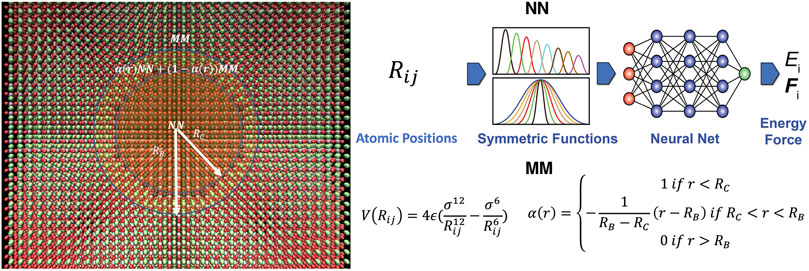
FIGURE 1. NN/MM method. (Left panel) Spatial decomposition into NN and MM domains to study PTO nanowire, where black, green, silver and red spheres represent Pb, Sr, Ti and O atoms, respectively. Within the nanowire domain defined by radius RC, molecular dynamics is governed by the NNQMD model for PTO. For atoms within
We used Rc = 0.75 nm in this study. Hyperparameters
The network nodes are interconnected by adjustable weight matrices that are trained to reproduce a ground-truth QMD training dataset. We use two hidden layers and twenty nodes in each layer with modified hyperbolic tangent as the activation function. Eq. 4 shows the loss function L, i.e., the mean square error (MSE) of the system energy and the total sum of the atomic forces, to improve both the model fidelity and robustness.
The loss function compares the system energy E and the atomic forces Fi between NNQMD prediction and ground truth obtained by QMD. Here, NI is the number of frames of the training dataset, Natom is the number of atoms in each frame. The coefficients pE and pF are adjustable parameters to control the relative importance of the two terms as model training progresses. We used an equal weight for the energy and force loss functions and the L-BFGS-B scheme to minimize the loss function.
Training data was generated using density functional theory (DFT) based QMD simulations in the canonical (NVT) ensemble at temperature 300 K performed for a 4
To model the paraelectric and strain boundary conditions imposed by large STO matrix, we use a Lennard-Jones (LJ) force field, which is much less compute-intensive than the neural network inference in NNQMD:
where
We perform multiscale NN/MM simulations in a core + buffer approach analogous to divide-and-conquer approaches commonly used in linear-scaling QMD simulations (Shimojo et al., 2014). Here, a NNQMD region is defined with a core radius
Forces on the atoms are determined by the NNQMD model inside the core region within
Results
We first investigate the ground-state polarization field in the nanowire by performing molecular dynamics simulation at a low temperature of 10 K until polarization field becomes steady and only slightly oscillates due to harmonic oscillation within 4 ps. The formation of a vortex state is illustrated in Figure 2A with Sr atoms colored in green, Pb black, O red, Ti silver and the arrows representing Ti polar displacements creating the vortex state. Formation of a similar vortex state has been computationally studied in BaTiO3 embedded within a STO matrix (Nahas et al., 2015). The center of the vortex is found to occur in the Pb-O plane of four neighboring unit-cells with finite polarization, drawing similar resemblance to Pb-O styled domain walls (Behera et al., 2011). We find the vortex core displaced from the center of the nanowire, despite the cylindrical symmetry of boundary conditions. A similar spontaneous symmetry breaking was observed experimentally and in phase-field modeling in STO/PTO heterostructures (Behera et al., 2022), where off centering of vortex cores in alternating clockwise and counter-clockwise vortex pair states led to a net polarization and emergent net chirality of vortex pair states. The nanowire system possesses no preferred location to pin the emergence of the vortex core such as a domain wall or oxygen vacancy. While the radial location of the vortex core is dictated by the energetics, its angular location is stochastic, depending on the initial velocities of the simulation.
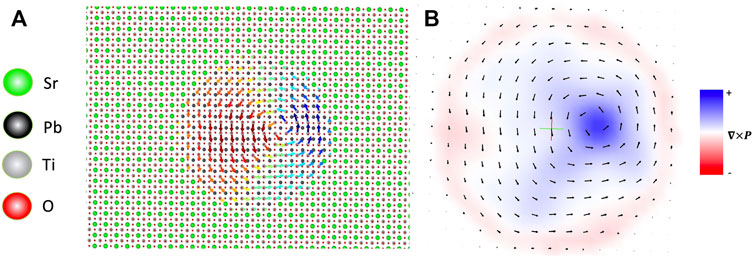
FIGURE 2. Vortex formation. (A) Formation of a vortex state in the PTO nanowire after 4 ps of NNQMD simulation at a temperature of 10 K. Black, green, silver and red spheres are Pb, Sr, Ti and O atoms, respectively, whereas arrows represent Ti polar displacements. (B) Vorticity map of the polar vortex state.
For our 2-dimensional system, the chirality of the vortex in can be determined by its circulation
where P is the polarization. We compute the pseudovector vorticity
We next study the dynamics of the vortex state under electric field, to examine the possibility of electric manipulation of the vortex state. We apply an electric field of 1 V/nm parallel to the vortex plane (Figure 3A). Figures 3B–D show progression of the vortex state after turning on the field at time
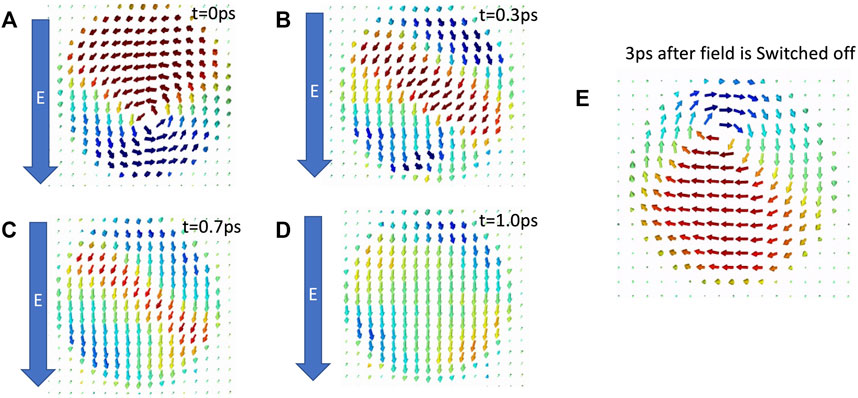
FIGURE 3. Electric-field-induced annihilation of vortex. (A)–(D) Evolution of a topological vortex state to a topologically trivial, uniformly polarized state under electric field. (E) Restoration of the vortex state upon subsequent turning-off of the electric field.
To examine the possibility of mechanical manipulation of vortex states, we next study the dynamics of the vortex state under shear strain. Figure 4A shows the initial vortex state in a 5.5 nm PTO nanowire embedded in STO matrix. We simulate shear dynamics by reducing the yz box angle at a rate of
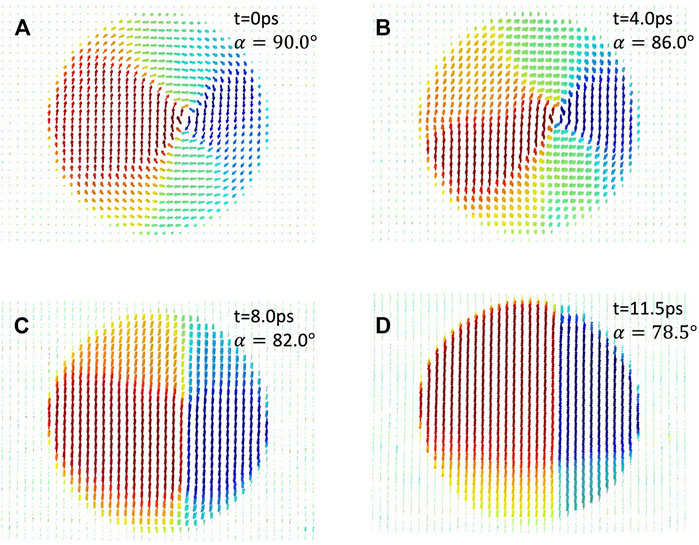
FIGURE 4. Shear-induced annihilation of vortex state. (A) Original vortex state prior to shear deformation. (B)–(D) Gradual transformation to a trivial domain-wall state under shear strain at different times t and lattice angles
Discussion
Overall, our results demonstrate the controllability of topological vortex states in PTO nanowires embedded in STO through electrical and mechanical means. This work also demonstrates the ability of the new multiscale NN/MM method to model the emergence of topological vortices and their erasure under electric field and shear strain, highlighting its potential to investigate complex topological phase transitions in ferroelectric materials. Ultimately, deterministic control of polar topologies requires a precise understanding of the switching dynamics on sub nanosecond time scales (Tian et al., 2021), which is currently lacking. Atomistic methods like the new NN/MM simulations performed here could help provide valuable insight in this vein. Along with a recently developed multiscale approach that combines Maxwell equations, real-time timed-dependent density functional theory, nonadiabatic and Fermi-occupation QMD, and excited state NNQMD (Linker et al., 2022) to study optical control of topological structures, the proposed NN/MM method will form the basis of the promising new area of “computational topotronics” to explore optical, electrical and mechanical control of topological states in next generation toptronics devices.
Data availability statement
The raw data supporting the conclusions of this article will be made available by the authors, without undue reservation.
Author contributions
RK, AN, FS, and PV designed the work. KN and KS developed the NNQMD code. TL and AK developed the force fields. TL performed the NNQMD simulations. TL, SF, and AK analyzed the results.
Funding
This work was supported as part of the Computational Materials Sciences Program funded by the US Department of Energy, Office of Science, Basic Energy Sciences, under Award Number DE-SC0014607.
Acknowledgments
Simulations were performed at the Argonne Leadership Computing Facility under the DOE INCITE and Aurora Early Science programs and at the Center for Advanced Research Computing of the University of Southern California.
Conflict of interest
The authors declare that the research was conducted in the absence of any commercial or financial relationships that could be construed as a potential conflict of interest.
Publisher’s note
All claims expressed in this article are solely those of the authors and do not necessarily represent those of their affiliated organizations, or those of the publisher, the editors and the reviewers. Any product that may be evaluated in this article, or claim that may be made by its manufacturer, is not guaranteed or endorsed by the publisher.
References
Behera, P., May, M. A., Gomez-Ortiz, F., Susarla, S., Das, S., Nelson, C. T., et al. (2022). Electric field control of chirality. Sci. Adv. 8 (1), eabj8030. doi:10.1126/sciadv.abj8030
Behera, R. K., Lee, C. W., Lee, D., Morozovska, A. N., Sinnott, S. B., Asthagiri, A., et al. (2011). Structure and energetics of 180° domain walls in PbTiO3by density functional theory. J. Phys. Condens. Matter 23 (17), 175902. doi:10.1088/0953-8984/23/17/175902
Behler, J. (2015). Constructing high-dimensional neural network potentials: A tutorial review. Int. J. Quantum Chem. 115 (16), 1032–1050. doi:10.1002/qua.24890
Das, S., Tang, Y. L., Hong, Z., Goncalves, M. A. P., McCarter, M. R., Klewe, C., et al. (2019). Observation of room-temperature polar skyrmions. Nature 568 (7752), 368–372. doi:10.1038/s41586-019-1092-8
Das, S., Hong, Z., Stoica, V. A., Goncalves, M. A. P., Shao, Y. T., Parsonnet, E., et al. (2021). Local negative permittivity and topological phase transition in polar skyrmions. Nat. Mater. 20, 94–201.
Krishnamoorthy, A., Nomura, K., Baradwaj, N., Shimamura, K., Rajak, P., Mishra, A., et al. (2021). Dielectric constant of liquid water determined with neural network quantum molecular dynamics. Phys. Rev. Lett. 126 (21), 216403. doi:10.1103/PhysRevLett.126.216403
Linker, T., Nomura, K., Aditya, A., Fukshima, S., Kalia, R. K., Krishnamoorthy, A., et al. (2022). Exploring far-from-equilibrium ultrafast polarization control in ferroelectric oxides with excited-state neural network quantum molecular dynamics. Sci. Adv. 8 (12), eabk2625. doi:10.1126/sciadv.abk2625
Nahas, Y., Prokhorenko, S., Louis, L., Gui, Z., Kornev, I., and Bellaiche, L. (2015). Discovery of stable skyrmionic state in ferroelectric nanocomposites. Nat. Commun. 6, 8542. doi:10.1038/ncomms9542
Ogata, S., Lidorikis, E., Shimojo, F., Nakano, A., Vashishta, P., and Kalia, R. K. (2001). Hybrid finite-element/molecular-dynamics/electronic-density-functional approach to materials simulations on parallel computers. Comput. Phys. Commun. 138 (2), 143–154. doi:10.1016/S0010-4655(01)00203-X
Shimojo, F., Fukushima, S., Kumazoe, H., Misawa, M., Ohmura, S., Rajak, P., et al. (2019). QXMD: An open-source program for nonadiabatic quantum molecular dynamics. SoftwareX 10, 100307. doi:10.1016/j.softx.2019.100307
Shimojo, F., Kalia, R. K., Kunaseth, M., Nakano, A., Nomura, K., Ohmura, S., et al. (2014). A divide-conquer-recombine algorithmic paradigm for multiscale materials modeling. J. Chem. Phys. 140 (18), 18A529. doi:10.1063/1.4869342
Tian, G., Yang, W. D., Gao, X. S., and Liu, J. M. (2021). Emerging phenomena from exotic ferroelectric topological states. Apl. Mater. 9 (2), 020907. doi:10.1063/5.0039139
Tokura, Y., and Kanazawa, N. (2021). Magnetic skyrmion materials. Chem. Rev. 121 (5), 2857–2897. doi:10.1021/acs.chemrev.0c00297
Wang, Y. J., Feng, Y. P., Zhu, Y. L., Tang, Y. L., Yang, L. X., Zou, M. J., et al. (2020). Polar meron lattice in strained oxide ferroelectrics. Nat. Mat. 19 (8), 881–886. doi:10.1038/s41563-020-0694-8
Warshel, A., and Levitt, M. (1976). Theoretical studies of enzymic reactions: Dielectric, electrostatic and steric stabilization of the carbonium ion in the reaction of lysozyme. J. Mol. Biol. 103 (2), 227–249. doi:10.1016/0022-2836(76)90311-9
Keywords: neural-network quantum molecular dynamics, ferroelectrics, topotronics, QM/MM simulation, machine learning
Citation: Linker T, Fukushima S, Kalia RK, Krishnamoorthy A, Nakano A, Nomura K-i, Shimamura K, Shimojo F and Vashishta P (2022) Towards computational polar-topotronics: Multiscale neural-network quantum molecular dynamics simulations of polar vortex states in SrTiO3/PbTiO3 nanowires. Front. Nanotechnol. 4:884149. doi: 10.3389/fnano.2022.884149
Received: 25 February 2022; Accepted: 01 August 2022;
Published: 30 August 2022.
Edited by:
Andrey Miroshnichenko, University of New South Wales, AustraliaReviewed by:
Alexandre Reily Rocha, São Paulo State University, BrazilJunyi Liu, California State University, Northridge, United States
Copyright © 2022 Linker, Fukushima, Kalia, Krishnamoorthy, Nakano, Nomura, Shimamura, Shimojo and Vashishta. This is an open-access article distributed under the terms of the Creative Commons Attribution License (CC BY). The use, distribution or reproduction in other forums is permitted, provided the original author(s) and the copyright owner(s) are credited and that the original publication in this journal is cited, in accordance with accepted academic practice. No use, distribution or reproduction is permitted which does not comply with these terms.
*Correspondence: Aiichiro Nakano, YW5ha2Fub0B1c2MuZWR1