 Débora De-Esteban-Escobar1*
 Carmen De-Pablos-Heredero2
 José Luis Montes-Botella1
 Francisco José Blanco-Jiménez1
- 1Department of Applied Economics I, Economic History and Institutions, Rey Juan Carlos University, Madrid, Spain
- 2Department of Business Economics (Administration, Management and Organization), Applied Economics II and Fundamentals of Economic Analysis, Rey Juan Carlos University, Madrid, Spain
Introduction: This research investigates the impact of business incubators' training and support initiatives on emotional intelligence in entrepreneurship and how this subsequently affects the success of incubated startups.
Methods: The study proposes and tests four hypotheses using a structural equation model (SEM) and data collected from October 2023 to February 2024.
Results: The findings indicate the following: First, business incubator training programmes significantly enhance entrepreneurs' emotional intelligence. Second, psychological support services help entrepreneurs overcome challenges and maintain a positive mindset. Third, incubators provide a supportive environment that fosters entrepreneurs' confidence, contributing to business success.
Discussion: By elucidating the relationship between incubator activities, emotional intelligence development, and entrepreneurial success, this study can inform the design of more effective business incubator programmes and the development of policies prioritising entrepreneurs' emotional growth, strengthening the entrepreneurial ecosystem.
1 Introduction
Academic literature on entrepreneurship has tended to focus on identifying and characterising the conditions that motivate someone to become an entrepreneur, primarily emphasising rational factors (Lu et al., 2022) and drawing on the perspective of economic theory (Palomeque et al., 2020). Research has often centred on factors such as the individual's environment, training and experience (Teruel-Sánchez et al., 2021) business financing (Díaz, 2018), income (Shi and Wang, 2021), business strategy, marketing, sales, management, and technology (Vaz et al., 2022), as well as government policies (Yin and Wu, 2023). However, in recent decades, emotional factors such as confidence, resilience, and personal skills have also been recognised as influential elements in one's decision to become an entrepreneur.
When discussing emotional factors, researchers frequently invoke concepts such as soft skills (Ubfal et al., 2022) and emotional intelligence (EI). EI, in particular, has gained significant attention in the fields of psychology, business management, and entrepreneurship (Minarova et al., 2020; Popovici et al., 2020; Castilla, 2021; Enriquez et al., 2021; Sah, 2021; Bartra et al., 2022).
Defined by Goleman (1996), EI is the way our emotional and mental abilities shape our character traits, which are essential for social adaptation. In the business context, studies by Daniel Goleman support the importance of Emotional Intelligence (EI) in areas such as leadership. Goleman concludes that truly effective leaders share a fundamental trait: a high level of emotional intelligence, without which neither the best training, nor a brilliant mind, nor great ideas can guarantee true leadership (Goleman, 1998a). Other researchers have found that high levels of self-confidence, adaptive assertiveness (Baciu et al., 2020), self-innovation, self-inspiration, self-vision (Karia, 2021), and resilience (Garcés et al., 2018) positively correlate with job performance, leadership, and physical and mental health (Humphrey, 2013). These skills and competencies are important for an individual's personal and professional success (Torres and Vidal, 2018) and an organisation's workplace and business success (Jansen et al., 2023). Larger and more personality-diverse teams within startups, where individuals exhibit low levels of modesty and high levels of openness to experience and activity, are more likely to achieve success (Branca et al., 2025).
EI has been associated with various aspects of personal and professional life, including physical and mental wellbeing (Goleman, 1998b, 2006), academic and work performance, interpersonal relationships, communication, leadership, mental health, problem-solving, and resilience, among others (Allen et al., 2020; Zhao and Xie, 2020). As such, this concept is increasingly being researched in entrepreneurial environments. In this context, Vidal et al. (2021) relate EI to personal competencies, organisational behaviour, personal development, and human relationships. Meanwhile Garcés et al. (2018) link it to an individual's understanding of their emotions, as well as their emotional sensitivity, self-control, empathy, and resilience. Torres and Vidal (2018) explore EI's connexion to entrepreneurial intention in the university environment, relating it to work experience and the individual's field of study.
Rutka et al. (2020) and Lotito (2022) have revealed that individuals with higher EI demonstrate greater teamwork, communication, and leadership skills, as well as greater resilience to stress (Pathak and Goltz, 2021; Khan et al., 2022) than individuals with lower EI. This enables them to make better decisions, fostering motivation and confidence (Popovici et al., 2020). So much so that, based on the Big Five personality traits (openness to experience, extraversion, conscientiousness, agreeableness, and neuroticism), Ahmad et al. (2023) suggest that while four of the five major personality traits are important for an entrepreneur's success, neuroticism is unlikely to contribute to it.
The importance of EI also extends to the corporate world, where larger companies' efficiency indicators have improved after implementing EI in corporate culture (Gerasimova, 2018). Thus, EI is a determining factor in business success (Doan et al., 2020). Business leaders who apply these emotional tools can positively impact employee engagement (Malik et al., 2021), improve organisational culture, and foster innovation and business growth (Allen et al., 2020; Wang et al., 2019).
These findings explain the emerging line of academic research on the emotional and psychological factors that influence one's decision to become an entrepreneur. In terms of EI, Goleman identifies five key factors: self-awareness, self-control, motivation, empathy, and social skills. In addition to their effect on one's decision to become an entrepreneur, these factors can affect the longevity and success of entrepreneurial initiatives, warranting further research.
Entrepreneurship has emerged as a vital pillar of the economy (Cavallo and Ghezzi, 2021; Sanchaniya and Geipele, 2021; Fernandes et al., 2022; Li et al., 2022; Munyo and Veiga, 2022; Salimi, 2022), articularly in the fields of business development (García et al., 2023), innovation, and employment. As such, it is receiving increasing attention in the academic community (Haugh, 2020; Montiel and Soto, 2020). However, entrepreneurs face multiple challenges (Hoogendoorn et al., 2019) distinct from those of other business people. These challenges can be mitigated by business incubators (Lange and Johnston, 2020; Oberg et al., 2020; De Esteban et al., 2022; Lubishtani et al., 2022). Business incubation centres play a crucial role in supporting startups and fostering innovation. So much so that it is essential to delve into the need for a holistic approach to measuring their performance, incorporating both hard and soft metrics (Azadnia et al., 2022). Our analysis will examine how business incubators help improve the EI of the entrepreneurs they host, potentially enhancing their chances of success and the longevity of their startups.
Existing literature evaluates startup success through indicators such as survival rate (Blank, 2021; Manconi et al., 2022; Woolley and MacGregor, 2022), profitability, and resource acquisition (Fernández et al., 2019; Zheng et al., 2019; Gozali et al., 2020; Siddiqui et al., 2021; Fuschi and Galiyeva, 2022; Pattanasak et al., 2022). As with the trend in entrepreneurship literature more broadly, academic reviews on business incubators have primarily focused on performance parameters based on rational factors (Palomeque et al., 2020), such as revenue, sales, job creation, etc., without thoroughly evaluating those based on emotional factors (Schiopu et al., 2015).
Considering this background and the emerging research that relates emotional factors to business success (including entrepreneurial success) and the lack of previous research on this topic, there is a need to analyse the extent to which business incubators promote EI and confidence in entrepreneurs. Therefore, this study applies these findings to the field of business incubators by showing how emotional skills affect the behaviour of Spanish entrepreneurs and the sustainability of their startups. This leads us to the following research questions, which we aim to address through the findings of this study:
RQ1. How do business incubators provide security and confidence to entrepreneurs and support them in developing their emotional skills?
RQ2. In what ways do the security, confidence, and emotional skills fostered by business incubators influence the success, survival, growth, and long-term sustainability of the startups they host?
To this end, we propose a measurement model that describes the influence of business incubators on emotional factors and the influence of emotional factors on entrepreneurial success. The model was developed using data collected from 84 business incubator managers in Spain via an online survey. The results of this work can inform strategies and practises that allow entrepreneurs to optimise their emotional skills, leading to improved work and business performance. They can also present new ways of supporting and developing entrepreneurship within organisations, such as business incubators.
Table 1 summarises the key findings of the literature review to enhance the understanding of the research focus.
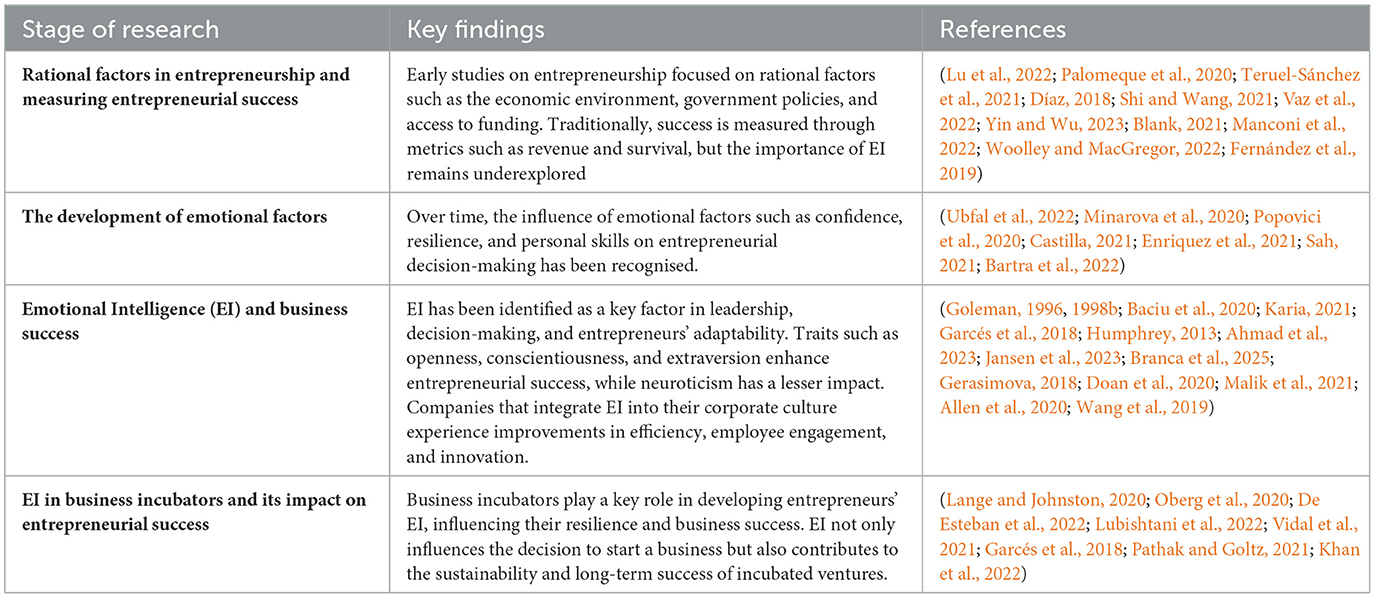
Table 1. Key findings of the literature review.
Following this introduction, we describe the methodology, theoretical support, and hypotheses of our study. Subsequently, we present the results, followed by a discussion and final conclusions.
2 Materials and methods
This study employs a mixed-method approach. First, we used the Web of Science (WoS) database to conduct a systematic review of existing literature on the relationship between emotional intelligence and business incubators. WoS is a comprehensive resource that catalogues high-quality, peer-reviewed academic journals, conference proceedings, and books from across the world and over 250 disciplines in the sciences, social sciences, and humanities. Relevant studies were identified based on the search criteria outlined in Table 2, focusing on the link between EI and business incubator operations.
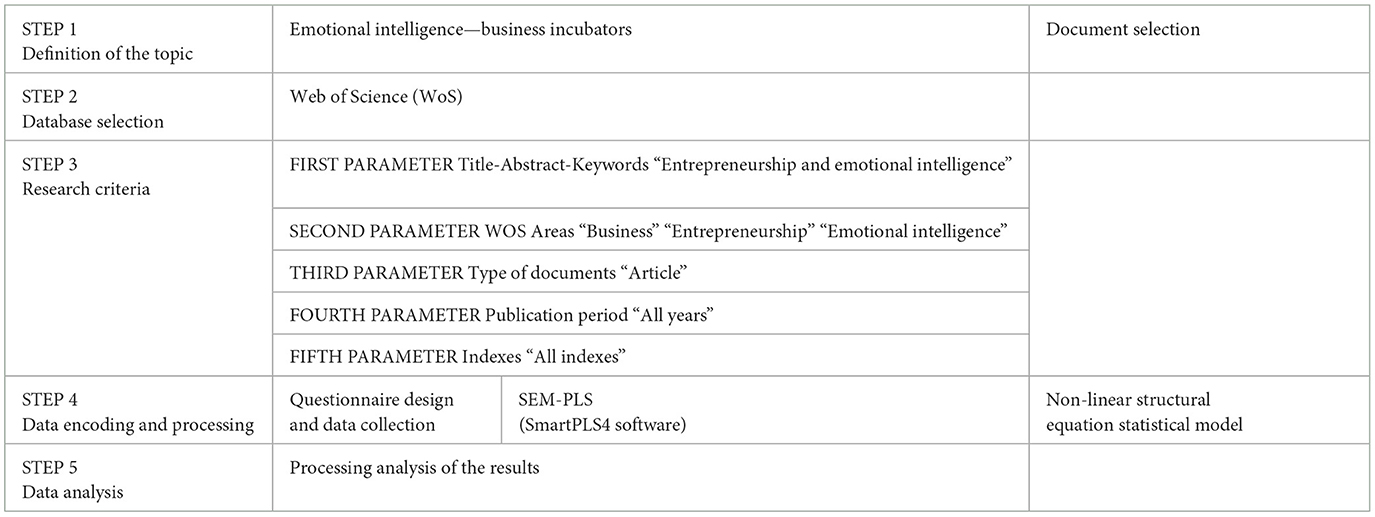
Table 2. Research steps.
We simultaneously conducted surveys with business incubator managers to collect practical, contextual insights that could enrich the literature review findings. Subsequently, we developed a structural equation model (SEM) to analyse the results and obtain a robust understanding of the relationship between EI and business incubators. Table 2 outlines each of these research steps.
2.1 Methodological framework and hypothesis development
Business incubators provide a collaborative and supportive working environment that fosters learning (Man et al., 2022), trust, and knowledge sharing (Redondo and Camarero, 2022), increasing entrepreneurs' ability to work in teams and network with other entrepreneurs (Blanco et al., 2023). Arguably, the services and methodologies used in business incubators could easily be adapted to help entrepreneurs develop skills and knowledge related to EI, which are necessary to manage the stress and uncertainty (Hoogendoorn et al., 2019) inherent in creating and managing a company (Games et al., 2023).
Among the various support functions offered by business incubators, training plays a crucial role (Ahmed et al., 2022; Santana et al., 2022; Antonovica et al., 2023). Beyond mere knowledge transmission, these programmes act as catalysts for business development, forging competent and resilient leaders (Ahmed et al., 2020; Vaz et al., 2022). The training offered in business incubators transcends theory, instructing participants in business realities and building a pragmatic ecosystem where entrepreneurs acquire technical knowledge and the mindset needed to face challenges (Chavoushi et al., 2020). Chavoushi et al. (2020) propose that training sessions influence entrepreneurial progress significantly, making it a determining factor of incubated businesses' future success. Based on this context, we formulate the first hypothesis:
H1: Business incubators' training enhances the EI of hosted entrepreneurs.
The relationship between psychology and entrepreneurship has been attracting growing academic interest (Baron et al., 2016; Miao, 2020; Yousaf et al., 2020; St-Jean and Tremblay, 2021; Zhao and Wibowo, 2021). Researchers are working to understand how such psychological factors as decision-making, motivation, resilience, self-efficacy, and EI affect entrepreneurial behaviour and success. Hu et al. (2022) report that psychological capital mediates the relationship between individual entrepreneurial passion and business success. In this context, psychological capital is understood as confidence, optimism, and perseverance (Tang, 2020; De Hoe and Janssen, 2022; Hu et al., 2022; Nate et al., 2022). Based on these findings, we propose the following hypothesis:
H2: Business incubators' psychological support enhances the EI of hosted entrepreneurs.
Previous research has established that EI is a crucial skill for business success. It enhances assertive communication, which, when used correctly with emotions, ethics, and timing, improves the likelihood of ideal results (Jansen et al., 2023). EI can also play a vital role during crises, improving company performance by promoting emotional stability (Khan et al., 2022). Furthermore, it improves decision-making, conflict management, and interpersonal relationships, making its incorporation into team dynamics essential for business environments (Popovici et al., 2020). Thus, we propose the following hypothesis:
H3: Business incubators' group dynamics enhance the EI of hosted entrepreneurs.
These attributes of business incubators highlight the importance of our research. Understanding how business incubators nurture entrepreneurs' EI and trust helps us devise strategies to improve the success and profitability of startups. Our final hypothesis is as follows:
H4: Business incubators' collective actions nurture the EI of hosted entrepreneurs, increasing their success.
Figure 1 graphically represents the theoretical model with the proposed hypotheses.
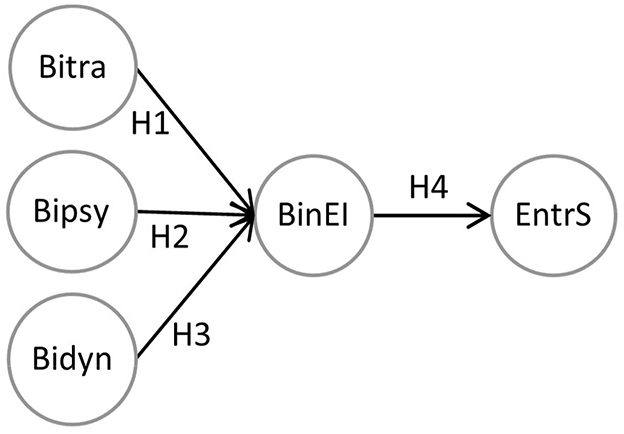
Figure 1. Theoretical model.
2.2 Variables
Next, we describe how the concepts in this study have been measured. The variables are grouped into five constructs:
BinEI (Business Incubators' Emotional-Intelligence-Related Actions): This represents the total, varied actions undertaken by business incubators to foster hosted entrepreneurs' EI. In this study, we focus specifically on training (Ahmed et al., 2022; Vaz et al., 2022), psychological support (Hu et al., 2022), and group dynamics (Jansen et al., 2023).
Bitra (Business Incubator Training): This construct pertains to the training provided by business incubators (Ubfal et al., 2022; Antonovica et al., 2023) to bolster entrepreneurs' mental health and provide tools for emotional management. It also reflects the intensity of EI-related training offered by the incubator.
Bipsy (Psychological Support): This refers to the psychological support available in business (De Hoe and Janssen, 2022; Nate et al., 2022), which aims to reinforce and support entrepreneurs' wellbeing and understand their mental state during the early stages of business development.
Bidyn (Group Dynamics): This construct relates to business incubators' efforts to foster effective communication, empathy, personal development, and soft skills among hosted entrepreneurs through group dynamics (Khan et al., 2022; Jansen et al., 2023).
EntrS (Entrepreneurial Success): EntrS measures the impact of these actions on entrepreneurial EI and their reflection in business success metrics (Villares et al., 2020; Sevilla et al., 2022), such as increased turnover, expanded customer base, and sustained business continuity over time.
Table 3 lists the sources that informed our measurements for each of the dimensions examined in this study.
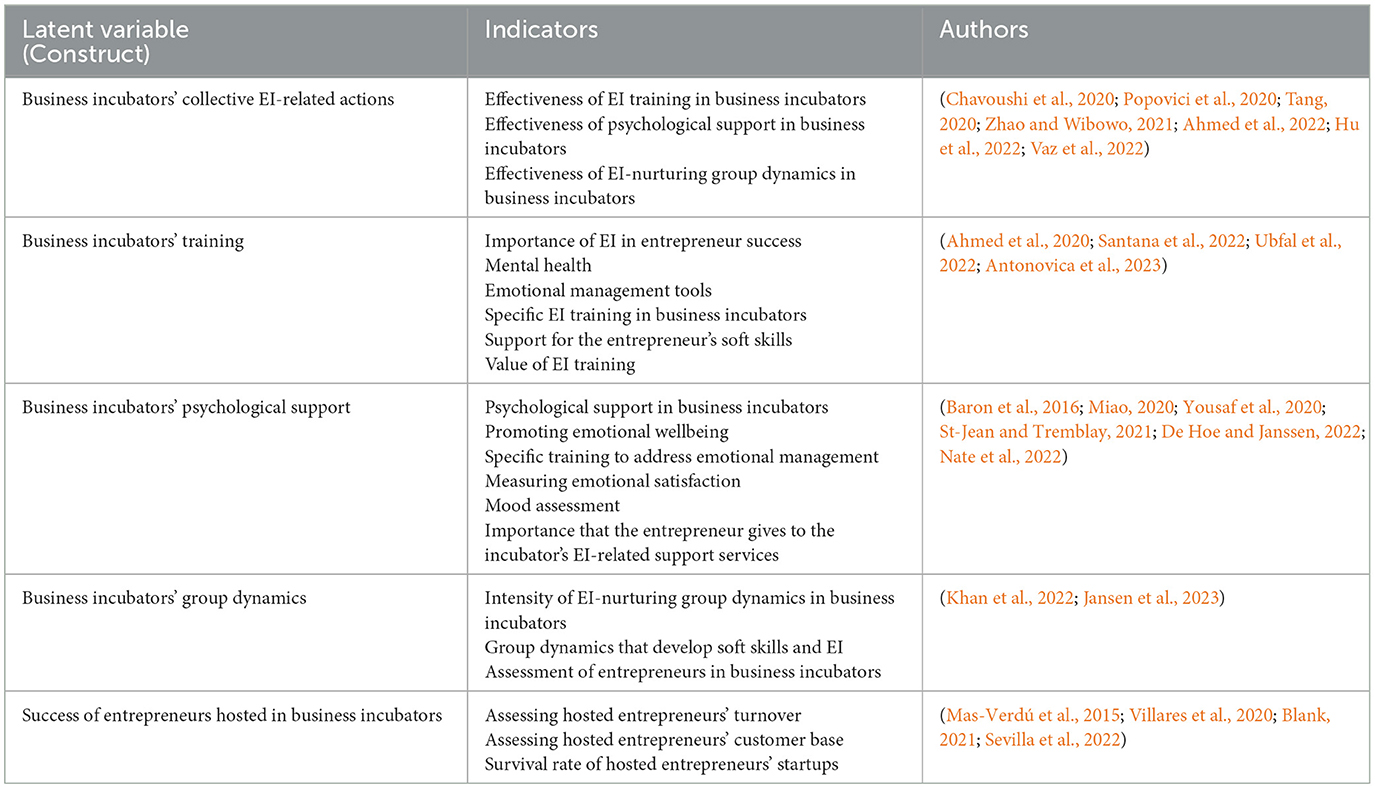
Table 3. Sample questionnaire items for each latent variable in the study based on previous research.
2.3 Sample
The sample comprises 84 business incubators located across Spain. We used an online survey to collect data in a structured manner, employing uniform questions for all respondents. Various researchers have utilised this methodology previously (Roustapisheh and Yazdizadeh, 2019; Boubker et al., 2021; Kummitha and Kummitha, 2021).
The questionnaire, developed internally and influenced by the authors listed in Table 2, was distributed from January to February 2024 via Google Forms to all 410 business incubators in Spain. It was designed to test our four hypotheses through empirical analysis. A total of 84 valid responses were obtained, as detailed in Table 4.
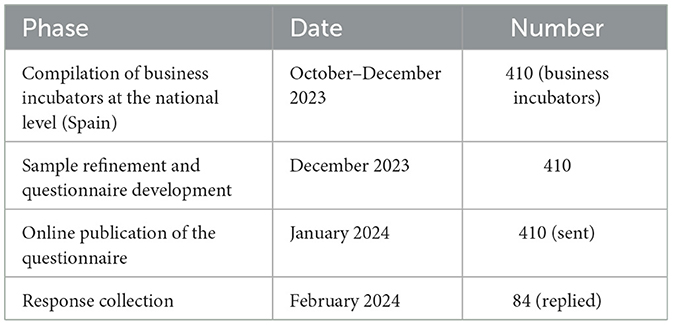
Table 4. Sampling schedule and response collection.
We used an SEM approach to test the validity of these hypotheses. This linear statistical model is based on our theoretical framework and validated using the empirical data collected from our representative sample of business incubators in Spain. SEM is one of the most widely used multivariate statistical tools, as it allows researchers to examine multiple relationships between latent variables simultaneously. It has gained popularity in recent decades, particularly in the field of psychology and studies involving numerous variables (Zhang et al., 2013; Grace, 2022; De Rooji et al., 2023).
Statistical estimates were generated using SmartPLS 4 software to validate the hypothesised relationships (Ringle et al., 2022).
3 Results
Figure 2 illustrates the relationships between the five constructs and summarises the main values and p-values for each parameter in the model.
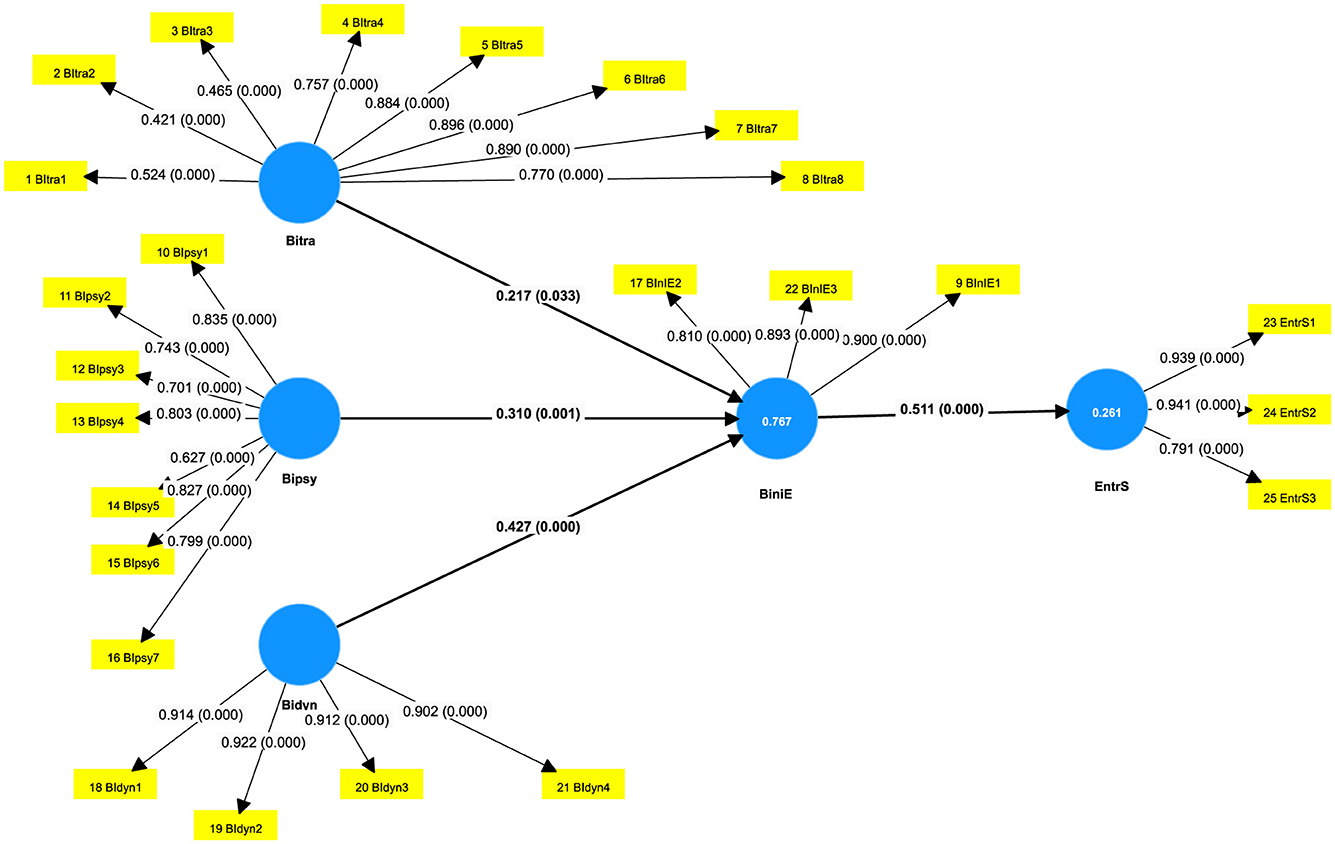
Figure 2. Hypothesis results (H1–H4) from the structural equation model.
We extracted the following results from the model's parameters:
H1: Incubators' training (Bitra) enhances the EI of hosted entrepreneurs (BinEI). The training provided by incubators significantly influences entrepreneurs' EI, with β = 0.217 and p = 0.033. Thus, H1 is accepted.
H2: Incubators' psychological support (Bipsy) enhances the EI of hosted entrepreneurs (BinEI). The psychological support offered by business incubators significantly influences entrepreneurs' EI, with β = 0.310 and p = 0.001. Thus, H2 is accepted.
H3: Incubators' dynamics (Bidyn) enhance the EI of hosted entrepreneurs (BinEI). The dynamics of the incubators significantly influence entrepreneurs' EI, with β = 0.427 and p = 0.000. Thus, H3 is accepted.
H4: Incubators' collective actions nurture the EI of hosted entrepreneurs (BinEI) increasing their success (EntrS). A substantial positive relationship exists between the actions conducted in business incubators and the success of hosted entrepreneurs, with β = 0.511 and p = 0.000. Thus, H4 is accepted.
The results of the model exhibited a confidence level of over 95%, confirming all our hypotheses. These are summarised in Table 5 below.
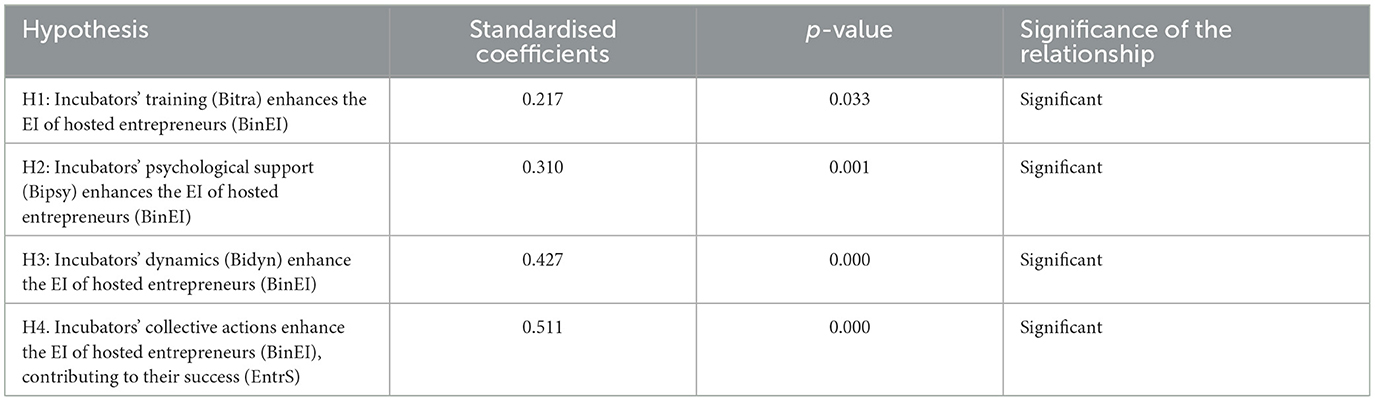
Table 5. Significance levels (by standardised coefficients and p-values) of the indicators.
The values R2 = 0.767 and R2 = 0.261 indicate that the model explains 76% of the impact of incubators' collective actions on hosted entrepreneurs' EI and 26% of the impact on hosted entrepreneurs' success.
Convergent validity was tested using the average of variance extracted (AVE), with values >0.50 indicating convergent validity (Table 6). Discriminant validity was assessed using the Fornell-Larcker criterion (Table 7), wherein you take the square root of each latent variable's AVE; square roots that exceed the variable's correlation with any other latent construct indicate discriminant validity. Our constructs exhibited high discriminant validity, except for Bipsy and Bitra, which were considerably close to the generally accepted threshold. This was considered acceptable, given the exploratory nature of the model.
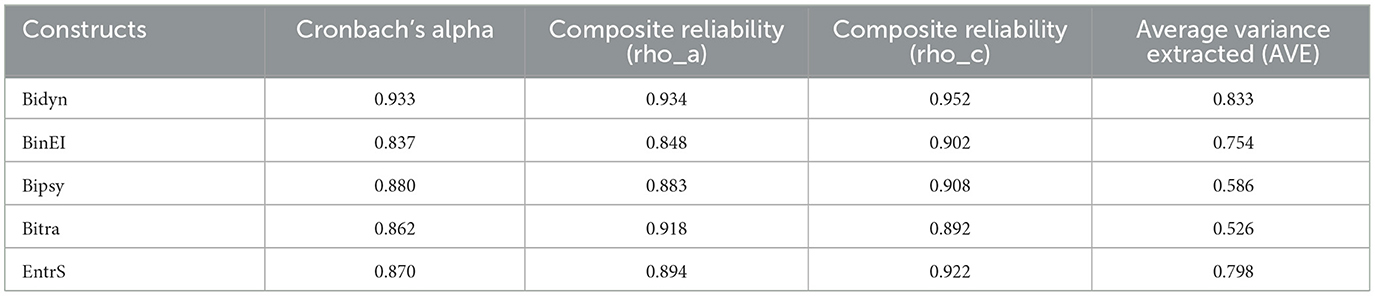
Table 6. Construct reliability and validity.

Table 7. Fornell-Larcker criterion.
Additionally, measurement models' reliabilities were also verified. Indicator reliability with outer loadings higher than 0.70, and internal consistency reliability Cronbach's alpha values between 0.70 and 0.90 are considered satisfactory (Table 6).
Regarding the structural model, the adjusted R2 values of 0.767 and 0.261 measure the extent to which the latent variables explain the variability of the dependent variable. This measure is considered acceptable in social science research. For interpretation, notably, the closer the R2 value is to one, the better the model fit. Additionally, the model does not present collinearity problems (Table 8), as the variance inflation factors (VIFs) are significantly lower than five (the upper limit commonly proposed in the literature).
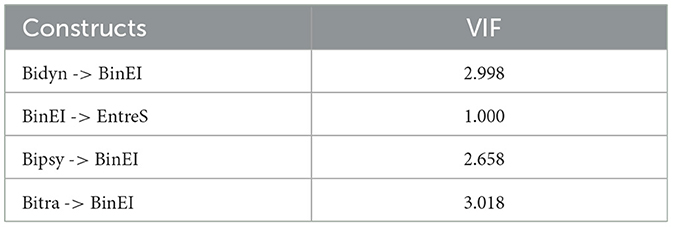
Table 8. Collinearity statistics (VIF).
4 Discussion
The results obtained from the statistical analysis provide significant insights into the relationship between emotional skills, entrepreneurial behaviour, and the sustainability of startups in Spain, particularly in the context of business incubators. First, the evidence highlights how business incubators facilitate the development of entrepreneurs' emotional skills (Galiyeva and Fuschi, 2021; Azadnia et al., 2022). These spaces provide the ideal conditions for trust, security, and collaboration among entrepreneurs, which, in turn, helps strengthen their emotional skills. The presence of mentors, training (Ubfal et al., 2022; Antonovica et al., 2023), dynamic activities (Khan et al., 2022; Jansen et al., 2023), and support networks within business incubators (Ahmed et al., 2020; Nate et al., 2022; Vaz et al., 2022), plays a critical role in the development of business ventures. This is consistent with the findings of Enriquez et al. (2021), Sah (2021), Vidal et al. (2021), and Bartra et al. (2022).
The results also indicate that startups led by individuals with a high level of EI empathy and resilience (Ramadani et al., 2022) tend to experience higher survival and growth rates, which are the main measures of business success in existing literature (Puente, 2020: Blank, 2021; Manconi et al., 2022; Woolley and MacGregor, 2022; Branca et al., 2025). These entrepreneurs exhibit a greater ability to manage stress (Pathak and Goltz, 2021; Khan et al., 2022), greater assertiveness and adaptability to changing environments, enhancing business model innovation, identifying new entrepreneurial opportunities (Guo et al., 2020) and better mental health (Humphrey, 2013; Baciu et al., 2020; Karia, 2021) compared to entrepreneurs with lower levels of EI. The findings also highlight their growing customer base and increased turnover, factors previously emphasised by Fernández et al. (2019), Siddiqui et al. (2021), Fuschi and Galiyeva (2022), and Pattanasak et al. (2022). This confirms the integral role of EI in supporting entrepreneurs during their initial and most vulnerable stages of growth and consolidation and the importance of emotional development in business incubators' efforts to ensure the sustainability of startups (Wang et al., 2019; Doan et al., 2020; Azadnia et al., 2022).
This study demonstrates that the knowledge and skills entrepreneurs acquire from business incubators' training enhance their EI. Psychological support offers theoretical and technical guidance and the ability to overcome challenges and maintain a positive mindset in the face of adversities. The dynamics facilitated by incubators are crucial for strengthening the entrepreneur's confidence, as they provide a supportive environment and ongoing assistance during the most vulnerable phase of their business. Overall, this diverse range of services enhances the long-term viability of the businesses nurtured within these incubators.
The results of this study have significant implications for business theory and practise, highlighting the need to promote emotional development as a fundamental part of the entrepreneurial ecosystem. We suggest that incubators invest more effort in fostering emotional development by strengthening resources and initiatives that support entrepreneurs and creating a collaborative environment. These findings can also influence the formulation of public policies that promote entrepreneurship and business sustainability in Spain. This includes integrating emotional development initiatives within entrepreneurship support programmes and promoting and strengthening business incubators throughout the country.
5 Limitations and future research
This study has certain limitations. First, the research was geographically restricted to Spain, which limits the generalisability of the findings. Second, the questionnaire methodology used for data collection could have biassed the results. Third, as data were collected at a single time point, our data could not capture trends over time, including seasonal variations or other temporal changes. Future research could address these limitations by implementing additional statistical models and using multiple data collection methods to improve the validity and reliability of the findings.
Lastly, this study does not explicitly consider potential disparities related to race, gender, socioeconomic status, or neurodiversity, which may influence the relationship between emotional intelligence (EI) and startup success. Previous research, such as Ray's (2019) study on racialised organisations, demonstrates that many organisations present themselves as racially neutral when, in reality, they are not. Similarly, Stamarski and Hing's (2015) research highlights how decision-makers' biases contribute to sexist behaviours. These findings suggest that, while this study primarily focuses on individual cognitive and emotional factors, future research should incorporate an intersectional perspective to better capture the complexity of the entrepreneurial ecosystem.
Despite these limitations, the positive results achieved in this research highlight the importance of emotional skills in the success and sustainability of startups, especially within business incubators. Our findings suggest that the acquisition of EI, within incubator environments that enable the development of emotional skills is a determining factor in the growth and continuity of startups.
6 Conclusions
Based on the results presented here, we can conclude that business incubators that incorporate emotional support activities into their programmes play a crucial role in developing the EI of hosted entrepreneurs (RQ1), ultimately increasing the possibility of success for their ventures. Our findings reveal that the various initiatives undertaken by these incubators, such as training and capacity-building activities, psychological support, and group dynamics, significantly impact the sustainability and growth of entrepreneurs' startups (RQ2).
The positive influence of these initiatives is expressed in entrepreneurs' ability to manage their emotions efficiently, enhance their communication, leadership, and teamwork skills, and face the challenges and stress associated with the entrepreneurial process. Traditionally, entrepreneurial education and incubation models have focused primarily on technical and strategic skills, often overlooking the emotional and psychological dimensions of entrepreneurship. However, our research suggests that fostering an environment conducive to personal and emotional development enhances entrepreneurs' leadership, teamwork, and adaptability skills, which are critical factors in overcoming the common challenges associated with launching and scaling a business. The study highlights the importance of considering emotional aspects in the design and implementation of entrepreneurship support programmes rather than focusing solely on the rational and technical aspects of entrepreneurship. It is essential to provide an environment that fosters the personal and emotional development of entrepreneurs, as this has a positive influence on incubated companies. Moreover, the study underscores the role of business incubators as dynamic ecosystems that not only provide opportunities for financing and networking but also serve as safe environments where entrepreneurs can cultivate self-confidence, resilience, and problem-solving abilities. The conclusions of this study are supported by and aligned with contemporary research that positions emotional intelligence (EI) as a key factor in business success, particularly in contexts characterised by high levels of uncertainty and competition. Entrepreneurs with well-developed EI are more likely to engage effectively with stakeholders, maintain positive relationships with clients, and lead their teams with empathy and strategic vision. In conclusion, business incubators present themselves as key agents in this process by offering numerous services focused on business technicalities and entrepreneurs' wellbeing and emotional capacity.
Data availability statement
The raw data supporting the conclusions of this article will be made available by the authors, without undue reservation.
Ethics statement
Ethical review and approval was not required for the study on human participants in accordance with the local legislation and institutional requirements. Written informed consent from the participants legal guardian/next of kin was not required to participate in this study in accordance with the national legislation and the institutional requirements.
Author contributions
DD-E-E: Conceptualisation, Data curation, Formal analysis, Investigation, Methodology, Resources, Writing – original draft, Writing – review & editing. CD-P-H: Investigation, Validation, Writing – review & editing. JM-B: Data curation, Software, Writing – review & editing. FJB-J: Project administration, Supervision, Validation, Writing – review & editing.
Funding
The author(s) declare that no financial support was received for the research and/or publication of this article.
Acknowledgments
Our sincere gratitude goes out to the entrepreneurs who generously shared their data, offered their support, and dedicated their time, enabling the completion of this project. We would also like to extend our appreciation to the High Research Performance Group, OPENINNVOVA, Rey Juan Carlos University, as well as the participating business incubators for their invaluable contributions of ideas and resources, which were instrumental in launching our research journey into the realm of business incubation.
Conflict of interest
The authors declare that the research was conducted in the absence of any commercial or financial relationships that could be construed as a potential conflict of interest.
Publisher's note
All claims expressed in this article are solely those of the authors and do not necessarily represent those of their affiliated organizations, or those of the publisher, the editors and the reviewers. Any product that may be evaluated in this article, or claim that may be made by its manufacturer, is not guaranteed or endorsed by the publisher.
References
Ahmad, Z., Chan, W., and Oon, E. (2023). Does congruence between a descendant entrepreneur's personality traits and family business values matter for succession? Front. Psychol. 14:1043270. doi: 10.3389/fpsyg.2023.1043270
Ahmed, N., Li, C., Khan, A., and Qalati, S. A. (2020). An opportunity structure for entrepreneurship growth: the mediating and moderating role of business incubators and government regulations. Pac. Bus. Rev. Int. 12, 114–131. Available online at: https://www.researchgate.net/publication/342364985_An_Opportunity_Structure_for_Entrepreneurship_Growth_The_Mediating_and_Moderating_Role_of_Business_Incubators_and_Government_Regulations
Ahmed, N., Li, C., Qalati, S. A., Rehman, H. U., Khan, A., and Rana, F. (2022). Impact of business incubators on sustainable entrepreneurship growth with mediation effect. Entrep. Res. J. 12, 137–160. doi: 10.1515/erj-2019-0116
Allen, J., Stevenson, R., O'Boyle, E., and Seibert, S. (2020). What matters more for entrepreneurship success? A meta-analysis comparing general mental ability and emotional intelligence in entrepreneurial settings. Strategic Entrep. J. 15, 352–376. doi: 10.1002/sej.1377
Antonovica, A., Curiel, J. D., and Herráez, B. R. (2023). Factors that determine the degree of fulfilment of expectations for entrepreneurs from the business incubator programmes. Int. Entrep. Manag. J. 19, 261–291. doi: 10.1007/s11365-022-00818-1
Azadnia, A. H., Stephens, S., Ghadimi, P., and Onofrei, G. (2022). A comprehensive performance measurement framework for business incubation centres: empirical evidence in an Irish context. Bus. Strat. Env. 31, 2437–2455. doi: 10.1002/bse.3036
Baciu, E., Virga, D., and Lazar, T. (2020). What characteristics help entrepreneurs ‘make it' early on in their entrepreneurial careers? Findings of a regional study from Romania. Sustainability 12:5028. doi: 10.3390/su12125028
Baron, R. A., Franklin, R. J., and Hmieleski, K. M. (2016). Why entrepreneurs often experience low, not high, levels of stress: the joint effects of selection and psychological capital. J. Manag. 42, 742–768. doi: 10.1177/0149206313495411
Bartra, R., Torres, R., and Armesto, C. (2022). Emotional intelligence and collaborator performance in a technological company in lima. 3c Empresa 11, 119–147. doi: 10.17993/3cemp.2022.110149.119-147
Blanco, J., Asensio, C., De Esteban, E., Fernández, F., and Santos, B. (2023). The Services Provided by Business Incubators and Accelerators in Spain. Ranking 2023/2024. FUNCAS. Available online at: https://www.funcas.es/boletines/los-servicios-que-prestan-los-viveros-y-aceleradoras-de-empresas-en-espana-ranking-2023-2024/ (accessed October 15, 2023).
Blank, T. (2021). When incubator resources are crucial: survival chances of student startups operating in an academic incubator. J. Technol. Transf. 46, 1845–1868. doi: 10.1007/s10961-020-09831-4
Boubker, O., Arroud, M., and Ouajdouni, A. (2021). Entrepreneurship education vs. management students' entrepreneurial intentions. A PLS-SEM approach. Int. J. Manag. Educ. 19:100450. doi: 10.1016/j.ijme.2020.100450
Branca, E., Intenza, M., and Doni, F. (2025). Startup entrepreneurs' personality traits and resilience: unveiling the interplay of prior experience. Int. Entrep. Manag. J. 21:2. doi: 10.1007/s11365-024-01023-y
Castilla, G. (2021). Emotional Intelligence and Entrepreneurial Initiative: Future Entrepreneurs in Vocational Training. INFAD Journal of Psychology. International Journal of Developmental and Educational Psychology, 2, 361–366. doi: 10.17060/ijodaep.2021.n2.v2.2243
Cavallo, A., and Ghezzi, A. (2021). Economic growth: the role of digitalization and entrepreneurship. Proceedings of the 16th European Conference on Innovation and Entrepreneurship (ECIE 2021) (Portugal: ACI and Instituto Universitário de Lisboa (ISCTE-IUL)), 177–185.
Chavoushi, Z. H., Nicholls-Nixon, C. L., and Valliere, D. (2020). Mentoring fit, social learning, and venture progress during business incubation. J. Appl. Bus. Econ. 22. doi: 10.33423/jabe.v22i14.3963
De Esteban, E., De Pablos, H., Montes, B., Blanco, J., and García, A. (2022). Business incubators and survival of startups in times of COVID-19. Sustainability 14:2139. doi: 10.3390/su14042139
De Hoe, R., and Janssen, F. (2022). Re-creation after business failure: a conceptual model of the mediating role of psychological capital. Front. Psychol. 13:842590. doi: 10.3389/fpsyg.2022.842590
De Rooji, M., Karch, J., Fokkema, M., Bakk, Z., Pratiwi, B. C., and Kelderman, H. (2023). SEM-based out-of-sample predictions. Struct. Equ. Model. 30, 132–148. doi: 10.1080/10705511.2022.2061494
Doan, T., Nguyen, L., and Nguyen, T. (2020). Emotional intelligence and project success: the roles of transformational leadership and organizational commitment. J. Asian Finance Econ. Bus 7, 223–233. doi: 10.13106/jafeb.2020.vol7.no3.223
Enriquez, C., Pantoja, B., and Cuaran, G. (2021). Research on emotional intelligence in companies. Trends in Ecuadorian Universities. Rev. Conrado 17, 211–219. Available online at: https://conrado.ucf.edu.cu/index.php/conrado/article/view/1888
Fernandes, C., Ferreira, J., Veiga, P., Kraus, S., and Dabic, M. (2022). Digital entrepreneurship platforms: mapping the field and looking towards a holistic approach. Technol. Soc. 70:101979. doi: 10.1016/j.techsoc.2022.101979
Fernández, F., Santos, J., and Blanco, J. (2019). Performance of business incubators and accelerators according to the regional entrepreneurship ecosystem in Spain. Investig. Reg. 43, 41–56. Available online at: http://hdl.handle.net/10017/39166
Fuschi, D., and Galiyeva, N. (2022). Proposal for a set of business incubator performance metrics based system and model analysis. J. Organ. Stud. Innov. 9, 38–61. doi: 10.51659/josi.22-167
Galiyeva, N., and Fuschi, D. (2021). A review of business incubator model related literature and evolution. J. Organ. Stud. Innov. 8, 1–12. doi: 10.51659/josi.21.162
Games, D., Sari, D., Khairiyyah, N., and Shaikh, H. (2023). Entrepreneurial fear of failure and well-being of incubated and non-incubated startups during crises. J. Sci. Technol. Policy Manag. 15, 948–962. doi: 10.1108/JSTPM-03-2022-0052
Garcés, D., García, N., and Roa, L. (2018). Mediating Effect of Emotional Intelligence and Resilience on the Business Success of Entrepreneurs Belonging to the Los Angeles Business Development Center. Doctoral Thesis. University of Concepción, Los Angeles Campus.
García, F., Romero, F., Sarabia, M., and Del Val, M. (2023). Longevity trends in entrepreneurial activity. An analysis of the characteristics of senior entrepreneurship in Spain. Int. J. Entrepreneurial Behav. Res. 29, 1541–1567. doi: 10.1108/IJEBR-06-2022-0547
Goleman, D. (1998b). Working with Emotional Intelligence. New York City, NY: Bantam Doubleday Dell Publishing Group.
Goleman, D. (2006). Social Intelligence: The New Science of Human Relationships. Random House Large Print.
Gozali, L., Masrom, M., Zagloel, T., Haron, H., Garza, R., Tjahjono, B., et al. (2020). Performance factors for successful business incubators in Indonesian public universities. Int. J. Technol. 11, 155–166. doi: 10.14716/ijtech.v11i1.2464
Grace, J. B. (2022). General guidance for custom-built structural equation models. One Ecosyst 7. doi: 10.3897/oneeco.7.e72780
Guo, L. X., Liu, C. F., and Yain, Y. S. (2020). Social entrepreneur's psychological capital, political skills, social networks and new venture performance. Front. Psychol. 11:925. doi: 10.3389/fpsyg.2020.00925
Haugh, H. (2020). Call the midwife! business incubators as entrepreneurial enablers in developing economies. Entrepr. Reg. Dev. 32, 156–175. doi: 10.1080/08985626.2019.1640480
Hoogendoorn, B., Van der Zwan, P., and Thurik, R. (2019). Sustainable entrepreneurship: the role of perceived barriers and risk. J. Bus. Ethics 157, 1133–1154. doi: 10.1007/s10551-017-3646-8
Hu, W., Xu, Y., Zhao, F. Q., and Chen, Y. (2022). Entrepreneurial passion and entrepreneurial success: the role of psychological capital and entrepreneurial policy support. Front. Psychol. 13:792066. doi: 10.3389/fpsyg.2022.792066
Humphrey, R. (2013). The benefits of emotional intelligence and empathy to entrepreneurship. Entrep. Res. J. 3, 287–294. doi: 10.1515/erj-2013-0057
Jansen, A., Bogheanu, C., Kis, I., Tabarcia, M., and Nen, M. (2023). Assertive managerial communication: a purposeful factor for career success during COVID-19 times. Manag. Res. Pract. 15, 34–49. Avaialble online at: https://ideas.repec.org/a/rom/mrpase/v15y2023i1p34-49.html
Karia, N. (2021). A comparative benchmark model for SMEs: viable entrepreneur emotional intelligence. Benchmarking 28, 813–829. doi: 10.1108/BIJ-06-2020-0291
Khan, M., Zubair, S., and Shah, S. (2022). Influence of emotional intelligence on enterprise performance with mediating role of entrepreneurial resilience: a case of SMEs in Pakistan under the light of COVID-19. Transn. Corp. Rev. 15, 118–132. doi: 10.1016/j.tncr.2023.09.008
Kummitha, R. H., and Kummitha, R. K. (2021). Sustainable entrepreneurship training: a study of motivational factors. Int. J. Manag. Educ. 19:100449. doi: 10.1016/j.ijme.2020.100449
Lange, G., and Johnston, W. (2020). The value of business accelerators and incubators–an entrepreneur's perspective. J. Bus. Ind. Mark. 35, 1563–1572. doi: 10.1108/JBIM-01-2019-0024
Li, G., Long, Z., Jiang, Y., Huang, Y., Wang, P., and Huang, Z. (2022). Entrepreneurship education, entrepreneurship policy and entrepreneurial competence: mediating effect of entrepreneurship competition in China. Educ. Train. 65, 607–629. doi: 10.1108/ET-06-2021-0218
Lotito, F. C. (2022). Leadership and emotional intelligence: emotions as a relevant part of business. RAN-Rev. Acad. Negocios 8, 71–86. doi: 10.29393/RAN8-2LIFL10002
Lu, X., Xiong, Y., and Shan, B. (2022). Emotion in the area of entrepreneurship: an analysis of research hotspots. Front. Psychol. 13:922148. doi: 10.3389/fpsyg.2022.922148
Lubishtani, E., Beka, E., and Jahja, A. (2022). The impact of knowledge management and knowledge transfer in growth and innovation a study of business start-ups, business incubators and business accelerators. IFAC Papersonline 55, 54–59. doi: 10.1016/j.ifacol.2022.12.010
Malik, M., Khan, M., and Mahmood, S. (2021). Increasing the efficiency of business process through authentic leaders and follower's attitude. Bus. Process Manag. J. 27, 529–545. doi: 10.1108/BPMJ-04-2020-0162
Man, T., Berger, R., and Rachamim, M. (2022). Social constructivist perspective on novice entrepreneurial learning in business incubators. Int. J. Emerg. Markets 19, 1281–1305. doi: 10.1108/IJOEM-11-2021-1784
Manconi, M., Bellomo, S., Nosella, A., and Agostini, L. (2022). Attributes of business incubators: a conjoint analysis of venture capitalist's decision making. J. Risk Financial Manag. 15:213. doi: 10.3390/jrfm15050213
Mas-Verdú, F., Ribeiro, D. S., and Roig, T. N. (2015). Firm survival: the role of incubators and business characteristics. J. Bus. Res. 68, 793–796. doi: 10.1016/j.jbusres.2014.11.030
Miao, Z. Y. (2020). The influence factors of psychological understanding and behavior choice for legal industry entrepreneurs based on artificial intelligence technology. Front. Psychol. 11:1615. doi: 10.3389/fpsyg.2020.01615
Minarova, M., Mala, D., and Smutny, F. (2020). Emotional intelligence of managers in family businesses in Slovakia. Adm. Sci. 10:84. doi: 10.3390/admsci10040084
Montiel, J., and Soto, A. (2020). An exploratory framework for entrepreneurship from an evolutionary perspective. Retos Rev. Cienc. Adm. Econ. 10, 361–373. doi: 10.17163/ret.n20.2020.10
Munyo, I., and Veiga, L. (2022). Entrepreneurship and economic growth. J. Knowl. Econ. 15, 319–336. doi: 10.1007/s13132-022-01032-8
Nate, S., Grecu, V., Stavytskyy, A., and Kharlamova, G. (2022). Fostering entrepreneurial ecosystems through the stimulation and mentorship of new entrepreneurs. Sustainability 14:7985. doi: 10.3390/su14137985
Oberg, C., Klinton, M., and Stockhult, H. (2020). Inside the incubator: business relationship creations among incubated firms. J. Bus. Ind. Mark. 35, 1767–1784. doi: 10.1108/JBIM-12-2018-0391
Palomeque, S., Plaza, G., and Tapia, E. (2020). Emotional intelligence and entrepreneurship: brief approach to understanding. Rev. Univ. Sociedad 12, 281–287. Available online at: http://scielo.sld.cu/scielo.php?pid=S2218-36202020000400281&script=sci_abstract&tlng=en
Pathak, S., and Goltz, S. (2021). An emotional intelligence model of entrepreneurial coping strategies. Int. J. Entrepreneurial Behav. Res. 27, 911–943. doi: 10.1108/IJEBR-01-2020-0017
Pattanasak, P., Anantana, T., Paphawasit, B., and Wudhikarn, R. (2022). Critical factors and performance measurement of business incubators: a systematic literature review. Sustainability 14:4610. doi: 10.3390/su14084610
Popovici, N., Munteanu, F., and Oprisan, O. (2020). Emotional intelligence and entrepreneurial skills. Knowledge Economy 815–824. Available online at: https://strategica-conference.ro/wp-content/uploads/2022/04/62-1.pdf
Puente, W. (2020). Emotional Intelligence Effect on Transformational Leadership Types Among Startup Entrepreneurs. San Antonio, TX: Our Lady of the Lake University.
Ramadani, V., Agarwal, S., Caputo, A., Agrawal, V., and Dixit, J. K. (2022). Sustainable competencies of social entrepreneurship for sustainable development: exploratory analysis from a developing economy. Bus. Strat. Env. 31, 3437–3453. doi: 10.1002/bse.3093
Ray, V. (2019). A theory of racialized organizations. Am. Sociol. Rev. 84, 26–53. doi: 10.1177/0003122418822335
Redondo, M., and Camarero, C. (2022). Building the first business relationships: incubatees in university business incubators (UBIs). Entrep. Res. J. 12, 597–627. doi: 10.1515/erj-2018-0259
Ringle, C. M., Wende, S., and Becker, J. M. (2022). SmartPLS 4. Oststeinbek: SmartPLS GmbH. Available online at: http://www.smartpls.com
Roustapisheh, N., and Yazdizadeh, H. (2019). Effects of top management support, technological skills, and capabilities on entrepreneurship and organizational performance. Int. Trans. J. Eng. Manag. Appl. Sci. Technol. 10. doi: 10.14456/ITJEMAST.2019.232
Rutka, L., Vitola, I., and Kreituss, I. (2020). “Different level managers' emotional intelligence and their individual performance,” in 14th International Technology, Education and Development Conference (INTED 2020) (Valencia: INTED2020 Proceedings), 3615–3621. doi: 10.21125/inted.2020.1019
Sah, V. (2021). Impact of emotional intelligence on job performance and techniques to improve emotional intelligence. Pac. Bus. Rev. Int. 13, 24–29.
Salimi, N. (2022). “How does the entrepreneurship ecosystem contribute to the performance of entrepreneurial start-up firms?” in: Advances in Best-Worst Method, BWM 2021, eds. J. Rezaei, M. Brunelli, and M. Mohammadi (Springer, Cham), 52–66. doi: 10.1007/978-3-030-89795-6_5
Sanchaniya, R., and Geipele, I. (2021). The role of entrepreneurship activity in economic development. Econom. Sci. Rural Dev. 55, 388–395. doi: 10.22616/ESRD.2021.55.039
Santana, I. D., Ballesteros, J. L., and Dominguez, C. F. (2022). An application of training transfer literature to the analysis of training for entrepreneurship: a conceptual model. Int. J. Manag. Educ. 20:100649. doi: 10.1016/j.ijme.2022.100649
Schiopu, S., Vasile, D., and Tuclea, C. (2015). Principles and best practices in successful tourism business incubators. Amfiteatru Econ. 17, 474–487. Available online at: https://hdl.handle.net/10419/168928
Sevilla, J. B., Sanchez, B. R., and Herrador, A. T. (2022). Success factors of startups in research literature within the entrepreneurial ecosystem. Adm. Sci. 12:102. doi: 10.3390/admsci12030102
Shi, B., and Wang, T. (2021). Analysis of entrepreneurial motivation on entrepreneurial psychology in the context of transition economy. Front. Psychol. 12:680296. doi: 10.3389/fpsyg.2021.680296
Siddiqui, K., Al-Shaikh, M., Bajwa, I., and Al-Subaie, A. (2021). Identifying critical success factors for university business incubators in Saudi Arabia. Entrep. Sustain. Issues 8, 267–279. doi: 10.9770/jesi.2021.8.3(15)
Stamarski, C., and Hing, L. (2015). Gender inequalities in the workplace: the effects of organizational structures, processes, practices, and decision makers' sexism. Front. Psychol. 6:1400. doi: 10.3389/fpsyg.2015.01400
St-Jean, E., and Tremblay, M. (2021). Consequences of the pandemic on the psychological health of the entrepreneur: can public support avoid the worst? Rev. Int. PME. 34, 81–99. doi: 10.7202/1079189ar
Tang, J. J. (2020). Psychological capital of entrepreneur teams and human resource development. Front. Psychol. 11:274. doi: 10.3389/fpsyg.2020.00274
Teruel-Sánchez, R., Briones-Peñalver, A. J., Bernal-Conesa, J. A., and de Nieves-Nieto, C. (2021). Influence of the entrepreneur's capacity in business performance. Bus. Strat. Env. 30, 2453–2467. doi: 10.1002/bse.2757
Torres, T. C., and Vidal, M. B. (2018). The importance of perceived behavioral control as a determining element of entrepreneurial intention among university students. Univ. Empresa 21, 108–135. doi: 10.12804/revistas.urosario.edu.co/empresa/a.6522
Ubfal, D., Arraiz, I., Beuermann, D. W., Frese, M., Maffioli, A., and Verch, D. (2022). The impact of soft-skills training for entrepreneurs in Jamaica. World Dev. 152:105787. doi: 10.1016/j.worlddev.2021.105787
Vaz, R., Teixeira, S. F., and Vidal, J. C. (2022). Comfortable but not brilliant: exploring the incubation experience of founders of technology-based startups. Sustainability 14:15864. doi: 10.3390/su142315864
Vidal, F. D., De Souza, L. M., Mitie, M. H., Rossini, A. C., Limongi, A. C., and Ribeiro, M. I. (2021). The Entrepreneur's View of the Importance of the Five Domains of Intelligence. In Anais. São Paulo: EAD/FEA/USP. Available online at: http://sistema.emprad.org.br/7/anais/download.php?cod_trabalho=111
Villares, M. D., Miguéns, V. R., and Ferreiro, F. S. (2020). Business survival and the influence of innovation on entrepreneurs in business incubators. Sustainability 12:6197. doi: 10.3390/su12156197
Wang, S., Wu, M., and Pan, W. (2019). “The effects and mechanism of leader's emotional intelligence on team innovation performance,” Proceedings of the 2019 5th International Conference on Social Science and Higher Education (Icsshe 2019) (Wuhan: Atlantis Press), 370–373.
Woolley, J., and MacGregor, N. (2022). The influence of incubator and accelerator participation on nanotechnology venture success. Entrepr. Theory Pract. 46, 1717–1755. doi: 10.1177/10422587211024510
Yin, L., and Wu, Y. (2023). Opportunities or threats? The role of entrepreneurial risk perception in shaping the entrepreneurial motivation. J. Risk Financial Manag. 16:48. doi: 10.3390/jrfm16010048
Yousaf, S. U., Hizam-Hanafiah, M., Isa, R. M., Abdullah, N. L., Senik, Z. C., and Usman, B. (2020). Mediating effects of entrepreneurs' work performance on the relationship between their psychological capital and growth intentions: a study on Malaysian entrepreneurs. Southeast Asian J. Manag. 14, 63–78. doi: 10.21002/seam.v14i1.11838
Zhang, Y., Chen, X., and Sun, Q. (2013). “Review of structural equation modeling (SEM) applications,” in: 2nd International Symposium on Instrumentation and Measurement, Sensor Network and Automation (IMSNA) (Toronto, Canada: IEEE), 211–214.
Zhao, H., and Wibowo, A. (2021). Entrepreneurship resilience: can psychological traits of entrepreneurial intention support overcoming entrepreneurial failure? Front. Psychol. 12:707803. doi: 10.3389/fpsyg.2021.707803
Zhao, Y., and Xie, B. (2020). Cognitive bias, entrepreneurial emotion, and entrepreneurship intention. Front. Psychol. 11:625. doi: 10.3389/fpsyg.2020.00625
Keywords: business incubators, emotional intelligence, entrepreneurship, startup, business success
Citation: De-Esteban-Escobar D, De-Pablos-Heredero C, Montes-Botella JL and Blanco-Jiménez FJ (2025) Impact of emotional intelligence on the success of startups in business incubators. Front. Organ. Psychol. 3:1491792. doi: 10.3389/forgp.2025.1491792
Received: 07 September 2024; Accepted: 25 February 2025;
Published: 14 March 2025.
Edited by:
Jose Manuel Saiz-Alvarez, Catholic University of Santiago de Guayaquil, EcuadorReviewed by:
Samantha E. Erskine, University of Massachusetts Boston, United StatesSantiago Gutiérrez-Broncano, University of Castilla-La Mancha, Spain
Antonio Juan Briones-Peñalver, Universidad Politécnica de Cartagena, Spain
Antonio Martínez Raya, Polytechnic University of Madrid, Spain
Copyright © 2025 De-Esteban-Escobar, De-Pablos-Heredero, Montes-Botella and Blanco-Jiménez. This is an open-access article distributed under the terms of the Creative Commons Attribution License (CC BY). The use, distribution or reproduction in other forums is permitted, provided the original author(s) and the copyright owner(s) are credited and that the original publication in this journal is cited, in accordance with accepted academic practice. No use, distribution or reproduction is permitted which does not comply with these terms.
*Correspondence: Débora De-Esteban-Escobar, ZGVib3JhLmRlZXN0ZWJhbkB1cmpjLmVz