In the original article, there was a mistake in Table 2 as published. In the paper by Gerrits et al. (2021) microglia and astrocytes were analyzed separately (i.e., subcluster 0 of astrocytes is not the same as subcluster 0 from microglia). The corrected Table 2 appears below.
Table 2
| Microglia | ||||||||||||||||||
|---|---|---|---|---|---|---|---|---|---|---|---|---|---|---|---|---|---|---|
| Subgroups | Clusters/ | |||||||||||||||||
| genes | ||||||||||||||||||
| ACSL1 | ACSL4 | ALOX15 | ATG7 | FTH1 | FTL | GCH1 | GCLC | HMOX1 | NCOA4 | SAT1 | SLC11A2 | SLC40A1 | SLC7A11 | STEAP3 | TFRC | TP53 | ||
| Homeostatic | 0 | |||||||||||||||||
| 1 | ||||||||||||||||||
| 5 | ||||||||||||||||||
| Amyloid beta-related | 7 | |||||||||||||||||
| 9 | ||||||||||||||||||
| 10 | ||||||||||||||||||
| Tau pathology-related | 2 | |||||||||||||||||
| 3 | ||||||||||||||||||
| 6 | ||||||||||||||||||
| Other | 8 | |||||||||||||||||
| 11 | ||||||||||||||||||
| 4 | ||||||||||||||||||
| 12 | ||||||||||||||||||
Log-fold change of ferroptosis-related DEGs in glia cells in AD.
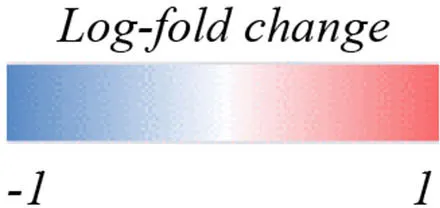
In the original article, there was a mistake in the legend for Table 2 as published. The legend was changed because the content of the Table 2 revised, and we used Log-fold change in the color scale legend. The correct legend appears below.
Data in this table represent the Log-fold change per gene per subcluster. Decreased (blue) and increased (red) expression of ferroptosis-related genes in microglia nuclei isolated from CTR and AD brain tissues. Microglia were clustered into 13 subclusters, that were categorized as follows: 1. homeostatic, 2. Aβ-plaque associated (-AD1) and 3. Tau-associated (AD2), and other subclusters were related to pro-inflammatory responses, cellular stress and proliferation. White space corresponds to unchanged gene expression. ACSL, Long-chain-fatty-acid—CoA ligase; ALOX15, coding for Arachidonate 15-lipoxygenase/15-lipoxygenase-1; ATG, Autophagy related gene; FTH1, Ferritin heavy chain; FTL, Ferritin light chain; GCH1, Guanosine triphosphate cyclohydrolase-1; GCLC, Glutamate-cysteine ligase catalytic subunit; HMOX1, Heme oxygenase 1; NCOA4, Nuclear receptor coactivator 4; SAT1, Spermidine/spermine N1-acetyltransferase; SLC, Solute carrier family; STEAP3, STEAP3 Metalloreductase, TFRC, Transferrin receptor; TP53, tumor protein 53. The differential expression analysis was performed using a logistic regression from which we included ferroptosis-related genes with an adjusted p-value < 0.05. Differential gene expression results were extracted from supplementary table 2 from Gerrits et al. (2021).
Due to the change in Table 2, the text describing it was also revised on page 6, section Differential Expression of Ferroptosis-related Genes in Alzheimer's Disease, paragraph 5.
To further investigate how ferroptosis could affect glia cells in AD, we looked at the difference in expression of ferroptosis-related genes in microglia between control and AD brains containing only amyloid-β plaques in the occipital cortex (OC) and both amyloid-β and tau pathology in the occipitotemporal cortex (OTC) (Gerrits et al., 2021). In this study, the differential expression analysis was performed using a logistic regression and adjusted p-value below 0.05 was used to determine the significance (Gerrits et al., 2021). Microglia belonging to different subclusters (homeostatic, Aβ-related = AD1 and tau-related = AD2) showed changes in the expression of ferroptosis-related genes between AD and control subjects (Table 2). Microglia affected by Aβ pathology alone, or the combination of Aβ and tau pathology showed more DEGs than cells in the homeostatic subcluster. Microglia in the Aβ-related subcluster showed increase in the expression of ferroptosis-related genes, while microglia in tau pathology-related subcluster showed decrease in the expression of these genes. As the presence of tau pathology in OC is typical for later stages of the diseases, these results could suggest that there seem to be a difference between the expression of ferroptosis-related genes between early and late stages of AD. However, whether glia cells die via ferroptotic cell death at later stages of AD should be investigated further.
The authors apologize for this error and state that this does not change the main scientific conclusions of the article in any way. The original article has been updated.
Publisher's Note
All claims expressed in this article are solely those of the authors and do not necessarily represent those of their affiliated organizations, or those of the publisher, the editors and the reviewers. Any product that may be evaluated in this article, or claim that may be made by its manufacturer, is not guaranteed or endorsed by the publisher.
References
1
GerritsE.BrouwerN.KooistraS. M.WoodburyM. E.VermeirenY.LambourneM.et al. (2021). Distinct amyloid-β and tau-associated microglia profiles in Alzheimer's disease. Acta Neuropathol. 141, 681–696. 10.1007/s00401-021-02263-w
Summary
Keywords
neurodegeneration, iron dysregulation, glutathione, lipid peroxidation, amyloid β
Citation
Majerníková N, den Dunnen WFA and Dolga AM (2022) Corrigendum: The Potential of Ferroptosis-Targeting Therapies for Alzheimer's Disease: From Mechanism to Transcriptomic Analysis. Front. Aging Neurosci. 14:863205. doi: 10.3389/fnagi.2022.863205
Received
26 January 2022
Accepted
07 February 2022
Published
08 March 2022
Volume
14 - 2022
Edited and reviewed by
Allison B. Reiss, New York University, United States
Updates
Copyright
© 2022 Majerníková, den Dunnen and Dolga.
This is an open-access article distributed under the terms of the Creative Commons Attribution License (CC BY). The use, distribution or reproduction in other forums is permitted, provided the original author(s) and the copyright owner(s) are credited and that the original publication in this journal is cited, in accordance with accepted academic practice. No use, distribution or reproduction is permitted which does not comply with these terms.
*Correspondence: Amalia M. Dolga a.m.dolga@rug.nl
This article was submitted to Alzheimer's Disease and Related Dementias, a section of the journal Frontiers in Aging Neuroscience
Disclaimer
All claims expressed in this article are solely those of the authors and do not necessarily represent those of their affiliated organizations, or those of the publisher, the editors and the reviewers. Any product that may be evaluated in this article or claim that may be made by its manufacturer is not guaranteed or endorsed by the publisher.