Abstract
Background:
The possible effects of Metaverse environments on psychological and mental health have attracted many researchers’ attention within the past few years. Metaverse is a collection of cyberspaces connected into a single virtual world that can mimic myriads of objects such as real places, societies, and wildlife. People can access them via platforms including gaming consoles, PCs, mobile devices, and the internet. It is widely acknowledged that our understanding of its implications is still in its beginnings. Behavior change because of Metaverse utilization can be positive or negative, and studies in adjacent fields may give insight into how to overcome negative impacts and highlight their benefits.
Objective:
The purpose of this study is to introduce a thorough systematic review of how this virtual world affects users’ psychological and mental wellbeing.
Methods:
Renowned scientific databases have been employed, Scopus and Web of Science, to search for published papers interested in studying this topic from 2020 to April 2024. To identify the relevant papers, a search statement can be formulated from the keywords related to Metaverse, psychology, and mental health. Studies were screened for eligibility based on predefined inclusion and exclusion criteria to include only studies that were published in journals and conferences, and to exclude all types of reviews and meta-analysis studies. The PRISMA guidelines are applied for reporting and VOSviewer software is used for bibliometric analysis. Results: Based on screening the studies, 12 out of 42 papers met the eligibility criteria. Several studies suggest that the Metaverse creates an enjoyable mood and positive emotions.
Conclusion:
While the Metaverse has drawbacks, different Metaverse environments have contributed to boosting the psychological and mental health of the end users. Many articles introduce recommendations to stakeholders in various fields such as learning and education, entertainment, sport, tourism, and healthcare to gain the most benefits from the Metaverse and avoid its detrimental effects.
1 Introduction
Metaverse is a term widely used to refer to persistent 3D environments or digital virtual worlds that allow people to have immersive experiences through virtual interaction with other users, objects, and environments. This digital universe is designed to grant all the features of the real physical world, enabling users to meet, socialize, work, and play in a diverse virtual space using avatars (Gómez-Zará et al., 2023).
Although Meta CEO, Mark Zuckerberg, published a video keynote that consolidated Metaverse in 2021, the term Metaverse has deep roots. It is attributed to Neal Stephenson (1992) (Huggett, 2020) in his novel Snow Crash; it comes from the combination of “meta” and “verse,” apheresis of “universe.” Metaverse changes many aspects of human life, from entertainment to health, advertising, and business (López Díez, 2021). Despite resembling Augmented Reality (AR) and Virtual Reality (VR) applications that are types of simulation technologies designed to either enhance or replicate real physical environments, Metaverse differs from these applications by means of design; it has a service-oriented architecture. The idea is based on the concept of being in another plane of reality in the form of a realm of virtual reality to interact with and/or solve real-world problems. It is not restricted to a single portrayal, but it can vary in many different representations (Park and Kim, 2022; Nari̇n, 2021). Like our brains that can predict sensory events before being experienced, by predictive coding Metaverse creates a hybrid experience that people can manipulate and explore as if they were in (Riva and Dakanalis, 2018). To be realistic, the Metaverse environment aims to mimic the brain model as closely as possible; the more the environment resembles the brain model, the more the user feels real in the Metaverse (Riva, Wiederhold, and Mantovani, 2019; Cerasa et al., 2022).
The COVID-19 pandemic and the need for digital transformation have accelerated the use of Metaverse and other state-of-the-art technologies in many fields such as education and learning, healthcare, tourism, business, sports (Dwivedi, 2022). As a result, there is a significant potential for organizations to adjust their business models to function on the Metaverse, which has diverse impacts on several fields such as marketing, tourism, health, education, social networks. Notable number of studies have highlighted important areas of concern concerning to regulation, ethics, security, safety as well as the probable harmful psychological impact for vulnerable members of society (Lee et al., 2021). Moreover, users are reporting growing levels of offensive and detrimental behaviors such as harassment, bullying, and data exploitation (Glavish, 2022). Every 7 min on average, Metaverse users are exposed to harmful, abusive content (CCDH, 2022). In 2021, Statista emphasized the dangers related to using the Metaverse amongst internet users worldwide and concluded the main concerns are: addiction to virtual reality, privacy, and mental and psychological health issues (Dwivedi, 2022).
On the other hand, Metaverse as an emerging technology has substantial potential to affect psychiatric diagnosis, treatment, research, and education by providing immersive experiences that allow people to discover and interact with digital environments. Moreover, it can help enhance mental health outcomes and improve learning experiences (Torous et al., 2021; Sönmez and Hocaoglu, 2023). People’s relationships with technology are evolving, which suggests that these people’s mental health is probably being impacted in some way. Those who are more involved, for instance, could start to lose sight of the distinction between their real and online identities. A person’s online identity can be different from their identity, and someone can lose track of who they are behind an avatar. Because these individuals spend extra time in an online community, the emotional disturbances caused by this loss of identity may worsen. Spending a lot of time in a place where one feels alienated and alone can exacerbate feelings of depression and alienation (Usmani, Sharath, and Mehendale, 2022). It is crucial to be aware of these problems because, if a sizable segment of the population shares these sentiments, it will undoubtedly affect the quality of life for those people and, perhaps more significantly, the social structures that these people are a part of. Finding answers to potential concerns and averting circumstances that can be detrimental to people’s general wellbeing as well as the wellbeing of society at large are made simpler by knowing how these online technologies affect different emotional and psychological problems. Given the speed at which online technologies are developing, there has never been a better moment to research the psychological implications of these systems to guide the Metaverse’s growth toward beneficial outcomes and stay clear of potentially harmful situations (Atiye Pinar Zumrut, 2023).
This systematic review intends to identify the impact of the Metaverse on the users’ mental and psychological health. This level of analysis should help to guide future development work in this area, ensuring that wellbeing is considered fully during the design of new virtual environments.
2 Methodology
2.1 Protocol/reporting guidelines
The systematic style review is followed and applied using the Preferred Reporting Items for Systematic Review and Meta-analysis statement (PRISMA) (Page et al., 2021). It depicts the methodology of paper selection for the area of interest. A systematic search identified studies related to Metaverse and its effect on users’ mental health and psychological status and accumulated the most relevant studies from prescribed sources. Then these studies were evaluated and analyzed.
A PRISMA flowchart of the whole process is shown in Figure 1. It includes three steps, starting from Identification wherein to identify the online repositories to be used during the systematic review and formulate the search key that complies with the review objectives to have a preliminary set of scientific documents. The second step is to perform the screening process; it includes identifying and applying the articles’ inclusion and exclusion rules, searching for any duplications, and performing manual screening to ensure the selection of the right articles after filtering the un-matching ones. The third and final step is to collect these filtered documents.
FIGURE 1

PRISMA flowchart for the impact of metaverse on psychological and mental health.
2.2 Research questions
As the research questions for all different study designs, and for a systematic review too, should best be defined in terms of Populations, Interventions, Comparators, and Outcomes (PICO) (
Ranganathan and Aggarwal, 2020). In this review, the population is the Metaverse users, the intervention is the Metaverse, comparators are not specified, and the outcome is any changes in participants’ psychological and mental health. Thus, based on PICO, the research questions are:
RQ1. What are the positive effects of Metaverse on psychological and mental health?
RQ2. What are the negative effects of Metaverse on psychological and mental health?
RQ3. What are the recommended mitigation strategies?
2.3 Inclusion and exclusion criteria
It is crucial to set the inclusion and exclusion criteria before the paper selection process to filter out the documents that do not match these criteria. These criteria are:
• Inclusion Criteria:
• Articles and proceedings papers.
• Articles’ titles, keywords, and abstracts are compatible with the research topic.
• Exclusion Criteria:
• Data paper, book chapter, and early access.
• Articles that are not written in English.
• Documents that are published before 2020.
• Duplicated papers.
These criteria are to be identified through check boxes within the online databases or by setting it manually. Document types are chosen to be only articles and proceeding papers, all other sorts of documents such as data papers, book chapters, and early access documents were excluded. Any review papers have been excluded too. Moreover, only documents that were written in English have been selected; papers with languages other than the identified ones were filtered out. The documents were chosen to be published starting in 2020, the commencing year of the Metaverse movement (Tavana and Sorooshian, 2024) due to the raising of the COVID-19 pandemic that began in December 2019 and the lockdown consequences (Tukur et al., 2023), until April 2024. The articles that resulted from this filtering process went through another scanning process to find the duplicated papers in all used databases to avoid repetition. Finally, a manual screening is performed to select only articles matching the research topic.
2.4 Databases and search strategy
Two of the well-known databases have been used to search for the appropriate documents that comply with the inclusion and exclusion criteria concerning the search term, theses databases are Scopus (Burnham, 2006) and Web of Science (WOS) (Sevinc, 2004). These databases were selected to provide a robust and comprehensive foundation for this review. They were chosen because they are amongst the most reliable and widely used academic databases, known for their extensive coverage and high-quality indexing of scientific literature across a wide range of disciplines. While other databases may offer additional studies, the overlap and duplications between major academic databases reflect that most high-quality and impactful research is indexed in Web of Science and Scopus. Expanding to other databases would likely yield diminishing returns in terms of additional relevant studies, while significantly increasing the complexity and resource requirements of our review process. By focusing on WOS and Scopus, we ensure a balance between comprehensiveness and feasibility, leveraging the strengths of these databases to provide a thorough and reliable review (Mongeon and Paul-Hus, 2016).
Clinical Observations proved that psychological and mental health influence each other in many aspects. For example, co-occurrence; mental health problems often come with psychological issues such as people with anxiety may also have negative thinking patterns (Kessler et al., 2012; Wang et al., 2017). Another aspect is the coping skills; good psychological coping skills help preserve and sustain mental health, while poor coping negatively affects mental health and may lead to issues like chronic stress (Riehm et al., 2021; Zacher and Rudolph, 2020). Therefore, in terms of search strategy, the keyword search syntax used in searching all fields in WOS and searching within article title, abstract, and keywords in Scopus are Metaverse AND (Psychological OR Psychology) AND Mental AND Health.
2.5 Selection process
Through searching the databases using the search syntax, 42 records could be obtained through database explorations. Interestingly, the number of papers has not changed after deciding the year margin. Yet, after setting the document type to include only articles and proceeding papers, they counted 23. Five duplicates were identified and eliminated.
Two researchers independently reviewed the titles and abstracts of 18 papers. In disagreement, consensus was reached on inclusion or exclusion by discussion. Six documents were found not to comply with the scope of the research. Therefore, the final number of articles is 12 papers.
2.6 Quality assessment
After applying the inclusion and exclusion criteria and accomplishing the selection process, quality assessment is applied to check the papers’ quality and avoid bias. A study (Teneiji et al., 2024) developed an instrument encompassing four quality assessment criteria. Based on the design, a “No” answer scores 0, “Partially” scores 1, and “Yes” scores 2. All papers with scores <4 are to be excluded. The articles were read by one author and reviewed by another to confirm the reliability of the results. After applying this assessment, the 12 papers scored >4. The quality assessment questions are: (1) Is the theoretical framework clearly presented in the article? (2) Does the paper provide a comprehensive explanation of its research methodology? (3) Does the article provide a clear and detailed description of its data collection methodology? and (4) Does the paper present a clear and comprehensible analysis of the data?
2.7 Data synthesis and extraction
Synthesis can identify the position of different topics seeking an integrative image of the research problem. This is done by designing extraction sheets to precisely record the data obtained from the selected studies. Microsoft Excel spreadsheets were used to extract and categorize the related data into several elements such as research theme, and outcome themes (Han et al., 2018). Different extracted data is depicted in Table 1 such as authors’ names, year of publication, whether it is published in a journal or a conference, database, objectives, and key findings.
TABLE 1
| Ref. In-text citation | Database | Author | Research theme | Study design | Population/Sample size | Objectives | Key findings | Published in | Published date |
|---|---|---|---|---|---|---|---|---|---|
| Villamil and King (2024) | WOS/Scopus | Villamil, A; King, S | Education | Descriptive Research Design | It does not specify a particular sample size | 1. Exploring how online platforms, such as Metaverses, offer distinct social settings for complicated learning experiences. 2. The significance of applying the Social Learning Theory to gain better experience through digital learning configurations and other factors that affecting it |
1-By employing Social Learning Theory, a digital learning environment can contribute to positive technology experiences, and lead to beneficial outcomes such as positive interactions and connections with peers while building adaptive capacities, self-efficacy, and resilience, which are particularly important when people experience personal obstacles or may be struggling through isolation or global pandemics such as COVID-19.2- positive social learning environments encourage exploration, novelty, and connection. 3- building positive digital learning environments can better shape a humane Metaverse as well as other digital domains | Journal | 2024 |
| Wang et al. (2023) | WOS/Scopus | Wang, ML; Liu, SS; Hu, LL; Lee, JY | Entertainment/Education | Mix of Qualitative and Quantitative Research Design | 536 users aged 18–40 years old from various career fields | 1- Define reasons affect users’ preferences in Metaverse that may have influence psychological health negatively. 2- Search the relationship between different users’ experiences in Metaverse such as entertainment and educational experience and their responses that may affect mental health 3- Exploring how utilizing the concept of the experience economy can affect the psychological and mental health of the users |
Entertainment and educational experiences positively influenced the use intention of the Metaverse exhibition. This can be seen in how, when users feel the entertainment and educational experiences, they will be more actively involved and use the Metaverse exhibition | Journal | 2023 |
| Cai et al. (2023) | WOS/Scopus | Cai, L; Huang, ZS; Feng, QJ; Chang, XM; Yan, KX | Healthcare/eSport | Exploratory Research Design | 400 young Chinese athletes aged 18–27 years | 1. To investigate the influence of Metaverse-based digital healthcare system on the eSport performance of young Chinese athletes. 2. To assess the mediating influence of mental health in the relationship between digital healthcare, which based on Metaverse and eSport performance of young athletes in China. 3. To examine the effect of the digital personality on the relationship between the digital healthcare that based on Metaverse and the mental health of the young Chinese players |
Metaverse-based digital healthcare significantly impacts eSport performance. Mental health also has a significant mediating role in the relationship between Metaverse-based digital healthcare and eSport performance, whereas the moderating role of digital personality was also found to be positive in the relationship between Metaverse-based digital healthcare and mental health. The present study results show that digital healthcare provides effective services and information to athletes, which helps improve their eSport performance | Journal | 2023 |
| Yang and Kang (2023) | Scopus | Yang, Sun-Yi; Kang, Mi-Kyung | Education | Experimental Research Design | Third-year nursing students in South Korea (n = 58), with 29 in the experimental group and 29 in the control group | Evaluate the performance of a Metaverse-based early onset schizophrenia simulation program on the nursing students’ knowledge, communication ability, and self-efficacy in caring for patients with early onset schizophrenia | The experimental group, which received the multi-access Metaverse-based schizophrenia nursing simulation program, significantly improved their knowledge scores compared with the control group, which received only an online lecture. This result can be attributed to students’ interactions and experience with applying their lecture-based theoretical knowledge to a virtual situation with multiple simultaneous users, represented by avatars | Journal | 2023 |
| Ezawa et al. (2023) | WOS | Ezawa, I; Hollon, S; Robinson, N | Healthcare | Qualitative Research Design | 127 participants with clinical levels of depression or anxiety symptoms attended at least 2 sessions of CBI. | 1. Assess improvements in depression and anxiety symptoms in those who took part in Cognitive Behavioral Immersion (CBI), a group-based cognitive behavioral skills training program provided online. 2. It intends to investigate the predictors of symptom changes, specifically the working alliance and web-based social support |
Participation in Cognitive Behavioral Immersion (CBI) is associated with both depression and anxiety symptom improvement. Web-based social support may play an important role in fostering changes in depression symptoms | Journal | 2023 |
| Mizuta et al. (2024) | WOS/Scopus | Mizuta, Rami, Noriaki Maeda, Tsubasa Tashiro, Yuta Suzuki, Sayo Kuroda, Ayano Ishida, Sakura Oda et al | Sport | Exploratory Research Design | 48 adults aged between 18 and 30 years were assigned to 3 groups of 16 each: the Metaverse, YouTube, and control group | Whether exercise video distribution using Metaverse space is effective in improving physical activity levels, along with mental health and locomotive function, among young people | Delivering exercise videos through Metaverse space can increase physical activity in young adults by providing a gathering space for individuals similarly motivated for exercise practice. This way, the sense of isolation during exercise is reduced compared with merely distributing videos on YouTube | Journal | 2024 |
| Ud Din and Almogren (2023) | WOS/Scopus | Din, Ikram Ud; Almogren, Ahmad | Tourism | Exploratory Research Design | sample of 100 individuals were randomly assigned to one of three categories: social interaction, gaming, or other activities | The system model aims to boost the performance of monitoring systems in harsh environments by integrating cognitive memory. By considering a variety of factors that affect the user’s mental health, the model approximates its parameters utilizing the MLE method. This model can predict the mental health of users operating in harsh environments and thereby enhance the monitoring system performance | The Metaverse can both enhance and impede mental health and wellbeing, contingent upon the type of activity engaged in within the Metaverse. The investigation sheds light on the Metaverse’s influence on mental health and wellbeing, underscoring the need to consider the nature of activities pursued within the Metaverse while studying its psychological effects | Journal | 2023 |
| Yin et al. (2022) | WOS | Yin, Bin; Wang, Ya-Xin; Fei, Cheng-Yang; Jiang, Ke | Healthcare | Exploratory Research Design | A case of 36-year-old Linda who had suffered from borderline personality disorders | To reformulate the patient’s modes to help in behavior adaptation and reach emotional balance like of the healthy adult by using Metaverse to reconstruct the world surrounding the patient based on the prescription of a psychotherapist | reshaping the patient’s schema modes using the Metaverse can ultimately result in an adaptive, and more inclusive, interaction with the real world | Journal | 2022 |
| Kitty (2024) | WOS | Mo, Kitty Yuen-han | Healthcare | Exploratory Research Design | 15 older adults residing in Hong Kong, usually aged 60 and above | Examine the effectiveness of the Metaverse life story museum reminiscence remedy in enhancing the psychological health of older adults, advancing positive aging, and strengthen remembrance functions | the Metaverse Life Story Museum reminiscence therapy successfully increased reminiscence functions. Reminiscence fulfills numerous functions such as reducing boredom, facilitating social bonding | Journal | 2024 |
| He et al. (2024) | WOS | Jibo He, Sayed Fayaz Ahmad, MunAl-Razgan, Yasser A. Ali, Muhammad Irshad | Healthcare | Quantitative Research Design | 384 individuals aged 18 and above, 245 were males, and 139 were females, who are continuous users of Internet smartphones and other related technology from Pakistan and China | find out the factors affecting the adoption of Metaverse in healthcare. This study explores the effect of perceived ease of use, perceived usefulness, and trust on adopting Metaverse in healthcare by keeping digital division and metaculture as moderating variables | The findings validate the relationship between perceived ease of use and the adoption of Metaverse, and the relationship between perceived usefulness and the adoption of Metaverse | Journal | 2024 |
| Huang et al. (2022) | Scopus | Huang, Zengsong; Choi, Deok-Hwan; Lai, Bingsen; Lu, Zhicheng; Tian, Haijun | Sport | Exploratory Research Design | Young Chinese athletes whose ages range from 12 to 18 years answered 400 questionnaires | Investigate the effect of the Metaverse-based virtual reality sporting experience on the performance stability of the young players from China considering their mental health status and anxiety level | Metaverse sporting experiences significantly positively affect mental health. It reduces performance anxiety significantly | Journal | 2022 |
| Muslihati et al. (2023) | Scopus | Muslihati, Yuliati Hotifah, Wahyu Nur Hidayat, Edy Purwanta, Anabelie V. Valdez, Achmad Miftachul ‘Ilmi, Nur Mega Aris Saputra | Healthcare | Quantitative Research Design | A total of 700 students from 14 schools representing the Malang City, Malang Regency, and Batu City | predict the relationship between the level of mental health quality with online game addiction and social media addiction in high-school-aged (SMA) adolescents | Online games negatively affect mental health at a rate of 31.5%. These findings suggest that adolescents are likelier to develop a negative addiction to online games. It affects the quality of teenagers’ mental health. These results provide empirical evidence for theoretical predictions regarding the impact of Metaverse on mental health quality in adolescents | Journal | 2023 |
Data extraction and classification.
3 Results
In this section, the results are presented and structured according to (1) Numerical Analysis, (2) Synthesis (3) the bibliometric characteristics of the articles, and (4) the articles’ contents and the answers to the research questions.
3.1 Numerical analysis
Figure 2 depicts the trend of Metaverse published papers related to psychological and mental health, over the prescribed years of the review, indicating that the first documents were published in 2022. In addition, it emphasizes the growing interest and research in that field. As a reflection, this area of research is still attractive, and researchers have myriads of opportunities to investigate this state-of-the-art topic. Interestingly, in 2023 the number of published documents has shown a noticeable increase than in 2022; five papers in the case of the Scopus database and four in the case of the WOS database considering the existence of duplicate articles in both databases. For the year 2024, the continuity of the rising trend is diminished, this is because the articles were included until April 2024; the date of accomplishing this review research. However, it is still greater than the number of papers in 2022. It is expected that more documents will be published.
FIGURE 2
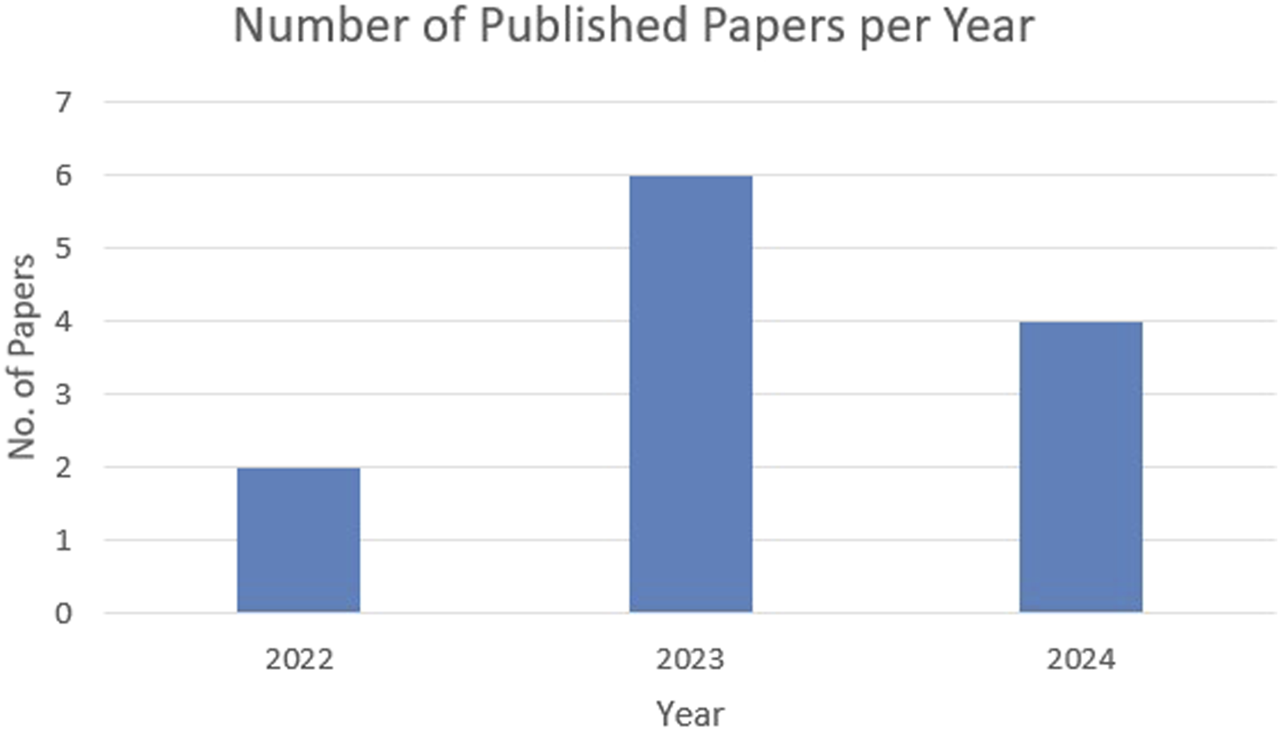
Number of published papers per year.
Furthermore, Figure 3 shows the published documents per country; Figure 3A for the WOS database, and Figure 3B for the Scopus database. The illustration depicts that only limited countries are productive in publishing Metaverse papers related to mental health research, with Eastern countries such as China and South Korea taking the lead. This underlines the need for more knowledge exchange through international collaboration to encourage advanced research and development in the field. China and South Korea are competing for the first and second ranks in the number of published documents between 2022 and 2024. While South Korea placed first by publishing four documents and China ranked second by publishing three papers in the Scopus database, they have exchanged places in the WOS database with four published articles by Chinese scientists and two by South Koreans. Furthermore, the USA researchers placed third in the WOS database by publishing two papers, yet in the Scopus database, they published only one paper. Interestingly, researchers in Japan, Pakistan, and Saudi Arabia could keep the same rank in both databases by publishing one paper per database. Both Macao and Indonesia have one publication in the Scopus database but have no published documents in the WOS database.
FIGURE 3
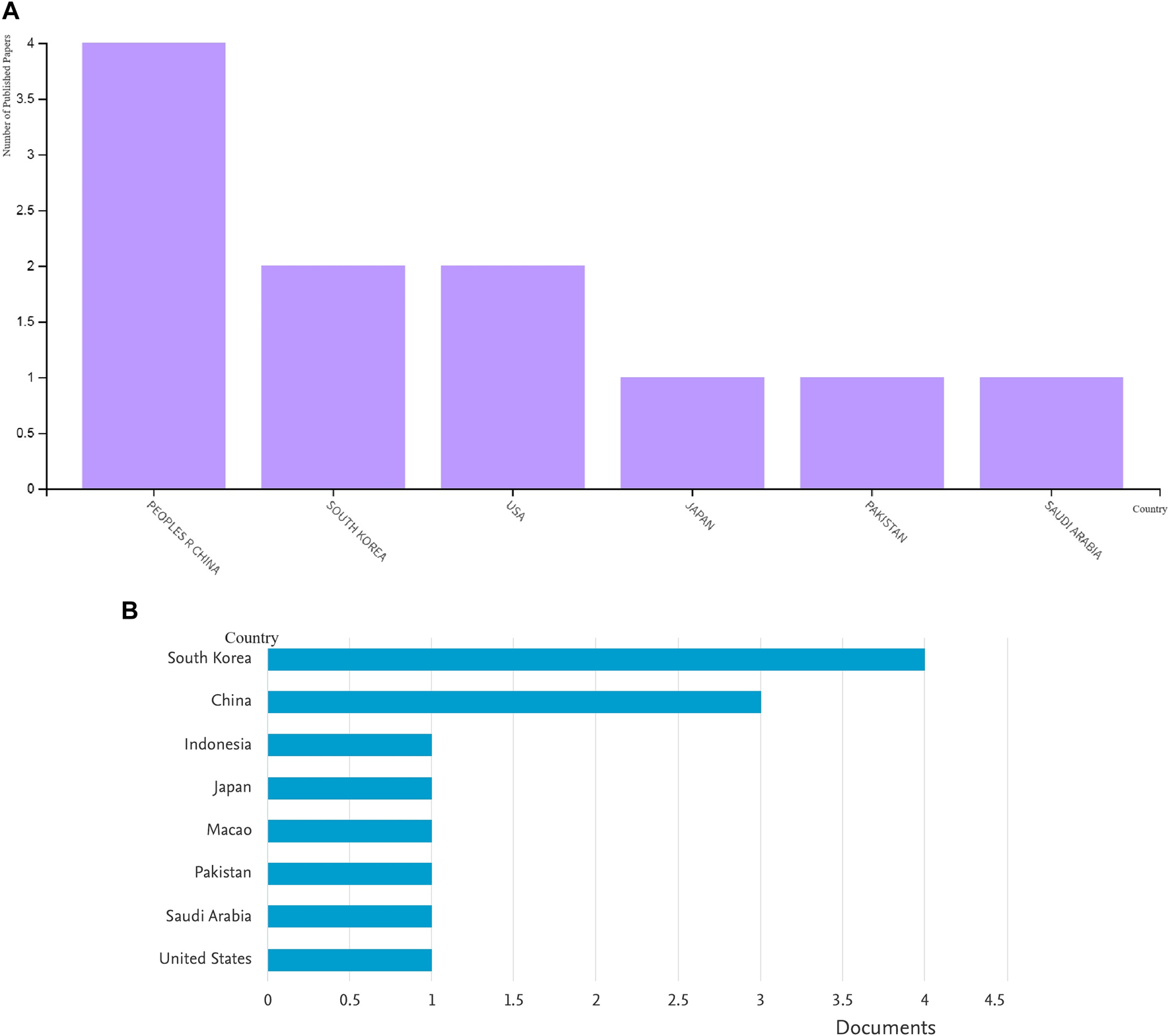
Documents per country (A) web of science database (B) scopus database.
3.2 Synthesis
3.2.1 Research themes
The central issue that determines the focus area of the paper that each article intends to investigate. After careful review, the research themes of the selected studies are education/learning, entertainment, sport, tourism, and healthcare. Some papers were found to share more than one theme; studies with one theme such as (Villamil and King, 2024; Yang and Kang, 2023; Huang et al., 2022; Ud Din and Almogren, 2023; Ezawa et al., 2023; Mizuta et al., 2024; Yin et al., 2022; Kitty, 2024; He et al., 2024; Muslihati et al., 2023), studies with two or more themes such as in (Wang et al., 2023; Cai et al., 2023) as shown in the cone chart in Figure 4 and Table 2 that depict an overview of the research themes by categorizing the selected papers. Figure 4 illustrates the category trend of the published articles. It stresses the high and raising interest in investigating the contribution of Metaverse and its effect on mental health especially in the healthcare and the education themes, especially the healthcare that is the dominant one. It depicts too the limited interest of scientists in conducting research keen to evaluate such effects in areas such as entertainment and tourism. This emphasizes the need for more contributions from researchers and academics to explore the Metaverse and its psychological implications in the entertainment and tourism themes.
FIGURE 4
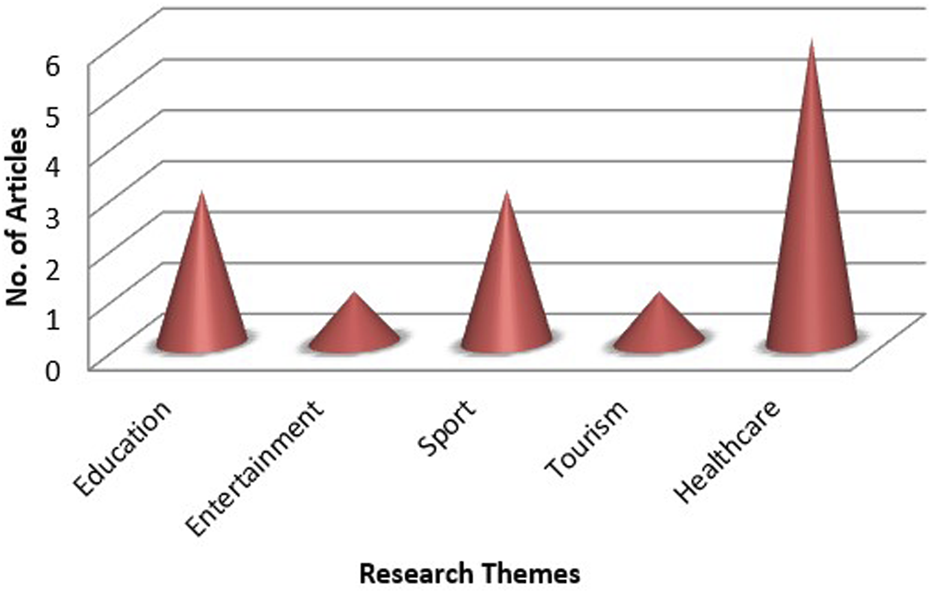
Total number of papers per research theme.
TABLE 2
| Research themes | Papers |
|---|---|
| Education or Learning | Villamil and King (2024), Wang et al. (2023), Yang and Kang (2023) |
| Entertainment | Wang et al. (2023) |
| Sport | Cai et al. (2023), Huang et al. (2022), Mizuta et al. (2024) |
| Tourism | Ud Din and Almogren (2023) |
| Healthcare | Cai et al. (2023), Ezawa et al. (2023), Mizuta et al. (2024),Yin et al., 2022, Kitty (2024),He et al. (2024),Muslihati et al. (2023) |
Distribution of articles by research themes.
3.2.2 Outcome themes
In Table 3, the papers are categorized into outcome themes related to psychological and mental health impacts. Four major themes emerged as being relevant to the outcomes relating to the impact of the Metaverse on psychological and mental health (i) have positive technology experience, (ii) reduce anxiety/stress reduction, (iii) increase engagement/reduce isolation/improve social connection, and (iv) improved cognitive skills. The first theme refers to the accessibility, usability, and availability of a variety of environments in the Metaverse technology that boosted the usage experience. Users’ experience of stress and anxiety reduction is displayed in the second theme. The third theme reflects the users’ experience improving cognitive skills such as memory, attention, problem-solving, and emotional regulation as a term of cognitive psychology.
TABLE 3
| References | Theme 1: Have positive technology experience | Theme 2: Reduce anxiety/Stress reduction | Theme 3: Increase engagement/Reduce isolation/Improve social connection | Theme 4: Improved cognitive skills |
|---|---|---|---|---|
| Villamil and King (2024) | Yes | Yes | Yes | Yes |
| Wang et al. (2023) | Yes | No | Yes | Yes |
| Cai et al. (2023) | Yes | Yes | Yes | Yes |
| Yang and Kang (2023) | Yes | Yes | Yes | Yes |
| Ezawa et al. (2023) | Yes | Yes | No | Yes |
| Mizuta et al. (2024) | Yes | Yes | Yes | No |
| Ud Din and Almogren (2023) | Yes | Yes | Yes | Yes |
| Yin et al. (2022) | Yes | Yes | Yes | Yes |
| Kitty (2024) | Yes | Yes | Yes | Yes |
| He et al. (2024) | Yes | No | Yes | No |
| Huang et al. (2022) | Yes | Yes | Yes | Yes |
| Muslihati et al. (2023) | No | No | No | No |
| Prevails in 91.667% of the studies | Prevails in 75.0% of the studies | Prevails in 83.33% of the studies | Prevails in 75.0% of the studies |
Distribution of articles by outcome themes.
In the context of the first theme, results reflect how having a positive Metaverse experience impacts mental health and psychological wellbeing through different environments, for example, digital learning environments such as (Villamil and King, 2024), digital healthcare environments like (Cai et al., 2023; Yin et al., 2022), or digital sporting environments as in (Mizuta et al., 2024; Huang et al., 2022). Furthermore, the positive Metaverse experience theme has a valuable influence in fostering social connection, engagement and isolation reduction; the third theme was reported in 83.33% of studies. Knowing that stress is a proven risk factor for mental illness in young people (Sapthiang et al., 2019), both the second and fourth themes; the stress and anxiety reduction theme and the improved cognitive skills theme were identified in 75% of the papers involved in the review. On the other hand, although the Metaverse usage was accessible and available in (Muslihati et al., 2023), it is not attained in the first theme because it is identified as a negative experience. Furthermore, the Metaverse addiction was reported to develop symptoms of depression, feelings of loneliness, symptoms of social anxiety and aggressive behavior, mood swings, and negative self-esteem, consequently, the second and third themes were not presented. Besides, that study proved a harmful influence of the addiction to Metaverse and adolescent mental health, therefore, the fourth theme has not been introduced.
3.2.3 Study design
Different study designs (Pradana and Elisa, 2023) were utilized by the authors of the selected articles. Exploratory research design is the most adapted design such as in (Cai et al., 2023; Mizuta et al., 2024; Ud Din and Almogren, 2023; Yin et al., 2022; Kitty, 2024; Huang et al., 2022). Moreover, authors have employed qualitative study design (Ezawa et al., 2023), quantitative design (He et al., 2024; Muslihati et al., 2023), and mixed-method of qualitative and quantitative study design such as (Wang et al., 2023). Some studies used experimental study designs (Yang and Kang, 2023), while others used descriptive research (Villamil and King, 2024).
3.2.4 Population/sample size
The sample size used in the selected studies of the Metaverse impact on psychological and mental health was analyzed in the 12 studies, and it was found that in 33.33% of the paper, the sample used was less than 100 participants such as in (Yang and Kang, 2023; Mizuta et al., 2024; Yin et al., 2022; Kitty, 2024). In only 16.67% of the articles, the sample size was between 100 and 300 individuals. Moreover, a sample size exceeding 300 participants was dominant in the studies with 41.67%. In addition, only one research did not show the sample used (Villamil and King, 2024). The biggest sample size is reported in (Muslihati et al., 2023) with 700 students from 14 schools participating in the study.
3.2.5 Key findings
The main finding of (Cai et al., 2023; Mizuta et al., 2024; Huang et al., 2022) is that practicing sports and physical activities through Metaverse reduces the sense of isolation during exercise, reduces performance anxiety and significantly positively affect mental health. However, spending extra hours on Metaverse games resulted in game addiction that has dramatic consequences on teens’ mental health (Muslihati et al., 2023). Results of having diverse entertainment as well as educational experience through Metaverse as in (Villamil and King, 2024; Wang et al., 2023; Yang and Kang, 2023) shows to positively influenced the use intention of the Metaverse exhibition; users are more actively involved in positive interactions and connections with peers while building adaptive capacities, self-efficacy, and resilience. Different applications of Metaverse in healthcare introduced in (Ezawa et al., 2023; Ud Din and Almogren, 2023; Yin et al., 2022; Kitty, 2024; He et al., 2024) either through Metaverse museums, CBI, reshaping the patient’s schema modes can ultimately result in an adaptive, and more inclusive, interaction with the real world and associated with both depression and anxiety symptom improvement.
3.2.6 Potential bias
Some of the studies reported potential bias such as authors of (Ezawa et al., 2023) who noted some key limitations of this study in the measurement approaches that have been used to measure the alliance, web-based social support and symptoms; although the self-report measures has been validated, different measurement methods can more nuanced valuations of these variables. Moreover, the authors stated that they could not establish causality of relations between variables; they were unable to declare with confidence that participation in CBI causes symptom change without a control group. Authors (He et al., 2024; Huang et al., 2022) reported that his study might face a “common methods bias” type (CMB). In (He et al., 2024) CMB is due to biases of respondents when using surveys. Therefore, the authors checked the variance inflated factors (VIF) to detect the multicanonicity issues between independent variables. Authors (He et al., 2024) reported VIF values smaller than 0.3, the threshold value, and (Huang et al., 2022) VIF is 0.25 for all the independent variables, which reflects that the collected data is free from the multicollinearity threat. In (Mizuta et al., 2024) researchers reported that their study has some limitations. The first is the selection bias might have occurred due to selected participants from one university who did not exercise heavily. Secondly, the difficulty to precisely verify the time and frequency of interactions between participants in the Metaverse space. Lastly, contributors could obtain interventions. They reported too that the selection bias risk might be decreased by running the study on a larger scale and including more institutions. Assigning the principal investigator to be the group leader may lead to data interpretation bias (Kitty, 2024). Two bias limitations were raised in (Cai et al., 2023). The first is the small target audience; only young athletes participated in the study, and no data were collected from old athletes, because of the easy accessibility of young ones and researcher bias.
Consequently, the older generation’s point of view is missed in the eSport context. Secondly, racial bias was detected, as the participants were only Chinese athletes. Researchers in (Villamil and King, 2024) stated that when negative influences are prioritized over positive ones, human negativity bias occurs, which is highly correlated with increased technology engagement. Therefore, it is vital to increase the positivity ratio by building more positive experiences than negative ones to balance the attentional resources contributed to negative emotions.
3.3 Bibliometric characteristics of the articles
For all the selected articles to be analyzed, bibliometrics analysis (Donthu et al., 2021) is a well-known and reliable process for evaluating and investigating large volumes of articles. There are several reasons to perform such analysis, such as to find emerging trends in scientific documents, patterns, and the scholarly structure of a specific domain in the articles.
VOSviewer (Eck and Waltman, 2010) is a bibliometric software used to highlight the spatio-temporal features of the selected articles. Figures 5, 6 show that network nodes represent keywords. Generally, each node size represents the occurrence of that word and the links between these nodes show the co-occurrence between keywords. Furthermore, the thickness of these links represents the co-occurrences between keywords, the thicker the link, the greater the occurrence of co-occurrence between words. The bigger the node, the higher the occurrence number of the keyword.
FIGURE 5
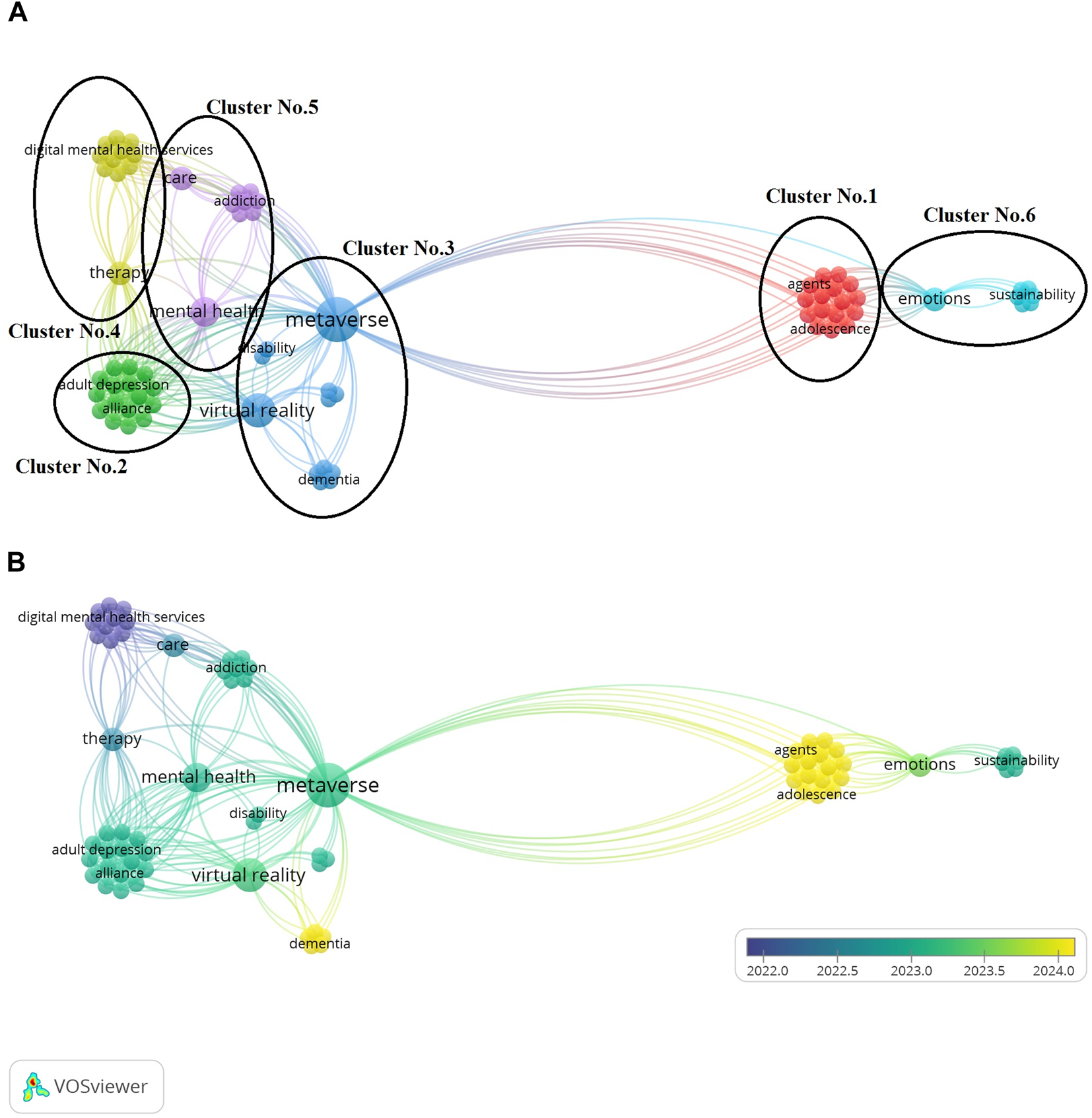
VOSviewer keywords Co-occurrences (A) network visualization (B) publication year overlay visualization.
FIGURE 6
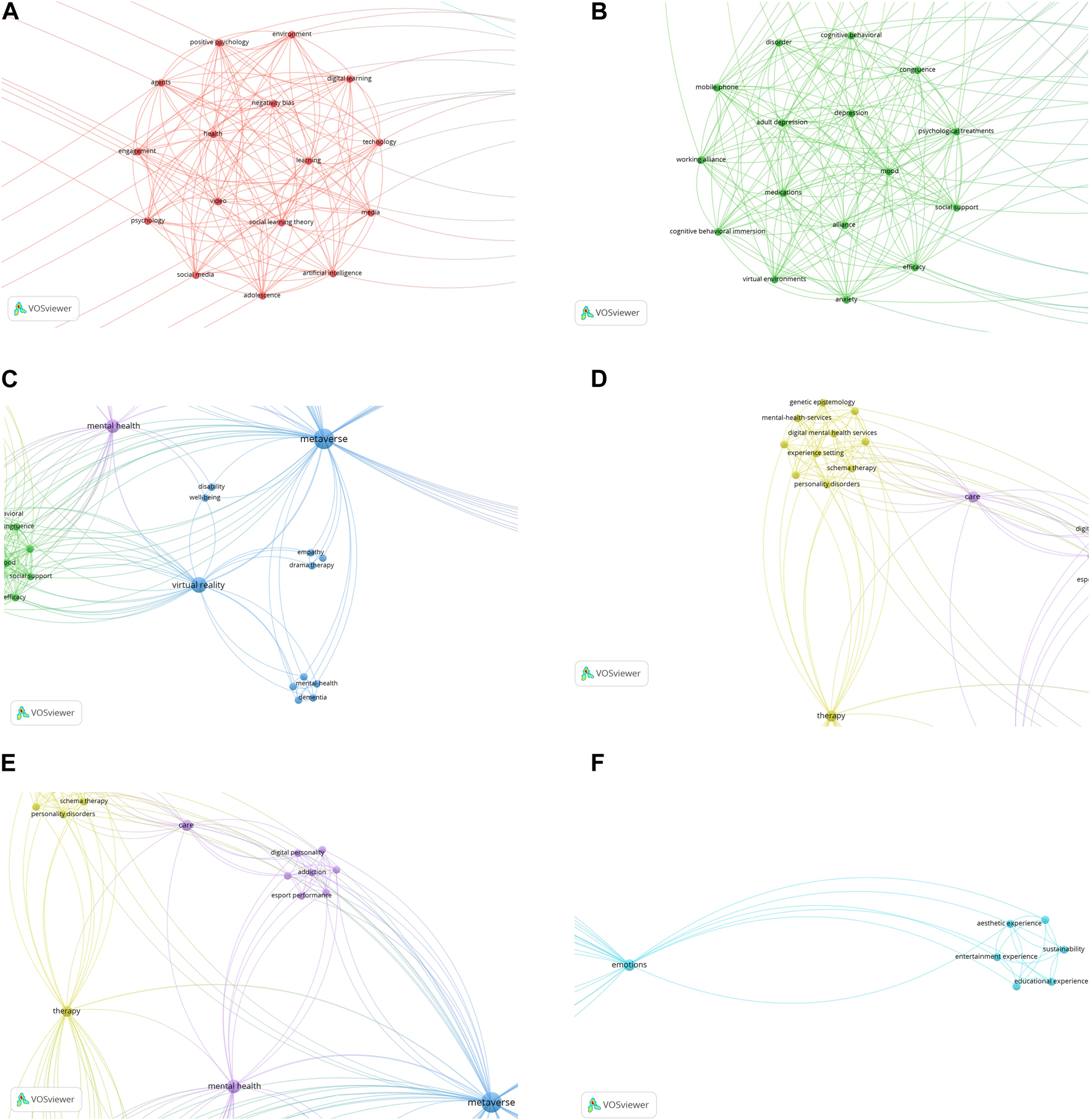
Network visualization of the keyword clusters (A) cluster no. 1, (B) cluster no. 2, (C) cluster no. 3, (D) cluster no. 4, (E) cluster no. 5 and (F) cluster no. 6.
Clusters are represented by colors, in which the nodes and links are used to clarify the covered subjects. The distance between two keywords in the visualization approximately indicates the relatedness of the words in terms of co-occurrence links. In general, the closer two words are located to each other, the stronger their relatedness (Donthu et al., 2021). Based on performing bibliometric analysis of the data that were extracted from the WOS database, Figure 5A depicts the network visualization of keywords co-occurrence grouped in clusters, and (b) overlay visualization of publication year. Overlay visualization identifies correlations between different topics over time. As well as the evolution of research topics. These visualization techniques help researchers quickly identify patterns, trends, and hotspots of research activity. Obviously, overlay visualization shows a remarkable change in 2023 ± 0.5, especially a keyword “Metaverse” granted increased scholarly attention, followed by “virtual reality “and “mental health.”
Furthermore, while in 2022 research might have focused on foundational topics such as “digital mental health services” and the related keywords in cluster No.4, in 2024 the focus may have shifted to specific areas such as “adolescence” and “dementia” and the keywords in cluster No.1. By comparing Figures 5A, B it can be observed that keywords in cluster No.1 and some of cluster No.3 appear in the newest publications in 2024. Cluster No. 2,3,5,6 words exist in 2023 articles and cluster No.4 represents the oldest one in 2022. The software created six clusters with 71 items formulating 520 links. Keywords are listed in Table 4 grouped by colored cluster and each cluster network is shown in Figure 6. Clusters 1 and 2 contain 16 words, cluster 3 has grouped 12 items and 11 in cluster 4. Clusters 5 and 6 have nine and seven words respectively.
TABLE 4
| No. | Cluster No.1 | Cluster No.2 | Cluster No.3 | Cluster No.4 | Cluster No.5 | Cluster No.6 |
|---|---|---|---|---|---|---|
| 1 | adolescence | adult depression | dementia | digital mental health services | addiction | aesthetic experience |
| 2 | agents | alliance | disability | experience setting | care | educational experience |
| 3 | artificial intelligence | anxiety | drama therapy | genetic epistemology | cognitive theory | emotions |
| 4 | digital learning | cognitive behavioral | empathy | mental healthcare | digital healthcare | entertainment experience |
| 5 | engagement | cognitive behavioral immersion | mental-health | mental-health-services | digital personality | psychological state |
| 6 | environment | congruence | Metaverse | personality disorders | esport performance | sustainability |
| 7 | health | depression | older adults | piaget | mental health | use intention |
| 8 | learning | disorder | people | psychotherapy | multiplayer online battle arena (moba) | |
| 9 | media | efficacy | perspective-taking | schema therapy | theory of behaviorism | |
| 10 | negative bias | medications | reminiscence therapy | therapy | ||
| 11 | positive psychology | mobile phone | virtual reality | virtual-reality | ||
| 12 | psychology | mood | wellbeing | |||
| 13 | social learning theory | psychological treatment | ||||
| 14 | social media | social support | ||||
| 15 | technology | virtual environments | ||||
| 16 | video | working alliance |
List of the keywords per clusters in colors.
Cluster No. 3 has the biggest node in the whole network for the “Metaverse” keyword, which means it is the most frequent word that exists in the selected articles. It has occurred seven times with a total link strength of 71. Next is the “virtual reality” keyword, which exists in the same cluster and is repeated four times with total link strength of 33. Next is” mental health” in cluster No. 5, repeated three times with a total link strength of 32. Finally, “emotions” and “therapy” keywords are in cluster No.6 and No.4 respectively. Both have occurred twice with total link strengths of 23 and 31 respectively. When gathering the words that have the highest co-occurrence frequency, which are (Metaverse, virtual reality, mental health, emotions, and therapy), it can be reflected that the main interest of the selected articles complied with the selection criteria that were applied. After performing a bibliometric analysis of the data extracted from the Scopus database, Figure 7 shows the overlay visualization of author co-occurrence per publication year.
FIGURE 7
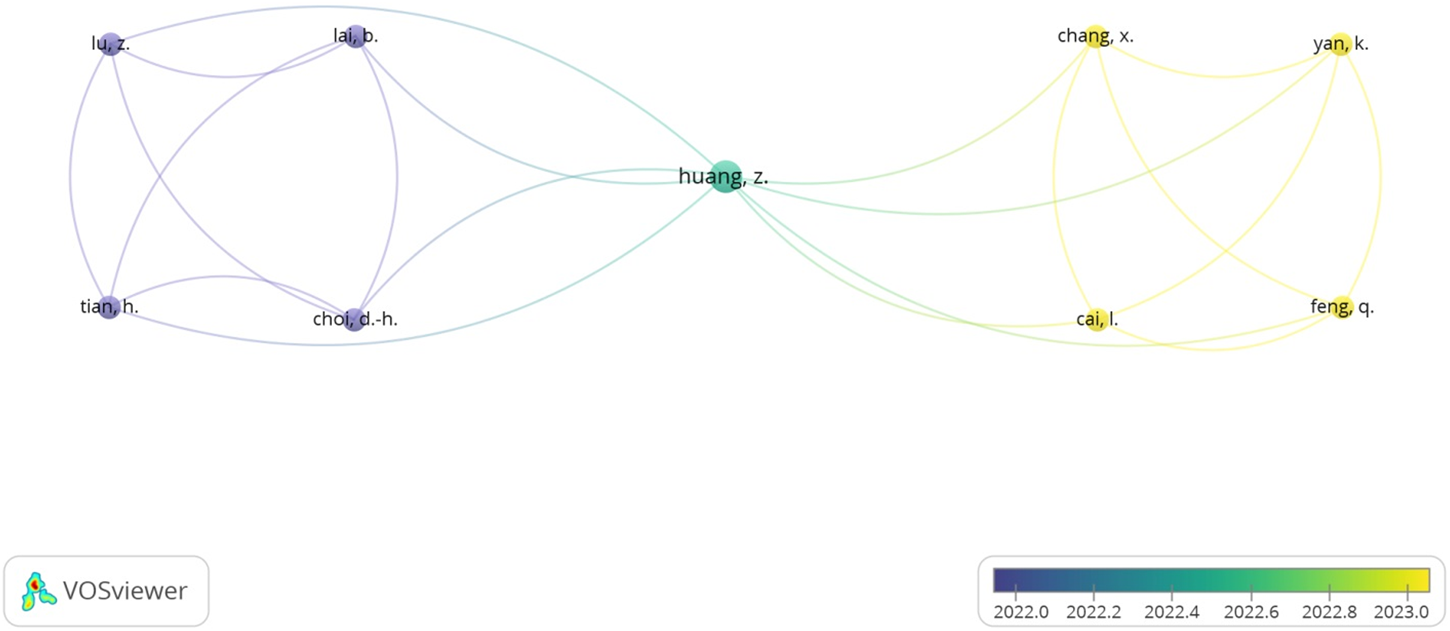
Overlay visualization of author Co-occurrence per publication year.
By choosing the largest set of connected items because some of the items in the network are not connected, two clusters were created with 9 items and 20 links. The first cluster has five authors and the second has four. This analysis revealed that the author Haung Z. (Cai et al., 2023; Huang et al., 2022). has the biggest node and located in cluster No.1. He has published two articles in 2022.5, which means that there is an article that was published in 2022 and another was published in 2023. The rest of the authors in both clusters each have one published article. Moreover, Table 5 shows the two clusters of authors with year of publication, number of publications, and the number of links, and the author who has the greatest number of publications is highlighted in gray. It is imperative to mention that the items in the network do not overlap, for example, although an author has two publications, he is mentioned only in cluster No.1 and does not exist in cluster No.2 and the relationship to the other published document is only represented by a link to the second cluster.
TABLE 5
| Cluster | Author name | Number of articles | Source | Avg. year | Links |
|---|---|---|---|---|---|
| No.1 | Cai, I | 1 | Cai et al. (2023) | 2023 | 4 |
| Chang, X | 1 | Cai et al. (2023) | 2023 | 4 | |
| Feng, Q | 1 | Cai et al. (2023) | 2023 | 4 | |
| Huang, Z | 2 | Cai et al. (2023), Huang et al. (2022) | 2022.5 | 8 | |
| Yan, K | 1 | Cai et al. (2023) | 2023 | 4 | |
| No.2 | Choi,D.-H | 1 | Huang et al. (2022) | 2022 | 4 |
| Lai, B | 1 | Huang et al. (2022) | 2022 | 4 | |
| Lu,Z | 1 | Huang et al. (2022) | 2022 | 4 | |
| Tian,H | 1 | Huang et al. (2022) | 2022 | 4 |
List of authors per clusters.
To analyze the number of citations per country, Figure 8 shows the results concerning the citation year. There are five clusters each cluster represents a country. The countries that have publications, but no citations are not included in Figure 8, such countries are Indonesia, Japan, and the United States. Table 6 depicts that China has the highest number of cited publications 36, followed by South Korea with 34 articles, and the rest of the listed countries each has 2 cited documents which are Saudi Arabia, Macao, and Pakistan. The average publication of the years (Avg.Pub.Year) for China and South Korea means that they have many documents published in 2022 and 2023.
FIGURE 8
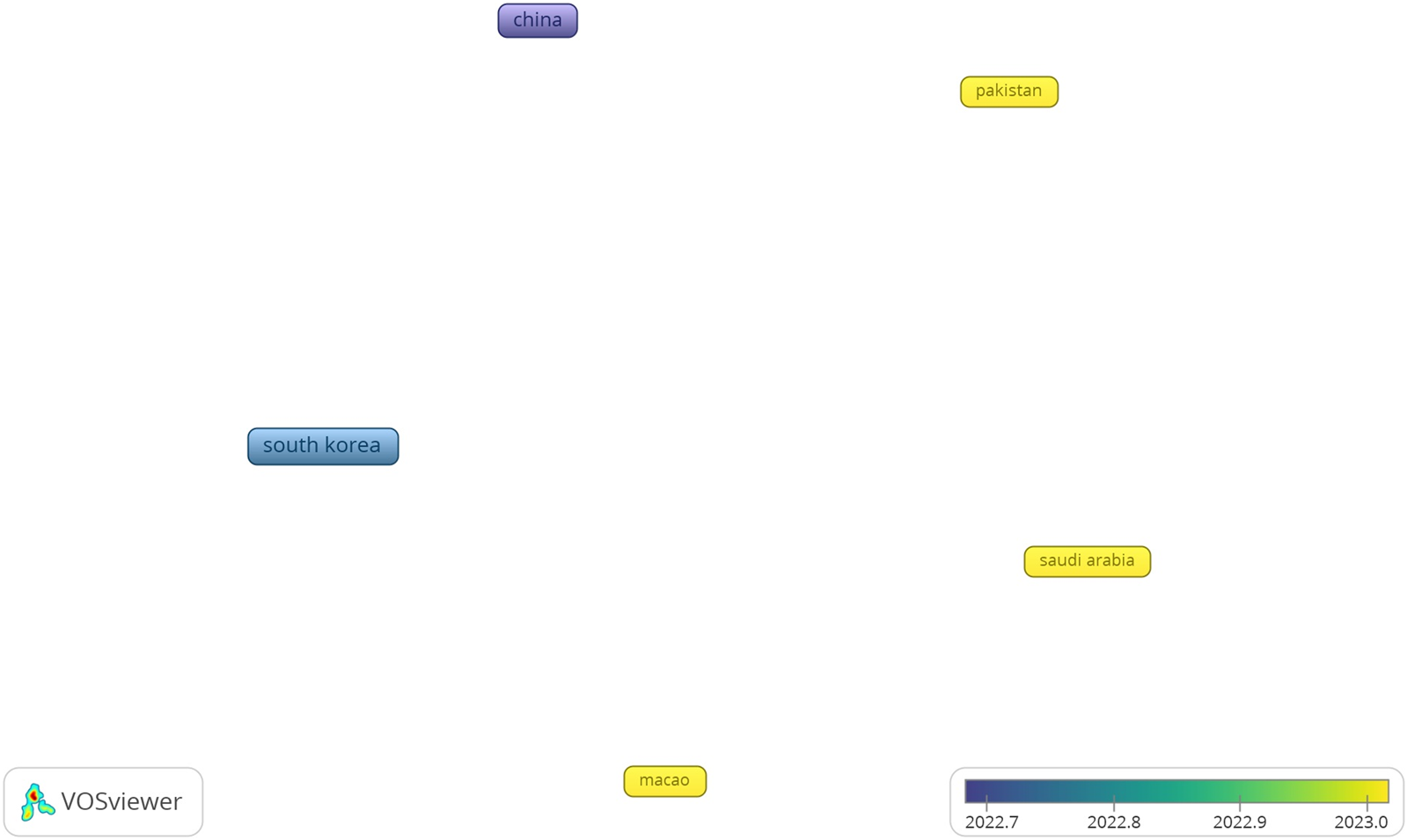
Overlay visualization of number of citations per country.
TABLE 6
| Cluster no. | Country name | Number of documents | Citations | Avg. pub.year |
|---|---|---|---|---|
| 1 | China | 3 | 36 | 2022.67 |
| 2 | Macao | 1 | 2 | 2023 |
| 3 | Pakistan | 1 | 2 | 2023 |
| 4 | Saudi Arabia | 1 | 2 | 2023 |
| 5 | South Korea | 4 | 34 | 2022.75 |
Number of documents and citations per countries.
Table 7 shows that the article published by Haung and Yin in 2022 cited 14 times each, and the paper published by Cai in 2023 has eight citations. Followed by Wang et al. (2023) and Yang and Kang (2023) each had six citations and published their papers in 2023. Each (He et al., 2024; Ud Din and Almogren, 2023) cited twice.
TABLE 7
| Document | Published year | Number of citations |
|---|---|---|
| Mizuta et al. (2024) | 2024 | 3 |
| He et al. (2024) | 2024 | 2 |
| Cai et al. (2023) | 2023 | 8 |
| Villamil and King (2024) | 2024 | 0 |
| Ud Din and Almogren (2023) | 2023 | 2 |
| Huang et al. (2022) | 2022 | 14 |
| Wang et al. (2023) | 2023 | 6 |
| Yang and Kang (2023) | 2023 | 6 |
| Muslihati et al. (2023) | 2023 | 1 |
| Ezawa et al. (2023) | 2023 | 3 |
| Yin et al. (2022) | 2022 | 14 |
| Kitty (2024) | 2024 | 0 |
Number of citations per document.
3.4 Articles’ contents and research questions answers
To enhance user experiences in virtual settings, the research (Villamil and King, 2024) tackles the challenges of creating a Metaverse while highlighting social learning concepts. It could examine how, beyond the traditional classroom settings, the Metaverse might offer a range of dynamic situations that foster creative learning processes. This research uses the Social Learning Theory to illustrate how individuals learn in virtual environments through collaboration, observation, and interaction. In (Wang et al., 2023) authors focus on how the Metaverse platform enhances mental health through reaching emotional balance and therapy. Moreover, online environments offer creative artistic content that enhances the users’ psychological and mental states.
Furthermore, by assessing the emotional status of end users, Metaverse can manage mental and psychological health. Authors (Cai et al., 2023) could shed light on the positive relation between the athlete’s eSport performance and their mental status. It also discusses the digital personality effect on the players’ mental health, cognitive abilities, and performance. The main purpose of the research (Yang and Kang, 2023) is to assess the performance of the schizophrenia simulation program based on Metaverse for enhancing nursing students’ performance in patient care who suffer from onset schizophrenia. It shows that nurses who had this practice had higher scores in knowledge, communication capability, and self-efficacy compared to the control group. The objective of (Ezawa et al., 2023) is to assess the differences in depression and anxiety symptoms in individuals who participated in Cognitive Behavioral Immersion (CBI) by investigating two interpersonal process variables (working alliance and web-based social support) as predictors of symptom changes. Authors (Mizuta et al., 2024) aim to explore whether using exercise videos in the Metaverse space for an exercise intervention has positively influenced physical activity.
Interestingly, results depict a noteworthy improvement in total physical activity in the Metaverse group compared with before the intervention. The study (Ud Din and Almogren, 2023) highlights the psychological effects of using Metaverse on mental health, overall wellbeing, and disability in the tourism industry. It explores that the activity type in the Metaverse determines whether the impacts on psychological and mental health are positive or negative. Moreover, it sheds light on the importance of implementing monitoring systems to protect people’s psychological and mental status in the Metaverse. Furthermore, it underlines the impact of the Metaverse on revolutionizing traditional tourist practices and marketing techniques. This article (Yin et al., 2022) describes the theory, mechanism, process, and ethical considerations of using the Metaverse as a tool in schema therapy for personality disorders. By prescribing specific experiences within the Metaverse, schema therapy techniques can be transformed into natural autobiographical experiences for patients, gradually reshaping their schema modes and promoting adaptive behavior. Researchers (Kitty, 2024) conducted a quasi-experiment on 15 adults using the Metaverse platform to assess its role in enhancing the capability of remembering and improving their psychological health. They could prove the positive contribution of the Metaverse museum as a memory trigger for old adults. In (He et al., 2024) authors aim to define the factors that affect the adoption of the Metaverse in healthcare by exploring the influence of perceived usefulness, perceived ease of use and trust on adopting Metaverse in healthcare by keeping metaculture and digital division as moderating variables. Results confirm the relationship between perceived ease of use and the adoption of Metaverse and moderated by the digital divide.
Moreover, the meta culture does not moderate any of the relationships. Researchers (Huang et al., 2022) studied the influence of the Metaverse-based sporting experience on the stability of young Chinese athletes’ performance considering their mental health condition and anxiety level through utilizing a statistical application called SEM-AMOS for results analysis and validation. They prove that mental health conditions and performance anxiety control the relationship between online sporting experience and performance stability. The authors (Muslihati et al., 2023) aim to investigate whether the social interaction and the quality of mental health of adolescents can be at risk because of Metaverse. This is accomplished by examining the effect of online games and social media addiction on adolescents’ mental health. They proved that virtual games and social media have negative influences on mental health.
The following presents the answers to the research questions based on the previously mentioned results.
RQ1. What are the positive effects of Metaverse on psychological and mental health?
Based on the contents of the selected articles, it can be said that the Metaverse presents a state-of-the-art and innovative way to aid individuals to entertain life as in (Wang et al., 2023; Cai et al., 2023; Huang et al., 2022). It has revolutionarily reshaped different stereotypes of online gaming, sports, learning and education, and healthcare services. It is proven that it could aid patients suffering from stress and anxiety (Ezawa et al., 2023). Moreover, myriad studies show its capability to participate in introducing therapeutics and for better health in many ways such as in (Cai et al., 2023; Ezawa et al., 2023; Mizuta et al., 2024; Yin et al., 2022; Kitty, 2024; He et al., 2024). Creative ideas have been merged in providing such healthcare services as museums (Kitty, 2024). It could offer easier access to support, especially curing and healing aids. This can be done by introducing a series of situations designed by the therapist. The Metaverse environment can mimic the scenarios using several virtual settings. Such settings can easily be changed based on the patient’s status. Moreover, people who use Metaverse tend to accept as a truth that they are the curators of the experiences they went through. This is because this human engagement affects their beliefs in “self-selecting” capabilities which impose their psychological health positively (Villamil and King, 2024). Furthermore, Metaverse museum exhibitions facilitate the creation and display of high-quality artistic works. Entertainment experiences are usually comprehended as positive feelings and good moods caused by certain stimuli that might be an event or behavior. In this case, exploring the Metaverse exhibition can be considered as the stimuli wherein users create virtual characters and move freely in the art space, facilitating active participation and interaction as the entertainment experience continues to improve, ensuing a pleasurable feeling of appreciation (Wang et al., 2023). Psychologically, educational experience requires synchronization between mental processes such as imagination, thoughts, and emotions. Educational spaces introduced as Metaverse museum exhibitions that have artistic designs and provide online interactive learning characters to explore the museum contents. This state-of-the-art education experience creates a sense of pleasure and positive emotions (Wang et al., 2023). Researchers (Muslihati et al., 2023) state myriads of benefits that can be achieved by posing more control and responsibility over online games, such advantages as the improvements of foreign language skills, enhancements of public speaking skills, elimination of social isolation by contributing to teamwork, expanding players’ social circles, it can increase concentration if regulations are followed, and boost pleasure any enjoyments of individuals.
RQ2.What are the negative effects of Metaverse on psychological and mental health?
Despite being attractive, it is dangerous (Villamil and King, 2024). Artificial intelligence algorithms offer various content either beneficial such as awe-inspiring or even funniest content, or bad content such as hatred or harmful content. Moreover, they may offer different experiences to the users wherein offensive messaging or cyberbullying exists. Unfortunately, all these sorts of destructive environments can promote negative behaviors, and victims become accustomed to abusive patterns either online or even in the physical world as they lose their sense of trust and safety. Consequently, this loss has detrimental drawbacks for the users such as negatively affecting self-confidence and raising isolation and depression feelings. Being vulnerable to all these kinds of practices leads to actions that promote alienation and withdrawal, which then reinforce negative emotions such as depression and loneliness (Villamil and King, 2024).
Interestingly, after investigating the selected articles so far, most of these articles have been used to enhance, cure, or find solutions to different psychological and mental health problems either because of dealing in the virtual or physical world. This has been done in healthcare in different branches. For example, in eSport (Cai et al., 2023), in depression and anxiety symptoms enhancement via CBI (Ezawa et al., 2023), in Metaverse space-based exercise videos (Mizuta et al., 2024), in schema therapy (Yin et al., 2022), in Metaverse life story museum reminiscence remedy (Kitty, 2024), and in investigating factors influence adoption of Metaverse in healthcare (He et al., 2024), however, authors (Muslihati et al., 2023) proved that virtual Metaverse games addiction negatively influence adolescent mental health; The higher the level of online game addiction in youngsters, the lower their mental health level. This is because they lose track of time as they daily spend eight to 10 hours playing online games. In addition, they can fall asleep while playing without eating or sleeping, they even may neglect daily activities such as school or family and friends’ interaction. They will feel restless and angry if they are prevented from playing. Online game addicts gradually suffer from aggressive behavior, mood swings, symptoms of depression, negative self-esteem, feelings of loneliness, and symptoms of social anxiety.
Furthermore, a noteworthy result is that male youngsters are more dominant in online game addiction than female scholars. Moreover, female undergraduates are more susceptible to mental health problems than male students; in dealing with various problems, juvenile girls tend to have a higher sense of anxiety than youthful boys. Generally, males benefit from having better resilience in reacting to stressful situations as they lean toward logical thinking and facts. This greatly supports the quality of their mental health.
RQ3. What are the recommended mitigation strategies?
Some studies such as (Villamil and King, 2024) introduced recommendations to catalyze and encourage further discussions and explore areas of investigation among researchers, educators, policymakers, technology designers, caregivers, end users, and other relevant stakeholders from the communities in the field of digital learning environments such as making technology less extractive, implementing robust safeguards, promoting positive psychology interventions and promoting flourishing. Authors (Ud Din and Almogren, 2023) emphasize the significance of founding monitoring systems and custom-made interventions to safeguard persons’ wellbeing in the Metaverse and benefit from its potential to expand tourism experiences. Consequently, it underscores the important contributions of policymakers, mental health practitioners, and tourism industry professionals in their work towards responsible utilization and makes the most of benefits using the Metaverse. Moreover, researchers (Kitty, 2024) recommend that social workers should present Metaverse technology to older adults simultaneously teaching them how to use it safely and securely. In the eSport community, authors in (Huang et al., 2022) suggest that governments may develop arrangements for VR sports contests which results in positive effects on players’ performance. Authors (He et al., 2024) suggest that resolving the digital divide in healthcare as well as the ethical issues caused by Metaverse technology should be done by an international body working under the United Nations. The International Telecommunication Union is necessary for the regulations, policies, and laws related to the Metaverse. In addition, funds should be raised internationally to ensure universal access to Metaverse in healthcare and make it more accessible, beneficial, and easier by converging different technologies. Moreover, different levels of risks, threats, and challenges in the Metaverse should be identified and eliminated to the minimum level so that individuals’ information such as privacy, security, identity remain safe. In the context of online games, to be beneficial, self-regulation and control should be developed in adolescents with the help of parents and teachers so that they can control themselves and be aware of the dramatic consequences of the excessive use of virtual games (Muslihati et al., 2023).
4 Discussion
This systematic review is conducted to investigate the effect of using Metaverse on users’ psychological and mental health. Before commencing this review, there was a prior expectation to find myriads of scientific articles that discuss both the positive and negative consequences of using this sort of virtual world, however, our findings did not match our expectations, and this is discussed in the following subsections.
4.1 Implications of the findings
The results of the study are beneficial for attaining a better understanding of the impact of using Metaverse on psychological and mental health, especially for people who implement this sort of virtual environment and for users who tend to spend time exploring this technology. As per results, there was an expectation to refer to the negative consequences of using such state-of-the-art technology, yet as per the articles that went through the systematic review steps, different Metaverse environments have been created and used for the benefits of users, such as in learning and education, entertainment, sport, tourism and more in the healthcare field. Such virtual environments contribute to boosting the psychological and mental health status of users and yield gain good experience using them. Moreover, many articles introduce recommendations for all stakeholders to control and gain the most benefits from such technology and avoid its detrimental effects.
The technological developments of Metaverse have made crucial contributions in the field of healthcare as well as in education, entertainment, and tourism. In 2022, the Metaverse global healthcare market size was estimated to be 8.9 billion dollars. It is anticipated to reach 71.97 billion dollars by 2030 by growing at a compound annual growth rate of 29.89% from 2022 to 2030 (Kim and Kim, 2023), reflecting its growth potential that necessitates working on the industry transformation, improving access, cost-effectiveness, and patient care service enhancement.
The review explores different applications of Metaverse in various medical domains such as enhancing medical education and training to improve medical staff technical skills and educational level as well as improving the healthcare service (Yang and Kang, 2023). Moreover, it confirms patient safety by reducing risks and ethical concerns correlated to exposing patients to healthcare professionals in the training phase. In addition, for mental health consultants, the Metaverse is proposed to arise as a helpful tool; by enabling them to elevate their therapeutic sessions to an advanced level, expanding their practicing scope socially and geographically, and generating diverse environments that enhance treatment’s accessibility and adherence (He et al., 2024; Cai et al., 2023).
Furthermore, it provides an opportunity for patients with psychological and mental health problems who have no or limited access to this type of healthcare service physically, to benefit from the use of technologies and obtain the appropriate treatment. On the other hand, some factors may limit patients’ access to Metaverse world such as hardware technology cost and operation. In addition, not all individuals accept or can use these new devices, despite their advantages (Ezawa et al., 2023).
The COVID-19 pandemic has triggered an exceptional move to online practice, with the limited availability of traditional clinical practice or face-to-face simulations. Therefore, practicing virtual simulation based on a digital learning environment using various devices. For example, Nursing students who received the multi-access Metaverse-based early onset schizophrenia simulation program significantly improved their knowledge scores. This can be attributed to students’ interactions and experience with applying their lecture-based theoretical knowledge to a virtual situation with multiple simultaneous users, represented by avatars (Yang and Kang, 2023).
Another healthcare application related to online museums is the Metaverse Life Story Museum reminiscence therapy was found to successfully increase gerotranscendence and improve reminiscence functions. Reminiscence provides several functions such as reducing boredom and facilitating social bonding (Kitty, 2024). One more field of application is digital healthcare and its effect on eSport performance. A positive mediating role of mental health in the relationship between Metaverse-based digital healthcare and eSport performance is determined (Cai et al., 2023).
Interestingly, the review notably observed the shifting mindset, determined by the increased adoption of Metaverse-based medical services and the influence of eSports, online museums, and gaming on different users, reflects a growing acceptance of technology especially in the healthcare field (Cai et al., 2023; Kitty, 2024; Mizuta et al., 2024; Huang et al., 2022).
Despite being beneficial, the Metaverse virtual reality universe can cause addiction in people, especially for gaming purposes, leading to psychological disorders by disrupting both reality and time perceptions (Muslihati et al., 2023).
Different implications were raised such as policy, theoretical and managerial Implications (He et al., 2024; Huang et al., 2022; Cai et al., 2023). Concerning policy ones, it is paramount to have well-defined regulations that control the Metaverse’s adoption in healthcare. Such policies should emphasize patient privacy, awareness, ethical issues, and adherence to generally recognized medical practices to ensure trust among the users. In addition, digital inclusion initiatives should be highlighted to help policymakers decrease the gaps considering technological access and knowledge. Moreover, policymakers must improve inclusivity and fair access to Metaverse by posing standardized regulations that overcome cultural differences. As for theoretical Implications, the digital divide is one of the potential challenges the Metaverse in healthcare will be facing. It is the difference between people who have access to contemporary communication technologies and those who do not. Thus, researchers should investigate how to include the factors of the digital divide into the recent theories seeking a deeper understanding concerning the technological adaptation in healthcare. In addition, researchers should study the complex influence of culture on trust for current theories improvements. Lastly, concerning the managerial Implications, different practical strategies should be developed by managers, like training programs, partnerships, research, and cost benefits analysis before the adoption of Metaverse in healthcare. Furthermore, to ensure that every employee can use Metaverse, healthcare managers, and institutions need to create unique programs to address the different levels of digital literacy among medical practitioners. A balanced approach should be followed by healthcare managers, acknowledging that metaculture has minimum influence over trust in the adoption of the Metaverse.
Other findings related to the entertainment and educational research theme show that by offering entertainment and educational experiences through Metaverse environments, individuals will be more actively involved and use the Metaverse world. Different Metaverse exhibitions have overcome the limitations of physical space and time, allowing for increased participation, connection, and communication in social activities. Meanwhile, the Metaverse exhibition promotes offline physical exhibitions, increasing the number of visitors, consequently, endorsing the sustainable development of the economy of the tour destination. In addition, creating different new participation models in the virtual system efficiently increased the quality and frequency of use. (Ud Din and Almogren, 2023; Wang et al., 2023).
4.2 Limitations and future research directions
Although results depict that Metaverse environments have been used in beneficial ways and only negative consequences have been observed, it might have more harmful impacts that may be revealed in articles by changing the search keywords in the next systematic reviews to add words such as “meta,” virtual reality” and “online environment.” Such words can change the search results in the used databases to have more articles related to this area of research. Moreover, in this review two databases have been utilized that are Scopus and WOS. In the future, more online repositories can be used such as Springer, Pubmed, Emerald Insights, and Google Scholar, however, researchers should balance and consider the probability of expanding to further databases may lead to little contribution in terms of additional relevant studies, at the same time having more complex resource requirements of the reviews.
Hence, this systematic review presents a useful contribution that highlights the good involvements of different Metaverse environments that introduce a helping hand to users for the benefit of their psychological and mental health.
5 Conclusion
Nowadays, Metaverse has been used in myriads of contexts that affect the psychological and mental health of wellbeing. This systematic review has discussed various environments and their effects on users’ feelings and mental status. Interestingly, articles reviewed in this paper have revealed the good side of using this new technology; it was used in different fields such as learning and education, entertainment, sport, tourism, and healthcare to study and enhance the psychological and mental health of users. This was a remarkable finding that could collect studies wherein underscore the good contribution of Metaverse in different fields to boost end users’ experience for the benefit of their health status. Moreover, some of these articles introduced recommendations to have a better experience in this virtual world. For a greater understanding of the relationship between Metaverse and psychological and mental health, further research in this area should use more keywords’ synonyms during the search process and use more online repositories too.
Statements
Data availability statement
The datasets presented in this study can be found in online repositories. The names of the repository/repositories and accession number(s) can be found in the article/supplementary material.
Author contributions
RA-Y: Conceptualization, Data curation, Formal Analysis, Investigation, Methodology, Resources, Software, Validation, Visualization, Writing–original draft, Writing–review and editing. AD. AH: Conceptualization, Investigation, Methodology, Project administration, Resources, Software, Supervision, Validation, Visualization, Writing–review and editing.
Funding
The author(s) declare that no financial support was received for the research, authorship, and/or publication of this article.
Conflict of interest
The authors declare that the research was conducted in the absence of any commercial or financial relationships that could be construed as a potential conflict of interest.
Generative AI statement
The author(s) declare that no Generative AI was used in the creation of this manuscript.
Publisher’s note
All claims expressed in this article are solely those of the authors and do not necessarily represent those of their affiliated organizations, or those of the publisher, the editors and the reviewers. Any product that may be evaluated in this article, or claim that may be made by its manufacturer, is not guaranteed or endorsed by the publisher.
References
1
Atiye Pinar Zumrut (2023). Evaluation of the metaverse universe in light of psychology and sociology. Stud. Big Data, 203–218. 10.1007/978-981-99-4641-9_14
2
Burnham J. F. (2006). Scopus database: a review. Biomed. Digit. Libr.3 (1), 1. 10.1186/1742-5581-3-1
3
Cai L. Huang Z. Feng Q. Chang X. Yan K. (2023). Co-transformation of digital health and ESport in metaverse: moderating effects of digital personality on mental health in multiplayer online battle arena (MOBA). Int. J. Environ. Res. Public Health20 (1), 760. 10.3390/ijerph20010760
4
CCDH (2022). Facebook metaverse is unsafe. Available online at: https://www.counterhate.com/metaverse.
5
Cerasa A. Gaggioli A. Marino F. Riva G. Pioggia G. (2022). The promise of the metaverse in mental health: the new era of MEDverse. Heliyon8 (11), e11762. 10.1016/j.heliyon.2022.e11762
6
Donthu N. Kumar S. Mukherjee D. Pandey N. Lim W. M. (2021). How to conduct a bibliometric analysis: an overview and guidelines. J. Bus. Res.133 (September), 285–296. 10.1016/j.jbusres.2021.04.070
7
Dwivedi Y. K. Hughes L. Baabdullah A. M. Ribeiro-Navarrete S. Giannakis M. Al-Debei M. M. et al (2022). Metaverse beyond the hype: multidisciplinary perspectives on emerging challenges, opportunities, and agenda for research, practice and policy. Int. J. Inf. Manag.66 (66), 102542. 10.1016/j.ijinfomgt.2022.102542
8
Eck N. J. van Waltman L. (2010). Software survey: VOSviewer, a computer program for bibliometric mapping. Scientometrics84 (2), 523–538. 10.1007/s11192-009-0146-3
9
Ezawa I. D. Hollon S. D. Robinson N. (2023). Examining predictors of depression and anxiety symptom change in cognitive behavioral immersion: observational study. JMIR Ment. Health10 (July), e42377–77. 10.2196/42377
10
Glavish M. (2022). The dark side of the metaverse, part I. American Enterprise Institute - AEI. Available online at: https://www.aei.org/technology-and-innovation/the-dark-side-of-the-metaverse-part-i/ (Accessed March 17, 2022).
11
Gómez-Zará D. Schiffer P. Wang D. (2023). The promise and pitfalls of the metaverse for science. Nat. Hum. Behav.71–4. 10.1038/s41562-023-01599-5
12
Han H. Xu H. Chen H. (2018). Social commerce: a systematic review and data synthesis. Electron. Commer. Res. Appl.30, 38–50. 10.1016/j.elerap.2018.05.005
13
He J. Ahmad S. F. Al-Razgan M. Zheng C. Yu K. Ali Y. A. et al (2024). RETRACTED: factors affecting the adoption of metaverse in healthcare: the moderating role of digital division, and meta-culture. Heliyon10 (7), e28778–78. 10.1016/j.heliyon.2024.e28778
14
Huang Z. Choi D.-H. Lai B. Lu Z. Tian H. (2022). Metaverse-based virtual reality experience and endurance performance in sports economy: mediating role of mental health and performance anxiety. Front. Public Health10, 991489. 10.3389/fpubh.2022.991489
15
Huggett J. (2020). Virtually real or really virtual: towards a heritage metaverse. Stud. Digital Herit.4 (1), 1–15. 10.14434/sdh.v4i1.26218
16
Kessler R. C. Petukhova M. Sampson N. A. Zaslavsky A. M. Wittchen H.-U. (2012). Twelve-month and lifetime prevalence and lifetime morbid risk of anxiety and mood disorders in the United States. Int. J. Methods Psychiatric Res.21 (3), 169–184. 10.1002/mpr.1359
17
Kim E. J. Kim J. (2023). The metaverse for healthcare: trends, applications, and future directions of digital therapeutics for urology. Int. Neurourol. J.27 (Suppl. 1), S3–S12. 10.5213/inj.2346108.054
18
Kitty Y.-h. M. (2024). Metaverse life story museum and reminiscence group therapy for older adults in Hong Kong. Res. Soc. Work Pract. 10.1177/10497315241236967
19
Lee L.-H. Braud T. Zhou P. Wang L. Xu D. Lin Z. et al (2021). All one needs to know about metaverse: a complete survey on technological singularity, virtual ecosystem, and research agenda. ArXiv:2110.0535214 (8). 10.13140/RG.2.2.11200.05124/8
20
López Díez J. (2021). Metaverso: Año Uno. La presentación en vídeo sobre Meta de Mark Zuckerberg (octubre 2021) en el contexto de los estudios previos y prospectivos sobre metaversos. Pensar La Public. Rev. Int. Investig. Public.15 (2), 299–303. 10.5209/pepu.79224
21
Mizuta R. Maeda N. Tashiro T. Suzuki Y. Kuroda S. Ishida A. et al (2024). Effectiveness of metaverse space–based exercise video distribution in young adults: randomized controlled trial. JMIR Mhealth Uhealth12, e46397–97. 10.2196/46397
22
Mongeon P. Paul-Hus A. (2016). The journal coverage of web of science and Scopus: a comparative analysis. Scientometrics106 (1), 213–228. 10.1007/s11192-015-1765-5
23
Muslihati M. Hotifah Y. N. Nur Hidayat W. Valdez A. V. Purwanta E. Miftachul 'Ilmi A. Nur (2023). Predicting the mental health quality of adolescents with intensive exposure to metaverse and its counseling recommendations in a multicultural context. Cakrawala Pendidik.42 (1), 38–52. 10.21831/cp.v42i1.54415
24
Nari̇n N. G. (2021). A content analysis of the metaverse articles. J. Metaverse1 (1), 17–24.
25
Page M. J. McKenzie J. E. Bossuyt P. M. Boutron I. Hoffmann T. C. Mulrow C. D. et al (2021). The PRISMA 2020 statement: an updated guideline for reporting systematic reviews. Br. Med. J.372 (71), n71. 10.1136/bmj.n71
26
Park S.-M. Kim Y.-G. (2022). A metaverse: taxonomy, components, applications, and open challenges. IEEE Access10 (January), 4209–4251. 10.1109/access.2021.3140175
27
Pradana M. Elisa H. P. (2023). Metaverse in education: a systematic literature review. Cogent Soc. Sci.9 (2). 10.1080/23311886.2023.2252656
28
Ranganathan P. Aggarwal R. (2020). Study designs: Part 7 – systematic reviews. Perspect. Clin. Res.11 (2), 97. 10.4103/picr.picr_84_20
29
Riehm K. E. Holingue C. Smail E. J. Kapteyn A. Bennett D. Thrul J. et al (2021). Trajectories of mental distress among U.S. adults during the COVID-19 pandemic. Ann. Behav. Med.55 (2), 93–102. 10.1093/abm/kaaa126
30
Riva G. Dakanalis A. (2018). Altered processing and integration of multisensory bodily representations and signals in eating disorders: a possible path toward the understanding of their underlying causes. Front. Hum. Neurosci.12 (February), 49. 10.3389/fnhum.2018.00049
31
Riva G. Wiederhold B. K. Mantovani F. (2019). Neuroscience of virtual reality: from virtual exposure to embodied medicine. Cyberpsychology, Behav. Soc. Netw.22 (1), 82–96. 10.1089/cyber.2017.29099.gri
32
Sapthiang S. Van Gordon W. Shonin E. (2019). Health school-based mindfulness interventions for improving mental health: a systematic review and thematic Synthesis of qualitative studies. J. Child Fam. Stud.28 (10), 2650–2658. 10.1007/s10826-019-01482-w
33
Sevinc A. (2004). Web of science: a unique method of cited reference searching. PubMed96 (7), 980–983.
34
Sönmez D. Hocaoglu C. (2023). Metaverse ve psikiyatri: bir gözden geçirme. Psikiyatr. Güncel Yaklaşımlar16 (2), 225–238. 10.18863/pgy.1283964
35
Tavana M. Sorooshian S. (2024). A systematic review of the soft computing methods shaping the future of the metaverse. Appl. Soft Comput.150, 111098. 10.1016/j.asoc.2023.111098
36
Teneiji A Yahia T. Riaz Z. (2024). Factors impacting the adoption of big data in healthcare: a systematic literature review. Int. J. Med. Inf.187, 105460–60. 10.1016/j.ijmedinf.2024.105460
37
Torous J. Bucci S. Bell I. H. Kessing L. V. Faurholt‐Jepsen M. Whelan P. et al (2021). The growing field of digital psychiatry: current evidence and the future of apps, social media, chatbots, and virtual reality. World Psychiatry20 (3), 318–335. 10.1002/wps.20883
38
Tukur M. Schneider J. Househ M. Ahmed H. D. Ismail U. Dawaki M. et al (2023). The metaverse digital environments: a scoping review of the challenges, privacy and security issues. Front. Big Data6, 1301812. 10.3389/fdata.2023.1301812
39
Ud Din I. Almogren A. (2023). Exploring the psychological effects of metaverse on mental health and well-being. Inf. Technol. and Tour.25, 367–389. 10.1007/s40558-023-00259-8
40
Usmani S. S. Sharath M. Mehendale M. (2022). Future of mental health in the metaverse. Gene. Psychi.35 (4), e100825. 10.1136/gpsych-2022-100825
41
Villamil A. King S. (2024). A humane social learning-informed metaverse: cultivating positive technology experiences in digital learning environments. Cyberpsychology, Behav. Soc. Netw.27 (1), 47–56. 10.1089/cyber.2023.0001
42
Wang J. Wu X. Lai W. Long E. Zhang X. Li W. et al (2017). Prevalence of depression and depressive symptoms among outpatients: a systematic review and meta-analysis. BMJ Open7 (8), e017173. 10.1136/bmjopen-2017-017173
43
Wang M. Liu S. Hu L. Lee J.-Y. (2023). A study of metaverse exhibition sustainability on the perspective of the experience economy. Sustainability15 (12), 9153. 10.3390/su15129153
44
Yang S.-Y. Kang M.-K. (2023). Efficacy testing of a multi-access metaverse-based early onset schizophrenia nursing simulation program: a quasi-experimental study. Int. J. Environ. Res. Public Health20 (1), 449. 10.3390/ijerph20010449
45
Yin B. Wang Y.-X. Cheng-Yang F. Jiang K. (2022). Metaverse as a possible tool for reshaping schema modes in treating personality disorders. Front. Psychol.13, 1010971. 10.3389/fpsyg.2022.1010971
46
Zacher H. Rudolph C. W. (2020). Individual differences and changes in subjective wellbeing during the early stages of the COVID-19 pandemic. Am. Psychol.76 (1), 50–62. 10.1037/amp0000702
Summary
Keywords
metaverse, virtual reality, wellbeing, psychology, psychological health, mental health
Citation
Aboul-Yazeed RS, Darwish A and Hassanien AE (2025) Flourish the mood: a systematic review on the impacts of metaverse on psychological and mental health. Front. Virtual Real. 6:1429038. doi: 10.3389/frvir.2025.1429038
Received
07 May 2024
Accepted
28 February 2025
Published
23 April 2025
Volume
6 - 2025
Edited by
Manuel B. Garcia, FEU Institute of Technology, Philippines
Reviewed by
Triton Ong, Doxy.me Inc., United States
Raquel Simões de Almeida, Polytechnic of Porto, Portugal
Updates
Copyright
© 2025 Aboul-Yazeed, Darwish and Hassanien.
This is an open-access article distributed under the terms of the Creative Commons Attribution License (CC BY). The use, distribution or reproduction in other forums is permitted, provided the original author(s) and the copyright owner(s) are credited and that the original publication in this journal is cited, in accordance with accepted academic practice. No use, distribution or reproduction is permitted which does not comply with these terms.
*Correspondence: Rasha S. Aboul-Yazeed, rashasaleh24@hotmail.com, Rasha.Saleh@ecu.edu.eg
Disclaimer
All claims expressed in this article are solely those of the authors and do not necessarily represent those of their affiliated organizations, or those of the publisher, the editors and the reviewers. Any product that may be evaluated in this article or claim that may be made by its manufacturer is not guaranteed or endorsed by the publisher.