 Brent I. Rappaport1*
 Laura Hennefield2
 Autumn Kujawa3
 Kodi B. Arfer4
 Danielle Kelly2
 Emily S. Kappenman5Joan L. Luby2
 Deanna M. Barch1,2,6
- 1Department of Psychological & Brain Sciences, Washington University in St. Louis, St. Louis, MO, United States
- 2Department of Psychiatry, School of Medicine, Washington University in St. Louis, St. Louis, MO, United States
- 3Department of Psychology & Human Development, Vanderbilt University, Nashville, TN, United States
- 4Center for HIV Identification, Prevention, and Treatment Services, University of California, Los Angeles, Los Angeles, CA, United States
- 5Department of Psychology, San Diego State University, San Diego, CA, United States
- 6Department of Radiology, School of Medicine, Washington University in St. Louis, St. Louis, MO, United States
A Corrigendum on
Peer Victimization and Dysfunctional Reward Processing: ERP and Behavioral Responses to Social and Monetary Rewards
by Rappaport, B. I., Hennefield, L., Kujawa, A., Arfer, K. B., Kelly, D., Kappenman, E. S., et al. (2019). Front. Behav. Neurosci. 13:120. doi: 10.3389/fnbeh.2019.00120
In the original article, there was a mistake in Figure 2 as published. In the original article, we had stated that “all data were re-referenced to the average of Tp9 and Tp10” in the Data Analysis section of the Materials and Methods. Although this was our intention, we recently discovered that our scripts had in fact been re-referencing the data to the average of Tp9, Tp10, and Cz electrodes accidentally. Repeating the analyses using the correct referencing and same trials from the original paper yields identical results to those reported in the original article. The corrected Figure 2 appears below. The authors apologize for this error and state that this does not change the scientific conclusions of the article in any way. The original article has been updated.
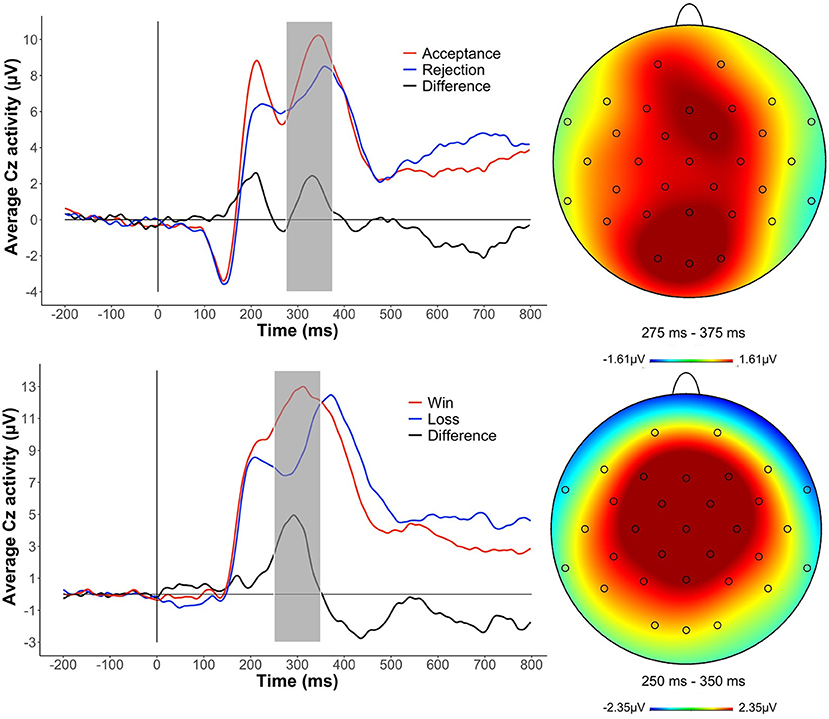
Figure 2. Grand average event-related potential (ERP) waveforms and scalp distributions to social and monetary reward feedback at Cz electrode. Time window is highlighted in gray.
Keywords: peer victimization, event-related potentials (ERP), reward, depression, adolescence, monetary reward, social reward
Citation: Rappaport BI, Hennefield L, Kujawa A, Arfer KB, Kelly D, Kappenman ES, Luby JL and Barch DM (2020) Corrigendum: Peer Victimization and Dysfunctional Reward Processing: ERP and Behavioral Responses to Social and Monetary Rewards. Front. Behav. Neurosci. 14:100. doi: 10.3389/fnbeh.2020.00100
Received: 28 April 2020; Accepted: 22 May 2020;
Published: 23 June 2020.
Edited and reviewed by: Johanna M. Jarcho, Temple University, United States
Copyright © 2020 Rappaport, Hennefield, Kujawa, Arfer, Kelly, Kappenman, Luby and Barch. This is an open-access article distributed under the terms of the Creative Commons Attribution License (CC BY). The use, distribution or reproduction in other forums is permitted, provided the original author(s) and the copyright owner(s) are credited and that the original publication in this journal is cited, in accordance with accepted academic practice. No use, distribution or reproduction is permitted which does not comply with these terms.
*Correspondence: Brent I. Rappaport, YnJhcHBhcG9ydEB3dXN0bC5lZHU=