 Frontiers Production Office
An Erratum on
Rheological Properties and Age-Related Changes of the Human Vitreous Humor
by Tram, N. K., and Swindle-Reilly, K. E. (2018). Front. Bioeng. Biotechnol. 6:199. doi: 10.3389/fbioe.2018.00199
Due to a production error, the value of the Loss Modulus Data Type, for the Human species in the last column of Table 2, was erroneously changed.
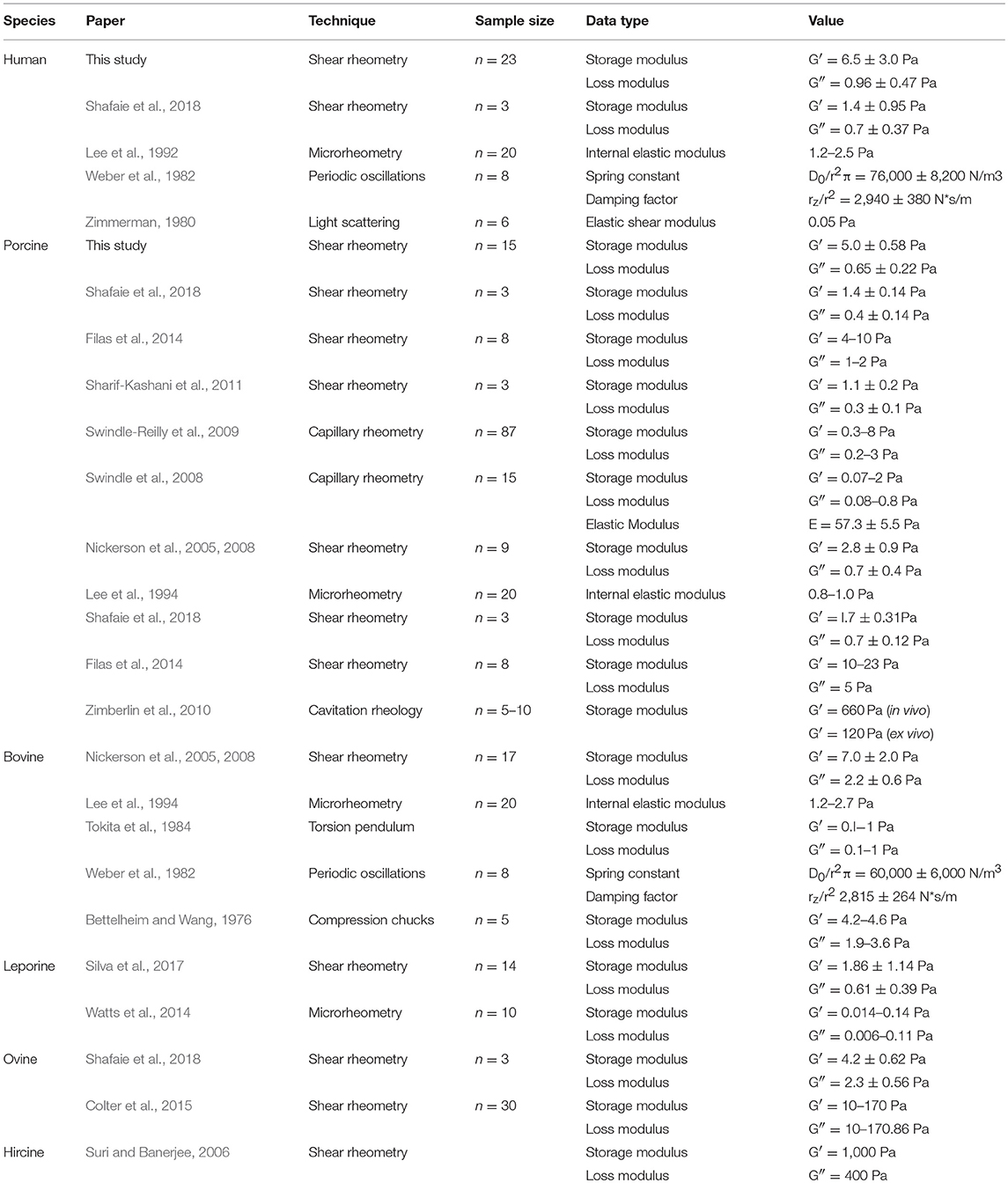
Table 2. Summaries of rheological data of the vitreous humor.
The publisher apologizes for this mistake. The original article has been updated.
References
Bettelheim, F. A., and Wang, T. J. Y. (1976). Dynamic viscoelastic properties of bovine vitreous. Exp. Eye Res. 23, 435–441. doi: 10.1016/0014-4835(76)90172-X
Colter, J., Williams, A., Moran, P., and Coats, B. (2015). Age-related changes in dynamic moduli of ovine vitreous. J. Mech. Behav. Biomed. Mater. 41, 315–324. doi: 10.1016/j.jmbbm.2014.09.004
Filas, B. A., Zhang, Q., Okamoto, R. J., Shui, Y., and Beebe, D. C. (2014). Enzymatic degradation identifies components responsible for the structural properties of the vitreous body. Invest. Ophthalmol. Vis. Sci. 55, 55–63. doi: 10.1167/iovs.13-13026
Lee, B., Litt, M., and Buchsbaum, G. (1992). Rheology of the vitreous body. Part I: viscoelasticity of human vitreous. Biorheology 29, 521–533. doi: 10.3233/BIR-1992-295-612
Lee, B., Litt, M., and Buchsbaum, G. (1994). Rheology of the vitreous body: Part 3. Concentration of electrolytes, collagen and hyaluronic acid. Biorheology 31, 339–351. doi: 10.3233/BIR-1994-31404
Nickerson, C. S., Karageozian, H. L., Park, J., and Kornfield, J. A. (2005). Internal tension: a novel hypothesis concerning the mechanical properties of the vitreous humor. Macromol. Symp. 227, 183–189. doi: 10.1122/1.1917846
Nickerson, C. S., Park, J., Kornfield, J. A., and Karageozian, H. (2008). Rheological properties of the vitreous and the role of hyaluronic acid. J. Biomech. 41, 1840–1846. doi: 10.1016/j.jbiomech.2008.04.015
Shafaie, S., Hutter, V., Brown, M. B., Cook, M. T., and Chau, D. Y. (2018). Diffusion through the ex vivo vitreal body–Bovine, porcine, and ovine models are poor surrogates for the human vitreous. Int. J. Pharm. 550, 207–215. doi: 10.1016/j.ijpharm.2018.07.070
Sharif-Kashani, P., Hubschman, J. P., Sassoon, D., and Kavehpour, H. P. (2011). Rheology of the vitreous gel: effects of macromolecule organization on the viscoelastic properties. J. Biomech. 44, 419–423. doi: 10.1016/j.jbiomech.2010.10.002
Silva, A. F., Alves, M. A., and Oliveira, M. S. N. (2017). Rheological behaviour of vitreous humour. Rheol. Acta 56, 377–386. doi: 10.1007/s00397-017-0997-0
Suri, S., and Banerjee, R. (2006). In vitro evaluation of in situ gels as short term vitreous substitutes. J. Biomed. Mater. Res. A 79, 650–664. doi: 10.1002/jbm.a.30917
Swindle, K. E., Hamilton, P. D., and Ravi, N. (2008). In situ formation of hydrogels as vitreous substitutes: viscoelastic comparison to porcine vitreous. J. Biomed. Mater. Res. A 87, 656–665. doi: 10.1002/jbm.a.31769
Swindle-Reilly, K. E., Shah, M., Hamilton, P. D., Eskin, T. A., Kaushal, S., and Ravi, N. (2009). Rabbit Study of an in situ forming hydrogel vitreous substitute. Invest. Ophthalmol. Vis. Sci. 50, 4840–4846. doi: 10.1167/iovs.08-2891
Tokita, M., Fujiya, Y., and Hikichi, K. (1984). Dynamic viscoelasticity of bovine vitreous body. Biorheology 21, 751–756. doi: 10.3233/BIR-1984-21602
Watts, F., Tan, L. E., Wilson, C. G., Girkin, J. M., Tassieri, M., and Wright, A. J. (2014). Investigating the micro-rheology of the vitreous humor using an optically trapped local probe. J. Opt. 16:015301. doi: 10.1088/2040-8978/16/1/015301
Weber, H., Landwehr, G., Kilp, H., and Neubauer, H. (1982). The mechanical properties of the vitreous of pig and human donor eyes. Ophthalmic Res. 14, 335–343. doi: 10.1159/000265211
Weber, H., Landwehr, G., Kilp, H., and Neubauer, H. (1982). The mechanical properties of the vitreous of pig and human donor eyes. Ophthalmic Res. 14, 335–343. doi: 10.1159/000265211
Zimberlin, J. A., McManus, J. J., and Crosby, A. J. (2010). Cavitation rheology of the vitreous: mechanical properties of biological tissue. Soft Matter 6, 3632–3635. doi: 10.1039/B925407B
Keywords: rheometry, vitreous, aging, ocular biomechanics, liquefaction, eye, viscoelasticity, floaters
Citation: Frontiers Production Office (2019) Erratum: Rheological Properties and Age-Related Changes of the Human Vitreous Humor. Front. Bioeng. Biotechnol. 7:44. doi: 10.3389/fbioe.2019.00044
Received: 20 February 2019; Accepted: 21 February 2019;
Published: 15 March 2019.
Approved by:
Frontiers in Bioengineering and Biotechnology, Frontiers Media SA, SwitzerlandCopyright © 2019 Frontiers Production Office. This is an open-access article distributed under the terms of the Creative Commons Attribution License (CC BY). The use, distribution or reproduction in other forums is permitted, provided the original author(s) and the copyright owner(s) are credited and that the original publication in this journal is cited, in accordance with accepted academic practice. No use, distribution or reproduction is permitted which does not comply with these terms.
*Correspondence: Frontiers Production Office, cHJvZHVjdGlvbi5vZmZpY2VAZnJvbnRpZXJzaW4ub3Jn