 Qianqian Wang
 Xu Sun
 Chen Liu
 Chunge Wang
 Wenjie Zhao
 Zehui Zhu1
 Sheng Zhang
- 1Ningbo Innovation Center, Zhejiang University, Ningbo, China
- 2State Key Laboratory of Chemical Engineering, College of Chemical and Biological Engineering, Zhejiang University, Hangzhou, China
- 3Faculty of Science and Engineering, University of Nottingham Ningbo, Ningbo, China
- 4School of Mechanical and Energy Engineering, NingboTech University, Ningbo, China
In combination with the growing fields of artificial intelligence and Internet-of-things (IoT), the innovation direction of next-generation biosensing systems is toward intellectualization, miniaturization, and wireless portability. Enormous research efforts have been made in self-powered technology due to the gradual decline of traditional rigid and cumbersome power sources in comparison to wearable biosensing systems. Research progress on various stretchable self-powered strategies for wearable biosensors and integrated sensing systems has demonstrated their promising potential in practical biomedical applications. In this review, up-to-date research advances in energy harvesting strategies are discussed, together with a future outlook and remaining challenges, shedding light on the follow-up research priorities.
1 Introduction
The demand for flexible biosensors in biomedical applications is rising rapidly, especially those integrated with self-powered technology (Zhang et al., 2021a; He et al., 2021; Ouyang et al., 2021; Zeng et al., 2022a). The biological system of humans is extremely complex and possesses a series of physiological signals. These signals provide essential information on the human body’s health status (Zhang et al., 2021b; Liu et al., 2021; Zhang et al., 2022a; Jackson et al., 2022; Kukkar et al., 2022). Biosensors’ accuracy, flexibility, stretchability, lightness, and portability have been much improved based on newly developed fabrication techniques and sensing technologies (Guo et al., 2021; Tiwari et al., 2022). However, miniaturized biosensors such as epidermal sensors, tattoo sensors, and tactile sensors usually present limited size and thickness (Gao et al., 2019; Wang et al., 2019; Liu et al., 2020). Therefore, power supply to these types of sensors is challenging since the size of the power device needs to be adapted to the miniaturized nature of the biosensor so that the integrated system can be wearable and stretchable (Table 1).
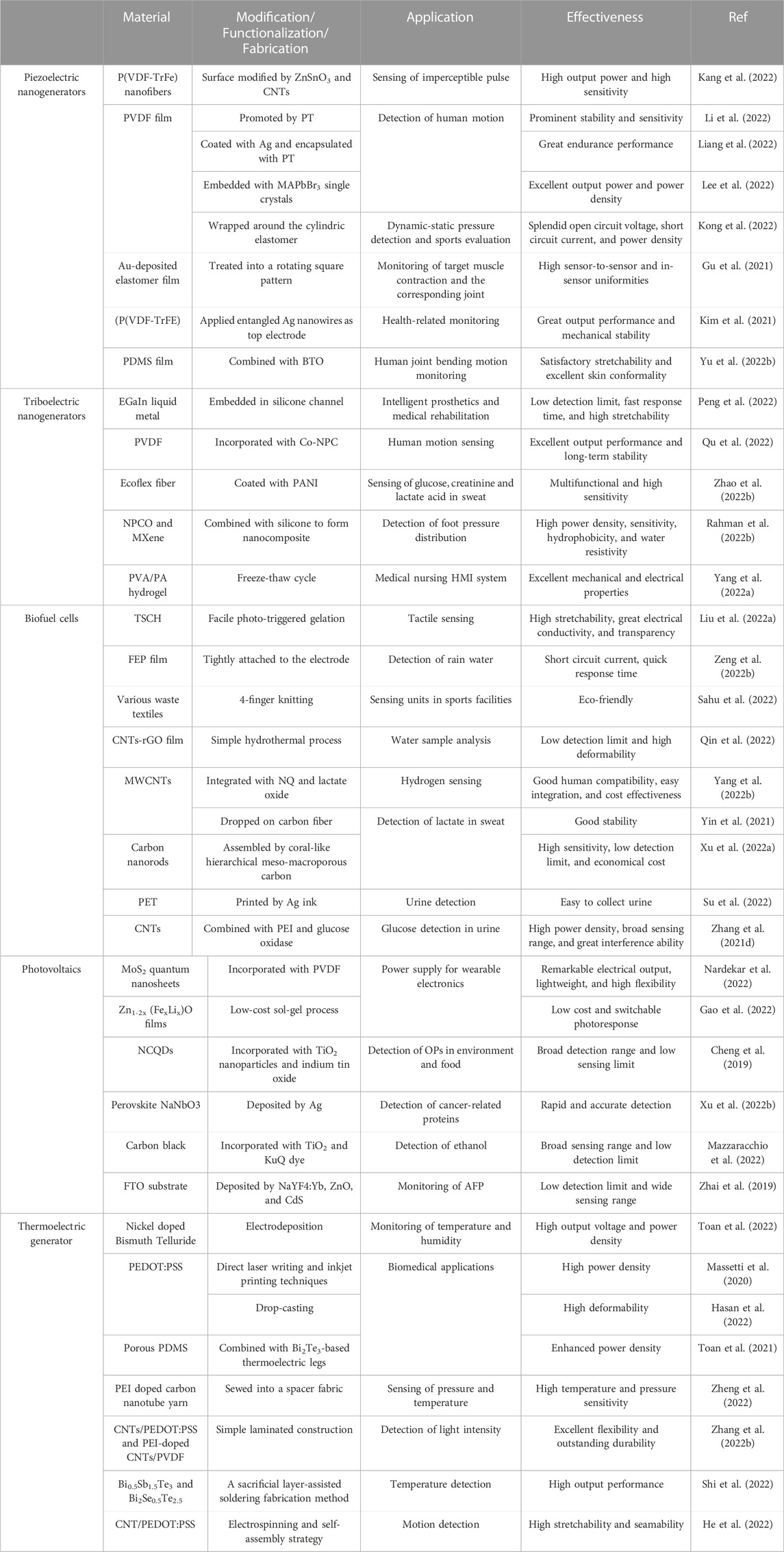
TABLE 1. Examples of self-powered technology towards wearable biosensors and biomedical applications. P(VDF-TrFe): poly (vinylidene fluoride-co-trifluoroethylene); CNTs: carbon nanotubes; PVDF: polyvinylidene fluoride; PT: polythiophene; MAPbBr3: Methylammonium lead tribromide; BTO: barium titanate; EGain: eutectic gallium-indium; Co-NPC: cobalt-based nanoporous carbon; PANI: polyaniline; NPCO: nanoporous cobalt oxide; PVA/PA: polyvinyl alcohol/phytic acid; TSCH: transparent, stretchable and conductive hydrogel; FEP: fluorinated ethylene propylene; CNTs: carbon nanotubes; rGO: reduced graphene oxide; MWCNTs: multi-walled carbon nanotubes; NQ: naphthoquinone; PET: Polyethylene terephthalate; PEI: polyethyleneimine; NCQDs: nitrogen-doped carbon quantum dots; OPs: organophosphorus pesticides; AFP: alpha-fetoprotein.
Self-supply power is a key element for achieving portability of wearable biosensors. The best solution is to abandon traditional external power sources and to allow the biosensors to be self-powered (Reid and Mahbub, 2020). In recent years, soft wearable electronic sensors based on nanomaterials have progressed significantly, benefited by hybrid nanomaterials such as carbon nanomaterials, metallic nanomaterials, metallic compound nanomaterials, and hybrid nanomaterials. As a result, the range of applications has considerably widened, for example, personal health monitoring, human-machine interfaces, smart tactile artificial skin, and personal prosthetics (Liu and Zhu, 2023). Due to the improvements in new nanomaterials, nanogenerators (NGs) can be fabricated with excellent mechanical flexibility and environmental adaptability. For instance, a triboelectric nanogenerator (TENG) can convert the mechanical energy obtained from the environment into effective electric power and signals (Rahman et al., 2022a). According to the capability of triboelectric nanogenerators, artificial intelligence technologies will greatly benefit, including fields such as machine learning, big data processing, and massive sensors with complicated network. In particular, combining the latest 5G technologies with artificial intelligence will allow the Internet of Things (IoT) to progress with great speed, emerging into a new era of human-machine interface (HMI) by applying self-powered operation based on TENGs (Yun et al., 2020). Advancing chemical sensor technologies will enable a generational update to integrated wearable system in a new era of IoT. IoT toward multifunctional, self-powered, and wearable chemical sensors with point-of-care testing (POCT) is an inevitable trend (Wen et al., 2020).
The published self-powered technologies mainly involve two typical types: self-powered sensors and self-powered integrated sensing systems (Ouyang et al., 2021; Tiwari et al., 2022). Self-powered sensors directly transform physical, chemical, or biological fluctuations from the surrounding environment/organisms into electrical information, while self-powered integrated sensing systems need to harvest energy and store it before utilizing it to power the integrated sensor. Both self-powered types of technologies have benefitted from the latest advances in materials science and device designs (Dai et al., 2021). For instance, Panda et al. (Panda et al., 2022) summarized numerous up-to-date piezoelectric biomaterials and device designs applied to Piezoelectric Energy Harvesters (PEHs) to harvest mechanical energy, e.g., motion from human movements and vibration from vital organs, and transform this harvested energy into electricity based on the piezoelectric effect, revealing a new possible way for health monitoring, especially organ health status.
Energy conversion is essential for self-powered technology, determining the power outputs, sensitivity, and durability of the sensor devices (Chadha et al., 2022). In this review, the latest progress on energy conversion strategies for biosensors and biomedical applications is discussed in detail, including sensors self-powered by piezoelectricity, triboelectricity, biofuel cells, photovoltaics, thermoelectricity, and others. Furthermore, this review highlights the state-of-the-art research in self-powered technology and discusses the potential applications and future trends of integrated self-powered biosensor systems.
2 Self-powered technology
Self-powered technologies allow sensing devices to extract and utilize energy from chemical/physical changes in the surrounding environment. Compared to a traditional power source such as a rigid primary or rechargeable battery, the characteristic strengths of self-powered technologies are their excellent deformability and wearability, high security, eco-friendly nature, and high economic efficiency (Prunet et al., 2021; Wu et al., 2021). This section introduces the latest research on self-powered technologies based on a variety of main strategies for energy conversion toward wearable biosensors and biomedical applications.
2.1 Self-powered by piezoelectricity
Composite-based piezoelectric nanogenerators (PENGs) can generate a potential difference when undergoing mechanical deformations, namely, the piezoelectric effect, and can then convert from mechanical energy to electrical energy. PENGs are widely adopted in wearable biosensors and biomedical applications as a prominent self-powered technology (Yu et al., 2022a). To cope with the intrinsic flexibility and various deformation of different human body parts, PENGs, or the sensing system integrated with PENGs, are required to be deformable and stretchable (Zhou et al., 2020). Previous research demonstrates that new polymer-based PENGs, advanced piezoelectric materials, and rational stretchable design can effectively contribute to wearable high-power-density PENGs and related integrated systems (Ng et al., 2022; Yue et al., 2022; Zhu et al., 2022).
PENGs have a wide range of biomedical applications, including personalized recognition and human-machine interfaces, owing to their high feasibility in terms of mechanical energy harvesting and flexible structure design (Askari et al., 2022; Zhou et al., 2022). Kang et al. (Kang et al., 2022) reported a ZnSnO3-surface-modified piezoelectric material (poly (vinylidene fluoride-co-trifluoroethylene)-based nanofiber) and judiciously designed a system-level piezoelectric device. This work demonstrates the device’s excellent piezoelectric properties for harvesting high-power energy (97.5 V and 1.16 μA) and even for sensing the imperceptible pulse in the arteries of the posterior tibial. Li et al. (Li et al., 2022) fabricated a highly flexible piezoelectric motion sensor, which is based on the promoting aid of polythiophene in the transformation process from α-phase polyvinylidene fluoride (PVDF) to β-phase PVDF. Furthermore, PENGs as a power supply for a brain-machine-interface platform have been developed recently. Liang et al. (Liang et al., 2022) proposed a novel wearable body-detecting/brain-simulating system self-powered by a flexible piezoelectric power generator. The whole system includes PENGs, body monitoring unit, data processing unit, and brain-stimulating electrodes, which are integrated into a flexible substrate (Figure 1A). This work reveals that the endurance performance of running mice is enhanced with the brain-stimulating electrodes of the system.
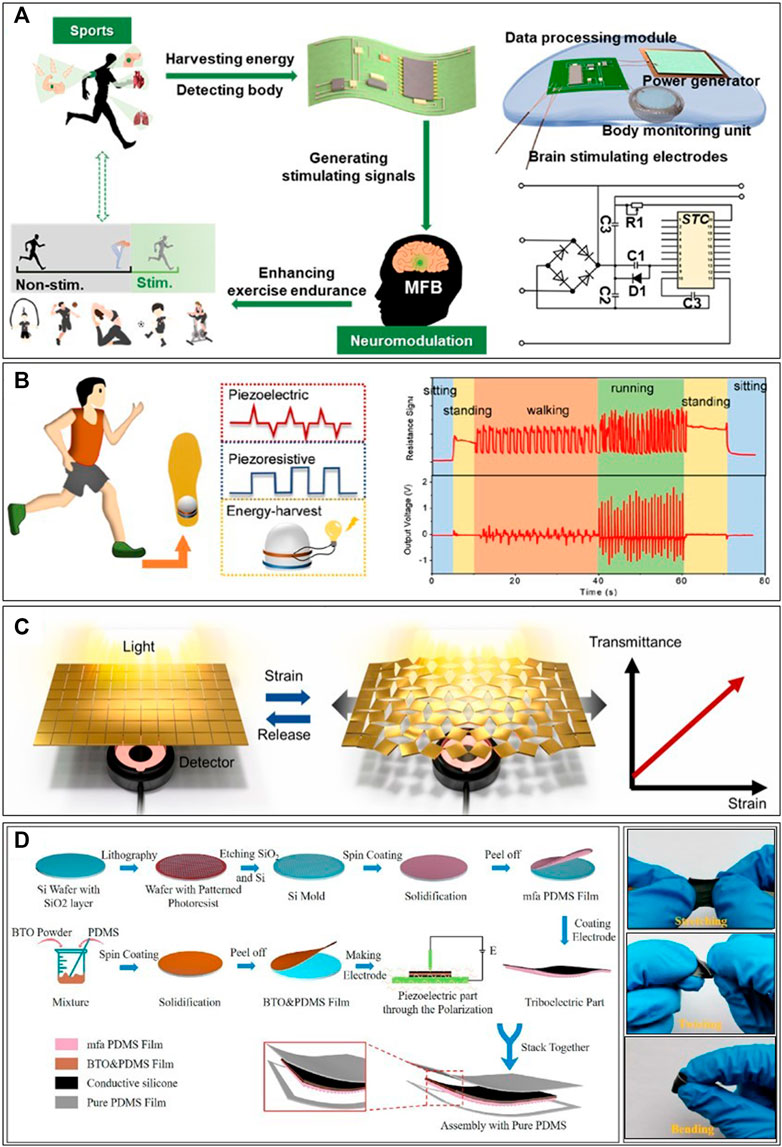
FIGURE 1. (A) Schematic illustration of the wearable and real-time brain-machine-interface system for enhancing exercise endurance showing the four parts of the system and the electronic circuit of the data processing module (Liang et al., 2022). (B) Schematic diagram of the dual-mode device incorporated into the insole to detect human motion via voltage/resistance variation of the dual-mode sensor during a series of body movements (Kong et al., 2022). (C) Schematic illustration of the GDE-R (the rotating square pattern) based piezo-transmittance strain sensor (Gu et al., 2021). (D) The fabrication process of the P-TPS and optical photos of the P-TPS under different deformations (Yu et al., 2022b).
Most piezoelectric sensors suffer from a lack of robust and reliable sensitivity for various mechanical stimuli from rough or spiky surfaces of a subject, and experimental results indicate that improvement of the sensing configuration of pressure sensors could be an efficient coping strategy (Sharma et al., 2022). Kong et al. (Kong et al., 2022) prepared a self-protective pressure sensing device with a piezoelectric-piezoresistive dual mode (Figure 1B), based on a positive Poisson’s ratio elastic cylinder, which could significantly amplify the external pressure thereby enhancing the sensitivity and energy conversion efficiency of the fabricated piezoelectric device. Gu et al. (Gu et al., 2021) constructed a self-powered soft strain sensor based on the piezo-transmittance of an auxetic-pattern negative Poisson’s ratio elastomer. Specifically, the soft sensor uses a light-blocking Au-coated elastomer film, designed as a rotating square structure pattern. The measuring mechanism of the strain sensor is based on the changes in optical transmittance, correlating with changes in the gaps in the auxetic structure under externally applied strains (Figure 1C). The novel design endows the sensor with ultralow stiffness, high uniformity, fast response, and great robustness. Moreover, a self-powered wireless sensing system was successfully fabricated by integrating the developed strain sensor with a Bluetooth Low Energy 4.0 transceiver and a commercial solar cell, which effectively monitors device-structure health and human-body motion in real time.
Apart from this, PENGs incorporated with other types of energy conversion strategies, such as triboelectric nanogenerators, demonstrate excellent synergies with outstanding stretchability, high sensitivity, and excellent output performance (Zhang et al., 2021c). Kim et al. (Kim et al., 2021) developed a flexible piezoelectric-thermoelectric hybrid generator (f-PTEG) composed of a piezoelectric unit of poly (vinylidene fluoride-co-trifluoroethylene) film and a thermoelectric unit of bismuth telluride-based alloy blocks. Owing to the combined piezoelectric and thermoelectric effects, the hybrid f-PTEG could well integrate the energy converted from human body heat and movement. Pan et al. (Pan et al., 2022) constructed a transparent piezoelectric-photovoltaic energy harvesting device using the SnO-TiO2 quantum dots (QDs)/ZnO PN junction. Owing to the high quantum yield and appropriate potential of TiO2 QDs, the injection and separation of charge carrier are accelerated. The energy harvesting device exhibits high transmittance and obvious photovoltaic conversion enhancement, and can be an outstanding candidate in smart windows. Lee et al. (Lee et al., 2022) designed novel piezoelectric-triboelectric hybrid nanogenerators (PTHNG) based on MAPbBr3 (methyammonium lead tribromide) single crystals embedded into porous PVDF (MAPbBr3-PVDF), which simultaneously functions as a piezoelectric layer for a piezoelectric nanogenerator and as a dielectric layer for a triboelectric nanogenerator. The power density of the PTHNG is approximately 200 times larger than that of the pure PENG based on the same materials. Yu et al. (Yu et al., 2022b) proposed a stretchable self-powered piezo-triboelectric press sensor (P-PTS) fabricated by combining a piezo-film with a triboelectric nanogenerator (Figure 1D). Owing to the coupling of the piezoelectric effect with triboelectrification, the flexible-polymer-based P-PTS demonstrates satisfactory electrical sensitivity (voltage of 0.3 V kPa−1 and 4.3 nA kPa−1 under a pressure range of 0–200 kPa), excellent skin conformality, and considerable stretchability (∼187.32%). The output performances of the P-PTS are highly robust and almost unaffected after a series of various external forces. Moreover, the self-powered P-PTS is practical for monitoring a wide range of joint motion, such as different motion types of the knuckle, elbow, and wrist. The design concept of cooperation between different energy conversion strategies in this work is expected to promote advanced self-powered technologies in future follow-up research.
2.2 Self-powered by triboelectricity
Triboelectricity is delivered by highly efficient triboelectric nanogenerators (TENGs) via the process of friction between various materials with different triboelectric polarities. TENGs have gained enormous attention and numerous investigations on them have been performed in recent years, especially focusing on their applications in wearable biosensors and biomedical applications (Zhou et al., 2021). As an attractive self-powered technology, the merits of TENGs, and the related integrated systems, are outstanding, including low cost, a wide variety of available materials, the potential of harvesting wind energy, and tidal energy (Zhao et al., 2022a; Yuan et al., 2022). However, the practical applications of TENGs are still limited by insufficient stretchability, poor output performance, and a lack of reliable power management tactics.
In recent years, specialists mainly focused on chemical/physical modification and charge enhancement tactics to promote further improvement of self-powered wearable biosensors with TENGs (Wan et al., 2021; Peng et al., 2022). Qu et al. (Qu et al., 2022) designed a flexible multi-fingerprint-shaped wearable triboelectric tactile sensor (FTTS) with respectively independent fingerprint-shaped channels filled with eutectic gallium-indium liquid metal. Zhao et al. (Zhao et al., 2022b) constructed a self-powered stretchable biosensor with fiber-based triboelectric nanogenerators (F-TENG) for real-time body monitoring. The ultra-stretchable Ecoflex fiber and the design twining varnished wires endow F-TENG with excellent stretchability (∼600%) (Figures 2A, B). During practical application, F-TENG can be integrated into smart clothes and incorporated with wireless communication (Figure 2C), exhibiting a high potential to act as a promising alternative for next-generation biosensing systems.
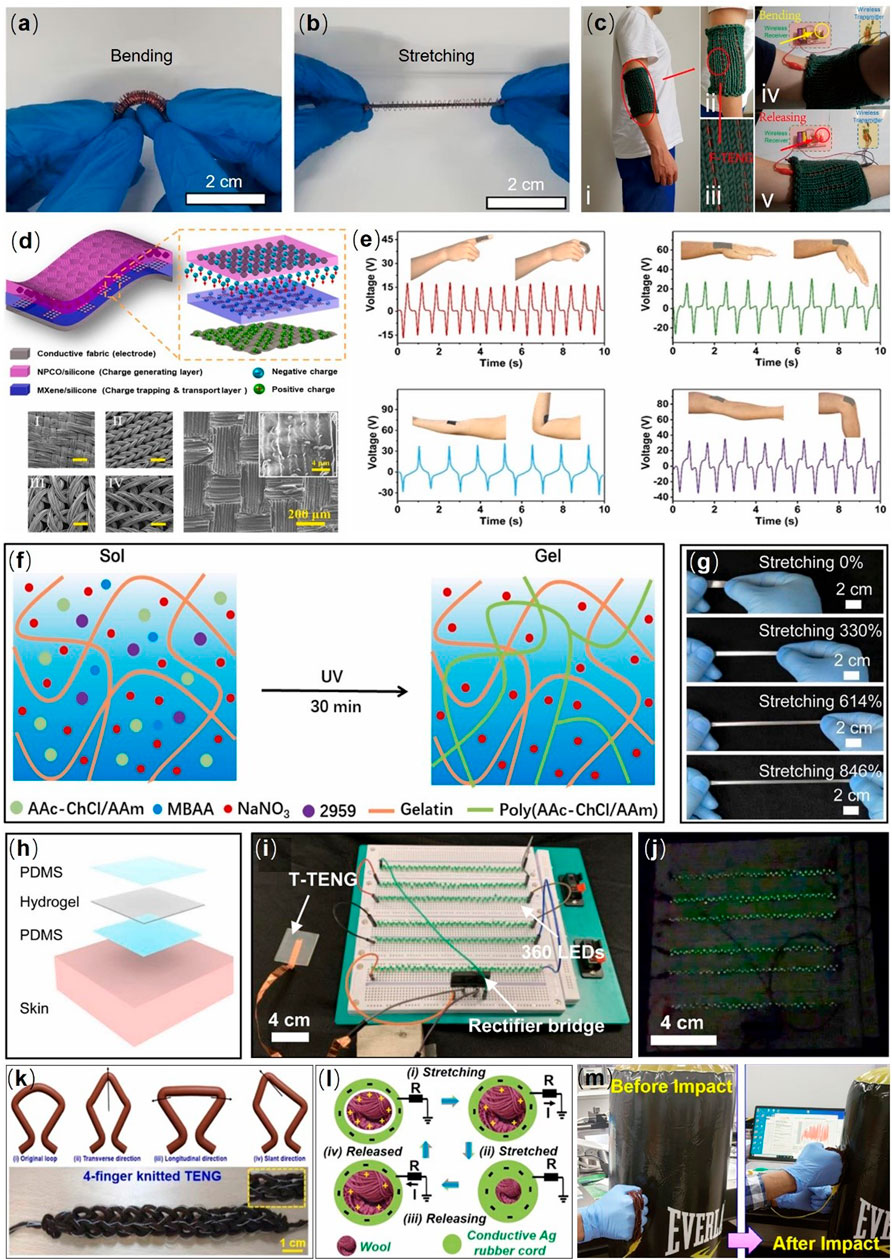
FIGURE 2. (A) F-TENG under bending. (B) F-TENG under stretching. (C) Smart clothing integrated with F-TENG (Zhao et al., 2022b). (D) Schematic description of the NDL-TENG. (E) Produced voltage signals of the self-powered biosensor integrated with NDL-TENG in response to the bending of different body joints (Rahman et al., 2022b). (F) Schematic illustration of the transparent, stretchable, and conductive hydrogel (TSCH). (G) Optical photos of the stretchability testing of TSCH. (H) Schematic illustration of the T-TENG based on hydrogels. (I) Optical photo of the setup for lighting LEDs using the T-TENG (J) Optical photos of the 360 LEDs lit by the T-TENG (Liu et al., 2022a) (K) Deformation of the knitted textile and optical photos of the 4-finger knitted TENG (L) Schematic illustration of the working mechanism of the developed F-TENG (M) Optical photos of an individual imparting a punch on a boxing kit before and after impact (Sahu et al., 2022).
Recently, a novel multifunctional double-layered triboelectric nanogenerator (NDL-TENG) was successfully developed by incorporating nanoporous cobalt oxide (NPCO) and Mxene into silicone (Figure 2D) (Rahman et al., 2022b). Combining the advantages of a high specific surface area and chemical oxygen functional groups, the NPCO effectively enhances the electronegativity and improves the triboelectric performance fourfold. At the same time, the Mxene in the silicone has the excellent ability to trap and transport charge. Compared to the pristine silicone tribo-layer, the Mxene/silicone efficiently increases the surface potential of NDL-TENG more than ninefold. Moreover, various commercial fabrics were constructed on a layer of NPCO/silicone to build up high stretchability and robustness. The optimized output performance of the designed NDL-TENG is excellent, including a high power density of 10.4 W m−2, an outstanding sensitivity of 5.82 V kPa−1, and a stretchability of ∼230%. Attached to various body joint parts, the NDL-TENG shows clear and stable physiological signals (Figure 2E), exhibiting its practical potential in medical rehabilitation applications.
For visual monitoring of the real-time condition of the detection subject, transparency is a crucial characteristic for TENGs toward functionalized wearable biosensors and biomedical applications (Wu et al., 2022a; Shahbaz et al., 2022). Yang et al. (Yang et al., 2022a) reported a stretchable polyvinyl alcohol/phytic hydrogel-based transparent triboelectric sensor for a self-powered medical human-machine interaction (HMI) sensing system. In the practical application of medical diagnosis, the HMI sensing system shows excellent mechanical durability (over 20,000 cycles) and considerable electrical performance (up to 1.33 W m−2), providing real-time assistance for both clinicians and patients. Liu et al. (Liu et al., 2022a) fabricated a flexible and transparent triboelectric nanogenerator (T-TENG) based on a self-developed conductive hydrogel layer and adopted polydimethylsiloxane (PDMS) layers as packaging (Figures 2F, H). The T-TENG demonstrates a highly flexible nature (∼850%) (Figure 2G), high transparency (∼90%), and outstanding electrical performance (open-circuit voltage of ∼684.4 V and short-circuit current of ∼116.5 μA per 16 cm2). The output performance of the T-TENG is quite stable under various conditions, which include being folded, twisted, smashed, and stretched over 200 cycles, and it supplies sufficient power for 360 LEDs (Figures 2G, I, J). Furthermore, the T-TENG mounted on the fingers outputs clear electrical information along with information on the body’s mechanical movement and deformation, demonstrating the high sensitivity of the self-developed T-TENG and its potential for effective energy harvesting.
Owing to the intercoupling of triboelectrification with electrostatic induction, TENGs show considerable potential for converting irregular and randomly distributed energies into consistently usable electricity. Zeng et al. (Zeng et al., 2022b) introduced a self-powered rain droplet sensor using a stimulating liquid-solid triboelectric nanogenerator (LS-TENG) to harvest water/raindrop energy. The LS-TENG demonstrates high sensitivity to contact with surrounding water motion, generates an electrical signal in response to the droplet impact force on the LS-TENG and the electrostatic induction of water flowing down the fluorinated ethylene propylene film, and harvests irregular energies from the ambient environment to sustainably supply power for portable electronics. Additionally, the LS-TENG can also sense the falling speed and velocity of water droplets. This work sheds valuable light on the improvement of the conversion effectiveness of irregular energies based on TENGs toward wearable biosensing systems.
Moreover, TENGs also demonstrated their potential in the reuse of a large number of waste textiles generated due to the lack of public recycling awareness. Sahu et al. (Sahu et al., 2022) proposed recycling abandoned worn-out textiles into single-electro-mode triboelectric nanogenerators for self-powered devices (Figure 2L). The positive and negative triboelectric layers adopted various waste textiles. A triboelectric nanogenerator (TENG) was fabricated from the fibers of a cigarette butt by the 4 fingers knitted technique (Figure 2K) and could deliver a peak-to-peak voltage of 4.2 V and a current of 2.7 nA under mechanical stretching and releasing. The newly designed triboelectric nanogenerator can harvest biomechanical energy from various sports by attaching it to sports accessories such as socks and exercise bands (Figure 2M). Moreover, combining the self-powered sensor with digital signal processing (e.g., wavelet transformation and wavelet packet transformation) can effectively promote intelligent sports devices.
2.3 Self-powered by biofuel cells
Biofuel cells (BFCs), as a green self-powered strategy, can convert the biochemical energy of the components contained in various body fluids (biofuel, e.g., lactate and glucose) into available electrical energy through biocatalytic reactions. BFCs have many prominent advantages, such as environmental friendliness, easy integration, and good biological compatibility, which contribute to their broad use in self-powered on-body biosensors and biomedical applications (Dutta et al., 2022). However, BFCs still suffer from a low power output and non-ideal operational stability in the long term. An effective approach to solve these obstacles is the exploration of different nanocatalytic systems based on various advanced enzymes (Gu et al., 2022), nanomaterials (Haque et al., 2023), and energy management (Assad et al., 2022). A selective self-powered dibutyl phthalate aptasensor was prepared based on a flexible enzymatic biofuel cell (EBFC) using a glucose oxidase/Bi3Ti2O8F/carbon nanotube-reduced graphene oxide (CNTs-rGO) layer as the anode and a layer of aptamers fixed with AuNPs/CNTs-rGO as the corresponding cathode (Qin et al., 2022). Owing to the modification of Bi3Ti2O8F with catalase mimicking properties on the anode, the output performance of the EBFC effectively improves. Yang et al. (Yang et al., 2022b) prepared an advanced lactate oxidase bio-anode modified with multi-walled carbon nanotube (MWCNT)/naphthoquinone, which enhances the electron transfer efficiency of BFCs. Compared to previously published flexible BFCs, the fabricated bio-anode-based biofuel cell is competitive in terms of power-density output. Among the advanced nanomaterials for enzyme immobilization, Xu et al. (Xu et al., 2022a) proposed a coral-like hierarchical meso-macroporous carbon (CHMC) prepared from cucumber, which facilitates the high-quality immobilization of enzymes (LOx) and accelerates the transfer of electrons in the bioelectrodes. Furthermore, a CHMC-based lactate/air BFC was constructed to harvest energy from practical samples. This work indicates a novel avenue for the synthesis of advanced bioelectrode materials for BFC-based healthcare applications.
The rational design of biosensing systems integrated with BFCs would provide not only high efficiency but also considerable assistance for medical staff and disabled patients (Wang et al., 2022a). Yin et al. (Yin et al., 2021) reported a high-power lactate-based biofuel cell using a hydrophilic supportive textile woven from fibers to store sweat (Figure 3A). To boost the output performance, series-connection anode/cathode fibers are bundled and wrapped around the wrist in a bracelet-type biofuel cell (Figure 3B). The six-cell bracelet produces power at 2.0 V to sufficiently drive digital wrist watches (Figure 3C). Su et al. (Su et al., 2022) developed a low-cost wearable sensing system composed of an electrochemical biosensor integrated with a diaper and a smartphone with a data processing application (App). The multifunctional sensing system not only reminds the nurse to change the diaper but also monitors the real-time health status of patients. Apart from the App alarm, Zhang et al. (Zhang et al., 2021d) fabricated an innovative biofuel cell-type biosensor system incorporated into the diaper to detect information about urine glucose levels for diabetic patients, using an LED flashing alarm (Figure 3D). The system was self-powered by its biofuel cell module, with glucose oxidase as the bioanode and MnO2 as the biocathode, and, at the same time, the power density (up to 220 μW cm−2) generated by the biofuel cell was stored in a capacitor to power the LED flash. The glucose concentration was proportional to the LED’s flashing frequency, associated with the charging rate of the capacitor, and the corresponding linear correlation is excellent in the range of 1–5 mM glucose concentration. During the anti-interference experiment using uric acid and carbamide, the device was almost unaffected by the interferences.
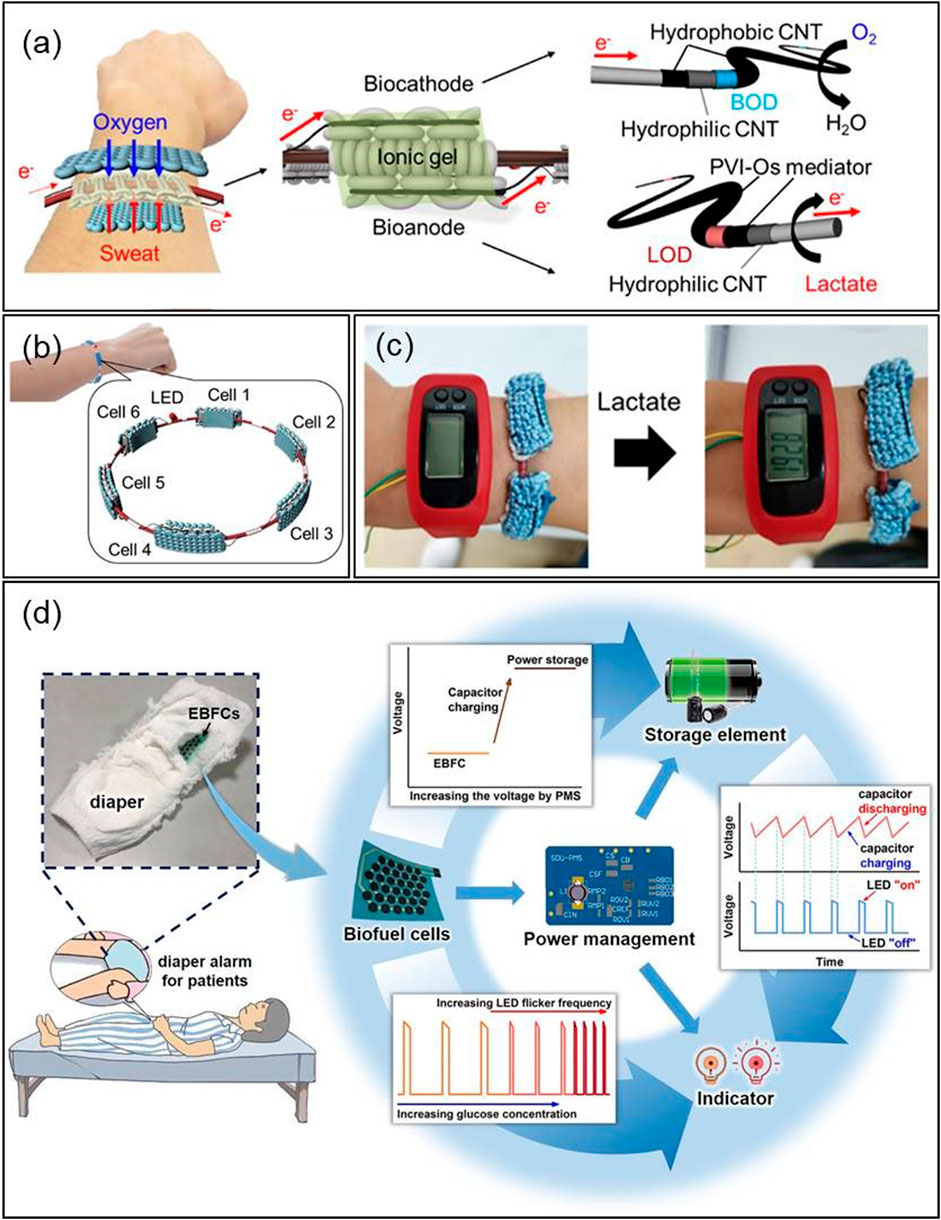
FIGURE 3. (A) Schematic diagram of the fiber-crafted biofuel cell based on lactate biofuel from human sweat. (B) The configuration of the six-cell bracelet. (C) Optical photos of powering an electronic watch with the bracelet-type biofuel cells (Yin et al., 2021). (D) Schematic diagram showing the components of the diaper alarm integrated with the biofuel cell-type biosensor and the circuit diagram of the alarm device (Zhang et al., 2021d).
Different from utilizing human endogenous substances to generate energy in previously reported research, Sun et al. (Sun et al., 2021) proposed a noteworthy self-powered epidermal ethanol-oxygen biofuel cell based on exogenous substances in the perspiration of individuals after drinking alcohol (Figure 4A). The epidermal BFC includes two functional modules, namely, a specially designed microfluidic module for the collection and transport of the sweat, and a BFC module for harvesting bioelectricity in real-time (Figures 4B, C). Additionally, the two modules use highly flexible PI and PET as substrates to ensure skin-conformal adhesion of the wearable epidermal BFC in practical applications (Figure 4D). This work enlarges the potential circumstance of the BFC for on-body bioelectricity harvesting and conversion.
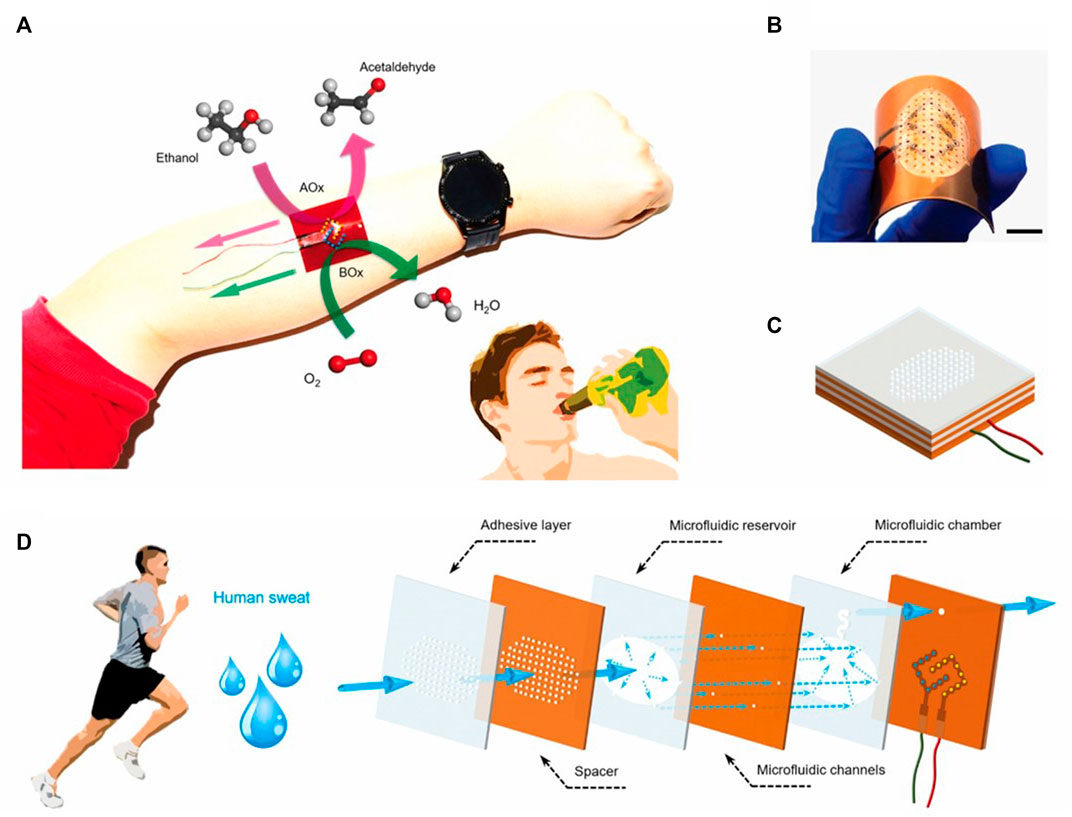
FIGURE 4. (A) Schematic illustration of a flexible and wearable epidermal ethanol BFC that harvests bioenergy in real-time from the perspiration of individuals after drinking alcohol. (B) Optical photo of a flexible epidermal ethanol BFC (scale bar, 1 cm). (C) Schematic illustration of an epidermal ethanol BFC. (D) Schematic illustration of the microfluidic module for continuous real-time in situ fresh sweat sampling, transfer, storage, and excretion on human skin (Sun et al., 2021).
2.4 Self-powered by photovoltaics
Owing to years of market inspection and technical improvement, solar photovoltaics is the most mature and viable self-powered technology among the up-to-date emerging self-powered strategies in the field of wearable biosensors and biomedical applications (Kumari et al., 2022). To cope with the requirement of miniaturization and high-power density for a wearable biosensor, researchers have devoted enormous efforts to developing advanced multifunctional materials and rational device configurations for photoelectrochemical biosensors (Liu et al., 2022b; Wu et al., 2022b; Jahromi et al., 2022). Nardekar et al. (Nardekar et al., 2022) reported a self-developed photovoltaically self-powered cell (PSCPC) based on a dual-functional nanocomposite film composed of a two-dimensional quantum sheet of molybdenum disulfide, which is incorporated into a polyvinylidene fluoride (PVDF) layer to improve the dielectric properties of pure PVDF (Figure 5A). The output performance of the novel piezoelectric nanogenerator fabricated using the MoS2 QSs-PVDF film is remarkable, with a high output voltage (47 Vpp) and power density (3.2 mW m−2). Due to the significant role of the TiO2 intermediator, the PSCPC delivers an excellent charging voltage (900 mV) and a remarkable photocurrent (25 μA). Furthermore, when practically integrated with clothing (Figure 5B), the unique PSCPC can sufficiently supply power for flexible wearable electronics, with energy scavenging from natural sunlight and ambient indoor light. This work demonstrates an effective design strategy for combining smart biosensors with photovoltaic materials in the field of converting and storing energy.
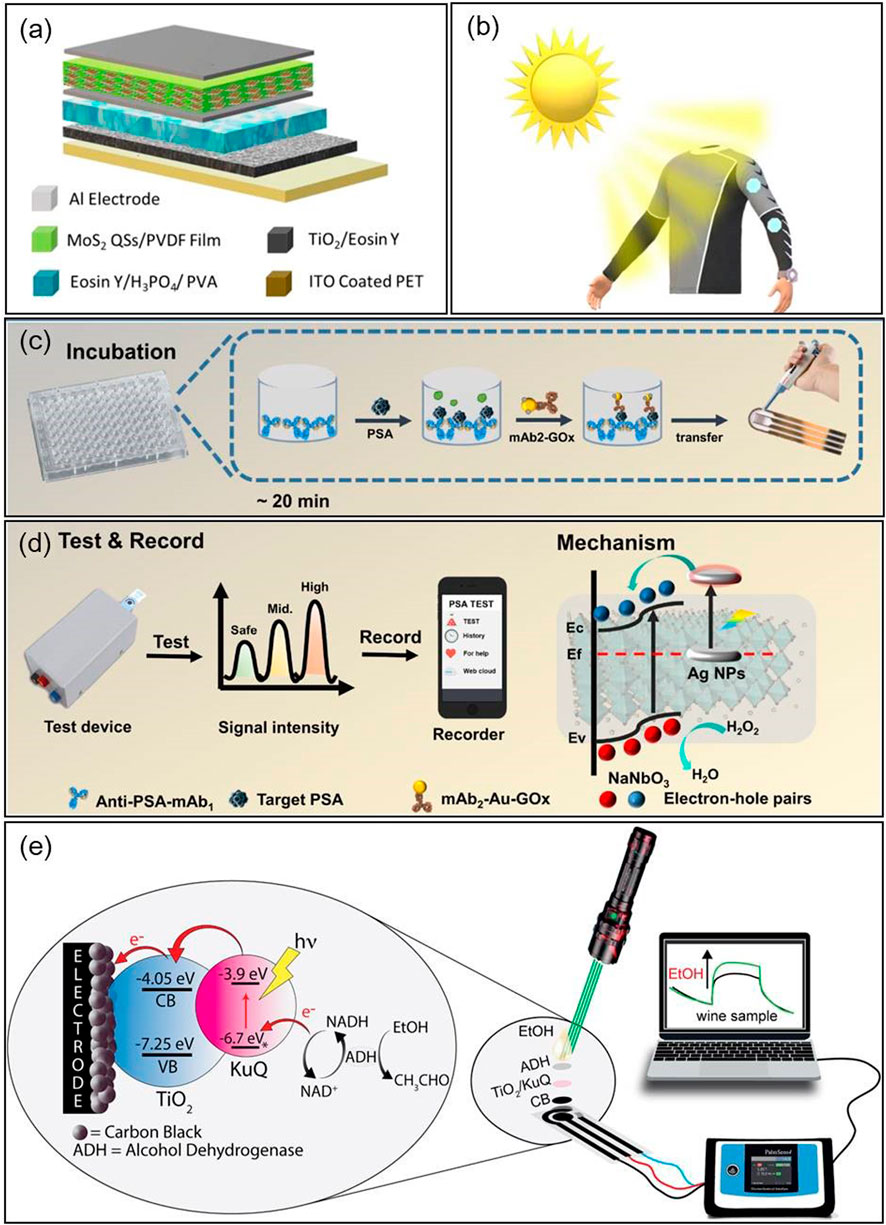
FIGURE 5. (A) Schematic diagram of the PSCPC device. (B) Conceptional representation of the PSCPC absorbing natural sunlight for powering smart gadgets (Nardekar et al., 2022). (C) Schematic illustration of the incubation process of target PSA in a microtiter plate. (D) Schematic illustration of the PEC recording platform for 3D printed microdevices and the photoelectron transfer of the Ag/NaNbO3 composites. (Xu et al., 2022b). (E) Schematic illustration of the photoelectrochemical sensing system and the experimental set-up for detection of ethanol (Mazzaracchio et al., 2022).
Researchers have also put great efforts into the elemental doping/co-doping strategy to reasonably tune bandgaps in order to effectively facilitate the photovoltaic effect and to improve the photoelectrochemical response in self-powered biosensing systems (Ai et al., 2022; Ma et al., 2022). Cheng et al. (Cheng et al., 2019) constructed a novel nitrogen-doped carbon quantum dot (NCQD)-based photoelectrochemical (PEC) biosensor driven by visible light for the detection of organophosphate pesticides. The excellent optical performance of the NCQDs, including a narrow band gap, fast electron transportation, and upconversion photoluminescence, endow the NCQD/TiO2/ITO electrode with a high photocurrent response, which is approximately 42 times that of the TiO2/ITO electrode under visible light. Gao et al. (Gao et al., 2022) designed Fe3+-Li+ co-doped Zn1-2x (FexLix)O films using an economical sol-gel method. The Zn1-2x (FexLix)O films demonstrate an anomalous photovoltaic effect with high performance (a switchable photoresponse of 34.1 mA W−1 and a power conversion of 10.3%), which is attributed to the enhancement of current density and fill factor in the fabricated films. To explore novel ferroelectric photovoltaic materials with a narrow band gap, Wang et al. (Wang et al., 2022b) proposed an advanced 0.8NaNbO3-0.2La(Mn0.5Ni0.5)O3 (0.2NLMNO) ferroelectric ceramic fabricated by a solid-state process. The doped La(Mn0.5Ni0.5)O3 can induce a crystal structure with higher symmetry and can significantly decrease the resistance between grains and grain boundaries. The photocurrent response of 0.2NLMNO is approximately 10 times higher than that of pure NaNbO3.
Furthermore, the light source and photoelectrochemical active species are both crucial factors for photoelectrochemical biosensors that are based on a measurable electrical signal enhanced by photoelectrochemical active species under illumination (Yang et al., 2020; Tang et al., 2022). Xu et al. (Xu et al., 2022b) presented a UV light-driven photoelectrochemical (PEC) biosensor based on the co-enhanced effects of localized surface plasmon resonance and portable piezoelectric effect between Ag nanoparticles and NaNbO3 nanomaterials (Figure 5C). The biosensing platform integrated with the fabricated PEC biosensor exhibits a wide linear range and low detection limits for the cancer marker PSA in point-of-care testing (Figure 5D). Mazzaracchio et al. (Mazzaracchio et al., 2022) developed an economical self-powered photoelectrochemical biosensor based on a unique screen-printed electrode with carbon black (CB) as a conductor. The TiO2/KuQ is homogeneously dispersed on the surface of the CB layer and expands the range of absorbable light from the UV to the visible light region (Figure 5E). The photoelectrochemical biosensor exhibits high analytical performance, with an excellent linear range (between 50 μM and 8 mM) and an outstanding detection limit (∼20 μM) for NADM measurement. The sensor incorporating alcohol dehydrogenase can detect ethanol in white wine samples at a competitive detection limit (∼0.062 mM), which sheds valuable light on the practical application of other dehydrogenase enzymes in the field of biosensors based on screen-printed-electrodes. To avoid the possible damage of biological subjects caused by UV light, Zhai et al. (Zhai et al., 2019) constructed a near-infrared light-triggered photoelectrochemical biosensor for the ultrasensitive detection of alfa-fetoprotein (AFP), which is based on the synergistic effects of ZnO, CdS, and upconversion luminescence of NaYF4:Yb and Tm nanophosphors. The fabricated biosensor presents an ultra-wide linear range (0.01 ng mL−1) and an ultra-low detection limit (5 pg mL−1) for the target AFP. The upconversion-nanophosphor-based PEC biosensor provides an attractive alternative for testing other cancers in practical clinical analysis.
2.5 Self-powered by thermoelectricity
Thermal gradient-based thermoelectricity is a promising source of energy for powering wearable biosensors and epidermal healthcare applications (Nozariasbmaez et al., 2020; Sun et al., 2022). When there is an uneven distribution of temperature between n-type and p-type thermoelectric materials, the charge carriers (electrons and holes) will migrate from the relatively high temperature region to the low temperature region. The efficiency of converting heat into electricity is correlated with temperature difference (ΔT) and the ZT value (equals to S2Tσ/к) of thermoelectric (TE) materials (Jaafreh et al., 2022; Zhi et al., 2022), which suggests explicitly viable approaches for designing rational thermoelectric generators (TEGs) with high energy conversion efficiencies.
In terms of exploring excellent thermoelectric materials, significant effort has been made regarding organic/inorganic TE materials and optimization strategies for TE materials (Chen et al., 2021; Soleimani et al., 2021; Yang et al., 2022c). Recently, Toan et al. (Toan et al., 2022) developed an ultra-flexible considerable-performance thermoelectric generator (TEG) using a silicon rubber sheet and thermoelectric material fabricated by electrodeposition. The ultra-flexible TEG displays a high output performance, with an output voltage of 1 V and power density of 552.9 μW cm−2 under a ΔT of 60 K. Moreover, based on the ultra-flexible TEG, a self-powered temperature/humidity monitoring electronic device was successfully constructed. Massetti et al. (Massetti et al., 2020) prepared a novel micro-sized integral organic thermoelectric generator (µ-OTEG) using PEDOT: PSS and a doped fullerene derivative as the p-type and n-type legs, respectively, which are embedded into a plastic substrate using a fully direct writing technique. The reported flexible µ-OTEG exhibits an excellent power density (30.5 nW cm−2) and small thermal gradients, demonstrating the potential of scalable organic-based TEGs for low-power real life biosensing applications. Jung et al. (Jung et al., 2021) fabricated a new soft thermoelectric module (TEM) using a porous polydimethylsiloxane (PDMS) filler (pP filler) and Bi2Te3-based thermoelectric legs (Figure 6A). Due to the low thermal conductivity (0.8 W m−1 K−1) of the pP filler, the internal ΔT was increased by successfully suppressing thermal bypass. Compared to the reference TEM samples, containing dense PDMS filler and the pP filler, the partially filled TEMs presented a higher power density (123% that of the pP filler sample) and an excellent ZT value (0.75) (Figures 6B, C). Utilizing body heat, eight in-series partially filled TEMs can power 32 LEDs over 30 min. The design approach used in this work shows attractive potential in the field of stretchable self-powered biosensors.
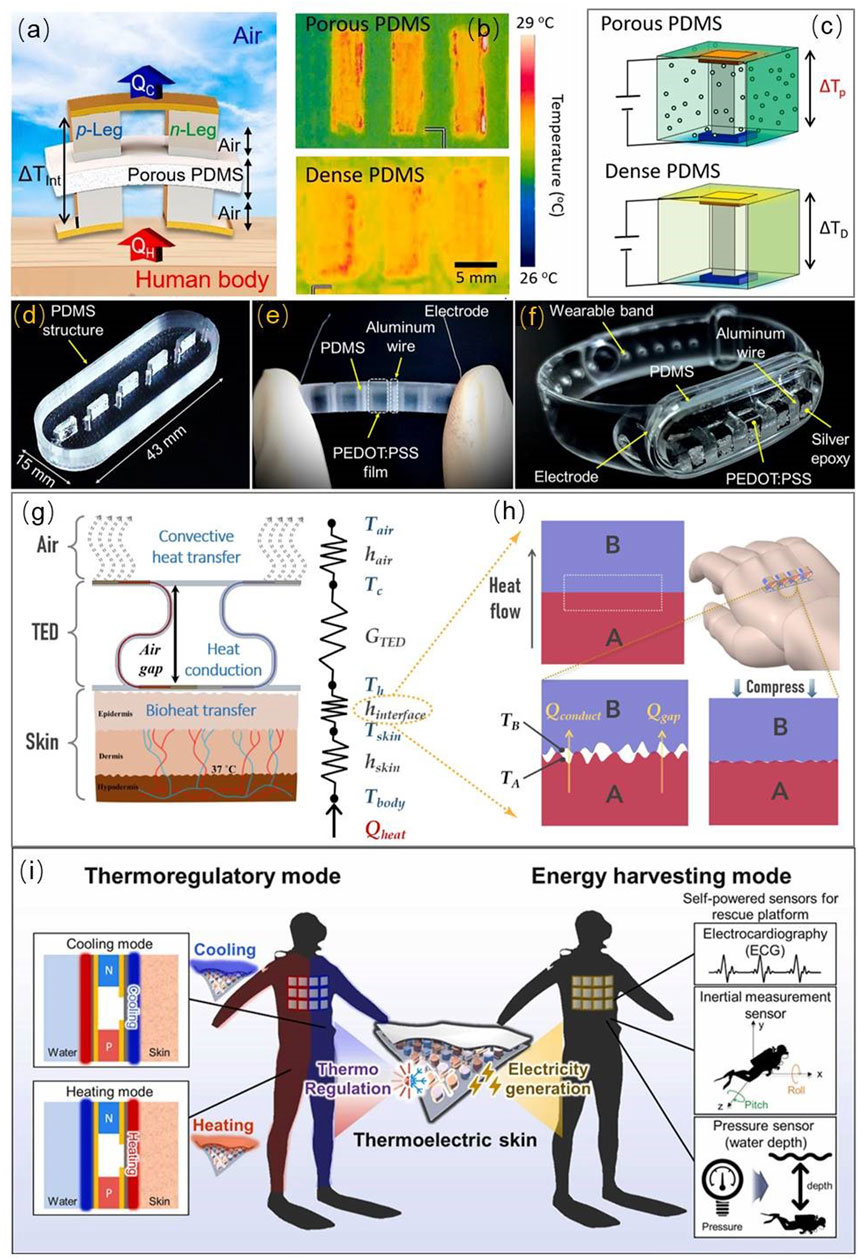
FIGURE 6. (A) Schematic diagram of a partially filled TEM. (B) Temperature response of the hot-side surfaces of pP TEM and dP TEM when direct current was used. (C) Schematics of the TEM configurations during the direct current experiments (Jung et al., 2021). (D) Optical photo of the fabricated PDMS structure, (E) side view of the wearable thermoelectric generator, and (F) a wearable band integrating the fabricated thermoelectric generator (Hasan et al., 2022). (G) Schematic diagram of the complete thermal process for a wearable S-TED. (H) Interface thermal resistance analysis (Lv et al., 2021). (I) Schematic illustration of dual modes (energy harvesting mode/thermoregulatory mode) that the TES switch between (Jung et al., 2022).
The efficient structural configuration of flexible/stretchable thermoelectric devices has also garnered the significant attention of increasingly more researchers (Fan et al., 2021; Toan et al., 2021). Hasan et al. (Hasan et al., 2022) developed an efficient and wearable thermoelectric generator based on vertically aligned thermoelements comprised of a p-type PEDOT:PSS film and an n-type aluminum wire-based thermoelement. A wearable wrist-based thermoelectric generator, with five pairs of thermoelements, exhibited an excellent output voltage of 5.15 mV at a ΔT of 80 K (Figures 6D–F). Zheng et al. (Zheng et al., 2022) prepared an ingenious self-powered two-mode temperature and pressure sensor with tridimensional arrays achieved by sewing CNT yarn segmentally modified with polyethyleneimine into a high-arrangement-density spacer fabric. Zhang et al. (Zhang et al., 2022b) designed a novel flexible self-supported laminated thermoelectric device based on a rational array of thermal parallel and series electrical connections, using CNTs/PEDOT:PSS as p-type materials and CNTs/PVDF self-supported films as n-type materials. The obtained thermoelectric device generates an output voltage of 3.31 mV under a ΔT of 35 K and demonstrates promising potential in the detection of light intensity due to the prominent photothermal characteristics of CNT-based materials. To make better use of the vertical temperature gradient in the plane of the device, Lv et al. (Lv et al., 2021) proposed a flexible three-dimensional spring-shaped thermoelectric device (S-TED) based on dual elastomer layers with air gaps, showing excellent compressibility and effectively harvesting vertical waste heat (Figures 6G, H). The as-fabricated S-TED, using only three pairs of p-n couples, can deliver an excellent output power (749.19 nW) under a vertical ΔT of 30 K, which outperforms other reported flexible thermoelectric devices (416.22 nW cm−2). The design strategy of the S-TED opens up new possibilities for the utilization of human body heat in wearable biosensors and biomedical applications.
Innovations in fabrication techniques can also contribute to the enhancement of the wearable suitability of self-powered biosensing devices integrated with thermoelectric generators. Shi et al. (Shi et al., 2022) adopted a soldering fabrication process with the assistance of a sacrificial layer to fabricate a novel stretchable thermoelectric generator (STEG), comprised of kirigami-inspired flexible electrodes connecting 50 couples of cubic-shaped thermoelectric legs. In the work, various biomedical applications of the STEG were investigated and these show the potential of the as-fabricated STEG as wearable biosensing devices. He et al. (He et al., 2022) developed a CNT/PEDOT:PSS-based thermoelectric nanofiber yarn by integrated a coagulation-bath electrospinning technique with a self-assembly strategy, which can continuously produce high-stretchability (∼350%) and high-seamability nanofiber yarns. CNT/PEDOT:PSS is effectively loaded onto every fabricated nanofiber during the spinning process due to the phase separation and self-assembly effect. Biosensing platforms integrating the nanofiber yarns with gloves and masks can accurately identify cold/heat sources and sufficiently supply power for human respiration monitoring.
Thermoelectricity is also an excellent solution to address the practical conundrum of supplying power to wearable electronics in extreme environmental conditions for a long-term period, where bulky traditional batteries are not viable. Jung et al. (Jung et al., 2022) proposed a stretchable dual-function thermoelectric skin (TES) to harvest thermoelectric power and regulate the temperature of the subject wearing the TES underwater (Figure 6I). Due to the structure of the serpentine array and the reasonably designed backbone, the conductive elastomer-based TES demonstrated a high stretchability (up to 230%) and excellent mechanical durability. The TES generated a competitive power density (3.42 mV cm−2), the highest to date according to a comparison with published research on stretchable wearable thermoelectric devices. Furthermore, the dual-function TES units were integrated with the deformable surfaces of a neoprene dry-suit to validate their strength in practical applications. The sensors of the integrated suit could be sufficiently self-powered by the TES units to wirelessly monitor the real-time human body temperature, which was simultaneously regulated by the multiple TES units, based on a temperature feedback loop algorithm. The design concept and engineering principles of this work shed significant light on the future of underwater electronics.
3 Conclusion
Owing to their attractive potential in continuously non-invasive/real-time medical diagnosis, self-powered wearable biosensors have attracted enormous attention and efforts from researchers in various fields. In this review, the recent research advances in self-powered technologies toward wearable biosensors are discussed, mainly focusing on several typical self-powered strategies such as piezoelectric nanogenerators, triboelectric nanogenerators, biofuel cells, photovoltaically self-powered cells, and thermoelectric generators. The novel functional materials and stretchable structure designs in the above self-powered strategies are highlighted, which promote the advancement of self-powered wearable biosensors and the related integrated medical applications.
Over the past few decades, the number of investigations on wearable electrochemical sensors toward biomedical applications has increased. Nevertheless, some major obstacles need to be cleared to achieve the requirements for continuous health monitoring of body biomarkers over wide ranges in a reliable manner. Among these obstacles, the power supply units for most biosensors are not stable due to physical motions such as bending, twisting, and stretching. Therefore, a flexible and stretchable self-power unit is expected to provide a correct, reliable, and high-quality energy supply to ensure the continuous monitoring functionality of wearable biosensors. Moreover, insufficient output energy density remains a pivotal obstacle to be resolved for the broad practical biomedical application of self-powered biosensing systems. Further innovations in functional materials, stretchable device integration, and optimized energy management strategies are expected to lead to the fabrication of next-generation advanced biosensors with excellent self-powered ability, miniaturization, and intellectualization.
Overall, this review provides insights into and future trends of self-powered technologies based on nanomaterials toward wearable biosensors in biomedical applications, particularly for flexible, stretchable, and continuous health monitoring systems.
Author contributions
QW did most of the writing of the manuscript and literature review. CL, WZ, and ZZ assisted in partial writing and literature review. XS and CW participated in the frame writing and discussion. SM and SZ supervised the manuscript generation process.
Funding
Ningbo Scientific and Technological Innovation 2025 Major Project (No. 2021Z108); Yongjiang Talent Introduction Programme (No. 2021A-154-G).
Conflict of interest
The authors declare that the research was conducted in the absence of any commercial or financial relationships that could be construed as a potential conflict of interest.
Publisher’s note
All claims expressed in this article are solely those of the authors and do not necessarily represent those of their affiliated organizations, or those of the publisher, the editors and the reviewers. Any product that may be evaluated in this article, or claim that may be made by its manufacturer, is not guaranteed or endorsed by the publisher.
References
Ai, S., Liu, Y., Chai, Y., Yuan, R., and Liu, H. (2022). Enhanced cathodic photocurrent derived from N-type S doped-Bi2WO6 nanoparticles through an antenna-like strategy for photoelectrochemical biosensor. Biosens. Bioelectron. 207, 114176. doi:10.1016/j.bios.2022.114176
Askari, H., Xu, N., Barbosa, B., Huang, Y., Chen, L., Khajepour, A., et al. (2022). Intelligent systems using triboelectric, piezoelectric, and pyroelectric nanogenerators. Mat. Today 52, 188–206. doi:10.1016/j.mattod.2021.11.027
Assad, H., Kaya, S., Kumar, P.-S., Vo, D.-V., Sharma, A., and Kumar, A. (2022). Insights into the role of nanotechnology on the performance of biofuel cells and the production of viable biofuels: A review. Fuel 323, 124277. doi:10.1016/j.fuel.2022.124277
Chadha, U., Bhardwaj, P., Agarwal, R., Rawat, P., Agawal, R., Gupta, I., et al. (2022). Recent progress and growth in biosensors technology: A critical review. J. Ind. Eng. Chem. 109, 21–51. doi:10.1016/j.jiec.2022.02.010
Chen, W., Shi, X.-L., Zou, J., and Chen, Z.-G. (2021). Wearable fiber-based thermoelectrics from materials to applications. Nano Energy 81, 105684. doi:10.1016/j.nanoen.2020.105684
Cheng, W., Zheng, Z., Yang, J., Chen, M., Yao, Q., Chen, Y., et al. (2019). The visible light-driven and self-powered photoelectrochemical biosensor for organophosphate pesticides detection based on nitrogen doped carbon quantum dots for the signal amplification. Electraochim. Acta 296, 627–636. doi:10.1016/j.electacta.2018.11.086
Dai, J., Li, L., Shi, B., and Li, Z. (2021). Recent progress of self-powered respiration monitoring systems. Biosens. Bioelectron. 194, 113609. doi:10.1016/j.bios.2021.113609
Dutta, S., Patil, R., and Dey, T. (2022). Electron transfer-driven single and multi-enzyme biofuel cells for self-powering and energy bioscience. Nano Energy 96, 107074. doi:10.1016/j.nanoen.2022.107074
Fan, S., Gao, Y., and Rezania, A. (2021). Thermoelectric performance and stress analysis on wearable thermoelectric generator under bending load. Renew. Energy 173, 581–595. doi:10.1016/j.renene.2021.04.009
Gao, C., Zhao, Y., Li, W., Jing, L., Qiao, Y., Wang, Z., et al. (2022). Anomalous photovoltaic effect with high fill factor in Fe3+-Li+ co-doped ZnO films. Nano Energy 102, 107685. doi:10.1016/j.nanoen.2022.107685
Gao, S., Yang, D., Zhang, S., Li, B., Tran, N., Li, Z., et al. (2019). Development of a cloud-based epidermal MoSe2 device for hazardous gas sensing. Adv. Funct. Mat. 29, 1900138. doi:10.1002/adfm.201900138
Gu, C., Gai, P., and Li, F. (2022). Construction of biofuel cells-based self-powered biosensors via design of nanocatalytic system. Nano Energy 93, 106806. doi:10.1016/j.nanoen.2021.106806
Gu, J., Ahn, J., Jung, J., Cho, S., Choi, J., Jeong, Y., et al. (2021). Self-powered strain sensor based on the piezo-transmittance of a mechanical metamaterial. Nano Energy 100, 106447. doi:10.1016/j.nanoen.2021.106447
Guo, S., Wu, K., Li, C., Zhang, S., Yang, D., Zhao, Y., et al. (2021). Integrated contact lens sensor system based on multifunctional ultrathin MoS2 transistors. Matter 4 (3), 969–985. doi:10.1016/j.matt.2020.12.002
Haque, S., Nasar, A., Duteanu, N., Pandey, S., and Inamuddin, (2023). Carbon based-nanomaterials used in biofuel cells – a review. Fuel 331, 125634. doi:10.1016/j.fuel.2022.125634
Hasan, M., Nayan, N., Nafea, M., Muthalif, A., and Ali, M. (2022). Novel structural design of wearable thermoelectric generator with vertically oriented thermoelements. Energy 259, 125032. doi:10.1016/j.energy.2022.125032
He, W., Fu, X., Zhang, D., Zhang, Q., Zhou, K., Yuan, Z., et al. (2021). Recent progress of flexible/wearable self-charging power units based on triboelectric nanogenerators. Nano Energy 84, 105880. doi:10.1016/j.nanoen.2021.105880
He, X., Gu, J., Hao, Y., Zheng, M., Wang, L., Yu, J., et al. (2022). Continuous manufacture of stretchable and integratable thermoelectric nanofiber yarn for human body energy harvesting and self-powered motion detection. Chem. Eng. J. 450, 137937. doi:10.1016/j.cej.2022.137937
Jaafreh, R., Seong, K., Kim, J.-G., and Hamad, K. (2022). A deep learning perspective into the figure-of-merit of thermoelectric materials. Mat. Lett. 319, 132299. doi:10.1016/j.matlet.2022.132299
Jackson, C., Anderson, A., and Alexandrov, K. (2022). The present and the future of protein biosensor engineering. Curr. Opin. Struc. Biol. 75, 102424. doi:10.1016/j.sbi.2022.102424
Jahromi, M., Koushkaki, H., Rahmanian, S., and Jahromi, S. (2022). Evaluation of nanostructured GNP and CuO compositions in PCM-based heat sinks for photovoltaic systems. J. Energy Storage 53, 105240. doi:10.1016/j.est.2022.105240
Jung, S., Shin, J., Lim, S.-S., Kwon, B., Baek, S.-H., Kim, S., et al. (2021). Porous organic filler for high efficiency of flexible thermoelectric generator. Nano Energy 81, 105604. doi:10.1016/j.nanoen.2020.105604
Jung, Y., Choi, J., Yoon, Y., Park, H., Lee, J., and Ko, S. (2022). Soft multi-modal thermoelectric skin for dual functionality of underwater energy harvesting and thermoregulation. Nano Energy 95, 107002. doi:10.1016/j.nanoen.2022.107002
Kang, S., Kim, S., Lee, H., Mhin, S., Ryu, J., Kim, Y., et al. (2022). High-power energy harvesting and imperceptible pulse sensing through peapod-inspired hierarchically designed piezoelectric nanofibers. Nano Energy 99, 107386. doi:10.1016/j.nanoen.2022.107386
Kim, S., Hyeon, Y., Ham, S., Youn, J., Lee, H., Yi, S., et al. (2021). Synergetic enhancement of the energy harvesting performance in flexible hybrid generator driven by human body using thermoelectric and piezoelectric combine effects. Appl. Surf. Sci. 558, 149784. doi:10.1016/j.apsusc.2021.149784
Kong, H., Song, Z., Li, W., Chen, M., Bao, Y., Liu, Z., et al. (2022). A self-protective piezoelectric-piezoresistive dual-mode device with superior dynamic-static mechanoresponse and energy harvesting performance enabled by flextensional transduction. Nano Energy 100, 107498. doi:10.1016/j.nanoen.2022.107498
Kukkar, D., Zhang, D., Jeon, B.-H., and Kim, K.-H. (2022). Recent advances in wearable biosensors for non-invasive monitoring of specific metabolites and electrolytes associated with chronic kidney disease: Performance evaluation and future challenges. Trend. Anal. Chem. 150, 116570. doi:10.1016/j.trac.2022.116570
Kumari, N., Singh, S., and Kumar, S. (2022). A comparative study of different materials used for solar photovoltaics technology. Mat. Today Proc. 06, 3522–3528. doi:10.1016/j.matpr.2022.06.403
Lee, Y., Kim, D., Kim, Y., Shabbir, I., Li, M., Yoo, K., et al. (2022). Significant enhancement of the output voltage of piezoelectric/triboelectric hybrid nanogenerators based on MAPbBr3 single crystals embedded into a porous PVDF matrix. Nano Energy 102, 107676. doi:10.1016/j.nanoen.2022.107676
Li, J., Zhou, G., Hong, Y., He, W., Wang, S., Chen, Y., et al. (2022). Highly sensitive, flexible and wearable piezoelectric motion sensor based on PT promoted β-phase PVDF. Sens. Actuat. A-Phys. 337, 113415. doi:10.1016/j.sna.2022.113415
Liang, S., Han, Y., Zhang, W., Zhong, T., Guan, H., Song, Y., et al. (2022). A self-powered wearable body-detecting/brain-stimulating system for improving sports endurance performance. Nano Energy 93, 106851. doi:10.1016/j.nanoen.2021.106851
Liu, C., Zhang, B., Chen, W., Liu, W., and Zhang, S. (2021). Current development of wearable sensors based on nanosheets and applications. Trend. Anal. Chem. 143, 116334. doi:10.1016/j.trac.2021.116334
Liu, D., Wang, J., Wu, L., Huang, Y., Zhang, Y., Zhu, M., et al. (2020). Trends in miniaturized biosensors for point-of-care testing. Trend. Anal. Chem. 122, 115701. doi:10.1016/j.trac.2019.115701
Liu, S.-T., Chen, J.-S., Liu, X.-P., Mao, C.-J., and Jin, B.-K. (2022). A photoelectrochemical biosensor based on b-TiO2/CdS:Eu/Ti3C2 heterojunction for the ultrasensitive detection of miRNA-21. Talanta 253, 123601. doi:10.1016/j.talanta.2022.123601
Liu, Y., Wong, T., Huang, X., Yiu, C., Gao, Y., Zhao, L., et al. (2022). Skin-integrated, stretchable, transparent triboelectric nanogenerators based on ion-conducting hydrogel for energy harvesting and tactile sensing. Nano Energy 99, 107442. doi:10.1016/j.nanoen.2022.107442
Liu, Y., and Zhu, Y. (2023). Nanomaterials for soft wearable electronics. Nanomater. soft wearable Electron. 3, 484–505. doi:10.1016/B978-0-12-822425-0.00076-2
Lv, H., Liang, L., Zhang, Y., Deng, L., Chen, Z., Liu, Z., et al. (2021). A flexible spring-shaped architecture with optimized thermal design for wearable thermoelectric energy harvesting. Nano Energy 88, 106260. doi:10.1016/j.nanoen.2021.106260
Ma, L., Chen, T., Li, Q., Mai, M., Ye, X., Mai, J., et al. (2022). Yb3+, Er3+ co-doped NaGdF4/BiVO4 embedded Cu2O photocathodes for photoelectrochemical water reduction with near infrared light. App. Surf. Sci. 585, 152650. doi:10.1016/j.apsusc.2022.152650
Massetti, M., Bonfadini, S., Nava, D., Butti, M., Criante, L., Lanzani, G., et al. (2020). Fully direct written organic micro-thermoelectric generators embedded in a plastic foil. Nano Energy 75, 104983. doi:10.1016/j.nanoen.2020.104983
Mazzaracchio, V., Marrone, R., Forchetta, M., Sabuzi, F., Galloni, P., Wang, M., et al. (2022). Carbon-black combined with TiO2 and KuQ as sustainable photosystem for a reliable self-powered photoelectrochemical biosensor. Electrochim. Acta 426, 140766. doi:10.1016/j.electacta.2022.140766
Nardekar, S., Krishnamoorthy, K., Pazhamalai, P., Sahoo, S., and Kim, S. (2022). MoS2 quantum sheets-PVDF nanocomposite film based self-poled piezoelectric nanogenerators and photovoltaically self-charging power cell. Nano Energy 93, 106869. doi:10.1016/j.nanoen.2021.106869
Ng, Y., Yau, Z., Ooi, P., Auliya, R., Kurian, T., Xie, M., et al. (2022). Effects of electrode materials on solution-processed polyvinylidene fluoride-based piezoelectric nanogenerators: Do they matter? Solid State Electron 190, 108252. doi:10.1016/j.sse.2022.108252
Nozariasbmaez, A., Collins, H., Dsouza, K., Polash, M., Hosseini, M., Hyland, M., et al. (2020). Review of wearable thermoelectric energy harvesting: From body temperature to electronic systems. Appl. Energy 258, 114069. doi:10.1016/j.apenergy.2019.114069
Ouyang, H., Jiang, D., Fan, Y., Wang, Z.-L., and Li, Z. (2021). Self-powered technology for next-generation biosensor. Sci. Bull. 66, 1709–1712. doi:10.1016/j.scib.2021.04.035
Pan, J., Wang, P., Yu, Q., Wang, P., Chen, Z., Zhao, W., et al. (2022). A transparent energy harvesting device of SnO/TiO2 quantum dots/ZnO orderly nanoarrays pn junction via photovoltaic and piezoelectric conversion. J. Alloy. Compd. 897, 163149. doi:10.1016/j.jallcom.2021.163149
Panda, S., Hajra, S., Mistewicz, K., Sahu, M., Rajaitha, P.-M., and Kim, H. (2022). Piezoelectric energy harvesting systems for biomedical applications. Nano energy 100, 107514. doi:10.1016/j.nanoen.2022.107514
Peng, L., Zhang, Y., Wang, J., Wang, Q., Zheng, G., Li, Y., et al. (2022). Slug-inspired magnetic soft millirobot fully integrated with triboelectric nanogenerator for on-board sensing and self-powered charging. Nano energy 99, 107367. doi:10.1016/j.nanoen.2022.107367
Prunet, G., Pawula, F., Fleury, G., Cloutet, E., Robinson, A., Hadziioannou, G., et al. (2021). A review on conductive polymers and their hybrids for flexible and wearable thermoelectric applications. Mat. Today Phys. 18, 100402. doi:10.1016/j.mtphys.2021.100402
Qin, H., Wang, Z., Yu, Q., Xu, Q., and Hu, X.-Y. (2022). Flexible dibutyl phthalate aptasensor based on self-powered CNTs-rGO enzymatic biofuel cells. Sens. Actuat. B-Chem. 371, 132468. doi:10.1016/j.snb.2022.132468
Qu, X., Xue, J., Liu, Y., Rao, W., Liu, Z., and Li, Z. (2022). Fingerprint-shaped triboelectric tactile sensor. Nano Energy 98, 107324. doi:10.1016/j.nanoen.2022.107324
Rahman, M., Rana, S., Salauddin, M., Zahed, M., Lee, S., Yoon, E., et al. (2022). Silicone-incorporated nanoporous cobalt oxide and MXene nanocomposite-coated stretchable fabric for wearable triboelectric nanogenerator and self-powered sensing applications. Nano Energy 100, 107454. doi:10.1016/j.nanoen.2022.107454
Rahman, M., Rana, S., Zahed, M., Lee, S., Yoon, E., and Park, J. (2022). Metal-organic framework-derived nanoporous carbon incorporated nanofibers for high-performance triboelectric nanogenerators and self-powered sensors. Nano Energy 94, 106921. doi:10.1016/j.nanoen.2022.106921
Reid, R.-C., and Mahbub, I. (2020). Wearable self-powered biosensors. Curr. Opin. Electroche. 19, 55–62. doi:10.1016/j.coelec.2019.10.002
Sahu, M., Hajra, S., Panda, S., Rajaitha, M., Panigrahi, B., Rubahn, H.-G., et al. (2022). Waste textiles as the versatile triboelectric energy-harvesting platform for self-powered applications in sports and athletics. Nano Energy 97, 107208. doi:10.1016/j.nanoen.2022.107208
Shahbaz, A., Kee, C., Kuldeep, K., Subhodeep, C., Kai-Po, F., Dongwhi, C., et al. (2022). Recent advancements for improving the performance of triboelectric nanogenerator devices. Nano energy 99, 107318. doi:10.1016/j.nanoen.2022.107318
Sharma, S., Kiran, R., Azad, P., and Vaish, R. (2022). A review of piezoelectric energy harvesting tiles: Available designs and future perspective. Energy Convers. manage. 254, 115272. doi:10.1016/j.enconman.2022.115272
Shi, Y., Lu, X., Xiang, Q., Li, J., Shao, X., and Bao, W. (2022). Stretchable thermoelectric generator for wearable power source and temperature detection applications. Energy Convers. manage. 253, 115167. doi:10.1016/j.enconman.2021.115167
Soleimani, Z., Zoras, S., Ceranic, B., Cui, Y., and Shahzad, S. (2021). A comprehensive review on the output voltage/power of wearable thermoelectric generators concerning their geometry and thermoelectric materials. Nano Energy 89, 106325. doi:10.1016/j.nanoen.2021.106325
Su, H., Sun, F., Lu, Z., Zhang, J., Zhang, W., and Liu, J. (2022). A wearable sensing system based on smartphone and diaper to detect urine in-situ for patients with urinary incontinence. Sens. Actuat. B-Chem. 357, 131459. doi:10.1016/j.snb.2022.131459
Sun, M., Gu, Y., Pei, X., Wang, J., Liu, J., Ma, C., et al. (2021). A flexible and wearable epidermal ethanol biofuel cell for on-body and real-time bioenergy harvesting from human sweat. Nano Energy 86, 106061. doi:10.1016/j.nanoen.2021.106061
Sun, T., Wang, L., and Jiang, W. (2022). Pushing thermoelectric generators toward energy harvesting from the human body: Challenges and strategies. Mat. Today 57, 121–145. doi:10.1016/j.mattod.2022.06.001
Tang, X., Lu, C., Xu, X., Ding, Z., Li, H., Zhang, H., et al. (2022). A visible and near-infrared light dual responsive “signal-off” and “signal-on” photoelectrochemical aptasensor for prostate-specific antigen. Biosens. Bioelectron. 202, 113905. doi:10.1016/j.bios.2021.113905
Tiwari, N., Chatterjee, S., Kaswan, K., Chung, J.-K., Fan, K.-P., and Lin, Z.-H. (2022). Recent advancements in sampling, power management strategies and development in applications for non-invasive wearable electrochemical sensors. Electroanal. Chem. 907, 116064. doi:10.1016/j.jelechem.2022.116064
Toan, N., Tuoi, T., Hieu, N., and Ono, T. (2021). Thermoelectric generator with a high integration density for portable and wearable self-powered electronic devices. Energy Convers. manage. 245, 114571. doi:10.1016/j.enconman.2021.114571
Toan, N., Tuoi, T., Sui, H., Trung, N., Samat, K., and Ono, T. (2022). Ultra-flexible thermoelectric generator based on silicone rubber sheet and electrodeposited thermoelectric material for waste heat harvesting. Energy Rep. 8, 5026–5037. doi:10.1016/j.egyr.2022.03.121
Wan, D., Yang, J., Cui, X., Ma, N., Wang, Z., Li, Y., et al. (2021). Human body-based self-powered wearable electronics for promoting wound healing driven by biomechanical motions. Nano Energy 89, 106465. doi:10.1016/j.nanoen.2021.106465
Wang, F., Luo, H., Hou, Y., Ya, Y., Huang, K., Li, S., et al. (2022). Dual microRNAs-driven enzyme biofuel cells: Visualization biosensing system with capacitor assistance output signal amplification. Sens. Actuat. B-Chem. 365, 131970. doi:10.1016/j.snb.2022.131970
Wang, H., Yang, H., Zhang, S., Zhang, L., Li, J., and Zeng, X. (2019). 3D printed flexible tactile sensor mimicking the texture and sensitivity of human skin. Adv. Mat. Technol. 4, 1900147. doi:10.1002/admt.201900147
Wang, J., Peng, Z., Wang, J., Wu, D., Yang, Z., and Chao, X. (2022). Band gap tunning to enhance photovoltaic response in NaNbO3-based bulk ferroelectrics. Scr. Mat. 221, 114976. doi:10.1016/j.scriptamat.2022.114976
Wen, F., He, T., Liu, H., Chen, H.-Y., Zhang, T., and Lee, C. (2020). Advances in chemical sensing technology for enabling the next-generation self-sustainable integrated wearable system in the IoT era. Nano energy 78, 105155. doi:10.1016/j.nanoen.2020.105155
Wu, M., Wang, X., Xia, Y., Zhu, Y., Zhu, S., Jia, C., et al. (2022). Stretchable freezing-tolerant triboelectric nanogenerator and strain sensor based on transparent, long-term stable, and highly conductive gelatin-based organohydrogel. Nano Energy 95, 106967. doi:10.1016/j.nanoen.2022.106967
Wu, M., Yao, K., Li, D., Huang, X., Liu, Y., Wang, L., et al. (2021). Self-powered skin electronics for energy harvesting and healthcare monitoring. Mat. Today Energy 21, 100786. doi:10.1016/j.mtener.2021.100786
Wu, W., Wang, L., Yang, Y., Du, W., Ji, W., Fang, Z., et al. (2022). Optical flexible biosensors: From detection principles to biomedical applications. Biosens. Bioelectron. 210, 114328. doi:10.1016/j.bios.2022.114328
Xu, C., Li, G., Zhou, M., and Hu, Z. (2022). Carbon nanorods assembled coral-like hierarchical meso-macroporous carbon as sustainable materials for efficient biosensing and biofuel cell. Anal. Chim. Acta 1220, 339994. doi:10.1016/j.aca.2022.339994
Xu, M., Li, L., Jin, G., Lin, Y., and Zhang, K. (2022). Two-in-one: Portable piezoelectric and plasmonic exciton effect-based co-enhanced photoelectrochemical biosensor for point-of-care testing of low-abundance cancer markers. Biosens. Bioelectron. 211, 114413. doi:10.1016/j.bios.2022.114413
Yang, J., An, J., Sun, Y., Zhang, J., Zu, L., Li, H., et al. (2022). Transparent self-powered triboelectric sensor based on PVA/PA hydrogel for promoting human-machine interaction in nursing and patient safety. Nano Energy 97, 107199. doi:10.1016/j.nanoen.2022.107199
Yang, X., Wang, C., Lu, R., Shen, Y., Zhao, H., Li, J., et al. (2022). Progress in measurement of thermoelectric properties of micro/nano thermoelectric materials: A critical review. Nano Energy 101, 107553. doi:10.1016/j.nanoen.2022.107553
Yang, Y., Su, Y., Zhu, X., Ye, D., Chen, R., and Liao, Q. (2022). Flexible enzymatic biofuel cell based on 1, 4-naphthoquinone/MWCNT-Modified bio-anode and polyvinyl alcohol hydrogel electrolyte. Biosens. Bioelectron. 198, 113833. doi:10.1016/j.bios.2021.113833
Yang, Z., Qin, T., Niu, Y., Zhang, Y., Zhang, C., Li, P., et al. (2020). Flexible visible-light-driven photoelectrochemical biosensor based on molecularly imprinted nanoparticle intercalation-modulated graphene fiber for ultrasensitive urea detection. Carbon 157, 457–465. doi:10.1016/j.carbon.2019.10.061
Yin, S., Liu, X., Kaji, T., Nishina, Y., and Miyake, T. (2021). Fiber-crafted biofuel cell bracelet for wearable electronics. Biosens. Bioelectron. 179, 113107. doi:10.1016/j.bios.2021.113107
Yu, J., Chen, L., Hou, X., Mu, J., He, J., Geng, W., et al. (2022). Stretchable and skin-conformal piezo-triboelectric pressure sensor for human joint bending motion monitoring. J. Materiomics 8, 247–256. doi:10.1016/j.jmat.2021.10.007
Yu, S., Tai, Y., Milam, J., Nam, J., and Myung, N. (2022). Electrospun organic piezoelectric nanofibers and their energy and bio applications. Nano Energy 97, 107174. doi:10.1016/j.nanoen.2022.107174
Yuan, S., Zeng, Q., Tan, D., Luo, Y., Zhang, X., Guo, H., et al. (2022). Scavenging breeze wind energy (1–8.1 ms-1) by minimalist triboelectric nanogenerator based on the wake galloping phenomenon. Nano Energy 100, 107465. doi:10.1016/j.nanoen.2022.107465
Yue, R., Ramaraj, S., Liu, H., Elamaran, D., Elamaran, V., Gupta, V., et al. (2022). A review of flexible lead-free piezoelectric energy harvester. J. Alloy. Compd. 918, 165653. doi:10.1016/j.jallcom.2022.165653
Yun, J., Jayababu, N., and Kim, D. (2020). Self-powered transparent and flexible touchpad based on triboelectricity towards artificial intelligence. Nano Energy 78, 105325. doi:10.1016/j.nanoen.2020.105325
Zeng, X., Peng, R., Fan, Z., and Lin, Y. (2022). Self-powered and wearable biosensors for healthcare. Mat. Today Energy 23, 100900. doi:10.1016/j.mtener.2021.100900
Zeng, Y., Luo, Y., Lu, Y., and Cao, X. (2022). Self-powered rain droplet sensor based on a liquid-solid triboelectric nanogenerator. Nano Energy 98, 107316. doi:10.1016/j.nanoen.2022.107316
Zhai, Y., Liu, D., Jiang, Y., Chen, X., Shao, L., Li, J., et al. (2019). Near-infrared-light-triggered photoelectrochemical biosensor for detection of alpha-fetoprotein based on upconversion nanophosphors. Sens. Actuat. B-Chem. 286, 468–475. doi:10.1016/j.snb.2019.01.080
Zhang, D., Wang, D., Xu, Z., Zhang, X., Yang, Y., Guo, J., et al. (2021). Diversiform sensors and sensing systems driven by triboelectric and piezoelectric nanogenerators. Coord. Chem. Rev. 427, 213597. doi:10.1016/j.ccr.2020.213597
Zhang, J., Liu, J., Su, H., Sun, F., Lu, Z., and Su, A. (2021). A wearable self-powered biosensor system integrated with diaper for detecting the urine glucose of diabetic patients. Sens. Actuat. B-Chem. 341, 130046. doi:10.1016/j.snb.2021.130046
Zhang, S., Liu, C., Sun, X., and Huang, W. (2022). Current Development of Materials science and engineering towards epidermal sensors. Prog. Mat. Sci. 128, 100962. doi:10.1016/j.pmatsci.2022.100962
Zhang, S., Liu, C., Zhang, G., Chen, Y., Shang, F., Xia, Q., et al. (2021). Full review: The progress and developing trends of nanosheet-based sensing applications. Chem. Rev. 433, 213742. doi:10.1016/j.ccr.2020.213742
Zhang, S., Xia, Q., Ma, S., Yang, W., Wang, Q., Yang, C., et al. (2021). The application of wearable glucose sensors in point-of-care testing. Front. Bioeng. Biotech. 9, 774210. doi:10.3389/fbioe.2021.774210
Zhang, Y., Yang, C., Lu, R., Zhang, S., and Tang, B. (2022). Flexible thermoelectric device with excellent durability towards self-powered light intensity detection. Compos. Sci. Technol. 227, 109616. doi:10.1016/j.compscitech.2022.109616
Zhao, C., Wu, Y., Dai, X., Han, J., Dong, B., and Huang, L.-B. (2022). Calliopsis structure-based triboelectric nanogenerator for harvesting wind energy and self-powerd wind speed/direction sensor. Mat. Des. 221, 111005. doi:10.1016/j.matdes.2022.111005
Zhao, T., Fu, Y., Sun, C., Zhao, X., Jiao, C., Du, A., et al. (2022). Wearable biosensors for real-time sweat analysis and body motion capture based on stretchable fiber-based triboelectric nanogenerators. Biosens. Bioelectron. 205, 114115. doi:10.1016/j.bios.2022.114115
Zheng, Y., Liu, H., Chen, X., Qiu, Y., and Zhang, K. (2022). Wearable thermoelectric-powered textile-based temperature and pressure dual-mode sensor arrays. Org. Electron. 106, 106535. doi:10.1016/j.orgel.2022.106535
Zhi, S., Jia, J., Zhang, Q., Cao, F., Liu, X., and Mao, J. (2022). A sketch for super-thermoelectric materials. Mat. Today Phys. 22, 100618. doi:10.1016/j.mtphys.2022.100618
Zhou, H., Zhang, Y., Qiu, Y., Wu, H., Qin, W., Liao, Y., et al. (2020). Stretchable piezoelectric energy harvesters and self-powered sensors for wearable and implantable devices. Biosens. Bioelectron. 168, 112569. doi:10.1016/j.bios.2020.112569
Zhou, Y., Lin, Y., Huang, S., Chen, G., Chen, S., Wu, H., et al. (2022). Tungsten disulfide nanosheets for piezoelectric nanogenerator and human-machine interface applications. Nano Energy 97, 107172. doi:10.1016/j.nanoen.2022.107172
Zhou, Y., Shen, M., Cui, X., Shao, Y., Li, L., and Zhang, Y. (2021). Triboelectric nanogenerator based self-powered sensor for artificial intelligence. Nano Energy 84, 105887. doi:10.1016/j.nanoen.2021.105887
Keywords: self-powered, stretchable device, biosensor, biomedical applications, wearable
Citation: Wang Q, Sun X, Liu C, Wang C, Zhao W, Zhu Z, Ma S and Zhang S (2023) Current development of stretchable self-powered technology based on nanomaterials toward wearable biosensors in biomedical applications. Front. Bioeng. Biotechnol. 11:1164805. doi: 10.3389/fbioe.2023.1164805
Received: 13 February 2023; Accepted: 27 March 2023;
Published: 11 April 2023.
Edited by:
Guangli Li, Hunan University of Technology, ChinaReviewed by:
Bowen Ji, Northwestern Polytechnical University, ChinaWilliam Serrano, University of South Florida, United States
Copyright © 2023 Wang, Sun, Liu, Wang, Zhao, Zhu, Ma and Zhang. This is an open-access article distributed under the terms of the Creative Commons Attribution License (CC BY). The use, distribution or reproduction in other forums is permitted, provided the original author(s) and the copyright owner(s) are credited and that the original publication in this journal is cited, in accordance with accepted academic practice. No use, distribution or reproduction is permitted which does not comply with these terms.
*Correspondence: Sheng Zhang, c3poYW5nMTk4NEB6anUuZWR1LmNu; Sainan Ma, c2FpbmFubWFAemp1LmVkdS5jbg==