Cardiovascular disease (CVD) is the leading cause of death in the United States with heart failure (HF) being the highest reason for hospital admission. Despite improved therapies for CVD patients, the 5-year mortality rate after HF hospitalization remains around 40% (1). Preclinical and clinical studies have attempted to promote healing and decrease HF incidence in high-risk patients. While great strides have been made, significant knowledge gaps in our understanding of cardiac repair and regeneration remain. Advanced interpretation of the molecular mechanisms that stimulate beneficial vs. adverse remodeling is critical for improving current therapies.
In the current digest topic (https://www.frontiersin.org/research-topics/18185/role-of-molecular-modulators-in-combatting-cardiac-injury-and-disease-prevention-repair-and-regenera#overview), authors identify possible mechanisms for prevention, repair, and cardiac regeneration. Here, we summarize the major findings of interest to the readership and provide a frame of reference for future studies.
Over 50% of HF patients present with preserved ejection fraction (HFpEF), a prevalent pathology with no specific therapy (2). Recent molecular and cellular studies provide evidence that HFpEF is not a homogenous disease, instead, it presents through heterogeneous pathophysiology with aging as a common denominator. Superimposed with aging, obesity activates multiple inflammatory pathways that intersect with metabolic dysfunction and exacerbates uncontrolled, non-resolving, inflammation in HFpEF patients. The review by Tourki and Halade compiles current literature on obesity-driven HFpEF and discusses the potential of formyl peptide 2 receptor, an essential molecule for resolution of inflammation post-cardiac injury, as a prospective target to promote tissue clearance and expedite cardiac repair and regeneration. The authors stress the importance and benefit of an appropriate diet and nutrient intake as a preventative tool for development and progression of HFpEF.
Inflammation plays a central role in CVD. However, therapeutics that target inflammatory mediators have not been effective, likely because a controlled inflammatory response is necessary for repair and regeneration (3, 4). Rech and Rainer describe emerging evidence of the therapeutic potential for the innate immune DNA sensor cyclic GMP-AMP synthase (cGAS) and stimulator of interferon genes (STING) pathway in CVD. Many of the risk factors associated with CVD including smoking, obesity, and aging are accompanied by alterations in cGAS-STING signaling (5–9). Inhibition of cGAS and STING activation has been shown to be beneficial in CVD ranging from MI to models of HFpEF (10–12). While the data is promising, Rech and Rainer indicate concern that long-term inhibition of the cGAS-STING pathway could promote cancer or viral infection.
Nicotinamide adenine dinucleotide (NAD) is an essential cellular substrate critical for energy production. A decrease in NAD+ abundance has been associated with metabolic stress, chronic inflammation, and aging (13, 14). The review by Jahan and Bagchi emphasizes NAD+ as a promising therapy for reducing CVD risk through its actions on inflammation, muscle function, and mitochondrial health. Highlighting clinical trials such as NCT02921659 (15), the authors underline that direct and indirect NAD+ supplementation (by either increasing NAD+ precursors, e.g., tryptophan or nicotinic acid, or inhibiting NAD+ processing enzymes) is associated with beneficial outcomes such as decreased blood pressure and aortic stiffness, improved hypercholesterolemia, and enhanced cardiac mitochondrial function (15–18). Jahan and Bagchi stress that although boosting NAD+ levels is promising both for therapy and prevention of CVD, the type of NAD+ supplementation, as well as the dosage, should be critically evaluated to ensure both the effectiveness of treatment and prevention of potential side effects.
The ECM from neonatal hearts has pro-regenerative properties compared to that of the adult heart (19–22). Dissecting the bioactive vs. biomechanical aspects of the ECM has been challenging and has limited our understanding of ECM effects on cardiac regeneration. Wang et al. thoroughly explored the role of heart stiffness, ECM proteins, and the combination of these factors on the cardiac regenerative response in juvenile mice. The investigators administered β-aminopropionitrile (BAPN) or genipin to alter tissue stiffness before subjecting mice to myocardial infarction (MI) at postnatal day 5. After MI, mice were given decellularized ECM (dECM) derived from either fetal or adult pigs. Consistent with published literature, fetal heart dECM produced pro-regenerative phenotypes including improved ejection fraction, reduced scarring, and increased cardiomyocyte cell cycle activity post-MI. Of particular novelty, the effects of fetal dECM were substantially accentuated when tissue stiffness was decreased by BAPN administration, suggesting an interaction between bioactivity and biomechanics in cardiac repair. Future studies identifying the specific ECM factors mediating biomechanical transduction pathways and cardiac regeneration will pave the way for new therapeutic approaches in post-MI patients.
The principal functions of the heart are regulated by the autonomic nervous system of which dopamine acts as an important neurotransmitter by stimulating peripheral dopamine receptors including D1R and D3R (23, 24). Kisling et al. report for the first time the existence of an intrinsic cardiac dopaminergic system as demonstrated by both D1R and D3R expression in murine cardiac tissue and fibroblasts. Mice with dysfunctional D3R displayed limited fibroblast proliferation and migration, reduced viability, and increased expression of collagen type 3. These phenotypes were recapitulated using a non-ergot pharmacological inhibitor of D3R. While a large body of evidence describes roles for dopamine and its receptors in the neuro and renal-vascular systems (25–31), there is very little information on the functions of these receptors in the heart. Data described in this brief report points to a potential role for the dopaminergic system in cell apoptosis and cardiac fibrosis, making this system of interest when studying modulation of cardiac repair and remodeling.
This editorial commentary highlights the key points from the collection of review and original research articles in the current topic issue (Figure 1). The phenotype of CVD is broad and diverse; thus, defining each pathophysiological process and understanding what factors contribute to repair and regeneration is needed for improvement in prognosis. The research community should strive to identify the correct balance of molecular triggers that limit adverse remodeling and HF pathogenesis by inhibiting an exacerbation of inflammation and ECM accumulation and promoting reparative processes. In addition, consideration for the role that primary risk factors such as gender, aging, obesity, and drug interactions have on the multiple molecular regulators of cardiovascular remodeling is warranted.
Figure 1
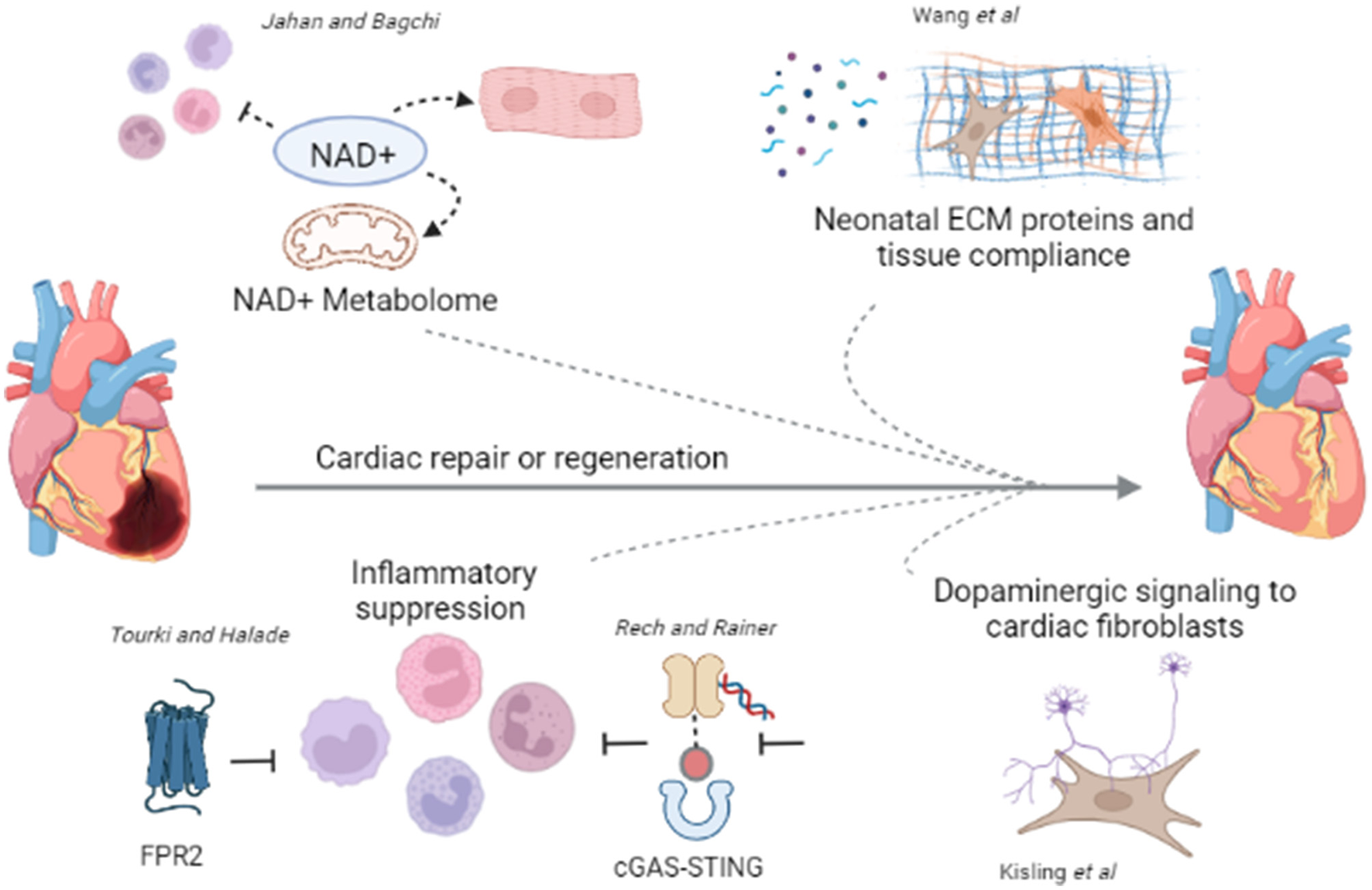
Broad and diverse mechanisms contribute to cardiac repair or regeneration. In the current topic issue, articles review the literature regarding NAD+ metabolome in CVD (Jahan and Bagchi), and inflammatory suppression via FRP2 activation (Tourki and Halade) or cGAS-STING inhibition (Rech and Rainer) in cardiac repair. Primary research articles demonstrate a role for ECM proteins and tissue compliance in cardiac regeneration (Wang et al.), and dopaminergic signaling to cardiac fibroblasts in cardiac repair post MI (Kisling et al.). Future studies should assess what molecular triggers can tip the balance to limit adverse remodeling and the pathogenesis of HF promoting the reparative processes. Figure was generated using Biorender.com.
Funding
We acknowledge funding from the National Institutes of Health under Award Numbers HL148114 (DI), HL145817 (KD-P), HL156022 (CO'M), HL141159 (CO'M), and HL152297 (LdCB), the Biomedical Laboratory Research and Development Service of the Veterans Affairs Office of Research and Development under Award Number BX003922 (KD-P), Advancing a Healthier Wisconsin Endowment (AHW) #5520561 (CO'M), American Heart Association IPA35260039 (KD-P), and the Department of Physiology startup funds from Augusta University (DI).
Author Disclaimer
The content is solely the responsibility of the authors and does not necessarily represent the official views of any of the funding agencies.
Publisher's Note
All claims expressed in this article are solely those of the authors and do not necessarily represent those of their affiliated organizations, or those of the publisher, the editors and the reviewers. Any product that may be evaluated in this article, or claim that may be made by its manufacturer, is not guaranteed or endorsed by the publisher.
Statements
Author contributions
CO'M prepared the figure. All authors conceived, drafted, edited the manuscript, and approved this final manuscript.
Conflict of interest
The authors declare that the research was conducted in the absence of any commercial or financial relationships that could be construed as a potential conflict of interest.
References
1.
Jones NR Roalfe AK Adoki I Hobbs FDR Taylor CJ . Survival of patients with chronic heart failure in the community: a systematic review and meta-analysis. Eur J Heart Fail. (2019) 21:1306–25. 10.1002/ejhf.1594
2.
Pfeffer MA Shah AM Borlaug BA . Heart failure with preserved ejection fraction in perspective. Circ Res. (2019) 124:1598–617. 10.1161/CIRCRESAHA.119.313572
3.
Lorchner H Poling J Gajawada P Hou Y Polyakova V Kostin S et al . Myocardial healing requires Reg3beta-dependent accumulation of macrophages in the ischemic heart. Nat Med. (2015) 21:353–62. 10.1038/nm.3816
4.
Brenes-Castro D Castillo EC Vazquez-Garza E Torre-Amione G Garcia-Rivas G . Temporal frame of immune cell infiltration during heart failure establishment: lessons from animal models. Int J Mol Sci. (2018) 19:12. 10.3390/ijms19123719
5.
Liu F Liu Y Zhuang Z Ma J Xu X Zhang W et al . Beclin1 Haploinsufficiency accentuates second-hand smoke exposure -induced myocardial remodeling and contractile dysfunction through a STING-mediated mechanism. J Mol Cell Cardiol. (2020) 148:78–88. 10.1016/j.yjmcc.2020.08.016
6.
Mao Y Luo W Zhang L Wu W Yuan L Xu H et al . STING-IRF3 triggers endothelial inflammation in response to free fatty acid-induced mitochondrial damage in diet-induced obesity. Arterioscler Thromb Vasc Biol. (2017) 37:920–9. 10.1161/ATVBAHA.117.309017
7.
Gong Y Li G Tao J Wu NN Kandadi MR Bi Y et al . Double knockout of Akt2 and AMPK accentuates high fat diet-induced cardiac anomalies through a cGAS-STING-mediated mechanism. Biochim Biophys Acta Mol Basis Dis. (2020) 1866:165855. 10.1016/j.bbadis.2020.165855
8.
Quan Y Xin Y Tian G Zhou J Liu X . Mitochondrial ROS-modulated mtDNA: a potential target for cardiac aging. Oxid Med Cell Longev. (2020) 2020:9423593. 10.1155/2020/9423593
9.
Hamann L Ruiz-Moreno JS Szwed M Mossakowska M Lundvall L Schumann RR et al . STING SNP R293Q is associated with a decreased risk of aging-related diseases. Gerontology. (2019) 65:145–54. 10.1159/000492972
10.
Cao DJ Schiattarella GG Villalobos E Jiang N May HI Li T et al . Cytosolic DNA sensing promotes macrophage transformation and governs myocardial ischemic injury. Circulation. (2018) 137:2613–34. 10.1161/CIRCULATIONAHA.117.031046
11.
Zhang Y Chen W Wang Y STING . is an essential regulator of heart inflammation and fibrosis in mice with pathological cardiac hypertrophy via endoplasmic reticulum (ER) stress. Biomed Pharmacother. (2020) 125:110022. 10.1016/j.biopha.2020.110022
12.
Hu D Cui YX Wu MY Li L Su LN Lian Z Chen H . Cytosolic DNA sensor cGAS plays an essential pathogenetic role in pressure overload-induced heart failure. Am J Physiol Heart Circ Physiol. (2020) 318:H1525–37. 10.1152/ajpheart.00097.2020
13.
Canto C Menzies KJ Auwerx J . NAD(+) metabolism and the control of energy homeostasis: a balancing act between mitochondria and the nucleus. Cell Metab. (2015) 22:31–53. 10.1016/j.cmet.2015.05.023
14.
Elhassan YS Kluckova K Fletcher RS Schmidt MS Garten A Doig CL et al . Nicotinamide riboside augments the aged human skeletal muscle NAD(+) metabolome and induces transcriptomic and anti-inflammatory signatures. Cell Rep. (2019) 28:1717–28 e6. 10.1016/j.celrep.2019.07.043
15.
Mileykovskaya EI Abuladze AN Ostrovsky DN . Subunit composition of the H+-ATPase complex from anaerobic bacterium Lactobacillus casei. Eur J Biochem. (1987) 168:703–8. 10.1111/j.1432-1033.1987.tb13472.x
16.
Lee CF Chavez JD Garcia-Menendez L Choi Y Roe ND Chiao YA et al . Normalization of NAD+ redox balance as a therapy for heart failure. Circulation. (2016) 134:883–94. 10.1161/CIRCULATIONAHA.116.022495
17.
Abdellatif M Trummer-Herbst V Koser F Durand S Adao R Vasques-Novoa F et al . Nicotinamide for the treatment of heart failure with preserved ejection fraction. Sci Transl Med. (2021) 13:580. 10.1126/scitranslmed.abd7064
18.
Canner PL Berge KG Wenger NK Stamler J Friedman L Prineas RJ et al . Fifteen year mortality in Coronary Drug Project patients: long-term benefit with niacin. J Am Coll Cardiol. (1986) 8:1245–55. 10.1016/s0735-1097(86)80293-5
19.
Porrello ER Mahmoud AI Simpson E Hill JA Richardson JA Olson EN et al . Transient regenerative potential of the neonatal mouse heart. Science. (2011) 331:1078–80. 10.1126/science.1200708
20.
Uygur A Lee RT . Mechanisms of cardiac regeneration. Dev Cell. (2016) 36:362–74. 10.1016/j.devcel.2016.01.018
21.
Wang Z Long DW Huang Y Chen WCW Kim K Wang Y . Decellularized neonatal cardiac extracellular matrix prevents widespread ventricular remodeling in adult mammals after myocardial infarction. Acta Biomater. (2019) 87:140–51. 10.1016/j.actbio.2019.01.062
22.
Bassat E Mutlak YE Genzelinakh A Shadrin IY Baruch Umansky K Yifa O et al . The extracellular matrix protein agrin promotes heart regeneration in mice. Nature. (2017) 547:179–84. 10.1038/nature22978
23.
Kaya D Ellidokuz E Onrat E Ellidokuz H Celik A Kilit C . The effect of dopamine type-2 receptor blockade on autonomic modulation. Clin Auton Res. (2003) 13:275–80. 10.1007/s10286-003-0097-3
24.
Johnson TL Tulis DA Keeler BE Virag JA Lust RM Clemens S . The dopamine D3 receptor knockout mouse mimics aging-related changes in autonomic function and cardiac fibrosis. PLoS ONE. (2013) 8:e74116. 10.1371/journal.pone.0074116
25.
Krishnamoorthy S Rajan R Banerjee M Kumar H Sarma G Krishnan S et al . Dopamine D3 receptor Ser9Gly variant is associated with impulse control disorders in Parkinson's disease patients. Parkinsonism Relat Disord. (2016) 30:13–7. 10.1016/j.parkreldis.2016.06.005
26.
Sokoloff P Le Foll B . The dopamine D3 receptor, a quarter century later. Eur J Neurosci. (2017) 45:2–19. 10.1111/ejn.13390
27.
Muhlbauer B Kuster E Luippold G . Dopamine D(3) receptors in the rat kidney: role in physiology and pathophysiology. Acta Physiol Scand. (2000) 168:219–23. 10.1046/j.1365-201x.2000.00665.x
28.
Luippold G Kuster E Joos TO Muhlbauer B . Dopamine D3 receptor activation modulates renal function in anesthetized rats. Naunyn Schmiedebergs Arch Pharmacol. (1998) 358:690–3. 10.1007/pl00005314
29.
Lopez EF Kabarowski JH Ingle KA Kain V Barnes S Crossman DK et al . Obesity superimposed on aging magnifies inflammation and delays the resolving response after myocardial infarction. Am J Physiol Heart Circ Physiol. (2015) 308:H269–80. 10.1152/ajpheart.00604.2014
30.
Huang H Han Y Wang X Chen C Yu C He D et al . Inhibitory effect of the D(3) dopamine receptor on insulin receptor expression and function in vascular smooth muscle cells. Am J Hypertens. (2011) 24:654–60. 10.1038/ajh.2011.41
31.
Zeng C Wang D Yang Z Wang Z Asico LD Wilcox CS et al . Dopamine D1 receptor augmentation of D3 receptor action in rat aortic or mesenteric vascular smooth muscles. Hypertension. (2004) 43:673–9. 10.1161/01.HYP.0000118958.27649.6f
Summary
Keywords
cardiovascular disease, regeneration, remodeling, inflammation, extracellular matrix
Citation
de Castro Brás LE, Schibalski RS, Ilatovskaya DV, O'Meara CC and DeLeon-Pennell KY (2022) Editorial: Role of Molecular Modulators in Combatting Cardiac Injury and Disease: Prevention, Repair and Regeneration. Front. Cardiovasc. Med. 9:861442. doi: 10.3389/fcvm.2022.861442
Received
24 January 2022
Accepted
23 March 2022
Published
18 April 2022
Volume
9 - 2022
Edited by
Gabriela Kania, University Hospital Zürich, Switzerland
Reviewed by
Giulio Agnetti, Johns Hopkins University, United States
Updates
Copyright
© 2022 de Castro Brás, Schibalski, Ilatovskaya, O'Meara and DeLeon-Pennell.
This is an open-access article distributed under the terms of the Creative Commons Attribution License (CC BY). The use, distribution or reproduction in other forums is permitted, provided the original author(s) and the copyright owner(s) are credited and that the original publication in this journal is cited, in accordance with accepted academic practice. No use, distribution or reproduction is permitted which does not comply with these terms.
*Correspondence: Kristine Y. DeLeon-Pennell deleonky@musc.edu
This article was submitted to Cardiovascular Biologics and Regenerative Medicine, a section of the journal Frontiers in Cardiovascular Medicine
Disclaimer
All claims expressed in this article are solely those of the authors and do not necessarily represent those of their affiliated organizations, or those of the publisher, the editors and the reviewers. Any product that may be evaluated in this article or claim that may be made by its manufacturer is not guaranteed or endorsed by the publisher.