Abstract
Background:
This study aimed to assess the scientific results and activities of premature beats research from a global perspective.
Methods:
Publications related to premature beats published between 2003 and 2024 were identified and selected from the Web of Science core collection. VOSviewer was used to conduct co-authorship, co-citation, and co-occurrence analyses of the authors, organizations, countries/regions, references, sources, cited authors, and keywords.
Results:
In total, 5,283 publications on the topic of premature beats were identified from the Web of Science core collection. The number of publications on this topic has steadily grown since 2003. Fred Morady, Frank Bogun and Krit Jongnarangsin were the top three researchers with the strongest total link strengths. The University of Washington, Johns Hopkins University, and the University of Minnesota are the top three organizations with the strongest total link strengths. The United States has made the greatest contributions to the field of premature beats. Haïssaguerre, M et al.'s publication in The New England Journal of Medicine in 1998 entitled “Spontaneous initiation of atrial fibrillation by ectopic beats originating in the pulmonary veins” is the most cited reference. The most cited references come from the journal named Circulation. Haïssaguerre, M has the highest number of citations. The keywords for all current publications can be divided into four categories: “mortality rate,” “risk and prevention,” “mechanism,” and “classification and treatment.”
Conclusions:
This bibliometric study provides insights into the current status and research trends in premature beats over more than 20 years. Future research will focus on an in-depth exploration of the nature of premature beats, especially ventricular premature beats, mastering the development law of premature beats, and optimizing existing detection methods.
1 Introduction
Premature beats, also known as ectopic beats or premature contractions, are a common type of cardiac arrhythmias. They refer to heartbeats that occur earlier than expected because of impulses originating from ectopic pacemaker sites, while the underlying heart rhythm remains regular (1). Based on their site of origin, premature beats can be categorized as ventricular, atrial, or junctional (2, 3). With an aging population and widespread use of dynamic electrocardiogram monitoring, the prevalence of premature beats has increased in the general population (4, 5). Premature beats in structurally normal hearts are usually benign; however, in the presence of structural heart disease, they can contribute to various cardiovascular conditions, such as myocardial diseases, heart failure, and sudden cardiac death, becoming a major cause of morbidity and mortality in cardiovascular diseases (6–8).
Since Sir Thomas Lewis proposed “aberrant beats” in 1910 (9), scholars have been interested in the potential pathophysiological processes of ventricular premature beats in clinical and translational research (10–12). Some researchers have focused on the prevention and basic treatment approaches for atrial premature beats in clinical strategy (13–15). Additionally, there has been attention to the classification and significance of junctional premature beats in basic research and clinical practice (3, 16–18). With advancements in medical care, premature beats have become an increasingly important factor in the development of cardiovascular diseases, prompting scholars to conduct in-depth research.
Bibliometric analysis is a quantitative analytical method that explores information within a large body of literature, including publications, authors, organizations, countries/regions, references, sources, cited authors, keywords, etc. By utilizing the VOSviewer software (19), a tool for constructing and visualizing bibliometric networks, scholars can uncover the inherent connections between information and further understand the trends and cutting-edge developments in their research field. Despite nearly a century of research on premature beats, a bibliometric visualization analysis has not been conducted. This study aimed to employ VOSviewer software to provide a visual and quantitative description and evaluation of premature beats research from 2003 to May 31,2024. It comprehensively organizes and presents representative information networks and offers a theoretical reference for identifying new research hotspots in the field of premature beats.
2 Methods
This article was indexed based on raw data from the Web of Science core collection (WoScc). The keywords for premature beats were obtained from MeSH (https://www.ncbi.nlm.nih.gov/mesh) searches.
Topic#1 = Cardiac Complexes, Premature or Complexes, Premature Cardiac or Extrasystoles or Premature Beats or Beat, Premature or Beats, Premature or Premature Beat or Premature Cardiac Complex or Premature Cardiac Complexes or Cardiac Complex, Premature or Premature Cardiac Complices or Ectopic Heartbeats or Ectopic Heartbeat or Heartbeat, Ectopic or Heartbeats, Ectopic or Extrasystole.
Topic#2 = Ventricular Premature Complexes or Extrasystole, Ventricular or Ventricular Extrasystole or Ventricular Extrasystoles or Premature Ventricular Beats or Premature Ventricular Beat or Ventricular Beat, Premature or Ventricular Beats, Premature or Premature Ventricular Complex or Ventricular Complex, Premature or Premature Ventricular Contractions or Premature Ventricular Contraction or Ventricular Contraction, Premature or Ventricular Contractions, Premature or Ventricular Ectopic Beats or Ectopic Beats, Ventricular or Ectopic Beat, Ventricular or Ventricular Ectopic Beat or Ventricular Premature Complex.
Topic#3 = Atrial Premature Complexes or Premature Complexes, Atrial or Atrial Ectopic Beats or Atrial Ectopic Beat or Ectopic Beat, Atrial or Ectopic Beats, Atrial or Atrial Premature Complex or Atrial Premature Complices or Premature Complex, Atrial or Premature Complices, Atrial or Extrasystole, Atrial or Atrial Extrasystole or Atrial Extrasystoles or Extrasystoles, Atrial or Premature Atrial Beats or Atrial Beat, Premature or Atrial Beats, Premature or Premature Atrial Beat or Premature Atrial Complex or Atrial Complex, Premature or Atrial Complices, Premature or Premature Atrial Complices or Premature Atrial Contractions or Atrial Contraction, Premature or Atrial Contractions, Premature or Premature Atrial Contraction or Premature Supraventricular Beats or Premature Supraventricular Beat or Supraventricular Beat, Premature or Supraventricular Beats, Premature.
The index topic was (Topic Search = #1 OR #2 OR #3). The index data range was “from 2003-01-01 to 2024-05-31”. The document type was “article” and the language was English. Data were collected on June 4, 2024. We then exported the complete records and cited references as plain text files and used VOSviewer (v.1.6.20) for co-authorship, co-citation, and co-occurrence analysis (Figure 1).
Figure 1
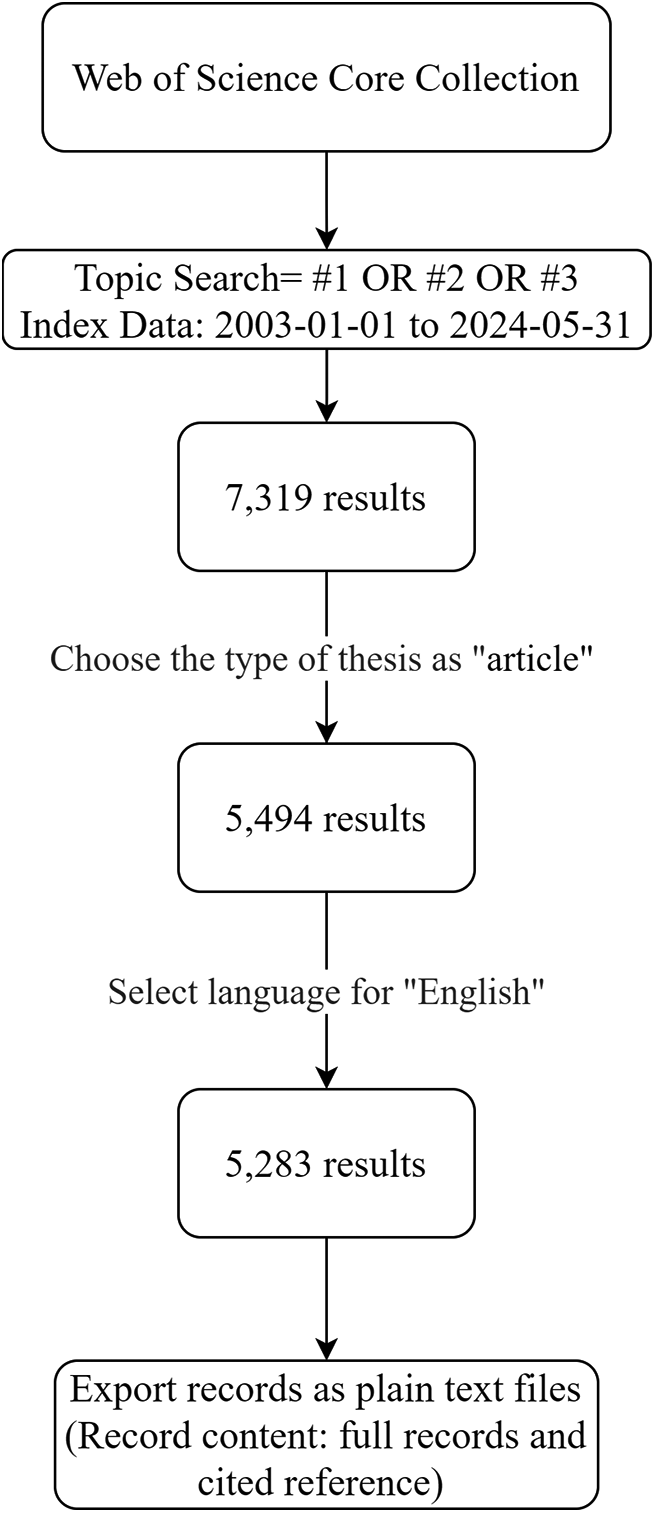
Flow chart of data source and research strategy.
3 Results
3.1 Literature development trends
The number of publications over a period of time reflects the research speed and trends in this field. From 2003 to 2024, 5,283 publications on premature beats were published in WoScc. Figure 2 shows the annual publications data. From 2003 to 2014, the number of publications remained constant at 190. A total of 419 studies were published in 2021. In the recent ten years, the number of articles published has been approximately 300, indicating that premature beats have become a topic of increasing concern for scholars.
Figure 2
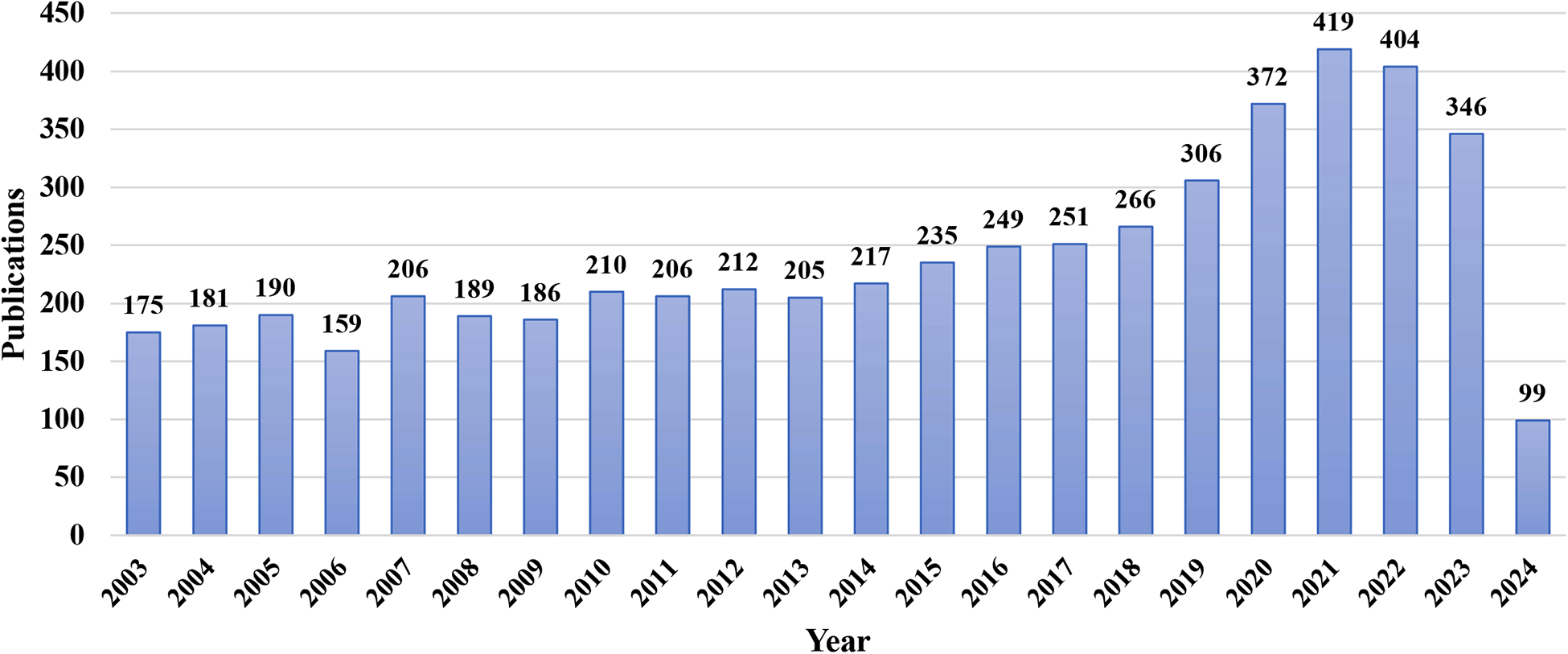
Number of annual publications from 2003 to 2024.
3.2 Co-authorship analysis
The relevance of premature beats research can be discovered by conducting a co-authorship analysis. The resulting map of key authors, organizations, and countries/regions directly displays a network of connections in premature beats research. Valuable information can guide researchers to find cooperating authors, guide organizations to know other institutions, and guide countries/regions to find development cooperation worldwide, thereby promoting high-quality development of premature beats research. In the figure created by VOSviewer, the author, institution, or countries/regions are represented by points. The larger the point, the more the articles published. A line between any two points symbolizes cooperation. The thickness of the line is known as the link strength. The thicker it is, the stronger is the collaboration.
In total, 26,876 authors were involved in the field of premature beats with 5,283 publications. The VOSviewer parameters were set as follows: minimum number of documents by an author: 15; minimum number of citations by an author: 150. The results were retrieved from 26,876 authors, 58 of whom met the thresholds (Figure 3A). According to the total link strength (TLS), the top three were Fred Morady (TLS = 171), Frank Bogun (TLS = 165), and Krit Jongnarangsin (TLS = 145) (Table 1). According to VOSviewer analysis, 5,283 documents were published by 5,381 different organizations and 20 met the threshold (minimum number of documents of an organization: 36; minimum number of citations of an organization: 200) (Figure 3B). The top three were the University of Washington (TLS = 43), Johns Hopkins University (TLS = 36), and the University of Minnesota (TLS = 31) (Table 2). 94 countries/regions were involved in the publication of premature beats, and 11 met the threshold (minimum number of documents in a country: 150; minimum number of citations in a country: 200) (Figure 3C). The top three countries/regions were the United States (TLS = 654), Germany (TSL = 316), and China (TSL = 278) (Table 3).
Figure 3
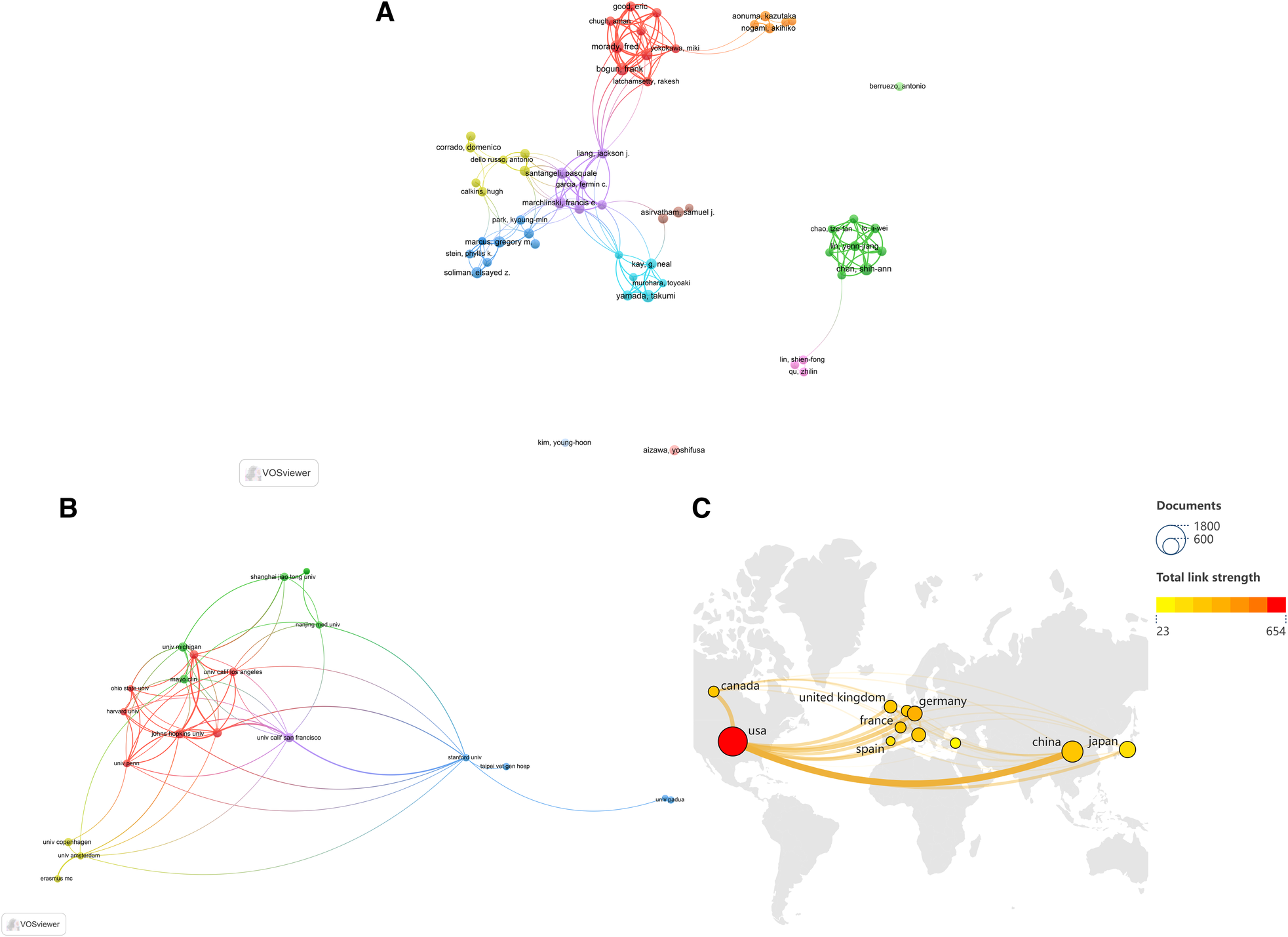
Co-authorship analysis in the premature beats research from 2003 to 2024 [(A) authors; (B) organizations; (C) countries/regions].
Table 1
| Rank | Author | Documents | Citations | Total link strength |
|---|---|---|---|---|
| 1 | Fred Morady | 35 | 2,368 | 171 |
| 2 | Frank Bogun | 34 | 2,120 | 165 |
| 3 | Krit Jongnarangsin | 27 | 2,021 | 145 |
| 4 | Shih-Ann Chen | 32 | 463 | 118 |
| 5 | Eric Good | 20 | 2,195 | 118 |
| 6 | Yenn-Jiang Lin | 20 | 326 | 118 |
| 7 | Aman Chugh | 19 | 2,198 | 117 |
| 8 | Hakan Oral | 19 | 2,198 | 117 |
| 9 | Shih-Lin Chang | 19 | 318 | 116 |
| 10 | Li-Wei Lo | 19 | 325 | 116 |
Top 10 co-authorship authors in the premature beats research from 2003 to 2024.
Table 2
| Rank | Organization | Documents | Citations | Total link strength |
|---|---|---|---|---|
| 1 | University of Washington | 65 | 3,015 | 43 |
| 2 | Johns Hopkins University | 67 | 2,429 | 36 |
| 3 | University of Minnesota | 57 | 1,972 | 31 |
| 4 | University of California San Francisco | 69 | 2,202 | 29 |
| 5 | University of Pennsylvania | 48 | 2,115 | 21 |
| 6 | Stanford University | 43 | 1,468 | 19 |
| 7 | University of California, Los Angeles | 55 | 2,106 | 18 |
| 8 | The Ohio State University | 37 | 908 | 15 |
| 9 | Harvard University | 44 | 1,830 | 13 |
| 10 | Shanghai Jiao Tong University | 56 | 612 | 13 |
Top 10 co-authorship organizations in the premature beats research from 2003 to 2024.
Table 3
| Rank | Country/region | Documents | Citations | Total link strength |
|---|---|---|---|---|
| 1 | USA | 1,599 | 52,678 | 654 |
| 2 | Germany | 413 | 11,408 | 316 |
| 3 | China | 842 | 13,527 | 278 |
| 4 | Italy | 362 | 9,885 | 270 |
| 5 | Netherlands | 231 | 6,991 | 260 |
| 6 | United Kingdom | 301 | 9,130 | 250 |
| 7 | Canada | 222 | 7,127 | 235 |
| 8 | France | 229 | 7,625 | 235 |
| 9 | Spain | 150 | 4,704 | 180 |
| 10 | Japan | 500 | 9,348 | 173 |
Top 10 co-authorship countries/regions in the premature beats research from 2003 to 2024.
3.3 Co-citation analysis
Obtaining important information from cited articles enables researchers to identify mainstream research types and acquire relevant information and knowledge through co-citation analysis. The resulting map visually demonstrates the relevance of the research on premature beats. In the figure created by VOSviewer, cited references, journals, or cited authors are represented by dots. The larger the dot, the more times it has been cited, symbolizing higher academic value.
A total of 96,202 cited references were included in the field of premature beats, with 5,283 publications. The VOSviewer parameters were set as follows: minimum number of citations of a cited reference: 70. The results were retrieved from 96,202 cited references, 29 of which met the thresholds (Figure 4A). According to the number of citations, the top three were Haïssaguerre, M et al., published in The New England Journal of Medicine in 1998, entitled “Spontaneous initiation of atrial fibrillation by ectopic beats originating in the pulmonary veins. (20)” (Citation = 212); Baman, TS et al., published in Heart Rhythm in 2010 entitled “Relationship between burden of premature ventricular complexes and left ventricular function. (21)” (Citation = 194); and Goldberger, AL et al., published in Circulation in 2000 entitled “PhysioBank, PhysioToolkit, and PhysioNet: components of a new research resource for complex physiologic signals. (22)” (Citation = 169) (Table 4). According to VOSviewer analysis, 96,202 cited references were published in 13,270 sources and 93 met the threshold (a minimum number of citations of a source: 200) (Figure 4B). The top three were Circulation (Citation = 13,577), Journal of the American College of Cardiology (Citation = 8,394), and Heart Rhythm (Citation = 5,823) (Table 5). Further, 96,202 cited references were written by 60,128 authors, of which 59 met the threshold (minimum number of citations per author: 100) (Figure 4C). The top three were Haïssaguerre, M (Citation = 577), Yamada, T (Citation = 548), and Priori, SG (Citation = 378) (Table 6).
Figure 4
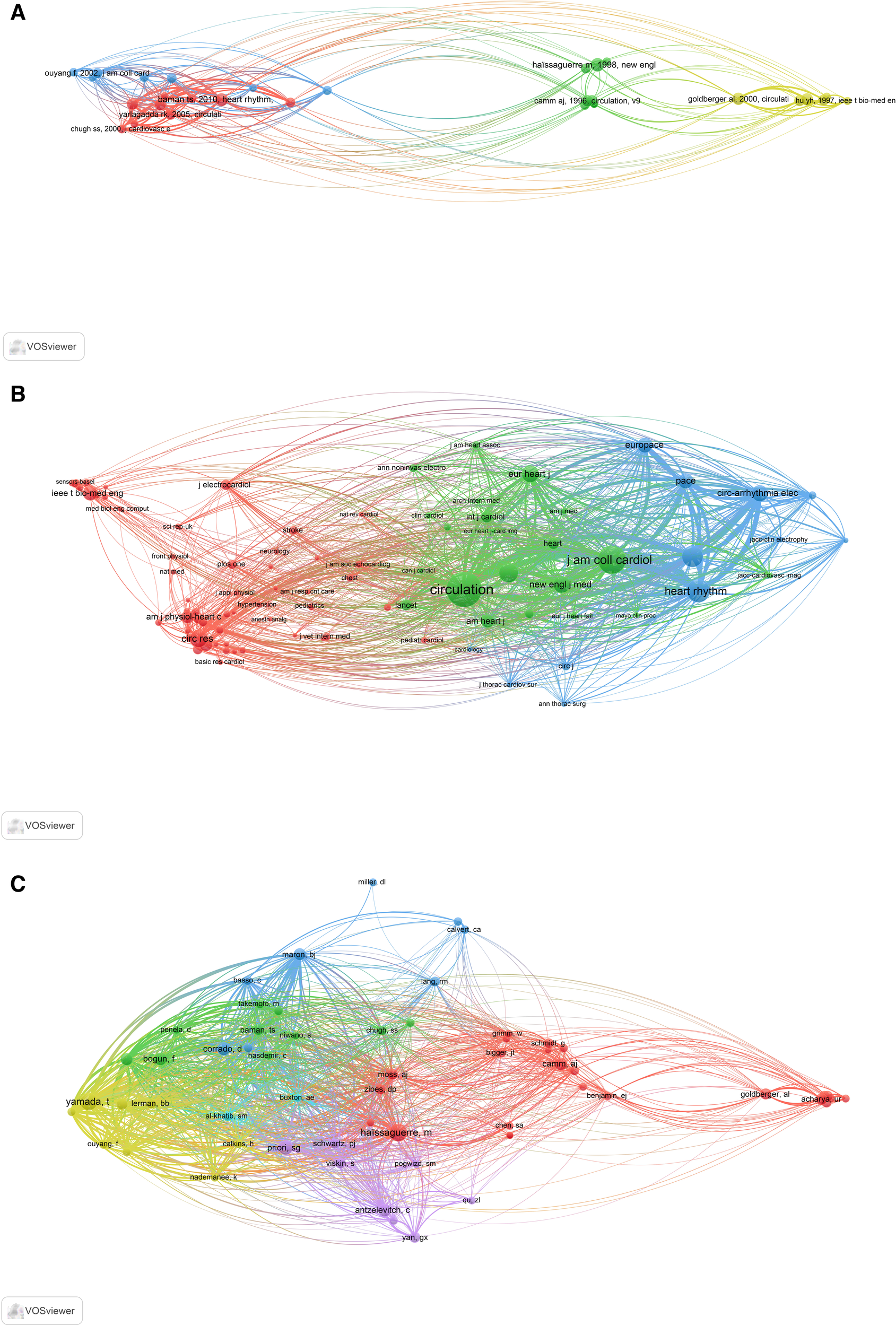
Co-citation analysis in the premature beats research from 2003 to 2024 [(A) cited references; (B) cited sources; (C) cited authors].
Table 4
| Rank | Cited reference | Citations |
|---|---|---|
| 1 | Haïssaguerre M, 1998, New Engl J Med, v339, p659, doi 10.1056/nejm199809033391003 | 212 |
| 2 | Baman TS, 2010, Heart Rhythm, v7, p865, doi 10.1016/j.hrthm.2010.03.036 | 194 |
| 3 | Goldberger AL, 2000, Circulation, v101, pe215, doi 10.1161/01.cir.101.23.e215 | 169 |
| 4 | Moody GA, 2001, IEEE Eng Med Biol, v20, p45, doi 10.1109/51.932724 | 161 |
| 5 | Bogun F, 2007, Heart Rhythm, v4, p863, doi 10.1016/j.hrthm.2007.03.003 | 159 |
| 6 | Camm AJ, 1996, Circulation, v93, p1043 | 148 |
| 7 | Takemoto M, 2005, J Am Coll Cardiol, v45, p1259, doi 10.1016/j.jacc.2004.12.073 | 147 |
| 8 | Yarlagadda RK, 2005, Circulation, v112, p1092, doi 10.1161/circulationaha.105.546432 | 142 |
| 9 | Schmidt G, 1999, Lancet, v353, p1390, doi 10.1016/s0140-6736 (98)08428-1 | 135 |
| 10 | Pan J, 1985, IEEE T Bio-Med eng, v32, p230, doi 10.1109/tbme.1985.325532 | 132 |
Top 10 cited references in the premature beats research from 2003 to 2024.
Table 5
| Rank | Source | Citations |
|---|---|---|
| 1 | Circulation | 13,577 |
| 2 | Journal of the American College of Cardiology | 8,394 |
| 3 | Heart Rhythm | 5,823 |
| 4 | Journal of Cardiovascular Electrophysiology | 4,880 |
| 5 | American Journal of Cardiology | 4,179 |
| 6 | Circulation Research | 3,411 |
| 7 | The New England Journal of Medicine | 3,136 |
| 8 | European Heart Journal | 3,003 |
| 9 | Circulation: Arrhythmia and Electrophysiology | 2,821 |
| 10 | EP Europace | 2,556 |
Top 10 cited sources in the premature beats research from 2003 to 2024.
Table 6
| Rank | Author | Citations |
|---|---|---|
| 1 | Haïssaguerre, M | 577 |
| 2 | Yamada, T | 548 |
| 3 | Priori, SG | 378 |
| 4 | Corrado, D | 315 |
| 5 | Camm, AJ | 296 |
| 6 | Antzelevitch, C | 285 |
| 7 | Bogun, F | 283 |
| 8 | Maron, BJ | 275 |
| 9 | Yokokawa, M | 255 |
| 10 | Tada, H | 239 |
Top 10 cited authors in the premature beats research from 2003 to 2024.
3.4 Co-occurrence analysis
Co-occurrence analysis aims to identify hot topics in the field of premature beats research by analyzing the number of keywords that appear together in publications. From the generated keyword map, it is also easier to obtain advanced information in the field, which helps researchers follow the development of field research. The keywords in the figure created by VOSviewer are represented by dots. The larger the dot, the higher is its frequency of occurrence, which symbolizes the scholar's attention and current popularity.
A total of 14,583 keywords were involved in the field of premature beats with 5,283 publications and 73 met the threshold (minimum number of occurrences of a keyword: 85) (Figure 5), which was mainly divided into four clusters, namely blue, yellow, green, and red (Table 7). The blue cluster primarily revolved around the risk and prevention of premature beats. The yellow cluster mainly focused on the mechanism of premature beats. The green cluster primarily revolved around disease and mortality. The red cluster primarily focused on the classification and treatment of premature beats.
Figure 5
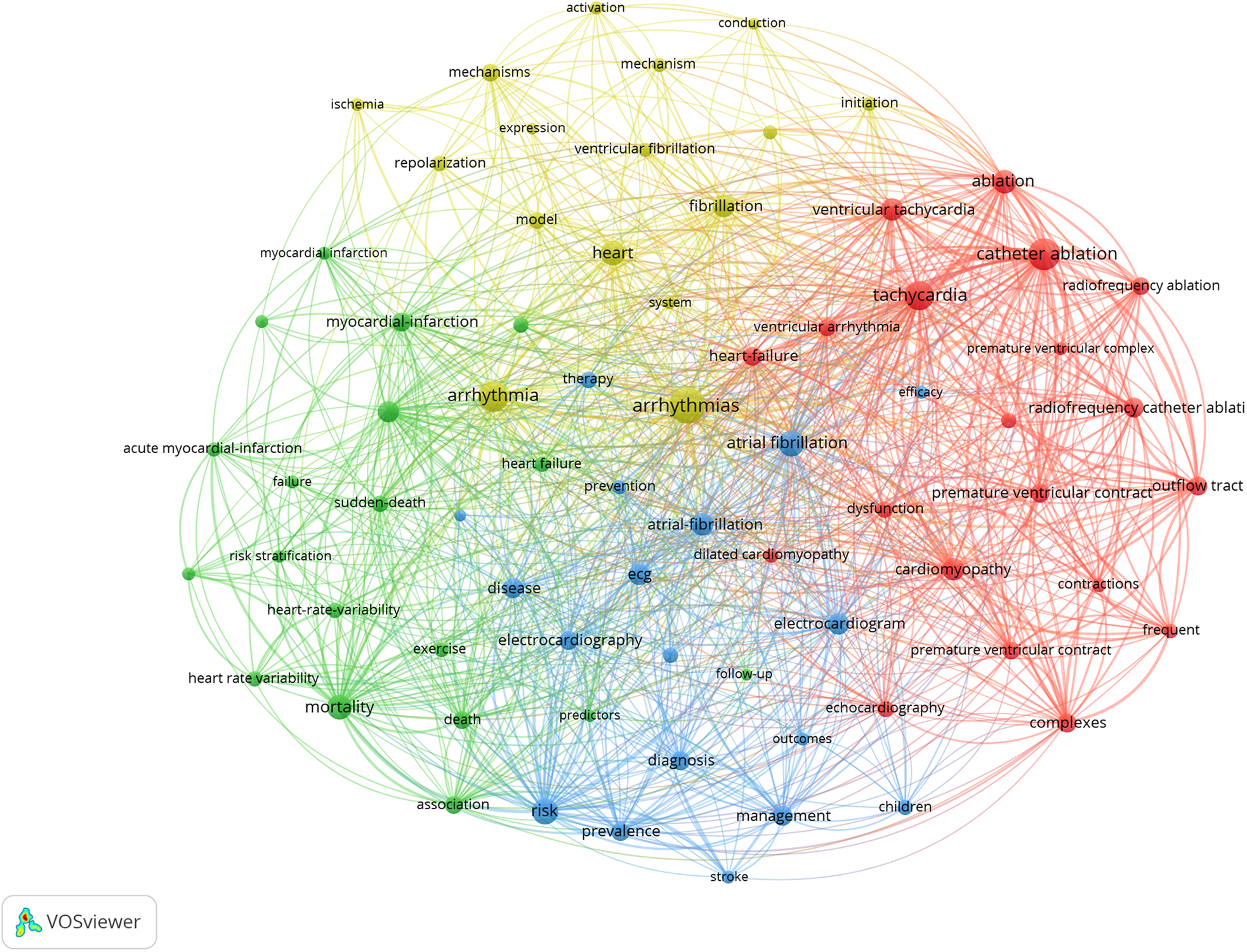
Co-occurrence analysis of keywords in the premature beats research from 2003 to 2024.
Table 7
| Cluster | Color | Keywords |
|---|---|---|
| 1 | Blue | Risk, atrial fibrillation, atrial-fibrillation, ecg, electrocardiogram, disease, management, diagnosis, electrocardiography, prevalence, therapy, classification, children, prevention, stroke, outcomes, efficacy, cardiac-arrhythmias |
| 2 | Yellow | Arrhythmias, arrhythmia, heart, fibrillation, mechanisms, model, repolarization, initiation, ventricular fibrillation, mechanism, electrophysiology, ischemia, activation, system, conduction, expression |
| 3 | Green | Mortality, sudden cardiac death, myocardial-infarction, death, association, sudden-death, heart failure, heart-rate-variability, heart rate variability, ventricular arrhythmias, acute myocardial-infarction, exercise, risk stratification, myocardial infarction, rate-variability, failure, ventricular-arrhythmias, follow-up, predictors |
| 4 | Red | Catheter ablation, tachycardia, ablation, cardiomyopathy, ventricular tachycardia, radiofrequency catheter ablation, heart-failure, outflow tract, premature ventricular contraction, complexes, ventricular arrhythmia, premature ventricular contractions, radiofrequency ablation, echocardiography, dysfunction, premature ventricular complexes, frequent, dilated cardiomyopathy, contractions, premature ventricular complex |
Cluster of keywords in the premature beats research from 2003 to 2024.
4 Discussion
4.1 Research trends in premature beats
Using VOSviewer to conduct quantitative and visual analyses of research in the field of premature beats, we aimed to evaluate the development trend of premature beats research and predict its future research direction. From the dynamic changes in the total annual publication volume, we observed that research in the field of premature beats has steadily grown in recent years. With an aging global population, rapid economic development, emphasis on health, and improvements in medical care, the demand for the diagnosis and treatment of premature beats has increased significantly. It is not difficult to predict that the publications will continue to increase over the next few years.
Co-authorship analysis was used to assess and demonstrate collaborations between different authors, institutions, and countries/regions. The closeness between the authors forms a network of research relationships. The top three authors with the most TLS were all cardiac electrophysiologists and cardiologists from the University of Michigan (Table 1), mainly focusing on arrhythmia, ectopic heartbeat, and cardiac ablation, which form a very close connection (Figure 3). Co-creation can help researchers innovate and obtain new information. Paying attention to and promoting collaboration among authors will play a key role in the development of premature beats research. The nine institutions with the highest TLS among the research institutions were all in the United States (Table 2). In terms of the number of papers published and citations, the leading country was the United States (Table 3). The above findings confirm the United States's critical contributions and leading position in premature beats research, which may result from the United States' national economic conditions and high medical investment levels. This field will benefit from extensive international cooperation, which will improve the overall standard of research.
Co-citation analysis displays and illustrates the internal relationship between a large number of cited references, sources, and authors, and evaluates the impact of research on premature beats. The top three journals with the highest number of citations published high-quality papers that were recognized and cited by scholars. In Figure 4A, various frequently cited references are included. The reference with the most citations was by Haïssaguerre, M. Figure 4C shows that he also has the highest number of citations. He specializes in internal medicine, cardiology, catheter ablation, atrial fibrillation, and ablation. His research showed that the vast majority of premature atrial contractions that cause frequent paroxysmal atrial fibrillation originate from the pulmonary veins. These lesions initiate atrial fibrillation through rapid discharge and respond to local radiofrequency ablation using a catheter (20).
4.2 Research focus on premature beats
Hot topics and promising research directions are also presented in our study. The keywords reflected the research topic of this study. Therefore, research hotspots can be identified by analyzing the frequency of keywords in the field of premature beats. Co-occurrence analysis was used to analyze the keywords in all excerpted publications, which were mainly divided into four clusters. Based on these results, we summarized the popular topics of premature beats-related research over the past 20 years.
In the general population, the prevalence of premature ventricular contractions ranges from 3% to 20%, and increases with age, underlying heart disease, and other comorbidities (including hypertension, coronary artery disease and electrolytes) (11). Ventricular arrhythmias can manifest as asymptomatic ventricular premature syndrome or non-sustained ventricular tachycardia, symptoms of previous arrhythmias, or sustained ventricular tachycardia. Symptoms range from mild to complete hemodynamic failure (23), and studies have shown that ventricular arrhythmias are an important factor in morbidity and mortality in patients with heart failure (24). Therefore, premature ventricular beats have the greatest clinical significance and impact on the heart, which requires close attention and timely diagnosis and treatment.
Currently, three basic mechanisms underlie the occurrence of premature beats: triggered activity, automaticity, and reentry (25). Triggered activity describes premature beats and tachycardia caused by afterpotentials generated by a previous action potential (26). This is usually attributed to post-depolarization mediated by increased intracellular calcium. Clinical findings show that the typical cause of early after-depolarization is torsade de pointes secondary to long QT syndrome (referring to a group of syndromes with prolonged QT interval, ventricular arrhythmia, syncope, and sudden death on electrocardiography) (27), and the typical manifestations of late after-depolarization are digitalis intoxication or catecholaminergic polymorphic ventricular tachycardia (28). Spontaneous pacing involves ectopic pacing points that increase self-discipline; that is, the potential ectopic pacing point in different parts of the heart, when its self-discipline suddenly increases, before the basic rhythm of the excitation has not been issued or down, preemptive excitation to depolarize the atrium or ventricle, it will form premature beats (29). Reentry refers to the impulse of one part of the heart that is transmitted down the conduction path and returns to the original part to produce an impulse again (30). The classification of premature beats included the location of the origin of premature beats, number of pacing points, mechanism of occurrence, degree of early onset, and similarities and differences between the origin and dominant rhythm sites. The treatment of premature beats depends on the type of premature beats, severity of symptoms, and overall health of the patients. For most patients with premature beats, if the symptoms are not severe or there are no obvious cardiac structural abnormalities, doctors may recommend observation and lifestyle management, which includes avoiding caffeine, alcohol, and stimulants, maintaining good sleep quality, and reducing stress and anxiety. Doctors may consider using drugs to control arrhythmias during severe or frequent episodes of premature beats. Commonly used drugs include β-blockers, calcium antagonists, and antiarrhythmic drugs. Specific drug selection and dosage can be adjusted individually according to the patient's condition (25); for some types of premature beats, especially ventricular premature beats or atrial premature beats with severe symptoms, doctors may recommend cardiac ablation (this is an interventional procedure that burns or freezes abnormal heart tissue inside the heart through a catheter to restore normal heart rhythm) (31). In some special cases, such as cardiac structural abnormalities or the presence of other heart diseases, other treatment methods may be required, such as pacemaker implantation or surgical correction (32). Although surgery is the last-best choice for doctors, continuous monitoring and follow-up are important. The medical community's understanding of the consequences of ventricular premature beats and VPB-induced cardiomyopathy comes mainly from observational and large-scale population studies (10). In view of the current drug treatments for premature beats, the safety of long-term medication, effectiveness of drugs, and limitations of surgical treatment need to be considered. Current scholars focus on exploring the essence of premature beats and understanding the development law of premature beats.
Early detection and diagnosis are the basis for the prevention of premature beats. Ventricular arrhythmias are an important cause of morbidity and mortality and occur in many forms ranging from single premature ventricular complexes to sustained ventricular tachycardia and fibrillation. Over the past decade, the understanding of arrhythmias and their ability to diagnose them have advanced rapidly (33). With the development of new methods and tools and the publication of large-scale clinical trials, electrocardiography, Holter monitoring, event recorders, echocardiography, cardiac monitoring, and other detection techniques have been rapidly developed in hospitals or clinics for premature beats detection; these techniques are used to check or record heart-related parameters to help doctors detect and analyze the frequency, type, and related arrhythmia of premature beats (33). In the future, the continuous optimization of detection technology can quickly help doctors diagnose while reminding professional medical technicians that they need to constantly update and improve their professional knowledge. Furthermore, the results obtained through follow-up, continuous testing, and continuous summary may contribute to daily clinical practice and early intervention in the occurrence and development of premature beats as much as possible.
4.3 Advantages and limitations
To help new academic researchers relatively easily understand the evolution, current situation, and hotspots of premature beats research, publications on premature beats-related research were extracted from WoScc. Because all publications were evaluated based on authors, organizations, countries/regions, references, sources, and cited authors, our analysis results may provide reference values for scientists and funding agencies to explore potential partnerships and understand cutting-edge research. However, this study has some limitations. First, publications in other databases (such as PubMed, Google Scholar, and Scopus) were not considered but were only retrieved and collected from the WoScc database. Second, critical studies published in other languages may have been ignored because the analysis included only English articles. Third, although the selected publications were mainly published from 2003 to 2024, owing to the open state of the WoScc database, new research will be received continuously, and there may be some publication bias.
5 Conclusions
This study identified articles published between 2003 and 2024 in the field of premature beats research. We highlighted outstanding authors, organizations, countries/regions, references, sources, cited authors, and performed a keyword analysis. In summary, research on premature beats is still in its nascent stage. According to current global trends, the number of publications on premature beats research is expected to increase significantly. The United States is a dominant country in this area. Currently, all publications can be divided into four categories: “ mortality rate,” “ risk and prevention,” “ mechanism,” and “ classification and treatment.” Future research will focus on an in-depth exploration of the nature of premature beats, especially ventricular premature beats, mastering the development law of premature beats, and optimizing existing detection methods.
Statements
Data availability statement
The original contributions presented in the study are included in the article/Supplementary Material, further inquiries can be directed to the corresponding author.
Ethics statement
The manuscript presents research on animals that do not require ethical approval for their study.
Author contributions
DW: Data curation, Writing – original draft. XX: Writing – review & editing.
Funding
The author(s) declare that no financial support was received for the research, authorship, and/or publication of this article.
Conflict of interest
The authors declare that the research was conducted in the absence of any commercial or financial relationships that could be construed as a potential conflict of interest.
Publisher’s note
All claims expressed in this article are solely those of the authors and do not necessarily represent those of their affiliated organizations, or those of the publisher, the editors and the reviewers. Any product that may be evaluated in this article, or claim that may be made by its manufacturer, is not guaranteed or endorsed by the publisher.
References
1.
Sörnmo L Laguna P . Bioelectrical Signal Processing in Cardiac and Neurological Applications: Bioelectrical Signal Processing in Cardiac and Neurological Applications. Cambridge, MA: Academic Press (2005).
2.
Verba SD Jensen BT Lynn JS . Electrocardiographic responses to deer hunting in men and women. Wilderness Environ Med. (2016) 27(3):364–70. 10.1016/j.wem.2016.03.005
3.
Bagliani G Della Rocca DG De Ponti R Capucci A Padeletti M Natale A . Ectopic beats: insights from timing and morphology. Card Electrophysiol Clin. (2018) 10(2):257–75. 10.1016/j.ccep.2018.02.013
4.
Cantillon DJ . Evaluation and management of premature ventricular complexes. Cleve Clin J Med. (2013) 80(6):377–87. 10.3949/ccjm.80a.12168
5.
Tseng AS Kowlgi GN DeSimone CV . Management of premature ventricular complexes in the outpatient setting. Mayo Clin Proc. (2023) 98(7):1042–53. 10.1016/j.mayocp.2023.01.021
6.
Gorenek B Fisher JD Kudaiberdieva G Baranchuk A Burri H Campbell KB et al Premature ventricular complexes: diagnostic and therapeutic considerations in clinical practice: a state-of-the-art review by the American College of Cardiology Electrophysiology Council. J Interv Card Electrophysiol. (2020) 57(1):5–26. 10.1007/s10840-019-00655-3
7.
Santangeli P Marchlinski FE . Ablation therapy for refractory ventricular arrhythmias. Annu Rev Med. (2020) 71:177–90. 10.1146/annurev-med-041818-020033
8.
Crow RS Prineas RJ Dias V Taylor HL Jacobs D Blackburn H . Ventricular premature beats in a population sample. Frequency and associations with coronary risk characteristics. Circulation. (1975) 52(6 Suppl):Iii211–5.
9.
Lewis T . Paroxysmal Tachycardia, the Result of Ectopic Impulse Formation.
10.
Huizar JF Tan AY Kaszala K Ellenbogen KA . Clinical and translational insights on premature ventricular contractions and pvc-induced cardiomyopathy. Prog Cardiovasc Dis. (2021) 66:17–27. 10.1016/j.pcad.2021.04.001
11.
Klewer J Springer J Morshedzadeh J . Premature ventricular contractions (pvcs): a narrative review. Am J Med. (2022) 135(11):1300–5. 10.1016/j.amjmed.2022.07.004
12.
Gomez SE Hwang CE Kim DS Froelicher VF Wheeler MT Perez MV . Premature ventricular contractions (pvcs) in young athletes. Prog Cardiovasc Dis. (2022) 74:80–8. 10.1016/j.pcad.2022.10.011
13.
Mitchell AR Sulke N . How do atrial pacing algorithms prevent atrial arrhythmias?Europace. (2004) 6(4):351–62. 10.1016/j.eupc.2004.03.005
14.
Applegate TE . Atrial arrhythmias. Prim Care. (2000) 27(3):677–708;vi. 10.1016/s0095-4543(05)70169-x
15.
Donal E Galli E Lederlin M Martins R Schnell F . Multimodality imaging for best dealing with patients in atrial arrhythmias. JACC Cardiovasc Imaging. (2019) 12(11 Pt 1):2245–61. 10.1016/j.jcmg.2018.06.031
16.
de Azevodo IM Watanabe Y Dreifus LS . Atrioventricular junctional rhythm: classification and clinical significance. Chest. (1973) 64(6):732–40. 10.1378/chest.64.6.732
17.
Meijler FL Janse MJ . Morphology and electrophysiology of the mammalian atrioventricular node. Physiol Rev. (1988) 68(2):608–47. 10.1152/physrev.1988.68.2.608
18.
Akhtar M . Human his-purkinje system: abnormalities of conduction, rhythm disorders and case studies. Card Electrophysiol Clin. (2016) 8(4):683–742. 10.1016/j.ccep.2016.07.004
19.
van Eck NJ Waltman L . Software survey: vosviewer, a computer program for bibliometric mapping. Scientometrics. (2010) 84(2):523–38. 10.1007/s11192-009-0146-3
20.
Haïssaguerre M Jaïs P Shah DC Takahashi A Hocini M Quiniou G et al Spontaneous initiation of atrial fibrillation by ectopic beats originating in the pulmonary veins. N Engl J Med. (1998) 339(10):659–66. 10.1056/nejm199809033391003
21.
Baman TS Lange DC Ilg KJ Gupta SK Liu TY Alguire C et al Relationship between burden of premature ventricular complexes and left ventricular function. Heart Rhythm. (2010) 7(7):865–9. 10.1016/j.hrthm.2010.03.036
22.
Goldberger AL Amaral LA Glass L Hausdorff JM Ivanov PC Mark RG et al Physiobank, physiotoolkit, and physionet: components of a new research resource for complex physiologic signals. Circulation. (2000) 101(23):E215–20. 10.1161/01.cir.101.23.e215
23.
Markman TM Nazarian S . Treatment of ventricular arrhythmias: what’s new?Trends Cardiovasc Med. (2019) 29(5):249–61. 10.1016/j.tcm.2018.09.014
24.
Kumar S Stevenson WG John RM . Catheter ablation for premature ventricular contractions and ventricular tachycardia in patients with heart failure. Curr Cardiol Rep. (2014) 16(9):522. 10.1007/s11886-014-0522-3
25.
Marcus GM . Evaluation and management of premature ventricular complexes. Circulation. (2020) 141(17):1404–18. 10.1161/circulationaha.119.042434
26.
Cranefield PF . Action potentials, afterpotentials, and arrhythmias. Circ Res. (1977) 41(4):415–23. 10.1161/01.res.41.4.415
27.
Krahn AD Laksman Z Sy RW Postema PG Ackerman MJ Wilde AAM et al Congenital long qt syndrome. JACC Clin Electrophysiol. (2022) 8(5):687–706. 10.1016/j.jacep.2022.02.017
28.
Kim CW Aronow WS Dutta T Frenkel D Frishman WH . Catecholaminergic polymorphic ventricular tachycardia. Cardiol Rev. (2020) 28(6):325–31. 10.1097/crd.0000000000000302
29.
Bastiaenen R Batchvarov V Gallagher MM . Ventricular automaticity as a predictor of sudden death in ischaemic heart disease. Europace. (2012) 14(6):795–803. 10.1093/europace/eur342
30.
Thaler MS . The Only Ekg Book You'll Ever Need Seventh Edition. Philadelphia: Wolters Kluwer (2012). p. 95–160.
31.
Kautzner J Peichl P . Catheter ablation to prevent sudden cardiac death. Int J Cardiol. (2017) 237:29–33. 10.1016/j.ijcard.2017.03.135
32.
Cheung CC Mori S Gerstenfeld EP . Iatrogenic atrioventricular block. Cardiol Clin. (2023) 41(3):419–28. 10.1016/j.ccl.2023.03.009
33.
Cronin EM Bogun FM Maury P Peichl P Chen M Namboodiri N et al 2019 Hrs/ehra/aphrs/lahrs expert consensus statement on catheter ablation of ventricular arrhythmias. Heart Rhythm. (2020) 17(1):e2–e154. 10.1016/j.hrthm.2019.03.002
Summary
Keywords
premature beats, arrhythmia, ventricular premature beats, VOSviewer, visualization
Citation
Wu D and Xia X (2024) Frontiers in premature beats research: a bibliometric analysis. Front. Cardiovasc. Med. 11:1343274. doi: 10.3389/fcvm.2024.1343274
Received
23 November 2023
Accepted
01 July 2024
Published
12 July 2024
Volume
11 - 2024
Edited by
Marianna Meo, Boston Scientific, Netherlands
Reviewed by
Mark Gallagher, St George's University Hospitals NHS Foundation Trust, United Kingdom
Alejandro Alcaine, Universidad San Jorge, Spain
Updates
Copyright
© 2024 Wu and Xia.
This is an open-access article distributed under the terms of the Creative Commons Attribution License (CC BY). The use, distribution or reproduction in other forums is permitted, provided the original author(s) and the copyright owner(s) are credited and that the original publication in this journal is cited, in accordance with accepted academic practice. No use, distribution or reproduction is permitted which does not comply with these terms.
* Correspondence: Xiaojing Xia xiaojingxia20@163.com
Disclaimer
All claims expressed in this article are solely those of the authors and do not necessarily represent those of their affiliated organizations, or those of the publisher, the editors and the reviewers. Any product that may be evaluated in this article or claim that may be made by its manufacturer is not guaranteed or endorsed by the publisher.