There was a mistake in Figure 1C as published.
FIGURE 1
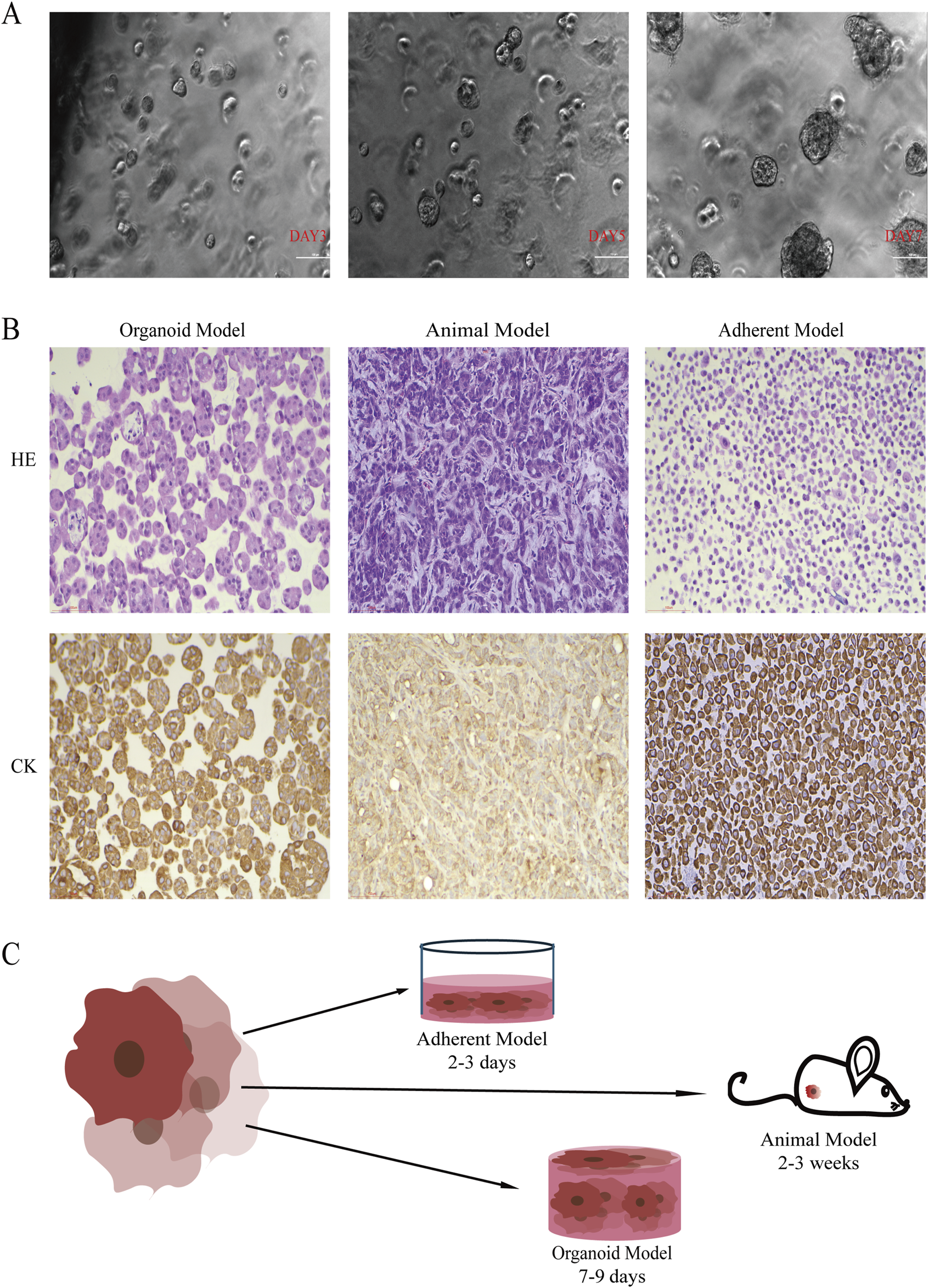
The Organoid Model Demonstrates Advantages in Simulating 3D Spatial Structure and Morpho Function. (A) Phase-contrast microscopy images show that the organoid diameter increased with culture time, reaching 100–200 µm by day 7 (20×, scale bar: 100 µm). (B) Representative HE and immunohistochemical CK7 staining for the organoid model, animal model, and adherent model. The organoid model preserved the adenomatous structure of lung adenocarcinoma and exhibited strong CK7 expression (20×, scale bar: 100 µm). (C) Growth cycles of models based on the A549 cell line. The organoid model completed functional construction within 9 days.
In Figure 1C the culture time for the adherent model was incorrectly stated as 2–3 weeks. The correct cultivation time for the adhesive model should be 2–3 days. The corrected Figure 1 appears below.
The original article has been updated.
Statements
Generative AI statement
Any alternative text (alt text) provided alongside figures in this article has been generated by Frontiers with the support of artificial intelligence and reasonable efforts have been made to ensure accuracy, including review by the authors wherever possible. If you identify any issues, please contact us.
Publisher’s note
All claims expressed in this article are solely those of the authors and do not necessarily represent those of their affiliated organizations, or those of the publisher, the editors and the reviewers. Any product that may be evaluated in this article, or claim that may be made by its manufacturer, is not guaranteed or endorsed by the publisher.
Summary
Keywords
lung cancer, organoid model, chemotherapy response, resistance evolution, Clinical Prediction, precision oncology
Citation
Yun W, Li Y, Ge Y, Zhang X, Liu H, Chen W and Xiao L (2025) Correction: Tumor organoids may be more suitable for clinical personalized chemotherapeutic drug screening in lung adenocarcinoma. Front. Cell Dev. Biol. 13:1728870. doi: 10.3389/fcell.2025.1728870
Received
21 October 2025
Revised
20 October 2025
Accepted
14 November 2025
Published
24 November 2025
Volume
13 - 2025
Edited and reviewed by
Yahima Frión-Herrera, University of Padua, Italy
Updates
Copyright
© 2025 Yun, Li, Ge, Zhang, Liu, Chen and Xiao.
This is an open-access article distributed under the terms of the Creative Commons Attribution License (CC BY). The use, distribution or reproduction in other forums is permitted, provided the original author(s) and the copyright owner(s) are credited and that the original publication in this journal is cited, in accordance with accepted academic practice. No use, distribution or reproduction is permitted which does not comply with these terms.
*Correspondence: Huifeng Liu, liuhf309@sina.com; Wen Chen, dr.chen20160224@foxmail.com; Li Xiao, xiaolilab309@163.com
†These authors have contributed equally to this work
Disclaimer
All claims expressed in this article are solely those of the authors and do not necessarily represent those of their affiliated organizations, or those of the publisher, the editors and the reviewers. Any product that may be evaluated in this article or claim that may be made by its manufacturer is not guaranteed or endorsed by the publisher.