 Anjal Prakash
 Katriona McGlade
 Mathew Koll Roxy
 Joyashree Roy
 Shreya Some
 Nitya Rao
- 1Bharti Institute of Public Policy, Indian School of Business, Hyderabad, India
- 2School of International Development, University of East Anglia, Norwich, United Kingdom
- 3Ecologic Institute, Berlin, Germany
- 4Centre for Climate Change Research, Indian Institute of Tropical Meteorology, Pune, India
- 5Sustainable Energy Transition Program, Department of Energy, Environment, and Climate, School of Environment, Resources and Development, Asian Institute of Technology, Khlong Luang, Thailand
- 6Department of Economics, Jadavpur University, Kolkata, India
- 7Global Centre for Environment and Energy, Ahmedabad University, Ahmedabad, India
In this paper, we present the results of a rapid review of the literature on gender and coastal climate adaptation. The IPCC's 2019 Special Report on Oceans and Cryosphere (SROCC) highlighted some of the major ways in which gender inequality interacts with coastal climate change. However, the report does not consider how gender interacts with adaptation interventions. This review was driven the need to understand these dynamics in more detail as well as deepen the understanding of how coastal climate adaptation affects the attainment of Sustainable Development Goal (SDG) 5, for gender equality and the empowerment of women and girls. Our analysis is based on a screening of over 1,000 peer-reviewed articles published between 2014 and 2020. The results were strongly populated by natural science publications leading to very low coverage of gender as a social dimension of adaptation. Of the papers reviewed, a mere 2.6% discussed gender and often only in a cursory manner. While the literature surveyed does not allow us to close the gap present in the SROCC in any meaningful way, the results do provide important new insights from the literature that does exist. Of particular note is the fact that adaptation measures may have positive and negative gender outcomes currently invisible under the SDG5 framework. We conclude that there is a need to collect gender-disaggregated data on coastal adaptation efforts and to review SDG5 targets and indicators to ensure that the gender dimensions of climate adaptation are fully captured and accounted for.
Introduction
Adaptation responses to climate change in coastal and marine contexts include ecosystem protection and restoration, structural defence, as well as livelihood diversification (Gattuso et al., 2018; He and Silliman, 2019). While there is a need to act rapidly to support coastal communities to undertake these adaptations, this should not be at the expense of achieving gender equality, or worse still lead to an exacerbation of inequalities. In many places, women are already exposed to disproportionate risks to health and income through structural disadvantage manifested as poor labour conditions or cultural norms that may reduce access to information or decision-making spheres (Alston, 2013; Pearse, 2017). Ignoring the gender dimensions of climate adaptation interventions may mean that the experiences of those who are already sidelined in the context of fisheries and coastal livelihoods (Musinguzi et al., 2018) continue to be rendered invisible, further compounding inequalities of various natures. For this reason, it is essential that those designing and monitoring adaptation action take explicit notice of gender dynamics. The IPCC's Special Report on Oceans and Cryosphere (SROCC) (IPCC, 2019a,b) provides the most recent international assessment of coastal climate change issues and broadly highlights some of the major ways in which gender inequality interacts with coastal climate change and risk. However, one important shortcoming is that the SROCC does not consider how gender interacts with adaptation interventions. The review process carried out for this article was driven by our desire to put together a comprehensive account of the state of knowledge on gender and coastal adaptation dynamics as well as deepen the understanding of how coastal climate adaptation effects might have a wider impact on the attainment of Sustainable Development Goal (SDG) 5 for gender equality and the empowerment of women and girls (see Figure 1).

Figure 1. Sustainable development goal 5 and its targets. Source: Authors' compilation based on the website—https://sdgs.un.org/.
We analyse recent peer-reviewed literature on coastal climate adaptation to see if and how interlinkages with gender are considered. We then apply our analysis to consider how coastal climate adaptation intersects with SDG5. This paper is divided into five sections. Following this introductory section we consider some of the reasons why gender is relevant to consider in coastal climate adaptation interventions. Section three outlines the methodology adopted for this study. In the fourth section, we present the key results of the review divided according to the type of adaptation measure. Section five concludes the paper with analysis and observations. It also draws out areas for future research where the evidence base is particularly low and where we consider more information is required to inform gender-sensitive adaptation planning.
Coastal Livelihoods and Gender
Around 40 percent of the world population, ~2.4 billion people, live within 100 km from the coast. Taking the figure of people living within 10 km of the coastline, this figure amounts to around 600 million people; about 10 per cent of the world's population. Aquatic food systems, including capture fisheries and aquaculture, are key for the livelihoods and nutrition of these coastal populations, particularly in the case of low-income food-deficit countries (LIFDCs) and least developed countries (LDCs) (FAO, 2020, p. 5).
Women are central to the fish value chain and their historical contribution has been immense. Women contribute directly as fish farmers, traders and processors (Frangoudes and Gerrard, 2019; FAO, 2020, p. 113; Tilley et al., 2021), alongside playing supportive roles in the management of money, labour and equipment for the fishing enterprise (Rao and Pratheepa, 2020). Yet despite their importance for fisheries and in particular for post-harvest processing and aquaculture, women are often assigned the most unstable and poorly paid positions leading to a lack of recognition and to fisheries being seen as a masculine sector (Satapornvanit, 2018; FAO, 2020, p. 40). The precarity of women's positions is compounded by a lack of accurate, regular gender-disaggregated data collection. This is as much the case in capture fisheries and aquaculture as for “secondary” activities such as processing (where women are most prominent) (FAO, 2020, p. 66). This lack of data renders women practically invisible and reinforces gender inequalities (Brugere and Williams, 2017). For example, in the Pacific Island states, the lack of gender-specific data leads to a deficiency in gender-responsive decision making and low female participation in sustainable oceans management (Michalena et al., 2020). The FAO has emphasised that even if such gender-disaggregated data should begin to be collected, it would be unlikely to reflect the less visible gender dimensions of the fishing industry including the access to resources, technology and finance, power to make certain decisions, or access to leadership positions (FAO, 2020, p. 39).
Despite the challenges, data is nevertheless urgently needed to understand the gender dimensions of coastal livelihoods and how they may be affected by other pressures such as climate change. The evidence from the IPCC Special Report on Oceans and Cryosphere (SROCC) highlights that the warming of the ocean has already affected marine ecosystems. This process has affected the fisheries sector with consequences for food production and livelihoods of fisher-people (Abram et al., 2019; IPCC, 2019b). Any changes in access to resources and markets will have obvious implications for reaching SDG 14 on the sustainable use of the oceans. However, what happens to marine and coastal resources is strongly interlinked with the wellbeing of women and children as well as to gender relations in coastal areas. As such SDG 14 is also fundamental to attaining SDG 5 on gender equality (Le Blanc et al., 2017).
Coastal Hazards and Gender
Densely populated coastal zones are already ‘risky places', exposed to multiple meteorological and geophysical hazards such as storms and storm-induced flooding (Kron, 2013; Nicholls, 2015). The significant rise in global temperatures has increased the prevalence and intensity of these events as well as the potential for cascading effects and multiplication of threats in the coastal zone (Collins et al., 2019). The SROCC shows sea levels are rising at 3.7 mm per year, about three times faster than the long-term average during 1901–1971 (1.3 mm per year) due to retreating glaciers and ice sheets and thermal expansion of seawater (Figure 2). Climate models project that under low-to-high GHG emission scenarios SLR will continue at a rate of 4.4–9 mm per year from 2015–2100, leading to increased numbers of coastal extreme events. Warmer oceans also lead to a speedy intensification of tropical cyclones (Emanuel, 2017).
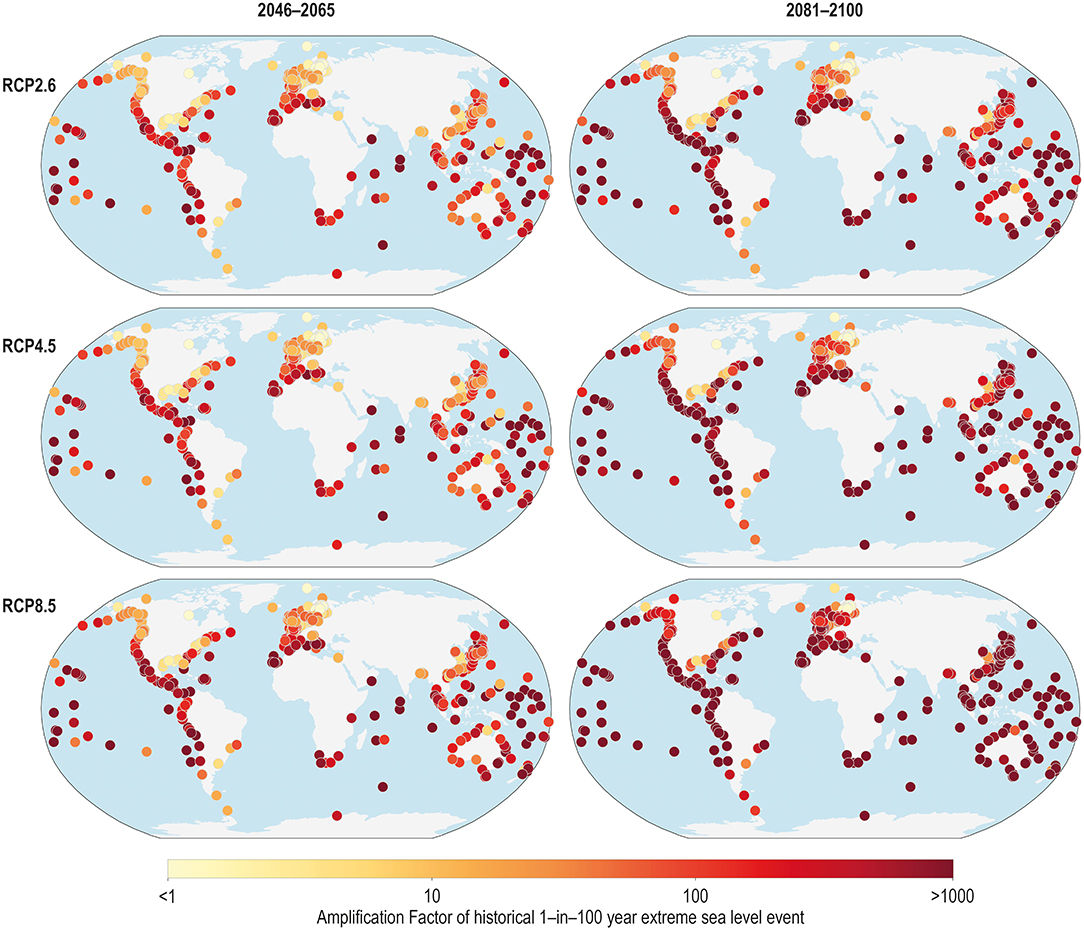
Figure 2. Coastal extreme events due to melting glaciers and ice sheets causing sea level rise. The colours of the dots express the factor by which the frequency of extreme sea-level events increases in the future for events that historically have a return period of 100 years. Hence a value of 50 means that what is currently a 1-in-100-year event will happen every 2 years due to a rise in mean sea level. Source: Oppenheimer et al. (2019).
While the casualties from cyclone-induced coastal flooding are globally decreasing due to improved prediction and evacuation (Bouwer and Jonkman, 2018) this does not paint the full picture. The SROCC has highlighted several ways in which the impacts of these climate hazards are gendered. For example, women have less access than men to information and training concerning climate and disaster preparedness as well as decision-making processes and economic resources. Patriarchal structures and disaster management strategies that privilege men and hinder women's security have an important impact on women's vulnerability during extreme weather events like cyclones (Kopf et al., 2020). Set against gendered structural inequalities in access to education, health infrastructure and food, these barriers mean that women are also disproportionately disadvantaged in adaptation to gradual environmental change (IPCC, 2019b). What is more, these inequalities are only set to be further aggravated by increasing vulnerability to climate change (Jerneck, 2018; Hans et al., 2021).
While the SROCC provides broad global insights, there is an implicit geographical bias in the literature. For example, the IPCC report draws on a large number of studies from Bangladesh to evidence women's exclusion from processes of decision-making at the household and community levels, including women's voice in institutions of micro-credit, ownership of land and decisions regarding mobility for access to markets (Alam and Rahman, 2014; Rahman and Rahman, 2015). Indeed most of the studies that consider gender in the context of coastal hazards and sea-level rise are focused on the global South with much less known about these hazards in the global North (Kulp and Strauss, 2019; Hauer et al., 2020).
Methodology
This paper is based on a rapid review of global literature on changing coastal environments and their impact on people's lives, especially low income and marginalised women. To assess the existing literature on climate adaptation options related to oceans and coastal ecosystems we carried out a systematised rapid review of the literature in this field. We differentiate this approach from that of a “systematic review,” which focuses on answering a narrowly defined research question and is very resource-intensive. Our approach was devised to gain a broad understanding of the ways in which gender was being considered in the literature on adaptation to coastal climate change. To this end, two steps were followed. In the first step, a series of searches were conducted in Scopus and Web of Science in May and June 2020, respectively. We looked for papers on gender concerning five climate adaptation strategies—(1) coral and mangrove restoration, (2) aquaculture, (3) wetlands, (4) biodiversity, and (5) coastal protection. These five categories were derived from the Global Adaptation Mapping Initiative (GAMI)'s protocol of ocean and coastal ecosystems (GAMI—Global Adaptation Mapping Initiative, 2022). The two search engines produced a total of 1007 scientific peer-reviewed papers for the years 2014–2020 (Supplementary Annex 1). Paper titles and abstracts were screened to produce a first shortlist. The choice of this time frame was purposeful in order to align the paper with the SROCC's cut-off dates for the review which was also between 2014 and 2020. A full overview of the papers reviewed and included is available alongside the search strings in Supplementary Annex 1. It should be noted that this search strategy had its limitations, notably the focus on anglophone research from databases with peer-reviewed journals. This review thus acknowledges the presence of a blind spot regarding alternative forms of data e.g. grey literature documenting adaptation measures in locally spoken languages.
Out of 1,007 papers that matched our keywords in the initial search, only 26 papers (2.6%) addressed the nexus between gender and climate adaptation in coastal and marine environments and were thus suitable for review. These 26 selected papers were read in full. Following this, we found that 6 papers did not have any appreciable handling of gender and adaptation and hence these were not selected for further review. Reasons for exclusion included only fleeting reference to gender differences or data that had not been disaggregated, no tangible connection between an adaptation measure or programme and an effect on gender (e.g., references to the need for adaptation policies or descriptions of lower adaptive capacity or differential vulnerability). The remaining 20 papers were reviewed in detail to extract relevant quotes to evidence the connection between different sub-targets of SDG5 (see Figure 1 for sub-target categories).
We assessed the level of evidence available, the positive or negative connection with the achievement of SDG5 targets and the strength of this connection using Nilsson Interaction Scores (Nilsson et al., 2016), following Roy et al. (2018) and Hoegh-Guldberg et al. (2019). Nilsson Interaction Scores consist of a 7-point rating scale to score seven possible types of interaction, +3 (inextricably linked to the achievement of SDG 5, +2 (aids the achievement of SDG 5.), +1 (creates conditions for/ enabling the achievement of SDG 5), 0 (no significant positive or negative interactions with SDG 5), −1 (constrain/limit the achievement of SDG 5), −2 (clashes with the achievement of SDG 5) and −3 (makes it impossible to reach SDG 5).
One immediate gap that became evident during the review was that many of the retrieved papers were from the natural sciences, i.e., looking at biological adaptation in coastal and marine environments. For example, the gender-related terms applied in the searches led to papers concerning the behaviour of female species of marine fauna and descriptions of biophysical adaptations in different coastal and marine habitats. Papers which were written from a social science perspective, and which reflected on gender aspects of climate adaptation as pertaining to SDG5 (i.e., discrimination, economic (dis)empowerment, participation, equal opportunities) were extremely limited in number. This may of course have been related to the search terms applied, however, we experimented with different strings (see Supplementary Annex 1) none of which came back with significantly more results.
Results and Discussion
This section presents the results of our review, organised according to five categories of climate adaptation measures. A majority are focused on ecosystem-based measures covering coral reefs, mangroves, wetlands, coastal protection, and biodiversity conservation. Other measures considered were hard coastal protection structures and aquaculture schemes. For each section, we outline the number of results followed by a detailed view of the relevant papers.
Coral Reef Conservation and Mangrove Restoration
The search protocol for adaptive interventions on coral reef conservation and mangrove restoration produced 84 results. Following screening and detailed reading, only one of these journal papers provided information about the interplay between adaptation actions and gender. Omukuti (2020) presents research on a mangrove restoration project in Pangani Magharibi (Tanzania) and Kisiwa Panza (Zanzibar). The women's focus group discussions conducted in these two locations suggest conditions that constrain the progress towards SDG 5 (Table 1; Figure 3). Firstly, in the case of Pangani Magharibi, on the Tanzanian mainland, female participants reported a lack of access to information about the mangrove restoration project meetings. Meeting announcements targeted marketplaces where men primarily worked, not farms and homes where women spent their time. Secondly, in the case of Kisiwa Panza in Zanzibar, male focus group discussants reported that they did not want to participate in mangrove restoration activities. This was due to the low pay which feminised the tasks and made them appear more suitable for women. In Quelimane Mozambique, the project led by the International Union for the Conservation of Nature (IUCN) recognised women's role in mangrove restoration. The project provided training for women in mangrove forest restoration through improved planting and nursery practises (Nippon Foundation-Nereus Program, 2017; Friess et al., 2019).

Table 1. Assessment of interactions between coastal climate adaptation and gender using the Nilsson Interaction Score.
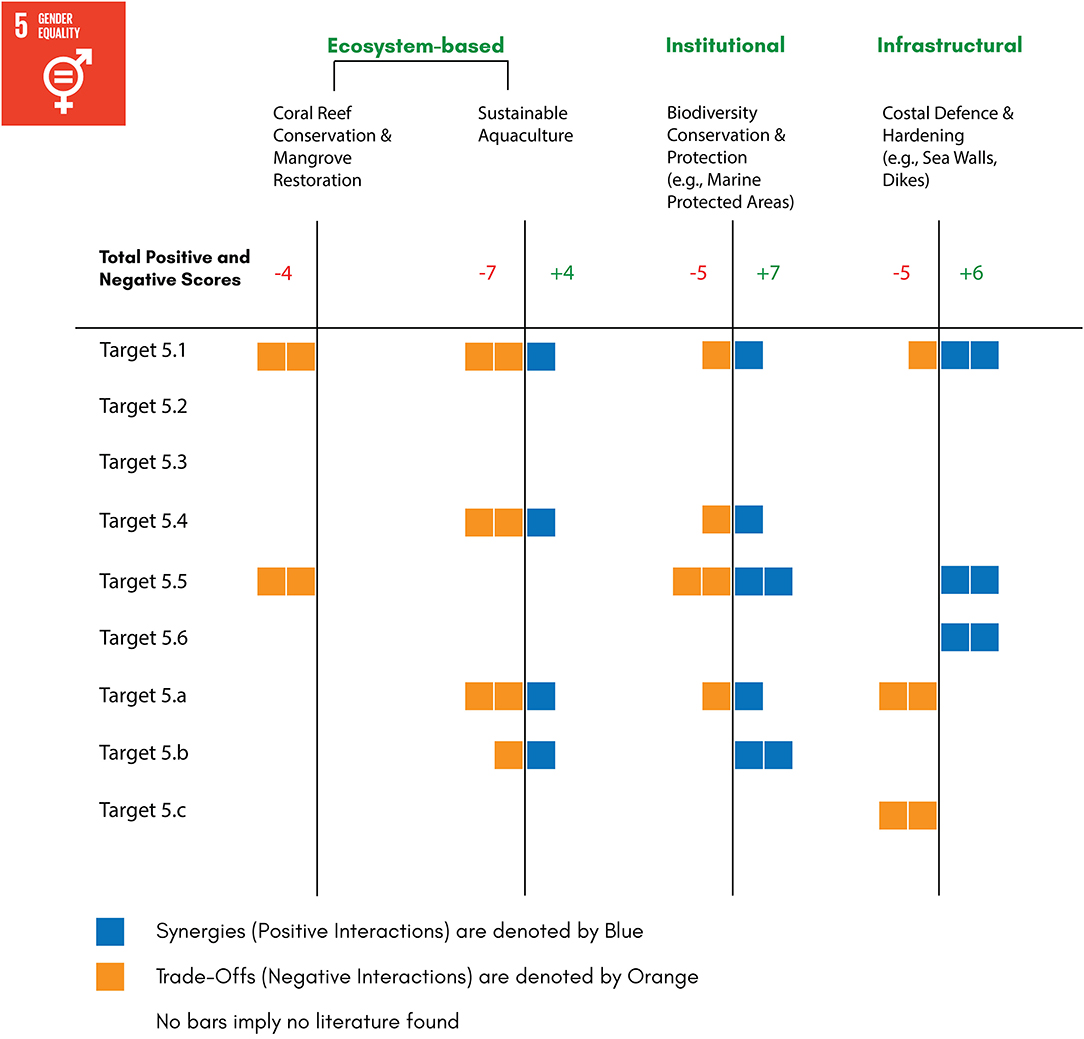
Figure 3. Synergies and trade-offs between coastal climate adaptation and SDG 5—gender equality.
Sustainable Aquaculture
On sustainable aquaculture, we found 24 papers published in peer-reviewed journals from 2014 to 2020. The literature on aquaculture as a livelihood or adaptation option creating favourable conditions/ enabling gender equality-SDG 5 (Table 1; Figure 3) falls into three main areas. First, the literature focuses on the opportunities provided to women in terms of increasing their participation in the workforce (Msuya and Hurtado, 2017; Hossain M. A. et al., 2018; Hossain S. et al., 2018; Onyeneke et al., 2020). Based on a case from the western Indian Ocean, Msuya and Hurtado (2017) show how women's involvement in seaweed farming has provided positive changes in their and their family's quality of life. It has provided women with an opportunity for equal rights to economic resources as well as control over property (Bennett and Dearden, 2014; Ahmed and Diana, 2015a,b; Lauria et al., 2018; Call and Sellers, 2019; D'agata et al., 2020). Despite aquaculture being seen as an adaptation strategy, it is still affected by climate impacts. With a second angle on the topic, Ahmed and Diana (2015b) report how climate change impacts aquaculture with a focus on shrimp farming in Bangladesh. Shrimps are popularly called “white gold” due to the economic benefits they bring for the people associated with shrimp farming. One of the consequences of climate change is rising temperature. Women who work on shrimp farms are severely affected by heatwaves, lowering their ability to work. Due to salinity ingress, the water is becoming saline, and women must go longer distances in search of potable water. The third group of papers falls into the category of integrating gender into climate policies (Bennett and Dearden, 2014; Lebel et al., 2016; Graziano et al., 2018; Khan et al., 2018; Call and Sellers, 2019). Citing the case of fishing communities in Chilika lagoon in India, these studies show how gender intersects with class, caste, economic status, and geography to create differential vulnerabilities for women. The findings demonstrate how fisherwomen are out-migrating in response to changing environmental and climatic conditions and the impacts this has on gender roles and division of labour.
Restoration and Reduced Conversion of Coastal Wetlands
The review produced no results for papers that related to the effects of coastal wetland interventions on gender. Though an interesting paper, Sherren et al. (2016) do not show the impact of a particular adaptation response on gender, nor does the work relate to the achievement of a specific SDG5 target. The paper was thus not included in our final selection, but is worth a brief mention here for its insights on gender and adaptation more generally. Sherren et al. indicate that women and men in the case study area (Bay of Fundy, Nova Scotia, Canada) may support different adaptation options. The authors suggest that although many women favoured the adaptation option of dykes, wetland restoration may instead be given precedence as it is favoured by men who wield power. They also note that women in the area are economically disadvantaged. While this was not correlated with the adaptation measures, it demonstrates that vulnerability is linked to poverty in climate adaptation. The important lesson here appears to be the need to include women's voices and provide fair representation in decision-making bodies as articulated in Target 5.5 (Figure 1). This will also ensure that traditional knowledge systems, particularly, women's knowledges, are brought into adaptation practices. Recent studies (Broeckhoven and Cliquet, 2015; Gissi et al., 2018; De la Torre-Castro, 2019) have shown that integration of gender issues in restoration policies, especially in coastal ecosystems can have co-benefits—promoting gender equality as well as protecting crucial environmental systems such as mangrove forests.
Biodiversity Conservation and Marine Protection
Adaptation through nature conservation and protection, e.g., through the establishment of Marine Protected Areas (MPAs) produced the highest number of search results (n = 316) from all types of adaptation relating to gender. From these results, however, only four papers contained detailed information relevant to gender and SDG 5. However, one of the four papers (Call and Sellers, 2019) was a review paper that made further reference to 17 relevant studies. There are several publications on this topic area from 2014 to 2020. However, no clear conclusion can be drawn concerning the effect of nature protection on gender. Indeed, even within some studies, the outcomes for gender were not clear-cut, with some presenting positive as well as negative aspects.
Call and Sellers (2019) conducted a systematic review of peer-reviewed academic literature on livelihoods and gender. The review included capture fisheries and aquaculture; two-thirds of the 31 papers found by the authors had a focus on MPAs. The results of the review in terms of gender outcomes are mixed. On the negative side, Call and Sellers found that MPAs often reproduce existing gender disparities concerning leadership and power; this can lead to a prioritisation of men's needs for resources over the needs of women thereby constraining the achievement of SDG 5 (Table 1; Figure 3). Examining research that covered Brazil, the Caribbean, Kenya, Tanzania, Madagascar, Indonesia and the Philippines, the authors conclude that women are less likely to participate in MPA governance and activities than men. Two studies in Tanzania also demonstrate that fishing restrictions imposed by MPAs can have negative and disproportionate effects on women because they have to find other sources of income to support their families (Kamat, 2014; Moshy and Bryceson, 2015).
Older studies included in the Call and Sellers review, but which predated our 2014–2020 timeframe, found that participation in MPA governance was roughly balanced between men and women (Pollnac and Pomeroy, 2005; Tobey and Torell, 2006). Furthermore, when MPAs are combined with activities targeted at women, they can support the achievement of SDG5 (Table 1; Figure 3). For example, family planning can improve household food security and natural resource conditions (D'agnes et al., 2010). As with the Call and Sellers review, Bennett and Dearden (2014) also had mixed findings concerning gender outcomes on the Andaman coast of Thailand. In some communities, women were integrated into governance structures, whereas in others, they had only a minimal representation. A range of factors affected women's inclusion such as rights and gender relations. At the level of the household, Bennett et al. identify important economic contributions made by women through activities such as gleaning, backyard gardening, livestock rearing and selling food products. These activities are carried out to provide sustenance to the households. However, men's income is almost double that of women. Mcleod et al. (2018) report slightly more positive findings based on workshops conducted in the Pacific. They highlight ways in which women are taking the lead in a range of local-scale solutions that innovate as well as build on traditional knowledge to adapt to climate change. The final paper retrieved by the search terms for conservation measures was from Omukuti (2020). These mangrove restoration measures have already been described above in the section on Coral Reef Conservation and Mangrove Restoration and did not indicate positive outcomes for gender.
Coastal Defence and Hardening
A study by Asugeni et al. (2019) examining responses to sea-level rise in the Solomon Islands was the only paper from over 1,000 articles surveyed that focused on gender in detail. The authors report the impacts of rising sea levels on community infrastructure, social harmony, and adverse mental health outcomes for women. Women were able to lead an initiative to build raised walkways and stone seawalls in areas that had been permanently flooded by seawater. They were supported by men in this endeavour who felt “compelled” to join. It is not clear whether the latter is an indication of an increase in gender equality or whether it is proof of the opposite. If men felt compelled to help, it could be because gender roles were embedded to the extent that men felt obliged to show their strength. Indeed, the women did not / could not complete the project themselves. However, the result was that women's gardens were protected and the walkways created meant greater access to the nearby hospital thereby reducing the gendered burden of need for reproductive medical care, a direct contribution to SDG target 5.6 (Table 1; Figure 3). Overall, the picture presented in the paper by Asugeni et al. (2019) is rather nuanced, making it difficult to generalise about gender relations and discrimination at an aggregate level. However, McLeod et al. (2019) highlight that due to prevalent customary and patriarchal laws, women in some Pacific Island states, do not possess land rights meaning that when their land is at risk, they are not able to adapt by relocating to safer locations. This disadvantage has a direct bearing on Target 5a regarding property ownership and creates the negative situation of “trapped” populations (Black et al., 2011).
Assessment
Our assessment of the literature shows that the overall score of the relationship between climate adaptation in coastal ecosystems concerning gender is principally negative (Table 1; Figure 3). These negative outcomes can be interpreted in two main ways; either coastal and marine adaptation options are gender blind or else they are ignoring the opportunity to enhance gender equity in the implementation of new adaptation-related investments and projects. This may be due to a lack of information on the additional steps needed to consider gender or due to imbalanced and discriminatory approaches to measures. On this basis, we suggest that there is a need for deeper research and understanding about how to design gender-aware adaptation approaches in coastal ecosystems.
The findings of our work are echoed by the large-scale review carried out by Brink et al. (2016). The authors found that most papers (85%) did not mention equity or gender issues at all. For equity, 9% of papers touched on the topic briefly, while only 6% discussed it in detail. Gender was even more rarely referenced; only 8% of papers addressed the topic, and only half of these mentioned it more than twice. One of the points emerging from this discussion is that the actions and measures being described might support SDG5, but almost as a by-product. For example, when women took the initiative to build a seawall, men were inspired to support and follow. This reveals perhaps less discrimination in some communities, but it is certainly not due to any government action to help meet this goal. Furthermore, it is very difficult to generalise from the literature what the overall impacts on discrimination more broadly might be.
(En)Gendering Climate Change Adaptation in Coastal Ecosystems
While attention to issues of gender (in)equality has been growing within studies of climate change, the evidence is still relatively low in relation to coastal ecosystems (De la Torre-Castro et al., 2017; Akinsemolu and Olukoya, 2020). From a screening of over 1,000 peer-reviewed articles (Supplementary Annex 1) published between 2014 and 2020, only 26 articles (2.6%) directly addressed the nexus between gender and climate adaptation in coastal and marine environments and only one of these (Asugeni et al., 2019) in any detail. Furthermore, the actions described are geographically limited, representing seven papers from Asia, ten papers from Africa and three papers from the Pacific islands. The remaining papers focussed on global assessments. Therefore, we can only emphasise what is already patently evident; that there is a substantial research gap in relation to understanding the gender dimensions of coastal climate change as well as an unequal concentration of research geographically. This is of course with the caveat that outside anglophone mainstream academia the evidence base may look more promising.
What is more, the review has highlighted that of the sparse evidence we gathered, not all insights could be captured by the framework proposed for achieving SDG5. For example, women play an important role not just in post-harvest processing, gleaning and farming fish, or in household maintenance tasks, but equally in a range of activities that are supportive of the fishing enterprise while remaining unpaid. A strict division between productive activities and care work is therefore not always helpful in understanding gender relations amongst fishing communities. Similarly, technology and credit are often geared towards the actual tasks of “fishing,” ignoring the multiple pre-and post-harvest tasks that are also essential. This has contributed to both the invisibility and precarity of women's work. Finally, in the case of property ownership, one is often dealing with the commons, rather than individual rights. In patriarchal contexts, women are excluded from the management of the commons, unless there are specific provisions for their inclusion. So, while SDG5 does provide a useful analytical framework, our review demonstrates that issues of gender equality within coastal communities may not neatly fit into the identified indicators, making assessment difficult.
The reviewed papers in this study have unfortunately not been able to move us very much further in our understanding of the interactions between gender and coastal climate change adaptation. However, in the few cases where gender was discussed in some detail, it was quickly apparent that climate adaptation can have important, often negative, implications for gender. If this is indeed the case, it underlines the need for paying specific attention to gender within climate adaptation and to collect gender-disaggregated data. This will not only help to gain a fuller picture of the effects that interventions to address climate impacts may have on gender but also allow us to understand the positive and negative interlinkages between climate adaptation and the attainment of SDG5. Vice-versa, further research into the effects of SDG5-related action for climate resilience as well as considering interlinkages with SDG13 on climate action would be interesting to share with the climate research community.
Considering communities as homogenous can lead to a failure of adaptation practises, and even maladaptation, in instances where interventions may aggravate inequalities. Disaggregation of data on both risks and adaptation then becomes the starting point for addressing differential impacts of climate change and related interventions. Lack of gender-disaggregated data is clearly a research gap, which impacts the assessment of the range of issues and constraints faced by communities and the possibilities for action. A gender analysis points to differences in perspectives, capacities, and opportunities, thereby providing a clearer picture of who gains and who loses from particular interventions, enabling us to understand progress towards SDG5.
Finally, there are important geographical dimension to consider. Climate change impacts are distributed unequally across societies, with the greatest burden weighing on economically disadvantaged communities within the global South. This indicates a need for research to focus on these locations. Indeed, this is reflected in a knowledge gap regarding gender and adaptation in the global North. However, even the research that is conducted in the global South is unequally distributed, with a clear bias towards countries where English is more widely spoken. For example, the papers from Africa were dominated by Tanzanian experiences and no papers from Latin America were picked up by the review. This may mean moving such reviews away from common academic search engines and seeking localised expertise that can lead to grey literature or papers in less-known journals. On this last point, we see this review as having been a learning process whose results necessitate a call to action. Firstly, for greater efforts by social scientists to explicitly document and analyse gender and coastal climate adaptation dynamics, secondly for journals to actively promote review articles that include lesser-known regions, authors and journals and thirdly for authors of review articles such as ourselves to acknowledge the cultural bias and epistemological blind spots of employing search engine strategies to understand the complexities of gender and climate change.
Author Contributions
AP, KM, and JR were part of the initial conceptualisation of this review. KM and AP conducted the literature search and assessment, and both were involved equally in writing the first draft of the paper and in subsequent revisions and redrafting towards the final publication. MR contributed to the section on the sea-level rise and coastal hazards while JR and SS investigated the method of assessment and drew results presented in Figure 3. NR was part of the initial conceptualisation and discussions on the paper for the journal and later reviewed the paper and provided critical comments. All authors contributed to the article and approved the submitted version.
Funding
This work was carried out as part of a voluntary contribution to the IPCC WGII AR6 Report cross-cutting box on gender.
Conflict of Interest
The authors declare that the research was conducted in the absence of any commercial or financial relationships that could be construed as a potential conflict of interest.
Publisher's Note
All claims expressed in this article are solely those of the authors and do not necessarily represent those of their affiliated organizations, or those of the publisher, the editors and the reviewers. Any product that may be evaluated in this article, or claim that may be made by its manufacturer, is not guaranteed or endorsed by the publisher.
Acknowledgments
We would like to thank our reviewers, in particular for the helpful comments on the representation of research in non-prestigious journals. The group would like to acknowledge the IPCC AR 6 WG 2—Gender group from where this assessment was initially done. The group process has helped the authors in sharpening the objective of this study. We thank Juby Aleyas Koll for reformatting Figure 3 for production purposes.
Supplementary Material
The Supplementary Material for this article can be found online at: https://www.frontiersin.org/articles/10.3389/fclim.2022.785212/full#supplementary-material
References
Abram, N., Gattuso, J. P., Prakash, A., Cheng, L., Chidichimo, M. P., Crate, S., et al. (2019). “Framing and context of the report,” in IPCC Special Report on the Ocean and Cryosphere in a Changing Climate, eds. H. O. Pörtner, D. C. Roberts, V. Masson-Delmotte, P. Zhai, M. Tignor, E. Poloczanska (Geneva: IPCC).
Ahmed, N., and Diana, J. S. (2015a). Coastal to inland: expansion of prawn farming for adaptation to climate change in Bangladesh. Aquacult. Rep. 2, 67–76. doi: 10.1016/j.aqrep.2015.08.001
Ahmed, N., and Diana, J. S. (2015b). Threatening “white gold”: impacts of climate change on shrimp farming in coastal Bangladesh. Ocean Coastal Manag. 114, 42–52. doi: 10.1016/j.ocecoaman.2015.06.008
Akinsemolu, A. A., and Olukoya, O. A. (2020). The vulnerability of women to climate change in coastal regions of Nigeria: A case of the Ilaje community in Ondo State. J. Cleaner Prod. 246, 119015. doi: 10.1016/j.jclepro.2019.119015
Alam, K., and Rahman, M. H. (2014). Women in natural disasters: a case study from southern coastal region of Bangladesh. Int. J. Disaster Risk Reduct. 8, 68–82. doi: 10.1016/j.ijdrr.2014.01.003
Alston, M. (2013). “Introducing gender and climate change: research, policy and action,” in Research, Action and Policy: Addressing the Gendered Impacts of Climate Change (Dordrecht: Springer), 3–14.
Asugeni, R., Redman-MacLaren, M., Asugeni, J., Esau, T., Timothy, F., Massey, P., et al. (2019). A community builds a “bridge”: an example of community-led adaptation to sea-level rise in East Kwaio, Solomon Islands. Clim. Dev. 11, 91–96. doi: 10.1080/17565529.2017.1411239
Bennett, N. J., and Dearden, P. (2014). Why local people do not support conservation: Community perceptions of marine protected area livelihood impacts, governance and management in Thailand. Mar. Policy 44, 107–116. doi: 10.1016/j.marpol.2013.08.017
Black, R., Bennett, S. R., Thomas, S. M., and Beddington, J. R. (2011). Migration as adaptation. Nature 478, 447–449. doi: 10.1038/478477a
Bouwer, L. M., and Jonkman, S. N. (2018). Global mortality from storm surges is decreasing. Environ. Res. Lett. 13, 014008. doi: 10.1088/1748-9326/aa98a3
Brink, E., Aalders, T., Ádám, D., Feller, R., Henselek, Y., Hoffmann, A., et al. (2016). Cascades of green: a review of ecosystem-based adaptation in urban areas. Glob. Environ. Change 36, 111–123. doi: 10.1016/j.gloenvcha.2015.11.003
Broeckhoven, N., and Cliquet, A. (2015). Gender and ecological restoration: time to connect the dots. Restor. Ecol. 23, 729–736. doi: 10.1111/rec.12270
Brugere, C., and Williams, M. (2017). Profile: Women in Aquaculture. Available online at: https://genderaquafish.org/portfolio/women-in-aquaculture/ (accessed May 6 2020).
Call, M., and Sellers, S. (2019). How does gendered vulnerability shape the adoption and impact of sustainable livelihood interventions in an era of global climate change? Environ. Res. Lett. 14, 083005. doi: 10.1088/1748-9326/ab2f57
Collins, M., Sutherland, M., Bouwer, L., Cheong, S. M., Frölicher, T., Des Combes, H. J., et al. (2019). “Chapter 6: Extremes, abrupt changes and managing risks,” in IPCC Special Report on the Ocean and Cryosphere in a Changing Climate, eds. H. O. Pörtner, D. C. Roberts, V. Masson-Delmotte, P. Zhai, M. Tignor, E. Poloczanska (Switzerland: IPCC).
D'agata, S., Darling, E. S., Gurney, G. G., McClanahan, T. R., Muthiga, N. A., Rabearisoa, A., et al. (2020). Multiscale determinants of social adaptive capacity in small-scale fishing communities. Environ. Sci. Policy 108, 56–66. doi: 10.1016/j.envsci.2020.03.006
D'agnes, L., d'agnes, H., Schwartz, J. B., Amarillo, M. L., and Castro, J. (2010). Integrated management of coastal resources and human health yields added value: a comparative study in Palawan (Philippines). Environ. Conserv. 37, 398–409. doi: 10.1017/S0376892910000779
De la Torre-Castro, M. (2019). Inclusive management through gender consideration in small-scale fisheries: the why and the how. Front. Mar. Sci. 6, 156. doi: 10.3389/fmars.2019.00156
De la Torre-Castro, M., Fröcklin, S., Börjesson, S., Okupnik, J., and Jiddawi, N. S. (2017). Gender analysis for better coastal management—increasing our understanding of social-ecological seascapes. Mar. Policy 83, 62–74. doi: 10.1016/j.marpol.2017.05.015
Emanuel, K. (2017). Will global warming make hurricane forecasting more difficult? Bull. Am. Meteorol. Soc. 98, 495–501. doi: 10.1175/BAMS-D-16-0134.1
FAO. (2020). The State of World Fisheries and Aquaculture 2020. Sustainability in Action. Rome: FAO.
Frangoudes, K., and Gerrard, S. (2019). “Gender perspective in fisheries: examples from the South and the North,” in Transdisciplinarity for Small-Scale Fisheries Governance (Cham: Springer).
Friess, D. A., Rogers, K., Lovelock, C. E., Krauss, K. W., Hamilton, S. E., Lee, S. Y., et al. (2019). The state of the world's mangrove forests: past, present, and future. Annu. Rev. Environ. Resourc. 44, 89–115. doi: 10.1146/annurev-environ-101718-033302
GAMI—-Global Adaptation Mapping Initiative. (2022). Systematic evidence synthesis protocol. Accessed at https://globaladaptation.github.io/docs/Protocol1_systematicreview.pdf. (accessed January 28, 2022)
Gattuso, J. P., Magnan, A. K., Bopp, L., Cheung, W. W., Duarte, C. M., Hinkel, J., et al. (2018). Ocean solutions to address climate change and its effects on marine ecosystems. Front. Mar. Sci. 5, 337. doi: 10.3389/fmars.2018.00337
Gissi, E., Portman, M. E., and Hornidge, A. K. (2018). Un-gendering the ocean: why women matter in ocean governance for sustainability. Mar. Policy 94, 215–219. doi: 10.1016/j.marpol.2018.05.020
Graziano, K., Pollnac, R., and Christie, P. (2018). Wading past assumptions: gender dimensions of climate change adaptation in coastal communities of the Philippines. Ocean Coastal Manag. 162, 24–33. doi: 10.1016/j.ocecoaman.2018.01.029
Hans, A., Rao, N., Prakash, A., and Amrita, P. (2021). Engendering Climate Change: Learnings from South Asia. Melbourne: Taylor & Francis, 262.
Hauer, M. E., Fussell, E., Mueller, V., Burkett, M., Call, M., Abel, K., et al. (2020). Sea-level rise and human migration. Nat. Rev. Earth Environ. 1, 28–39. doi: 10.1038/s43017-019-0002-9
He, Q., and Silliman, B. R. (2019). Climate change, human impacts, and coastal ecosystems in the Anthropocene. Curr. Biol. 29, R1021–R1035. doi: 10.1016/j.cub.2019.08.042
Hoegh-Guldberg, O., Lovelock, C., Caldeira, K., Howard, J., Chopin, T., and Gaines, S. (2019). The Ocean as a Solution to Climate Change: Five Opportunities for Action. Available online at https://oceanpanel.org/sites/default/files/2019-10/HLP_Report_Ocean_Solution_Climate_Change_final.pdf (accessed March 02, 2022).
Hossain, M. A., Ahmed, M., Ojea, E., and Fernandes, J. A. (2018). Impacts and responses to environmental change in coastal livelihoods of south-west Bangladesh. Sci. Total Environ. 637, 954–970. doi: 10.1016/j.scitotenv.2018.04.328
Hossain, S., Koshio, S., Ishikawa, M., Yokoyama, S., Sony, N. M., Islam, J., et al. (2018). Substitution of dietary fishmeal by soybean meal with inosine administration influences growth, digestibility, immunity, stress resistance and gut morphology of juvenile amberjack Seriola dumerili. Aquaculture 488, 174–188. doi: 10.1016/j.aquaculture.2018.01.037
IPCC. (2019a). “Summary for Policymakers,” in IPCC Special Report on the Ocean and Cryosphere in a Changing Climate, eds. H. O. Pörtner, D. C. Roberts, V. Masson-Delmotte, P. Zhai, M. Tignor, E. Poloczanska and N. M. Weyer (Switzerland: IPCC).
IPCC. (2019b). “IPCC special report on the ocean, and cryosphere in a changing climate,” in The Ocean and Cryosphere in a Changing Climate. IPCC Special Report on the Ocean and Cryosphere in a Changing Climate, eds D. C. Pörtner, D. C. Roberts, Masson-Delmotte, P. Zhai, M. Tignor, E. Poloczanska, and N. M. Weyer (Switzerland: IPCC).
Jerneck, A. (2018). What about gender in climate change? Twelve feminist lessons from development. Sustainability 10, 627. doi: 10.3390/su10030627
Kamat, V. (2014). “The ocean is our farm”: marine conservation, food insecurity, and social suffering in southeastern Tanzania. Human Organ. 73, 289–298. doi: 10.17730/humo.73.3.f43k115544761g0v
Khan, A., Guttormsen, A., and Roll, K. H. (2018). Production risk of pangas (Pangasius hypophthalmus) fish farming. Aquacult. Econ. Manag. 22, 192–208. doi: 10.1080/13657305.2017.1284941
Kopf, A., Fink, M., and Weber, E. (2020). “Gender vulnerability to climate change and natural hazards: the case of Tropical Cyclone Winston, Fiji,” in Mapping Security in the Pacific (London: Routledge), 119–132.
Kron, W. (2013). Coasts: the high-risk areas of the world. Nat. Hazards. 66, 1363–1382. doi: 10.1007/s11069-012-0215-4
Kulp, S. A., and Strauss, B. H. (2019). New elevation data triple estimates of global vulnerability to sea-level rise and coastal flooding. Nat. Commun. 10, 1–12. doi: 10.1038/s41467-019-12808-z
Lauria, V., Das, I., Hazra, S., Cazcarro, I., Arto, I., Kay, S., et al. (2018). Importance of fisheries for food security across three climate change vulnerable deltas. Sci. Total Environ. 640, 1566–1577. doi: 10.1016/j.scitotenv.2018.06.011
Le Blanc, D., Freire, C., and Vierros, M. (2017). Mapping the Linkages Between Oceans and Other Sustainable Development Goals: A Preliminary Exploration. UN Department of Economic and Social Affairs (DESA) Working Papers, No. 149, UN, New York. doi: 10.18356/3adc8369-en
Lebel, L., Lebel, P., and Lebel, B. (2016). Impacts, perceptions and management of climate-related risks to cage aquaculture in the reservoirs of northern Thailand. Environ. Manag. 58, 931–945. doi: 10.1007/s00267-016-0764-5
Mcleod, E., Arora-Jonsson, S., Masuda, Y. J., Bruton-Adams, M., Emaurois, C. O., Gorong, B., et al. (2018). Raising the voices of Pacific Island women to inform climate adaptation policies. Mar. Policy 93, 178–185. doi: 10.1016/j.marpol.2018.03.011
McLeod, E., Bruton-Adams, M., Förster, J., Franco, C., Gaines, G., Gorong, B., et al. (2019). Lessons from the Pacific Islands–adapting to climate change by supporting social and ecological resilience. Front. Mar. Sci. 6, 289. doi: 10.3389/fmars.2019.00289
Michalena, E., Straza, T. R., Singh, P., Morris, C. W., and Hills, J. M. (2020). Promoting sustainable and inclusive oceans management in Pacific islands through women and science. Mar. Pollut. Bull. 150, 110711. doi: 10.1016/j.marpolbul.2019.110711
Moshy, V. H., Bryceson, I., and Mwaipopo, R. (2015). “Social-ecological changes, livelihoods and resilience among fishing communities in Mafia Island Marine Park, Tanzania,” in Forum for Development Studies (Vol. 42, No. 3, 529–553). London: Routledge.
Msuya, F. E., and Hurtado, A. Q. (2017). The role of women in seaweed aquaculture in the Western Indian Ocean and South-East Asia. Eur. J. Phycol. 52, 482–494. doi: 10.1080/09670262.2017.1357084
Musinguzi, L., Natugonza, V., Efitre, J., and Ogutu-Ohwayo, R. (2018). The role of gender in improving adaptation to climate change among small-scale fishers. Clim. Dev. 10, 566–576. doi: 10.1080/17565529.2017.1372262
Nicholls, R. J. (2015). “Chapter 4 - Adapting to Sea Level Rise,” in Hazards and Disasters Series, Coastal and Marine Hazards, Risks, and Disasters, eds J. F. Shroder, J. T. Ellis, and D. J. Sherman (Elsevier), 243–270. doi: 10.1016/B978-0-12-396483-0.00009-1
Nilsson, M., Griggs, D., and Visbeck, M. (2016). Present a simple way of rating relationships between the targets to highlight priorities for integrated policy. Nature 534, 320–323. doi: 10.1038/534320a
Nippon Foundation-Nereus Program. (2017). Oceans and Sustainable Development Goals: Co-benefit, Climate Change and Social Equity, Vancouver, p. 28. Available online at: www.nereusprogram. org. Downloaded from https://nereusprogram.org/reports/report-oceans-and-sustainable-development-goals-co-benefits-climate-change-and-social-equity/ (accessed September 12, 2021)
Omukuti, J. (2020). Challenging the obsession with local level institutions in country ownership of climate change adaptation. Land Use Policy 94, 104525. doi: 10.1016/j.landusepol.2020.104525
Onyeneke, R. U., Igberi, C. O., Aligbe, J. O., Iruo, F. A., Amadi, M. U., Iheanacho, S. C., et al. (2020). Climate change adaptation actions by fish farmers: Evidence from the Niger Delta Region of Nigeria. Aust. J. Agric. Resour. Econ. 64, 347–375. doi: 10.1111/1467-8489.12359
Oppenheimer, M., Glavovic, B. C., Hinkel, J., van de Wal, R., Magnan, A. K., Abd-Elgawad, A., et al. (2019). “Chapter 4: Sea Level Rise and Implications for Low-Lying Islands, Coasts and Communities,” in IPCC Special Report on the Ocean and Cryosphere in a Changing Climate, eds. H. O. Pörtner, D. C. Roberts, V. Masson-Delmotte, P. Zhai, M. Tignor, and E. Poloczanska (Switzerland: IPCC). Available online at: https://www.ipcc.ch/site/assets/uploads/sites/3/2019/11/08_SROCC_Ch04_FINAL.pdf
Pearse, R. (2017). Gender and climate change. Wiley Interdiscip. Rev. Clim. Change 8, e451. doi: 10.1002/wcc.451
Pollnac, R. B., and Pomeroy, R. S. (2005). Factors influencing the sustainability of integrated coastal management projects in the Philippines and Indonesia. Ocean Coast. Manag. 48, 233–251. doi: 10.1016/j.ocecoaman.2005.04.003
Rahman, S., and Rahman, M. A. (2015). Climate extremes and challenges to infrastructure development in coastal cities in Bangladesh. Weather Clim. Extr. 7, 96–108. doi: 10.1016/j.wace.2014.07.004
Rao, N., and Pratheepa, C. M. (2020). “Fishing in distant waters: issues of identity and well-being among migrant fishers on the west coast of Tamil Nadu,” in Fisherfolk in Cambodia, India and Sri Lanka (India: Routledge), 112–131
Roy, J., Tschakert, P., Waisman, H., Abdul Halim, S., Antwi-Agyei, P., Dasgupta, P., et al. (2018). “Sustainable development, poverty eradication and reducing inequalities,” in Global Warming of 1.5°C. An IPCC Special Report on the Impacts of Global Warming of 1.5°C Above Pre-Industrial Levels and Related Global Greenhouse Gas Emission Pathways, in the Context of Strengthening the Global Response to the Threat of Climate Change, Sustainable Development, and Efforts to Eradicate Poverty, eds. V. Masson-Delmotte, P. Zhai, H.-O. Pörtner, D. Roberts, J. Skea, P. R. Shukla, et al. (Switzerland: IPCC).
Satapornvanit, A. N. (2018). The importance of gender in fisheries: the USAID Oceans experience. Fish People 16, 9–13. Available online at: http://hdl.handle.net/20.500.12066/1381
Sherren, K., Loik, L., and Debner, J. A. (2016). Climate adaptation in ‘new world'cultural landscapes: The case of Bay of Fundy agricultural dykelands (Nova Scotia, Canada). Land Use Policy 51, 267–280. doi: 10.1016/j.landusepol.2015.11.018
Tilley, A., Burgos, A., Duarte, A., dos Reis Lopes, J., Eriksson, H., and Mills, D. (2021). Contribution of women's fisheries substantial, but overlooked, in Timor-Leste. Ambio 50, 113–124. doi: 10.1007/s13280-020-01335-7
Keywords: gender equality, SDG 5, coastal ecosystem, marine ecosystem, adaptation, vulnerability and rapid review
Citation: Prakash A, McGlade K, Roxy MK, Roy J, Some S and Rao N (2022) Climate Adaptation Interventions in Coastal Areas: A Rapid Review of Social and Gender Dimensions. Front. Clim. 4:785212. doi: 10.3389/fclim.2022.785212
Received: 28 September 2021; Accepted: 16 February 2022;
Published: 25 April 2022.
Edited by:
Zita Sebesvari, United Nations University, JapanReviewed by:
Clive Schofield, World Maritime University, SwedenBeate M. W. Ratter, Universität Hamburg, Germany
Copyright © 2022 Prakash, McGlade, Roxy, Roy, Some and Rao. This is an open-access article distributed under the terms of the Creative Commons Attribution License (CC BY). The use, distribution or reproduction in other forums is permitted, provided the original author(s) and the copyright owner(s) are credited and that the original publication in this journal is cited, in accordance with accepted academic practice. No use, distribution or reproduction is permitted which does not comply with these terms.
*Correspondence: Anjal Prakash, QW5qYWxfUHJha2FzaEBpc2IuZWR1