 Alec Feinberg
A corrigendum on
Solar geoengineering modeling and applications for mitigating global warming: Assessing key parameters and the urban heat island influence
by Feinberg, A. (2022). Front. Clim. 4:870071. doi: 10.3389/fclim.2022.870071
In the published article, there was an error. The percentage of the forcing (used in Table 2) was unclear and should be removed from the Abstract.
A correction has been made to Abstract. This sentence previously stated:
“The UHI reverse forcing requirements are assessed with amplification estimates of 3.1 and 5.2, yielding 7.6% to 12.7% of gross global warming (corresponding to forcing percentages of 16% to 27%) could be due to the urbanization effect, respectively.”
The corrected sentence appears below:
“The UHI reverse forcing requirements are assessed with amplification estimates of 3.1 and 5.2, yielding 7.6% to 12.7% of gross global warming could be due to the urbanization effect, respectively.”
A correction has been made to the Introduction, paragraph 4. This sentence previously stated:
“This 12.7% gross warming equates to a forcing of 27.3% (see Table 2 in Section Assessing the Influence of Urbanization on Global Warming).”
The corrected sentence appears below:
“This 12.7% gross warming equates to a percentage of the forcing (see Table 2 details in Section Assessing the Influence of Urbanization on Global Warming).”
There was an error. Percentage of the forcing (used in Table 2) is unclear to the reader and should be further clarified in the Introduction.
A correction has been made to Introduction, paragraph 5. This sentence previously stated:
“The author's prior geoengineering modeling results (Feinberg, 2020) agree with the current findings in this paper which is 7.6% gross warming and forcing of 16.2% (section Assessing the Influence of Urbanization on Global Warming) for the urbanization global warming influence.”
The corrected sentence appears below:
“The author's prior geoengineering modeling results (Feinberg, 2020) agree with the current findings in this paper which is 7.6% gross warming and a percentage of the forcing (see Table 2 details in section Assessing the Influence of Urbanization on Global Warming), for the urbanization global warming influence.”
In the original article, there was a mistake in Table 1 as published. Forcing percentage in Table 2, Col 4, the column should have a clearer label as the denominator of 2.38 Wm−2 comes from a GHG forcing reference in Table 1. The corrected Table 1 appears below.
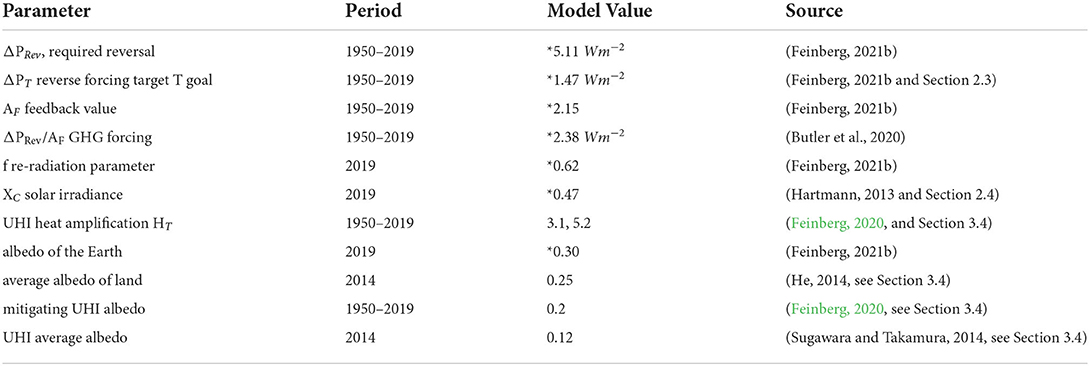
Table 1. Suggested model GMEEB* estimates and other values.
In the original article, there was a mistake in Table 2 as published. Forcing in Table 2 includes feedback per Equation 23 and this was missed. The corrected Table 2 appears below.

Table 2. UHI Global warming estimates (1950–2019).
In the published article, there was an error. In Equation 26 an extra term AE was added after the second equal sign.
A correction has been made to Results, “Heat Pollution From Dark Surface”
This equation previously stated:
The corrected equation appears below:
The authors apologize for these errors and state that this does not change the scientific conclusions of the article in any way. The original article has been updated.
Publisher's note
All claims expressed in this article are solely those of the authors and do not necessarily represent those of their affiliated organizations, or those of the publisher, the editors and the reviewers. Any product that may be evaluated in this article, or claim that may be made by its manufacturer, is not guaranteed or endorsed by the publisher.
References
Keywords: solar geoengineering, UHI global warming estimates, UHI footprint, heat pollution, land-cover/land-use, drought relief, reservoir evaporation, Paris Accord suggested goals
Citation: Feinberg A (2022) Corrigendum: Solar geoengineering modeling and applications for mitigating global warming: Assessing key parameters and the urban heat island influence. Front. Clim. 4:994381. doi: 10.3389/fclim.2022.994381
Received: 14 July 2022; Accepted: 01 August 2022;
Published: 05 September 2022.
Edited and reviewed by: Yuanjian Yang, Nanjing University of Information Science and Technology, China
Copyright © 2022 Feinberg. This is an open-access article distributed under the terms of the Creative Commons Attribution License (CC BY). The use, distribution or reproduction in other forums is permitted, provided the original author(s) and the copyright owner(s) are credited and that the original publication in this journal is cited, in accordance with accepted academic practice. No use, distribution or reproduction is permitted which does not comply with these terms.
*Correspondence: Alec Feinberg, ZGZyc29mdEBnbWFpbC5jb20=