 Fabian Chukwudi Ogenyi
 Chinyere Nneoma Ugwu
 Okechukwu Paul-Chima Ugwu
- 1Department of Electrical, Telecommunication and Computer Engineering, Kampala International University, Kampala, Uganda
- 2Department of Publication and Extension, Kampala International University, Kampala, Uganda
This review explores the evolving vision of sixth-generation (6G) networks as a paradigm shift from conventional data-centric communication to intelligence-native architectures, where meaning, context, and adaptive decision-making are central. The convergence of semantic communication, reconfigurable intelligent surfaces (RIS), and edge intelligence enables context-aware, low-latency, and resilient wireless systems. Semantic encoding prioritizes task-relevant information to reduce communication redundancy; RIS dynamically controls the wireless propagation environment to enhance energy-efficiency and coverage; and edge intelligence supports decentralized, AI-driven inference closer to end users. Together, these technologies reframe traditional quality of service (QoS) metrics, moving beyond throughput and latency toward intent-driven and context-aware service delivery. This paper presents a structured analysis of their technical foundations, integration strategies, and mutual synergies. It also highlights open challenges such as joint semantic-environment modelling, cross-layer orchestration, and secure, trustworthy deployment of distributed AI at the network edge. Looking ahead, the review outlines promising directions including quantum-aware semantic channels, bio-inspired cognition for network adaptation, intelligent metasurfaces with embedded AI, and integrated space-air-ground-sea (SAGS) architectures. These advances suggest that 6G is not merely a generational upgrade but a foundational framework for future intelligent infrastructures capable of reasoning, learning, and responding autonomously in real time.
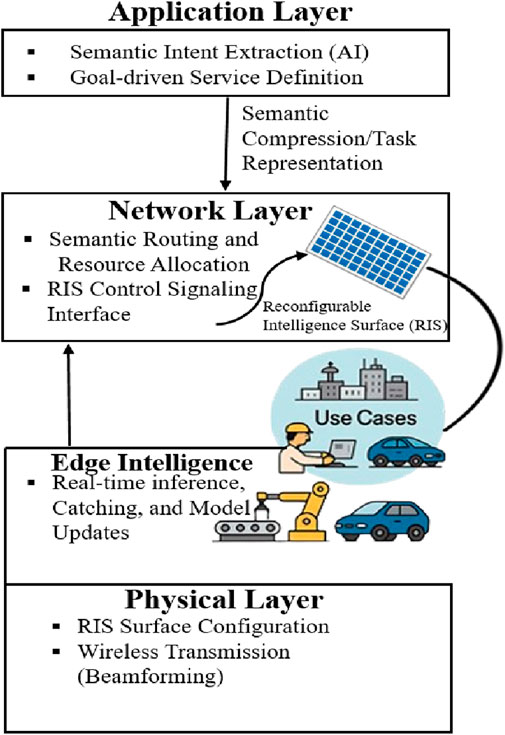
GRAPHICAL ABSTRACT | AI-Native 6G Architecture: Synergizing Semantic Communications, Reconfigurable Intelligent Surfaces, and Edge Intelligence for Ultra-Reliable Low-Latency Services.
1 Introduction
The evolution toward sixth-generation (6G) wireless communication represents a transformative leap beyond the capabilities of fifth-generation (5G). Unlike its predecessor, which emphasized traditional metrics such as throughput, latency, and connectivity, 6G envisions an intelligent, context-aware, and ultra-reliable network architecture (Tera et al., 2024; Fang et al., 2022). Although 5G has achieved remarkable milestones in enhancing data rates and supporting massive device connectivity, it remains largely rooted in bit-level communication and centralized architectures that are insufficient for emerging application demands (Xu et al., 2022). The proliferation of immersive and mission-critical services, including extended reality (XR), autonomous vehicles, holographic telepresence, metaverse environments, and digital twins, requires communication systems that extend beyond conventional performance limits. These applications are not only data-intensive but also demand stringent guarantees on ultra-reliable low-latency communication (URLLC), semantic-level understanding, and intelligent, real-time decision-making (Zhu et al., 2025; Baduge et al., 2024; Siddiqui et al., 2023).
Despite its advancements, 5G faces foundational limitations. Its reliance on Shannon-centric principles, which focus on reliable bit transmission, neglects the semantic relevance of data, an essential consideration in systems where understanding meaning takes precedence over raw data delivery (Wang X. et al., 2025). Furthermore, cloud-dependent architectures introduce non-negligible latency and communication overheads, making them unsuitable for sub-millisecond response applications such as remote surgery or autonomous control (Rafique et al., 2024). Physical-layer constraints, such as inflexible channel modeling and environmental rigidity, also limit performance predictability in dynamic or mobile contexts (Shoaib et al., 2024). Additionally, the integration of machine learning (ML) into 5G is often superficial or confined to specific applications rather than deeply embedded across the protocol stack (Benzaid et al., 2022). 6G is being conceptualized as an AI-native communication paradigm, where artificial intelligence is deeply woven into every layer of the network from the physical to the application tier (Chaccour et al., 2025). Unlike 5G, where artificial intelligence (AI) serves as an optimization add-on, 6G aims to achieve real-time sensing, reasoning, and network self-optimization (Sanjalawe et al., 2025; Jiao et al., 2025). This shift is underpinned by three converging technological pillars: Semantic Communication prioritizes meaning and task relevance over bit fidelity. Reconfigurable Intelligent Surfaces (RIS) facilitate programmable wireless propagation by allowing real-time control over the physical environment.
Edge Intelligence facilitates distributed, low-latency AI processing close to data sources, enabling localized decision-making (Getu et al., 2024; Zhang et al., 2024).
While each of these technologies has seen significant progress individually, there remains a critical research gap in understanding their synergistic integration, especially for 6G URLLC use cases that require semantic awareness, adaptive beamforming, and distributed intelligence (Wu et al., 2024).
This paper aims to fill that gap by offering a comprehensive, forward-looking synthesis of how semantic communications, RIS, and edge intelligence can be co-designed to meet the demands of future 6G networks. We systematically explore the theoretical foundations, current advancements, integration challenges, and open research questions surrounding each technology. Additionally, we propose a unified architecture that highlights their interdependencies and collaborative potential for delivering intelligent, low-latency, and ultra-reliable communication services.
Our contributions also differentiate this work from existing literature by not only unifying these three domains but also by identifying emerging directions such as quantum semantic communication, Space-Air-Ground-Sea (SAGS) architectures, and bio-inspired intelligent agents as potential enablers of autonomous, cognitive 6G ecosystems. This review is intended to serve as a foundational reference for researchers, practitioners, and policymakers aiming to shape next-generation wireless systems that are intelligent by design and contextually adaptive by function.
2 AI-native architecture in 6G networks
The evolution from 5G to 6G networks signifies not merely an enhancement in data speed or capacity, but a fundamental architectural transformation toward AI-native communication systems. In this paradigm, artificial intelligence is no longer an auxiliary component but an intrinsic and pervasive layer embedded across all levels of the network, from the physical transmission layer to service orchestration and intent-based communication (Tera et al., 2024).
An AI-native 6G network is characterized by its capability to perceive, learn, reason, and adapt autonomously in real time. Intelligence is deeply integrated into every component, enabling proactive decision-making, autonomous resource management, and task-specific communication (Wu et al., 2024; Yan et al., 2024). Such networks support self-configuration, self-optimization, and self-healing, forming the foundation for perceptive and context-aware connectivity.
The design framework for AI-native 6G architecture is typically underpinned by three interdependent pillars, such as core intelligence, distributed learning, and self-evolving protocols (Sheraz et al., 2025).
At the heart of the network lies a centralized intelligence engine that aggregates insights from across the system, ranging from user behavior to environmental changes and application demands (Zhu et al., 2025; Baduge et al., 2024). Surrounding this core, distributed AI agents are deployed at the network edge, base stations, and end-user devices. These agents engage in hierarchical, federated, and reinforcement learning, thereby facilitating collaborative intelligence and enhancing local decision-making without constant cloud reliance (Baccour et al., 2022; Abushaega et al., 2025).
A defining feature of AI-native 6G is the self-evolving protocol stack, wherein communication protocols dynamically update based on context, user intent, and task requirements (Katsaros et al., 2024). This shift enables goal-driven and semantically aware transmission, contrasting with 5G’s reactive and data-centric mechanisms (Alhaj et al., 2023; Serôdio et al., 2023). In 5G, AI is typically employed in isolated functions such as traffic prediction or beamforming. However, 6G integrates AI into the control loop, enabling seamless interaction between sensing, decision-making, and actuation, embedded throughout the protocol layers (Sanjalawe et al., 2025; Yellanki, 2023; Campolo et al., 2023).
Moreover, 6G architecture integrates emerging enablers notably, Semantic Communication, Reconfigurable Intelligent Surfaces (RIS), and Edge Intelligence, to deliver intelligent, adaptive, and efficient communication such as Semantic communication redefines traditional data transmission by prioritizing the meaning and intent behind data rather than its raw volume. This is vital in scenarios such as autonomous driving and virtual reality, where transmitting every bit is inefficient and unnecessary (Zeb et al., 2023; Li et al., 2023).
RIS introduces controllable, programmable metasurfaces that allow the physical environment to be shaped for optimal signal propagation as shown in Table 1. When orchestrated by AI, RIS can dynamically reconfigure channels to improve signal strength, reduce interference, and support ultra-reliable low-latency communication (Das et al., 2023).
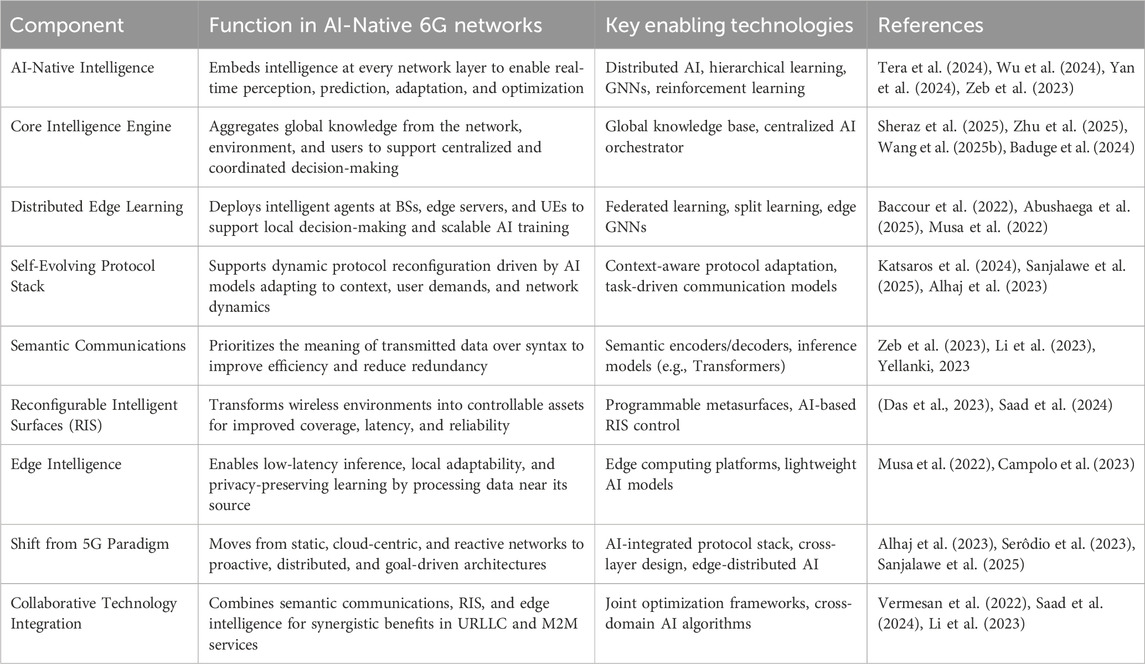
Table 1. Foundational elements of AI-native 6G networks: functional roles, technological enablers.
Edge intelligence brings computation closer to the data source, enabling real-time inference, local caching, and rapid AI model updates crucial for latency-sensitive and context-aware applications like Industry 5.0 and XR environments (Musa et al., 2022).
2.1 Interdependencies and architectural overview
These layers are not isolated; instead, they operate in a tightly coupled loop. As depicted in the graphical abstract, the application layer initiates the communication process through semantic intent extraction and goal-oriented service definition. The Network Layer receives this compressed intent and performs semantic-aware routing and RIS coordination, while the Edge Intelligence Layer enables localized learning and adaptation. Finally, the physical layer, empowered by RIS, executes fine-grained control over beamforming and wireless propagation.
The graphical abstract demonstrates how feedback and control signals circulate across these layers. For instance, edge-inferred context updates can refine application-layer objectives, while RIS adjustments informed by semantic priorities at the network layer can directly impact physical layer performance. This looped interdependency ensures that communication is purpose-driven, energy-efficient, and environmentally adaptive (Saad et al., 2024; Vermesan et al., 2022).
To support this narrative review, a structured literature mapping approach was employed. The review spans reputable academic databases such as IEEE Xplore, Scopus, and arXiv, focusing on works published between 2020 and 2025. Search keywords included “AI-native 6G,” “semantic communication,” “reconfigurable intelligent surface,” and “edge intelligence.” Article selection was based on relevance to the architectural framework, citation strength, and alignment with 6G conceptual developments.
3 Semantic communications: from bits to meaning
Traditional communication systems, rooted in Shannon’s information theory, focus on the accurate and efficient transmission of bits over noisy channels. While this model has served as the foundation for current wireless networks, it does not consider the meaning or intent behind transmitted data. As 6G evolves toward intelligent, context-aware systems, semantic communication emerges as a new paradigm, one that prioritises the value and relevance of information over sheer data volume (Niu et al., 2022; Karahan and Kaya, 2025). Semantic communication shifts the focus from “how much” data is transmitted to “what” data is transmitted and “why” it matters. The goal is to enable machines and agents to extract, interpret, and act on information based on its semantic content, thereby reducing communication overhead and latency while improving operational efficiency (Dai et al., 2022). This is particularly valuable in applications like autonomous systems, the Tactile Internet, and real-time industrial control, where only task-relevant information needs to be exchanged. At the heart of this paradigm is the semantic communication model, which introduces a new semantic layer in the communication stack. This model typically consists of three key components:
Semantic Encoder: Compresses the source message by extracting its underlying meaning.
Semantic Decoder: Reconstructs the intended message using shared knowledge and context.
Semantic Noise Model: Captures meaning-level distortions such as ambiguity, context drift, or relevance mismatch (Kumar, 2021; Sun, 2023).
Unlike the Shannon model that minimises bit error rates (BER), the semantic model optimizes for meaning reconstruction. This shift requires advanced machine learning (ML) techniques, particularly AI models like Transformers such as BERT, GPT and Graph Neural Networks (GNNs), to learn and represent contextual semantics across diverse communication scenarios (Yenduri et al., 2024). These models serve dual roles: compressing information semantically and enabling machines to infer intent with minimal transmission. To evaluate such systems, new semantic-centric metrics have been proposed that move beyond traditional metrics, such as BER, or packet delivery ratio. These include:
a. Semantic Efficiency (SE): Measures the amount of meaningful information transmitted per unit of bandwidth and time. As shown in Equation 1,
Where
b. Semantic Fidelity (SF): It assesses how accurately the meaning that has been reconstructed matches the original intent. It is defined in Equation 2 as:
Where
c. Semantic Relevance (SR): Evaluates the task-specific utility of the received information. As expressed in Equation 3,
Where
3.1 Practical applications
Semantic communication has demonstrated significant potential across 6 key 6G use cases. In URLLC, it minimises transmission delays by focusing on essential information, ideal for real-time robotics and autonomous driving (Chen et al., 2023). In digital twin systems, semantic-aware updates ensure bandwidth-efficient synchronisation of only critical state changes (Jagatheesaperumal et al., 2023). Similarly, in the Tactile Internet, semantic compression improves responsiveness by omitting redundant sensory data (Javaid et al., 2024).
3.2 Challenges and limitations
Despite its promise, semantic communication faces multiple challenges. First, semantic interpretation is inherently context-dependent, and devices with mismatched ontologies or knowledge bases may experience semantic misalignment. Second, semantic collisions, where users infer contradictory meanings can degrade performance in shared environments (Liu et al., 2022). Additionally, the robustness of semantic models under dynamic conditions and their adaptability to evolving languages, intents, or usage contexts remain open issues (Lin et al., 2022). Lastly, since semantic data often reflect user goals or behaviour, privacy, inference security, and explainability are vital concerns (Akhtar et al., 2024; Friha et al., 2024; Lin et al., 2022).
In summary, semantic communication represents a foundational shift in wireless communication, one that aligns naturally with AI-native 6G systems. It facilitates more intelligent, efficient, and purpose-driven interactions between users, machines, and networks. As illustrated in Figure 1, this paradigm integrates semantic encoders/decoders, shared knowledge models, and adaptive metrics to support emerging applications in autonomous systems, digital twins, and human-centric services.
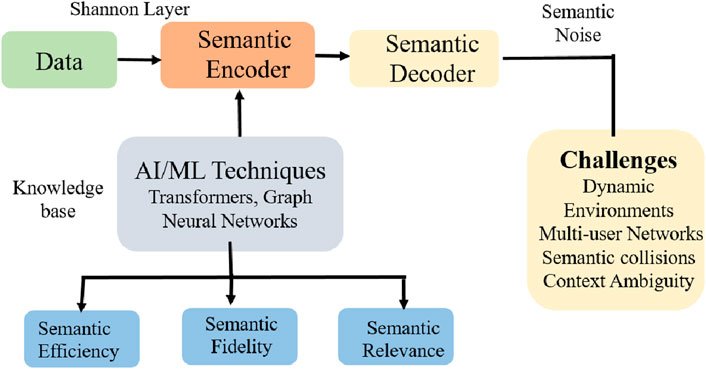
Figure 1. Semantic communications in AI-native 6G networks: Architecture, intelligence, and challenges toward meaning-centric connectivity.
4 Smart environments in 6G: reconfigurable intelligent surfaces
One of the most groundbreaking innovations in the evolution toward 6G networks is the Reconfigurable Intelligent Surface (Basar et al., 2024). Unlike traditional infrastructure that merely transmits or relays signals, RIS can actively manipulate the wireless propagation environment, transforming passive elements into intelligent communication entities (Zaoutis et al., 2025). This is achieved through engineered metasurfaces, two-dimensional arrays of sub-wavelength, programmable scatterers that dynamically adjust the phase, amplitude, and polarisation of incoming electromagnetic waves (Venkatesan and Chakkaravarthy, 2025).
RIS structures are built using programmable materials such as liquid crystals, PIN diodes, and grapheme-based tunable components, allowing real-time reconfiguration with minimal energy consumption (Adeshina et al., 2024). In a typical RIS-aided system, the surface intercepts base station signals and reflects them toward users by adjusting the phase shifts of individual elements to create constructive signal paths (Basar et al., 2024; Zaoutis et al., 2025). This introduces a new level of flexibility in wireless channel design by converting random propagation behaviours into predictable and controllable patterns (Jian et al., 2022).
However, these benefits come with complex modelling and estimation challenges. Optimizing RIS-assisted systems requires joint active and passive beamforming design. Since RIS elements are passive and lack RF chains, traditional channel estimation techniques are inadequate (Magbool et al., 2024). Effective modeling of the cascaded BS-RIS-User channel necessitates novel techniques such as compressed sensing, matrix factorization, or pilot reuse schemes (Abdallah et al., 2022).
RIS holds great promise for enabling URLLC, a cornerstone of 6G applications such as autonomous vehicles, smart manufacturing, and remote healthcare (Othman et al., 2025). By reshaping propagation paths, RIS enhances signal strength, mitigates multipath fading, and reduces congestion and path loss (Wu, 2022). Passive beamforming and dynamic rerouting further boost reliability and reduce latency (Naaz et al., 2024). Its ultra-low energy consumption also enables green URLLC, aligning with the 6G vision of sustainability (Kumar et al., 2023).
The integration of Artificial Intelligence greatly enhances RIS performance and adaptability. Techniques like Deep Reinforcement Learning (DRL) enable RIS to learn optimal reflection patterns in real time by treating the surface as an agent interacting with its wireless environment (Zaoutis et al., 2025). Federated learning also allows distributed RIS devices to train local models collaboratively without sharing raw data, a critical advantage in densely connected smart environments (Zhong et al., 2022). Through AI, RIS can autonomously adapt to user mobility, interference dynamics, and quality-of-service (QoS) demands, supporting context-aware and proactive communication (Ashraf N. et al., 2023).
An emerging innovation is the fusion of RIS with semantic-aware communications. In this paradigm, RIS does not merely optimize based on signal quality but also considers the semantic value of transmitted content (Hello et al., 2024). For instance, in tactile internet scenarios, mission-critical haptic feedback can be prioritized over delay-tolerant data by dynamically steering beams through faster, more reliable RIS-assisted paths (Chakkaravarthy et al., 2025). Less urgent content may be routed through alternative paths (Cao et al., 2023). This synergy enables a meaning-centric wireless system, where the physical layer aligns with the semantic needs of applications (Getu et al., 2023).
Despite its promise, several challenges hinder the deployment of RIS in 6G. These include scalability in high-mobility environments, RIS-base station synchronization, imperfections in metamaterials, and the absence of standardized control protocols (Sun, 2023). Additionally, real-time integration of RIS with AI and semantic layers remains computationally demanding and non-convex, requiring lightweight and approximate optimization strategies (Das et al., 2023).
In nut shell, RIS represents a pivotal technology for realizing intelligent, adaptive, and programmable wireless environments in 6G (Basar et al., 2024). By transforming passive surfaces into intelligent agents and integrating them with AI and semantic layers, RIS facilitates more robust, responsive, and sustainable communications. It is a multidisciplinary innovation, merging principles from material science, electromagnetics, machine learning, and communication theory, making it a foundational enabler of the Internet of Everything (Liang et al., 2024).
5 6G edge intelligence
Edge Intelligence (EI) represents a transformative shift in 6G network architecture, moving from centralized, cloud-based processing to decentralized intelligence closer to the end-users (Adeshina et al., 2024). As 6G targets URLLC in environments marked by extreme heterogeneity, traditional cloud AI models become increasingly inadequate due to latency, privacy, and bandwidth constraints. EI addresses these limitations by embedding AI capabilities directly into edge nodes such as base stations, small cells, access points, and even user devices (Singh et al., 2022; Zaoutis et al., 2025).
This edge-centric architecture supports real-time data processing, context-aware decision-making, and collaborative intelligence, making it ideal for delay-sensitive and privacy-critical applications (Wang B. et al., 2025). Instead of sending all raw data to a central cloud, edge devices execute localized learning and inference tasks. For instance, Federated Learning allows multiple edge nodes to train a shared global model without sharing raw data, thereby enhancing privacy and reducing network overhead (Abreha et al., 2022). Similarly, Split Learning divides neural network models between clients and edge servers, offering a secure and resource-efficient paradigm suitable for constrained devices (Ren and Lee, 2025). These learning methods are particularly advantageous in scenarios such as massive machine-type communication and the tactile internet, where responsiveness and adaptability are essential (Singh et al., 2022).
Beyond learning, Edge Intelligence enables dynamic resource orchestration, illustrated in Figure 2. Unlike static provisioning models, edge nodes in 6G autonomously manage spectrum, compute resources, energy budgets, and caching functions (Sefati et al., 2024). Techniques such as reinforcement learning, graph-based optimization, and game theory empower edge agents to respond adaptively to dynamic network conditions, user mobility, and QoS fluctuations (Subrahmanyam, 2025). This distributed decision-making fosters latency reduction, energy-efficiency, and fair service allocation (Zhong et al., 2022).
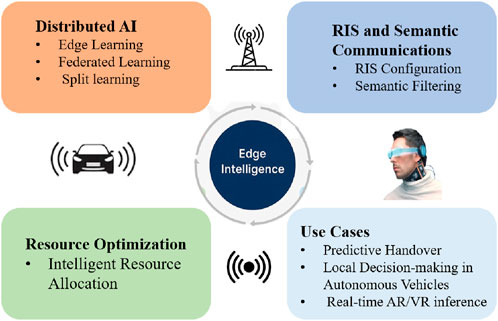
Figure 2. Edge intelligence in 6G: distributed AI, resource optimization, and use cases for ultra-low latency applications.
Critically, EI also enables seamless coordination with RIS and semantic communication, which are foundational to the 6G vision (Friha et al., 2024). Through predictive analytics, edge agents anticipate user mobility and channel conditions to guide real-time RIS reconfiguration, optimizing beam orientation and signal quality (Zawia et al., 2025). In semantic communication, EI facilitates the extraction and prioritization of contextually relevant data filtering, compressing, or discarding information based on user intent, task criticality, or situational awareness (Yang et al., 2022b; Zawia et al., 2025).
The practical applications of edge intelligence span multiple critical domains. For example, in predictive handover, edge nodes analyze mobility and signal strength data to anticipate and manage handover events, reducing service interruptions (El-Hajj, 2025). In autonomous vehicle networks, edge AI supports real-time perception, decision-making, and control functions that are highly sensiive to latency and unsuitable for centralized clouds (Biswas and Wang, 2023). In augmented and virtual reality (AR/VR) scenarios, edge-based inference ensures fast rendering, position tracking, and contextual responsiveness, which are essential in industrial metaverse applications and smart healthcare (El-Hajj, 2025; Biswas and Wang, 2023).
Despite its transformative potential, deploying Edge Intelligence in 6G comes with several challenges. These include heterogeneous hardware environments, limited energy and processing capacity, and the complexity of maintaining model convergence and consistency across distributed nodes (Abd Elaziz et al., 2024). Federated models often struggle with fairness and robustness under dynamic and Non-IID. Data distributions (Cao et al., 2023). Moreover, effective coordination mechanisms are still needed to integrate edge nodes with centralized clouds, RIS controllers, and semantic engines (Golpayegani et al., 2024).
In nut shell, Edge Intelligence is a core enabler of 6G networks not merely a support function. By enabling distributed inference, preserving user privacy, and facilitating cross-layer coordination with RIS and semantic engines, EI paves the way for intelligent, resilient, and ultra-low-latency communication infrastructures (Jian et al., 2022; Rancea et al., 2024).
6 Convergence of semantic communications, RIS, and edge intelligence
The convergence of semantic communications, reconfigurable intelligent surfaces, and edge intelligence marks a fundamental shift in the design of AI-native 6G networks. This integration establishes a cross-disciplinary synergy that breaks away from the conventional isolated approach, in which communication, computation, and control operate independently (Zawia et al., 2025). In contrast, the 6G vision embraces a unified, co-optimized architecture to enable ultra-reliable, low-latency, and context-aware services (Valsalan et al., 2024).
This convergence occurs at both the functional and architectural levels. Semantic encoding at the application layer, RIS-based channel control at the physical layer, and real-time decision-making at the network edge are no longer treated as separate modules. Instead, they co-evolve in a distributed and dynamically reconfigurable topology (Liu et al., 2025). This architecture supports cross-layer optimization, where traditional OSI boundaries between PHY, MAC, and application layers, are relaxed or redefined to enable end-to-end semantic intelligence (Mustafa et al., 2024).
For instance, a semantic encoder may collaborate directly with RIS controllers to prioritize the transmission of meaning-critical content. Simultaneously, edge nodes act as orchestration agents, using local sensing and AI inference to manage RIS configurations in real time, thereby aligning physical-layer adaptations with semantic-layer demands (Zhang et al., 2022). This interplay facilitates a closed-loop intelligent system, one that can sense, infer, and adapt to evolving user and environmental contexts.
A practical example of this synergy is seen in semantic-aware RIS beam steering. In this setup, RIS dynamically configures its elements not just to enhance SNR but also to preserve the semantic integrity of the transmitted content (Wang X. et al., 2025). For example, in a smart healthcare system, if an edge node detects that critical patient telemetry is being sent, it may prompt RIS reconfiguration to minimise latency and improve reliability for that specific stream (Zeng and Bao, 2023). Figure 3 illustrates this interplay, showing the feedback loop between semantic inferences, RIS control logic, and edge-based orchestration. Another area of synergy is edge-driven semantic compression and interpretation. Edge devices perform localized semantic extraction, dramatically reducing bandwidth requirements while maintaining content fidelity. These compressed packets are then optimised by RIS for directional, low-energy transmission, completing a loop from meaning extraction to environment-aware delivery (Polese et al., 2023).
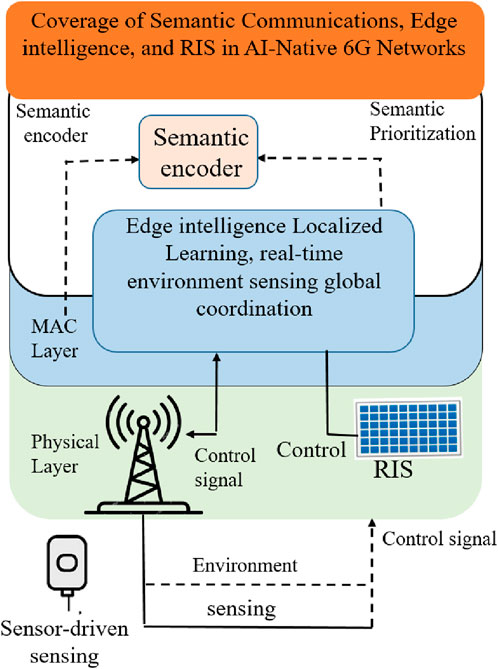
Figure 3. Integrated 6G architecture: convergence of semantic communications, RIS, and edge intelligence.
In parallel, RIS plays a transformative role in federated learning (FL) by optimizing uplink and downlink paths among distributed clients. In traditional FL, convergence can be hampered by unreliable connections, especially in mobile scenarios (El-Hajj, 2025). With RIS, the network dynamically enhances link quality and synchronisation, minimizing dropped updates and communication overhead. More advanced schemes even allow RIS to factor in gradient importance or user context to optimize learning schedules, forming RIS-aware federated intelligence (Rahbari et al., 2023).
This convergence also addresses core 6G challenges such as semantic ambiguity and scalability. By combining edge-based reasoning with RIS reconfiguration, the system can preserve message meaning in unpredictable channel conditions. Additionally, RIS can distribute semantic tasks across edge devices, enabling collaborative reasoning in heterogeneous, multi-user environments (Ahmed et al., 2024).
The result is an emergent class of 6G services: autonomous drone fleets coordinated through semantic mission cues, real-time digital twins powered by RIS-augmented streams, and immersive AR/VR supported by edge-rendered semantic frames and delay-sensitive routing. These capabilities are not mere outcomes of stacking technologies, they emerge from deep, multidimensional co-design (Merluzzi et al., 2023).
This triadic convergence-optimizing meaning (semantics), propagation environment (RIS), and decision intelligence (edge), is foundational to the vision of 6G as a self-evolving, context-aware, and ultra-reliable infrastructure (Xu et al., 2023).
Yet, challenges remain. While frameworks like DeepSC and Semantic Compression and Completion (SCC) are state-of-the-art, they are mostly validated in simulated settings. Only partial real-world implementation, e.g., deploying DeepSC on NVIDIA Jetson edge boards, has been achieved, and open-world performance is constrained by unstructured data and semantic label scarcity (Choe et al., 2024; Jouini et al., 2024). Similarly, practical RIS deployments remain limited. Although prototypes such as ZTE’s programmable metasurfaces and Southeast University’s STAR-RIS mmWave testbeds exist, most semantic-RIS frameworks remain conceptual due to hardware reconfiguration delays and semantic modelling complexity (Yan et al., 2024).
7 Applications and use cases
The combination of AI-native architecture, semantic communications, RIS, and edge intelligence in 6G networks enables a previously unseen variety of prospective applications (Zaoutis et al., 2025). These applications are no longer limited by traditional throughput and latency constraints but rather by context-awareness, real-time adaptability, and semantic precision, allowing intelligent services to be deployed across verticals such as manufacturing, healthcare, immersive environments, and urban mobility. This integration ensures that communication is no longer solely about transmitting data but about prioritizing meaning, relevance, and contextual reliability at the network edge (Xu et al., 2023).
Factory automation powered by digital twins represents a disruptive transformation. Here, physical manufacturing processes are mirrored in virtual environments for predictive maintenance and real-time process optimization (Mon et al., 2025). Semantic communication drastically reduces overhead by transmitting only task-relevant deviations, while RIS maintains reliable connectivity in complex electromagnetic environments. Edge intelligence performs localized analytics and supports federated learning for predictive anomaly detection (Islam et al., 2025). The result is a near-zero-latency, self-optimizing industrial ecosystem, impossible with traditional 5G systems. Immersive environments and metaverse applications also benefit from this technological trinity. Semantically compressed rendering, enabled by semantic encoders, transmits only perceptually salient elements. RIS holographic beamforming supports high-speed 3D streaming, while edge intelligence dynamically offloads compute tasks and tracks user behavior in real time (Hatami et al., 2024; Joda et al., 2022). Applications such as collaborative design, VR-based tourism, and virtual classrooms rely on this seamless sensing-compute-communication loop, enhanced by semantic-aware QoS policies that prioritize intent over content type (Ahmed et al., 2024).
In remote surgery and robotic healthcare, ultra-low latency and semantic clarity are mission-critical as shown in Table 2. Semantic communication ensures the transmission of task-relevant clinical data (e.g., tool trajectory, anomaly markers), not redundant visual streams (Nguyen et al., 2023). RIS emulates direct line-of-sight to reduce signal degradation, while edge intelligence supports real-time inference and privacy-preserving diagnostics without cloud dependency (Gupta et al., 2022).
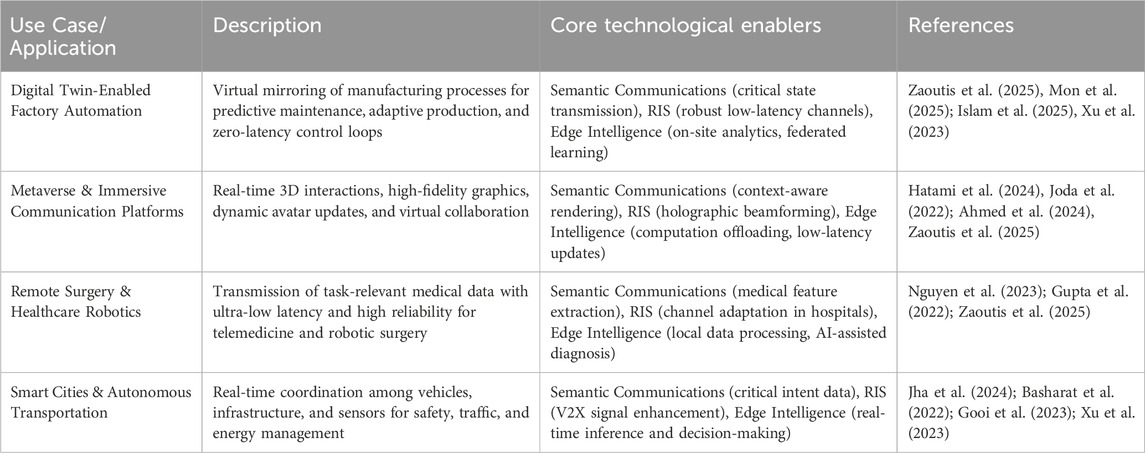
Table 2. AI-native 6G use cases and core technological enablers.
The system architecture guarantees sub-millisecond round-trip latencies, vital for tactile feedback and remote precision operations.
Smart cities and autonomous transport networks showcase another vital application domain. RIS-enhanced V2X communication maintains signal quality in dense urban environments (Basharat et al., 2022). Semantic-aware vehicular communications reduce channel congestion by prioritizing critical events (e.g., braking or collisions). Edge intelligence at intersections and in vehicles enables predictive traffic modelling, collision avoidance, and grid control (Li and Li, 2022) This tightly integrated system fosters resilient, self-organizing urban ecosystems, improving safety, sustainability, and scalability (Jha et al., 2024; Gooi et al., 2023; Serôdio et al., 2023). In all these domains, security and privacy emerge as critical enablers of trust, safety, and continuity.
7.1 Emerging threat models, countermeasures, and real-world limitations
As 6G networks evolve into intelligence-native infrastructures, the attack surface expands significantly, exposing them to novel threat models beyond conventional cybersecurity risks. AI-native protocols and semantic inference mechanisms could be vulnerable to adversarial attacks, model poisoning, and data manipulation, where malicious actors inject perturbed inputs or misleading semantic cues to influence decisions at the edge or core. Furthermore, RIS introduce new physical-layer vulnerabilities, including the possibility of malicious reprogramming or side-channel eavesdropping via unintended signal reflections (Ahmed et al., 2025; Won et al., 2024). The distributed nature of edge intelligence also broadens the exposure to attacks on federated learning protocols, including inference leakage, sybil attacks, or compromised nodes within cooperative training environments (Firdaus and Rhee, 2022).
A multi-layered security approach needs to be created to address these emerging threats. Artificial intelligence in intrusion detection systems (IDS) also seems like a solution, since it enables the proactive detection and response to suspicious activity on any level of the 6G stack based on pattern recognition and anomaly detection (Naeem et al., 2023). Node authentication and spectrum access policies can be improved with the help of trust-aware reinforcement learning frameworks, which can continuously learn the adversarial patterns (Ali et al., 2021). At the physical layer, cryptographically bound network functions are under investigation that can secure RIS control protocols and avoid unauthorized reconfiguration (Guo et al., 2024). In the meantime, federated learning methods using differential privacy and secure multi-party computation are able to reduce privacy leakage and maintain performance at distributed training (Ficili et al., 2025).
Although these innovations are in place, there are still several limitations in the real world. First, security protocols can be associated with latency and computational overheads, which are contradictory to the aim of 6G services, which are ultra-low-latency (Won et al., 2024). Second, existing countermeasures are based on theoretical hypotheses or controlled settings and were not validated in large-scale dynamic network settings. Finally, there exist gaps in regulation and standardization of the security benchmarks of AI-native functions and RIS control, and thus worldwide consensus is hard to reach. These limitations will need joint research among wireless security, cryptography, systems engineering, and policy fields.
8 Key research challenges
The integration of semantic communications, RIS, and edge intelligence in AI-native 6G networks unlocks unprecedented opportunities but also introduces multifaceted research and standardisation challenges (Gupta et al., 2022). One of the foremost challenges is the joint modelling of semantic understanding, physical-layer propagation environments, and AI-based decision-making (Li and Li, 2022). Traditional communication systems are primarily optimized for bit-level accuracy and channel capacity, without accounting for the contextual or application-level meaning of information. In contrast, semantic communications require a paradigm shift enabling systems to interpret, extract, and communicate meaning aligned with application tasks (Friha et al., 2024). Achieving this calls for sophisticated models that combine semantic context with dynamic physical channel behaviors, including RIS configurations, while leveraging real-time AI-driven adaptation mechanisms (Bilal et al., 2025). Another complex challenge lies in orchestrating resources across the semantic, physical, and edge intelligence layers. In 6G, performance requirements such as ultra-low latency, semantic accuracy, and resilience under mobility require the joint management of resources like spectrum, RIS phase shifts, and edge compute capacity. Unlike traditional OSI-layered networks, AI-native 6G systems demand deeply integrated cross-layer frameworks that coordinate semantic encoding, RIS-assisted transmission, and edge learning (Song et al., 2022). Effective orchestration will necessitate multi-objective optimization strategies, distributed learning techniques, and game-theoretic models capable of real-time adaptation to dynamic environmental and traffic conditions (Tan et al., 2024). Security, trust, and privacy pose significant concerns in decentralized edge intelligence and semantic transmission systems. Edge-AI inference on local user data raises risks of data leakage, model poisoning, and adversarial semantic attacks (Wei and Liu, 2025). These attacks may distort the interpreted meaning of information without altering its bit representation, a unique threat in semantic communications (Tan et al., 2024). Addressing these risks requires secure semantic encoding schemes, integrity verification at both semantic and physical layers, and lightweight privacy-preserving techniques like federated learning with differential privacy, suitable for resource-constrained edge devices (Bilal et al., 2025).
Hardware limitations represent a practical bottleneck. The deployment of semantic-aware encoders, adaptive RIS panels, and edge-AI accelerators must overcome constraints in power efficiency, real-time performance, and platform interoperability (Ahmed et al., 2024). Energy consumption is especially critical in distributed RIS and edge deployments operating autonomously. Scalability challenges are also intensifying, as future networks will interconnect vast numbers of heterogeneous devices requiring seamless semantic and AI capabilities (Bhide et al., 2025). Solutions may include low-power neuromorphic processors, tunable metamaterials, and standardized open hardware interfaces (Othman et al., 2025). Despite rapid technological advances, standardization remains in its early stages and represents a key barrier to large-scale adoption and interoperability, as shown in Figure 4. Existing frameworks such as those from the 3rd Generation Partnership Project (3GPP) still focus predominantly on bit-level communication and radio access protocols, with little support for semantic fidelity or task-orientated performance metrics (Shi et al., 2023). Recognizing this, the International Telecommunication Union -Telecommunication Standardization Sector (ITU-T) Study Group 13 has initiated efforts on semantic-aware networking by defining KPIs and use cases for future semantic communication services (Shi and Xiao, 2024). European Telecommunications Standards Institute (ETSI), through its Industry Specification Group on Experiential Network Intelligence (ENI), is working on context-aware AI models and edge intelligence alignment (Tanevski et al., 2024). In parallel, Institute of Electrical and Electronics Engineers (IEEE) has launched initiatives under IEEE P7010 to address algorithmic transparency and semantic fairness in edge-AI systems, which could serve as a reference for communication-layer trustworthiness. Additionally, RIS-specific standardization is still emerging, with efforts underway to define signaling interfaces and configuration protocols through 3GPP SA1 and SA2 working groups (Jian et al., 2022). However, the lack of unified metrics, semantic performance benchmarks, and regulatory alignment across national authorities creates significant interoperability gaps.
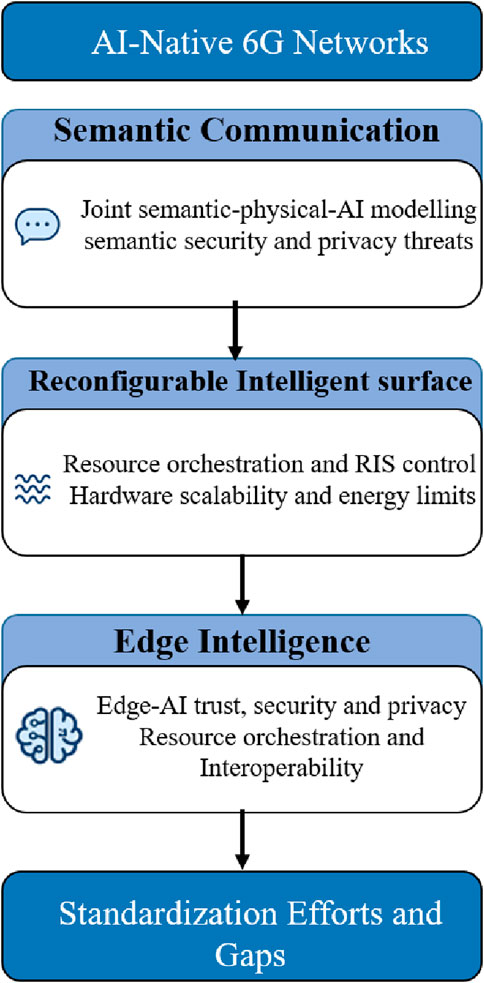
Figure 4. Key research challenges in AI-native 6G networks across semantic, RIS, edge, and standardization layers.
Bridging these gaps requires multi-stakeholder collaboration among academia, industry consortia, and global standard bodies. Reference architectures, testbeds, and benchmarking tools must be co-developed to support integration across semantic layers, programmable RIS elements, and edge AI frameworks. Furthermore, discussions around regulatory policy, ethical safeguards, and global alignment are vital to ensure 6G inclusivity, accountability, and resilience (Jahid et al., 2023).
To summarize, the path to realizing the goal of AI-native 6G networks driven by semantic communications, RIS, and edge intelligence is riddled with challenging research hurdles in modeling, resource management, security, hardware, and standards. Addressing these difficulties necessitates multidisciplinary approaches that include communications theory, artificial intelligence, hardware design, and cybersecurity. The solutions to these open challenges will not only enable breakthrough applications in business, healthcare, the meta-verse, and urban transportation but will also serve as the foundation for future intelligent societies.
9 Future directions
The evolution toward AI-native 6G networks presents a transformative opportunity to reimagine not just communication efficiency but the semantic, cognitive, and environmental intelligence of the network itself. Building upon the core enablers discussed in this review: semantic communications, RIS, and edge intelligence several emerging technologies are poised to address current limitations, amplify system resilience, and enable new paradigms of performance, security, and adaptability (Ali et al., 2023).
9.1 Quantum semantic communications
Expanding on the need for secure and meaning-centric transmission raised in Section 7.1, quantum semantic communication represents a radical leap. Unlike conventional quantum systems, which focus on bit transmission and key distribution, quantum semantic systems will encode and teleport meaning, leveraging quantum state modulation and natural language comprehension (Liu et al., 2023). These systems could address both semantic compression bottlenecks and the security threats of semantic manipulation, discussed earlier, by enabling non-classical, context-aware communication that is inherently resistant to eavesdropping (Hassan et al., 2025; Erhard et al., 2020). Future research must bridge semantic encoding frameworks with quantum entanglement protocols and error-resilient channel modelling.
9.2 Bio-inspired AI agents for edge and RIS co-evolution
To address non-IID data distribution, autonomy under dynamic uncertainty, and adaptive inference challenges from Sections 7.1, 8, bio-inspired AI agents offer promising solutions. These agents, modeled after neural plasticity and swarm intelligence, could enable lifelong learning, self-organization, and resilient inference at the edge (Traniello and Avarguès-Weber, 2023). Their decentralized adaptability aligns well with edge-RIS synergy discussed in Section 6, offering the potential to continuously reconfigure wireless environments and semantic prioritization policies under changing conditions (Baeza et al., 2025). Neuromorphic computing hardware, optimized for energy efficiency, will be a critical enabler here.
9.3 Intelligent metasurfaces and active RIS
As discussed in Section 6, current RIS models remain limited in configurability and semantic responsiveness. The next generation-active RIS and intelligent metasurfaces, will evolve from passive reflectors into programmable electromagnetic processors (Ahmed et al., 2024). These surfaces could semantically filter or enhance signal content before reflection, acting as autonomous semantic relays. When coupled with localized edge-AI orchestration, active RIS could address latency constraints in dynamic environments (Ashraf Q. M. et al., 2023), and mitigate beamforming-related vulnerabilities raised in Section 7.1. Future research must co-design AI control loops, hardware adaptability, and multi-user fairness within the constraints of energy and spectral efficiency.
9.4 Blockchain and zero-trust architectures
The vulnerabilities in federated learning, RIS reprogramming, and semantic attacks identified earlier demand a new trust paradigm. Blockchain, in combination with zero-trust security architectures, can offer verifiable provenance for semantic encoders, authenticated RIS control, and immutable logs for edge model updates (Friha et al., 2024; Ren and Lee, 2025). These frameworks are particularly relevant for distributed trust coordination in multi-tenant, multi-domain environments. Lightweight consensus algorithms and privacy-preserving smart contracts will be essential to meet URLLC constraints, while secure semantic logging can bolster transparency and accountability in healthcare, vehicular, and financial applications (Li et al., 2025; Han et al., 2024).
9.5 Global-scale SAGS networks
To overcome the geospatial limitations of terrestrial infrastructure, especially in disaster, rural, or underwater environments, SAGS networks will play a pivotal role. By integrating satellites, HAPs, aerial drones, and underwater nodes with terrestrial 6G systems, SAGS networks can enable ubiquitous semantic interoperability, coordinated edge intelligence, and resilient RIS deployment (Cao et al., 2023). However, this vision demands progress in topology-aware RIS reconfiguration, multi-domain semantic translation, and policy harmonization across space, sea, and terrestrial jurisdictions. These networks may also require cross-layer AI protocols that orchestrate semantic task allocation across vastly heterogeneous platforms.
9.6 Summary
Each of the emerging directions outlined above directly responds to the challenges of dynamic control, semantic integrity, energy-efficiency, and decentralized trust discussed in Sections 6 through 8. Together, they represent a co-evolutionary pathway for the 6G ecosystem where architectural flexibility, real-time semantic cognition, programmable propagation, and autonomous security mechanisms are co-designed across layers and domains.
As we push the boundaries of what networks can do, the convergence of quantum information science, biological intelligence models, secure distributed ledgers, and adaptive wireless environments promises to transform AI-native 6G from a high-performance infrastructure into a global cognitive ecosystem capable of interpreting, reasoning, and adapting to the needs of intelligent societies.
10 Conclusion
This review has analyzed the intersection of three major enabling technologies: semantic communication, RIS, and edge intelligence, which altogether transform what 6G networks can do. Unlike past generations, which prioritised throughput and latency, 6G aims to integrate cognition, context awareness, and intent recognition into the communication stack. The semantic communication minimizes transmission overheads because it communicates content based on meaning but not data, which increases efficiency in content delivery. RIS provides control of a wireless environment that is programmable and dynamically enhances signal propagation, coverage, reliability, and energy-efficiency. Edge intelligence is the process of decentralizing computation to perform inference and privacy-preserving analytics in real time at the network edge, near the user. Combining these technologies creates a smart and flexible network fabric that can be responsive to changing user requirements and environmental situations. To give an example, edge-based semantic processing may preselect data based on relevancy before transmission, whereas RIS may guide signals towards ideal propagation. The use of AI techniques implemented in these systems also makes it possible to perform predictive, intent-based orchestration that is learnt via user behavior and network conditions. The synergies enable a responsive and flexible network architecture that is appropriate to new use cases, including immersive extended reality (XR), real-time digital twins, autonomous systems, and intelligent healthcare. But to achieve such vision, not only technological advances are needed, but also the standardized benchmarks provided by organizations such as ITU, 3GPP, and IEEE, at least in the areas of semantic fidelity, RIS control, and AI robustness. System design must also incorporate ethical values, such as transparency, fairness, and data security.
Finally, 6G will be a paradigm shift from the traditional communication infrastructure to cognitive systems that perceive, reason, and act. This transformation will require research, industry, and policy cross-disciplinary collaboration to develop smart, inclusive, sustainable future networks.
Author contributions
FO: Writing – original draft, Conceptualization, Writing – review and editing. CU: Writing – review and editing, Writing – original draft, Conceptualization. OP-CU: Supervision, Writing – review and editing, Writing – original draft.
Funding
The author(s) declare that no financial support was received for the research and/or publication of this article.
Conflict of interest
The authors declare that the research was conducted in the absence of any commercial or financial relationships that could be construed as a potential conflict of interest.
Generative AI statement
The author(s) declare that no Generative AI was used in the creation of this manuscript.
Any alternative text (alt text) provided alongside figures in this article has been generated by Frontiers with the support of artificial intelligence and reasonable efforts have been made to ensure accuracy, including review by the authors wherever possible. If you identify any issues, please contact us.
Publisher’s note
All claims expressed in this article are solely those of the authors and do not necessarily represent those of their affiliated organizations, or those of the publisher, the editors and the reviewers. Any product that may be evaluated in this article, or claim that may be made by its manufacturer, is not guaranteed or endorsed by the publisher.
References
Abd Elaziz, M., Al-qaness, M. A., Dahou, A., Alsamhi, S. H., Abualigah, L., Ibrahim, R. A., et al. (2024). Evolution toward intelligent communications: impact of deep learning applications on the future of 6G technology. Wiley Interdiscip. Rev. Data Min. Knowl. Discov. 14 (1), e1521. doi:10.1002/widm.1521
Abdallah, A., Celik, A., Mansour, M. M., and Eltawil, A. M. (2022). RIS-Aided mmWave MIMO channel estimation using deep learning and compressive sensing. IEEE Trans. Wirel. Commun. 22 (5), 3503–3521. doi:10.1109/twc.2022.3219140
Abreha, H. G., Hayajneh, M., and Serhani, M. A. (2022). Federated learning in edge computing: a systematic survey. Sensors 22 (2), 450. doi:10.3390/s22020450
Abushaega, M. M., Moshebah, O. Y., Hamzi, A., and Alghamdi, S. Y. (2025). Multi-objective sustainability optimization in modern supply chain networks: a hybrid approach with federated learning and graph neural networks. Alexandria Eng. J. 115, 585–602. doi:10.1016/j.aej.2024.12.048
Adeshina, M. A., Ogunleye, A. M., Lee, H., Mareddi, B., Kim, H., and Park, J. (2024). Graphene–liquid crystal synergy: advancing sensor technologies across multiple domains. Materials 17 (17), 4431. doi:10.3390/ma17174431
Ahmed, M., Raza, S., Soofi, A. A., Khan, F., Khan, W. U., Xu, F., et al. (2024). A survey on reconfigurable intelligent surfaces assisted multi-access edge computing networks: state of the art and future challenges. Comput. Sci. Rev. 54, 100668. doi:10.1016/j.cosrev.2024.100668
Ahmed, M., Soofi, A. A., Raza, S., Li, Y., Khan, F., Khan, W. U., et al. (2025). A comprehensive Survey on RIS-Enhanced physical layer security in UAV-Assisted networks. IEEE Internet Things J., 1. doi:10.1109/jiot.2025.3569716
Akhtar, M. A., Kumar, M., and Nayyar, A. (2024). Privacy and security considerations in explainable AI. InTowards ethical and socially responsible explainable AI: challenges and opportunities. Cham: Springer Nature Switzerland Available online at: http://repository.psa.edu.my/handle/123456789/4901.
Alhaj, N. A., Jamlos, M. F., Manap, S. A., Abdelsalam, S., Bakhit, A. A., Mamat, R., et al. (2023). Integration of hybrid networks, AI, ultra massive-MIMO, THz frequency, and FBMC modulation toward 6G requirements: a review. IEEE Access 12, 483–513. doi:10.1109/access.2023.3345453
Ali, B., Gregory, M. A., and Li, S. (2021). Multi-access edge computing architecture, data security and privacy: a review. Ieee Access 9, 18706–18721. doi:10.1109/access.2021.3053233
Ali, S. A., Elsaid, S. A., Ateya, A. A., ElAffendi, M., and El-Latif, A. A. A. (2023). Enabling technologies for next-generation smart cities: a comprehensive review and research directions. Future Internet 15 (12), 398. doi:10.3390/fi15120398
Ashraf, N., Saeed, T., Taghvaee, H., Abadal, S., Vassiliou, V., Liaskos, C., et al. (2023a). Intelligent beam steering for wireless communication using programmable metasurfaces. IEEE Trans. Intelligent Transp. Syst. 24 (5), 4848–4861. doi:10.1109/tits.2023.3241214
Ashraf, Q. M., Tahir, M., Habaebi, M. H., and Isoaho, J. (2023b). Toward autonomic internet of things: recent advances, evaluation criteria, and future research directions. IEEE Internet Things J. 10 (16), 14725–14748. doi:10.1109/jiot.2023.3285359
Baccour, E., Mhaisen, N., Abdellatif, A. A., Erbad, A., Mohamed, A., Hamdi, M., et al. (2022). Pervasive AI for IoT applications: a survey on resource-efficient distributed artificial intelligence. IEEE Commun. Surv. & Tutorials 24 (4), 2366–2418. doi:10.1109/comst.2022.3200740
Baduge, D. P. P. R., Perera, T. D. P., and Jayakody, D. N. K. (2024). “Semantic wireless communications: unveiling the next frontier in intelligent connectivity,” in 2024 international conference on signal processing, computation, electronics, power and telecommunication (IConSCEPT) (IEEE), 1–8.
Baeza, V. M., Parada, R., Salor, L. C., and Monzo, C. (2025). AI-Driven tactical communications and Networking for Defense: a survey and emerging trends. doi:10.48550/arXiv.2504.05071
Basar, E., Alexandropoulos, G. C., Liu, Y., Wu, Q., Jin, S., Yuen, C., et al. (2024). Reconfigurable intelligent surfaces for 6G: emerging hardware architectures, applications, and open challenges. IEEE Veh. Technol. Mag. 19, 27–47. doi:10.1109/mvt.2024.3415570
Basharat, S., Khan, M., Iqbal, M., Hashmi, U. S., Zaidi, S. A. R., and Robertson, I. (2022). Exploring reconfigurable intelligent surfaces for 6G: state-of-the-art and the road ahead. IET Commun. 16 (13), 1458–1474. doi:10.1049/cmu2.12364
Benzaid, C., Taleb, T., and Song, J. (2022). Ai-based autonomic and scalable security management architecture for secure network slicing in b5g. IEEE Netw. 36 (6), 165–174. doi:10.1109/mnet.104.2100495
Bhide, P., Shetty, D., and Mikkili, S. (2025). Review on 6G communication and its architecture, technologies included, challenges, security challenges and requirements, applications, with respect to AI domain. IET Quantum Commun. 6 (1), e12114. doi:10.1049/qtc2.12114
Bilal, H., Rehman, A., Aslam, M. S., Ullah, I., Chang, W. J., Kumar, N., et al. (2025). Hybrid TrafficAI: a generative AI framework for real-time traffic simulation and adaptive behavior modeling. IEEE Trans. Intelligent Transp. Syst., 1–17. doi:10.1109/tits.2025.3571041
Bilotti, F., Barbuto, M., Hamzavi-Zarghani, Z., Karamirad, M., Longhi, M., Monti, A., et al. (2024). Reconfigurable intelligent surfaces as the key-enabling technology for smart electromagnetic environments. Adv. Phys. X 9 (1), 2299543. doi:10.1080/23746149.2023.2299543
Biswas, A., and Wang, H. C. (2023). Autonomous vehicles enabled by the integration of IoT, edge intelligence, 5G, and blockchain. Sensors 23 (4), 1963. doi:10.3390/s23041963
Campolo, C., Iera, A., and Molinaro, A. (2023). Network for distributed intelligence: a survey and future perspectives. IEEE Access 11, 52840–52861. doi:10.1109/ACCESS.2023.3280411
Cao, X., Lu, P., Ni, B., Summers, D., Shprits, Y., and Long, M. (2023). Resonant scattering of radiation belt electrons at Saturn by ion cyclotron waves Geophysical Research Letters 50 (3), e2022GL102394. doi:10.1029/2022GL102394
Chaccour, C., Kurisummoottil Thomas, C., Saad, W., and Debbah, M. (2025). Introduction to semantic communications. Found. Semantic Commun. Netw., 1–18. doi:10.1002/9781394247912.ch1
Chakkaravarthy, S. E., Rayaroth, D., Kumaravelu, V. B., Sundarrajan Jayaraman, T., Periyakarupan Gurusamy Sivabalan, V., Chelian Thirumavalavan, V., et al. (2025). Reconfigurable intelligent surfaces for 6G: a comprehensive overview and electromagnetic analysis. Reconfigurable Intelligent Surfaces for 6G and Beyond Wireless Networks, 71–112.
Chen, J., Yi, C., Okegbile, S. D., Cai, J., and Shen, X. (2023). Networking architecture and key supporting technologies for human digital twin in personalized healthcare: a comprehensive survey. IEEE Commun. Surv. & Tutorials 26 (1), 706–746. doi:10.1109/comst.2023.3308717
Choe, S. K., Ahn, H., Bae, J., Zhao, K., Kang, M., Chung, Y., et al. (2024). What is your data worth to gpt? Llm-scale data valuation with influence functions. arXiv Prepr. arXiv:2405.13954. doi:10.48550/arXiv.2405.13954
Dai, J., Zhang, P., Niu, K., Wang, S., Si, Z., and Qin, X. (2022). Communication beyond transmitting bits: semantics-Guided source and channel coding. IEEE Wirel. Commun. 30 (4), 170–177. doi:10.1109/mwc.017.2100705
Das, S. K., Benkhelifa, F., Sun, Y., Abumarshoud, H., Abbasi, Q. H., Imran, M. A., et al. (2023). Comprehensive review on ML-based RIS-Enhanced IoT systems: basics, research progress and future challenges. Comput. Netw. 224, 109581. doi:10.1016/j.comnet.2023.109581
Dritsas, E., and Trigka, M. (2025). Exploring the intersection of machine learning and big data: a survey. Mach. Learn. Knowl. Extr. 7 (1), 13. doi:10.3390/make7010013
El-Hajj, M. (2025). Enhancing communication networks in the new era with artificial intelligence: techniques, applications, and future directions. Network 5 (1), 1. doi:10.3390/network5010001
Erhard, M., Krenn, M., and Zeilinger, A. (2020). Advances in high-dimensional quantum entanglement. Nat. Rev. Phys. 2 (7), 365–381. doi:10.1038/s42254-020-0193-5
Fang, X., Feng, W., Chen, Y., Ge, N., and Zhang, Y. (2022). Joint communication and sensing toward 6G: models and potential of using MIMO. IEEE Internet Things J. 10 (5), 4093–4116. doi:10.1109/jiot.2022.3227215
Ficili, I., Giacobbe, M., Tricomi, G., and Puliafito, A. (2025). From sensors to data intelligence: leveraging IoT, cloud, and edge computing with AI. Sensors 25 (6), 1763. doi:10.3390/s25061763
Firdaus, M., and Rhee, K. H. (2022). “A joint framework to privacy-preserving edge intelligence in vehicular networks,” in International conference on information security applications (Cham: Springer Nature Switzerland), 156–167.
Friha, O., Ferrag, M. A., Kantarci, B., Cakmak, B., Ozgun, A., and Ghoualmi-Zine, N. (2024). Llm-based edge intelligence: a comprehensive survey on architectures, applications, security and trustworthiness. IEEE Open J. Commun. Soc. 5, 5799–5856. doi:10.1109/ojcoms.2024.3456549
Getu, T. M., Kaddoum, G., and Bennis, M. (2023). Making sense of meaning: a survey on metrics for semantic and goal-oriented communication. IEEE Access 11, 45456–45492. doi:10.1109/access.2023.3269848
Getu, T. M., Kaddoum, G., and Bennis, M. (2024). A survey on goal-oriented semantic communication: techniques, challenges, and future directions. IEEE Access 12, 51223–51274. doi:10.1109/access.2024.3381967
Golpayegani, F., Chen, N., Afraz, N., Gyamfi, E., Malekjafarian, A., Schäfer, D., et al. (2024). Adaptation in edge computing: a review on design principles and research challenges. ACM Trans. Aut. Adapt. Syst. 19 (3), 1–43. doi:10.1145/3664200
Gooi, H. B., Wang, T., and Tang, Y. (2023). Edge intelligence for smart grid: a survey on application potentials. CSEE J. Power Energy Syst. 9 (5), 1623–1640. doi:10.17775/CSEEJPES.2022.02210
Guo, S., Wang, Y., Zhang, N., Su, Z., Luan, T. H., Tian, Z., et al. (2024). A survey on semantic communication networks: architecture, security, and privacy. IEEE Commun. Surv. & Tutorials, 1. doi:10.1109/comst.2024.3516819
Gupta, M., Jha, R. K., and Jain, S. (2022). Tactile based intelligence touch technology in IoT configured WCN in B5G/6G-A survey. Ieee Access 11, 30639–30689. doi:10.1109/access.2022.3148473
Han, D., Liu, Y., Cao, R., Gao, H., and Lu, Y. (2024). A lightweight blockchain architecture with smart collaborative and progressive evolution for privacy-preserving 6G IoT. IEEE Wirel. Commun. 31, 148–154. doi:10.1109/mwc.013.2300491
Hassan, S. S., Khan, L. U., Park, Y. M., Guizani, M., Han, Z., Ratnarajah, T., et al. (2025). Quantum machine learning for 6G space-air-ground integrated networks: a comprehensive Tutorial and Survey. Authorea Prepr. doi:10.22541/au.174733096.61197083/v1
Hatami, M., Qu, Q., Chen, Y., Kholidy, H., Blasch, E., and Ardiles-Cruz, E. (2024). A Survey of the real-time metaverse: challenges and opportunities. Future Internet 16 (10), 379. doi:10.3390/fi16100379
Hello, N., Merluzzi, M., Strinati, E. C., and Sanguinetti, L. (2024). Optimizing RIS impairments through semantic communication. doi:10.48550/arXiv.2410.08155
Islam, M. T., Sepanloo, K., Woo, S., Woo, S. H., and Son, Y. J. (2025). A review of the industry 4.0 to 5.0 transition: exploring the intersection, challenges, and opportunities of technology and Human–Machine collaboration. Machines 13 (4), 267. doi:10.3390/machines13040267
Jagatheesaperumal, S. K., Yang, Z., Yang, Q., Huang, C., Xu, W., Shikh-Bahaei, M., et al. (2023). Semantic-aware digital twin for metaverse: a comprehensive review. IEEE Wirel. Commun. 30 (4), 38–46. doi:10.1109/mwc.003.2200616
Jahid, A., Alsharif, M. H., and Hall, T. J. (2023). The convergence of blockchain, IoT and 6G: potential, opportunities, challenges and research roadmap. J. Netw. Comput. Appl. 217, 103677. doi:10.1016/j.jnca.2023.103677
Javaid, S., Khalil, R. A., Saeed, N., He, B., and Alouini, M. S. (2024). Leveraging large language models for integrated satellite-aerial-terrestrial networks: recent advances and future directions. IEEE Open J. Commun. Soc. 6, 399–432. doi:10.1109/ojcoms.2024.3522103
Jha, A. V., Appasani, B., Khan, M. S., Zeadally, S., and Katib, I. (2024). 6G for intelligent transportation systems: standards, technologies, and challenges. Telecommun. Syst. 86 (2), 241–268. doi:10.1007/s11235-024-01126-5
Jian, M., Alexandropoulos, G. C., Basar, E., Huang, C., Liu, R., Liu, Y., et al. (2022). Reconfigurable intelligent surfaces for wireless communications: overview of hardware designs, channel models, and estimation techniques. Intelligent Converged Netw. 3 (1), 1–32. doi:10.23919/icn.2022.0005
Jiao, T., Xiao, Z., Xu, Y., Ye, C., Huang, Y., Chen, Z., et al. (2025). Addressing the curse of scenario and task generalization in AI-6G: a multi-modal paradigm. IEEE Trans. Wirel. Commun., 1. doi:10.1109/twc.2025.3560231
Joda, R., Elsayed, M., Abou-Zeid, H., Atawia, R., Sediq, A. B., Boudreau, G., et al. (2022). The internet of senses: building on semantic communications and edge intelligence. IEEE Netw. 37 (3), 68–75. doi:10.1109/mnet.107.2100627
Jouini, O., Sethom, K., Namoun, A., Aljohani, N., Alanazi, M. H., and Alanazi, M. N. (2024). A survey of machine learning in edge computing: techniques, frameworks, applications, issues, and research directions. Technologies 12 (6), 81. doi:10.3390/technologies12060081
Karahan, S. N., and Kaya, O. (2025). “Towards 6G semantic communication: technologies, applications, and research challenges,” in 2025 7th international Congress on human-computer interaction, optimization and robotic applications (ICHORA) (IEEE), 1–7.
Katsaros, K., Mavromatis, I., Antonakoglou, K., Ghosh, S., Kaleshi, D., Mahmoodi, T., et al. (2024). AI-Native multi-access future networks-the REASON architecture. IEEE Access 12, 178586–178622. doi:10.1109/access.2024.3507186
Kumar, A. A. (2021). Semantic memory: a review of methods, models, and current challenges. Psychonomic Bull. & Rev. 28 (1), 40–80. doi:10.3758/s13423-020-01792-x
Kumar, R., Gupta, S. K., Wang, H. C., Kumari, C. S., and Korlam, S. S. V. P. (2023). From efficiency to sustainability: exploring the potential of 6G for a greener future. Sustainability 15 (23), 16387. doi:10.3390/su152316387
Li, K., and Li, X. (2022). AI driven human–computer interaction design framework of virtual environment based on comprehensive semantic data analysis with feature extraction. Int. J. Speech Technol. 25 (4), 863–877. doi:10.1007/s10772-021-09954-5
Li, K., Lau, B. P. L., Yuan, X., Ni, W., Guizani, M., and Yuen, C. (2023). Toward ubiquitous semantic metaverse: challenges, approaches, and opportunities. IEEE Internet Things J. 10 (24), 21855–21872. doi:10.1109/jiot.2023.3302159
Li, K., Li, C., Yuan, X., Li, S., Zou, S., Ahmed, S. S., et al. (2025). Zero-trust foundation models: a new paradigm for secure and collaborative artificial intelligence for internet of things. arXiv preprint arXiv:2505.23792.
Liang, C., Du, H., Sun, Y., Niyato, D., Kang, J., Zhao, D., et al. (2024). Generative AI-driven semantic communication networks: architecture, technologies and applications. IEEE Trans. Cognitive Commun. Netw. 11, 27–47. doi:10.1109/tccn.2024.3435524
Lin, Z., Pathak, D., Wang, Y. X., Ramanan, D., and Kong, S. (2022). Continual learning with evolving class ontologies. Adv. Neural Inf. Process. Syst. 35, 7671–7684. doi:10.48550/arXiv.2210.04993
Liu, J., Shi, C., Yang, C., Lu, Z., and Yu, P. S. (2022). A survey on heterogeneous information network based recommender systems: concepts, methods, applications and resources. AI Open 3, 40–57. doi:10.1016/j.aiopen.2022.03.002
Liu, Y., Li, Q., Wang, B., Zhang, Y., and Song, D. (2023). A survey of quantum-cognitively inspired sentiment analysis models. ACM Comput. Surv. 56 (1), 1–37. doi:10.1145/3604550
Liu, B., Li, X., Zhang, J., Wang, J., He, T., Hong, S., et al. (2025). Advances and challenges in foundation agents: from brain-inspired intelligence to evolutionary, collaborative, and safe systems. doi:10.48550/arXiv.2504.01990
Magbool, A., Kumar, V., Wu, Q., Di Renzo, M., and Flanagan, M. F. (2024). A survey on integrated sensing and communication with intelligent metasurfaces: trends, challenges, and opportunities. doi:10.1109/OJCOMS.2025.3594049
Merluzzi, M., Borsos, T., Rajatheva, N., Benczúr, A. A., Farhadi, H., Yassine, T., et al. (2023). The hexa-x project vision on artificial intelligence and machine learning-driven communication and computation co-design for 6g. IEEE Access 11, 65620–65648. doi:10.1109/access.2023.3287939
Mon, B. F., Hayajneh, M., Ali, N. A., Ullah, F., Ullah, H., and Alkobaisi, S. (2025). Digital twins in the IIoT: current practices and future directions toward industry 5.0. Comput. Mater. & Continua 83 (3), 3675–3712. doi:10.32604/cmc.2025.061411
Musa, S. S., Zennaro, M., Libsie, M., and Pietrosemoli, E. (2022). Convergence of information-centric networks and edge intelligence for IoV: challenges and future directions. Future Internet 14 (7), 192. doi:10.3390/fi14070192
Mustafa, R., Sarkar, N. I., Mohaghegh, M., and Pervez, S. (2024). A cross-layer secure and energy-efficient framework for the internet of things: a comprehensive survey. Sensors Basel, Switz. 24 (22), 7209. doi:10.3390/s24227209
Naaz, F., Nauman, A., Khurshaid, T., and Kim, S. W. (2024). Empowering the vehicular network with RIS technology: a state-of-the-art review. Sensors 24 (2), 337. doi:10.3390/s24020337
Naeem, F., Ali, M., Kaddoum, G., Huang, C., and Yuen, C. (2023). Security and privacy for reconfigurable intelligent surface in 6G: a review of prospective applications and challenges. IEEE Open J. Commun. Soc. 4, 1196–1217. doi:10.1109/ojcoms.2023.3273507
Nguyen, C. C., Wong, S., Thai, M. T., Hoang, T. T., Phan, P. T., Davies, J., et al. (2023). Advanced user interfaces for teleoperated surgical robotic systems. Adv. Sens. Res. 2 (4), 2200036. doi:10.1002/adsr.202200036
Niu, K., Dai, J., Yao, S., Wang, S., Si, Z., Qin, X., et al. (2022). A paradigm shift toward semantic communications. IEEE Commun. Mag. 60 (11), 113–119. doi:10.1109/mcom.001.2200099
Othman, W. M., Ateya, A. A., Nasr, M. E., Muthanna, A., ElAffendi, M., Koucheryavy, A., et al. (2025). Key enabling technologies for 6G: the role of UAVs, terahertz communication, and intelligent reconfigurable surfaces in shaping the future of wireless networks. J. Sens. Actuator Netw. 14 (2), 30. doi:10.3390/jsan14020030
Polese, M., Dohler, M., Dressler, F., Erol-Kantarci, M., Jana, R., Knopp, R., et al. (2023). Empowering the 6G cellular architecture with open RAN. IEEE J. Sel. Areas Commun. 42 (2), 245–262. doi:10.1109/jsac.2023.3334610
Rafique, W., Barai, J., Fapojuwo, A. O., and Krishnamurthy, D. (2024). A survey on beyond 5g network slicing for smart cities applications. IEEE Commun. Surv. & Tutorials. doi:10.1109/COMST.2024.3410295
Rahbari, D., Alam, M. M., Le Moullec, Y., and Jenihhin, M. (2023). Applying RIS-Based communication for collaborative computing in a swarm of drones. IEEE Access 11, 70093–70109. doi:10.1109/access.2023.3293737
Rancea, A., Anghel, I., and Cioara, T. (2024). Edge computing in healthcare: Innovations, opportunities, and challenges. Future internet, 16 (9), 329. doi:10.3390/fi16090329
Ren, S., and Lee, C. (2025). A hierarchical blockchain architecture for federated learning in edge computing networks. J. Supercomput. 81 (7), 808–827. doi:10.1007/s11227-025-07262-2
Saad, W., Hashash, O., Thomas, C. K., Chaccour, C., Debbah, M., Mandayam, N., et al. (2024). Artificial general intelligence (AGI)-Native wireless systems: a journey beyond 6G. arXiv Prepr. doi:10.1109/JPROC.2025.3526887
Sanjalawe, Y., Fraihat, S., Abualhaj, M., Makhadmeh, S., and Alzubi, E. (2025). A review of 6G and AI convergence: enhancing communication networks with artificial intelligence. IEEE Open J. Commun. Soc. 6, 2308–2355. doi:10.1109/ojcoms.2025.3553302
Sefati, S. S., Haq, A. U., Craciunescu, R., Halunga, S., Mihovska, A., Fratu, O., et al. (2024). A comprehensive survey on resource management in 6G network based on internet of things. IEEE Access 12, 113741–113784. doi:10.1109/access.2024.3444313
Serôdio, C., Cunha, J., Candela, G., Rodriguez, S., Sousa, X. R., and Branco, F. (2023). The 6G ecosystem as support for IoE and private networks: Vision, requirements, and challenges. Future Internet 15 (11), 348. doi:10.3390/fi15110348
Sheraz, M., Chuah, T. C., khan Tareen, W. U., Al-Habashna, A. A., Saeed, S. I., Ahmed, M., et al. (2025). A comprehensive survey on GenAI-Enabled 6G: technologies, challenges, and future research avenues. IEEE Open J. Commun. Soc. 6, 4563–4590. doi:10.1109/ojcoms.2025.3568496
Shi, G., and Xiao, Y. (2024). An introduction to semantic communication and semantic-aware networking standardization for 6G. Getmob. Mob. Comput. Commun. 28 (3), 14–19. doi:10.1145/3701701.3701707
Shi, Y., Zhou, Y., Wen, D., Wu, Y., Jiang, C., and Letaief, K. B. (2023). Task-oriented communications for 6G: vision, principles, and technologies. IEEE Wirel. Commun. 30 (3), 78–85. doi:10.1109/mwc.002.2200468
Shoaib, M., Husnain, G., Sayed, N., and Lim, S. (2024). Unveiling the 5G frontier: navigating challenges, applications, and measurements in channel models and implementations. IEEE Access 12, 59533–59560. doi:10.1109/access.2024.3392761
Siddiqui, M. U. A., Abumarshoud, H., Bariah, L., Muhaidat, S., Imran, M. A., and Mohjazi, L. (2023). URLLC in beyond 5G and 6G networks: an interference management perspective. IEEe Access 11, 54639–54663. doi:10.1109/access.2023.3282363
Singh, A., Saini, K., Nagar, V., Aseri, V., Sankhla, M. S., Pandit, P. P., et al. (2022). Artificial intelligence in edge devices. Adv. Comput. 127, 437–484. doi:10.1016/bs.adcom.2022.02.013
Song, L., Hu, X., Zhang, G., Spachos, P., Plataniotis, K. N., and Wu, H. (2022). Networking systems of AI: on the convergence of computing and communications. IEEE Internet Things J. 9 (20), 20352–20381. doi:10.1109/jiot.2022.3172270
Soni, D., and Kumar, N. (2022). Machine learning techniques in emerging cloud computing integrated paradigms: a survey and taxonomy. J. Netw. Comput. Appl. 205, 103419. doi:10.1016/j.jnca.2022.103419
Subrahmanyam, S. (2025). Future trends and research directions. Neural Networks and Graph Models for Traffic and Energy Systems 17 (4), 373–400. doi:10.4018/979-8-3373-9340290-4.ch014
Sun, P. (2023). “Semantic communication technologies,” in A guidebook for 5GtoB and 6G vision for deep convergence (Singapore: Springer Nature Singapore), 301–313.
Tan, J., Khalili, R., and Karl, H. (2024). Multi-objective optimization using adaptive distributed reinforcement learning. IEEE Trans. Intelligent Transp. Syst. 25, 10777–10789. doi:10.1109/tits.2024.3378007
Tanevski, D., Janevski, T., and Kafedziski, V. (2024). 225. Survey on technical, business and regulatory aspects of artificial intelligence in telecom networks and services. J. Electr. Eng. Inf. Technol. 9, 108–115. doi:10.51466/jeeit2492225108t
Tera, S. P., Chinthaginjala, R., Pau, G., and Kim, T. H. (2024). Towards 6G: an overview of the next generation of intelligent network connectivity. IEEE Access. doi:10.1109/ACCESS.2024.3523327
Traniello, J. F., and Avarguès-Weber, A. (2023). Individual and collective cognition in social insects: what’s in a name? Behav. Ecol. Sociobiol. 77 (11), 119. doi:10.1007/s00265-023-03392-w
Trevlakis, S. E., Pappas, N., and Boulogeorgos, A. A. A. (2024). Toward natively intelligent semantic communications and networking. IEEE Open J. Commun. Soc. 5, 1486–1503. doi:10.1109/ojcoms.2024.3371871
Valsalan, P., Hasan, N. U., Baig, I., Zghaibeh, M., Farooq, U., and Suhail, S. (2024). Unleashing the potential: the joint of 5G and 6G technologies in enabling advanced IoT communication and sensing systems: a comprehensive review and future prospects. J. Commun. 19 (11), 523–535. doi:10.12720/jcm.19.11.523-535
Venkatesan, V., and Chakkaravarthy, A. (2025). Design and implementation of an automated exposure notification framework: Scalable health monitoring for clinical enterprises. TechRxiv, 956. doi:10.36227/techrxiv.174966670.03743983
Vermesan, O., Friess, P., Guillemin, P., Giaffreda, R., Grindvoll, H., Eisenhauer, M., et al. (2022). “Internet of things beyond the hype: research, innovation and deployment,” in Building the hyperconnected society: Internet of Things research and innovation value chains, ecosystems and markets (Copenhagen, Denmark: River Publishers), 15–118. doi:10.1201/9781003337454-3
Wang, X., Jia, H., Cheng, N., and Niyato, D. (2025a). Latent diffusion model based denoising receiver for 6G semantic communication: from stochastic differential theory to application. arXiv Prepr. arXiv:2506.05710.
Wang, Y., Pan, Y., Su, Z., Deng, Y., Zhao, Q., Du, L., et al. (2025b). Large model based agents: state-Of-the-art, cooperation paradigms, security and privacy, and future trends. IEEE Commun. Surv. & Tutorials, 1. doi:10.1109/comst.2025.3576176
Wang, B., Xu, R., Yang, Z., and Huang, C. (2025c). RIS-Enhanced semantic communication. Wirel. Semantic Commun. Concepts, Princ. Challenges, 183–197. doi:10.48550/arXiv.2506.05710
Wei, W., and Liu, L. (2025). Trustworthy distributed ai systems: robustness, privacy, and governance. ACM Comput. Surv. 57 (6), 1–42. doi:10.1145/3645102
Won, D., Woraphonbenjakul, G., Wondmagegn, A. B., Tran, A. T., Lee, D., Lakew, D. S., et al. (2024). Resource management, security, and privacy issues in semantic communications: a survey. IEEE Commun. Surv. & Tutorials 27, 1758–1797. doi:10.1109/comst.2024.3471685
Wu, G. (2022). Analysis of multi-path fading and the doppler effect for reconfigurable-intelligent-surface-assisted wireless networks. Entropy 24 (2), 281. doi:10.3390/e24020281
Wu, M., Gao, Z., Wang, Z., Niyato, D., Karagiannidis, G. K., and Chen, S. (2024). Deep joint semantic coding and beamforming for near-space airship-borne massive mimo network. IEEE J. Sel. Areas Commun. 43, 260–278. doi:10.1109/jsac.2024.3460084
Xu, M., Ng, W. C., Lim, W. Y. B., Kang, J., Xiong, Z., Niyato, D., et al. (2022). A full dive into realizing the edge-enabled metaverse: visions, enabling technologies, and challenges. IEEE Commun. Surv. & Tutorials 25 (1), 656–700. doi:10.1109/comst.2022.3221119
Xu, W., Yang, Z., Ng, D. W. K., Levorato, M., Eldar, Y. C., and Debbah, M. (2023). Edge learning for B5G networks with distributed signal processing: semantic communication, edge computing, and wireless sensing. IEEE J. Sel. Top. signal Process. 17 (1), 9–39. doi:10.1109/jstsp.2023.3239189
Yan, Y., Li, L., Zhang, X., Lin, W., Cheng, W., and Han, Z. (2024). Adaptive semantic generation and NOMA-based interference-aware transmission for 6G networks. IEEE Trans. Wirel. Commun. 24, 2404–2416. doi:10.1109/twc.2024.3520870
Yang, W., Du, H., Liew, Z. Q., Lim, W. Y. B., Xiong, Z., Niyato, D., et al. (2022a). Semantic communications for future internet: fundamentals, applications, and challenges. IEEE Commun. Surv. & Tutorials 25 (1), 213–250. doi:10.1109/comst.2022.3223224
Yang, W., Liew, Z. Q., Lim, W. Y. B., Xiong, Z., Niyato, D., Chi, X., et al. (2022b). Semantic communication meets edge intelligence. IEEE Wirel. Commun. 29 (5), 28–35. doi:10.1109/mwc.004.2200050
Yellanki, S. K. (2023). Enhancing retail operational efficiency through intelligent inventory planning and customer flow optimization: a data-centric approach. Eur. Data Sci. J. (EDSJ) 1 (1). doi:10.5281/zenodo.16027156
Yenduri, G., Ramalingam, M., Selvi, G. C., Supriya, Y., Srivastava, G., Maddikunta, P. K. R., et al. (2024). Gpt (generative pre-trained Transformer)–A comprehensive review on enabling technologies, potential applications, emerging challenges, and future directions. IEEE Access 12, 54608–54649. doi:10.1109/access.2024.3389497
Zaoutis, E. A., Liodakis, G. S., Baklezos, A. T., Nikolopoulos, C. D., Ioannidou, M. P., and Vardiambasis, I. O. (2025). 6g wireless communications and artificial intelligence-controlled reconfigurable intelligent surfaces: from supervised to federated learning. Appl. Sci. 15 (6), 3252. doi:10.3390/app15063252
Zawia, J. M., Ismail, M. A. B., Imran, M., Hanggara, B. T., Kurnianingtyas, D., Asna, S., et al. (2025). Comprehensive review of meta-learning methods for cold-start issue in recommendation systems. IEEE Access 13, 24622–24641. doi:10.1109/access.2025.3536025
Zeb, S., Rathore, M. A., Hassan, S. A., Raza, S., Dev, K., and Fortino, G. (2023). Toward AI-enabled NextG networks with edge intelligence-assisted microservice orchestration. IEEE Wirel. Commun. 30 (3), 148–156. doi:10.1109/mwc.015.2200461
Zeng, X., and Bao, S. (2023). Key technologies of internet of things and smart grid. Berlin New York: Springer.
Zhang, Y., Jiang, C., Yue, B., Wan, J., and Guizani, M. (2022). Information fusion for edge intelligence: a survey. Inf. Fusion 81, 171–186. doi:10.1016/j.inffus.2021.11.018
Zhang, P., Xu, W., Liu, Y., Qin, X., Niu, K., Cui, S., et al. (2024). Intellicise wireless networks from semantic communications: a survey, research issues, and challenges. IEEE Commun. Surv. & Tutorials 27, 2051–2084. doi:10.1109/comst.2024.3443193
Zhong, R., Liu, X., Liu, Y., Chen, Y., and Han, Z. (2022). Mobile reconfigurable intelligent surfaces for NOMA networks: Federated learning approaches. IEEE Trans. Wirel. Commun. 21 (11), 10020–10034. doi:10.1109/twc.2022.3181747
Keywords: semantic communications, reconfigurable intelligent surfaces (RIS), edge intelligence, AI-native 6G networks, context-aware connectivity, future network architectures
Citation: Ogenyi FC, Ugwu CN and Ugwu OP-C (2025) A comprehensive review of AI-native 6G: integrating semantic communications, reconfigurable intelligent surfaces, and edge intelligence for next-generation connectivity. Front. Commun. Netw. 6:1655410. doi: 10.3389/frcmn.2025.1655410
Received: 27 June 2025; Accepted: 13 August 2025;
Published: 30 September 2025.
Edited by:
Xiaohua Li, Binghamton University, United StatesReviewed by:
Jordan Madden, Binghamton University, United StatesLhamo Dorje, Binghamton University, United States
Copyright © 2025 Ogenyi, Ugwu and Ugwu. This is an open-access article distributed under the terms of the Creative Commons Attribution License (CC BY). The use, distribution or reproduction in other forums is permitted, provided the original author(s) and the copyright owner(s) are credited and that the original publication in this journal is cited, in accordance with accepted academic practice. No use, distribution or reproduction is permitted which does not comply with these terms.
*Correspondence: Fabian Chukwudi Ogenyi, Y2h1a3d1ZGkub2dlbnlpQHN0dWR3Yy5raXUuYWMudWc=