Abstract
There is a growing consensus that current conservation strategies are unable to cope with the acceleration of human-caused environmental degradation. The philosophies that underpin and shape traditional conservation initiatives have begun to shift toward a “people and nature” approach, based on a new and deeper understanding of relational values. With this shift, there is increasing concern about the social impacts of conservation and a need to consider not only the environmental aspects of conservation, but also issues of equity and social justice. This is especially important for marine conservation to avoid repeating the exclusionary and unjust protective measures sometimes seen in traditional terrestrial conservation. Additionally, lack of compliance with management schemes, and failure to consider the social dimensions and realities of local communities have hindered the success of conservation initiatives. Therefore, increasing engagement with social science and a better understanding of human-wildlife and human-nature connections are necessary. Community-based conservation approaches and payment for ecosystem service schemes can provide important insights and lessons for such improved participatory management. Furthermore, the use of social science offers a range of methods and approaches that can be used to improve the consideration of those social dimensions. These include different theoretical frameworks for understanding the relationships between people, society, and nature, innovative participatory methods and more flexible, adaptive systems-based approaches for understanding complex socio-ecological systems. Increasing and mainstreaming the inclusion of the social dimensions of conservation will also depend on overcoming current institutional barriers such as lack of capacity, time, and funding opportunities especially in the context of marine social science.
Introduction
On May 31, 2019, the Intergovernmental Science-Policy Platform on Biodiversity and Ecosystem Services (IPBES) released the first results of their global assessment on biodiversity and ecosystem services. This assessment, which began in 2016, holds a dire outlook on the current environmental situation. The report states that indicators for the condition of most ecosystems and ecological communities show net declines over the last few decades, and that these trends are likely to continue. Currently, 75% of the land surface has been significantly altered and 66% of the ocean is experiencing increasing cumulative impacts, resulting in serious declines in species abundance in both terrestrial and marine biomes (Diaz et al., 2019). The assessment also identifies humans as the key drivers of these threats. The unprecedented global changes recorded within the last 50 are attributed mainly to changes in land and sea use, direct exploitation of organisms, climate change, pollution, and the invasion of alien species. Human actions now threaten an average of 25% of the species within the plant and animal groups IPBES assessed, and while the risk of extinction varies among taxonomic groups, the rate of extinction globally has risen as much as hundreds of times the average rate of the last 10 million years and is still rising. Extrapolating from assessments of the best-studied taxonomic groups in both marine and terrestrial groups, more than a million species of plants and animals currently face extinction within the next decades (Diaz et al., 2019).
The marine environment is particularly susceptible to these changes. Direct exploitation, primarily through fishing, has had the greatest impact on the loss of species abundance and has potentially driven declines in critical ecosystem functions. Approximately half of global live coral cover has been lost since the 1870s and climate change is currently accelerating these declines. Continued human expansion has led to increases in land- and sea-based pollution and coastal development for infrastructure and aquaculture, exacerbating the impacts of other drivers (Diaz et al., 2019).
Even though humans are the main drivers of these processes, they are also in turn directly affected by the consequences of those changes. This is especially important for coastal and indigenous communities with small-scale fisheries that are dependent on the oceans for their livelihood, food security, and wellbeing. Additionally, the oceans also often play an important cultural role for those communities (Bennett, 2019). Due to their dependency and interconnectedness with the oceans, those communities are more vulnerable to the effects of climate change and other environmental pressures (Nkoana et al., 2018). Therefore, these interconnected anthropogenic and environmental threats to marine systems and the people that depend on them demand a concerted response that includes both environmental and social considerations. The increasing need for such strategies that include both of these dimensions equally is also reflected in recent literature and international legislation (Bennett, 2018). The Sustainable Development Goals of the United Nations (Goal 14) and the Convention on Biological Diversity with the Aichi Targets both propose reserving 10% of the ocean from all extractive activities (Boonzaier and Pauly, 2016; Bennett et al., 2017). For example, Aichi target 11 incorporates social aspects by specifically stating that MPAs need to be both “effectively and equitably managed” (Bennett, 2018). The UN also further recognized the need for this dual approach with a broad mandate for the upcoming UN Decade of Ocean Science for Sustainable Development (2021–2030). The mandate states an intention to “gather ocean stakeholders worldwide behind a common framework that will ensure ocean science can fully support countries in creating improved conditions for sustainable development of the ocean” (Bennett, 2019). Even though the recognition of the need for marine social sciences is growing, there is still a general lack of capacity for the inclusion of social dimensions in conservation.
Therefore, this review will first examine the different philosophies and value systems that have shaped conservation efforts over time. Afterward, the rationale and benefits of integrating social science into conservation will be explored. Finally, this review will showcase a range of participatory methodologies and adaptive approaches that can be used for integrating aspects of social science into conservation practices.
The Reasons We Conserve
The necessity of conservation as a defensive measure can seem obvious as awareness of anthropogenic threats and resulting ecosystem changes increase. Scenarios, like those outlined by the above IPBES reports, will have drastic impacts on human well-being (Karki et al., 2018; Diaz et al., 2019). Anthropogenic climate change, severe losses in biodiversity and ecosystem functioning, ocean acidification, exploitative depletion of resources, and other interconnected threats are expected to lead to scarcities in food and water, increases in infectious diseases, and increased conflicts (Bowles et al., 2015; Pecl et al., 2017; Butler, 2018). Many of these impacts are also expected to disproportionately affect communities which are already the most disadvantaged (Adger et al., 2003).
Protecting human health and well-being is a worthy objective and merits attention out of global self-interest. Indeed, many organizations champion conservation as a ‘‘human’’ necessity, and this stance is a primary factor in IPBES’ mission as well. As seen in their objective, to ‘‘strengthen the science-policy interface for biodiversity and ecosystem services for the conservation and sustainable use of biodiversity, long-term human well-being and sustainable development,’’ the human benefits of their activities are a focal point1. This rationale hinges upon the fact that, “Biodiversity and nature’s benefits to people underpin almost every aspect of human development,” the evidence of which can be seen globally by communities suffering from degrading environments (Pecl et al., 2017; see Text Footnote 1). However, this highlights one of the great controversies behind the philosophy of conservation and shapes the way it is approached: who should be the primary benefactors of conservation?
The framework for any conservation endeavor rests upon how the actors value nature, which in turn will inform their relationship with the nature they seek to conserve. Traditionally, there have been two opposing perspectives which divide into “anthropocentric” and “biocentric” approaches (Chan et al., 2016; Morelli et al., 2016; Piccolo, 2017). Anthropocentric approaches aim to conserve nature based on the benefits it provides for humans (Piccolo, 2017). These values are often referred to as utilitarian or instrumental values, and typically focus on ecosystem services such as decomposition, pollination, climate regulation, water purification, and recreation (Pearson, 2016). IPBES provides an example of an anthropogenic approach by placing human development and well-being as their end goal with conservation and sustainable ecosystem use as their primary tools for helping achieve it.
The classically opposing view is the biocentric perspective. This conservation approach can be characterized by the motto ‘nature for itself,’ though application of that philosophy varies in complication and nuance (Pearson, 2016). Biocentric arguments for conservation often evolve around ‘intrinsic values,’ or nature’s values irrespective of human use (Chan et al., 2016; Pearson, 2016; Piccolo, 2017). These values are often characterized by philosophical and ethical arguments. As Pearson (2016) explained the viewpoint, nature has a right to exist regardless of function, making its conservation a “moral imperative, akin to not committing murder or selling human organs.” Intrinsic value systems strongly oppose the way anthropocentric approaches threaten to monetize nature. Biocentric proponents criticize the anthropogenic focus on ecosystem services as devaluing natural processes, creating markets which could exclude disadvantaged communities, discounting nature as a public good, and for dismissing humanity’s ethical responsibilities to nature (Silvertown, 2015).
There have been growing disagreements between those two groups relating to differences in the underlying values and prioritizations. Anthropogenic conservationists are often depicted as caring only for humanity and viewing other pecies only as exploitable resources, whereas biocentric conservationists are depicted as misanthropic, with disadvantaged communities receiving the cost in their refusal to value human wellbeing over other species’ (Morelli et al., 2016).
The power dynamic between these two perspectives in the discussion surrounding conservation has shifted over the years, resulting in changes to its framing and goals even as many of the basic biological tenants have remained relatively constant. Since its emergence as a discipline in the 1960’s, the shifts in philosophies behind conservation can be divided into four main phases (Figure 1; Mace, 2014).
FIGURE 1
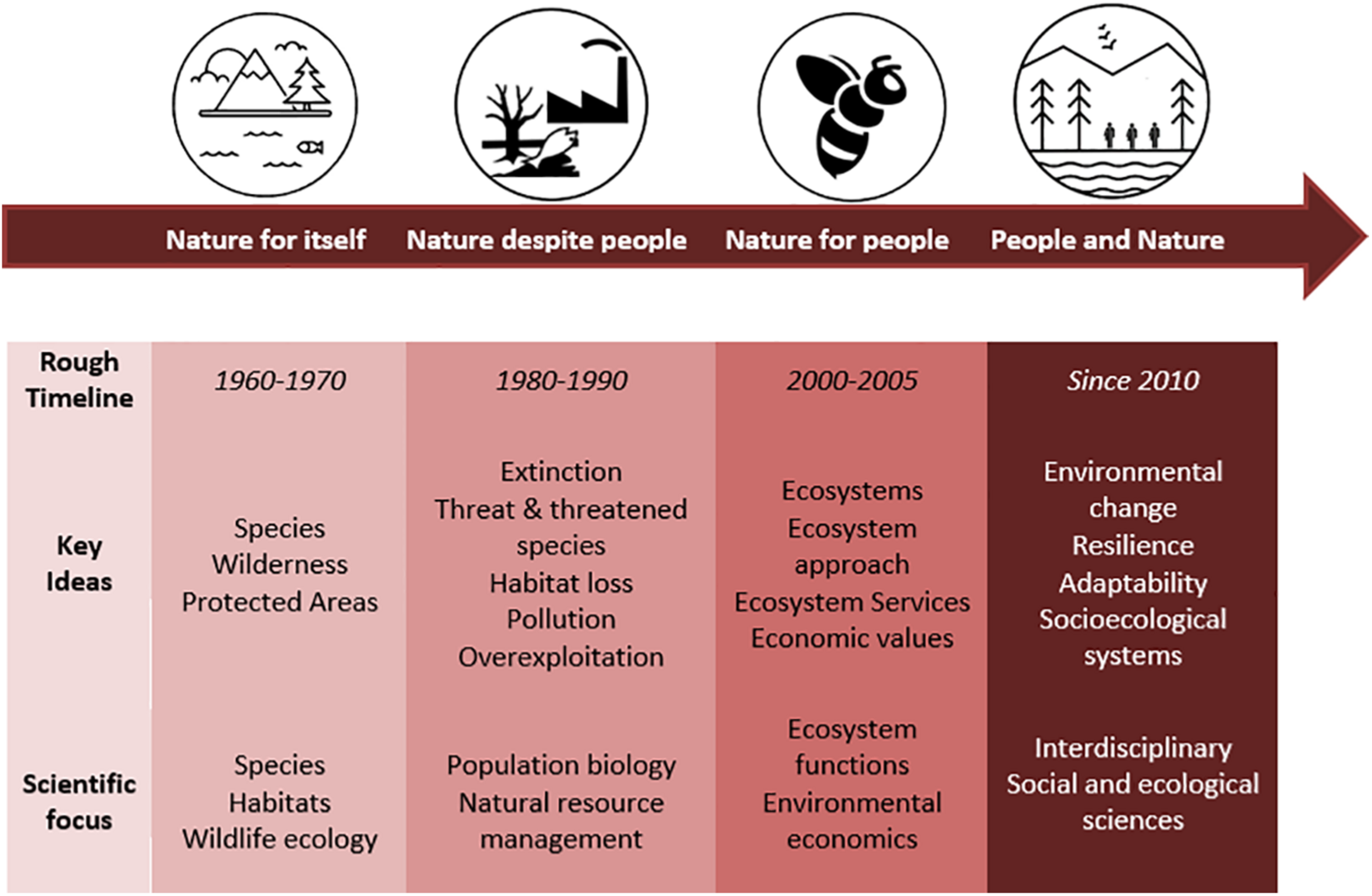
Changes in the philosophical framing of conservation over 50 years and the resulting shifts in practical focuses (adopted from Mace, 2014).
Conservation ideologies developed in the 1960’s with a strong concept of nature being an independent entity, with actions prioritizing the preservation of wild and intact natural habitats. This framing was characterized by a strong ethos of ‘nature for itself’ with a focus on species and area protection that can still be seen in the biocentric attitudes of today (Mace, 2014). However, in the 1970’s and 1980’s, as anthropogenic activities increased, and scientists became more cognizant of the environmental consequences of changes in human land and sea use, the framing of conservation shifted as well. Conservation biology emerged and was immediately deemed a ‘crisis discipline’ born in response to anthropogenic environmental threats (Soule, 1985; Godet and Devictor, 2018). In the seminal 1985 paper, “What Is Conservation Biology?”, Soule underscored its urgency by drawing a relational parallel of conservation and ecology to war and political science, as well as laying out a set of postulates meant to underpin the discipline. These were divided into four functional postulates designed to guide biologists ecologically and four normative postulates designed to act as the core values of the fledgling field (Table 1).
TABLE 1
| Functional postulates | Normative postulates |
|
|
Summary of Soule’s (1985) functional and normative postulates for the field of conservation biology.
The normative postulates Soule proposed carried much of the biocentric attitude of the conservation ideals of the 1960’s, stating that biodiversity, ecological complexity, and evolution are “good,” and that biotic diversity has intrinsic value. He even cites human nature and ethical imperatives in his reasonings for these values (Soule, 1985). However, what differs is in how these attitudes were applied to conservation measures. The approach can be described as “nature despite people,” which recognized anthropogenic threats to species and habitats and sought to mitigate or reverse the impacts. In practice, this resulted in measures to manage exploited populations, as well as some of the first conversations about sustainable use and community-based management (Mace, 2014).
Framing philosophies for conservation shifted again in the 1990s, along with a realization that human pressures on natural environments were ubiquitous and that many of the previous measures to halt their degradation were failing (Mace, 2014). Yet, this period also mainstreamed the idea of ecosystem services, a realization that ecosystems provide irreplaceable goods and services that directly impact human well-being. The relevance of ecosystem services to humans had until then been consistently ignored and the systems mismanaged (Braat and de Groot, 2012; Mace, 2014). This led to the third phase of conservation thinking, characterized as “nature for people” and with a focus shifted from protecting species to protecting ecosystems and their functions, thereby preserving their benefits for humans (Mace, 2014; Pearson, 2016). Major drivers such as the Millennium Ecosystem Assessment, as well as monetary valuation of ecosystem services, provided opportunities for easier inclusion of conservation measures in concrete policies. These also helped drive this ideology to become the dominant force in conservation biology until the last decade (Braat and de Groot, 2012; Mace, 2014; Pearson, 2016).
However, the dialog is once again shifting, this time away from either intrinsic or instrumental values, and more toward a synthesis of the two. As biodiversity and ecosystem integrity have continued to decline, the conversation has turned to why embracing either side of this dichotomy of value systems has failed to produce meaningful results. This gave rise to the idea of ‘relational’ values. Relational values are dependent upon the realization that people rarely make choices solely on the inherent worth of an object or on how it satisfies their needs (which is the intrinsic versus instrumental dichotomy), but upon how they relate with the object and others around them, and on how that choice itself can be conducive to a meaningful and happy life (Chan et al., 2016). The differences between these framings are shown in Figure 2. In a wider context, this philosophy can be viewed as “people and nature” and uses a broader axis of values when framing conservation measures, which are often more dependent on a range of societal norms and value systems (Mace, 2014; Chan et al., 2016; Piccolo, 2017). Those value systems include, for example, concepts of stewardship and kinship with nature. These concepts stem from the idea that caring for nature can contribute to the collective vision for a sustainable and self-determined community, thereby contributing to human well-being (Chan et al., 2016).
FIGURE 2
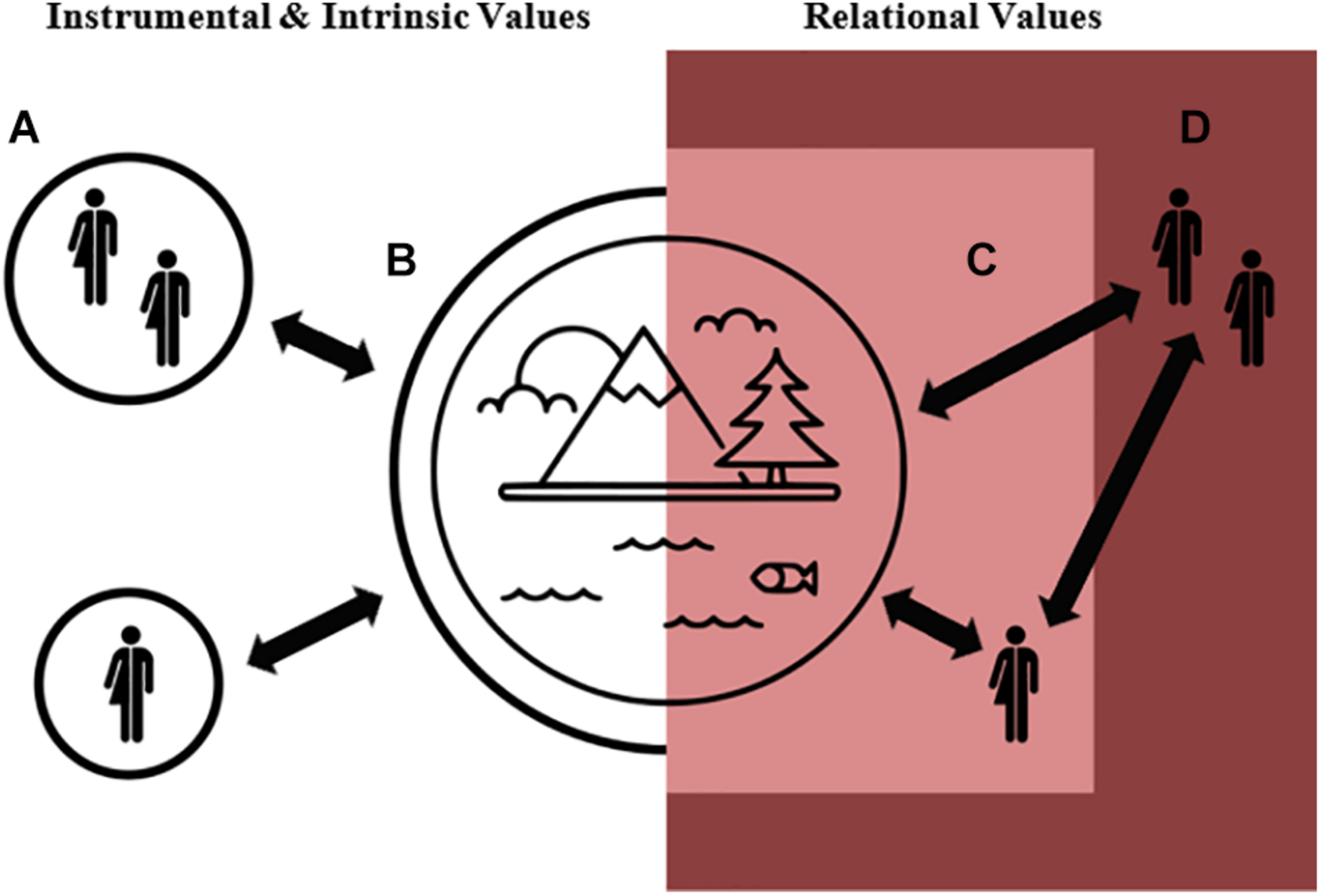
The differences in framing between intrinsic, instrumental, and relational values. (A)Intrinsic values - nature has value, independent of people, (B)instrumental values - being in/seeing nature brings people pleasure or satisfaction, (C)relational values (individual) – nature can contribute to an individual’s identity, may create feelings of eudemonia through the virtue of stewardship or caring for the land may be seen as a moral duty, (D)relational values (human collective). Relationships between groups of people and nature can help define cultural identities, provide social cohesion, and create social or moral bonds of stewardship (adopted from Chan et al., 2016).
In practice, proponents of the most recent framing of “people and nature” suggest that there is a need to move toward a broader framework of conservation science rather than conservation biology. This entails a more interdisciplinary approach that integrates improving human well-being with preserving nature and using both to inform and support the other (Kareiva and Marvier, 2012; Doak et al., 2015; Godet and Devictor, 2018; Washington et al., 2018). While disagreement exists on how to utilize the various tools of intrinsic and instrumental approaches, the framing of new conservation measures often tries to synthesize the old ideologies by recognizing that while their focuses may be functionally disparate, their goals are not. Some new philosophies even seek to subset old anthropogenic ideals within biocentric goals by changing the focus from a single species to multi-species, since achieving conservation goals on the broader scale should necessarily preserve the services humans value as well (Mace, 2014; Morelli et al., 2016).
This results in changes to the scales of practical conservation targets. Where early intrinsic value methods often approached conservation on a species level and where instrumental value approaches often attempted conservation on a broad ecosystem basis, relational approaches attempt conservation at a greater number of levels, as well as varying spatial and temporal contexts (Mace, 2014; Pearson, 2016). Factoring in relational values provides a greater toolset for evaluating and prioritizing threats. For instance, a threatened species may have intrinsic aesthetic local value, yet the existence of non-threatened global populations may reduce the perceived threat and devalue intrinsic arguments as a stimulus for action on local levels. Yet, relational values can evaluate the threat on a local scale, where the species plays a role in biodiversity and ecosystem functioning, and where monetary valuations may be more appropriate and effective (Pearson, 2016). On temporal scales, relational values consider not only the utilitarian values of an environment’s ability to sustain human well-being, but also the cultural and personal values gleaned from the relationship. Thus, the goal is not only to preserve nature so it can provide instrumental goods for future generations, but also to preserve it in such a condition that future generations can continue to garner the same relational benefits (Chan et al., 2016).
The spirit of relational valuation is an inclusionary one. It seeks to buoy previous value systems by providing alternative approaches in situations where adhering to strict dichotomies have failed (Pearson, 2016). This inclusive spirit not only addresses value methodologies, but also to who we value as actors and stakeholders in conservation. Relational value thinking provides a pathway for incorporating local narratives and struggles for good, meaningful lives into the context of conservation, especially as social equity becomes a more prominent feature in the discussion as a way to combat exclusionary practices (Kareiva and Marvier, 2012; Chan et al., 2016; Friedman et al., 2018). These inclusionary approaches can also serve to strengthen global conservation efforts by encouraging local-level stewardship and reinforcing the values of human-nature kinship commonly shared by both traditional and Western cultures, all through leveraging the connections people already share with nature (Chan et al., 2016; Friedman et al., 2018). While incorporation of these concepts by name is still relatively new, there have been a range of initiatives in the developing tropics that show successful examples of interdisciplinary and participatory management following the spirit of relational values (Cinner et al., 2012; Cinner and Huchery, 2014; Campos-Silva and Peres, 2016; Charnley et al., 2017; Ives et al., 2017; Campos-Silva et al., 2018).
Integrating Social Sciences Into Conservation
New relational value approaches to conservation advocate for more integration with other disciplines, and the social sciences are being advocated as a key component in forging more effective and sustainable efforts (Kareiva and Marvier, 2012). However, this still leaves the question of why the sudden resurgence? Arguably, the social sciences have always been a part of conservation. Soule (1985), in his original description of the discipline, included social sciences as one of the key interdisciplinary components, citing the interaction of conservation measures with indigenous populations as an example of its necessity. Reviewing the shifts in value systems over the brief history of conservation ideology highlights the invisible, yet ubiquitous, influence of social, cultural norm, and value-systems on the discipline. These social shifts resulted in very real environmental impacts because of the methods and priorities valued by conservationists of the time (Mace, 2014). The current state of the environment can be seen as a complex interplay of how people, both as exploiters and conservationists, have valued and interacted with nature. Yet, these are not mutually exclusive sides. Measures performed in the name of conservation can be disproportionately harmful to local communities or used to support exploitative narratives, highlighting a fundamental reason social consideration are vital to conservation (Chan et al., 2016; Bennett, 2018). Saunders (2003) puts it succinctly, “[since] humans are the source of the problems as well as the hope for solutions, the role of the social sciences has grown in importance.”
The philosophies shaping conservation practices have been well documented as demonstrated above (Mace, 2014; Chan et al., 2016; Morelli et al., 2016; Pearson, 2016; Piccolo, 2017). However, understanding general human-nature relationships is just as critical for understanding people’s motivations, or lack thereof, to protect these relationships (Saunders, 2003). This is a growing field of research due to the recent increase in calls for reconnection with nature and evidence of its benefits for sustainability goals (Ives et al., 2017).
In the broadest sense, human and wildlife interactions can be divided into two categories: social and ecological. While these divisions overlap and feedback into each other, ecological drivers of nature’s interactions can generally be broken down into internal biological components such as ecosystem, community, population, and individual behaviors. The social drivers of human interactions are shaped by societies, institutions, groups, and individual behaviors (Lischka et al., 2018). Models such as the socio-ecological systems (SES) approach attempt to better understand the outcome of these interactions by acknowledging the role of these internal and external factors. However, there exists a knowledge gap in determining why interactions are judged as negative or positive experiences, which is important as those judgments heavily influence the outcome of future interactions (Jochum et al., 2014; Lischka et al., 2018). This uncertainty is distilled into the psychological concept of attitude constructs, the collection of dispositions and tendencies people hold to respond to psychological objects, and which attempt to predict and explain human behavior. In practice, this means intangible and difficult to quantify factors like human emotions can have critical impacts on conservation measures, such as stakeholder support for protecting a species, and need to be considered in designing effective management strategies (Kansky and Knight, 2014).
Early explorations of these attitude constructs received much attention, and one of the most famous typologies divided these attitudes along ten primary axes, based upon what primary concern or relation characterized them, such as utilitarian, symbolic, or ethical interests, as well as identifying fearful or passive tendencies (Table 2; Kellert, 1984).
TABLE 2
| Typology | Orientation toward animals |
| Naturalistic | Has a primary interest in and affection for wildlife and the outdoors. |
| Ecologistic | Has a primary concern for the environment as a system and for interrelationships between wildlife species and natural habitats. |
| Humanistic | Has a primary interest in and a strong affection for individual animals, principally pets. |
| Moralistic | Has a primary concern for the right and wrong treatment of animals, with a strong opposition to exploitation of and cruelty toward animals. |
| Scientistic | Has a primary interest in the physical attributes and biological functioning of animals. |
| Aesthetic | Has a primary interest in the artistic and symbolic characteristics of animals. |
| Utilitarian | Has a primary concern for the practical and material value of animals. |
| Dominionistic | Derives satisfaction primarily from the mastery and control over animals, typified by sporting situations. |
| Negativistic | Has a primary orientation of active avoidance toward animals due to dislike or fear. |
| Neutralistic | Has a primary orientation of passive avoidance toward animals due to indifference and lack of interest. |
Summary of the basic attitude typologies toward animals as defined by Kellert (1984).
These constructs were then identified among groups of people, such as educational level, regional populations, and occupations, with the hope of predicting how such groups would interact with nature (Kellert, 1984). While these typologies were developed based upon internal attitudes in the United States, they can be further distilled into two prevailing attitudes with more cross-cultural evidence: mutualism and domination. Mutualistic beliefs are characterized by the egalitarian desire to extend similar care and rights of humans toward nature while domination beliefs prioritize human well-being and call for the use and management of wildlife for human benefit (Jacobs et al., 2018). These beliefs draw strong parallels to the instrumental and intrinsic value dichotomy which still divides many conservationists, and similarly can be the source of conflict, both amongst people and between humans and nature (Young et al., 2010).
Compliance and Effectiveness of Management Schemes
Lessons learned from conflicts between humans and wildlife have reinforced the idea that relational values play a large role in predicting how people will react both to wildlife and wildlife management schemes. This correlates with the rise of the “people and nature” theme in conservation literature, where people are viewed as part, not apart, from the environment’s successes and failures (Chan et al., 2016; Morelli et al., 2016; Piccolo, 2017). This has also given new life to the old concept of “stewardship,” a term which originally arose as a description of land ethic approaches designed to reinforce healthy agro-environmental relationships, particularly between farmers and impacted ecologies. These approaches typically relied heavily on ethical and intrinsic value arguments (Piccolo, 2017; Mathevet et al., 2018). Recently, stewardship has been advocated as “the responsible use (including conservation) of natural resources in a way that takes full and balanced account of the interests of society, future generations, and other species” (Worrell and Appleby, 2000). In this way, it combines both intrinsic and instrumental values as a method to promote both ecological resilience and human well-being. Specific stewardship methods can be broken down by how radical or prosaic their approaches are in dealing with political and societal structures to reach their objectives. Adaptive stewardship for example recognizes both economic and natural limits to human development and advocates working within those restraints. Transformative stewardship in contrast rejects the industrial framework entirely in favor of a fundamental societal change that eliminate practices detrimental to future generations. However, one thing usually in common between the various perspectives of stewardship is recognition of the influence of societal systems and the need to incorporate people (the “stewards”) into effective, bottom-up approaches (Mathevet et al., 2018).
The role of people in conservation, and specifically stakeholders, is an evolving conversation. The “traditional” method of conservation involves the establishment of a protected area to protect biodiversity and associated processes within the area. This is usually an exclusionary top-down approach, meaning aside from the managers themselves, people are prohibited from interacting with nature in the protected area, and sometimes referred to as “fortress conservation” (Brown, 2002; Berkes, 2004). Yet, these methods are frequently found ineffective at achieving their conservation goals. Additionally, they often bar local communities from utilizing the resources important for their livelihoods and sometimes even displace them from their traditional lands completely, which gives rise to hostile attitudes toward managers and conservation measures (Brown, 2002; Andrade and Rhodes, 2012). These approaches carry “people and nature” attitudes that conceptualize humans as the environment’s antagonists, and ironically these methods created situations where alienated communities fulfilled that role. Following the gazetting of the Bwindi Impenetrable Forest in Uganda, local communities deliberately set fires that burned 5% of the forest while in Tsitsikamma National Park in South Africa, local communities retributively performed illegal extractive activities (Andrade and Rhodes, 2012).
Community-based management (CBM) and co-management approaches were developed in part as a response to such failures (Berkes, 2004). There are several hallmarks that are commonly found in the implementation of those management schemes (Figure 3).
FIGURE 3
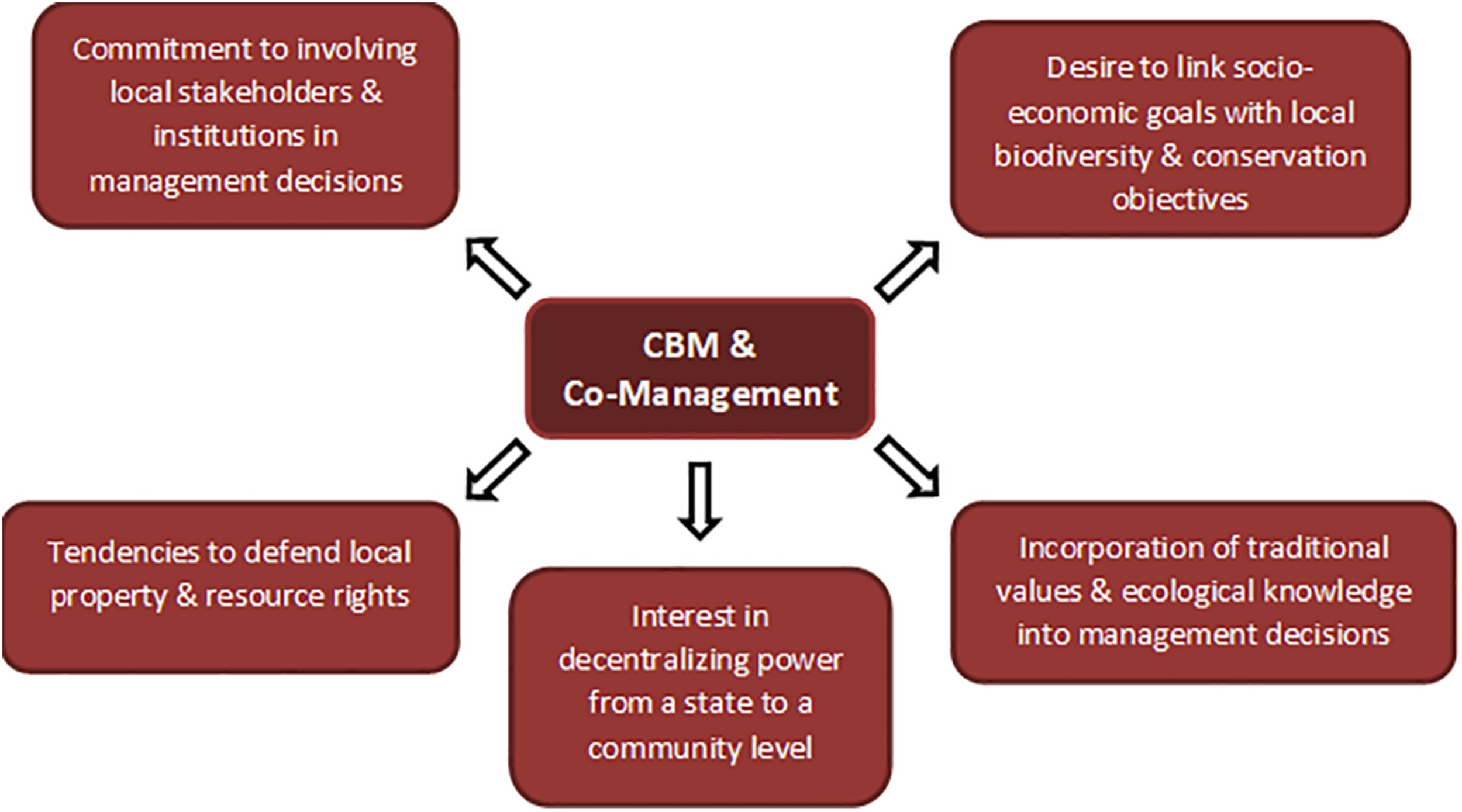
Common hallmarks of CBM and co-management approaches (based on Fernandes, 2006).
However, CBM is usually characterized by a stronger reliance on the community with external support from universities or NGOs, whereas co-management tends to feature a more formal involvement of other institutions (Brown, 2002; Campbell and Vainio-Mattila, 2003; Fernandes, 2006). These approaches recognize that social and ecological processes are interconnected and that ignoring or failing to adapt to local cultural contexts can have critical impacts on the outcome of conservation measures (Fernandes, 2006; Waylen et al., 2010).
The central theory behind the push for CBM is that involving local communities in the process of natural resource decision making and management will foster a greater sense of ownership, compliance, and commitment to long-term protection strategies (Fernandes, 2006; Andrade and Rhodes, 2012). Additionally, they can significantly contribute to local livelihoods. Community-based mangrove restoration in Ghana, for example, has been shown to yield high economic returns for the community. As Aheto et al. (2016) demonstrated, mangroves can be sustainably exploited and restored given the necessary institutional arrangements to regulate their use and with the enforcement of local customary rules. A participatory and community-based restoration of freshwater small-scale pirarucu (Arapaima spp.) fishery in the Amazon also, for example, led to significant increases in harvest and population growth rates as well as high monetary returns (Castello et al., 2009). Apart from these social benefits, CBM programs can also result in additional multi-species co-benefits as exemplified by a CBM program targeting the giant South American turtle (Podocnemis expansa) which also benefited a wide range of vertebrae and non-vertebrae taxa (Campos-Silva et al., 2018).
Therefore, CBM concepts have received a wide amount of attention from literature and have become extremely popular globally, with many governments seeking to decentralize resource management to local groups (Berkes, 2004; Fernandes, 2006; Klain et al., 2014). However, despite this popularity, evaluations of CBM projects have yielded mixed results (Kellert et al., 2000).
While some hold that these failures point to inherent flaws in the ability of CBM to manage both conservation and socio-economic development, many others view the field as highly situational with complex case-specific success rates (Campbell and Vainio-Mattila, 2003; Fernandes, 2006). This has also been stressed in the evaluation of successful CBM initiatives, such as the community-based mangrove management in Thailand, which highlights the importance of multiple changing factors that have facilitated successful CBM establishment. Those include factors internal to the community like leadership and the capacity to organize into groups, as well as external factors such as NGO and government support (Kongkeaw et al., 2019).
Simply put and as noted by Berkes (2004) in their evaluation of CBM, the important thing is not so much counting the failures but examining why methods have failed. There are certainly many cases of poor implementation to be found within the discipline. Klein et al. (2007) outlined the establishment of several CBM initiatives in the Ambohitantley Special Reserve in Madagascar, all of which failed to fulfill their conservation and development goals. Reasons cited for these failures included oversimplified analyses of the community that failed to account for its heterogenous social structures and the development of projects which consequently did not fit the community’s needs. This fits with a common critique of CBM methods, which is that they are approached with pre-conceived notions of what “appropriate” conservation actions are, most often favoring the implementation of protected areas. Actual participation by the community in the decision-making process can be minimal, often consisting of little more than consultation and education with the goal of getting the community “on the side” of the predetermined conservation action (Campbell and Vainio-Mattila, 2003; Berkes, 2004; Waylen et al., 2010). Without proper needs analysis, the result is that the prescribed conservation solutions can clash with local cultural norms or conceptions of human-wildlife relationships (Campbell and Vainio-Mattila, 2003).
This should be compared with another popular, if controversial, method of socio-economic-based conservation: payments for ecosystem services (PES). PES was designed as an ecosystem conservation method aimed to preserve key ecosystem processes valued by humans, for example, for climate change mitigation. PES are defined as “voluntary transactions between service users and service providers that are conditional on agreed rules of natural resource management for generating offsite services” (Tran et al., 2016). Most PES schemes have been implemented around forest conservation and aim to address the underlying economic reasons for forest loss and degradation by offering direct economic incentives to promote environmental behavior and in situ biodiversity conservation (Grillos, 2017). Rudimentary forms of PES have existed for decades, but there has been criticism on the technical implementation of PES schemes, as well as on the fundamental question if economic pricing of nature is ethical.
Currently, most PES schemes exist only through local level arrangements (Grima et al., 2016). The scheme for Reducing Emissions from Deforestation and forest Degradation (REDD) is a set of international policies designed by the United Nations that aim to reduce emissions by compensating land owners for demonstrable reduction in forest-based carbon emissions in an attempt to standardize and encourage PES schemes (Pasgaard et al., 2016). So far, the United Nations REDD Program has invested $258 million in funding more than 300 projects in 64 countries (Rakatama et al., 2016). REDD+ is an extended version of REDD designed at the United Nations Framework Convention on Climate Change (UNFCCC) in 2015. REDD+ focuses on conservation and enhancement of forest carbon stocks and sustainable forest management. Most countries haven’t started implementing REDD+ yet since this requires collaboration of UN bodies, governments, multilateral organizations and local communities. Avoiding influences of corruption, perverse economic interests and contradictory policy objectives is crucial for successful implementation (Dunlop and Corbera, 2016).
Implementation of PES systems have been met with international successes, though these successes should be examined in their specific cultural and political contexts, as should the failures (Sierra and Russman, 2006; Turpie et al., 2008). However, doubts still remain about the efficacy of these strategies, and there is a range of examples of poorly implemented projects (Reutemann et al., 2016). PES schemes necessarily rely upon the instrumental valuation of nature, and critics often cite this as ethical and philosophical issue, fearing that monetization of natural series may erode intrinsic valuations of nature by local communities (Muradian et al., 2013; Silvertown, 2015). Aside from ethical considerations, PES systems have also faced more foundational challenges. PES systems may lack long-term sustainability due to the temporal limitations of schemes, and reversions to environmentally destructive behaviors have been observed after incentives have ended (Reutemann et al., 2016). The REDD+ program specifically has faced several challenges, such as inequity in benefit sharing and variable willingness among stakeholders to participate (Pasgaard et al., 2016). In extreme scenarios, REDD+ systems can threaten to remove the agency of communities over their resources, shifting control from local hands to global actors while compromising food and livelihood security (Beymer-Farris and Bassett, 2012).
In contrast, if implemented responsibly, CBM approaches can be characterized by higher levels of compliance, commitment to long-term strategies, sensitivity and adaptability to local political and cultural situations, and are founded upon the concept of local ownership and management of resources (Berkes, 2004; Fernandes, 2006; Waylen et al., 2010; Andrade and Rhodes, 2012). Effective CBM is founded upon relational values, is inherently inclusive, and designed as a bottom-up approach.
Yet, as described above - CBM approaches are not immune to the pitfalls of poor implementation. Meaningful discussion between outside agents and actors within the community should be a priority, with an aim of identifying local and regional needs within local political and cultural contexts (Campbell and Vainio-Mattila, 2003; Berkes, 2004; Klein et al., 2007). Participatory activities should seek to share both the power and responsibility of management equitably, while working to create a context stimulating stewardship and mutual trust. Finally, incentives should be multi-dimensional. Monetary incentives rarely fulfill all of the requirements of rural communities, and equity in political and social benefits, access to resources, or processes of empowerment that help people become “enabled to take more control of their own lives, and secure a better livelihood” are valuable incentives that can drive conservation (Berkes, 2004).
Equity and Social Justice
Community-based and participatory methods have emerged as part of a cultural shift in conservation, one which has seen reversals in how humans are conceptualized in their relation to nature. This reframing of values also altered methodologies, recasting people actors and beneficiaries rather than as purely threats (Mace, 2014). This ‘people-centric’ approach foregrounded the importance of contextualizing efforts within cultural and political frameworks, with the objective of both preserving biodiversity and improving socio-economic situations (Campbell and Vainio-Mattila, 2003; Berkes, 2004; Klein et al., 2007). One of the primary theories behind this approach is that poverty and biodiversity loss are interlinked, often occur in the same places, and leave local populations with few means to manage resources sustainably (Barrett et al., 2011). Thus, targeting this as an underlying cause of biodiversity is expected to increase the likelihood of achieving conservation goals by giving local resource users more control over their livelihoods and increasing commitment to participatory measures (Berkes, 2004; Waylen et al., 2010; Andrade and Rhodes, 2012).
However, this shift toward people-centered philosophies has also brought a greater awareness of the ethical implications of conservation. It might seem as a paradox that some of the greatest costs of conservation are often borne by the poorest people. While the benefits of preserving biodiversity can be felt globally, local communities frequently face the greatest opportunity costs through loss of access to resources upon which their livelihoods may depend (Green et al., 2018). This imbalance is another point of increasing criticism of current conservation efforts often brought up by social scientists. The clash between social scientists and conservationists stems from well-documented cases of unjust interventionalist conservation measures, such as displacement of communities from traditional lands or saddling underprivileged communities with unfair amounts of the costs for environmental repair (Brockington and Igoe, 2006; Shoreman-Ouimet and Kopnina, 2015). In some of the most extreme cases, conservationists are accused of siding with political interests that use conservation as an excuse for expanding state sovereignty, supporting neo-imperialist and oppressive power structures, and using environmentalism as a guise in for-profit conservation schemes (Muradian et al., 2010; Shoreman-Ouimet and Kopnina, 2015). Though such criticisms are scathing, having such injustices called out is one of the arguments for including social sciences in conservation processes if the field hopes to progress.
Participatory measures are advocated in part to preclude such injustices since proper implementation should also be framed around concepts of equity (Camill et al., 2013). In its simplest terms, equity can be distilled into how fairly individuals or groups are treated. However, its application can be more complex. In conservation, equity can be considered along four dimensions (Figure 4).
FIGURE 4
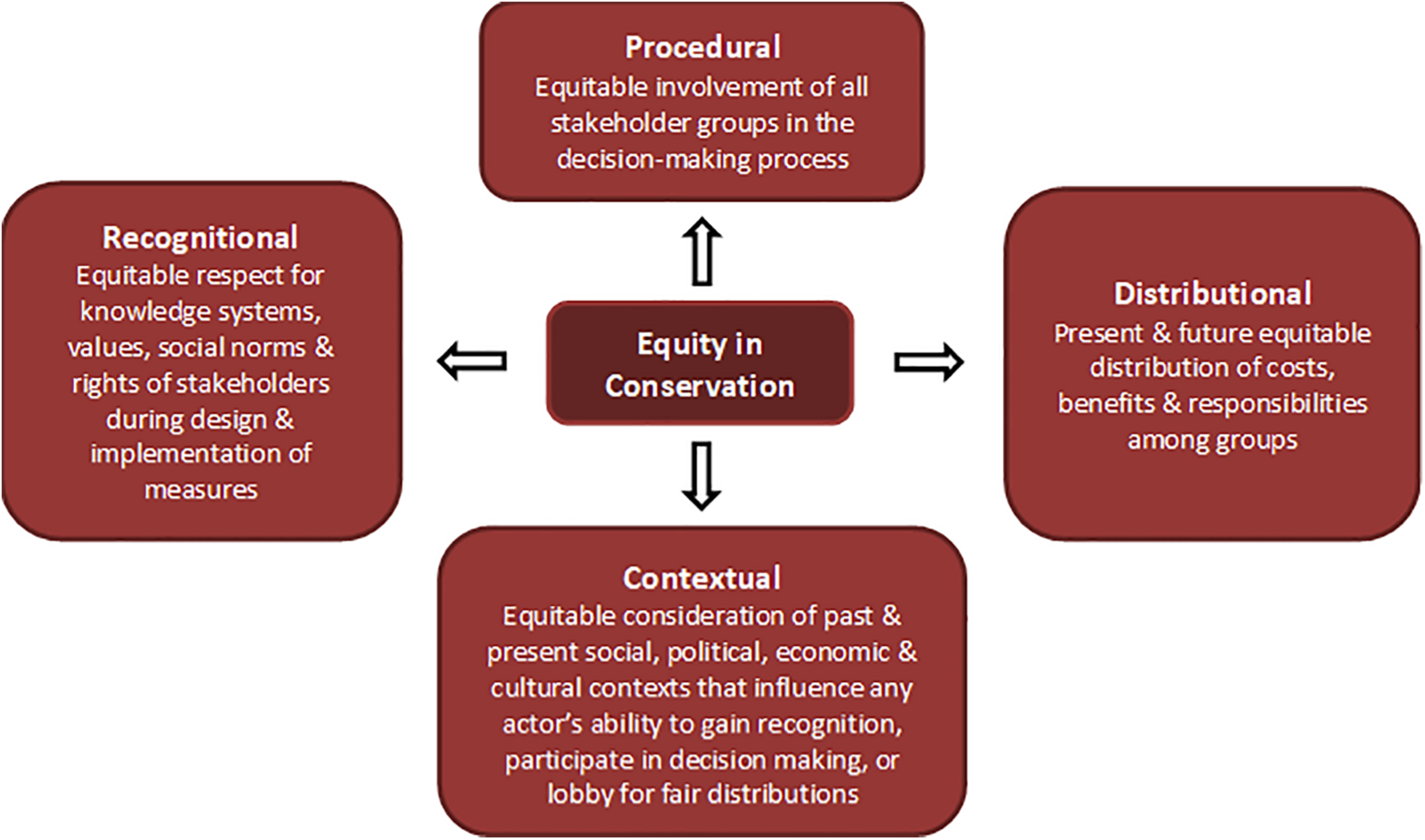
The four dimensions of equity in conservation (based on McDermott et al., 2013; Law et al., 2018).
Understanding how these different aspects of equity apply to and influence specific projects can help identify potential conflicts as well as underlying biases. Analysis of how these dimensions interact may also help to contextualize trade-offs in equity, such as where traditional rights might be valued more than monetary compensation, and explain the failures where projects overlooked them (Friedman et al., 2018).
However, participatory methods are not a panacea for conservation injustices or inequities. They are still susceptible to abuses if not practiced with good faith and poor implementation or planning can still breed oversights. For instance, while participation may be the greatest strength of CBM endeavors, it is also the most crucial step, and failures at this level are often detrimental to proper equity distributions (Brown, 2002; Campbell and Vainio-Mattila, 2003; Berkes, 2004). If participation is employed in a top-down manner or passive manner, it can exacerbate already existing power imbalances or even be employed as ‘containment’, where local involvement is carefully managed to exert control over the process and avoid dissent (Brown, 2002). While this is a clear injustice and abuse of the system, similar inequities in power can be perpetuated if conservationists simply fail to put in the due to diligence to understand the social systems they are working in. There is an idealization of the term ‘community’ in conservation which often undermines the effectiveness and equity of CBM measures. Communities are often conceptualized as homogenous organizations rather than mixes of ethnicities, religions, and languages with different, often conflicting, needs (Klein et al., 2007). Failing to account for these social and political power dynamics can leave disadvantaged actors in the community voiceless in decision-making processes or exacerbate imbalances by introducing additional benefits into systems already dominated by local elites (Berkes, 2004; Barnaud and van Paassen, 2013).
Many of these issues can be seen in the rapidly expanding field of marine conservation. In response to mounting anthropogenic threats, the international community has made a strong push for marine conservation efforts, yet in that rush, there is a concern that many of the same injustices and equity oversights recorded in terrestrial conservation are occurring (Bennett, 2018). The use of marine protected areas (MPAs) in particular has expanded as a popular management tool (Mascia, 2003; Bennett et al., 2017; Bennett, 2018). However, many of these strategies bear the same hallmarks of terrestrial ‘fortress conservation’, as some implementations have been marred by exclusions of local communities from decision processes, failure to consider local needs and livelihoods, dispossession from areas and resources, and even infringements of human rights (Bennett, 2018; Kamat, 2018). Some of these practices have even been characterized as “ocean grabbing,” where inappropriate governance is used to gain control over areas or resources from prior users, usually at the cost of their security, livelihoods, or socio-ecological well-being (Bennett et al., 2015; Bennett, 2018). Ocean grabbing can take a different form than land grabbing as the areas involved are often still state-owned. Instead, it occurs as a form of accumulation, where the benefits from the natural resources for example contribute to the capital of tourist operators and indirectly the state instead of local communities. This often happens when governance systems lack transparency and local communities are excluded from benefitting from the resources as areas in Malaysia for example, are permanently closed to fishing following a narrative of “overfishing by the local community” (Hill, 2017). However, ocean or seabed grabbing can also occur at national levels as for example in Kiribati, where powerful actors aim to influence decision-making regarding mineral resource extractions (Mallin, 2018). Additionally, sea tenure is inherently more difficult to delineate and enforce than terrestrial tenure. Therefore, working closely together with indigenous or aboriginal communities and creating marine spatial plans based on customary marine areas and traditional ecological knowledge is imperative to creating socially fair marine spatial plans with high compliance (Outeiro et al., 2015).
Even large marine protected areas (LMPAs), which are frequently located in open-water areas and away from vulnerable or dependent coastal resources, still need careful equity considerations. This is because some LMPAs that have been praised for their ecological effectiveness to conserve nearly pristine areas are already being questioned for exclusion and infringement of human rights. In the case of the like the Chagos Archipelago for example, the right of the native Chagossians to return to the island was still examined by the European Court of Human Rights when the LMPA was designated by the United Kingdom (de Santo et al., 2011; Sand, 2012). As there are often still ambiguities around boundary delineations at sea and a lack of detailed marine spatial plans for many countries, this legislative aspect also contributes to the likelihood of “ocean grabbing” (Bennett, 2018).
While there are numerous arguments for including considerations of equity from a perspective of efficacy, the ethical arguments deserve equal attention. Put more simply, including stakeholders, local communities, and traditional resource users in decisions about their shared resources can be strongly argued as the right thing to do (Kareiva and Marvier, 2012; Bennett, 2018). Dialogs about the role of social justice and equity in conservation have been increasing in frequency, and as with CBM and participatory approaches, have become more foundational in conservation methodologies. Kareiva and Marvier (2012) have even gone so far as to reframe Soule’s iconic 1985 paper “What is conservation biology?” from the new lens of social consideration, reframing his normative postulates to include, “conservation will be a durable success only if people support conservation goals” and “conservation must not infringe on human rights and must embrace principles of fairness and gender equity.” Just as importantly, these ethical focuses have begun to be codified in policies as well. Both the Aichi Target 11 of the Convention on Biological Diversity and the United Nations Sustainable Development Goals (Goal 14) foreground social inclusion and equity in their objectives (Woodley et al., 2012; Gupta and Vegelin, 2016). Applying this ethic to conservation methodologies can be complex, as social and ecological contexts vary, making even the application of equity a fluid process as it changes from situation to situation. However, embracing this complexity for long-term ethical and sustainable outcomes may be a key to making better conservation decisions (Law et al., 2018).
Incorporating Social Science in Conservation Methodologies
Recognition of the fact that conservation has transitioned into a space where ecological and sociological systems are not viewed as separate entities, but as intertwined aspects that mutually inform the problem has changed how we look for solutions. It has also demanded a certain accountability, altering what a ‘successful’ conservation looks like to include equity and social justice into the equation, along with traditional notions of biodiversity and environmental preservation and rehabilitation (Berkes, 2004; Kareiva and Marvier, 2012; Chan et al., 2016; Bennett, 2018). Making conservation a more interdisciplinary science, with social science playing a key role, is one way to help achieve this. However, the level of contribution depends a great deal on how accepting conservationists are of the lessons of social science. Despite apparent philosophical shifts, much of the ‘old school’ focus on instrumental research still remain, and there is a danger that social science may be used superficially to support status quo conservation practices (Bennett and Roth, 2019). ‘Mainstreaming’ of the social sciences within conservation may be necessary to overcome barriers to its full acceptance. This means recognition of institutional cultural biases, lack of institutional capacity for social sciences, and biases in funding prioritization; problems which may require fundamental restructuring of educational and research institutions to overcome (Bennett, 2018). However, embracing such an integration could yield vast benefits for conservation projects (Bennett and Roth, 2019). Below, we engage in detail with a few examples of how social science methods like social network analysis, soft system methodologies and conservation marketing can inform conservation methodologies. Table 3 provides a broad overview of additional complimentary and participatory-focused social techniques. These techniques be used independently or in conjunction with other methods to gain a better understanding of the relevant social dimensions. However, we want to stress that all these methods are best used as part of a broader social science methodology and with an understanding and appreciation of their underlying research philosophy (Moon and Blackman, 2014; Moon et al., 2019).
TABLE 3
| Participatory technique | Description and characteristics | Examples |
| Nominal group technique | Structured group-based technique to build consensus for situations with low conflict to clarify and identify problems or to develop clear solutions.
|
Hugé and Mukherjee, 2018; Sánchez, 2018 |
| Scenario planning | Workshops to explore different internally coherent and plausible short and long-term future narratives shot and long-term visions to allow decision making between diverse stakeholder groups with differing aims and perspectives.
|
Oteros-Rozas et al., 2015; Flynn et al., 2018; Gissi et al., 2019 |
| Photo-elicitation and photovoice | Visual evocative methods to capture and examine people’s values, perceptions, emotions, and social relations in a non-textual way.
|
Bignante, 2010; Bennett and Dearden, 2013 |
| Rich pictures | Drawings and diagrams that are created collectively by participants as a way of expressing their preliminary vision regarding a shared specific issue among group members.
|
Bell and Morse, 2013; Berardi et al., 2018; Bell et al., 2019 |
Methods traditionally associated with social science are increasingly being used in conservation.
Listed here are some of the participatory social techniques being used including their key points and some example studies. These techniques can be used in compliment with methodologies like SSM or independently to gain a better understanding of the social dimensions involved in conservation issues, though this is by no means a comprehensive list.
Social Network Analysis
As shown, participatory conservation efforts need to be rooted within social, political, and cultural contexts that recognize the inherent heterogeneity of the communities they work with (Berkes, 2004; Klein et al., 2007). Thus, effectively implementing a community-based action requires first identifying stakeholders: those people in the community affected by decisions and who can influence their outcomes (Reed et al., 2009). However, this can be a deceptively difficult process, as conservation objectives can be incredibly variable and even determining what qualifies as a ‘stake’ is not a clear-cut issue (Reed et al., 2009; Mbaru and Barnes, 2017). Classical stakeholder analysis normally attempts to classify these community members by their interests and characteristics, frequently identifying and targeting formal ‘leaders’ as the key components in these social systems (Prell et al., 2009; Mbaru and Barnes, 2017). However, these top-down approaches run the risk that relevant stakeholders located more along the social fringe may be excluded, missing opportunities for expanding or enhancing efforts, or relying too heavily on figures that may not be positioned to spearhead measures within the context of heterogenous and partitioned communities (Reed et al., 2009; Mbaru and Barnes, 2017).
An alternative approach is to use social network analysis (SNA). SNA is a relatively new practice in the field of conservation, though it has seen extensive use in such fields as public health, counterterrorism, and business (Vance-Borland and Holley, 2011). Where SNA differs from other stakeholder analysis approaches is that rather than attempting to characterize or categorize individual stakeholders, SNA examines communities through the lens of socially meaningful relations. This creates a dynamic overview that values how actors are positioned within networks and helps characterize their social influence (Prell et al., 2009). In practice, this means attempting to quantify the strength of these ties which are formed on the basis of several attributes such as emotional intensity, time, intimacy, and reciprocation of services. Data can be gathered through structured interviews, questionnaires, or observation and these values are then be quantified into either “strong” or “weak” relationships based on how highly they score along these axes, and finally organized into matrices for structural analysis (Prell et al., 2009; Reed et al., 2009).
Analysis can help reveal the relational structure of stakeholders, providing a clearer picture of which actors are more central or marginal and how clustered they are. Individuals sharing strong ties are more likely to influence one another and share similar views and trust, as well as being more effective and communicating effectively and performing complex tasks, all of which is valuable for conservation efforts as these ties will enhance mutual learning and the sharing of resources. However, weak ties cannot be discounted. While more vulnerable to breaking and lacking in trust, research indicates that these are pathways for diverse information and resources, as well as ways to connect otherwise disparate segments of the community (Prell et al., 2009; Reed et al., 2009). Identifying these relationships can change the way conservationists approach participatory projects. SNA can find actors who bridge cross-scale gaps, allowing objectives to scale beyond local levels (Mills et al., 2014). Within communities, SNA can be used to identify the most effective actors for rapidly diffusing complex information or narratives and sustaining initiatives for on longer-term scales. SNA maps also useful for identifying when stakeholder groups are missing or underrepresented in a decision-making process (Vance-Borland and Holley, 2011). While conservationists need to be aware of the challenges in implementing SNA, such as the high cost in time and resources and recognition that communities are not static systems and will need to be routinely re-assessed, SNA can be an incredibly valuable tool for informing decisions in participatory conservation planning (Mills et al., 2014).
Soft System Methodologies
Soft system methodology (SSM) is a holistic research methodology that can be used for conducting participatory conservation with a systems thinking approach (Bunch, 2003; Mehregan et al., 2012). In broad terms, it is an adaptive management system, which means it is characterized by “learning by doing” where experiments are continually used to learn about systems where knowledge is incomplete and there is high uncertainty (Cundill et al., 2011). In essence, SSM evolved as a response to “messy” problems involving human activity where stricter systematic analyses had failed. Its transition into use with conservation coincides with its philosophical reframing as a human/nature system, where “it is our interactions with the physical environment that need to be managed, not the physical environment per se” (Bunch, 2003). Therefore, the focus of SSM lies in understanding the relationships between different stakeholders and appreciating the different perspectives they might hold.
Soft system methodology is an interpretive approach with two philosophical principles at its core: that of Weltanschauungen and of purposeful human activity (Fennessy and Burstein, 2000; Bunch, 2003). Weltanschauungen (or world views) are the explicitly stated world views people hold of the world around them and which can vary greatly from person to person even within the same social context. Purposeful human activity are the actions people take in the context of the problem situation based upon their individual Weltanschauungen (Bunch, 2003).
Soft system methodology is therefore a holistic and highly adaptive approach which can inform on both the theoretical level as well as providing techniques for action situated within the cultural, political, and socio-economic realities of environmental problems (Bunch, 2003). However, it is also extremely difficult in practice, and further hindered by general lack of capacity for social science among natural scientists. Highly social approaches like these run into the same barriers as other social science techniques employed for conservation: lack of institutional funding, capacity, and inherent intuitional biases which often prevent techniques like SSM ending up the in the toolbox of conservationists (Cundill et al., 2011).
Conservation Marketing
While incorporating social techniques into conservation is becoming more mainstream, the scope of the problem may require conservationists to become comfortable using approaches that are almost wholly rooted in the social sciences. Most current environmental problems, such as ocean acidification and loss of species’ habitats, are not biological in origin, but human (Schultz, 2011). They are the cost of people’s collective lifestyles, an observation which brought Balmford and Cowling (2006) to the conclusion that, “conservation is primarily not about biology, but about people and the choices they make.” This makes a large part of conservation an issue of altering human behavior, a problem social scientists are typically better equipped to handle than naturalists (Schultz, 2011; Wright et al., 2015).
Inducing behavioral change necessitates reaching and influencing large amounts of people and educational campaigns are conservationists’ traditional tool (Wright et al., 2015). As a result, there is a generally high level of awareness and support for environmental protection, but this has not translated into significant widespread behavioral changes (Schultz, 2011). In contrast, marketing techniques have already been used in other fields to great effect by using audience targeting and measuring impacts with both qualitative and quantitative techniques. Social marketing has already been employed to stimulate changes in public health behaviors in both the United Kingdom and the United States (Wright et al., 2015). It has even been used to a limited extent in conservation, such as in Rare’s widespread Pride campaigns, but has left little impact on peer-reviewed literature (Veríssimo, 2019).
The definition of marketing is the process of developing, valuing, promoting, and distributing goods, services, and ideas for mutually beneficial exchange. Yet, this is also an inherently human process centered around building relationships and storytelling. The goals of marketing are threefold: (1) create awareness of an idea and its relevance to the target audience; (2) ease acceptance of the marketed idea by removing barriers; and (3) develop and maintain relationships with the target audience (Wright et al., 2015). These techniques can and have been used to create targeted and emotionally appealing bids for conservation.
Flagship species campaigns (which mimic branding campaigns in commercial marketing) highlighted specific species or ecosystems and marketed them with an emotional appeal that resonated with audiences (Wright et al., 2015; Veríssimo, 2019). The result was that conservationists were able to generate support and elicit behavioral changes in relation to the targeted species. Project Ocean is another high-profile conservation marketing campaign which sought to raise awareness of overfishing, change people’s buying and eating habits, and raise money and awareness for MPAs. Through an extensive multimedia campaign utilizing high profile advocates, creative framing of advertisements, and community engagement, Project Ocean was able to influence select retail outlets to offer more sustainable seafood products, stimulated the establishment of a community-managed MPA in the Philippines, and led to the creation of the Marine Reserves Coalition in the United Kingdom (Wright et al., 2015).
Conservation marketing offers promise for conservation by being able to engage large numbers of people on emotional levels and stimulating behavioral changes that could help reverse some of the underlying causes of environmental degradation. This is not to say that, like any other fledgling practice, conservation marketing is free of challenges or unforeseen effects. For instance, while flagship campaigns may have generated benefits for targeted species, some peripheral species suffered as resources were diverted away from their protection (Wright et al., 2015). Conservation marketing must also overcome the fact that the benefits of its “product” are neither felt immediately nor do they typically accrue directly, but communally, making it much more difficult to sell (Veríssimo, 2019). Additionally, conservation marketing will require a strong community of practitioners and researchers who will need to identify and target high-priority behaviors for change to maximize its utility (Schultz, 2011; Veríssimo, 2019). However, it makes a strong case for the value of interdisciplinary efforts and encourages the creation and exploration of new spaces to expand the definition of conservation.
Conclusion and Outlook
Mainstreaming the use of social science in conservation beyond the current superficial engagement will require conservationists to keep a much more open mindset toward increasing the use of participatory social science methods (Bennett, 2018). As demonstrated here, taking social dimensions into account can increase the effectiveness of conservation measures as well as fulfill ethical and legislative imperatives for sustainable and socially just conservation. However, this will require overcoming the current institutional barriers (especially with regards to institutional capacity), the cultural bias in natural science against social science, and the lack of adequate project time and funding for social endeavors. Additionally, it is crucial that these factors adopt more flexible, adaptive and systems-based approaches where appropriate, and that these considerations become more integral parts of project planning (Cundill et al., 2011). Creating such a space for social science in conservation is necessary for adequate implementation of participatory measures, which will also help increase the adaptive capacity to respond to the dynamic realities of working in messy socio-ecological systems. The necessity of expanding conservationist’s social science capacity is highlighted when working in the marine environment which is troubled by issues of boundary delineation and conflicts with the use of traditional resources, and much can be learned from the lessons of exclusionary protective approaches seen in many terrestrial conservation initiatives (Bennett, 2018). Therefore, marine conservation should aim beyond a simple interdisciplinary shift that increases the use of social science methodologies, but more toward transdisciplinary projects with holistic views that take equal consideration of the environmental and social aspects of the socio-ecological systems in question.
Statements
Author contributions
TS and JJ are equal co-authors on this manuscript. Most of the literature review was compiled by JJ while most of the writing was completed by TS. Both authors contributed equally to the development of figures and in editing the final manuscript.
Funding
Funding for publishing was granted by the state of Bremen.
Conflict of interest
The authors declare that the research was conducted in the absence of any commercial or financial relationships that could be construed as a potential conflict of interest.
Footnotes
References
1
Adger W.N. Huq S. Brown K. Conway D. Hulme M. (2003). Adaptation to climate change in the developing world.Prog. Dev. Stud.3179–195. 10.1191/1464993403ps060oa
2
Aheto D.W. Kankam S. Okyere I. Mensah E. Osman A. Jonah F.E. et al (2016). Community-based mangrove forest management: implications for local livelihoods and coastal resource conservation along the Volta estuary catchment area of Ghana.Ocean Coast. Manag.12743–54. 10.1016/j.ocecoaman.2016.04.006
3
Andrade G.S.M. Rhodes J.R. (2012). Protected areas and local communities: an inevitable partnership toward successful conservation strategies?Ecol. Soc.17:14. 10.5751/ES-05216-170414
4
Balmford A. Cowling R.M. (2006). Fusion or failure? The future of conservation biology.Conserv. Biol.20692–695. 10.1111/j.1523-1739.2006.00434.x
5
Barnaud C. van Paassen A. (2013). Equity, power games, and legitimacy: dilemmas of participatory natural resource management.Ecol. Soc.18:21.
6
Barrett C.B. Travis A.J. Dasgupta P. (2011). On biodiversity conservation and poverty traps.Proc. Natl. Acad. Sci. U.S.A.10813907–13912. 10.1073/pnas.1011521108
7
Bell S. Berg T. Morse S. (2019). Towards an understanding of rich picture interpretation.Syst. Pract. Action Res.32601–614. 10.1007/s11213-018-9476-5
8
Bell S. Morse S. (2013). Rich pictures: a means to explore the sustainable mind?Sust. Dev.2130–47. 10.1002/sd.497
9
Bennett N.J. (2018). Navigating a just and inclusive path towards sustainable oceans.Mar. Policy.97139–146. 10.1016/j.marpol.2018.06.001
10
Bennett N.J. (2019). Marine social science for the peopled seas.Coastal Manage.47244–252. 10.1080/08920753.2019.1564958
11
Bennett N.J. Govan H. Satterfield T. (2015). Ocean grabbing.Mar. Policy.5761–68. 10.1016/j.marpol.2015.03.026
12
Bennett N.J. Teh L. Ota Y. Christie P. Ayers A. Day J.C. et al (2017). An appeal for a code of conduct for marine conservation.Mar. Policy.81411–418. 10.1016/j.marpol.2017.03.035
13
Bennett N.J. Dearden P. (2013). A picture of change: using photovoice to explore social and environmental change in coastal communities on the Andaman Coast of Thailand.Local Environ.18983–1001. 10.1080/13549839.2012.748733
14
Bennett N.J. Roth R. (2019). Realizing the transformative potential of conservation through the social sciences, arts and humanities.Biol. Conserv.229A6–A8. 10.1016/j.biocon.2018.07.023
15
Berardi A. Mistry J. Haynes L. Jafferally D. Bignante E. Albert G. et al (2018). “Using visual approaches with Indigenous communities,” in Mapping Environmental Sustainability: Reflecting on Systematic Practices for Participatory Research, edsOreszczynS.LaneA. (Bristol: Policy Press), 103–128.
16
Berkes F. (2004). Rethinking community-based conservation.Conserv. Biol.18621–630. 10.1111/j.1523-1739.2004.00077.x
17
Beymer-Farris B.A. Bassett T.J. (2012). The REDD menace: resurgent protectionism in Tanzania’s mangrove forests.Glob. Environ. Change.22332–341. 10.1016/j.gloenvcha.2011.11.006
18
Bignante E. (2010). The use of photo-elicitation in field research.EchoGeìo111–20. 10.4000/echogeo.11622
19
Boonzaier L. Pauly D. (2016). Marine protection targets: an updated assessment of global progress.Oryx5027–35. 10.1017/S0030605315000848
20
Bowles D.C. Butler C.D. Morisetti N. (2015). Climate change, conflict and health.J. R. Soc. Med.108390–395. 10.1177/0141076815603234
21
Braat L.C. de Groot R. (2012). The ecosystem services agenda: bridging the worlds of natural science and economics, conservation and development, and public and private policy.Ecosyst. Serv.14–15. 10.1016/j.ecoser.2012.07.011
22
Brockington D. Igoe J. (2006). Eviction for conservation: a global overview.Conservat. Soc.4424–470. 10.1111/j.1523-1739.2006.00335.x.
23
Brown K. (2002). Innovations for conservation and development.Geogr. J.1686–17. 10.1111/1475-4959.00034
24
Bunch M.J. (2003). Soft systems methodology and the ecosystem approach: a system study of the Cooum River and environs in Chennai, India.Environ. Manage.31182–197. 10.1007/s00267-002-2721-8
25
Butler C.D. (2018). Climate change, health and existential risks to civilization: a comprehensive review (1989–2013).Int. J. Environ. Res. Public Health.15:2266. 10.3390/ijerph15102266
26
Camill P. Kothari A. Brown J. (2013). Conservation as if people also mattered: policy and practice of community-based conservation.Conservat. Soc.111–15. 10.4103/0972-4923.110937
27
Campbell L.M. Vainio-Mattila A. (2003). Participatory development and community-based conservation: opportunities missed for lessons learned?.Hum. Ecol. Interdiscip. J.31417–437. 10.1023/A:1025071822388
28
Campos-Silva J.V. Hawes J.E. Andrade P.C.M. Carlos A.P. (2018). Unintended multispecies co-benefits of an Amazonian community-based conservation programme.Nat. Sustain.1650–656. 10.1038/s41893-018-0170-5
29
Campos-Silva J.V. Peres C.A. (2016). Community-based management induces rapid recovery of a high-value tropical freshwater fishery.Sci. Rep.6:34745. 10.1038/srep34745
30
Castello L. Viana J.P. Watkins G. Pinedo-Vasquez M. Luzadis V.A. (2009). Lessons from integrating fishers of arapaima in small-scale fisheries management at the mamirauá reserve, amazon.Environ. Manage.43197–209. 10.1007/s00267-008-9220-5
31
Chan K.M.A. Balvanera P. Benessaiah K. Chapman M. Diaz S. Gómez-Baggethun E. et al (2016). Opinion: why protect nature? Rethinking values and the environment.Proc. Natl. Acad. Sci. U.S.A.113:1462–1465. 10.1073/pnas.1525002113
32
Charnley S. Carothers C. Satterfield T. Levine A. Poe M.R. Norman K. et al (2017). Evaluating the best available social science for natural resource management decision-making.Environ. Sci. Policy.7380–88. 10.1016/j.envsci.2017.04.002
33
Cinner J. Huchery C. (2014). A comparison of social outcomes associated with different fisheries co-management institutions.Conserv. Lett.7224–232. 10.1111/conl.12057
34
Cinner J.E. Daw T.M. McClanahan T.R. Muthiga N. Abunge C. Hamed S. et al (2012). Transitions toward co-management: the process of marine resource management devolution in three east African countries.Global Environ. Chang.22651–658. 10.1016/j.gloenvcha.2012.03.002
35
Cundill G. Cumming G.S. Biggs D. Fabricius C. (2011). Soft systems thinking and social learning for adaptive management.Conserv. Biol.2613–20. 10.1111/j.1523-1739.2011.01755.x
36
de Santo E.M. Jones P.J.S. Miller A.M.M. (2011). Fortress conservation at sea: a commentary on the Chagos marine protected area.Mar. Policy.35258–260. 10.1016/j.marpol.2010.09.004
37
Diaz S. Settele J. Brondízio E.S. Ngo H.T. Guèze M. Agard J. et al (2019). Summary for policymakers of the global assessment report on biodiversity and ecosystem services of the Intergovernmental Science-Policy Platform on Biodiversity and Ecosystem Services.IPBES Secretariat, Bonn. 10.5281/zenodo.3553579
38
Doak D.F. Bakker V.J. Goldstein B.E. Hale B. (2015). What is the future of conservation?Trends Ecol. Evol.277–81. 10.1016/j.tree.2013.10.013
39
Dunlop T. Corbera E. (2016). Incentivizing REDD+: how developing countries are laying the groundwork for benefit-sharing.Environ. Sci. Policy.6344–54. 10.1016/j.envsci.2016.04.018
40
Fennessy G. Burstein F. (2000). Using Soft Systems As a Methodology for Researching Knowledge Management Problems.Paper Presented at the 1st International Conference on Systems Thinking in Management 8-10 November 2000, Geelong.
41
Fernandes D. (2006). “More eyes watching…” Community-based management of the Arapaima (Arapaima gigas) in Central Guyana.Paper presented at the Eleventh Conference of the International Association for the Study of Common Property: Survival of the Commons: Mounting Challenges and New Realities, 19-23 June 2006, Bali.
42
Flynn M. Ford J.D. Pearce T. Harper S.L. , IHACC Research Team (2018). Participatory scenario planning and climate change impacts, adaptation and vulnerability research in the Arctic.Environ. Sci. Policy.7945–53. 10.1016/j.envsci.2017.10.012
43
Friedman R.S. Law E. Bennett N.J. Ives C.D. Thorn J.P.R. Wilson K.A. (2018). How just and just how? A systematic review of social equity in conservation research.Environ. Res. Lett.13:053001. 10.1088/1748-9326/aabcde
44
Gissi E. Fraschetti S. Micheli F. (2019). Incorporating change in marine spatial planning: a review.Environ. Sci. Policy.92191–200. 10.1016/j.envsci.2018.12.002
45
Godet L. Devictor V. (2018). What conservation does.Trends Ecol. Evol.33720–730. 10.1016/j.tree.2018.07.004
46
Green J.M.H. Fisher B. Green R.E. Makero J. Platts P.J. Robert N. (2018). Local costs of conservation exceed those borne by the global majority.Glob. Ecol. Conserv.14:e00385. 10.1016/j.gecco.2018.e00385
47
Grillos T. (2017). Economic vs non-material incentives for participation in an in-kind payments for ecosystem services program in Bolivia.Ecol. Econ.131178–190. 10.1016/j.ecolecon.2016.08.010
48
Grima N. Singh S.J. Smetschka B. Ringhofer L. (2016). Payment for Ecosystem Services (PES) in Latin America: analysing the performance of 40 case studies.Ecosyst. Serv.1724–32. 10.1016/j.ecoser.2015.11.010
49
Gupta J. Vegelin C. (2016). Sustainable development goals and inclusive development.Int. Environ. Agreements16433–448. 10.1007/s10784-016-9323-z
50
Hill A. (2017). Blue grabbing: reviewing marine conservation in Redang Island Marine Park, Malaysia.Geoforum7997–100. 10.1016/j.geoforum.2016.12.019
51
Hugé J. Mukherjee N. (2018). The nominal group technique in ecology & conservation: application and challenges.Methods Ecol. Evol.933–41. 10.1111/2041-210X.12831
52
Ives C.D. Giusti M. Fischer J. Abson D.J. Klaniecki K. Dorninger C. (2017). Human–nature connection: a multidisciplinary review.Curr. Opin. Env. Sust.26-27106–113. 10.1016/j.cosust.2017.05.005
53
Jacobs M.H. Vaske J.J. Teel T.L. Manfredo M.J. (2018). “Human dimensions of wildlife,” in Environmental Psychology: An Introduction, 2nd Edn, ed.StegL.de GrootJ. I. M. (West Sussex: John Wiley & Sons, Ltd), 85–94.
54
Jochum K.A. Kliskey A.A. Hundertmark K.J. Alessa L. (2014). Integrating complexity in the management of human-wildlife encounters.Global Environ. Chang.2673–86. 10.1016/j.gloenvcha.2014.03.011
55
Kamat V.R. (2018). Dispossession and disenchantment: the micropolitics of marine conservation in southeastern Tanzania.Mar. Policy.88261–268. 10.1016/j.marpol.2017.12.002
56
Kansky R. Knight A.T. (2014). Key factors driving attitudes towards large mammals in conflict with humans.Biol. Conserv.17993–105. 10.1016/j.biocon.2014.09.008
57
Kareiva P.M. Marvier M. (2012). What is conservation science?Bioscience62962–969. 10.1525/bio.2012.62.11.5
58
Karki M. Sellamuttu S.S. Okayasu S. Suzuki W. (2018). The IPBES regional assessment report on biodiversity and ecosystem services for Asia and the Pacific. Secretariat of the Intergovernmental Science-Policy Platform on Biodiversity and Ecosystem Services.Bonn10.5281/zenodo.3237373
59
Kellert S.R. (1984). “American attitudes toward and knowledge of animals: an update,” in Advances in Animal Welfare Science 1984/85, ed.FoxM.W.MickleyL.D. (Washington, DC: The Humane Society of the United States), 177–213.
60
Kellert S.R. Mehta J. Ebbin S.A. Lichtenfeld L.L. (2000). Community natural resource management: promise, rhetoric, and reality.Soc. Nat. Resour.13705–715. 10.1080/089419200750035575
61
Klain S.C. Beveridge R. Bennett N.J. (2014). Ecologically sustainable but unjust? Negotiating equity and authority in common-pool marine resource management.Ecol. Soc.19:art52. 10.5751/ES-07123-190452
62
Klein J. Réau B. Kalland I. Edwards M. (2007). Conservation, development, and a heterogeneous community: the case of Ambohitantely special reserve, Madagascar.Soc. Nat. Resour.20451–467. 10.1080/08941920701211900
63
Kongkeaw C. Kittitornkool J. Vandergeest P. Kittiwatanawong K. (2019). Explaining success in community based mangrove management: four coastal communities along the Andaman Sea, Thailand.Ocean Coast. Manag.178:104822. 10.1016/j.ocecoaman.2019.104822
64
Law E.A. Bennett N.J. Ives C.D. Friedman R. Davis K.J. Archiblad C. (2018). Equity trade-offs in conservation decision making.Conserv. Biol.32294–303. 10.1111/cobi.13008
65
Lischka S.A. Teel T.L. Johnson H.E. Reed S.E. Breck S. Don Carlos A. (2018). A conceptual model for the integration of social and ecological information to understand human-wildlife interactions.Biol. Conserv.22580–87. 10.1016/j.biocon.2018.06.020
66
Mace G.M. (2014). Whose conservation?Science3451558–1560. 10.1126/science.1254704
67
Mallin M.F. (2018). From sea-level rise to seabed grabbing: the political economy of climate change in Kiribati.Mar. Policy97244–252. 10.1016/j.marpol.2018.04.021
68
Mascia M.B. (2003). The human dimension of coral reef marine protected areas: recent social science research and its policy implications.Conserv. Biol.17630–632. 10.1046/j.1523-1739.2003.01454.x
69
Mathevet R. Bousquet F. Raymond C.M. (2018). The concept of stewardship in sustainability science and conservation biology.Biol. Conserv.217363–370. 10.1016/j.biocon.2017.10.015
70
Mbaru E.K. Barnes M.L. (2017). Key players in conservation diffusion: using social network analysis to identify critical injection points.Biol. Conserv.210222–232. 10.1016/j.biocon.2017.03.031
71
McDermott M. Mahanty S. Schreckenberg K. (2013). Examining equity: a multidimensional framework for assessing equity in payments for ecosystem services.Environ. Sci. Policy33416–427. 10.1016/j.envsci.2012.10.006
72
Mehregan M.R. Hosseinzadeh M. Kazemi A. (2012). An application of Soft System Methodology.Procedia Soc. Behav. Sci.41426–433. 10.1016/j.sbspro.2012.04.051
73
Mills M. Álvarez-Romero J.G. Vance-Borland K. Cohen P. Pressey R.L. Guerrero A.M. (2014). Linking regional planning and local action: towards using social network analysis in systematic conservation planning.Biol. Conserv.1696–13. 10.1016/j.biocon.2013.10.015
74
Moon K. Blackman D. A. Adams V. M. Colvin R. M. Davila F. Evans M. C. et al (2019). Expanding the role of social science in conservation through an engagement with philosophy, methodology, and methods.Methods Ecol. Evol.10294–302. 10.1111/2041-210X.13126
75
Moon K. Blackman D. (2014). A guide to understanding social science research for natural scientists: social science for natural scientists.Conserv. Biolo.281167–1177. 10.1111/cobi.12326
76
Morelli F. Tryjanowski P. Benedetti Y. (2016). Differences between niches of anthropocentric and biocentric conservationists: wearing old clothes to look modern?J. Nat. Conserv.34101–106. 10.1016/j.jnc.2016.09.005
77
Muradian R. Arsel M. Pellegrini L. Adaman F. Aguilar B. Agarwal B. (2013). Payments for ecosystem services and the fatal attraction of win-win solutions.Conserv. Lett.6274–279. 10.1111/j.1755-263x.2012.00309.x
78
Muradian R. Corbera E. Pascual U. Kosoy N. May P.H. (2010). Reconciling theory and practice: an alternative conceptual framework for understanding payments for environmental services.Ecol. Econ.691202–1208. 10.1016/j.ecolecon.2009.11.006
79
Nkoana E.M. Verbruggen A. Huge J. (2018). Climate change adaptation tools at the community level: an integrated literature review.Sustainability10:796. 10.3390/su10030796
80
Oteros-Rozas E. Martín-López B. Daw T. Bohensky E.L. Butler J.R.A. Hill R. (2015). Participatory scenario planning in place-based social-ecological research: insights and experiences from 23 case studies.Ecol. Soc.20:32. 10.5751/ES-07985-200432
81
Outeiro L. Gajardo C. Oyarzo H. Ther F. Cornejo P. Villasante S. (2015). Framing local ecological knowledge to value marine ecosystem services for the customary sea tenure of aboriginal communities in southern Chile.Ecosyst. Serv.16354–364. 10.1016/j.ecoser.2015.04.004
82
Pasgaard M. Sun Z. Müller D. Mertz O. (2016). Challenges and opportunities for REDD+: a reality check from perspectives of effectiveness, efficiency and equity.Environ. Sci. Policy.63161–169. 10.1016/j.envsci.2016.05.021
83
Pearson RG (2016). Reasons to Conserve Nature.Trends Ecol. Evol.31:366–371. 10.1016/j.tree.2016.02.005
84
Pecl G. Araujo M.B. Bell J.D. Blanchard J. Bonebrake T.C. Chen I. (2017). Biodiversity redistribution under climate change: impacts on ecosystems and human well-being.Science355:eaai9214. 10.1126/science.aai9214
85
Piccolo J.J. (2017). Intrinsic values in nature: objective good or simply half of an unhelpful dichotomy?.J. Nat. Conserv.378–11. 10.1016/j.jnc.2017.02.007
86
Prell C. Hubacek K. Reed M. (2009). Stakeholder analysis and social network analysis in natural resource management.Soc. Nat. Resour.22501–518. 10.1080/08941920802199202
87
Rakatama A. Pandit R. Ma C. Iftekhar S. (2016). The costs and benefits of REDD+: a review of the literature.For. Policy Econ.75103–111. 10.1016/j.forpol.2016.08.006
88
Reed M.S. Graves A. Dandy N. Posthumus H. Hubacek K. Morris J. (2009). Who’s in and why? A typology of stakeholder analysis methods for natural resource management.J. Environ. Manage.901933–1949. 10.1016/j.jenvman.2009.01.001
89
Reutemann T. Engel S. Pareja E. (2016). How (not) to pay — Field experimental evidence on the design of REDD + payments.Ecol. Econ.129220–229. 10.1016/j.ecolecon.2016.05.020
90
Sánchez P.T.G. (2018). Social-Ecological Assessment of Coastal Ecosystem Services and Non-Use Values, Within Transboundary Conservation: Transboundary Perspective of a ‘Society in Transition’ in the South Coast of Kenya. master’s thesis, Brussel: Universiteit Antwerpen/Universiteit Gent/Vrije Universiteit Brussel
91
Sand P.H. (2012). Fortress conservation trumps human rights? The “Marine Protected Area” in the Chagos Archipelago.J. Environ. Dev.2136–39. 10.1177/1070496511435666
92
Saunders C.D. (2003). The emerging field of conservation psychology.Hum. Ecol. Rev.10137-149.
93
Schultz P.W. (2011). Conservation means behavior.Conserv. Biol.251080–1083. 10.1111/j.1523-1739.2011.01766.x
94
Shoreman-Ouimet E. Kopnina H. (2015). Reconciling ecological and social justice to promote biodiversity conservation.Biol. Conserv.184320–326. 10.1016/j.biocon.2015.01.030
95
Sierra R. Russman E. (2006). On the efficiency of environmental service payments: a forest conservation assessment in the Osa Peninsula, Costa Rica.Ecol. Econ.59131–141. 10.1016/j.ecolecon.2005.10.010
96
Silvertown J. (2015). Have ecosystem services been oversold?Trends Ecol. Evol.30641–648. 10.1016/j.tree.2015.08.007
97
Soule M.E. (1985). What is conservation biology?Bioscience35727–734. 10.2307/1310054
98
Tran T.T.H. Zeller M. Suhardiman D. (2016). Payments for ecosystem services in Hoa Binh province, Vietnam: an institutional analysis.Ecosyst. Serv.22:83–93. 10.1016/j.ecoser.2016.10.001
99
Turpie J.K. Marais C. Blignaut J.N. (2008). The working for water programme: evolution of a payments for ecosystem services mechanism that addresses both poverty and ecosystem service delivery in South Africa.Ecol. Econ.65788–798. 10.1016/j.ecolecon.2007.12.024
100
Vance-Borland K. Holley J. (2011). Conservation stakeholder network mapping, analysis, and weaving.Conserv. Lett.4:278–288. 10.1111/j.1755-263X.2011.00176.x
101
Veríssimo D. (2019). The past, present, and future of using social marketing to conserve biodiversity.Soc. Mark. Q.253–8. 10.1177/1524500419825545
102
Washington H. Chapron G. Kopnina H. Curry P. Gray J. Piccolo J.J. (2018). Foregrounding ecojustice in conservation.Biol. Conserv.228367–374. 10.1016/j.biocon.2018.09.011
103
Waylen K.A. Fischer A. Mcgowan P.J.K. Thirgood S.J. Milner-Gulland E.J. (2010). Effect of local cultural context on the success of community-based conservation interventions.Conserv. Biol.241119–1129. 10.1111/j.1523-1739.2010.01446.x
104
Woodley S. Bertzky B. Crawhall N. Dudley N. Londoño J.M. MacKinnon K. (2012). Meeting Aichi target 11: what does success look like?Parks1823–36. 10.2305/IUCN.CH.2012.PARKS-18-1.SW.en
105
Worrell R. Appleby M.C. (2000). Stewardship of natural resources: definition, ethical and practical aspects.J. Agric. Environ. Ethics12263–277. 10.1023/A:1009534214698
106
Wright A.J. Veríssimo D. Pilfold K. Parsons E.C.M Ventre K. Cousins J. (2015). Competitive outreach in the 21st century: why we need conservation marketing.Ocean Coast. Manag.11541–48. 10.1016/j.ocecoaman.2015.06.029
107
Young J.C. Marzano M. White R.M. McCracken D.I. Redpath S.M. Carss D.N. (2010). The emergence of biodiversity conflicts from biodiversity impacts: characteristics and management strategies.Biodivers. Conserv.193973–3990. 10.1007/s10531-010-9941-7
Summary
Keywords
conservation social science, marine social science, environmental ethics, socio-ecological systems, human dimensions
Citation
Sanborn T and Jung J (2021) Intersecting Social Science and Conservation. Front. Mar. Sci. 8:676394. doi: 10.3389/fmars.2021.676394
Received
05 March 2021
Accepted
16 April 2021
Published
20 May 2021
Volume
8 - 2021
Edited by
Viola Liebich, Bremen Society for Natural Sciences, Germany
Reviewed by
Samiya Ahmed Selim, Leibniz Centre for Tropical Marine Research (LG), Germany; Priscila Fabiana Macedo Lopes, Federal University of Rio Grande do Norte, Brazil
Updates
Copyright
© 2021 Sanborn and Jung.
This is an open-access article distributed under the terms of the Creative Commons Attribution License (CC BY). The use, distribution or reproduction in other forums is permitted, provided the original author(s) and the copyright owner(s) are credited and that the original publication in this journal is cited, in accordance with accepted academic practice. No use, distribution or reproduction is permitted which does not comply with these terms.
*Correspondence: Thomas Sanborn, thms.sanborn@gmail.com
This article was submitted to Marine Conservation and Sustainability, a section of the journal Frontiers in Marine Science
Disclaimer
All claims expressed in this article are solely those of the authors and do not necessarily represent those of their affiliated organizations, or those of the publisher, the editors and the reviewers. Any product that may be evaluated in this article or claim that may be made by its manufacturer is not guaranteed or endorsed by the publisher.